Tag Archives: Judaism

Introduction to Messianic Judaism: Fulfilling the Prophesy of Amos, Part 1

conference2The most momentous decision the early Christian movement had to make was on the status of Gentiles who wished to join it. That Gentiles should join the movement was not in itself problematic, since there was a widespread Jewish expectation, based on biblical prophecies, that in the last days the restoration of God’s own people Israel would be accompanied by the conversion of the other nations to the worship of the God of Israel. Since the early Christians believed that the messianic restoration of Israel was now under way in the form of their own community, it would not have been difficult for them to recognize that the time for the conversion of the nations was also arriving. What was much less clear, however, was whether Gentiles who came to faith in Jesus the Messiah should become Jews, getting circumcised (in the case of men) and adopting the full yoke of Torah, or whether they could remain Gentiles while enjoying the same blessings of eschatological salvation that Jewish believers in Jesus did.

-Richard Bauckham
“Chapter 16: James and the Jerusalem Council Decision” (pg 178)
Introduction to Messianic Judaism: Its Ecclesial Context and Biblical Foundations

This should be a familiar theme to those of you who regularly read my blog. I spent a considerable amount of time and effort reviewing Luke’s Acts, thanks largely to D. Thomas Lancaster’s Torah Club series Chronicles of the Apostles, published by First Fruits of Zion (FFOZ). I was pleased to find that several of the articles in Rudolph’s and Willitts’ book addressed the same issues. But let’s back up a step.

Darrell Bock, in “Chapter 15: The Restoration of Israel in Luke-Acts” sets the stage for the drama of Gentile inclusion into a branch of normative Judaism by deconstructing the traditional Christian view of these books of scripture.

Burge argues for a landless and nationless theology in which the equality of Jew and Gentile in Christ is the key ecclesiological reality. In this view, Jesus as Temple or as forming a new universal Temple community becomes the locus for holy space. Israel is absorbed into the church and hope in the land is spiritualized to refer to a restored earth.

This chapter seeks to redress the balance. When I speak of Israel in this essay it is the Jewish people I have in mind as opposed to new Israel.

-Bock, pg 168

It is true that Luke-Acts is really all about the Gentiles. According to Bock…

Luke-Acts was written between CE 60 and 80 in part to legitimate the inclusion of Gentiles in an originally Jewish movement according to God’s plan. Theopolis (Luke 1:3; Acts 1:1) is a Jesus-believing Gentile who needs assurance. Luke-Acts presents Jesus as God’s exalted and vindicated bearer of kingdom promise, forgiveness, and life for all who believe, Jew and Gentile. The bestowal of God’s Spirit marks the new era’s arrival…This message completes the promises made to Abraham and Israel centuries ago.

-ibid, pp 168-9

The Messiah movement was a wholly owned and operated franchise of Judaism (if you’ll forgive the slight levity here). It’s only natural to imagine that Gentiles hearing that they too could join might have been skeptical about the reality of this promise and the status that they would (or wouldn’t) be granted. Luke means to reassure them that they will be equal sharers in the blessings made to Israel, but make no mistake, there is another side to Luke’s narrative.

Luke argues that the church roots its message in ancient promises, a story in continuity with Israel’s promised hope found in God’s covenantal promises to her. The entire saga involves Israel’s restoration. For all that Gentile inclusion and equality in the new community brings, we never lose sight of the fact that it is Israel’s story and Israel’s hope that brings blessing to the world, just as Genesis 12:3 promised.

-ibid

Nothing Luke, let alone Bock, writes allows Gentile inclusion to delegitimize the Jewish people as God’s people and nation Israel. Messiah is depicted as “the light to the Gentiles and the glory of Israel” (pg 171). We among the nations receive blessings because of Israel, not because we become Israel. Bock also states:

Thus, redemption involves both political and spiritual elements, nationalistic themes (Luke 1:71, 74) and the offer of forgiveness (1:77-78).

-ibid, pg 171

Redemption for Israel is not just spiritual, it’s national and physical. If Israel is obedient to God, Messiah will place Israel at the head of the nations and take up his Throne in Jerusalem. However, there is a problem. Bock does not cast the Gentiles as the primary roadblock to God’s restoration of Israel, but instead declares:

The warning to the nation is that if she rejects God’s message, then blessing may not come to her but may go to the Gentiles. Israel’s story has an obstacle, her own rejecting heart. The question is whether that obstacle is permanent or not.

-ibid, pg 172, citing Luke 4:16-30

the-prophetTraditional Christian supersessionism would say that the obstacle was permanent and the blessings forever left Israel and were transferred to the (Gentile) church. However, since the blessings promised to Abraham only come to the nations by way of Israel, if Israel were permanently eliminated what would happen to us? By definition, any roadblock confronting Israel can only be temporary, just as the Old Testament (Tanakh) record presents how God only turned away from his people Israel “momentarily,” turning immediately back when they humbled their hearts and turned to their God.

Luke 21:24 pictures a turnaround in Israel’s fate. Near the end of the eschatological discourse, Luke describes Jerusalem being trodden down for a time and refers to this period as “the times of the Gentiles.” It refers to a period of Gentile domination, while alluding to a subsequent hope for Israel.

…this view of Israel’s judgment now but vindication later suggests what Paul also contents in Romans 11:25-26: Israel has a future, grafted back in when the fullness of the Gentiles leads her to respond. These chapters certainly have ethnic Israel in view, not any concept of a spiritual Israel. Romans 9-11 develops the temporary period of judgment noted in Luke 13:34-35.

-ibid, pg 173

I should say at this point that Bock extensively cites scripture to support his statements. To restrict the length of this blog post (and I’ve already had to split it into two parts), I am editing out most of his references, so I encourage you to read his chapter in full to get all of the corroborating details.

In covering Acts, Bock deliberately omits Acts 15 and presents several other key areas. Using Acts 1:4-7, Bock establishes the “promise of the Father” which leads the disciples of Jesus to anticipate that the kingdom of Heaven is at hand and that Messiah, prior to (or instead of) the ascension, will restore Israel nationally and spiritually. He does no such thing, but not because the desire is inappropriate. It simply isn’t time yet. However in Acts 3:18-21, Bock shows us that Peter is completely aware that the “times of refreshing” refer to future “refreshment”, which promises the messianic age of salvation as foretold by the Prophets.

But what’s important for we Gentiles to note, is his treatment of Acts 10-11:

In the two passages involving Cornelius in Acts 10-11, the Spirit’s coming shows that Gentiles are equal to Jews in blessing, so that circumcision is not required of Gentiles. The Spirit occupying uncircumcised Gentiles shows they are already cleansed and sacred. The new era’s sign comes to Gentiles as Gentiles. There is no need for them to become Jews. Israel’s story has finally come to bless the nations.

-ibid, pp 175-6

Notice that the nations (Gentiles) did not have to actually become Israel, either by replacing them or joining them as Jews (or pseudo-Jews). We are blessed within one ekklesia made up of Israel (Jews) and the nations (Gentile believers).

As I mentioned before, Bock omits the most critical part of Acts for Gentile inclusion. Bauckham picks that theme up in the following chapter, which you’ll read, along with how we Gentile Christians fulfill the words of the Prophet Amos, in Part 2 of this meditation.

156 days

Shalom Aleichem

Shalom_AleichemShalom aleichem is a greeting version in Hebrew, meaning “peace be upon you” (literally: “peace to you”). The appropriate response is “aleikhem shalom” Yiddish: עליכם־שלום , or “upon you be peace”.

This form of greeting is traditional among Jews throughout the world. The greeting is more common amongst Ashkenazi Jewish. It first found in Bereishit (Genesis) 43:23 and occurs six times in the Jerusalem Talmud. Only the plural form is used even when addressing one person. A religious explanation for this is that one greets both the body and the soul, but Hebrew does occasionally use the plural as a sign of respect (e.g. a name of God is Elohim אלוהים literally gods).

-from Wikipedia.

I was sitting in my Sunday school class getting ready for the discussion and mentally dissecting the sermon given by one of the Associate Pastor’s half an hour before when I woman I’d never met before walked up to me and said, “Shalom aleichem.” I was momentarily taken aback, but I returned the same greeting and we struck up a conversation. I started talking about how “Jewish” the Messiah would be upon his return and that a lot of people would be surprised when he returned as the Jewish King, ruling with a rod of iron from Jerusalem. We discussed how “every knee will bow” in acknowledgement of the King, not because they reasoned it out or even because their hearts became soft to God, but because Messiah is King! He will rule the world. It will be obvious.

Strange conversation but it’s not the point of this missive.

We got back around to her interesting way of greeting me. I told her I had assumed that she said it because she knew my wife and kids were Jewish. That wasn’t it. She had no idea who I was and who my family is. She isn’t Jewish either and doesn’t speak Hebrew, so that’s not it. In fact, she’s a fairly traditional Christian. I’m not sure Kathy (that’s her name) really knew why she greeted me with “Shalom aleichem.” Understanding that, I assumed it was something God had to say to me in relation to my recent cultural and spiritual hollowness. I think it was God’s way of saying to me that I’m not as disconnected and isolated as I think.

That said, Sunday school class was “interesting” but sometimes in an almost dismaying way. That’s only because of something called Bible Study Fellowship and a fellow named John MacArthur, whose interpretation of the Bible is heavily leveraged by our Sunday school teacher Dean.

Dean’s a nice guy. I like him. He’s not always very flexible, though. He tends to take MacArthur and run with him, so to speak, forgetting that Bible interpretation isn’t the same thing as established and immutable fact. How Dean tied 1 Peter 3:18-20, Chapter 12 of Revelation and the “demon possessed humans” in Genesis 6:1-4 made me almost chew my tongue right off (metaphorically…my tongue is quite intact, thank you very much).

Shalom aleichem vs. the “culture” of Bible Study Fellowship. Oh my.

But I was reminded that a significant portion of our class time was spent praying for others. For people with cancer. For people who are out of work. For people who are old and slowly dying. And more than that, we talked and planned how we, as human beings, would be the answer to the prayers we could answer (we can’t cure cancer, but we can offer other assistance). Part of the lesson from 1 Peter 3 was all about being people designed to help others, how God would enable us to do what we thought we couldn’t do, how we should be eager to do good, how we would be blessed and yes, how we would be sometimes punished, just for doing good.

seeking-peaceOne guy gave a reasonable description of Tikkun Olam without ever having heard the term before. Really, he reminded me of a Rabbinic commentary I’d read recently. Something about how we are all created in the image of God and in His image, we are designed to do good. Only the “brokenness” of the world and our own “brokenness” get in the way.

At the end of class, Charlie, the guy sitting next to me, said he admired my ability to keep quiet when I obviously had something to say (good thing I don’t play poker). That helped to defuse some of my frustration at MacArthur and how he was being applied. Yes, there are other opinions besides MacArthur’s, but the flip side to some of these little puzzles we discuss is that what we are really supposed to be doing as children of God and disciples of the Master isn’t hard to figure out. Charlie also reminded me that we have this sign out in the foyer to the church:

He has told you, O man, what is good; and what does the LORD require of you but to do justice, and to love kindness, and to walk humbly with your God?

Micah 6:8

God is listening to me after all, He’s paying attention…and He responded to me today.

Shalom aleichem.

157 days.

Introduction to Messianic Judaism: The Troubled Ekklesia

jewish-repentanceJewish repentance is not the same as repentance for Gentiles. R. Kendall Soulen highlights a pivotal distinction intrinsic to the Bible but almost entirely ignored by the church:

Christians should recover the biblical habit of seeing the world as peopled, not by Christians and Jews, but by Jews and gentiles, by Israel and the nations…. The Bible, including the Apostolic Witness, presents the distinction as an enduring mark of the one human family, still visible in the church and even in the consummated reign of God.

Human sin is never merely the sin of the creature against the Creator-Consummator. Human sin is also always the sin of Jew and Gentile, of Israel and the nations.

This insight has profound implications for our understanding of Jewish repentance. If departure from Torah living is the measure of Jewish sin, should not a return to the paths of Torah be a sign of Jewish repentance?

-Stuart Dauermann
“Chapter 7: Messianic Jewish Outreach” (pg 95)
quoting R. Kendall Soulen, “The Grammar of the Christian Story” and “The God of Israel and Christian Theology”
Introduction to Messianic Judaism: Its Ecclesial Context and Biblical Foundations

I chose the paragraph’s quoted above from Dr. Dauermann’s chapter in Rudolph’s and Willitts’ book largely to highlight the struggle of understanding between the Messianic Jewish and Gentile Christian perspectives. Certainly Dauermann’s and Soulen’s descriptions of sin and repentance, and especially differentiating them between Jews and Gentiles, flies in the face of how Protestant Christianity defines those concepts. In normative Protestantism, sin is sin, regardless of the individual involved being Jew or Gentile. It’s personal, never national. But therein lies the rub.

I might as well tackle this rather difficult topic since lately, I’ve been pursuing unpopular causes. No, that’s too cynical, even for me. It’s just been a rough week, and I know how much people struggle with the interactions I’m trying to explore.

Whenever I try to describe (let alone understand) the relationship between Messianic Judaism and Christianity, I typically am criticized for my “lack of understanding” of Messianic Judaism. I’m generally told that my error is in defining Messianic Judaism as a “Judaism.” Although my critics aren’t Jewish, they do accurately describe the problem between Messianic Jews and the other Judaisms, both historically and in the modern sense.

Messianic Judaism and its antecedent movement, Hebrew Christianity, first emerged as attempts to reconfigure the relationship between the Christian Church and the Jewish people. The Hebrew Christians of the nineteenth and twentieth centuries were for the most part evangelical Protestants who saw the Church as an invisible and universal body of “true believers” that was expressed concretely but imperfectly in the local Christian congregation – a community constituted by the regenerated individuals who voluntarily joined it.

-Mark Kinzer
“Chapter 11: Messianic Jews and the Jewish World” (pg 126)
Introduction to Messianic Judaism

Although I doubt Dr. Kinzer intended this paragraph to be received in such a manner, when I read it, I could only be reminded of a long-standing argument between Messianic Jewish and Hebrew Roots perspectives. In the situation described by Dr. Kinzer, Jewish people accepted Jesus as Lord and Savior, set aside all “Jewish” types of religious observance, self identified as Christians, and joined the larger body of the church, being absorbed into their ranks. The Hebrew Christians, except for a string of DNA and the self-awareness of being “Jewish,” were indistinguishable from their Gentile Christian counterparts. People “knew” they were “Jewish” but that knowledge was beside the point. They were first and foremost Christians and anything that distinguished their national and covenant identity as Jews was swept away.

By contrast, to accept (in general since there are a number of variations on this theme) the Hebrew Roots perspective of Gentile “obligation” to Torah observance and full covenant identity as “Israel” as wholly shared with Jewish believers effectively does the same thing to Messianic Jews. Jews and Gentiles in the Hebrew Roots movement look, act, and identify identically. Except for a string of DNA and the cognitive awareness that certain members are Jewish, both Gentile and Jewish participants are indistinguishable from one another. While Jewish covenant observances and behaviors are not “swept away” as such since the Jewish members remain Torah observant, the distinction becomes irrelevant, since everyone looks and acts “Jewish.”

kinzer-postmissionaryHebrew Christians within evangelical Protestantism become invisible and absorbed by the church as a whole. In Hebrew Roots, it is the same for Messianic Jews.

But this is so hard for most Christian Hebrew Roots practitioners to understand.

And why is it so important for Messianic Jews to maintain their distinctiveness from Gentile Christian populations?

The term “postmissionary” was chosen to make an ecclesiological rather than a missionological point – namely, that Messianic Jews are not called to be representatives of the Christian community operating within another religious community (i.e., the Jewish people) but to be fully part of the Jewish world in both religious and national terms. In fact, they are to represent the Jewish community in relation to the Church, rather than the reverse.

-Kinzer, pg 132

Dr. Kinzer is describing material from his book Postmissionary Messianic Judaism: Redefining Christian Engagement with the Jewish People, a work that is at once revolutionary, controversial, wildly applauded by many but not all Messianic Jews, and frequently criticized by various branches of Christianity.

But it, and Dr. Kinzer, describe the need for Messianic Jews to be disciples of the Messiah first and foremost as Jews. The Hebrew Christianity and Hebrew Roots solutions to Jewish Messianic discipleship both require the surrender of that unique covenant identity and role from the Jewish people, in both cases, isolating Messianic Jews from larger Judaism and larger Jewish practices (while Hebrew Roots Gentiles generally support Torah observance in one sense or another, they usually disdain and reject much or all of the historic Jewish traditions which have identified Jewish communities for the past twenty centuries). The Hebrew Roots solution, like Hebrew Christianity, “absorbs” the Jewish population of believers into the wider “ekklesia,” diluting their identity and eventually, causing them to “disappear” within the masses.

But as has been pointed out to me time and again, even the largest and most robust of Messianic Jewish synagogues still have a majority of Gentiles as its members. However, as I have learned time and again, those are Gentiles who have chosen to come alongside Messianic Judaism in order to dialog with and to support the Jewish disciples of the Jewish Messiah King in Torah observance, identification with national Israel, and forming the ekklesia made up of (Jewish) Israel and (the believers of) the nations that will once day herald the Messiah’s return.

Together the Messianic Jewish community and the Christian Church constitute the ekklesia, the one Body of Messiah, a community of Jews and Gentiles who in their ongoing distinction and mutual blessing anticipate the shalom of the world to come.

“Defining Messianic Judaism”
UMJC.org

In quoting the Hashivenu core values, Dr. Kinzer states:

The expanded core value continues by expressing appreciation for the religious life of the wider Jewish world: “When we say that Messianic Judaism is ‘a Judaism,’ we are also acknowledging the existence of other ‘Judaisms.’ We do not deny their existence, their legitimacy, or their value.”

Never before had a group of Messianic Jewish leaders sought to differentiate their movement so definitively from evangelicalism and to identify it so radically as a branch of Judaism.

-Kinzer, pg 131

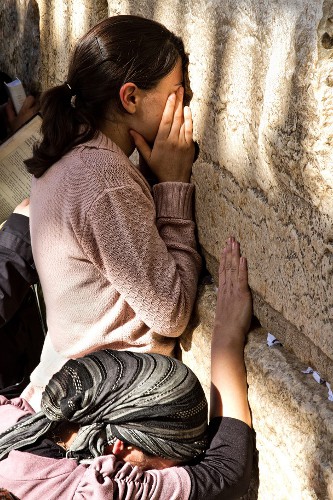
women_praying_at_the_wallI suppose you have to be Jewish to really understand the perspective Dr. Kinzer is describing, but being married to a (non-believing) Jewish spouse, I think I have some idea why it’s intensely important for her to be, not just genetically or generically Jewish, but culturally, ethnically, religiously, traditionally, and right-down-to-the-bone Jewish.

Obviously, her requirement has not been the “swan song” for our marriage because I’m a Gentile Christian since we’re still together after over thirty years, but it comes with a few additional challenges. In terms of the wider Messianic Jewish-Christian interface, those challenges are magnified.

Messianic Jews regard Gentile Christians as their brothers and sisters in the Lord and at the same time experience significant tension with the Gentile Christian world.

-Daniel Juster
“Chapter 12: Messianic Jews and the Gentile World” (pg 136)

That’s pretty much it in a nutshell. “You’re my brother and I love you, but you also drive me crazy.” That’s what family members do to each other, sometimes.

Oh, it gets even more “interesting:”

According to this statement, the Messianic Jewish community is united with the “Christian Church” in forming the ekklesia, the Body of Messiah. The term “Christian Church” is used here in a more delimited way to describe the “Gentile wing of the Church.” This is in keeping with the connotation of the word “Christian” in the wider Jewish world. For Jews, Christian = not Jewish, i.e., Gentile. This is why Messianic Jews do not self-identify as “Christians.” It would imply to fellow Jews that they are no longer Jews.

-Juster, pp 136-7

I can imagine that many Christians will take Juster’s words as an insult, but again, I think you have to be Jewish to understand the dissonance being experienced. For the vast majority of the last two-thousand years, Christianity has demanded that Jews surrender every last bit of their Jewish identity and practice in order to become disciples of the Jewish Messiah King. Go figure. For the vast majority of the last two-thousand years, the larger, normative Judaisms have considered any Jew who believes that Jesus is the Messiah is no longer Jewish but instead, a “Christian.”

But what if, like James, and Peter, and Paul, and all of the other first-century CE Jewish apostles and disciples (thousands upon thousands of them) you, as a Jew, wanted to be a disciple of the Moshiach and continue a fully lived and observant Jewish experience? Where’s the problem in that?

Old habits die hard. The church will need to learn to accept Jews who identify as “Messianic” as Jews, not just in terms of DNA and a cognitive awareness that the Jew in question had Jewish parents and other family members, but that the Messianic Jew is really, really Jewish in every observable, identifiable, and covenantal sense.

But what about those Gentiles who self-identify as “Messianic?” Not all of them are, as I previously described, Hebrew Roots Christians who aspire to the same identity as the Jews in the Messianic movement, thus claiming what is not their’s. I mentioned in my review of the First Fruits of Zion television series, that narrator and teacher Toby Janicki introduces himself as a Gentile who practices Messianic Judaism. Do Gentiles who come alongside Jews in Messianic Jewish synagogues practice Messianic Judaism (as distinctly different from Christianity)?

jewish-t-shirtI’ve laid out a case, based on chapters in the Rudolph-Willitts book, that describes why Messianic Jews need to identify separately from Christianity, even as Messianic Jews and Christians must be unified within the body of Messiah to form the Ekklesia, but where to “Messianic Gentiles” fit in, if at all?

I could make a case for Christian/Jewish intermarried couples to identify as “Messianic” and whose religious practice is within that context for what I hope are obvious reasons. What about the large number of non-Jews attracted to the Messianic movement who aren’t intermarried or otherwise connected to the Jewish community? I can’t really describe the attraction except I know it’s there. I have the same attraction, which is evidenced by what I write on this blog. Even if I weren’t intermarried at this point, the drive to see God, the Messiah, and the Bible through that particular lens would not go away. For some reason, it’s hardwired to my soul.

But that drive can’t be used to justify the diluting or elimination of Jewish identity and covenant distinctiveness from within the larger Ekklesia of Messiah. Juster, in describing the initiative Toward Jerusalem Council II, speaks of coming together to “heal historic wounds and repudiate ancient decisions by the Church against Messianic Jews.” I believe this should be applied to the overarching relationship of Messianic Jews and believing Gentiles, both within the Messianic Jewish worship framework and between Messianic Jews and all believing Gentile worship groups including the Church and other variant branches of Christianity (even if they choose not to self-identify as “Christianity”).

Juster’s conclusion of Chapter 12 is the hopeful note within the continual struggle between believing Jewish and Gentile communities.

This notwithstanding, the Messianic Jewish community views itself as united with the Gentile wing of the Church in a partnership that is intended by God to reflect interdependence and mutual blessing (emph. mine). Such interdependence and mutual blessing can come about only through close relationship. Therefore, Messianic Jews invest in Christian groups and organizations that welcome a Messianic Jewish presence, even as Paul wrote, “Welcome one another, therefore, just as Messiah has welcomed you, for the glory of God” (Rom 15:7 JNT).

Christian theology emphasizes that God is unfolding his great plan for the redemption and transformation of the cosmos through the work of the Church. As Messianic Jews, we have added a significant corollary to the traditional Christian narrative: the work of the Gentile Christian world cannot be accomplished without being in right relationship with Israel and the Messianic Jewish community in particular.

-ibid, pp 142-3

Most Gentile believers aren’t going to accept this message, at least at first. Some never will at all, for a variety of reasons, some of which I’ve already mentioned. But Christianity in all its forms has traditionally rejected the Jewish people from the worshipers of Messiah except on the condition that they give up being uniquely Jewish in any demonstrable and experiential sense. That is no longer a sustainable position for the church or any believing Gentile organization or individual.

When King Messiah returns in power and glory, the Church will be in no position to demand that he surrender his Jewish identity as a condition of ascending the Throne of Israel. That being the case, how can we dare to make such a demand of his Jewish subjects?

157 days.

The Hollow Man

clickedIt clicked when I saw this photo. I realized what’s been bothering me all along. I finally got why I was counting time down. Why I was waiting for it all to end. Why I didn’t believe my life in the community of faith was ever going to last. I realized I didn’t belong. I wasn’t part of the whole. No matter how hard I tried, I’d always be on the outside looking in.

Let me explain.

In reading the Rudolph and Willitts book Introduction to Messianic Judaism: Its Ecclesial Context and Biblical Foundations, I found a confirmation of what I believed about Jewish/Christian relations on so many levels. It all made so much sense. Chapters 17, 18, and 19, written by Craig Keener, William Campbell, and Scott Hafemann respectively, all spoke of Jewish and Gentile interdependence within the body of Messiah, specifically accessing Paul’s letter to the Romans. I’ll write about those chapters in more detail some other time, and I believe that there is an interdependence between believing Jews and Gentiles, but there’s a puzzle to solve, at least for me. The contributors to the Rudolph/Willitts book universally present the Messianic Jewish movement as one that is a home to believing Jews who are ethnically, culturally, religiously, and experientially Jewish. You cannot separate the lifestyle of being Jewish from the person who is Jewish, regardless if they have come to faith in Jesus as Messiah or not.

However, for the vast amount of Gentiles who are believers, their culture is the church. I know there are multiple expressions of the Christian church in our world, but they all have one thing in common. Their culture isn’t even remotely Jewish. Jewish religious and lived culture isn’t even remotely Christian. It’s like two different worlds that are trying to intersect and as interrelated as they are in Messiah, I’m not sure how they’re ever going to fit together.

And then there’s me.

No matter who you are as a believer, you “fit” somewhere. There are Gentiles, just tons and tons of them, who fit extremely well in the church. I’m anticipating seeing a lot of them tomorrow morning, Sunday morning at the church I attend. They are all very comfortable where they are. I’m the only one who sticks out like a sore thumb.

No, don’t tell me to go to a Jewish religious venue. None are accessible to me and even if they were, I don’t fit in there, either. Even if I fit in, that wouldn’t “fit in” with my wife. She’d feel extremely uncomfortable with my being a square peg trying to fit into a round hole. And that’s what I’d be. My past participation in pseudo-Jewish Hebrew Roots wouldn’t even come close to preparing me for an actual Jewish cultural encounter.

I like to think of myself as a person with a foot in each of two worlds but the fact is, I am only standing in between them. I’m not in contact with either one. I don’t belong in either one. That isn’t to say I don’t believe, but faith and religion and worship don’t exist in a vacuum, they exist in community, and I don’t belong in any of them.

It’s like someone tried to transplant a heart into my chest, but my body is rejecting it. It doesn’t belong. It’s alien. Without it, I’ll die (metaphorically speaking, of course), but I’m not being nourished by it, either.

A friend of mine once said, don’t seek Christianity and don’t seek Judaism, but rather, seek an encounter with God. But how do I meet God without a context and a culture? People can’t experience God in raw, unshielded contact. We need an interface, layers of abstraction so we can make sense of what’s happening to us, so we won’t be obliterated by connecting to God. For Jews, that interface is Judaism, cultural, Talmudic, tradition-based Judaism. For Christians, that’s the church and all the culture and traditions that are attached to the various “Christianities” in our world.

But I don’t connect to either one. I don’t belong. That’s the problem. I can read the Bible, but if I read it in a Jewish or Christian framework, it seems alien. Only just plain reading it makes any sort of sense to me, but then I’m limited to my own experience. To access the sages and the experts, I have to apply a context, which puts me in contact with denomination, with doctrine, with theology, with culture, and while that seems to work for everyone else, it doesn’t work for me because their doctrine, theology, culture, and context doesn’t belong to me and I don’t belong to them.

Classic approach-avoidance syndrome or as put more plainly, can’t live with it and can’t live without it.

That’s why doing my homework for Sunday school seems like an exercise in emptiness. It’s a culture that I don’t relate to, a perspective that seems hollow. If I’m ever going to experience God, it will be somewhere outside religion and culture, but that’s impossible for a human being. So where does that leave a “hollow man?”

157 days.

How to Love Your Neighbor as Yourself

love-your-neighborWhy an “extra meditation” so late in the day? Why so close to Shabbos, when many of my readers east of me have already gone offline or are preparing to do so? Because I can, I suppose. More accurately, because I read something that touched me and I want it to touch you as well.

Many of us could write up a list of rules for how we’d like to be treated by our friends. Most don’t have a physical list to hand out to people (although it might reduce some painful guesswork if we did), but this is how the list might look:

  1. Be sincere — no acting.
  2. Respect me, always.
  3. Check up on me to see how I’m doing.
  4. Be supportive when I’m in pain.
  5. Greet me warmly when I visit.
  6. Give me the benefit of the doubt.
  7. If I need some help, be ready to lend a hand.
  8. Don’t act overbearing or disdainful towards me.

In our eyes these expectations are within reason. We don’t delude ourselves to think our friends would give us full access to their bank accounts, or sign their house or car over to us, nor do we want them to.

We’re obliged to “Love your friend like yourself” (Lev. 19:18). The obvious question is: how can we be obligated to love others as we love ourselves? Even for someone who naturally loves people, there’s no way such love could equal the devotion they have to themselves!

We come back to our list of expectations. That’s all we really want from others, and it’s really all they want from us. Just treat others as you expect them to treat you — that’s the obligation. Are we able to demonstrate that level of love? We must be, for we couldn’t reasonably expect of others more than we’re capable of doing ourselves! (HaKsav VeHaKabalah, R’ Yaakov Tzvi Mecklenburg, 1785–1865)

Good Shabbos!
Rabbi Mordechai Dixler
Program Director, Project Genesis – Torah.org

I love that list but am also accused by it. I know I don’t always treat my family and friends in the way the list suggests (do I ever?). My heart also pines because I’d love to be treated that way by my family and friends as well. I am not assigning blame. If I don’t treat others this way, how can I expect the treatment to be returned?

And yet, it’s not just our friends and family who are involved.

“You have heard that it was said, ‘You shall love your neighbor and hate your enemy.’ But I say to you, Love your enemies and pray for those who persecute you, so that you may be sons of your Father who is in heaven. For he makes his sun rise on the evil and on the good, and sends rain on the just and on the unjust. For if you love those who love you, what reward do you have? Do not even the tax collectors do the same? And if you greet only your brothers, what more are you doing than others? Do not even the Gentiles do the same? You therefore must be perfect, as your heavenly Father is perfect.”

Matthew 5:43-48

I’m sure you saw that one coming from a mile away.

Hillel the Elder once said, “That which you hate, do not do to your friend [the negative picture of “love your fellow as yourself”]―that is all the Torah and all the rest is commentary. Go and study it.” Our Master Jesus said the same thing expressed positively, linking love of God and love of neighbor:

And he said to him, “You shall love the Lord your God with all your heart and with all your soul and with all your mind. This is the great and first commandment. And a second is like it: You shall love your neighbor as yourself. On these two commandments depend all the Law and the Prophets.”

Matthew 22:37-40

I’ve already written on the Torah’s greatest principle but I find that I need to repeat myself, not just for your sake, but for my own.

We can’t stop everything that’s wrong in the world. As I’m writing this, a terrorist has all but shut down the city of Boston and the surrounding area. An uncounted number of people are huddling in their homes in fear for their lives. Where will “the suspect” be found? Will he be found? Will he kill again? Who will be his next victim? Will it be me?

Hardly the sort of thoughts and feelings that usher in a peaceful Shabbos.

And we can’t do anything about it. But we can do something else. We can be sincere with our family, friends, and others we come in contact with. We can always treat them with respect. When we haven’t seen a friend for a while, we can call and see how they’re doing. We can be supportive when they’re sick or in pain. When they come to visit, we can greet them warmly and act sincerely glad to see them. When there’s a disagreement, we can strive to give them the benefit of the doubt. If they need help, we can offer them assistance. And even when we’re tempted to or we feel that we are in the right, we can deliberately avoid behaving overbearing or disdainful toward them.

And if we did all that, and if we did all that to everyone we encounter, and if we did that all of the time, we probably wouldn’t stop even a single act of terrorism, stop even one bomb from exploding, prevent even one gun from being fired at another human being, or inhibit the next natural disaster from devastating another city somewhere in the world.

But we would still make the world a better place and we would make ourselves better people.

159 days.

The Torah’s Great Principle

love-one-anotherRabbi Akiva said, “Love your fellow as yourself” is a great principle of the Torah. A similar principle is gleaned from the famous story of a proselyte who wished to convert to Judaism on condition that someone would teach him the entire Torah while standing on one foot. Hillel the Elder accepted his conversion and told him, “That which you hate, do not do to your friend [the negative picture of “love your fellow as yourself”]―that is all the Torah and all the rest is commentary. Go and study it.”

Obviously, the entire Torah is a true, God-given Torah, but Hillel the Elder and Rabbi Akiva teach us that there is room to meditate on the principle that is the Torah’s “great principle”; the signpost that puts us on the right track.

The need for such guiding lights is most necessary when an outsider wishes to approach the infinite sea of Torah and needs an anchor to show him where to begin.

-Rabbi Yitzchak Ginsburgh
“The Torah’s greatest principle”
Wonders From Your Torah

Our Master Yeshua (Jesus) taught something similar.

And he said to him, “You shall love the Lord your God with all your heart and with all your soul and with all your mind. This is the great and first commandment. And a second is like it: You shall love your neighbor as yourself. On these two commandments depend all the Law and the Prophets.”

Matthew 22:37-40

Referencing Rabbi Ginsburgh, I periodically write about non-Jewish people (including me) who are drawn to the larger body of Torah mitzvot and who find they have a desire to live a more “Jewish” lifestyle as a means of holiness. Essentially, there’s nothing wrong with this and indeed, the Torah was created not just for the Jewish people, but for humanity, as it is said:

For out of Zion shall go forth the Torah, and the word of the LORD from Jerusalem.

Micah 4:2

I substituted the word “Torah” for “Law” in the ESV translation for effect, but both terms are correct (although I’d argue that “Torah” is the more correct word to use here).

Again, as we see from Rabbi Ginsburgh’s commentary, the “outsider” (non-Jew or secular Jew) who desires to learn Torah has to start somewhere. Although as Rabbi Ginsburgh states, the entire Torah is true, it’s easy for a beginner (Rabbi Ginsburgh is talking about potential converts to Judaism but I’m applying his statements to the rest of us) to become lost, confused, discouraged or even “seduced” by the complexities of Torah and the vast span of mitzvot. I’ve seen non-Jewish people introduced to the concept of “complete Torah observance” or “obligation” who throw themselves headlong into what they imagine it is to lead a “Torah-submissive life” only to become enamored by “the stuff.”

tzitzit1I call “stuff” all the outward devices, objects, or activities that are typically associated with observant Judaism, such as donning a tallit gadol and tefillin when davening, wearing a tallit katan under one’s shirt daily, wearing a kippah in public daily, lacing their sentences with Hebrew or even Yiddish words, growing a long, furry beard (because they believe God wants this), and so on.

But what does Rabbi Ginsburgh, citing both Hillel the Elder and Rabbi Akiva suggest is the Torah’s “great principle?” What does the Master say is the greatest commandment?

None of those things I just mentioned. What is the anchor for “beginners” in the Torah? “You shall love your neighbor as yourself.”

This concept sheds light on the Jewish conception of holiness. The Hebrew word kedosh , meaning “holy,” implies separation; (See Tanya, ch. 46.) a distinction must be made between the Jewish approach and a secular approach to any particular matter, as is stated at the conclusion of our Torah reading: (Levitcus 20:26.) “You shall be holy unto Me, for I, G-d, am holy, and I have separated you from the nations to be Mine.”

Such a distinction is unnecessary with regard to the ritual dimensions of the Torah and its mitzvos. These are clearly distinct; there is no need for man to do anything further. Instead, the focus of our Torah reading is on concerns shared by all mortals. Thus the reading relates laws involving agriculture, human relations, business, and sexual morality. For it is in these “mundane” areas that the holiness of the Jewish people is expressed.

Judaism does not understand holiness to be synonymous with ascetic abstention. Instead, it demands that a person interact with his environment, and permeate it with holiness. (See Rambam, Mishneh Torah, Hilchos De’os 3:1.)

-Rabbi Eli Touger
“What Does Being Holy Mean?”
Adapted from
Likkutei Sichos, Vol. I, p. 254ff; Vol. XII, p. 91ff;
Sichos Shabbos Parshas Acharei-Kedoshim, 5745
Chabad.org

That might be a little “intense” or at least unfamiliar to most Christians. Here’s another way of saying it.

What good is it, my brothers, if someone says he has faith but does not have works? Can that faith save him? If a brother or sister is poorly clothed and lacking in daily food, and one of you says to them, “Go in peace, be warmed and filled,” without giving them the things needed for the body, what good is that? So also faith by itself, if it does not have works, is dead.

James 2:14-17

A life of faith and holiness cannot be lived apart from actually living life. Holiness is doing not just praying, meditating, studying, and contemplating. Holiness is an action. Go and do.

An emissary is one with his sender. This concept is similar to that of an angel acting as a Divine emissary, when he is actually called by G-d’s name. If this is so with an angel it is certainly true (See Iyar 6.) of the soul; in fact with the soul the quality of this oneness is of a higher order, as explained elsewhere. (See Tamuz 10.)

“Today’s Day”
Thursday, Iyar 8, 23rd day of the omer, 5703
Compiled by the Lubavitcher Rebbe;
Translated by Yitschak Meir Kagan
Chabad.org

Again, the Master taught something similar.

For I have given you an example, that you also should do just as I have done to you. Truly, truly, I say to you, a servant is not greater than his master, nor is a messenger greater than the one who sent him. If you know these things, blessed are you if you do them.

John 13:15-17

boston_marathon_terror_explosionWe are his servants and we are not greater than he is. He gave us an example of what to do by the living of his life and his teachings. He gave us an “anchor” in the Torah as to where we should begin and where we should stay centered: to love God with all of our being, and to love our neighbor (who is really everyone) as ourselves. And just recently, we’ve been reminded that there are opportunities to fulfill the Master’s mitzvot all around us.

The Mighty Rock, Whose deeds are perfect, because all His ways are good. He is a faithful God in Whom there is no iniquity.

Deuteronomy 32:4-5

These very sobering words are often invoked at moments of great personal distress to express our faith and trust in the Divine wisdom and justice.

People who have suffered deep personal losses, such as destruction of their home by fire or the premature death of a loved one, or who have observed the widespread suffering caused by a typhoon or an earthquake, may be shaken in their relationship with God. How could a loving, caring God mete out such enormous suffering?

It is futile to search for logical explanations, and even if there were any, they would accomplish little in relieving the suffering of the victims. This is the time when the true nature of faith emerges, a faith that is beyond logic, that is not subject to understanding.

The kaddish recited by mourners makes no reference to any memorial concept or prayer for the departed. The words of kaddish, “May the name of the Almighty be exalted and sanctified,” are simply a statement of reaffirmation, that in spite of the severe distress one has experienced, one does not deny the sovereignty and absolute justice of God.

Our language may be too poor in words and our thoughts lacking in concepts that can provide comfort when severe distress occurs, but the Jew accepts Divine justice even in the face of enormous pain.

Today I shall…

…reaffirm my trust and faith in the sovereignty and justice of God, even when I see inexplicable suffering.

-Rabbi Abraham J. Twerski
“Growing Each Day, Iyar 8”
Aish.com

Without trust and faith in God, it’s easy to lose faith in humanity and we are unable (or unwilling) to be the Master’s servant in this world and to do his will by loving and helping others in need.

In a commentary on this week’s Torah portion, we learn from the midrash that one of the reasons for the death of Aaron’s sons Nadab and Abihu was that they loved God “too much.” They came too near the Holy One and were consumed. This was a warning to Aaron that no matter how great his love for God was and the desire to draw near the Divine Presence in the Holy of Holies, he must restrain himself.

G-d knew that Aharon’s love for Him was so great that he would always desire to enter the Holy of Holies. However, by doing so, it could cause his soul to leave his body, as happened with his sons. G-d therefore informed told him of the need to keep his soul within his body so that he could fulfill his mission in this world — transforming it into a dwelling place for G-d.

The lesson we can learn from the command to Aharon is that every Jew has the capacity to love G-d, and indeed is commanded to do so, as the verse states: “You shall love your G-d with all your heart, soul and might.” (Devarim 6:5)

peace-of-mind1While midrash may not appeal to you in a literal sense, when viewed metaphorically or as a moral lesson, it teaches that human beings, out of our love for God, can achieve greater heights of holiness, drawing nearer to God, though we can never be “greater than our Master.” Yet as servants, we must always strive to become better than we are.

It’s not easy. God never gets tired, He never gets scared, He never gets discouraged, He never wants to “throw in the towel,” but we poor, pathetic human beings experience all those things.

People think that if they are not well, they must sacrifice all meaning in their life in order to take care of their physical situation.

In fact, the opposite is true: You cannot separate the healing of the body from the healing of the soul. As you treat the body, you must also increase in nourishing the soul.

-Rabbi Tzvi Freeman
“Soul Healing”
Based on letters and talks of the Rebbe, Rabbi M. M. Schneerson
Chabad.org

Just as we cannot separate healing of the body from healing of the soul, we cannot separate our personal need for healing from the needs of those around us. In fact, by acting for the benefit of others and serving their needs, we may discover that our own wounds are also being healed.

I have been guilty on many occasions of wanting to withdraw from humanity and particularly from the community of faith when it has hurt too much. God has shown me (again and again and again) that I’ve been going in the wrong direction.

When in doubt, I must return to the portion of Torah that is for all of us, Jew and Gentile alike, the anchor, the center, the love of God and humanity. Without that, nothing else we do means anything.

160 days.