Tag Archives: Judaism

What Does “Torah” Mean To You?

For clarification, by the word “Torah,” I do not just mean the Torah, as in the Five Books of Moses, but to all Jewish religious texts such the Hebrew Bible, rabbinic and halakhic texts, and kabbalistic and hasidic texts.

-Rabbi Joel E. Hoffman
“Why I Learn Torah Daily”
Aish.com

This somewhat dovetails with what I wrote in The Torah Without Judaism, and particularly the brief exchange I had in the comments section of that blog post with reader ProclaimLiberty.

The question for the Messianic and particularly the “Messianic Gentile” or “Talmid Yeshua” is what the word “Torah” means to us.

There’s probably no one answer, since depending on the given disciple, Jewish or Gentile, the perspective is going to vary.

What do I mean by “Torah?”

This is just my personal opinion. I’m not trying to tell anyone what to do. But I think it’s a helpful question we should all ask ourselves periodically, rather than just assume that our answer is “the answer.”

From my point of view, “Torah” includes the whole Bible, and by that I mean the Five Books of Moses, the Prophets, the Writings, and the Apostolic Scriptures. However, I also habitually read articles and commentaries found at Aish.com and Chabad.org, mainly to get a Jewish viewpoint on what I’m studying.

Granted, I am doing a lot of mental editing when I read content from those resources, since those sites and their information are written by and for Jews, not Gentiles, particularly not for Christians, and absolutely not for anyone with my unique conceptualization of scripture, Messiah, and Hashem.

christian books
Photo: sharonglasgow.com

I don’t typically read traditional Christian resources, even though they are far more Yeshua (Jesus) focused, because, frankly, I just don’t relate to them. I’ve always had a problem with “Christianese,” even when I first became a believer about twenty years ago.

I do read the occasional Christian-oriented book here and there, but either I don’t get very much out of them, or I actively criticize their content.

There have been other resources I have heavily consumed in the past, and they still guide the majority of my thinking and beliefs, but for a variety of reasons, I’ve chosen not to pursue them further, at least to any significant degree.

I have become aware that a debate somewhat like the one I previously mentioned is occurring at a Hebrew Roots blogspot, and the discussion there is very contentious.

However, the blog owner did provide a link to a brief review of a book by Rabbi Chaim Clorfene called The World of the Ger. You can learn more about it at the blog Soul Mazal.

I know that there are some “Messianic Gentiles” who at least suggest the path of the Noahide is an appropriate journey for them/us as well, and I’ve written on this before.

I think there are some things we might take from that example, but it’s also filled with trap doors and land mines. It’s far too easy for some of us to confuse our faith in Hashem and devotion to our Rav with the practice of Judaism or Noahidism. Hence the fact that we see some non-Jews in our communities as well as in churches leave Yeshua-faith and either join the ranks of the Noahide or convert to (Orthodox) Judaism.

It would almost be better for believing Gentiles to stay in their churches rather than take such a risk.

But then, in my opinion, their perspectives regarding what the Bible really says about Israel, the Jewish people, the redemption of the world, and yes, about Judaism, would remain limited if not misguided.

studyAs with many other questions I bring up, I don’t have a hard and fast answer for you. Interestingly enough, this brings us back to Rabbi Hoffman’s brief essay:

I learn Torah every day because it gives me a cohesive set of answers to all of the ultimate questions.

I suppose, from Rabbi Hoffman’s perspective, it does, but it doesn’t work that way for me. I still have far more questions than I do “ultimate” answers.

But here’s another wrinkle R. Hoffman introduces:

I learn Torah every day because it connects me with the millions of other Jews worldwide who also learn Torah every day.

That works if you are a religious Jew, but not so much for we non-Jews, even Noahides, I suspect. After all, how Torah applies to the Ger is remarkably different from how it applies to the Jew, at least in the details, although keep in mind that I also previously mentioned a private Jewish school in Utah that teaches Jewish values to a student body made up of 75% non-Jews.

And that’s one of the reasons, maybe one of my top reasons, for studying the Torah as I understand it. To seek a common ground where I as a non-Jew can stand and learn who God is and who I am to Him through a Jewish lens.

But I craft that “lens” to fit more my particular “eyesight” requirements, since I’m not a Jew and I consider myself more than a Noahide.

The one advantage I have is that I stand outside of actual, face-to-face Jewish or Christian community. Neither one can have too strong a pull on me, although the Pastor at the church I attended for two years certainly tried as hard as he could to turn me into a good Baptist.

But since, as I’ve admitted, I find Jewish thought more appealing, I suppose if I were constantly exposed to Jewish community of the non-Messianic variety, I’d be putting myself at risk of being influenced to the point of challenging my faith. I don’t know if it would go that far, but why take the chance?

That may be why so many of us are unaffiliated, although there are plenty of other reasons.

Laying TefillinIf I study Torah as I understand it and don’t adopt the praxis of Judaism, I can’t be as strongly influenced to confuse Judaism with my identity and role as God created them for me. I also can’t be accused (as sometimes occurs) of misappropriating the things unique to the covenant relationship between Hashem and the Jewish people, such as Shabbat, Kosher, the prayers, donning a tallit gadol, or laying tefillin.

If you’re Jewish, then I say what’s yours is yours.

If I’m not Jewish and I don’t identify as a traditional Christian, all that’s left, assuming I retain my Yeshua-faith, is a journey to discover who I am uniquely in my relationship with my Rav.

If you confuse that with either Judaism or Christianity, you might already have lost your way.

The Torah Without Judaism?

The article got me thinking; why don’t we create a 30-Day Challenge for Jewish things like mitzvot to help Jewish people undertake a new level of commitment? After all, Judaism is not an all or nothing religion. Whatever steps a person takes to follow the mitzvot, no matter what level or station of life they are at, that is always a plus and to be applauded and celebrated. If you don’t observe Shabbat but decide to light candles, then good for you! That’s a great positive step. Doing that one thing is better than doing nothing. Judaism is a journey that is taken one step at a time.

-Rabbi Tzvi Nightingale
“The 30-Day Jewish Challenge”
Aish.com

It’s Friday afternoon at the McGillis School in Salt Lake City, and students from the third through fifth grades are gathered for the weekly Shabbat celebration.

They read and discuss a passage about humility by former British Chief Rabbi Jonathan Sacks. Then a blond girl with braided hair prepares to light the candles. A hush falls over the room as the flames are kindled, and the students recite the practiced benediction in unison:

“As we bless this source of light, the warmth these candles bring reminds us of times we gave light and received light,” they sing, followed by a recitation of the traditional Shabbat candle-lighting blessing in Hebrew.

The ceremony is not dissimilar from weekly Shabbat celebrations held in Jewish schools across America.

Except for one thing: The student lighting the candles isn’t Jewish. Nor is the one who follows her to recite the kiddush blessing over grape juice. Nor the one after that who recites Hamotzi over the challah bread.

-Uriel Heilman
“With 75% non-Jewish students, Utah’s Jewish school seeks to universalize Judaism”
Jewish Telegraphic Agency (JTA)

I had a good conversation with a friend of mine over coffee last Sunday. However, things became a bit “pointed” when the discussion turned to “Judaism vs. Torah.” I know that’s a strange thing to say, but bear with me.

I actually haven’t talked with anyone on this topic in quite some time…maybe for years. It’s the same old saw I used to see wheeled out when I was active in the Hebrew Roots movement; the idea that one can be obedient, or subservient, or compliant to the written Torah without having any sort of involvement with the Talmud or otherwise, the “oral Law”.

My friend referenced two groups of Jews in Israel he has some familiarity with…well, he’s familiar with one group more than the other.

synagogueHe says one group is active in encouraging Messianic Jews in the Land to start attending synagogue services within normative (probably Orthodox) Judaism as opposed to meeting with Messianic Jewish congregations. I don’t know how true this is since I’m getting it third hand, but it’s something to consider.

The other group (I’m purposely not naming names), the one my friend is more familiar with, are Messianic Jews who live their lives observing the written Torah and only the written Torah as they understand it.

Granted, from an outsider’s point of view, many of the customs of say, the Breslovers may seem archaic and odd, but I just don’t see how one can observe the mitzvot without consulting the Rabbis, at least to some degree. This is because the written portion of the Torah doesn’t always describe how to perform the mitzvot. Apart from the Karaites, all religious Jews rely on Rabbinic rulings and traditions to help them navigate the Torah, although according to the Wikipedia page I just referenced:

Karaite Jews do not object to the idea of a body of interpretation of the Torah, along with extensions and development of non-Rabbinic Halakha (Jewish law) that strives to adhere to the Tanakh’s straightforward meaning. Several hundred such books have been written by various Karaite Ḥakhamim (sages) throughout the movement’s history, although most are lost today.

This begs the question of whether or not modern Rabbinic Judaism is an absolute requirement for Jewish (or non-Jewish) Torah observance. I’ll get back to that in a minute.

My friend has certain problems with modern Judaism, such as why the majority of religious Jews aren’t trying to be a light to the nations.

He says, “It is too small a thing that You should be My Servant To raise up the tribes of Jacob and to restore the preserved ones of Israel; I will also make You a light of the nations So that My salvation may reach to the end of the earth.”

Isaiah 49:6 (NASB)

I did mention that The Chabad Rebbe, Rabbi Menachem Mendel Schneerson, actively promoted Noahidism among the Gentiles. Granted, this probably isn’t what my friend meant when he said Israel is commanded to be a light to the nations, but from the Rebbe’s point of view, that’s exactly what he was doing.

The RebbeOn the other hand, the article published by the Jewish Telegraphic Agency shows at least one Jewish school being that light:

“We have Muslims, Buddhists, atheists, Presbyterians, Lutherans and LDS students,” said head of school Matt Culberson, using the acronym for Latter-day Saints, or Mormons. “But this school takes Jewish culture as its foundational point. We start with Judaism first.”

The outgrowth of a JCC early childhood program that morphed into an independent K-8 school about 15 years ago, McGillis may be the only American Jewish school of its kind. The vast majority of its students – 75 percent – are not Jewish, by the administration’s reckoning. And though McGillis teaches Jewish values, Jewish holidays and Hebrew, it does not teach Judaism as a religion.

And what are Jewish values without the Jewish religion as such?

Practically everywhere you turn, identical blue posters advertise the school’s guiding Jewish values: tzedakah (translated as “giving to others”); tikkun olam (“repairing the world”); gemilut hasadim (“doing good and kind deeds”); derech eretz (“having respect for all”); limud l’shma (“learning for the sake of learning”), and kehillah (“our community”). Students, teachers and administrators constantly reference these values, albeit sometimes straining to pronounce the Hebrew.

Yes, I can certainly see those values being universal in scope and not restricted to the Torah, the Jewish people, and Judaism, although these values are exemplified in Judaism.

They probably are in Christianity as well, at least most of them, but I’m sure Christians would have different names for those values and activities.

And I did tell my friend that if he believes Judaism is a poor reflection of the Torah as it was originally understood and lived out by the ancient Israelites, then Christianity is just as poor a reflection of the teachings of Rav Yeshua (Jesus) and his emissary to the people of the nations, Rav Shaul (the Apostle Paul).

So should we attempt to reconstruct the Torah observance of the ancient Israelites and the devotion to Rav Yeshua of the very early non-Jewish disciples? I’m not sure how we could do it with any hope of accuracy. Too many Hebrew Roots people who think they have done so marshal a whole lot of chutzpah and much too little respect, and occasionally march into synagogues to tell the Rabbi that he is doing it all wrong.

I have a rather unique view of my local Jewish community through the eyes of my wife, so I’m quite aware of how Jewish people take to such bold intrusions into their space.

PogromI tried to explain to my friend that after nearly two-thousand years of persecution, pogroms, maimings, and murder committed upon the Jewish people by their non-Jewish neighbors (most often Christians), I can see why Jews aren’t falling all over themselves to share their version of the “good news” of the Torah with the rest of the world. Jewish insularity and Talmud have gone a long way to preserve the Jewish people and Judaism, when the rest of us were trying to wipe both from the face of the Earth.

He reminded me that there have been groups of Christian missionaries who have been wiped out by indigenous people in far off corners of the world, at least historically, who have then been followed by more missionaries, risking their own lives, who eventually did share the salvation of Christ with the folks who had butchered their predecessors.

And while I admire the courage of these missionaries, and do not in the slightest demean their accomplishments, it’s one thing for a single, isolated people group to kill one party of missionaries, and another thing entirely for the vast majority of this planet’s population to continually attempt genocide against the Jewish people as a religion and a race.

And if God intends on judging the Jewish people along with the rest of us, that’s God’s privilege, not mine.

Apart from small groups of Messianic Jews (or non-Jews) who believe they can disregard Rabbinic Judaism out of hand and practice a greater fidelity to the Torah and to God by doing so, the majority of religious Jews, Messianic and otherwise, observe the mitzvot and serve Hashem within the religious, cultural, social, and historical context of Judaism.

As we saw in the JTA article, Judaism can successfully transmit universal moral values to non-Jews without necessarily transmitting Judaism as a religious construct.

When brings me back to Rabbi Nightingale’s 30-Day Jewish Challenge, as well as to the idea of a Torah observance without Judaism.

Whether you care to admit it or not, your worship of God operates within a specific religious, social, cultural, and community context. Even if you are alone in your faith as I am, you get your understanding and interpretation of the Bible from somewhere, and your praxis was probably not invented just by you.

Some sort of organized body or bodies imparted all that upon you, and you continue with it because it makes sense to you, even if your religion and practices don’t always make sense to others.

Within the various streams of mainstream Judaism, Judaism makes sense to religious Jews. The same can be said for the numerous denominations of Christianity. That an outside observer can criticize and point to portions of the Bible that seem to contradict the activities within those branches and denominations, doesn’t mean it’s seen the same way from the inside.

McGillis School
Head of School Matt Culberson says the McGillis School tries to inculcate the school’s guiding Jewish principles across the curriculum. (Uriel Heilman)

No system is perfect, and a lot of systems are dysfunctional, but when you say that Judaism is broken because it treats the Talmud as more authoritative than the Torah, you are making that statement from inside some system, not from a 100% objective understanding of the Torah.

If you say that Judaism is biased in a particular way, so are you. We all are. No one exists without bias, without a perspective, without an interpretation.

I’m not in any shape to be tilting at windmills. I’ve got enough to deal with in my own life. Sure, sometimes I take a stab at religious criticism, but I don’t like to make a habit of it.

If I have to judge, I guess I’ll start with myself. If, in any sense, I can be successful in practicing charity, repairing the world, doing good and kind deeds, having respect for all, and learning for the sake of learning (I don’t have a kehillah or community, so that one’s out), then maybe I’m not doing so bad (although a 30-day challenge or some other form of “upping my game” wouldn’t hurt).

If I look at other communities and they’re doing the same thing, maybe they’re not doing so bad either.

Final word. In case you’re wondering, I’m not trying to bang away at my friend. We don’t always agree on everything, but we do get along, and I cherish our relationship. He’s a kind, intelligent person who I believe is close to the Spirit of God and who walks in the footsteps of our Rav.

May it be that way for all of us.

Why We Are Never Alone

Gather together and I will tell you what will befall you at the end of days.

Genesis 49:1

Prior to his death, the Patriarch Jacob wished to disclose to his children the future of the Jewish nation. We know only too well what those prophecies were, and Jacob knew that revealing the enormous suffering that the Jews were destined to experience would be devastating to his children. The only way they could hear these things was if they “gathered together” and, by virtue of their unity, could share their strengths.

What was true for our ancestors holds true for us. Our strength and our ability to withstand the repeated onslaughts that mark our history lie in our joining together.

Jacob knew this lesson well. The Torah tells us that “Jacob remained alone, and a man wrestled with him” (Genesis 32:25). Jacob discovered that he was vulnerable only when he remained alone.

-Rabbi Abraham J. Twerski
from the “Growing Each Day” column
Aish.com

DaveningSomeone recently commented in one of my blog posts wondering why I said that “Messianic Gentiles” had no active spiritual life.

I replied that it wasn’t that we didn’t have an active spiritual life, but that our praxis is ill-defined when in relation to Jewish community.

I’d actually read Rabbi Twerski’s commentary before the blog comment, but once I read and responded to the comment, my thoughts turned back to R. Twerski’s statements about Jewish community. Here’s some more about what he said from the same source (see the link above):

Some people feel that they must be completely independent. They see reliance on someone else, be it others or God, as an indication of weakness. This destructive pride emanates from an unhealthy ego. In my book Let Us Make Man (CIS 1987), I address the apparent paradox that a humble person is one who is actually aware of his strengths, and that feelings of inadequacy give rise to egocentricity and false pride.

Not only are we all mutually interdependent, the Torah further states that when we join together, our strengths are not only additive, but increase exponentially (Rashi, Leviticus 26:8). Together, we can overcome formidable challenges.

Of course, R. Twerski is writing to Jews about Jews, but I don’t think it’s much of a stretch to say that the principles he is highlighting apply to the rest of us as well.

However, the “rest of us,” or at least that subset who identify as “Messianic Gentiles,” “Talmidei Yeshua,” or something similar, are really only who we are in relation to (Messianic) Jewish community, or at least (Messianic) Jewish religious thought and teaching. Otherwise, who are we?

The Jewish PaulWe are non-Jews who have chosen to understand and explore our faith by returning said-faith back (as best we can) to its original Jewish context rather than accept the Christian refactoring of the teachings of Rav Yeshua (Jesus) and his emissary to the Gentiles, Rav Shaul (the Apostle Paul), or for that matter, just about anything else in the Bible.

Granted, some writers and teachers within the Messianic Jewish religious and educational space are non-Jews, and they are very helpful in assisting us in understanding ourselves. However, by definition, we Gentiles cannot set aside the “Jewishness” of the context that defines us (although that definition isn’t clearly understood). That context is a large portion of who we are.

And that’s part of the problem.

Another part is that because we are so few in number, it’s pretty hard for a bunch of us to get together and “hobnob,” at least on a regular basis.

Every other Sunday afternoon, I get together with a friend of mine for several hours of coffee and conversation, however not everything we talk about has to specifically do with our common understanding of our faith and praxis.

Yet another part of the “community” difficulty is that although we all may share certain things in common, we are also divided by what we don’t have in common. I’ve probably met or at least know of most or all of the “Messianic Gentiles” in the greater southwestern Idaho area, and in the past, I would meet with a few of them periodically, but we weren’t and aren’t the same, and that lack of “sameness”  (and sometimes a radical “differentness”) makes our “community” highly fragmented.

While Rabbi Twerski can reasonably expect to regularly gather with a large or at least significant number of Jews to worship with, study with, and to be in community with (not just religious community, but social, cultural, and national community), the same cannot be said of “Messianic Gentiles”.

It’s one of the things we have in common with Noahides, since there aren’t to many of them around either, and even if they can gather in community with other “righteous Gentiles,” they don’t always live near a significant number of Jews.

I’ve been reminded that Messianic Jews have the same problem, often swimming in a vast sea of secular and religious Gentiles, but without another Jew in sight.

MessiahOne day, we will all find unity and “ekkelsia” in the Messianic Kingdom, but that day has yet to arrive.

Until then, we must focus on the hub that unites us all through the spokes of the wheel, so to speak, that is, Rav Yeshua. If we have no immediate community, although geographically (and often theologically) apart, we are spiritually united. Although our traditions and doctrine may not always line up with each other, the Messiah has one mind and one heart and after all, God is One.

We may not always see Him or each other in the same way, but He is One and when our Rav returns, our King will correct all of our misunderstandings about Messiah, God, ourselves, and each other.

Faith and trust means being patient, even in isolation, and holding onto the fact that this current world is not forever. The Bible states that all the Jewish people will be returned to their Land, national Israel. It’s one of the tasks of Messiah, and one in which the people of the nations will take part.

Those Jews who find themselves apart from their people and their Land will have unity as the covenant people of Hashem.

We Gentiles, though we live in many different lands and in Messianic Days we will continue to live in our nations, will have one King and one God, and we will also be brought to a place of unity and peace.

WaitingRabbi Twerski ended his column by stating:

Today I shall…

…try to join with others in strengthening Judaism and in resisting those forces that threaten spirituality.

We should try to do the same thing in relation to our faith in God and in trusting our Rav, and if we can’t join with others in this mission, then at least we can do this within ourselves.

We are vulnerable when alone, but if we don’t have a body with which we can join, then as long as we turn to God, we can never be alone, and in Spirit, we are also with each other.

Are Christians and “Messianic Gentiles” Idolaters According to Judaism?

I’ve come across a very interesting Wiki called WikiNoah.org which bills itself as:

Everything worthwhile to know about the Bnei Noach movement. The Online Encyclopedia about the Noahide movement created by observant Noahides and Jews.

Since I’ve been writing a series of blog posts on a comparison between Noahides and those who call themselves “Messianic Gentiles” (and finding a lot of common ground between the two groups), I decided to take a closer look. The following got my attention:

Within Judaism it is a matter of debate whether all Christians should be considered Noahides.

While Christianity appears to conform to six of the seven Noahide laws, an informal comparison of the Nicene Creed and Noahide Law reveals that three major theological teachings may involve a violation of the Noahide prohibition against idolatry.

  • Equating Jesus with G-d
  • Equating the Holy Spirit with G-d
  • Jesus as Savior (in his proposed capacity as G-d)

However, these theological issues do not fit the classical Jewish definition of idolatry. This has caused disagreement among rabbinic authorities on the question of the permissibility of Christianity for non-Jews. (All authorities forbid Christianity for Jews).

Another consideration would be that even if Christians are considered at least partially observant Noahides, are they Chasidei Umos HaOlam or Chochmei Umos HaOlam? The former are considered to have a share in the world to come because they recognize Noahide Law as being revealed through mosaic (rabbinic) tradition, the latter are not considered to have a share in the world to come because they follow Noahide Law based on intellectual expediency.

In summary, classical idolatry has been clearly defined by Jewish Law. Christianity, however, has been defined as something less. The problem is defining how much less, and for what purposes.

-from Christianity and Noahide Law
WikiNoah.org

rabbis talmud debateI realize I’m treading on somewhat thin ice, so to speak, because this is a single source, and Jewish opinion on any topic rarely is defined by a single source. Nevertheless, this also stands in sharp relief to some Jewish opinions I’ve recently read in the religious blogosphere stating that Christianity is unequivocally idolatrous.

Granted, there are multiple Rabbinic legal opinions on this topic.

Maimonides most definitely considered Christianity “avodah zarah” (loosely translated as “idolatry”), while Rabbenu Tam and his fellow Tosafists did not condemn Christianity as idolatry (all this can be found at the wiki page for the article from which I’m quoting so just click the link above). There are also many other Rabbinic views on Christianity.

For instance Rabbi Moses Rivkes who lived in Lithuania in the 17th century said:

The rabbis of the Talmud meant by the term ‘idolators’ the pagans who lived in their time, who worshipped the stars and the constellations and did not believe in the Exodus from Egypt and in the creation of the world out of nothing. But the nations under whose benevolent shadow we, the Jewish nation, are exiled and are dispersed among them, they do believe in the creation of the world out of nothing and the Exodus from Egypt and in the essentials of faith, and their whole intention is toward the Maker of heaven and earth, as other authorities have said . . . these nations do believe in all of this

Whereas Rabbi Israel Lipschutz (1782-1860) stated:

R. Elazar ben Azaryah said, “If there is no Torah there is no culture [derekh eretz]” – The word “Torah” here cannot be meant literally, since there are many ignorant people who have not learned it, and many pious among the gentiles who do not keep the Torah and yet are ethical and people of culture. Rather, the correct interpretation seems to me to be that every people has its own religion [dat Eloki] which comprises three foundational principles, [a] belief in a revealed Torah, [b] belief in [Divine] reward and punishment, and [c] belief in an afterlife (they disagree merely on the interpretation of these principles). These three principles are what are called here “Torah”.

While citing Rabbi Zevi Yehudah Kook (1891-1982):

Rabbi Zevi Yehudah Kook was a rabbi, leader of the Religious Zionist, Mizrachi movement in Israel, on the other hand resurrects many of the classic anti-Christian polemics with a vigor not seen for centuries. Among them: Christianity should be dismissed as an internal Jewish heresy; G-d the creator clearly cannot be a man; the Jewish G-d is alive whereas the Christian’s is dead. Christianity is the refuse of Israel, in line with the purported ancient Talmudic portrayals of Jesus as boiling in excrement.

Talmudic RabbisI say all this not to make a personal statement of whether or not Christianity is idolatry. I don’t believe it is. What I’m attempting to do is illustrate that the viewpoint on Christianity, whether or not it is idolatry, and if Christians, from a halachic perspective, can be considered Noahides, is highly complex, and there isn’t a uniform Jewish opinion on the matter that “settles” it once and for all.

A nice summary of this thought can be found on another WikiNoah page:

Some rabbis in the Talmud view Christianity as a form of idolatry prohibited not only to Jews, but to gentiles as well. Rabbis with these views did not claim that it was idolatry in the same sense as pagan idolatry in Biblical times, but that it relied on idolatrous forms of worship (i.e. to a Trinity of gods and to statues and saints) (see Hullin, 13b). Other rabbis disagreed, and did not hold it to be idolatry. The dispute continues to this day. (Jacob Katz, Exclusiveness and Tolerance, Oxford Univ. Press, 1961, Ch.10)

Of course, it would stand to reason that Messianic Jews do not view themselves nor the non-Jews in their midst as idolators, since although covenant status and religious praxis differs between Jews and Gentiles within the “Messianic” context, they both possess the same faith in Hashem, God of Israel, and loyalty and fealty to King Messiah.

And citing a 2007 ruling by the Jerusalem Court for Bnei Noah:

A recent ruling by the Jerusalem Court for Bnei Noah has ruled that it will not allow people from a Christian background to take the The Noahide Pledge if they believe that Jesus was Messiah. However they state that this is based on procedural and not halachic considerations. They state that another court may accept the Noahide pledge from such a person and it may be completely valid.

So while traditional Christians as well as “Messianic Gentiles,” would not be allowed to take The Noahide Pledge according to the Jerusalem Court, this is not a universal ruling, nor does it represent halachah, but rather legal procedure.

I’m obviously sidestepping Hashem’s point of view on the matter, but I’m not writing this to share what I believe God thinks about us. I just want to illustrate that Jewish opinion on Christians, Messianic Gentiles, and Noahides isn’t a “slam dunk” as some folks might have you believe.

discussion
Image: kishfanclub.info

In Messianic Days, the devoted disciples of Rav Yeshua will be supported and affirmed and all the difficulties we have in comprehending who we are relative to each other and to God will be swept away. I suspect we will all have our eyes opened one way or another. In the meantime, we do what we can to understand ourselves and the people around us, hopefully treating each other as people all made in Hashem’s image, regardless of how we may otherwise disagree.

Some of my blog posts in this series comparing Noahides and Gentiles devoted with our Rav within the context of Messianic Judaism have stimulated interesting discussion, both on this blogspot and on Facebook. I hope today’s “morning meditation” will help continue the conversation.

The Life and Times of the Modern “Messianic Gentile”

It is imperative that every Jew know that he is an emissary of the Master of all, charged with the mission – wherever he may be of bringing into reality G‑d’s will and intention in creating the universe, namely, to illuminate the world with the light of Torah and avoda. This is done through performing practical mitzvot and implanting in oneself fine character traits.

Hayom Yom: 7 Adar I
Compiled by the Lubavitcher Rebbe; free translation by Yitschak Meir Kagan
Chabad.org

According to the great medieval Jewish philosopher and legal authority Moses Maimonides, teaching non-Jews to follow the Noahide laws is incumbent on all Jews, a commandment in and of itself. However, most rabbinic authorities rejected Maimonides’ view, and the dominant halakhic (Jewish law) attitude had been that Jews are not required to spread Noahide teachings to non-Jews.

“The Modern Noahide Movement”
by Michael Kress
MyJewishLearning.com

This blog post was born out of my reading of another “My Jewish Learning” article called The Do’s and Don’ts of Talking to Converts written by Aliza Hausman. I started thinking that if there are “guidelines” for born Jews relating to “Jews by choice,” maybe there are also “guidelines” for Jews relating to Noahides (how that relates to my primary audience will become apparent, so keep reading).

The only reason I’m pursuing this is that there could be some application to the body of (Messianic) Jews relating to (Messianic) Gentiles within their midst.

I put “Messianic” in brackets in the paragraph above because I think the matter has more to do with Jewish and Gentile relationships in general than the peculiarities of that relationship within a Messianic context.

But before I get to that, I want to quote from the Hausman article. Oh, but before even that…

Aliza Hausman is a Latina Orthodox Jewish convert, freelance writer, blogger and educator. Currently working on a memoir, she lives in New York with her husband.

Now to the quote:

There are things I still can’t believe people have said to me. Fresh out of the mikvah, I heard, “But you’re not really Jewish. I mean I’m still more Jewish than you, right?” Oy vey. In the end, all converts want to be accepted as good Jews. We want to fit in. Possibly the reason Jewish tradition goes out of its way to tell you to be kind to us is that there are so many ways you can make us feel left out.

mikvahIf a non-Jew converts to Judaism, one mechanism to helping them “fit in” is for them to follow Jewish halachah, just like the other Jews in their community. But for Gentiles in Jewish community, it isn’t that simple…

…or is it?

Meet Jim Long. A documentary filmmaker with striking blue eyes, Long recites blessings in Hebrew before eating, peppers his conversation with Hebrew phrases–a “b’ezrat Hashem” (with God’s help) here, a “baruch Hashem” (praise God) there–and keeps a household that is, to the untrained eye, traditionally Orthodox. Only Long is not actually Jewish, nor does he have any plans to convert.

Oh, there’s more:

To Noahides, these seven laws are but a starting point, the foundation on which they’ve built a lifestyle of obligations and voluntary observances. The result is a life every bit as rigorous and all-encompassing as Orthodox Judaism, which guides and structures all aspects of their existence. While others drawn so intensely to Judaism would likely convert, these non-Jews have chosen to remain outside the fold, believing that life as a Noahide is an end in itself, a way to be partners–if not quite equals to the Chosen People–in the divine plan for the world.

Did you catch the key phrase? Let me quote it again.

…these seven laws are but a starting point, the foundation on which they’ve built a lifestyle of obligations and voluntary observances. The result is a life every bit as rigorous and all-encompassing as Orthodox Judaism, which guides and structures all aspects of their existence.

That sounds like it’s saying that it can be acceptable within Jewish community for Noahides to go above and beyond the seven Noahide laws and voluntarily add various observances to their day-to-day existence, resulting in “a life every bit as rigorous and all-encompassing as Orthodox Judaism.”

That’s saying quite a bit, and I don’t think a lot of Jews within Messianic Judaism would feel comfortable if their non-Jewish counterparts started living a life “as rigorous and all-encompassing as” an Orthodox Jew.

Kress echoes other articles I’ve referenced saying that many or most Noahides come from Christianity. He also mentioned that the Rebbe, Rabbi Menachem Mendel Schneerson, believed it was incumbent upon every Jew to spread the word about the seven Noahide laws or “Sheva Mitzvot” to the non-Jewish world. He thought what would hasten the coming of Messiah was having both Jews and non-Jews doing God’s will.

He may have been alone in that thought as it remains controversial and, to the best of my knowledge, most branches of Judaism adhere to the halachah that Jews have no such obligation to non-Jews.
Who am IOf course, that hasn’t stopped the small but growing population of Noahides, but there is one glaring problem:

Despite the passion of committed Noahides, embracing seven laws of basic morality does not a lifestyle make. In some key ways, the Noahide movement is defined more by what it’s not than what it is: Not Jewish, not Christian, without a central organization, and with no clear consensus even on what the faith entails. Even the laws themselves–six out of the seven–are prohibitions. There’s little or no active spiritual life, no prescribed ritual and liturgical life for Noahides. There is, to borrow a phrase, “no there there.”

For many committed Noahides, that’s the biggest challenge the movement faces. Once they’ve given up their prior religious lives, immersed themselves in Jewish learning, perhaps even succeeded in hooking up with a local Jewish community, many Noahides speak of a lingering hole, the lack of an active and defined spiritual and ritual life.

This is exactly my point.

This is exactly the point for any “Messianic Gentile” or “Talmid Yeshua”. Like the Noahide, we do not have a lifestyle that is inherent to our faith. Like the Noahide, we’re not Jewish but we also aren’t traditionally Christian either, though we retain our devotion to Rav Yeshua (Jesus).

Like the Noahide, we have “little or no active spiritual life, no prescribed ritual and liturgical life,” unless we borrow it from Jewish praxis, but that comes with a lot of trap doors.

This is probably why so many in the Hebrew Roots movement are adamant that they are “obligated” to the 613 mitzvot of the Jewish people. They desperately want something that defines them relative to their faith, and they see those of us who believe the “one Law fits all” view is Biblically unsustainable as at least being in error if not actually hostile to the Torah.

I don’t think this is a new problem. In the Nanos and Zetterholm volume Paul within Judaism: Restoring the First-Century Context to the Apostle, one or more of the articles it contains stated that the late First Century CE non-Jewish disciples of Rav Yeshua likely suffered from a similar lack of definition.

If that’s correct, then one of the possible motivations for later groups of these ancient non-Jewish Yeshua disciples to split from the Yeshua-believing Jewish movement and manufacture the brand new Gentile-driven religion of Christianity, was the strong desire to be defined by their faith. They had no place in Judaism, so they created a place in a different religion.

Unfortunately, this was maladaptive and ended up being a total disaster as far as Jewish/Gentile relations are concerned. Worse, the Gentiles kicked the Jews out of their own party, so to speak, by radically redefining the Jewish Messiah as the Gentile Christian Savior, and astonishingly requiring Jews to stop being Jewish in order to become devotees of their own King.

judeo-christianReturning to the present, how do modern Noahides solve this dilemma? I quoted part of the answer above.

To fill the void–to transform this notion of Noahide law from a formless set of vague moral guidelines to a spiritually fulfilling lifestyle–Noahides have taken on themselves a host of what are known as “positive commandments,” the rituals and religious activities that infuse traditional Jews’ lives with structure, meaning, and spiritual foundation. These are not an inherent part of the Seven Mitzvot, but rather are voluntary observances to give their lives added spiritual meaning.

As a result, a committed Noahide lives a life of intense study of Jewish texts, not only on the Seven Laws themselves but also on all other aspects of a Jewish lifestyle, to discern which rituals a non-Jew may and may not perform. Theirs also is a life of prayer, which usually includes reading Psalms, composing original prayers, and reciting traditional Jewish liturgy, altered to remove or adapt all mentions of commandedness and chosenness, to make clear that it is only Jews, and not the Noahides, to whom those concepts apply.

They do just what has been suggested. They borrow from Jewish praxis, adapting ritual and custom for their own needs. There are two basic differences involved however. The first is that the practice is adapted from Jewish praxis rather than mirroring it identically. The second is the acknowledgment that said-observance is voluntary rather than obligatory.

Some hang a mezuzah on their doors, others don’t feel it’s appropriate. Ditto with tzitzit, the fringed undergarment worn by traditionally observant men. Shabbat looms large in the life of any traditional Jew, but all Noahides agree that they should not observe the Sabbath in the same strict way as Jews.

Since “observance” is voluntary, it makes sense that there would be variability of practice from one Noahide family to the next. Some might “keep” a form of Shabbos while others don’t. The same thing for mezuzah.

I was more than surprised to find a mention of tzitzit since I was unaware that any Noahide would elect to don a tallit katan.

I can see why some groups of Messianic Gentiles draw a comparison between themselves and Noahides. Not only are our struggles remarkably similar, but Noahides seem to have a leg up on how to successfully address said-struggles:

Many people are working to give structure and clarity to Noahide life. In other words, to give the movement its “there.” Chabad and other rabbis, together with Noahides, are creating a Noahide siddur (prayer book) to standardize prayers, and a liturgy of lifecycle rituals, such as funerals and baby-naming ceremonies. Also in the works is a Noahide Shulhan Arukh, a comprehensive book of law pertaining to non-Jews, which will spell out specifically how Noahides should live, which mitzvot are acceptable for them, and which aren’t. There are also numerous Noahide organizations popping up, aimed at uniting Noahides, providing support, and spreading their teachings.

I couldn’t help but notice that one such project to develop a Noahide Shulchan Aruch didn’t do so well. Perhaps Chabad will be more successful.

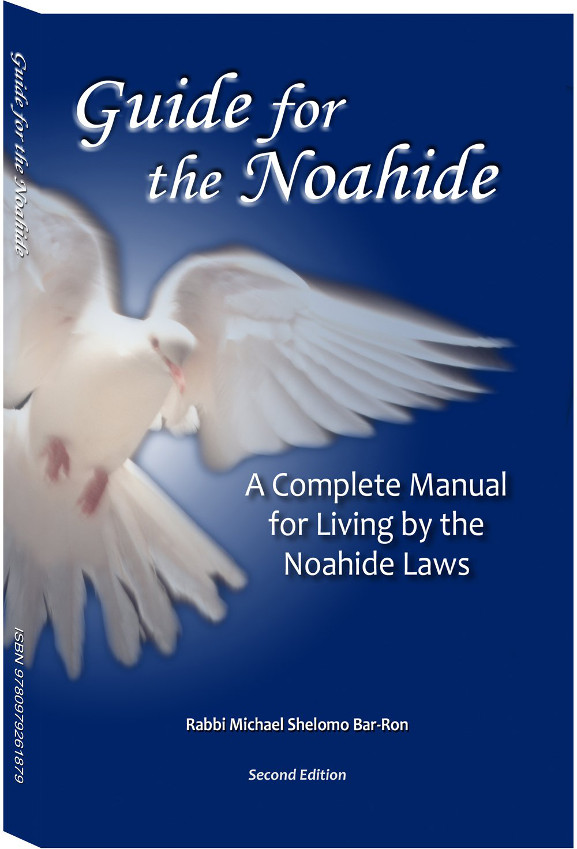
noahide guide We Messianic Gentiles, Talmidei Yeshua, or whatever you want to call us, could probably use the same siddurim and other supportive materials utilized by Noahides, with some adaptation to include our faith in Rav Yeshua who will return as King Messiah, but there’s something missing. I’ll pull it out of the paragraph I just quoted above:

There are also numerous Noahide organizations popping up, aimed at uniting Noahides, providing support, and spreading their teachings.

For Messianic Gentiles, not so much. They/we are too fragmented, our theology, doctrine, and praxis are too variable. Unlike Noahides who, at least in an ideal sense, have Chabad as a Jewish authority upon which to depend, Messianic Gentiles have no central Jewish organization that can help to unite us under a single standard collection of resources.

I suppose this could be a good reason why some Messianic Gentiles leave their faith and either join the ranks of Noahides or convert to Judaism.

Frankly, although people are free to make their own decisions, I don’t think either option is advisable and certainly not necessary. Neither is co-opting the Torah for Gentile use without so much as a by your leave to the Jewish people.

…the Jewish vision for the idealized, messianic future does not call for a world full of Jewish converts…

There are numerous mentions in both the Tanakh and Apostolic Scriptures saying the Messianic future will contain both Israel, that is, the Jewish people within their nation, and the people of the nations of the world, that is, the rest of us.

For prophesy to be fulfilled, there has to be “the rest of us,” there has to be a body of non-Jews who worship Hashem, the God of Israel, and who are devoted to Rav Yeshua as the coming King.

It’s incredibly easy for non-Jews to get lost in the world of Judaism and mistake it for the focus of our faith. I periodically quote my friend Tom who said, Don’t seek Christianity and Don’t seek Judaism, but rather, seek an encounter with the living God.”  Although ritual and custom help to define our lifestyle as Talmidei Yeshua, they are just the means by which we practice our faith, they are not the target. God is.

But like converts to Judaism and like Noahides, we just want to fit in and be accepted by our “parent” Jewish community (those of you who have one). However, the way to do that isn’t clearly understood, either by Jews or non-Jews in Messiah-faith. That means there is no one defined reality for our lived experience, at least in the realm of ritual and tradition.

But it’s nice to know we’re not alone.

If Your Religion is Boring, It’s Because of You

“It is customary to blame secular science and anti-religious philosophy for the eclipse of religion in modern society. It would be more honest to blame religion for its own defeats. Religion declined not because it was refuted, but because it became irrelevant, dull, oppressive, insipid. When faith is completely replaced by creed, worship by discipline, love by habit; when the crisis of today is ignored because of the splendor of the past; when faith becomes an heirloom rather than a living fountain; when religion speaks only in the name of authority rather than with the voice of compassion – its message becomes meaningless.”

-Rabbi Abraham Joshua Heschel

I originally found the meme on Facebook but it led to James F. McGrath’s blog (which is at Pathoes and thus cluttered with too many ads that slow the blog page from loading in the browser) where he doesn’t say that much more about it. All McGrath commented on was this:

The quote was circulating on social media recently, and so I thought it should be turned into a meme. I made the one above and scheduled the post. Then yesterday I saw that Christians Tired of Being Misrepresented had made their own meme with (a truncated version of) the quote. And so I am including that one too, below. I am glad Heschel’s words are getting this much attention just in time for Evolution Weekend, for which they seem especially appropriate.

See also Jim Kidder’s post on the attempt of the Discovery Institute to do precisely what Heschel criticizes.

For some reason, this reminded me of articles such as Millennials leaving church in droves, study finds and 5 Things Millennials Wish the Church Would Be.

The former article begins:

At its core, Christian life is set of sacred traditions linking generations of sacraments and Sunday school lessons, youth ministry morals and family gatherings sanctified by prayer. An unbroken circle, in the words of an old hymn.

netflixMaybe that’s the problem, assuming it’s true. If the rituals, sacraments, and Sunday school lessons don’t connect to anything but the life you lead on Sunday morning and evaporate immediately afterward, then religion is no more relevant to your day-to-day existence than watching an hour-long television show once a week. In fact, given how much attention entertainment is given in our culture, that TV series may actually be more relevant, since it has a much wider audience, thus giving you more people to relate to through the show.

In the latter story, the first question it says millenials are asking is “Is our church real or relevant?”

I guess the question I’d respond with is “Are you real or relevant?”

OK, that was a tad snarky, but hear me out.

In any human endeavour, it can be said that you will get out of it what you put into it. I think that extends to the world of religion and faith as well. If you want a “relevant” relationship with God, you have to seek it out. It’s not just going to happen.

Sure, God can do anything including override your free will, but experience and the Bible teach me that He’s not going to do that. He requires much, and we only find relevancy and a sense of our faith being real when we respond, not just for a few hours on Sunday (or on Saturday if you’re Jewish or otherwise attend a synagogue), but for seven days a week during each waking moment.

I know, I know. Easier said than done, and I’ll be the first one to admit that I don’t attend to the desires and requirements of God every time I take a breath. It’s too easy to get distracted by our jobs, home life, taking kids to soccer practice, dozens and dozens of mundane tasks where, in order to be mindful of the living God, we must make the extra effort to turn to Him, even as He’s waiting for us to do that.

I think the problem with the perceived lack of relevance of religion in modern life is the misunderstanding on what religion is. Yes, part of it has to do with ritual, and particularly for observant Jews, set times for prayer, gathering with a minyan, blessings upon donning a tallit and laying tefillin, blessings before eating, different blessings depending on what you’re eating, blessings after eating, blessings over lighting the Shabbos candles, blessings over…

DaveningI’m making Judaism sound rather cumbersome, but only to make a point.

If that’s your total vision and understanding of your religion, it’s going to eventually get either really boring or a less-than-mindful habit that you practice by rote. Perhaps comforting, but ultimately meaningless.

Christians do this too, it just isn’t called “ritual”. Go to church, get greeted at the door, chit-chat with a Bible in one hand and a cup of coffee in the other until the service starts, go through the ritual of the service, listening to announcements, standing and sitting, singing, greeting the people around you when you’re told, putting money in a plate, more music, listening to the sermon (maybe even taking notes but more often than not just zoning out), going to Sunday school (or not because it’s boring and you have better things to do), agreeing with the standard party line during class and not asking questions that you don’t already know the answers to…

That’s really tedious as well. No wonder there’s a mad rush to leave for Sunday brunch afterwards and then maybe get in a quick game of golf.

I know you’ve heard this before and I know I’ve said this before in a number of different ways, but it’s one of those messages I believe needs to be repeated often.

Because if decades ago, Rabbi Heschel could recognize this problem, and in this day and age, the problem seems worse than ever, just dropping the message into a single blog post and walking away isn’t going to have much (or any) impact.

Is your church or synagogue boring, not real, irrelevant? Maybe that’s because you are. If you want something more out of your religion, start putting more into it. Stop acting like religion is something you’ve just added to your pre-existing life, and start acting like you can’t live without an active, pulsating, moment-by-moment encounter with God.

Easier said than done, I know.

I can’t tell you exactly how to do all that. I’m still figuring it out for myself. This is as far as I can take you, assuming this is territory you want to explore.

I know what I’m about to say is full of trap doors, but your relationship with God isn’t wholly dependent on ritual and religious celebrations. It’s more about stopping whatever you’re doing right now and turning toward God. Then it’s about doing that again as often as you can.

Helping the HomelessIt’s about seeing human needs all around us as opportunities to serve God in a real, meaningful, and relevant way. Donate food to a food bank and your old clothing to a homeless shelter. Visit a sick friend at their home or in the hospital. Comfort the widow who has just lost her husband. Donate clothing, toys, and any other necessary items to foster children.

If you want your religion to be real and relevant, live a real and relevant life. I said I didn’t know how to take you any further, but all of the suggestions I made in the previous paragraph are based on what the Bible says God wants us to do.

If your religion is boring, it’s because of you. If you’re religion is relevant, same answer. All you have to do is listen to God and your faith will never be boring again.

Our problem is we don’t always listen. For some of us, we listen so infrequently that we’ve forgotten (or never learned) what God’s voice sounds like.