Tag Archives: Judaism

Message to the Sons of Solomon

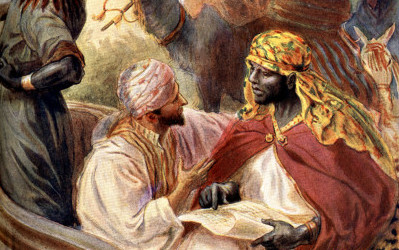
philip_and_the_ethiopianAnd King Solomon gave to the queen of Sheba all that she desired, whatever she asked besides what was given her by the bounty of King Solomon. So she turned and went back to her own land with her servants.

1 Kings 10:13 (ESV)

Now an angel of the Lord said to Philip, “Rise and go toward the south to the road that goes down from Jerusalem to Gaza.” This is a desert place. And he rose and went. And there was an Ethiopian, a eunuch, a court official of Candace, queen of the Ethiopians, who was in charge of all her treasure. He had come to Jerusalem to worship…

Acts 8:26-27 (ESV)

The Ethiopian history described in the Kebra Negast, or “Book of the Glory of Kings,” relates that Ethiopians are descendants of Israelite tribes who came to Ethiopia with Menelik I, alleged to be the son of King Solomon and the Queen of Sheba (or Makeda, in the legend) (see 1 Kings 10:1-13 and 2 Chronicles 9:1-12). The legend relates that Menelik, as an adult, returned to his father in Jerusalem, and then resettled in Ethiopia, and that he took with him the Ark of the Covenant.

-Budge, Queen of Sheba, Kebra Negast, chap. 61.
quoted from Wikipedia

I’ve written before about the section of Acts 8 that chronicles the encounter between Philip and the Ethiopian eunuch in relation to D. Thomas Lancaster’s commentary in Volume 6 of the Torah Club: Chronicles of the Apostles. Today (as I write this “church report”), it was Pastor Randy’s turn to teach us his perspective during Sunday services where I go to church.

It was also Charlie’s turn to discuss it in Sunday school and it was interesting. I already knew that Charlie believed the Ethiopian was Jewish but as Pastor started delivering his message, he shared with us that he just that week had changed his opinion about the Ethiopian and now believes that he must have been a Jew! Interesting.

I’m torn between whether to write about the history of the Ethiopian Jews, which is a topic of some controversy and speculation, or if I should focus on why God found it necessary to send an angel to tell Philip to find the Ethiopian (Acts 8:26). I think I’ll focus on the latter.

Let me explain.

In teaching the Sunday school lesson, Charlie remarked more than once how unusual he thought it was for God to send “an angel of the Lord” to tell Philip to stop everything he was doing in Samaria and travel south on the desert road to find one man who was returning to his native Ethiopia after a pilgrimage to Jerusalem. Why was this one man so important?

From a traditional evangelical Christian point of view, converting a high-ranking official of a foreign country to faith in Jesus Christ is a great way to spread the gospel message to all of the other high-ranking government officials in that country as well as to the general body of citizens. But I don’t think we can exactly map 21st Century evangelical strategies to First Century CE Jewish devotion to the sect of “the Way.” Charlie thought, given how the message of Christ was transmitted first to the Jews, then to the Samaritans, and finally to the rest of the nations, that God believed the Jewish population in Ethiopia was close to the heart of their Creator, and that the “Good News” of Messiah was a message God intended for all Jews to embrace. After all, much of the New Testament text addresses the spread of the Gospel into Europe, Asia, and the Near East. What about the Jews to the south?

This is all speculation of course, and only one part of a single chapter in the New Testament is devoted to transmitting such a message in that particular direction, but what Charlie also said more than once got my attention. He said that God wanted to make sure all of the Jews got the message that God had changed the rules.

What? What rules?

(I should say at this point, when Charlie made his comment about “changing rules” I was seriously considering what I should say or do in response. I chose not to say or do anything, but given my sensitivity to the matter of supersessionism in the church, I was afraid that I would have to defend against such a theology at the cost of my budding relationship among these fellow believers. Fortunately, it didn’t come to that.)

Actually, something important did change thanks to Christ.

Go therefore and make disciples of all nations, baptizing them in the name of the Father and of the Son and of the Holy Spirit…

Matthew 28:19 (ESV)

While Israel had always been intended to be a “light to the nations” (Isaiah 49:6), this is the first indication that the Messiah wanted people from all of the nations, and not just from Israel, to become disciples of the Master and grafted in sons and daughters of God. As we progress forward and especially attending to Acts 10 and beyond, we see that God’s intent was not to require the Gentiles to convert to Judaism or abandon their own national and ethnic uniqueness in order to become disciples. The Holy Spirit was just as available to the Gentile disciple as to the Jew.

Walking TogetherIn this specific sense, something had changed. Prior to this moment in time, if a Gentile wanted to worship the God of Israel in a covenant relationship, he or she had to embrace Judaism (that’s more or less an exact quote from Pastor Randy). With the command of Christ, which the church calls “the great commission,” anyone from anywhere could worship God in a covenant relationship without converting to Judaism (the concept of conversion is complicated…it probably didn’t exist as such during the days of Moses or David, but it was a recognized practice during the late Second Temple period and beyond).

Did God want Philip to tell the Ethiopian that God changed the rules? A plain reading of the text doesn’t suggest such a thing. From my point of view, what God wanted Philip to tell the Jewish Ethiopian was the good news of the Messiah who had come and will come again, as revealed by Isaiah 53. Why God wanted this event to occur is up for grabs, but what the Ethiopian carried back with him to his land and to his people was the gospel message, or as much of it as Philip was able to transmit in the time they were together and related to the passages from Isaiah. What fruit resulted upon the eunuch’s homecoming and in the years and centuries to follow, we cannot know.

But if God changed anything, it wasn’t His “rules” or His Torah but rather access. God opened up covenant access to Himself for all peoples. There are two portions to the good news of Christ. Of course, there is the good news for the Gentile, that we can now come to God in covenant through the blood of His son. However, Christianity rarely considers the good news of Christ to the Jew who already had such a covenant relationship (which would include the Jews in Ethiopia), that the Messiah had come, the King of Israel had been born, that he died and rose and sits at the Father’s right hand, and that at the proper time, Messiah would cause a scattered Israel to be gathered together as a nation and one day, the King would rule from Jerusalem (I’m not suggesting two, separate paths of salvation, one for Gentiles and one for Jews, but because of Israel’s special unique relationship with God, the Messiah has more and different good news for the Jews in addition to the good news he has for the Gentiles).

On Friday May 24, 1991: Over the course of 36 hours, a total of 34 El Al Hercules c-130s – with their seats removed to maximize passenger capacity – flew non-stop.

14,325 Ethiopian Jews came home to Israel, to be greeted by thousands of Israelis who gathered at temporary absorption centers, hotels and hostels to welcome their brethren.

Operation Solomon saw the rescue of twice the number of Ethiopian Jews in Operations Moses and Joshua put together.

-from bluestarpr.com

A Christian group said Tuesday, June 7, it would help organize “the return of the last 8,700 Ethiopian Jews to Israel” by sponsoring what are known as “Aliyah” flights, the coming months.

“Last Ethiopian Jews to Return to Israel, Christian Group Says”
-from worthynews.com, June 8, 2011

I know I’m stringing together bits and pieces of scripture, news, and commentary in a less than rock-solid structure, but consider for a moment that Jews from all across the nations have been returning to Israel and are being gathered to their people. God has never forgotten them nor will He ever forsake them. Perhaps that’s why He made it a point to send an angel to Philip and to insure that the message of the Messiah would reach all of his people, including the Jewish Ethiopians.

Just a thought.
The Evolution of Judaism, Part 6: Evolutions

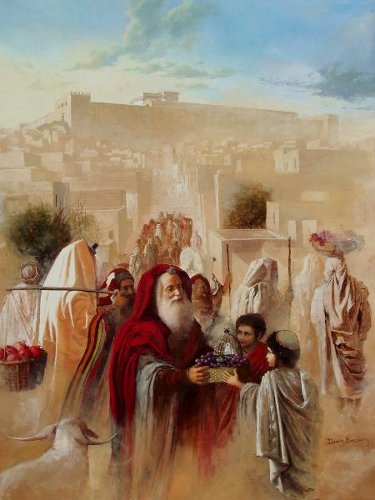
ancient_jerusalemThe best evidence that the temple was the locus of prayer during the First and Second Temple periods is the book of Psalms. Virtually all the biblical psalms, even those that lament personal or national catastrophes or that hail a king at this coronation, are hymns of praise to God. They range in date from the period of the monarchy, if not earlier (some of them are Israelite versions of Canaanite or Egyptian hymns), to that of the Maccabees.

All these texts imply that the recitation of prayers was a prominent feature of Jewish piety, not just for sectarians like the Jews of Qumran but also for plain folk. Jews who lived in or near Jerusalem prayed regularly at the temple. This is the plausible claim of Luke 1:10, “Now at the time of the incense offering, the whole assembly of the people was praying outside [the temple],” and Acts 3:1, “One day Peter and John were going up to the temple at the hour of prayer, at three o’clock in the afternoon.”

By the third century BCE, diaspora Jews began to build special proseuchai, which literally means “prayers” but probably should be translated “prayer-houses.” Instead of “prayer-houses,” the Jews of the land of Israel had synagogai, which literally means “gatherings” but probably should be translated “meeting-houses.” Whether they prayed regularly in their “meeting-houses,” which are not attested before the first century CE, is not entirely clear.

The history of this (Amidah or Eighteen Benedictions) prayer is immensely complicated, but its basic contours were established no later than the second century CE, and its nucleus certainly derives from the latter part of the Second Temple times. It bears obvious similarities to the Lord’s Prayer (Matt. 6:9-13 and Luke 11:2-4).

…by the end of the Second Temple period, sections of the Torah were read publicly in synagogues every week.

The purpose of all these rituals was, as the Torah repeatedly says, to make Israel a “holy” people (Exod. 19:6; Lev. 19:2; Deut. 7:6). To better achieve this objective, the Jews of the Second Temple period developed new rituals, broadened the application of many of the laws of the Torah, and in general intensified the life of service to God.

After the destruction of the temple, the petition was changed from a prayer for acceptability of the sacrifices to a prayer for their restoration, and the petition entered the Eighteen Benedictions. In rabbinic times, the prayer was still in flux.

This practice is based on the idea that God can be worshiped through the study of his revealed word.

-Shaye J.D. Cohen
Chapter 3: The Jewish “Religion:” Practices and Beliefs
From the Maccabees to the Mishnah, 2nd Ed.

Forgive the rather lengthy history lesson from different portions of this chapter in Cohen’s landmark book, but as I’ve continued to read from his work, I’ve been struck by how Judaism developed significantly in practice and in its comprehension of a life of devotion to God from the days of the Mishkan (Tabernacle) in the desert to the post-Second Temple era. Some time ago, I began a series of blog posts intended to outline the evolution of Judaism as it applies to Yeshua (Jesus), halakhah, and the “acceptability” of the various Judaisms in any given age and across time to the God who established Israel as a nation. You can follow the link at the end of Part 1 of the series to review all of my comments to date, which ends at Part 5. I had intended for Messiah in the Jewish Writings, Part 1 to be the “sixth” part of the series, but it was pointed out to me that certain “weaknesses” in the scholarship of the material from which I was quoting made it unsuitable for that purpose.

Before proceeding, you should probably review Noel S. Rabbinowitz’s paper “Matthew 23:2-4: Does Jesus Recognize the Authority of the Pharisees and Does He Endorse their Halakhah?” which can be found as a PDF as published in the Journal of the Evangelical Theological Society 46:3 (September 2003): 423-47. That, along with reading the other “Evolution” blog posts in this series, should provide the foundation for continuing (and ultimately concluding) the discussion here.

In providing the series of quotes from Cohen’s book, I intended to illustrate how what was acceptable Jewish practice in worship, Temple sacrifice, and prayer developed over time and was never a single, static set of religious rules and procedures that perfectly reflected the intent of the Torah and God in the life of Israel. Sometimes in certain corners of Christianity and its variants, we find people who sincerely are seeking a more authentic method of practicing their faith, based on some sort of idealized and perfect template or model that was established, either by Moses or Jesus. Somehow that particular set of behaviors is believed to be what God wants us to do and is the only valid model by which we should construct our faith practices in the present age.

But as the title of this series implies, perhaps the human practice of worshiping God can never be static nor was it ever intended to be a single set of rigid rules and concrete regulations that never modified in the slightest across the long centuries between Sinai and the present.

I don’t mean that right and wrong don’t have timeless value and that God changes His requirements for humanity at a whim, but humanity changes, circumstances change, and what seems right to do at one point in human history seems very much different at another point on the timeline of existence. Surely how Solomon viewed what was proper worship differed greatly from what the Rambam might have considered right Jewish practice, and yet can we say that either one of them (or both) was wrong? They were both certainly convinced that they were doing what God required, but who they were, where they lived, and the demands of history upon both of these men (and the untold scores that lived before and since) were radically dissimilar.

But while you may understand this relative to the history of the Jewish people, what at all does this have to do with believers in Jesus and who we are in Christ?

Agrippa’s first full year as king over Judea (41/42 CE) was a Sabbatical year. Drought had already begun to hamper the land. The people were gathered for Sukkot to pray for rain and to hear the new king read from the Torah (see Deut. 31:10-11). The apostles and the disciples of Yeshua were present along with the rest of the pious of Israel to witness the historic event. Their hearts burned within them, jealous for the Master. They longed for the day when King Messiah will stand in the Temple and read the Torah aloud to the assembly of Israel.

-D. Thomas Lancaster
Torah Club, Volume 6: Chronicles of the Apostles
from First Fruits of Zion (FFOZ)
Torah Portion Shemot (“Names”) (pg 329)
Commentary on Acts 12:1-24

Yom Kippur prayersLancaster is no doubt taking a bit of poetic license in describing whether or not the hearts of the apostles were “burning” on this occasion, but it does cast the early Jewish disciples of “the Way” in a light that integrates them with overall Jewish religious and social participation. In the church, we tend to think of the “early Christians” as a body wholly apart from the various Judaisms that surrounded them, but as I’ve mentioned before, the Jews who were devoted to the Messiah as part of “the Way,” were just as much a valid sect of Judaism as any of the other Judaisms (Pharisees, Essenes, and so on) with which they co-existed.

In fact, the Jewish disciples of the Master in the days recorded by Luke in the book of Acts can only be separated from overall, normative Judaism anachronistically.

The King James Version of Acts 12:4 translates the Greek “pascha” as “Easter.”

The Greek word “pascha” (which transliterates the Hebrew “pesach”) occurs 27 times in the New Testament. In every instance except Acts 12:4, the King James translators rendered it as “Passover.” In Acts 12:4, they retained William Tynsdale’s anachronistic, Christian rendering and translated it as “Easter.”

The translation betrays a theological bias. It assumes Christianity replaced Judaism. Christ cancelled the Torah, and the Christian Jews would not have been keeping Passover any longer. In reality, the apostles had never heard of a festival called Easter. They had no special Christian festivals. They kept the Passover along with all Israel in remembrance of the Master, just as He had instructed them… (Luke 22:19)

-Lancaster, pg 338

Lancaster continues in his commentary, explaining that the separate Christian observance of Easter wouldn’t be established until the Second Century CE as the Gentile believers in Rome began to neglect observing Passover, but began to revere the Sunday that fell during the week of Unleavened bread as the day of Christ’s resurrection. As you can see, the passage of time and the demands of history have resulted in both Judaism and Christianity evolving and changing how they practice their divergent methods of worshiping God. In fact, the divergence of “the Way” from the rest of the Judaisms post-Second Temple is likely part of those historical requirements.

Is all this desirable? Probably not. That is, it would be great to have a Christianity that actually remained a normative part of Judaism and was able to include Gentile practitioners who came to faith in the Messiah, but such was not to be.

Lest you be wise in your own sight, I do not want you to be unaware of this mystery, brothers: a partial hardening has come upon Israel, until the fullness of the Gentiles has come in.

Romans 11:25 (ESV)

Paul seems to be telling us that the schism between the Gentile and Jewish believers was inevitable for the sake of the Gentiles and that, referencing Isaiah 59 and Jeremiah 31, by doing so, all Israel will be saved. (see Romans 11:26-27)

If Judaism was practiced differently and in fact, in radically different ways between the ancient times of Moses, David, and Solomon, the time of the Babylonian exile, the time of Herod, the Second Temple, and the rise of “the Way,” and in the post-Second Temple rabbinic period, can we say that all of these Judaisms are “valid?” I don’t think we have much of a choice but to say that they are. If you disagree, then you have to point to some place in history and say “here’s where the Jews made their big mistake.” I know that many Christians will point to Jesus and say that the Jewish rejection of their own Messiah caused them to become lost and gave rise to the “age of the Gentiles,” but be careful. For the first fifteen years post-ascension, only Jews were disciples of Jesus Christ. Even after Peter’s fateful meeting with Cornelius and the subsequent mission of Paul to the Gentiles of the diaspora, Jews remained in total control of the “Jesus movement” within Judaism until the fall of Jerusalem and the scattering of the vast majority of the Jewish population among the nations (there has always been a remnant of Jews living in the Land). It is rumored that there were Jews in synagogues acknowledging Yeshua as Messiah into the second, third, and possibly even up to the fifth century CE or later.

Rabbi Joshua Brumbach wrote a blog post called Rabbis Who Thought for Themselves which records the lives of a number of prominent 19th century Rabbis who all came to the knowledge and faith of the Messiah in the person of Yeshua (Jesus), and we know of a remnant of Jews in the 21st century who also have come to faith and yet have lives that are completely consistent with modern Jewish halakhah.

At no one point in history will you find the quintessential moment where you can say “that is the true Judaism” or for that matter, “that is the true Christianity.” Humanity in all our forms has been struggling with our relationship with God, what it means, and how to live it out since the days when God walked with Adam in the Garden. We never get it quite right because we live in a broken world and our vision of who we are, who God is, and what it all means is fractured and distorted, even with the Spirit of God residing with us as a guide.

staring-at-the-cloudsWe can look at the mistakes we have made and are making even now, but we cannot say that “at such and thus time, we got it all right.” We never got it right, we just made different mistakes. But faith and devotion have been a constant thread running through the tapestry and that is what we can find tied to our own heartstrings. We can then grab hold of that thread and pull ourselves along the line, touching the lives of the saints and tzaddikim who came before us, who like us, got some things right and some things wrong, but who like us, did their very best to serve the God of Heaven.

It’s easy to point a finger at history and at men who have been dead for hundreds or thousands of years, and vilify them in order to make ourselves look better, but in reality, they were no different from us in the important ways of how human beings work. Our only constant is love of God and of each other. We look to God to be the unchanging part of our own ever-changing universe. And we wait for the day when King Messiah will stand before Israel in Jerusalem and before the body of believers from the nations, and read the Torah aloud, and we will all hear his voice, and we will all know that we are his.

Shemot: Trusting God

trust2In this week’s Torah portion the Torah tells us “There arose a new king over Egypt who did not know Joseph.” There is a disagreement whether it was truly a new king or whether the king (Pharaoh) chose to ignore any debt of gratitude to Joseph and his people for saving Egypt and the world from the 7 year famine. Obviously, trusting in people — especially heads of governments — is problematic. Who do you trust? Who can you trust?

In my youth there was a television show entitled, “Who Do You Trust?” The show was not entitled “Is There Anyone You Trust?,” because, in the end all of us trust in someone or something. People trust in their intelligence, their power, their charm, their knowledge, their connections, their political candidate, and in their wealth. For those who trust (or trusted…) in their wealth, it is ironic that on the American dollar bill it advises “In God We Trust.”

Ultimately, what will help all of us to weather these difficult times is strengthening our trust in God. Trust in God gives a person peace of mind, the ability to relax and to be free of stress and worry. It helps one to deal with frustrations and difficulties.

Like all intelligent discussions, we first have to start with a definition. Trust in God is believing, knowing, internalizing that all that the Almighty does for us if for our good. It is knowing that the Almighty loves us greater than any love one human being can have for another person. He totally knows and understands us and our personal situations. Only the Almighty has the power to impact your situation. He has a track record. You can rely on Him. Everything the Almighty does for you is a gift; there are no strings attached.

-Rabbi Kalman Packouz
“Who Do You Trust?”
Commentary on Torah Portion Shemot
Aish.com

That sounds fine as far as it goes, but it’s not as simple as all that. Trusting in God does not mean that you are guaranteed a problem-free life. In fact, as we’ve recently seen, Many people suffer horrible tragedy and tremendous loss regardless of their trust, or lack thereof, in God. The hurricane devastates the righteous and unrighteous alike and loss of a child will break anyone’s heart.

However, Rabbi Packouz provides a handy list of 7 Principles for Trusting in God for our review. Here they are:

  1. The Creator of the universe loves me more than anybody else in the world possibly can.
  2. The Almighty is aware of all my struggles, desires and dreams. All I need is to ask Him for help.
  3. The Almighty has the power to give me anything I want.
  4. There is no other power in the universe other than the Almighty. Only He can grant me success and give me what I want.
  5. The Almighty has a track record for giving me more than I am asking for.
  6. The Almighty gives with no strings attached. I don’t need to earn it or deserve it. He will give it to me anyway.
  7. The Almighty knows what is best for me and everything He does is only for my good.

Although Christianity and Judaism are two different religions (with a common root), I think the list above can be applied just as well to the non-Jewish believer as to the Jewish person.

Does God love you more than anybody else in the world can? The New Testament is full of comments about God’s love, the most obvious being John 3:16. Yes, God does love you and He loves me, and He loves all Christians, and all Jews, and all Muslims, and all Buddhists, and all human beings who have ever lived and who will ever lived.

And yet disaster can strike at any moment and human history is replete with tragedies and disasters. The road of our lives and the lives of all who came before us is littered with broken bodies and broken hearts and broken spirits.

Certainly God is aware of all our needs and struggles since nothing is hidden from Him, but point two suggests that all we have to do to be relieved of our pain is to ask Him for help. Does everyone who has a sincere faith and prays to God receive immediate relief from suffering? Ask the parents of those children who were murdered at Sandy Hook Elementary school.

God really does have the power to give you, me, and everyone else anything we want, but that doesn’t mean He will grant us anything we want. In fact, it is very likely that God will not grant us anything we really want most of the time.

From a Christian’s, Jew’s, or Muslim’s point of view, there is only one power in the universe: God. Only God can grant success and comfort. But as I already said, there’s a difference between what He can do and what He will do.

Does God have a track record of giving us more than what we ask for? I’m not even sure how to measure such a thing. I think that’s probably true in some cases, but not in others. Ask six million Jews who died during the Holocaust while praying for God to grant them mercy. Was death the only mercy He decided to give?

no-strings-attachedGod gives with no strings attached. Hmmm. Is that true? Probably in more cases than not, but there’s a presupposition that even in giving, God is trying to get our attention, especially if those receiving His gifts do not have faith. On the other hand, referring back to John 3:16, God is the grand master of unconditional love, so who am I to talk?

God knows what is best for me. I can’t argue against that and this seventh point could be used to explain the other six. We may ask for something and not get it and then conclude that we didn’t get what we wanted because it wasn’t good for us. On the other hand, the parents of 26 murdered children only want this all to be a bad dream and for their precious little ones to be restored to them. Is that not “good for them?”

No, I’m not trying to be a downer and “diss” trusting in God, but such an abiding trust is difficult to come by.

Blessed are You, O God … Who has provided me my every needs.

-Siddur

One of the great tzaddikim lived in abject poverty, yet always had a happy disposition. He was asked how he managed to maintain so pleasant an attitude in the face of such adverse conditions.

“Each day I pray to God to provide all my needs,” he said. “If I am poor, that means that one of my needs is poverty. Why should I be unhappy if I have whatever I need?”

Tzaddikim are great people and we are little people who may not always be able to achieve the intensity of trust in God that would allow us to accept adversity with joy. But even if we cannot attain it to the highest degree, we should be able to develop some sincere trust.

When our children are little, we as parents know what they need. They might prefer a diet of sweets, but we give them nourishing foods. They certainly despise receiving painful injections that immunize them against dreadful diseases, but we forcibly subject them to these procedures because we know what is good for them.

Some people do not believe in God. But to those that do, why not realize that He knows our needs better than we do, and that even some very unpleasant experiences are actually for our own betterment?”

Today I shall…

try to bear adversity with less anger and resentment, remembering that God is a compassionate Father, and that He gives me that which He knows, far better than I, that I truly need.

-Rabbi Abraham J. Twerski
“Growing Each Day, Tevet 20”
Aish.com

The Hebrew word bitachon is typically translated as “trust” in English, but that hardly does it justice. Trusting God isn’t about God always giving us what we want or us experiencing God as always doing what we think of as good. It’s the realization that God is always good regardless of our experiences.

Consider any of the “holy men” you may admire and revere from the Bible. From Abraham to Paul, they all led less than perfect lives. Yes, God granted them many gifts, but He also allowed much hardship. Abraham and Sarah were childless and without an heir for most of their lives and into extreme old age until God granted them Isaac. Jacob was hated by his brother Esau, kept in virtual slavery by his relative Laban for twenty years, his daughter was raped and held captive, his favorite son Joseph was lost and presumed dead. Another son Judah married outside of the Hebrews and two of his three sons died. Joseph was a slave and a prisoner for years in a strange land before being elevated to great power, but only on the condition that he conceal his identity, even from his own brothers. When Joseph died, every one of his descendants for generations was kept as slaves in Egypt. Even their rescuer Moses was unable to lead his people into Canaan and instead wandered with them in the desolate wilderness for forty years until finally dying with almost everyone else in his generation without walking in Israel for himself.

Dietrich BonhoefferThe “saints” of the New Testament fared no better. Consider the stoning of Stephen, the harsh life of Paul leading only to death in Rome, and the martyrdom of Peter and every other Apostle. No, trust and faith did not result in comfort of life.

No, trust in God cannot be based on experience with God because if it were, none of these people would have been able to trust Him. In fact it seems that one must trust God in spite of our life experience. Rabbi Packouz’s list does little good, since God does not perform good on command. Knowing that God can spare us pain and suffering doesn’t help and is a bitter irony when God doesn’t spare us pain and suffering. Job’s most famous line (for me) illustrates what it is to trust in God.

Though he slay me, I will hope in him; yet I will argue my ways to his face.

Job 13:15 (ESV)

This gives us a picture of the Jewish method of trusting God, since it doesn’t preclude telling God how we feel about what’s happening to us.

Rabbi Twerski tells us that only a great tzaddik, a very holy and spiritual person, can truly trust God at the level I’m talking about here. But he also says that it’s not impossible for we “ordinary folk” to trust God, either. In his own declaration on the matter, Rabbi Twerski states, Today I shall try to bear adversity with less anger and resentment, remembering that God is a compassionate Father, and that He gives me that which He knows, far better than I, that I truly need.

In our own times of hardship and anguish, maybe this is the best we can do as well.

For what we proclaim is not ourselves, but Jesus Christ as Lord, with ourselves as your servants for Jesus’ sake. For God, who said, “Let light shine out of darkness,” has shone in our hearts to give the light of the knowledge of the glory of God in the face of Jesus Christ. But we have this treasure in jars of clay, to show that the surpassing power belongs to God and not to us. We are afflicted in every way, but not crushed; perplexed, but not driven to despair; persecuted, but not forsaken; struck down, but not destroyed; always carrying in the body the death of Jesus, so that the life of Jesus may also be manifested in our bodies. For we who live are always being given over to death for Jesus’ sake, so that the life of Jesus also may be manifested in our mortal flesh. So death is at work in us, but life in you.

2 Corinthians 4:5-12 (ESV)

Good Shabbos.

Why Are We Needed?

i-need-youThe sixth Lubavitcher rebbe, Rabbi Yosef Y. Schneerson, recounted the following story some 64 years ago:

Rabbi Schneur Zalman of Liadi, the first Chabad rebbe, had a disciple who was also a great philanthropist. Two causes that were particularly dear to him were supporting the Jewish community in the Land of Israel and ransoming captives.

This wealthy chassid had already married off his children and begun pledging dowries for his less-affluent relatives, when the wheel of fortune turned, and his finances suffered.

He was forced to borrow money, and at the end he was left penniless. Overwhelmed and pursued by creditors, he did what any chassid would do: he traveled to his rebbe and unburdened his heavy heart.

After listening intently to his complaints, Rabbi Schneur Zalman addressed him: “You speak about what you need, but say nothing of what you are needed for!”

In this week’s Torah portion, the first one of the book of Exodus, we read about the beginning of the harsh Egyptian exile. But with the disease comes the cure: in the same portion we read about the birth of Moses, the man who was to lead the Jewish people out of their bondage.

One of the first things we hear about Moses is that how he helps another person. Emerging from a sheltered existence as a member of Pharaoh’s household, he sees an Israelite slave being cruelly beaten by an Egyptian, and rescues him.

There are times in our lives when it may be challenging to think about anyone other than ourselves, but the message of Rabbi Schneur Zalman to the anonymous chassid rings true: You speak about what you need, but say nothing of what you are needed for!

Often, the best response to adversity is to break out of our comfort zones and extend a helping hand to another person with love and gratitude for all the good that we have.

-Rabbi Shaul Wertheimer
“What Are You Needed For?”
Commentary on Torah Portion Shemot
Chabad.org

I’ve recently lamented about the relative significance of our lives to God and His purposes, but I suppose the above-commentary, part of which I’ve read before, provides us with something of an answer. Still, it’s difficult when we have needs, to set those aside and to consider instead what we are needed for. When it is our heart that hurts and our eyes that grow dim, how can we view ourselves as the pilgrim instead of the exile? Yet we see that in God causing Moses to rise up among his Jewish brothers, that He created Moses to become both.

Some time after that, when Moses had grown up, he went out to his kinsfolk and witnessed their labors. He saw an Egyptian beating a Hebrew, one of his kinsmen. He turned this way and that and, seeing no one about, he struck down the Egyptian and hid him in the sand. When he went out the next day, he found two Hebrews fighting; so he said to the offender, “Why do you strike your fellow?” He retorted, “Who made you chief and ruler over us? Do you mean to kill me as you killed the Egyptian?” Moses was frightened, and thought: Then the matter is known! When Pharaoh learned of the matter, he sought to kill Moses; but Moses fled from Pharaoh. He arrived in the land of Midian, and sat down beside a well.

Exodus 2:11-15 (JPS Tanakh)

I can only imagine that after having grown up in Pharoah’s court, becoming a shepherd in Midian was something of a let down for Moses, at least at first. But in my imagination, I think of Moses finally marrying, raising sons, and eventually coming to terms and to a peace with the simple life, tending to his flock in the shadow of the mountain of God.

But then, God had other plans for Moses.

“You speak about what you need, but say nothing of what you are needed for!”

-Rabbi Schneur Zalman

But Moses said to the Lord, “Please, O Lord, I have never been a man of words, either in times past or now that You have spoken to Your servant; I am slow of speech and slow of tongue.” And the Lord said to him, “Who gives man speech? Who makes him dumb or deaf, seeing or blind? Is it not I, the Lord? Now go, and I will be with you as you speak and will instruct you what to say.” But he said, “Please, O Lord, make someone else Your agent.” The Lord became angry with Moses, and He said, “There is your brother Aaron the Levite. He, I know, speaks readily. Even now he is setting out to meet you, and he will be happy to see you. You shall speak to him and put the words in his mouth — I will be with you and with him as you speak, and tell both of you what to do — and he shall speak for you to the people. Thus he shall serve as your spokesman, with you playing the role of God to him, And take with you this rod, with which you shall perform the signs.”

Exodus 4:10-17 (JPS Tanakh)

Most of us have never been a prince in Egypt or even a wealthy philanthropist and chassid, but I’m sure many of you reading this have been poor (or are poor) and in need and have been focused more on your own desperation than the plight of the world around you. It’s only natural that when we are confronted with our own pain, we direct all our attention to it and ask for help. It is only natural that, when presented with a task or a mission that seems well beyond our capacities, we should try to turn it down or ask that it be assigned to someone else.

But sometimes God asks the most unlikely people to do the most unusual things.

For some days he was with the disciples at Damascus. And immediately he proclaimed Jesus in the synagogues, saying, “He is the Son of God.” And all who heard him were amazed and said, “Is not this the man who made havoc in Jerusalem of those who called upon this name? And has he not come here for this purpose, to bring them bound before the chief priests?” But Saul increased all the more in strength, and confounded the Jews who lived in Damascus by proving that Jesus was the Christ.

Acts 9:19-22 (ESV)

micah6-8And what does God ask us to do?

He has told you, O man, what is good; and what does the LORD require of you but to do justice, and to love kindness, and to walk humbly with your God?

Micah 6:8 (ESV)

For kindness is Yours, O God, when You compensate each person according to his actions.

Psalms 62:13

In our productivity-oriented society, we tend to place value on the product rather than on the process. Success is praised and failure is condemned, and we have little interest in the circumstances under which others function.

This attitude might be justified in the marketplace, since commerce lives by the bottom line. Still, our preoccupation with commerce should not influence us to think that people’s successes and failures should be the yardsticks for how we value them.

God does not judge according to outcome. God knows that people have control only over what they do, not over the results. Virtue or sin are determined not by what materializes, but by what we do and why.

Since the Torah calls on us to “walk in His ways,” to emulate God as best we can, we would do well to have a value system so that we judge people by their actions, not their results. This system should be applied to ourselves as well. We must try to do our utmost according to the best ethical and moral guidance we can obtain. When we do so, our behavior is commendable, regardless of the results of our actions.”

Today I shall…

try to be considerate of others and of myself as well, and realize that none of us is in control of the outcome of our actions, only of their nature.

-Rabbi Abraham J. Twerski
“Growing Each Day, Tevet 19”
Aish.com

You and I speak of our needs to God and He desires this. But He also desires that ask Him what we are needed for. The answer is the reason we are all alive today.

Tent of David: Return of the Christian

restoring-davids-fallen-tentYet even before delving into an appraisal of the institutional church, it is important to recognize the common ground on which we stand. By any biblical definition, all believers in Yeshua the Messiah (Jesus Christ) are part of one body, the ecclesia of God. All who have made Yeshua their master are subjects of one kingdom, the kingdom of heaven.

I believe the term “Messianic” is an easy-to-understand descriptor that helps Christians who understand their Jewish roots to find a concrete identity and definition. Yet to be a “Messianic Gentile” does not make one something other than “Christian.”

-Boaz Michael
“Chapter One: The Church is Good,” pg 36
Tent of David: Healing the Vision of the Messianic Gentile

I started my somewhat unique review of Boaz’s book in yesterday’s extra meditation so you may want to go back and read it before continuing here. I’m only “sort of” reviewing the book, as I’m not presenting my assessment in a single chunk, nor am I trying to look at it with an objective eye. The book is primarily intended to impact the Christian already in the church who has become somewhat “Judaically-aware.” That doesn’t describe me, since I left the church for many years and have only recently returned, and I am writing my response to Tent of David from the viewpoint of my personal experience as a church “returnee.”

Boaz continues to talk about the definition of a Christian in relation to being a “Messianic Gentile,” which he began in the Introduction of his book. I think identity is very important because so many people have left behind the church and the identity of “Christian” out of a sense of disillusionment, seeking something more authentic in other realms, particularly that venue we tend to call Messianic Judaism.

I’ve received quite a bit of encouragement to return to the church recently, both from a friend and from my Mom (hi, Mom). I’ve concluded that God must want me in the church, regardless how I may feel about it and that there is some intended good in my returning there, and perhaps even in the particular church I currently attend. Of course it’s important, as Boaz points out in the first chapter of his book, to remember that there is much good in the Christian church, even if you’ve been told otherwise.

The first good mentioned is community, but the nature and scope of that community may not be what you expect. In the quote above, Boaz mentioned that everyone who is a believer in Jesus Christ is a member of the ecclesia of God. But just who is that exactly?

As a Messianic Jew, I am a Jewish follower of the Jewish Messiah; Gentile believers have also attached themselves to the same Messiah. So we are all Christians according to the word’s original, lexical meaning – Christ-followers. God forbid, that the term “Messianic” should foster an “us vs. them” mentality toward Christians who do not accept the Messianic viewpoint; this attitude is counterproductive, unbiblical, and unnecessary.

-Michael, pg 37

Boaz means to communicate that those Christians who consider themselves (ourselves) “Messianic” should not allow their (our) identity to separate them (us) from Christians who do not necessarily see themselves in the same light, relative to the Torah, the mitzvot, and Jewish practice. However he uses himself as a Messianic Jew in the example and that might not fit the metaphor, at least not according to Rabbi Dr. Michael Schiffman in his blog post Messianic Judaism and Christianity: Two Religions With The Same Messiah.

Messianic Judaism affirms that the Jewish people, believing in Yeshua or not, have been, are, and will always be the chosen people of God. The only nation God ever linked His name to in Scripture is Israel, calling Himself, the God of Israel. Scripture tells us His promises to Israel are eternal, and extend to the sons of Jacob, the House of Israel, known today as the Jewish People. Those leaders of the church did not affirm this. To them, 2000 years of post-Yeshua Jewish history, a history of spirituality and suffering for being Jewish, was worthless. In their view, 2000 years of Jewish unbelief in Yeshua means Twenty centuries of Jews went to hell. I have to confess that the concept doesn’t sit well with me. For Yeshua to be the Messiah of Israel, he would have to be good for the Jews. If his coming resulted in twenty centuries of Jewish people going to hell, the bottom line is, he wasn’t very good for the Jews. Either he wasn’t the Messiah, or the doctrinal understanding is wrong. I believe the latter. Yeshua brings salvation, but is that the only reason to believe in Him; for something we get? I think we should believe in Him because he is the Messiah, and being in relationship to Him brings us closer to God, and increases our kavvanah, or spiritual connection with God.

What they don’t grasp, is the idea put forth by R. Kendall Soulen in his book, The God Of Israel In Christian Theology, that after the first century, the Jewish Yeshua was virtually unrecognizable as a Jew, and therefore, as the Messiah. Jewish rejection of Yeshua was not an act of infidelity towards Yeshua, as much as it was an act of fidelity towards His Father.

infinite_pathsWhile Rabbi Dr. Schiffman has assured me that his writings were not intended to be anti-Gentile, they do draw a sharp distinction between what Jews do and who Jews are within a Messianic Jewish context, and what Gentile Christians do and who we are (Messianic Gentiles or otherwise) within a church or other primarily Gentile believing context. One God, One Messiah, two religions.

If I were to return to Boaz’s definition, then I’d have to believe that at some “meta-religious” level, both the Jewish and Gentile believers of the Jewish Messiah King must belong to the “Kingdom of God,” however you want to define it (In a recent conversation with Boaz, he talked about devoting a great deal of First Fruits of Zion’s (FFOZ’s) resources to address the nature of the Kingdom of God in the coming year. You can get a preview of what he’s talking about at tv.ffoz.org).

But now in Christ Jesus you who once were far off have been brought near by the blood of Christ. For he himself is our peace, who has made us both one and has broken down in his flesh the dividing wall of hostility by abolishing the law of commandments expressed in ordinances, that he might create in himself one new man in place of the two, so making peace, and might reconcile us both to God in one body through the cross, thereby killing the hostility. And he came and preached peace to you who were far off and peace to those who were near. For through him we both have access in one Spirit to the Father. So then you are no longer strangers and aliens, but you are fellow citizens with the saints and members of the household of God, built on the foundation of the apostles and prophets, Christ Jesus himself being the cornerstone, in whom the whole structure, being joined together, grows into a holy temple in the Lord. In him you also are being built together into a dwelling place for God by the Spirit.

Ephesians 2:13-22 (ESV)

Is this where Paul tries to describe that “meta-level” where both the Jewish and Gentile disciples of the Master exist in some sort of common framework? If so, then I have to conclude, going back to Rabbi Dr. Schiffman, that said-framework is virtual, spiritual, supernatural, or even mystical, since a united platform of Jews and Gentiles as believers cannot exist and yet maintain two separate and distinct religious identities.

In any event, that meta-level can’t really help me right now if I must adopt a specific Christian persona within a traditional church context. And yet the concept of identity gets complicated even if we just stick to Christians.

It is not anyone’s place to pass judgment on those who are infants in their faith, who have not taken on this or that mitzvah. James wrote in his epistle (4:11-12), “Do not speak evil against one another, brothers. The one who speaks against a brother or judges his brother, speaks evil against the law and judges the law. But if you judge the law, you are not a doer of the law but a judge. There is only one lawgiver and judge, he who is able to save and to destroy. But who are you to judge your neighbor?”

In essence, this passage communicates to us that the pace of someone else’s spiritual development is God’s concern alone…God has not appointed us to judge someone else based on his or her level of observance; to do so is tantamount to judging the law itself. James even goes so far as to say that one who judges another’s level of observance has ceased to observe the Torah himself.

-Michael, pg 38

I know Boaz intended to address the “Messianic Gentile” in the church or returning to the church, but that person isn’t me. In the past several weeks, Christians have shown me where I am immature in my faith. I have no judgment to offer anyone in the church, who have been performing the “weightier matters of the law” for much longer than I’ve even been considering them. Heck, on Christmas, I found out that one of the local Boise restaurants volunteered free meals to the hundreds and even thousands of homeless. My wife told me someone she works with volunteers for this project every year. Imagine that. I didn’t even know about it. Organizations such as the Boise Rescue Mission, Lighthouse Rescue Mission, City Light Home for Women and Children and Interfaith Sanctuary Housing Service, the CraftWorks Foundation, and others in the local Boise community regularly perform these “mitzvot,” so I along with many others, should be careful who we judge. I certainly have no room to say that who I am and what I do is better than any of these people and agencies.

That’s a rather humbling realization (I’ve been having a lot of them lately) when facing the daunting task of returning to God’s ecclesia and trying to find a place among them.

divergence0-3-negative_pointsBut “levels of spiritual development” aren’t always a simple set of stairs. For me, the different spiritual paths of the people around me and my own path look like a set of divergent vectors, different not only in level, but in character, trajectory, and “texture.”

In his book, Boaz says that some people who become “Judaically-aware” modify their trajectory to adapt their new experiences within the church context, but others allow it to drive their entire course, altering it so drastically, that it carries them completely out of the church and out of Christian fellowship. Of the former group, Boaz has this to say.

I know a number of Christian pastors who have seen the merit in Messianic theology and practice, and have embraced the feasts and even the dietary law on some level, but have no desire to leave their denominations, or their particular theological and cultural distinctiveness, behind. One, an Independent Fundamental Baptist, restricts himself to clean meat and attends Erev Shabbat dinners, yet still puts on his suit and tie for church every Sunday morning and evening, and goes door-to-door every Saturday. Another, a Methodist, erected a sukkah in his backyard last year, yet proudly supports his denomination at the state and national level.

-Michael pp 46-7

These people are the opposite of me. Instead of being in the church as my “home” and extending myself outward toward some modest Judaic awareness, I’m trying to reinsert my Judaically-aware self back into the church and discovering, much to my shock, that I’ve been terribly wrong about a good many things. It isn’t the church that has been resisting me, but rather me resisting the church, and from what I’ve been able to tell so far, they know a great deal more about the “weightier matters of Torah” than I do.

The Christians who, throughout the ages, have propagated this message and tried to soothe the hurting, feed the hungry, and speak to social injustice have been keeping the weightier matters of the Torah. Both Yeshua (Mark 12:31) and the Sages (Rabbi Hillel in b.Shabbat 31a and Rabbi Akiva in Sifra, Kedoshim 4:12) taught that love of neighbor is the essence of Torah. These are non-trivial accomplishments which speak to the robust, biblical ethical system which many devout Christians have embraced.

-Michael, pg 49

The one thing Boaz doesn’t do, and this is where I will have to watch my balance, is he doesn’t “chase the Gentiles back into church” with no inherit connection to the origins of our faith as it was born in ancient Judaism.

One thing Messianic Gentiles must learn is that they do not have a direct, unmediated relationship with God. Jews have many covenants with God by virtue of their very existence as descendants of the Patriarchs. In contrast, Ephesians 2:12-13 describes the state of Gentiles as “separated from Christ, alienated from the commonwealth of Israel and strangers to the covenants of promise, having no hope with out God in the world. But now in Christ Jesus you who once were far off have been brough near by the blood of Christ.”

-Michael, pg 50

I know I quoted from Ephesians 2 earlier but Boaz uses it in a different manner. He’s talking about what links the Gentile to Messiah and God and that link only exists through the covenants God established with Israel and the Jewish people. Without them, we Gentiles would have no connection to Jesus and to God. I’ve tried to explore this in my own covenants series, but it’s a very complex and elusive topic of investigation. Even trying to isolate and examine Ephesians 2 led to a divisive “discussion.”

Nevertheless, Boaz tells us that going back to the basis of our faith, the Jewish Messiah King, and his Jewish apostles, we see that we owe a debt of gratitude to them and their inheritors.

Pirkei Avot 6:3 contains a profound teaching that is particularly relevant here:

One who learns from his fellow a single chapter, or a single law, or a single verse, or a single word, or even a single letter, he must treat him with respect. For so we find with David, king of Israel, who did not learn anything from Achitofel except for two things alone, yet he called him his “master,” his “guide” and his “intimate,” as is stated, “And you are a man of my worth, my guide and intimate friend.” [Psalm 55:13] Surely we can infer a fortiori: if David, king of Israel, who learned nothing from Achitofel except for two things alone, nevertheless referred to him as his master, guide and intimate, it certainly goes without saying that one who learns from his fellow a single chapter, a law, a verse, a saying, or even a single letter, is obligated to revere him. And there is no reverence but Torah, as is stated “The sages shall inherit honor” [Proverbs 3:35] “and the integral shall inherit good” [Proverbs 28:10]; and there is no good but Torah, as is stated, “I have given you a good purchase; My Torah, do not forsake it.” [Proverbs 4:2]

Messianic Gentiles would do well to heed the teaching of this mishnah. Showing reverence towards one’s teacher, even if what they learned was small – a single letter or verse – is showing reverence toward God and the Torah. Conversely, dishonoring one’s teacher is in fact dishonoring God’s work in one’s life.

Michael, pp 51-2

Out of the darknessFor me, the door swings both ways. Not only must I maintain a sense of honoring my ancient and modern Jewish teachers (since I often quote from modern Jewish teachers and scholars), but I must also sustain my respect and honor for the Pastors and Bible teachers at the church I’m attending. That can extend to Christian friends with whom I meet and from whom I learn a great deal.

I suppose in addition to this being a commentary on one of the chapters in the Tent of David book, it could also be part of my “Days” series (though I haven’t titled it as such), but it’s pretty much a foregone conclusion at this point that I’ll be going back to church next Sunday and continuing to go in coming year. But while Tent of David may be a guide for Pastors who build a sukkah or who have decided to eat kosher meat, I don’t know if is particularly aimed at me. Boaz told me that between the preliminary drafts, which I previously reviewed, and the current, final publication, the intended audience shifted from people like me who left and are now returning (or considering returning) to church, to those Christians who are currently in the church and part of its culture, and who have also recently become aware of the Jewish origins of Christianity and the significance of Torah as the foundation of Christian faith.

It’s not like I’m without a guide and in fact, I may even have found a mentor of sorts, but I am unlikely to be able to use Boaz’s book as a direct mapping to my own, personal experience. As I continue to read what he’s written, attend services at church, and record my experiences a chapter at a time, I will share that with you and we will see together how accurate my prediction is…and where I go from here.

5 Days: Practicing Christianity

pakistani-christians-singing-hymnsBoth the Jews and gentiles recognized that the Jews denied the gods of the nations and claimed that their God alone was the true God, the Lord of the universe, but for both Jews and gentiles the boundary line between Judaism and polytheism was determined more by Jewish observances than by Jewish theology. Josephus defines an apostate as a Jew who “hates the customs of the Jews” or “does not abide by the ancestral customs.” He defines a convert to Judaism as a gentile who, through circumcision, “adopts the ancestral customs of the Jews.”

-Shaye J. D. Cohen
Chapter 3: The Jewish “Religion”, Practices and Beliefs
From the Maccabees to the Mishnah, 2nd ed.

Many years later, as recorded in Acts 21, the apostles reaffirmed that the Jewish believers in Jerusalem were all “zealous for the Law.” To clarify the key difference between Jewish and Gentile believers, they continued: “But as for the Gentiles who have believed, we have sent a letter with our judgment that they should abstain from what has been sacrificed to idols, and from blood, and from what has been strangled, and from sexual immorality” (Acts 21:25).

Based on this ruling and on the revelation Christ gave to him personally, the apostle Paul staunchly fought for the right of Gentile believers to remain Gentiles. This is actually what Paul was arguing for in Galatians 3:28: “There is neither Jew nor Greek, there is neither slave nor free, there is no male and female, for you are all one in Christ Jesus.” In other words, the body of Messiah accepts everyone as they are – it doesn’t matter whether you’re slave or free, male or female, Jew or Gentile. You don’t have to become something you’re not in order to follow Yeshua.

-Boaz Michael
Introduction, pg 20
from his book
Tent of David: Healing the Vision of the Messianic Gentile

That’s comforting to know. God is the ultimate supporter of diversity. No matter who you are, where you come from, what your race, ethnicity, nationality, language, heritage, or anything else is, you can be reconciled to the Father through His Son, Jesus Christ, Yeshua HaMashiach, the Savior of the world and the Jewish Messiah King.

Only let each person lead the life that the Lord has assigned to him, and to which God has called him. This is my rule in all the churches. Was anyone at the time of his call already circumcised? Let him not seek to remove the marks of circumcision. Was anyone at the time of his call uncircumcised? Let him not seek circumcision. For neither circumcision counts for anything nor uncircumcision, but keeping the commandments of God. Each one should remain in the condition in which he was called.

1 Corinthians 7:17-20 (ESV)

This is Paul, saying the same thing we read in Galatians 3:28 and it fits very well with how Cohen states Josephus defines a convert to Judaism. Since we know that Paul opposed Gentile believers becoming circumcised when they came to faith in God through the Messiah, then we understand that the Gentiles did not convert to Judaism. They retained their Gentile identities. If we compare the message of Acts 21 with the rest of the definition of a convert as presented by Josephus, we can reasonably believe that the Gentile disciples of Messiah were not required to adopt the full yoke of the Torah and not commanded to perform the entire body of mitzvot.

I know I’ve talked about this before in The Uncircumcised Convert, Part 1 and Part 2, but when I started reading my actual, official, published copy of Boaz Michael’s book Tent of David (yes, it finally arrived) and in parallel, took up Cohen’s book again (I couldn’t access it for a while because I needed to get my Kindle Fire replaced – battery problems), I immediately saw how what both Michael and Cohen wrote dovetailed into this message.

christian-coffee-cultureI know it seems as if I’m off on another religious harangue designed to bring the so-called “One Law” or “One Torah” movements within Hebrew Roots (as opposed to Jewish roots and as more opposed to Messianic Judaism) to task, but this is more personal, or more to the point, this has more to do with my personal identity.

After a recent encounter, I’ve received a very strong message that I need to redouble my efforts to return to church, stay there, and become part of the body of believers within their walls and their context. Part of that effort is picking up, to whatever degree I’m able, the identity of a Gentile believer, a Christian. Boaz Michael in his book plainly defines a “Messianic Gentile” as:

While these believers are still Christians, for the sake of clarity and definition I will call them by the term “Messianic Gentile” (the term “Gentile” meaning nothing more than “non-Jew”). A Messianic Gentile is a non-Jewish Christian who appreciates the Torah, his relationship with Israel, and the Jewish roots of his faith.

-Michael, pg 17

There are probably a fair number of Christians in churches who are also “Messianic Gentiles” based on that definition, but who just haven’t thought of themselves in such a light.

Based on my recent coffee encounter as well as other factors, not the least of which is Boaz’s book, I know I have to go to church and stay in church. It still doesn’t particularly thrill me at this stage, but I must proceed hopefully. And I know I’m not going in to change anyone or to present myself as some sort of “expert.” I’m certainly not going to bill myself as a “Messianic Gentile,” though I suppose the definition fits me after a fashion.

But who I am needs to fit better with other Christians. I can study the Jewish texts forever, and forever I will be isolated and alone because I’m not Jewish. It’s not my “Messianic Gentileness” I’m taking into the church and it’s not even my Christianity…it’s my desire to encounter God within the context of his non-Jewish disciples. Perhaps at some point, my voice will be added to theirs but for now, I need to be a learner and not a teacher.

I know I’m not a Jew and I know based on the Bible, that I’m not required or directed to act like one. Yes, the very early Gentile believers took on a number of the mitzvot such as giving to the poor among Israel, donating to build synagogues, studying the Law of Moses, and the fixed times of prayer.

All these texts imply that the recitation of prayers was a prominent feature of Jewish piety, not just for sectarians like the Jews of Qumran but also for plain folk. Jews who lived in or near Jerusalem prayed regularly at the temple. This is the plausible claim of Luke 1:10, “Now at the time of the incense offering, the whole assembly of the people was praying outside [the temple],” and Acts 3:1, “One day Peter and John were going up to the temple at the hour of prayer, at three o’clock in the afternoon.”

-Cohen, Chapter 3

PrayingWe know the early Jewish disciples met at Solomon’s colonnade (John 10:23, Acts 3:11, 5:12) at the Temple for daily prayers. The later Gentile converts to “the Way” most likely adopted the times and “the prayers” in their own worship (Acts 10:3) as well as other Jewish customs and practices, but of course, as we’ve seen above, they were not considered converts to Judaism nor obligated to the mitzvot, although it seems like they were certainly allowed to perform the mitzvot in a number of instances. That had limits, particularly in terms of access to the Temple.

When the seven days were almost completed, the Jews from Asia, seeing him in the temple, stirred up the whole crowd and laid hands on him, crying out, “Men of Israel, help! This is the man who is teaching everyone everywhere against the people and the law and this place. Moreover, he even brought Greeks into the temple and has defiled this holy place.” For they had previously seen Trophimus the Ephesian with him in the city, and they supposed that Paul had brought him into the temple.

Acts 21:27-29 (ESV)

We may never recapture the full history of what the relationship was like between the early Jewish and Gentile disciples of the Master, but we can take what information we have and use it to reasonably recognize who and what we are today as Christians. For me, that means pursuing a course of action that requires following both the timeless footsteps of the first Christians such as Cornelius (Acts 10) and the modern Gentile believers, with the firm conviction of who I am and who the Jewish people are in relation to God. If God permits, maybe my role will one day be of some use to Him among His people in the church, but for now, I just need to practice being who I am…a Christian.