Tag Archives: mark nanos

Reflections on Romans 1 and 2

For I am not ashamed of the gospel, for it is the power of God for salvation to everyone who believes, to the Jew first and also to the Greek. For in it the righteousness of God is revealed from faith to faith; as it is written, “But the righteous man shall live by faith.”

Romans 1:16-17 (NASB)

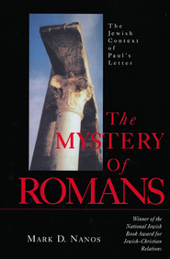
When I was preparing for last week’s Sunday school class for the study on Romans 10:1-13, I decided to read the entire Epistle to the Romans. I’ve studied Romans before, principally using the Mark Nanos book The Mystery of Romans, but there’s something to be said for just reading the Bible and letting it speak to you.

I prefer, when I can, to read entire books in the Bible rather than just a few verses at a time. Imagine reading your favorite novel three or four sentences at a time, then putting the book down for four days, picking it up and reading another few sentences.

First of all, it would take you forever to get through the novel and secondly, you probably would have a tough time keeping the book’s overarching narrative in your mind as a complete story.

But we think nothing of treating the Bible or any of the books it contains as if it were a large collection of “sound bytes”.

Paul wrote each of his letters to be read as a whole, including Romans. Why don’t we read them that way? The impression we get of the epistle (or any other single book in the Bible) will probably be different and perhaps yield a more complete impression in the mind of the reader.

Alas, I can’t review the whole epistle to the Romans in a single blog post, so I’ll have to break my own rule. But I can use a series of blog posts to communicate my overall impression of Romans a few chapters at a time? Hopefully, that will be sufficient.

None of this is scientific or scholarly. I don’t read Biblical Greek and I didn’t use any references or other study aids while reading Romans. I just read Romans and took notes on the margins of the pages as I was reading. That’s what I’m going to share with you.

Oh, these are just impressions. Little bits and pieces that I picked up in my overall read of the letter. I’m not going to comment on all the verses in each chapter. Just what prompted me to write a note down.

Take it for what it’s worth.

The first thing I noted in my reading of Romans was the above-quoted verses. Paul was not ashamed of the Good News of Messiah. That good news is the “power of God for salvation to everyone who believes, to the Jew first and also to the Greek.”

What is “salvation?” We like to think that it’s as simple as being saved from the consequences of our sins and being reconciled to God, but remember, for Jesus and for Paul, based on the New Covenant promises, having your sins forgiven is only the first step.

The New Covenant promises are aimed solely at the Jewish people and the nation of Israel, and include restoring national Israel to its former glory and elevating her as the head of all the nations of the world. It’s the promise that Israel’s Messiah King will rule with justice and mercy, not over just Israel, but the nations of the Earth. It’s the promise that Messiah will completely end the Jewish exile and return all Jews to their nation. It’s the promise to rebuild the Temple and to restore the sacrificial system in accordance to the commandments. It’s the promise to defeat all of Israel’s enemies and bring them (us) under subjugation. It’s the promise to establish a reign of worldwide peace and tranquility. It’s the promise of the resurrection for the just, that they (hopefully, we) will live in the resurrection under Messiah’s reign, for that is the hope of our faith. It is the promise…

You get the idea.

So when Paul says something as simple as “power of God for salvation to everyone who believes, to the Jew first and also to the Greek,” he’s really saying all of the stuff I put into the previous, large paragraph. That’s why it’s first to the Jew. Because promises were made to the Jewish people. Gentiles, by God’s mercy and favor, get to come along for the ride…but I’ll get to that in a subsequent blog post.

For even though they knew God, they did not honor Him as God or give thanks, but they became futile in their speculations, and their foolish heart was darkened.

Romans 1:21 (NASB)

balaam_israelI read this the same weekend I read Torah Portion Pinchas and hopefully you’ll see the connection. After Israel was spared being cursed and was in fact blessed by the Gentile prophet Balaam, Balaam had the “brilliant” suggestion to have Moabite and Midianite women seduce the men of Israel sexually to incite them to worship their (foreign) gods.

It worked. If not for the zeal of the Kohen Pinchas (Phinehas), the plague of Hashem might have consumed the whole nation:

The Lord spoke to Moses, saying, “Phinehas, son of Eleazar son of Aaron the priest, has turned back My wrath from the Israelites by displaying among them his passion for Me, so that I did not wipe out the Israelite people in My passion. Say, therefore, ‘I grant him My pact of friendship. It shall be for him and his descendants after him a pact of priesthood for all time, because he took impassioned action for his God, thus making expiation for the Israelites.'”

The name of the Israelite who was killed, the one who was killed with the Midianite woman, was Zimri son of Salu, chieftain of a Simeonite ancestral house. The name of the Midianite woman who was killed was Cozbi daughter of Zur; he was the tribal head of an ancestral house in Midian.

The Lord spoke to Moses, saying, “Assail the Midianites and defeat them—for they assailed you by the trickery they practiced against you—because of the affair of Peor and because of the affair of their kinswoman Cozbi, daughter of the Midianite chieftain, who was killed at the time of the plague on account of Peor.”

When the plague was over…

Numbers 25:10-19 (JPS Tanakh)

The Israelites knew God but they did not honor Him.

There’s also the corresponding Psalm for this Torah Portion:

But to the wicked God says,
“What right have you to tell of My statutes
And to take My covenant in your mouth?
“For you hate discipline,
And you cast My words behind you.
“When you see a thief, you are pleased with him,
And you associate with adulterers.
“You let your mouth loose in evil
And your tongue frames deceit.
“You sit and speak against your brother;
You slander your own mother’s son.
“These things you have done and I kept silence;
You thought that I was just like you;
I will reprove you and state the case in order before your eyes.
“Now consider this, you who forget God,
Or I will tear you in pieces, and there will be none to deliver.
“He who offers a sacrifice of thanksgiving honors Me;
And to him who orders his way aright
I shall show the salvation of God.”

Psalm 50:16-23 (NASB)

Even in the condemnation of the faithless and the wicked, God still offers a path back to salvation and redemption.

Or not…

And just as they did not see fit to acknowledge God any longer, God gave them over to a depraved mind, to do those things which are not proper, being filled with all unrighteousness, wickedness, greed, evil; full of envy, murder, strife, deceit, malice; they are gossips, slanderers, haters of God, insolent, arrogant, boastful, inventors of evil, disobedient to parents, without understanding, untrustworthy, unloving, unmerciful; and although they know the ordinance of God, that those who practice such things are worthy of death, they not only do the same, but also give hearty approval to those who practice them.

Romans 1:28-32 (NASB)

teshuvahGod always offers a way back, but you have to be willing to take it. You can only access the path of teshuvah and return to God if you repent of your sins. If you don’t, if you are guilty of what the above-quoted verses state, if you fail to acknowledge God, then God, according to how I read Paul, will give you enough rope to hang yourself with.

Or do you think lightly of the riches of His kindness and tolerance and patience, not knowing that the kindness of God leads you to repentance?

Romans 2:4 (NASB)

God doesn’t always “drop the hammer” the minute we stray from the path of light and into darkness. In fact, often he just lets us do what we want to do, and it’s easy to take that as a sign that God doesn’t seem to mind. No, that’s not it. He’s giving us the rope with which to hang ourselves, but he’s also giving us time to realize how badly we’ve messed up. He’s giving us time to repent. For when our time is up, then and only then will it be too late.

He thereupon says to them, “Permit me to go repent!” And they answer him and say, “You fool! Do you know that this world is like the Sabbath and the world whence you have come is like the eve of the Sabbath? If a man does not prepare his meal on the eve of the Sabbath, what shall he eat on the Sabbath?”

-from Ruth Rabbah 3:3
quoted by Young in
Chapter 15: Death and Eschatology: The Theology of Imminence, pp 281-2
The Parables: Jewish Tradition and Christian Interpretation

I quoted this yesterday and for the same reason. To illustrate that we have lots and lots of time, at least as humans measure time (but maybe not as much time as we think), but in the end, God’s justice prevails. Don’t take God’s patience lightly.

There will be tribulation and distress for every soul of man who does evil, of the Jew first and also of the Greek, but glory and honor and peace to everyone who does good, to the Jew first and also to the Greek. For there is no partiality with God.

Romans 2:9-11 (NASB)

I found this rather sobering. God puts the Jew first in both good and evil. If the blessings of the New Covenant come to the Jew first, so does tribulation and distress. There’s a definitely negative aspect to being at the center of God’s attention. I read “no partiality” both as God delivering consequences equally upon the Jew and Greek and as God not being partial to Israel giving her only good but not evil.

For all who have sinned without the Law will also perish without the Law, and all who have sinned under the Law will be judged by the Law…

Romans 2:12 (NASB)

under-law-torahIt seems that Jews will be held to a higher standard than Gentiles. But was Paul writing to believing and unbelieving Jews and to pagan Gentiles when he said “under the Law” and “not under the Law”? Paul was writing to the “church” in Rome, which Nanos said was more likely to the believing and non-believing Jews and the believing Gentiles in the synagogue. Paul had no audience with the pagans and his letter wasn’t addressed to them. So who is under the Law and not under the Law? Were the believing Gentiles under the Law?

…for it is not the hearers of the Law who are just before God, but the doers of the Law will be justified. For when Gentiles who do not have the Law do instinctively the things of the Law, these, not having the Law, are a law to themselves, in that they show the work of the Law written in their hearts, their conscience bearing witness and their thoughts alternately accusing or else defending them, on the day when, according to my gospel, God will judge the secrets of men through Christ Jesus.

Romans 2:13-16 (NASB)

This is getting very close to something like having the law “written on hearts,” for how would Gentiles who were not given the Law at Sinai “instinctively” know to do the things of the Law? And what did they do? Did Gentiles “instinctively” put tzitzit on their garments and lay tefillin? Did they “instinctively” start observing the Shabbat and keeping kosher? Or is being kind, gracious, and compassionate a more “instinctive” response in doing the Law?

If Paul is talking about Gentiles who are already disciples of Jesus, then they would possess the Holy Spirit and the finger of God would be just beginning to write the Law upon their hearts.

But the Jewish believers (and non-believers) already had the Law.

But if you bear the name “Jew” and rely upon the Law and boast in God, and know His will and approve the things that are essential, being instructed out of the Law, and are confident that you yourself are a guide to the blind, a light to those who are in darkness, a corrector of the foolish, a teacher of the immature, having in the Law the embodiment of knowledge and of the truth, you, therefore, who teach another, do you not teach yourself?

Romans 2:17-21 (NASB)

Is it possible to take a gift for granted. Were there Jews who relied on outward behavior alone to justify them before God. Yes, it is the “doer” of the Law who is made righteous, but only by faith. Performing the mitzvot without faith is not effective. See Psalm 50 above if you don’t believe me.

Hopefully, a believing Jew would not take the Torah for granted, but if Nanos is right, Paul was also writing to Jews who were not believers in Jesus as the Messiah, and some of them may have strayed from their faith, relying on behavior and ethnic identity alone to justify them before Hashem. This is Paul’s dire warning to his brothers.

…you, therefore, who teach another, do you not teach yourself? You who preach that one shall not steal, do you steal? You who say that one should not commit adultery, do you commit adultery? You who abhor idols, do you rob temples? You who boast in the Law, through your breaking the Law, do you dishonor God? For “the name of God is blasphemed among the Gentiles because of you,” just as it is written.

Romans 2:21-24 (NASB)

Hypocrisy? Jesus accused his brothers among the Pharisees of hypocrisy more times than I can count.

Then Jesus spoke to the crowds and to His disciples, saying: “The scribes and the Pharisees have seated themselves in the chair of Moses; therefore all that they tell you, do and observe, but do not do according to their deeds; for they say things and do not do them.”

Matthew 23:1-3 (NASB)

PhariseesI’ve quoted Noel S. Rabbinowitz’s paper Matthew 23:2-4: Does Jesus Recognize the Authority of the Pharisees and Does He Endorse Their Halakhah (PDF) more than once to illustrate while Jesus accused at least some of the Pharisees of not practicing what they taught, he confirmed that what they taught was correct, and that they had the proper authority to be teachers in Israel.

Applying that forward to Paul, he may well have accused some of the Jews in the Roman synagogues of hypocrisy but at the same time acknowledged what they taught was correct and that they had the authority to teach in the synagogues. Thus, Paul was criticizing the hypocritical practices of some of his audience, not their validity as Jews nor the validity of the Torah as a continued covenant obligation for Jews.

But someone may well say, “You have faith and I have works; show me your faith without the works, and I will show you my faith by my works.” You believe that God is one. You do well; the demons also believe, and shudder. But are you willing to recognize, you foolish fellow, that faith without works is useless? Was not Abraham our father justified by works when he offered up Isaac his son on the altar? You see that faith was working with his works, and as a result of the works, faith was perfected; and the Scripture was fulfilled which says, “And Abraham believed God, and it was reckoned to him as righteousness,” and he was called the friend of God.

James 2:18-23 (NASB)

Faith and works are required. They come as a set. You cannot properly separate them. Faith without works is dead but so is works without faith.

Make no mistake though. God fully intended (intends) for Jews to observe the mitzvot.

“For this commandment which I command you today is not too difficult for you, nor is it out of reach. It is not in heaven, that you should say, ‘Who will go up to heaven for us to get it for us and make us hear it, that we may observe it?’ Nor is it beyond the sea, that you should say, ‘Who will cross the sea for us to get it for us and make us hear it, that we may observe it?’ But the word is very near you, in your mouth and in your heart, that you may observe it.

Deuteronomy 30:11-14 (NASB)

That completely shoots down any Christian argument that God gave the Jews the Law to prove how impossible it would be to keep, thus showing them that they could only be “saved” by faith and grace alone, apart from the Torah.

For indeed circumcision is of value if you practice the Law; but if you are a transgressor of the Law, your circumcision has become uncircumcision. So if the uncircumcised man keeps the requirements of the Law, will not his uncircumcision be regarded as circumcision? And he who is physically uncircumcised, if he keeps the Law, will he not judge you who though having the letter of the Law and circumcision are a transgressor of the Law? For he is not a Jew who is one outwardly, nor is circumcision that which is outward in the flesh. But he is a Jew who is one inwardly; and circumcision is that which is of the heart, by the Spirit, not by the letter; and his praise is not from men, but from God.

Romans 2:25-29 (NASB)

If a Jew fails to perform a mitzvah, does he stop being a Jew? Does he become “uncircumcised?” This used to puzzle me. The whole “For he is not a Jew who is one outwardly, nor is circumcision that which is outward in the flesh” thing has been used to justify calling Christians “spiritual Jews” and to support the old, tired theology of supersessionism. But I don’t think that’s what Paul is saying.

Paul is trying to inspire zeal for the Torah and for faith in Messiah in his non-believing Jewish brothers in Rome. How would he do that by insulting them and rejecting them? Worse, how would he do that by denigrating the Torah? He couldn’t.

JewishBut he could be saying that a Jew is justified before God if he is outwardly a Jew, that is, if he is obedient to the commandments, and if he is inwardly a Jew, that is, if he has faith in God and that faith is the motivation for obedience. The two go together…faith and works.

I had intended to cover Chapter 3 as well in this first “reflection” but I can see this “meditation” is long enough as it is.

This is an experiment of sorts, so let me know what you think. Should I continue writing my reflections of Romans for the entire epistle?

Next up: Reflections on Romans 3.

The Nangeroni Seminar on the Jewish Apostle Paul

I returned last night from a very enjoyable trip to Rome to take part in the Nangeroni Seminar on “Paul as a Second-Temple Jew.” For more information on the Nangeroni Seminars click here. This encouraging and demanding event brought together about 35 scholars from various countries who are specialists on second-temple Judaism and/or the Apostle Paul. The premise and the broad conclusion to which all assented is that Paul was and remained in his ministry as apostle to gentiles a Jew. He did not renounce his identity as a member of the Jewish people. He did not demonize his ancestral religion. He did not reject the Torah (“Law”) as false. He did not regard his Jewish past as one of frustration, failure, inability to observe Torah, or as something to escape. He did not play off the particularity of his Jewishness in favour of some kind of universalism.

-Dr. Larry Hurtado
“Paul: The Second-Temple Jewish Apostle to the Gentiles”
Larry Hurtado’s Blog

In case you need a quick background on who Larry Hurtado is and what his qualifications are as a New Testament scholar, you can either Google him or read his Wikipedia page.

I’ve quoted Dr. Hurtado before on my blog and always for two reasons. One is that he is a noteworthy, mainstream Christian New Testament scholar who is currently active in his research, he’s well-respected in his field, and he has published extensively both in scholarly venues and in popular reading. The second reason I refer to him is that he has what I consider to be a fascinating view of Paul’s Christology and one that many “average” Christians might find surprising.

I’ve complained in the past that the latest findings of Christian scholarly research never find their way to the pulpit of the normative Evangelical church let alone into the hands and minds of Evangelicals sitting in their pews every Sunday.

More’s the pity.

That means as Christians, we have to go looking for this information, which isn’t that hard to find. After all, Dr. Hurtado’s books are easily found at Amazon and he maintains a WordPress blog.

Nevertheless, a statement such as the one I quoted above, would almost never be heard in any American church on Sunday, either in a sermon or a Bible study class.

What we hear, or rather, what I hear in the church I attend, is somewhat similar to how men like Pastor John MacArthur view Paul relative to Judaism and Christianity. I’ve reviewed the relevant sermons given by Pastor MacArthur in a three-part series (Part One, Part Two, and Part Three) on my blog, but in short, MacArthur believes that any practice of Judaism by Paul or the other Apostles was a “transitional period” between the end of the Law (Torah) and the beginning of the Christian era of grace. That is, from God’s point of view, Judaism was expected to cease as a valid and normative worship and religious practice in devotion to God through Christ (Messiah).

The Jewish PaulAnd yet, compared to “35 scholars from various countries who are specialists on second-temple Judaism and/or the Apostle Paul” all gathered together who agree that Paul “did not renounce his identity as a member of the Jewish people,” nor did he “demonize his ancestral religion,” did not “reject the Torah (“Law”) as false,” and “did not regard his Jewish past as one of frustration, failure, inability to observe Torah, or as something to escape,” opinions such as the one from MacArthur and most other Evangelical Pastors seem as archaic as dinosaurs.

I don’t say this to be unkind, nor do I “resurrect” my arguments about MacArthur just because I can. I’m trying to illustrate (again) for my Christian readers and for any other Christians who possibly will find my writings by “surfing the web,” that what we’re typically taught in church about Paul (and thus about Jesus) isn’t necessarily the most accurate information we can acquire. The majority of what is taught in most churches (as far as I can tell) is based more on the traditions we’ve built around Biblical exegesis than on active and modern Biblical research.

Studying the Bible isn’t supposed to be for the purpose of endlessly regurgitating what we have already been taught for years or even decades, it’s to discover what we may not know or understand about the message of the Bible, and thus to better understand God and who we are in Christ.

Science, in its broadest possible sense, is the testing and retesting of beliefs and observations to determine if they are valid. If we test a belief, an assumption, or a theory through objective means and the test validates our belief, that’s fine and well. However, if we apply such a test to a belief and we discover it to be invalid or at least questionable, then that demands an investigation…

…doesn’t it?

My experience in church and especially in Sunday school, is that the apparent purpose of Bible study is to confirm what we already know, which provides us with doctrinal and emotional security. Cooperation and agreement of opinions are emphasized and variations in beliefs are tolerated only if those variations are slight and conform to established and accepted parameters.

Heaven help someone in Sunday school if they were to say that not only did Paul remain Jewish and devoted to the Torah of Moses, but that he saw absolutely no inconsistency between continuation of Torah observance and worship of Jesus as the Messiah within a variant of normative first century Judaism. Within the Sunday school context, that statement would at least raise a few eyebrows if not be considered an extremely radical suggestion.

And yet we have thirty-five scholars and experts in Paul and/or the late second temple period who uniformly agree on exactly that “extremely radical suggestion.”

Larry Hurtado
Larry Hurtado

But I don’t want to put words in Dr. Hurtado’s mouth. After all, he’s said that Paul did not see an inconsistency between being Jewish, practicing Judaism and the prophetic revelation of Jesus as Messiah. But does that mean, at least from Hurtado’s perspective, that Judaism should have continued to be the religious framework for Jesus-worship and will be in the coming Messianic age? After all, I’ve previously written about the rather ugly divorce that occurred between Gentile and Jewish Jesus-believers. Could the relationship between Jesus-believing Jews and Gentiles have been saved or will it be restored in the future?

I asked Dr. Hurtado the following on his blog:

Dr. Hurtado, I don’t know if you can answer this question but it’s one I need to ask. I attend a rather conservative Evangelical church. The Pastor preaches that although Paul continued to live as a Jew after his “conversion” to Christianity, the continuation of his (and the other Jewish apostles) Jewish practice was always considered by God to be a “transitionary period.” Judaism was expected to cease as a normative approach to God through Christ and be replaced by “the Church” which would “retire” Jewish practices and replace them with a “law-free” body of Jewish and Gentile believers.

If, as you say, Paul saw the worship of Messiah as a variant of Jewish practice in his day, is it reasonable to believe that he expected Jesus-worship to remain a variant Judaism that included a Gentile component not required to undergo the proselyte rite? That is, was (Gentile) Christianity always destined to replace Judaism in the worship of Christ or was/is it expected that worship and devotion to Christ was to remain a Judaism that included Gentiles?

To which he replied:

James: To engage your question involves speculation . . . about what Paul might have imagined that the future would comprise, how much of a future there would be to his present world, etc. The intense eschatological hope/expectation that seems reflected in Paul’s letters has led some scholars to judge that Paul’s vision of the “ekklesia of God” as both comprising Jewish believers (who continued to practice Torah as Jews) and non-Jewish believers was not viable over the long haul. Historical events of the first couple of centuries after Paul’s time can be invoked in justification for this judgement. But one might also ask whether the problem was an inherent problem in Paul’s vision, or whether other factors, including the Jewish war of 66-72 CE and other things (including a failure of many Christians of that time to grasp Paul’s vision) contributed to the emergence of a mainly gentile “Christianity” distinguished from a “Judaism”. For one view, I recommend a book by my friend, the late Alan F. Segal, Rebecca’s Children: Judaism and Christianity in the Roman World (Cambridge, MA: Harvard Univesity Press, 1986).

In any case, Paul didn’t undergo a “conversion” to “Christianity.” He refers to his experience as a prophet-like “calling” (e.g., Gal. 1:13-15), and there was no “Christianity” (as a separate religion) to which he could “convert” as a Jew. We could describe the former “pagans” (gentiles) that formed his churches as “converting” from the worship of their various ancestral deities to the God of the Bible/Israel.

So, to break this down:

  • We would have to speculate about how Paul thought the future Messianic movement would develop since we cannot definitively know from his writings.
  • Some scholars judge Paul’s vision of the “ekkelsia of God” as being made up of formerly pagan Gentiles and Torah observant Jews was not a viable model and could not persist over time.
  • History seems to validate the viewpoint of scholars who did not expect the Jewish/Gentile ekkelsia to endure.
  • We don’t know if this is because there was an inherent flaw in Paul’s vision or if various factors including the Jewish revolt contributed to the outcome of a splitting off of Gentile Christianity from Judaism.

In other words, as Dr. Hurtado outlines things, we can’t really know, based on a scholarly understanding of Paul’s letters, what he expected the future to hold. We also can’t really tell if Paul’s vision of the “ekklesia of God” was flawed and thus could not endure as he attempted to construct it, or, assuming his model was fine, if history conspired to destroy Messiah-worship as a normative Jewish practice going forward in time.

beth immanuelIt’s also possible, as Hurtado states, that one of the factors was the Gentile inability to grasp Paul’s vision, although from other books and papers I’ve read, plus my own understanding of the relevant sections of the New Testament, it seems as if the other streams of Judaism in Paul’s day had an equally difficult time accepting Paul’s concept of non-proselyte Gentiles entering a Jewish social and religious space.

I did like Hurtado verifying for me that Paul indeed did not “convert to Christianity” as is preached in many churches (including the one I currently attend), and that his experience in Acts 9 and later was a “prophet-like calling” that revealed the identity of the Messiah within a wholly Jewish experience. This sent Paul on a mission to the Jews and Gentiles, not unlike how God would call upon and task the prophets of old. Paul would have “converted” to “the Way” as I suppose a Jewish person of that era would have “converted” from one branch of Judaism to another (Sadducee to Pharisee for example), although I have no idea how common that sort of thing would have been in those days (and my understanding is that “the Way” was very similar in most respects to Pharisaism apart from it’s very liberal attitude about Gentile admission and, of course, devotion to a known-Messiah).

The only real converts would be Gentiles, since they would be exiting their worship of the various pagan gods and begin worshiping the God of Israel through faith in Israel’s Messiah.

While Hurtado presented me with something of a scholarly “dead-end” in my quest to develop the idea that Judaism was the proper context for Jesus-faith and possibly that it will be again in the Messianic age (since this requires some speculation), I’ll still proceed from that speculative platform for lack of any better place to stand.

My reading of Magnus Zetterholm, Mark Nanos, and others leads me to believe that while a Gentile/Jewish schism did take place splitting Jesus-faith into two camps and ultimately extinguishing the body of Jewish Jesus-faith, that doesn’t necessarily invalidate Judaism as a context for devotion to Messiah, complete with the continuation of Torah observance in response to their covenant relationship with God.

What will the future bring? I have my own ideas about that, but I suppose in an ultimate sense, we’ll have to wait and see about the exact details of the unfolding of the Messianic Era.

Since Dr. Hurtado suggested it, I went ahead and ordered the book he referenced (see the quote above) and I look forward to reading it when it arrives.

I intended to publish this tomorrow or maybe on Sunday, but then I realized we are rapidly approaching a major (American) national holiday weekend and I can expect a significant drop off in my readership over those three days, so I’m offering this to you now as an “extra meditation”. Have a good, fun and safe Independence Day and for those of you who observe it, a Good Shabbos.

Addendum: Dr. Hurtado published another blog post today, based on his time at the Nangeroni Seminar, called Paul and Gentile Circumcision. I definitely recommend it.

Zetterholm, Nanos, Ancient Antioch, and Some Implications

…and the disciples were first called Christians in Antioch.

Acts 11:26 (NASB)

I mentioned in my previous blog post, Zetterholm, Ancient Antioch, and “Honey, I Want a Divorce”, that I wanted to discuss the implications of the final chapter in Magnus Zetterholm’s book The Formation of Christianity in Antioch on a number of different religious communities.

Obviously, there are implications for the modern Church, but also I see how ancient and modern Judaism is significantly impacted, as are the Messianic Jewish and Hebrew Roots movements. I’ll take each one in turn.

Christianity

Based on what Zetterholm concluded regarding the forced separation of Gentiles and Jews in the Jesus-believing communities which resulted in Gentiles forming their (our) own brand new religion called “Christianity,” we can see that we weren’t kicked out of Jesus-believing Judaism. We rebelled like a petulant teenager and walked out the door. Certainly if Saint Ignatius of Antioch can make a statement such as, “[i]t is monstrous to talk of Jesus Christ and to practise Judaism” (Magn. 10:3 quoted by Zetterholm on pg 203), we aren’t talking about a “no-fault divorce.” The “Church Fathers” went out of their way to “demonize” Judaism and separate any “valid” worship of Jesus Christ from anything related at all to the Jews.

We noted above that Ignatius in Phld. 6:2 connected Judaism with the activities of “the prince of this world,” and that he in Magn. 8:1 probably used popular prejudice against the Jews in describing Judaism as being based on myths and fables.

It is well known that, in the decades after the death of Ignatius, Christian literature abounds in developing anti-Semitic themes.

-Zetterholm, pg 210

It is likely, as Schoedel states, that the identification of Christ as the word from silence refers to the supposed inability of the Jews to understand their own religious tradition: the appearance of Christ from silence brings the divine hidden purpose to light. The radical “Christianization” of the prophets is one indication of how profound this inability is, and how extensive the hostility is between Judaism and Christianity.

-ibid, pg 220

I know I’ve quoted these passages from Zetterholm’s book previously, but they’re important for context. As the history of the Church attests, these attitudes weren’t isolated to the first few centuries of the Common Era, they’ve echoed down the corridors of time from Ignatius of Antioch to the modern Christian Church with predictable results on Jews and Judaism. True, we no longer torture Jewish people in order to force them to convert or exile them from our nations, but we aren’t always “safe,” either.

Sarah (not her real name) is a young Jewish woman, an academic, raised in Orthodox Jewish life, who came to believe in Yeshua in a remarkable manner some years ago. Having been greatly sheltered in her upbringing, and knowing nothing about either Protestants or Messianic Jews, she wanted to serve Yeshua in an academic setting. She therefore joined the Dominicans, a teaching order of the Roman Catholic Church. She reasoned that they would allow her to teach freely in her field. In this she was right: as an excellent teacher, she was allowed to freely teach. She also assumed, on the basis of her limited knowledge of the early Yeshua movement, that she would be allowed to live as a Jew while she served Yeshua amongst the Dominicans. In this, she was wrong. Her superiors were at first amused at her adherence to Jewish life, then annoyed, and then intolerant. She was thrown out for her unacceptable adherence to Jewish life. This is a true story, and really, nothing new. It should not have surprised Sarah, but it did. And it shouldn’t surprise the rest of us either.

-Rabbi Dr. Stuart Dauerrman
“Signals: The Interfaithfulness Newsletter”
from May 12, 2014

St. dominic
Saint Dominic

I know Evangelicals are going to point out that Dominicans (Roman Catholics) were responsible for rejecting Sarah’s Jewish observance, but imagine how a Jewish believer would be received in a Protestant church if she were to continue significant Jewish observance such as kashut and Shabbat.

You might not think it would be an issue, but consider. Should “Sarah” show up at your church for a communal meal, how would you feel if she passed up the ham and took a salad instead? What if she kept an even more strict form of kosher and wouldn’t eat unless the meal had been prepared in a kosher kitchen (which church kitchens and Christian homes would not possess)? How would you feel if “Sarah” visited your home for a Bible study on Friday afternoon but after sunset, chose to walk back to her home and even refused a ride from you because it was Shabbat? You might be amused for a while but I suspect, like the Dominicans in the tale above, amusement would give way to annoyance and finally, intolerance. We haven’t come so far from the writings and attributes of Ignatius after all.

The Church has much to repent of.

Note: For those who feel I’m being overly hard on the Christian Church, especially the modern community of Christ, please continue to read. I’ll address this matter further at the end of today’s blog post.

Judaism

It is likely, as Schoedel states, that the identification of Christ as the word from silence refers to the supposed inability of the Jews to understand their own religious tradition: the appearance of Christ from silence brings the divine hidden purpose to light. The radical “Christianization” of the prophets is one indication of how profound this inability is, and how extensive the hostility is between Judaism and Christianity.

-Zetterholm, pg 220

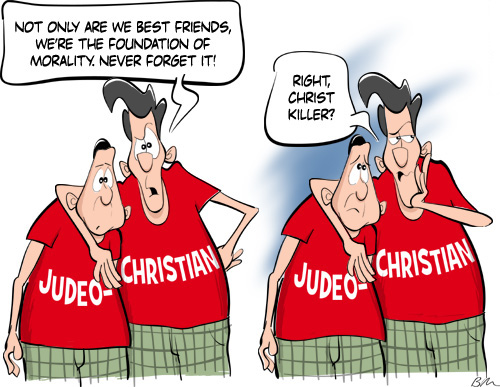
Dovetailing on my previous statement, the modern Church still gives religious and even secular Jews reason to question their (our) motivation for any form of approach to them. My experience tells me that most often, Jews are politely cautious when a Christian enters Jewish religious or social space or conversely, invites them into our space. We speak of “interfaith relationships” or “interfaith events” but there really is no such thing as a “Judeo-Christian” shared experience. The minute those two concepts entered the world, they existed in opposition to one another.

Why should Jews trust Christians? Why shouldn’t organizations such as Jews for Judaism believe there is a (perceived) threat represented by the Christian Church, including organizations like Jews for Jesus?  I’m not saying Jews for Jesus is a bad organization and that the Church is necessarily an active threat against Jewish faith and practice, but the best predictor of future behavior is past behavior. If you want to know how the Church is going to act toward Jews in the future, look at Church history.

I’m saying that Jewish people have a reason to be dubious about Christianity and that all began nearly two-thousand years ago. Sadly, Jews and Christians really do have a shared history but it’s not a positive one.

The Church has much to repent of.

Note: This doesn’t mean that Judaism in all its expressions is perfect or hasn’t made it’s mistakes, but rarely is Judaism in a position as an extreme minority in our world to “throw its weight around,” so to speak. Through the vast majority of the history of the Jewish people, they’ve been much too busy just trying to survive.

Hebrew Roots

This is an “umbrella category” designed to cover just about any Gentile Christian organization, small group, or fellowship that specifically identifies itself as seeking the “Hebrew roots” of the Christian faith and who adopt an altered theology, doctrine, and practice based on some sort of “Hebraic” perspective on the Bible.

It’s probably unfair of me to treat Hebrew Roots as a single entity given what I’ve just said, since it is comprised of so many divergent groups and attitudes, but then, that’s pretty much true of Christianity and Judaism as well.

Praying with tefillinOne of the (more or less) commonalities within Hebrew Roots is the belief that Hebrew/Jewish practices are also incumbent upon any Gentile who is a believer in Jesus. This usually includes some sort of practice based on modern synagogue worship including praying with a siddur, donning of a tallit gadol (for men, usually), wearing a kippah (again, usually for men), and other acts that superficially create the impression that these Hebrew Roots practitioners may be Jewish.

We saw in Zetterholm’s book that Gentiles participating in the ancient Jewish synagogue of “the Way,” were sometimes mistaken as Jews due to their association with Jews and likely many of their practices and lifestyle behaviors, so it’s possible to extrapolate that situation into modern Hebrew Roots. But there’s a problem. In ancient times, Gentiles adopted some Jewish practices and behaviors because they were operating within a Jewish religious and social context and were being mentored by Jewish teachers and synagogue leaders. Hebrew Roots operates in total separation from Jewish community and often is denigrating of much of Rabbinic Judaism.

Hebrew Roots tends to believe they practice a form of “Biblical Judaism” as opposed to “Rabbinic Judaism,” and as a result, they reject many of the practices and conceptualizations that are associated with modern or historic Judaism. In this, they somewhat mirror the original Church Fathers who separated their own practice from Jewish authority and community, creating a self-sustaining entity that by necessity, operated in opposition to the normative Judaisms of its day.

Like many Evangelicals, many Hebrew Roots groups have sort of “love/hate” relationship with modern Judaism, mainly because of Rabbinic Judaism’s insistence that they have the right to make internally binding rulings and the ability to govern their own communities.

Note: Hebrew Roots has a lot of different expressions, some of which are truly serving God, helping others, and teaching the good news of Messiah. I worshipped with one such group for many years and my companions were Godly and humble people. But Hebrew Roots is kind of like the “wild west,” where anything can happen and where anyone with a kippah and a theological ax to grind can dub themselves a “Messianic Rabbi” and draw a following. Be cautious.

Messianic Judaism

Like the other groups I’ve discussed above, there is no single, monolithic organization called “Messianic Judaism”. All Messianic Jewish groups have certain things in common, but the details of their theology, doctrine, and practice are variable.

One thing all Messianic Jewish groups (at least in the U.S.) have in common is the majority of their members are not Jewish. The ancient Antiochian Synagogue of the Way, while “owned and operated” by a Jewish leadership and Jewish teachers, was also inclusive of Gentiles, though there’s no way to determine the ratio of Jews to Gentiles in their midst.

Messianic Judaism, for this reason, faces some or even most of the same challenges as did the apostle Paul’s mixed Jewish/Gentile Jesus-believing communities, principally the issue of integration. As my previous blog posts on Antioch, Zetterholm, and Nanos attest, the issue of integration was of paramount importance and at the same time, hotly contested (see Galatians 2 for example).

That the Gentile Jesus-believers were included in the New Covenant blessings and part of the soteriological system of Judaism was not in question, especially to Paul, but the nature of their role and participation in a Jewish community and religious stream was still problematic. The Acts 15 ruling aside, we don’t really know how day-to-day life in the Messianic synagogue among Jewish and Gentile co-participants was negotiated.

That’s a question Messianic Judaism is trying to answer today as well.

We see from Zetterholm that, given the right social and political pressures, this could all blow up in their (our) faces (again). It’s one of the arguments in support of a concept Rabbi Mark Kinzer introduced called Bilateral Ecclesiology. Zetterholm seems to believe that James the Just, the brother of Messiah and leader of the Council of Apostles and Elders in Jerusalem supported an ancient version of Bilateral Ecclesiology, the establishment and maintenance of separate communities of Jews and Gentiles in Messiah.

Ironically, that’s exactly what happened historically, but with disastrous results.

judeo-christianBut that’s unfair and untrue. That’s not exactly what happened. Kinzer’s Bilateral Ecclesiology (and presumably James’) assumes that the separate Jewish and Gentile communities exist in a complementary fashion, sharing a common theology and doctrine (but not identical practice), maintaining a cordial but distant relationship with one another, while supporting the right of each group to maintain their own identity within an exclusive space. History has shown that the relationship between ancient Christianity and Messianic Judaism was anything but complementary and cordial, although distance was created, maintained, and expanded, usually due to animosity.

We noted above that Ignatius in Phld. 6:2 connected Judaism with the activities of “the prince of this world,” and that he in Magn. 8:1 probably used popular prejudice against the Jews in describing Judaism as being based on myths and fables.

It is well known that, in the decades after the death of Ignatius, Christian literature abounds in developing anti-Semitic themes.

-Zetterholm, pg 210

Zetterholm believes Paul opposed James’ view on separate Jewish and Gentile space in Messiah and that he believed in a shared community of Jewish and Gentile Jesus-believers. That said, shared space and social community doesn’t equal shared identity, role, and responsibility and that’s the rub. Did Paul have a clear vision of exactly how Jews and Gentiles were to exist in community with each other in all the details?

The Didache might be one possible answer to that question since one suggested origin for this teaching is with the apostles or those close to the apostles. The Didache may have started out as an oral teaching that accompanied the spread of the “Jerusalem letter” (Acts 15) among the diaspora Gentiles in community with Jesus-believing Jews.

Note: As I’ve mentioned above, Messianic Judaism includes a variety of different approaches to how a Jew may be a disciple of the Jewish Messiah and continue to be an observant Jew. In the days of Peter and Paul, this was a given. No one wondered how this was possible, it was simply understood. The problem was how to integrate Gentiles. That’s the problem today as well, and responses run the gamut from Jews-only Messianic groups to full social inclusion of Jews and Gentiles in the synagogue. I think of Messianic Judaism as a work in progress. Also, keep in mind that many Hebrew Roots groups call themselves “Messianic Judaism,” however once in, the distinction is obvious.

Conclusion

So here we are. The Church, if possessing any belief that it somehow has replaced the Jewish people and national Israel in the covenant promises, continues to have much to answer (to God) for. The Church has much to answer for if it continues to oppose Jews who have faith in Messiah and continue to observe the mitzvot of the Torah of Moses. Thankfully, an increasing number of churches are accepting Jesus-believing Jews who are Torah observant Jews, but we have a long way to go.

Hebrew Roots, while a noble effort to attempt to recapture what Jesus-believing Gentiles lost with the ascension of Gentile Christianity and the (ultimate) collapse of Jewish Jesus-faith, often chooses to throw the baby out with the bath water, so to speak. In trying to recapture and apprehend ancient Hebraic practices and implement them in the modern era, they many times utilize modern Rabbinic worship practices while rejecting historic and modern Rabbinic Jewish rulings and even fail to acknowledge the Jewish community’s right to self-govern and self-define. Gentile Christians seeking the Hebrew Roots of the faith might find a better model in those who have become known as Messianic Gentiles, but there are still many challenges involved when traveling that path, as I can personally attest.

Messianic Judaism continues to struggle forward toward not only its own identity, but the identity of the Gentiles in its midst and as the Apostolic record and Zetterholm’s research indicates, Messianic Judaism is characterized, in part, by the communal inclusion of the Gentiles. Perhaps they would have eventually developed a “bilateralness” in relationship with each other, but that doesn’t seem to have been what Paul was trying to create.

I offer no solutions to any of this, but if you think you have any, I invite you to comment. We may never know what would have happened if Paul’s vision of the mixed Jewish/Gentile ekklesia had been realized, but given our current situation, we’re obligated to take the next step forward, whatever that might be.

Notes on the Church

ChurchI know I’ve laid the lion share of the responsibility for the Jewish/Gentile split within the body of Jesus-believers at the feet of the then new religion called “Christianity.” Further, I continue to assign responsibility to the modern Church for its long history of abuses against Jewish people and Judaism. Am I being unfair? I suppose you could say so.

And yet, next Sunday at the church I attend, the Bible class being held after services will be teaching on Acts 21:15-26 and the class study notes pay special attention to the following verse:

You see, brother, how many thousands there are among the Jews of those who have believed, and they are all zealous for the Law… (emph. mine)

Acts 21:20 (NASB)

To me, this speaks of the thousands of Jesus-believing Jews in Jerusalem who all gave glory to God and were zealous for the Torah of Moses. But my teacher quotes John MacArthur in saying:

“Nowhere in the New Testament are the Jewish believers condemned for observing them (the so-called “ceremonial” aspects of the law). Paul nowhere taught Jewish Christians to abandon their Jewish heritage. God Himself was tolerant during this period of transition, knowing how difficult it was for them to break with their past.”

It never occurs to MacArthur, or to any of the Evangelical church Pastors or their lay staff, or to the congregations of all those churches, that the reason they don’t see God being critical of Jewish Jesus-believers performing the Torah mitzvot wasn’t “tolerance.” It was because God expected Jewish Torah observance as a matter of covenant obedience. It wasn’t an aberration or some quaint set of customs that Jewish people had a tough time letting go of, it was their very lifeblood, the linkage between God and the Jewish people, more so than ever with the realization that the Messiah was the inauguration of the living fulfillment of all of God’s promises to Israel.

Even in the most Israel-friendly, Jewish people loving churches, this attitude still remains, in spite of a great deal of scholarly evidence to the contrary. This is what the Church yet has to repent of and so far, they don’t even see the problem.

More’s the pity.

If “Sarah” were to show up in my Bible class next Sunday and give her interpretation of Acts 21:20, how would she be received? I don’t know how far to push in class over the troubling interpretation of this single bit of scripture (and it’s wider implications), but how can I remain silent in the face of everything I’ve just written?

Addendum: And then there are rather disturbing current trends in Christianity, such as the one presented at the Rosh Pina Project about who is expected to speak at Bristol Baptist College.

Nanos, Ancient Antioch, and the Problem with Peter

Paul told the Galatians of a time in Antioch when he “condemned” Peter “to his face” for failing to “walk straight toward the good news.” He attributed Peter’s change of mealtime behavior to a hypocritical effort to escape pressure from “the ones for the circumcision” (Gal 2:11-21). For before “certain ones came from James,” Peter “was eating with the Gentiles” but afterwards he “drew back and separated himself.

-Mark D. Nanos
“What Was at Stake in Peter’s ‘Eating with Gentiles’ at Antioch?” pg, 282 (pages 282-318) in The Galatians Debate. Edited by Mark Nanos. Peabody, Mass.: Hendrickson, 2002.

So begins Nanos’ article on a topic I’ve been exploring recently, the Messianic community of Jews and Gentiles in the “Synagogue of the Way” in first century CE Syrian Antioch, and more specifically, what is known as “the Antioch Incident” which involved the activity chronicled by the apostle Paul in Galatians 2:11-21.

While this article was included as a chapter (fifteen) in the book The Galatians Debate: Contemporary Issues in Rhetorical and Historical Interpretation, it also functions as a stand-alone paper which we can examine and from which we may be able to draw certain conclusions.

I’ve covered this material in two previous blog posts, both based on chapters from Magnus Zetterholm’s book The Formation of Christianity in Antioch: A Social-Scientific Approach to the Separation between Judaism and Christianity (See Zetterholm, Ancient Antioch and Today’s Messianic Judaism and Zetterholm, Ancient Antioch, and the Problem of the Gentiles). There is only one more chapter left in the Zetterholm book, which describes his perspective on the split between the Jewish and Gentile groups within the Messianic Antioch ekklesia (and ultimately all believing communities of that era), but someone suggested that I might want to review the Nanos paper on this topic first, since it may provide some clarification as to the actual problem between Paul and Peter as related to Gentile community and social status in this Jewish religious stream.

What Was at Stake in the Antioch Incident?

Nanos defines two “interpretive elements” that are “central for determining what was at stake” in “Peter’s eating or not eating with these Gentiles (pg 283):”

  1. What did the ones for the circumcision, whom Peter feared, find so objectionable about Peter’s eating with Gentiles?
  2. What did Paul find so objectionable about Peter’s decision to withdraw and separate from these mixed meals?

Keep in mind all this is from Paul’s point of view, so we don’t have the perspectives of Peter, the other Jewish believers (and unbelievers?) present, and particularly the Gentiles who were impacted by the incident.

According to Nanos, there are three possibilities as far as what the “ones advocating circumcision” could have found objectionable or offensive about Peter eating with the Jesus-believing Gentiles:

  1. The food served was objectionable according to Jewish dietary norms.
  2. Peter was violating halachah in even eating with Gentiles at all, even though the food was acceptable.
  3. It was the way Peter was eating with these Gentiles, rather than having a meal with them as such (and with the food being acceptable).

In trying to select an appropriate response, we also have to take Paul’s reaction into consideration. Which of these circumstances was most likely to elicit his offense and outrage and why?

Traditionally Paul has been understood to be upset because he maintained that faith in the gospel obviated continued regard for eating according to Jewish dietary regulations. But for Paul, did observing a Jewish diet compromise in principle “the truth of the gospel”? Or did he perhaps object instead to the degree of Jewish dietary rigor necessary to comply with the standards of those whom Peter feared? Or again, in a different direction, could it be that Paul understood that Peter’s withdrawal and separation undermined the identity of the Gentiles as equals while remaining Gentiles?

-Nanos, pg 284

At the church I currently attend (and I suspect at most or all Evangelical churches just about everywhere), it is assumed that the first and traditional Christian interpretation is obviously correct. Jesus canceled “the Law” including kashrut and Peter was eating ham sandwiches and shrimp scampi with his Gentile buds until other Jews who were “still under the Law” showed up and embarrassed Peter. Peter caved in to peer pressure and pulled away from eating trief with the goyim. Clearly for Evangelicals, the issue at hand was the food.

But before we get into whether this is actually supported by scripture or not, we need to identify the players. I used to think there were only two interest groups outside of Paul, Peter, Barnabas, and of course, the Gentiles present:

  1. The “certain men from James” who represented the “party of the circumcision” (Gal. 2:12 NASB).
  2. The rest of the Jews (Gal. 2:13 NASB) who “joined him (Peter) in hypocrisy.”

However, Nanos draws a distinction between the Jewish men from James and the advocates of circumcision as representing two different groups of Jews. Paul obviously knew the particulars and presumably, so did the intended audience of his epistle (Gentile believers in the Messianic synagogues in the area of Galatia), but because that understanding was assumed, this narrative doesn’t contain a lot of information to help us figure out who’s who.

Antioch Rubens“The rest of the Jews” probably isn’t a terribly significant group, according to Nanos. They could be local Jesus-believing Jews, or Jews who accompanied Peter from Jerusalem/Judea to Antioch (Peter’s personal disciples?).

More critical to grasp are the two other groups. From verse 12, the Greek describing the contingent from James is best translated, again according to Nanos, as ”certain/some ones came from James,” (pg 286) but doesn’t absolutely delineate whether James actually sent them or if they came from James but weren’t specifically his representatives.

This is important because in my previous blog posts citing Zetterholm, it was thought that Paul and James disagreed about the status of Gentiles in the Messianic Jewish community and even that James advocated for a total “bilateral” separation of Jewish and Gentile believers, while Paul supported covenant and social inclusion. It makes a difference if James sent this group to “spy out” the doings in the Antioch synagogue vs. this group was associated with James but didn’t directly represent his views.

The third group (pp 286-7), the ones Peter was actually afraid of (I guess this would mean he wasn’t afraid of the group from James), is simply identified as “circumcision” (Jews) as opposed to “foreskinned” (Gentiles). Why did Paul call this third group only “circumcision?” What did he mean? Were they believing or non-believing Jews?

It would seem odd, at least to me, for Paul to call this Jewish group “circumcision” in order to differentiate them from believing Jews (although according to one Pastor I’ve spoken with who represents the traditional Christian viewpoint, Paul was advocating against believing Jews becoming circumcised, though this should have happened when they were eight-days old, or having their male children circumcised). In Galatians 3:28, Paul wrote that Jews and Greeks are all “one in Christ” but he still differentiates Jews and Greeks, even as he differentiates men and women “in Christ.”

This would mean (and Nanos speaks of this on pg 287), that Paul and Peter self-identified as “Jews by birth” (v. 15…also see Rom. 9:3-5, 11:1; Phil. 3:3-5, and by inference, 1 Cor. 7:17-20), thus a Jew becoming a disciple of Messiah Jesus (Yeshua) did not remove the status of “Jew” from the Jewish person. In other words a Jesus-believing Jew and any other Jew are both considered Jews, with no distinction relative to their ethnic or (Sinai) covenant status. So Paul and Peter are just as Jewish as any other Jewish individual. Being called “circumcision” is only to differentiate Jews from the “foreskinned” Gentiles.

Citing Dunn (Dunn, “Echoes,” 460-61; see also, Dunn, Theology, 123, where he cites Rom 4:12; Col 4:11; Titus 1:10), Nanos states (pg 288):

…but an interest group specifically distinguished from other groups of circumcised Jews as advocates of circumcision.

And further:

Given the rhetorical context dealing with Gentile associates, the likely connotation of this particular advocacy is proselyte conversion.

The “circumcision” then are a group of Jews (believing or non-believing) who advocate for Gentiles in the Jewish religious space to gain equality with the “Jews by birth” only through the proselyte rite which includes circumcision.

This group represented the dominant viewpoint of Jewish communal norms (see Acts 15:1) relative to full Gentile inclusion in Jewish religious/communal space. Gentile God-fearers were attendees or guests in that space but were hardly considered of equal status to Jews in the synagogue and in Jewish society at large and they absolutely were not included in covenant.

fellowshipNanos presents what appears to be a new perspective (from an Evangelical Christian point of view) regarding the issue at hand. Paul considered the believing Gentiles as having equal status in the Jewish “Way,” both in terms of social status and covenant blessings, while still remaining Gentiles. In fact, Paul required that the Gentiles retain their status as Gentiles lest “Christ be of no benefit” to them (Galatians 5:2).

The problem was not food, and it was not a general ban of Jews eating with Gentiles (since in diaspora communities, the halachah for such mixed-meals would have to allow for some social intercourse), but rather non-proselyte believing Gentiles being treated as social and covenant equals within the Jewish community.

Nanos refers to v. 13 in terms of Peter and the other Jews as “masking their true conviction,” which will be seen as significant because:

Therefore, the Christ-believing Jews try to mask their convictions that these Gentiles are not regarded among their subgroups as mere “pagan” guests, but at the same time not as proselyte candidates either, by withdrawing from eating with Gentiles to distance themselves from meals symbolizing this nonconforming “truth.”

-ibid, pg 289

The “nonconforming truth” is that, through faith in Messiah, the Gentiles are considered equal co-participants in Jewish covenant and community while remaining Gentiles and with no intention of them ever participating in the proselyte rite. Something about the way Peter was eating with the Gentiles, indicated to outside Jewish observers, that Peter and the Jews with him considered the believing Gentiles as social/covenantal equals to the Jews, something that non-Jesus-believing Jews (or maybe Jesus-believing Jews from a different faction) found offensive and unsustainable.

Peter’s hypocrisy then, was pretending the Gentiles did not have equal social standing with the Jews of the Way when just previously, he had been eating with them as equals. Peter then included Barnabas and other Jews in his hypocrisy when his example resulted in their following his lead.

Nanos supports something that I’ve believed for a while now. The “offense of the cross” for non-believing Jews wasn’t Jesus himself, but rather Paul’s insistence that Jesus-believing Gentiles be included in the Jewish community as equal co-participants while remaining Gentiles.

Apostle Paul preachingA classic example of this occurred at Pisidian Antioch. In Paul’s first appearance and “sermon” there on Shabbat, the Jews and Proselytes were quite interested in Paul’s message of the good news of Messiah and wanted him to return the following Shabbat to say more (Acts 13:43). However, the following Shabbat, it was apparent that the Gentile God-fearers, present the previous week, had “spread the word” to their Gentile families and friends, most likely not God-fearers, but “straight up” pagans and idol worshipers, because “crowds” of Gentiles showed up at the synagogue (v. 45) resulting in “jealousy” among the synagogue leaders, and with them responding to Paul with “blasphemy” and evicting Paul and his companions from the synagogue and the entire district.

Getting back to the two groups, the ones from James and the advocates of circumcision for Gentiles, Nanos states that we don’t know how they are related or what the timing of the arrival of the first group has to do with the presence of the second group. It could be a coincidence, but in the Bible, I tend to think there is no such critter.

That describes a great deal about the situation but doesn’t answer the question about what was at stake in Peter eating with and withdrawing from the Gentiles at Antioch.

J.B. Lightfoot argues that before the withdrawal Peter “had no scruples about living [like a gentile],” that is, without observing Jewish dietary restrictions (“discard Jewish customs”), for the vision of Acts 10 “taught him the worthlessness of these narrow traditions.” Lightfoot assumes that this change is the logical result of the desire to “mix freely with the Gentiles and thus of necessity disregard the Jewish law of meats.”

-ibid, pg 293

This is an example of the traditional Christian interpretation of the matter, but as I’ve stated here and in many other blog articles, this just doesn’t jibe with the overall presentation of Paul relative to the Torah as well and Jewish and Gentile status, and it certainly is inconsistent with Messiah’s interpretation of his own mission in terms of continued Torah observance by believing Jews (Matthew 5:17-19).

Nanos presented examples of the opinions of other New Testament scholars who support the traditional view and then more “recent trends in interpretation.”

As E.P. Sanders makes exceptionally clear, there is no reason to believe that observant Jewish people and groups did not eat with Gentles given the right conditions.

-ibid, pg 296

And…

There is no reason to believe that many, if not most, observant Jews, certainly those living in the Diaspora, would not and did not eat with Gentiles without compromising their Jewish dietary norms to do so.

-ibid, pg 297

However, other Jewish groups may have feared that such mixed meals between Jewish and Gentile “equals” would somehow lead to Jews ”eating of inappropriate food according to Jewish dietary norms, inclusive of the food and drink associated with idolatry.”

shared wineThere has been some support of the idea that God-fearing Gentiles remained polytheistic (M. Zetterholm, S.J.D Cohen), probably as a convenience since they had to continue to interact with individuals, groups, and businesses that were part of the diaspora pagan cult. If Jews witnessed other Jews and Gentiles eating (kosher food and wine) together as equals, they may have assumed that this represented a significant risk, based on their experience with and understanding of God-fearers. The only way they could be reasonably sure that such mixed meals weren’t “risky” was if the Gentiles involved were participants in the proselyte rite. The Jewish observers objecting to mixed meals didn’t “know,” they just assumed what was going on.

Nanos says Paul’s reference to the “truth of the gospel,” to which the circumcision advocate objected, was the way Gentiles were treated by Jews at the mixed meals, that is, the Gentiles were treated as full equals in the Jewish subgroup.

It pronounced these Gentiles full members of the people of God apart from the traditional conventions for rendering them such. Thus the pressure is specifically said to be from “advocates of circumcision.” And the reaction of Peter and the other Jews was to “withdraw” and “separate” in order to “hide” their conviction with behavior that does not exemplify “the truth of the gospel,” instead of dismissing the Gentiles as though they agreed in principle with those who brought the pressure…

ibid, pg 301

But what about this?

I said to Cephas in the presence of all, “If you, being a Jew, live like the Gentiles and not like the Jews, how is it that you compel the Gentiles to live like Jews?

Galatians 2:14 (NASB)

The issue of Peter “living like a Gentile” is traditionally assumed to mean that Peter gave up a life of Jewish Torah observance, including keeping the laws of kashrut, and felt free to live life as a Gentile, eating and drinking pretty much anything with disregard of Jewish norms. Also, and this is less clear in Christian thinking, Peter was somehow compelling the Gentiles present to live like Jews.

In Peter’s withdrawal and separation from the Jesus-believing Gentiles present, he was indicating that Gentile status in the Jewish ekklesia was not equal after all and that, by appearing to side with the Jewish circumcision advocates, he was implicitly saying that for the Gentiles to be considered equal, they had to participate in the proselyte rite and become Jews (compelling the Gentiles to live like Jews). This was Peter’s hypocrisy, because he actually believed the Gentiles were already equal co-participants due to their discipleship in Christ.

Did Peter compromise his Jewish identity by eating with the Gentiles (living like a Gentile)? The issue at hand relates to identity, both Jewish and Gentile:

The question before these Gentiles, as Paul sees the matter, is one of identity, not behavior per se, although it is Peter’s change in behavior — because of his desire to maintain the privileges of identity on terms that no longer should dictate behavior of members of this coalition — that provoked the incident around which Paul constructs his case.

-Nanos, pg 311

Peter and accusersPeter wasn’t “living like a Gentile” in the sense that he had abandoned his Jewish identity and affiliation, but he was behaving in a manner that was not dependent on absolutely separating himself from equal co-participation in the ekklesia, including mixed Jewish/Gentile meals, in order to maintain and affirm his Jewish identity. Jews and Gentiles could maintain distinct identities and yet, in terms of social behavior, they could be co-equals in fellowship within the Messianic Jewish ekklesia.

Peter’s behavior, when seen by Jewish outside observers, was criticized as violating Jewish social norms and thus Jewish identity (living like a Gentile) by the circumcision party, but they were unaware or they didn’t accept the new status of the Gentiles relative to Jewish community.

Nanos adds dimension to this by re-translating the relevant scripture in this way:

If you Peter, remain Jewish yet are identified now as a righteous one (justified) in the same way as are these Gentiles (by faith in/of Christ) and not by virtue of the fact that you were born a Jew, how can you decide to behave in a way that implies that these Gentiles are not your equal unless they become Jews too?

-ibid, pg 315

The mindset required here is a shift from Jewish privilege as justified by being born Jewish, to justification through faith in/of Christ in exactly the same manner as the Gentiles.

I found the following quote revealing:

The salient difference is the claim of this subgroup to live “in Christ” as equals before God and one another, as “one,” whether Jew or Gentile. Claiming that the end of the ages has dawned, this coalition seeks to exemplify this “truth” by living together without discrimination according to certain prevailing conventions of the present age (cf. 1:3-4; 3:27-29; 6:14-16).

-ibid, pg 316

I’ve mentioned previously, citing D.T. Lancaster (see the Holy Epistle to the Hebrews sermons and What About the New Covenant lectures), that the Messianic Age or Kingdom was inaugurated with the death and resurrection of Christ but will not be brought to fullness until the return of Messiah as conquering King. In the meantime, we believers, Jewish and Gentile, have received a “downpayment,” or a “guarantee” that the Messianic promises of the New Covenant will indeed reach fruition in their appointed time.

We are to live like partisans or freedom fighters resisting the current “King” in the present age, and living as if the “once and future King” were already here.

That’s what the mixed meals between Jewish and Gentile co-participants in the ekklesia as equals represents.

I say to you that many will come from east and west, and recline at the table with Abraham, Isaac and Jacob in the kingdom of heaven…

Matthew 8:11 (NASB)

This is one picture of the Messianic Kingdom, when we Gentiles will indeed ”come from east and west, and recline at the table with Abraham, Isaac and Jacob in the kingdom.” That’s what was at stake in the Antioch incident, the recognition and acceptance of Gentiles as equal co-participants in the coming Kingdom which has yet to arrive but is already here.

When Peter pulled away from the Gentiles and caused other Jesus-believing Jews to do likewise, he was sending a clear signal (whether he intended to or not) that the Gentiles were not equal, and he was actually denying the “truth of the gospel,” the good news of the coming Kingdom of God, the Kingdom of Messiah, and the reign of Messiah over Israel and the nations of the Earth in peace and unity.

Peter, in one simple but devastating act, denied that God had to power to bring about all He promised in the New Covenant times. No wonder Paul was so furious.

Conclusion

What I’ve gotten from Zetterholm so far is that in mid-first century CE in Antioch, and presumably influencing the rest of the Messianic communities (the “churches” Paul had “planted”), there was a dynamic “tension” between Paul and James, with Paul advocating for Jesus-believing Gentiles being included into the Jewish ekkelsia as equal co-participants socially and in covenant blessings, while James strongly thought the Gentiles should maintain their own separate and bilateral communities apart from the Jesus-believing Jews. This tension in my reading of Zetterholm so far, was never resolved, and the result was the ultimate schism between the Gentiles and Jews in the community of believers.

The Jewish PaulNanos doesn’t paint quite so grim a picture, but he’s writing while strictly considering only Paul’s perspective in Galatians 2. The ones from James may have had something to do with the Antioch incident, but Nanos believes the ones Peter actually feared were a separate group, a group of believing or non-believing Jews who advocated Gentile inclusion in Jewish religion and fellowship only by circumcision and participation in the proselyte rite.

Paul continues as the advocate for Gentile inclusion which he sees as a sign of the emergent Messianic Kingdom symbolized by Jews and Gentiles sharing meals as equals rather than the Gentiles being subordinate in the Jewish space, either as pagan guests or God-fearers. Peter’s withdrawal punched a really big hole in the structure Paul was trying to construct, a portrait, an image of the future age coming into the world now. Peter not only rejected Gentile equality in the ekklesia, he denied the power of God to bring about unity in the Kingdom to come.

What implications can we draw for the modern Messianic Jewish (MJ) movement. The current MJ movement exists as separate or interrelated streams with different standards of Torah observance, halachot, and particularly, different viewpoints on Jewish/Gentile community interaction and participation.

Many of the questions Paul was addressing are the same issues we find in MJ today. For the most part, communal meals aren’t an issue, since in the communities in which I’ve participated, either kosher meals are available prepared and served in accordance with accepted Jewish halachah, or kosher meal requirements have been loosened (for instance, the elimination of the requirement that said meals must be prepared in a kosher kitchen) to allow for mixed Jewish/Gentile (kosher or kosher-style) meals.

However, the issue of bilateral ecclesiology very much continues to be at the forefront of the debates regarding Jews and Gentiles in the Messianic Jewish community. Should Messianic Jewish synagogues only allow Jewish membership or should Gentiles be included? If Gentiles are included as members in Jewish religious space, should they be considered equals (as Paul likely advocated) or should they have a lesser status (associate membership) with lesser privileges and responsibilities? Should non-Jewish kids participate in a Bar/Bat Mitzvah? Can Gentiles be called up for an aliyah to read the Torah on Shabbat? What about Gentiles being included or excluded from davening in a minyan?

We have no record in the Bible of these questions being answered, but we do, at least in my opinion, have strong indications, both Biblically and through historical records, that Gentiles did participate in Jewish communal life in diaspora synagogues. They did eat together as equal co-participants.

Taking all of this into account, where does the modern Messianic Jewish movement go from here and what part do we “Messianic Gentiles” play in it?

I hope to finish my final review of Zetterholm soon.

Book Review: The Irony of Galatians

The Irony of GalatiansFinally, I want to acknowledge the victims of certain interpretations of Paul’s voice, especially those who have suffered the Shoah. Their suffering cannot be separated from the prejudices resulting from those interpretations any more than it can be wholly attributed to them. To them I dedicate the effort represented in this book.

-Mark D. Nanos
from the Acknowledgments, pg ix
The Irony of Galatians: Paul’s Letter in First-Century Context

I know I also began my blog post Prologue to the Irony of Galatians with this quote, but I think it’s important to remember a little bit about where Nanos is coming from in writing “Irony”. It’s not just another scholarly book addressing an interpretation of a New Testament letter, and it’s not even just presenting a new perspective on Paul. It’s aimed at correcting a nearly two-thousand year old injustice to the Jewish people by what eventually became the Christian Church, started by the so-called Church Fathers who reinvented the Bible to say that the Jewish people and Judaism became passé if not completely evil, perpetuated by the authors of the Reformation, and culminated in the most incredible evil of the twentieth century, an evil that still sends echos into this day and this hour: the Holocaust.

I know that some hard-core Evangelicals such as John MacArthur might say that the classic Christian interpretation of Galatians is the correct one and that the Church can hardly be blamed for how it’s been used against the Jewish people over the long centuries of exile, all the pogroms, all the torture, all the forced conversions, all the assimilation, all the deaths. He might say (I’m not saying he ever breathed a word of this, I’m just “supposing”) that most Jewish people have failed to “move on” and leave the Law behind, and that they should give up the past and embrace grace and Jesus Christ instead.

But what if that’s wrong? What if Paul never wrote something that he intended to be twisted into a declaration of condemnation against his own people, against the Torah, against the Temple, and even against himself? Christian apathy and the reluctance to overcome its own inertia (in most cases) has resulted in an almost total lack of desire, let alone any activity directed at reading Paul’s letters through fresh eyes, removing the “tradition” colored glasses and donning lenses more appropriate to how a first-century Jewish scholar would have seen the Messiah in context and how he intended his audience, in this case the Gentile believers in the various synagogues in the area of Galatia, to read his “ironic rebuke” of their apparent foolishness (I’m getting to all of that).

What if we’ve got Paul all wrong? What if that results in our having to re-examine and even to re-create what it is to be a non-Jewish worshiper of the God of Israel with the Son of God, the Moshiach, Yeshua of Nazareth as the doorway?

Nanos doesn’t go that far in his book, but it’s the logical consequence of his writing if we accept his conclusions.

Let’s dive in.

Before reading/hearing Paul’s polemical assault, the influencers appeared very differently to those he now addresses in Galatia, as trusted guides, likely even friends, who had their best interests in mind. Rather, I suggest that the influencers represented Jewish communities in Galatia that were concerned about the integration of these particular Gentiles, who were, through their involvement in the (still Jewish) Jesus subgroups, an integral part of the larger Jewish communities at this time. But their appeal to traditional norms maintained in the present age apart from Christ to modify the identity expectations of Paul’s children in Christ threatened the addressees’ interests in ways that neither the influencers nor the addressees perceived accurately–according to their parent, Paul. We have only his response.

This response implies that these Gentiles declared themselves to be identified with the Jewish communities in a new and disputable way, as righteous ones apart from proselyte conversion.

-Nanos, “Conclusion: The Irony of Galatians,” pg 317

The Mystery of RomansI probably should have started with the Conclusion and then worked through the body of the book. Like Nanos’ Romans book, “Irony” is densely packed with details as Nanos first attempts to refute the traditional Christian interpretations of Paul in general and the Galatians letter in specific, and then presents his own evidence for the premise he suggests, that this letter is not Paul’s major attempt to torpedo the Torah, Judaism, and the Jewish people, but rather what he calls an “ironic rebuke” written to his Gentile disciples who frankly he believes should have known better than to listen to the Jewish (quite possibly proselytes themselves) influencers who neither had faith in Yeshua as Messiah nor believed that Gentiles could ever fully integrate and participate in Jewish worship and community life without undergoing the proselyte rite and converting to Judaism.

While reading this book, on more than one occasion, I felt I had gotten lost in the forest, unable to see the grand landscape for the trees, and there are a lot of “trees” in this book. I took an amazing number of notes that still riddle the pages of “Irony,” and could possibly form a small book themselves if bound between their own covers. However, this book is the result of Nanos’ doctoral dissertation so you can expect it to be tough reading (for most of us, anyway).

Like “Romans”, “Irony” presupposes that the Gentile believers in Galatia were involved in the local synagogues as the only likely venue for them to practice worship of Israel’s God and to learn more about the teachings of Messiah which after all, were contained in the Torah and the Prophets. Where else does one learn Torah than among Jewish teachers and students in a synagogue?

But as Nanos presents the situation, some of the Jewish people, “agents of social control” in the Jewish community, had a problem. As I stated above, how could they understand, since Nanos states these Jewish influencers were not disciples of Yeshua/Jesus, that these righteous Gentiles could be fully equal co-participants in Jewish worship and community without undergoing the proselyte rite? Apparently, these Gentiles, in the absence of Paul or any other Jewish believer and teacher, were being successfully convinced that faith in Messiah was not enough and that they must too undergo circumcision and take on the full yoke of Torah, as it applies to the Jewish people, in order to complete their devotion to God as “Messianic” disciples.

But the ideas Nanos presents in “Irony” aren’t exactly radical.

The next Sabbath nearly the whole city assembled to hear the word of the Lord. But when the Jews saw the crowds, they were filled with jealousy and began contradicting the things spoken by Paul, and were blaspheming.

Acts 13:44-45 (NASB)

Some men came down from Judea and began teaching the brethren, “Unless you are circumcised according to the custom of Moses, you cannot be saved.”

Acts 15:1 (NASB)

You may have to read all of Acts 13 for context, but as you may recall, on Paul’s first trip to the synagogue at Pisidian Antioch, his message of the good news of Messiah for all of the people present, born Jews, proselytes, and God-fearing Gentiles, met with great success. The Jewish members of the synagogue followed Paul and his companions after they left Sabbath services for the day, urging them to return the following Shabbat and to teach more. It was only when large numbers of pagan Gentiles who had heard of this good news invaded the synagogue that the synagogue leaders, threatened by their presence and the implications involved, turned against Paul and drove him out.

ancient-rabbi-teachingAccording to Nanos, something similar may have been operating among the influencers since how could they be sure these “righteous Gentiles” who in no way were progressing on the path to becoming proselytes, weren’t also involved in community pagan rites? The only way to be sure, would be to confirm their commitment to Hashem and the Jewish people by having them convert to Judaism.

Also, in the eyes of most Jews, the statement of Acts 15:1 seemed incredibly obvious. One does not come to Hashem except through Judaism.

Paul knew the truth, but he wrote his letter to the Galatians most likely before the Acts 15 legal decision handed down by the Council of Apostles that dictated the formal status and identity of the Gentile disciples within the Jewish community as something like “strangers living among us (Israel)”. Paul’s “gospel” was a radical idea at the time (and still is for most Jewish people today), that by faith could the Gentiles be grafted in to the community of Israel, coming to the Father by way of the Son.

As I mentioned in my previous review, according to Nanos, Paul was not a happy camper at hearing his students were defecting from their faith in Messiah and joining the more traditional path toward becoming proselytes. But rather than crafting a logical, dispassionate, and scholarly theological paper, he wrote a hopping mad “ironic rebuke,” whereby he took his Gentile followers to task for acting like inconsistent teenagers following after the “cool kids” in school rather than what they knew to be the truth.

But without understanding that Paul was being ironic, and sarcastic, and “snarky,” we could completely misunderstand what he was saying and who he was saying it to. If we believed that he was talking to Gentile and Jewish believers, and if we believed he was condemning circumcision, the Torah, and the Temple to that entire population, then we might conclude that Paul was himself “Law-free” and advocating for all Yeshua-believers, including Jewish disciples, that they become “Law-free” as well. Sounds like the exact accusations leveled against Paul in Jerusalem by Jewish people from the diaspora we find in Acts 21 (specifically from verse 17 onward), accusations that Paul steadfastly denied throughout a number of legal proceedings for the remainder of the book of Acts.

Assuming Paul wasn’t lying, then believing that Paul was against the Law, against the Temple, and against the formal practice of Pharisaic Judaism for believing Jewish people as most Christians interpret the Galatians letter just doesn’t make sense.

If approached as a theological tractate or an oration in a court of law, for example, or as a polemical attack on Jewish identity and Law observance as Galatians has often been read, then an entirely different set of expectations shapes the interpretive process than those suggested herein. But if Galatians exemplifies a letter of ironic rebuke designed to address the source they had been running when confident that their understanding of the meaning of Christ was legitimate–rightly so according to Paul’s revealed good news–then the guardians of the majority or dominant communities, who are guided in their sensibilities and responsibilities by long-standing membership and reference group norms, will no doubt consider it their rightful duty to obstruct such a course.

-Nanos, pg 319

It’s not a matter of changing a single word of the Galatians letter, but rather, shifting your perspective on what Paul was intending when he wrote it. We only have this letter to tell us what was going on with his addressees in Galatia and to suggest (Paul doesn’t tell us outright) who the influencers were. The method of interpretation makes all of the difference and as I’ve said before, Protestant Christianity has a very definite tradition about how to interpret Galatians and the rest of the Bible. The real challenge is getting the Church, from the average person sitting in a pew on Sunday morning, to the Pastoral staff, to the governing bodies of the various denominations, to the New Testament scholars and students in seminaries and universities, to set aside those traditions long enough to read what Paul is saying as a devoted disciple of Moshiach who was zealous for the Torah and never taught against the Law of Moses or the Temple of God.

Not an easy task to be sure.

The Jewish PaulBut if we read not just Galatians, but the rest of the record of Jewish and Gentile interactions in the Apostolic era with an eye on the tremendous social difficulties involved in even attempting to integrate these two populations in the synagogue under the radical notion that Gentiles did not have to adopt Jewish identities in order to be fully equal co-participants in the worship of God through Messiah, then we come up with a very different picture of the lives of the first Gentile believers and even what our lives as Christians should be today, particularly relative to the Jewish people and Judaism.

Which brings us back to Nanos’ statement about Shoah in the introduction to “Irony”.

The vast majority of the text, while it seems quite logical to me, would really require someone well-studied in New Testament scholarship to critically analyze. What Nanos writes makes sense to me primarily because it fits my own overarching view of the message of the Bible, but without traveling a similar educational path to Nanos or others like him, I don’t doubt I could miss quite a lot. But while I don’t have the ability to intimately examine each and every bit of research and evidence “Irony” presents, I can see that the final conclusion, at least generally, fits the portrait in which I have come to see the Apostle to the Gentiles, a Jewish man who was given the extraordinary task of bringing the good news of the Messiah to the pagan nations of the world; a man who centuries after his death, has been (in my opinion) falsely accused both by Christians and Jews, of being a traitor to his own people, of abandoning the Torah, abandoning the practice of his forefathers in the worship of God, and twisting the teachings of a humble itinerant Rabbi in the Galilee into a brand-new religious form that has no resemblance to the way Jesus taught the Torah of Moses to the “lost sheep of Israel.”

I’m glad I read this book but it certainly wasn’t easy. I consider myself educated but not in this field of study. However, this is a necessary book to work through for Christians because we must be shaken up and startled out of our complacency and our interpretive traditions. Even if you’re not willing to accept a view of Paul and his letter to the Galatians that exactly matches Nanos’ description, the very attempt should help convince you as it continues to convince me, that historic and modern Christianity has made a terrible mistake in how we see Paul. There’s a lot more to learn or relearn about Paul. “The Irony of Galatians” by Mark Nanos is but one step on that journey.

Prologue to the Irony of Galatians

The Irony of GalatiansFinally, I want to acknowledge the victims of certain interpretations of Paul’s voice, especially those who have suffered the Shoah. Their suffering cannot be separated from the prejudices resulting from those interpretations any more than it can be wholly attributed to them. To them I dedicate the effort represented in this book.

-Mark D. Nanos
from the Acknowledgments, pg ix
The Irony of Galatians: Paul’s Letter in First-Century Context

Such a strange way to end a series of acknowledgments for a book. The author usually thanks his/her publisher, editor, spouse, and whoever else contributed to or who were sometimes inconvenienced by the author’s writing of the book. Occasionally, religious people will thank God, their congregation, and so forth, in addition to the “usual suspects.” Having written a few books myself (though not in the religious studies space), I know the author’s side of composing acknowledgments.

That said, I normally blow past the acknowledgment page quickly when I get a new book in my hands, but something told me to slow down a bit before getting to the “meat” of the content. What we have here is a suggestion that the traditional way Paul has been understood by Christian interpreters has, in some manner or fashion, contributed to the injury of the Jewish people, including the most glaring injury in recent history, the Holocaust. There have been two injustices committed by the “consensus view” of Paul which includes his letter to the Galatians: a gross misunderstanding of Paul himself and his missives to various First Century churches, and as a result of that misunderstanding, a terrible injustice to Jewish people across the last nearly two-thousand years of history.

That’s a heavy burden to place upon collective Christianity, but it’s not a burden that is undeserved, nor is it one that cannot be lightened. What is needed is a fresh reading of Paul from a First Century Jewish context.

While Nanos states in the book’s Prologue that he attempts to make no direct comparison between the Paul of Galatians and how Nanos depicted Paul in his previous book The Mystery of Romans, I don’t doubt that I’ll be making the comparison anyway, considering my several recent reviews of that work. After all, we are talking about the same human being, and unless Paul received a “personality transplant” between writing one letter and the next, he should be transmitting the same basic understanding of the role of Jews and Gentiles in the Jewish religious stream once known as “the Way.

Because the prevailing interpretations have probed Paul’s text without sufficient appreciation of the powerful role of ironic inversion at work, at the formal as well as functional level, the interpretation of the apostle’s scathing rhetoric has exaggerated and, regardless of other plans, continues to accentuate the differences that are imagined to separate Christian and Jewish identity, behavior, and even intentions toward God and neighbor. The legacy of this perception of the Jewish other has proven often tragic for the Jewish people, at least in a world that has been often dominated by those who look to Paul to shape reality, and for others, as a foil to justify their twisted construal of what is right.

-Nanos, Prologue, pg 2

This reads more like an indictment than, as Nanos puts it, a project that “represents a revised and expanded version of (his) Ph.D. dissertation…in 2000.” There’s a sense that Nanos has more invested in this project than simply a serious and scholarly re-investigation into the traditional interpretation of Paul relative to ancient and modern Christian and Jewish relationships and identities.

No interpretation is independent of context, that realized or assumed for the original author and audience, and that of the interpreter him-or herself. I am a product of many factors, not the least the long shadow of the Holocaust, which claimed so many Jewish people, my people, as well as exposure to critical tools now available to the interpreter.

ibid, pg 4

PaulNanos goes on in the Prologue to compare the “Consensus View” which he states has “not changed that significantly in the history of Christian interpretation” to his perspective which he calls “The Irony of Galatians,” characterizing Paul’s letter as an “ironic rebuke”. He challenges the consensus view of Paul as Law-free and in opposition to Jewish Law (Torah) and religiously obedient Jews, which is an interpretation of Paul’s message in Galatians that has been “undeniably colored by the interpreter’s understanding” rather than “producing a disinterested portrait” of the subjects of the letter, “considering their identity, motives, messages, or methods on their own terms.”

Of course, we have to consider that Nanos, in partially attributing Shoah and the murder of six million of his people to the traditional interpretation of Paul renders him less than completely objective, but then again as Nanos has already alluded, no one fails to bring something to the table when interpreting the Bible. In the book’s Prologue, Nanos leaves it up to the reader to determine if he has “constructed a probable context for interpretation of Paul’s voice…”

I know a fellow who is quite an erudite scholar and it is his opinion that more often than not, a book’s prologue may contain enough of the contents of the book itself to tell the entire story, sort of how some movie trailers give away most or all of the story of the films they are advertising. This may also be true of Nanos’ “Irony,” but not having cracked even the first page of the first chapter yet (as I write this), I’ll have to wait and see.

On the other hand, Nanos does reveal that he considers the “influencers” to also be Galatians and Jews who have a certain responsibility to initiate the Gentiles in the Galatian synagogues into their entry into Judaism. If these influencers were like those Jewish people we encounter in Acts 15:1-2, we may be seeing a heavy bias in the non-believing and believing Jewish communities in the days of Paul toward the proselyte ritual as the only means by which a Gentile may enter “the Way.” That makes Paul’s Galatian letter, according to Nanos, an “ironic rebuke” to the Gentile readers and an intra and inter-Jewish communal dispute between Paul and the Jewish influencers.

As I read in Nanos’ “Romans” book, he continues to depict Paul as Torah-observant, which only makes sense, given that Paul wrote that a Gentile being circumcised and converting to Judaism is obligated to the full yoke of Torah (Galatians 5:3). Being Jewish then, by definition, would mean that Paul considered himself as obligated to said “full yoke” of Torah in the same manner as his fellow believing and unbelieving Jews.

Paul is himself an example of status and observance, and his message in this letter does not abrogate the identity or observance of Torah for Jewish people (i.e. Israelites) in the least but is instead predicated upon their continued validity for himself and other Jewish members of this movement.

-Nanos, pg 9

The remainder of the prologue covered a summary of each of the three parts of the book and what the reader can expect to discover. What remains are the detailed arguments presented by the author, which I have yet to experience.

For the “Romans” book, I reviewed the material almost chapter by chapter in some cases, and I have a tendency to write book reviews in parts, often before I’ve completed my reading of the entire work. I don’t know if I’ll do that here since such an analysis takes a fair amount of time. On the other hand, it’s difficult in just a few sentences, to impart complex ideas and descriptions accurately when presented in a “book-length” form. Also, as much as I report for the sake of my audience, I write these blogs to process my own experience as I encounter new thoughts and concepts, so the level of detail in which I engage is sometimes more for me, the writer and learner, than it is for you the reader. Of course, my benefit is also your benefit as long as you don’t mind having to consume the output of my internal dialogue.

Mark NanosSince I’ve liberated myself from having to produce daily morning meditations, I can’t say when the next installment of my review on “Irony” will be written, but know, compulsive blogger that I am, that it will appear before too long. Galatians is one of my Biblical “pet peeves” along with the traditional Christian interpretation of Paul as either suffering from multiple personality disorder or as a liar and hypocrite.

I’m searching for an interpretation of Paul’s letters that renders him sane, internally consistent, consistent relative to his personal history as an observant Jewish Pharisee, and as a living expression of generations of Torah-observant Jews who came before him, worshiping the God of his fathers, obeying the Torah, and honoring the Temple, all within the context of a zealous faith in the Jewish Messiah. No other Paul makes sense, and a Paul (as the Christian consensus view defines him) who is mentally ill, a duplicitous liar, or a two-faced hypocrite makes the apostle completely disingenuous and an unreliable author of the majority of the canonized New Testament.

So much for the Christian faith if the consensus view is true.

I can only take Paul seriously if I can find another way to hear his voice. I believe I have found that sane and reliable Pauline voice. Now I want to see how that voice speaks in Paul’s letter to the Galatians.