Tag Archives: Messiah

Born Again Idol Worshipper

jesus-idolAs Rabbi Abraham Isaac Kook, the great Kabbalist and philosopher living at the turn of the century put it, “There is faith that is actually denial, and there is denial that is actually faith.” When a person says that he believes in God, but in fact, that God he believes in is really a conceptual spiritual idol, an image of God that he has conjured up, then his faith is actually denial of truth, heresy. However, when a person professes atheism because he just can’t believe in some almighty king with a white flowing beard floating somewhere in outer space, in a sense he is expressing true faith, because there is no such God.

-Rabbi David Aaron
“Chapter One: Getting Rid of God,” pg 7
Seeing God: Ten Life-Changing Lessons of the Kabbalah

In Christian thinking, that human failure is inherent in human nature, one of the results of original sin, Adam’s rebellion against God’s will in the Garden of Eden as recorded in Genesis 3. That blemish is transmitted from one generation to another to all of humanity through the sexual act. Jesus’ vicarious death on the Cross then represents God’s gracious gift, which erases that original sin and grants salvation to the believer who accepts Jesus’ saving act.

But in Jewish sources, the very fact that the prophets urge the people of Israel to unblock their hearts, to open their eyes, to remove the obstacles that get in the way of their relation to God suggests that this obstacle is more a matter of will, not at all inherent epistemological obstacle to recognizing God’s presence in the world.

Any time we install a feature of creation and call it God, we are committing the sin of idolatry, the Jewish cardinal sin. It need not be a material object; it can be something much more abstract or elusive: a nation, history itself (as in Marxism), financial reward, or another human being.

-Rabbi Neil Gillman
“Introduction,” pp x-xi
The Jewish Approach to God: A Brief Introduction for Christians

It’s not really pleasant to be called an idol worshipper but that’s exactly what happened to me recently.

No, it wasn’t done in an unkind way and I understand the complete sincerity of the person involved and their desire to be “a light to the world,” so to speak, by encouraging me to reconsider what this person believes is a very bad decision on my part…worshipping a man as God.

I think it’s rather amazing that I checked out both Rabbi Aaron’s and Rabbi Gillman’s books from my local library a week or more ago, before I knew I’d be having this conversation with my friend. In reading their first chapters, they both seem to be speaking to the idea of worshipping idols, albeit from different directions. Rabbi Gillman’s book sounds somewhat like my friend in that it’s a Jewish person attempting to be a light to the nations by writing to Christians and letting us know how we’re not getting it right. We aren’t examining the Bible through the correct lens. There are just too many areas of the Tanakh (Old Testament) that either fail to speak of God becoming man and Messiah, or that directly speak against such a thing.

My friend and I have had these conversations before and while I try very hard to take his suggestions and information and examine them objectively, I continue to run headlong into my faith in Jesus as Messiah. I’ve been challenged to re-examine that faith against the Tanakh and seek my answers within its pages. Can we “prove” Jesus is the Messiah without touching the New Testament at all?

Some of those who were with us went to the tomb and found it just exactly as the women also had said; but Him they did not see.” And He said to them, “O foolish men and slow of heart to believe in all that the prophets have spoken! Was it not necessary for the Christ to suffer these things and to enter into His glory?” Then beginning with Moses and with all the prophets, He explained to them the things concerning Himself in all the Scriptures.

Then their eyes were opened and they recognized Him; and He vanished from their sight. They said to one another, “Were not our hearts burning within us while He was speaking to us on the road, while He was explaining the Scriptures to us?”

Luke 24:24-27, 31-32 (NASB)

I suppose I just cheated because I’m quoting from the New Testament, but look at what’s being said. Jesus, using only Moses and the Prophets (which makes perfect sense as none of the New Testament writings existed during this time in history), “explained to them all the things concerning Himself in all the Scriptures.”

If I take that statement at face value, that means it’s possible to support having faith in Jesus as Messiah using only the Torah and the Prophets. Too bad Luke didn’t record what Jesus actually said. It would have made things a lot easier to investigate.

crossLately, I’ve been writing a lot to Christians in the church defending Messianic Judaism and the observance of the Torah mitzvot by believing Jews. I’ve spent almost no time at all directly addressing Jewish people who are religious but have no faith in Jesus, and who see worshipping Jesus as God as idolatry. Rabbi Aaron implied, based on the above-quoted passage of his book, that someone who doesn’t believe in a God that is not credible because He is quantifiable, physical, and definable, has more faith than a person who can point to Jesus as “the image of the invisible God” (Colossians 1:15). Is worshipping Jesus worshipping an “image?” Is worshipping Jesus who lived a human life actually worshipping a man?

You shall not bow down to their gods, nor serve them, nor do after their works: but you shall utterly overthrow them, and quite break down their images.

Exodus 23:24 (American King James Version)

So watch yourselves carefully, since you did not see any form on the day the Lord spoke to you at Horeb from the midst of the fire, so that you do not act corruptly and make a graven image for yourselves in the form of any figure, the likeness of male or female…

Deuteronomy 4:15-16 (NASB)

Those two verses don’t seem to have a direct bearing on the worship of God in corporeal, living form, since “images” and “graven images” address more manufactured items, like statues and such.

This all goes to the heart of how we Christians understand that Jesus was at once human and Divine. For most Jewish people, this does not compute. Rabbi Gillman’s book is written specifically to refute Christianity, although I’m certain with the best intentions.

When Christians try to explain their/our faith to most other groups, we rely a lot on the New Testament and we speak in all manner of “Christianese.” However, does this work very well with most Jewish people? The majority of Messianic Jewish people I know came into the movement by way of the church. Most of them became familiar with and invested in the Torah and a lived Jewish experience only later on. Faith in Jesus preceded a Jewish understanding of faith in Jesus.

Not being Jewish and not having that lived experience and education, I can only present the basis of my faith from a Christian/Gentile point of view.

A lot of Jewish people have a point in “defending” themselves against Christianity. Conversion and assimilation are considered a real threat to Jewish continuance forward in time. While I don’t believe that God would ever allow the extinction of the Jewish people and of Israel, Jewish people are still afraid. Further more, people like my friend and Rabbi Gillman authentically believe they are providing Gentile Christians a service in explaining how we are mistaken and how to correct our mistakes.

This is the sort of dialog that the church hasn’t done well at during the past twenty centuries or so. But if we can’t show from the Tanakh that Jesus is Messiah and Lord, what can we Gentiles in Christianity say to the Jewish people who challenge the validity of our faith and our identity in Christ?

It Isn’t Done

first-fruits-barleyThen the Lord spoke to Moses, saying, “Speak to the sons of Israel and say to them, ‘When you enter the land which I am going to give to you and reap its harvest, then you shall bring in the sheaf of the first fruits of your harvest to the priest. He shall wave the sheaf before the Lord for you to be accepted; on the day after the sabbath the priest shall wave it. Now on the day when you wave the sheaf, you shall offer a male lamb one year old without defect for a burnt offering to the Lord. Its grain offering shall then be two-tenths of an ephah of fine flour mixed with oil, an offering by fire to the Lord for a soothing aroma, with its drink offering, a fourth of a hin of wine. Until this same day, until you have brought in the offering of your God, you shall eat neither bread nor roasted grain nor new growth. It is to be a perpetual statute throughout your generations in all your dwelling places.

Leviticus 23:9-14 (NASB)

I don’t have my notes from last Sunday’s sermon so I’m pretty much winging it, but Pastor, in describing the Festival of First Fruits, said an interesting thing. He said that God gave the Children of Israel and their descendants, the Jewish people, the Land of Israel in perpetuity, that is, forever. He said that this giving of the Land to the Jews goes well beyond the Messianic Age and even to the end of our understanding of time as presented in the Bible. He said that should settle all of the political wrangling we see in current times, and the various attempts to persuade or coerce the Jewish people to surrendering some (all) of their Land to the Arab people living among them, in exchange for the Arabs not committing various acts of terrorism.

The Land of Israel was given to the Jewish people by God for all time through the Almighty’s promises to Abraham, and to Isaac, and to Jacob.

Now let’s look at one of the functions of Torah. Torah, as it was given at Sinai and recorded by Moses throughout the forty years in the desert, was to operate as the national constitution of the nation of Israel. It described all of the civil and criminal laws, as well as social customs and mores, as well as what we think of as “religion” today, though Torah doesn’t specifically categorize these distinctions. This is just how the Jewish people, as citizens of Israel, were to behave in all the various details of their lives, with God as their King.

We know that verse 14 in the above-quoted passage indicates that the Festival of First Fruits was “to be a perpetual statute throughout your generations in all your (the Jewish people’s) dwelling places.” Perpetual. Forever.

But according to Pastor, the only thing left of this particular festival in modern Judaism is the Counting of the Omer. Actually, Leviticus 23:15-16 says to count the days, not the Omer.

When Torah was given, it was tailored to an agrarian society, one where the primary economy is based on agriculture. So the sacrificial system involves the products of such a society, the religious calendar is geared to the timing of the harvests.

But how can God give the Israelites a commandment that says the Festival of First Fruits is perpetual when there is no Temple? How can this be a perpetual command when there have been times when the Jewish people have been exiled from their Land and arguably, continue to remain in exile until the return of Messiah?

If you believe that the Jewish people were given perpetual possession of the Land of Israel by God, and you believe that the Torah is the national constitution of the Land of Israel when ruled either by God directly or a King appointed by God, and you believe that at least the Festival of First Fruits (and possibly the other festivals…certainly Sukkot) is to be a perpetual festival before the Lord, and you believe that Messiah will restore Israel completely to the Jewish people, rebuilding Jerusalem, and rebuilding the Temple, then how can you believe that the Torah is no longer valid and will never again be valid?

I know, I know. It depends on what you call Torah. That gets pretty complicated, at least from a Christian point of view. If everything I said in the paragraph above is true, then Torah must include all of the commandments related to the perpetual festivals and if that’s true, then the commandments related to the Temple and the Priesthood must all continue to be valid, although currently held in abeyance.

Consider the Babylonian exile. Consider the Israelites either scattered or held captive in a foreign country, with only a tiny remnant remaining in the Land. Consider the destruction of Solomon’s Temple. Did that cancel the Torah? Were the Laws of Moses removed? Were the Jewish people deleted from any significance in the course of history?

temple-prayersNo, of course not. Then why should the destruction of Herod’s Temple mean the cancellation of Torah and the “dejudizing” of the Jewish people? Oh, because of Jesus and the cross? Why should that make a difference? Because of Paul? Why does Paul get to re-write God’s law for the Jewish people? Why does the Christian viewpoint of the Jewish Messiah exist in such opposition to everything else we see in the Bible?

You’d think Messiah would exist in harmony with the Word of God. You’d think Messiah would be the pinnacle, the culmination, the very height of the commandments of God. In Torah, it is said that the King must possess a personal copy of the Torah and study it daily, so he does not place himself above his people, but that he functions as King among his people, the perfect example of obedience to God as a Jewish man and ruler.

As the perfect and final King, shouldn’t that also be the role of Messiah, of Jesus?

On the cross, Jesus said, “It is finished,” (John 19:30) and this is interpreted to mean that Judaism and the Torah are finished and that finally grace reigns in their stead. But then what was actually finished if we have this?

And He who sits on the throne said, “Behold, I am making all things new.” And He said, “Write, for these words are faithful and true.” Then He said to me, “It is done (emph. mine). I am the Alpha and the Omega, the beginning and the end. I will give to the one who thirsts from the spring of the water of life without cost. He who overcomes will inherit these things, and I will be his God and he will be My son.

Revelation 21:5-7 (NASB)

I’ve said before that I don’t think all of the work of Messiah was finished at the cross. How could it be? If it were, why would he need to return or for that matter, why did he leave? What was finished at the cross was his suffering and he was brought to the point of death. The forgiveness of sins for all the people of the earth was established through Messiah and the beginning of the process of the New Covenant, which also is not yet finished, for we do not all yet know God.

But God said, “It is done,” right before the coming of New Jerusalem, right before the final time, right before the end of all things as we understand them.

Revelation 21:22 says that the New Jerusalem has no Temple in it because God and the Lamb are the Temple, but that doesn’t occur until everything else we are waiting for as prophesied in the Bible is finally completed. We are no where near that point in human history.

What men like Thomas Schreiner describes in books like 40 Questions About Christians and Biblical Law can’t possibly be correct because such a viewpoint denies God’s promises to the Jewish people about the Land, the Temple, the Torah, and particularly the Messiah. Christian theological blinders inhibit a view of the “big picture” of the Bible. It’s a fascination with a piece of bark on one tree while ignoring the panorama of the forest. It’s like focusing on every detail of a freeway rest stop when you need to be planning a major road trip that includes all of the miles between Los Angeles and New York.

In the span of one Sunday church sermon, my Pastor inserted enough information that confirms and supports the continuation of the Torah of Moses…the Torah of God in the lives of the Jewish people, both in the present and especially in the future.

Jews on the Wrong Side of the Cross

crossAngela Buchdahl was born to an Ashkenazi, Reform Jewish father and a Korean Buddhist mother, yet on her path to the rabbinate did not take the time to convert to Judaism.

-Yori Yanover
“It’s Official: You Can Be a Non-Jewish Rabbi”
Published: August 14th, 2013 Latest update: August 15th, 2013
JewishPress.com

Now that’s an odd story. I was having coffee with my friend Tom last Sunday afternoon when he mentioned this news item. Today, he sent me the link via Facebook. But Reform Rabbi Angela Buchdahl’s tale isn’t quite as it appears.

Exactly 30 years ago, in 1983, the Reform movement in America adopted the bilineal policy: “The Central Conference of American Rabbis declares that the child of one Jewish parent is under the presumption of Jewish descent. This presumption of the Jewish status of the offspring of any mixed marriage is to be established through appropriate and timely public and formal acts of identification with the Jewish faith and people. The performance of these mitzvot serves to commit those who participate in them, both parent and child, to Jewish life.”

It should be noted that outside the U.S. the Reform movement is yet to adopt the sweeping “presumption of Jewish descent” doctrine, but they do, by and large, offer “accelerated conversions” to children of a Jewish father.

In the Hebrew Roots and Messianic Jewish movements (and their various branches), Jewish identity is an important issue. Who is Jewish and who isn’t directly relates to the roles and responsibilities of individuals within Messianic Judaism and great efforts are made to maintain such distinctions, particularly since Messianic Jewish congregations contain (typically) a minority of halachically Jewish members and a majority of Gentile believers who choose to worship within a Jewish context.

Yori Yanover, in his article says that Reform Rabbi Buchdahl’s synagogue on the Lower East Side of Manhattan can be seen to have a number of African and Hispanic attendees and that, as far as diversity goes, Yanover would “beam with pride” over “gentiles who embrace the Jewish faith and who go through the grueling process of converting to Judaism.” But that presupposes conversion to Judaism and adoption of Jewish identity.

Yet outside of Reform Judaism, especially the United States expression of it, Rabbi Buchdahl would be considered a non-Jew and the lines defining Jewish identity have gone beyond being blurred to being eradicated. A non-Jewish Rabbi and Cantor?

Indeed, the more the Reform movement is reinventing itself, the closer it gets to Christianity. She’s been active, among other things, at Auburn Theological Seminary, “an interfaith platform to address global issues and build bridges across religious traditions.” “Angela is an extraordinary religious leader,” Rev. Katherine Henderson, Auburn’s president, told Hadassah. At a gathering for a Presbyterian group last year, Buchdahl “led worship that was completely authentic for her as a Jew and yet completely accessible for this group of Christians,” says Henderson. “We were all able to praise God together!”

But should Jewish writer Yanover be complaining? Shouldn’t we all be getting along as people of faith? And as a Christian, shouldn’t I delight to see Judaism and Christianity coming together, merging, forming a combined corporate identity? Isn’t this just one more step to converting Jews to Christians and becoming “one new man?”

In 1827, Czar Nicholas I decreed that all Jewish boys be forcibly conscripted into the Russian Army at age 12. Called “cantonists,” these boys were kidnapped from their parents’ home, and tortured repeatedly with the implication that conditions would improve if they’d accept Christianity. (Many died of their wounds.) The boys were indoctrinated in military prep school until age 18, and thereafter served 25 years in the army. The authorities saw it as a corrective, forced assimilation of stubborn Jews into Russian society, and as a way to undermine the authority of Jewish communal leaders. Some 50,000 Jewish boys were forced into Czar Nicholas’ army, and most never returned to the families they had left at age 12. The policy was abolished in 1855, with the death of Nicholas.

Day in Jewish History – Elul 15
Aish.com

gentile-jesusI was talking with another Christian recently and the topic of Jews being forced to convert to Christianity under torture came up. In the course of conversation, my companion said that the Jewish people ultimately need to accept Jesus as the Messiah and that it’s wrong for Jews to refuse to convert. Frankly, I could hardly believe my ears. Was this person saying that a Jewish person who felt that the blue-eyed, Goyishe Jesus was not the Jewish Messiah and who believed that Christianity embodied polytheism and idolatry should nevertheless accept conversion to Christianity while under torture as an act of obeying God?

That’s plain nuts. Yes, I believe that Jesus is the Jewish Messiah, but it is not “Christian” to torture someone to conversion. Further, if you force a “conversion,” how sincere can it be? Did Jesus advocate such monstrous acts? Did Paul routinely beat, starve, burn, and cut other Jews who refused to see his side of the story about Jesus? How can this be right? How is this uplifting the Name of God and keeping it Holy?

I’m not saying that Judaism trumps the Word of God or the message of Messiah anymore than Christianity does. We are all (or should all be) seeking an encounter with God, not blindly marching after a series of theologies, doctrines, and dogmas. But is being Jewish nothing to God? Didn’t He call Abraham as the first Hebrew? Didn’t He require that the Children of Israel set themselves apart from the nations as His treasured possession, a kingdom of priests, and a holy nation? (Exodus 19:5-6) And even on the “other side of the cross,” were not there many thousands of Jews who were all believers in Jesus as Messiah and all of them zealous for the Torah? (Acts 21:20)

It hardly seems as if God established the Jewish people and required them to be unique and set apart from the other nations and peoples of the world, and yet after the crucifixion, deleted them from any significance in the course of human history and the plan of the most Holy and One God.

Is God among the Jewish people who have not accepted Jesus as Messiah?

A commenter recently stated that he had no intention of reading anything by Abraham Joshua Heschel because he did not believe he could “grow spiritually” by reading “someone that doesn’t have the type of faith that’s required to be a born again believer in Yeshua.” I am not writing this response with the intention of casting aspersions on the commenter. I simply want to stand against this idea that we cannot learn from or grow spiritually by reading the ideas of people who do not share faith with us in Jesus.

I think the idea is baseless. I’d like to discuss it from various angles, not least of which is the observation that Christianity and Judaism both have long histories of believing otherwise. The theology behind the idea that spiritual truth can only be learned from people with Jesus-faith is not biblical, is not sound thinking about God and his ways, and has its basis in a spiritual triumphalism of the shallowest proportions. I am not saying that people who believe in the Jesus-believers-only theology are shallow, but they have been influenced by an arrogant religious culture.

-Derek Leman
“Can We Learn From ‘Unbelievers?'”
DerekLeman.com

Abraham-Joshua-HeschelI can’t imagine Abraham Joshua Heschel not being a man of God, and certainly his famed book God in Search of Man is a testimony to every man’s spiritual search for his Creator.

Part of the response I posted on Derek’s blog states:

The whole idea of taking “sides of the cross,” so to speak, drives me nuts. In Scot McKnight’s book The King Jesus Gospel, McKnight tells a story about a chance meeting with another Pastor and McKnight asked in the course of the conversation if Jesus preached the gospel. The Pastor without hesitation said that it was impossible for Jesus to even have understood the gospel message because he was born on the wrong side of the cross! Apparently, this Pastor believed that no one understood the gospel message until Paul.

While Jesus changed a great deal in terms of non-Jewish covenant access to God, he didn’t revolutionize the universe and radically transform Judaism by eliminating any connection between Jewish people and God at the cross. Jesus, as the Jewish Messiah King, should be seen as both a continuation of Judaism across time and as an amplification of Judaism’s greatest gift to the Jewish people and the world.

I found the following Rabbinic stories at Aish.com and I encounter them elsewhere from time to time.

Rabbi Shimon ben Shatach once bought a donkey and found a gem in the carrying case which came with it. The rabbis congratulated him on the windfall with which he had been blessed. “No,” said Rabbi Shimon, “I bought a donkey, but I didn’t buy a diamond.” He proceeded to return the diamond to the donkey’s owner, an Arab, who remarked, “Blessed be the God of Shimon ben Shatach.”

A non-Jew once approached Rabbi Safra and offered him a sum of money to purchase an item. Since Rabbi Safra was in the midst of prayer at the time, he could not respond to the man, who interpreted the silence as a rejection of his offer and therefore told him that he would increase the price. When Rabbi Safra again did not respond, the man continued to raise his offer. When Rabbi Safra finished, he explained that he had been unable to interrupt his prayer, but had heard the initial amount offered and had silently consented to it in his heart. Therefore, the man could have the item for that first price. Here too, the astounded customer praised the God of Israel.

praying-at-the-kotelIn Judaism, kiddush Hashem means “sanctifying the Divine Name,” usually by some sort of behavior. While I can’t say that all Jewish people across the world and across time have always lived up to this principle, I know for a fact that not all Christians have, either. We can hardly point to the cross and the fact that we were born on the “right” side of it as evidence that we have the spiritual upper hand. We certainly can’t say that our efforts to delete Jewish people and Judaism over the last nearly 2,000 years, using tools ranging from torture and murder to assimilation and conversion, represents the highest standard of kiddush Hashem. Are we introducing the Jewish people to their Messiah who holds the message of the good news for Jews, Israel, and through them, the rest of the world, or are we trying to earn points in the church by bringing another one to the Gentile Christ?

In my conversation with my Pastor last week, we discussed the range of beliefs within overall Christianity from fundamental to liberal and where people fall off the “scale of Christianity” on both edges. Yoni Yanover believes such a thing is possible in Judaism as well.

This reporter is known to be flippant, so I very much want to avoid being flippant about this story. I don’t think we should denounce people like Angela Buchdahl, or condemn the Reform movement for its straying so far out of the Rabbinical Jewish tent. But we should remain steadfast in not calling any of these people and the nice things they do “Jewish” in any way at all. We’re already not permitted to set foot inside their houses of worship. We should probably stop calling their religious teachers “Rabbi” – perhaps “Reform Rabbi” will do. And we should look forward to the time when calling someone “Reform” would simply mean a really nice non-Jew.

I’ve written before about the fundamental, core beliefs a person must hold to authentically call themselves “Christian,” but how does our treatment of Jewish people figure in to those beliefs? Is it OK to treat Jewish people and their beliefs with contempt and still call ourselves disciples of the King of the Jews? Can we really say that God is never, ever among the Jewish people because of the cross? How do we know?

“Jerusalem, Jerusalem, who kills the prophets and stones those who are sent to her! How often I wanted to gather your children together, the way a hen gathers her chicks under her wings, and you were unwilling. Behold, your house is being left to you desolate! For I say to you, from now on you will not see Me until you say, ‘Blessed is He who comes in the name of the Lord!’”

Matthew 23:37-39 (NASB)

This set of verses is often used by Christians to condemn the Jewish people, but listen to the compassion and love in Messiah’s lament. He longs to gather his people to him. He begs them to open their eyes and see him. It breaks his heart knowing that Jerusalem will soon be ravaged by Roman armies and be left desolate of her exiled people. He knows that his people, the Jewish people, will see him when they say, Blessed is the one who comes in the name of the Lord.

New Testament scholar Larry Hurtado just wrote a blog post called A Future for NT Studies?.

But, to take a slightly different approach, let’s consider why there is (and should continue to be) a field of study, a discipline, of NT Studies. It’s not practical here to do more than state some things briefly. “Byron” claims that NT scholars are simply “chasing their own tails.” That may characterize some work(ers) perhaps, but as a generalization is an unfair, and uninformed, view of things.

bible_read_meIf, after nearly 2,000 years, our studies of the New Testament record have not produced an understanding of the Jewish Messiah, the Jewish Apostles, the Jewish disciples, and their interaction with and tutelage of the newly minted Gentile disciples who struggled to enter and maintain their presence in a Jewish religious venue, then we can only say that New Testament scholars and theologians are only “chasing their own tails” if they keep studying the same scriptures and coming up with the same conclusions that result in anti-Semitism, supersessionism, and (frankly) worship of the cross instead of the Jewish King who died on it.

As Gentile Christians, we should be provoking zealousness among the Jewish people as the means to emphasizing the need for them to return to the Torah and there, find the Messiah.

I apologize if this blog post has offended or upset anyone. I can’t imagine that I haven’t offended or upset practically everyone with today’s “extra meditation,” but we really, really need to stop worshiping Christianity, especially in a manner that must delete Judaism in order to ensure our continued existence. Seek God and His desires. If He continues to love and cherish the Jewish people, who are we as Christians in the church to do otherwise?

Hoping for Salvation

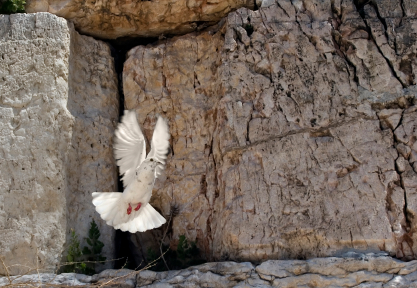
white-pigeon-kotelEach day we hope for Your salvation.

-Shemoneh Esrei

The Talmud states that one of the questions that will be posed to each person on his or her day of judgment is, “Did you look forward to salvation?” While the question refers to anticipating the ultimate Redemption, it can also refer to the salvation of the individual.

Positive attitudes beget positive results, and negative attitudes beget negative results. Books have been written about people who have recovered from hopeless illnesses because, contrary to medical opinion, they did not give up hope. On the contrary, they maintained a positive attitude. While this phenomenon may be controversial (for many people are skeptical that cheerful outlooks can cure), people certainly can and have killed themselves by depression. With a negative attitude, a person suffering from an illness may even abandon those practices that can give strength and prolong life, such as the treatment itself.

I have seen a poster that displays birds in flight. Its caption comments, “They fly because they think they can.” We could do much if we did not despair of our capacity to do it.

Looking forward to Divine salvation is one such positive attitude. The Talmud states that even when the blade of an enemy’s sword is at our throat, we have no right to abandon hope of help.

No one can ever take hope from us, but we can surrender it voluntarily. How foolish to do so.

Today I shall…

…try to always maintain a positive attitude and to hope for Divine salvation.

-Rabbi Abraham J. Twersky
“Growing Each Day, Elul 11”
Aish.com

Recently, I’ve written a number of reviews on portions of Thomas Schreiner’s book 40 Questions About Christians and Biblical Law. If you’ve read them, you know my feelings about Schreiner’s point of view on the Torah of Moses and how (or if) the Torah carries forward for the Jewish people into Apostolic times and beyond.

I want to take a step backward from that perspective this morning (but not too big a step). I’ve commented previously on the commonalities between Hebrew Roots, Messianic Judaism, and Christianity, as well as the fundamental platform upon which all who have faith in Yeshua (Jesus) as Messiah (the Christ) stand. While ultimately there is a dividing line between people who have faith in God through Jesus and those who do not, we can’t afford to dispense with authentic people of God who differ from us based on our opinions on “the Law” or how we understand God’s Word.

All people of faith face the same struggles. We are opposed by people who deny the existence of God, who deny that there is a core morality that is never-changing, who believe that human beings are the ultimate moral and intellectual force in the universe.

How can one be certain of the authority of the T’nach in all its particulars? The answer to this is based on common sense, and if one approaches the question open-mindedly and without prejudice, one must come to this conclusion. To put it very briefly, and going back from our present generation to preceding generations, we have before us the text of the T’nach as it was transmitted from one generation to the other by hundreds and thousands of parents of different backgrounds to their children. Even during the times of the greatest persecutions, and even after the destruction of the Beth Hamikdash, there always survived hundreds and thousands of Jews who preserved the text of the T’nach and the traditions, so that the chain has never been broken.

-from correspondence by Rabbi Menachem M. Schneerson
27th of Shevat, 5723 [February 21, 1963]
posted at Chabad.org

The Lubavitcher Rebbe has critics not only in Christianity but in different branches of Judaism, but the struggles he describes are the same as ours. Although I wouldn’t make a good Chabadnik for a number of reasons (not the least of which is the fact that I’m not Jewish), I often find their published writings and philosophies to be beautiful and reflective of God, especially when contrasted against criticisms against Torah and Judaism. No, it’s not that Judaism isn’t also critical of Christianity.

Furthermore, there is a basic difference between our Jewish tradition and those of other faiths, such as Christianity or Islam. For, whereas in the latter cases the traditions go back to one individual or a limited number of individuals, our traditions go back to a revelation which was experienced by a whole people at once, so that at no time did we have to place our trust in the veracity of one, or a few, individuals.

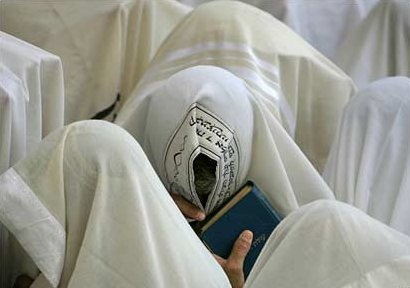
tallit-prayerThe Rebbe is being very “even-handed” in his response to Christianity in this letter. Some Jewish criticisms are far more biting.

I’m not saying we should compel religious Jews to abandon the practices of their faith or attempt to drive Christians from their (our) views on Jesus, but I am saying that we should stop trying so hard to jockey for position in order to establish our “lead” in the “race” by forcing the “defeat” of others.

Similarly in regard to the Torah. For the Torah, too, already contains the methods and principles whereby it is to be interpreted. Therefore, the traditional interpretation of the Torah is already contained in the Torah itself, and it is nothing but a continuation of the written Torah itself, so that only both together constitute one living organism.

I know one of the criticisms Christianity levels against religious Judaism is that Judaism interprets scripture according to a set of prescribed traditions. The assumption is that, by comparison, Christianity (in all its flavors and forms including Hebrew Roots) uses a Biblical hermeneutic that objectively examines the text and arrives at conclusions based only on what the words are saying in their various original languages.

But if anything convinces me that Protestant Christianity is also plumb full of traditions, it is theological texts such as Thomas Schreiner’s book. Only the fact that Schreiner must speak to a specific tradition of Christian Biblical interpretation can explain why he must base his theories on certain portions of the Bible, while ignoring other scriptures that directly refute his conclusions on the Torah’s purpose in ancient and modern Judaism (including Messianic Judaism). Also, the widely varying denominations that span the realm of Christianity are no different than the multiple streams of Jewish transitions and communities. How can one tradition criticize another when we all employ the same dynamics?

When Jews read in the Shemoneh Esrei, “Each day we hope for Your salvation,” it summons visions of the Moshiach coming to redeem and restore the Jewish people and Israel. And yet, those words should also bring to mind the second coming of Christ for anyone in the church. We may not agree as to the identity of Messiah, but the fact remains that we are all awaiting his ascent to the Throne of the King in Jerusalem, and his reign of peace throughout the Earth.

Right now, we all exist like a handful of sand slipping out from between clenched fingers, or millions of tiny shards of shattered glass strewn across a cold, dark ground. We’re broken apart. We’re disconnected. We’re separated and isolated. Each tiny shard cries out into an infinite universe, “I am the only one who truly knows God!” For the atheists, the “god” is themselves, the human being as final authority. For each religious person, it is the claim that we each “own” God. We claim Him exclusively as our private possession and denigrate all the other people in all the other faiths as mistaken, wrong, bad, evil.

From God’s point of view, what must we look like except a crowd of kindergarteners on a playground, each one of us chasing after the ball and screaming, “Mine! Mine!” I’m embarrassed to be reminded of the cartoon seagulls in the film Finding Nemo (2003).

And that is the much vaunted human race, religious and otherwise. No wonder in the Bible, we people are often compared to sheep.

And yet, every once in a while, someone among the “seagulls” and “sheep” rises higher and climbs above.

At the final ascent,
he clings to any crack or crevice
to pull higher.

That is where we are now:
Any spark of light that comes your way,
squeeze all you can from it.

-Rabbi Tzvi Freeman
“Mountain Climbing”
Based on letters and talks of the Rebbe, Rabbi M. M. Schneerson
Chabad.org

free-birdIt is easy in the study of the Bible to get caught up in the mechanics and lose our connection to the spirituality. When we “know” God, is that knowledge supposed to be exclusively intellectual, or is knowing God a transcendent experience…or both? Either extreme has its pitfalls and, as I’ve been trying to communicate, can lead us to believe that our little group, church, congregation, denomination, whatever, is the one, the only one that has the corner market on God.

We must become more than the sum of our doctrines. We must become the people God made us to be. We must seek Him with unbridled desire and not be tempted to control His image and put it into our box. In longing to fly, we must be willing to fall.

“One who romanticizes over Judaism and loses focus of the kingdom of Heaven can be compared to a carpenter who is infatuated with the hammer, rather than the house it was meant to build.”

-Troy Mitchell

“Our work involves trying to dance when others only know how to wrestle.”

-Rabbi Carl Kinbar

“Do not seek Christianity and do not seek Judaism. Seek an encounter with God.”

-Tom

Each day, I hope for your salvation, God. How long, O’ Lord, how long?

FFOZ TV Review: Exile and Redemption

tv_ffoz6_oneEpisode 06: Exile and redemption are two of the most significant Biblical concepts and in episode six viewers will learn that these two concepts play a major role in the job description of Messiah. It was the job of Messiah to bring redemption to Israel by ending their exile and gather them back to the land of Israel. While Messiah did bring a spiritual redemption at his first coming, he has some unfinished business to take care of upon his second return in the way of bringing a physical redemption to not only Israel but the entire world.

-from the Introduction to FFOZ TV: The Promise of What is to Come
episode 6: Exile and Redemption

The Lesson: What Does It Mean To Be Redeemed?

This lesson summoned a lot of material I recently read about and described in this blog. Toby Janicki explores what he called “The Mystery of Redemption”, which is far more than just what Scot McKnight in his book The King Jesus Gospel called “a plan for salvation.”

Toby, who was raised as a Christian, describes his own early understanding of terms such as “being saved” and “being redeemed.” Traditionally in the church, we are taught that Jesus died for our sins and that we have been redeemed by the blood of the lamb. But redeemed from what exactly? Typically, the answer is that we are saved or redeemed from the power of sin and any punishment in the afterlife.

But as McKnight says in his book, which I reviewed last month, and as Founder and President of First Fruits of Zion (FFOZ) Boaz Michael stated in his presentation “Moses in Matthew,” there’s a lot more going on in the gospel message of redemption than we get in the common Christian viewpoint. The gospel message is a message directed at the Jewish people, and only through the redemption of national Israel and the return of the Jews from exile to their Land, will be people of the nations who are called by His Name, that is, we Christians, also be fully redeemed.

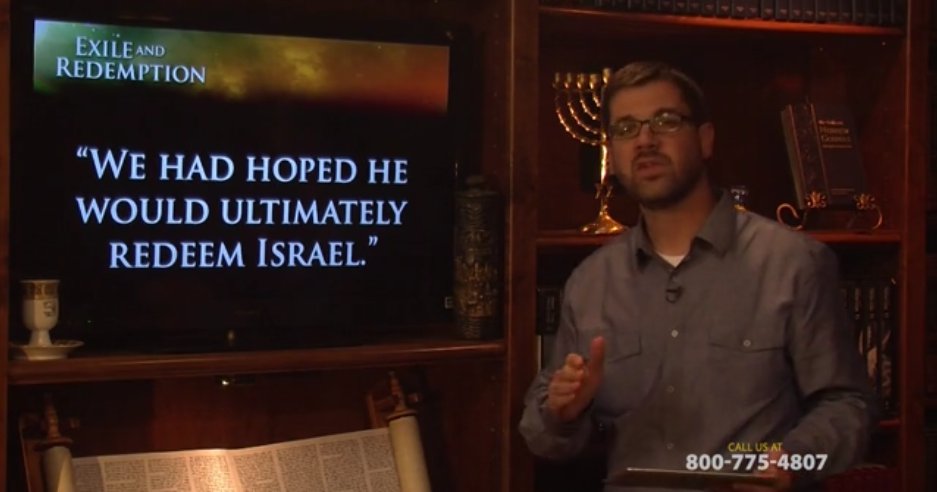
One of them whos name was Kleyofas answered. He said to him, “Are you the only one residing in Yerusalayim that does not know what has happened within it in these days?” He said to them, “What is it?” They told him, the incident of Yeshua the Notzri, who was a prophet mighty in works and in speech before God and before all the people. “But our high priests and elders arrested him for a death sentence and crucified him. We had hoped that he would ultimately redeem Yisrael, but today it has been three days since these things happened.”

Luke 24:18-21 (DHE Gospels)

Here we see two Jewish men who were disciples of Yeshua (Jesus) and whose hopes of redemption for Israel had been dashed to the ground. They believed Yeshua was the Messiah, but the fact that he died and was buried meant for them that he couldn’t be, because he had not lived to redeem the nation of Israel. I should note here that most Jewish people today deny that Jesus could be the Messiah for exactly the same reasons. These are people who deny the resurrection, the ascension, and that one day, Jesus will return to finish the Messianic mission.

But I’m getting ahead of myself or rather the program. Toby teaches that this scripture gives us our first clue in solving today’s mystery:

Clue 1: Messiah will redeem Israel from exile.

This is not only what Jewish people believed in the late Second Temple period but what religious Jews believe today. Messiah must come to redeem the Jewish people and to restore Israel. But exactly what does that mean? Most Christians don’t know, which is the importance of this TV episode. Where did the Jewish people get the idea that Messiah as redeemer was more than just about redemption from personal sin and what will that teach Christians in the church?

Say to them, ‘Thus says the Lord God, “Behold, I will take the sons of Israel from among the nations where they have gone, and I will gather them from every side and bring them into their own land; and I will make them one nation in the land, on the mountains of Israel; and one king will be king for all of them; and they will no longer be two nations and no longer be divided into two kingdoms.

“I will make a covenant of peace with them; it will be an everlasting covenant with them. And I will place them and multiply them, and will set My sanctuary in their midst forever.”‘

Ezekiel 37:21-22, 26 (NASB)

The prophet Ezekiel is speaking of King Messiah who will return all of the Jewish people in exile to their Land, the Land of Israel. In addition, God will make a covenant of peace with Israel, which will last forever, and God will establish His sanctuary, the Temple, among the Jewish people in their nation forever.

This last part threw me a bit. Revelation 21:22 describes New Jerusalem as having no Temple in the sense of a structure, since God and the Lamb are the Temple. I suppose there’s another mystery we could explore here, but it’s not contained in this television episode, so it’ll have to wait for another time.

tv_ffoz6_threeWe know that God exiled the Jewish people and Israel at the end of the Second Temple period. Jewish sages believe this was because of the sin of baseless hatred among the Jewish people. But religious Jews also believe that God will one day redeem them by sending Messiah.

But there is a modern state of Israel. Jews can make aliyah at any time. Isn’t the exile over? Not according to Toby’s teaching. Israel may exist nationally but the restoration is not complete. There is no Davidic King on the Throne, there is no Sanhedrin court system, and there certainly is no Temple in Holy Jerusalem. The state of Israel has not been set right again and established as the head of the nations. The Temple is to be a house of prayer for all nations (Isaiah 56:7), but not one stone of the Temple stands upon another, so there is no “house of prayer” for anyone right now.

Shocking as this may seem to many Christians, Messiah’s work was not finished at the cross, not by a long shot.

Toby uses 1 Peter 1:17-19 to illustrate that not only are the Jewish people in exile, but as long as our King, Jesus the Messiah, is not sitting on his throne is Jerusalem, all of his disciples, Jewish and Gentile, are also in exile. In effect, Messiah himself went into exile when Jerusalem was destroyed nearly two-thousand years ago, much as God went down into Egypt and ultimately into slavery with Jacob and the seventy members of his family (Genesis 46:3-4).

Although Toby didn’t mention this at all, I should say that as long as the current Israeli government negotiates with the Arab “Palestinian” people to carve up Israel including Jerusalem, and give it away in exchange for the Arabs ceasing all acts of terrorism, then Israel can hardly be said to be “redeemed” and even Jews in the Land may as well consider themselves in exile. In fact, Israel itself is still in a sort of exile. I imagine the Jewish people trying desperately to hold onto their homes in the so-called “territories” feel that way, too.

Toby also didn’t say this explicitly, but we must consider it to be the drive and desire of all Christians everywhere to see King Messiah restored to his throne in Jerusalem because until this happens, redemption is not complete. Yes, we are still “saved” from sin and condemnation, but being personally “saved” is only the beginning. The greatest works of Messiah are yet to come.

The scene shifts to Israel and to teacher and translator Aaron Eby who discusses what the word “redeemer” means in Hebrew and what it means to “redeem” a person or property.

Thus for every piece of your property, you are to provide for the redemption of the land.

‘If a fellow countryman of yours becomes so poor he has to sell part of his property, then his nearest kinsman is to come and buy back what his relative has sold.’

Leviticus 25:24-25

This portion of the Torah explains that the concept of redemption is a buying back or re-acquiring of property or even a person who has been a slave. The principle and meaning of ancestral property is well-defined in the Torah and if it is lost, there is a strong expectation that the original owner or his heirs will buy it back; will redeem it.

tv_ffoz6_aaron2Aaron brought up a question (sort of) I have recently explored. What if the owner dies and has no heirs? The answer lies in the concept of the leverite marriage. Aaron draws examples from scripture including Ruth and Boaz. Ruth the Moabitess was married to a Jewish man who died. Boaz was a relative, a kinsman redeemer, and by marrying Boaz and having a son with him, she restored her former husband’s lost family line.

Aaron also says that, when God liberated the Israelites from slavery in Egypt, He was acting as a redeemer and indeed, as God’s agent in this matter, Moses was also a redeemer. But another redeemer is to come after Moses.

Returning to Toby, we reach our second clue:

Clue 2: Redemption means buying back, re-acquiring, and setting things right.

That’s the function of Messiah in terms of the Jewish people, the nation of Israel, and through redeeming them, he also redeems the rest of us who continue to have faith. Toby cites Paul in Romans 6:17-18 where Paul metaphorically uses the laws related to redeeming slaves in describing how believers in Jesus are redeemed from slavery to sin, which is also part of the Messianic mission.

Toby referred to another scripture as a way to get to the third clue, a passage that I also commented on less than a week ago.

The Lord your God will raise up for you a prophet like me from among you, from your countrymen, you shall listen to him.

Deuteronomy 18:15

Toby identifies Jesus as “the prophet” and directs his viewers to Peter in Acts 3 and Stephen in Acts 7 as evidence that the Jewish believers also saw Jesus as “the prophet” spoken of by Moses. Thus we have the third clue.

Clue 3: Prophesy says that Messiah will be the prophet like Moses. Moses was the first redeemer and Messiah will be the ultimate redeemer.

Part of this third clue is dependent on another portion of scripture and I’ll get to that momentarily.

What Did I Learn?

Actually, some interesting stuff.

“Therefore behold, days are coming,” declares the Lord, “when it will no longer be said, ‘As the Lord lives, who brought up the sons of Israel out of the land of Egypt,’ but, ‘As the Lord lives, who brought up the sons of Israel from the land of the north and from all the countries where He had banished them.’ For I will restore them to their own land which I gave to their fathers.

Jeremiah 16:14-15 (NASB)

passover-artIt never occurred to me to consider the return of the Jewish people to their Land from the current exile as a sort of second Exodus, one that makes the first Exodus from Egypt pale by comparison. I started to think, especially in light of how most Christians have to see Jesus in all of the moedim as their only application, if a new meaning will be assigned to Passover in the Messianic Age, one that reminds the Jewish people not only of their redemption from Egypt, but their ultimate redemption from exile and the restoration of Israel as a united people and a sovereign nation. If the absence of our King on his throne means that even the Gentile disciples are in exile, along with the Jewish people, and along with Israel itself, then we should be crying out to Heaven, “How long, God? How long?”

The other thing I learned, and I’m not sure what to make of it, is that when Jerusalem is redeemed by Messiah taking up his throne, that Jews and Christians will see Jerusalem as their (our) city. Of course, Jerusalem is the Jewish city, the City of David, but how can we Christians lay claim to it in any sense?

I suppose because our King will be sitting on the Throne and the Temple in Jerusalem will finally be a house of prayer for all peoples. I don’t think that means we Gentiles get to live there, but if God is willing, may I see Messiah on his throne in Holy Jerusalem in those days, and may my sacrifices and burnt offerings be a sweet aroma to him.

I’ll review the next episode very soon.

Shoftim: The Messianic Prophet and King

king-priest-torahNOTE: I wrote this commentary a few days before my recent blog post, Can Jesus Inherit Lineage from his Adoptive Father Joseph?.

If, after you have entered the land that the Lord your God has assigned to you, and taken possession of it and settled in it, you decide, “I will set a king over me, as do all the nations about me,” you shall be free to set a king over yourself, one chosen by the Lord your God. Be sure to set as king over yourself one of your own people; you must not set a foreigner over you, one who is not your kinsman. Moreover, he shall not keep many horses or send people back to Egypt to add to his horses, since the Lord has warned you, “You must not go back that way again.” And he shall not have many wives, lest his heart go astray; nor shall he amass silver and gold to excess.

When he is seated on his royal throne, he shall have a copy of this Teaching written for him on a scroll by the levitical priests. Let it remain with him and let him read in it all his life, so that he may learn to revere the Lord his God, to observe faithfully every word of this Teaching as well as these laws. Thus he will not act haughtily toward his fellows or deviate from the Instruction to the right or to the left, to the end that he and his descendants may reign long in the midst of Israel.

Deuteronomy 17:14-20 (JPS Tanakh)

Of course, this instruction was incumbant upon all of Israel’s Kings beginning with Saul, but we know that subsequently Saul was removed from the Throne by God and David set in his place. Further, we know that God made a covenant with David that a descendent of his would always sit upon the Throne of Israel (2 Samuel 7:11-17), and the ultimate Davidic King is Messiah (John 1:49).

But if Messiah is a legitimate King of Israel, he should be subject to what we see in this week’s Torah Portion Shoftim, as quoted above.

The parsha goes further: the king is commanded to write two copies of the Torah, to keep the Torah with him, and should read from it “all the days of his life.” Thus the king was to acquire and maintain fear of Heaven, and to observe the Torah and perform its Commandments. A Jewish king recognizes that in actuality, he is merely a servant of a Higher authority. The Torah commands that he do all this “so that his heart does not lift itself over his brothers.” The intent is the same: he remains one of the people, and he is responsible for them and their spiritual well-being. Unlike monarchies in other nations, the Jewish king must remain part of the people, and care for them.

-Rabbi Yaakov Menken
Commentary on Shoftim
Torah.org

Perhaps Messiah was responding to this requirement when he said and did this:

So when He had washed their feet, and taken His garments and reclined at the table again, He said to them, “Do you know what I have done to you? You call Me Teacher and Lord; and you are right, for so I am. If I then, the Lord and the Teacher, washed your feet, you also ought to wash one another’s feet. For I gave you an example that you also should do as I did to you. Truly, truly, I say to you, a slave is not greater than his master, nor is one who is sent greater than the one who sent him. If you know these things, you are blessed if you do them.

John 13:12-17 (NASB)

But Jesus called them to Himself and said, “You know that the rulers of the Gentiles lord it over them, and their great men exercise authority over them. It is not this way among you, but whoever wishes to become great among you shall be your servant, and whoever wishes to be first among you shall be your slave; just as the Son of Man did not come to be served, but to serve, and to give His life a ransom for many.”

Matthew 20:25-28 (NASB)

And Jesus cried out again with a loud voice, and yielded up His spirit.

Matthew 27:50 (NASB)

We often think of Kings as rulers and especially in the case of David, as warriors, leading armies to defeat enemies, but what about the servant King who so identified with his subjects that he would give his life so they would live?

Although we don’t typically think of Moses as a King, we see that he possessed the same qualities:

Then Moses returned to the Lord, and said, “Alas, this people has committed a great sin, and they have made a god of gold for themselves. But now, if You will, forgive their sin—and if not, please blot me out from Your book which You have written!”

Exodus 32:31-32 (NASB)

moshiach-ben-yosefWe don’t think of Jesus as becoming a King until he returns, but even as Yeshua ben Yosef, the suffering servant, he was everything we could ever hope from a King, especially in his humility and his willingness to give his life for those he loves.

The Lord your God will raise up for you a prophet from among your own people, like myself; him you shall heed. This is just what you asked of the Lord your God at Horeb, on the day of the Assembly, saying, “Let me not hear the voice of the Lord my God any longer or see this wondrous fire any more, lest I die.” Whereupon the Lord said to me, “They have done well in speaking thus. I will raise up a prophet for them from among their own people, like yourself: I will put My words in his mouth and he will speak to them all that I command him; and if anybody fails to heed the words he speaks in My name, I myself will call him to account.

Deuteronomy 18:15-19 (JPS Tanakh)

Then a voice came out of the cloud, saying, “This is My Son, My Chosen One; listen to Him!”

John 9:35 (NASB)

But while it may not be obvious that Jesus was, in some sense, King upon his first coming, he certainly was a prophet, the prophet foretold in this week’s Torah portion.

Now when Jesus came into the district of Caesarea Philippi, He was asking His disciples, “Who do people say that the Son of Man is?” And they said, “Some say John the Baptist; and others, Elijah; but still others, Jeremiah, or one of the prophets.” He said to them, “But who do you say that I am?” Simon Peter answered, “You are the Christ, the Son of the living God.”

Matthew 16:13-16 (NASB)

When Moses was speaking of God raising a prophet like him, in one sense, he was speaking of all the prophets who came after him. The text immediately after the prophesy describes how to determine if one is a valid prophet or not.

Moses would not be the last of the prophets. He would have successors. Historically this was so. From the days of Samuel to the Second Temple period, each generation gave rise to men – and sometimes women – who spoke G‑d’s word with immense courage, unafraid to censure kings, criticize priests, or rebuke an entire generation for its lack of faith and moral integrity.

-Chief Rabbi Lord Jonathan Sacks
Chief Rabbi of the United Hebrew Congregations of the Commonwealth
“Testing Prophecy”
Chabad.org

Of course, this test should be applied to all who claim to be prophets and most importantly to one who claims to be Messiah, for if his prophesies are not true, then not only is he not a prophet, but he cannot be Moshiach.

There was, however, an obvious question: How does one tell a true prophet from a false one? Unlike kings or priests, prophets did not derive authority from formal office. Their authority lay in their personality, their ability to give voice to the word of G‑d, their self-evident inspiration. But precisely because a prophet has privileged access to the word others cannot hear, the visions others cannot see, the real possibility existed of false prophets – like those of Baal in the days of King Ahab. Charismatic authority is inherently destabilizing. What was there to prevent a fraudulent, or even a sincere but mistaken, figure, able to perform signs and wonders and move the people by the power of his words, from taking the nation in a wrong direction, misleading others and perhaps even himself?

-Lord Rabbi Sacks

the-prophetI’m sure this is how at least some Jewish people see Jesus if they acknowledge his ability to do signs and wonders as well as the power of his words of teaching. We know from the Biblical record that this is how some Jewish people even in the days Jesus walked in Israel thought of him. Christian apologetics tend to defend Jesus based on Jewish prophesy, but can they, can we defend him based on his own prophecies?

Unfortunately, while there is just tons and tons of information about the prophesies referring to Messiah, but I can’t immediately find anything available about the prophesies spoken by Jesus. Do we call these his prophesies?

From that time Jesus began to show His disciples that He must go to Jerusalem, and suffer many things from the elders and chief priests and scribes, and be killed, and be raised up on the third day.

Matthew 16:21

“But when the Son of Man comes in His glory, and all the angels with Him, then He will sit on His glorious throne. All the nations will be gathered before Him; and He will separate them from one another, as the shepherd separates the sheep from the goats; and He will put the sheep on His right, and the goats on the left. “Then the King will say to those on His right, ‘Come, you who are blessed of My Father, inherit the kingdom prepared for you from the foundation of the world.'”

Matthew 25:31-34

Jesus said to him, “You have said it yourself; nevertheless I tell you, hereafter you will see the Son of Man sitting at the right hand of Power, and coming on the clouds of heaven.”

Matthew 26:64

As He was going out of the temple, one of His disciples *said to Him, “Teacher, behold what wonderful stones and what wonderful buildings!” And Jesus said to him, “Do you see these great buildings? Not one stone will be left upon another which will not be torn down.”

Mark 13:1-2

“But when you see Jerusalem surrounded by armies, then recognize that her desolation is near. Then those who are in Judea must flee to the mountains, and those who are in the midst of the city must leave, and those who are in the country must not enter the city; because these are days of vengeance, so that all things which are written will be fulfilled. Woe to those who are pregnant and to those who are nursing babies in those days; for there will be great distress upon the land and wrath to this people; and they will fall by the edge of the sword, and will be led captive into all the nations; and Jerusalem will be trampled under foot by the Gentiles until the times of the Gentiles are fulfilled.

Luke 21:20-24

Now on the last day, the great day of the feast, Jesus stood and cried out, saying, “If anyone is thirsty, let him come to Me and drink. He who believes in Me, as the Scripture said, ‘From his innermost being will flow rivers of living water.’” But this He spoke of the Spirit, whom those who believed in Him were to receive; for the Spirit was not yet given, because Jesus was not yet glorified. Some of the people therefore, when they heard these words, were saying, “This certainly is the Prophet.”

John 7:37-40

rambamCertainly the prophesies where Jesus foretold his own death were accurate, as were the words he spoke of the destruction of Jerusalem and the Temple. But he hasn’t returned in power yet to restore Israel, return the exiles, and rebuild the Temple. It is these prophesies modern Jews point to and say, “he didn’t fulfill these,” thus declaring that Jesus can’t have been the Messiah.

There are other prophesies in the Bible that just “hang out there” in the air awaiting fulfillment. It is only faith that allows us to wait for them, just as observant Jews faithfully await the coming of Messiah, as Rabbi Mosheh ben Maimon, also known as Maimonides or Rambam said in the twelfth of his Thirteen Principles of Faith:

I believe with a complete faith in the coming of the Messiah, and even though he may delay, nevertheless, every day I anticipate that he will come.

There is much evidence in scripture that Jesus (Yeshua) is the awaited Messiah, that he came and will return, but there is not absolute proof. We are expected to also exercise faith. One of the criticisms of the “two comings model” of Messiah is that it’s been nearly two-thousand years since his death, resurrection, and ascent. Why does he delay? What’s he waiting for? Isn’t the world screwed up enough yet? Aren’t we long overdue for a Savior?

Jesus said he would return “soon” (Revelation 22:20), but apparently that isn’t “soon” by human standards. On the other hand, the prophet Jonah declared that in forty days, the great city Ninevah would be overthrown (Jonah 4:4) but the King, the city, and even the animals repented (Jonah 4:5-9) and as a result, God relented and did not destroy Ninevah (Jonah 4:10), which made Jonah pretty unhappy.

But since Jonah made a prophesy and it didn’t come true (because God apparently overrode the prophesy), does that make Jonah a false prophet? It doesn’t appear so. Then what happened?

Of course, Ninevah was eventually destroyed, so their repentance wasn’t what you would call “permanent.” But that’s not good enough. Jonah said that Ninevah would be destroyed in forty days, not eventually.

Rabbi Sacks has, what for Christians, is an uncomfortable answer.

Fundamental conclusions follow from this. A prophet is not an oracle: a prophecy is not a prediction. Precisely because Judaism believes in free will, the human future can never be unfailingly predicted. People are capable of change. G‑d forgives. As we say in our prayers on the High Holy Days: “Prayer, penitence and charity avert the evil decree.” There is no decree that cannot be revoked. A prophet does not foretell. He warns. A prophet does not speak to predict future catastrophe but rather to avert it. If a prediction comes true it has succeeded. If a prophecy comes true it has failed.

This only applies to what Rabbi Sacks calls a “negative prophecy,” one that foretells some dire event or punishment. If it comes true, then God kept His word. If it does not come true (in the case of Ninevah), it meant that the people repented and God relented of His punishment. They heeded God’s warning and He was merciful.

But what of Messiah’s prophesies of his return as King? First, no specific time frame was set except “soon.” In fact, we are told that he will come as a thief in the night (1 Thessalonians 5:2), and that no one, not even the angels in Heaven, know the time of Messiah’s return (Mark 13:32). However, let’s assume that (here’s the problematic part) human beings have some sort of impact on the timing of Messiah. There are many opinions in Judaism about this timing. Some say that only when Israel is completely faithless will he return, others say only when Israel is completely faithful. However, there is an enduring idea that in some way our behavior or our worthiness or lack of worthiness all affect exactly when Messiah will come.

tallit-prayerHuman free will doesn’t override God’s plan, but in Judaism, free will has an “interactive” relationship with that plan, making some adjustments on it. It’s like God’s plan is a mighty river. The river cannot be stopped, but the various objects and structures in the river might affect its flow one way or the other. It will still wind its way to the delta and meet the ocean, so the end is a foregone conclusion, but the little details potentially are adjustable.

That’s one way of looking at the return of the King. It probably won’t be palatable to Christians, but then, we tend not to want to think in those directions, anyway.

So what do we have? We have a Jesus who we know was a prophet in his first coming and who less obviously also was a King, at least in his service to Israel up to and including his sacrificial death. As prophet, the events he prophesied that have already come to pass can be verified (his death and resurrection, the destruction of the Temple and Jerusalem). But the prophesies of his return cannot be verified for they have yet to arrive.

It is faith that helps us believe that the prophesies will be fulfilled, and that we will see the return of the Messiah King.

Addendum: Rabbi Joshua Brumbach wrote an excellent commentary on this week’s Torah Portion that also addresses Messiah as a Prophet like Moses, but from a Jewish perspective: Why Do We Need Yeshua? I encourage you to read it.

Good Shabbos.

47 days.