Tag Archives: messianic judaism

The Mitzvah of Loving a Jew

The Alter Rebbe repeated what the Mezritcher Maggid said quoting the Baal Shem Tov: “Love your fellow like yourself” is an interpretation of and commentary on “Love Hashem your G-d.” He who loves his fellow-Jew loves G-d, because the Jew has with in himself a “part of G-d Above.” Therefore, when one loves the Jew – i.e. his inner essence – one loves G-d.

from “Today’s Day”
Friday, Menachem Av 12, 5703
Compiled by the Lubavitcher Rebbe; Translated by Yitschak Meir Kagan
Chabad.org

Of course, the scripture to love God and to love your fellow (Deut. 6:5 and Lev. 19:18 respectively) is rendered very “Jewish-oriented” by Chabad, but it made me ask myself that if one Jew loving another Jew is considered a mitzvah, what about a Gentile loving a Jew? No, not a Gentile Christian loving another Gentile Christian or generic human being, but specifically a Jew…is it a mitzvah?

I can’t find any Biblical corroboration except perhaps for the following:

“Then the King will say to those on His right, ‘Come, you who are blessed of My Father, inherit the kingdom prepared for you from the foundation of the world. For I was hungry, and you gave Me something to eat; I was thirsty, and you gave Me something to drink; I was a stranger, and you invited Me in; naked, and you clothed Me; I was sick, and you visited Me; I was in prison, and you came to Me.’ Then the righteous will answer Him, ‘Lord, when did we see You hungry, and feed You, or thirsty, and give You something to drink? And when did we see You a stranger, and invite You in, or naked, and clothe You? When did we see You sick, or in prison, and come to You?’ The King will answer and say to them, ‘Truly I say to you, to the extent that you did it to one of these brothers of Mine, even the least of them, you did it to Me.’

Matthew 25:34-40 (NASB)

At first blush, that seems to be a directive for us to love people in need, feeding the hungry, giving water to the thirsty, and so on, but early in my return to church, Charlie, who is on the Board of Elders at the church I attend was teaching Sunday school one day, and he interpreted that scripture specifically as what Christians are supposed to do for the needy of Israel.

Up until that day, it had never occurred to me to read that passage in such a manner, but now it makes perfect sense. I read the Master’s words as a commandment to assist the hungry and thirsty and needy among the Jewish people.

Of course, Jesus (Yeshua) was talking to a completely Jewish audience, so from that perspective, he was issuing the commandment of one Jew to love another Jew, even as we see it from the Chabad’s point of view. But we also have this:

“A new commandment I give to you, that you love one another, even as I have loved you, that you also love one another.”

John 13:34 (NASB)

Here again we have Jesus speaking to his Jewish disciples, so we can interpret this command as we have the one we have in Matthew 25, but I also believe we can extend the intent to include how we Gentile disciples are supposed to love other disciples, both Jewish and Gentile, with a love like the Master’s, with a love that includes the willingness to give our lives for our fellows in Messiah.
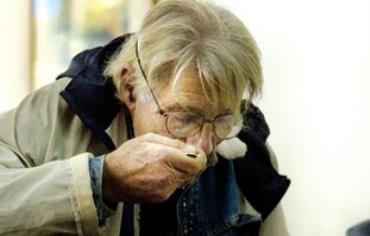
jewish charity
Photo: Reuters

But that doesn’t absolve us from our duty to love the Jewish people as well, particularly those who are in need, those who are suffering.

In my case, having a Jewish wife and children, I automatically fulfill the mitzvah on a daily basis, but that’s not an excuse to remove myself from loving the larger Jewish population, the people and nation of Israel.

Related to the recent observance of Tisha B’Av, Aish.com dedicated an article to the challenge of one Jew loving another. Jewish people come in all shapes and sizes and dispositions, and as you might imagine, it isn’t always easy for one Jewish individual to indiscriminately love all other Jewish people everywhere.

How much more difficult it is for us, who are not Israel and not Jewish, and especially we who in the Church have a history of disagreement and even enmity with the Jewish people, to express that indiscriminate love?

In trying to research the “mitzvah” of Gentiles loving Jews, I came across this:

I love the Jewish people and have enjoyed reading the many spiritual thoughts on your website. I want to draw closer to God, but from what I’ve read it is a very big commitment to convert. I don’t think I am up for this at this stage in my life. Is there some way to tap into the Torah wisdom without being part of the Jewish people?

-from Ask the Rabbi
“Seven Laws of Noah”
Aish.com

One of the ways that some non-Jews express their love for the Jewish people and Israel is to become Noahides, or people of the nations who observe the Seven Noahide Laws. This is about the best way to express such a love and attraction from a Jewish point of view, since it has the full support of Orthodox Judaism and allows Gentiles to enter into Jewish worship and community space, albeit with a radically different status than the Jewish leaders, mentors, and participants.

Of course, you have large groups of Evangelicals who love Jews and love Israel, but that love isn’t always returned. To be fair, sometimes Christian love for Israel is pretty shallow and very conditional, so Jews have a right to be hesitant about returning all the “love and support”.
in gratitude and hope
Photo: Aish media

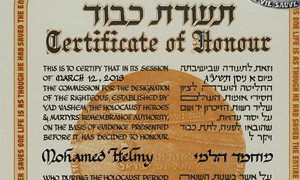
There are, of course, those non-Jews who show love to Jewish people, even at great risk to themselves such as an Arab family protecting Jews during the Holocaust. Given the current world-wide criticism of Israel (and by inference all Jewish people) relative to Hamas and its terrorist attacks (and Israel’s response), it may come to a point, even very soon, when any non-Jew who supports the Jewish people will risk at least a verbal or print backlash if not actual violence. If not now, then eventually I believe it will come to that.

But what is it to love the Jewish people? Is it just a warm and fuzzy feeling? Is it giving money to Jewish causes and charities? Is it wearing t-shirts supporting the IDF? I suppose it could be all those things. But what about supporting Judaism?

What’s the difference between supporting Jewish people and causes and supporting Judaism? A big, fat, whopping one for some folks.

There are a lot of people in a great many religious venues who say they love the Jewish people. I’ve already mentioned Noahides and Evangelical Christians, but what about Gentiles in Messianic Judaism (Messianic Gentiles) and Gentiles in one of the expressions of the Hebrew Roots movement (One Law/One Torah, Two House, Sacred Name, and so on)?

That can get a little more dicey. Relative to Hebrew Roots, there, I believe, is an authentic love of the Jewish people and national Israel, but sort of a love-hate relationship with Rabbinic Judaism (no, there isn’t any other kind, even Messianic Judaism is Rabbinic Judaism). There’s a love of Torah as it is understood, and a love of the “roots of our faith” which is usually expressed in some sort of modern Jewish religious practice (wearing a tallit and kippah, praying from a siddur in Hebrew, reading from the Torah, practicing a form of Shabbat rest, and so on), but there is also often a disdain for Talmud, for the authority of the Sages in ordering how to perform the mitzvot, and how Torah is continually interpreted and reinterpreted across time to apply to later generations.

I was re-reading Dr. Rabbi Stuart Dauermann’s article The Problem With Hebrew Roots, or, It’s Good to be a Goy. It actually kind of reminded me of something Aaron Eby said on this Vine of David video about the unique calling of the Messianic Gentile:

We at Vine of David have composed an alternate form of the second paragraph of Kiddush for Messianic Gentiles that reflects their unique identity and relationship to the Sabbath. The blessing was culled from the most ancient strata of the prayers of early believers. This form of Kiddush is affirming, beautiful, and ancient, and represents a radical rebound from centuries of replacement theology. Messianic Gentiles would do well to use such prayers in order to instill in their children a sense that their identity and mission as Messianic Gentiles are important and meaningful.

jewishThe identity structures of Messianic Jews and Messianic Gentiles is, by definition, complementary and even vaguely reminiscent of the relationship between Orthodox Jews and Noahides in the synagogue.

However, the latter relationship can’t really be compared to the former, because in the former, at the end of the day, we are all disciples of the Master and we all share equal co-participation in the blessings of the resurrection and the life in the Messianic Age in accordance with the same covenant, the New Covenant. Of course there’s also differentiation because Jews additionally come under the Sinai Covenant, but relative to Noahides and Judaism, they have no common Covenant relationship with God at all.

That complementary relationship between Jew and Gentile in Messiah requires mutual respect, which includes respecting each other’s space. A comment and R. Dauermann’s response on his aforementioned blog post drew my attention:

Glenn – July 31, 2014
Splendidly written, Stuart! It is so in concert with Paul’s exhortation in 1 Cor. 7, and the larger message of Isaiah 56.

But I am a bit perplexed. On the very principle you articulate, shouldn’t we absolutely discourage the practice of converting Gentiles to Messianic “Jews”? It was my understanding that you support such conversions.

As always, thanks for your time!
Glenn

Stuart Dauermann – August 2, 2014
Well, Glenn, I so much appreciated your question that I devoted another blog to it. See it here: http://www.interfaithfulness.org/?p=2040

So I visited the link R. Dauermann posted, which led me to an article called Conversion, Yes; Confusion, No.

While Dauermann actually supports Gentile conversion specifically within Messianic Judaism on very rare occasions, he also made a number of statements relevant to the point I’m trying to make:

The problem nowadays is that Gentiles are being made to feel like second class citizens, or feel themselves to be second class citizens in the Kingdom of God because they are not Jewish. This is WRONG! Gentiles are NOT second class citizens and in no manner whatsoever do they or can they improve their citizenship in the Kingdom of God through “discovering their Jewish roots,” through deciding they are part of the lost tribes of Ephraim and Manasseh, or any such thing. In other words, not only are Gentiles not second class citizens, they also do not become in some manner super-citizens through discovering or creating some sort of Jewish identity.

This is pretty common of Christians who, for whatever reasons, have left formal church attendance and entered some form of Messianic Judaism or Hebrew Roots. I’ve attended some Hebrew Roots groups that were downright disrespectful of Christianity and used quite abusive language when referring to Churches. There was a real drive to do anything possible to separate themselves from anything having to do with “the Church” (i.e. “Babylon” or a thousand other insulting labels).

Beth Immanuel ShavuotAlong with that need to separate was the requirement to create a new identity, but since Judaism is the general template for Hebrew Roots, any statement that pointed to Jewish exclusiveness in the covenants tended to elicit two related reactions: a feeling of inferiority and a response of hostility (I should point out here that not all Hebrew Roots people exhibit this dynamic, particularly the Hebrew Roots congregation in which I once worshiped, but it’s been sadly common in my previous experience with other people and groups I’ve encountered). As R. Dauermann pointed out, Gentiles are not inferior to Jews. I’ve read many (non-Messianic) Jewish commentaries stating that Jews do not (ideally) see themselves as better or superior to Gentiles, just different.

The same is true in Messianic Judaism. The distinctions particular to Jews are not really rights so much as responsibilities and duties. Think how much more difficult it is to attend to the mitzvot as a Jew than those duties assigned to the Gentile in Messiah (Christian in Jesus). Is faith in Jesus supposed to be about our “rights?” Does God owe us rights? Does He owe us anything?

Even Paul called himself a slave (see Romans 1:1 for example). He didn’t complain about his rights.

Many people act like the Torah is a book they may apply any way they choose, and that by doing so, they are being more faithful to God than those who do not bother to do so. Some even imagine that by doing so, they become in some manner Jewish. Such people are naïve and in error.

The Torah is not a book we happened to find and which we may interpret as we choose, but rather it is the national constitution of a people. It must be understood as the community property of the Jewish people, and must be understood and interpreted in keeping with millennia of Jewish discussion and practice. It is not like the Koran, which allegedly came down entire from heaven, or like the Book of Mormon, allegedly found on golden plates hidden in the Hill Cumorah in Palmyra, New York. No, Torah is the way of life of the Jewish people, it enshrines the decorum appropriate to the Jewish people as a Kingdom of Priests and a Holy Nation, the way of life appropriate to this people serving in the courts of the King of Kings.

-R. Dauermann

This is where love of Jews and love of Judaism, particularly the Judaism(s) observed within the context of Messiah, begins to separate for some.

In my opinion, being a disciple of the Master and attaching ourselves to the God of Israel is not a matter of rights but a matter of service. We have duties and obligations and we have unique roles and identities that define those obligations. God made us who we are, and although He gave us free will, He didn’t give the leopard the ability to change his spots.

Nevertheless, each person should live as a believer in whatever situation the Lord has assigned to them, just as God has called them. This is the rule I lay down in all the churches. Was a man already circumcised when he was called? He should not become uncircumcised. Was a man uncircumcised when he was called? He should not be circumcised. Circumcision is nothing and uncircumcision is nothing. Keeping God’s commands is what counts. Each person should remain in the situation they were in when God called them.

1 Corinthians 7:17-20 (NASB)

And by “Keeping God’s commands is what counts,” my interpretation is keeping the commands as they apply to the person, which isn’t the same for a Jewish believer as it is for a non-Jewish believer.

As both R. Dauermann said on this blog and Dr. Mark Nanos said in a recent paper, while Paul generally opposed Gentiles in Messiah converting to Judaism, he didn’t absolutely forbid it. He just felt (and rightly so) that converting to Judaism would not have any sort of impact on the person’s justification before God. You don’t become a better person by converting to Judaism, you just become Jewish.

If you feel a strong need and desire to live as a Jew and to observe the mitzvot as a Jew, then conversion is probably the right thing for you (there are a lot of other factors to consider that are beyond the scope of this blog post, but it’s not as simple as all that).

Restoration
Photo: First Fruits of Zion

However, as I mentioned, conversion isn’t necessary to serve God, because God expects the whole world to serve Him, both Israel and the nations. How we serve God is dependent on who we are, Israel or the nations. Rejecting this definition is where you may feel you love Jewish people and Israel, but it actually means you’re rejecting how they define themselves and frankly, you’re rejecting how God defines the Jews and Israel.

Judaism isn’t perfect, but it can be argued that Judaism, that is Rabbinic Judaism including Mishnah, Talmud, halachah, and the whole meal deal is what God gave the Jewish people to enable them to survive the last two-thousand years of exile, and to make it possible to re-establish the modern state of Israel.

You can’t love the Jewish people and the nation of Israel and also throw the Rabbis and their volumes of Talmud under a bus. You can’t say “I love you but I deny you the right to define yourself.”

That isn’t love. I don’t even know what to call that sort of behavior.

If it’s a mitzvah for a Christian and/or Messianic Gentile to love the Jewish people and Israel, you can’t hate Judaism at the same time. You can’t hate someone’s identity as it was assigned to them by God but say that somehow, you love that person anyway.

I know the people who need to hear this the most will reject it out of hand, but this message is the natural and logical extension of exploring the mitzvah of loving Jews. In order to love the Jewish people, we cannot hate ourselves. The mitzvah of loving our neighbor as we love ourselves (Lev. 19:18; Matthew 22:39) means we must love both our neighbor and ourselves. If we hate being a Gentile because we think (or have been taught) that it is inferior or pagan or some other ridiculous thing, then we have no basis or platform for loving someone else, anyone else, really.

Love starts with loving God (Deut. 6:5; Matthew 22:37), then (in my opinion), loving ourselves as God made us since we are created in His image (Gen. 1:27). Only then, realizing that God loves us with a powerful love and realizing we are lovable just as we are (which in my case is a Gentile), can we love another person. Only then can we love a Jew because God made the Jew just the way he or she is including the Jewish person’s covenant identity, which includes unique roles and responsibilities.

Once you are confident in God’s love for you, no matter who you are, then you have no reason to feel inferior to someone else and you should have no desire to covet their status and assume that it is your “right” to do so.

It’s only at that point where you are capable of fulfilling the mitzvah as a Gentile disciple of the Master of loving the Jewish people, Judaism, and Israel. God loves them. So should we.


Acting Jewishly But Not Jewish, Part 1

Paul’s “Jewish Assemblies” rather than “Paul’s Gentile Churches”? “Paul’s Jewish non-Jews” instead of “Paul’s Christian Gentiles?”? Paul bringing Non-Jews into “Judaism” rather than into “Christianity”? Am I really going to argue that these are more accurate labels for discussing the non-Jews who Paul brought to faith in Jesus Christ and the gatherings of them with Jews sharing that conviction, as well as the communal ways of life into which Paul sought to enculturate them? “Yes” — and “No.”

Dr. Mark D. Nanos
‘Paul’s Non-Jews Do Not Become “Jews,” But Do They Become “Jewish”?: Reading Romans 2:25-29 Within Judaism, Alongside Josephus,’ p.1
forthcoming in The Journal of the Jesus Movement in its Jewish Setting (2014)
and presented as a paper at the SBL Annual Meeting in 2013, Baltimore, MD.

Since this cites a portion of Romans 2, it would be prudent to review that part of scripture before proceeding:

For indeed circumcision is of value if you practice the Law; but if you are a transgressor of the Law, your circumcision has become uncircumcision. So if the uncircumcised man keeps the requirements of the Law, will not his uncircumcision be regarded as circumcision? And he who is physically uncircumcised, if he keeps the Law, will he not judge you who though having the letter of the Law and circumcision are a transgressor of the Law? For he is not a Jew who is one outwardly, nor is circumcision that which is outward in the flesh. But he is a Jew who is one inwardly; and circumcision is that which is of the heart, by the Spirit, not by the letter; and his praise is not from men, but from God.

Romans 2:25-29 (NASB)

How did the Apostle Paul see the distinction between Jesus-believing Jews and Gentiles in Jewish worship and community space? I’ve written on this topic numerous times, often utilizing the research and publications of both Mark Nanos and Magnus Zetterholm in such “meditations” as Nanos, Paul, and the Consequences of Jewish Identity in Messiah, Nanos, Ancient Antioch, and the Problem with Peter, and Zetterholm, Nanos, Ancient Antioch, and Some Implications. In this more recent paper by Nanos, one that should be published later this year, we see an interesting development in how Nanos presents Paul relative to Romans. Did Paul see the non-Jewish disciples of the Jewish Messiah as practicing Judaism or behaving “jewishly” without converting to Judaism or taking on identical obligations and roles with the Jews?

Being identified as a Jew and behaving like a Jew are readily recognized to represent two related yet not identical matters (p.2).

This behavior can be referred to by the adverb “jewishly,” and as the expression “jewishness.” In colloquial terms, one who practices a Jewish way of life according to the ancestral customs of the Jews, which is also referred to as practicing “Judaism”… (p.3).

Mark Nanos
Mark Nanos

Nanos distinguishes between being born ethnically Jewish and (as a male) being circumcised on the eighth day and acting “jewishly” (the lower-case “j” is used deliberately by Nanos), as having significant overlap, but not precisely being same. Even a Jewish person born of two Jewish parents and circumcised may choose not to observe any of the mitzvot and nevertheless will be considered Jewish, albeit apostate.

A Gentile who chooses to observe some or even all of the Jewish behaviors associated with the mitzvot can be said to be acting “jewishly” or practicing “Judaism,” but that does not mean the person is actually considered Jewish.

But where is the dividing line? How far could a Gentile Jesus-believer go in Paul’s time, and how far can a Gentile Jesus-believer go in our time in “acting Jewishly” without actually being Jewish? Can we use Paul to establish any rules or guidelines for Gentile Christians today who are attracted to Jewish practices or learning and yet do not desire to convert to Judaism because of their Christian faith?

Because ethnic identity (Jew/s) and ethnic thinking and behavior (Jewish / jewishly / jewishness / Judaism) are clearly related, but not synonymous, interchangeable terms, an interesting phenomenon arises when seeking to describe groups as Jewish. Although “Jewish” can be and is most often used to refer to Jews specifically, and thus gatherings of Jews: they are Jewish, the Jewish people, a Jewish service, and so on, as we will see, “Jewish” can also refer to groups or activities that include non-Jews: that group is Jewish, although it includes non-Jews who appear to think and behave like Jews (p. 6).

Nanos could easily be describing almost any synagogue I’ve ever been in. I’m a Christian married to a Jew. It’s very common to find a mixed Jewish/Gentile group in our local Reform/Conservative synagogue and of course at the Chabad, a number of intermarried couples attend, and yet both venues are undeniably Jewish. The same may be said for some Messianic Jewish synagogues that have at least a core population and leadership of Jews but that also houses a large number of Gentiles who are involved in Jewish practices, such as listening to the Torah readings, davening from a siddur, praying in Hebrew, and so forth.

In all of the contexts listed in the above paragraph, the participating Gentiles can be considered as acting “jewishly” within a Jewish community while remaining fully Gentile. But as I said before, how far can we take the concept of “Gentile jewishness” and consider it a valid method of “practicing Judaism?”

orthodox-talmud-studyAlmost two years ago, I stopped searching for an identity and declared myself a Gentile who studies Messianic Judaism. While my practice isn’t all too “Jewish” (or “jewish”), my thought processes, study materials, and some of my study methods borrow heavily from traditional Judaism.

Of course, I can be a Gentile studying Judaism in the same sense as a 21st century American studying 16th century Greek cuisine. I don’t have to be the thing that I’m studying. Learning the typical dishes of Greece of the 1700s doesn’t require that I be Greek.

But it’s a little different in the world of religion and religious lifestyle. I could study Torah as an abstract collection of knowledge the way some people study the Bible as literature or as history, but the Bible is unique and the Torah is designed to change lives. To be a Gentile student of Messianic Judaism involves not only specific study methods and materials but the required context in which to live it all out.

To continue from Nanos:

What if a group mostly made up of non-Jews with some Jews in leadership behaves jewishly? What if it is made up exclusively of non-Jews yet founded or advised by Jews? What if it consists of only non-Jews and functions independent of any Jews and yet bases its thinking and behavior on Jewish Scriptures, traditions and ways of life? (pp. 6-7)

As I read these passages from the Nanos paper, I can’t help but see a progression from Messianic Judaism (MJ) into Hebrew Roots (HR). The closer the Gentile is to the MJ side of the scale, in a mixed group of Jews and Gentiles to a group of Gentiles with a core leadership of Jews or even arguably, a group of only Gentiles that is advised and guided by Jewish mentors, that group is or could be considered “Jewish” or at least perceived correctly as acting “jewishly”.

However, once to you approach the opposite side of the scale, which would be defined by a group made up exclusively of Gentiles with only Gentiles in leadership, even if they are using Jewish educational materials and religious artifacts (siddurs, kippahs, Tallits, the Chumash, and so on), that group may still appear to be acting “jewishly,” but they are not a Jewish group. They can study Judaism, but they aren’t a Judaism, thus a group made up exclusively of Gentiles with no ties to Jewish oversight cannot, in this paradigm, call itself “Messianic Judaism” and is better defined as “Hebrew Roots” or by some other label.

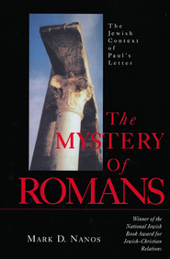
This directly reflects back to the communities Paul established or in which he was involved such as the “synagogue of the Way” in Syrian Antioch (see Zetterholm’s The Formation of Christianity in Antioch as well as Nanos’ The Mystery of Romans).

The level of “jewishness” practiced by Gentile disciples of the Master may have been in direct proportion to the involvement and influence of Jesus-believing Jews operating in the same religious and social community. The less influence exerted by Jewish mentors on the Gentiles, the less “jewish” were the behaviors and lifestyles of the Gentiles.

The Jewish PaulWe see something of this in Paul’s Epistle to the Romans. Historically, we know that for a time, Jews were banned from Rome. Prior to that event, there were both Gentiles and Jews who co-mingled as disciples of Jesus. Once the Jews were banned and (presumably) Rome was without a Jewish population, the Gentiles became solely in charge of their own social and religious dynamic, including how “jewishly” they chose to behave. When the Jews were allowed to return and attempted to resume their prior relationship with the Gentiles in Messiah, they discovered the Gentiles were riding on their “high horses,” so to speak, pushing back against Jewish synagogue authority and even criticizing the Jews for lack of strict adherence to Jewish Torah practice.

The chapter (Romans 2) within which this text appears begins with a challenge to anyone judging others, based on the argument that the very act of knowing there is a standard to which the other is held logically involves knowing that one has also failed to achieve it. Realizing that God is the judge who is fully aware of both one’s own intentions and actions as well as that of one’s neighbors, the message Paul drives home is to focus on one’s own responsibilities to do what is required of one, to judge oneself and leave the judging of others to the Judge… (p.19)

And again, Nanos states:

Paul’s argument is constructed to encourage non-Jews to avoid making the same mistake they are quick to recognize in this diatribal caricature. Paul calls them to concentrate on being faithful to what they are responsible to do in service instead of judgment toward the other, including the one who may be judging them… (p. 31)

Nanos is specifically referencing Romans 2:25-29 which I quoted at the top of this blog post, and is saying that those Gentiles who were choosing to judge their Jewish counterparts for any errors or lapses in Torah observance would be better advised to pay attention to their own responsibilities and let the Righteous Judge of Israel judge Israel.

Which, given the current conversation, begs the question of what behaviors of theirs should the Gentiles in Rome have been attending to? Put another way, should the Roman Gentile disciples have been paying attention to the proper execution of their “jewish” behaviors? What does it mean to “concentrate on being faithful to what they are responsible to do?”

Paul argued that these uncircumcised non-Jews were full and equal members of the family of God alongside of the Jewish members, indeed, equally children of Abraham and co-heirs of the promises made to him and his seed, not simply welcome guests (p. 7).

That sounds good but it doesn’t complete the picture.

In the next argument, vv. 12-16, Paul makes it plain that God judges according to the faithful behavior, which is not expected to represent precisely the same standards for Jews and non-Jews; indeed, each is held to the standard of what they know to be proper behavior (p. 19). (emph. mine)

studying_tanakh_messiahSeveral chapters in Romans seem to toggle back and forth between the responsibilities of Jews and Gentiles relative to God and the potential for hypocrisy among the Jews who claim the advantages of being Jewish but who, while teaching the Gentiles what is proper for God (for Gentiles), fail themselves to perform what is proper before God (for Jews). It should have been fairly clear to the Jewish people involved what their roles and responsibilities were, but were the Gentiles just supposed to “wing it,” hoping to know what is right and wrong?

We know that Paul had certain expectations of the Gentiles. Although he opposed Gentiles in Christ from undergoing the proselyte rite, he also discouraged them from continuing any idolatrous practices (Rom 3:29–4:25; 6; 1 Cor 7:17-22; Gal 4:8-10; 1 Thess 1:9-10).

Of the Gentiles taught by Paul, Nanos says:

Paul was exhorting non-Jews turning to God in Christ to seek to discover within themselves the noble values of jewishness, what being a Jew ideally signifies. They should learn to internalize jewishness as the highest value for themselves, albeit remaining non-Jews… (p. 32). (emph. mine)

But here’s a strong caveat:

His letters consist precisely of instruction in the Jewish way of life for non-Jews who turn to Israel’s God as the One God of all the nations; he enculturates them into God’s Guidance (Torah) without bringing them under Torah technically, since they do not become Jews/Israel. They are non-Jews who are learning, by way of Paul’s instructions, to practice Judaism! (p. 33) (emph. mine)

I can see where you might think all this is as clear as mud.

How can Gentiles learn to draw their values from Judaism and even practice Judaism to the degree that outside observers would say the Gentiles are acting “jewishly” and yet still operate under an overlapping but distinct set of standards from the Jews, not be considered under the Torah, and not be considered either Jews or Israel?

From the Didache (6:2), it is said:

For, on the one hand, if you are able to bear
the whole yoke of the Lord, you will be perfect;
but if, on the other hand, you are not able,
that which you are able, do this.

quoted from The Didache: Text, Translation, Analysis, and Commentary, pg 19
by Aaron Milavec

The Didache is considered a set of formalized instructions for Gentile initiates who were seeking to become disciples of Jesus. The document is traced to the second century C.E. and probably represents an earlier form of oral instructions and traditions, possibly originating with the Apostles or their immediate disciples. These standards would have been the basis Jewish mentors used to train the Gentile initiates in preparing them to become baptized and enter into their role as disciples.

beth immanuelFrom here we see that it is likely the Gentiles were encouraged to bear “the whole yoke of the Lord” Torah, in order to be “perfect,” but if they were not able, it was allowable that they should perform whatever was within their capacity. Again, please keep in mind, that a Gentile acting “jewishly” was both voluntary and was designed to occur within a Jewish communal context.

Given space limitations and the patience of those of you reading this, I’m going to stop here and pick it up in a subsequent blog post. There’s still much to explore about a Gentile acting “jewishly” in ancient times and what happens when he or she is outside a Jewish space. Also, what are the implications for those of us today who are Gentiles who study Messianic Judaism, both inside a Jewish context and outside?

Addendum: I’ve published the second part of this two-part series including a correction to some mistakes I’ve made in part one. I want to thank Dr. Mark Nanos for bringing what I’ve misunderstood about his paper to my attention and allowing me the opportunity to fix my mistakes.

A Book Review By Invitation

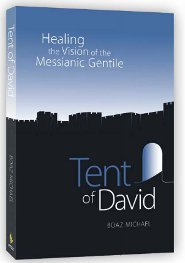
My recent post/review of Boaz Michael’s Tent of David has really fostered some good discussion. Probably one of the longest and best discussion thread on any post on this blog. At times it has been spirited, but peace and grace have been the general tenor. Thank you!!

Leaders in the discussion have been bloggers James Pyles of “My Morning Meditations” and Ruth of Sojourning With Jews. Both are friends I have gotten to know over the last year in the blogosphere and though we do not see eye to eye on all things Messianic, we all desire truth and enjoy the pursuit thereof. Each of us has publicly wrestled with thoughts and understandings as we search the Scriptures (though I envy both for being more open with their hearts than I have been…).

-Pete Rambo
“You are invited….”
natsab.com

Hebrew Roots (HR) blogger Pete Rambo has issued a challenge to me (Ruth had to back out) to read one or more leading HR books (since Pete and I have already discussed Boaz’s book Tent of David: Healing the Vision of the Messianic Gentile in the comments section of his review) and to “co-review” the book, he with his perspective on his blog and me on mine.

Pete generously sent me two books to choose from, both written by a gentleman named J.K. McKee who maintains a personal/professional website called TNN Online (Theology News Network Online). McKee’s rather lengthy Statement of Faith is also available on his site, so in addition to his About page, you should be able to find out all you need to know about him.

As far as Pete goes, he describes himself as a “46 [year old] recovering seminary trained pastor.” He also says:

During most of my life I have had a particular interest in eschatology (end times events/prophecy) and in understanding truth. (I used to be a conspiracy theorist… now, I am a conspiracy factualist… ) In my quest, I began to run into pieces of information that challenged my very conservative traditional Christian religious perspectives. Only when I began to pray earnestly for Yahweh to show me TRUTH did He move my focus from geopolitical events and onto a close scrutiny of what I now call ‘Churchianity.’ As I learned how far the Church had moved from the simplicity of the Book of Acts and the clear teaching of the Word, I became convicted of the need for a personal reformation.

Tent of DavidTo “bottom line” it, my understanding (and please correct me if I get this wrong, Pete) is that both Pete and Mr. McKee would fall into the theological/doctrinal category within Hebrew Roots of being One Law (and I’ve linked to a set of definitions created by Rabbi David Rudolph from his website MessianicGentiles.com).

The book Pete and I agreed upon (via email) to review first is McKee’s One Law for All: From the Mosaic Texts to the Work of the Holy Spirit. The book is about two-years old and so far has rather stellar reviews on Amazon with a total of nine reviews as I write this. Either the book is incredibly good, or the deck is stacked, or both.

Let me explain.

Since I’m also published author, though not in the religious or theological space, the publishers I’ve written for typically send me anywhere from five to ten “review copies” of my books once they go to market so I can pass them out to family and friends, asking them to write and publish reviews on Amazon.

This is a traditional marketing technique and the assumption is that the author’s family and friends or perhaps “fans” of his/her work will be more likely to write favorable reviews, elevating the book’s ranking at Amazon. Of course, at least from my experience, every time I’ve sent out review copies of one of my books and asked people I know to review it, it’s always a tad risky, since I want the reviewers to be honest and sincere, and there’s always a chance they’ll take exception to some portion of what I’ve written (if not the whole book). On the other hand, I don’t want anyone to be dishonest in writing their opinion of something I’ve created. If one of my books is to be praised, I want that praise to be authentic.

I say all this with the idea that the individuals who have reviewed McKee’s “One Law” book at Amazon may be those people who are already predisposed to like the content of McKee’s book (and his general theological bent) and thus write positive reviews.

I know one of the reasons I reviewed Matthew Vines’ book God and the Gay Christian: The Biblical Case in Support of Same-Sex Relationships is because I knew it would draw exactly two audiences: those who automatically supported his platform and those who automatically opposed it. I wondered if Mr. Vines would ever get a truly objective review of his work, so I made it my “mission,” so to speak, to do just that, setting aside as much of my own personal bias as was possible.

I intend to do the same thing here with the caveat (please pay attention to this part) that I am theologically and doctrinally opposed to the position that there is One Law, that is, a single and unified application of the Torah mitzvot that applies to all disciples of Jesus Christ (Yeshua HaMoshiach) whether they be Jewish or Gentile (that application would ultimately be applied to all human beings since the Bible refers to how “every knee will bow, see Romans 14:11; Philippians 2:10).

I have a history in “One Law,” and after coming to faith within the context of a Christian church nearly twenty years ago, I swiftly (long story) transitioned into a Hebrew Roots/One Law congregation (which billed itself as “Messianic Judaism”) and learned my basic understanding of the Bible and my faith there.

Without going into a long explanation, after some years, I finally was prompted to question all of the assumptions I naively accepted back in the day and spent nearly a year publicly exploring said-assumptions on my previous blog spot (to which I no longer contribute).

In the spirit of friendship and learning, I have agreed to Pete’s proposal but I could be considered what trial attorneys call a hostile witness in that my attitudes and beliefs regarding “One Law” are not supportive of the theological presuppositions it entails.

one law bookThe goal is as Pete states on his own blog:

In the process of our discussion, I mentioned to James via email that we ought to read and review/discuss a book at the same time…

One point to stress for all of us from the outset: the goal here is to learn and grow. We may be challenged, but we want to plan on good vigorous discussion that at the same time is peaceful and displays the fruit of the Spirit!!

That is, Pete and I will read McKee’s book and each of us will post our impressions/reviews on our respective blogs (and I also intend to post a review on Amazon). We will insert McKee’s book into a crucible and attempt, through our differing viewpoints, to tease out the essence of what’s been written, then present those findings to whoever chooses to read our blogs.

As Pete says, we both want to show that two people can discuss differing theological perspectives in a peaceful and cooperative manner, and avoid those emotional meltdowns that we all frequently have witnessed in the religious blogosphere. We aren’t (necessarily) trying to convince the other to change his mind, but rather are trying to provide clarity of thought and expression of our respective points of view.

I hope you will follow along on our two blogs and feel free to join in (politely and respectfully) on our discussions.

When Christians Aren’t Israel

In writing the review, I mentioned that I had gone back to J.K.McKee‘s A Part of Israel? as a resource for scholarly exposition of Scripture related to the place of non-Jews who come to Messiah. You’ll remember I lamented not having reviewed the book… Well, I started reading it again and couldn’t put it down! ‘Nuff said?

He is gracious in doing so, but is clear to demonstrate where there is error in various understandings of what the Kingdom of Israel looks like and who is in it! Example passages would be 30 pages dedicated to the predictably selected Ephesians 2:11-13 passage. He specifically addresses politeia, a Greek word we have looked at before, however, he understandably takes a much more coy approach as to whether non-Jews will have an inheritance in the land.

-Pete Rambo
from portions of his review of
JK McKee’s ‘Are Non-Jewish Believers Really A Part Of Israel?

I normally ignore these sorts of topics since historically in the blogosphere, debating the issues involved in Jewish/Gentile relationships in modern Messianic Judaism and/or the ancient ekklesia of “the Way” have, at best, proven unfruitful, and at worst, hostile and abusive.

But I’ve always had good, civil, and friendly conversations with Pete, including in the comments section on another of his blog posts,. So when I read his review, I was prompted to consider responding. After all, the legal and community status of the ancient Gentile disciples of the Jewish Messiah King relative to the synagogue, Jewish co-participants, and ultimately national Israel not only have applications in modern Christianity, but ultimately will be realized in the Messianic Kingdom when the New Covenant Age comes toward completion.

I requested a review copy of McKee’s book from the publisher and received a very nice and prompt reply stating that they do not honor such requests. Fair enough, since self-publication does not usually allow for such an option.

When I read Pete’s review last night, I got stuck on a single word: politeia. My commentary rather narrowly focuses on this word and how it is used since I can’t comment more generally on what McKee has written.

The word “politeia” is used in the following passages of scripture:

Then the commander said, “I had to pay a lot of money for my citizenship.”

Acts 22:28 (NASB)

…remember that at that time you were separate from Christ, excluded from citizenship in Israel and foreigners to the covenants of the promise, without hope and without God in the world.

Ephesians 2:12 (NASB)

I’ve bolded the English word corresponding to the Greek word “politeia” which is rendered as “citizenship” in both cases in the NASB translation.

However, this creates a number of questions.

  • Is Paul telling us (or his readers) that non-Jewish members of the Messianic ekklesia are now legally citizens of national Israel by faith in Messiah?
  • If so, then does such citizenship automatically require that the Gentile disciples adhere to, by obligation, the same Torah mitzvot in the same manner as the Jewish disciples/citizens?
  • Can “politeia” be translated in any other way besides “citizenship” and if so, what are the implications for the relationship of Gentiles and Jews belonging to Messiah in relationship to national Israel?

politeiaAs you can see from my source material, depending on the translation and in which part of scripture the word occurs, it can be translated differently. In Acts 22:28 using the KJV translation, it is rendered “freedom,” while in Ephesians 2:12, the NAS, KJV, and INT translations all present the word as “commonwealth”.

In fact, “citizenship” is only one of three major ways to translate”politeia”:

  1. the administration of civil affairs (Xenophon, mem. 3, 9, 15; Aristophanes, Aeschines, Demosthenes (others)).
  2. a state, commonwealth (2 Macc. 4:11 2Macc. 8:17 2Macc. 13:14; Xenophon, Plato, Thucydides (others)): with a genitive of the possessor, τοῦ Ἰσραήλ, spoken of the theocratic or divine commonwealth, Ephesians 2:12.
  3. citizenship, the rights of a citizen (some make this sense the primary one): Acts 22:28 (3Macc. 3:21, 23; Herodotus 9, 34; Xenophon, Hell. 1, 1, 26; 1, 2, 10; (4, 4, 6, etc.); Demosthenes, Polybius, Diodorus, Josephus, others).

I’m not a linguistic scholar, but I’ve known enough of them to understand that any sort of translation from one language to another is much more complicated than saying a particular word in language A always means another particular word in language B, especially when those languages are separated by nearly two-thousand years of history.

I am absolutely not saying McKee is making such a “rookie error,” but I will say that we all read and translate the Bible from a particular perspective, usually one that supports our own biases (everyone has biases, it’s not a dirty word). And yes, it’s easy to read those two verses in the New Testament and conclude that Paul must be making Israeli citizens out of Gentile believers in Jesus.

Tel Aviv
Tel Aviv

A lot of Evangelical Christians believe we’re “spiritual” citizens of Israel too, and expect to take over physical, national Israel when Jesus comes back. Naturally, Jewish people object to being kicked out of their own Land (even by allegory) and those teachers in Messianic Judaism who I follow do not believe we Gentiles will be moving to Jerusalem, or Tel Aviv, or Haifa once Messiah ascends the Davidic throne.

So where does that leave us? What’s the “differential diagnoses?”

If indeed it is the case that in Christ these Gentiles have a portion in [Israel’s covenant membership and national eschatology], i.e. that they are saved as Gentiles, then it suffices to apply to them the same ethical principles that would in any case apply to righteous Gentiles living with the people of Israel, i.e. resident aliens.

-Markus Bockmuehl
“Jewish Law in Gentile Churches:
Halakhah and the Beginning of Christian Public Ethics”
(Grand Rapids, MI: Baker Academic, 2000), 165

While the gerim in the days of Moses were not Israelites as such and did not obtain full membership status in the nation due to lack of tribal affiliation, they did observe a large number (majority? nearly-full obligation?) of the Torah mitzvot in the days of Moses and beyond. The argument of some branches of the Hebrew Roots movement is that the gerim status can be wholly transferred to the Gentile disciples of Jesus and be used to justify Gentile Christian obligation to the full yoke of Torah. Lancaster has spent considerable effort in his commentary to illustrate how James and the Council exempted the Gentiles from the full yoke of Torah because they were not born Jews or converts. Now, he apparently brings in an element in explaining the four prohibitions that could reverse his argument.

-from my blog post Return to Jerusalem, Part 6
based on my reviews of First Fruits of Zion’s (FFOZ) Torah Club series Chronicles of the Apostles

Up to JerusalemThe key to all this is in understanding what sort of decision the Council of Apostles and Elders made in Jerusalem about the legal status of Gentiles in “the Way”. The question was brought up (Acts 15:1-2) and after much debate, Paul and his detractors couldn’t make any headway toward a solution, so they took it to a higher authority in Jerusalem. After much deliberation, the Council rendered what amounts to a binding legal decision and issued halachah specific to the communal role and responsibilities of Gentile disciples of the Master. Did they have to undergo the proselyte rite and become wholly obligated to the Torah mitzvot? If not, how could they be included as equal co-participants in Jewish worship and community and yet not be Jewish? How could they be included in covenant?

How do we resolve the matter of the ancient Ger as applied to the late Second Temple Gentile God-fearing disciple? Lancaster doesn’t make that clear, but based on my own reading, particularly of Cohen, the full role of a Ger as it existed in the days of Moses was to allow a non-Israelite to live among the people of God as permanent resident aliens without being able to formally become national citizens due to lack of tribal affiliation. After the Babylonian exile, a tribal basis for Israelite society was lost and affiliation by clan was emphasized. By the time of Jesus, this clan affiliation basis was too lost, and thus the rationale for the status of Ger as it was originally applied no longer was valid. A Gentile in the days of Jesus or later, who wanted to join the community of Israel, in most cases, would convert to Judaism, since becoming a Ger was not an option.

-from my aforementioned blog post

To further cite Shaye J.D. Cohen:

Biblical law frequently refers to the “resident alien” (ger in Hebrew) who is grouped with the widow, the orphan, and the Levite. All of these are landless and powerless, and all are the potential victims of abuse. (An American analogy to the ger is the Chicano (specifically, undocumented alien) farmworker; a European analogy is the Turkish laborer in Germany.) The Bible nowhere states how a ger might ameliorate his status and become equal to the native born, because there was no legal institution by which a foreigner could be absorbed by a tribal society living on its ancestral land. Resident aliens in the cities of pre-Hellenistic Greece fared no better.

But there’s another authoritative source that should be considered:

and in order that the Gentiles might glorify God for his mercy. As it is written,

“Therefore I will confess you among the Gentiles,
and sing praises to your name”;
and again he says,

“Rejoice, O Gentiles, with his people”;
and again,

“Praise the Lord, all you Gentiles,
and let all the peoples praise him”;
and again Isaiah says,

“The root of Jesse shall come,
the one who rises to rule the Gentiles;
in him the Gentiles shall hope.”

Romans 15:9-12 (NASB)

To which Nanos responds:

Christian gentiles worshiping the One God in the midst of the congregation of Israel — my point exactly! (emph. mine)

-Mark D. Nanos
Chapter 6: Romans 13:1-7: Christian Obedience to Synagogue Authority, pg 326
The Mystery of Romans: The Jewish Context of Paul’s Letters

Paul is urging the Gentile believers to take note of their position, their role, and their halachic status as “resident aliens” within the midst of corporate Israel, which here is the synagogue context in Rome.

-from my review of Nanos’s book

The Mystery of RomansThe alternative explanation, based Bockmuehl, Cohen, Lancaster, and Nanos, is that the Gentiles were included in the commonwealth of Israel but not as equal national citizens. It would be as if my wife, as a Jew, decided to make aliyah, become an Israeli citizen and live in Israel. As her husband, even though I’m not Jewish, I would be allowed a permanent status as a resident in Israel as well, but I do not have an automatic right to become a citizen, as does my wife, because I am not Jewish.

I would still have most or all of the same rights as Jewish Israelis and I would have most or all of the same obligations as Jewish Israelis, but none of that would make me Jewish, nor would the Chief Rabbis of Israel or any other Jewish religious authority expect me to observe Torah as they proscribe because I’m not Jewish.

I know you’re going to say that’s all secular law (with the exception of the authority of the Chief Rabbis) and has little or nothing to do with how God sees things, but I’m using the above example by way of analogy. When James and the Council issued their decision, it wasn’t some magical, spiritual event, it was a legal ruling on the same order as the authorities among the Pharisees made, and was binding halachah upon the community.

However, there is another citizenship I have and one in which I’m looking forward to living out in the age to come. It’s a status I currently possess since according to at least one interpretation of the New Covenant, I need to start living my life as if the world were already fully under the rule of Messiah, Son of David, as he is seated on his Throne in Jerusalem.

I consider myself a citizen of the worldwide Messianic Kingdom to come and many wonderful blessings come from this status. I will be resurrected from dead flesh and made immortal (assuming I die before Messiah’s return). I will have my sins fully, permanently cleansed from me. I will have the Holy Spirit poured into me to such fullness that I will have an apprehension of God in the same or even greater manner than the prophets of old. I will have my heart of stone turned to a heart of flesh and God will write His Word upon it so that it will be my natural inclination to always obey Him and not return to sin.

And as a Gentile of the nations, I will reside in a country that is a vassal state to national Israel, subservient to Israel which will be the head of all nations, and ultimately I and my nation of residence will be accountable to the King of Israel, Moshiach. I expect that I and everyone else like me will be planning our vacations around the festivals and making regular pilgrimages to Jerusalem to spend time with family and friends and pay homage and honor to our King.

The goyishness of Christianity is a sign of its success, not its failure!

-Rabbi Dr. Stuart Dauermann
“The Problem With Hebrew Roots, or, It’s Good to be a Goy”
Interfaithfulness.org

Stuart Dauermann
Rabbi Dr. Stuart Dauermann

R. Dauermann makes a compelling argument that Gentiles who attach themselves to the God of Israel are intended by God to remain Gentiles. The prophets of the Tanakh who spoke of the Messianic Age all seemed to share that belief. I’ll only quote two of them:

And foreigners who bind themselves to the Lord
to minister to him,
to love the name of the Lord,
and to be his servants,
all who keep the Sabbath without desecrating it
and who hold fast to my covenant—
these I will bring to my holy mountain
and give them joy in my house of prayer.
Their burnt offerings and sacrifices
will be accepted on my altar;
for my house will be called
a house of prayer for all nations.”

Isaiah 56:6-7 (NASB)

“In that day

“I will restore David’s fallen shelter—
I will repair its broken walls
and restore its ruins—
and will rebuild it as it used to be,
so that they may possess the remnant of Edom
and all the nations that bear my name,”
declares the Lord, who will do these things. (emph. mine)

Amos 9:11-12 (NASB)

And to quote verse 14:

and I will bring my people Israel back from exile. (emph. mine)

which can also be interpreted as:

will restore the fortunes of my people Israel. (emph. mine)

In both of these prophetic examples describing Jews and Gentiles in the Messianic Age, it is clear that Gentiles will become attached to the God of Jacob as Gentiles and as citizens of the nations. While Isaiah paints for us a portrait of Gentiles offering sacrifices at the Temple of God (something which was allowed during the time of Herod’s Temple), Amos 9:14 makes a clear distinction between the Gentiles of the nations who “bear my name” and Israel!

It is true that Isaiah describes Gentiles keeping to the covenant, but after all, we will receive blessings because of our Abrahamic faith under the New Covenant, and in Messianic Days, I expect it will be more common for even the citizens of vassal nations to have laws and observances that more closely mirror national Israel’s including Sabbath keeping.

I’m not even saying (with apologies to R. Dauermann) that Gentiles in Messiah shouldn’t observe Sabbath in the present age. I’ve met many who do.

What I am saying is that none of what I see in the Bible, particularly the use of a single Greek word, absolutely mandates that all non-Jewish people who are disciples of Jesus be made into citizens of Israel, either in the present age or in the Messianic future.

God made a covenant with Abraham that was specifically and narrowly passed down to Abraham’s son Isaac (but not to Ishmael or any of Abraham’s subsequent children) and then to Isaac’s son Jacob (but not to Esau) and then to Jacob’s twelve sons who became the heads of the twelve tribes, who became the nation of Israel (but not to any other people group or nations).

That Abraham would also become the father of many nations and that through his seed (singular) Messiah, the nations would be blessed, does not abrogate the part of the covenant that specifically promises Israel only to the direct biological offspring of Abraham, and Isaac, and Jacob.

Having not read his book, I can’t say for sure, but if  McKee comes to a different conclusion in his writing, then in spite of his stated education and scholarship, I’m forced to disagree with him.

I don’t write this against Pete or anyone else who holds to his views of scripture, but rather to illustrate that there are other valid and educated views of the Bible that come to other valid and educated conclusions.

I considered just making a few comments on Pete’s blog but as you see, the response requires a lot of words and it’s easier to write out my thoughts here and then just to share a link to my blog with him (and anyone else who is interested).

Beth Immanuel ShavuotConsidering all of the different viewpoints involved in this sort of discussion, I see the position of One Law/One Torah (OL/OT) as existing at one end of a continuum and what’s been called Bilateral Ecclesiology (BE) positioned at the opposite end. While I obviously am leaning closer to the BE end of the scale, I’m not sitting right on top of it.

Of those congregations I am aware of that I consider authentic Messianic Jewish synagogues, including Beth Immanuel, Tikvat Israel, and Ahavat Zion, they all have a majority membership/attendance of non-Jewish people worshiping the God of Israel and giving honor and glory to Yeshua HaMoshiach (Jesus Christ), with a smaller membership and usually leadership of Jews. In fact, the primary teacher at Beth Immanuel is a Gentile: D. Thomas Lancaster. And yet Beth Immanuel is a Jewish community and worship venue that adheres to specific standards of established halachah.

From my perspective, that’s the current state of Messianic Judaism, or at least those portions I know about in my little corner of the world.

That I don’t consider non-Jewish disciples to be literally citizens of national Israel does not exclude us from many incredible blessings or from association with our Jewish brothers and sisters in Messiah. I am quite comfortable inside of my own skin, so to speak, being a person among the nations who is called by His Name. Being married to a Jewish wife, I am content to recognize that she is among her people Israel and I’m dedicated to supporting her, and all other Jewish people I’m associated with, being and becoming closer to the God of Jacob as HIs people Israel through the mitzvot and within their unique community and nation which was established forever by Hashem.

Reflections on Romans 4

What then shall we say was gained by Abraham, our forefather according to the flesh?

Romans 4:1 (ESV)

Remember that in my reflection on Romans 3, Paul was toggling back and forth between Jewish obligation to the Law (Torah) and justification by faith, making sure that his audience, probably Jewish and Gentile believers in the synagogues in Rome (but talking about Gentile relationships with non-Jesus-believing Jews), understood the proper association, that Jews had many advantages including those Jews who had not yet come to faith in Messiah Yeshua, (Christ Jesus) but that only faith ultimately justifies one before the Almighty.

It must have been a struggle, especially for the Gentile Jesus-believers, to comprehend the relationship between faith and Torah observance. My reading of Romans tells me that these Gentiles might have been getting pretty arrogant, especially in relationship with the non-Jesus-believing Jews they encountered, because they had the Torah but not faith in Messiah. The Gentiles may have concluded that they were justified before God as were their Jewish Jesus-believing counterparts, but not the non-believing (in Jesus) Jews. After all, keeping the Law doesn’t justify.

Paul was trying to correct the error of the Gentiles’ thinking. Christians today tend to mess this up as well, but if we apply Paul to today’s Jewish communities, we see they too must have many advantages, and that God has not abandoned them or replaced them with the Church or even with the community of Jesus-believing Messianic Jews.

Chapter four sees Paul continuing to make his point and expand upon it.

What then shall we say that Abraham, our forefather according to the flesh, has found? For if Abraham was justified by works, he has something to boast about, but not before God. For what does the Scripture say? “Abraham believed God, and it was credited to him as righteousness.” Now to the one who works, his wage is not credited as a favor, but as what is due. But to the one who does not work, but believes in Him who justifies the ungodly, his faith is credited as righteousness…

Romans 4:1-5 (NASB)

Paul continues to state that Abraham wasn’t justified by what he did, by any works, including circumcision, he was justified by faith and his faith was credited to him as righteousness, even as faith is credited to his readers and to us as disciples of the Master.

But that didn’t mean Abraham wasn’t subject to behavioral expectations by God. That doesn’t mean he didn’t have to obey:

So Abram went forth as the Lord had spoken to him; and Lot went with him. Now Abram was seventy-five years old when he departed from Haran. Abram took Sarai his wife and Lot his nephew, and all their possessions which they had accumulated, and the persons which they had acquired in Haran, and they set out for the land of Canaan; thus they came to the land of Canaan.

Genesis 12:4-5 (NASB)

Now it came about after these things, that God tested Abraham, and said to him, “Abraham!” And he said, “Here I am.” He said, “Take now your son, your only son, whom you love, Isaac, and go to the land of Moriah, and offer him there as a burnt offering on one of the mountains of which I will tell you.” So Abraham rose early in the morning and saddled his donkey, and took two of his young men with him and Isaac his son; and he split wood for the burnt offering, and arose and went to the place of which God had told him. On the third day Abraham raised his eyes and saw the place from a distance. Abraham said to his young men, “Stay here with the donkey, and I and the lad will go over there; and we will worship and return to you.” Abraham took the wood of the burnt offering and laid it on Isaac his son, and he took in his hand the fire and the knife. So the two of them walked on together. Isaac spoke to Abraham his father and said, “My father!” And he said, “Here I am, my son.” And he said, “Behold, the fire and the wood, but where is the lamb for the burnt offering?” Abraham said, “God will provide for Himself the lamb for the burnt offering, my son.” So the two of them walked on together.

Genesis 22:1-8 (NASB)

Abraham was faithful to God and obeyed him, even at great personal cost. Picture what it must be like to, at the word of God, pack up your family and all your possessions and head out in a direction with no stated destination in sight.

The AkedahBut that pales in comparison to the commandment to take your son and serve him up on the altar like a lamb to slaughter. As a father and grandfather, I can only imagine how Abraham’s heart must have been in anguish at knowing not only that his son would die, but that he would have to bind him and kill him with a knife.

Midrash says that Abraham believed that God would allow the sacrifice of Isaac but that God would resurrect him. However, the Torah is silent about this area of Abraham’s thoughts, so we’ll never be sure this side of Messiah what Abraham did and didn’t believe.

We only know that out of faith in God, he obeyed. Thus we can’t say that faith replaces obedience, only that it precedes it. From this I extrapolate that Paul is saying once justified by faith, Jews are expected to continue to observe the mitzvot and that in fact, their observance will have more depth of meaning because of faith.

But there’s something else:

David also speaks of the blessing on the man to whom God credits righteousness apart from works:

“Blessed are those whose lawless deeds have been forgiven, And whose sins have been covered. “Blessed is the man whose sin the Lord will not take into account.”

Is this blessing then on the circumcised, or on the uncircumcised also? For we say, “Faith was credited to Abraham as righteousness.” How then was it credited? While he was circumcised, or uncircumcised? Not while circumcised, but while uncircumcised; and he received the sign of circumcision, a seal of the righteousness of the faith which he had while uncircumcised, so that he might be the father of all who believe without being circumcised, that righteousness might be credited to them, and the father of circumcision to those who not only are of the circumcision, but who also follow in the steps of the faith of our father Abraham which he had while uncircumcised.

Romans 4:6-12 (NASB)

In short, the forgiveness of sins is by faith, not by performance of the mitzvot, thus both Jews and Gentiles receive forgiveness by their faith and the Gentiles don’t have to be concerned that their sins will be counted against them if they don’t also observe the mitzvot in the manner of the Jews.

Remember I said that I thought the Gentiles were probably getting arrogant in their status of saved by faith apart from the Torah? It’s possible that the non-believing (in Jesus) Jews were “pushing back” with their advantage as Jews, having the Torah, the oracles of God, and maybe getting back at the Gentiles among them by pointing out what the Jews had that the Gentiles would never have.

If indeed there was a “war of egos” going on between the Jesus-believing Gentiles and the non-Jesus-believing Jews (with the Jesus believing Jews caught in the middle), then each party would be pressing their own perceived advantage against the other. Paul’s writing this letter to even things out. He’s saying that yes, non-Messianic Jews continue to have the advantages under the Abrahamic and Sinai covenants, but that under one of the blessings of Abraham, it is faith that removes sin for all, not Torah observance, so everyone who has faith will be saved.

DaveningAlso remember that the non-believing (in Jesus) Jews weren’t faithless. They had faith, probably great faith, not in Jesus being Messiah but rather in Hashem, God of Creation, Master of Legions. Yes, faith in Messiah as the first fruits of the dead is the next logical, historical, and Biblical step in Jewish faith in God and the advancement of God’s plan to bring the New Covenant into the world, but non-believing (in Jesus) Jews were not totally abandoned by God, nor were they bereft of His compassion.

For the promise to Abraham or to his descendants that he would be heir of the world was not through the Law, but through the righteousness of faith. For if those who are of the Law are heirs, faith is made void and the promise is nullified; for the Law brings about wrath, but where there is no law, there also is no violation.

Romans 4:13-15 (NASB)

This sounds like one of those either/or statements about faith being good and the Law bringing wrath, but what about the Law brings wrath?

If someone depended on their behavior alone with no faith in God and with the absence of intent to serve God, the response would be wrath, for without faith, no one can be saved from the consequences of their sin and from God’s righteous judgment. Yes, the Jews had the promises and they were (and are) heirs to the Land of Israel, but if observance is what you believe justifies you before God, then “faith is null,” as Paul wrote. Of course, the other side of that wrath is a Jew who claims to have faith in God but who is not observant. The Torah is clear about the consequences of disobedience or abandoning God’s Law for a Jew. But what about Gentiles in Messiah?

We see that there are two standards of judging obedience. They may overlap, but they’re hardly identical. If the Gentile disciples of the Master were not expected to observe the Torah in the manner of the Jews as per the legal ruling of the Council of Apostles and Elders (see Acts 15), then those without the Law (Torah), that is, the Gentile disciples, are not under the wrath of the Law. They are not expected to obey thus if they fail to observe the mitzvot, there is no transgression.

But as I said above, the other wrinkle is that even if a Jew has great faith and is justified before God, if he or she does not observe the Torah commandments (the conditions of fulfilling the Sinai Covenant), imagining somehow that they are like the Gentiles (and I can imagine that a few Jews may have taken this as Paul’s meaning), then that Jewish person would be under condemnation. Abandoning the Torah is written all over the history of the Israelites.

But to the wicked God says,
“What right have you to tell of My statutes
And to take My covenant in your mouth?
“For you hate discipline,
And you cast My words behind you.”

Psalm 50:16-17 (NASB)

Just to show you that I’m not making up the idea that a Jew could misunderstand Paul’s intent in teaching Jewish Torah obligation and Gentile non-obligation…

And when they heard it they began glorifying God; and they said to him, “You see, brother, how many thousands there are among the Jews of those who have believed, and they are all zealous for the Law; and they have been told about you, that you are teaching all the Jews who are among the Gentiles to forsake Moses, telling them not to circumcise their children nor to walk according to the customs.

Acts 21:20-21 (NASB)

Apparently some Jewish people got the idea that because Paul was teaching the Gentiles that they did not have to observe the Torah commandments (Moses) and they didn’t have to circumcise their sons, that Paul was also teaching the Jews the diaspora the same thing. Maybe some Jews reading Paul’s letters or hearing him teach actually thought he was applying the same “freedom” he was preaching to the Gentiles to Jewish believers in Yeshua.

Here was James’ solution to the problem and his attempt to clarify what Paul was really doing:

Therefore do this that we tell you. We have four men who are under a vow; take them and purify yourself along with them, and pay their expenses so that they may shave their heads; and all will know that there is nothing to the things which they have been told about you, but that you yourself also walk orderly, keeping the Law. But concerning the Gentiles who have believed, we wrote, having decided that they should abstain from meat sacrificed to idols and from blood and from what is strangled and from fornication.”

Acts 21:23-25 (NASB)

The Jewish PaulPaul was to pay the expenses of four Jewish men under a vow (probably a Nazarite vow) in order to graphically illustrate that he continued to observe the mitzvot and that there was nothing to the erroneous rumors about him teaching “lawlessness” to diaspora Jews. Verse 25 presents the distinction for the Gentile believers, citing the Acts 15 letter, which limits the observance of the Messianic Goyim to a subset of the commandments.

Thus Paul was not teaching Jews that their level of observance was reduced to that of the Gentile disciples but rather, Paul remained a Torah-observant Jew teaching other Jews to keep to the commandments while at the same time, teaching the Gentile disciples a different or overlapping set of observances that were not nearly as strict or involved.

No wonder the Romans letter seems so difficult to follow. Paul was trying to explain circumstances that were (and are) very difficult to understand.

The common denominator for Jews and Gentiles in Messiah is faith. Faith justifies, makes one righteousness, and erases all guilt of sin (after repentance, of course), and only afterward are we to live a life of obedience by faith. Only then will God judge our hearts and hold us accountable to the level of our observance as specifically assigned to Jew or Gentile.

I know I’m going to get some “push back” for all that, but it’s the only way to explain what Paul is saying that makes any sort of sense to me.

For this reason it is by faith, in order that it may be in accordance with grace, so that the promise will be guaranteed to all the descendants, not only to those who are of the Law, but also to those who are of the faith of Abraham, who is the father of us all, (as it is written, “A father of many nations have I made you”) in the presence of Him whom he believed, even God, who gives life to the dead and calls into being that which does not exist. In hope against hope he believed, so that he might become a father of many nations according to that which had been spoken, “So shall your descendants be.”

Romans 4:16-18 (NASB)

Like I said, faith is the common denominator in accordance with grace. Abraham has two lines of descendants, those who are of the Law, that is, the Jewish people, and those who are of the faith of Abraham, that is, the Gentile believers. This isn’t to say that the Jews have only the Law and Gentiles are the ones with all the faith. Like I said, faith is the common link between Jews and Gentiles. But we Gentiles are joined to the covenant blessings by faith and we do not have the Law.

The Law, that is, the Torah, the conditions of the Sinai covenant between God and Israel, is particularly identifying of Jews. That’s why (in my opinion), Paul structured his sentence as he did. The Jews are the ones whose obligations to God are specifically defined in the Torah. The Gentiles, by contrast, are specifically identified, not by the Law obviously, but as children of Abraham by faith alone. The Gentile behavioral conditions are summarized in the Acts 15 letter. Remember, the Jews were also physically children of Abraham, so they had their link back to the Patriarch both by faith and by bloodline. Gentiles are Abraham’s children by faith alone. This is how Abraham would be the father of the Jews but also the “father of many nations.”

sarah and isaacThe final verses of this chapter pull Paul’s points together, citing Abraham’s faith in the promise of an offspring, even in the face of both his and Sarah’s great age, and repeating that Abraham’s faith was credited to him as righteousness. Paul then points all this back to Jesus, the keeper of the New Covenant promises, the seed of Abraham (Galatians 3:16; 3:29), the one God raised from the dead, the one who was delivered over to sinful men for the transgressions of the world, for the sake of the Jews but also the Gentiles, that through faith in him and the resurrection, we have the hope of living in the New Covenant age, in an age of peace and tranquility, in an age without strife or sin, with Messiah the King.

Christians and Tisha B’Av

…Should I weep in the fifth month [Av], separating myself, as I have done these so many years?

Zechariah 7:3

In the fifth month, on the seventh day of the month …came Nebuzaradan … and he burnt the house of the L-RD…

II Kings 25:8-9

In the fifth month, on the tenth day of the month… came Nebuzaradan … and he burnt the house of the L-RD…

Jeremiah 52:12-13

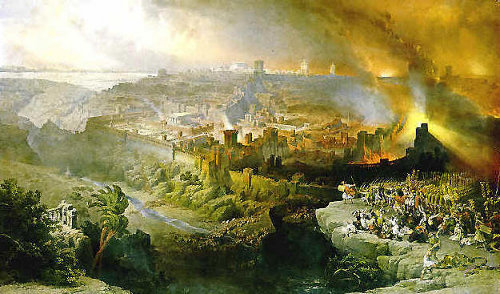
Tisha B’Av, the Fast of the Ninth of Av, is a day of mourning to commemorate the many tragedies that have befallen the Jewish people, many of which have occurred on the ninth of Av. Tisha B’Av means “the ninth (day) of Av.” It occurs in July or August.

Tisha B’Av primarily commemorates the destruction of the first and second Temples, both of which were destroyed on the ninth of Av (the first by the Babylonians in 586 B.C.E.; the second by the Romans in 70 C.E.).

Although this holiday is primarily meant to commemorate the destruction of the Temple, it is appropriate to consider on this day the many other tragedies of the Jewish people, many of which occurred on this day, most notably the expulsion of the Jews from Spain in 1492 and from England in 1290.

-from Judaism 101

Sometime before May of 2011, as chronicled on my former blog, I significantly reduced many activities that I had erroneously believed were my obligation to Torah observance. Not that my observance was performed with any sort of accuracy as an observant Jew might consider it, but at one time in my life I made the mistake of thinking that Jews and Jesus-believing Gentiles were assigned identical obligations to God and for all intents and purposes, a homogenous identity.

All that changed over the period of about a year and one of the primary motivators of that change was me watching my Jewish wife integrate into the local Jewish community across two synagogues and into her exploration of who she is as a Jew.

I realized that by attempting to “mimic” Jewish observance and behavior, I was diminishing my wife in her Jewish identity and diminishing the special chosen status the Jews have received from God.

Which left me with the question of just how much Jews and Christians can and should share, at least relative to Messianic Judaism but ultimately as an act of interactive fellowship between all Christians and all Jews.

And that brings me to Tisha B’Av or the ninth day of the month of Av on the Jewish religious calendar. You can click the link posted in the last sentence as well as the Judaism 101 link to learn more about this event and the weeks leading up to it.

The question is, can I or should I fast on Tisha B’Av? What is the purpose of a non-Jew fasting on a day of Jewish mourning? I’m sure the question has been asked so I went searching for questions and answers.

QUESTION: Is it OK for a Noahide to fast on Tisha B’Av? [The 9th/Tisha of the Hebrew month of Menachem Av, when Jews observe total fasting for about 24 hours and 40 minutes, as part of their traditional mourning on this anniversary of the destruction of both the first and the second Holy Temples in Jerusalem. When the 9th falls on the Seventh Day as in this year, the fast is pushed off 24 hours, and starts on Saturday night.]

ANSWER: It would seem that if a Noahide would make a full observance of all the Jewish precepts of Tisha B’Av, he would be making a religiously-observed memorial day for himself, which is like innovating a religious observance, which is forbidden.

Rabbi Moshe Weiner, author of Sefer Sheva Mitzvot HaShem, says that the only point upon which an individual Noahide could justify fasting is that he is mourning the temporary (but far too long) destruction of the Holy Temple and the exile of the Divine Presence. Since this is a permitted activity, it depends on his intention.

-from “Remembering the destruction of the Temples”
AskNoah.org

rainbow-forestYou may think it strange that I started looking for answers by exploring the propriety of a Noahide (a Gentile who observes the Seven Noahide Commandments [see Genesis 9] and is considered a “righteous Gentile” from a religious Jewish perspective) observing the fast. After all, I previously explored the idea of a Christian also being seen as a “righteous Gentile” and found, with rare exception, that the two states are incompatible.

But since this question (and many others like it) has probably been considered by the various branches of Judaism for hundreds of years or more, why not seek out their viewpoint? After all, it is a Jewish commemoration.

I only quoted from part of the article, but as you can see, it’s not considered obligatory for a Noahide to observe the fast or any of the other customary events leaving up to the actual fast day.

While a complete fast is discouraged, there are other recommended behaviors that are thought appropriate according to the Ask Noah Rabbi:

You can certainly increase in deeds of goodness and kindness for others, especially in giving donations to proper charities (which are not in conflict with Torah laws or morals)

Certainly a Noahide is encouraged to pray that the Third Holy Temple shall be established by Moshiach ben David very speedily in our days. And it very appropriate for a Noahide to read the Book of Lamentations on the night and/or day of Tisha B’Av.

The Rabbi also recommended the traditional reading of the Book of Job.

Rabbi Qury Cherki at the Noahide World Center has a similar opinion:

There are no commandments binding on a Noahide on the Ninth of Av. Any actions that he or she takes are completely voluntary. Anybody who decides to fast, or to read the Book of Lamentations or the Wars of the Jews and the Romans by Josephus, will be blessed for compassion.

The same is true of other restrictions, such as not listening to music, not greeting other people, and not using makeup. All such practices are copied from the obligations of Israel and are voluntary for Noahides. Children should not be told to fast.

Noahides can also decide on their own conditions. For example, they might allow themselves a partial fast by drinking but not eating any food. They can freely choose their own conditions.

This commentary seems a bit more relaxed than the “Ask Noah” opinion but it ultimately centers on any action the Noahide takes in response to Tisha B’Av being completely voluntary and a blessing for compassion.

churchBut what about Christians? Since the Church has been the source of much Jewish misery over the long centuries, would it be considered forbidden for a Christian to participate, or would it be (perhaps) considered an obligation as a matter of Teshuvah? If we have caused Jewish suffering, should we now, as an act of repentance, share in Jewish mourning?

It’s not easy to find anything online about Christianity and Tisha B’Av. I did manage to locate a letter written by Rabbi Yechiel Eckstein posted at the International Fellowship of Christians and Jews. It’s addressed “Dear Pastor and Friend of the Fellowship,” so the audience is generically Christian. The letter seems educational in nature and is more advice to a Pastor on how to explain the Jewish significance of Tisha B’Av to Christian congregations.

R. Eckstein ends his letter:

It is my hope that these materials will help you gain greater insights into the Jewish roots of the Christian faith and understand the significance of Tisha b’Av.

I thank you for your continued interest and partnership in building bridges of understanding between our two faith communities.

May God bless you richly as you and your congregation continue to study His word.

The Christian Broadcasting Network posted an article by John Parsons of Hebrew for Christians Ministries entitled Tishah B’Av: Remembering the Destruction of Zion, but that too was an informational piece with no specific recommendations for Christian observance of the fast.

Which brings me to First Fruits of Zion’s (FFOZ) article The Affliction of Av.

This day holds intense significance for the Jewish people, but what about Christians, the followers of Messiah? Should believers mourn as well? Yes, we more than anyone else.

This is the first and only affirmation I could find (granted, my search was hardly exhaustive) that Christians not only could but should observe the fast. The article continues to conclusion:

The afflictions of Tisha b’Av were not just limited to the days of the Bible. Tisha b’Av has continued to be an ominous day for the Jewish people throughout their history. Sadly, many of these tragedies have been at the hands of “Christian” rulers, popes, and angry mobs. Whether by crusades, inquisitions, pogroms, or blood libels, so-called followers of Yeshua have tortured, burned, and murdered Jews. In so doing, these “Christians” have maligned the name of the Master and blasphemed His character.

But though some of these tragedies may seem like ancient history, “Christian” persecution is still fresh in the collective mind of the Jewish people. Given that fact, perhaps Tisha b’Av should become a Christian tradition as well. We must continue to rid our congregations of the sin of anti-Semitism in whatever form it takes, whether in thought, speech, or theology.

Once again, tzom kal – May you have an easy fast.

If the Church can be said to be obligated at all to the observance of Tisha B’Av, repentance for our historic (and maybe more modern) crimes against Israel, Judaism, and the Jewish people is the reason. Beyond Teshuvah is fasting as an act of compassion and solidarity. From a Christian and Messianic point of view, we are all looking to a future time when Messiah comes (returns) and rebuilds the Temple in Jerusalem, defeating Israel’s enemies, and bringing a lasting peace to the entire world for all nations…for Jews and Gentiles alike.

Each of them will sit under his vine
And under his fig tree,
With no one to make them afraid,
For the mouth of the Lord of hosts has spoken.

Micah 4:4 (NASB)

fall-of-jerusalemYesterday, I posted both a blessing and a cautionary tale about praying for the peace of Jerusalem or, conversely and even fatally, failing to do so. I believe Christians are commanded to pray for Israel’s shalom as a matter of aligning ourselves with the will of God for the Jewish nation and all of her people. In that light, I can see Christian observance of Tisha B’Av on some level to be obligatory as well. That most church Pastors and their congregations know nothing at all of Tisha B’Av may be a tragedy and a crime. Could it also be a sin?

As I write this, it is the first day of the month of Av, which begins the Jewish observance of the Nine Days leading up to the fast day. You can also learn a lot more about the three weeks leaving up to Tisha B’Av at Chabad.org.

This year, Tisha B’Av begins just before sundown on Monday, August 4th and ends about forty minutes after sundown the following day, Tuesday the 5th.

If you are Jewish and reading this and you don’t have a practice of fasting on Tisha B’Av (unless for a medical reason) I encourage you to strongly consider participating in the fast as a matter of community with all of Jewry, your brothers. If you are a Christian, from a traditional Jewish point of view, any observance of Tisha B’Av is completely voluntary and you are free to not observe the fast at all. However, the reality from a Messianic point of view (and who is to say this isn’t God’s point of view as well) is that observing Tisha B’Av can be seen as an obligation for Gentile Jesus-believers as both a matter of repentance and compassion.

This could be akin to that portion of Psalm 122 which pronounces prosperity for anyone who prays for the peace of Jerusalem and who loves the Holy City, as well as to Genesis 12 which announces blessings for those who bless Israel and curses for those who curse her.

Thus not only should we pray for Israel’s peace but we should also mourn with her in her loss.

“Be joyful with Jerusalem and rejoice for her, all you who love her; Be exceedingly glad with her, all you who mourn over her…”

Isaiah 66:10

“He who does not mourn over the Destruction of Zion will not live to see her joy.”

-T. Bab Bathra, fol. 60. 2. & Caphtor, fol. 118. 2.

RestorationOur hope as Christians is in the return of the Messiah and the resurrection in the New Covenant age when Jerusalem will be rebuilt and Israel will raised as the head of all the nations. Jerusalem will be in her uttermost joy, but according to Jewish tradition, those who do not mourn for Zion now will not be alive in the Messianic future to receive her joy. This is commentary on both Isaiah 66:10 and Genesis 12. This is a warning to all believers who still embrace hatred of Israel in their (our) hearts.

May God grant wisdom and compassion to His worshipers among the nations, and may He teach us to weep bitter tears over the fallen Temple, so that we may sing with joy when Messiah raises the Mikdash, the Holy Temple, again.