Tag Archives: midrash

Sermon Review of the Holy Epistle to the Hebrews: Ten Testimonies

In the first two chapters of the Epistle to the Hebrews, the writer of the epistle employs ten proof texts drawn from the Torah, the Prophets, and the Writings to make his case that Messiah is more exalted than angels. In this teaching, D. Thomas Lancaster connects the dots between the ten passages to reveal the larger message. A fun exploration of apostolic methods of Bible interpretation.

-D. Thomas Lancaster
Sermon Six: Ten Testimonies
Originally presented on February 2, 2013
from the Holy Epistle to the Hebrews sermon series

Each of Lancaster’s sermons about Hebrews seems to have a different emphasis, sometimes radically different. Last week, we focused on a Judaic study of Christology, if we can say there is such a thing. This week, we use the “midrashic method of Bible study,” as Lancaster says, to prove a simple statement: Messiah is greater than the angels.

Actually, Lancaster’s explanation for the distinction between how Christians do Bible study and how Rabbinic Judaism approaches the same task is worth the price of admission alone. It’s the reason (or one of them) why I’m doing a review on the Meaning of Midrash, humble though it may be, based on a series written by Rabbi Tzvi Freeman. It’s not just the way religious Jewish people study the Bible, it is, according to Lancaster, the way the Bible was studied in the Apostolic era; it’s the way that the writer of the Book of Hebrews wrote the Book of Hebrews.

Thus, in order to understand the Book of Hebrews, we need not only to understand something about midrashic Bible study, but we need to apply that method when we read the Book of Hebrews. Otherwise, we’re going to sail right past the meaning and come up with (probably) some pretty goofy conclusions.

This is also why many, many Christians Pastors and scholars, people who are very smart, well-educated, and well-read can be firmly convinced, based on educated and rational grounds, that they know what the Book of Hebrews is saying and yet still (probably) be very, very wrong.

I should note at this point that the very first person to comment on part one of my “Reviewing the Meaning of Midrash” blog post took Christianity/Messianic Judaism to task, rather severely so, for our use of Rabbinic commentary to “prove” Yeshua was Messiah and that Messiah was/is Divine. I can only conclude that any further mention of Midrash from a Christian (me) is going to be viewed unfavorably among Jewish people. I mean no offense, though I understand (to the best of my ability) why you experience offense from me. However, this is the only way I can say what I’m trying to say right now.

Be that as it may…

This kind of goes back to what I said in The Two-Thousand Year Old Christian Mistake. If the most fundamental foundation by which we understand the Bible and our Christian faith is in error, then our theological and doctrinal conclusions are also very likely to be in error. In fact, it’s by the grace of God and the Holy Spirit that the Christian Church continues to serve God just as, I believe, observant Judaism continues to serve God, even though most Jewish people do not currently recognize the Messiah’s face or voice.

So what is the “midrashic method of Bible study” according to Lancaster?

    1. A Rabbinic dissertation or midrash attempts to solve some sort of identified “problem” or topic in the Bible.
    2. The solution is stated and then a series of proof texts are presented to support the solution.
    3. The proof text references assume that the audience has memorized large portions of the Bible, since typically only a short phrase or sentence from each proof text is presented.
    4. Keyword associations are used to link the proof texts whereby portions of scripture are deconstructed and then reconstructed to create new meanings (which can be terrifically unsafe).

And this is how Lancaster says that the Bible was studied in Apostolic times. If he’s right, then the traditional methods of Bible study we employ in our churches are nowhere near what is required to understand the apostolic texts including the Book of Hebrews.

Some of you think that’s a big “if.”
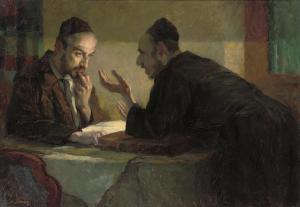
Talmud Study by LamplightLancaster presented ten proof texts along with their explanations and yes, they’re very involved. It would make a very long blog post if I were to try to replicate his commentary here, plus it would be very unfair, since such a detailed review might make it unnecessary for you to actually listen to his sermon.

Here’s the goal of these proof texts again: To prove the Son, that is Messiah, is superior to the angels…not necessarily in the world today, but in the world to come.

…having become as much better than the angels, as He has inherited a more excellent name than they.

Hebrews 1:4 (NASB)

You’re probably thinking of Philippians 2:9-10 where it says, “God highly exalted Him, and bestowed on Him the name which is above every name, so that at the name of Jesus every knee will bow,” but according to Lancaster, you’d be wrong. The inherited name is the “Son of God.”

How do we know this? Start in Psalm 2.

Like I said, it would take a lot of space and be very complicated to go through all of these connections and compress a nearly fifty minute sermon into a few paragraphs (OK, more than “a few”).

But Lancaster uses the Rabbinic associative method to link Psalm 2 to 2 Samuel 7 where it speaks both literally of Solomon and prophetically of Messiah, Son of David, building a house, which can be both a house and a family or congregation.

The linkage got kind of tricky when we arrived at the third text Deuteronomy 32:43, because the writer of Hebrews used an alternate version found only in the Septuagint, and almost all of our Bibles use the Masoretic text. However, the quote references the joy of both the Jewish people and the Gentiles, which is important later in the study and important in general.

D. Thomas LancasterIt also speaks of the angels worshiping Messiah, which connects to the fourth text, Psalm 104 quoted in Hebrews 1:6. Lancaster was speaking fast and furious, so it was tough to take notes on everything he said (his speaking notes would be a great download to offer with the recording for people like me). This point goes back to point two when it speaks of a Throne and a Kingdom forever and is echoed in text five, which is Psalm 45, Solomon’s wedding song. This is also a Messianic prophesy since it addresses the Son of David. It also speaks of the Throne and the Scepter.

An apparent contradiction is revealed since Hebrews 1:10-11 states everything that God has made, both Heaven and Earth, will be destroyed so that only God remains, but the sixth proof text, Psalm 102 tells us that Hashem’s Throne will last forever, even when everything else perishes, as is stated in verse 12. Verse 18 of this Psalm says the words were recorded for a future generation, which Lancaster says is us, we who are servants and children who will also be eternal with God.

Proof text seven is Psalm 110 and the key in this scripture is not just that Messiah is sitting at God’s right hand but that the Throne we have been referencing is God’s Throne and is also the Throne of Messiah, which is how Messiah’s Throne can be forever.

The next referenced text is Psalm 8 which is quoted in Hebrews 2:5 and speaks of all things subjugated to the Son, but this is not apparent now because we are reading about the age to come.

Text nine is Psalm 22 which is the classic prophesy of the suffering and crucifixion of the Son. Verse 22 says the Son has brothers and verse 23 identifies some of those brothers, the congregation as “you who fear the Lord,” which is taken to mean God-fearing Gentiles. Verse 24 follows up with identifying the offspring of Jacob, the Jewish people also as that congregation.

While Psalm 22 says that God has not hidden his face from Messiah, the tenth proof text, Isaiah 8 says God has hidden his face, in this case, speaking of the current exile of the Jewish people…but the exile will not last forever.

The conclusion of the lesson ties everything up, but you need to listen to the sermon to get Lancaster’s summarized points in his own voice along with all of the details I had to leave out of my review. However, the big point, like in the last couple of sermons, is that the original audience of Hebrews as well as we modern readers, should place our hope and faith in Messiah, so that we will become part of the body of his servants, of his children, his congregation, and be built up into a house for Hashem.

What Did I Learn?

As I mentioned above, it wasn’t just Lancaster’s whirlwind tour of the Bible that I found illuminating, it especially was the method he used to open up the scriptures. I won’t pretend that there aren’t a lot of pitfalls, trap doors, and sinkholes in employing this method, especially when traveling at rocket-like speed through different parts of the Bible, but if indeed we can say this replicates how the apostles and disciples would have understood the New Testament (or all scriptures) in general and Hebrews in specific, then there are also many definite advantages.

Glasses on Open BibleAs I’ve said previously, this isn’t going to sit well with people who are used to studying the Bible through normative Christian processes. It’s not that Christians don’t have a rich and well-defined scholarly approach to Bible study, but the premise upon which Christianity builds that study may not lead down the path of the original author’s intent and what the original audience, especially a first century Greek-speaking Jewish audience, would have heard.

But what about the guidance of the Holy Spirit? I’ve said before that the Holy Spirit can guide us, but I don’t think He will overwrite our free will. If we are determined not to see a particular perspective, even if the Spirit is pointing our nose right at it, then we won’t see it. We have the Bible and we have the Holy Spirit, but we also have free will and the desire to confirm what we think we already know, rather than (sometimes) learn what God really has to say to us, especially if it is unexpected or contrary to long held belief and tradition.

As I also said above, this re-enforces my desire and intent to review the Midrashic approach to scripture as presented by Rabbi Tzvi Freeman and Chabad.org. That doesn’t mean that everything R. Freeman teaches and everything the Chabad believes completely or even greatly meshes with the study on Hebrews, but at least gaining some additional familiarity with how Rabbinic interpretation works, especially if indeed this is how Hebrews is written, may well give those of us who don’t have the benefit of a classic Jewish education a bit of a leg up.

Reviewing the Meaning of Midrash, Part 1

Torah, like any wisdom, has departments. That’s important to know. You can’t study literature the same way you study biology, and you can’t critique poetry as you would journalism. So too, you can’t study one department of Torah the same as you study another.

There’s more than one way of dividing up those departments. One way is to talk about approaches to the text.

Rabbi Yitzchak Luria, the Ari, constructs an acronym from these four departments, disciplines, or levels of peshat, remez, derush and sod: pardes, meaning “an orchard.” He taught that every soul must delve into all four layers of the Torah, and must continue to return to this world until having done so.

-Tzvi Freeman and Yehuda Shurpin
Is Midrash for Real?
Part 1 in a series on the truth behind Talmudic tales
Chabad.org

I have been promising to write a review on this series for a few weeks now, but as I read part one, I already feel like I’ve bitten off more than I can chew. I’m not Jewish and certainly not an Orthodox Jew, nor am I a mystic, which is what seems to be required to understand what Freeman and Shurpin are saying.

True, I’ve been critical of Christian devotion to Sola Scriptura more than once, but investigating Midrash on the road to Kabbalah could be a bit much for me.

I’m not throwing in the towel. I just want you to know how different this is.

First things first. How does this article define Midrash?

Finding deeper meaning and lessons in life is yet another department, which we call derush or midrash—and our basic commentators will again be found in these halls as well. Midrash often includes stories, called aggadah, some allegorical, some anecdotal, some reaching far beyond what we understand to be possible in our world. Midrash can be found strewn throughout the Talmud, and in many anthologies compiled contemporaneously with the Talmud or later. The largest, best-known collection is called Midrash Rabbah.

Many of the juiciest midrashim are collected in the classic commentary of Rashi. This despite Rashi’s repeated insistence that “I come only to explain the simple meaning of the text.” Because the text bubbles with meaning, frequently defying the steamroller of the strict literalist, demanding deeper interpretation at every turn.

What I’m taking from this is that Midrash isn’t necessarily intended to be literal fact. Certainly Christianity has its own rich tradition of religious allegory, so how can we criticize Judaism for employing the same tools. Midrash is in the “Derush” department, that which reveals the deeper meanings of the Torah.

AggadahBut are these “deeper meanings” actually encoded in the Torah or are they what various authorities including the esteemed Rashi have taken out of Torah and formed into morality tales, fables, or colorful metaphors to communicate principles that can be derived from scripture? How many Christian Pastors take a verse or two of scripture and develop a homily to be delivered from the pulpit on Sunday? I can accept Midrash at that level of understanding and meaning, even though in Orthodox Jewish thought, it may be intended to represent so much more.

But according to the article and the sages it cites, a steady diet of all four “departments” of Torah understanding is necessary for the “spiritual health” of every Jewish person.

The Ari’s message is not as esoteric as it may seem: Just as our bodies do not live by carbs alone, so our souls require a mixed diet. To be a complete Jew embracing a complete, wholesome Torah, you can’t satisfy your requirements studying in one department alone. You need a well-rounded curriculum at all four levels.

But the focus on this series as well as my review is of only one of the four “departments” or “food groups” in this diet.

And the midrashic tales and the secrets of the Torah are just as vital. Why? Because as much as Torah is about what you know and what you do, it’s also about how you think and what you feel. As magnificent a structure as you may have built for yourself, without light and warmth nobody is going to live there too long. That’s the way life goes: without the sparks firing, the engine just stops turning.

Midrash is your gateway to connect with the Author of the Torah. “If you want to know the One who formed the universe,” the Talmudic sages advise, “learn aggadah.” Aggadah, the midrashic tales scattered throughout Torah literature, are said to contain “most of the secrets of the Torah.”

That’s probably a lot farther than most Christians would be willing to go, and understandably so. Outside of Orthodox Judaism and especially the mystic context of the Chabad, it’s also much farther than many Jewish people would want to go. Let’s not kid ourselves. What I’m investigating is a relatively narrow perspective within the panoramic landscape of overarching Judaism. Nevertheless, for those of us who “intersect” with religious Judaism at some level, encountering Midrash is inevitable. So why fight it? Let’s have a look.

But the secrets are veiled, as Maimonides writes (we’ll get to that soon), so that only those who are fit to receive them will discover them there. The Zohar provides a parable to explain why the Torah must speak in parables…

I’m pausing here to remind everyone that Jesus spoke in parables. Christians tend to take the parables of Jesus for granted, largely because those parables have all been explained in the text of the Gospels, and even if we don’t always understand the explanations, we usually receive some satisfactory interpretation from our Pastors or some Christian book writer.

ffoz_tv18_aaron
Aaron Eby

Last fall I reviewed an episode of the First Fruits of Zion (FFOZ) television series called Speaking in Parables which sought to explain the purpose of the Master’s parables in terms of Messianic Judaism.

FFOZ Teachers and Toby Janicki and Aaron Eby are the hosts for these episodes and present each one as a “mystery” that requires three “clues” to solve. In these clues and their solutions, they use the Bible and Jewish literature to teach their audience that “Parables were a common teaching device used to simplify complex concepts.” The question then is whether or not Midrashim also take complex concepts and simplify them for their audience. Most Christians encountering a Midrash would probably say “no.” Sometimes a midrashic tale can make what we think of as the plain meaning of the text seem all too mysterious.

Apparently, the stories and mysterious words are more than packaging. After all, as the parable of the Zohar tells, from within the cloak of these parables the inner soul of the Torah speaks. Perhaps we should think of these stories as haute couture for G‑d’s wisdom. They are the fine clothing and jewelry that allow expression for Torah’s most inner wisdom, as a tasteful wardrobe betrays beauty that would otherwise elude the senses.

I invite you to read Part 1 in a series on the truth behind Talmudic tales (I also put the link at the top) for the full article, including the various parables it contains, to gain the full context of what I’m discussing. The sense I get from this text, and I’ve read similar material before, is that the Torah almost has a life of its own and is deeply encoded with meaning that extends well beyond what we can perceive, even if we could read the oldest available Torah documents in their original ancient Hebrew.

So fitting, so magnificent is this wardrobe that it carries the secrets of Torah even to the small child. In a way, it transmits to the simple child much more than to the sophisticated adult. To the adult, the clothing is distinct from the meaning it contains; the analogy and its analogue live in two different worlds. The child, when he grasps the clothing, grasps the warm body and soul breathing within. They are all one and the same. In his simple understanding of the tale, he touches G‑d.

To better understand how that is so, we’ll have to examine midrash a little deeper. We need to ask, are the stories of the Midrash truth or fiction? If they are truth, how is it that they so often conflict with one another? And how do we know when the Talmud is telling us a historical anecdote and when it is speaking in parables?

MidrashJust a reminder. There’s a difference between facts and truth. Or as Indiana Jones once said, “Archaeology is the search for fact… not truth. If it’s truth you’re looking for, Dr. Tyree’s philosophy class is right down the hall.”

Midrash, like any metaphor or morality tale, can contain truth and still be fiction. We’ll see what more Freeman and Shurpin have to say in next week’s review.

Does the Church Interpret the Bible Based on Traditions?

Question: What if I believe only in the written text of the Torah?

Answer: I’m glad to hear that you have such strong faith in the “Hebrew Bible.” My question is, how do you know that this is true? Certainly, you must be relying on tradition. Otherwise, how do you know that the words you have before you are the original words written by Moses and the prophets? How do you know that they ever received this to begin with? What other way is there than to rely on the integrity of the Jewish people over the ages?

-Rabbi Tzvi Freeman
-from “What If I Believe in Only the Written Text of the Torah?”
Chabad.org

Rabbi Freeman has written a multi-part series on the nature of Midrash which I plan to explore. The above-quoted text isn’t part of that series but I think it’s a good place to start my own investigation for a couple of reasons. The first, as I previously mentioned, is I have my doubts of the effectiveness of the philosophy of sola scriptura as practiced by certain expressions of “the Church”. I really don’t believe that most Christians really, really access “scripture alone.” To be fair, I believe they think they do and that they are sincere in their convictions, I just think they are either blind to the presence of interpretive tradition, or if aware of it, they do not believe it has as much influence on their “vision” as it actually does.

One of the things I admire about Judaism is that it admits to relying on tradition to interpret the Bible and in fact states that it is impossible to understand what the Bible is saying without a system of interpretation and tradition to use as a lens.

That’s going to freak out a lot of Biblical literalists in the Church and this isn’t the first time I’ve made such a statement (see Removing the Garments of Torah and The Purpose of Torah in New Testament Judaism series for examples).

I do want to state upfront that just because a tradition exists, either in the Christian or Jewish frameworks, doesn’t mean we should automatically accept it as fact and truth. On the other hand, without tradition (and I agree with the Jewish perspective on this), at least to some degree, we’d never be able to understand let alone implement various portions of the Bible.

I should also mention at this point that many (most?) Hebrew Roots groups echo the question stated above, believing in the accuracy and authority of the written Torah but disdaining any of the Rabbinic commentaries which are used to interpret and operationalize Torah (and how do they tie their tzitzit and lay their tefillin without relying on Rabbinic tradition?). Such groups seem to take what they want from normative Judaism while escorting the Rabbinic sages and their rulings and interpretations to the nearest dust bin.

And that, really, is Judaism: a faith in the integrity of the Jewish experience as transmitted to us by previous generations. It turns out that everything we believe, including faith in the word of the written Torah, is based on this faith in the Jewish people. Perhaps that is the reason we call it Judaism (or Yahadut, or Yiddishkeit) and not “Torahism” (or Karaism)—because the most basic faith we have is in the Jewish people, and from there extends our faith in the written word and in the prophets.

As I read Rabbi Freeman, I get the impression that one of the functions of Judaism is to provide the traditions by which Jews interpret the Torah. This gets complicated in that there is no one “Judaism” and thus no one authoritative interpretation of Torah, although within the larger “Judaism” construct, meanings heavily overlap.

But how the Chabad traditionally interprets a portion of the Torah and how to perform the associated mitzvot may differ greatly from how a Reform or Conservative synagogue may read and understand the same material. Thus, from an outsider’s point of view, it makes Judaism seem very inconsistent, highly variable, and the meaning taken from the Bible to be incredibly fractured.

But what about the untold hundreds or even thousands of denominations, subgroups, and sects of Christianity? The answer my Pastor would give me is that there is only one right answer, which is why the Fundamentalist movement was established in the early days of the 20th century…to create (or return to) that one “right” answer. My Pastor has tried to explain the core meaning of Fundamentalism to me, apart from all of the media hype and unfair interpretation of the “label,” and I’ve recorded that understanding on my blog so I wouldn’t lose track.

Really, Fundamentalism at its center is just “getting back to the basics” of Christianity, but those “basics” were established barely a hundred years ago. Would the apostles have understood their faith in the same way as John MacArthur, R.C. Sproul, or Steven J. Cole?

R.C. Sproul
R.C. Sproul

So the best we can say at this point is that Judaism and Christianity both heavily utilize tradition to tell each religious body and their various subgroups  (actually, each of the subgroups have their own traditions) what the Bible is supposed to be saying and how we are to live out what the Bible tells us in our individual and corporate worship lives.

I’ve also recently mentioned the story of Hillel, Shammai, and the Three Converts, which Rabbi Freeman too mentions in his commentary.

Another gentile who accepted only the Written Torah, came to convert. Shammai refused, so he went to Hillel. The first day, Hillel taught him the correct order of the Hebrew Alphabet. The next day he reversed the letters. The convert was confused:”But yesterday you said the opposite!?” Said Hillel: “You now see that the Written Word alone is insufficient. We need the Oral Tradition to explain G-d’s Word.”

Rabbi Freeman’s point, citing Hillel, is “that without an oral tradition, there is no written Torah. Written symbols on a scroll are meaningless without context. We have no clue what the words mean, or even whether they are at all true.”

But is that really true? Does not understanding the original language in and of itself impart some meaning? Of course, you also have to understand the historic, cultural, national, linguistic, traditional, theological (and many other) contexts involved that subtly or significantly modify the meaning of the plain text. Could the overall understanding of those contexts be codified to become an interpretative tradition?

Because the prevailing interpretations have probed Paul’s text without sufficient appreciation of the powerful role of ironic inversion at work, at the formal as well as functional level, the interpretation of the apostle’s scathing rhetoric has exaggerated and, regardless of other plans, continues to accentuate the differences that are imagined to separate Christian and Jewish identity, behavior, and even intentions toward God and neighbor. The legacy of this perception of the Jewish other has proven often tragic for the Jewish people, at least in a world that has been often dominated by those who look to Paul to shape reality, and for others, as a foil to justify their twisted construal of what is right.

-Mark D. Nanos,
from the Prologue of his book (pg 2)
The Irony of Galatians: Paul’s Letter in First-Century Context

It is Nanos’ belief that Christianity’s understanding of the basic nature and personality of the apostle Paul has changed not very much since the days of the so-called “Church fathers” and hardly at all in the last five-hundred years since the Reformation. While the Church doesn’t cite time-honored Christian tradition as the necessary element to understand the letters of Paul or as required to comprehend his actions as recorded in Luke’s Book of Acts, nevertheless, my recent reviews of some of the sermons of John MacArthur have convinced me completely that Christianity’s understanding of the meaning of scripture is totally reliant on revered Christian traditions.

When, on occasion, I’ve tried to challenge those traditions (and not the scriptures themselves), the reaction I observed could at least be called resistance.

Judaism has its traditions as well, but Jewish authorities are quite upfront about saying that they have a tradition and that, as far as Rabbi Freeman goes, “Judaism-colored glasses” (my phrase, not his) are required when reading the Word of God.

The Torah says to rest on the seventh day. I once met a man who told me that he tried to keep the Sabbath as written in the Torah, but it was too hard—by four in the afternoon he just had to get up out of bed! Who says his interpretation is worth anything less than anyone else’s?

The Torah says that “these words should be totafot between your eyes.” What on earth are totafot? Where is “between your eyes”? When do you wear them, and how?

The Torah says, “You shall slaughter an animal as I have commanded you.” What was it that G‑d commanded Moses? How can we know? There seems to be no hint whatsoever in the entire Five Books of Moses. Obviously, everybody knew what Moses had been told; they did it all the time, and nobody needed it in writing.

Praying with tefillinGood points, Rabbi Freeman. Of course modern Christians would say all that stuff is dead and gone, so who cares if we don’t know how to properly rest on Shabbat, figure out what “totafot” means or how to put them “between your eyes,” and what the correct method of “slaughtering an animal” was as required by God?

But even if I took the Christian point of view, I’d have to admit those things meant something once. Just how were they enacted in ancient days without sufficient written instructions? When asked, how did Moses answer those questions? In the days of the Temple, how did Solomon address those issues? And did Jesus even obey those requirements since the Temple still stood during his “earthly ministry?”

It seems like neither Christianity or Judaism can exist and practice their faiths without a rich tradition of…tradition.

Protestants, as I experience them anyway, seem to have a deep-rooted resentment against a central authority in religion. I’ve heard Evangelicals say some pretty rough things about Catholics and their Pope, and I’ve listened to more than one Christian say (more or less) that it was part of God’s plan for the Apostles to die off so “Christian authority” could be de-centralized. Never mind that Christians tend to revere the “Church fathers” and particularly the authors of the Reformation. Some churches, including the one I attend, even celebrate Reformation Day.

The oral tradition also includes later decisions and exegeses made by those who led the Jewish people and were empowered to make decisions on their behalf. These are the seventy elders in every generation, as established originally by Moses himself (read all about it in Numbers 11). It is to these sages that Moses refers when he charges the Jewish people that if anything is to difficult for them to solve, they must take it to these wise leaders, and “do not turn from whatever they tell you, not to the right and not to the left” (read that one in Deuteronomy 17:8–12). Otherwise, what on earth are we supposed to do when Faraday discovers how to harness electrical power? Is it fire? If not, what is it? So, a rabbinical assembly came to the consensus that we will treat it as fire, and not turn it on or off on the Shabbat. Now all the Jewish people can keep one rule and one Torah.

These same sages were empowered to protect the Jewish people from breaking the Torah by “building fences” about the prohibitions. If you can walk right up to the edge of a serious transgression, it’s unlikely that no one is going to fall off. Which should provide an answer to your question about the boundaries for walking on Shabbat.

All this is seen by Christians as “adding to the Bible.” I’ve heard Matthew 23:4 and the surrounding text applied to Rabbinic Judaism as a whole, casting all Jewish practices into the same bucket and observant Jewish people under a bus.

On the other hand, try telling people in a church to do away with their Christmas and Easter (or Resurrection Day) observances because they’re “man-made traditions” (not to mention the previously cited “Reformation Day”) and you’ll likely start a riot (OK, probably an angry and offended discussion, not a riot).

Christians don’t like the Rabbinic sages for the same reason they don’t like the Pope. They don’t like or trust a central authority that can establish binding religious rulings over their lives. It interferes with the “freedom of the gospel” they enjoy, but do Christians really have that much freedom?

It depends on the church and which Pastors and teachers are favored, with their books enshrined in the church’s library or bookstore. Which books are studied by the Wednesday night woman’s group or deemed worthy of possessing lessons to be followed by the men’s ministry? Are preachers like John MacArthur, R.C. Sproul, and Steven J. Cole considered the “sages” of modern Evangelical Christianity? Do the churches that follow their particular teachings not rely on these men and their theologies and doctrines to interpret the Bible for them?

But allow me to summarize the most crucial point: You can choose to believe in a book. Or you can choose to believe in a divine revelation. The divine revelation was encoded into a book by Moses, but its light never ceased to shine. In every generation, more and more of it enters into the world, through the medium of those sages who study the book and its surrounding traditions and all the accumulated wisdom that has unfolded over the millennia. One day, we will see how all that we unfold was contained in those original words Moses wrote. But to access it all now, make yourself part of the Jewish people, and have a little faith in us. After all, if it weren’t for us, where would that little book be?

To be fair, the whole concept of a set of traditions being required for understanding what God’s Divine Revelation means, especially as adapted across multiple generations, is alien to Christian thought, even if it’s not foreign to Christian interpretative practice. We just don’t talk about it, like some dirty family secret, some hidden skeletons in the Church’s closet.

Christian BookshelfAlso to be fair, Rabbi Freeman wouldn’t have written such an article if some Jewish people, perhaps a lot of Jewish people, weren’t as critical of midrash and oral tradition as we Christians are.

R. Freeman offered some additional resources for the Jewish (and Christian?) curious including The Essential Talmud by Rabbi Adin Steinsaltz, R. Freeman’s own article Is It Really the Torah, Or Is It Just the Rabbis, and a series of audio teachings by Rabbi Lazer Gurkow called The Oral Tradition. You also might consider Is Torah Just For Jews?

I encourage you to read the responding comments to Rabbi Freeman’s article (scroll down) so you can see that among individual Jewish people, what the Rabbi professes is not a “slam dunk” in their minds and hearts. Hopefully, that will help dispel the idea held among some Christians that Jewish people are “all the same,” meant in the worst possible manner.

When the Church and its “sages” disregard and denigrate Jewish traditions while upholding Christianity’s own long history of interpretive tradition (all the while denying its existence), then it participates in another historical tradition of the Church that, while also “hidden,” is nevertheless still a potent force in the lives of many Gentile believers: anti-Semitism and supersessionism.

For more on the same topic, see Tradition!, According to the Traditions: A Primer for Christians, and Introduction to Messianic Judaism: Tradition!, my review of Rabbi Dr. Carl Kinbar’s article “Messianic Jews and Jewish Traditions”.

How Far Can We Explore the Bible?

The Bible is not a book but a library. It abounds with a spectrum of complementary, contrasting, and conflicting views, preserved by different sources and traditions. Diversity is not anathema. The Talmud records that books like Ezekiel, Proverbs, Song of Songs, Ecclesiastes, and Esther made it into the canon of Hebrew Scripture after much dispute, because they often contain often large chunks of theologically objectionable material. The editors did not put a premium on consistency and uniformity, but rather on assembling clashing voices driven by a hunger for the holy. A tolerance for diverse opinion and practice is imbedded in the foundation text of Judaism and in the vast exegetical literature that it inspired.

-Ismar Schorsch
“Conceiving of God,” February 13, 1999
Commentary on Torah Portion Mishpatim
Canon Without Closure: Torah Commentaries

Sounds kind of like how I relate to the Book of Hebrews and why I feel is it so problematic, but Schorsch’s commentary on the “theologically objectionable material” and its “clashing voices” in the “foundation text of Judaism” speaks to me of the whole Bible and especially those portions, like Hebrews, that “clash” with other portions. Perhaps that “clash” is deliberate (at least on God’s part) and exists not just to inform us, but to challenge us.

I must admit to being bothered by John MacArthur (yes, him again) and the Sufficiency of Scripture crew, because for them (as least as I read them), the Bible is to Christians what an auto repair manual is to a car mechanic.

You’ve probably heard of the “Bible” described by the acronym Basic Instructions Before Leaving Earth. Cute. There’s even a song with that title.

But it’s incredibly reductionistic and highly limiting of the power and the depth of the Word of God, as if the record of God’s interaction with man is just a history book, as if God were describing the workings of an internal combustion engine, which a sufficiently skilled human being can completely disassemble, describe the role and function of each and every part, and then reassemble and start-up with relatively no creative effort at all.

God is just a machine and the Bible is the instruction manual.

OK, it’s probably kind of unfair of me to say that, but there seems to be so much more “encoded” in the Bible, not necessarily though some arcane mystic means by which we must enter into an extraordinary metaphysical process to pry loose, but that requires we look at the scriptures as more than a book and even more than a library. If we believe that “all scripture is God-breathed,” (2 Timothy 3:16) then we must allow for the “breath of God” to be experienced as we open its pages and immerse in its waters. In other words, there’s a lot more to the Bible than meets the eye.

Even MacArthur’s commentary on scriptural sufficiency heavily, actually almost exclusively, references Psalm 19 and Psalm 119, both lyrical monuments to the glory, wisdom, and righteousness of the Torah of Moses. MacArthur just removes these passages from their original context and reforms them to suit his purposes.

This is probably why I have problems sometimes in Sunday school class. I expect to dive into a bottomless ocean of Biblical mystery and find myself wading in the shallow end of a swimming pool.

I’m being unfair again, but frankly, the Bible can take us just as far as we want to go and then, even farther. But just how far is that?

You’ll get a good idea of what I’m talking about if you’ll read Part 1 and Part 2 of my review on Boaz Michael’s lecture Moses in Matthew:

The two-hour seminar introduced many of the typologies throughout Matthew to Yeshua’s “Moses-like” fulfillment. The Gospels are composed in a thoroughly Jewish manner and need to be understood within that context to fully see what and why things take place and are said. The Moses in Matthew seminars are currently being offered at various locations and if you have the opportunity to attend one of these seminars, definitely do it! I found myself not only intellectually engaged and enlightened, but spiritually encouraged by this discussion.

-Rabbi Joshua Brumbach
“Moses in Matthew”
Yinon Blog

Gateway to EdenI’ve written before about the implications of treating Matthew and the other gospels as Jewish literature rather than Christian documents about Jesus and admittedly, the former is where my heart lies. It’s also where my head goes when I want to know more, learn more, see more clearly the path of God as He walks (metaphorically speaking) from Gan Eden (Garden of Eden) across early creation, on the road down to Egypt with Jacob, on the road up to Sinai with Moses, across the path of the Judges and the Prophets, and into the time of the apostles and beyond.

Why should God be so “Jewish” up until the end of the “Old Testament” (Tanakh, Jewish Scriptures) and then abruptly exchange His tefillin (and in Jewish legend even Hashem lays tefillin) for a cross around His neck (again speaking metaphorically)? Why would God set fire to the Torah scroll and when the flames have died out and the embers have cooled, sweep away the ashes and set a good ol’ King James Bible on the bema…uh, pulpit in front of Him to read to the Christian faithful as He evicts the Jews not only out of paradise but out of significance, love, hope, mercy, and completely off of the path of eschatology?

You think I’m kidding?

When Jesus came, everything changed, everything changed.… He didn’t just want to clean up the people’s attitudes as they gave their sacrifices, He obliterated the sacrificial system because He brought an end to Judaism with all its ceremonies, all its rituals, all its sacrifices, all of its external trappings, the Temple, the Holy of Holies, all of it.

-John MacArthur
“Understanding the Sabbath”
Grace to You

In other words, according to MacArthur and Protestant tradition, God destroyed everything that made the Jewish people Jewish, the Temple, the Torah, everything that defines Judaism, everything that sustains Jews. If you destroy what gives a people their life, don’t you destroy the people too?

My Pastor encouraged me to listen to some Christian sermons, probably since so much of my information comes from Jewish sources. I’m not sure that was such a good idea and the experience doesn’t seem to be producing the result I think he hoped for.

Why am I rehashing stuff I’ve rehashed and reheated many times before? What new information can I hope to produce? What new insights do I think will appear?

I suppose it’s one way to continue on the journey I declared couple of months ago. Challenged to stop sitting on the fence, I decided to hop off but not on the side I think my Pastor and the Church desired of me.

I’ve also been meaning to write some sort of commentary on Tzvi Freeman’s and Yehuda Shurpin’s series Is Midrash for Real?.

MidrashNow I’ve done it. I bet I’ve crossed somebody’s line in the sand. On the other hand, how do you get further into understanding the meaning of creation unless you break a few barriers and blow past a few “Do Not Enter” signs?

In a comment on one of my blog posts, I quoted from an article written by Adrian Kent called Our quantum reality problem or When the deepest theory we have seems to undermine science itself, some kind of collapse looks inevitable. I did this to illustrate how difficult it is for us to quantify and operationalize our observations of the universe. Shouldn’t our exploration into the deepest parts of a Spiritually inspired Bible, a Bible that was just as much authored by the finger of God as the pen of man contain just as much, if not more, difficulty and even “bizarreness?”

If God is truly infinite and unknowable in an absolute sense and even a created universe is only explained (and still imperfectly explained) by the shifting colors and currents described by quantum mechanics, how can we expect to experience the Bible as merely equivalent to the owner’s manual of a 1964 Volkswagen Beetle?

I’m not necessarily advocating for treating midrash as in any way the same as the Bible, but I am saying that we need to stop limiting ourselves by limiting the Word of God and thus limiting God. We must be willing to admit that God is God and He is not quantifiable. Even referring to God as “He” is a convention, just as the Bible describes God as having arms, or as walking. These are just literary devices to allow us to conceptualize the unimaginable.

“To claim absolute knowledge is to become monstrous. Knowledge is an unending adventure at the edge of uncertainty.”

-Leto, pg 275
Children of Dune by Frank Herbert (1976)

The Bible, among its other functions, sets up a basic framework for our faith. The framework exists as an environment in which to explore what that faith means, to discover our identity as God has given it to us, and what that identity means in relation to other people and in a relationship between the created and the Creator.

pathThe danger in this exploration is to read into the Bible what God did not put there, but there’s an equal danger in believing we have already discovered everything God breathed into the scriptures. Oversimplifying the matter, Christianity seems to be in danger of doing the latter and Judaism risks the former, at least in their most extreme expressions.

Somewhere there is a middle ground, a straddling path, a place where we can tether one foot in the pages of paper and ink and let the other one begin to stride among clouds. Even commentaries such as D. Thomas Lancaster’s Holy Epistle to the Hebrews sermon series (now, as I write this, at thirty-nine recordings and still counting) is just slightly slipping away from the Bible as a repair manual and entering the Bible as the barest beginning of an exploration into the hem of the garments of God.

For though by this time you ought to be teachers, you have need again for someone to teach you the elementary principles of the oracles of God, and you have come to need milk and not solid food.

Hebrews 5:12 (NASB)

If you think you have attained absolute knowledge of God and His Word, interestingly enough, you may still be dining on Gerber’s and have missed a few other culinary opportunities. The Bible contains an unending adventure of epicurean delights at the edge of uncertainty and I intend on tasting some delicacies.

“There is always an easy solution to every human problem — neat, plausible, and wrong.” -H.L. Mencken

Paul’s Hagar and Sarah Midrash

hagar_and_sarahTell me, you who want to be under law, do you not listen to the law? For it is written that Abraham had two sons, one by the bondwoman and one by the free woman. But the son by the bondwoman was born according to the flesh, and the son by the free woman through the promise. This is allegorically speaking, for these women are two covenants: one proceeding from Mount Sinai bearing children who are to be slaves; she is Hagar. Now this Hagar is Mount Sinai in Arabia and corresponds to the present Jerusalem, for she is in slavery with her children. But the Jerusalem above is free; she is our mother. For it is written,

“Rejoice, barren woman who does not bear;
Break forth and shout, you who are not in labor;
For more numerous are the children of the desolate
Than of the one who has a husband.”

And you brethren, like Isaac, are children of promise. But as at that time he who was born according to the flesh persecuted him who was born according to the Spirit, so it is now also. But what does the Scripture say?

“Cast out the bondwoman and her son,
For the son of the bondwoman shall not be an heir with the son of the free woman.”

So then, brethren, we are not children of a bondwoman, but of the free woman.

Galatians 4:21-31 (NASB)

This set of verses from Paul’s letter to the Galatian churches has been one of the most devastating commentaries used against the Torah of Moses and the Jewish people over the last two-thousand years. Torah and Judaism are slavery. Christ and his grace are freedom. The message to any Jewish person who struggles to come to faith in Jesus as Messiah is that they must give up being Jewish, Judaism, and any connection to the Torah because it is all slavery, and pursue the Christian Jesus because only the Goyim have freedom…

…or be cast out as the bondwoman and her son…her Jewish son.

But given the larger dynamics of Paul’s life, it seems extraordinarily unlikely that he would have meant to say that in this message.

And when they heard it they began glorifying God; and they said to him, “You see, brother, how many thousands there are among the Jews of those who have believed, and they are all zealous for the Law; and they have been told about you, that you are teaching all the Jews who are among the Gentiles to forsake Moses, telling them not to circumcise their children nor to walk according to the customs. What, then, is to be done? They will certainly hear that you have come. Therefore do this that we tell you. We have four men who are under a vow; take them and purify yourself along with them, and pay their expenses so that they may shave their heads; and all will know that there is nothing to the things which they have been told about you, but that you yourself also walk orderly, keeping the Law. But concerning the Gentiles who have believed, we wrote, having decided that they should abstain from meat sacrificed to idols and from blood and from what is strangled and from fornication.” Then Paul took the men, and the next day, purifying himself along with them, went into the temple giving notice of the completion of the days of purification, until the sacrifice was offered for each one of them.

Acts 21:20-26 (NASB)

After Paul arrived, the Jews who had come down from Jerusalem stood around him, bringing many and serious charges against him which they could not prove, while Paul said in his own defense, “I have committed no offense either against the Law of the Jews or against the temple or against Caesar.”

Acts 25:7-8 (NASB)

Throughout Paul’s entire ordeal, in trial after trial, before one judge to the next, Paul continually denied that he had committed any crime against the Jewish people. He denied that he told Jewish believers not to circumcise their sons. He denied that he told Jewish believers not to walk in the customs of their fathers. He denied that he took a Gentile into the Temple or committed any crime against such a Holy place. He denied that he told the Jewish believers to forsake Moses.

Apostle-PaulSo how can we interpret the statements Paul made in Galatians 4:21-31 to mean that Paul did tell the Jewish believers to forsake the Torah and that faith in Messiah was totally inconsistent with Jewish people living as Jews?

In his article A Torah-Positive Summary of Sha’ul’s Letter to the Galatians, Ariel Berkowitz defends Paul’s statement from a Jewish perspective, something most Christian Bible readers lack (please forgive the length of the following quote):

In chapter four, Sha’ul, having been thoroughly trained in the best rabbinic methods of Bible interpretation of his day, makes a midrash. A midrash is the Jewish way of saying that an allegorical or sermonic interpretation of the Scripture is about to take place.

This midrash is in 4:21–31. It is difficult to understand, as all midrashim (plural of midrash) are. Its difficulty has thrown many an earnest Bible interpreter aside. We will not analyze all of the midrash. We will only summarize the main point, because that is the point that is most pertinent to our present study of Galatians.

Sha’ul uses this midrash to illustrate the point he made in chapter three with his comparison of the two important covenants, the Abrahamic and Mosaic. Just as Abraham was putting Hagar before Sarah in order to fulfill God’s promises of descendants, so are those who are attempting a works justification putting Sinai before Abraham. Let us explain.

God called Abraham to a life of faith. God promised Abraham that He would give him children in his old age. God meant that the children would come through Sarah. Time went by and no children came.

Apparently, Abraham thought he would attempt to secure God’s promises by his own effort instead of relying on God to perform it. Thus, he had a child through Hagar. Although this was perfectly in keeping with the established customs of his day, it was not perfectly in keeping with trusting God! Abraham should have trusted God and waited for Sarah to have a child. Ishmael, therefore, was a child of works, but Isaac was the child of faith.

Sha’ul says that anyone who tries to secure God’s gracious promises of salvation and justification by obeying the Torah (going to Sinai) is like Abraham trying to secure God’s gracious promises through his own effort with Hagar. In the Galatian congregation, they were putting “Sinai” before “Abraham,” when they should have put “Abraham” before “Sinai.”

If you read my commentary on last week’s Torah portion, you’ll recognize a familiar theme from the Berkowitz article, that of justification coming through faith, not the mechanics of performing the mitzvot. Berkowitz’s interpretation of Paul’s midrash is no different.

Just as Abraham thought he could fulfill God’s promise of a son through his own efforts with Hagar, so too did some of the Jewish people (or Gentiles who thought they must convert to Judaism) believe they could secure justification before God by perfectly observing the Torah mitzvot. However, those Jewish and Gentile believers who understood that justification comes through faith and not the observance of Torah, are like Abraham when he trusted God’s promise of a son through Sarah, though it seemed completely impossible, because Sarah was so old.

abraham1This is not nullifying the Jewish responsibility of observing the Torah but rather putting faith and obedience in perspective. Obedience must follow faith, otherwise it is not in response to faith. Obedience, that is, following “the rules” for their own sake, does not provide justification before God. This is to be compared to Hagar and her son in Paul’s midrash. Only by faith in God does justification before God become achieved, not through our own performance of the mitzvot, then and only then, does Jewish obedience to the Torah of God have full meaning. This is to be compared to Sarah and her son in Paul’s midrash.

Lest I depend too much on Berkowitz for my defense of Paul, the Torah, and the Jewish people, I want to examine another, related source:

Paul develops a parable (midrash) based upon the story of Hagar and Sarah, Ishmael and Isaac, to point out the difference between God-Fearers and proselytes.

-D Thomas Lancaster
“Sermon Twenty-Two: Sarah, Hagar, Isaac, and Ishmael” pg 219
The Holy Epistle to the Galatians

That’s Lancaster’s brief summary as he’s introducing this chapter and the topic of Galatians 4:21-31. He seems to be taking a somewhat different approach to Paul’s midrash, making a comparison, not between “legalistic” Torah observance for justification vs. justification by faith, but between Gentile God-fearers and those who desired to convert to Judaism for the purpose of justification.

Lancaster takes his cue from Galatians 4:22, “For it is written that Abraham had two sons.”

In the synagogue world, a “ben Avraham” is a convert. Paul used the story of Isaac and Ishmael to illustrate two different types “benei Avraham,” in other words, two different types of Gentile proselytes. He was not contrasting Jews against Christians, nor was he contracting Jews against Gentiles. He was not talking about Jews at all. Instead, he used the Isaac and Ishmael analogy to contrast two different types of Gentiles: “For it is written that Abraham had two sons, one by the slave woman and one by a free woman” (Galatians 4:22).

-Lancaster, pg 221

Lancaster says that Paul makes a big deal out of “flesh versus the promise” as in:

Now the promises were spoken to Abraham and to his seed. He does not say, “And to seeds,” as referring to many, but rather to one, “And to your seed,” that is, Christ.

Galatians 3:16 (NASB)

Lancaster makes specific in his chapter that “All nations will be blessed in Abraham’s seed, the Messiah.” Abraham and Sarah conceived their son Isaac according to the promise, Abraham believed and it was reckoned to him as righteousness (Genesis 15:6). Isaac was born by faith but Ishmael was born by Abraham taking matters into his own hands, so to speak, and attempting to fulfill the promise of God, the promise that leads to Messiah, by his own efforts and not faith.

Lancaster points out something Berkowitz missed. Most Christians interpret the two covenants as Old Testament vs New Testament, which is totally untrue given the context. As should be obvious, the contrast is between the Abrahamic and Sinai covenants, which both Lancaster and Berkowitz point out, and does not allow for a replacement of one over the other.

What I am saying is this: the Law, which came four hundred and thirty years later, does not invalidate a covenant previously ratified by God, so as to nullify the promise. For if the inheritance is based on law, it is no longer based on a promise; but God has granted it to Abraham by means of a promise.

Galatians 3:17-18 (NASB)

Torah at SinaiIt seems rather apparent that the latter law, Sinai, does not nullify the earlier law and the promise made to Abraham by God. As Lancaster says, Hagar cannot replace Sarah. From Lancaster’s perspective, the “children of Hagar” aren’t born Jewish people but rather, Gentiles who have undergone the formal process of converting to Judaism. The “children of Sarah” are the Gentile God-fearers who have come into relationship with God through faith in the Messiah. The converts are compared to Ishmael, who was conceived and born through completely human means, while the Gentiles who have come to faith in Messiah without converting to Judaism are compared to Isaac who was conceived and given life though supernatural means.

I can see where Lancaster is going with this, but I don’t think I can agree. In this case, I think Berkowitz makes the more convincing case. Lancaster rightly is addressing the Gentiles and saying that Paul is communicating that they do not need to convert to Judaism in order to inherit the promise, but he’s leaving the Jewish believers in the Galatian churches out of the equation. There are portions of the letter that could be interpreted as being directed at both Jewish and Gentile believers.

When Paul is addressing his audience in Galatians 1:2, depending on the translation you use, he is saying “brothers and sisters,” or “brothers,” or “brethren.” There’s no indication that he was singling out a specific population, either Jewish or Gentile. If Paul meant to address only the Gentiles in order to convince them not to convert to Judaism in order to be justified before God, I would expect him to have pointed more directly at his desired audience. He seems to be talking to both Jews and Gentiles explaining a unified message: “Obedience to the Law does not justify anyone (Jew or Gentile) before God. Only faith in God, faith such as Abraham had, faith in the promise of Abraham’s seed, faith in Messiah, justifies.”

I know people will say that if Paul was addressing both Jews and Gentiles, then he was telling them both that the Torah has been invalidated by the grace of Jesus Christ, however I can’t agree with that. Based on what I wrote previously and my current analysis of Paul’s Hagar and Sarah midrash, he is saying that yes, obedience does not justify a person before God, only faith. However, that does not nullify what comes next for a Jewish person, anymore than the covenant with Abraham nullified the covenant at Sinai. Jewish believers have a continuing obligation to God to obey the Torah mitzvot because of the specific promises made to Abraham, and to Isaac, and to Jacob.

BerkowitzBerkowitz’s interpretation of Paul’s midrash seems the better one to illustrate this point, but it should be emphasized that it does not justify being interpreted as any obligation for the Gentile believers to obey the mitzvot in the manner of the Jews. I’ve already pointed out that the Acts 15 decision offers us a different or overlapping set of responsibilities.

Paul’s Galatians 4 midrash has been terribly misused by the church over the centuries, and we’ve forgotten what Peter has said to us about Paul:

…and regard the patience of our Lord as salvation; just as also our beloved brother Paul, according to the wisdom given him, wrote to you, as also in all his letters, speaking in them of these things, in which are some things hard to understand…

2 Peter 3:15-16 (NASB)

If Peter, a contemporary of Paul and a fellow Jewish believer, could say such a thing back then, how much more can Paul be misunderstood in the present age by non-Jewish believers laboring under nearly twenty centuries of anti-Judaic doctrine about Paul?

One of the gifts of the Messianic Jewish movement is to help return the Gospels and Epistles to their original Jewish context so that we in the church can see the actual meaning of the good news of Moshiach and the role and purpose of faith, grace, and Torah for the Jewish believers as well as the Gentiles.

I’m Not Who I Was

changing-courseDo not be dismayed by the hypocrisy of others, nor by your own inconsistencies. Our lives are all journeys through hills and valleys—no person’s spiritual standing is a static affair.

But the good each person achieves is eternal, as he connects to the Source of All Good, Who is infinite and everlasting. The failures, on the other hand, are transient and superficial, fleeting shadows of clouds, as stains in a garment to be washed away.

-Rabbi Tzvi Freeman
“Hypocrisy”
Based on letters and talks of the Rebbe, Rabbi M. M. Schneerson
Chabad.org

I’ve written over 900 blog posts for “morning meditations” and 214 for my previous blog (which stopped being active in 2011) called Searching for the Light on the Path. That’s over 1100 blog posts that record my progressive journey of faith, attempting to discover my position along the trail that leads to God.

In all that time and in all those blog posts, my opinions and beliefs have shifted a bit; perhaps more than just a bit in some areas. I’ve explored and opened myself up to some concepts and investigated and shut down others. Some people who were my friends or who were at least friendly to me have dropped me like a hot rock as I’ve developed my understanding of God, the Messiah, and the Bible in directions that oppose their belief systems. Other people have opened up to me and shared their highly valuable insights when seeing that I am not trying to impose my will on others, but seeking to discover God’s will for me and the world around me.

I suppose that last part sounds a bit narcissistic but then again, no one blogs except from their own perspective and as a means of presenting that perspective to anyone with Internet access.

I haven’t been directly accused of this, but I remember one blogger accusing another of hypocrisy based on the changing of the second blogger’s perspectives over time.

But aren’t we supposed to change? Aren’t we supposed to grow? What would happen if you learned basic arithmetic but never progressed beyond that point? What would have happened if no one anywhere across history ever developed algebra, calculus, or trigonometry? What would have happened if the best telescope we had in the world was still on the level of the one created by Galileo? What if our best medical technology for curing fevers and multiple other ailments was to apply leaches to human beings?

Are you a hypocrite if you learn something new and it changes how you see things and how you think?

As Rabbi Freeman said above, “Our lives are all journeys through hills and valleys—no person’s spiritual standing is a static affair.”

It’s interesting that a religious person should be the one to say that because, at least in Christianity, after achieving a certain level of knowledge, the expectation (this is just my opinion, of course) is that we should stay “static” with “the truth.” I’m not denying that there is Divine and eternal truth in our universe. Our universe was created by such truth. But that hardly means we know everything that there is to know about God or faith or that we even know enough. Is it enough to answer some altar call or to raise your hand in church as a profession of your faith in Jesus Christ? Is it enough to be saved?

It seems that a lot of Christian Bible studies and Sunday school classes aren’t really designed to teach people new ideas or to help people explore uncharted territory in theology, but to continue confirming what everyone already knows. Earlier today, I reviewed a television episode produced by First Fruits of Zion describing the meaning behind the name “Jesus.” However, the information presented, though very basic from my point of view, was designed to be new and even a tad bit “revolutionary” to the traditional conservative Christian audience targeted by these programs.

iam-not-a-numberIf someone who had been raised and educated spiritually in a “typical,” “ordinary” American church saw this or some other episode of FFOZ TV, they would very likely encounter what for them would be brand new information about topics they thought they knew completely.

I recently reviewed Scot McKnight’s book The King Jesus Gospel: The Original Good News Revisited. In the book, McKnight recounts a conversation he had with another Pastor about the meaning of the gospel. That Pastor too had stopped learning a long time ago and if he was studying at all, it was for the purpose of maintaining the pattern and level of knowledge he already possessed:

I replied, “A book about the meaning of gospel.”

“That’s easy,” he said, “justification by faith.” After hearing that quick-and-easy answer, I decided to push further, so I asked him Piper’s question: “Did Jesus preach the gospel?”

His answer made me gulp. “Nope,” he said, “Jesus couldn’t have. No one understood the gospel until Paul. No one could understand the gospel until after the cross and resurrection and Pentecost.” “Not even Jesus?” I asked.

“Nope. Not possible,” he affirmed. I wanted to add an old cheeky line I’ve often used: “Poor Jesus, born on the wrong side of the cross, didn’t get to preach the gospel.”

In my weekly conversations with my Pastor, I find myself challenged by a person who does study a great deal and who presents me with information I don’t possess which, in my case, is how traditional Christian theology, doctrine, and dogma works. For a Christian, I don’t know very much about how the formal “church” conceptualizes things. I often reference Jewish sources for my studies, both because I’m drawn to them and because they challenge my “Gentile” way of understanding God and faith. Both my Pastor and my studying help me grow, at least a little bit at a time.

We’re supposed to grow and we’re supposed to help other people grow. In the church (and in other Gentile-driven religious contexts based on the Bible), we have adopted a philosophy, not of growth, but of comfort. We want to be comfortable in what we think, feel, and believe. We don’t want to be challenged. Our day-to-day lives are challenging enough. We want to spend our Sunday services and Bible studies with people who think just like us, discussing things that we all understand in exactly the same way.

I know that sounds cynical, but it’s actually very human. All people who identify with a group that thinks, feels, and acts in a particular way relative to the larger environment want that. Christians want that, and religious Jews want that, and Hebrew Roots people want that, and progressives want that, and atheists want that, and everyone else wants that, too.

God is transcendent. He doesn’t fit in the little boxes we try to put Him in (if we are people who believe that God exists at all). Our hope, our goal, our journey should all be pointed in the direction of transcendence. We can never completely know the infinite God all in all, but we are tasked with approaching Him as closely as we can, knowing that it won’t be incredibly close.

Instead, we’ve reached an area of comfortable equilibrium and there we stay. It’s like two married people who behave more like roommates, including sleeping in separate bedrooms. It may be comfortable, but you’ll never experience passion that way.

The Rebbe would sit down with his students and say, time and time again:

The Baal Shem Tov taught that from every thing a person hears or sees in this world he must find a teaching in how Man should serve G‑d. In truth, this is the whole meaning of service of G‑d.

-Rabbi Tzvi Freeman
“All the World is My Teacher”
Based on letters and talks of the Rebbe, Rabbi M. M. Schneerson
Chabad.org

icarus-seeking-lightIn Greek mythology, the wings of Icarus melted when he flew too close to the Sun and he fell, but we will freeze into complete inaction and be totally ineffectual if we stay away from the flames of wisdom and knowledge. Challenge involves risk and risk feels dangerous. Sometimes we accept a challenge and the danger and then we (seemingly) fail and fall, ending up not getting what we want. Moses accepted the challenge of leading the Jewish people through a desert for forty years at the behest of God, and in the end, he was denied entry into Israel. He failed the challenge.

Or was it a failure?

Chassidic teaching explains that this is the deeper reason why Moses was not allowed to enter the Land of Israel. If Moses would have settled us in the Land, we could never have been exiled from it. If Moses would have built the Holy Temple, it could never had been destroyed. If Moses would have established the people of Israel in their homeland as a “light unto the nations,” that light could never have been dimmed.

If Moses would have crossed the Jordan, that would have been the end: the end of the struggle, the end of history.

G-d wasn’t ready for the end yet. So He decreed that Moses remain in the desert. But He did allow him to see the Land. And because Moses saw it, and because the effect of everything Moses did is everlasting, we, too, can see it.

At all times, and under all conditions, we have the power to ascend a summit within us and see the Promised Land. No matter how distant the end-goal of creation may seem, we have the power to see its reality, to know its truth with absolute clarity and absolute conviction.

We are still in the midst of the struggle. It is a difficult, oft-times painful struggle; but it is not a blind struggle. Moses has seen to that.

-Rabbi Yanki Tauber
“Land and See”
Based on letters and talks of the Rebbe, Rabbi M. M. Schneerson
Chabad.org

building-the-templeAll that isn’t in the Bible, but let’s go with it for now. If Moses had entered the Land, would the Messiah have come? What would have happened to the people of the nations of the world? Would we all have been drawn to the light of Israel in the days of Moses? What would that have meant? Becoming gerim, “resident aliens” and then having our descendants being assimilated and absorbed into tribal Israel? That would mean anyone outside of the original Israelites and their descendants would have had to ultimately become part of tribal Israel to become Holy unto God. But what about the rest of us?

God wasn’t ready for the end, perhaps not because of what it would have meant for Israel but because of what it would have meant for the majority of the world. All those things midrash says Moses would have done will actually be performed by Messiah, Son of David. But Israel had to suffer because Moses didn’t enter the Land and instead died in the desert. That’s a horrible realization; not comfortable at all.

We won’t come to learn the reality of our existence in a world created by God if we allow ourselves to remain in a comfortable place. Moses died, and Joshua was challenged with conquering a nation. David founded Jerusalem but the task of building the Temple was left to Solomon. Israel fell into exile on multiple occasions, her Temple destroyed, her Land lost for centuries. The Messiah came and died. Then he rose. Then he ascended. And then he didn’t come back. Human history has been spinning out of control ever since, or so it appears.

What can we do? We can stop being comfortable. “Comfortable” is not the condition of our current world. We need to read, to study, to challenge ourselves, to change as we encounter each new spark of the Divine that has been left here for us by the Source of that fire. We’re meant to grow, to develop, and to act. How else can we prepare the way for the return of the King?