Tag Archives: Moses

The Prophet and the Shade Plant

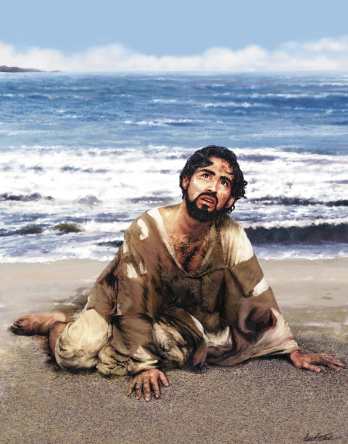
JonahJonah had gone out and sat down at a place east of the city. There he made himself a shelter, sat in its shade and waited to see what would happen to the city. Now the Lord G-d appointed a kikayon, and it grew up over Jonah to be shade over his head, to save him from his discomfort. Jonah was overjoyed with the kikayon.

But G-d designated a worm when the morning rose the next day, and the worm attacked the kikayon, and it withered.

Now it came to pass when the sun shone, that G-d appointed a stifling east wind; the sun beat on Jonah’s head, and he felt faint. He begged to die, and he said, “It would be better for me to die than to live.”

And G-d said to Jonah: “Are you very grieved about the kikayon?” And he said, “I am very grieved even to the point of death.”

And the Lord said: “You took pity on the kikayon, for which you did not toil nor did you make it grow; it lived one night and the next night perished. Now should I not take pity on Nineveh, the great city, in which there are many more than one hundred twenty thousand people that cannot discern between their right hand and their left, and many animals as well?”Jonah 4:5-11

Before continuing to read, if you haven’t done so already, go to yesterday’s meditation and review part 2 in this series: Mission Drift, then come back here.

The Rohr Jewish Learning Institute’s Rabbi Mordechai Dinerman wrote a commentary called “Jonah and the Big Shade” on which today’s morning meditation is based. You all probably know the basic story of Jonah. My inserting Jonah’s story here may seem a little mysterious in light of what I’m trying to study in this series of blog posts. Most people walk around the earth searching for purpose and meaning, but for Jonah, those things were abundantly clear. Right from the beginning, Jonah was a Prophet of God and his path was set before him:

The word of the LORD came to Jonah son of Amittai: “Go to the great city of Nineveh and preach against it, because its wickedness has come up before me.” –Jonah 1:1-2

I would imagine that if God came out point blank and told me the specifics of my purpose in life, where I was to go to find it, and what I was to do to fulfill it, I’d be thrilled beyond comprehension. But then again, maybe not. Jonah wasn’t thrilled. In fact, he tried to run away from his purpose and from God. He didn’t get very far. He was meant to go to Ninevah one way or the other. Like the old joke says, “we can do this the easy way or the hard way.” Jonah didn’t choose the easy way.

A few weeks ago, I wrote a blog post as a commentary for Torah Portion Masei. One of the key features of this Torah Portion is Moses reciting all of the places the Children of Israel camped during the 40 years of wandering. Why do that? Wasn’t the journey more important than the rest stops?

Perhaps not.

Recall the quote from yesterday’s morning meditation that was taken from the course book for the “Toward a Meaningful Life” lesson:

I wake up in the morning with the knowledge that my unique opportunities will be used to convey my individual personality in the places I find myself, thus inspiring the people around me.

Pay attention to the phrases, “my unique opportunities” and “in the places I find myself”. For Jonah, he could go no place on earth besides Nineveh in order to fulfill his purpose. He tried to go just about anyplace else, but that didn’t work out. Once the Children of Israel were consigned to wander the Sinai for 40 years, were they just wandering, or was there a purpose to where they went and what they did while they were there? What would have happened if they hadn’t encountered the descendents of Lot or Esau? Was it important that Aaron die specifically on Mount Hor? What about the battles and victories over Og, King of the Bashan and Sihon, King of the Amorites?

If the wanderings were truly aimless and the people and events they encountered really just random, why did Moses recount them to all of Israel on the threshold of entering Canaan? Why did Moses even bother to remember? Why were his words recorded in the Torah for all time to come, and why do we have them today?

Jonah's KikayonJonah had a reason to be at Ninevah and there was even a special purpose in his encounter with the kikayon plant (no one know exactly what this plant was supposed to be…it’s just a plant, but it had a purpose, too). Now think about where you go every day. Think about all of the places you’ve lived. Where have you gone on vacation? Where have you been “randomly” sidetracked? What did you do there and did any of it matter?

If your life isn’t random and arbitrary but rather, has a purpose and meaning assigned by God, then so does where your feet have taken you, or your car, or a train, or a plane, or whatever transportation you have used.

But what about the kikayon? Why did Jonah care more about that plant than he did for over 120,000 people in one of the largest cities in the world (at that point in history)? For that matter, why did God care about Ninevah when they had sinned greatly, including against the Israelites? God has exterminated whole people groups for their sin. Why did he care enough to spare Ninevah?

The most common explanation is that He felt compassion for their lives. They didn’t know their left hand from their right. They were helpless and blind, as far as God was concerned. Did Jonah care about the kikayon in the same way that God cared for Ninevah?

Yes and no.

Rabbi Dinerman explains:

In fact, the final message of the Book of Jonah is much more than a message about compassion. It is a message about the utter indispensability of every creature. G-d allows Jonah to enjoy the shade of a simple plant that protects him from the blazing sun. And the relief that Jonah feels as a result is so great that he cannot imagine being deprived of it, and when it is taken away, he is so upset that he cannot imagine living without it.

Jonah wasn’t upset about the kikayon’s death because he had compassion for it. He was upset because the kikayon served the purpose of shading him from the elements, and its death ended that purpose in Jonah’s life. How does this apply to the people and animals of Ninevah? Did God spare them because they repented and He had pity on them, or did He spare them because they repented and they were ready to fulfill their purpose in life?

Wow!

Yesterday, I quoted Rabbi Simon Jacobson’s famous definition of purpose:

Birth is G-d’s way of saying “you matter.”

Perhaps life is G-d’s way of saying “you still matter.” As long as it lived, the kikayon had a purpose and when its purpose ended, God appointed the means of its death. Though Jonah fully expected to die when he was thrown into the sea, God appointed a sea creature to preserve his life and to deliver him to his destination. Although the Book of Jonah ends abruptly, as if stopping in the middle of the story, we know that God spared Ninevah for a reason, we just don’t know what happens next.

You and I are still alive today, but the rest of our story hasn’t been written yet. There are still places to go, people to meet, things to do, and somehow, that’s all part of the reason we are here, even if we don’t always understand it.

“And why do you worry about clothes? See how the flowers of the field grow. They do not labor or spin. Yet I tell you that not even Solomon in all his splendor was dressed like one of these. If that is how God clothes the grass of the field, which is here today and tomorrow is thrown into the fire, will he not much more clothe you – you of little faith? –Matthew 6:28-30

The kikayon was only a plant, and yet it had a purpose assigned by the Creator of the Universe. Even the cattle in Ninevah each had a purpose. Jesus talks about grass growing one day and being thrown into the fire the next, and yet it is clothed in more splendor than King Solomon in all his royal glory.

Are not two sparrows sold for a penny? Yet not one of them will fall to the ground outside your Father’s care. And even the very hairs of your head are all numbered. So don’t be afraid; you are worth more than many sparrows. –Matthew 10:29-31

Grass, kikayons, sparrows, and cattle. Are you not worth more than all of these? If these common things all have a purpose and significance in the eyes of the Creator, how much greater is your purpose and significance to God?

Don’t go away. I’ll publish my commentary for Torah Portion Eikev in a few hours.

This series will continue on Sunday’s “morning meditation” Shattered Fragments. How does man and woman becoming “one flesh” affect the reason God made us?

Healing the Wounded

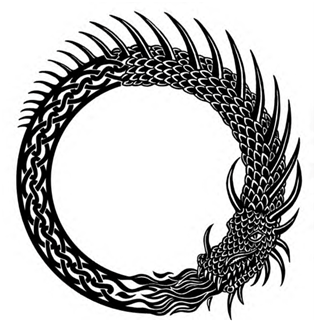
Snake swallowing tailWhen the Egyptians realized that they were being attacked by supernatural forces at the Red Sea, they said, “I must flee from the presence of Israel, for G-d [Havayah] is fighting for them against Egypt.” (Ex. 14:25)

As you know, Pharaoh derived sustenance entirely from immature divine consciousness [mochin d’katnut], which is alluded to by the word “End”.

The words usually translated as “Red Sea” [in Hebrew, “Yam Suf”] really mean “Reed Sea”, and can also be read as if they were vocalized “Yam Sof”, meaning “Sea of the End”. The “end” is the final sefira, malchut, which descends into the lower worlds, i.e. the lower levels of divine consciousness. Relative to its native environment, these lower levels of consciousness are “immature” or “constricted”.

This is the significance of [the fact that] the snake puts its tail in its mouth.

Pharaoh personified the Primordial Snake.

From the teachings of Rabbi Yitzchak Luria
adapted by Rabbi Moshe Yaakov Wisnefsky
“The Snake at the Sea’s End”
Chabad.org

This is Part 3 in a 3-part series. Before reading this, see Part 1: Overcoming Evil and Part 2: The Primordial Serpent.

The surprise appearance of Pharaoh, King of Egypt (yes, “that” Pharaoh, King of Egypt…the one that gave Moses so much trouble) in the role of the primordial serpent may take you a little off guard, but from the perspective of Kabbalah, many things look different. In Judaism, the serpent is less a specific being or entity (i.e. Satan) and more a representation of an idea or a force, in this case, the personification of the evil inclination. In this sense, you could have many evil people across history personifying the snake. Hitler could be a personification of the ancient serpent of Eden.

But there’s more:

This being the case, Pharaoh was both a head and a tail, in the idiom of the verse, “G-d will cut off from Israel both the head and the tail…on one day.”(Isaiah 9:14)

Pharaoh, here signifying the evil inclination in general, acts as the tail, the lowest consciousness of the Jew, and as the head, i.e. the tail elevated to and usurping the role of the head, proper divine consciousness.

This also alludes to the [Primordial] Snake. Originally, he was the tail and Adam was the head, but [because of the Primordial Sin] this was inverted and the snake became the head and Adam the tail.

Adam here personifies the Good Inclination, or divine consciousness. Sin consists of reversing the hierarchy between divine and material consciousness.

This is the mystical meaning of the verse “He will hit you on the head and you will bite him in the heel” (Gen. 3:15).

Man hits the snake on the head because the snake has usurped man’s role as the leader; the snake bites the heel because by sinning man has become the heel/tail instead of the head.

This is very interesting when your deconstruct the role of snake as Pharaoh back to the original appearance of the serpent in the Garden, and then re-visit the relationship between the snake and Adam (which I suppose we could project back up to the relationship between Pharaoh and Moses).

Adam is the heel (or tail) rather than the head because by sinning, he exchanged roles with the serpent. Instead of man ruling over Creation, now evil rules and man struggles to allow good to ascend while evil inhibits his efforts. The snake bites the heel but the heel will crush the snake.

In Christian thought, the heel of man is symbolized by Jesus crushing the evil of Satan, and Rabbi Wisnefsky, when recounting the wisdom of the Rebbe in his article Transforming the Primordial Snake, presents an interesting interpretation that seems to apply:

Since the snakes were deadly, anyone who had been bitten was for all intents and purposes already dead. Healing the bitten person was thus tantamount to resurrecting him.

Now, in order to resurrect a dead person, it is not enough to simply infuse his body with life, because the body has already lost its capacity to support life. First, the dead body had to be made capable once more of living. This can be done only by a force that transcends the laws of nature, including the dichotomy of life and death. Infusing this transcendent force into the dead body restores its capacity to support life, after which the person’s soul can re-enter it and he can live again.

This is why G-d also commanded Moses to heal the people using a snake. By using the image of the deadly, Primordial Snake to restore life, G-d indicated to them that resurrection requires eliciting a level of divinity that transcends the dichotomy of life and death. When people saw the snake, they understood that in order to elicit this transcendent divinity and be healed, they had to transform their own, inner “snake” – their evil inclination – into a force of good.

What was that? Resurrect the dead?

River of LifeLet’s weave Rabbi Wisnefsky’s commentary into more familiar language. When man fell in the Garden, he was “bitten” by a “poisonous” snake and that “poison”, the evil within us, has continued to sicken humanity down through the ages. Christianity considers a sinner as “spiritually dead”, unable to perceive God let alone to attempt to perform His will.

Jesus, by his death and resurrection, provides the means by which mankind can be healed of our poison and by which we can be brought back from the dead. The commentary above talks about the restoration of the soul and the resurrection of the body, both of which we see in the promise of Jesus Christ. The last paragraph of the Rabbi’s missive illustrates that we must see and be aware of our evil inclination, how it serves as the barrier preventing us from a holy life, and also shows us how we can conqueror that nature and bend it to our will and God’s will (Romans 8:37).

I’m sure that Rabbi Wisnefsky would say that I’m playing fast and loose with his interpretation of the Rebbe’s teachings, but there seems to be more than a casual similarity between the Rebbe’s lesson and what we know of the role of the Messiah relative to the subjugation of evil. Jesus came during the Second Temple period to provide for the repairing of our damaged souls, to reconcile us with God, and to prepare the way to eternal life. When he returns, he will finish the job and completely heal us and the world of the evil that plagues us and restore us to the state which we enjoyed with God in Eden.

All Israel has a share in the World to Come, as is stated: “And your people are all righteous; they shall inherit the land forever. They are the shoot of My planting, the work of My hands, in which I take pride.” –Sanhedrin, 11:1

Then the angel showed me the river of the water of life, as clear as crystal, flowing from the throne of God and of the Lamb down the middle of the great street of the city. On each side of the river stood the tree of life, bearing twelve crops of fruit, yielding its fruit every month. And the leaves of the tree are for the healing of the nations. No longer will there be any curse. The throne of God and of the Lamb will be in the city, and his servants will serve him. They will see his face, and his name will be on their foreheads. There will be no more night. They will not need the light of a lamp or the light of the sun, for the Lord God will give them light. And they will reign for ever and ever. –Revelation 22:1-5

We’re not there yet. We’re still in “exile”. However, God is here with us.

Perhaps, for you, this exile is not so bad. And you feel you are doing whatever you can about it, anyway.

But it is not just you. Abraham, Isaac and Jacob and all their children through all the generations, as well as all the heavenly hosts,
the entire Creation—all is unfulfilled, in exile and imprisoned.

Even the Creator, blessed be He, locks Himself into prison along with His Creation.

Until you get us out of here.

Rabbi Tzvi Freeman
Based on letters and talks of the Rebbe, Rabbi M. M. Schneerson
“Pity on the Cosmos”
Chabad.org

Devarim: One Man’s Story

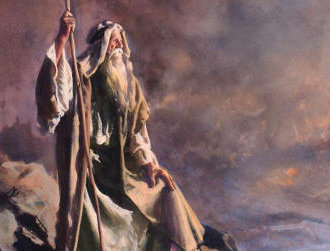
MosesThis week’s Torah reading begins: “These are the words that Moshe spoke to the entire Jewish people.” Noting the distinction between this book and the previous four, which are all “the word of G-d,” our Sages explain that Moshe recited the Book of Deuteronomy “on his own initiative.”

Rabbi Eli Touger
Commentary on Torah Portion Devarim
“A Mortal Mouth Speaking G-d’s Word”
Adapted from Likkutei Sichos, Vol. IV, p. 1087ff; Vol. XIX, p. 9ff
Chabad.org

For most Christians, who don’t have a conservative evangelical view like the one I had, these textual facts can be interesting, but there is nothing in them to challenge their faith, which is built on something other than having the very words that God inspired in the Bible. And I certainly never intended to lead anyone away from the Christian faith; critics who have suggested that I myself stopped being a Christian once I realized there were differences among our manuscripts are simply wrong and being ridiculous.

Author and New Testament Scholar
Bart D. Ehrman in his book
Jesus, Interrupted

Today’s “extra” meditation and my commentary on this week’s Torah Portion Devarim.

Occasionally people ask why most of the book of Deuteronomy (in Hebrew, “Devarim”) even exists. It seems to do little more than repeat and summarize the events in the first four books of the Torah. The answer can be a little disturbing to some Christians and even to some Jews. Our understanding is that the first four books of the Bible were the words of God as dictated to Moses and Deuteronomy is in Moses’ own words.

Does that mean Deuteronomy is completely human in origin and without the influence of God? Let’s return to Rabbi Touger’s commentary:

This does not…mean that the Book of Deuteronomy is merely a mortal invention. Our Rabbis immediately clarify that Moshe delivered his words “inspired by the Holy Spirit.” Similarly, when the Rambam defines the category of “those who deny the Torah,” he includes: “a person who says that the Torah even one verse or one word does not emanate from G-d. If one would say, ‘Moshe made these statements independently,’ he is denying the Torah.”

Not a single commentator maintains that there is a difference in this regard between the Book of Deuteronomy and the four preceding books.

For the Book of Deuteronomy are merely Moshe’s words. Moshe’s identification with G-dliness was so great that when he states: “I will grant the rain of your land in its season,” he speaks in the first person although the pronoun “I” clearly refers to G-d. “The Divine Presence spoke from his mouth.”

The origin of the Bible and exactly how it was written and codified is complex and more than a little mysterious. The simple belief among many Christians is that each author wrote under the influence and guidance of the Holy Spirit and what they wrote originally is exactly what we have in our Bibles today (translated into the language we prefer to read). I included the quote from Bart Ehrman’s book to illustrate that even among modern Bible scholars, there is some doubt as to whether or not we can read the Bible as if it were a history book, newspaper, and court reporter’s record all rolled into one. In fact, we can’t.

The Bible is as much a human document as a document of the Divine. It’s a series of “stories” that illustrate something about God and His interactions with humanity. That it contains internal inconsistencies and historic flaws in no way disqualifies its moral and mystic significance among the community of faith. The stories tell us what we need to know, not as a history lesson, but as a guide to righteous living and as a doorway into domains that leave our mortal plane and allow us to glimpse the Throne of God.

In referring to Midrash Tehillim to 90:4; Bereishis Rabbah 8:2, we see that the Sages believe that “The Torah preceded the world” and when we read John 1:1, we see that “In the beginning was the Word, and the Word was with God, and the Word was God”. From this, we understand that only part of the Bible’s function is to act as a record and a document. Beyond the scroll in the Ark or the book on our hand, it exists in transition between our world and the next.

Rabbi Touger continues:

Here, the concept of precedence is not chronological, for time like space is a creation, relevant only after G-d brought existence into being. Rather the intent is that the Torah is on a level of spiritual truth which transcends our material frame of reference. Although the Torah “descends” and “enclothes itself” in our world, speaking of seemingly ordinary matters such as agricultural laws, codes for fair business practice, and the proper structure for marriage and family relations, this is not its essence. The essence of the Torah is “G-d’s will and His wisdom,” united with Him in perfect unity (see Tanya, ch. 4).

The Amazon.com product description for Ehrman’s book states that “the New Testament is riddled with contradictory views about who Jesus was and the significance of his life”, yet from a mystic point of view, this doesn’t present a problem.

The Ba'al Shem TovWhen I was reading The Hasidic Tale by Gedaliah Nigal, I wrote several commentaries about what I gained from the text including The Messianic Tale and Stories are Miracles. From these, we see that the stories of the Chasidim are less a series of historical facts and more a collection of mystic and allegorical tales designed to reveal something about ourselves, about holiness, and about God. How much of each story is factually accurate isn’t particularly relevant, because one does not approach the tales of the Chasidim that way. What we are looking for is something that will peel away the covers from the world of the supernatural and give us a peek at what lies around the next bend on our path of faith.

We can apply that commentary back to the Bible thus.

Jorge Quinonez, in his book “Paul Philip Levertoff: Pioneering Hebrew-Christian Scholar and Leader” Mishkan 37 (2002): 21-34 (quoted in Love and the Messianic Age) describes Levertoff, a Chasidic Jew and devoted disciple of Jesus, this way:

He read the Gospels in German. Then he obtained a Hebrew version and reread them. Though he was in the midst of a Gentile, Christian city where Jesus was worshiped in churches and honored in every home, Feivel felt the Gospels belonged more to him and the Chasidic world than they did to the Gentiles who revered them. He found the Gospels to be thoroughly Jewish and conceptually similar to Chasidic Judaism. He wondered how Gentile Christians could hope to comprehend Yeshua (Jesus) and His words without the benefit of a classical Jewish education or experience with the esoteric works of the Chasidim.

This perhaps, is what scholars like Bart Ehrman miss when they study and criticize the Bible for not reading like a story posted at CNN. Divinity and humanity collide, meld, mesh, and blend within the pages of the Bible and we are not always meant to be able to tell where one leaves off and the other begins…or if that division is even possible.

Rabbi Touger states:

But why is the Book of Deuteronomy necessary? Enclothing the Torah in human intellect seemingly does nothing but lower its spiritual content. What purpose is served?

Nevertheless, this is G-d’s intent in giving the Torah: that it permeate mortal thought and thus elevate man’s understanding. Whenever a person studies Torah, regardless of his spiritual level, he is making its infinite truth part of his personal nature.

Were there to have been only four books in the Torah, it would have been impossible for our powers of understanding to unite completely with the Torah. It was only by having the Book of Deuteronomy pass through Moshe’s intellect that this goal accomplished. Moreover, Moshe’s review of the Torah in he Book of Deuteronomy gives us the capacity to understand the previous four books in a similar fashion.

Enclothing the Torah in mortal intellect does not merely grant man the opportunity for advancement, it also introduces a higher quality to the Torah itself, as it were. For clothing limitless spirituality in the confines of mortal intellect represents a fusion of opposites that is possible only through the influence of G-d’s essence. Because His essence transcends both finiteness and infinity, it can weld the two together, bringing the spiritual truth of the Torah within the grasp of mortals.

TranscendentWho we are and who God is in us requires that we leave behind some of our attachment to what we call “reality” and allow ourselves to stand transcendent at the uncomfortable and mystic threshold between Heaven and Earth. We don’t have to rely on the Bible to be a book of facts but rather a book of truth.

Consider this:

These are the words which Moses spoke to the children of Israel, across the Jordan, in the desert, in the plain, opposite Suf, between Paran and Tofel, Lavan, Chatzeiroth, and Di-Zahav –Devarim 1:1

All these “places” are allusions to sins committed by the Jewish people during their forty years of wandering in the Sinai Desert. Moses rebuked them only by insinuation so as not to embarrass them.

-Rashi’s commentary

Rabbi Menachem Mendel of Lubavitch once delivered a scathing critique of a certain type of outlook and behavior. Later, one of those present complained to him: “Rebbe, why did you rebuke me in public? Could you not have privately made me aware of my negative traits, without embarrassing me in front of everyone?”

Replied Rabbi Menachem Mendel: “Did I mean you? Obviously, I did. You see, I am a hat-maker. The hat-maker fashions a hat and places it in his window. People come in and try it on, until someone finds that it suits his head perfectly. Whom did he have in mind when he made this hat? Why, he made it precisely for the very customer who finds that it fits him!”

-Rabbi Yanki Tauber
Commentary of Torah Portion Devarim
“The Discreet Hatter”
Chabad.org

The Bible serves many purposes in our lives, not the least of which is to reveal the nature of who we are, for good or for ill. It is a book that condemns but also encourages. It shows us the goodness of God and where we fall short of that goodness (Romans 3:10). Let the Bible be what God intended it to be and let God be who He is. Listen to the words of Moses and his “Chasidic” tale of the wanderings of the Children of Israel, of his own journey with God, of the approach to the end of his life, and in listening to him, learn something about yourself.

Good Shabbos.

The Sons of Noah

NoahOn our daf, Rav Acha bar Yaakov notes that the rule of Reish Lakish leads us to a fascinating situation. The Jewish people have a law of shechita, and the meat of an animal is permitted to be eaten as soon as shechita is done. The gentiles do not have a mitzvah of shechita, but they must not eat a limb from a live animal. Whenever we shecht an animal, the trachea is cut first, followed by the esophagus. As soon as the trachea is cut, the lung immediately becomes permitted, due to shechita, but because the esophagus is not cut, the animal is not yet dead. At that moment, the lung is permitted for a Jew, because shechita was performed on the trachea, but the lung is not permitted for a non-Jew.

When R’ Pappa heard this lesson from R’ Acha, he thought to ask that it seems peculiar that we now have something (lungs) which is permitted for a Jew but prohibited for a non-Jew. However, R’ Pappa refrained from asking, because he realized that R’ Acha had taught his lesson with a reasonable explanation.

R’ Pappa noted that it is not possible that something be permitted for a Jew but be prohibited for a non-Jew. The idea is that when the Jews accepted upon themselves added levels of holiness, more than their being just Noachides, this commitment included added levels of restriction, not less.

Daf Yomi Digest
Distinctive Insight
“Permitted for a Jew, prohibited for a non-Jew”
Chullin 33

This is a strange situation, but in order to understand it, you have to understand how Judaism sees a Jew’s obligation to God as opposed to a non-Jew’s obligation (whether Christian or not).

Without going into all of the history involved, Jews believe that the Torah, which was given to the Children of Israel at Sinai (Exodus 20), obligated the Jewish people to 613 specific commandments or mitzvot. These commandments are only incumbent upon the Jewish people and do not apply to any other people group or religion. Within the 613 commandments, there are mitzvot that only apply to sub-groups within the Jewish people such as men, women, priests, and so on. Sub-groups aside, all Jews regardless of their community or religious roles, are considered to merit a place in the world to come (Romans 11:26; Sanhedrin 11:1).

In Christianity, in order to have a right relationship with God, a person must become a Christian. There is no other “right” status before the Creator of the Universe and “no one comes to the Father” except through Jesus (John 14:6). All Christians are equal before Christ and there are no different sub-groups within Christianity (Galatians 3:28). You’re either all the way in or you’re all the way out.

This isn’t true in Judaism. You don’t have to be a Jew to have a relationship with God.

Jews do not require that non-Jews convert to Judaism in order to “merit a place in the world to come”. Although some Gentiles convert to Judaism out of a desire to take upon themselves the complete responsibilities of a Jewish person and to delight in the beauty of the mitzvot, Judaism’s understanding of God’s desire for the “nations” (i.e. everyone who isn’t Jewish) is for us to obey a much smaller set of commandments given by God to Noah (Genesis 9) referred to as the Noahide Laws. Although there are only seven laws of Noah, they actually expand out into at least 66 specific mitzvot according to my friend Gene Shlomovich, and Hasidic University suggests that the number of mitzvot for which a Gentile is obligated, can be up to 620.

If you’re a Christian, the vast majority of this is likely to leave you unimpressed, since the traditional understanding of the church is that grace fully replaced the Law of Moses (and most Christians aren’t even aware of a “Law of Noah”) and believers do not take their guide for a Christian’s obligations to God from Jewish theology or commentary. Still, for those Christians who feel somehow that they got the short end of the stick as far as the mitzvot are concerned, you can see the matter isn’t as simple as it appears on the surface. It’s not like we got the “Reader’s Digest” version of God’s expectations.

From what I can tell, there’s nothing in the Seven Noahide Laws that directly contradicts being a Christian, but you might object if you look at some of the particulars. Take the example from the Daf Yomi Digest quote in reference to eating a part (in this case, a lung) from a live animal. Jesus didn’t specifically teach on this so you might think the point is moot, but then, most of us would find eating a limb off of a cow or chicken while it was still alive repulsive and cruel. I suppose God does too, which is why we find a prohibition against this behavior in both the Noahide Laws and the Torah. The difference between a Jewish and a Christian perspective on these obligations is that Christians tend not to think of the details of their responsibilities to God and others, while observant Jews do so all the time as a matter of lifestyle. In other words, you could say that Jews focus on their obligations to God through the Torah while Christians focus on their freedom in God through the grace of Jesus.

The RabbiSounds easier and better to be a Christian since there isn’t nearly as much theological and educational “heavy lifting”, but this also robs us of greater opportunities to serve God and to honor our Master with deliberate intent. The Noahide Laws aren’t exactly “required reading” for Christians, but maybe they should be. For Christians who sometimes wonder what God wants out of their (our) lives, the Noahide Laws might provide greater dimension and meaning. It’s not just a list of “dos and don’ts”, but rather, a way to order the actions of our lives to conform more fully with the life God created for us. Jesus opened the door, but once we step inside a life of faith and holiness, we are the ones responsible for discovering what that means and how to live it out.

Is it crazy for a Christian (or any Gentile, since the Noahide Laws apply to every non-Jew regardless of religion or belief) to have as many obligations to God as a Jew or, to be even crazier, to have obligations that don’t apply to a Jew? Maybe, but maybe not as much as you’d imagine.

I know some people will accuse me of sowing the seeds of division between Christians and Jews by emphasizing such differences, but that is not a reflection of Chasidic Jewish thought:

The souls are all one. Only the bodies divide us. -The Alter Rebbe

According to Rabbi Tzvi Freeman in his book, Bringing Heaven Down to Earth:

In his latter years, the Rebbe would stand for hours every Sunday, as thousands of people, both Jew and non-Jew would stand in line to receive his blessing.

The Rebbe didn’t care just about Jews but about every human being. Still quoting from Rabbi Freeman’s book:

They asked the Alter Rebbe: “Which is greater: Love of G-d, or love of your fellow man?” He answered, “Love of your fellow man, for then you are loving that which your Beloved loves.”

How like what Jesus said when he was asked, “Rabbi, which is the greatest commandment in the Law?”

Oh, all of this becomes even more complex when you consider that Christians are viewed as “Sons of Abraham” (see Galatians 3:7-9) rather than “Sons of Noah” since the Messianic Covenant at least extends, if not actually overwrites the Noahide Covenant. I think I’ll save that meditation for another day.

“Noah’s Covenant of the Rainbow is a living heritage for all Gentiles. When we fulfill our potential by living within this covenant, the Creation is spiritually elevated to realize its intended goal. This makes the world into a beautiful gem – a place where G-d can dwell”. -from AskNoah.org

“The Moshiach will bring all the Jews back to the Torah and teach all mankind how to be partners with the Creator through observing His Seven Noahide Commandments. Then the true love of G-d to each of us will be in every heart. But [as the Rebbe taught,] it’s up to us to make it happen”. -Rabbi Tuvia Bolton

To find out more about how Jews see Gentiles and our relationship with God, have a look at What the Talmud Says About Gentiles, Revisited. Also visit the AskNoah.org site.

Addendum: Tomorrow’s morning mediation will be Part 2 of this theme: Children of God, and will explore God-fearers and Noahides as compared to Christians. Please come back tomorrow for the next “morning meditation”.

Light in the Darkness

Man in the DarknessAs impossible as it sounds, as absurd as it may seem: The mandate of darkness is to become light; the mandate of a busy, messy world is to find oneness.

We have proof: for the greater the darkness becomes and the greater the confusion of life, the deeper our souls reach inward to discover their own essence-core.

How could it be that darkness leads us to find a deeper light? That confusion leads us to find a deeper truth?

Only because the very act of existence was set from its beginning to know its own Author.

As it says, “In the beginning . . . G-d said, ‘It shall become light!’”

Rabbi Tzvi Freeman
From the wisdom of the Lubavitcher Rebbe, of righteous memory
“Mandate Unmasked”
Chabad.org

When God began to create heaven and earth – the earth being unformed and void, with darkness over the surface of the deep and a wind from God sweeping over the water — God said, “Let there be light”; and there was light. God saw that the light was good, and God separated the light from the darkness.Genesis 1:1-5 (JPS Tanakh)

When Jesus spoke again to the people, he said, “I am the light of the world. Whoever follows me will never walk in darkness, but will have the light of life.” John 8:12

Yesterday’s morning meditation borrowed from the daf for Chullin 29 in describing a person who has fallen far from the light of God. Yesterday, I also quoted from Rabbi Freeman’s interpretation of the Rebbe’s wisdom in which he says, among other things, that we “only fall down in order to bounce back even higher”. It is said that every descent we must make is for the sake of an ascent. Every fall brings us to the point where we will rise. Drop a heavy chunk of ice into a swimming pool. First, it will sink under the surface, but then it will rise back up.

The words of Rabbi Freeman quoted above are taken from a collection called Meditations on Moshiach (Messiah). Both Christians and Jews long for the coming (or return) of the Messiah and the day when he will heal our injured, bleeding world and us along with it. Put another way, lock anyone in utter and complete darkness and they will search, perhaps in vain, for even the tiniest glimmer of light.

That’s what we’re doing. We are people in the dark, straining our eyes and our spirits, seeking to glimpse a spark of the Moshiach and a sign of his Kingdom come.

Whenever things got worse, Jews would say, “This is a sign! Moshiach is coming!”

But in those days, a messianic era would have meant a radical change in the natural order of things.

Today, though the human soul sleeps a deep slumber of materialism, the material world itself is prepared.

Rabbi Freeman’s Good Signs commentary reminds me of many in the church or even some self-styled “Messianics”. There seems to be an obsession about the “end times” and “end time prophesy”, as if people are looking for secrets and conspiracies worthy of some sort of “spiritual X-Files”. Every earthquake, every flood, every war is “a sign” that vaguely and tenuously points to some scripture confirming that the Messiah’s coming is just around the corner. However, as we see from history, our world is replete with signs and with would-be Messiahs, and yet the world is still here and we’re still waiting in the dark.

Rabbi Freeman’s interpretations of the Rebbe continue:

The final war is not fought on battlefields, nor at sea, nor in the skies above. Neither is it a war between kings or nations. It is fought in the heart of each human being, with the armies of his or her deeds in this world.

Holding onto the lightIndeed, the final battle or in my point of view, our “daily battle”, is not one of great wars, terrible disasters, or supernatural and miraculous events taking place in the larger world or in cosmic realms, but rather, it is fought moment-by-moment, hour-by-hour, in the heart and soul of each individual who professes trust and faith in God.

We are still in the dark, but it is a mistake to look to the future or to the outside, or to mystic prophecies of epic, panoramic events to see the Messiah. To find him, we must look to the light within and be mindful of where we are and what we are doing at this very moment:

At that time if anyone says to you, ‘Look, here is the Messiah!’ or, ‘There he is!’ do not believe it. For false messiahs and false prophets will appear and perform great signs and wonders to deceive, if possible, even the elect. See, I have told you ahead of time. –Matthew 24:23-25

While Christians sit passively, seeking signs of his coming in the world outside or in arcane interpretations of scripture, Jews understand that people, all people, have an active part in bringing the Messiah. Not that we can control the day or hour of his coming, but we can prepare the way, by ordering our lives, turning more fully to God, and helping to repair the world, fixing one small, broken piece at a time. The Rebbe knew this when he said:

There is no need to tell a Jew what he or she must do to bring Moshiach. Our job is only to wake them up. Once awake, every Jew knows what he or she must do.

If it is not evil, we must use it for good.
If it can be raised higher, we cannot leave it in the dirt.
For everything He made, He made for His glory.

Do not leave yourself in the dirt, pining for what may be coming outside of your senses. Stand up now. Act in God’s Name to make the world a better place, no matter how small or seemingly insignificant your efforts. Who knows? Even the most humble prayer of a sincere and righteous disciple could make the difference. Your actions may be modest, but the cause you join is magnificent:

When journeying upon the path of wisdom, do not seek to follow in the footsteps of the wise. Seek what they sought. –Matsuo Basho

A Jew never gives up. We’re here to bring Mashiach, we will settle for nothing less. –Harav Yitzchak Ginsburgh

Finding Freedom

CaptureTell me, you who want to be under the law, are you not aware of what the law says? For it is written that Abraham had two sons, one by the slave woman and the other by the free woman. His son by the slave woman was born according to the flesh, but his son by the free woman was born as the result of a divine promise.

These things are being taken figuratively: The women represent two covenants. One covenant is from Mount Sinai and bears children who are to be slaves: This is Hagar. Now Hagar stands for Mount Sinai in Arabia and corresponds to the present city of Jerusalem, because she is in slavery with her children. But the Jerusalem that is above is free, and she is our mother.Galatians 4:21-26

Speak and act as those who are going to be judged by the law that gives freedom, because judgment without mercy will be shown to anyone who has not been merciful. Mercy triumphs over judgment.James 2:12-13

So what is it? Does the Law take away freedom or does the law give freedom? Are we even talking about the same Law; the Torah?

I’ve often suspected that Paul and James didn’t see eye-to-eye on many issues. Paul was operating for years at a time in the diaspora, bringing the Gentiles to faith in the Jewish Messiah and teaching them his ways and how to trust in God. There wasn’t a lot of oversight going on from the Jerusalem Counsel, so Paul could have gotten away with re-writing the Gospel message in his own image, diluting or even eliminating the law and replacing it a type of “grace” that is the antithesis of the law (though in reality, they are not mutually exclusive). It’s clear that James wouldn’t have agreed with that message.

However, if you read D. Thomas Lancaster’s new book The Holy Epistle to the Galatians, you’ll see that Paul and James were more alike than unalike (though I still suspect that they had their individual perspectives). For one thing, despite the common Christian tradition of interpreting Galatians 4:21-26 as “anti-Law” (and in the plain English text, it certainly seems that’s what Paul’s saying), the issues are more complex. Lancaster interprets them this way:

The passage contrasts two types of proselytes: the legal proselyte and the spiritual proselyte. The one becomes part of Abraham’s family by conventional conversion, the other through faith in Messiah, the promised seed of Abraham, in whom all nations find blessing. The passage does not contrast the Old Testament against the New Testament or the Old Covenant with the New Covenant. It does not equate Judaism and Torah with slavery, nor does it pit Christians against Jews.

It means that if you are a Jewish believer , you should be proud of being Jewish because you are a child of Abraham, legally, physically, and spiritually. It means that if you are a Gentile believer, you, too, are part of the people, a spiritual son of Abraham, and that is remarkable – miraculous even. You are a child of the promise that God made to Abraham so long ago.

I’ve already written a review of Lancaster’s book and I’m not going to “reinvent the wheel”, so to speak, but I’m presenting this “extra meditation” this afternoon, in response to the following:

No one can say he is free today because yesterday he was granted freedom.

Freedom is a source of endless energy.
Freedom is the power behind this entire universe.
Freedom is the force that brings existence out of the void.

You are free when you take part in that endlessness. When you never stand still. When you are forever escaping the confines of today to create a freer tomorrow.

Rabbi Tzvi Freeman
“Perpetual Freedom”
Chabad.org

As an Orthodox Jew, Rabbi Freeman isn’t considering that the Torah is somehow slavery or bondage, even for a single moment. So how are Christians to interpret his words of freedom as well as the apparent conflict between Paul and James, both observant and devout Jews, on how they view the Torah?

It is said that the world was created for the sake of Torah and that, without the Torah, the world could not have been made. The analogous teaching we have in Christianity is this:

In the beginning was the Word, and the Word was with God, and the Word was God. He was with God in the beginning. Through him all things were made; without him nothing was made that has been made. –John 1:1-3

TeshuvahHere, we see a sort of “fusion” or co-identity, in some mystic sense, between the Torah and the Messiah, Son of the living God. Christians know that Jesus gives us freedom from the slavery of sin and Jews know that the Torah is the gateway to God’s endless energy, the power behind the universe, and the limitless, eternal source that creates existence out of nothingness. Through Torah, God does not enslave, but provides the means by which men may know God and understand our relationship to Him. If the same can be said of Jesus, then we can all understand from where our freedom comes.

While non-Jewish disciples of the Jewish Messiah are not obligated to the same “yoke of Torah” as the Jewish people (see Acts 15), we nonetheless are grafted into the root of the Tree of Life and like branches on the vine, we draw our nourishment and the ability to live a life of holiness from an identical source; God.

To do so requires more than just believing and more than just learning; we must do, we must behave, we must live out the values we understand from the Torah and how they were taught to us by the “living Torah”, the Moshiach, Jesus Christ. Part of that living is understanding where we came from, who we are, and our need to separate from sin and embrace holiness and peace. To gain freedom from sin, we must recognize the depth and despair of sin, which is what the Torah aptly defines, and only upon achieving that understanding, can we truly turn away from that sin and turn toward the God of Abraham, Isaac, and Jacob:

The Ohr Hachaim HaKadosh, zt”l, writes that one can only do teshuvah if he first recognizes the gravity of his sin.

A certain person committed a sin. When Rav Mordechai Aryeh Halevi Horowitz, zt”l, gently nudged him to repent the sinner displayed his relaxed attitude towards teshuvah. “Why repent now? Soon enough it will be Elul, the season when the shofar is sounded to remind us to do teshuvah. Can’t my teshuvah wait until then?”

Rav Horowitz rejected this attitude out of hand. “As is well known, the main element in teshuvah is havdalah, separating between what is proper and what is not. It is only by determining which actions lead to darkness and which generate light that we act as is fitting. Even if a person with understanding falls to sin chas v’shalom, he knows to repent and change his ways. But many people wait until Elul to do teshuvah. After all, isn’t that when we are aroused to repentance by the shofar as the Rambam writes?

“We find in the Mishnah in Chulin 26 that whenever the Shofar is sounded we do not say havdalah. Conversely, whenever we say havdalah we do not sound the shofar. Although on a simple level this is a sign for when they would blow the shofar to signify the onset of Shabbos or Yom Tov, this statement also teaches a lesson about teshuvah. When one feels justified waiting to do teshuvah until the shofar is sounded during Elul, this shows he lacks understanding. He does not comprehend the gravity of sins since this leads to havdalah, healthy separation between what is right and what is wrong. One who has fitting discrimination between good and bad doesn’t wait to hear the shofar to repent!”

Dam Yomi Digest
Stories off the Daf
“Time for Repentance”
Chullin 26

If we claim to be without sin, we deceive ourselves and the truth is not in us. If we confess our sins, he is faithful and just and will forgive us our sins and purify us from all unrighteousness. –1 John 1:8-9

Good Shabbos