Tag Archives: New Covenant

Sermon Review of the Holy Epistle to the Hebrews: Protos and Deuteros

Bible teachers often use Hebrews 9 as proof that the disciples of Yeshua abandoned the Old Testament rituals of Temple worship and sacrifices as vestiges of an old covenant that had been replaced by a new covenant. A closer look reveals an entirely different message. Hebrews 9 uses the layout of the Temple to present a mystical illustration of the passage from this world to the world to come.

-D. Thomas Lancaster
Sermon Thirty-Four: Protos and Deuteros
Originally presented on December 14, 2013
from the Holy Epistle to the Hebrews sermon series

Lancaster finished his survey of the New Covenant as it applies to Hebrews 8 in the previous week’s sermon which I reviewed here. This also should have finished Hebrews 8 and have taken us into chapter 9 but there’s something Lancaster wanted his listeners to get first. Protos and Deuteros.

For if that first covenant had been faultless, there would have been no occasion sought for a second. (emph. mine)

Hebrews 8:7 (NASB)

The first or in Greek “Protos” covenant was the Sinai or Mosaic covenant and the second or “Deuteros” covenant is the New Covenant (Jeremiah 31, Ezekiel 36). There needed to be a Deuteros covenant because God found fault with “them” not “it”. That is, He found fault with people not the Protos covenant and not the conditions of the Protos covenant, the Torah, and not with the enactment of some of the covenant commandments which involve the Temple and the Priesthood (all this is covered in previous reviews and you can listen to the recording of this sermon to pick up more details).

After verse 7, Lancaster quickly reviewed verses 8 through 12 which quote Jeremiah 31 and the New Covenant language and then he focused on verse 13:

When He said, “A new covenant,” He has made the first obsolete. But whatever is becoming obsolete and growing old is ready to disappear.

Verb tenses are really important here which is why some English translations of the Bible, including the English Standard Version (ESV) are bad, because they make everything sound like it’s in the past tense, which is not what the actual Greek says. Remember, interpretation begins at translation. Some translators read their theology back into the text when they do the translation, changing the literal meaning to fit their assumptions and all of the classic, though erroneous, perspectives they’ve been taught as part of Christian tradition.

The reason Protos and Deuteros are important is because Paul makes a lot of symbolic use of these two terms as we enter chapter 9.

What is becoming obsolete and getting ready (but hasn’t yet) to disappear?
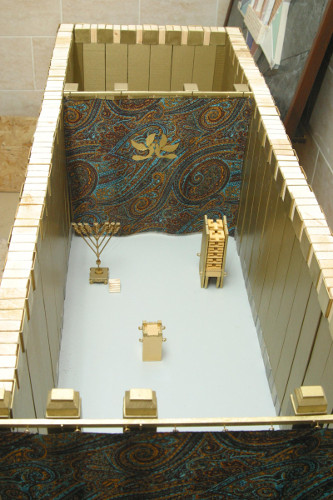
holy placeNot the Torah, because it represents the conditions of both the Sinai and the New Covenants. Not the Temple because the Temple was still standing when this epistle was written and there will be a Temple in the Messianic Age. Not the Priesthood because God declared that the Aaronic Priesthood is eternal.

So what does Protos represent that is in the process of becoming obsolete and getting ready to disappear.

The Olam Hazah or the Present Age. The age that we have with us now. The age of everything before the Messianic Age and the Age to Come. That’s what is just about to, but hasn’t yet because we’re still in it, get ready to pass away.

Now this next part has to be followed carefully. Once you get it, it’s rather simple to comprehend, but it’s easy to get lost if you don’t get it. Lancaster admitted that he makes it all sound more complicated than it really is.

Now even the first covenant had regulations of divine worship and the earthly sanctuary. For there was a tabernacle prepared, the outer one, in which were the lampstand and the table and the sacred bread; this is called the holy place. Behind the second veil there was a tabernacle which is called the Holy of Holies, having a golden altar of incense and the ark of the covenant covered on all sides with gold, in which was a golden jar holding the manna, and Aaron’s rod which budded, and the tables of the covenant; and above it were the cherubim of glory overshadowing the mercy seat; but of these things we cannot now speak in detail.

Hebrews 9:1-5

Both Lancaster and the writer of the Hebrews epistle are hip deep in symbolism at this point.

The Holy Place described in these verses is the Protos or the Present Age. The Holy of Holies is the Deuteros or the Age to Come. Lancaster goes into a lengthy and detailed explanation of what each of the objects in this analogy of the letter writer’s description means but basically, the Present Age is where all of the daily duties of the Priests occur. It’s where we live today. Here’s what I mean.

holy-holies2

Remember, Lancaster says that he believes the Temple was still standing when this letter was written, so he’s being quite literal. But also, this is representative of the fact that he was describing the Present Age, the age in which he and his readers were living and the age in which we continue to live. We have daily access to the holy things and the service to God as described in the Sinai Covenant (and remember, this is a Jewish person writing to Jewish people so for them, it’s all about the Sinai Covenant). It doesn’t matter that the Temple is now destroyed because Solomon’s Temple was destroyed and there was a long period between that and the building of Herod’s Temple, and yet the Sinai Covenant was (and is) still in effect.

The Holy of Holies by contrast, represents the Age to Come which begins or which is beginning in the Messianic Age, the place where not just any Priest but only the High Priest could enter, and not on a daily basis but only on one day of the year, Yom Kippur, the Day of Atonement, and the High Priest could only enter carrying blood.

He’s saying that the Holy Place, representing our reality today, still has Godliness but there’s a big difference between what we have now and what is going to happen.

Now when these things have been so prepared, the priests are continually entering the outer tabernacle performing the divine worship, but into the second, only the high priest enters once a year, not without taking blood, which he offers for himself and for the sins of the people committed in ignorance. The Holy Spirit is signifying this, that the way into the holy place has not yet been disclosed while the outer tabernacle is still standing, which is a symbol for the present time. Accordingly both gifts and sacrifices are offered which cannot make the worshiper perfect in conscience, since they relate only to food and drink and various washings, regulations for the body imposed until a time of reformation.

Hebrews 8:6-10

Verse 8 is the key and where we have to pay close attention to the verb tenses:

The Holy Spirit is signifying this, that the way into the holy place has not yet been disclosed while the outer tabernacle is still standing, which is a symbol for the present time.

The way into the New Covenant age has not been shown to us nor will it be while the current age exists, the Present Age, the age we are living in right now. So the Old (Sinai) Covenant still is in effect and we are still living in the Present Age under the rules and conditions of the Old Covenant. Nothing has been replaced, including the Sinai Covenant, the Torah, the Temple (since it will be rebuilt) and the Priesthood (since it’s an eternal Priesthood and will make sacrifices in the Temple in the Messianic Age).

But why isn’t the New Covenant Age open to us yet?

And Jesus cried out again with a loud voice, and yielded up His spirit. And behold, the veil of the temple was torn in two from top to bottom; and the earth shook and the rocks were split.

Matthew 27:50-51

Most Christians take these verses to mean that once Yeshua (Jesus) died, the Priesthood was abolished and everyone could enter the (spiritual) Holy of Holies and stand before the throne of God. And yet the writer of the epistle to the Hebrews is saying that this isn’t true and it won’t be true until the New Covenant Age which Messiah will bring to completion, or near completion, when he returns.

What Did I Learn?

I was following Lancaster along pretty well but this next part was new to me. The Present Age is represented by the Holy Place, where our daily service to God takes place and where the Sinai Covenant remains in effect. The Present Age is slowly beginning to pass away and about to become obsolete, but since it’s still here and we’re still here, it still has some life left in it.

The Messianic Age can be compared to the veil between the Holy Place and the Holy of Holies. Both resurrected/perfected people, the Saints, so to speak, in Christ who will rise at the first resurrection and the rest of the people alive at his Second Coming who are yet to be resurrected. It’s the intersection between covenants which is why there will have to be a Temple.

world-to-come

But the Messianic Age is relatively brief, only about a thousand years or so, and once passed through that veil, we’ll be fully in the Age to Come:

I saw no temple in it, for the Lord God the Almighty and the Lamb are its temple. And the city has no need of the sun or of the moon to shine on it, for the glory of God has illumined it, and its lamp is the Lamb.

Revelation 21:22-23

It is only at this point in future history, after the Messianic Age has passed away, that the Sinai Covenant will also pass away and there will no longer be a need for the Temple. It’s difficult to imagine what life will be like here, but this is part of what’s being described.

But it’s not as relevant as what happens in the Messianic Age and indeed what’s happening now.

But when Christ appeared as a high priest of the good things to come, He entered through the greater and more perfect tabernacle, not made with hands, that is to say, not of this creation; and not through the blood of goats and calves, but through His own blood, He entered the holy place once for all, [m]having obtained eternal redemption.

Hebrews 8:11-12

Even though we can’t actually enter the Deuteros, the second, the New Covenant Age yet, we still have a stake in it that allows us to live as if we have already entered. How can we do this? Because we have a High Priest who has entered before us, the first fruits of the dead (1 Corinthians 15:20). How can he enter where we cannot?

The High PriestBecause he already died and was resurrected into a perfected body. We haven’t done that yet. Also, since even the High Priest cannot enter without blood, the blood he shed in the Present Age he “carried” (spiritually, not literally with his hands) from the Protos to the Deuteros as a one time event (not an annual event as is the present Yom Kippur) as a forerunner for the rest of us, and to provide an anchor for us, bridging the gap from the Present Age to the Age to Come.

As I was listening to Lancaster, I realized that when the Temple veil was torn top to bottom the moment Jesus died, it wasn’t a sign that the Old Covenant was dead and buried right then and there so we all could immediately enter the Holy of Holies and stand naked before the Throne of God. It was a sign that the High Priest of Heaven, Messiah Yeshua could now enter…but only him, and only in the Heavenly Holy of Holies, and only with the blood, his blood.

The sermon ended abruptly at this point so I can only imagine Lancaster will continue to follow through next time. Only eleven sermons left to complete the series. It’s getting pretty exciting. I can’t wait to see what comes next.


Reflections on Romans 8

I find then the principle that evil is present in me, the one who wants to do good. For I joyfully concur with the law of God in the inner man, but I see a different law in the members of my body, waging war against the law of my mind and making me a prisoner of the law of sin which is in my members. Wretched man that I am! Who will set me free from the body of this death? Thanks be to God through Jesus Christ our Lord! So then, on the one hand I myself with my mind am serving the law of God, but on the other, with my flesh the law of sin.

Romans 7:21-25 (NASB)

If you’ll recall from my previous Reflections on Romans 7, I said that Paul didn’t write his epistle with chapters and verses in mind, so at the end of chapter 7, he was still probably in the middle of a thought. Let’s continue with that thought.

Therefore there is now no condemnation for those who are in Christ Jesus. For the law of the Spirit of life in Christ Jesus has set you free from the law of sin and of death. For what the Law could not do, weak as it was through the flesh, God did: sending His own Son in the likeness of sinful flesh and as an offering for sin, He condemned sin in the flesh, so that the requirement of the Law might be fulfilled in us, who do not walk according to the flesh but according to the Spirit. For those who are according to the flesh set their minds on the things of the flesh, but those who are according to the Spirit, the things of the Spirit. For the mind set on the flesh is death, but the mind set on the Spirit is life and peace, because the mind set on the flesh is hostile toward God; for it does not subject itself to the law of God, for it is not even able to do so, and those who are in the flesh cannot please God.

Romans 8:1-8

Paul, like the rest of us, is a man caught between his inclinations of the flesh and the righteousness of God. He doesn’t do what he wants to do which is the right thing, but finds himself doing what he doesn’t want to do, which is disobeying God. What can save him but only the blood sacrifice of Messiah, the Righteous Tzaddik whose death atoned for the sins of many; who inaugurates the New Covenant which is a time when the righteous Word of God will be written on hearts and all sins will be forgiven.

So Paul I think is justified (no pun intended) when he says “there is now no condemnation for those who are in Christ Jesus,” not that we should continue sinning due to “hyper-grace” (see my forthcoming review of Rabbi Joshua Brumbach’s book Jude: Faith and the Destructive Influence of Heresy for more on this topic), but that in striving and often failing to meet God’s expectation, in contrite repentance, we are forgiven.

Paul continues to compare and contrast the “law of the Spirit of life” and the “law of sin and death”, but this time he says that the former has set us free from the latter, not that our human natures are changed yet, but they will be, and we can choose to live as if our hearts are changed now and as if the “law of the Spirit of life” is fully and permanently written on our hearts.

For what the Law could not do, weak as it was through the flesh…

Romans 8:3

On one of Pete Rambo’s blog posts, I commented that the Torah is a delight but that even though God fully expected the Israelites to always observe the mitzvot, it was also a burden because of human frailty and weakness. My sometimes “sparring partner” Zion criticized my opinion, but frankly, I believe there would be no need for a New Covenant if human beings could naturally obey God and never sin.

Here, in the above quoted verse from Romans 8, we see what I think is a clear reference to this process, God doing what people can’t do…making it possible (or creating a process in which it is slowly becoming possible) for people, specifically Israelites and their descendants, the modern-day Jewish people, to fully observe the mitzvot and obey the commandments through the New Covenant promises and that covenant’s mediator, the Messiah, the Christ.

For what the Law could not do, weak as it was through the flesh, God did: sending His own Son in the likeness of sinful flesh and as an offering for sin, He condemned sin in the flesh…

Romans 8:3

The Torah could outline all of God’s requirements for the Jewish people and the nation of Israel, but in and of itself, Torah cannot enable broken, imperfect human beings to attain God’s righteous perfection. That’s why a New Covenant is necessary, not to replace the requirements of the Torah so that the Israelites would have a much easier or watered down set of standards, but to “fix” people, so that their/our hearts and spirits would become (are becoming) so different that they would be enabled to naturally obey the statues of God, “so that the requirement of the Law might be fulfilled in us, who do not walk according to the flesh but according to the Spirit” (Romans 8:4).

walking_discipleSo for human beings who are walking in the flesh and attempting to observe the Torah, that observance is going to be imperfect. However, those walking in the (New Covenant) Spirit will be able to perfectly obey God and not sin, at least after the resurrection when the New Covenant is fully enacted and people really do have new hearts and spirits.

…because the mind set on the flesh is hostile toward God; for it does not subject itself to the law of God, for it is not even able to do so, and those who are in the flesh cannot please God.

Romans 8:7-8

People have a choice to make now where before, apparently, they (we) didn’t, or at least that choice was much more difficult. In Messiah through the Spirit, they (we) can choose to walk by that Spirit in obedience (to those Laws that apply to us depending on whether we are Jewish or Gentile disciples of the Master), or we can continue to set our minds on the flesh and continue to be hostile toward God in our natures, even as another part of us seeks to obey Him. We must, according to Paul, subject ourselves to the law of God, though those people who are still in the flesh, that is, their human natures, are unable to do so.

My little children, I am writing these things to you so that you may not sin. And if anyone sins, we have an Advocate with the Father, Jesus Christ the righteous…

1 John 2:1

Paul goes on to assure his readers that they are not in the flesh but in the Spirit, that is, if the Spirit dwells in them at all. If it does, it is an indication that the New Covenant age has begun which allows Jews and Gentiles to receive the Spirit (Acts 2; Acts 10) impartially and with equal access. Spiritual man can override natural man, not that we don’t still have our human natures, but we can choose to overcome those natures by the Spirit’s power.

But we have to choose…it’s not automatic, and the battle goes on daily.

He who raised Christ Jesus from the dead will also give life to your mortal bodies through His Spirit who dwells in you.

Romans 8:11

Paul is continuing to present the New Covenant promises with this clear reference to the resurrection. So just as God raised Jesus (Yeshua) from the dead, so too will He raise us through the Holy Spirit.

For all who are being led by the Spirit of God, these are sons of God. For you have not received a spirit of slavery leading to fear again, but you have received a spirit of adoption as sons by which we cry out, “Abba! Father!” The Spirit Himself testifies with our spirit that we are children of God, and if children, heirs also, heirs of God and fellow heirs with Christ, if indeed we suffer with Him so that we may also be glorified with Him.

Romans 8:14-17 

Those who receive the Spirit, which must be both Jews and Gentiles, are adopted as sons of God and entitled to cry out to Him “Abba! Father!” If we live the life of the Master, if we are obedient and are willing to suffer for his sake and not pursue the flesh for our own, then we prove that we are indeed sons and daughters of the Almighty through the Spirit and “fellow heirs” of God’s blessings of the resurrection and a life in the Kingdom with Messiah. If we suffer, we will also be glorified.

For I consider that the sufferings of this present time are not worthy to be compared with the glory that is to be revealed to us. For the anxious longing of the creation waits eagerly for the revealing of the sons of God. For the creation was subjected to futility, not willingly, but because of Him who subjected it, in hope that the creation itself also will be set free from its slavery to corruption into the freedom of the glory of the children of God. For we know that the whole creation groans and suffers the pains of childbirth together until now.

Romans 8:18-22

broken worldAnd yet, we aren’t the only ones suffering. Remember in Romans 5, Paul compared and contrasted Adam and Yeshua, the first man who brought sin into the world, and Messiah the redeemer who takes it away. But the fall of humanity through Adam didn’t just affect the nature and character of all subsequent human beings, but somehow, it altered the nature of all Creation. Creation itself “groans” in its present, imperfect state. The world is broken and is constantly in need of repair.

If Creation is “anxiously longing” and “waiting eagerly for the revealing of the Sons of God” and we believers, Jews and Gentiles alike, are the sons and daughters of God, what must we do to “reveal” ourselves and how does this help Creation?

This is only my opinion of course, but I think that we are expected to observe the principle of Tikkun Olam or repairing the world. I heard a Jewish person once refer to Messiah as “the great fixer” because that’s what he’s supposed to do: fix everything broken about the world.

According to some opinions, “making the world a better place…brings us closer to the Messianic Age.” According to Rabbi Yochanan, quoting Rabbi Shim’on bar Yochai, the Jewish people will be redeemed when every Jew observes Shabbat (the Sabbath) twice in all its details (Kaplan, Aryeh. Chapter 2, “Sabbath Rest”, Sabbath: Day of Eternity, 1974). Shabbat 118b suggests that performing acts of tikkun olam will hasten the coming of Messiah and the emergence of the Messianic Age.

So, at least in my way of seeing things, the “Sons of God” reveal themselves to a waiting Creation by acts of repairing the damage to Creation.

But all that isn’t going to be easy:

For we know that the whole creation groans and suffers the pains of childbirth together until now.

Romans 8:22

You will be hearing of wars and rumors of wars. See that you are not frightened, for those things must take place, but that is not yet the end. For nation will rise against nation, and kingdom against kingdom, and in various places there will be famines and earthquakes. But all these things are merely the beginning of birth pangs.

Matthew 24:6-8

If we’re supposed to help repair the world by pushing against human nature and sin, human nature and sin are going to push back. We, along with the world around us, will continue to suffer, even as we fight to establish the Kingdom, until Messiah’s return when he comes to finish the work that he started (and that we’ve been continuing) and brings the completion of the New Covenant with him by perfecting the world and by perfecting us through the resurrection.

And not only this, but also we ourselves, having the first fruits of the Spirit, even we ourselves groan within ourselves, waiting eagerly for our adoption as sons, the redemption of our body. For in hope we have been saved, but hope that is seen is not hope; for who hopes for what he already sees? But if we hope for what we do not see, with perseverance we wait eagerly for it.

Romans 8:23-25

We have the first fruits of the Spirit, the down-payment, so to speak, of what is yet to come (Ephesians 1:14-16; 2 Corinthians 1:22). Like Creation, we must suffer, but we must also patiently wait. For as Creation waits for us, we wait longingly for the return of the King.

And we know that God causes all things to work together for good to those who love God, to those who are called according to His purpose. For those whom He foreknew, He also predestined to become conformed to the image of His Son, so that He would be the firstborn among many brethren; and these whom He predestined, He also called; and these whom He called, He also justified; and these whom He justified, He also glorified.

Romans 8:28-30

This is one of those passages that some Christians say “proves” that Calvinism is correct and that God only chooses certain people to be saved. I’ve written more on this topic than I care to think about sometimes, including a four-part series called Taking the Fork in the Road (with apologies to Yogi Berra), but rest assured that God’s Sovereignty is not threatened in the least by allowing us free will to choose Him or to reject Him. That He has foreknowledge doesn’t affect what we choose to do down here “on the ground,” so to speak.

After all, it’s not the first time God set the choice between blessings and curses, between life and death in front of people:

“See, I have set before you today life and prosperity, and death and adversity; in that I command you today to love the Lord your God, to walk in His ways and to keep His commandments and His statutes and His judgments, that you may live and multiply, and that the Lord your God may bless you in the land where you are entering to possess it. But if your heart turns away and you will not obey, but are drawn away and worship other gods and serve them, I declare to you today that you shall surely perish. You will not prolong your days in the land where you are crossing the Jordan to enter and possess it. I call heaven and earth to witness against you today, that I have set before you life and death, the blessing and the curse. So choose life in order that you may live, you and your descendants, by loving the Lord your God, by obeying His voice, and by holding fast to Him; for this is your life and the length of your days, that you may live in the land which the Lord swore to your fathers, to Abraham, Isaac, and Jacob, to give them.”

Deuteronomy 30:15-20

If you do well, will not your countenance be lifted up? And if you do not do well, sin is crouching at the door; and its desire is for you, but you must master it.

Genesis 4:7

love-in-lightsWe have the same choice set before us as did the Israelites, life or death, in our case by accepting or rejecting the New Covenant and its mediator Jesus Christ.

The rest of the chapter is an encouragement from Paul to his readers that given everything he’s just said, we have a great promise and a tremendous assurance that in choosing our Master and obedience, we cannot be ultimately condemned. If God was willing to turn His own Son over to suffering and death so as to elevate him to His right hand, He will also not fail us in our suffering but will graciously give us all things and fulfill His covenant promises.

But in all these things we overwhelmingly conquer through Him who loved us. For I am convinced that neither death, nor life, nor angels, nor principalities, nor things present, nor things to come, nor powers, nor height, nor depth, nor any other created thing, will be able to separate us from the love of God, which is in Christ Jesus our Lord.

Romans 8:37-39

Human anguish and suffering in a broken and bleeding world juxtaposed against our conquest of that world through God and His love from which we cannot be separated by any imaginable entity or force. This is what we are longing for as adopted children who are being continually brought into His Presence through the blessings of the New Covenant promises as we enter the world that is here and still yet to come.

Sermon Review of the Holy Epistle to the Hebrews: Glory to Glory

But if the ministry of death, in letters engraved on stones, came with glory, so that the sons of Israel could not look intently at the face of Moses because of the glory of his face, fading as it was, how will the ministry of the Spirit fail to be even more with glory?

For if the ministry of condemnation has glory, much more does the ministry of righteousness abound in glory. For indeed what had glory, in this case has no glory because of the glory that surpasses it. For if that which fades away was with glory, much more that which remains is in glory.

2 Corinthians 3:7-11

In 2 Corinthians 3 Paul teaches a short discourse contrasting the glory of the Old Covenant and the glory of the New Covenant, employing the metaphor of the veil that concealed the light of Moses’ face. This passage is frequently understood to imply replacement theology the cancellation of the Torah, but a closer look reveals a the role of the Torah in both old and new covenants.

-D. Thomas Lancaster
Sermon Thirty-Three: Glory to Glory
Originally presented on December 7, 2013
from the Holy Epistle to the Hebrews sermon series

Before getting into today’s review, I should mention that this is pretty much the same material I reviewed from Lancaster’s lecture series What About the New Covenant. You’ll get most of my commentary from my previous review of From Glory to Glory (which you should read if you haven’t done so already), but you won’t get all of it. That’s because Lancaster changed a few things around and became more overtly “mystic” in today’s sermon. Maybe that’s because he’s talking to his home congregation vs. producing a teaching for a more generalized audience.

The new stuff I learned came packaged in the two “Prologues” to his sermon (also see Zechariah 12:10).

Prologue One

Then Joseph could not control himself before all those who stood by him, and he cried, “Have everyone go out from me.” So there was no man with him when Joseph made himself known to his brothers. He wept so loudly that the Egyptians heard it, and the household of Pharaoh heard of it. Then Joseph said to his brothers, “I am Joseph! Is my father still alive?” But his brothers could not answer him, for they were dismayed [terrified] at his presence.

Then Joseph said to his brothers, “Please come closer to me.” And they came closer. And he said, “I am your brother Joseph, whom you sold into Egypt. Now do not be grieved or angry with yourselves, because you sold me here, for God sent me before you to preserve life. For the famine has been in the land these two years, and there are still five years in which there will be neither plowing nor harvesting. God sent me before you to preserve for you a remnant in the earth, and to keep you alive by a great deliverance.”

Genesis 45:1-7 (NASB)

Prologue Two

It came about when Moses was coming down from Mount Sinai (and the two tablets of the testimony were in Moses’ hand as he was coming down from the mountain), that Moses did not know that the skin of his face shone because of his speaking with Him. So when Aaron and all the sons of Israel saw Moses, behold, the skin of his face shone, and they were afraid to come near him. Then Moses called to them, and Aaron and all the rulers in the congregation returned to him; and Moses spoke to them. Afterward all the sons of Israel came near, and he commanded them to do everything that the Lord had spoken to him on Mount Sinai.

Exodus 34:29-32 (NASB)

Let’s take a look at what these two passages have in common.

joseph-and-pharaohFirst we have Joseph, you all know about Joseph, who his brothers had sold into slavery, who was first a slave in Potiphar’s house, then a prisoner, and finally raised to the station of ruler over Egypt second only to Pharaoh, King of Egypt.

His identity was hidden from all his brothers. They never recognized him, even though they faced him repeatedly, even in Joseph’s household. Only when Joseph directly revealed himself, taking off his veil if you will, did they recognize him…and were terrified. After all the rotten things they’d done to Joseph, they suddenly knew that not only was he alive but he was virtually the most powerful man on Earth, capable of any act, good or bad, and they were totally in his power.

But Joseph was merciful. He forgave them, all of them. He told them not to be afraid. He told them to come near and when they did, they were all reconciled.

Now how about Moses. The “back story” is when Moses was up on the Mountain with God the first time, the Israelites rebelled, created the Golden Calf, and worshipped it as the “god” who had brought them out of Egypt. Moses came down with the first pair of tablets and when he realized what they were doing, smashed them. God wanted to wipe out the Israelites, but Moses interceded on their behalf, made a second set of tablets at God’s command, and renewing the covenant, took the tablets down to Israel.

What Moses hadn’t realized was that in his time with God, his face started glowing with a sort of reflection of the light of the Divine Presence. When Moses returned to the Israelites, they saw him, the tablets, and his glowing face and they were afraid and ashamed, especially so soon after the incident of the Golden Calf. But Moses forgave them, all of them. He brought with him God’s Torah and he bade his brothers to come closer. And when they did, they were all reconciled.

To summarize:

  1. The revelation of the identity (Joseph and Moses).
  2. The reaction of fear and shame (brothers and Israelites).
  3. He (Joseph and Moses) asks his brothers/Israelites to come near to him.
  4. His brothers/Israelites come near.
  5. They are all forgiven and reconciled.
  6. The Renewed Covenant is presented (Moses).

Now imagine this is a picture of the Second Coming of Christ (Messiah). Remember, I mentioned Zechariah 12:10.

The revelation of the identity of Messiah to the Jewish people could very easily be anticipated by the six-point list above including Yeshua (Jesus) presenting what Lancaster calls the Supernal Torah, the Heavenly Torah, unfettered by the “clothing” that was necessary to present the Earthly Torah at Sinai.

I knew of the comparison between Joseph’s revelation to his brothers and Messiah but I hadn’t factored in Moses before.

2 Corinthians 3 is the link. It makes a “lighter to heavier” comparison between the Old (Sinai) and New Covenants using Moses’ glowing face and the veil.

When Moses had finished speaking with them, he put a veil over his face. But whenever Moses went in before the Lord to speak with Him, he would take off the veil until he came out; and whenever he came out and spoke to the sons of Israel what he had been commanded, the sons of Israel would see the face of Moses, that the skin of Moses’ face shone. So Moses would replace the veil over his face until he went in to speak with Him.

Exodus 34:33-35 (NASB)

lightMoses’ face absorbed some of the light of the Divine Presence but eventually his “charge” faded. He uncovered his face in the presence of God, absorbing the light. He kept his glowing face uncovered when he spoke with Israel, revealing the light. He covered his face with a veil so they wouldn’t realize the glow was fading.

According to what Lancaster says, although the Sinai Covenant is exceedingly glorious, the New Covenant still blows it away because, mystically and metaphorically speaking, the “glow” of the New Covenant’s mediator, that is Messiah, never fades.

Lancaster believes this is the difference between mortality and immortality. Moses, like all men, was mortal, and so were all the Priests and Prophets, but one of the requirements of the job description of Heavenly High Priest, the mediator of the New Covenant, is to be immortal.

Another thing:

Therefore having such a hope, we use great boldness in our speech, and are not like Moses, who used to put a veil over his face so that the sons of Israel would not look intently at the end of what was fading away. But their minds were hardened; for until this very day at the reading of the old covenant the same veil remains unlifted, because it is removed in Christ. But to this day whenever Moses is read, a veil lies over their heart; but whenever a person turns to the Lord, the veil is taken away.

2 Corinthians 3:12-16 (NASB)

Lancaster compares this to a Chassidic rebuke that can only be understood via mysticism (I’m sure I’m losing some of my audience here). This is not a comparison between Judaism and Christianity, it’s a comparison between Jews who study the Torah without the “lens” of the revelation of Messiah and those who do. Those who are not yet aware of the identity of Messiah may be compared to Moses wearing a veil with the glow faded. Those who study Torah with the revelation of Messiah may be compared to Moses with his face unveiled and glowing with the reflected glory of God.

Now the Lord is the Spirit, and where the Spirit of the Lord is, there is liberty. But we all, with unveiled face, beholding as in a mirror the glory of the Lord, are being transformed into the same image from glory to glory, just as from the Lord, the Spirit.

2 Corinthians 3:17-18 (NASB)

Lancaster commented that he wished Paul would have said more about “there is liberty” at the end of verse 17. Liberty from what? From the Torah? From observing the mitzvot? That doesn’t make sense given the context of the New Covenant he’s been teaching for the past few sermons. What does make sense is freedom from condemnation. One of the purposes of the Torah under the Sinai Covenant was to identify and condemn sin. The penalty for unrepented sin was/is death. But under the New Covenant, the sins of all of Israel are forgiven and with the New Covenant written on human hearts, comes everlasting life.

For without the revelation of the New Covenant, we see through a mirror dimly (1 Corinthians 13:12), as did all the Prophets of old save Moses who saw God clearly. With the revelation of the New Covenant, faces are unveiled and our eyes can see as “beholding as in a mirror the glory of the Lord…”

I think you can get the other important points Lancaster made from my other review. Of course, to be sure, you should listen to the sermon yourself. It’s only about forty minutes long.

Oh, one more thing:

When He said, “A new covenant,” He has made the first obsolete. But whatever is becoming obsolete and growing old is ready to disappear. (emph. mine)

Hebrews 8:13 (NASB)

For his sermon, Lancaster used the NASB translation rather than his usual ESV. He said that the ESV does “unforgivable violence to the text.” More specifically, it all has to do with verb tenses. The ESV makes it sound like it’s all said and done and that the Old Covenant is totally extinguished and replaced by the New. Classic Evangelical doctrine.

Light under the doorHowever, the actual Greek doesn’t say things like has become obsolete” but rather is becoming obsolete,” describing an active process that is still happening today (as Paul and the author of the Hebrews epistle were writing). In other sermons, Lancaster said that we are still living in Old Covenant times. We may have one foot in the New Covenant, but we still aren’t through the doorway yet. We won’t be until the dead are resurrected, Messiah returns, his identity is revealed, and his brothers and sisters, that is, the Jewish people, recognize him, come close to him, and are reconciled with him in the forgiveness of sins.

In those days, King Messiah will be revealed to the world, he will reveal the Supernal or Heavenly Torah and teach us all the things we currently misunderstand and all of the hidden things that in this life, we cannot possibly know. And he will be our King and we will be his people, all of Israel, and the people of the nations who come alongside and who are called by his name.

What I Learned in Church Today: Christians Approaching Sinai

In the third month after the sons of Israel had gone out of the land of Egypt, on that very day they came into the wilderness of Sinai. When they set out from Rephidim, they came to the wilderness of Sinai and camped in the wilderness; and there Israel camped in front of the mountain. Moses went up to God, and the Lord called to him from the mountain, saying, “Thus you shall say to the house of Jacob and tell the sons of Israel: ‘You yourselves have seen what I did to the Egyptians, and how I bore you on eagles’ wings, and brought you to Myself. Now then, if you will indeed obey My voice and keep My covenant, then you shall be My own possession among all the peoples, for all the earth is Mine; and you shall be to Me a kingdom of priests and a holy nation.’ These are the words that you shall speak to the sons of Israel.”

Exodus 19:1-6 (NASB)

I probably talked a little too much (or a lot too much) in Sunday school class today. I may have even gotten on a few nerves. It was difficult not to. The sermon was on Exodus 19:1-25 which is Pastor Randy’s introduction to a sermon series on the Ten Commandments and how they apply to the Church today.

Before even getting to the Ten Commandments, he’s going to spend separate sermons on Deuteronomy 5:1-5; 22-23, 1 Timothy 1:8-11, and Galatians 3:1-14. After that, he’ll spend one sermon on each of the Ten Words (Aseret ha-Dibrot).

I had the opportunity to speak with Pastor before service began. He knew I’d be particularly interested in these sermons and also knows the points where I’m likely to disagree. That’s OK since there are other areas where I do agree, one of which is that most Christians really need to hear more about “the Law” and how not only was it valuable in ancient days, but that it is valuable and relevant for not only present day Jews, but all modern believers in Jesus Christ.

I won’t spend a lot of time on his sermon, but he did reference a Christian children’s song that goes Every promise in the book is mine, every chapter, every verse, every line. Happily he said that these lyrics are not true and that the Bible must be studied carefully to determine which of the promises can be applied to the Gentile Christian. He also said “we (the Church) are not Israel,” to which I wholeheartedly agree.

I actually ran out of room on the sheet of paper given out before services to take notes on the sermon. What Randy explained was worth a lot of ink to preserve his thoughts. Pastor got into such detail that he ran out of time, only getting to verse nine out of twenty-five, so we’ll pick it up starting with verse ten next Sunday.

I told Randy that I didn’t feel sorry for him (in the sense that we don’t always see eye-to-eye) since he is a careful, honest, and thorough researcher and instructor. My Sunday school teacher on the other hand, I do feel sorry for.

I didn’t get a chance to talk with teacher before class began but given the topic and the fact that he knows my areas of emphasis, he should have expected my “active participation.” It didn’t help that not a lot of other people in class were speaking up much. Again, like last week, we had new people in class, so I also felt a little sorry for them since I’m not a typical Sunday school student.

In his notes, teacher quoted from one of Walt Kaiser’s books:

The “sign” given to Moses in Ex. 3:12 is fulfilled here: he has returned to the “mountain of God.” The presence of the “if” in Ex. 19:5 did not pave the way for Israel’s decline from grace into the law.

“Decline from grace into the law?” Since when did the two become mutually exclusive?

Torah at Sinai

I’m not sure that’s what Kaiser was saying and teacher did try hard to emphasize that the grace shown Abraham (Genesis 15) ran parallel to the giving of the Law at Sinai.

I tried hard to demonstrate the relationship between the Abrahamic, Mosaic (Sinai), and New Covenants bit by bit as I responded to questions in the teacher’s notes, but had to disagree with Pastor and teacher that all of the laws of the Torah constitute the Sinai Covenant. Actually, the Covenant is stated in just two verses:

Now then, if you will indeed obey My voice and keep My covenant, then you shall be My own possession among all the peoples, for all the earth is Mine; and you shall be to Me a kingdom of priests and a holy nation.’

Exodus 19:5-6 (NASB)

That’s the Covenant. The Torah, all of the commandments, statues, and ordinances, are the conditions of the Covenant, the things the Israelites agreed to obey to uphold their end of the Covenant.

But both Pastor and teacher introduced an interesting parallel:

But you are a chosen race, a royal priesthood, a holy nation, a people for his own possession, that you may proclaim the excellencies of him who called you out of darkness into his marvelous light. Once you were not a people, but now you are God’s people; once you had not received mercy, but now you have received mercy.

1 Peter 2:9-10 (NASB)

These are just about the same words we see in Exodus 19 where God describes who the Children of Israel are to Him in the Covenant, but Peter is addressing a non-Jewish audience. Pastor said that in the body of Christ, it is not the peoples but the people of God, singular. But since he also said that the Church is not Israel and recognizes Jews in the Church (presumably) as “Israel,” then there are distinctions, though I recognize more distinctiveness between believing Jews and Gentiles than he does.

And yet, it is the ekklesia (assembly) who are “chosen,” “a royal priesthood,” “a holy nation,” a possession” (Am Segulah — a treasured, splendorous people) according to Peter. Israel became a people and a nation before God at Sinai (and according to Jeremiah 31:35-37 they will never stop being a people before God) and when the people of the nations become disciples of the Jewish Messiah through faith, we too become “chosen” and “treasured” as grafted into the root.

Teacher filtered the Exodus 19 experience through Romans 7, 8, and Galatians 3. I used some of the information from my Reflections on Romans series to head off the idea that the Torah in any sense could be “bad” or cause sin. This was surprisingly acceptable to teacher but I have no idea what anyone else was thinking. Pastor Bill was in class, so if I’d said something too far out of line, you’d think he’d have brought it up.

Like I said last week, it’s like they’re shooting all round the target and are just short of a bullseye as far as “getting it” in regards to the continuation of the Torah in Jewish lives.

Teacher even mentioned Psalm 19 which is one of David’s strongest endorsements of the beauty of the Torah. And yet in past classes, teacher has also said how relieved he was that we Christians aren’t under the law, so some dissonance is happening somewhere.

I brought way more notes to class than I needed (or had time for), but one I did bring up, though I didn’t have time to quote it, is this:

“For this commandment that I command you today is not too hard for you, neither is it far off. It is not in heaven, that you should say, ‘Who will ascend to heaven for us and bring it to us, that we may hear it and do it?’ Neither is it beyond the sea, that you should say, ‘Who will go over the sea for us and bring it to us, that we may hear it and do it?’ But the word is very near you. It is in your mouth and in your heart, so that you can do it.

Deuteronomy 30:11-14 (NASB)

Obviously God expected that when Israel said “All that you have said we will do,” they would and actually could do it. The Torah is a delight. It always has been. Only human weakness and frailty make it difficult if not impossible for the Jewish people to be able to fulfill their vow before God. But while perfection in the performance of the mitzvot isn’t something that can reasonably be achieved, God’s plan of redemption through the New Covenant (Jeremiah 31, Ezekiel 36) will make it possible.

Since we people of the nations, through a portion of the Abrahamic Covenant (Abraham 12:1-3, Galatians 3:15-16) solve the mystery of the Gospel (Ephesians 3:1-13) on how Gentiles can receive New Covenant blessings and yet not be of the House of Judah and the House of Israel, we also benefit from that redemptive plan. But if not for Israel and God’s promises to her, there would be no hope for us.

I managed to get all that out in class but I don’t know if it made the impact I wanted it to. I think Pastor’s goal and mine for his sermon series are pretty much alike. I think we both want the people at church to see the Bible as one, big, unified book, and not a document that describes a “before” and “after” picture, or a bunch of different plans God had, trying out one after the other until he found one that would work.

Rolling the Torah ScrollPastor’s going to teach a class this Fall called “God’s Big Picture” where he presents the Bible as the single, overarching Word of God. I’d attend but I’ve spent over a year having almost weekly private conversations with him about these topics, so we both know where the other stands. I’d just serve as a speed bump to the other people who want to listen to Randy, but then again, maybe that’s what I’m doing in Sunday school, too.

I came away from class feeling pretty flat and regretting that I spoke up so much. I was still holding myself back but there was so much I felt needed to be said. I realized that when I was responding to questions, I wasn’t really answering them, but then, I think that was because I didn’t agree with how the teacher organized his entire lesson. His “vision” of how to teach the material and mine are more than a little different.

I guess I’ll have more than one shot at this, so next week when we delve into Deuteronomy, I’ll try again. Hopefully, God will help me become a more effective participant unless He doesn’t want me to speak up at all. But then again, what would be the point of going if I couldn’t participate because, and I’m sorry to put it this way, I believe I have a better handle on topics related to the Torah than my Sunday school teacher.

Yeah, that sounds incredibly arrogant, even to me. So much for the month of Elul.

Addendum: Monday, September 1st: If you read the comments below, you’ll see that several people pointed out my mistake regarding 1 Peter 2. The intended audience of the epistle is not a non-Jewish but rather a Jewish audience, thus we Gentile disciples of the Master cannot consider ourselves “a chosen race, a royal priesthood, a holy nation, a people for God’s own possession.” In retrospect, this actually strengthens my prior statements that the people of the nations called by our Master’s name cannot be Israel, since only they are referred to by the language from the Sinai Covenant.

Sermon Review of the Holy Epistle to the Hebrews: Better Promises

The Messiah “has obtained a more excellent priesthood” than the Aaronic priesthood because he is “the mediator of a better covenant, which has been enacted on better promises” (Hebrews 8:6). What are the better promises? How well do you really know the “new covenant”? This discourse takes a closer look at the “better promises” of the new covenant as described in the prophecies of Jeremiah.

-D. Thomas Lancaster
Sermon Thirty-Two: Better Promises
Originally presented on November 23, 2013
from the Holy Epistle to the Hebrews sermon series

I covered the vast majority of the material from today’s sermon in my previous review of D. Thomas Lancaster’s lecture “Better Promises” from his What About the New Covenant audio CDs.

In comparing my notes from today’s sermon with my prior review, I found that they were almost identical, so I suppose you could just click the link I provided above, read that review, and then call it good.

But, I think I’ll go over some of that material again. It can always use repeating.

But now He has obtained a more excellent ministry, by as much as He is also the mediator of a better covenant, which has been enacted on better promises.

Hebrews 8:6 (NASB)

Better promises. Jesus (Yeshua) is supposed to be a High Priest in Heaven with a superior priesthood to the Levites, and a mediator of a superior covenant than the Old Covenant based on better promises. What are these better promises?

night-and-dayTo find out, we have to go to Jeremiah 31 since the New Covenant isn’t in the Apostolic Scriptures (New Testament), it’s in the Tanakh (Old Testament):

“Behold, days are coming,” declares the Lord, “when I will make a new covenant with the house of Israel and with the house of Judah, not like the covenant which I made with their fathers in the day I took them by the hand to bring them out of the land of Egypt, My covenant which they broke, although I was a husband to them,” declares the Lord. “But this is the covenant which I will make with the house of Israel after those days,” declares the Lord, “I will put My law within them and on their heart I will write it; and I will be their God, and they shall be My people. They will not teach again, each man his neighbor and each man his brother, saying, ‘Know the Lord,’ for they will all know Me, from the least of them to the greatest of them,” declares the Lord, “for I will forgive their iniquity, and their sin I will remember no more.”

Thus says the Lord,
Who gives the sun for light by day
And the fixed order of the moon and the stars for light by night,
Who stirs up the sea so that its waves roar;
The Lord of hosts is His name:
“If this fixed order departs
From before Me,” declares the Lord,
“Then the offspring of Israel also will cease
From being a nation before Me forever.”
Thus says the Lord,

“If the heavens above can be measured
And the foundations of the earth searched out below,
Then I will also cast off all the offspring of Israel
For all that they have done,” declares the Lord.

“Behold, days are coming,” declares the Lord, “when the city will be rebuilt for the Lord from the Tower of Hananel to the Corner Gate. The measuring line will go out farther straight ahead to the hill Gareb; then it will turn to Goah. And the whole valley of the dead bodies and of the ashes, and all the fields as far as the brook Kidron, to the corner of the Horse Gate toward the east, shall be holy to the Lord; it will not be plucked up or overthrown anymore forever.”

Jeremiah 31:31-40 (NASB)

I broke out the different better promises step-by-step in my previous review but now I’ll just give them as numbered and bulleted lists. But first a few introductory points.

  • This is a prophesy about the end of times, the Messianic future, the final redemption.
  • It is a prophesy that the New Covenant will be like the Old (Sinai) Covenant in that it will also be made exclusively with the House of Judah and the House of Israel, that is, with the Jewish people. The Gentile nations are not mentioned, just as they are not mentioned in the Sinai Covenant.
  • It’s not like the Old (Sinai) Covenant in that it’s based on better promises.

And now, just what are those better promises?

  1. The Torah will be written on every Jew’s heart so that every Jew will intuitively, naturally obey God’s commandments.
  2. God will be Israel’s God and they will be His people. This is the promise of redemption and is actually marital language based on a marriage declaration a man made to a woman in the ancient near east.
  3. Every Jew will have an intimate and inclusive knowledge of God, a personal knowledge of God rather than knowing about God.
  4. God will completely and permanently forgive Israel of all of her sins (see Romans 11:25-27).
  5. Israel will always be a nation before God, that is, the Jewish people will always be a separate and unique national, physical entity called Israel in God’s sight, just as long as there is such a thing seasons, the sun, the moon, and the stars.
  6. Jerusalem, the Holy City, the center of King Messiah’s government, will be rebuilt

Those are great promises but there’s still more. If you read Jeremiah 32:36-42, a number of promises are present including:

  • The ingathering of the Jews.
  • The redemption of the Jews.
  • The betrothal.
  • The Torah written on Jewish hearts.
  • The New Covenant will be everlasting.
  • The New Creation.

Cutting BranchesBut that’s not all (I feel like some cheesy salesman selling vegetable choppers on the shopping channel *jk*). Jeremiah 33:14-26 speaks of God’s promise to raise up a “righteous branch” from the House of David, which is King Messiah, as well as rebuild the Temple, restore the Levitical priesthood, and reinstitute the sacrifices. And these promises can only be broken if day and night should cease to exist.

The latter verses speak of how the nations say that Israel is not a nation before God and that God has rejected Israel (which historically the Church has done). God is telling foolish ones who say such things that if day and night cease only then would God reject Israel. This is rhetorical language meaning that God will never reject His people Israel, the Jewish people. Never.

These are all terrific promises and there are still more that are written in the books of the prophets Amos, Ezekiel, Joel, Micah, and others.

Yes, they’re all great promises…if you’re Jewish.

But what about the Gentiles? What about us?

I also covered the answer to this question in my previous review but I think Lancaster worded part of his answer differently here.

What Did I Learn?

What did I learn new about how Gentiles are included in the New Covenant when we aren’t explicitly included in the New Covenant? Lancaster mentioned Abraham but didn’t explicitly describe how a portion of the Abrahamic Covenant is connected to Gentile inclusion in New Covenant blessings. You can read about that in a detailed summary I wrote.

Lancaster did say that as a result of the Acts 15 legal decision made by the Council of Apostles and Elders, Gentiles were given an honorary status within the commonwealth of Israel, an affiliation with the Jewish people by being grafted in as adopted sons and daughters of Abraham. By sharing Abraham’s faith, we are the fulfillment of the promise God made to Abraham that “all the families of the earth will be blessed” through him.

Lancaster said that Gentiles have a share in the New Covenant but (and it’s a big but) only by virtue of their/our association with Israel, that is, the nation of the Jews, through our faith in Messiah, for as the Master said to the Samaritan woman, “Salvation is from the Jews” (John 4:22).

But how?

According to Lancaster (and this is where you may think that things are getting a little bit fuzzy), King Messiah conquers the world, that is, he defeats all of the armies that go up against Israel in the final war. And since he conquers every nation on Earth, he annexes them and their people. And under that annexation, God extends the New Covenant blessings to include the people of those annexed nations, effectively granting them (us) citizenship under the Messiah’s government; citizenship in the Kingdom.

This could be a problem because some people have told me that even in Messianic Days, there will be nations not sworn to acknowledge the King of Israel as their King and people who remain disobedient. That means, if correct, that Messiah does not conquer literally all of the nations and some remain outside his authority.

However, according to Lancaster, for those Gentiles in the present age who have sworn an oath of fealty to the King, we are already annexed, so to speak, and thus gain access as vassel servants to the King, achieving citizenship in the Kingdom of God now, even though it has not yet arrived.

This goes back to the themes I’ve addressed in a number of my blog posts over the last week or two about the actual status of Gentiles as disciples of the Master in relation to the Jewish people, the nation of Israel, and obedience to the Torah mitzvot.

sefer-torahLancaster tossed around terms like “Torah written on Gentile hearts,” “commonwealth of Israel,” and “citizenship” without so much as a “by-your-leave,” but I don’t think he was implying anything you could call “One Law”.

He seems to be saying that when the New Covenant’s better promises are delivered in full to the Jewish people and they are made into a strong and mighty nation, a nation that is at the head of all the nations, those of us who are among the Gentile nations who have been loyal to the Messiah King and who have served him will also be blessed with the fruits of those same promises. Indeed, we are already being blessed as we serve him and cleave to him (which may not necessarily require wearing a kippah and tallit if you aren’t Jewish).

For the Son of God, Christ Jesus, who was preached among you by us—by me and Silvanus and Timothy—was not yes and no, but is yes in Him. For as many as are the promises of God, in Him they are yes; therefore also through Him is our Amen to the glory of God through us.

2 Corinthians 1:19-20 (NASB)

God’s promises find their “yes” in Messiah. All the many promises I listed above and so much more have their “yes” in Jesus Christ for those who believe and who faithfully serve the King and the Kingdom until it comes and then beyond.

“May you be inscribed and sealed for a good year.”

What I Learned in Church Today: The “Lost” in the Church

When they had set a day for Paul, they came to him at his lodging in large numbers; and he was explaining to them by solemnly testifying about the kingdom of God and trying to persuade them concerning Jesus, from both the Law of Moses and from the Prophets, from morning until evening. Some were being persuaded by the things spoken, but others would not believe.

Acts 28:23-24 (NASB)

Today’s (as I write this) sermon and Sunday school lesson at church was on Acts 28:17-31, the end of the Book of the Acts of the Apostles. Pastor Randy has spent more than three years and given seventy-two sermons on the Book of Acts and next week, he launches into a sermon series on, no, not Romans, though I was looking forward to it, but on the Ten Commandments starting out in Exodus 19. That promises to be full of interesting information and my Sunday school teacher, who was not exactly thrilled with the idea initially, is going to have his hands full with me.

But I digress.

At one point early in his sermon, Pastor said that God keeps all His promises, including His promise to return the Jewish exiles to the Land of Israel, His promise to raise Israel as the head of the nations, and His promise to rebuild the Temple. Pastor said if we can’t trust God to keep His promises to the Jewish people, we can’t trust that He will keep His promises to us.

Brethren, my heart’s desire and my prayer to God for them is for their salvation. For I testify about them that they have a zeal for God, but not in accordance with knowledge. For not knowing about God’s righteousness and seeking to establish their own, they did not subject themselves to the righteousness of God. For Christ is the end of the law for righteousness to everyone who believes.

Romans 10:1-4 (NASB)

And then he said that the Jewish people chose to follow Rabbinic Judaism rather than the plain meaning of the Biblical text. Pastor had such a great start, too.

It would be difficult to convince most people at church that what we call Rabbinic Judaism (is there any other kind of religious Judaism?) today is an extension of Pharisaism and that the first century Jewish religious stream of “the Way” is simply Pharisaism with a “Messianic twist” and an unusually liberal policy about admitting Gentiles. It would be almost impossible to convince them that God may well have imbued the sages with the authority to make binding halachah for their communities, and thus that God continues to be involved positively with Jews practicing Judaism in the present age. I guess that’s yet to come.

One of the things that was driving me nuts, both in the sermon and in Sunday school, was the constant mention of Christianity. Christianity didn’t exist in Paul’s lifetime. It was a variant religious discipline within larger Judaism, just as was practiced by the Pharisees, Sadducees, Essenes, and the Qumran Community. They all shared a common core Judaism but outside of that, had widely differing beliefs and to a degree, practices.

In Pastor Randy’s notes, he had one of the three main themes of the Book of Acts as “the hostility of the world towards Christianity.” I rewrote it in my copy of the notes to say “hostility toward God” since “the world,” and by that I assume Pastor meant the pagan Greek and Roman world, wouldn’t have noticed a difference between “the Way” and any other form of Judaism.

One other good thing Pastor said was regarding the quote from Romans 10:4:

For Christ is the end of the law…

The word translated in English as “end” is the Greek word “telos” which Randy translated as “goal” or “purpose” and which can be expressed as “the reason for,” thus we could say:

“For Messiah is the purpose of the Torah for righteousness to everyone who believes.”

MessiahMessiah is the purpose for, the goal, the reason for the Torah, the target, the focus that gives Jewish observance of the mitzvot its clearest meaning as the conditions of obedience to the Sinai and New Covenant and the lived experience of Jewish devotion to God.

I know how I understand what all that means, but I wonder what Pastor understands since in our previous conversations, he seemed to indicate that the Torah was passing away in this “transitional period” of Jewish and “Christian” history and was soon to be extinguished?

I wonder what the people in the sanctuary were thinking as they listened to him? Nothing radical if Sunday school class, which studies the sermon material, is any indication. I suspect (hope) that Pastor’s sermon series on the Ten Commandments will expand on this topic, but here too, I know Pastor’s perspective. He believes that the Ten Commandments can be generally applied to Christianity but not the entire set of Torah commandments (which are organized into 613 commandments in modern Judaism based on the teachings of 12th century sage Rabbi Moshe ben Maimon, also known as Maimonides or the Rambam). Further, he believes the Torah commandments no longer are an obligation for the Jewish people, particularly Jewish believers in Christ.

However, I agreed with Pastor when in his sermon he said how we Gentiles are grafted into the root through the faith of Abraham, which connects nicely with how I see what bridges the gap between Gentiles and the New Covenant blessings.

And when they did not agree with one another, they began leaving after Paul had spoken one parting word, “The Holy Spirit rightly spoke through Isaiah the prophet to your fathers, saying,

‘Go to this people and say,
“You will keep on hearing, but will not understand;
And you will keep on seeing, but will not perceive;

For the heart of this people has become dull,
And with their ears they scarcely hear,
And they have closed their eyes;
Otherwise they might see with their eyes,
And hear with their ears,
And understand with their heart and return,
And I would heal them.”’

Therefore let it be known to you that this salvation of God has been sent to the Gentiles; they will also listen.”

Acts 28:25-28 (NASB)

We find after listening to Paul’s evidence from the Torah and the Prophets establishing Yeshua is Messiah, that some of the Jewish leaders in Rome were convinced and came to faith and others did not. Since they didn’t all agree, Paul quoted from Isaiah 6:9-10 which one person in Sunday school class pointed out was the statement God made to Isaiah after commissioning him as a prophet to Israel to bring them to repentance. Isaiah was to speak of repentance but God told him point-blank in advance that no one was going to listen.

So apparently it was the same in Paul’s day as well, except that some did repent. I wonder if some individual Jews repented in the days of Isaiah but that it was not enough to save the nation from God’s wrath?

But what does that say of the Jews in Paul’s day let alone in ours?

What then? What Israel is seeking, it has not obtained, but those who were chosen obtained it, and the rest were hardened; just as it is written,

“God gave them a spirit of stupor,
Eyes to see not and ears to hear not,
Down to this very day.”

And David says,
“Let their table become a snare and a trap,
And a stumbling block and a retribution to them.

“Let their eyes be darkened to see not,
And bend their backs forever.”

I say then, they did not stumble so as to fall, did they?

Romans 11:7-11 (NASB)

working handsThis seems to say that some Jewish people were chosen to accept Messiah but the rest were hardened against such acceptance quoting Deuteronomy 29:4; Isaiah 29:10, and Psalm 69:22,23

Verse 11 continues:

May it never be! But by their transgression salvation has come to the Gentiles, to make them jealous.

I won’t get into the whole “provoking jealousness” or “zealousness” thing right now since I’ve written about it before, but I want to compare two conditions:

Therefore let it be known to you that this salvation of God has been sent to the Gentiles; they will also listen.”

Acts 28:28 (NASB)

For I do not want you, brethren, to be uninformed of this mystery—so that you will not be wise in your own estimation—that a partial hardening has happened to Israel until the fullness of the Gentiles has come in; and so all Israel will be saved; just as it is written,

“The Deliverer will come from Zion,
He will remove ungodliness from Jacob.”

“This is My covenant with them,
When I take away their sins.”

Romans 11:25-27 [see Isaiah 59:20,21; 27:9 (see Septuagint); Jer. 31:33,34] (NASB)

So on the one hand, the Jewish people, most of them anyway, were temporarily hardened against coming to faith in Messiah, and on the other hand, a time will come when all Israel will be saved.

In Isaiah 6:10, God states that if Israel would turn (make Teshuvah), God would heal them, but I’ve read a paper by Dr. Mark D. Nanos titled ‘Callused,’ Not ‘Hardened’: Paul’s Revelation of Temporary Protection Until All Israel Can Be Healed (PDF) in which he states this “hardening” can be compared to calluses on the hands, which are a temporary protection after injury (I lift free weights regularly at a local gym so I know about calluses on my hands) and which can be softened and eventually healed.

Paul was pulling from Jeremiah 31 which famously contains some of the New Covenant language:

They will not teach again, each man his neighbor and each man his brother, saying, ‘Know the Lord,’ for they will all know Me, from the least of them to the greatest of them,” declares the Lord, “for I will forgive their iniquity, and their sin I will remember no more.”

Jeremiah 31:34 (NASB)

It all comes back to the New Covenant and how we can understand it applying to Israel and the nations.

And just for emphasis, lest anyone be mistaken:

Thus says the Lord,
Who gives the sun for light by day
And the fixed order of the moon and the stars for light by night,
Who stirs up the sea so that its waves roar;
The Lord of hosts is His name:

“If this fixed order departs
From before Me,” declares the Lord,
“Then the offspring of Israel also will cease
From being a nation before Me forever.”

Thus says the Lord,

“If the heavens above can be measured
And the foundations of the earth searched out below,
Then I will also cast off all the offspring of Israel
For all that they have done,” declares the Lord.

Jeremiah 31:35-37 (NASB)

Cutting through the metaphorical language, God is saying that one of the blessings of the New Covenant for Israel,  all the Jewish people, is that they will always be a people and a nation before Him and He will never cast them off or reject them.

It doesn’t get much plainer than that.

MitzvahIn his sermon, Pastor said that Acts 28:17-21 was just the latest in Paul’s declarations of innocence that he had said or done nothing against the Torah of Moses, the Jewish customs, and the Temple (See Acts 13, 22, and 23). In other words, he never, ever taught the Jews in the diaspora not to circumcise their sons and to not observe the mitzvot in the manner of the their fathers. Paul also kept the commandments in obedience to the Covenant Israel made with God, and in spite of what men like John MacArthur have said, there is no concrete evidence that this was some sort of “transitional period” in the Bible between Jewish observance of the Torah commandments and being “Law free”. We have every indication that Paul never saw any sort of change in a Jew’s duty to God based on the New Covenant, and a careful reading of all of the New Covenant language in the Prophets indicates that the conditions of the New Covenant are identical to the conditions of the Sinai Covenant, that is, the mitzvot of Moses.

One of the questions in the Sunday school teacher’s notes is:

How is God bringing His good out of the blindness of the Jewish nation? Has He forsaken them? Have you or I? (Rom. 11:1 & 25-29, Zech. 12:9-31:1)

I asked the teacher if he was talking about the Jews in Paul’s time or in ours and he said “ours”. My response was that I was aware of a number of Jewish people who had come to faith in Messiah within their own context.

I’m sure everyone in class missed the “within their own context” part or at least no one mentioned it or asked what I meant by that. What I meant by that, in case you can’t guess, is that I’m aware of Jews who are disciples of the Master who live fully realized Jewish lives, observant to the mitzvot and the customs of their fathers and zealous for the Torah of Moses, given its full meaning through faith in Moshiach.

“You see, brother, how many (tens of) thousands there are among the Jews of those who have believed, and they are all zealous for the Law…”

Acts 21:20 (NASB)

As it was then, may it be so now.

The message is so close and so nearly apparent to the Christians I study with at church that I still can’t believe people aren’t tripping over it, but somehow they still can’t quite see it. They still feel all this means that in the end, the Jewish remnant is going to convert to Christianity and that they will still be a Jewish people and national Israel (as such), but there will be no practice and lived experience of Judaism, the traditions, the mitzvot, the Torah as a continuation of a Jew’s duty and obligation to the God of their fathers and in obedience to the Sinai and New Covenants.

I try to steer the class a little bit closer to the realization of a continuation of lived Jewish experience among Jewish disciples of Messiah each week, but in order to put it right under their noses (so to speak), I’d have to hijack the class, and that’s not going to happen. More realistically, I’d have to teach a class, because the answer to all this can’t be properly expressed in response to the questions asked by another teacher in a lesson that is less than sixty minutes long.

Acts 28:23-25 describes a day-long “sermon” if you will, given by Paul to the leading Jewish people in Rome. He cites both the Torah and the Prophets to prove his case, convincingly enough to bring some to faith. What did he say? I don’t know, but in class, I said I wished Luke had written it all down, just as I wish he had written down all the Master said during that fateful journey on the road to Emmaus (Luke 24:13-35).

The answers are there if we just knew where to look and especially, if we knew how to interpret from the perspective of the Master, Paul, and their Jewish audiences. I said out loud in class (and there were a couple of guests visiting the church who were passing through from South Carolina on their way to California to see their kids, so it was kind of “cheeky” of me) that I study the Bible and Christianity through a Jewish (I didn’t say Messianic Jewish) lens because it’s impossible to understand Jesus without understanding the Old Testament from a Jewish perspective.

Abraham and the starsOf course, it’s more complicated than that, but basically, I’m trying to tell these folks that they can study the Bible using standard Christian theology and doctrine all day long and still hit a wall in their ability to learn and comprehend based on the limitations contained in Christian tradition.

I don’t know if they’ll ever have an “ah ha” moment when the light bulb goes off over their collective heads and they actually “get” what I’m saying. If they ever do, they’ll either become highly curious and want to know more or (and this is probably more likely), they’ll figure I’m a heretic, an apostate, or a cult member, and boot me out of the church.

Pastor Randy said that the mistake the Jews of Paul’s day made was to pursue Rabbinic Judaism and not the plain meaning of the Biblical text, but in reading Jeremiah 31, Ezekiel 36 and the other prophets who speak of the New Covenant, this is the plain meaning of the text!

The last question in the Sunday school teacher’s notes is:

Do you and I allow rejection to affect our ministry or love for others?

Pastor asked something similar at the end of his notes about how it is the responsibility of every believer to proclaim the Gospel and what are we actually doing about it?

What am I doing about it? Certainly, I’m blogging incessantly but that’s not enough since by and large, I’m reaching an audience that already has a conceptualization of the Bible similar to my own. One of the responses to his question the Pastor gave was to direct us to ask God to give us a “burden for the lost.”

But what about the “lost” in the Church? What about all those Christians in all those churches who read a truncated Gospel or worse, those who don’t read the Bible at all and just depend on their Pastor or their teachers to tell them what the Bible is saying? Even under the best of circumstances (and at the church I attend, the perspectives on the Bible, Jewish people, and Israel are pretty good), they still will get only part of the story. They’ll never understand why Paul went to the Jew first and only afterward to the Gentile. They’ll never understand that the Good News of Moshiach is even better news for Jewish Israel than it is for the Gentile nations. They’ll never get that the “better promises” (Hebrews 8) are better for Israel and that it is only through God’s redemptive plan for Israel that we people of the nations have any hope at all.

Paul said he was in chains in Rome for the “hope of Israel”. We are here because of that hope, too. But the Church will never know the full extent of what that hope means unless they open their eyes. To that degree, Isaiah 6:10 could have been talking about the “lost of the Church” as well as Israel.

Only by grasping the meaning of the New Covenant blessings for Israel and then what they mean to a grafted in Gentile humanity will our hearts become sensitive, our ears learn to hear, and our eyes begin to see, and when we return to the Jewish King, God will heal us too, after He heals His people Israel.