Tag Archives: New Covenant

Reflections on Romans 6

What shall we say then? Are we to continue in sin so that grace may increase? May it never be! How shall we who died to sin still live in it? Or do you not know that all of us who have been baptized into Christ Jesus have been baptized into His death? Therefore we have been buried with Him through baptism into death, so that as Christ was raised from the dead through the glory of the Father, so we too might walk in newness of life.

Romans 6:1-4 (NASB)

I realized the other day that I haven’t written one of these “reflections” in a while and thought I should get back to it. Chapter 6 is fairly short so hopefully this will be a short blog post as well (but don’t count on it).

Remember, these “reflections” are just that…a set of impressions I received and took notes on as I was reading Paul’s Epistle to the Romans in a single sitting. I’m not taking a look at the Greek or doing anything in-depth. Take this for what it’s worth.

Since Paul wasn’t creating chapters and verses in this letter, it’s not really fair for me to “review” the Epistle this way, but if I didn’t, I’d have to write one really long blog post, which also wouldn’t be fair (to my poor aching fingers or to you, my readers). So here we are. Paul is continuing the thought he was pursuing at the end (for us) of the previous chapter:

So then as through one transgression there resulted condemnation to all men, even so through one act of righteousness there resulted justification of life to all men. For as through the one man’s disobedience the many were made sinners, even so through the obedience of the One the many will be made righteous. The Law came in so that the transgression would increase; but where sin increased, grace abounded all the more, so that, as sin reigned in death, even so grace would reign through righteousness to eternal life through Jesus Christ our Lord.

Romans 5:18-21 (NASB)

This is the comparison and contrast between Adam, the first man, and Jesus (Yeshua) the “antidote” for Adam’s bringing sin into the world. As sin increased, God’s grace increased in proportion to the sin. So then Paul asks (Romans 6:1-2), “Are we to continue in sin so that grace may increase? May it never be!” Even though grace increases as sin increases, this is hardly a reason to continue sinning.

Then Paul gives his reasoning. We were baptized into the death of Messiah and so as he died for our sins, we died to sin.

For if we have become united with Him in the likeness of His death, certainly we shall also be in the likeness of His resurrection, knowing this, that our old self was crucified with Him, in order that our body of sin might be done away with, so that we would no longer be slaves to sin; for he who has died is freed from sin.

Now if we have died with Christ, we believe that we shall also live with Him, knowing that Christ, having been raised from the dead, is never to die again; death no longer is master over Him. For the death that He died, He died to sin once for all; but the life that He lives, He lives to God. Even so consider yourselves to be dead to sin, but alive to God in Christ Jesus.

Romans 6:5-11 (NASB)

When we became baptized into the name of the Messiah, we entered a unity with him via an oath of fealty, but it seems something even closer. We became united with him in dying, in this case to our old, pagan natures, and resurrected, both as the promise of the physical resurrection of the faithful to come, but also in terms of a change of our natures.

“But this is the covenant which I will make with the house of Israel after those days,” declares the Lord, “I will put My law within them and on their heart I will write it; and I will be their God, and they shall be My people. They will not teach again, each man his neighbor and each man his brother, saying, ‘Know the Lord,’ for they will all know Me, from the least of them to the greatest of them,” declares the Lord, “for I will forgive their iniquity, and their sin I will remember no more.”

Jeremiah 31:33-34 (NASB)

Moreover, I will give you a new heart and put a new spirit within you; and I will remove the heart of stone from your flesh and give you a heart of flesh. I will put My Spirit within you and cause you to walk in My statutes, and you will be careful to observe My ordinances.

Ezekiel 36:26-27 (NASB)

new heartThis is classic New Covenant language describing how God will circumcise the Jewish heart, write His Torah upon it, and give Israel a new Spirit, all of which will enable the Jewish people to perfectly obey God’s commands and to observe His mitzvot flawlessly.

This, of course, does not happen until the resurrection of the faithful from the dead, so just as Jesus was resurrected in a perfected body, so too will we be resurrected into perfection, not only of our bodies, but our spirits so that we too will be without sin, not only having our past sins completely atoned for, but not sinning in the Messianic Age.

Paul directly ties Messiah’s resurrection into our own resurrected states so our bodies will never die again and in the realization that we are dead, but only to sin.

However, the Jeremiah 31 and Ezekiel 36 passages are specifically addressed to Jewish Israel and not to the peoples of the rest of the nations, but Paul is writing to a Gentile audience in his epistle. How do we reconcile this apparent inconsistency? How can Paul apply the writing of Torah on the hearts of Gentiles?

On yesterday’s morning meditation, ProclaimLiberty commented giving part of the answer:

Now that I have addressed the notion of “Torah on the heart” as a covenantal anticipation and partial fulfillment as promised to Jews, how may we envision it having an impact also on non-Jews who attach themselves to the Jewish Messiah? They do not become members of Israel or participants in the covenant per se, and they are not legally obligated by the Torah covenant. Therefore, something must become available to them because of their increasingly close proximity to the knowledge of Torah and its impact on those who actually are members of the covenant. In one other recent post, I invoked the analogy of gentiles entering the Temple’s “court of the gentiles” in order to offer sacrifices in accordance with Torah stipulations for gentiles doing so. I compared the symbolic sacrifice of Rav Yeshua to such sacrifices, but offered in the heavenly sanctuary by Rav Yeshua as a mediating Melchitzedekian priest. Such symbolism reflects the ratification of continual repentance, after which the forgiven offerer learns to walk in newness of life in accordance with HaShem’s guidance (e.g., the aspects of Torah that apply to him or her). In another recent post I addressed the notion of a gentile ‘Hasid and the appropriate reflections of Torah that may be applicable — in which a gentile might become thoroughly immersed in order to experience the same sort of spiritual intimacy with HaShem, and enter into the perceptive environment of the kingdom of heaven in its metaphorical sense in anticipation of its future physical realization. Thus non-Jews would experience spirituality from outside and alongside the covenant in the same manner as intended for Jews inside the covenant.

Sorry for the large block of text but that’s a direct quote.

bedtime-shemaYou can click on the link to see his entire comment, which includes an interesting perspective on Gentiles reciting the Shema. What I get out of it is a way to look at how Gentiles are included in the New Covenant blessings, also being given a new heart and new spirit with the Torah written with us even though the nations aren’t directly addressed in the New Covenant and accounting for variability in application of the Torah to Jewish and Gentiles co-participants.

But that hasn’t happened yet…or has it?

Even so consider yourselves to be dead to sin, but alive to God in Christ Jesus.

Romans 6:11 (NASB)

Paul is saying to his Gentile readers that they are to be “dead to sin but alive to God in Christ Jesus” right now (as he was writing his letter). That’s not in the future Messianic Era but rather in the present for his audience. But how could Paul expect them to be dead to sin if their hearts were not yet changed and they hadn’t been given a new spirit yet?

While Peter was still speaking these words, the Holy Spirit fell upon all those who were listening to the message. All the circumcised believers who came with Peter were amazed, because the gift of the Holy Spirit had been poured out on the Gentiles also.

Acts 10:44-45 (NASB)

OK, so did the Jews and Gentiles have the spirit or not? Clearly they had the spirit but as D.T. Lancaster has said in different sermons in his Holy Epistle to the Hebrews series, the spirit we see given to the Gentiles in Acts 10 and to the Jews in Acts 2 is a pledge or down payment, a mere foretaste of the full filling of the Holy Spirit we will be given when the New Covenant times completely enter our world with Messiah (also see 2 Corinthians 3:3 and Ephesians 1:13-14).

Now He who prepared us for this very purpose is God, who gave to us the Spirit as a pledge.

2 Corinthians 5:5 (NASB)

The Greek word translated above as “pledge” can also be rendered “down payment,” “deposit,” or “guarantee.” The idea is that we have the spirit, but it’s not nearly as much as we are going to have. It’s like putting a down payment down on a car. You get the use of the car without paying the full price, but with the idea that your down payment is your pledge that you will pay the full amount when it comes due.

So we have a portion of the spirit and perhaps the finger of God is beginning to write the Law on our hearts, but it’s not to the degree that all of the promises are within our grasp yet…we just know by what we have now, we can be assured that the rest will be coming.

Rising IncenseBut even though “the goods” haven’t arrived yet, we are expected to live, to the best of our abilities, as if we have already received everything we were promised. I guess this is the part where the person who gives the down payment on the full amount gets to drive the car right away. God can expect us to behave as if the Law were already within us (as it applies to different populations) even though it isn’t yet. That’s the point of verses 12 through 14 in the current chapter.

What then? Shall we sin because we are not under law but under grace? May it never be! Do you not know that when you present yourselves to someone as slaves for obedience, you are slaves of the one whom you obey, either of sin resulting in death, or of obedience resulting in righteousness? But thanks be to God that though you were slaves of sin, you became obedient from the heart to that form of teaching to which you were committed, and having been freed from sin, you became slaves of righteousness.

Romans 6:15-18 (NASB)

So if we are no longer to consider ourselves slaves to sin, we are to consider ourselves slaves to righteousness. After all, we are always slaves to something, it’s just a matter of choosing our Master.

But it looks like Paul might build some “wiggle room” into this system:

I am speaking in human terms because of the weakness of your flesh. For just as you presented your members as slaves to impurity and to lawlessness, resulting in further lawlessness, so now present your members as slaves to righteousness, resulting in sanctification.

Romans 6:19 (NASB)

Paul speaks of “human terms” and “weakness of your flesh” seemingly indicating that we aren’t really “there” yet in terms of the ability to be sinless. He’s also presenting us with a choice given our weaknesses, to chose to present our “members as slaves to lawlessness or slaves to righteousness”. I guess the implication is that prior to becoming disciples of the Master, we really didn’t have a choice. We were slaves to lawlessness being without the Law (or rather slaves to a different law as we’ll see below), that is the Law that leads to sanctification.

But there’s another law to consider:

For when you were slaves of sin, you were free in regard to righteousness. Therefore what benefit were you then deriving from the things of which you are now ashamed? For the outcome of those things is death. But now having been freed from sin and enslaved to God, you derive your benefit, resulting in sanctification, and the outcome, eternal life. For the wages of sin is death, but the free gift of God is eternal life in Christ Jesus our Lord.

Romans 6:20-23 (NASB)

Under the law of sin and death we were free from righteousness, but now under the Law of Righteousness, we are free from sin.

“The wages of sin is death” is the Law of Sin which Paul periodically contrasts with the Law of Righteousness (Torah). If you didn’t know that, then every time Paul writes “law” it would be easy to assume that he’s always talking about the Torah. That, I think, is why many Christians take a dim view of “the Law” since they’ve been taught that the Law brings increased transgression (see Romans 5:20). That’s also why reading the Bible and getting “impressions” or “reflections” as I’m doing is a little dangerous, especially given the various English translations, because Paul’s meaning isn’t always plainly written on the surface of the Bible’s pages. Sometimes you have to dig for what he’s really saying.

brand-new-daySo at the end of this chapter, we’re left in an interesting place. We are baptized into the name of our Master and therefore in unity with him on a very intimate level. Just as he was resurrected into a perfected body, we are to consider ourselves also resurrected as a new person free from sin and a slave to righteousness. The trick is that we have only been given a down payment on the full amount of God’s promises and it’s only that full amount of His Word and Spirit that will truly perfect us.

Nevertheless, we are expected to behave as if we have already received the full gift, even though we must constantly struggle to present ourselves for righteousness and to disdain acts of sin and lawlessness.

One question, in verse 10 when it says “He (Jesus) died to sin once for all,” how could he die to sin if he lived a completely sinless life?


Sermon Review of the Holy Epistle to the Hebrews: The Inner Torah

What is the differences between the letter of the Law and the Spirit of the Law in Pauline terminology?

A discussion on the promise in Jeremiah 31 regarding the Torah written on our hearts in the New Covenant, with reference to Paul’s discourse in Romans 7-8 regarding the Spirit and the Law.

-D. Thomas Lancaster
Sermon Thirty-One: The Inner Torah
Originally presented on November 16, 2013
from the Holy Epistle to the Hebrews sermon series

As I was listening to this recording, I paid close attention to see if I could hear the sounds of an audience in the background, indicating that Lancaster was actually speaking to his congregation at Beth Immanuel Sabbath Fellowship rather than this being a direct repurposing of the third lecture on his What About the New Covenant CD series.

Yes, I could hear people in the background, but the material was virtually identical, right down to the jokes he told. I don’t feel like writing the same review over again, so you can get the details about what Lancaster said concerning “the Inner Torah” at Review of “What About the New Covenant” Part 3.

However, my reviews are always influenced by whatever else I’m reading or listening to at the time, so my head is in a different place now than it was last April when I wrote that review. And given my recent reviews of J.K. McKee’s book One Law for All: From the Mosaic Texts to the Work of the Holy Spirit (see Part 1 and Part 2 as well as my follow-up in If You Love Something), I heard different details than I did before, or at least they seemed more pronounced this time around.

Lancaster was talking about how some Christians, including some Messianics, understand the Holy Spirit. The Holy Spirit could be thought of by these folks as “obedience light”. The covenant conditions God wants Christians to fulfill have not only changed, they are very few and fairly easy to manage. You often can tell what God wants just by how you feel.

I’ve heard a lot of Christians say they’ve felt led by the Spirit to do this and not led to do that. One of the examples Lancaster used was how (amazingly) a Messianic Gentile could actually say they aren’t led by the Spirit to observe Shabbat. Lancaster seemed to be making a point that Christians really should feel led by the Spirit to observe Shabbos.

But later on in his sermon, Lancaster went through a list of the signs of the different covenants and the Sabbath is the sign of the Sinai Covenant God made with Israel.

“But as for you, speak to the sons of Israel, saying, ‘You shall surely observe My sabbaths; for this is a sign between Me and you throughout your generations, that you may know that I am the LORD who sanctifies you.

Exodus 31:13 (NASB)

I’ve just spent several blog posts and frankly, a lot of years believing and writing that the Sinai covenant conditions, that is, the Torah mitzvot, don’t apply to Gentiles as they do to Jewish Israel, so what do we do with Lancaster’s statement here?

Spirit, Torah, and Good NewsHe also said that the sign of the New Covenant (also see my review of last week’s sermon) is the outpouring of the Holy Spirit, which we see famously in Acts 2 with the Jewish Apostles and Acts 10 with the Gentile Cornelius and his entire household. We also know from 2 Corinthians 3:3, 2 Corinthians 5:5, and Ephesians 1:13-14 that the Holy Spirit given to believers is but a down-payment, a token, a small deposit on the whole sum that will not be delivered in full until the resurrection.

So, as Lancaster said before, we’re not living in New Covenant times yet because if we were, then we wouldn’t sin but instead, have the conditions of the covenant written on our hearts as opposed to on paper or animal skins, and we would have an apprehension of God equal to or greater than the greatest of all the prophets.

But if the conditions of the covenant don’t change from the Sinai Covenant to the New Covenant, and if the Sabbath is a sign of the Sinai (Old) Covenant God made exclusively with Israel, and if Lancaster believes that Gentiles today should be led by the Holy Spirit, our down-payment on the deliverables to come in the New Covenant times, to observe the Sabbath, what does that say about Messianic Gentiles and our observance relative to Messianic (or any other kind of) Jews?

So then, brethren, we are under obligation, not to the flesh, to live according to the flesh—for if you are living according to the flesh, you must die; but if by the Spirit you are putting to death the deeds of the body, you will live. For all who are being led by the Spirit of God, these are sons of God. For you have not received a spirit of slavery leading to fear again, but you have received a spirit of adoption as sons by which we cry out, “Abba! Father!”

Romans 8:12-15 (NASB)

We are not under obligation or “debtors” to the flesh, that is our human inclinations, but to the Spirit, which leads us to obey God as if His statues were already written on our hearts, even though they aren’t yet. What makes Romans 6, 7, and 8 so confusing is when Paul refers to “law”, he’s not always talking about the Torah. He’s comparing and contrasting the Law of Torah with the Law of Sin. What’s the Law of Sin?

For the wages of sin is death, but the free gift of God is eternal life in Christ Jesus our Lord.

Romans 6:23 (NASB)

Lancaster didn’t go into a detailed analysis of these passages in Romans so neither will I, but know that it’s quite possible to see the Torah as always good in Paul’s words, and when the law is supposedly denigrated by Paul, this law is the law of sin and death.

But if we are obligated to at least try to the best of our abilities to live life as if it were already the Messianic Era, already the resurrection, when the Torah is written on all hearts and the Spirit is fully poured out on all flesh (Joel 2:28), and that Torah is identical to the conditions of the Sinai Covenant given to Israel in the days of Moses, then where does that leave all Christians right now?

It’s puzzling.

Lancaster, citing Jewish mysticism, leads us to the idea that there is a heavenly Torah, a supernal Torah in Heaven, and that this Torah is the perfect expression of God’s will and wisdom. Lancaster says it is this Torah that will be written on our hearts.

He also says that there is no difference between the supernal Torah and the earthly Torah, but it gets confusing. Over a year ago I wrote a review of Michael Fishbane’s book The Garments of Torah: Essays in Biblical Hermeneutics. While the book was not mystical as such, it certainly illustrated the difficulty in translating God’s perfect will and wisdom into methods, principles, and terms human beings can understand let alone perform. When God “clothed” the Torah so that it could be delivered to our world, the material world, it took on the nature and characteristics of our world so it could be an adequate interface for people.

If it is this “unclothed” Torah that will be written on our hearts, what will that be like? Will the actual mitzvot (Shabbat, Kosher, tzitzit, visiting the sick, charity to the poor) remain exactly the same and our human abilities to perfectly carry them out will be enhanced, or will the nature and character of the commandments themselves be subtly changed because they are internal drives and not external lists?

I don’t know. It gets pretty metaphysical from here.

I did recall a quote from mechon-mamre.org about the days of Mashiach:

In the messianic age, the whole world will recognize YHWH, the LORD God of Israel, as the only true God, and the Torah will be seen as the only true religion (Isaiah 2,3; 11,10; Micah 4,2-3; Zechariah 14,9).

The only true religion for the whole world will be the Torah.

Simchat TorahIs this saying that there’s a principle in Judaism that the Torah will be applied to the Gentiles as well as the Jews in Messianic Days including what are called “sign commandments?”

If I didn’t know what First Fruits of Zion (FFOZ) taught (Lancaster is a primary author of FFOZ’s educational material), I could be convinced Lancaster was preaching some form of “One Law.”

And yet I know that they do describe two sometimes overlapping paths for Jews and Gentiles in Messiah. Their long-awaited Sabbath Table materials have content that is tailored differently, at certain junctions in the reading, to be recited either by a Jew or a Gentile.

And yet, when Lancaster said that the Shema is recited at Beth Immanuel every week, and I know the majority of people who attend that congregation are not Jewish, I found myself wondering if a Gentile disciple of Messiah could or should recite the Shema. I sometimes miss the “old days” when I did recite the Shema on Shabbat, but in deference to the requirements of Messianic Jews (not to mention my wife who is not Messianic but is a Jew), I surrendered that practice along with most other behaviors one could think of as “jewish”.

The very first words you utter when you recite the Shema are:

Hear, O Israel, the L-rd is our G-d, the L-rd is One.

But if everything I’ve been taught and believe is correct, we Gentiles are not Israel, nor will we ever be Israel. Such a thing is a direct violation of the promises God made to Abraham, Isaac, and Jacob about the Land and their inheritance.

Lancaster quoted from Isaiah something I must have read many times before but never picked up on:

O people in Zion, inhabitant in Jerusalem, you will weep no longer. He will surely be gracious to you at the sound of your cry; when He hears it, He will answer you. Although the Lord has given you bread of privation and water of oppression, He, your Teacher will no longer hide Himself, but your eyes will behold your Teacher.

Isaiah 30:19-20 (NASB)

Of course, the prophet is talking to Israel and not the rest of the world, but given that he is referencing a teacher, according to certain circles of Judaism, one of the things the Messiah is supposed to do is teach Torah correctly. Except that once the Holy Spirit is fully poured out on all flesh, that won’t really be necessary since it will all be inscribed on our hearts, the full wisdom and will of God. Our “teacher” then, will no longer hide Himself and we will see Him.

I normally put a section toward the end of these reviews called What Did I Learn but my entire “review” of this sermon today is about interpreting and learning (or at least struggling to learn) rather than an analysis of Lancaster’s lecture and what was new to me in it.

One thing is certain. In the New Covenant age there will be no questions, only answers. Our teacher will be in our hearts. We only currently possess a small down-payment against the full amount to be paid in the resurrection, but Lancaster says that’s no excuse to slack off and blame God for not giving us everything we need up front. The answers are coming but we are supposed to behave as if they’re already here. I feel like I’ve been blindfolded with my hands tied behind my back, and then sent into a maze with the instructions to make it to the other end without falling victim to any of the many, sometimes lethal traps that infest the maze at every turn.

No wonder a life of faith feels so dangerous and frustrating. No wonder it’s so hard to understand the difficult teachings of the Bible. No wonder the temptation is almost overwhelming to turn off my brain and to cleave to the teacher with the easiest story to follow.

But that would drive me crazy. My “inner teacher” won’t allow it.

Lancaster likens faith to a battle between our flesh and spirit natures, a lifetime struggle between two elemental forces locked in conflict until trumpets sound and graves open depositing the dead into life again. The battle is hard but that’s no excuse. We don’t have the option of giving up because if we do, sin and flesh wins and there’s no resurrection among the righteous for us…only among the damned.

the mazeI’m tired of the war, God. I’m tired of fighting with myself every waking minute of every day. And yet people of faith, both Gentile Christians and religious Jews have been fighting this battle for thousands of years. None of them were perfect at it and none of them found its even remotely easy.

I’m no tzaddik. I’m no saint. I’m only a guy trying to figure it all out and then live it all out. It would be nice to have the rules of life all spelled out for us, but as I’ve been trying to say, they’re not, at least not very clearly. Our teacher is still hiding.

Yes, I’ve heard Christians say that “Bible” stands for “Basic Instructions Before Leaving Earth.” A little too cute for me and it trivializes the enormous struggle each one of us faces every day. What do we learn from the sermon of the Inner Torah? Only that we must pray for endurance and perseverance that we last in faith until it arrives, until the King returns, and may God have mercy on those of us whose strength should fail.

Addendum: I wrote this about a week ago and obviously I’ve been doing a lot of reading, pondering, and writing since then. On the FFOZ eDrash for Torah Portion Re’eh, referencing Deut. 12:7, 12, it says in part:

Messiah offers us a similar invitation. He invites us into the Father’s house eternally. He tells His disciples, “In My Father’s house are many dwelling places; if it were not so, I would have told you; for I go to prepare a place for you.” (John 14:2) He invites us into the LORD’s house, not just as invited guests, but as family members. Thanks to Yeshua, we will rejoice before the Father in His holy house for all eternity. We will sit at the table in the kingdom with Abraham, Isaac and Jacob and all Israel. How could we ever refuse such a fabulous invitation?

When I read “not just as invited guests, but as family members,” I saw the relationship between the redeemed nations and Israel again knocked somewhat into a cocked hat. If we believing Gentile disciples of the Master are considered “family members,” that implies a level of access and intimacy very close to the born-sons (if Gentiles are considered adopted). The only way I can resolve this within my current conceptual framework is that in the Messianic Kingdom, the ekklesia of Jews and Gentiles do share a “oneness” of access and knowledge of God. But what does that make Gentiles and Jews together in Messiah?

Another Letter from the Outside

I have heard a lot of anti-Israel sentiment from my friends who support the Palestinians. A good client of mine questions the validity of Israel’s existence, saying: “How do you justify inhabiting an already populated land through force? How can you contemplate the horrors of the Holocaust and then inflict such suffering on the Arabs?” Some of these people say they respect Judaism, but question why it is acceptable to “steal” land from a people and keep it yourself.

I am not attacking Israel, just trying to investigate the issue. Do the Jews have a valid claim on Israel? From the times of Abraham and Moses, how many years was the land ours? I could also use some info on the history of U.N. declarations, etc. Thank you.

-A question from the “Ask the Rabbi” column at
Aish.com

I know I said I didn’t want to make this debate the center of my life, but reading the various articles at Aish this morning made a few things line up. I still don’t have the time to read large blocks of Ezekiel, Jeremiah, and the other prophets to continue to search for substantiation (or lack thereof as some people are trying to convince me) that God gave Israel exclusively to the Jewish people, but I don’t think it would hurt to take a look at how Jewish people see their own connection to the Land.

The question framed above apparently comes from a Jewish person who is having doubts about the Biblical and historical right of Jews to claim Israel as their own nation.

The Aish Rabbi started his reply with:

The Jewish people are not stealing anything. They were granted the Land of Israel by God, as is stated in Genesis 15:7 and 21:12.

In fact, the very first thing that God said to Abraham was: “Go from your land of your birth… to the land that I will show you, and I will make you into a great nation” (Genesis 12:1). When Abraham and Sarah got to Israel, God promised them, “To your descendants have I given this land from the river of Egypt to the Euphrates River.” In God’s eyes the deal was considered set in stone, which is why He said “I have given this land” in the past tense, as if the thing were already done and impossible to undo. (Genesis 15:18, Rashi)

Of course all this is from the point of view of the “Old Testament” and so Christians often write off Jewish exclusivity to possession of Israel based on later, New Testament scriptures.

For this reason I, Paul, the prisoner of Christ Jesus for the sake of you Gentiles—if indeed you have heard of the stewardship of God’s grace which was given to me for you; that by revelation there was made known to me the mystery, as I wrote before in brief. By referring to this, when you read you can understand my insight into the mystery of Christ, which in other generations was not made known to the sons of men, as it has now been revealed to His holy apostles and prophets in the Spirit; to be specific, that the Gentiles are fellow heirs and fellow members of the body, and fellow partakers of the promise in Christ Jesus through the gospel…

Ephesians 3:1-6 (NASB)

lightSpecifically the portions of verses 4 and 5 which say “mystery of Christ, which in other generations was not made known to the sons of men,” are used to derive the “fact” that Gentile inclusion into Israeli citizenship was not revealed to the prophets of the Tanakh but only to Paul and the “holy apostles and prophets in the Spirit,” thus, by definition, most Christians believe that there was never supposed to be evidence of Gentile inclusion into Israel in the Old Testament.

But continuing with Ephesians 3, let’s see what else Paul has to say:

…to be specific, that the Gentiles are fellow heirs and fellow members of the body, and fellow partakers of the promise in Christ Jesus through the gospel, of which I was made a minister, according to the gift of God’s grace which was given to me according to the working of His power. To me, the very least of all saints, this grace was given, to preach to the Gentiles the unfathomable riches of Christ, and to bring to light what is the administration of the mystery which for ages has been hidden in God who created all things; so that the manifold wisdom of God might now be made known through the ekklesia to the rulers and the authorities in the heavenly places. This was in accordance with the eternal purpose which He carried out in Christ Jesus our Lord, in whom we have boldness and confident access through faith in Him. Therefore I ask you not to lose heart at my tribulations on your behalf, for they are your glory. (emph. mine)

Ephesians 3:6-13 (NASB)

I took the liberty of emphasizing certain words and phrases in the above-quoted scripture (I also changed “Church” to “ekklesia” for clarity) to illustrate what Paul says that our faith in Jesus (Yeshua) makes us “fellow heirs” to. To Israel? It doesn’t say so. It says to the body. The body of what?

…so we, who are many, are one body in Christ, and individually members one of another.

Romans 12:5

As it is, there are many parts, but one body.

1 Corinthians 12:20

Now you are the body of Christ, and each one of you is a part of it.

1 Corinthians 12:27

So we are fellow heirs and fellow members of the Body of Messiah, fellow partakers of the promise in Messiah Yeshua.

What did he promise, that everyone who believed in him would become citizens of national Israel?

Believe on the Lord Jesus, and you will be saved…

Acts 16:31

And because of his glory and excellence, he has given us great and precious promises. These are the promises that enable you to share his divine nature and escape the world’s corruption caused by human desires.

2 Peter 1:4

And this same God who takes care of me will supply all your needs from his glorious riches, which have been given to us in Christ Jesus.

Philippians 4:19

“I am leaving you with a gift—peace of mind and heart. And the peace I give is a gift the world cannot give. So don’t be troubled or afraid.

John 14:27

This is the promise which He Himself made to us: eternal life.

1 John 2:25

everybodyThat’s only a partial list but it seems as if we were promised salvation from our sins, to be able to share in his divine nature and escape the world’s corruption, to have all of our needs satisfied, to have peace of mind and heart, and of course, eternal life in the resurrection.

In a comment I read recently, someone rendered part of Ephesians 2:11 as “You who were formerly Gentiles…” as if faith in Jesus changed us from being Gentiles to being, if not Jewish, then citizens of Israel or somehow “naturalized Israelites”. But the New American Standard Bible translates that same verse as:

Therefore remember that formerly you, the Gentiles in the flesh…

Biblical Greek comes without punctuation, so depending on the translator, the text can be made to read “you former Gentiles” or “remember that formally you, the Gentiles of the flesh…were at that time separate from Christ.”

In other words, “You Gentiles were formerly separated from Christ but through faith, have been brought near.”

…excluded from the commonwealth of Israel…But now in Christ Jesus you who formerly were far off have been brought near by the blood of Christ.

Ephesians 2:12-13

I truncated these verses to emphasize the point of what is being said. Formerly, the pagan Gentiles were excluded from the commonwealth of Israel but in Messiah, we who were formerly far off, have been brought near. Near to what? The commonwealth of Israel and Jesus Christ.

I still have a lot of homework to do, but based on this and my recent reviews (see Part 1 and Part 2) of one of J.K McKee’s books, I’m still not seeing God using Paul to rewrite or negate the older portions of scripture that promise the Land of Israel in perpetuity to the Jewish people. Nor do I think that being “brought near” to the “commonwealth of Israel” equates “being brought into national Israel”.

Our “co-heirness,” so to speak, is in the resurrection and the other New Covenant promises of the forgiveness of sins, having our hearts changed from stone to flesh, having God’s Word written on our hearts so we will not sin, having eternal life in the Messianic Kingdom of peace.

I don’t have a single problem with any of those promises.

Another part of the Aish Rabbi’s response is:

Although Abraham knew that God had given him the land, he nevertheless chose peaceful measures and paid exorbitant amounts for a field in Hebron (Genesis 23:4, Rashi). This became the Jewish holy site, the Tomb of the patriarchs, 4,000 years ago. Similarly, Jacob purchased Shechem (Genesis 33:19), and King David bought Jerusalem (2-Samuel 24:24). Note that Jerusalem has been the Jewish capital for more than twice as many centuries as Islam has even existed!

puzzleAs I’ve said, I still have a lot of reading to do, but as I also said, I’m not going to be able to drop everything and pursue this. It’s just that stuff turns up in my field of view and it helps complete part of the puzzle, so I share those puzzle pieces here.

I try to be an honest researcher and yes I do have a bias. Everyone has biases. As stuff comes up, I’ll write more.

In the meantime, if you’ve ever wondered why Israel is considered so special from a Jewish point of view, try reading The Centrality of the Land of Israel.

Also, I’ve explored some of this before in Sampling Ephesians and Stealing a Conversation About Ephesians, Jesus, and Being a Christian.

Israel and the Nations According to Isaiah: A Brief Survey

I enjoy reading large “chunks” of the Bible rather than taking in little “sound bytes” each day, because it better helps me understand the whole flow of a book in the Bible. Yesterday, I read through Isaiah. It doesn’t take as long as you might think…maybe an hour or less, and that was even with jotting down a few notes.

I know people like Derek Leman have written copious amounts about Isaiah and I will never match that level of scholarship. I’m just a guy who reads the Bible sitting on the patio in my backyard on a gorgeous southern Idaho summer morning. On the other hand, God didn’t write the Bible just for theologians and didn’t reveal His Word just to the highly educated:

At that time Jesus said, “I praise You, Father, Lord of heaven and earth, that You have hidden these things from the wise and intelligent and have revealed them to infants.”

Matthew 11:25 (NASB)

I’m not knocking education. I believe in learning as much as you can. I’m just saying that the rest of us aren’t locked out of the Bible because we don’t have advanced degrees in theology or divinity.

I’ll try to keep this short (yeah, right) and I won’t share everything I wrote down about reading Isaiah, but I want to illustrate something about Israel and the nations from what I believe is Isaiah’s (and thus God’s) point of view. I want to illustrate that in Messianic Days both Israel and those nations who choose to cleave to Israel’s God will be serving God. What this means for us is that we Gentile believers, we non-Jewish disciples of Jesus (Yeshua) are not and do not ever become Israel. We have our own part to play in the redemptive plan of God.

A short tour of what it says about Israel and the nations in Isaiah. Unless otherwise indicated, all scriptural quotes come from the Stone Edition Tanakh:

If [Israel] would grasp My stronghold, then he would make peace with Me; peace would he make with Me. [Days] are coming when Jacob will take root; Israel will bud and blossom and fill the face of the earth like fruit.

Isaiah 27:5-6

Admittedly this is midrash, but the sages understand “My stronghold” to be the Torah, indicating that in Messianic Days, the Jewish people are still expected to grasp the Torah tightly and to observe the mitzvot.

Chapter 40 in its entirety speaks of the end of the Jewish exile and the return of the Jewish people to their Land, to Israel.

But you, O Israel, My servant, Jacob, you whom I have chosen, offspring of Abraham who loved Me — you whom I grasp from the ends of the earth shall I summon from among all its noblemen, and to whom I shall say, ‘You are my servant’ — I have chosen you and not rejected you.

Isaiah 41:8-9

Notice the language mentioning Israel and Jacob and the offspring of Abraham. This would seem to eliminate the possibility that God is talking about Jews and Gentiles. I suppose “offspring of Abraham” could be leveraged toward the Gentiles since Abraham is supposed to be the Father to many nations (Genesis 17:5) but Jacob and Israel used together can only mean the Jewish people. No non-Jewish person in their right mind would call themselves a Son of Jacob. Even modern converts to Judaism refer to themselves as “ben Avraham” (sons of Abraham).

Fear not, My servant Jacob and Jeshurun, whom I have chosen. Just as I pour out water upon a thirsty [land] and flowing water upon the dry ground, so shall I pour out My spirit upon your offspring…

Isaiah 44:2-3

This connects to the New Covenant made with Israel and Judah and the giving of the Spirit as we see in Ezekiel 36 and Acts 2. Verse 6 in the same chapter says God is:

King of Israel and its Redeemer.

Verse 21 states:

Jacob and Israel, you are My servant.

Isaiah 45:14-17 is the “confession” of the nations and God says:

They [the nations] will prostrate themselves before you; they will pray before you, ‘Only with you [Jerusalem] is God, and there is none other, except for God’

Isaiah 45:16

JerusalemThe nations will pray to God and prostrate themselves before “you” where the “you” is Jerusalem. That hardly sounds like “mutual submissiveness” as J.K. McKee puts it in his book One Law For All.

Verse 20 states:

Gather yourselves, come and approach together, O survivors of the nations…

Then verses 22 and 23 say:

Turn to Me and be saved, all ends of the earth, for I am God and there is no other. I swear by Myself, righteousness has gone forth from My mouth, a word that will not be rescinded: that to Me shall every knee bow and every tongue swear.

And then in verse 25:

All the seed of Israel will be vindicated and will glory in Hashem.

Over and over there is a clear indication that God expects both Israel and the nations to serve Him and in the Messianic Age, He continues to distinguish between Israel and the faithful Gentile nations.

So how can we Christians become Israel?

But there’s more.

If you had hearkened to My commandments, your peace would [flow] like a river and your righteousness like waves of the sea.

Isaiah 48:18

Further indication that God continues Jewish Torah observance both in the past and I believe present into the Messianic Era. This dovetails into my belief that one of the vital roles of Gentiles in Messiah is to encourage and support Jewish repentance and return to the Torah.

He said: It is insufficient that you be a servant for Me [only] to raise up the tribes of Jacob and to restore the ruins of Israel; I will make you a light for the nations, so that My salvation may extend to the ends of the earth.

Isaiah 49:6

This idea of “light” turns up more than once, and as far as Israel being the source of the salvation of the world:

Salvation is from the Jews.

John 4:22 (NASB)

From verse 9 to the end of chapter 49 speaks of the return from exile for the Jews, God’s remembering Israel, that Jerusalem is rebuilt and resettled, and, going into the beginning of chapter 50, how Israel is encouraged to repent.

Here’s another tie-in to the New Covenant:

Listen to Me, you who know righteousness, the nation with My Torah in its heart…

Isaiah 51:7

This is God referring to Israel, the Jewish people as “the nation with the Torah in its heart…” Yet another indication that Torah observance is connected to the righteousness of Israel, even into the days of Messiah.

At the start of chapter 52, the prophet speaks of Jerusalem and how the “uncircumcised and defiled people will no longer enter you.” Of course he could have meant uncircumcised of heart, but it doesn’t actually say that. Reminds me of the following:

Blessed are those who wash their robes, so that they may have the right to the tree of life, and may enter by the gates into the city. Outside are the dogs and the sorcerers and the immoral persons and the murderers and the idolaters, and everyone who loves and practices lying.

Revelation 22:14-15 (NASB)

MessiahDepending on your point of view, Isaiah 53 either describes the Messiah or Israel. If it’s a Jewish point of view, then it describes the wonderment of the nations at the miracle of Israel’s redemption, once again establishing that the nations exist outside of Israel and this redemption is that of the Jewish people as a nation.

The sages midrashically interpret the beginning of Isaiah 55 as “Come! Study Torah!” but it also speaks of the Davidic covenant as “an eternal covenant” which obviously references the eternal Messiah. Verse 5 says:

…a nation that had not known you will run to you…

and at least in English, “you” could either be Messiah or Israel.

Isaiah 56 is the first time in the entire sixty-six chapter book that says anything specifically about how the nations will serve God. I was wondering if the word “foreigner” in verse 3 might indicate “resident alien” and somehow distinguish between Gentile disciples of the Messiah and the rest of the nations, which could bolster the claim of some that these “foreigners” merge with national Israel, but these foreigners, also mentioned as such in verse 6, are contrasted with “the dispersed of Israel” referenced in verse 8. Actually, verse 8 says:

The word of my Lord Hashem/Elohim, Who gathers in the dispersed of Israel: I shall gather to him even more than those already gathered to him.

So we have the dispersed of Israel gathered and then we also have others who are to be gathered, most likely the aforementioned foreigners from the nations. This is not unlike the words of the Master:

I have other sheep, which are not of this fold; I must bring them also, and they will hear My voice; and they will become one flock with one shepherd.

John 10:16 (NASB)

Although we have one shepherd and are in one flock (ekklesia), we of the nations are not of the same fold as the Jewish sheep of Israel.

And the foreigners who join themselves to Hashem to serve Him and to love the Name of Hashem to become servants unto Him, all who guard the Sabbath against desecration, and grasp my covenant tightly…

Isaiah 56:6

This is the main indication that foreigners among Israel will also observe or at least “guard” the Sabbath (some Jewish sages draw a distinction between how Israel “keeps” and the nations “guard”), and the question then becomes, grasp what covenant tightly? Is this a reference to some of the “one law” sections of the Torah that laid out a limited requirement of observance of some of the mitzvot for resident aliens which includes Shabbat?

I won’t attempt to answer that now since I want to continue with a panoramic view of Isaiah in terms of the relationship between Israel and the nations (and since it requires a great deal more study and attention).

Nations will walk by your light and kings by the brilliance of your shine.

Isaiah 60:3

This could be seen as the nations walking either by God’s light or Israel’s, but in either case, the nations are still being differentiated from Israel. Verse 5 says:

…and the wealth of the nations will come to you [Israel].

In verse 9, God is referred to as “the Holy One of Israel,” and verse 12 states:

For the nation and kingdom that does not serve you will perish.

This indicates that there are nations that serve God and nations that don’t. Any nation not playing ball, so to speak, is utterly destroyed, which means the only nations left on Earth besides Israel, are serving God. If all Gentiles serving God became Israel, then there would be no nations to serve God, only Israel, and Isaiah’s prophecies would be false.

Referring to Israel, verse 21 says:

Your people will all be righteous; they will inherit the land forever.

This refers to Jeremiah 31 and Romans 11 where we read that God will forgive all the sins of Israel and all Israel will be saved. It also says that the Jewish people will inherit the Land of Israel forever. No other people need apply for citizenship of national Israel in the Messianic Kingdom.

Foreigners will stand and tend your flocks and the sons of the stranger will be your plowmen and your vineyard workers. And you [Jewish Israel] will be called “priests of Hashem.”

Isaiah 61:5-6

sukkot jerusalemYes, we’re all going to “make it” if we keep the faith, both the survivors among the nations and the remnant of Israel, but our relative roles seem to be very distinct, though according to Rabbinic commentary, this may more reflect the “Spiritual preeminence” of Israel.

Moving on to the end of the book, Isaiah 65:1 says that God can be found by those who are not looking for him, which means that God is ultimately accessible to all, every one of His creations. Isaiah 66:10 says we are to be “glad with Jerusalem and rejoice in her” which may also address the people of the nations rejoicing at the redemption of Jerusalem and the Jewish nation. Verse 12 again speaks of the “wealth of the nations” seemingly bankrolling this entire rebuilding effort.

In verse 19, God says he will put a sign upon some of the people of the different nations and tongues and send them to the survivors of the nations to declare His Glory.

The last words of the prophet speak of how we will worship in those days:

It shall be that at every New Moon and on every Sabbath all mankind will come to prostrate themselves before Me, says Hashem. And they will go out and see the corpses of the men who rebelled against Me, for their decay will not cease and their fire will not be extinguished, and they will lie in disgrace before all mankind.

Isaiah 66:23-24

That sounds more like a memorial and a cautionary tale than a worship service.

Over all, and this is just the short list, what I see in Isaiah is that not only do we faithful Gentiles never become Israel, but even under the best of circumstances in the Messianic kingdom, we are not at the top of the heap or anywhere near it. We serve, not only God, but Israel and the Jewish people. Yes, we guard the Sabbath, we pray and offer sacrifices in the rebuilt Temple, we come before God on each New Moon and Sabbath festival, but we are the tail and not the head.

Addendum: I had a conversation with my friend Tom about the core of this blog post yesterday afternoon over coffee and realized he had a more “one law” perspective. He believes there is a population of redeemed nations who are grafted into Israel vs. nations in general who do not cleave to God. He pointed me to Zechariah which I’ll have to follow up on at a later date. Needless to say, my learning is still in progress as I suspect it always will be.

Sermon Review of the Holy Epistle to the Hebrews: The New Covenant

Discussion on Hebrews 8 and Jeremiah 31 regarding the New Covenant and its meaning from a Messianic Jewish perspective. Discover why the New Covenant is not the New Testament, the “Renewed Covenant,” nor the “Brit Chadashah.” Find out what the New Covenant really is and how the Torah is part of the New Covenant. A foundational teaching for everyone interested in Messianic Judaism and the role of Torah in the lives of disciples of Yeshua.

-D. Thomas Lancaster
Sermon Thirty: The New Covenant
Originally presented on November 9, 2013
from the Holy Epistle to the Hebrews sermon series

I suppose I could just point you to part 1 of my review of Lancaster’s lecture series What About The New Covenant and call it good since it seems he intends to repurpose that material in the next four “Hebrews” lectures, but that probably wouldn’t be fair. Also, I don’t think he presents the information in exactly the same way, so I should review today’s sermon on its own merits.

I’ll skip over Lancaster’s introductory section since I don’t think it adds very much, and cut to the chase. The Old Testament does not equal the Old (Sinai) Covenant and the New Testament does not equal the New Covenant. Christianity has very poorly named these two major sections of the Bible, or at least named them with the intent of misrepresenting what the Old and New Covenants really mean.

Christians really take this naming convention seriously, though. I remember having a conversation about this with the head Pastor at the church I currently attend, and when he said that the books of the New Testament really were the New Covenant, I could scarcely believe my ears. How could someone so intelligent, well read, and well-educated as Pastor Randy actually believe this?

D. Thomas Lancaster
D. Thomas Lancaster

And yet it is a common, though wholly illogical doctrine of the Church. Lancaster told a story of how years back, he had worked for some place called Master’s Institute, a Lutheran seminary, and on his first day, he taught that the New Testament wasn’t the New Covenant. He promptly lost his job without so much as a “by your leave.”

That’s how seriously Christianity takes the doctrine of New Testament = New Covenant. But as Lancaster establishes in his sermon, that doctrine is dead wrong.

Lancaster knocks down all of the standard Christian arguments and if you want to know what they are, you can listen to the audio recording. The link is at the top of the page. What we call the New Testament is really the writings of the Apostles or what I call the Apostolic Scriptures. They contain information about the New Covenant, but the actual covenant is found in the Old Testament writings or the Tanakh.

The writer of the book of Hebrews, just as he made a comparison between the Levitical and Melkizedekian priesthoods and between the earthly and heavenly Temples, is now introducing a new comparison. He compares the Old and New Covenants (see last week’s review: Sermon Review of the Holy Epistle to the Hebrews: Shadow and a Copy for more information).

But now He has obtained a more excellent ministry, by as much as He is also the mediator of a better covenant, which has been enacted on better promises. For if that first covenant had been faultless, there would have been no occasion sought for a second.

Hebrews 8:6-7 (NASB)

Here’s one of the places Christians point to in the Bible and say, “See? The Old Covenant is bad and the New Covenant is better,” implying not only that grace is better than the Law (and that the two are mutually exclusive) but that it replaces the Law.

Except as we have heard in previous sermons, what was at fault with the Old Covenant priesthood wasn’t that the Law was bad or that the Temple or sacrifices were bad, but rather, all of that couldn’t grant resurrection and immortality. The Levitical priests were human, they were mortal, they died. They also had their own sins to deal with. But then again, as Lancaster has said already, that system was never designed to remove sins permanently and to make us sinless human beings.

New CovenantThat’s why we need a New Covenant and why God had it planned all along.

But what is a Covenant? I mentioned that the New Testament is not actually the New Covenant and thus the Old Testament isn’t the Old Covenant.

Guess what? The Old Covenant isn’t the Torah, it’s not the Law. Some of you, unless you already know or have read my commentaries on the New Covenant, are probably shocked that I had the nerve to say that. But it’s true.

Then Moses came and recounted to the people all the words of the Lord and all the ordinances; and all the people answered with one voice and said, “All the words which the Lord has spoken we will do!” Moses wrote down all the words of the Lord. Then he arose early in the morning, and built an altar at the foot of the mountain with twelve pillars for the twelve tribes of Israel. He sent young men of the sons of Israel, and they offered burnt offerings and sacrificed young bulls as peace offerings to the Lord. Moses took half of the blood and put it in basins, and the other half of the blood he sprinkled on the altar. Then he took the book of the covenant and read it in the hearing of the people; and they said, “All that the Lord has spoken we will do, and we will be obedient!”

Exodus 24:3-7 (NASB)

That’s the Old Covenant, also called the Sinai or the Mosaic Covenant, in a nutshell. God makes a proposal.

Now then, if you will indeed obey My voice and keep My covenant, then you shall be My own possession among all the peoples, for all the earth is Mine; and you shall be to Me a kingdom of priests and a holy nation.’ These are the words that you shall speak to the sons of Israel.”

Exodus 19:5-6 (NASB)

If the Israelites agree to obey God and keep the conditions of His Covenant, then He will be their God and make them into “a kingdom of priests and a holy nation.”

That’s the Sinai or Old Covenant. The Law or Torah are the conditions of the covenant but the not the covenant itself. The covenant is an agreement between two parties, in this case between God and the Children of Israel. The Torah contains the conditions that must be obeyed, what the Israelites agreed to do as their part of the bargain.

Here’s a news flash:

I call heaven and earth to witness against you today, that you will surely perish quickly from the land where you are going over the Jordan to possess it. You shall not live long on it, but will be utterly destroyed. The Lord will scatter you among the peoples, and you will be left few in number among the nations where the Lord drives you. There you will serve gods, the work of man’s hands, wood and stone, which neither see nor hear nor eat nor smell. But from there you will seek the Lord your God, and you will find Him if you search for Him with all your heart and all your soul. When you are in distress and all these things have come upon you, in the latter days you will return to the Lord your God and listen to His voice. For the Lord your God is a compassionate God; He will not fail you nor destroy you nor forget the covenant with your fathers which He swore to them.

Deuteronomy 4:26-31 (NASB)

light of torahWhen Israel failed to hold up their end, that is, when they disobeyed God by not observing the conditions of the covenant, God had no intention of abandoning them (see verse 31). He swore never to fail the Israelites and never to destroy them. He swore that even if Israel was faithless, He would never “forget the covenant with [their] fathers which He swore to them.”

Here’s another news flash. We are still living in Old Covenant times. The New Covenant hasn’t arrived yet and it won’t until Jesus (Yeshua) returns. That means the covenant and all its conditions established at Sinai are still in effect. Jewish people, including Jews in Messiah (Messianic Jews), are still under a covenant obligation to observe the Torah mitzvot. Please Christians, don’t try to talk them out of it. That would be a mistake.

OK, if that’s the Old Covenant, what’s the New Covenant?

And when He had taken a cup and given thanks, He gave it to them, saying, “Drink from it, all of you; for this is My blood of the covenant, which is poured out for many for forgiveness of sins.”

Matthew 26:27-28 (NASB)

No, that’s not the New Covenant, that’s Jesus in the process of inaugurating the New Covenant with those present at the Seder. By eating and drinking, they are entering the very leading edge of the New Covenant which is near but will not arrive until the return of the Master when he drinks the fullness of it:

“But I say to you, I will not drink of this fruit of the vine from now on until that day when I drink it new with you in My Father’s kingdom.”

Matthew 26:29 (NASB)

The New Covenant will not reach fruition until the Master drinks the cup of the Covenant in the Messianic Kingdom to come.

But what is the New Covenant then? The writer of Hebrews quotes from it starting in Hebrews 8:8 but Lancaster directs his audience to the source of that quote, which is in Jeremiah 31:

“Behold, days are coming,” declares the Lord, “when I will make a new covenant with the house of Israel and with the house of Judah, not like the covenant which I made with their fathers in the day I took them by the hand to bring them out of the land of Egypt, My covenant which they broke, although I was a husband to them,” declares the Lord. “But this is the covenant which I will make with the house of Israel after those days,” declares the Lord, “I will put My law within them and on their heart I will write it; and I will be their God, and they shall be My people.”

Jeremiah 31:31-33 (NASB)

There’s a lot more to it of course, but this is as far as Lancaster intends to go in his first sermon on the topic.

Torah at SinaiRemember, that a covenant is an agreement and the agreement contains certain terms and conditions that each party is supposed to uphold. In the Old Covenant, God’s part was He would be a God to Israel and make her a kingdom of priests and a holy nation. But that’s only as long as Israel did their part, which was obey the terms and conditions listed in the Torah. When Israel failed their end of things, God withdrew but not completely, sent the nation into exile, and applied any number of disciplinary measures. When Israel repented, God returned to them and returned them to their Land, the nation of Israel.

So what changes in the New Covenant?

“I will put My law within them and on their heart I will write it; and I will be their God, and they shall be My people.”

Isolating just that sentence, it seems that God intends to write His Law, that is, the Torah, on the hearts of the Israelites and He will continue to be their God and they will continue to be His people.

Here’s how Lancaster laid it out.

The Old Covenant

  1. God spoke the Torah
  2. Moses wrote it down and read it to the people
  3. The people said they would do everything in the Torah

The New Covenant

God puts the Torah inside of people rather than them accessing an external source and attempting to obey the covenant’s terms and conditions. The terms and conditions under the New Covenant are made internal for all the Jewish people so it’s natural for them to obey said-terms and conditions of the covenant.

But they are the same terms and conditions listed for the Old Covenant!

The only difference between the Old and New Covenants is where the terms and conditions are written.

The Torah isn’t bad or too hard to obey or a bait and switch to teach people that God’s standards are beyond our reach. In fact, the Torah is beautiful:

The law of the Lord is perfect, restoring the soul;
The testimony of the Lord is sure, making wise the simple.
The precepts of the Lord are right, rejoicing the heart;
The commandment of the Lord is pure, enlightening the eyes.
The fear of the Lord is clean, enduring forever;
The judgments of the Lord are true; they are righteous altogether.
They are more desirable than gold, yes, than much fine gold;
Sweeter also than honey and the drippings of the honeycomb.

Psalm 19:7-10 (NASB)

There’s nothing wrong with the Old Covenant conditions except that human beings are faulty.

For if that first covenant had been faultless, there would have been no occasion sought for a second. For finding fault with them, He says…

Hebrews 8:7-8 (NASB)

sinaiThe first covenant was not faultless, not because the covenant was at fault but they were at fault, that is the Israelites were at fault. They agreed to obey God but they repeatedly disobeyed. God’s solution to the problem of repeated disobedience wasn’t to annul the Old Covenant and its conditions but to make its possible for people to obey the covenant conditions by creating a New Covenant.

God didn’t change the Law, He changed, or rather, He will change the people.

The Church teaches that God did away with the Old Covenant and all of its terms and conditions completely and “dumbed down” the standards for human obedience. Instead of obeying God all we have to do is believe in Jesus Christ. Except that’s not what the Bible says the New Covenant is. But as I mentioned above, the Christian doctrine of the New Covenant is a dearly held assumption, even if it’s completely in error.

In Lancaster’s understanding of the New Covenant, it’s not here yet but it’s near. Jesus said repeatedly, “Repent for the Kingdom of God is at hand” (Matthew 3:2). That’s our job. To repent and to repent now! As much as we are able, we should try to live as if the New Covenant Era has already arrived, we should try to have as high a fidelity to the standards of God as we can in preparation for what is to come.

No, it’s not easy, but before it gets easier, it’s going to get a whole lot harder.

What Did I Learn?

As I’ve already said, I’ve gone over this material before so it’s not exactly a revelation, but as I was listening to the recording, I came up with an obvious problem.

We people of the nations are included in the New Covenant blessings. That is, by faith in Messiah, we too will be resurrected in the next age into immortal bodies and live in an era of total peace and tranquility.

But what will we have written on our hearts? The Torah? Will we be like the Jews? Will we be “grandfathered in” to Judaism? Will we be Jews?

Lancaster may cover all this in subsequent sermons, but it’s a compelling set of queries to consider now.

Remember though that the prophet Jeremiah was writing to the houses of Judah and Israel who were about to be sent into the Babylonian exile. Most of his writing was really bad news and he inserted the information about the future New Covenant times to give them hope. But Jeremiah wasn’t writing to Gentiles at all.

The writer of the epistle to the Hebrews was Jewish and he was writing to other Jews. He wasn’t writing to Gentile disciples, so he didn’t have to take them into account when he crafted the language of his letter.

Coffee and BibleWe Gentile Christians read Hebrews and the rest of the Apostolic Scriptures (and the rest of the Bible) as if it were written exclusively for us in the present age. But while the Bible certainly does have applications for us in our world today, that doesn’t mean every single page is addressing us and our issues. Maybe this epistle doesn’t present an explanation of the New Covenant that takes Gentile disciples into account.

I guess we’ll find out in the next few weeks or so.

When Christians Aren’t Israel

In writing the review, I mentioned that I had gone back to J.K.McKee‘s A Part of Israel? as a resource for scholarly exposition of Scripture related to the place of non-Jews who come to Messiah. You’ll remember I lamented not having reviewed the book… Well, I started reading it again and couldn’t put it down! ‘Nuff said?

He is gracious in doing so, but is clear to demonstrate where there is error in various understandings of what the Kingdom of Israel looks like and who is in it! Example passages would be 30 pages dedicated to the predictably selected Ephesians 2:11-13 passage. He specifically addresses politeia, a Greek word we have looked at before, however, he understandably takes a much more coy approach as to whether non-Jews will have an inheritance in the land.

-Pete Rambo
from portions of his review of
JK McKee’s ‘Are Non-Jewish Believers Really A Part Of Israel?

I normally ignore these sorts of topics since historically in the blogosphere, debating the issues involved in Jewish/Gentile relationships in modern Messianic Judaism and/or the ancient ekklesia of “the Way” have, at best, proven unfruitful, and at worst, hostile and abusive.

But I’ve always had good, civil, and friendly conversations with Pete, including in the comments section on another of his blog posts,. So when I read his review, I was prompted to consider responding. After all, the legal and community status of the ancient Gentile disciples of the Jewish Messiah King relative to the synagogue, Jewish co-participants, and ultimately national Israel not only have applications in modern Christianity, but ultimately will be realized in the Messianic Kingdom when the New Covenant Age comes toward completion.

I requested a review copy of McKee’s book from the publisher and received a very nice and prompt reply stating that they do not honor such requests. Fair enough, since self-publication does not usually allow for such an option.

When I read Pete’s review last night, I got stuck on a single word: politeia. My commentary rather narrowly focuses on this word and how it is used since I can’t comment more generally on what McKee has written.

The word “politeia” is used in the following passages of scripture:

Then the commander said, “I had to pay a lot of money for my citizenship.”

Acts 22:28 (NASB)

…remember that at that time you were separate from Christ, excluded from citizenship in Israel and foreigners to the covenants of the promise, without hope and without God in the world.

Ephesians 2:12 (NASB)

I’ve bolded the English word corresponding to the Greek word “politeia” which is rendered as “citizenship” in both cases in the NASB translation.

However, this creates a number of questions.

  • Is Paul telling us (or his readers) that non-Jewish members of the Messianic ekklesia are now legally citizens of national Israel by faith in Messiah?
  • If so, then does such citizenship automatically require that the Gentile disciples adhere to, by obligation, the same Torah mitzvot in the same manner as the Jewish disciples/citizens?
  • Can “politeia” be translated in any other way besides “citizenship” and if so, what are the implications for the relationship of Gentiles and Jews belonging to Messiah in relationship to national Israel?

politeiaAs you can see from my source material, depending on the translation and in which part of scripture the word occurs, it can be translated differently. In Acts 22:28 using the KJV translation, it is rendered “freedom,” while in Ephesians 2:12, the NAS, KJV, and INT translations all present the word as “commonwealth”.

In fact, “citizenship” is only one of three major ways to translate”politeia”:

  1. the administration of civil affairs (Xenophon, mem. 3, 9, 15; Aristophanes, Aeschines, Demosthenes (others)).
  2. a state, commonwealth (2 Macc. 4:11 2Macc. 8:17 2Macc. 13:14; Xenophon, Plato, Thucydides (others)): with a genitive of the possessor, τοῦ Ἰσραήλ, spoken of the theocratic or divine commonwealth, Ephesians 2:12.
  3. citizenship, the rights of a citizen (some make this sense the primary one): Acts 22:28 (3Macc. 3:21, 23; Herodotus 9, 34; Xenophon, Hell. 1, 1, 26; 1, 2, 10; (4, 4, 6, etc.); Demosthenes, Polybius, Diodorus, Josephus, others).

I’m not a linguistic scholar, but I’ve known enough of them to understand that any sort of translation from one language to another is much more complicated than saying a particular word in language A always means another particular word in language B, especially when those languages are separated by nearly two-thousand years of history.

I am absolutely not saying McKee is making such a “rookie error,” but I will say that we all read and translate the Bible from a particular perspective, usually one that supports our own biases (everyone has biases, it’s not a dirty word). And yes, it’s easy to read those two verses in the New Testament and conclude that Paul must be making Israeli citizens out of Gentile believers in Jesus.

Tel Aviv
Tel Aviv

A lot of Evangelical Christians believe we’re “spiritual” citizens of Israel too, and expect to take over physical, national Israel when Jesus comes back. Naturally, Jewish people object to being kicked out of their own Land (even by allegory) and those teachers in Messianic Judaism who I follow do not believe we Gentiles will be moving to Jerusalem, or Tel Aviv, or Haifa once Messiah ascends the Davidic throne.

So where does that leave us? What’s the “differential diagnoses?”

If indeed it is the case that in Christ these Gentiles have a portion in [Israel’s covenant membership and national eschatology], i.e. that they are saved as Gentiles, then it suffices to apply to them the same ethical principles that would in any case apply to righteous Gentiles living with the people of Israel, i.e. resident aliens.

-Markus Bockmuehl
“Jewish Law in Gentile Churches:
Halakhah and the Beginning of Christian Public Ethics”
(Grand Rapids, MI: Baker Academic, 2000), 165

While the gerim in the days of Moses were not Israelites as such and did not obtain full membership status in the nation due to lack of tribal affiliation, they did observe a large number (majority? nearly-full obligation?) of the Torah mitzvot in the days of Moses and beyond. The argument of some branches of the Hebrew Roots movement is that the gerim status can be wholly transferred to the Gentile disciples of Jesus and be used to justify Gentile Christian obligation to the full yoke of Torah. Lancaster has spent considerable effort in his commentary to illustrate how James and the Council exempted the Gentiles from the full yoke of Torah because they were not born Jews or converts. Now, he apparently brings in an element in explaining the four prohibitions that could reverse his argument.

-from my blog post Return to Jerusalem, Part 6
based on my reviews of First Fruits of Zion’s (FFOZ) Torah Club series Chronicles of the Apostles

Up to JerusalemThe key to all this is in understanding what sort of decision the Council of Apostles and Elders made in Jerusalem about the legal status of Gentiles in “the Way”. The question was brought up (Acts 15:1-2) and after much debate, Paul and his detractors couldn’t make any headway toward a solution, so they took it to a higher authority in Jerusalem. After much deliberation, the Council rendered what amounts to a binding legal decision and issued halachah specific to the communal role and responsibilities of Gentile disciples of the Master. Did they have to undergo the proselyte rite and become wholly obligated to the Torah mitzvot? If not, how could they be included as equal co-participants in Jewish worship and community and yet not be Jewish? How could they be included in covenant?

How do we resolve the matter of the ancient Ger as applied to the late Second Temple Gentile God-fearing disciple? Lancaster doesn’t make that clear, but based on my own reading, particularly of Cohen, the full role of a Ger as it existed in the days of Moses was to allow a non-Israelite to live among the people of God as permanent resident aliens without being able to formally become national citizens due to lack of tribal affiliation. After the Babylonian exile, a tribal basis for Israelite society was lost and affiliation by clan was emphasized. By the time of Jesus, this clan affiliation basis was too lost, and thus the rationale for the status of Ger as it was originally applied no longer was valid. A Gentile in the days of Jesus or later, who wanted to join the community of Israel, in most cases, would convert to Judaism, since becoming a Ger was not an option.

-from my aforementioned blog post

To further cite Shaye J.D. Cohen:

Biblical law frequently refers to the “resident alien” (ger in Hebrew) who is grouped with the widow, the orphan, and the Levite. All of these are landless and powerless, and all are the potential victims of abuse. (An American analogy to the ger is the Chicano (specifically, undocumented alien) farmworker; a European analogy is the Turkish laborer in Germany.) The Bible nowhere states how a ger might ameliorate his status and become equal to the native born, because there was no legal institution by which a foreigner could be absorbed by a tribal society living on its ancestral land. Resident aliens in the cities of pre-Hellenistic Greece fared no better.

But there’s another authoritative source that should be considered:

and in order that the Gentiles might glorify God for his mercy. As it is written,

“Therefore I will confess you among the Gentiles,
and sing praises to your name”;
and again he says,

“Rejoice, O Gentiles, with his people”;
and again,

“Praise the Lord, all you Gentiles,
and let all the peoples praise him”;
and again Isaiah says,

“The root of Jesse shall come,
the one who rises to rule the Gentiles;
in him the Gentiles shall hope.”

Romans 15:9-12 (NASB)

To which Nanos responds:

Christian gentiles worshiping the One God in the midst of the congregation of Israel — my point exactly! (emph. mine)

-Mark D. Nanos
Chapter 6: Romans 13:1-7: Christian Obedience to Synagogue Authority, pg 326
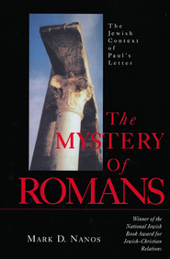
The Mystery of Romans: The Jewish Context of Paul’s Letters

Paul is urging the Gentile believers to take note of their position, their role, and their halachic status as “resident aliens” within the midst of corporate Israel, which here is the synagogue context in Rome.

-from my review of Nanos’s book

The Mystery of RomansThe alternative explanation, based Bockmuehl, Cohen, Lancaster, and Nanos, is that the Gentiles were included in the commonwealth of Israel but not as equal national citizens. It would be as if my wife, as a Jew, decided to make aliyah, become an Israeli citizen and live in Israel. As her husband, even though I’m not Jewish, I would be allowed a permanent status as a resident in Israel as well, but I do not have an automatic right to become a citizen, as does my wife, because I am not Jewish.

I would still have most or all of the same rights as Jewish Israelis and I would have most or all of the same obligations as Jewish Israelis, but none of that would make me Jewish, nor would the Chief Rabbis of Israel or any other Jewish religious authority expect me to observe Torah as they proscribe because I’m not Jewish.

I know you’re going to say that’s all secular law (with the exception of the authority of the Chief Rabbis) and has little or nothing to do with how God sees things, but I’m using the above example by way of analogy. When James and the Council issued their decision, it wasn’t some magical, spiritual event, it was a legal ruling on the same order as the authorities among the Pharisees made, and was binding halachah upon the community.

However, there is another citizenship I have and one in which I’m looking forward to living out in the age to come. It’s a status I currently possess since according to at least one interpretation of the New Covenant, I need to start living my life as if the world were already fully under the rule of Messiah, Son of David, as he is seated on his Throne in Jerusalem.

I consider myself a citizen of the worldwide Messianic Kingdom to come and many wonderful blessings come from this status. I will be resurrected from dead flesh and made immortal (assuming I die before Messiah’s return). I will have my sins fully, permanently cleansed from me. I will have the Holy Spirit poured into me to such fullness that I will have an apprehension of God in the same or even greater manner than the prophets of old. I will have my heart of stone turned to a heart of flesh and God will write His Word upon it so that it will be my natural inclination to always obey Him and not return to sin.

And as a Gentile of the nations, I will reside in a country that is a vassal state to national Israel, subservient to Israel which will be the head of all nations, and ultimately I and my nation of residence will be accountable to the King of Israel, Moshiach. I expect that I and everyone else like me will be planning our vacations around the festivals and making regular pilgrimages to Jerusalem to spend time with family and friends and pay homage and honor to our King.

The goyishness of Christianity is a sign of its success, not its failure!

-Rabbi Dr. Stuart Dauermann
“The Problem With Hebrew Roots, or, It’s Good to be a Goy”
Interfaithfulness.org

Stuart Dauermann
Rabbi Dr. Stuart Dauermann

R. Dauermann makes a compelling argument that Gentiles who attach themselves to the God of Israel are intended by God to remain Gentiles. The prophets of the Tanakh who spoke of the Messianic Age all seemed to share that belief. I’ll only quote two of them:

And foreigners who bind themselves to the Lord
to minister to him,
to love the name of the Lord,
and to be his servants,
all who keep the Sabbath without desecrating it
and who hold fast to my covenant—
these I will bring to my holy mountain
and give them joy in my house of prayer.
Their burnt offerings and sacrifices
will be accepted on my altar;
for my house will be called
a house of prayer for all nations.”

Isaiah 56:6-7 (NASB)

“In that day

“I will restore David’s fallen shelter—
I will repair its broken walls
and restore its ruins—
and will rebuild it as it used to be,
so that they may possess the remnant of Edom
and all the nations that bear my name,”
declares the Lord, who will do these things. (emph. mine)

Amos 9:11-12 (NASB)

And to quote verse 14:

and I will bring my people Israel back from exile. (emph. mine)

which can also be interpreted as:

will restore the fortunes of my people Israel. (emph. mine)

In both of these prophetic examples describing Jews and Gentiles in the Messianic Age, it is clear that Gentiles will become attached to the God of Jacob as Gentiles and as citizens of the nations. While Isaiah paints for us a portrait of Gentiles offering sacrifices at the Temple of God (something which was allowed during the time of Herod’s Temple), Amos 9:14 makes a clear distinction between the Gentiles of the nations who “bear my name” and Israel!

It is true that Isaiah describes Gentiles keeping to the covenant, but after all, we will receive blessings because of our Abrahamic faith under the New Covenant, and in Messianic Days, I expect it will be more common for even the citizens of vassal nations to have laws and observances that more closely mirror national Israel’s including Sabbath keeping.

I’m not even saying (with apologies to R. Dauermann) that Gentiles in Messiah shouldn’t observe Sabbath in the present age. I’ve met many who do.

What I am saying is that none of what I see in the Bible, particularly the use of a single Greek word, absolutely mandates that all non-Jewish people who are disciples of Jesus be made into citizens of Israel, either in the present age or in the Messianic future.

God made a covenant with Abraham that was specifically and narrowly passed down to Abraham’s son Isaac (but not to Ishmael or any of Abraham’s subsequent children) and then to Isaac’s son Jacob (but not to Esau) and then to Jacob’s twelve sons who became the heads of the twelve tribes, who became the nation of Israel (but not to any other people group or nations).

That Abraham would also become the father of many nations and that through his seed (singular) Messiah, the nations would be blessed, does not abrogate the part of the covenant that specifically promises Israel only to the direct biological offspring of Abraham, and Isaac, and Jacob.

Having not read his book, I can’t say for sure, but if  McKee comes to a different conclusion in his writing, then in spite of his stated education and scholarship, I’m forced to disagree with him.

I don’t write this against Pete or anyone else who holds to his views of scripture, but rather to illustrate that there are other valid and educated views of the Bible that come to other valid and educated conclusions.

I considered just making a few comments on Pete’s blog but as you see, the response requires a lot of words and it’s easier to write out my thoughts here and then just to share a link to my blog with him (and anyone else who is interested).

Beth Immanuel ShavuotConsidering all of the different viewpoints involved in this sort of discussion, I see the position of One Law/One Torah (OL/OT) as existing at one end of a continuum and what’s been called Bilateral Ecclesiology (BE) positioned at the opposite end. While I obviously am leaning closer to the BE end of the scale, I’m not sitting right on top of it.

Of those congregations I am aware of that I consider authentic Messianic Jewish synagogues, including Beth Immanuel, Tikvat Israel, and Ahavat Zion, they all have a majority membership/attendance of non-Jewish people worshiping the God of Israel and giving honor and glory to Yeshua HaMoshiach (Jesus Christ), with a smaller membership and usually leadership of Jews. In fact, the primary teacher at Beth Immanuel is a Gentile: D. Thomas Lancaster. And yet Beth Immanuel is a Jewish community and worship venue that adheres to specific standards of established halachah.

From my perspective, that’s the current state of Messianic Judaism, or at least those portions I know about in my little corner of the world.

That I don’t consider non-Jewish disciples to be literally citizens of national Israel does not exclude us from many incredible blessings or from association with our Jewish brothers and sisters in Messiah. I am quite comfortable inside of my own skin, so to speak, being a person among the nations who is called by His Name. Being married to a Jewish wife, I am content to recognize that she is among her people Israel and I’m dedicated to supporting her, and all other Jewish people I’m associated with, being and becoming closer to the God of Jacob as HIs people Israel through the mitzvot and within their unique community and nation which was established forever by Hashem.