Tag Archives: Paul

Abraham, Paul, Circumcision, and Galatians

Apostle-Paul-PreachesIt was for freedom that Christ set us free; therefore keep standing firm and do not be subject again to a yoke of slavery. Behold I, Paul, say to you that if you receive circumcision, Christ will be of no benefit to you. And I testify again to every man who receives circumcision, that he is under obligation to keep the whole Law. You have been severed from Christ, you who are seeking to be justified by law; you have fallen from grace. For we through the Spirit, by faith, are waiting for the hope of righteousness. For in Christ Jesus neither circumcision nor uncircumcision means anything, but faith working through love.

Galatians 5:1-6 (NASB)

On the surface, it seems as if Paul is speaking against circumcision, which is commanded by God to the Jewish people, that all their males will be circumcised on the eighth day of life. Did Paul just cancel God’s commandment to the Jews?

God said further to Abraham, “Now as for you, you shall keep My covenant, you and your descendants after you throughout their generations. This is My covenant, which you shall keep, between Me and you and your descendants after you: every male among you shall be circumcised. And you shall be circumcised in the flesh of your foreskin, and it shall be the sign of the covenant between Me and you. And every male among you who is eight days old shall be circumcised throughout your generations, a servant who is born in the house or who is bought with money from any foreigner, who is not of your descendants. A servant who is born in your house or who is bought with your money shall surely be circumcised; thus shall My covenant be in your flesh for an everlasting covenant. But an uncircumcised male who is not circumcised in the flesh of his foreskin, that person shall be cut off from his people; he has broken My covenant.”

Genesis 17:9-14 (NASB)

On the eighth day the flesh of his foreskin shall be circumcised.

Leviticus 12:3 (NASB)

I don’t see how Paul could be addressing Jewish people in the above-quoted scripture from Galatians and telling them not to circumcise. To do so would be in direct contradiction to God, and I don’t see Paul doing that. Neither does Ariel Berkowitz as he states in his article A Torah-Positive Summary of Sha’ul’s Letter to the Galatians:

We come now to another commonly misinterpreted passage in Galatians. This is the section about circumcision. Any reader of this letter written by Sha’ul who does not pick up the context of the Letter to the Galatians by now has one final opportunity to observe the context.

In verses 2 and 3, it appears at first sight that Sha’ul is teaching against circumcision. In turn, by doing so, he would appear to be teaching against following the teachings of Moses. On the one hand, Sha’ul is teaching against circumcision – and against Moses – if people follow those practices in order to earn, merit, or keep their salvation. Sha’ul, the staunch defender of justification by faith, seems almost at a loss for words in his determination to convince his students to abandon any effort to use God’s Torah, or any teaching, in order to achieve their justification by doing the works of that teaching.

The context for understanding why Sha’ul is against circumcision (and the Torah) for legalistic purposes is found in Galatians 5:4, which states, “You who are trying to be justified by Torah have been alienated from Messiah; you have fallen away from grace.” Here, the writer clearly states the problem he was having with their practicing circumcision: They were “trying to be justified by Torah.” This is in perfect keeping with the theme of the letter, which we saw in chapter two.

On the other hand, Sha’ul had absolutely no problem with circumcision (or living the Torah) — as long as it is done with the proper motives and for the right reasons. There are two reasons why we say this. First, we have already seen that his was a life of consistent Torah observance. Second, he had Timothy circumcised (Acts 16:1–3). One may debate about the reasons why Timothy was circumcised, but one cannot deny the fact that it was done and that Sha’ul was behind it. For these two reasons alone, we can see clearly that Sha’ul was not against circumcision per se, and consequently, not against proper Torah practice. But he was very much against it all if someone attempted to earn, merit, or keep his/her justification by performing it.
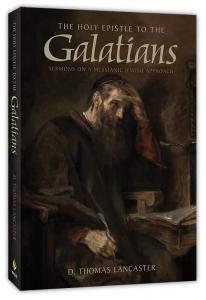
Galatians by D.T. LancasterThis explanation is in keeping with other portions of Berkowitz’s commentary, but here, he seems to indicate that both Jewish and Gentile believers should be circumcised in accordance to the commandments. That’s sort of understandable if we rely just on Genesis 17, but once we also involve Leviticus 12:3, we see circumcision as specifically a sign God gave for the Jewish males, not all males, such as Gentiles who are grafted in by faith in Messiah.

According to D. Thomas Lancaster in his book The Holy Epistle to the Galatians, in “Sermon Twenty-Three: Circumcision and Uncircumcision” (pg 231):

Paul warns Gentiles about relying on Jewish status for salvation and declares circumcision irrelevant with regard to salvation.

Berkowitz and Lancaster have similar perspectives regarding Paul’s intent, but Lancaster states that in this section of his letter, Paul is specifically addressing Gentiles. Based on the above quoted passages from Genesis 17 and Leviticus 12, it was an enduring commandment for the Jews to circumcise their males eight days after birth. Of course, Paul also said (1 Corinthians 7:19), “Circumcision is nothing, and uncircumcision is nothing, but what matters is the keeping of the commandments of God.”

That’s even more confusing because then we have to decide if Paul meant keeping all the commandments of God except the commandment to circumcise. However, in a larger context, Paul tells us:

Only, as the Lord has assigned to each one, as God has called each, in this manner let him walk. And so I direct in all the churches. Was any man called when he was already circumcised? He is not to become uncircumcised. Has anyone been called in uncircumcision? He is not to be circumcised. Circumcision is nothing, and uncircumcision is nothing, but what matters is the keeping of the commandments of God. Each man must remain in that condition in which he was called.

Were you called while a slave? Do not worry about it; but if you are able also to become free, rather do that. For he who was called in the Lord while a slave, is the Lord’s freedman; likewise he who was called while free, is Christ’s slave. You were bought with a price; do not become slaves of men. Brethren, each one is to remain with God in that condition in which he was called.

1 Corinthians 7:17-24 (NASB)

That’s rather similar to the following:

For all of you who were baptized into Christ have clothed yourselves with Christ. There is neither Jew nor Greek, there is neither slave nor free man, there is neither male nor female; for you are all one in Christ Jesus. And if you belong to Christ, then you are Abraham’s descendants, heirs according to promise.

Galatians 3:27-29 (NASB)

communityPut together, we seem to read that neither circumcision nor uncircumcision matters, just as there is neither Jew nor Greek. It appears as if we are all “one new man” (Ephesians 2:15) in Christ with no distinctions whatsoever. This argument has been used to justify both the complete rejection of observing the Torah mitzvot for any believing Jew or Gentile, and the complete acceptance of observing all the Torah mitzvot for every believing Jew or Gentile. It gets confusing.

Of course, when Paul says “neither male nor female,” he wasn’t obliterating physical distinctions between men and women. Another way to interpret Paul on this matter is to say that neither circumcision nor uncircumcision or being Jewish or Gentile matters as far as access to salvation and justification by faith in God through Messiah.

This preserves the commandment of circumcision for the Jews and still allows Paul’s statements to be consistent with God’s commandments.

I know there are some folks out there who will say that Abraham had faith and it was his seed (singular), the Messiah, that allows Gentiles to enter into a covenant relationship with God. And Abraham was commanded to be circumcised and to circumcise his male children and all the males in his household. Doesn’t that mean we Gentile believers need to be circumcised too?

Not so fast!

Then he believed in the LORD; and He reckoned it to him as righteousness.

Genesis 15:6 (NASB)

This is the establishment of faith as the primary linkage for anyone to enter into a covenant relationship with God. But the linkage for the blessings to the nations through Messiah comes earlier:

And I will bless those who bless you, and the one who curses you I will curse. And in you all the families of the earth will be blessed.

Genesis 12:3 (NASB)

Between the two above verses, we have the complete set of requirements that allows Gentiles to enter into covenant relationship with God through faith in Messiah (you can find a more complete description in my blog post The Jesus Covenant Part 8: Abraham, Jews, and Christians).

However, much later on, when Abraham was ninety-nine years old, something new happened. God made a covenant with Abraham that included a physical offspring, the Land of Israel, and circumcision. These, in my opinion, were conditions of God’s relationship with Abraham that took a different trajectory. Certainly the requirement of faith was carried down from the previous encounters with God, but God identified a specific population that were to be included relative to the Genesis 17 promises: Abraham’s physical descendents and members of his household were included in the circumcision requirement.

Does that mean Isaac, Ishmael, Eliezer, and all other males in Abraham’s household at this moment became Hebrews? No, because there’s more. Circumcision certainly created a linkage to Abraham but not all circumcised people become Hebrews, Israelites, or Jews.

Now Abraham took another wife, whose name was Keturah. She bore to him Zimran and Jokshan and Medan and Midian and Ishbak and Shuah. Jokshan became the father of Sheba and Dedan. And the sons of Dedan were Asshurim and Letushim and Leummim. The sons of Midian were Ephah and Epher and Hanoch and Abida and Eldaah. All these were the sons of Keturah. Now Abraham gave all that he had to Isaac; but to the sons of his concubines, Abraham gave gifts while he was still living, and sent them away from his son Isaac eastward, to the land of the east.

Genesis 25:1-6 (NASB)

abrahams-servantAfter Sarah died, Abraham married other wives and had other children. But before Abraham died, he sent away all of his other offspring, giving them gifts, and then singled out Isaac, the Child promised to him by God to fulfill the Genesis 17 covenant involving Abraham’s offspring, circumcision, and the Land of Israel. Of course, Abraham had circumcised Ishmael and all of his other sons as well as Isaac, but Isaac was the only beneficiary of the covenant relationship involving what would eventually become the Jewish people. Even his other sons, let alone the other non-relative males (servants, slaves, herdsmen) in his household who had been circumcised, were not inheritors of the covenant that led to possession of the Land of Israel and the conditions specified for the descendents of Isaac and Jacob, the Children of Israel, the Jewish people…the Torah of Moses.

If, as a Christian male, you believe you have an obligation to be circumcised and to circumcise your sons, no one is going to stop you, but being circumcised, even with the belief that it is required of the spiritual offspring of Abraham, does not create any sort of linkage between you and Abraham’s physical descendants. It doesn’t give you the Land of Israel, and it doesn’t obligate you to observing the Torah mitzvot in the manner of the Jews.

By Paul’s day, circumcision of males became a sort of shorthand way of saying “conversion to Judaism.” Paul was right in saying that circumcision (converting to Judaism) does not justify anyone before God, just as performing all of the mitzvot (for Jew or Gentile) does not justify.

Hopefully, at some point, I’ll be able to write on why Abraham was commanded to circumcise physical offspring who would not inherit Israel or non-relative males who also would not inherit, but for now, I will say that Paul did not believe that circumcision was a guarantee of salvation for Jew or Gentile, however I understand that he believed circumcision was still a requirement for the Jews, as were the other mitzvot of Torah. If he was teaching Jews not to circumcise their sons, then he was lying here:

After Paul arrived, the Jews who had come down from Jerusalem stood around him, bringing many and serious charges against him which they could not prove, while Paul said in his own defense, “I have committed no offense either against the Law of the Jews or against the temple or against Caesar.”

Acts 25:7-8 (NASB)

PaulActs 21:20-26 contains more complete text testifying to the fact that Paul never taught the diaspora Jews to fail to circumcise their sons. If he was lying here, then we can have no confidence in anything Paul wrote which would leave the majority of the New Testament in a shambles, along with our Christian faith.

If you, a Christian, feel you must be circumcised and you must circumcise your sons, remember that it does not justify you before God, it does not put you in the line of succession of Abraham, and Isaac, and Jacob, and Jacob’s twelve sons, and of the twelve tribes, and the Torah of Moses, and give you possession of the Land of Israel. At best, you may be aligned with the non-physical relative members of Abraham’s household, but then, we are still searching for what they and their circumcision mean.

Yes, Timothy was circumcised by Paul, but Titus the Gentile believer specifically was not. Neither was Cornelius the Roman and his entire household. Neither do we have a record of any other Gentile believers who were required to be circumcised as a condition of faith in Messiah. Think of this as you will.

For more on this topic, please read If Paul Had Circumcised Gentiles.

Paul’s Hagar and Sarah Midrash

hagar_and_sarahTell me, you who want to be under law, do you not listen to the law? For it is written that Abraham had two sons, one by the bondwoman and one by the free woman. But the son by the bondwoman was born according to the flesh, and the son by the free woman through the promise. This is allegorically speaking, for these women are two covenants: one proceeding from Mount Sinai bearing children who are to be slaves; she is Hagar. Now this Hagar is Mount Sinai in Arabia and corresponds to the present Jerusalem, for she is in slavery with her children. But the Jerusalem above is free; she is our mother. For it is written,

“Rejoice, barren woman who does not bear;
Break forth and shout, you who are not in labor;
For more numerous are the children of the desolate
Than of the one who has a husband.”

And you brethren, like Isaac, are children of promise. But as at that time he who was born according to the flesh persecuted him who was born according to the Spirit, so it is now also. But what does the Scripture say?

“Cast out the bondwoman and her son,
For the son of the bondwoman shall not be an heir with the son of the free woman.”

So then, brethren, we are not children of a bondwoman, but of the free woman.

Galatians 4:21-31 (NASB)

This set of verses from Paul’s letter to the Galatian churches has been one of the most devastating commentaries used against the Torah of Moses and the Jewish people over the last two-thousand years. Torah and Judaism are slavery. Christ and his grace are freedom. The message to any Jewish person who struggles to come to faith in Jesus as Messiah is that they must give up being Jewish, Judaism, and any connection to the Torah because it is all slavery, and pursue the Christian Jesus because only the Goyim have freedom…

…or be cast out as the bondwoman and her son…her Jewish son.

But given the larger dynamics of Paul’s life, it seems extraordinarily unlikely that he would have meant to say that in this message.

And when they heard it they began glorifying God; and they said to him, “You see, brother, how many thousands there are among the Jews of those who have believed, and they are all zealous for the Law; and they have been told about you, that you are teaching all the Jews who are among the Gentiles to forsake Moses, telling them not to circumcise their children nor to walk according to the customs. What, then, is to be done? They will certainly hear that you have come. Therefore do this that we tell you. We have four men who are under a vow; take them and purify yourself along with them, and pay their expenses so that they may shave their heads; and all will know that there is nothing to the things which they have been told about you, but that you yourself also walk orderly, keeping the Law. But concerning the Gentiles who have believed, we wrote, having decided that they should abstain from meat sacrificed to idols and from blood and from what is strangled and from fornication.” Then Paul took the men, and the next day, purifying himself along with them, went into the temple giving notice of the completion of the days of purification, until the sacrifice was offered for each one of them.

Acts 21:20-26 (NASB)

After Paul arrived, the Jews who had come down from Jerusalem stood around him, bringing many and serious charges against him which they could not prove, while Paul said in his own defense, “I have committed no offense either against the Law of the Jews or against the temple or against Caesar.”

Acts 25:7-8 (NASB)

Throughout Paul’s entire ordeal, in trial after trial, before one judge to the next, Paul continually denied that he had committed any crime against the Jewish people. He denied that he told Jewish believers not to circumcise their sons. He denied that he told Jewish believers not to walk in the customs of their fathers. He denied that he took a Gentile into the Temple or committed any crime against such a Holy place. He denied that he told the Jewish believers to forsake Moses.

Apostle-PaulSo how can we interpret the statements Paul made in Galatians 4:21-31 to mean that Paul did tell the Jewish believers to forsake the Torah and that faith in Messiah was totally inconsistent with Jewish people living as Jews?

In his article A Torah-Positive Summary of Sha’ul’s Letter to the Galatians, Ariel Berkowitz defends Paul’s statement from a Jewish perspective, something most Christian Bible readers lack (please forgive the length of the following quote):

In chapter four, Sha’ul, having been thoroughly trained in the best rabbinic methods of Bible interpretation of his day, makes a midrash. A midrash is the Jewish way of saying that an allegorical or sermonic interpretation of the Scripture is about to take place.

This midrash is in 4:21–31. It is difficult to understand, as all midrashim (plural of midrash) are. Its difficulty has thrown many an earnest Bible interpreter aside. We will not analyze all of the midrash. We will only summarize the main point, because that is the point that is most pertinent to our present study of Galatians.

Sha’ul uses this midrash to illustrate the point he made in chapter three with his comparison of the two important covenants, the Abrahamic and Mosaic. Just as Abraham was putting Hagar before Sarah in order to fulfill God’s promises of descendants, so are those who are attempting a works justification putting Sinai before Abraham. Let us explain.

God called Abraham to a life of faith. God promised Abraham that He would give him children in his old age. God meant that the children would come through Sarah. Time went by and no children came.

Apparently, Abraham thought he would attempt to secure God’s promises by his own effort instead of relying on God to perform it. Thus, he had a child through Hagar. Although this was perfectly in keeping with the established customs of his day, it was not perfectly in keeping with trusting God! Abraham should have trusted God and waited for Sarah to have a child. Ishmael, therefore, was a child of works, but Isaac was the child of faith.

Sha’ul says that anyone who tries to secure God’s gracious promises of salvation and justification by obeying the Torah (going to Sinai) is like Abraham trying to secure God’s gracious promises through his own effort with Hagar. In the Galatian congregation, they were putting “Sinai” before “Abraham,” when they should have put “Abraham” before “Sinai.”

If you read my commentary on last week’s Torah portion, you’ll recognize a familiar theme from the Berkowitz article, that of justification coming through faith, not the mechanics of performing the mitzvot. Berkowitz’s interpretation of Paul’s midrash is no different.

Just as Abraham thought he could fulfill God’s promise of a son through his own efforts with Hagar, so too did some of the Jewish people (or Gentiles who thought they must convert to Judaism) believe they could secure justification before God by perfectly observing the Torah mitzvot. However, those Jewish and Gentile believers who understood that justification comes through faith and not the observance of Torah, are like Abraham when he trusted God’s promise of a son through Sarah, though it seemed completely impossible, because Sarah was so old.

abraham1This is not nullifying the Jewish responsibility of observing the Torah but rather putting faith and obedience in perspective. Obedience must follow faith, otherwise it is not in response to faith. Obedience, that is, following “the rules” for their own sake, does not provide justification before God. This is to be compared to Hagar and her son in Paul’s midrash. Only by faith in God does justification before God become achieved, not through our own performance of the mitzvot, then and only then, does Jewish obedience to the Torah of God have full meaning. This is to be compared to Sarah and her son in Paul’s midrash.

Lest I depend too much on Berkowitz for my defense of Paul, the Torah, and the Jewish people, I want to examine another, related source:

Paul develops a parable (midrash) based upon the story of Hagar and Sarah, Ishmael and Isaac, to point out the difference between God-Fearers and proselytes.

-D Thomas Lancaster
“Sermon Twenty-Two: Sarah, Hagar, Isaac, and Ishmael” pg 219
The Holy Epistle to the Galatians

That’s Lancaster’s brief summary as he’s introducing this chapter and the topic of Galatians 4:21-31. He seems to be taking a somewhat different approach to Paul’s midrash, making a comparison, not between “legalistic” Torah observance for justification vs. justification by faith, but between Gentile God-fearers and those who desired to convert to Judaism for the purpose of justification.

Lancaster takes his cue from Galatians 4:22, “For it is written that Abraham had two sons.”

In the synagogue world, a “ben Avraham” is a convert. Paul used the story of Isaac and Ishmael to illustrate two different types “benei Avraham,” in other words, two different types of Gentile proselytes. He was not contrasting Jews against Christians, nor was he contracting Jews against Gentiles. He was not talking about Jews at all. Instead, he used the Isaac and Ishmael analogy to contrast two different types of Gentiles: “For it is written that Abraham had two sons, one by the slave woman and one by a free woman” (Galatians 4:22).

-Lancaster, pg 221

Lancaster says that Paul makes a big deal out of “flesh versus the promise” as in:

Now the promises were spoken to Abraham and to his seed. He does not say, “And to seeds,” as referring to many, but rather to one, “And to your seed,” that is, Christ.

Galatians 3:16 (NASB)

Lancaster makes specific in his chapter that “All nations will be blessed in Abraham’s seed, the Messiah.” Abraham and Sarah conceived their son Isaac according to the promise, Abraham believed and it was reckoned to him as righteousness (Genesis 15:6). Isaac was born by faith but Ishmael was born by Abraham taking matters into his own hands, so to speak, and attempting to fulfill the promise of God, the promise that leads to Messiah, by his own efforts and not faith.

Lancaster points out something Berkowitz missed. Most Christians interpret the two covenants as Old Testament vs New Testament, which is totally untrue given the context. As should be obvious, the contrast is between the Abrahamic and Sinai covenants, which both Lancaster and Berkowitz point out, and does not allow for a replacement of one over the other.

What I am saying is this: the Law, which came four hundred and thirty years later, does not invalidate a covenant previously ratified by God, so as to nullify the promise. For if the inheritance is based on law, it is no longer based on a promise; but God has granted it to Abraham by means of a promise.

Galatians 3:17-18 (NASB)

Torah at SinaiIt seems rather apparent that the latter law, Sinai, does not nullify the earlier law and the promise made to Abraham by God. As Lancaster says, Hagar cannot replace Sarah. From Lancaster’s perspective, the “children of Hagar” aren’t born Jewish people but rather, Gentiles who have undergone the formal process of converting to Judaism. The “children of Sarah” are the Gentile God-fearers who have come into relationship with God through faith in the Messiah. The converts are compared to Ishmael, who was conceived and born through completely human means, while the Gentiles who have come to faith in Messiah without converting to Judaism are compared to Isaac who was conceived and given life though supernatural means.

I can see where Lancaster is going with this, but I don’t think I can agree. In this case, I think Berkowitz makes the more convincing case. Lancaster rightly is addressing the Gentiles and saying that Paul is communicating that they do not need to convert to Judaism in order to inherit the promise, but he’s leaving the Jewish believers in the Galatian churches out of the equation. There are portions of the letter that could be interpreted as being directed at both Jewish and Gentile believers.

When Paul is addressing his audience in Galatians 1:2, depending on the translation you use, he is saying “brothers and sisters,” or “brothers,” or “brethren.” There’s no indication that he was singling out a specific population, either Jewish or Gentile. If Paul meant to address only the Gentiles in order to convince them not to convert to Judaism in order to be justified before God, I would expect him to have pointed more directly at his desired audience. He seems to be talking to both Jews and Gentiles explaining a unified message: “Obedience to the Law does not justify anyone (Jew or Gentile) before God. Only faith in God, faith such as Abraham had, faith in the promise of Abraham’s seed, faith in Messiah, justifies.”

I know people will say that if Paul was addressing both Jews and Gentiles, then he was telling them both that the Torah has been invalidated by the grace of Jesus Christ, however I can’t agree with that. Based on what I wrote previously and my current analysis of Paul’s Hagar and Sarah midrash, he is saying that yes, obedience does not justify a person before God, only faith. However, that does not nullify what comes next for a Jewish person, anymore than the covenant with Abraham nullified the covenant at Sinai. Jewish believers have a continuing obligation to God to obey the Torah mitzvot because of the specific promises made to Abraham, and to Isaac, and to Jacob.

BerkowitzBerkowitz’s interpretation of Paul’s midrash seems the better one to illustrate this point, but it should be emphasized that it does not justify being interpreted as any obligation for the Gentile believers to obey the mitzvot in the manner of the Jews. I’ve already pointed out that the Acts 15 decision offers us a different or overlapping set of responsibilities.

Paul’s Galatians 4 midrash has been terribly misused by the church over the centuries, and we’ve forgotten what Peter has said to us about Paul:

…and regard the patience of our Lord as salvation; just as also our beloved brother Paul, according to the wisdom given him, wrote to you, as also in all his letters, speaking in them of these things, in which are some things hard to understand…

2 Peter 3:15-16 (NASB)

If Peter, a contemporary of Paul and a fellow Jewish believer, could say such a thing back then, how much more can Paul be misunderstood in the present age by non-Jewish believers laboring under nearly twenty centuries of anti-Judaic doctrine about Paul?

One of the gifts of the Messianic Jewish movement is to help return the Gospels and Epistles to their original Jewish context so that we in the church can see the actual meaning of the good news of Moshiach and the role and purpose of faith, grace, and Torah for the Jewish believers as well as the Gentiles.

Paul’s Sunday Shavuot

first-fruits-barleyThe period from Passover to Shavu’ot is a time of great anticipation. We count each of the days from the second day of Passover to the day before Shavu’ot, 49 days or 7 full weeks, hence the name of the festival. The counting reminds us of the important connection between Passover and Shavu’ot: Passover freed us physically from bondage, but the giving of the Torah on Shavu’ot redeemed us spiritually from our bondage to idolatry and immorality. Shavu’ot is also known as Pentecost, because it falls on the 50th day; however, Shavu’ot has no particular similarity to the Christian holiday of Pentecost, which occurs 50 days after their Spring holiday.

Shavu’ot is not tied to a particular calendar date, but to a counting from Passover. Because the length of the months used to be variable, determined by observation, and there are two new moons between Passover and Shavu’ot, Shavu’ot could occur on the 5th or 6th of Sivan. However, now that we have a mathematically determined calendar, and the months between Passover and Shavu’ot do not change length on the mathematical calendar, Shavu’ot is always on the 6th of Sivan.

– “Shavu’ot” at Judaism 101

The date of Shavuot is directly linked to that of Passover. On Passover, the Jewish people were freed from their enslavement to Pharaoh; on Shavuot they were given the Law and became a nation committed to serving God. Shavuot is celebrated in Israel for one day and in the diaspora (outside of Israel) for two days. Reform Jews celebrate only one day, even in the diaspora. Karaite Jews and Christians believe that Shavuot always falls on a Sunday, while mainstream Jews follow the teaching of the Talmud, which holds that the holiday commences immediately after the “counting of the omer,” or 50 days after Passover.

– “Shavuot” at New World Encyclopedia

Last Sunday, my Pastor’s sermon from Leviticus 23 was on Shavu’ot/Pentecost. Like many Christians (and I had no idea Christians believed this before a few days ago), he believes that Shavuot must always fall on a Sunday for the following reasons:

The word “Sabbath” in this verse is assumed, by some, to be the first day of the Feast of Unleavened Bread, which has been deemed to be a “special Sabbath.” Therefore, it is not uncommon for people to assume that the first instance of “Sabbath” in Leviticus 23:15 indicates the special Sabbath during the Feast of Unleavened Bread, Aviv (or Nisan) 15—that is, the day after the Passover, Aviv 14. In thinking this way, their count of the Feast of Weeks would begin on the day after the 15th, which is the 16th. Many, if not most, Jewish rabbis begin the count here.

However, in Leviticus 23:16, it says, “Count off fifty days up to the day after the seventh Sabbath….” There are not special Sabbaths during each of the seven weeks during which the count is made. However, there are seven regular weekly Sabbaths. Therefore, the fifty-day count ends on Sunday, the day after the seventh weekly Sabbath (which is Saturday). That makes the first day of the fifty-day count to be a Sunday as well. So Shavuot = the Feast of Weeks = Pentecost always falls on a Sunday, although some believe that it can be on any day of the week, depending on the year.

– “How do you calculate the timing of Shavuot or Pentecost?”
at TedMontgomery.com

churchesI have no idea who Ted Montgomery is or why he’s considered an authority in this matter (and he should update his website design to something that doesn’t just scream, “1998!”), but what he has on his site is basically the same explanation Pastor gave in his sermon.

If he’s right, then Shavuot/Pentecost always occurring on a Sunday would have a great deal of meaning in Christianity and bolster the Christian tradition of having the official weekly worship day on a Sunday. I don’t know enough about it to have much of an opinion, but one of my personal “laws” (and I think almost everyone has this “law”) is that when something seems too good to be true, it probably is.

When I looked up the dates for Shavuot at Chabad.org, the holiday doesn’t always fall on a Sunday according to their calendar. In fact, this past year, since Shavuot is celebrated two days in the diaspora, Shavuot was observed on Wednesday, May 15th and Thursday, May 16th. Next year, it will also be held on a Wednesday and Thursday, but in early June.

How the dates for Shavuot are calculated depends on when you start counting. If it’s always on the first day after Passover, the day of the week Shavuot occurs will vary. If it’s always on the first day after the Saturday Shabbat, then it will always be on Sunday. Before last Sunday, the only way I heard that it was to be calculated was how Judaism traditionally recommends. Christianity, it seems, always comes up with little surprises for me.

I know that Christians, including my Pastor, will tell me that the calculation for the “Sunday-only” Shavuot/Pentecost is purely Biblical and thus, it doesn’t matter what Judaism and the Rabbis have to say about it. On the other hand, this observance was given to the Children of Israel well over a thousand years before the birth of Christ, so I’d have to give the Jewish people some “props” in how they choose to understand the Torah on this matter.

According to Pastor in his sermon, in Acts 20, we see Paul anxious to get to Jerusalem as soon as possible. Pastor tells us that this is because he wanted to arrive in time for Shauvot, but he asked an odd question. Why should it have mattered to Paul? He wasn’t a farmer. Shavuot is (or was) all about offering the first fruits of the wheat harvest to God at the Holy Temple in Jerusalem. What was the big deal for Paul?

Pastor’s answer was not so much about the Jewish Shavuot as the Christian Pentecost. Because of the giving of the Holy Spirit in the original Acts 2 event and its meaning as the “birthday of the Church,” Paul wanted to get back to Jerusalem to commemorate the Christian side of the coin, so to speak, as opposed to observing one of the three pilgrim festivals that all Jews are commanded to attend in Jerusalem each year.

shavuot_two_loavesIt is true that based on Leviticus 23:15-22, it doesn’t seem as if Paul would rush right back to Jerusalem in order to offer a personal wave offering of two loaves of bread along with the lamb and drink offerings. But then again, in the same sermon, Pastor said that the offerings recorded in those scriptures weren’t personal offerings but were offered for the entire assembly of Israel, so Paul wouldn’t have had to be a farmer  with a personal sacrifices to offer to desire to be present at the Temple. He just had to be a Jew.

We see in Acts 2 that thousands upon thousands of Jews from the diaspora were present in Jerusalem for Shavuot. Could they have been responding to this?

“Three times a year you shall celebrate a feast to Me. You shall observe the Feast of Unleavened Bread; for seven days you are to eat unleavened bread, as I commanded you, at the appointed time in the month Abib, for in it you came out of Egypt. And none shall appear before Me empty-handed. Also you shall observe the Feast of the Harvest of the first fruits of your labors from what you sow in the field; also the Feast of the Ingathering at the end of the year when you gather in the fruit of your labors from the field. Three times a year all your males shall appear before the Lord God (emph. mine).

Exodus 23:14-17 (NASB)

You can find similar language commanding Jewish people to appear at the Temple in Jerusalem for Shavuot in Exodus 34:21-24, Numbers 28:26-31, and Deuteronomy 16:9-12. I’m not saying that the Acts 2 event had no meaning for Paul and that it didn’t add a tremendous dimension to Shavuot for Paul and the other Jewish apostles and disciples, but it would hardly be disconnected from the commandments of God for the Jewish people and Jewish obedience to the Torah of Moses. There’s no reason to believe the Christian conceptualization of Pentecost would have unplugged the festival from the Jewish Shavuot.

After all. Pastor acknowledged in his sermon that one of the names for Shavuot is “Z’man Mattan Toratenu” or “The Time of the Giving of the Law (Torah).” In his sermon, he affirmed that it is quite Biblical to believe that, given the timing of the Exodus from Egypt, that the Children of Israel could have been at Sinai for the giving of the Torah on the traditional date for Shavuot.

For Paul then, the linkage between the giving of the Torah and the giving of the Spirit would have been inescapable and been seen as a dramatic illustration of God’s continual graciousness to the Jewish people as a light to the world and as the means by which Israel and the nations would be redeemed.

While I strongly believe that the coming of Jesus, his life, death, burial, resurrection, and ascension to the right hand of the Father represents a revolutionary event in the course of human history and the plan of God for both the Jewish people and the people of the nations, it was and is also the predictable, prophesied, and logical extension of God’s plan across time, not a radical departure shifting from God’s “plan A” to “plan B.”

The past several blog posts where I mention my Pastor, I know it seems as if I’m really butting heads with him, so to speak. While we don’t always see eye to eye, I have great respect for him and I thought last Sunday’s sermon especially was informative and illuminating. In fact, the highlight of my church attendance every Sunday is his sermon. As you can see, he provides me with a lot of food for thought.

ShavuotI know why Christians count the Sabbaths from Passover to Shavuot as they do. The symbolism relative to Pentecost and Sunday is exceptionally compelling given Christian tradition. I can also understand why Judaism would calculate it differently based on disconnecting the Jewish Shavuot from the Christian Pentecost. On the other hand, that doesn’t make the Christian calculation right and the Jewish calculation wrong (or vice versa). Even if Shavuot/Pentecost occurs annually according to the Jewish calendar, that hardly devalues the meaning of the holiday for believing Jews and Gentile Christians. Christians just don’t have to work so hard to disconnect Pentecost from its original and ongoing meaning in Judaism. If there will be a Third Temple as both Pastor and I believe, then those offerings will once again be upon the altar in Jerusalem in Messianic days.

Why was Paul in such a hurry to get to Jerusalem before the festival of Shavuot? We can’t derive his exact intent from the text of Acts 20. However, reason, history, and the Torah tells us that he needed no other reason than because he was Jewish. If he had other reasons, then we will learn those after the time of Messiah’s return, may he come swiftly and in our day.

Schreiner and Acts 15

Apostle-Paul-PreachesThe so-called apostolic decree is described by Luke in Acts 15. The leaders of the churches from Jerusalem and Antioch met in Jerusalem to determine whether circumcision would be mandatory for Gentiles who believed Jesus was the Messiah. As we saw…they decided that circumcision was not necessary. But James recommended that the Gentiles follow four other prescriptions, and these laws often are called the apostolic decree.

Why are these requirements added after the church has agreed that Gentiles are free from the requirement of circumcision? Does the law come in the back door after it has been shut out the front door? And what do these requirements mean?

-Thomas Schreiner
“Question 31: What Is the Apostolic Decree of Acts 15 and What Does It Contribute to Luke’s Theology of Law?” pg 181
40 Questions About Christians and Biblical Law

I hadn’t intended to write anymore about my impressions of this book. I didn’t think Schreiner had anything more to say to me that I hadn’t read in earlier parts of his work. He is just restating the same point of view and applying it to different parts of the Bible. In reading Schreiner, he seems almost like the poster child for Biblical eisegesis, reading his theology into the text rather than, by exegesis, developing his belief systems from out of the text.

But Acts 15 is near and dear to my heart, so I thought I’d present my impressions of Schreiner and how he perceives the four apostolic decrees.

Even in the above-quoted opening passages, we see that Schreiner continues to link circumcision and any behavioral expectations for Gentile believers as a direct requirement for non-Jewish disciples to respond to “the law.” But he misses that “circumcision” is shorthand for “conversion to Judaism,” so what we see is that James and the Apostolic Council did not require that Gentiles convert to Judaism and take on board the full yoke of Torah in order to have a covenant connection to God and join the community of the Way.

In Acts 15:1, the question was, “Do Gentiles need to convert to Judaism and observe Torah in order to be saved?” However, salvation, from a Jewish perspective, while it can be individual, is understood as corporate. The expectation of the Messiah is that he would “save” Israel nationally and corporately, by returning the exiled Jews to their Land, establishing peace and security for national Israel, including removing all military threats (which at that time meant removing Roman occupation from Israel), and placing Israel at the head of all nations, with Messiah as King.

In order to be “saved,” would Gentile disciples have to join Israel nationally by converting to Judaism? This, of course, would be in addition to being saved from their sins and meriting a place in the world to come.

The Council’s decision was “no,” which should please Schreiner, since they are saying that one does not have to be obligated to Torah obedience in order to have personal salvation. Corporate salvation is another story, but I’d interpret that as Messiah establishing peace for all countries on Earth, hence, we are “saved” by the provision of peace among the nations as well as in Israel.

But Schreiner still doesn’t get why Gentile believers should have any behavioral requirements at all. That just seems too much like “the law” and any “law” should only be applied to the circumcised. Really?

Schreiner goes on to say:

…but this should not be interpreted as if there are not moral requirements for believers. Gentiles would misinterpret freedom from the law if they thought they were free to worship idols, murder their neighbors, commit sexual sin, and mistreat others.

D.T. LancasterOK, so we do have behavioral expectations and they don’t have to function like “the law” as such. But if Schreiner objects to the four decrees of the apostles, then where are these “moral requirements” supposed to come from? Schreiner doesn’t answer the question in this chapter, but based on other portions of his book, I gather that in our communion with the Holy Spirit, we would be guided in all things, including righteous behavior as Christians. The “law” is written on our hearts. So, why the decrees, then? Schreiner examines different perspectives including one of which I’m familiar:

Richard Bauckham proposes an even more specific interpretation, finding the key in the phrase “in your/their midst” in Leviticus 17:8, 10, 12, 13, and 18:26. According to Bauckham, these commands, which are based on Leviticus 17-18, were required of Gentiles who lived in the midst of Israel. The commands, then, do not represent a pragmatic compromise to facilitate fellowship between Jews and Gentiles according to Bauckham. On the contrary, these commands were required of Gentiles who lived in the midst of Israel

-Schreiner, pp 182-3

I wrote a commentary of this viewpoint as it was presented by D. Thomas Lancaster in Torah Club, Volume 6, Chronicles of the Apostles. Schreiner, of course, disagrees with Bauckham and thus Lancaster, but then goes on to say something I consider rather amazing.

One of the problems with Bauckham’s solution relates to Paul. According to Acts, Paul was at the apostolic council and accepted the apostolic decree. Bauckham thinks that Paul later changed his mind and ended up rejecting the council’s decrees.

-ibid, pg 183

What? When did Paul do this? It’s not in Acts 15 and it would have been illogical for Paul to accept the limitations of the decree upon himself as a Jew. The decree was issued as a solution to how Gentiles could be allowed to enter a Jewish religious space as equal members and with a covenant connection to God. The Council decided that Gentiles would not be required to convert to Judaism and take upon themselves the full yoke of Torah (my Return to Jerusalem series goes into all of the details). The Council’s decision was incumbent upon only the Gentiles in the Way.

Paul was Jewish, so the Council’s decision had nothing to do with him personally, nor any other Jewish disciple of the Jewish Messiah. I have no idea how Bauckham (or Schreiner) could think otherwise. It doesn’t make sense.

fracturedSchreiner’s final conclusion is that the apostolic decree was put in place to smooth over the relationship between Gentiles and Jews and that obedience to the decrees was not a Gentile requirement for salvation. Schreiner reads Acts 15:21 not as an indication that Gentiles should “learn Torah” in order to better understand the teachings of Jesus (which are all based on a close understanding of Torah) but in order to learn “Jewish sensibilities” and to become “acquainted with customs that bothered Jews.”

I agree that obeying the apostolic decree or for that matter, any or all of the Torah mitzvot does not provide personal salvation apart from faith in God through Moshiach, but not only does Schreiner completely misunderstand the purpose of the decree (which can be unpacked and understood as a much more in-depth compilation of behavioral requirements), but he clearly doesn’t comprehend that the decree was not designed to impact Jewish obedience to God.

Schreiner’s understanding of Acts 15 is firmly rooted in his dismissal of all of the covenant connections of the Jewish people and Israel with God and his replacement of the Torah as the God-given method of Jewish obedience to God with the law-free Gospel of Jesus Christ.

Blessings, Curses, and Works of the Law

torah-nailed-to-the-cross…those who support the New Perspective on Paul, such as J.D.G. Dunn…and N.T. Wright…maintain that “works of the law” focuses on the boundary markers that separate Jews and Gentiles. The boundary markers, or identity badges, of Judaism were circumcision, food laws, and Sabbath. The problem with the Judaism in Paul’s day, then, was not legalism but exclusivism. “Works of law” highlights the nationalistic spirit of the Jews by which they excluded Gentiles from the promises of God. According to his interpretation, Paul does not indict the Jews for their failure to obey the law. Their fault was not inability but separatism.

-Thomas Schreiner from his book
40 Questions About Christians and Biblical Law
Question 5: What Does the Expression “Works of Law” Mean in Paul? pg 42

My previous review on earlier chapters of Schreiner’s book can be found in this morning’s “meditation,” Captured in the Glass. Please read that article before proceeding here.

It took me until this fifth chapter, uh…question to realize that Schreiner was writing this book primarily, or at least significantly, in order to refute the “New Perspective on Paul.” The New Perspective on Paul is actually a formal, academic interpretation of the writings of Paul, supported by a number of New Testament scholars. It also seems to dovetail nicely into the viewpoints of some commentators on Messianic Judaism, particularly those to support the distinction between Jewish and non-Jewish believers in Yeshua (Jesus) as Messiah relative to covenant signs (circumcision, food laws, and Sabbath).

But according to Schreiner, these scholars are dead wrong. I suspect that’s why my Pastor gave me this book. It really is a compelling book, but not in the way Pastor may have intended it.

Here’s Schreiner’s point of view on “works of the law.”

…”works of law” refers to the entire law and the actions that are required by the law. This is the most likely reading of Romans 3:20 (“For by works of the law no human being will be justified in his sight, since through the law comes knowledge of sin”) and Gal. 3:10 (“For all who rely on works of the law are under a curse; for it is written, ‘Cursed be everyone who does not abide by all things written in the Book of the Law, and do them'”).

-ibid

As noted above, I wrote about earlier “questions” in Schreiner’s book in my previous blog post and apparently the subsequent questions form the foundation for later parts of the text. Unfortunately so do the errors that were previously established as well. As I mentioned before, Schreiner himself states that observing the Torah mitzvot was a perfectly acceptable response to obeying God after He redeemed the Israelites from Egypt and apparently it was OK until the coming of Jesus.

Look up Deuteronomy 30, Psalm 19, and Psalm 119 as just a few of the many examples of how the Torah was upheld, esteemed, thought beautiful, a source of wisdom, on, and on, and on, how wonderful the Law of Moses was.

How did it get morphed in the late Second Temple period to be such a pain in the neck for the Jewish people?

Even Schreiner acknowledges that Paul sincerely believed that the Torah was the authoritative word of God for the Jewish people. So what’s Schreiner’s beef with “works of the law?”

A number of arguments support the idea that “works of law” refers to the entire law and the deeds commanded by it…”Works of law” most naturally refers to all deeds commanded by the law. There is no reason to think that it is limited to or focuses on only part of the law, or that it refers to “evil works,” or that it refers to legalism.

-ibid, pg 43

So what? So what if “works of the law” refers to the Torah as a whole? I still maintain that Paul was talking about Jewish and Gentile people who believed that one needed to keep the whole of Torah without error in order to be saved. If you believe keeping the mitzvot will save you instead of faith in God, then you’ve got a problem. I agree. No matter how many of the mitzvot you perform and no matter how well you perform them, those acts are not what saves you from sin and death. Abraham had faith and it was counted to him as righteousness (Genesis 15:6, Romans 4:3).

If the mitzvot was a perfectly good response of obedience to God after Israel’s redemption in the days of Moses, why is it a problem in the days of Paul?

I know what you’re thinking. Schreiner thinks the same way.

For whoever keeps the whole law and yet stumbles in one point, he has become guilty of all.

James 2:10 (NASB)

jewish-repentanceSchreiner’s argument from Question 7: Is Perfect Obedience to the Law Mandatory for Salvation? states that the law is impossible to keep perfectly and therefore no one can be saved by keeping the law. He’s rocketing toward the supersessionistic conclusion that in order to be saved, Jews must abandon the Torah (which he erroneously believes Paul did) and cling to Jesus and grace in order to be saved. He is correct in that God expected Israel to observe the mitzvot, but he forgets that God established provisions for the Israelites when they sinned. He uses examples such as Proverbs 20:9 and Ecclesiastes 7:20 to demonstrate how the “Old Testament” Jews couldn’t keep the law and of course, he uses Romans 3:10 to indicate how the “New Testament” Jews couldn’t keep the law either.

But he is building his argument on sand or rather, on a false premise.

Those who do not do everything the law commands are cursed.

Galatians 3:10b

Schreiner’s problem is that he assumes it was God’s intention that Israel keep the law perfectly in order to be saved…salvation by works. Would God really expect that? He didn’t seem to in Genesis 15. He redeemed Israel before He gave the Torah at Sinai (see my review of the FFOZ TV episode Exile and Redemption for the actual, Biblical definition of “redemption,” which is much more than how Schreiner understands the term), so obviously that redemption or salvation was not based on the Israelites keeping the Torah, being obedient, or any other form of “works-based salvation.”

So what was Paul complaining about, then? What was his problem with the law? His problem was with people, both Jews and Gentiles, who erroneously thought just keeping the law would save them. That’s why he was against Gentiles converting to Judaism (see the Book of Galatians), since they were laboring under the false teaching that they had to keep the law in order to be saved.

That wasn’t Paul’s understanding of the law and it certainly wasn’t God’s.

But if Paul is saying that those who convert to Judaism and thus who are bound to the Sinai covenant and its conditions, the mitzvot of Torah, don’t keep the law perfectly, and not keeping the law perfectly doesn’t cause them to lose their salvation, what is this curse Paul’s talking about?

You’ll find the blessings the Israelite were to receive for observing the mitzvot and the curses they were to suffer from for disobedience in next week’s Torah Portion Ki Tavo: Deuteronomy 26:1-29:8. The actual actions that must be committed in order to be cursed are listed in verses Deuteronomy 27:15-26 and 28:15-19. So what are the consequences of being cursed?

The Lord will let loose against you calamity, panic, and frustration in all the enterprises you undertake, so that you shall soon be utterly wiped out because of your evildoing in forsaking Me. The Lord will make pestilence cling to you, until He has put an end to you in the land that you are entering to possess. The Lord will strike you with consumption, fever, and inflammation, with scorching heat and drought, with blight and mildew; they shall hound you until you perish. The skies above your head shall be copper and the earth under you iron. The Lord will make the rain of your land dust, and sand shall drop on you from the sky, until you are wiped out.

The Lord will put you to rout before your enemies; you shall march out against them by a single road, but flee from them by many roads; and you shall become a horror to all the kingdoms of the earth. Your carcasses shall become food for all the birds of the sky and all the beasts of the earth, with none to frighten them off.

The Lord will strike you with the Egyptian inflammation, with hemorrhoids, boil-scars, and itch, from which you shall never recover.

The Lord will strike you with madness, blindness, and dismay. You shall grope at noon as a blind man gropes in the dark; you shall not prosper in your ventures, but shall be constantly abused and robbed, with none to give help.

Deuteronomy 28:20-29 (JPS Tanakh)

gerizim_ebalThat’s not the entire list, of course. You’ll have to read the rest of that chapter to find all of the curses. None of them says that the Children of Israel will lose their salvation and go to Hell when they die if they don’t keep the law perfectly.

Whenever Israel has been unfaithful to God and to their sincere, faithful obedience to the mitzvot, what consequence has God delivered to Israel? What consequence do we always see in the Tanakh (Old Testament)? What effects of these consequences do we see to this very day?

The Lord will scatter you among all the peoples from one end of the earth to the other, and there you shall serve other gods, wood and stone, whom neither you nor your ancestors have experienced. Yet even among those nations you shall find no peace, nor shall your foot find a place to rest. The Lord will give you there an anguished heart and eyes that pine and a despondent spirit. The life you face shall be precarious; you shall be in terror, night and day, with no assurance of survival. In the morning you shall say, “If only it were evening!” and in the evening you shall say, “If only it were morning!” — because of what your heart shall dread and your eyes shall see. The Lord will send you back to Egypt in galleys, by a route which I told you you should not see again. There you shall offer yourselves for sale to your enemies as male and female slaves, but none will buy.

Deuteronomy 28:64-68 (JPS Tanakh)

War, famine, destruction of the cities of Israel, and exile to the diaspora.

What was Paul’s problem? Did he know what was coming? Israel was occupied by the Roman Empire. At a thought, the Romans could swoop down on Israel, destroy the Temple, raze Jerusalem, and remove the Jewish people from their Land. If you were born Jewish in the late Second Temple period, there must have been an exceptional sense of being responsible for performing the mitzvot, since they knew the consequences of failure. But how could Gentile believers and God-fearers who were only somewhat familiar with the Torah, truly understand he horrendous consequences of converting to Judaism, being bound by the Torah, and what would happen if they weren’t obedient? The lived memory of all of the previous disasters that had befallen Israel, including the destruction of Solomon’s Temple and the Babylonian exile, were imprinted on every single Jew. But how could the Goyim who had recently come to faith in Messiah even begin to understand?

Was this Paul’s motivation? Probably not entirely, but it must have factored in. The other motivation is that it simply wasn’t necessary for Gentiles to convert, since, as I’ve been trying to hammer home, keeping the law does not save you!!! Any Christian who states this as the reason Paul “rejected” the law is barking up the wrong tree. Not only does a Gentile converting to Judaism and taking up the mitzvot not save that Gentile (and it doesn’t save Jewish people, either), but it makes that Gentile and lots of others like him/her a loaded gun pointed at the head of Israel. A bunch of Gentiles who don’t know squat about a experiential Torah lifestyle abruptly converting to Judaism on the mistaken notion that it will save them (and that Jesus isn’t enough) means a whole pool of “newbies” have just been primed to lead Israel into the next disaster because they don’t realize the tremendous responsibility they possess.

As it turns out, that disaster happened anyway, but I can see Paul’s point in saying that anyone who doesn’t keep the law perfectly brings a curse upon themselves and Israel. No, one little screw up wouldn’t do it, but lots and lots of Jews (including converts) over a sustained period of time who were being disobedient always resulted in exactly those curses being delivered by God upon Israel (and please understand that after each exile, God always redeemed and restored the Jews to their Land).

the-divine-torahWhen Paul said that anyone who does not keep the law is under a curse, it has nothing to do with salvation and going to Hell. It does not mean the Torah is bad. It does not mean Jews in Messiah should give up the mitzvot. It does not mean Jewish faith in God and performance of the commandments are mutually exclusive. Quite the opposite. Jesus gives the mitzvot their full meaning. He was the only Jewish person to ever keep the mitzvot perfectly. He’s the poster child for Torah obedience. He also takes away the curses of failing to be perfect and remember, even Jesus said, Be perfect for your Father in Heaven is perfect (Matthew 5:48).

Did Jesus expect his Jewish disciples to keep the law perfectly? How could he? We have a Biblical record that no one ever kept the law perfectly. What is being perfect? Works? Heaven forbid! What justifies us before God? Works? Not a chance. It’s faith. It’s always been faith. If a Jew keeps the law, no matter how imperfectly, are they instantly sent to Hell, are they sent to Hell when they die, or are they even instantly exiled from their Land? No. The consequences are for a faithlessness, corporate Israel, and faithlessness leads to lack of obedience. Lack of obedience is the symptom, the indicator of lack of faith. That’s the trigger for the consequences, the curses.

In Messiah, the curses are redeemed, removed, done with.

Christ redeemed us from the curse of the Law, having become a curse for us—for it is written, “Cursed is everyone who hangs on a tree”— in order that in Christ Jesus the blessing of Abraham might come to the Gentiles, so that we would receive the promise of the Spirit through faith.

Galatians 3:13-14

Yes, if Jesus removed the curse of the Law, then why would believing Gentiles converting to Judaism be a threat? Because, as we see from Paul’s argument in Galatians, the Gentiles were under the mistaken impression that keeping the Law justified them. In the end, if Israel believed observance of the mitzvot also justified them apart from faith, then that’s the recipe for exile.

Jesus died to redeem us from sin. He paid the price. He died for us. As Paul told the churches in Galatia, Jesus opened the door so both Jews and Gentiles could come to faith and thus be justified before God. In his death and resurrection, he fulfilled that part of the Abrahamic covenant that says he is the “seed” that blesses all the nations.

But also, in Messiah, Jewish believers are free from the curses and the obligation to be perfect, for only in Messiah is anyone considered justified before God. In Acts 15:10 Peter called the law a “burden.” Why would he say that? On some level, maybe it was. Maybe part of what Messiah brings to the table for the Jewish people is the freedom from the curses of the Law so that they are free to observe the mitzvot without a “burden.” This sets the stage so the Jewish people can ultimately be returned to their Land, to Israel, by Messiah.

For the Jewish people, faith and observance go hand in hand, Jewish observance of the mitzvot is the outward response and indicator of faith.

I have to thank Schreiner and my Pastor for this book. My brain is still percolating, I’m shooting from the hip, and half-rambling in this blog post, but I think I’m coming to a better understanding of Paul, the law, and maybe even Galatians. I think I’m getting closer to the Christian puzzle of “the law is bad.” I hope as I continue reading Schreiner’s book that my brain will be opened up and God will provide more illumination. I feel like He’s flipped the switch. Maybe it’s just a night-light so far. But the dawn is coming.

For more on this, see the commentary “Blessings Over Curses” at JewishJournal.com.

The next review in this series is Schreiner’s Law of Torah and Sin.

Captured in the Glass

dust-and-ashesThen the Lord God formed man of dust from the ground…

Genesis 2:7 (NASB)

…we commit his body to the ground; earth to earth; ashes to ashes, dust to dust. The Lord bless him and keep him, the Lord make his face to shine upon him and be gracious unto him and give him peace. Amen.

-from the funeral service in the Book of Common Prayer

That’s how I feel sometimes. Like ashes. Like dust.

I’m no theologian. I just finished reading Jobes’s and Silva’s book Invitation to the Septuagint. The title is rather deceptive, since after the first few chapters, the book is anything but introductory. I came away from the text realizing that it’s amazing how Bible scholars act like they are sure of so much. I’m stunned at how we can be certain of anything at all about the Bible. I knew this already, but the book reminded me that translating ancient texts is an almost impossible task, especially if you’re going to do something crazy with the translations like establish binding theology and doctrine for large groups of human beings, telling them the intent of God for their lives.

How can we be so sure of every, single, tiny, detail that we say we’re certain about? Can we say what God and Moses talked about on Sinai for every minute of those forty days and forty nights? Do we know what it actually felt like to stand in the presence of Jesus, to have watched him right before he began to teach on any given morning? Do we fully, completely understand the lived experience of what it was like to be a human being listening to the prophesies of Elijah, Jeremiah, and Isaiah, at the places and times where and when they lived and breathed?

We have words on a page, but that must pale in comparison to the original intent and action of the spoken words of Moses as he addressed all of Israel on the banks of the Jordan only hours and minutes before his death.

Who am I to tell anyone what I think as if I have any better thoughts than anyone else?

Sometimes I feel like I’m ready to give up spewing my thoughts and feelings into the blogosphere on a daily basis. Then I read something like this:

Another scholar who concurred with Sanders’s reading of Judaism was Heikki Räisänen, who retired from the University of Helsinki in 2006. Räisänen adopted a more radical solution than Sanders. If Sanders’s portrait of Second Temple Judaism is correct, then how do we explain Paul? Räisänen argued that the idea that Paul is a coherent and logical thinker is flawed. In other words, Paul’s theology of law is shot through with contradictions and is fundamentally incoherent. Scholars have labored to articulate Paul’s theology of the law as if it represented a consistent system of thought. They have generally failed to realize, according to Räisänen, that Paul operated with two fundamentally contradictory presuppositions. On the one hand, he posited that the Old Testament law was God’s authoritative word. On the other hand, he insisted that Gentiles were not required to observe the Old Testament law. Naturally, says Räisänen, Paul could not reconcile these two ideas since they are mutually exclusive.

-Thomas Schreiner from his book
40 Questions About Christians and Biblical Law
Question 4: What Is the New Perspective on Paul, and How Should It Be Assessed? pp 36-7

So close and yet so far. I believe Räisänen and ultimately Schreiner are missing the point. Räisänen lays it all out like a dream but still doesn’t grasp what Paul was doing. There was (and is) no contradiction between Paul’s view of the Torah and not requiring Gentile believers to keep it. Paul simply understood that Jewish believers continued to be bound to the Sinai covenant and the Gentiles were not.

Pastor Randy gifted me with this book a few weeks ago and I just started reading it yesterday (as I write this). There are significant parts I agree with and then there are parts that I believe miss the point. Yeah. Here’s me putting my thoughts and feelings out on the Internet again, non-theologian than I am. Go figure.

On the other hand, I thought Schreiner was more or less spot on in Question 2: Was the Mosaic Covenant Legalistic? when he said:

The giving of the law followed the salvation of Israel, and hence such obedience signified Israel’s grateful response to the redemption accomplished by the Lord. There is no basis in the text for the idea that Israel’s obedience established a relationship with the Lord. The Lord took the initiative in rescuing his people, and they were called upon to respond with faithful obedience.

-Schreiner, pg 26

Mount SinaiSchreiner almost has it right (IMHO) but he seems to believe that the Israelites observed the mitzvot out of emotional gratitude for being saved. This is a very Christian way of thinking. I agree that observing the Torah in a mechanical fashion does not make anyone right with God. It never did. However, once the Israelites were redeemed by God and agreed that He would be their God and they would be His people, He gave the Torah to the Israelites and they were expected to observe it.

When they didn’t, as the Tanakh (Old Testament) tells us, they didn’t lose their “salvation” (keeping in mind that Jewish people don’t think of salvation the same way we Christians do), but rather, they tended to lose their right to live in the Land of Israel and to enjoy personal and national freedom. They faced war, captivity, exile, and the destruction of Jerusalem.

Honor your father and your mother, that your days may be prolonged in the land which the Lord your God gives you.

Exodus 20:12 (NASB)

This is just one of the Torah mitzvot, contained in what we refer to as “the Ten Commandments,” that directly ties obedience to the mitzvot with continued residency in the Land of Israel.

I say all this because, in spite of the fact that Schreiner clearly states that Torah obedience is not and never has been tied to personal salvation and redemption by God, he subsequently becomes “confused.”

Consequently, Sanders’s claim that Second Temple Judaism did not emphasize the role of works in obtaining salvation is overstated. The Jewish sources do not so neatly support his contention that Second Temple Judaism was a religion of grace. At the very least some segments of Judaism focused on human obedience and had fallen prey to a kind of legalism.

We have significant evidence that Paul rejects the law because of human inability and that some of his opponents had fallen prey to legalism…

-Schreiner, pp 38-9

OK, Schreiner is talking about the practices of Judaism (Judaisms, really) during the Second Temple period and saying that some of the streams of Judaism believed that it was the scrupulous observance of the mitzvot that “saved” someone rather than faith in Hashem.

…and do not suppose that you can say to yourselves, ‘We have Abraham for our father’; for I say to you that from these stones God is able to raise up children to Abraham.

Matthew 3:9

Some men came down from Judea and began teaching the brethren, “Unless you are circumcised according to the custom of Moses, you cannot be saved.”

Acts 15:1

phariseesI tend to agree that the connection between faith and obedience became lost by many Jewish people in those days. Given that Israel was an occupied nation and that the Jewish people had no reason at all to love or regard the Gentiles, a form of ethnic and national “pride,” and in some cases, “egotism” was to be expected. You see that in any oppressed population. But if, as we have seen Schreiner state in earlier portions of his book, the Torah was considered a valid and indeed commanded form of response to God by the Israelites in ancient times, why was it suddenly so hard to obey in the late Second Temple era? Furthermore, why, given that we already know from Schreiner’s book, not to mention the Biblical record, would Paul, who esteemed the Torah as God’s Holy Word, ever reject it?

I know what you’re thinking. You’re thinking that a lot of what Paul wrote really does seem contradictory. We have an extraordinarily difficult time in the 21st century trying to figure Paul out. In fact, Christians have been trying to understand Paul for who knows how long? My opinion is that he is woefully misunderstood and miscast in the role of the villain who took the teachings of Jesus and made them anti-Law and anti-Jewish. I’m not alone in this opinion.

…and regard the patience of our Lord as salvation; just as also our beloved brother Paul, according to the wisdom given him, wrote to you, as also in all his letters, speaking in them of these things, in which are some things hard to understand, which the untaught and unstable distort, as they do also the rest of the Scriptures, to their own destruction.

2 Peter 3:15-16

Peter admitted that Paul’s writings were hard to understand and that even during the time in which Peter was writing, “untaught and unstable” people were distorting Paul’s words. How much more do we experience this distortion as we work from copies of copies of copies of his original writings, translated again and again, and on top of all that, rigidly filtered through the smoky lens of thousands of years of Christian theology and doctrine?

The reason that Schreiner can’t figure out the contradiction between Paul’s reverence for the Torah of Moses and Paul’s specifically not requiring the Gentile believers to keep the Torah in the manner of the Jews, as well as forbidding them to circumcise and thus convert to Judaism, is that the Christian lens of theology and doctrine is not designed to “see” the obvious resolution.

I know I’ve said this before, but when we understand how the Abrahamic covenant ties all nations to the Messianic promise by faith but links only the descendants of Abraham, and Isaac, and Jacob to the Sinai covenant, then we realize on what basis Paul, and the Council of the Apostles in their binding ruling of halachah for the Gentiles, established that the Gentile believers had a different legal status; one that didn’t require conversion to Judaism and being yoked to the entire mitzvot of Torah.

I’ll say it again for any Christians reading this. Keeping Torah or not keeping Torah is not an issue of personal salvation. The fact that Jewish people, including those who have faith in Yeshua (Jesus) as the Messiah, observe the Torah mitzvot doesn’t save them, but that doesn’t mean the Sinai covenant no longer applies to them. Paul, James, and the Council absolved the Gentile believers from having to take on board the same yoke. Once saved, we were given a status somewhat like non-Jewish people living among Israel (but not identical to the ancient Gerim) and obligated to a modified set of the mitzvot that, on the surface, seem deceptively simple.

shattered-glassBut there’s nothing I can see in the writings of Paul, especially the record of his life we read about in Luke’s Book of Acts, that tells us Paul dispensed with Torah observance in his own life, taught other Jews to do such a thing, or ever, ever disconnected Torah observance from the proper Jewish response to God.

I know this book is going to cause me more than a few headaches. It already has, and I’ve only read four of the questions. I’ve got thirty-six more to go. I suspect that my conversations with Pastor will be very dynamic. Hopefully, my conversations on this blog will be dynamic as well.

Our view of Paul is like he described our understanding of the Bible and God, as seen “through a glass darkly” (1 Corinthians 13:12). Our beliefs, theology, doctrines, and dogma are captured in that glass, trapped in crystal, frozen in amber. It’s time to take a big brick and start pounding on that glass, which was heated, blown, and cast by men who have long since died, and take a fresh look at Paul, Moses, Jesus, Torah, the Bible, and God.

Religious Judaism is accused of taking the Bible and weaving tons and tons of interpretations and traditions around it so that the original intent of the text is barely recognizable. What Protestant Christianity doesn’t realize is that we’ve done exactly the same thing with our post-Reformation, post-modern theologies and doctrines. That we are told we must see Paul’s love of Torah as God’s authoritative word, and his command to the Gentiles that they (we) are not required to observe Torah as mutually exclusive, is a perfect example of our own tradition-induced blindness in the church.

The next part of my review of Schreiner’s book can be found in Blessings, Curses, and Works of the Law.