Tag Archives: prayer

Lessons in Spirituality and Righteousness

This week I wish to share with you some thoughts about Spirituality. Spirituality is feeling the presence of the Almighty. Feeling this connection to the Almighty is the greatest pleasure a person can know. It is the pleasure we feel when seeing a magnificent sunset, looking from a mountaintop over the beauty of the Almighty’s creation — or seeing your newborn baby for the first time.

-Rabbi Kalman Packouz
from Shabbat Shalom Weekly for
Torah Portion Chayei Sarah
Aish.com

These words were spoken by a well-known contemporary of Jesus, Rabbi Hillel, into which Jesus often engaged in discussion or controversy. However, on this particular subject, I am assuming that there would have been none. The statement is found in Chapter 2, Mishnah 5 when he said that an ignoramus or an uneducated person cannot be righteous. Nor can the bashful person learn (he is too shy to ask questions). Nor can the hot-tempered man teach. Nor can one who occupies himself over much in business grow wise (as he would have no time to study). And, in a place where there are no competent men strive to be a competent person.

A boor cannot be sin-fearing, an ignoramus cannot be pious, a bashful one cannot learn, a short-tempered person cannot teach, nor does anyone who does much business grow wise. In a place where there are no men, strive to be a man.

So why would Hillel, some two thousand years ago, declare that an uneducated person cannot be a righteous person?

-Roy B. Blizzard
from Passages in Translation: Pirkei Avot Chapter 2, Mishnah 5
BibleScholars.org

Two seemingly random quotes from distant sources speaking of spirituality and righteousness. Taking them in isolation, it would seem that anyone capable of feeling awe at the works of the Almighty can experience spirituality, but only an educated person can be righteous. Hardly seems fair, does it?

Maybe Rabbi Packouz makes the connection:

How does one develop spirituality? First, learn Torah. How many times have you heard people say, “I just love John Grisham … or Hemingway … or Dickens? But they never met those authors! However, they read their books and intuitively love the author for his writings. Ergo … read the Torah and love the Almighty!

The doorway to spirituality and righteousness is knowing God by studying Torah, and in this instance, I’m going to include the entire Bible as “Torah”.

But apparently, we have a problem as Dr. Blizzard notes:

The answer is that Hillel did not mean that the uneducated lack the desire to do good. It’s just that right actions require knowledge and people lacking knowledge will often not know the proper way to behave.

The point is that study is the key. And, basically, it has been and is being neglected in Christendom. The great Jewish scholar Maimonides taught in the Mishneh Torah written in the 12th century, until what period in life ought one to study Torah? His answer was “until the day of one’s death.”

God’s people should never use the feeble excuse, “well, we just don’t have time”. If God is the most important thing in your life and the Bible is His Word, one can only conclude that you need to make time!

He also cites this:

Be diligent to present yourself approved to God as a workman who does not need to be ashamed, accurately handling the word of truth.

2 Timothy 2:15 (NASB)

While study is thoroughly ingrained in religious Judaism, it’s something of a chore in many churches. I was fortunate to attend a local Baptist church for two years where regular Bible reading and study was encouraged. It is true that I brought a different perspective to their ranks and one they ultimately could not absorb, but thankfully they continue to study and draw nearer to our God.

Christian CoffeeBut that’s not the case in many modern churches as Dr. Blizzard stated in the above-quoted paragraph. I study because I’m “built” to study. I completely enjoy reading and studying the Bible, so I don’t experience it as difficult or something to be avoided (which isn’t to say I don’t find study challenging). That means I can hardly take credit for my efforts as if I had overcome some personal obstacle or barrier with the goal of bettering myself.

But for a lot of other folks, it seems like there are so many other priorities that get in the way, or at least those people organize their priorities differently (and notice that as I write, I am not also vacuuming the living room carpet or cleaning the master bathroom).

Rabbi Packouz expands on this initial set of statements about the benefits of Torah study, including learning how to perform the mitzvot, which pleases Hashem and allows us to connect to Him in ways that otherwise would be unavailable to us.

Of course, R. Packouz is writing to a Jewish audience, so in order for Gentile Christians to make use of his commentary, we need to adjust it to our identity and our unique role in the redemptive plan of God.

With the permission of the heavenly assembly and with the permission of the earthly assembly, I hereby prepare my mouth to thank, praise, laud, petition, and serve my creator in the words of his people Israel. I cannot declare that Abraham fathered me, nor can I claim to be his offspring according to the flesh. For I am a branch from the stem of the children of Shem, Ham, and Japheth, like a wild olive branch grafted into a cultivated olive tree, in order to sprout forth and produce fruit in the name of all Israel.

-Aaron Eby
“Declaration of Intent for Messianic Gentiles,” p.134
First Steps in Messianic Jewish Prayer

I quoted part of the “declaration” from Aaron’s book to illustrate what I said above, that Gentiles are unique and have a special role to play within the Messianic assembly and among all of the disciples of the Messiah.

Having said that, there are many ways in which Jewish and Gentile roles and practices overlap in the Master’s ekklesia:

  1. Have a constant awareness of our Father, our King, Creator and Sustainer of the universe. As soon you think of the Creator, you immediately connect with Him. Think of Him often.
  2. Feel a sense of awe for the Creator by frequently contemplating the size and complexity of the universe.
  3. Realize that you are created in the image of the Creator and you are His child. When looking in a mirror, say to yourself, “I am a child of the Creator.”
  4. Everything you have in life, you have because it is a gift from the Creator. Be constantly grateful. This gratitude creates love.
  5. The Almighty loves us more than we love ourselves. Frequently say to yourself, “The Almighty loves me even more than I love myself.”
  6. Realize that everything that the Almighty causes to happen in your life, He causes to happen for a positive purpose. Some you will recognize, some you won’t. Frequently repeat, “This, too, is for the good.”
  7. Respect each human being because each human being is created in the Almighty’s image.
  8. When you do an act of kindness, you are emulating the Almighty. Do so frequently.
  9. Every prayer you say, whether formal or in your own words, is an expression of connecting with the Creator.
  10. Make a blessing to thank the Creator before and after eating. This adds a spiritual dimension to the food you eat.

That’s the first ten of the twenty ways R. Packouz lists to connect with the Almighty. Notice that none of them are specific to either Jews or Gentiles (the same goes for the other ten). In fact, you could take that list of twenty ways of connecting with God into any church and I can’t see why any Christian Pastor or layperson would object to them at all, except they might want to substitute “Jesus” for “the Almighty”.

Path of TorahSpirituality and righteousness all center around developing an awareness of God through the wonders in the world around us and specifically by studying the Torah. By studying the Torah however, we can go beyond “mere” awareness of God and begin to grasp who He created us to be and what we are expected to do with the lives we’ve been granted. While we Gentiles are grafted into Israel as a wild branch is grafted into a cultivated tree, that doesn’t make Gentile believers Israel. However, that also doesn’t mean we’re nothing either or that we are separated from God’s unique and chosen nation.

I am the vine, you are the branches; he who abides in Me and I in him, he bears much fruit, for apart from Me you can do nothing.

John 15:5

Truly, truly, I say to you, a slave is not greater than his master, nor is one who is sent greater than the one who sent him.

John 13:16

We see here that disciples of the Master are “grafted in” to him as a branch is grafted into a vine. That however doesn’t make any one of us Yeshua (Jesus), because he also teaches that we “sent ones” are not greater than the one who sent us. We are servants of the Master and slaves to the Most High.

But if we are grafted into the vine of Messiah and are not Messiah, to extend the metaphor, we are also grafted into Israel and are not Israel. In fact, without the benefit of the covenant promises God made with national Israel and the Jewish people, we Gentiles would have no status or relationship to God at all. We are grafted in only by God’s abundant mercy to mankind, and by our faith in the accomplished works of our Master, the mediator of the New Covenant.

The rest of the “declaration of intent for Messianic Gentiles” goes thus:

Father in Heaven, I will rejoice in you alone, for you have sanctified me and drawn me near to you, and you have made me a son of Abraham through your King Messiah. For the sake of our Master Yeshua, in his merit and virtues, may the sayings of my mouth and the meditation of my heart be joined to the prayers of all Israel, and may they be favorable before you, O Lord, my rock and my redeemer.

Although you are reading this on Sunday morning or later, I’m writing it near lunch time on Friday. My personal Shabbos Project will begin in a few hours and I hope to improve upon last week’s experience (and I no doubt will be writing about “Shabbat Observance 2.0” subsequently).

We all discover ourselves by the light of Torah, but what is illuminated is different for each of us. This is sometimes the difference between being a Jewish or Gentile disciple of the Master, but there are also many other distinctions.

Although by necessity, I’ll be observing Shabbat alone, I know that it is designed to be celebrated in community. But there are ways in which we seek God that sometimes require that only the person and the Almighty be present. The Master sought to be alone often to pray, and yet he was also part of the larger community of Israel. When Paul became the Master’s emissary to the Gentiles, he was faced with the challenge of integrating Gentiles into Jewish communal and religious space, and that challenge remained before him for the rest of his life.

Shabbat candlesWhile I agree that community is a vital part of a life of faith, it is only half of that life. The Master indeed said we were to love our neighbors as ourselves but the prerequisite for doing so was to love the Almighty with all of our heart, spirit, and resources. Holiness, spirituality, and righteous living begin with one person studying the Torah, praying, and developing a growing awareness of God in the world around that person. Sometimes those experiences can be shared, but in the case of we “Messianic Gentiles,” often they cannot be, except “remotely” via the Internet.

But there’s nothing remote about God or the Torah. His inspired Word and His Created world are before each of us. Today they are before me and tonight, as I write this, so will the Shabbat. May the blessings of my mouth and the meditations of my heart always be pleasing before Hashem, my rock and my redeemer, and may I always be a faithful servant to my Master, Messiah Yeshua.

Discovering Myself by the Light of Torah

Question:

I came across your site and wow–I really want to become Jewish. My mother was a fairly devout Italian Catholic and my father an Anglican skeptic who never went to church. I was always so confused. But now your site has really turned me on to Judaism, a real coming home for me. What’s my next step?

Response:

Your next step is to become a better person. Develop greater faith in your soul, in your destiny, and in your Maker. Do more good, reach out to more people. Learn more wisdom, apply whatever you learn, and make life worth living.

But you don’t need to become Jewish to do any of that. Plenty of wonderful people doing beautiful things in the world are not Jewish, and G‑d is nonetheless pleased with them.

-Rabbi Tzvi Freeman
“Should I Convert to Judaism?”
Chabad.org

My wife was reading this in an email newsletter from Chabad last Friday afternoon. As I came home from work, I passed by her and happened to glance at what she was viewing on her computer. I briefly saw the title and was intrigued (since she’s already Jewish and conversion is a non-issue for her). Later on, I looked up the article and read through it.

The full content of what Rabbi Freeman wrote is astonishingly applicable to the debates we see happening between the Messianic Jewish and Hebrew Roots (particularly One Law/One Torah) movements. I recently became aware of an online dialog discussing whether the One Law/One Torah movement should or should not be considered a “Judaism”. Some of the more well-known pundits in that space were saying “no” based on the requirement to distance themselves from the large body of Talmudic authority and rulings (subsequent commentary indicates the opinions being expressed are more complicated, but that has little bearing on what I’m presenting here).

This is in contrast to how First Fruits of Zion (FFOZ) Founder and President Boaz Michael recently defined Messianic Judaism in his “Director’s Letter” in the Fall 2014 edition of Messiah Journal, p.10:

To me, Messianic Judaism is not just a Jewish-flavored version of Christianity. If I was asked to define Messianic Judaism, I would say, “Messianic Judaism is the practice of Judaism coupled with the realization that Yeshua of Nazareth is the Messiah, the New Testament is true, and the kingdom is at hand.”

Rabbi Stuart Dauermann in a recent blog post, quoted the first five of The Hashivenu group’s seven core principles, which also defines Messianic Judaism:

  1. Messianic Judaism is a Judaism, and not a cosmetically altered “Jewish-style” version of what is extant in the wider Christian community.
  2. God’s particular relationship with Israel is expressed in the Torah, God’s unique covenant with the Jewish people.
  3. Yeshua is the fullness of Torah.
  4. The Jewish people are “us” not “them.”
  5. The richness of the Rabbinic tradition is a valuable part of our heritage as Jewish people.
Boaz Michael
Boaz Michael

Rather than emphasizing the sufficiency or the primacy of scripture to the exclusion of all other considerations or practices as does One Law/One Torah, Messianic Judaism can be thought of in the manner of the other branches of Judaism in accepting, in addition to the primacy of Torah, all of the history, traditions, customs, wisdom, and interpretations of the great Jewish sages as part of their legacy, heritage, and lived daily experience, and added to all that, “the realization that Yeshua of Nazareth is the Messiah, the New Testament is true, and the kingdom is at hand.”

In his reply to the non-Jewish writer who was inquiring about conversion to Judaism, Rabbi Freeman continued:

You see, there’s Judaism and there’s Jewishness, and the two are not one and the same. Judaism is wisdom for every person on the planet and beyond. We call it the Torah, meaning “the teaching,” and it’s a divine message to all human beings containing the principles that much of humanity has already accepted as absolute truths. The idea that human life is beyond value is a teaching originating from Torah, as is the related concept that all human beings are created equal. So too, the right of every individual to literacy and education was brought to the world through Torah. And world peace as a value and goal was preached exclusively by the Torah and its prophets thousands of years before it became popular in the rest of the world. And of course, the idea that there is a single, incorporeal Being who creates and sustains all of reality, and is concerned over all that occurs with each individual, thereby giving each person, creature, event and object meaning, purpose and destiny–this is a core teaching upon which everything else rests, and the central teaching of the Torah.

That’s Judaism. Then there is Jewishness. To be Jewish means to belong to an ancient tribe, either by birth or by adoption (a.k.a. conversion).

I invite you to click on link I provided above and read R. Freeman’s entire commentary (it’s not very long). He says some amazing things about the comparison and contrast of Judaism and Jewishness. It seems, on some level, anyone who is responding to God through the basic presentation of the Torah and the awareness presented by Judaism can access God through that template, that is, through the relationship Israel has with God as understood through the Torah, but that “Judaism” isn’t the same as “Jewishness”.

Tribes have rituals. So do Jews. Males of the tribe wear particular items of clothing, such as tzitzit and kippot. Women keep a certain mode of modest dress and married women cover their hair. Men also wrap leather boxes containing parchment scrolls on the heads and arms every morning, while robed in woolen sheets with more of those tzitzit tassels. In our services, we chant ancient Hebrew and read from an ancient scroll. We have holidays that commemorate our tribal memories and establish our identity as a whole. Certain foods are taboo and other food is supervised and declared fit-for-the-tribe. Nope, you can’t get much more ancient-tribal than any of that.

The point is, none of that ritual stuff was ever meant as a universal teaching, except perhaps in a more generalized way…

Now, what I’m saying is not very PC nowadays. We live in a world of hypermobility. Not just because we own our own cars and reserve our own tickets online to go anywhere, anytime–but because we imagine our very identities to be just as mobile as our powerbook. Pick me up and take me anywhere. Today I’m a capitalist entrepreneur, tomorrow an Inuit activist, and the next day a Californian bohemian. And we can mix and match–today, you can be Italian, Nigerian, Chinese and Bostonian all in the same meal. So who is this Freeman character to tell me which tribe I belong to and which not?

To be frank, because this Freeman character considers the hyper-identity scheme to be a scam, a mass delusion and a social illness. You can switch your clothes, your eating habits, your friends, your social demeanor, your perspective on life and maybe you can even switch to a Mac. But G-d decides who you are, and the best you can do is discover it.

It almost seems as if Rabbi Freeman were borrowing his arguments from those I’ve recently heard expressed in Messianic Judaism, but maybe it’s the other way around. If indeed we consider Messianic Judaism as another branch of Judaism alongside the other branches, it stands to reason that how they think of “Judaism” and “Jewishness” should be similar, in this instance, to the Chabad among the other Judaisms.

At the same time, there are also Jewish disciples of Yeshua; their Jewishness remains significant, and it is central to their unique identity. Unity in corporate prayer between Messianic Gentiles and Jews is a beautiful and powerful testimony of Yeshua’s greatness. Such unity can only exist in a setting in which members are aware of their respective roles within the people of God.

-Aaron Eby
“Declaration of Intent for Messianic Gentiles,” p.47
First Steps in Messianic Jewish Prayer

Stand aloneOne of the “issues” that comes up, and Boaz Michael discusses it in the aforementioned “Director’s Letter” from Messiah Journal, is that Messianic Judaism has some difficulty in identifying the role of the Messianic Gentile within Jewish community. This, as I’ve mentioned before, is also one of my personal challenges, although I am not involved in face-to-face Jewish (or any other kind of) community at present. Still, every time I do “Jewish stuff,” it is prudent of me to be mindful of that community and to at least try to imagine what my role as a Gentile should be.

Gentiles who devote themselves to Yeshua of Nazareth are not only disciples; they are his subjects, and he is their King…

These Gentiles are no longer separated from Messiah or “alienated from the commonwealth of Israel and strangers to the covenant of promise” (Ephesians 2:12). Instead, they share in the inheritance and the destiny of the whole nation. In keeping with this identity, the God-fearing Messianic Gentile should not hesitate to join the Jewish people in formal prayer.

As Messianic Gentiles engage in these prayers, they must not lose sight of their own important and esteemed position as the crowning jewels of the nations.

-ibid

I previously wrote a two-part review of Mark D. Nanos’ paper ‘Paul’s Non-Jews Do Not Become “Jews,” But Do They Become “Jewish”?: Reading Romans 2:25-29 Within Judaism, Alongside Josephus’ which discussed some of the distinctive differences between “Jews” and “Jewishly” as it might have been perceived by the apostle Paul (and Nanos’ paper is now freely available online at the Journal of the Jesus Movement in its Jewish Setting (JJMJS) website).

I received a number of pointed responses based on the controversial nature of the topic, but then, the idea of Gentiles operating in Jewish religious and communal space as equal co-participants tends to get controversial.

If I can take Rabbi Freeman’s commentary and adapt it to the Messianic Jewish and Gentile framework, then it seems, as the Rabbi suggests, that Gentiles are perfectly free to take the higher principles of the Torah as universal, but should reserve those rituals that are specifically “Jewishly” for the “tribal” Jewish people as the Rabbi defines them.

R. Freeman finished his response with the following paragraph.

I believe that what G-d wants from each person is that s/he examine the heritage of his ancestors, discover the truths hidden there and live in accordance with them, knowing that this is what his Creator wants from her/him. The truths are there because all of human society was originally founded upon the laws given to Adam and to Noah, along with those laws that all the children of Noah accepted upon themselves. These truths are found by examining one’s heritage through the light of Torah. The Jewish Tribe are the bearers of that light. But you don’t need to become Jewish to partake of it. Light shines for all who have eyes.

Granted, he isn’t writing with the Messianic Gentile in mind and our status in relation to Israel through our devotion to Messiah Yeshua isn’t the same as a Noahide, but I believe his basic point is essentially the right one. Jews, as tribal members (although Israel isn’t truly tribal in the modern era, they inherit was belongs to the tribes as their descendents), are the original possessors of the Torah including all of the tribal rituals assigned to them by God. The rest of us, once we are drawn to Israel by the light of Torah and the light of Messiah, discover the truth of the Torah by its light from within our own national and ancestral contexts. This is why a Gentile approaching Messianic Jewish prayer does so along a somewhat different trajectory than a Messianic Jew.

Torah platesThis is why my upcoming personal Shabbos Project is traveling a somewhat different path and why I’ve had difficulty in attempting to interpret the path as it applies to me. I’ve come to a sort of peace with it now that Shabbos is approaching and I no longer feel intimidated about having to “get everything right”. The point of the experience is to experience God, not to worry about my level of observance. I’m not going to look anything like an Orthodox Jew nor should I ever try. I want to honor God and enter His presence and with that uppermost in my mind and heart, the rest will take care of itself with a little judicious preparation.

In some ways, I’m facing the Shabbat for the first time and already I’m discovering more about myself and who I am through the Shabbat and the light of Torah, which is the portrait Rabbi Freeman has so aptly painted.

Messianic Jewish Shabbat Observance and the Gentile

It is appropriate for Gentile disciples of Yeshua to participate in Jewish prayer. After all, the Temple in Jerusalem is to be called “a house of prayer for all peoples” (Isaiah 56:7). Yeshua did not come to create a separate religion for Gentiles with different prayers.

-Aaron Eby
Chapter 2: Prayer in Jewish Space, p.33
First Steps in Messianic Jewish Prayer

I mentioned in my previous blog post My Personal Shabbos Project that I was planning an undertaking for two Sabbaths in November (the first is just a week away as you read this) to actually do my best to authentically observe Shabbos. The family will be away, so I’ll have the ability to construct my observance without offending anyone or intruding on “Jewish space” as a goy.

To that end, I mentioned a couple of resources I’d be studying: The Sabbath Table and Aaron Eby’s aforementioned First Steps in Messianic Jewish Prayer.

I’ve been looking through Eby’s book and in the second chapter, I came across a section called “Gentiles and Jewish Prayer”. The quote at the top of the page is taken from the first paragraph in that section. It sounds very supportive, encouraging, and inclusive. This is the second paragraph:

Nonetheless, there are issues and boundaries that must be considered when a Gentile chooses to participate in Jewish prayer services. In the same way, the “house of prayer for all peoples” had distinct areas through which men, women, Jews, Gentiles, and priests could enter and different ways in which they could participate.

-ibid

This was certainly true in the time of Herod’s Temple, and I can imagine, relative to Gentiles, it was also true in the time of Solomon:

Also a gentile who is not of Your people Israel, but will come from a distant land, for Your Name’s sake — for they will hear of Your great Name and Your strong hand and Your outstretched arm — and will come and pray toward this Temple — may You hear from Heaven, the foundation of Your abode, and act accordingly to all that the gentile calls out to You…

1 Kings 8:41-43 (Stone Edition Tanakh)

The key phrase for me is “and will come and pray toward this Temple…” I don’t have any command of the Hebrew, so I don’t know really what “toward this Temple” is supposed to indicate. Were the gentiles to stand outside the Temple and pray in its direction? King Solomon doesn’t seem to be saying that gentiles anywhere on earth could just face Jerusalem, because he speaks of gentiles traveling to Israel because of God’s great reputation.

Most Christian English language Bibles use the word “toward” although the International Standard Version says “facing,” and both the Jubilee Bible 2000 and the Douay-Rheims Bible say “in this house” and “in this place” respectively. Put together, I get the definite impression that gentiles weren’t expected to enter any part of the Temple’s grounds when Solomon was King. At least in Herod’s Temple, there was a court of the Gentiles.

About the ninth hour of the day he clearly saw in a vision an angel of God…

Cornelius said, “Four days ago to this hour, I was praying in my house during the ninth hour; and behold, a man stood before me in shining garments…

Acts 10:3, 30 (NASB)

Cornelius the centurion was the quintessential God-fearer. Luke says that he was a “devout” man, indicating some level of Torah observance.

-D. Thomas Lancaster
“Cornelius, the God-Fearer of Caesarea,” p.18
Messiah Magazine, Fall 2014 edition

cornelius
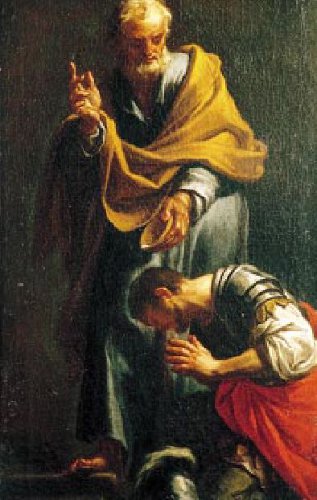
Peter and Cornelius

Clearly in the days of the apostles, the God-fearing Roman Cornelius had taken it upon himself to observe some of the mitzvot including the set times of prayer. Luke places the centurion praying at the ninth hour which corresponds to between two to three p.m., a time in both the ancient and modern worlds when devout Jews pray the Minchah or afternoon prayers. Exactly what and how Cornelius was praying we’ll never know, but his devotion to God and to the Jewish people got the attention of an angel and subsequently the apostle Peter.

So I agree that Gentiles were always meant to participate in the prayers, and both in the days of Solomon and Herod, we have indications that, as Eby says, there were distinctions regarding the placement of Gentiles in Jewish space, specifically the Temple.

I find this promising and more than a little daunting, which is why, even though ideally Shabbat observance is done in community, it is better for me to observe Shabbos alone, and particularly outside of Jewish space. Frankly, for me to have any sort of “thumbprint” placed upon my Sabbath practice, it’s just easier to do so in my own home.

Not that my home isn’t “Jewish space” since I live with a Jewish wife and daughter, but one of the requirements of my project is that I be alone so that, among other things, I don’t (metaphorically speaking) stomp all over their Jewish space with my big, fat feet. I have no desire to appear more “observant” than the Jewish people I live with, Heaven forbid. My role is supposed to be to encourage them to be more Torah observant.

It should be noted that until Peter and his party of Jewish companions entered Cornelius’s home, the centurion’s environment was composed exclusively of gentiles, so whatever Jewish observances he employed were not impinging on Jewish space. Of course God-fearing Gentiles regularly attended synagogue, but I can only imagine that they didn’t simply just “mix in” with the Jewish crowd but instead, had specific seating arrangements.

Eby in his book agrees with Lancaster and believes the “text implies that Cornelius prayed in what seemed to be a Jewish way” (p.33). Further, Eby says:

There is a delicate balance when it comes to the relationship of Gentiles to Jewish prayer. If the prayer of Messianic Gentiles is to be identical to Jewish prayer, it implies that these Gentiles have become Jews or that they fit into the same legal category as Jews. This is a type of replacement theology. On the other hand, if Messianic Gentile prayer is to be completely different from Jewish prayer, it denies the concept that it is through Israel that all nations connect with God.

-Eby, pp.33-4

Next, Eby speaks of “Blessings in Vain” and “Misappropriation of Identity,” both of which the Gentile (me) encounters in many of the blessings in a standard siddur, which, as Eby states, is “written from a first-person Jewish perspective.”

Fortunately, though I’m not terribly familiar with it yet, The Sabbath Table is written in such a way that it guides the Jewish and Gentile disciples along slightly different paths in the traditional liturgy, so the Gentile doesn’t have to “think fast on his/her feet,” so to speak, when reaching a part of the prayers where the reader is identified as Israel.

I remember encountering this issue in my “Hebrew Roots” days and I eventually learned to either avoid certain “problematic” areas of the siddur, or to broadly re-interpret them as meaning I supported Israel and her people rather than I was Israel.

Aaron Eby
Aaron Eby

Eby also suggests substituting “us” with “your people Israel” as a plea for Israel rather than as a request from Israel.

I know all this is going to rub some people the wrong way, but prior to the apostolic era, it was relatively rare for Gentiles to be in Jewish space and particularly to keep the Shabbat unless they were in the process of converting to Judaism or represented that equally rare phenomena (in those days) of being a Gentile married to a Jew.

Going back much further and into the time of Moses, any Gentile who wished to become attached to Israel and be considered a “resident alien” was actually obligated to a significant number of the mitzvot, including Shabbat observance, with the understanding that they would become permanent members of the community as Gentiles and that their descendents, starting at the third generation (grandchildren), would be absorbed into an Israelite tribe and clan (probably through intermarriage) and be considered Israelites; their ties to their Gentile ancestors obliterated.

But as Gentile disciples of Yeshua, we are not considered gerim as such (since Israel is no longer tribal), nor God-fearing Noahides, since all the nations of the earth are obligated to the basic laws of Noah, but we benefit from the blessings of the New Covenant, the promise of the resurrection, the giving of the Spirit (see Acts 10), and the life in the world to come.

Paul’s vision, his “gospel” included Gentiles in Jewish social and religious space and he staunchly defended his position, even in the face of James and the Apostolic Council (see Acts 15), and while his vision died with him, it has been reborn in modern Messianic Judaism.

Boaz Michael, President and Founder of First Fruits of Zion (FFOZ), defines Messianic Judaism in part by saying:

To me, Messianic Judaism is not just a Jewish-flavored version of Christianity. If I was asked to define Messianic Judaism, I would say, “Messianic Judaism is the practice of Judaism coupled with the realization that Yeshua of Nazareth is the Messiah, the New Testament is true, and the kingdom is at hand.”

-Boaz Michael
“Defining Messianic Judaism”
from the Director’s Letter, p.10
Messiah Journal, issue 117, Fall 2014

Boaz didn’t mention Gentiles in his definition of Messianic Judaism, but on pages 7 and 8, he states:

In many ways, the Messianic movement seems to be stuck in a rut, unable to resolve its most basic identity questions. Like one of those endless Messianic circle-dances, we are continually circling around the same sets of questions: Jewish identity, effective evangelism strategies, the role of tradition, the role of liturgy…and especially the role of Gentiles in the Messianic Jewish movement. (emph. mine)

I don’t know if the question of the role of the “Messianic Gentile” in Messianic Judaism is a problem in Messianic Judaism or just my own personal issue. I suppose I’m more sensitive to these matters than most because I’m intermarried, and particularly to a non-Messianic Jew. The divide between me being a Christian and her being Jewish is a well-defined line of demarcation.

Which brings me back to observing Shabbat individually and the “problem” of me being a Gentile and the Shabbat prayers being Jewish.

For example, one line in the traditional after-meal blessing offers thanks to God “for the covenant that [he] sealed in our flesh.” It seems problematic for a Messianic Gentile to say this. But should someone who is not Jewish then say “for the covenant that you have written on our hearts?” To do so would imply that Messianic Jews have only a fleshly covenant, whereas the new covenant that is written on hearts belongs only to Messianic Gentiles, God forbid.

-Eby, p.36

As my long-suffering wife would say, “Oy!”

Eby goes on to say that prayers in a Messianic Jewish synagogue should not be homogenized across the Jewish and Gentile population, and I agree, but that also would introduce a certain amount of “clashing” with one group saying one thing and another saying something completely different at the same time.

I can see the attraction of church only because it is homogenized. Everyone is the same, though I feel sorry for the “Christian Hebrews” in attendance since it is my firm belief that they aren’t “cookie cutter identical” to the Gentile Christian congregation in which they are embedded (I also can see the attraction of a homogenized [Jewish] synagogue environment for Messianic Jews and for the same reasons).

I don’t know how Paul did it. I wish he’d left more detailed instructions.

beth immanuel
Beth Immanuel Sabbath Fellowship

I remember feeling this sense of dissonance the second time I attended the Shavuot conference at Beth Immanuel Sabbath Fellowship. Although it advertises itself as “Messianic Judaism for the Nations,” within its walls, I experienced a severe case of identity confusion, probably because at that time, I had returned to regular church attendance and didn’t know if I was “fish or fowl”. How could I totally commit to church and still “feel” like a “Messianic Gentile?”

The dissonance damaged my Shavout experience and a few relationships along with it, much to my regret, and ultimately resulted in me bouncing back out of church since in the end, I didn’t have a single thing in common with the people there, at least in terms of theology and doctrine.

But “shoehorning” my way back into Messianic Judaism hasn’t proven particularly easy, either. When I’m just me, studying alone, praying alone (though I haven’t touched my siddur for months now), it’s just me and God and problems of identity and relationship aren’t a problem. God knows who I am and who I am created to be. I don’t know what He’ll think of all my preparations for Shabbat. Maybe He thinks they’re all foolish. I don’t know. If I’m doing this just for me, then I’m doing it in vain. Shabbat only means something if my intent is to honor God.

But dodging through this minefield of a Gentile and Jewish prayer and a Gentile and Jewish Shabbat observance makes me glad I’m doing all this in the privacy of my own home. If I slip or, Heaven forbid, get a little bit to “liberal” with the prayers, the only person who’ll be offended is God, and I’m hoping He’s more forgiving of me than I am of myself.

The Shabbat is supposed to be a delight. So why do I have a feeling of impending dread?

Actually, here’s part of the answer:

Don’t confuse God’s commandments with the traditions of men. Does God actually want such “extra effort” to do things He has never commanded?

Why was Jesus challenged so many times about what He did on the Sabbath? Was it because He was breaking God’s law? Or was it because His actions contravened the traditions men had ADDED to God’s commandments about the Sabbath?

What did Jesus actually mean by “The Sabbath was made for man, not man for the Sabbath”.

I just find something ludicrous in the fact that a refrigerator light can cause such concern and is that kind of thing REALLY what the Sabbath is about? Would applying duct tape to the switch (or disconnecting the light some other way) be pleasing to God or would leaving the light to shine displease Him ?

This is a recent comment on another blog post and it highlights one side of the argument. The other side is me trying to be sensitive to Jewish requirements as a non-Jew choosing to observe one or two Sabbaths using the only template I have available: a Jewish template. In trying to navigate the competing priorities of human beings, I’m letting them suck the joy out of what should be a joyous occasion. Really guys, I’m going to be alone so how I choose to observe Shabbos should be between me and God.

If I were in someone else’s house or in someone’s synagogue, I’d follow the requirements of my host, but in any real sense, my “host” will be God. Like I said, I’m following Jewish tradition to some degree because it’s the template I have available to me, and frankly, Jews have been observing the Shabbat for untold centuries before there were any Christians. You’d think we goyim would recognize by now that the Jewish people are the experts on Shabbat.

I probably won’t be perfect in my observance or meet everyone’s expectations, Jewish or Christian, but why should this be any different than anything else I’ve done or written about?

shabbos-candles-banner

Judgment and Guilt

Rabbi Chayim of Tzanz once said to an evildoer, “Don’t think that because you give in to your evil inclination in some areas you therefore must be evil in all areas. Rather, in whatever ways you can, do good and overcome evil.” (Maigdolai Hachasidus: Hoadmor Maitzanz)

-Rabbi Zelig Pliskin
“No matter how far away you are from the Almighty you can always come close when you make an effort,” p. 417
Commentary on Torah Portion Re’eh
Growth Through Torah

As a flawed and imperfect human being, I find this enormously comforting but it isn’t what Christianity always teaches. It’s also a lesson that if misused, could be employed in the service of laziness or hypocrisy. As servants of God we could be tempted to believe that it is acceptable to be obedient to God in certain areas while disobedient in others. This would certainly be in error, but there’s the opposite to consider.

How often does a “religious” person bemoan their state in never being “good enough” either for God’s acceptance or more likely for the acceptance of their faith community? All churches and synagogues (and other religious traditions) have standards, both formal and informal, and violation of said-standards can elicit responses, from the casual “tongue-clicking” of gossips and judgmental people to more formal criticisms and reprimands (and sometimes there is no more legalistic and judgmental institution than the Christian Church).

Although other streams of Orthodox Judaism may not be so open, the Chabad tends to run on the belief that encouraging a Jew to observe even one mitzvah may ultimately lead to another and then another and so on. Thus, Chabad, at least in theory, accepts Jews from all walks of life and backgrounds within their synagogues, even if they have to (or choose to) drive to services on Shabbat.

The Rebbe himself (Rabbi Menachem Mendel Schneerson), although strict and demanding in issues of halachah, nevertheless embraced a certain “flexibility” (I apologize if that’s not quite the right word) in his expectation of even Orthodox Jewish practice.

In 1977 after his heart attack, the Rebbe started seeing cardiologist Dr. Ira Weiss who was an Orthodox Jew. As with most physicians, Dr. Weiss labored under the heavy demands on his time and admitted to the Rebbe that he was often late in reciting Mincha (the afternoon prayers) which caused him great guilt and distress. The Rebbe responded:

“In a case like this, where your obligations are first to your patients, and where making them wait can cause them physical or emotional harm…you are not entitled to delay them any further. You have to finish your work with them first, and God will understand the delay in your Mincha. You don’t have to make any apologies for a late Mincha.”

-Joseph Telushkin
Chapter 8: “I’m Also Tired, So What?” p. 127
Rebbe: The Life and Teachings of Menachem M. Schneerson, the Most Influential Rabbi in Modern History

Lubavitcher Rebbe, Rabbi Menachem Mendel Schneerson

The Rebbe went on to caution Dr. Weiss that when time is available and he is not in the service of his patients to not become lax or indifferent and that indeed he had a duty to pray at the appointed times, but he wanted to relieve Dr. Weiss not only of any guilt he experienced but even the idea that he had done anything wrong. The Rebbe went so far as to tell the doctor of the serious demands on his own time and circumstances that resulted in the Rebbe sometimes starting Mincha late.

I realize that for a Christian, this doesn’t seem like anything we would worry about. After all, we don’t have set times of prayer and compared to Orthodox Judaism, very light requirements from our religious calendar and traditions. However, as I said above, there are times when the Church can be quite legalistic in its own expectations, they simply do not codify their requirements in as open a manner as Orthodox Judaism. And the fact remains that regardless of our religious preferences, it is a human trait to judge others.

I recently read another Rabbinic commentary whose source escapes me (I thought it was Rabbi Pliskin’s but I can’t find it now). It tells of a poor man who was invited to a wedding. The family who invited him were quite well off and the man was embarrassed that he couldn’t afford a good suit to wear to the occasion. He finally asked a neighbor if he could borrow a suit and his neighbor generously lent the man a $1000 suit.

The day of the wedding, the man discovered that many of the people at the wedding were wearing suits not as fine as his and he began to look down upon them. This, of course, is the improper response, since this poor man could not have dressed as well as even the most casually attired wedding guest of his own resources.

And yet, as faulty as we all are in our obedience of and service to God, we can almost always find someone who is more (apparently) faulty than we are and at least within our own thoughts (though sometimes with our facial expressions and even our words) judge them.

J.K McKee in his book One Law for All: From the Mosaic Texts to the Work of the Holy Spirit opposes a Gentile (Christian) from adhering to the Torah mitzvot in the manner of the Jews as a matter of covenant obligation. Although McKee has other reasons for believing in the “One Law” for Jews and Gentiles, he states that relating to the commandments as an obligation can lead to a form of legalism and judgmentalism within One Law Christian communities.

I think McKee is simply describing human nature. I think the “cure” if there is one, is for each of us to focus on our own lives, consider where we are called to serve God, and to attend to our own “observance,” however we choose to define it.

God is the righteous judge of the world. We, as the people we are now, are to judge no one but ourselves and even then, it would be good if we didn’t judge ourselves too harshly or in too lenient a manner. Since striking the proper balance in assessing our own service to the Almighty will take a lifetime to master (regardless of how young or old you are when you take up the task), there should be little time in your life to be concerned about how well someone else is doing.

Dr. Ira Weiss wasn’t worried about any other Jew being late in reciting Mincha, only about himself. As an Orthodox Jew, he knew the standards by which his service to God was measured. The Rebbe reminded him of the higher duty the doctor had to his patients and that God was a lot more understanding of human frailty and limitations than we are as human beings.

jewish-repentanceThe Rebbe was a great believer that it was never too late to make teshuvah (repent) and to return to God. When we fail, we must remind ourselves that we too can repent and return, and that the struggle between our humanity and God’s perfection is one we will live with every day of our lives. It’s not perfection we seek in this lifetime, it’s persistence, endurance, striving to climb higher, and forgiveness when we fall. Don’t worry about the other guy. He’s got enough worries of his own without you adding to his list. God will help him even as he does you…and me.

A Psalm for My Dad

Bless the Lord, O my soul,
And all that is within me, bless His holy name.
Bless the Lord, O my soul,
And forget none of His benefits;
Who pardons all your iniquities,
Who heals all your diseases;
Who redeems your life from the pit,
Who crowns you with lovingkindness and compassion;
Who satisfies your years with good things,
So that your youth is renewed like the eagle.
The Lord performs righteous deeds
And judgments for all who are oppressed.
He made known His ways to Moses,
His acts to the sons of Israel.
The Lord is compassionate and gracious,
Slow to anger and abounding in lovingkindness.
He will not always strive with us,
Nor will He keep His anger forever.
He has not dealt with us according to our sins,
Nor rewarded us according to our iniquities.
For as high as the heavens are above the earth,
So great is His lovingkindness toward those who fear Him.
As far as the east is from the west,
So far has He removed our transgressions from us.
Just as a father has compassion on his children,
So the Lord has compassion on those who fear Him.
For He Himself knows our frame;
He is mindful that we are but dust.
As for man, his days are like grass;
As a flower of the field, so he flourishes.
When the wind has passed over it, it is no more,
And its place acknowledges it no longer.
But the lovingkindness of the Lord is from everlasting to everlasting on those who fear Him,
And His righteousness to children’s children,
To those who keep His covenant
And remember His precepts to do them.
The Lord has established His throne in the heavens,
And His sovereignty rules over all.
Bless the Lord, you His angels,
Mighty in strength, who perform His word,
Obeying the voice of His word!
Bless the Lord, all you His hosts,
You who serve Him, doing His will.
Bless the Lord, all you works of His,
In all places of His dominion;
Bless the Lord, O my soul!

Psalm 103

I love you, Dad. Get better soon.

Crossing the Ford of the Jabbok

PrayingHear my prayer, O Lord, Give ear to my supplications! Answer me in Your faithfulness, in Your righteousness! And do not enter into judgment with Your servant, For in Your sight no man living is righteous. For the enemy has persecuted my soul; He has crushed my life to the ground; He has made me dwell in dark places, like those who have long been dead. Therefore my spirit is overwhelmed within me; My heart is appalled within me. I remember the days of old; I meditate on all Your doings; I muse on the work of Your hands. I stretch out my hands to You; My soul longs for You, as a parched land. Selah.

Psalm 143:1-6 (NASB)

Part of the Returning to the Tent of David series

This is the “flip side” to this morning’s meditation, The Christianization of Acts 15. Every couple of weeks or so, I have coffee and conversation with a friend who is smarter and wiser than I am. Certainly, his spirit is far closer to God than mine. I often tell him of my thoughts and feelings and he is direct and forthright in his response.

This is a continuation of my Returning to the Tent of David series since it has a direct connection to my reacquaintance with the church and how I have been conducting myself within its walls.

Apparently, I haven’t been doing so well.

I spend a fair amount of time expressing my point of view on this blog. I guess that’s OK since, after all, it is my blog, my platform for talking about my experiences as they occur. But I also air out my opinions of and frustrations with the church and its members on occasion. I commented to my friend that I felt my Sunday school teacher is rather dogmatic in how he presents his lessons. And the instant the words left my lips, I knew what he was going to say.

So am I, just with a different point of view.

I’ve been spending a lot of time presenting and expressing my opinions. But what about God? That is, who is expending the effort here and whose purpose is being served, mine or God’s? In my friend’s view, it’s the former, totally.

No, he isn’t being too hard on me and in fact, I have every reason to believe he speaks not only with an honest heart, but from the heart of God. I’ve been studying and using what I’ve learned as a sword or a club to “go after” those with whom I disagree, and without the slightest concern about God’s desires. I guess I assumed that if I was doing this, it must be what God wants, but that was arrogant presumption on my part. I never even considered the possibility that I wasn’t in the right spiritual frame from which to conduct such activities.

No, it doesn’t mean I’m going to stop going to church, attending Sunday school, or meeting with my Pastor (unless none of them will have me anymore). It does mean I need to take a step backward and start “preparing” for these actions in a different way.

Yes, studying the Bible is good. Studying intelligent and informative commentaries is good. But is it the mind and will of God that makes change, not the efforts of mere men.

There’s little doubt that my Pastor and I, in meeting together, are each trying to help the other change in a particular direction. Of course, I learn a great deal from these conversations, but I’m also hoping to impart something as well. But so far, I’m the only one doing the imparting. Has God been in my voice? Am I even aware of His presence in the Pastor’s office? For that matter, am I aware of God’s presence in the chapel during services or in the classroom during Sunday school?

Man aloneThe vast majority of the time, I must say “no.”

My friend keeps suggesting I “meditate” on the Bible, but the word “meditate” seems indistinct to me. He says it’s matter of considering a portion of scripture and mulling it over. What does it mean? What does it mean to me? What can it tell me about God and about myself? What scripture should I choose?

I meditate on all Your doings;
I muse on the work of Your hands.

I read books, including the Bible, as fast as I can, as if I’m in some sort of race to cover the maximum amount of territory in the least amount of time. I’m only mortal and my span on this sphere is exceptionally limited. God is infinite and forever. He can afford to take His time. After all, it is His time; He made it. Time exists only within His will and should He desire, time would cease to exist and scurry back to the nothingness from whence it came.

“In that day I will raise up the fallen booth of David,
And wall up its breaches;
I will also raise up its ruins
And rebuild it as in the days of old;
That they may possess the remnant of Edom
And all the nations who are called by My name,”
Declares the Lord who does this.

Amos 9:11-12 (NASB)

I keep coming back to these verses because they define my purpose within a “Hebraic” and “Messianic” context. I say “my purpose” but it’s really the purpose of any non-Jewish disciple of Messiah, “the nations who are called by My Name,” says the Lord. It’s the “job description” for Gentile disciples of the Jewish Messiah who perceive that they are operating within a Jewish religious and spiritual context and not necessarily inside of “goyishe Christianity.”

I’m not trying to be insulting, but consider who our King is and from where he will reign. Can there be any doubt that Moshiach our King is and will be King of Israel, King of the Jews, and only out of all that is he King of the World?

But I’m getting ahead of myself again. Humility is something I didn’t think far from my grasp, but a guess I am farther from its sheltering arms than I imagined. This isn’t my battle. I didn’t come here to fight. I came here to serve God. What an interesting thought, since it never occurred to me to say it that way before. I always thought, harkening back to Boaz’s book, that I returned to the church to help breach the gap between the traditional fundamental and evangelical perspective on Jesus, the Bible, and everything and how it all should be seen within the Jewish context, using Jewish terms, Hebrew language, and especially removing the paint from “Joseph’s” alien face (Genesis 45:4) to reveal the son of Jacob or more to the point, the son of David…the Jewish son and firstborn of Israel. The son of God.

man-without-a-coatIf this is how you want me to serve you God, then I have to admit I haven’t been doing such a good job. If this isn’t what you’ve wanted me to do, then I’ve been doing an even worse job than I thought.

How can I promote any form of healing at all by “banging heads” with other people or by beating my head against a wall? When Jacob wrestled the Divine, in midrash, it is said that Jacob wrestled with his doubts, or his evil inclination, or his own dark angel. He had to conquer something in himself before he could take the next steps back into the Land his descendants would one day inherit, the Land of Promise. Is that my mission as well, to conquer something within myself?

That I should slow down, take time with scripture, mull and turn over the Word in my mind and heart, meditate on His wisdom day and night is all worthy and right, and I’ve been in too much of a hurry to actually do it. Where will my spirit and the Spirit of God find a common meeting ground? Jacob arose at night, crossed the ford of the Jabbok and was left alone. There he encountered God. Jacob wrestled for the rest of the night and when the sun began to dawn, the battle was still raging. Jacob’s “companion,” seeing he had not prevailed, injured Jacob, permanently disabling him (see Genesis 32:22-32). But Jacob also received a blessing, a new name, and a mission to form a dynasty; to  ultimately become the father of a mighty nation that belongs only to God.

I seriously doubt my destiny is such a great thing in God’s eyes or in man’s. And yet there must be some reason for my existence, else God would have long since extinguished me, like I might blow out a candle. Not that I’m such a great light or even a small one. Who can glory in their own light when confronted with the blazing inferno of an Everlasting God? Only a fool. I pray that I am no fool, though I know I’ve been foolish.

God will judge us not according to how much we endured, but how much we could love.

-Richard Wurmbrand

Whatever God wants me to do could easily fail if it was all up to me. Having launched myself in a particular direction for nearly a year, I haven’t looked back and I haven’t checked the map. I just figured if I went in a nice, straight line, I’d end up where I’m supposed to be. But there are no nice straight lines in my terrain, only back alleys, narrow corridors, dark tunnels, and labyrinthine passages. Getting lost if I am the only navigator is a foregone conclusion.

…but whatever your original intentions, you have become truly lost.

-Ducard (played by Liam Neeson)
Batman Begins (2005)

extinguished_candleIs that me? Maybe. Or maybe it’s what I’m on my way to becoming. But according to my friend, it’s not too late. I can slow down the horse, so to speak, take stock of my surroundings, renew my connection to God, through the Bible, through meditation on His Word, through prayer, through sincere repentance. Like a watchman on the walls of the city at night, I rely on the Presence of God as I await the dawn, considering His mighty deeds, recalling Days of Old, meditating upon Him in my heart.

My voice rises to God, and I will cry aloud;
My voice rises to God, and He will hear me.
In the day of my trouble I sought the Lord;
In the night my hand was stretched out without weariness;
My soul refused to be comforted.
When I remember God, then I am disturbed;
When I sigh, then my spirit grows faint. Selah.
You have held my eyelids open;
I am so troubled that I cannot speak.
I have considered the days of old,
The years of long ago.
I will remember my song in the night;
I will meditate with my heart,
And my spirit ponders…

Psalm 77:1-6 (NASB)

And my spirit ponders…as I cross the ford of the Jabbok and am left alone in the dark…waiting.