Tag Archives: prayer

The Worlds Within Ourselves

??????????????????????????????????That’s when I noticed the rosary beads.

The woman next to me had them on her lap, running them through her fingers. Was she a nun? I didn’t want to violate the Code, so I couldn’t just turn and look. I also didn’t want to distract myself from my davening for too long. (How long is too long? I think it’s similar to the five-second rule for eating food you dropped on the floor – a moment is okay, after that you’re asking for trouble.)

Then I noticed the plastic divider in front of me, which separated us from the driver (affording him protection from spitballs, if nothing else). It was reflective, and I could see my seatmate perfectly well in it without having to turn.

She was middle-aged, dressed conservatively, her nondescript features notable only for the intensity of her expression, her lips moving in fervent prayer. Was she a nun on holiday, and thus out of her habit and habitat, or just a holy roller on her way to work? Was she even now praying for the return of Jerusalem to the Church’s hands? Had she noticed me with my siddur and added in a few prayers for the salvation of my soul? Or maybe its damnation! After all, she’d no doubt been taught that someone in my family had killed her Lord. Even though her Lord was actually someone in my family

-Eric Brand
“Peace on Earth in 30 Min., 45 with Traffic: Rosary beads, a yarmulke, and a lot of overthinking”
Aish.com

Eric Brand will never know how glad I am that he wrote this missive. Lately, I’ve been going through one or two challenges as far as how Jewish people see Christians. I haven’t experienced it as very complementary, to say the least.

On top of that, I’ve been musing about how my wife and children see my Christian faith. I’ve been taking a few conversations and a few cues and clues, and winding myself up quite a bit about what they mean. Maybe I’m right, but then again, like Mr. Brand, maybe I’m overthinking things.

A chance encounter on a public bus in New Jersey results in a Jewish man and a Catholic woman sitting next to each other. Both of them are praying, him with a siddur and her with rosary beads. Their religious orientations are unmistakable. While the “code” of riding public transportation from Jersey to New York forbids each of them from talking with or even looking at each other, what could they have been praying about?

That ticked me off. Was it right to stereotype and scapegoat me? Hadn’t my people suffered enough? Did I have to be subjected to this? I was just a guy on a bus!

I tried to go back to my siddur, but I could see those hands working the rosary beads out of the corner of my eye, and I could sense those lips going a mile a minute, spewing who knows what. Well, okay, lady, I thought, maybe this is a test from God to see if I have the right reaction! How about I throw in some prayers for your soul? How about we have a nice debate and pick apart your faulty theology?

I was mulling this over, thinking about a good opening crack, when I was struck by another thought. If I can see her, she can see me. And she can see me looking at her – and not davening. Better get those lips moving, buddy, you don’t want to give this religious nut a leg up on feeling superior.

I admire Brand’s transparency in describing his thoughts and feelings. I try to show that side of myself as well. What “teachable moment” might we inspire or intersect if we just write down what we think and feel about each other and let those words be accessible via the Internet? More than that, what can the writer learn in the writing?

I was still mouthing some words from the siddur when my brain re-engaged momentarily and focused on what I was reading. “God is close to all who call upon Him, to all who call upon Him sincerely.”

Oh, while there were two people in that seat, there were actually three “personalities” present. God had something to say to Brand and maybe to his Catholic traveling companion as well (we’ll never know what she was thinking during all this, alas).

“God is close to all who call upon Him, to all who call upon Him sincerely.”
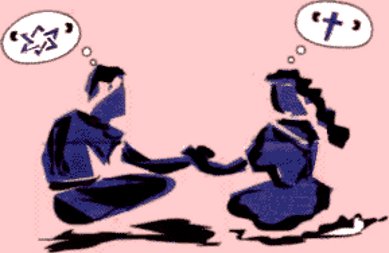
jewish-christian-intermarriageI know the assumption in the text from the siddur is that “all who call upon Him” means “all Jewish people who call upon Him,” but if God’s House is really to be a house of prayer for all people, then all people aren’t just Jewish people. It’s everyone who “calls upon Him with sincerity.” What if the Catholic woman was calling upon God sincerely? Was God as close to her as He was to Brand? Is God close to all of us when we sincerely call upon Him? Is He as close to me, a Christian, when I pray as He is to a davening Jew?

We religious people make a lot of assumptions about God and we make a lot of assumptions about each other. It would have been a complete breach of public transportation etiquette for Brand to have introduced himself to his seat-mate and struck up a conversation with her about their faiths. But if that could have been accomplished, maybe his fears would have been allayed somewhat (or maybe not). One Catholic person commented on Brand’s column and this might help figure out what the woman on the bus could have been thinking:

As a Catholic, who reads aish.com, I can almost guarantee that very few of us are condemning anyone to hell. We are all G_d’s children.

While Brand never talked with the Catholic person next to him on the bus, God managed to get his attention in the pages of his siddur.

I know I’ve wondered if my Jewish wife feels at all threatened about me going to church and what that means about my attitude towards Jews, but I wish she’d believe that we’re all God’s children.

But more than my concerns about my wife’s fears about me, Brand taught me that my own imagination could well be creating a situation that isn’t real.

But I left the bus undaunted – even after Comb-Over stepped on my foot as he rushed to get to the escalator – with a smile on my face. Jewish tradition tells us we should consider the world as though it was created for each of us. Because each of us has a unique touch of godliness that gives the universe purpose.

But there’s another way to look at it. We each create the world for ourselves. Our perceptions, our attitudes, our thoughts produce the world around us every moment of our waking days. We see, hear, experience what we want, what we will. And in doing so, we affect all the other people busily creating their worlds.

That’s a big responsibility. I’m glad I was able to figure this out before the journey ended. Fortunately, there was traffic.

The world is still a big, bad, ugly place in many ways. There’s all kinds of trouble and troublesome people around. But we also create the world we live in. We can choose to be upset, anxious, or angry because we are choosing to imagine what people think and feel about us. We can choose to communicate or choose to be silent. And even if silent, we can choose how we consider the people in our lives, for good or for ill.

I’ve heard it said that an anxiety attack is a person’s response to an emergency that does not exist. It still feels real, but the only danger is the choice we’ve somehow (it’s not volitional) made inside. Perhaps my being a Christian isn’t the danger I’ve imagined it is to my wife and children. And if some Jewish people, including my friends, believe my faith is a problem, please talk to Eric Brand. Maybe my faith isn’t automatically against you. Maybe I love you.
V’etchanan: What Comes From God

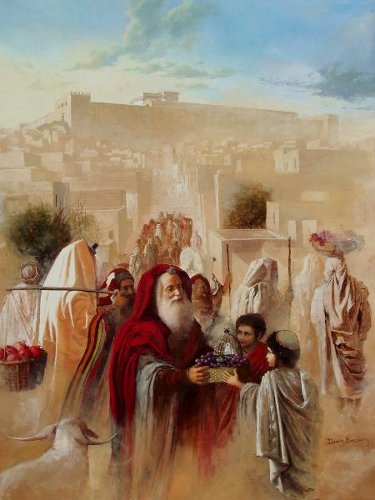
ancient_jerusalemFor what great nation is there that has a god so close at hand as is the Lord our God whenever we call upon Him?

Deuteronomy 4:7

Should one only call out for the “big things”? To think that prayer to God is only for the “big things” is a big mistake! We must turn to God for help and understanding in everything we do.

The Chazon Ish, a great rabbi, cited the Talmud which relates that Rav Huna had 400 barrels of wine that spoiled. His colleagues told him to do some soul-searching regarding the cause of this loss. Rav Huna asked, “Do you suspect me of having done anything improper?”

The Sages responded, “Do you suspect God of doing something without just cause?” They then told him that he was not giving his sharecropper the agreed upon portion of the crop.

“But, he is a thief!” Rav Huna protested. “He steals from me. I have a right to withhold from him.”

“Not so,” the Sages said. “Stealing from a thief is still theft” (Talmud Bavli, Berachos 5b).

“Suppose,” the Chazon Ish said, “that something like this would occur today. The search for the cause would be whether the temperature in the room was improper or the humidity too high or too low. Few people would search for the cause within themselves, in their ethical behavior. We should know that God regulates everything except for our free will in moral and ethical matters. As with Rav Huna, nothing happens without a cause.”

Dvar Torah for Parashat Va’ethannan
from Twerski on Chumash, by Rabbi Abraham J. Twerski
quoted by Rabbi Kalman Packouz in “Shabbat Shalom Weekly”
Aish.com

I agree that we should turn to God with all our matters, large or small, but I wonder if every single thing that happens to us was caused by God to teach us a lesson. What can we learn from the flat tire we get while driving to an important meeting and dressed in our best clothes? What should we gather from being caught in a rainstorm without an umbrella, stubbing our toe, tripping over a crack in the sidewalk, catching a cold? Does every single event that happens, even down to the tiniest detail have to be ordained in Heaven?

I don’t know. I suppose it could. On the other hand, maybe sometimes things happen and they have no meaning. If I go down to a ridiculously small level, does it matter if I choose to wear black or white socks today? Is there going to be some consequence one way or the other? Is there a moral lesson I should learn if I get the flu or did I just get the flu? If I’m in business and should have a bad year, is that the result of some moral or ethical fault of which I’m guilty, or is it the consequence of the current economy and all businesses like mine are suffering?

Regardless of the cause of our fortunes or misfortunes (and believers are taught that everything we have comes from God), it certainly wouldn’t hurt to turn to God in good times and in bad, and call to Him for He is always near, even when we don’t feel as if He’s near.

…fervent in spirit, serving the Lord; rejoicing in hope, persevering in tribulation, devoted to prayer…

Romans 12:11-12 (NASB)

Is anyone among you suffering? Then he must pray. Is anyone cheerful? He is to sing praises. Is anyone among you sick? Then he must call for the elders of the church and they are to pray over him, anointing him with oil in the name of the Lord; and the prayer offered in faith will restore the one who is sick, and the Lord will raise him up, and if he has committed sins, they will be forgiven him.

James 5:13-15 (NASB)

praying-apostleThe verses in the Bible exhorting the advantages of prayer are all but endless, so I offer only a few examples. But it doesn’t answer the question about the nature and cause of each and every circumstance we find ourselves in. When raising small children, we try to make the consequence of misbehavior happen immediately after the misbehavior, so they’ll connect the two and learn to avoid the misbehavior. It’s easy to get the idea that God does the same thing. But then again…

Because the sentence against an evil deed is not executed quickly, therefore the hearts of the sons of men among them are given fully to do evil. Although a sinner does evil a hundred times and may lengthen his life, still I know that it will be well for those who fear God, who fear Him openly. But it will not be well for the evil man and he will not lengthen his days like a shadow, because he does not fear God.

Ecclesiastes 8:11-13 (NASB)

In fact I believe that God deliberately delays providing the consequence upon the sinner, giving him or her time to repent and to change their behavior.

The Lord is not slow about His promise, as some count slowness, but is patient toward you, not wishing for any to perish but for all to come to repentance.

2 Peter 3:9 (NASB)

In some ways, it might be more merciful of God if He was to discipline and chastise us each and every time we mess up right when we mess up, kind of like swatting a dog on the nose with a rolled up newspaper when it does its business on the living room carpet. Then, like a dog or a small child, we’d see the obvious and inescapable pattern between certain of our actions and the painful things that happen right afterward.

But unlike the commentary I quoted above, God just doesn’t seem to arrange our lives that way, at least not all the time. We are left then, wondering which consequence is a moral lesson and which is only a random event.

We don’t know.

But what if we pretended that everything we experience is an immediate communication from God to us? This could be horribly misused and sometimes people blame themselves without reason because they were the victim of a tragic accident or a terrible crime. You can’t blame a five-year old boy because he was killed in a drive-by shooting while standing on a street corner with his Dad waiting for the light to change. You can’t blame a forty-four year old woman who has lived a life of impeccable health who is diagnosed with breast cancer.

But…

praying_at_masada…but what if regardless of whether we think an event has come from God or not, we turned to Him anyway? What if after having a productive day at work, you turned to God and thanked Him? What if after learning that the cost of repairing your car’s sudden breakdown will empty your savings account, you turned to God and begged for His help? What if, day in and day out, you turned to God, with praise and with petition, in happiness and in anguish?

What if?

Life happens. Sooner or later, something good will happen to you. Sooner or later something bad will happen to you. Sooner or later, nothing will happen to you and you’ll be really bored. You live, you laugh, you bleed, you breathe, you cry, you get angry, you get frustrated, you feel depressed, you are overjoyed, and everything else.

That’s your life. That’s from God. Talk to God about it. Ask Him Why? Ask Him How? Say “Thank you.” Say “I’m sorry.” You know your life. You know what’s happening. You know what to say. Just turn to God and say it.

And then listen.

Good Shabbos.

68 days.

Shalom Aleichem

Shalom_AleichemShalom aleichem is a greeting version in Hebrew, meaning “peace be upon you” (literally: “peace to you”). The appropriate response is “aleikhem shalom” Yiddish: עליכם־שלום , or “upon you be peace”.

This form of greeting is traditional among Jews throughout the world. The greeting is more common amongst Ashkenazi Jewish. It first found in Bereishit (Genesis) 43:23 and occurs six times in the Jerusalem Talmud. Only the plural form is used even when addressing one person. A religious explanation for this is that one greets both the body and the soul, but Hebrew does occasionally use the plural as a sign of respect (e.g. a name of God is Elohim אלוהים literally gods).

-from Wikipedia.

I was sitting in my Sunday school class getting ready for the discussion and mentally dissecting the sermon given by one of the Associate Pastor’s half an hour before when I woman I’d never met before walked up to me and said, “Shalom aleichem.” I was momentarily taken aback, but I returned the same greeting and we struck up a conversation. I started talking about how “Jewish” the Messiah would be upon his return and that a lot of people would be surprised when he returned as the Jewish King, ruling with a rod of iron from Jerusalem. We discussed how “every knee will bow” in acknowledgement of the King, not because they reasoned it out or even because their hearts became soft to God, but because Messiah is King! He will rule the world. It will be obvious.

Strange conversation but it’s not the point of this missive.

We got back around to her interesting way of greeting me. I told her I had assumed that she said it because she knew my wife and kids were Jewish. That wasn’t it. She had no idea who I was and who my family is. She isn’t Jewish either and doesn’t speak Hebrew, so that’s not it. In fact, she’s a fairly traditional Christian. I’m not sure Kathy (that’s her name) really knew why she greeted me with “Shalom aleichem.” Understanding that, I assumed it was something God had to say to me in relation to my recent cultural and spiritual hollowness. I think it was God’s way of saying to me that I’m not as disconnected and isolated as I think.

That said, Sunday school class was “interesting” but sometimes in an almost dismaying way. That’s only because of something called Bible Study Fellowship and a fellow named John MacArthur, whose interpretation of the Bible is heavily leveraged by our Sunday school teacher Dean.

Dean’s a nice guy. I like him. He’s not always very flexible, though. He tends to take MacArthur and run with him, so to speak, forgetting that Bible interpretation isn’t the same thing as established and immutable fact. How Dean tied 1 Peter 3:18-20, Chapter 12 of Revelation and the “demon possessed humans” in Genesis 6:1-4 made me almost chew my tongue right off (metaphorically…my tongue is quite intact, thank you very much).

Shalom aleichem vs. the “culture” of Bible Study Fellowship. Oh my.

But I was reminded that a significant portion of our class time was spent praying for others. For people with cancer. For people who are out of work. For people who are old and slowly dying. And more than that, we talked and planned how we, as human beings, would be the answer to the prayers we could answer (we can’t cure cancer, but we can offer other assistance). Part of the lesson from 1 Peter 3 was all about being people designed to help others, how God would enable us to do what we thought we couldn’t do, how we should be eager to do good, how we would be blessed and yes, how we would be sometimes punished, just for doing good.

seeking-peaceOne guy gave a reasonable description of Tikkun Olam without ever having heard the term before. Really, he reminded me of a Rabbinic commentary I’d read recently. Something about how we are all created in the image of God and in His image, we are designed to do good. Only the “brokenness” of the world and our own “brokenness” get in the way.

At the end of class, Charlie, the guy sitting next to me, said he admired my ability to keep quiet when I obviously had something to say (good thing I don’t play poker). That helped to defuse some of my frustration at MacArthur and how he was being applied. Yes, there are other opinions besides MacArthur’s, but the flip side to some of these little puzzles we discuss is that what we are really supposed to be doing as children of God and disciples of the Master isn’t hard to figure out. Charlie also reminded me that we have this sign out in the foyer to the church:

He has told you, O man, what is good; and what does the LORD require of you but to do justice, and to love kindness, and to walk humbly with your God?

Micah 6:8

God is listening to me after all, He’s paying attention…and He responded to me today.

Shalom aleichem.

157 days.

Pray for the Victims of the Boston Marathon Bombings

boston_marathon_terror_explosionTwo bombs exploded near the finish line at the Boston Marathon on Monday, leaving two people dead and dozens more wounded.

A third explosion was heard just before 4 p.m., about an hour after the first two blasts, at the nearby John F. Kennedy Library. The police later said that episode may have been unrelated.

By John Eligon and Ken Belson
“Explosions at Boston Marathon Kill 2”
Published April 15, 2013
The New York Times

What can I say that hasn’t already been said except to encourage everyone reading this to pray for the victims of the blasts and their loved ones. May God grant mercy and consoling to them and to everyone touched by this horrible tragedy.

My heart grieves with the victims.

163 days.

If Water Can Wear Down A Stone

prayer-hitbodedutSet aside time each day to meditate and pray alone in a room or some meadow and express your innermost thoughts and feelings and personal prayers to God. Use every kind of appeal and argument. Use words that will endear you to God and win His favor. Plead with God to draw you closer and let you truly serve Him. This is Hitbodedut.

You should hold these conversations in whatever language you speak best. Our set prayers are said in Hebrew, but if this is not one’s native language, it is difficult to use it to give expression to all one’s innermost thoughts and feelings and the heart is less drawn after the words. It is easier to pour out your heart and say everything you need in your own language.

You should tell God everything you feel, be it contrition and longing to repent over the past or requests and supplications to come truly close to God from now on, each person according to his level.

Be very careful to get into the habit of spending time every day on your personal prayers and meditation. Fix a regular time for this and then be happy for the rest of the day!

-Rebbe Nachman of Breslov
Translated by Rabbi Avraham Greenbaum
azamra.org

Sunday before last, I was having my bi-monthly coffee encounter with my friend. We spoke of many things, including matters both painful and necessary to me, but one of the topics we briefly touched upon was hitbodeut. I should say that neither of us could remember the name, but this is what we were describing when discussing an encounter with God. To briefly quote from Wikipedia:

Hitbodedut refers to an unstructured, spontaneous and individualized form of prayer and meditation taught by Rebbe Nachman of Breslov. Through hitbodedut one may establish a close, personal relationship with God and gain a clearer understanding of one’s personal motives and aspirations. However, Rebbe Nachman states that the ultimate goal is to free oneself of all negative traits that obstruct the spiritually-transforming non-dual realization of the “Imperative Existent,” which is the Divinity inherent in all being.

Mystic aspects aside, why am I bothering to write about this? Those of you reading my blog who are aware of hitbodedut, probably know far more about the practice than I do, and those of you who don’t can simply reduce the concept down to a way to be alone and talk to God. What’s the big deal?

First off, I have been aware of hitbodedut off and on for a few years but mentally, I always manage to lose track of both the term and the practice. This is a sort of “bookmark” in my memory so if I lose my place again, I can just search my blog and find it. Beyond a reminder, there is also what we know about how Jesus prayed:

At about morning light he left and went to a desolate place.

Luke 4:42 (DHE Gospels)

But he departed to the wilderness areas and prayed.

Luke 5:16 (DHE Gospels)

As he was praying alone, his disciples were gathered to him.

Luke 9:18 (DHE Gospels)

Although we can’t draw a direct connection between these examples of Jesus praying from Luke and Rebbe Nachman of Breslov, we can say that both of them seemed to practice a similar manner of prayer, withdrawing to wilderness areas or other places to be alone in order to pray. Even in his most desperate hour, Jesus continued to seek his Father alone.

Afterward, Yeshua came with them to a courtyard that was called Gat Shamnei. He said to the disciples, “You remain here until I have gone over there and prayed.” He took Petros and the two sons of Zavdai with him, and he began to become distressed and disheartened. He said to them, “My soul is bitterly troubled to the point of death. Stay here and keep watch with me.” Then he went a little bit away from them, fell on his face and prayed, saying “My Father, if it is possible to be so, let this cup pass from me, yet not according to my will, but according to your will.”

Matthew 26:36-39 (DHE Gospels)

I’ve often wondered if Jesus wanted to be alone, why he also took his closest companions with him. Maybe he wanted them to keep watch in case anyone might come who would disturb his prayers. Maybe he wanted them to pray for him in his hour of terror and hardship, before the betrayer came. What is he trying to say to us? Is it better to be alone with God than to pray in assembly?

But as for you, when you pray, go into your room, close your door behind you, and pray to your Father who is in secret, and your Father who sees the secret things will {openly} be generous to you.

Matthew 6:6 (DHE Gospels)

Being alone with God can be a lonely or terrifying experience. It can be lonely if all you experience is the emptiness of your own words. It can be terrifying if God answers you.

Really? How can I say that? Sure, we all have experienced times in prayer when it seems as if God isn’t listening, as if He has taken a two-week vacation to some distant place, leaving us to fend for ourselves, but why would God answering prayer be terrifying?

Because it’s God. He’s not a “cosmic teddy bear” who allows us to hop on His comfortable lap as if He was Santa Claus. We are trying to be seriously alone with the creator of the entire universe, who can and has laid waste to the surface of the Earth. Do we…do I know what I’m asking for?

And how can Nachman of Breslov say, “and then be happy for the rest of the day?”

Hitbodedut is of the greatest value. It is the way to come closer to God, because it includes everything else. No matter what you lack in your service of God, even if you feel totally remote from His service, tell God everything and ask Him for all that you need.

If at times you find yourself unable to speak to God or even open your mouth, the very fact that you are there before Him wanting and yearning to speak is itself very good. You can even turn your very inability to speak into a prayer. Tell God that you feel so far away that you cannot even speak to Him! Ask Him to have mercy on you and open your mouth to tell Him what you need.

Many great and famous Tzaddikim have said that all their achievements came only through Hitbodedut. Anyone with understanding can recognize the supreme value of this practice, which ascends to the most sublime heights. This advice applies to everyone equally, from the very least to the very greatest. Everyone is capable of practicing it and can attain great levels. Happy are all who persist in it.

It is also good to turn Torah teachings into prayers. When you study or hear a teaching of a true Tzaddik, make a prayer out of it. Ask God when you too will be able to fulfill this teaching. Tell Him how far from it you are and beg Him to help you attain everything contained in the lesson.

A person of understanding who wants the truth will be led by God in the path of truth, and he will learn how to practice Hitbodedut and offer words of grace and sound arguments to persuade God to bring him to true service.

Hitbodedut rises to a very high place. This applies especially to turning Torah teachings into prayers, which creates the greatest delight above.

Hitbodedut is the highest level: it is greater than everything.

When God helps with Hitbodedut, it is like a person talking to his friend.

prayers_in_the_darkI get the sense that the “talking to his friend” part is more familiar to some Christians than to many religious Jews. I could be wrong of course, but when I pray from a siddur, the words communicate a more formal relationship with God, a greater awe, the powerful majesty, as we stand before the King of all Glory. Not exactly like schmoozing with a good buddy.

But then again, that’s not exactly right, either. God is closer, more intimate than a friend. As the Master says, He is our Father, our “Abba.”

It is very good to pour out your heart to God like a child pleading with his father.

Doesn’t God call us His children? “You are children to the Lord your God” (Deuteronomy 14:1) . Therefore it is good to express your thoughts and feelings and all your troubles to God, like a child nagging and complaining to his father.

Even if you think you have done so much wrong that you are no longer one of God’s children, remember that God still calls you His child. As the Rabbis taught: “For better or worse, you are always called His children” ( Kiddushin 36a) .

Even if you think God has rejected you and told you that you are no longer His child, you must still say: “Let Him do His will – but I must do my part and continue acting as His child.”

How good it is when you can arouse your heart and plead with God until tears stream from your eyes and you stand like a little child crying before his Father.

Confusing thoughts may enter your mind, but if you stand firm, God will send you another thought to encourage you. You may think you are no longer one of God’s children. But if you do your part, God will eventually send you thoughts of encouragement.

Jesus encouraged his disciples to pray to their Father who is in Heaven. These were his Jewish disciples but by extension (and since we have no other model from the time of Jesus), we may apply the teachings of the Master about prayer to we non-Jewish disciples as well. What choice do we have?

I know Nachman of Breslev is addressing Jews in his teachings, but he does say, “From the smallest to the greatest, it is impossible to be a truly good person without Hitbodedut,” implying that one’s station in life or relative level of spirituality is beside the point. No matter who you are, unless you pray Hitbodedut, that is, pray totally from the heart, you are missing something.

Can we small, finite creatures be intimate with an infinite and Holy God?

Christianity seems to think so and sometimes I think some folks are a little too intimate. I’ve never been one of those who thinks that I can simply sit down at my kitchen table and share a casual cup of coffee with Jesus. He’s a King, not my next door neighbor. Not even his own disciples treated him so commonly.

But I’ve got to “reboot” my journey by starting somewhere. I’ve got to attempt to rise to a higher level. Even if I get it wrong, it’s better to stub my toe while walking the path than to stand frozen in one spot out of appearing foolish or a fear of failure.

During your Hitbodedut, it is good to say: “Today I am starting to attach myself to You!”

Make a new start each time, because everything that comes later is always in accordance with the beginning.

No matter what happens, it is always good to make a new start each time and say, “Today I am beginning…” If things were already good, now they will be even better! And if they were not good before, then you certainly need to start anew.

You’re probably familiar with the phrase, “today is the first day of the rest of your life,” generally attributed to Charles (“Chuck”) Dederich, and that seems to be part of what the Rebbe is saying too. Each day is a new beginning. Every moment is a fresh opportunity. The Master said, the spirit desires but the flesh is weak” (Matthew 26:41). We want to draw nearer to God, but there are so many things we let get in the way. After a while, we start to feel as if there are too many barriers and we stop trying.

But while we live there are always opportunities. Pushing the walls aside is as easy as finding some place to be alone and then starting to talk to God. Our first words can always be, “Today I am starting to attach myself to You!” Even if nothing seems to “happen” first, be patient.

Even if many days and years pass and it seems as if you have accomplished nothing with your prayers and conversations with God, don’t give up! Every single word makes an impression.

“Water wears away stone” (Job 14: 19 ) . It may seem that water dripping on hard stone could not make any impression, yet when water drips on stone continuously for many years, it can literally wear a hole in the stone. We actually see this.

Even if your heart is like stone and it seems that your words of prayer are making no impression at all, still, as the days and years pass, your heart of stone will also be softened. For: “Water wears away stone”.

rabbi-akiva-stone-waterThere is a story told about the great Rabbi Akiva that applies to us and particularly (I hope) to me.

Rabbi Akiva was a shepherd, a laborer, an am ha’aretz – religious in observance, but ignorant of Torah knowledge. At age 40, he didn’t even know how to read the aleph-beis.

One day, while sitting by a brook, Akiva noticed a steady trickle of water hitting a rock. It was only a drip, but it was constant – drop after drop after drop. Akiva observed something incredible: A hole had been carved out by that steady drip of water. He wondered how that could be. He concluded: If something as soft as water can carve a hole in solid rock, how much more so can words of Torah – which is hard as iron – make an indelible impression on my heart.

That marked a turning point in Rabbi Akiva’s life. He committed himself to Torah study, and went on to become the greatest sage of his generation, with 24,000 students learning under him at one time.

-from “Like Water on Rock”
Aish.com

It is said of Rabbi Akiva: If water can wear down a stone, then every Jew can and will study Torah…If water can wear down a stone, the Jewish people can overcome Rome…If water can wear down stone, then the Temple can be rebuilt…

If water can wear down a stone, then I can encounter God in prayer.

And so can you.

32 Days: The Rock Moved

One night, a man was sleeping in his cabin when suddenly his room was filled with the light and the Creator appeared.

The Creator told the man he had work for him to do, and showed him a large rock in front of his cabin. The Creator explained that the man was to push against the rock with all his might.

The man did the same, day after day. For many years he toiled from sun up to sun down, his shoulders set squarely against the cold, massive surface of the unmoving rock, pushing with all his might. Each night the man returned to his cabin sore, and worn out, feeling that his whole day had been spent in vain…

Since the man was showing signs of discouragement, the Adversary decided to enter the picture by placing thoughts into the man’s weary mind:

“You have been pushing against that rock for a long time, and it hasn’t budged. Why kill yourself over this? You can never move it,” thus, giving the man the impression that the task was impossible and that he was a failure. These thoughts discouraged and disheartened the man. “Why kill myself over this?” he thought. “I’ll just put in my time, giving just the minimum effort; and that will be good enough.” And that is what he planned to do, until one day he decided to make it a matter of prayer and take his troubled thoughts to the Creator. “Creator,” he said, “I have labored long and hard in your service, putting all my strength to do that which you have asked. Yet, after all this time, I have not even budged that rock by half a millimeter. What is wrong? Why am I failing?”

The Creator responded compassionately, “My friend, when I asked you to serve me and you accepted, I told you that your task was to push against the rock with all your strength, which you have done. Never once did I mention to you that I expected you to move it. Your task was to push.” “Now you come to me with your strength spent, thinking that you have failed. But is that really so?

Look at yourself. Your arms are strong and muscled, your back is sinewy and brown, your hands are callused from constant pressure, and your legs have become massive and hard. Through opposition you have grown much, and your abilities now surpass that which you used to have. Yet you haven’t moved the rock. But your calling was to be obedient and to push and to exercise your faith in My wisdom. This you have done. I, my friend, will now move the rock.” At times, when we hear a word from the Creator, we tend to use our own intellect to decipher what He wants, when actually what the Creator wants is just obedience and faith in Him…. By all means, exercise the faith that moves mountains, but know that it is still the Creator who moves the mountains.

“Push”
Story found at
Morning Story and Dilbert

The end of the story reminds everyone to “push” or to “pray-until-something-happens” as an act of faith, but frankly, that seemed a little too “cute” the way it was expressed, so I truncated the original text into the quote above.

That said, I know exactly how it feels like to push and push against an immovable object and see absolutely no result. I have often felt as if making a difference is impossible and that my life is a failure.

Just watching the latest situation in Israel and how the world press and most of the nations on our planet are castigating Israel for defending itself against bloodthirsty terrorists…um, excuse me, “courageous freedom fighters battling their oppressors,” is enormously frustrating. And yet there’s not one single thing I can do about it. Every time I speak out, usually in some social networking venue, in support of Israel, only a few like-minded “religious nuts” are supportive. The rest of the world is either strangely silent or venomously outspoken against Israel and against anyone who would support her and the Jewish people.

It’s the same in so many other areas of my life. As a self-avowed Christian, I’m used to taking plenty of “heat” from atheists who believe all manner of terrible things about me because of my faith. However, I also recently witnessed an online conversation taking Christians to task for our history of supersessionism against Jews. Granted, this is a valid observation, but to the speaker, it didn’t seem to make a difference who the Christian was or if they had renounced supersessionism. Further, the Jewish person in question is “Messianic” or a believer in Jesus (Yeshua) as the Messiah. While most Messianic Jews I know are friendly toward “Judaically-aware” Christians or “Post-supersessionistic” Christians, apparently there are some who aren’t particularly tolerant of anyone who is a non-Jewish believer.

There’s not a darn thing I can do about that, either.

I skipped going to church last Sunday for a number of reasons not the least of which was my concern over how I would be received again at Sunday school class given my being particularly outspoken (and embarrassing myself in the process) the previous week. It’s now Thursday and Sunday morning is just a few days away. In trying to project myself into the weeks and months ahead, unless something dramatic happens one way or the other, I don’t know that there’s anything I can do to “install” myself as an accepted participant in church, either.

The rock is the rock, after all. It’s big and it’s heavy, and in all the time I’ve been pushing against it…years and years and years, it hasn’t budged an inch.

But according to the anonymous storyteller, it doesn’t have to. My job is to push, or rather, to pray, without necessarily expecting or receiving a response or a result. The “push” acronym says “pray until something happens.” But what if nothing happens?

OK, clearly something recently happened but I wasn’t particularly praying about it or even thinking in that direction. It was just one of those “out of a clear blue sky” events. On the other hand, I’ve also recently said that there are miracles that only happen when we cooperate with God and actively participate in the miracle. That means do something. It also means that one day, I may push against the rock and feel it miraculously move!

Frankly, that kind of scares me. I live in a world of expectations. I expect the Sun to rise in the east and set in the west. I expect to go to sleep at night and wake up in the morning. I expect a particular routine for my days. Pushing the rock and not having it move, frustrating as it may be, is also expected. If it moves, suddenly, I’m out of control and off-balance; likely to fall on my face (not like that hasn’t happened before). I don’t know what to pray for more, that the rock moves or that it doesn’t move.

Strange, I know, but remember, I don’t like change…even when it’s beneficial and necessary.

But God makes changes according to His will and not my will and my only job is to push against the rock. If it doesn’t move, I push at the start of the day and stop at the end. The rock is just the rock and it doesn’t move. If I push and it does move, then it moves, I lose my balance and fall on my face. Embarrassing to be sure, but assuming it doesn’t hurt too much, the worse that happens is that my face gets dirty and I have to get up again and figure out what happened. What did God change and why? What do I have to do with it and what should I do now? Once I figure out what I’m supposed to do, will I have the courage to do it?

Strange, I know, but remember, I don’t like change.

Even when I ask for it.

He is my God, my living redeemer.
Rock of my affliction in time of trouble…

-from Adon Olam

So the rock has moved. I need to move too.