Tag Archives: purpose

20 Days: Nosce te ipsum

jewish-t-shirtA convert who converted while among the gentiles.

-Shabbos 68b

Our Gemara introduces the concept of a convert who became Jewish on his own accord, without being informed of the mitzvah of Shabbos. We must understand, though, in what way can we consider this person to be a Jew, and responsible to bring a sin-offering for his unintentional violation of Shabbos, when he has no knowledge of mitzvos? How is this conversion valid?

Reb Tzadok HaKohen of Lublin points out that we see from here that one’s basic identity as a Jew comes from his being known as “a Jew”. The verse (Yeshayahu 44:5) states: “This one will say I belong to Hashem…and he will refer to himself as Yisroel”. The very connotation of being called a Jew is tantamount to being associated with belonging to Hashem.

Accordingly, Reb Tzadok notes that if one is forced to accept Islam, he must resist to the supreme degree of יהרג ואל יעבור Even though we might not consider Islam as being avoda zara, being that their basic belief is monotheistic, nevertheless the very fact that the Jew is being coerced to abandon his identity as being called a Jew is enough of a reason to resist, even if the consequences are severe (see Radva”z, Vol. 4 #92). Even in earlier generations, when a Jew would compromise his mitzvah observance, he nevertheless maintained his distinctive identity as being Jewish.

The verse (Hoshea 4:17) describes this condition, as we find, “Even as Ephraim is bound up…and he follows idols, let him alone.” From here we learn that because they remained bound up with the nation, and they did not assimilate with the surrounding nations, this saved them despite the fact that they were involved with idols.

Daf Yomi Digest
Distinctive Insight
“What is a Jew?”
Commentary on Shabbos 68b

I’m not writing this to try to answer the question “What is a Jew” but to illustrate how difficult it is to even address such a question from a Christian point of view. As I make my attempt to “assimilate” back into a more traditional Christian context, I discover that I may never understand the answer to questions like the one posed regarding Shabbos 68b. The discussion of Jewish identity involves the concept of a Jew who is Tinok SheNishbeh (Hebrew: תינוק שנשבה, literally, “captured infant”) which, according to Wikipedia, “is a Talmudical term that refers to a Jewish individual who sins inadvertently as a result of having been raised without an appreciation for the thought and practices of Judaism. Its status is widely applied in contemporary Orthodox Judaism to unaffiliated Jews today.

This naturally leads me to thinking about the Chabad and their primary mission to attract “unaffiliated Jews” and make them more familiar with Jewish thought and practices. Whatever else you may think of the Chabad (and like any other community, they have their faults, some of them significant), they are “out there,” extending themselves, reaching out to Jews who might otherwise completely assimilate and disappear into the surrounding Gentile culture and environment.

In today’s morning meditation, I addressed the issue of Christian evangelism and how the church, in spite of the many faults we may find in it, is doing all of the “heavy lifting” in terms of reaching out to the would around it and introducing that world to the teachings and grace of Jesus Christ. One of the comments I received is that “spreading the Good News” isn’t really what Jesus had in mind, but rather making disciples of the nations, which is a more involved, intricate, and in-depth process and relationship.

And I agree.

public-menorah-lightingUnfortunately, Christianity and Judaism tend to collide rather disastrously relative to these two imperatives. I liked Tsvi Sadan’s “solution” to this problem as he presented it in his article “You Have Not Obeyed Me in Proclaiming Liberty” (written for Messiah Journal) by using the concept of keruv to bring the Jewish people closer…

…to God and to one another, first and foremost through familiarity with their own religion and tradition…the Jewish people, as taught by Jesus, cannot comprehend his message apart from Moses (John 5:46)…Keruv is all about reassuring the Jewish people that Jesus came to reinforce the hope for Jews as a people under a unique covenant.”

As I learned recently, it may take me a good deal longer than I originally anticipated to make even the tiniest headway into the church. If I’m to make a go of it, I may have to dedicate myself to the “long haul” of “going to church” at the cost of just about everything else. How am I to begin to “understand church” and yet remain on my current educational trajectory relative to Jewish learning and education (such as it is since I’m pretty much self-taught)?

There’s this idea in some churches as well as within Judaism that requires one to acquire a “mentor.” I’ve previously mentioned how difficult it is just to find someone to talk to in the church beyond the simple “hi” and “bye.” Acquiring a mentor seems like an insurmountable task. And yet acquiring a mentor within a church context means necessarily setting aside any learning one might consider “Jewish.” Can I travel in two (apparently) opposite directions at the same time?

I ask that question with a certain sense of irony. Although my Jewish family is anything but strictly observant, my wife and daughter have been diligent to light the Chanukah candles, say the blessings, and to at least play some Chanukah music on each night. It reminds me of how we used to light the Shabbos candles, pray the prayers and sing songs of joy, welcoming the “Queen” into our home. It’s the most “Jewish” experience I’ve had in our house for a long, long time. Man, did that feel good.

And yet here I am, boarding a ship, and sailing the seas toward a “Christian” destination.

I know that my friend Boaz Michael has told me on more than one occasion that the Torah is taught in the church, and we can learn its lessons if only we are open to it. I guess he should know since he and his wife Tikvah attend a church in a small town in Missouri every Sunday that Boaz isn’t traveling.

And yet he and his family still keep Shabbos, keep kosher, and observe the other mitzvot.

But (as far as I know) they’re not intermarried and I’m not Jewish so I have to go somewhere and do something.

Frankly, as much as synagogue life would be alien to me at this point, I’d still rather go to shul with my wife on Shabbos than to church alone on Sunday if I felt I had a choice. But I won’t embarrass my wife by suggesting that she try to find a way to introduce me to her Jewish friends under those circumstances.
lost-in-an-angry-seaThe rationale of returning to church, at least in part, is defined by Boaz’s soon to be released book, Tent of David: Healing the Vision of the Messianic Gentile. I’ve been speaking of “mission work” for the past few days. According to Boaz and relative to his new book…

Mission is broader than theology and stronger than a personal identity. Mission allows one to stay focused on the goal while facing challenges, needing to be flexible, and always showing love. A deep and shared sense of mission and kingdom identity allows one to be shaped by their spiritual growth, gifts, desires, etc. yet stay focused on the greater goal.

I don’t know that I have a “mission” or even a purpose in going to church, particularly since at this church, the Pastor seems sufficiently aware of the Christian’s need to support the Jewish people. But here I am because I feel like I shouldn’t be alone and that I might actually have something to share belong a daily blog posting.

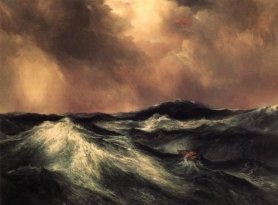
I feel like a person in a lifeboat somewhere out in the ocean. The waves lift me up and the waves dip me back down. I have higher days and lower days (today being “lower”). Do I want to invest a year just to explore the possibility that I might fit into a church and that I might have something to offer besides a few dollars in the donation plate and adding my body heat to a chair in the sanctuary?

Well, in spite of what I want, is it worthwhile? Is it what God wants? How do I know what God wants? I know what “feels” better to me and what doesn’t, but that’s hardly a litmus test that yields reliable results. 20 days and counting. The clock is ticking.

74 Days: Contemplating Jumping

The Rebbe my father told someone at yechidus: Ever since G-d told our father Avraham, “Go from your land etc.” (Genesis 12:1) and it is then written “Avram kept travelling southward,” (Ibid 12:9) we have the beginning of the mystery of birurim. By decree of Divine Providence man goes about his travels to the place where the “sparks” that he must purify await their redemption.

Tzadikim, who have vision, see where their birurim await them and go there deliberately. As for ordinary folk, The Cause of all causes and the Prime Mover brings about various reasons and circumstances that bring these people to that place where lies their obligation to perform the avoda of birurim.

“Today’s Day”
Shabbat, Cheshvan 1, Shabbat Rosh Chodesh, 5704
Compiled by the Lubavitcher Rebbe
Translated by Yitschak Meir Kagan
Chabad.org

There are people who do many good things, but with pessimism—because to them the world is an inherently bad place. Since their good deeds have no life to them, who knows how long they can keep it up?

We must know that this world is not a dark, sinister jungle, but a garden. And not just any garden, but G‑d’s own pleasure garden, full of beauty, wonderful fruits and fragrances, a place where G‑d desires to be with all His essence.

If the taste to us is bitter, it is only because we must first peel away the outer shell to find the fruit inside.

-Rabbi Tzvi Freeman
“The Garden”
Based on letters and talks of the Rebbe
Rabbi M. M. Schneerson
Chabad.org

I suppose Rabbi Freeman has hit the nail on the head as far as I’m concerned (though of course, he’s not even aware that I exist or of my circumstances). I tend to see the world as a rather negative place, as defined by the negative people who express themselves in it. You don’t have to go far to see what I mean. Watch any news channel on TV or the Internet and you’ll see tragedy, horror, despair, murder, and many other depressing and disheartening things. The debates and controversies surrounding the upcoming Presidential elections are just another reason to consider our world a negative place. It doesn’t matter which political party you belong to, the supporters of one person invariably use any trick and tactic they can find to sully the reputation their opponent’s supporters. The world of religion and religious blogging is no better, it seems.

According to the Rebbe, “Tzadikim, who have vision, see where their birurim await them and go there deliberately,” however, for the rest of us, “the Cause of all causes and the Prime Mover brings about various reasons and circumstances that bring these people to that place where lies their obligation to perform the avoda of birurim.” In other words, if you are a truly righteous person, you know where you must go and what you must do in order to accomplish the purpose of your life. For everyone else, God leads us to the places we must go and shows us what we must do, but it’s up to us to correctly interpret these events and then take the correct action.

Which is why, for most of us, life and God and our purpose can seem like we’re endlessly trying to solve a mystery by traveling down a dark street late at night hoping for illumination.

This week’s Torah Portion is Noah, which tells a narrative even most non-religious people know quite well. But according to Rabbi Abraham J. Twerski in his Growing Each Day commentary for Cheshvan 1, it tells me something more specific.

God said to Noah, “Enter … into the ark.”

Genesis 7:1

The Hebrew word for ark, teivah, has two meanings: it can mean “an ark,” and it can also mean “a word.” In the above verse, the latter meaning tells us that God instructed Noah to “enter into the word.” Rabbi Moshe of Kobrin expounded on this theme, explaining that when we pray, we should “enter into the words,” i.e. totally immerse ourselves into each word of prayer, as though the word is encompassing us.

A listener once asked him: “How can a big human being possibly enter into a little word?” Rabbi Moshe answered, “People who consider themselves bigger than the word are not the kind of person we are talking about.”

The Talmud states that people’s prayers are not accepted unless they efface themselves before God (Sotah 5a). God abhors those who are egotistical, and therefore the prayers of a vain person are not likely to be received favorably.

People preoccupied with their egos remain external to their prayers. The truly humble person feels small enough to “enter” even the tiniest word.

Today I shall…

try to throw myself entirely into my prayers by setting aside those thoughts and feelings that would inflate my ego.

While I don’t think of myself as someone who struggles with an inflated ego, it has already been pointed out to me (correctly, I might add) that I don’t trust God as I should. I don’t “enter into the word” with complete abandon, trusting that God will take care of my well-being. Terrible things happen to good people every day. Why would I be exempt?

That goes for trying to solve the mystery of my path of faith as well. If I make one decision, how will I manage the consequences? If I make no decision, that’s a decision and it has consequences. Even standing still is really moving backwards. If only all of the “egos” on the web who casually malign their brothers of the faith and the Jewish people (who are sometimes one in the same) never seem to throw themselves entirely into their prayers, setting aside those thoughts and feelings that would inflate their egos, at least as evidenced by their online behaviors.

Maybe it is better to ignore the world and to simply throw myself into a life of prayer, study, and contemplation.

There was a story about a Torah scholar who died young… – 13a-b

The Gemara elaborates and tells the story of a Torah scholar who died young. This man’s wife came to the Beis HaMidrash carrying his tefillin, and she began to complain about his shortened life. Although this student was very diligent, and no one was able to respond to this woman’s bemoaning, finally Eliyahu discovered and exposed the tragic flaw which this young man and his wife possessed.

It is noteworthy that this woman specifically brought her late husband’s tefillin with her, as if it indicated more of a reason why he did not deserve to die. Maharsha explains that she brought the tefillin to increase the anguish of the other students who would see her. Sefer Gilyonei HaShas of R’ Yaakov Engel explains that tefillin specifically represents the connection which we have to Torah study. Her argument was sharper, as she demonstrated that her husband learned Torah and was bound up with Torah as his life pursuit.

Therefore, this woman took her husband’s tefillin as she circulated around the shuls and the Batei Midrash to demonstrate that her husband did not simply learn Torah, but he was bound up with the Torah, just as the tefillin is tied around one’s arm.

Daf Yomi Digest
Distinctive Insight
“Bound in Torah”
Shabbos 13

But even reading this commentary convinces me that there is an insufficient perspective being applied here. It’s not what you study and learn but what you do with it that counts. I sometimes define the difference between Christianity and Judaism as the difference between what you believe and what you do, but that’s not always a very fair comparison. In some aspects of Jewish thought, the person who studies Torah, binding themselves in it so to speak, is of greater value than the simple person who cannot study but only tries to live a descent life as best they can.

A person can be a Jew just by being born of a Jewish mother and on that virtue, is a member of the covenant and one of God’s chosen people. A Christian can be born anybody and all by itself, that means practically nothing. A person is only a Christian after making a decision and a declaration. After coming to faith and confessing Christ, the only way to tell a Christian from a secular person is by what they do. Even then, many secular people behave more righteously than many Christians.

However, faith and belief are invisible. Only God knows what is in a person’s heart. It is what we do that defines us, sometimes because of what we believe and sometimes in spite of it. When God leads each of us, even me, into any given situation on any given day, there’s an expectation about what we’re supposed to do there. Should we turn left or right? Should we go forward or back? From God’s perspective, the answer is obvious. From a human’s point of view, it can seem like an impossible puzzle, or we might even miss the fact that a decision must be made at all.

Or, we know what we should do and are just loathe to do it. But if God has sent us to “reveal a spark,” so to speak, who are we to say we won’t do it or pretend we don’t understand what He is asking of us?

The answer is that we are human and flawed.

It would be easy just to ignore my dilemmas by ignoring God, but God or my conscience won’t let me do that. But it still feels like He’s asking me to jump off a cliff into a bottomless void with only the promise that He’ll make me fly to sustain me.

Let It Rain Joy

Restrain the festival by bonds to the corners of the altar.

Psalms 118:27

The Talmud states that if a person celebrates the day after the holiday with a festive meal, it is considered as though he had built an altar and had brought sacrificial offerings upon it.

Succah 45b

Rashi states that the reason for the eighth day, Shemini Atzeres, can be explained with the parable of a king who invited his children for several days of feasting. When the time came for them to leave, the king said, “Your departure is so difficult for me. Please stay with me for yet one more day” (Rashi, Leviticus 23:36). Similarly, after seven days of Succos, in His great love for Israel, God asks us to stay with Him for yet one more day before returning to our mundane activities, which so often distract us from Him.

To indicate that we cherish our closeness to God just as He does, we add a day of festivity after the last day of the holiday, to extend even further the intimate companionship with God. This testimony, that we value our intimacy with Him and that we leave the Sanctuary only because we must tend to our obligations, is held equivalent to building an altar and bringing votive offerings.

Indeed, God wants us to engage in work – Six days shall you work (Exodus 20:9) – but our attitude toward the workweek should be that of a person who is away from home on an assigned duty, and who longs to return home to his loved ones. The importance of our closeness to God should be manifest not only on the day following the festival but all year round as well.

Today I shall…

try to maintain the closeness with God, that I achieved during the festival, even when I am involved with the activities of everyday life.

-Rabbi Abraham J. Twerski
“Growing Each Day – Tishrei 24”
Aish.com

While for Christians, today is just another day of the week, for observant Jews all over the world, the party’s over. The festivals that have received so much build up over the past month or two have all ended. If they haven’t done so already, it’s time for Jewish families to dismantle their sukkot and put them away (assuming they use a kit like I do) for another year. The dancing is over and the Torah scrolls have been returned to their arks. This coming Shabbat’s reading is Genesis 1:1. The cycle of life begins once again.

It can either be a build up or a let down.

Or, as I mentioned yesterday, it can simply be another reminder for me that time is passing and there is no definite direction set for the next step of my journey. I suppose I could just keep walking and wait to see what turns up, but what if nothing turns up? Everybody hits a “dry spell” in their faith, but I feel positively arid.

Joy is supposed to be a mitzvah, but over the past year and a half or so, I’m still failing Joy 101.

If we have no joy in our hearts, we deny the love of God. We should not say, “Our heart is the dwelling place of lust, jealousy, anger; there is no hope for us.” Let us realize that we have another guest in us who desires to give us life and joy, notwithstanding our sin.

-Paul Philip Levertoff
Love and the Messianic Age

alone-desertLevertoff isn’t the only one to make such an observation:

The natural state of a human being is joy. Joy is a healthy state – healthy for us spiritually, emotionally, and physically. Lack of joy comes from thinking in ways that block your joy. Different people have different obstacles to their joy. It is easy to blame other people, circumstances, or situations for one’s lack of joy, but the only reason that other people, circumstances, and situations might cause a lack of joy is because of the way that one views those factors. The one who views everything in his life as an integral part of his service to the Almighty, will experience joy in dealing with whatever arises. “This, too, is part of my mission in this world.”

-Rabbi Zelig Pliskin
“Joy: The Natural State, Daily Lift #601”
Aish.com

Oh, and there’s this rather well-known scripture:

Count it all joy, my brothers, when you meet trials of various kinds, for you know that the testing of your faith produces steadfastness. And let steadfastness have its full effect, that you may be perfect and complete, lacking in nothing.

James 1:2-4 (ESV)

And then, according to Tsvi Freeman in his book The Concealed Light, Joy is one of the names of the Messiah (pp 240-1):

HaGra, the Gaon of Vilna, explained, “‘They shall obtain joy and gladness’ (Isaiah 35:10). Joy (sason) and Gladness represent the two Messiahs, the core of Joy being Messiah son of Joseph, about whom the verse speaks” (Kol HaTor 74). This understanding is based upon the Talmud, where Joy and Gladness are personified in a discussion about the highly significant practice of pouring water on the altar during the Feast of Booths (Sukkot).

And speaking of Sukkot:

With joy you will draw water from the wells of salvation.”

Isaiah 12:3

I can only conclude that joy, like love, is a verb; it’s something you do, not something you feel. We can love by performing acts of love, such as feeding the hungry, hugging a crying child who just skinned his knee, helping an elderly, infirm person across the street, or visiting a sick person in who is in the hospital. But how to you do joy?

Or has that question already been answered?

Simchat Torah means “the rejoicing of the Torah,” for the Torah rejoices on this day. The Torah is the stuff of the Jew’s life: his link to his Creator, his national mandate, the very purpose of his existence. But the Jew is no less crucial to the Torah than the Torah is to the Jew: it is he and she who devote their life to its study, teaching and practice; he and she who carry its wisdom and ethos to all peoples of the earth; he and she who translate its precepts and ideals into concrete reality.

So if we rejoice in the Torah on Simchat Torah, lifting its holy scrolls into our arms and filling the synagogue with song and dance, the Torah, too, rejoices in us on this day. The Torah, too, wishes to dance, but, lacking the physical apparatus to do so, it employs the body of the Jew. On Simchat Torah, the Jew becomes the dancing feet of the Torah.

“Torah in the Winter”
Based on the teachings of the Lubavitcher Rebbe
Adapted by Rabbi Yanki Tauber
Chabad.org

But James, the brother of the Master, didn’t say to “count it all joy” when you’re dancing around with the Torah scroll, but when “you meet trials of various kinds.” And Rabbi Pliskin said, “The one who views everything in his life as an integral part of his service to the Almighty, will experience joy in dealing with whatever arises,” so anything that happens, regardless of its nature, if it is part of us serving God, should be a source of joy.

What’s the connection, or is there a connection between Jewish tradition, Jewish philosophy, and Christian scripture?

I suppose this is where having a mentor might come in handy, but I can’t see that happening.

Of course, James didn’t say “feel joy when you meet trials of various kinds,” he just said “count it all joy,” as if it were joy, but it isn’t really. Rabbi Pliskin’s advice is harder, because he tells us to “count it all joy” no matter what, and to actually experience joy. I like James’s advice better. Maybe in the arid times, we’re supposed to just “count it all joy” not expecting to really experience joy, but knowing that someday, once the water starts to pour again, joy will be forthcoming with the rain.

Let it rain joy.

Answering God

Many of us believe we will have an opportunity after our stint upon this earth to stand before a great mahogany desk in the sky and demand of G‑d, “If You are so kind and omniscient, why were You silent?” And then G‑d will show us the view as He sees things, and all will be answered.

Perhaps. Perhaps not. Perhaps at the end of all things, at the core of all wisdom, at the very essence of all being lies not an answer, but a question. Perhaps many questions. And who knows, perhaps this question is one of them.

Perhaps G‑d will simply counter our question with yet another and ask, “So what did you do to answer this question?”

And if we will say, “I did nothing, because I saw you did nothing,” then He will say, “So this that you asked, was it a question? Or was it just another answer?”

For that is the only bad question: the one that is not a question at all, but merely an inexpensive excuse to shrug our shoulders and scurry back to our holes, to do nothing.

-Rabbi Tzvi Freeman
“Is There Such a Thing as a Bad Question?” (And when do you get to ask it?)
from “The Freeman Files”
Chabad.org

I probably write a pretty strange blog, especially in the “religious space.” Most religious blogs are all about giving answers to tough (or not so tough) questions on theology, doctrine, history, Bible translations, and so on.

I don’t do any of that. The idea of being the “Bible answer man” just repels me if, for no other reason, than because we aren’t so sure of our answers. Watching just the Christian religion and all the opinions, denominations, sects, and cults out there should be enough to convince even the most casual observer that we’re all madly dancing on the head of a pin anyway. What the heck to we know?

OK, it’s probably not that bad, but even I, a self-avowed Christian (albeit an unusual one), get disgusted with all the confusion and chaos within my own faith at times. What disgusts me even more than the chaos, is the amazing audacity of some folks out there who seem absolutely sure they have all of the answers all of the time. On top of that, they plan to build churches, schools, Jerusalem councils, and whatnot on the foundation of their opinions, and then they turn around and trash anyone who doesn’t agree with their set of arbitrary absolutes.

I sound like a very strange Christian right now, don’t I?

But as Rabbi Freeman points out, if we expect God to lay it all out for us before we can do anything about anything, all we’ll end up doing is “scurrying back to our holes” and hiding in the dark.

I must admit there are times when that sounds terrifically appealing.

But no, I can’t.

No, really. One of my favorite bloggers, Asher closed up his Lev Echad blog and walked away from it all. His motives are his own and I’m sure they aren’t the same as mine, (when I’m tempted to throw in the towel) but he seems to have ended his stint on the blogosphere as an act of faith.

Look through the history of the Jewish people (especially Israel) and there is a simple conclusion that can be drawn: God is orchestrating events. Even when it’s difficult to understand certain events, we can still control our reaction to them. In fact, Jewish tradition has it that the Final Redemption will occur when we realize that we can only rely on God. If we but take our incredible history to heart, it shouldn’t be all that difficult to come to that conclusion.

I admired Asher’s writing because he had no ax to grind, no agenda (hidden or otherwise), no theological complaint to harangue the rest of us with. He just wanted (and probably still wants) to promote unity between one Jew and another.

As for me, I’m still working on that whole “be at peace” thing.

Feel intense empowerment as you have the strength to remain silent when silence is the wisest course of action. Your silence will not be passive, but an active silence that comes from self-mastery. As you remain silent, hear an inner cheer. Your silence requires as much skill as any Olympic athlete. It is a victory that deserves a standing ovation. Hear an inner voice saying, “I’m proud of your self-mastery to remain silent.” Your silence is the mark of a champion!

-Rabbi Zelig Pliskin
“Have the Strength to Remain Silent, Daily Lift #563”
Aish.com

I’ve been reviewing this past week’s “meditations” and even in my most benign missives, I find that I couldn’t help making a few comments on those people and movements (though, not by name) who I feel also “struggle” with walking out the path that Jesus meant for us to follow. Frankly, it’s tough not to want to push back when so much of what people are saying “out there” is designed to sting you.

But if I were to truly look at Asher as an example and to take Rabbi Pliskin’s advice, I’d delete this blog, my Facebook and twitter accounts, and shut down my online presence completely. I don’t doubt that a few people would be glad that I did.

Is there a point to these “morning meditations” or are they just the random ramblings of a mind that needs to be busy with other things? Am I saying anything unique or just parroting the quotes of people wiser than I am?

Yesterday, you were inspired. Today, that is all gone. And so, you are depressed.

But this is the way the system works: Everything begins with inspiration. Then the inspirations steps aside—to make room for you to do something with it. For fire to become deeds.

-Rabbi Tzvi Freeman
“Runaway Inspiration”
Based on letters and talks of the Rebbe
Rabbi M. M. Schneerson
Chabad.org

As I continue to wrestle with these questions and find no absolute conclusions, the only answer I can come up with is temporary. We were each given an individual voice with which to speak. How we view the world we live in and our place in it is different for each of us. No two of us walks quite the same path and all individuals have their own special vision. Those of us who blog, express that vision in words and the occasional picture. Others paint, or pray, or teach, or give to charity, or build houses for the homeless, or serve food to the hungry, or realize it’s more important to be kind than clever, or…

You get the idea.

Many paths, many people, One God.

But remember, One God means He is Lord of all. We aren’t. With over 181 million blogs in existence around the world, how can any one blogger claim to be so important? Many voices and each one is unique, but none of us is special.

Humility eliminates many of life’s problems. A humble person will not be bothered by life’s circumstances and will not envy what anyone else has. He will not become angry nor quarrel with others.

It is very pleasant to be in the presence of a humble person, therefore people will invariably like him. All of his interactions with other people will be serene and tranquil. Fortunate is the person who has acquired this attribute.

Today, imagine that a miracle has occurred and you suddenly have total humility. In what way does this enable you to free yourself from any anxiety you frequently experience?

-Rabbi Zelig Pliskin
“Humility Eliminates Many Problems, Daily Lift #564”
Aish.com

Many voices, One God. Many questions, no answers. But it’s not the answers that drive me but the questions. It’s not certainty of purpose that compels me to write the next blog and then the next one, it’s the puzzle of humanity and the mystery of God.

It’s Friday. Shabbat will arrive at the end of a tiny march of hours. If total humility is a miracle, then so is total peace. But for a small span of time, I will still my voice and cease my questions. Then I will listen. May it be His will to speak.

But if He asks me a question, how will I answer God? How would you?

Waking Up Alive

In school, from an early age, Joe learned how stuff works. Joe learned how pulleys work, how electrical circuits work, how cells divide and how neurons process thoughts. He learned that the whole world is a big machine, and we are all little machines inside it.

Joe graduated college, got a job, got married, had kids.

Then Joe had a crisis. He needed help. He picked up books of today’s most popular genre—self-help. Lots of them. The books told him he has a soul, he has purpose, that’s there’s something beyond just being a pleasure-seeking machine.

Joe felt better. He was able to go back to work, keep his marriage and enjoy his kids.

There are many things the world needs. It needs nothing more than a soul.

Joe needed to know he has a soul.

-Rabbi Tzvi Freeman
“Why the World Needs a Soul”
from the “Chassidic Thought” series
Chabad.org

Some people don’t know this. Some people will never learn this. Even for people who do know that they have a soul and that life has a broader purpose beyond the day-to-day grind, any pain that is strong enough or lasts long enough will knock that information right out of awareness.

And all that you’ll be about to think or feel is the pain.

Fortunately, Joe was able to overcome that, as were the equally fictional Julie and Sasha in Rabbi Freeman’s tale (which I highly encourage you to read in its entirety since it makes many good points).

Yesterday, I talked about how experiencing chronic emotional and spiritual pain can make it very difficult to connect to your purpose and to cling to the awareness of your soul in any meaningful way. Actually, that kind of pain makes it hard to even get up in the morning and care about whether you have a purpose or not. No matter how hard the soul strives to reach its Creator, the weight of a thousand, thousand failures, disappointments and criticisms presses the soul back into the dirt like the hand of a thoughtless child crushing a bug.

Yesterday, I also said this:

Supposedly, you can only go down so far before you start to rise up again. There is a principle in some areas of Judaism that says, “Every descent is for the sake of a future ascent.” Of course, that “ascent” might not occur until the world to come, which means you’re already dead and your life on earth hasn’t worked out at all. Besides, it’s just a saying. You can’t find it in the Bible.

There is an increasingly mythical sacred person buried under endless tons of rock, dirt, and pain. They keep trying to dig their way out of their cave-in using only splintered, bloody stumps of what’s left of their fingers. The light is dimming and the air is running out. When the Divine spark is extinguished, what will be left of the person who was supposed to be holy? When the abyss finally claims its victim, will God still be there to watch?

Is God watching when we’re about to surrender to the final abyss and does He see how tiny and fragile the flicking spark of our soul is under the oppression of darkness and hopelessness? Is He waiting for our ascent after the descent as well? Is He waiting in vain?

It is said “that which doesn’t kill you will usually try again.” But that assumes whatever is trying to kill you will succeed. What if it just hurts instead?

“What is unique about a Jewish martyr,” wrote Rabbi Sholom DovBer of Lubavitch, “is that he would rather stay alive.”

-Rabbi Tzvi Freeman
“Martyrs for Life”
Based on letters and talks of the Rebbe
Rabbi M. M. Schneerson
Chabad.org

You feel the Divine spark growing weaker within you. The light dims. Suddenly, you realize that you are in complete darkness. Your lungs labor for air and then there is none and your chest sucks in only dirt and dust and gravel. You close your eyes in anguish one last time welcoming a final oblivion.

But the next morning you wake up and realize you’re alive. On days like that, I still say:

I gratefully thank you living and existing King for restoring my soul to me with compassion.

Abundant is Your faithfulness.

Modeh Ani

Somehow, the weight is still there but it’s lighter, just light enough to allow my chest to expand, let my lungs fill with air, let me exhale, and then inhale again. I open my eyes and I can see light. I sit up in bed, put my feet on the floor. And I can stand.

Why am I thanking God for being alive?

Because I have a soul and regardless of what the rest of me feels like, my soul is part of God and she (in Hebrew, words have gender and the Hebrew word for soul is feminine) thanks her maker for the restoration of life and the ability to continue in the service of the King.

Regardless of what the rest of me feels.

The need for meaning in our personal lives, the sense of responsibility for the ecology of our planet and the respect for the dignity of every human life—all these are sacrosanct today. Which is a good thing, because without them we would have destroyed ourselves in the century just past.

Yet they are entirely hollow. More than that: they are in utter conflict with the materialist concept of reality that we are taught in school and practice in the laboratory.

In short, we suffer an aching disconnect between our brains and our soul.

Our soul believes life has purpose and meaning, while our brains consider our bodies to be no more than a walking water-bottle of biochemical reactions. We teach small children to cry over the future of the elephants, the pandas and the blue whale, that they have a responsibility to save the planet and sustain it, and then we teach them that all this arrived due to a big bang and a series of accidents. We will not tolerate any voice that suggests the superiority of one family of human beings over another, all the while reducing this creature to a string of DNA in which serious differences have already been uncovered.

Nothing could be more precarious.

The world, existence, everything, is more than just how we feel at any given moment. No matter how much life can sometimes hurt, who we are and that we’re alive is more than just our circumstances, our history, our “excess baggage,” and how we perceive our lives. The world needs a soul because it needs a purpose. God built that into each and every human being, whether we choose to recognize that fact or not. Once we do, we’re “trapped” with that knowledge and we become aware of the Divine that lives within our secular, ordinary flesh. We are more and different than the sum of our wetware and our programming. The part of us that thanks God every morning for waking up alive means we can suffer what we think will kill us but still arise the next morning a living martyr.

Life means more than getting our way or winning or losing the endless arguments we find in the blogosphere and in social networking venues. It’s important to step away from the monitor and the keyboard and to realise that life doesn’t primarily occur in the Internet. It occurs in the connection between man and God, even if we only cry out to Him that it hurts, oh my does it hurt.

I recently read an article written by a fellow named Dr. Harlan Weisman called My 11 Months of Kaddish. It’s too long to quote the whole thing here, but it’s the story of a man who, in saying Kaddish for his deceased father everyday for 11 months, discovered himself, who he is as a Jew, and ultimately the relationship between his soul and God.

But he couldn’t do it until his father died and he began his bitter grief. However, Dr. Weisman didn’t really start to live again until the eleven months of saying Kaddish were over:

Next day, I went to shul, even though I didn’t have the obligation to say Kaddish anymore. But I needed the warmth and the continuity. And the minyan needed me, the tenth man. I’m repaying all those who took care of me for those 11 months. I’m helping those who continue their period of saying Kaddish, and I watch the new ones joining us, some just as unsure of what they’re doing as I was 11 months ago, as they stumble through their first Kaddish.

I go because it feels good to join the generations of Jews before me who were blessed with the same traditions.

I go because it makes the light inside me shine more brightly.

In the weeks following my last Kaddish, the hole inside of me opened and closed in unpredictable cycles. The sadness continued, coming and going, but gradually became less intense. And the hole gradually filled and stopped opening, just like the rabbi said. The sadness was pushed away by the knowledge that my father was not gone. He is with me today, with me every day. His values, his kindness, compassion, courage, endurance, fortitude, determination and tenacity to do what’s right, his commitment to justice and fairness, but most of all his love, is with me today, tomorrow and always. And I am passing these gifts onto my children, as they will to theirs, through the generations.

Sadness, grief, regret, self-loathing, depression…something’s trying to kill us, but our soul won’t let us die. We’ll just continue to suffer under the weight of a life we never wanted and cannot control. But something has to die for us to live again. Something must be extinguished, and we must let go of it before we realize that it is time for it to end.

Someday, we’ll pray to God, not just because we need Him, but because we want Him, too. Because being with God is the most natural and normal thing for us to do…like waking up in the morning, like breathing.

Our soul will never stop needing God. But we must realize that the rest of us needs and wants Him, too. Then we can stop simply existing in our suffering silence. Then we can begin to wake up alive.

Locking Up Meditation

There are three forms of hitbon’nut (contemplation, meditation):

  1. Study-meditation: After mastering the concept thoroughly, one meditates on its profundity, until the intellectual element shines forth for him.
  2. Meditation before davening: This is directed toward sensing the vitality of the concept learned, in contrast to sensing the intellectual element emphasized in study-meditation.
  3. Meditation in davening: To sense the “G-dly element” in the concept learned.

These three are rungs on the ladder of sensitivity. It is only by G-d’s kindness towards us that we may occasionally sense G-dhood spontaneously, without any avoda at all. This comes about by virtue of the quality of Ultimate Essential G-dhood within the soul. For avoda by one’s own efforts, however, these three forms of meditation are essential.

“Today’s Day”
Friday, Tamuz 20, 5703
Torah lessons: Chumash: Pinchas, Shishi with Rashi.
Tehillim: 97-103.
Tanya: Precisely so (p. 357) …or articulation. (p. 357).
Compiled by the Lubavitcher Rebbe; Translated by Yitschak Meir Kagan
Chabad.org

Don’t be discouraged. It’s often the last key in the bunch that opens the lock.

-Author unknown

I always consider meditation to be a quiet, contemplative state. As such, I never enter into it. I know that seems completely contrary to the basic premise of this blog, but I find it very difficult to quiet my mind. About the closest I come to a conscious, meditative state is the four minutes I’m cooling down after an aerobic workout on the elliptical machine. I can close my eyes and imagine my breath going in and out as a frosty, illuminated vapor in the darkness. All I’m trying to achieve though, is to slow my heart rate down as much as I can so that when I get off the machine, it’s not still pounding away at 150+ beats per minute.

I’m not contemplating God.

Even when I do contemplate God, it’s in a sea of static and chaos. It’s difficult or impossible to enter into a space where it’s just Him and me. Frankly, I don’t know if I even want to enter into that space. God is big and scary and I’m not even sure how guys like Abraham and Moses could stand being in His presence for even one split second. The God that created the Universe and everything in it isn’t some comfortable cosmic teddy bear that you can just walk up to and then sit in His lap.

Most days, I have a really good idea what I want to blog about, but not today. I pretty much burned off all my passion in yesterday’s meditation. Today, I’m emotionally drained. Wiped out. I know it probably doesn’t look this way from the outside, but some of these mediations take a lot of energy to write.

I just saw a photo of me (thankfully, I’m way in the background) in some promotional material for where I work. Everyone else looks fresh and young and happy. I look really old and fat and worn out. While I’ve got all this dynamic energy that sparks up in most of my “morning mediations,” today I feel like that picture (believe me, you don’t want to see it). I have this horrible feeling that’s how I look all the time.

I’m kind of reminded of the character Happy Hogan who first appeared in the comic book Tales of Suspense #45 (September 1963) with Iron Man. Marvel comics has “handsomed him up” quite a bit since those days, but back then, he was created for comic relief (along with Tony Stark’s then “mousy” secretary Pepper Potts). Happy rescued Tony from a race car crash and as a reward, Tony gave the out-of-work boxer a job as his chauffeur and personal assistant. Happy was always looking completely glum and “hang-dog”. Tony commented on it early in their relationship and asked if he was depressed. Happy’s response was something like, “Nah, I look like this all the time.”

I think I look like this all the time. OK, so I’ve never been a really attractive person, but I think this is more than age and carrying around a bunch of extra tonnage. I think I get tired of fighting God or fighting life or are they both the same thing? Problem is, that sort of fight is unavoidable. You only stop fighting when you die. Until then, it seems like it’s one battle after another, hammering away at something or being hammered at by something.

I try to imagine what it would be like to not fight. To relax. To set aside responsibility and duty, not just for a few minutes, or an hour, or when I’m asleep, but to really relax. Don’t say “vacation” because vacations are anything but relaxing. In fact, they’re harder work than going to work. Besides, even the most relaxing vacation in the world has to end sometime.

Paul spoke of “the peace of God, which surpasses all understanding” (Philippians 4:7) but I haven’t found it yet. I suspect I never will.

My “morning meditations” are really more like “morning encounters” or “morning contemplations” or even “morning conflicts”. I sleep. Wake up. Drink coffee. Go to the gym with my son. Eat breakfast. Take a shower. Go to work. Somewhere in the rest of the day, the next morning’s meditation gets written depending on my available time and what I’m thinking about. I eat dinner. Go to sleep. And the cycle starts all over again.

If someone has this lovey-dovey, floating on clouds, easy-peasy relationship with God and faith that keeps them in a semi-divine state as they slowly sail through each day, I’d like to know about it. I’m probably not a good candidate for such a state, even if it exists, but sometimes, as fluffy as it all sounds, I think I’d like a piece of it.

We are representatives of Above. And as such, live two lives at once:

We are free-thinking, independent beings.

And we are no more than messengers of Above.

It is a play of opposites in a single being. An impossibility realized in true-life drama. Just the sort of thing in which the Impossible One Above delights.

-Rabbi Tzvi Freeman
“Representatives”
Based on letters and talks of the Rebbe
Rabbi M. M. Schneerson
Chabad.org

Rabbi Freeman presents an idealized view of the thoughts and expressions of the Rebbe and thus of the Chabad, but I know there’s a reality behind Crown Heights in Brooklyn that isn’t anywhere near as pretty. That’s not to say anything against the Chabad as such, but to acknowledge that humans are humans and we can make a mess of things on the inside, even if the outside looks good.

My insides and my outsides seem to look the same, that is rather threadbare and lumpy. All the religious and motivational stuff on the web often seems empty to me because all of that “feel good” material seems so phony and unrealistic. Life is a struggle. You fight hard every day. You can only hope that food and sleep will rejuvenate you enough to face another day just like the one that came before. Somewhere in there, God is present, but who knows exactly where or when or if He’ll make Himself known or intervene in any meaningful way?

Between the “free-thinking, independent being” and the “messenger of Above,” there’s an ordinary (or sometimes I feel, sub-standard) human being who is just trying to stay alive and make sense the events of each passing moment. Making sense of life and contemplating the nature of God doesn’t happen as much as you’d think.

I get tired. Sometimes I don’t know why I’m doing all this. I’ve also just been reminded again of how many Jews see Christians so…gee whiz.

Time for another cup of coffee and then back to work…

..and to try to find that last key that will open the lock to…who knows what?