
Tag Archives: seder

The Unanticipated Passover Seder

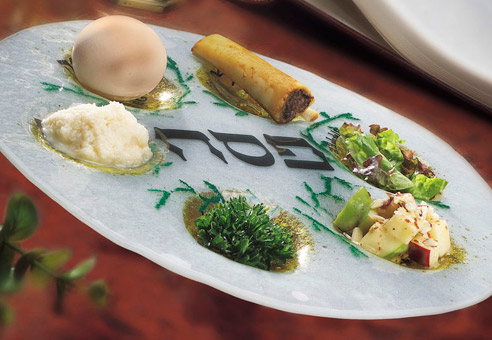
passover-bitter-herbs-sederIf there are aspects of the Passover seder from which all people can learn, how much more so is this true for believers in Messiah? After all, our Master Yeshua chose the wine and the matzah of a Passover Seder to represent his body and blood. More than just learning about and celebrating the concept of freedom from oppression and exile, for disciples of Messiah, the seder celebrates Yeshua’s atoning death and resurrection while remaining firmly grounded and centered on God’s deliverance of the Jewish people from Egypt.

There is ample evidence that, for the earliest Gentile believers, the celebration of Passover was an important holiday celebrated by all believers in Messiah—both Jewish and Gentile. Paul wrote the book of 1 Corinthians to a predominately Gentile audience who attended both synagogue and weekly gatherings of believers. Additionally, the timing of the letter seems to have been sometime in early spring before the Passover season had begun. Many portions in the letter allude to Passover and seem to offer instructions for observing it properly with the right heart-attitude.

-Toby Janicki
“God Fearers: Passover and Non-Jews”
First Fruits of Zion (FFOZ)

Everything before the story is to prepare for the story.

Everything after the story is to celebrate the story.

The Leader is the guide on this journey. One of the challenges of the Leader is to keep the participants engaged from beginning to end. All the traditional directions (like covering and uncovering the matzah, for instance) are just devices to help participants, especially children, pay attention and ask: Why?

-Rabbi Alexander Seinfeld
“The Art of Leading an Amazing Seder”
Aish.com

I’m going to need all the advice I can get, especially Rabbi Seinfeld’s, given my memory of last year’s Passover seder. My wife reminded me that it wasn’t my fault that the seder came off so poorly. We had a relative in the hospital and our lives were at least in a mildly emotionally chaotic state. The year before that, my wife and daughter felt rather unappreciated because they believed my sons and I didn’t appropriately recognize the great effort they had put into preparing the meal. Needless to say, Passover has lost some of its appeal in my family.

This year, I promised myself I wouldn’t even bring up the topic of Passover. And since there isn’t so much as a feather in sight and sufficient amounts of rolls and bread continue to inhabit our home, I was firmly and calmly resolved to simply passing by Pesach and moving right on to Easter.

Then yesterday evening, my wife asked me to go with her to our son’s and his wife’s home for a short visit and she said on the way, we could talk about Monday. What’s Monday got to do with anything? In Boise, Idaho, Erev Pesach candlelighting is at 7:44 p.m. on this coming Monday.

Oh.

When she said that we needed to plan for Monday’s seder, it was like she suddenly said, “I’m pregnant.” Well, maybe it wasn’t quite that shocking, but it still came out of the proverbial clear, blue sky. I never saw it coming.

In a way, I was relieved that we weren’t going to celebrate Passover this year, at least as a family. In my quest to return the Torah scroll, so to speak, to my Jewish wife in particular and to the Jewish people in general, I have surrendered a number of practices and observances that I had once held dear, Passover being among them. After all, I cannot be considered as one of the members of humanity who marched out of Egypt and left behind my slavery, and certainly I cannot project myself into the masses who stood at the foot of Mount Sinai and personally received the Torah from Hashem, as does every person who is Jewish.
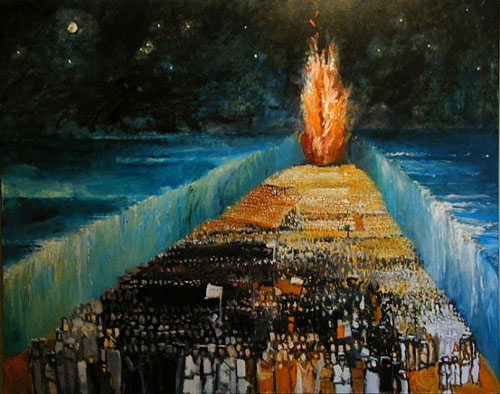
exodus-reed-seaSo as I processed my wife’s news about our impending family Passover seder, I found myself quickly dusting off Toby Janicki’s advice about Christians and the Passover (though he doesn’t phrase it that way).

I still feel like a fraud and I’m incredibly intimidated. I never used to feel this way, but then that’s the difference between historically celebrating Pesach among mostly non-Jews in a somewhat “Jewish-like” environment, and being the only non-Jew leading his Jewish family in the seder. Or as they say in the hood, “Sh*t just got real.”

There’s really only one difference between matzah and chametz.

They’re both made from flour and water, both baked in an oven, and both provide nourishment.

But one stays flat and humble, while the other fills itself with hot air.

That’s why matzah is a key ingredient for leaving your personal Egypt: As long as we are full of delusions of self-importance, there’s no way to break out and grow to a new level. Once we make ourselves small, we can fit through any bars and fly past any cloud.

-Rabbi Tzvi Freeman
“Between Matzah and Chametz”
Based on letters and talks of the Rebbe
Rabbi M. M. Schneerson
Chabad.org

On the other hand, as Rabbi Freeman suggests, maybe a healthy dose of humility is a good thing. But as it turns out, Rabbi Seinfeld’s advice won’t do me much good since it seems geared for a seder with lots of kids. My four-year old grandson will be the only child present (guess which child will find the afrikomen?) so the emphasis for the seder will have to go in a different direction.

Which direction I have no idea at this point. I’ll need to select a haggadah (after so many years, we have several tucked away in various drawers and cupboards around the house) and practice using it, so my leading doesn’t feel and sound so awkward and forced (and my Hebrew pronunciations are going to be traditionally poor).

I suppose if we were an actual Jewish family (in a traditional sense) and we all had grown up celebrating Passover every year, going to other homes where Passover was celebrated every year, and I, as “head of household,” had been leading family Passover seders for the past thirty years or so, it would seem like second nature by now.

But it isn’t, especially after “reinventing myself” a couple of years ago.

On the other hand, I’m approaching going to my first Easter service in well over a decade with an equal amount of dread if not horror. The one saving grace is that I won’t have to lead a thing…I just have to follow. I wonder where I’ll feel more “alien,” the seder or a sunrise Easter service? But I digress.

What am I really complaining about? Being a fish out of water? I’m certainly not afraid of co-opting Jewish identity or position since A) I’m not going to be very good at this, and B) as the husband and father in an intermarried family, it’s actually my place to lead the seder. Maybe I should play it safe and stick to the ABC’s of Passover, keep it simple (stupid), and just try to get by.
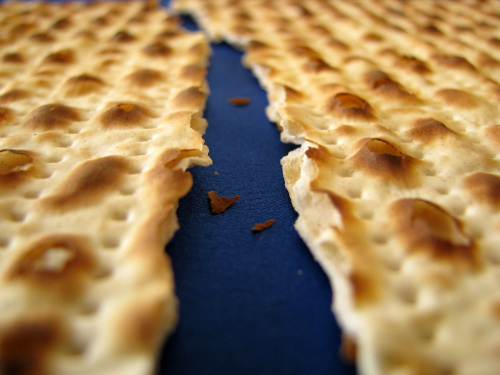
broken-matzah-passoverBut in all of my angst, I’m missing the reason for Passover. If it’s just an event and a performance, then it means nothing and all I’ll get out of it is anxiety in the anticipation and a guilty relief when it’s over. Still, it’s tough to get past what Rabbi Simmons says about “the Seder [being] designed to give each Jew the experience of “going from slavery unto freedom.”

But Christian/Jewish intermarried couples exist. We’re real. There must be some help out there for us…for me. Well, maybe not. I can find material on intermarriage and Purim, but that’s because at the heart of the Purim story is an intermarried couple. But what about intermarriage and Passover?

Shmuel Rosner at Slate Magazine says in part:

Being a pessimist on intermarriage is not easy these days. The Jewish community is tired of gloomy reports conveying what Steven Cohen titled “An Inconvenient Truth” in one of the most controversial studies of the last couple of years. The identity chasm between inmarried and intermarried is so wide, he wrote, as to suggest the imagery of “two Jewries.” One group attends Passover Seders in high percentage—namely, the inmarried—while the other, the intermarried, either refrains from doing so or attends these Seders in much lower numbers.

Rosner also says:

And there will be something different about their Seder itself, too. Passover, more than any other Jewish holy day, is the one in which Jews celebrate not their religion but this strange concept of becoming a people. This idea, of Jewish people-hood—the historic fact that Jews, for generations, didn’t see themselves as just sharing their faith, but also their national fate…

What part of that do I as a Christian share, if any?

But then, Tuvya Zaretsky writes:

“Either/or” thinking is a sadly limited perspective. For example, it sees only the Jewish religious aspects in Passover and misses the universal message of a redeemer God at the heart of Passover observance. Non-Jews who had sanctified themselves to the LORD were welcome to celebrate Passover, to eat unleavened bread and to give thanks to the LORD for His goodness. Gentiles, along with Jews, were welcome to the Lord’s table to eat the matzo and rejoice in the mercy of God. Followers of Y’shua (Jesus) see the message of the deliverer God prominently emphasized within the Passover story.

Although, by definition (my wife and children are not “believers”), our seder will not be “Messianic,” I must allow the seder to have a double meaning for me and not be solely focused on “the Seder [being] designed to give each Jew the experience of “going from slavery unto freedom.”

All this still has me feeling small and inadequate, and while not relative to Passover, I guess I’m not the only one. The following has nothing to do with Passover but everything to do with feeling small.

Blessings.

The Uninspired Passover Seder

All in all, this year’s Passover seder in my home was pretty lousy. There are a lot of reasons for this, most of which I am not at liberty to discuss. It’s wasn’t anyone’s fault. No one burned the roast, or behaved poorly, or arrived abysmally late to the event. But it certainly wasn’t the joyous occasion of freedom that I usually anticipate…at least not on the surface.

But I was disappointed and sundown at the end of Shabbat and the first full day of Passover was a sad relief. At least it was over.

I had anticipated a simple but happy affair. It is true that we were all busy for the past couple of weeks and there was no elaborate preparation for Passover, as there has been in years past. My wife and daughter (the principle authors of our family seder) were incredibly busy in the weeks approaching the first day of Pesach, so there wasn’t an opportunity to plan an elaborate meal. I had once suggested to my daughter that my sons and I do the actual planning and cooking this year, but her disdain for our “male” abilities in this area became immediately apparent. I actually thought at one point that we wouldn’t have a seder at all.

As the head of household, the responsibility to lead our family seder falls to me. This is when I become acutely aware that I’m a goy and while reading the Leader’s portions of the Haggadah, I tend to become more than a little embarrassed. This year, I was also the only Gentile present in a family of Jews, so my chagrin was even greater than usual. I also hadn’t had time to even look at the Haggadah prior to the start of the seder, so I could feel myself stumbling over the words and wondering if it was such a good idea to even hold the seder.

But it was my idea.

My wife, son, and I actually talked about not having the seder earlier in the day. True, all the food had been prepared, but perhaps, given the circumstances, we should just have a “Passover-themed” meal and call it good. But then, I had to shoot off my big mouth (and remember, I’m the only goy in this conversation) and say that Passover has been observed by Jews in all sorts of difficult circumstances but it has been observed. It’s important (in my humble Gentile opinion) to not give up the celebrations and commemorations of Judaism when faced with adversity. If a little difficulty was all it took to stop a Jew from celebrating what is Jewish, then probably there would be few or even no Jews left by now, or at least, no Jews who remember how to have a Passover seder.

So we went ahead and had our seder.

I won’t describe the grizzly details, but it wasn’t joyous. It wasn’t hideous or outrageously bad, but it simply fell rather flat. It lacked “pizzazz.” Whatever makes a seder an experience rather than just a meal with some reading just wasn’t there.

It was sort of like praying to God in a time of need and then feeling worse after praying then you did before entering His presence.

And it’s over for another year. Next year in Jerusalem? I’d be satisfied if it’s next year in my dining room, as long as at the end of the seder, we all felt, as a family, as if the Passover had been observed and not mangled or abused.

So for the next week or so, I’ll be dining on dry matzah and ashes and trying to remember that holiday expectations are not the same as a relationship with God. Events can be messed up for many, many reasons but it’s what God experiences with us that matters. Since I’m not Jewish, I am not strictly commanded to observe the Passover, but my family is. If I’ve done anything to prevent them from observing the mitzvot associated with the Pesach meal, then I’ll bear my guilt and whatever consequences that go along with it alone.

It’s not particularly my fault. It’s no one’s fault. But this being the first year I’m not affiliated with any congregation or religious organization, I somehow feel that I’m to blame. I’m looking for the good among the bad; the flower among the weeds, but so far, it hasn’t bloomed.

It is hard to describe the dire poverty that afflicted the citizens of Yerushalayim eighty years ago. The scarcity of food was so extreme that children sometimes went to sleep without having tasted a morsel the entire day.

One child was was walking along on a Shabbos afternoon when he noticed a very valuable gold coin. Of course he could not pick it up, since it was muktzeh. But he figured that he could stand on it, to guard it and take it after Shabbos. Unfortunately, an Arab youth passed by and he noticed that the boy remained stationary. Understanding that it was the Jewish Shabbos and that the boy might be guarding something to take after Shabbos, he threw the child to the floor and spotted the valuable coin— which he immediately pocketed.

The child was overwhelmed with grief. Not only had he endured being thrown violently to the ground, he had also lost a coin which could have fed his family for quite some time. He went into the Rachmastrivka shul and began to cry bitter tears.

When Rav Menachem Nochum, zt”l, the Rachmastrivka Rebbe, heard a child crying copiously in the beis haknesses, he immediately went to see what had occurred. When he asked the child and was told the entire story, he comforted the child. “Today is Shabbos, so we can’t speak about money, but please calm down for now. Come to see me after Shabbos.”

After Shabbos the rebbe took out a coin—exactly like what had been taken from him— and showed it to the child. “I am happy to give you this coin if you will sell me the merit of having endured great pain for the honor of Shabbos. To keep the halachah you were thrown onto the floor and you lost a fortune of money.” But the boy immediately refused. “No. I will not relinquish the reward for this mitzvah for any money in the world!”

Later the boy recounted. “I left the rebbe’s presence with a conviction that the treasure I had gained through my suffering was much more valuable than any mere coin!”

Daf Yomi Digest
Stories Off the Daf
“The Golden Treasure”
Kereisos 20

“Blessed are the poor in spirit, for theirs is the kingdom of heaven. –Matthew 5:3 (ESV)

The “poor in spirit” is looking for the golden treasure among broken crumbs of matzah. When a celebration of God dedicated to joy and freedom is anything but joyous and free, what then?

NOTE: I didn’t post my usual “meditation” Sunday morning because, outside of Israel, both the first and second day of Passover are considered “Sabbaths.” For that reason, I refrained from making any comments on the Internet during these special Shabbatot. Thank you to those who contacted me behind the scenes asking if everything is OK. I appreciate it.

Passover: Kos shel Eliyahu

In addition to the four cups of wine that each participant drinks during the Pesach Seder, a fifth cup is placed on the Seder table. This cup, which is not drunk, is known as kos shel Eliyahu , Eliyahu’s Cup.

Regarding this cup, the Alter Rebbe states in his Shulchan Aruch : (Orach Chayim, 481:1.) “It is customary in these countries to pour an additional cup — one more than for those seated. This cup is called kos shel Eliyahu.” What is the reason for this additional cup, and why is it so named?

There is a difference of opinion in the Gemara regarding the necessity of pouring a fifth cup of wine. Since this matter was not clearly adjudicated, there are those who say that a fifth cup is placed on the table. This cup, they say, is called kos shel Eliyahu , because, just as Eliyahu will clarify all doubtful Halachic matters, he will clarify the ruling about this cup as well.

The very fact that kos shel Eliyahu is merely placed on the table and not consumed indicates that it is bound up with a level of Divine service loftier than man’s drinking of wine. This is so, for kos shel Eliyahu is bound up with the final Redemption, something that transcends man’s service.

This belief is to be found within all Jews, for all are “believers and children of believers.” And this is so, notwithstanding the individual’s revealed level of service. For every Jew intrinsically believes in and awaits the coming of Moshiach — this belief and anticipation being a Divine command both in the written and oral Torah. Moreover, these feelings grow ever stronger as we move closer to the Redemption.

“Kos shel Eliyahu— A Cup of Redemption”
Commentary on Pesach
The Chassidic Dimension
Based on Likkutei Sichos, Vol. VII, pp. 48-53
and on the teachings of the Lubavitcher Rebbe
Rabbi Menachem M. Schneerson
Chabad.org

And he took a cup, and when he had given thanks he gave it to them, saying, “Drink of it, all of you, for this is my blood of the covenant, which is poured out for many for the forgiveness of sins. I tell you I will not drink again of this fruit of the vine until that day when I drink it new with you in my Father’s kingdom.”

Matthew 26:27-29 (ESV)

The cup of redemption. The fifth cup. Based on the above, the meaning of this cup is abundantly clear. Its placement at the Seder table is a testimony to the coming redemption of the Jewish people by the prophesied Moshiach. But the cup of the Messiah has meaning for the Goyim as well, since the Master commanded that the nations also be joined to him as disciples (Matthew 28:19-20). Can I say that the actual Passover Seder has meaning for we Christians? Perhaps. I know that it has meaning to me.

I just became aware of the Christian tradition of Maundy Thursday. My daughter plays drums with the local Highlanders and the group practices once a week at a church. When I was driving her to practice on Wednesday evening, I saw on the church marquee a mention of Maundy Thursday, but neither one of us had any idea what it meant. Of course, I looked it up.

Maundy Thursday, also known as Holy Thursday, Covenant Thursday, Great and Holy Thursday, Sheer Thursday and Thursday of Mysteries, is the Christian feast or holy day falling on the Thursday before Easter that commemorates the Maundy and Last Supper of Jesus Christ with the Apostles as described in the Canonical gospels. It is the fifth day of Holy Week, and is preceded by Spy Wednesday and followed by Good Friday.

Wikipedia

My first reaction when reading this was that it was a waste of effort, since Passover is a perfectly good occasion to commemorate these things and it existed thousands of years before the establishment of the Christian event. Kind of like re-inventing the wheel, and maybe it misses the point as well. I subsequently learned that there’s a little more to it than that. The interpretation of the scripture behind the holiday is that Jesus gave his disciples a new commandment to love each other and then (apparently) washed their feet, linking the two events. For different churches, this is interpreted either as a tradition, a custom, or an actual, literal commandment to show love by washing the feet of your fellow believer.

I think that’s a little too literal, and my interpretation was that Jesus washed the feet of his disciples in a “teachable moment” to  illustrate a point by metaphor. But I’ve been wrong before.

Christianity sees the Passover as the commemoration of the death of Jesus and Easter as the celebration of his resurrection and his life, so I suppose they found it necessary to initiate Maundy Thursday to “fill in the gaps.” But as we have already seen, the presence of the fifth cup; Eliyahu’s Cup, is the presence of the promise of the redemption, which encompasses all of these things, including loving God and loving one another. Death and Life are bound together at the Seder table, along with the bitter herbs, the bread of affliction, and the sweetness of the charoset. The beitzah or roasted egg symbolizes life everlasting and the meaning of the shank bone of the lamb should be obvious.

While the Passover Seder is primarily the story and the promise of the Jewish people, the final Seder meal (if it was a true Seder) of the Master is the bridge that allows we who call ourselves by his name to also find meaning and significance in the promise of life through the death of the Lamb. When he was resurrected, joined with Jesus, so were we. But we don’t drink the fifth cup because of its transcendent nature, and because we have yet to come to that place in the progression of all things. The Moshiach hasn’t returned yet. When he returns, he will come for his chosen people, his lost sheep of Israel. And by the grace of God, he will also come for we among the nations, who wait in humility and unworthiness for the King of the Jews.

Why pour a cup if we lack the ability to drink it?

In the course of the Passover Seder we drink four cups of wine, corresponding to the four “expressions of redemption” in the Divine declaration (Exodus 6:2-8):

“I will take you out”,

“I will deliver you”,

“I will redeem you”,

“I will acquire you.”

But the final and culminating level of redemption – its “I will bring you” element, which shall be fully realized only in the era of Mashiach – is something that transcends our human efforts.

This is not a cup we can drink on our own. We can only bring ourselves to the threshold of this Divinely perfect world, through our active realization of the first four “expressions of redemption.”

The drinking of the fifth cup awaits Elijah, herald of the final and ultimate redemption.

“The Fifth Cup”
Commentary on the Passover Seder
Chabad.org

Chag Sameach Pesach