Tag Archives: significance

The Equality Puzzle, Part 1

“For all that You created to revive the soul of all that live…” Tosafos – For example, apples. – 37a

One motza’ei Shabbos, one of the chassidim of R’ Aharon Karliner came to visit him. During their conversation, the gabai brought a plate of fruit before them. The Rebbe picked up an apple, and fervently recited the appropriate brochah, thanking Hashem for the fruit of the trees, and he cut off a slice. He then proceeded to eat the apple.

The chossid sat across the table from the Rebbe, watching his every move. He had always thought of the rebbe as akin to one of the angels, and yet, here was his rebbe, eating a mundane apple just like everyone else would. For a fleeting moment, a thought flashed through the mind of the chossid, “We both eat apples, and we both recite brachos. True, the rebbe recites the brochah with a bit more concentration than I do, but we are both essentially the same.”

The rebbe was quick to notice the subtle change of demeanor from reverence to careful appraisal, and he said to his guest, “Tell me, what indeed is the difference between you and me? I eat apples, and you eat apples. I recite blessings, and you recite blessings. So how are we different?”

“I was just wondering the same thing,” the chossid admitted, somewhat startled and embarrassed.

“I’ll tell you,” the rebbe said. “When I get up in the morning, I look around and see all the beautiful things Hashem has created. I am overwhelmed with the splendor of creation, and the mastery of the universe. I am enthralled and I crave to praise Hashem, but I know that it is forbidden to say Hashem’s name in vain. So, I reach for an apple, which gives me the opportunity to praise Hashem as I say a brochah.

“But when you arise in the morning, the first thing you think is that you are hungry, and you want to eat an apple. You cannot eat it without saying a brochah, so you do so to allow yourself to eat. You say your brachos in order to eat, but I eat in order to say a brochah and to talk to Hashem.”

Daf Yomi Digest
Stories Off the Daf
“Eating to Bless”
Berachos 37

Part 1 in a four-part series.

I mentioned just the other day that we believers who grew up in the west, particularly in the United States, seem to be all about our “rights” and all about “equality.” We have a philosophy that is even built into our Declaration of Independence (although at the time this document was written, it really only applied to white landowners), so it is difficult to even conceive of essential “inequalities” between different groups of human beings unless we invoke the terms “racism” or “bigotry.”

But is inequality between peoples true in terms of the Bible’s intent and more importantly, is it true in terms of God’s intent for humanity? On the surface, it would seem the answer is “no.”

For as many of you as were baptized into Christ have put on Christ. There is neither Jew nor Greek, there is neither slave nor free, there is no male and female, for you are all one in Christ Jesus. And if you are Christ’s, then you are Abraham’s offspring, heirs according to promise. –Galatians 3:27-29 (ESV)

It would seem then, that the Christian ideal is for anyone who has been “baptized into Christ,” there is “neither Jew nor Greek, there is neither slave nor free, there is no male and female.” We indeed are all equal before the throne of our King and no one is superior or inferior in relation to each other in the eyes of God.

That doesn’t mean we don’t have differences, of course. It would be foolish to believe that men and women are completely identical right down to their physiology and biochemistry. Also, in terms of social status, duties, and responsibilities, in the day of Paul, there were still slaves and masters, equal in the love of God, but still a master held authority over the slave. The Galatians 3:28 “equality” didn’t “whitewash” humanity. There are still differences in biology and in social roles and status.

Which tends to chafe at some people, particularly those who are more politically liberal. After all, no one wants to support or commit acts of discrimination or injustice which lowers one human being in relation to another. If we’re all equal in God’s eyes, shouldn’t our identities, practices, and roles relative to the faith be identical, too?

Not necessarily.

I quoted the commentary on Berachos 37 above to illustrate that on the level of spiritual development, we can exist on very different planes of accomplishment. A tzaddik like the Rebbe obviously has a more highly developed perspective on spiritual matters than the Chassid who was observing him. Their transaction reminds me of another “Rebbe” relating to his own “Chassidim.”

An argument arose among them as to which of them was the greatest. But Jesus, knowing the reasoning of their hearts, took a child and put him by his side and said to them, “Whoever receives this child in my name receives me, and whoever receives me receives him who sent me. For he who is least among you all is the one who is great.” –Luke 9:46-48 (ESV)

Jesus knew “the reasoning of their hearts” even as the Rebbe in the story above noticed “the subtle change of demeanor from reverence to careful appraisal” of his Chassid. He was also just as quick to point out that there we indeed differences between a Rebbe and his Chassid, just as there were differences between Jesus and his disciples. We are also the disciples of Jesus and just like his students of ancient days, we have a long way to go in our learning and understanding. We are not equal to our Master.

Truly, truly, I say to you, a servant is not greater than his master, nor is a messenger greater than the one who sent him. –John 13:16 (ESV)

I don’t think any Christian, regardless of denomination, tradition, or sect, would seriously consider themselves as equal to Jesus Christ, but do we consider ourselves always equal to one another?

Given the nature of human beings, probably not. That is, people have a tendency to elevate themselves at the expense of others. But is this always unjustified? It wasn’t in terms of the Rebbe and his Chassid. But what about between different groups of believers.

In traditional Judaism, Jews do not see themselves as superior to Christians or any other group of Gentiles. They only see themselves as functionally different based on the covenant requirements that were specified at Sinai. This viewpoint is illuminated by a response to an “Ask the Rabbi” question about why Jews don’t proselytize.

It would be discriminatory for Judaism to proselytize and try to convert those not of the religion. That would imply that everybody needs to be Jewish in order to make a relationship with God, participate in the Torah’s vision of repairing the world, and “get to heaven.” Yet this is not so.

The idea of demanding that everyone to convert is probably familiar to you as a Christian ideal. For example, a Baptist group in Florida recently spent over $1 million to distribute a video entitled “Jesus” to every household in Palm Beach County. It’s no coincidence that 60 percent of these homes are Jewish.

Be that as it may, the Jewish idea is that the Torah of Moses is a truth for all humanity, whether Jewish or not. The Torah (as explained in the Talmud – Sanhedrin 58b) presents seven mitzvot for non-Jews to observe. These seven laws are the pillars of human civilization, and are named the Seven Laws of Noah, since all humans are descended from Noah.

Maimonides explains that any human being who faithfully observes these laws earns a proper place in heaven. So you see, the Torah is for all humanity, no conversion necessary.

As well, when King Solomon built the Holy Temple in Jerusalem, he specifically asked God to heed the prayer of non-Jews who come to the Temple (1-Kings 8:41-43). The Temple was the universal center of spirituality, which the prophet Isaiah referred to as a “house for all nations.” The service in the Holy Temple during the week of Sukkot featured a total of 70 bull offerings, corresponding to each of the 70 nations of the world. In fact, the Talmud says that if the Romans would have realized how much they were benefiting from the Temple, they never would have destroyed it!

Of course, anyone wanting to take on an extra level of responsibility can voluntarily convert to become Jewish. But that is not a prerequisite for having a relationship with God and enjoying eternal reward.

From “Jewish Proselytizing?”
Ask the Rabbi
Aish.com

interfaithYes, all men are equal in the sense that all men are descended from Noah, and thus the wisdom and truth of the Torah is for all humanity, but how the responsibilities of the Torah are to be expressed are a function of covenant responsibility from a Jewish point of view. Jews are obligated to the full 613 mitzvot as modern Judaism understands the Torah commandments today, while most Jews consider Gentiles obligated to a subset of the Torah as defined by the Seven Noahide Laws.

Christianity disputes this, not in terms of thinking that we believers are obligated to the full weight of the Torah, but that Jesus removed the Torah obligations for everyone, and replaced them with grace, love, and forgiveness. I don’t believe the Bible supports this particular theology and maintain that while we non-Jewish Christians are not obligated to the full yoke of Torah, the Jewish people do remain a people of the full Torah in response to God and Sinai.

Christians and Jews don’t particularly believe that one group is better than the other and equality between the two groups is less of a concern than incompatibility. They simply see each other as completely different religious entities. Jews are Jews and Christians are Christians.

But if Christians and Jews traditionally don’t struggle over issues of equality or superiority, then where is the problem? We’ll address that in Part 2 of this series.

Diminishing

Man alone in a caveThe one who has the bride is the bridegroom. The friend of the bridegroom, who stands and hears him, rejoices greatly at the bridegroom’s voice. Therefore this joy of mine is now complete. He must increase, but I must decrease.”

John 3:29-30 (ESV)

Behold, he will slay me; I have no hope; yet I will argue my ways to his face.

Job 13:15 (ESV)

I suppose this is a continuation of my previous meditation which, as I write this, hasn’t gotten a lot of attention (but it’s not exactly uplifting, so I imagine most people don’t know what to say about it).

I’m not experiencing a crisis of faith so much as a crisis of environment (if there is such a thing). I suppose I should consider this “normal” since it was predicted by the Master.

Brother will deliver brother over to death, and the father his child, and children will rise against parents and have them put to death, and you will be hated by all for my name’s sake. But the one who endures to the end will be saved. When they persecute you in one town, flee to the next, for truly, I say to you, you will not have gone through all the towns of Israel before the Son of Man comes. –Matthew 10:21-23 (ESV)

“I came to cast fire on the earth, and would that it were already kindled! I have a baptism to be baptized with, and how great is my distress until it is accomplished! Do you think that I have come to give peace on earth? No, I tell you, but rather division. For from now on in one house there will be five divided, three against two and two against three. They will be divided, father against son and son against father, mother against daughter and daughter against mother, mother-in-law against her daughter-in-law and daughter-in-law against mother-in-law.” –Luke 12:49-53 (ESV)

But before all this they will lay their hands on you and persecute you, delivering you up to the synagogues and prisons, and you will be brought before kings and governors for my name’s sake. –Luke 21:12 (ESV)

In other words, I should expect to be a minority in society and even in my own family. Well, that’s pretty much true. Not a day goes by that someone doesn’t take a shot at my faith on the world wide web and while my home life isn’t actively hostile, as I’ve mentioned before, there are certain conversations that just never take place for the sake of peace.

It’s interesting because I obviously can’t discuss Christianity in my home, but even bringing up conversations about Judaism can get a tad dicey. No, I never comment negatively about Jews and Judaism, but even being too “enthusiastic” about Jewish learning and concepts can elicit a “you’re a Jewish wannabe” comment or (at its worst) “you’re just a Goy, Daddy.” (that last comment admittedly was just a joke my daughter was making, but I have to admit, it did stab at me for a second or two).

But like the Master said, I should expect all this. Not sure about the following, though.

Count it all joy, my brothers, when you meet trials of various kinds, for you know that the testing of your faith produces steadfastness. And let steadfastness have its full effect, that you may be perfect and complete, lacking in nothing. –James 1:2-4 (ESV)

broken-crossI’m not sure because these tests are getting kind of old but beyond that, James, the brother of the Master, addressed his letter to “the twelve tribes in the Dispersion.” Last time I looked, as a “Goy,” I’m not a member of any of those tribes, so is the audience of this message confined to the Jewish disciples of the Jewish Messiah? Hopefully not.

Someone recently suggested on Facebook that I should “renounce idolatry” and convert to Judaism. I know the Jewish gentleman in question was very sincere and I don’t doubt that he meant to be helpful, but it’s not an option. Not that I haven’t toyed with the idea from time to time, but that door is ultimately closed to me. It would mean renouncing my faith in my Lord, which I cannot do. But while millions experience “the peace of God, which surpasses all understanding,” (Philippians 4:7) I continually face the daily wrestling match of faith (Genesis 32:22-32).

It’s easy to get one of two messages from Christianity. The first message seems to be the most prevalent in the modern church and it goes something like, “You’re saved, Jesus is great, no worries from here on in, the heck with the rest of the world as long as you have Jesus.” That’s pretty simplified and perhaps a tad cynical, but just listen to some of the stuff coming out of those megachurches and you’ll understand what I mean.

The second message is one that I think is more historical and perhaps some older Christians still relate to it. That message is sort of like, “You’re a sinner, you’re scum, if it wasn’t for Jesus, you’d be sliding down the gutter on your way to eternal damnation, the world isn’t worth anything, it’s just a slime pit, anyone not saved will fry in their own fat and grease.” OK, that one seems “over the top” as well, but sometimes Christianity is a study in extremes.

Returning to the source, the Bible says, “Hey, I never said it was a picnic. Quit whining and get back to work.”

There’s got to be a better way than this.

The weak link in any system, organization, philosophy, or religion is the people involved. Humanity is the weakest link because no matter how beautiful the system is, human frailty will inevitably screw up its implementation. This is why atheists and secular humanists have plenty of ammunition with which to shoot down people of faith. Of course, it doesn’t help that we Christians are supposed to have a higher standard than generic society, so any time we mess up in public, it gets the maximum amount of press coverage. It also doesn’t help that in its evangelical zeal, some churches use a big, nasty hammer to deliver the message of Christ’s love and salvation. The hammer has bruised and bloodied a lot of folks. Now they want to hit back.

The rest of us get painted (or tainted) by the same brush, whether we had anything to do with swinging the hammer or not. Worse, the author of our faith gets painted with that brush, and he had absolutely nothing to do with what we’ve done with his teachings over the past 2,000 years.

But all that is irrelevant, too. That is, it doesn’t matter because it doesn’t change anything. The teachings about division in families, division in society, and generally being the tail and not the head apply as much today as they did the instant Jesus uttered them back in the late second Temple period in Roman-occupied Judea.

Oh, and about Christianity being a sect of Judaism, you might want to pay attention to how non-Messianic Jews hear this message:

One conclusion I would come to after understanding these issues is that the claim that Christianity has Jewish roots is false. Christianity has Jewish characters involved in the foundation of it, but aside from that it has virtually nothing in common with Judaism.

Messianic Judaism has been useful in pointing out the value of Torah and establishing it as a high priority item within Christianity, however the logical conclusion of seeing Torah for what it is, is to realize that it does not work within Christianity. Torah stands in direct contrast to Christianity on many levels, some of which are mentioned above. Therefore one is forced to decide between Torah and Christianity.

Torah has obvious legitimacy, and is undeniably G-d’s revelation to man as witnessed by millions of people at mount Sinai, whereas Christianity must be an invention of man. It can be a convincing invention, but an invention nonetheless.

Anything which stands in such stark contrast to the Torah, and which teaches that the Torah is something to be set free from, rather than obeyed, is certainly not of G-d. The Holy One, blessed be He, does not issue laws, commandments, judgments, and teachings, only to nullify everything He has taught us at another point in history, especially when He declares that it is for us and our decendents forever.

“How Judaism and Christianity Compare on Fundamental Issues”
from the blog: Kibbitzing Corner

As I mentioned above, Job said, “Behold, he will slay me; I have no hope.” We are in the hands of God. I am in the hands of God. It seems, as John suggested, that for God to be magnified, people need to get really small. At least that’s how I’m seeing it. I know that Christianity’s many critics, including Judaism, would like to see Christians get smaller and smaller and eventually vanish from existence. Christ said that when such events occur, we should persevere, but he didn’t say we had to survive. Plenty of Christians (and Jews as well) have suffered and even died to preserve who they were as people of faith and to not abandon God.

According to the Rebbe, God never intended humans (or at least Jews) to cease to exist or to be rendered insignificant because of their faith:

The ego is not to be destroyed. It, too, is a creation of G-d,
and all that He made, He made for His glory.

Only this: that the ego must know that it is a creation, and that all He made, He made for His glory.

-Rabbi Tzvi Freeman
“Ego Preservation”
Based on letters and talks of the Rebbe
Rabbi M. M. Schneerson
Chabad.org

Dylan Thomas once wrote, “Do not go gentle into that good night,” and while he was talking about old age and inevitable death, catastrophic failure isn’t limited to biological systems. The human spirit can be oppressed from without and within until it finally extinguishes, its light goes out, and all that is left is a human being living in darkness, ironically unaware of its fate.

In writing this meditation and searching for some spark or glimmer of hope in the endless abyss, I came upon an unusual source, the 1957 science fiction film The Incredible Shrinking Man (adapted from the novel by Richard Matheson). At the end of the film, the character Scott Carey, (played by Grant Williams) having defeated a gigantic (to him) spider in order to obtain food, and now despairingly lost; trapped in the basement of his own home, continues to shrink in size, approaching the threshold of the microscopic. In his final moments, alone and without hope of ever regaining his former life, he comes to a realization about who he is ultimately.

I was continuing to shrink, to become… what? The infinitesimal? What was I? Still a human being? Or was I the man of the future? If there were other bursts of radiation, other clouds drifting across seas and continents, would other beings follow me into this vast new world? So close – the infinitesimal and the infinite. But suddenly, I knew they were really the two ends of the same concept. The unbelievably small and the unbelievably vast eventually meet – like the closing of a gigantic circle. I looked up, as if somehow I would grasp the heavens. The universe, worlds beyond number, God’s silver tapestry spread across the night. And in that moment, I knew the answer to the riddle of the infinite. I had thought in terms of man’s own limited dimension. I had presumed upon nature. That existence begins and ends in man’s conception, not nature’s. And I felt my body dwindling, melting, becoming nothing. My fears melted away. And in their place came acceptance. All this vast majesty of creation, it had to mean something. And then I meant something, too. Yes, smaller than the smallest, I meant something, too. To God, there is no zero. I still exist!

Jesus spoke of the humble, the meek, the persecuted. While I can hardly claim to have greatly suffered, should I allow myself to simply shrink below the world of significance, worth, and ultimately humanity because, like Carey, I am alone and outside the realm of “normal” society? Should I, as a person of faith, vanish from the landscape of my family because that faith is perceived as alien, prejudiced, and even idolatrous?

Mathematically, the concept of zero exists but can a human being become zero and yet be alive? Borrowing inspiration from the fictional Scott Carey, if I still mean something to God, then I am not zero. Though devalued by secular humanity, I am not wholly without worth. If God notices even the smallest sparrow as it falls from an infinite sky, won’t he notice me too as I shrink into shadows and dust?

In the darkness of my abyss, is the tiny light I see in the distance a dying spark, or a foretaste of the universe exploding with light?

The Long Flight Home

There are two places to find the divine presence in all Her glory.

One: In the most holy of chambers, beyond the place of light and heavenly incense. There She is found by the most perfect of beings at the most sublime apexes of time.

The other: Beyond catacombs and convoluted mazes deep within the earth’s bowels. There She is found by those whose faces are charred with the ashes of failure, their hands bloody from scraping through dirt and stone, their garments torn from falling again and again and their hearts ripped by bitter tears.

There, in that subterranean darkness, they are blinded by the light of the hidden things of G-d, until that Presence will shine for all of us, forever.

So it is for the human spirit, and so it was in Solomon’s temple. There are two places for the Holy Ark: One in the chamber of the Holy of Holies; and one deep beneath that chamber, for us to find now.

-Rabbi Tzvi Freeman
“The Lost Ark”
Based on letters and talks of the Rebbe
Rabbi M. M. Schneerson
Chabad.org

We should expect holiness in the most holy of places, in the midst of the Heavenly Temple of God. But how can we expect to find holiness in the darkest and most dismal abyss under the earth or in the darkest heart of man? Of course, if holiness is present there, then the darkness can no longer be dark.

Or can it?

In Judaism and particularly through the philosophy of the Chabad, each of us contains a spark of the divine; of heaven come down to earth, which gives us our own unique identity and purpose. This spark is forever seeking its heavenly source, which is probably why, often against our human will, we find ourselves inexorably searching for God, so that our spark may return to Him.

I’ve recently been exploring the humanity of Jesus and have encountered some occasional resistance to my considering the “flesh” along with the spirit, but if God is One and we are, in some sense, part of God, even as Jesus was and is, then can we always separate the physical and the ethereal? Rabbi Freeman comments:

Yes, G-d is one. But, to share an analogy from the Maharal of Prague, from a simple point an infinite number of lines may be drawn through infinite dimensions.

So, too, with that divine spark within: On the one hand it is the same simple point within each one of us. Yet how that point expresses itself within you—another facet of the diamond, another ray of the light—that is unique. Both aspects, the point and its expression, are equally divine.

There’s no way to resolve this in some sort of mechanical sense or by use of a formula or diagram. This relationship within our human existence that connects to God exists, otherwise I would hardly be so obsessed with discussing it, yet I have no ability to explain the connection. The light is there in my inner darkness and it’s doing something, but I don’t know what it is, because I can’t clearly see it.

As I review my recent “meditations,” I find I’ve been writing about this a lot in one way or another. I have written of our human limits in exploring knowledge of God and how, though we are holy, can desecrate not only God, but ourselves.

Recently, I discovered that my original purpose and goal in creating this specific blog was completely in vain, and now I turn to God not knowing what to expect, and wondering if I should expect anything at all. I’ve even gone so far as to ask, in a completely Christian venue, if it’s possible for someone like me to find a church in which I, with all of my theological idiosyncrasies, could ever be at home (so far, it hasn’t worked out very well).

For many years, I called myself “Messianic,” but found that many Jews in the Messianic Jewish movement, to which I had once thought myself attached, objected to a non-Jew identifying himself as such. The Jews in Messianic Judaism saw me as a Christian, and my Jewish wife and children see me as Christian, in spite of my atypical beliefs. When I created this blog, I was determined to honor how they see me and to distance myself from anything that might cause them discomfort, and I agreed to call myself a Christian. I also felt that, if I wanted to reach a wider audience, which is part of the goal of this blog, I should attempt to reconnect with the larger body of Gentiles who call upon the name of Jesus.

So I’m a Christian.

But I wonder now if any of that matters. No, I’m not going back to calling myself “Messianic” or any variation on that theme. If indeed, it is a designation that is uniquely Jewish, I am content to leave it in that place and for those people who were called to the Creator and chosen at Sinai. But in leaving that behind, (if it was ever truly mine in the first place) I find, like fictional author George Webber (in Thomas Wolfe’s novel), you can’t go home again. I have no choice but to proceed forward into the dark unknown and seek a future to which I am blind.

And yet, if I dare the conceit of believing that the divine spark exists in me too, then the light must be there illuminating my darkness, though I can see nary a glimmer. If the spark exists, then does it conclude within me as Rabbi Freeman describes?

These two facets of the divine spark are expressed in every mitzvah: On the one hand, the act of the mitzvah is the same for each person–corresponding to the simple, essence-point of the soul. But the mental focus and passion you invest into the mitzvah, that is uniquely yours, expressing the unique mission of your soul.

Spiritual or “fleshly” (the latter being considered with disdain by many disciples of Christ) seem to be interchangeable in Jewish thought, like matter and energy in the realm of physics. In Judaism, you connect to the holy by performing “worldly” charity. I suppose it’s not as noble as prayer, laying tefillin (though this is a physical act), or singing the ancient Hebrew prayers, but it is something that is as accessible to me as to any of you reading this, or to any person who really can see only their holy light and nothing of their darkness.

Part of this blog, and my previous writing attempt, was to reinvent myself to be more consistent with how my understanding in God was being reinvented. Now I find that there is no rest for the “legless bird” and I must still continue to soar and search and continue to reinvent and reconfigure who I am and who I am in Him.

But to reverse causality, I’m going to ask the question that Rabbi Freeman already (supposedly) answered:

If the core of my being is a “spark of G-d,” then where is the me in me?

Is there a “me” in my or, as Rabbi Freeman also has said, there is only a “me” in the doing of mitzvot?

What is divine wisdom?
Divine wisdom is the inner delight of the Infinite, condensed and crystallized until fit for human consumption.

What is a mitzvah?
A mitzvah is divine wisdom condensed and crystallized until it can be performed as a physical action.

That is why in the study of Torah there is infinite delight.
That is why in the act of a mitzvah there is unlimited joy.

—Maamar Arbaah Rashei Shanim Heim, 5731

Somewhere in each of us, there is a spark of holiness. Somewhere in the holiness, is a lost human being, struggling in the glare and the abyss, trying to find his way, his face, and his name.

Somewhere in the sky, there is a bird, like the dove of Noah, soaring over an endless sea searching for a place to land and rest. Does the bird search in vain, as do I?

Time is the Fire

Woman in fireRav Yaakov Meir wrote, “In Chullin 58 we find a fascinating story. The Gemara records that people tell of a gnat who rebelled against her husband for seven years since he once enjoyed sucking a man’s blood without telling her. The Gemara explains that although gnats don’t live that long this number of years is meant to be relative to its brief lifespan. Its short life is divided into seventy segments. For seven of those segments this insect abandoned her mate in anger. Although gnats live a very short lifespan, these creatures still squandered their days on folly, fighting and taking vengeance. This story begs for an explanation.”

Daf Yomi Digest
Stories Off the Daf
“Life’s Too Short”
Chullin 58

This is part of a series of blogs I’m writing based, though not always directly, on the JLI course Toward a Meaningful Life. If you haven’t done so yet, please review yesterday’s installment, Why Are We Who We Are?, then return here and continue reading.

Yes, it certainly does beg for an explanation. Fortunately, the explanation is obvious.

The life of mortals is like grass,
they flourish like a flower of the field;
the wind blows over it and it is gone,
and its place remembers it no more. –Psalm 103:15-16

LORD, what are human beings that you care for them,
mere mortals that you think of them?
They are like a breath;
their days are like a fleeting shadow. –Psalm 144:3-4

The aforementioned “Story off the Daf” includes the following:

A certain person had a hard time capitalizing on his time. He learned but also wasted lots of time on what he knew was nonsense. Although he wished to stop, he didn’t feel like he could do so himself, so he sought some inspiration to wake him up.

It’s not like we don’t know that life is short. It’s not like we don’t know that we are wasting time in frivolous pursuits. Social networking is just the latest method we have of pouring our hours down the drain, but we also have many other activities that don’t contribute to those things we know are most important:

Jesus replied: “‘Love the Lord your God with all your heart and with all your soul and with all your mind.’ This is the first and greatest commandment. And the second is like it: ‘Love your neighbor as yourself.’ All the Law and the Prophets hang on these two commandments.” –Matthew 22:37-40

So what are we doing? Is even blogging on topics such as this one a waste of time? What should I be doing instead?

When I realize all that there is to learn, all that there is to accomplish in even attempting to understand one more thing about God, about humanity, about how to live a better, more meaningful life, I feel time gaining on me. I am aware that in my life, there are more days behind me than there are ahead. When you’re young, you think that time is an infinite resource, like the ocean or the sky, but as you get older, you realize that even the water and the air can become used up. So it is with life.

Is there an optimal amount of learning that, when accomplished, can be said to be “enough”? I can’t imagine that there is, and yet so many Christians, Jews, and other people of faith seem to behave as if that were true. I guess that’s how we justify sitting in front of the TV, or going to a baseball game, or even taking an afternoon nap.

But on the other side of the coin, is life just for toil, even in the service of God? That’s hard to say. We don’t see the Apostle Paul ever taking a vacation. Moses didn’t ask God for time off when leading the Children of Israel in the desert so he could relax in Cabo or Aruba. Did Isaiah or Jeremiah or Ezekiel ever take a break to go and “smell the roses”?

Running out of timeOn the one hand, there’s a tremendous urgency about life, living, learning, and serving God. On the other hand, we have this:

“Meaningless! Meaningless!”
says the Teacher.
“Utterly meaningless!
Everything is meaningless.”

What do people gain from all their labors
at which they toil under the sun?
Generations come and generations go,
but the earth remains forever. –Ecclesiasties 1:2-4

We’re here today and gone tomorrow. Does what we do really matter? In seventy or eighty years in life, what sort of real impact do we make? Sure, there are very famous people whose lives do make a tremendous difference on the national or global landscape. I’m sure most people know of the accomplishments of people like Dr. Martin Luther King or Mother Theresa, and many people will continue to learn about them for years to come. But most of us aren’t like them. Most of us…the vast, vast majority of us, don’t really make that much of a difference.

Maybe it just comes down to making a decision about what to pay attention to. If we focus on the futility of life and realize that not much we do really affects more than a tiny handful of people in the world, we can then just sit down and stop moving, because it doesn’t really matter. Or we can focus on that tiny handful of people who do think what we do matters…our spouse, our children, our parents, our friends…if we stopped doing and being, what would happen to them?

I know we can’t learn everything and we can’t do everything. When I’m gone, nothing I’ve ever done will really be remembered. Eventually, it will be as if I never existed. On the other hand, maybe it’s enough to matter, even a little, to just a few people. If one person’s life matters to just five or ten other people. and everything those five or ten people do matters to another five or ten each, if we multiple all of that out, eventually reaching all the people there are, then we do matter. Futile or not, each individual is a small part of a larger system. From the point of view of a molecule, it’s hard to see that it makes up the structure of something vital like a human heart.

Also, from our temporal point of view, it’s sometimes hard to see the wider scope that we are a part of, simply because God cares for us and we are His children:

Now that you have purified yourselves by obeying the truth so that you have sincere love for each other, love one another deeply, from the heart. For you have been born again, not of perishable seed, but of imperishable, through the living and enduring word of God. For,

“All people are like grass,
and all their glory is like the flowers of the field;
the grass withers and the flowers fall,
but the word of the Lord endures forever.”

And this is the word that was preached to you. –1 Peter 1:22-25

As people, we know that regardless of what we accomplish in any endeavor, it will never be enough. But we have to let whatever we can do be enough against the larger background of eternity. Even, if like the gnat, we waste some portion of our precious lifespan, we are still a part of something that is much, much larger than we could possibly imagine…and that our days, even when exhausted, spent, and depleted, will continue to extend to that place that has no time, when our tiny feeble sparks once again fly free and reunite with the fire that is the source of all things…God.

The Prophet and the Shade Plant

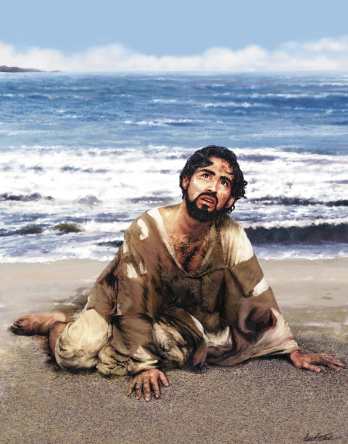
JonahJonah had gone out and sat down at a place east of the city. There he made himself a shelter, sat in its shade and waited to see what would happen to the city. Now the Lord G-d appointed a kikayon, and it grew up over Jonah to be shade over his head, to save him from his discomfort. Jonah was overjoyed with the kikayon.

But G-d designated a worm when the morning rose the next day, and the worm attacked the kikayon, and it withered.

Now it came to pass when the sun shone, that G-d appointed a stifling east wind; the sun beat on Jonah’s head, and he felt faint. He begged to die, and he said, “It would be better for me to die than to live.”

And G-d said to Jonah: “Are you very grieved about the kikayon?” And he said, “I am very grieved even to the point of death.”

And the Lord said: “You took pity on the kikayon, for which you did not toil nor did you make it grow; it lived one night and the next night perished. Now should I not take pity on Nineveh, the great city, in which there are many more than one hundred twenty thousand people that cannot discern between their right hand and their left, and many animals as well?”Jonah 4:5-11

Before continuing to read, if you haven’t done so already, go to yesterday’s meditation and review part 2 in this series: Mission Drift, then come back here.

The Rohr Jewish Learning Institute’s Rabbi Mordechai Dinerman wrote a commentary called “Jonah and the Big Shade” on which today’s morning meditation is based. You all probably know the basic story of Jonah. My inserting Jonah’s story here may seem a little mysterious in light of what I’m trying to study in this series of blog posts. Most people walk around the earth searching for purpose and meaning, but for Jonah, those things were abundantly clear. Right from the beginning, Jonah was a Prophet of God and his path was set before him:

The word of the LORD came to Jonah son of Amittai: “Go to the great city of Nineveh and preach against it, because its wickedness has come up before me.” –Jonah 1:1-2

I would imagine that if God came out point blank and told me the specifics of my purpose in life, where I was to go to find it, and what I was to do to fulfill it, I’d be thrilled beyond comprehension. But then again, maybe not. Jonah wasn’t thrilled. In fact, he tried to run away from his purpose and from God. He didn’t get very far. He was meant to go to Ninevah one way or the other. Like the old joke says, “we can do this the easy way or the hard way.” Jonah didn’t choose the easy way.

A few weeks ago, I wrote a blog post as a commentary for Torah Portion Masei. One of the key features of this Torah Portion is Moses reciting all of the places the Children of Israel camped during the 40 years of wandering. Why do that? Wasn’t the journey more important than the rest stops?

Perhaps not.

Recall the quote from yesterday’s morning meditation that was taken from the course book for the “Toward a Meaningful Life” lesson:

I wake up in the morning with the knowledge that my unique opportunities will be used to convey my individual personality in the places I find myself, thus inspiring the people around me.

Pay attention to the phrases, “my unique opportunities” and “in the places I find myself”. For Jonah, he could go no place on earth besides Nineveh in order to fulfill his purpose. He tried to go just about anyplace else, but that didn’t work out. Once the Children of Israel were consigned to wander the Sinai for 40 years, were they just wandering, or was there a purpose to where they went and what they did while they were there? What would have happened if they hadn’t encountered the descendents of Lot or Esau? Was it important that Aaron die specifically on Mount Hor? What about the battles and victories over Og, King of the Bashan and Sihon, King of the Amorites?

If the wanderings were truly aimless and the people and events they encountered really just random, why did Moses recount them to all of Israel on the threshold of entering Canaan? Why did Moses even bother to remember? Why were his words recorded in the Torah for all time to come, and why do we have them today?

Jonah's KikayonJonah had a reason to be at Ninevah and there was even a special purpose in his encounter with the kikayon plant (no one know exactly what this plant was supposed to be…it’s just a plant, but it had a purpose, too). Now think about where you go every day. Think about all of the places you’ve lived. Where have you gone on vacation? Where have you been “randomly” sidetracked? What did you do there and did any of it matter?

If your life isn’t random and arbitrary but rather, has a purpose and meaning assigned by God, then so does where your feet have taken you, or your car, or a train, or a plane, or whatever transportation you have used.

But what about the kikayon? Why did Jonah care more about that plant than he did for over 120,000 people in one of the largest cities in the world (at that point in history)? For that matter, why did God care about Ninevah when they had sinned greatly, including against the Israelites? God has exterminated whole people groups for their sin. Why did he care enough to spare Ninevah?

The most common explanation is that He felt compassion for their lives. They didn’t know their left hand from their right. They were helpless and blind, as far as God was concerned. Did Jonah care about the kikayon in the same way that God cared for Ninevah?

Yes and no.

Rabbi Dinerman explains:

In fact, the final message of the Book of Jonah is much more than a message about compassion. It is a message about the utter indispensability of every creature. G-d allows Jonah to enjoy the shade of a simple plant that protects him from the blazing sun. And the relief that Jonah feels as a result is so great that he cannot imagine being deprived of it, and when it is taken away, he is so upset that he cannot imagine living without it.

Jonah wasn’t upset about the kikayon’s death because he had compassion for it. He was upset because the kikayon served the purpose of shading him from the elements, and its death ended that purpose in Jonah’s life. How does this apply to the people and animals of Ninevah? Did God spare them because they repented and He had pity on them, or did He spare them because they repented and they were ready to fulfill their purpose in life?

Wow!

Yesterday, I quoted Rabbi Simon Jacobson’s famous definition of purpose:

Birth is G-d’s way of saying “you matter.”

Perhaps life is G-d’s way of saying “you still matter.” As long as it lived, the kikayon had a purpose and when its purpose ended, God appointed the means of its death. Though Jonah fully expected to die when he was thrown into the sea, God appointed a sea creature to preserve his life and to deliver him to his destination. Although the Book of Jonah ends abruptly, as if stopping in the middle of the story, we know that God spared Ninevah for a reason, we just don’t know what happens next.

You and I are still alive today, but the rest of our story hasn’t been written yet. There are still places to go, people to meet, things to do, and somehow, that’s all part of the reason we are here, even if we don’t always understand it.

“And why do you worry about clothes? See how the flowers of the field grow. They do not labor or spin. Yet I tell you that not even Solomon in all his splendor was dressed like one of these. If that is how God clothes the grass of the field, which is here today and tomorrow is thrown into the fire, will he not much more clothe you – you of little faith? –Matthew 6:28-30

The kikayon was only a plant, and yet it had a purpose assigned by the Creator of the Universe. Even the cattle in Ninevah each had a purpose. Jesus talks about grass growing one day and being thrown into the fire the next, and yet it is clothed in more splendor than King Solomon in all his royal glory.

Are not two sparrows sold for a penny? Yet not one of them will fall to the ground outside your Father’s care. And even the very hairs of your head are all numbered. So don’t be afraid; you are worth more than many sparrows. –Matthew 10:29-31

Grass, kikayons, sparrows, and cattle. Are you not worth more than all of these? If these common things all have a purpose and significance in the eyes of the Creator, how much greater is your purpose and significance to God?

Don’t go away. I’ll publish my commentary for Torah Portion Eikev in a few hours.

This series will continue on Sunday’s “morning meditation” Shattered Fragments. How does man and woman becoming “one flesh” affect the reason God made us?

Significance in the Vortex of God

The VortexThere we saw giants… and we were in our own eyes as locustsNumbers 11:33

Someone once asked Rabbi Shmuel of Lubavitch: “What is true learning?”

The Rebbe replied: “When one studies a section of Talmud or an idea in chassidus, one is there, together with its illustrious author. He is building upon the sage’s wisdom like a midget perched upon a giant – he is riding on the giant’s shoulders. “One must be grateful to the giant that he doesn’t fling the nuisance from his shoulders.”

-Rabbi Yanki Tauber
“The Irksome Burden”
Commentary on Parshah Shelach

Heaven above and the soul of man below are two halves of a single form, two converse hemispheres that fit together to make a perfect whole.

Attuned in perfect consonance, they dance a pas de deux of exquisite form, each responding to every subtle nuance of the other, mirroring and magnifying the most subliminal inner thought, until it is impossible to distinguish them as two.

Within the human being is the consciousness of G-d looking back upon Himself from within the world He has made.

We sit upon the vortex of Creation.

-Rabbi Tzvi Freeman
“Heaven Above, Man Below”
Chabad.org

We have this idea that we are connected to God. I wrote yesterday that part of the function of God’s commandments is to connect people with the Almighty. Yet, the two commentaries I quoted above seem to paint different pictures about the relationship between created being and Creator. Are we annoying gnats sitting on the shoulders of giants, or are we fully integrated into the very fabric of God’s eternity?

I have a hard time judging my relative position to God. Oh, I realize that in absolute terms, God is infinite and I am beyond insignificant by comparison. It is only through God’s mercy and grace that He’s even aware of me at all:

LORD, our Lord,
how majestic is your name in all the earth!
You have set your glory
in the heavens.
Through the praise of children and infants
you have established a stronghold against your enemies,
to silence the foe and the avenger.
When I consider your heavens,
the work of your fingers,
the moon and the stars,
which you have set in place,
what is mankind that you are mindful of them,
human beings that you care for them? –Psalm 8:1-4

Yet without human beings, what is the point of Creation?

As much as I try, there are days when I wonder how or why God would attend to any single individual. Yes, I know that “God so loved the world” and all of that (John 3:16), but does every single, specific person who is alive or who has ever lived really have a critical, irreplaceable part in God’s majestic, eternal, infinite plan?

Do I?

Someone once posed the following question to Rav Yechezkel Landau, the author of Teshuvas Noda B’Yehudah. He wanted to know whether it is permitted to place Sifrei Torah that are invalid and incapable of repair into the Aron Kodesh that was made to store valid Sifrei Torah. The questioner initially cited our Gemara as proof that it should be permitted. The Gemara relates that the broken set of Tablets was placed in the Aron Kodesh together with the second set of Tablets that was complete. Even though the Aron Kodesh was made for the second set of tablets, nevertheless, the broken Tablets were stored inside indicating that as long as an item had sanctity before it became broken or invalid it may continue to be stored in the place designated for intact and valid sacred items.

The questioner then rejected this parallel since it is possible that the broken Tablets were placed in the Aron Kodesh because they were made by God and that added sanctity allowed them to be stored in the Aron Kodesh even though they were broken. This would not allow for the storage of an invalid Sefer Torah to be stored in an Aron Kodesh since the Sefer Torah was not made by God. Noda B’Yehudah rejected this distinction and cited our Gemara to prove his point. After the Gemara teaches that the broken Tablets were stored in the Aron Kodesh the Gemara comments that this teaches that one must continue to treat a Torah scholar who forgot his learning with respect since he is similar to the broken Tablets. The Torah scholar was not the creation of God and yet the Gemara finds it to be a valid parallel to the broken Tablets and as such an invalid Sefer Torah could also be equated with the broken Tablets.

Daf Yomi Digest
Halacha Highlight
“Storing an invalid Sefer Torah in an Aron Kodesh”
Menachos 99

I’ve felt like an invalid Sefer Torah “incapable of repair”. My life has been like a “broken set of Tablets”. Am I worthy of being contained in a holy place just because I was made by God? Am I like a Torah scholar who has forgotten his learning? Once having been made holy, can my holiness be diminished?

Menachos 99 answers the latter question, “No”:

The Mishnah tells us that the lechem hapanim loaves were placed upon a marble stand as they were being brought to be placed upon the Shulchan in the Sanctuary. The set of loaves which were removed were placed upon a golden table after being taken out of the Sanctuary. This was a fulfillment of the adage, “we rise in holiness, and we do not descend.”

I admit to taking liberties with the interpretation and applying what is being said here to human beings , but I think this is a valid perspective (considering the Torah scholar with memory problems). If we are each made by God in His image, then individual people are sacred because we are His creations. If, as Rabbi Freeman states, “Heaven above and the soul of man below are two halves of a single form, two converse hemispheres that fit together to make a perfect whole”, then people enjoy a special unity with God that nothing else in Creation can possess. If this is true, then how can we dare to feel broken, or lost, or alone, or afraid?

And yet, we do. I know I do.

The Noda B’Yehudah is at odds with the parallel between the broken Tablets and the invalid Sefer Torah because:

…he maintains that the Aron Kodesh was built to store the broken Tablets and since that was the original intent it is permitted for them to be stored therein. An Aron Kodesh in a Beis HaKnesses was designed to store valid Sifrei Torah and as such one that is invalid and irreparable should not be stored in the Aron Kodesh. He observes, however, that common custom allows for the storage of invalid Sifrei Torah in an Aron Kodesh…

This seems to match up with Rabbi Tauber’s interpretation that we exist like insects riding the shoulders of giants every time we even learn one small section of Talmud or other holy lesson, building on the insights of those people much wiser and more righteous than we. We exist as a “convention” in the sense that broken pieces of the Tablet are stored in the holy ark simply because the ark was designed for that purpose and not because we have any intrinsic value of our own.

It’s more than a little puzzling. Are we important to God (or for that matter, other people) as individuals or not? Sometimes the answer seems to be “Yes” and at other times, “No”. Perhaps it’s the difference between allowing the full experience of connection between ourselves and God vs. the realization that God is amazingly, awesomely, vast, and my own presence on earth, by comparison, is like a hardly visible bit of flotsam barely staying above the waves of some expansive, turbulent, unfeeling sea.

“Come to me, all you who are weary and burdened, and I will give you rest. Take my yoke upon you and learn from me, for I am gentle and humble in heart, and you will find rest for your souls. For my yoke is easy and my burden is light.” –Matthew 11:28-30

I could use some of that “lightness of burden” right now. Contemplating the unimaginable intensity of God and sitting upon the vortex of Creation has become too much for me.

Good Shabbos.