Tag Archives: sukkot

Joy

Do you remember the thrill of hitting a home run? Getting out on the last day of school? Riding your new bicycle? You jump with joy. Fantastic!

Joy gives you energy and makes you feel great. You can achieve all kinds of things that otherwise may seem too difficult to attempt. With joy, you’re not afraid to talk to the guy sitting next to you on the plane. No problem! You’ve got energy, buoyancy. You’re alive!

True joy comes from the pleasure of growth and self-actualization – when we conquer a difficult challenge, or experience a moment of clarity.

When your team wins the World Series, or when you win the lottery, the joy is a delusion. Why? Because you did not change or grow.

Joy cannot result from events, from “good things happening to you.” Joy is solely the result of your reaction to life, your commitment to turning every moment into a growth experience. A new baby means you have to extend yourself at all hours of the day and night. That’s not easy. But if you focus – even at 3 a.m. – you’ll recognize this as real joy.

Do significant things and you will have more joy. If you are fighting for a cause, you are making an impact on the world. You are heavy. You are eternal.

-Rabbi Noah Weinberg
“Way #8, Constant Joy”
48 Ways to Wisdom
Aish.com

“Oh well,” he said after a moment. “Then I’ll dance, boss. Sit further away, so I don’t barge into you.”

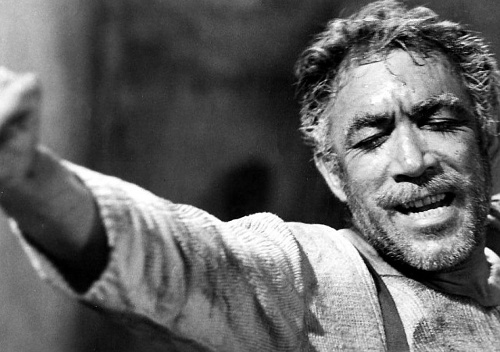
He made a leap, rushed out of the hut, cast off his shoes, his coat, his vest, rolled his trousers up to his knees, and started dancing. His face was still black with coal. The whites of his eyes gleamed.

He threw himself into the dance, clapping his hands, leaping and pirouetting in the air, falling on to his knees, leaping again with his legs tucked up – it was as if he were made of rubber. He suddenly made tremendous bounds in to the air, as if he wished to conquer the laws of nature and fly away. One felt that in this old body of his there was a soul struggling to carry away this flesh and cast itself like a meteor into the darkness. It shook the body which fell back to earth, since it could not stay very long in the air; it shot it again pitilessly, this time a little higher, but the poor body fell again, breathless.

-Nikos Kazantzakis
Zorba the Greek (1946)

Joy is usually an occasional or even rare event in our lives, not a constant companion. But then, how many of us could endure a constant state of joy, as if we were old Zorba, pushing our bodies to the limit, dancing and leaping and trying to defy gravity until we finally collapse on the ground exhausted?

Actually, this sounds like another “unlikely sage” I described last spring; Moshe the Shepherd, who also expressed unbounded joy with almost limitless energy.

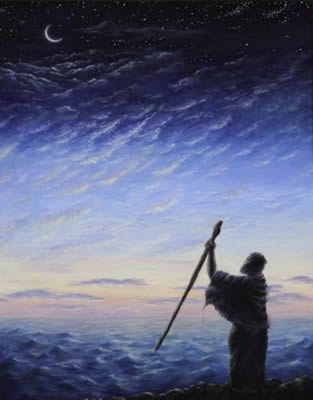
Then he got up and said, “Master of the world, I’m just a simple shepherd; I don’t know any Torah, and I don’t know how to pray. What can I do for You? The only thing I know is to sing shepherds’ songs!” He then began to sing loudly and fervently with all his strength until, again, he fell to the earth, exhausted, without an ounce of energy.

-Yitzchak Buxbaum
“The Shepherd”
from his book, Light and Fire of the Baal Shem Tov
quoted from Chabad.org

It’s the day after Yom Kippur. Either you feel elated or depressed. Like Elaina Cline said, “I used to hate Yom Kippur. Every year, as we blew the shofar and rushed home to eat, I would secretly breathe a huge sigh of relief. It was finally over – all the misery, the moroseness, the fear – until next year.”

You can hate Yom Kippur. You can dread confronting the darkest side of your soul. Or you can take joy in the opportunity to realize that what is worst about you is not who you really are. You are really a soul full of joy, singing, leaping, striving to reach your Creator, and to dance with God.

God does not desire that we remain in our pit of mud, sorrow, and regret. He didn’t create us to simply suffer and cry. We must have joy; we must take joy in Him, in all that He’s done for us, for creating our life, for giving us ambition and purpose, for granting us wings so that we can fly.

What is G‑d’s ultimate delight?

That a human soul will build portals of light so that the Creator’s presence may shine into His creation.

That a breath from His essence will pull herself out from the mud and turn to Him in love.

That a child of His being, exiled to the shadows of a physical world, will discover that the darkness is nothing more than Father hiding, waiting for His child to discover Him there.

But none of these can reach to the essence of all delights, the origin of all things, the hidden pleasure beyond all pleasures: The delight that this breath, this soul, this child did it all on its own.

-Rabbi Tzvi Freeman
“The Ultimate Delight”
Based on letters and talks of the Rebbe
Rabbi M. M. Schneerson
Chabad.org

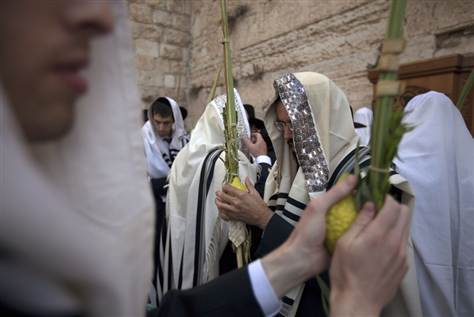
Sukkah in the rainSukkot is coming soon; a time to build and decorate, a time to eat, drink, and celebrate. Who better to invite to the party than God. How shall we call out to Him and express our joy?

“And my tongue will express Your charity. Your praise all day long.”

Psalms 35:28

The charity that King David was referring to was the kindness and charity that the Almighty bestowed on him. Out of gratitude and appreciation for this, King David would praise Hashem all day long.

Fulfillment of this one verse would guarantee a person a life of happiness and gratitude – an elevated and spiritual life.

-Rabbi Zelig Pliskin
“A Guarantee of Happiness”
Daily Lift #587
Aish.com

Oh come, let us sing to the Lord;
let us make a joyful noise to the rock of our salvation!
Let us come into his presence with thanksgiving;
let us make a joyful noise to him with songs of praise!
For the Lord is a great God,
and a great King above all gods.
In his hand are the depths of the earth;
the heights of the mountains are his also.
The sea is his, for he made it,
and his hands formed the dry land.
Oh come, let us worship and bow down;
let us kneel before the Lord, our Maker!

Psalm 95:1-6 (ESV)

Although life is no bed of roses and we face our burdens and struggles every day, God is with us. He cares about us, and makes the way clear for us to approach Him, from the greatest to the smallest, all of His creatures. Do not be afraid. Do not be discouraged. Even in the midst of your troubles, count it all joy.

Shavua Tov, chodesh tov, and shana tova!

The Elusive Unchanging Dove

The Lord spoke to Moses, saying: Say to the Israelite people: On the fifteenth day of this seventh month there shall be the Feast of Booths to the Lord, [to last] seven days. The first day shall be a sacred occasion: you shall not work at your occupations; seven days you shall bring offerings by fire to the Lord. On the eighth day you shall observe a sacred occasion and bring an offering by fire to the Lord; it is a solemn gathering: you shall not work at your occupations.

Those are the set times of the Lord that you shall celebrate as sacred occasions, bringing offerings by fire to the Lord — burnt offerings, meal offerings, sacrifices, and libations, on each day what is proper to it — apart from the sabbaths of the Lord, and apart from your gifts and from all your votive offerings and from all your freewill offerings that you give to the Lord.

Mark, on the fifteenth day of the seventh month, when you have gathered in the yield of your land, you shall observe the festival of the Lord [to last] seven days: a complete rest on the first day, and a complete rest on the eighth day. On the first day you shall take the product of hadar trees, branches of palm trees, boughs of leafy trees, and willows of the brook, and you shall rejoice before the Lord your God seven days. You shall observe it as a festival of the Lord for seven days in the year; you shall observe it in the seventh month as a law for all time, throughout the ages. You shall live in booths seven days; all citizens in Israel shall live in booths, in order that future generations may know that I made the Israelite people live in booths when I brought them out of the land of Egypt, I the Lord your God.

So Moses declared to the Israelites the set times of the Lord.

Leviticus 23:33-44 (JPS Tanakh)

The Midrash teaches: “Just as a dove (yonah) is simple and accepts authority, the Jewish people accept God’s authority by ascending to Yerushalayim during the holiday. Just as a yonah is distinguished to its partner, who can tell it apart from other birds, Klal Yisrael are separated from the non-Jews by how they cut their hair, their fulfillment of milah and their care to wear tzitzis. The Jews comport themselves with modesty, like doves…Just as doves atone, Yisrael atones for the nations when they bring the sacrificial bulls for them during Sukkos.

Daf Yomi Digest
Stories Off the Daf
“The Dove”
Kinnim 23

Wait a minute. Besides the part where it said “Klal Yisrael are separated from the non-Jews,” what did that say?

Just as doves atone, Yisrael atones for the nations when they bring the sacrificial bulls for them during Sukkos.

Yes, that’s what I thought it said.

I was reading this passage this morning (as I write this) and tried to recall exactly where in the Bible it says that the sacrifices of Sukkot were intended to atone for the nations of the earth. Naturally, my middle-aged memory being what it is, I couldn’t pull up the data, so I turned to my favorite research tool: Google. Turns out that the plain meaning of the text in the Torah regarding the Sukkot sacrifices doesn’t talk about atonement for the nations. But there’s always this:

These seventy oxen correspond to the original seventy nations of the world enumerated in the Torah who descended from the sons of Noah, and are the ancestors of all of the nations till this day. Israel brought these sacrifices as atonement for the nations of the world, and in prayer for their well-being; as well as for universal peace and harmony between them.

Thus our Sages taught, “You find that during the Festival [Succot], Israel offers seventy oxen for the seventy nations. Israel says: Master of the Universe, behold we offer You seventy oxen in their behalf, and they should have loved us. Instead, in the place of my love, they hate me (Psalms 109).”

G-d appointed Israel a kingdom of priests to atone for all these nations, and appointed Jerusalem a house of prayer for all the peoples…

We pray for the day when Israel will be fully restored to its land, rebuild the Holy Temple in Jerusalem, and bring peace between G-d and man, and between all peoples. Amen.

-Rabbi Yirmiyahu Ullman
“The Significance of Succot Sacrifices”
15 October 2005/12 Tishri 5766
Ohr Somayach International

Here’s another look at the same picture:

The Talmud (BT Sukkah 55:B) teaches that the seventy bulls that were offered in the Holy Temple served as atonement for the seventy nations of the world. Truly, as the rabbis observed, “if the nations of the world had only known how much they needed the Temple, they would have surrounded it with armed fortresses to protect it” (Bamidbar Rabbah 1, 3).

-quoted from The Temple Institute website.

The irony involved in this commentary is that even though the nations hate Israel and destroyed her Holy Temple, still the Jewish people continue to pray for the peace and redemption of the nations.

Actually, we do find the number of bulls that are sacrificed during Sukkot is 70 in Numbers 29 starting at verse 12. There’s also another connection between the nations, Israel and celebration of the feast of Sukkot found in the books of the Prophets:

Then everyone who survives of all the nations that have come against Jerusalem shall go up year after year to worship the King, the Lord of hosts, and to keep the Feast of Booths. And if any of the families of the earth do not go up to Jerusalem to worship the King, the Lord of hosts, there will be no rain on them. And if the family of Egypt does not go up and present themselves, then on them there shall be no rain; there shall be the plague with which the Lord afflicts the nations that do not go up to keep the Feast of Booths. This shall be the punishment to Egypt and the punishment to all the nations that do not go up to keep the Feast of Booths.

And on that day there shall be inscribed on the bells of the horses, “Holy to the Lord.” And the pots in the house of the Lord shall be as the bowls before the altar. And every pot in Jerusalem and Judah shall be holy to the Lord of hosts, so that all who sacrifice may come and take of them and boil the meat of the sacrifice in them. And there shall no longer be a trader in the house of the Lord of hosts on that day. –Zechariah 14:16-21 (ESV)

Sukkot is the only festival of the Jews when representatives of the nations of the world will be actually commanded to appear in Jerusalem to celebrate and, as you see, God desires this so much, that there will actually be penalties for nations refusing to be represented at this event in the days of the Messiah.

The Hebrew4Christians site adds a little more information to confirm this:

Prophetically, Sukkot anticipates the coming kingdom of Yeshua the Messiah wherein all the nations shall come up to Jerusalem to worship the LORD during the festival.

But that’s all in the future. What about now and especially, what about in ancient times? Has Israel been atoning for us all along and have we disastrously ended our own atonement before God by destroying the Temple and scattering the Jewish people throughout the earth?

I don’t know, but pondering all these thoughts did bring the following to mind:

You worship what you do not know; we worship what we know, for salvation is from the Jews. But the hour is coming, and is now here, when the true worshipers will worship the Father in spirit and truth, for the Father is seeking such people to worship him. God is spirit, and those who worship him must worship in spirit and truth.” The woman said to him, “I know that Messiah is coming (he who is called Christ). When he comes, he will tell us all things.” Jesus said to her, “I who speak to you am he.” –John 4:22-26 (ESV)

I’m not necessarily drawing a direct connection between all of these points, but they are rather compelling. Consider this. In ancient times, during the Sukkot festival, it is thought that the Israelites sacrificed 70 bulls for the atonement of the nations of the world. In the Messianic Age to come, the nations are commanded to come up to Jerusalem to celebrate Sukkot with Israel. And in his Sukkot commentary, Rabbi Ullman alludes to not only Zechariah 14 but this other prophetic word:

“And the foreigners who join themselves to the Lord, to minister to him, to love the name of the Lord, and to be his servants, everyone who keeps the Sabbath and does not profane it, and holds fast my covenant—these I will bring to my holy mountain, and make them joyful in my house of prayer; their burnt offerings and their sacrifices will be accepted on my altar; for my house shall be called a house of prayer for all peoples.” –Isaiah 56:6-7 (ESV)

Salvation for the nations comes from the Jews. It seems like our atonement in ancient days came from Israel and for those of us who are Christians, it continues to come from Israel even though the Temple in Jerusalem currently does not exist.

“For God so loved the world, that he gave his only Son, that whoever believes in him should not perish but have eternal life. For God did not send his Son into the world to condemn the world, but in order that the world might be saved through him. –John 3:16-17 (ESV)

We from the nations cannot escape the great gift that Israel has continued to bestow upon us from days of old until this very time. God made Israel a light to the nations (Isaiah 49:6) and that light has been allowed be spread from Israel and the Torah to the rest of us (Isaiah 2:2-4) so that we too can illuminate the world with that light (Matthew 5:14). But this is only possible because God sent the Jewish Messiah and King, our Master, to all of us. And this is only possible because the Messiah and Savior was as obedient as a dove (Matthew 3:16) and as silent as a lamb led to the slaughter (Jeremiah 11:19).

The Christian church hasn’t replaced Israel and we certainly haven’t merged into her so that Israel has ceased to be a people before her God. We among the nations are Israel’s beneficiaries. May we continue to bless the heart of Zion and her first born son, Jesus Christ, our Savior, King of the Jews.

That which can be grasped will change. That which does not change cannot be grasped.

-Rabbi Tzvi Freeman
“Grasping Change”
Based on letters and talks of the Rebbe
Rabbi M. M. Schneerson
Chabad.org

Without mentioning it specifically, the Zohar sees great significance in the fact that the dove (and turtledove) is the only kind of bird permitted for sacrifice. In this way, the mysterious legendary dove with an olive leaf in its mouth becomes a representation of King Messiah…

-Tsvi Sadan
Yonah – Dove, pg 113
The Concealed Light: Names of Messiah in Jewish Sources

He is the elusive, unchanging dove.


Terumah: Waiting for God On Earth

When dedicating the Beis HaMikdash, King Shlomo exclaimed in wonderment: “Will G-d indeed dwell on this earth? The heavens and the celestial heights cannot contain You, how much less this house!” For the Beis HaMikdash was not merely a centralized location for man’s worship of G-d, it was a place where G-d’s Presence was and is manifest. Although “the entire earth is full of His glory,” G-d’s Presence is not tangibly felt. He permeates all existence, but in a hidden way. The Beis HaMikdash, by contrast, was “the place where He chose to cause His name to dwell.” There was no concealment; His Presence was openly manifest.

Why was man’s activity necessary? Because G-d’s intent is that the revelation of His Presence be internalized within the world, becoming part of the fabric of its existence. Were the revelation to come only from above, it would merely nullify worldliness. To cite a parallel: when G-d revealed Himself on Mount Sinai, the world ground to a standstill. “No bird chirped… nor did an ox bellow, nor the sea roar.” Although G-dliness was revealed within the world, material existence did not play a contributory role.

When, by contrast, the dwelling for G-d is built by man himself part of the material world the nature of the materials used is elevated. This enables G-d’s Presence to be revealed within these entities while they continue to exist within their own context.

-Rabbi Eli Touger
“A Dwelling Among Mortals”
from the In the Garden of the Torah series
Adapted from
Likkutei Sichos, Vol. III, p. 902;
Vol. XVI, p. 286ff; Vol. XXI, p. 146ff
Chabad.org

The building of a Mishkan foreshadows the transformation of the entire world into a dwelling place for G-d. This is accomplished through Torah, Divine service, and deeds of kindness – the “three pillars” upon which the world stands. (Avos 1:2.)
-Based on Likkutei Sichos Vol. XVI, pp. 292-297.

In this week’s Torah portion, we see the Children of Israel being commanded to bring contributions that will be used as materials for building the Mishkan (Tabernacle) in the desert. Moses is provided with what me might think of as a “diagram” of the Heavenly Court and told to direct the Children of Israel to build, for all intents and purposes, a “scale model” so that God might dwell among His people. This is a strange enough request when you try to picture the “environment” where God dwells in the Heavens, and then imagine what it would be like to build a physical representation of that metaphysical “place.”

But it gets even stranger.

Thus, it is understood that although the construction of the Mishkan and the bringing of donations had to have happened in accordance with only one of these three schedules, all three opinions are true as they relate to the spiritual Mishkan within the heart of every Jew.
-Based on Likkutei Sichos Vol. VI, pp. 153-156.

The use of the term ‘them’ rather than ‘it’ has been interpreted as a message that the purpose of the Mishkan sanctuary was to facilitate the dwelling of the Divine Presence within the heart of every Jew. The role of the Mishkan in the wilderness and during the first four centuries of a Jewish presence in Eretz Yisrael was perpetuated by the first and second Beit Hamikdash Temples which spanned a period of nine centuries. All of this is today but a memory to which a visit to the Kotel (Western Wall) gives a special dimension. This does not mean, however, that a Jew cannot build a mini-sanctuary in his heart even today. The Divine Presence is waiting to dwell within the hearts of all Jews if only they will let it enter!

-Rabbi Mendel Weinbach
‘The “Holy Sites”‘
For the week ending 8 February 2003 / 6 Adar I 5763
Ohr Somayach

If it seems unusual or even incomprehensible to be able to build a “scale model” of the Heavenly Court and then expect God to take up residence, how much more incredible is it to expect God to take up residence within the “spiritual Mishkan within the heart of every Jew?”

Oh, have you heard of this before?

When the day of Pentecost arrived, they were all together in one place. And suddenly there came from heaven a sound like a mighty rushing wind, and it filled the entire house where they were sitting. And divided tongues as of fire appeared to them and rested on each one of them. And they were all filled with the Holy Spirit and began to speak in other tongues as the Spirit gave them utterance. –Acts 2:1-4 (ESV)

Perhaps this isn’t so strange, since the Jewish disciples of the Master had a precedent for the Pentecost event act at Sinai, but what came next was completely unexpected.

While Peter was still saying these things, the Holy Spirit fell on all who heard the word. And the believers from among the circumcised who had come with Peter were amazed, because the gift of the Holy Spirit was poured out even on the Gentiles. For they were hearing them speaking in tongues and extolling God. Then Peter declared, “Can anyone withhold water for baptizing these people, who have received the Holy Spirit just as we have?” And he commanded them to be baptized in the name of Jesus Christ. Then they asked him to remain for some days. –Acts 10:44-48 (ESV)

God desires to dwell among His people, which we can understand, because God once did dwell among His people in Eden before the fall. God once again, though in a somewhat different sense, arranged to dwell among His people Israel, and that dwelling was to be a light to the nations. As part of the process of God being among man, each Jew was to consider that the Divine Presence was also dwelling within each of them. This was repeated at the Pentecost event and while all of that is magnificent, the truly amazing thing in the eyes of God’s chosen ones, was (and perhaps still is for some Jewish people) that the Creator extended His splendid and compassionate grace, even to the Gentiles.

But is this the whole story and, now that Christianity boasts of the “indwelling of the Holy Spirit,” is this work finally complete?

On the ninth day of the month of Av (“Tish’ah B’Av”) we fast and mourn the destruction of the Holy Temple in Jerusalem. Both the First Temple (833-423 bce) and the Second Temple (349 bce-69 ce) were destroyed on this date. The Shabbat preceding the fast day is called the “Shabbat of Vision,” for on this Shabbat we read a chapter from the Prophets (Isaiah 1:1-27) that begins, “The vision of Isaiah…”

On the “Shabbat of Vision,” says Rabbi Levi Yitzchak, each and every one of us is granted a vision of the third and final Temple — a vision that, to paraphrase the Talmud, “though we do not see ourselves, our souls see.” This vision evokes a profound response in us, even if we are not consciously aware of the cause of our sudden inspiration.

Adapted by Yanki Tauber
“Shabbat of Vision”
Based on the teachings of the Lubavitcher Rebbe
Chabad.org

I previously mentioned that Christianity abandoned a major portion of it’s history and heritage by tossing the Jewish foundation of our faith aside, so I can understand that the church would view any Jewish “vision” of the Third Temple with skepticism if not utter disbelief. Perhaps they are right, but could there be any way to reconcile all of the imagery we have of the bodies of believers being as Temples for the Spirit of God and the coming of a Third, physical Temple where God will once again dwell among His people Israel?

Maybe.

Especially in western thought, we tend to see conditions as “either or”. Either the Spirit dwells in the Temple, or it dwells within the heart of the believer. For some reason, it can’t be both, although I’m not sure why. After all, in Judaism, the Divine Presence dwelt within the Mishkan, but it also dwelt within each Jewish heart in some mysterious, spiritual, and mystic way. God, in a metaphysical manner, dwelt within the Heavenly court, but He also made it possible for a physical replica of His “abode” to be created among His people Israel so He could also dwell among men, even though no structure could possibly contain Him.

God’s desire to be among us is fraught with problems when we actually make ourselves wonder how it is possible, and yet we see reliably, that God has indeed done so, in Eden, in the Mishkah, and in Solomon’s Temple. Jews are said to be able to have a vision, on a mystic level, of the Third Temple on the Shabbat just before the Ninth of Av. What are the Jewish people supposed to see and understand? Perhaps this.

The First Temple was built on Divine command and assistance. The Second Temple was constructed at the orders of a human being. The level of revelation associated with it, and the accompanying miracles, were far less intense. Yet, precisely because it came to be built through human efforts and on human initiative, it had a greater impact on this world. It was larger than the first Temple, taking up more of this world in terms of space, and it lasted longer, occupying this world for a greater length of time.

The Third Temple, like the Shabbat on which we are shown its image, combines the strengths of both the first and second Temples. It combines the Divine revelation, an inspiration from Above, along with human effort, an inspiration from below, to create a permanent home for G-dliness. Thus is the lesson and inspiration of this Shabbat. We are given a Divinely revealed vision which we must combine with human efforts to permanently alter the world we live in, and, even more challenging, ourselves.

-Chana Kroll
“Make It Real”
Shabbat Chazon
chabad.org

Repeatedly, we’ve seen how God must contribute to the construction of His dwelling on Earth, but so must man. While God does not need human beings to offer their efforts in the service of Divine tasks, we see in the Bible how people are continually involved in “building” with God and repairing the world. While God does not “need” our help, something about the nature of God dwelling among us requires that we be actively engaged. In this, we must take “ownership” of our desire to return the holy sparks within us to Him, not by our going up to God, but in allowing God to come down to us. Somehow, God dwelling within us and God dwelling among us in a Temple are all interconnected. We must change the world for Him but we must also change ourselves. Paradoxically, we can do neither without God’s help, but then, those tasks cannot occur without us, either. I can’t explain how it all works. I only know that God is showing all of us, not just the Jewish people, a picture of His future with His people; His human beings.

Chassidic master Rabbi Levi Yitzchak of Berdichev uses the following metaphor to explain the necessity of the Three Temples and why we must wait such a long time for Him to be truly among us again.

A father once prepared a beautiful suit of clothes for his son. But the child neglected his father’s gift and soon the suit was in tatters. The father gave the child a second suit of clothes; this one, too, was ruined by the child’s carelessness. So the father made a third suit. This time, however, he withholds it from his son. Every once in a while, on special and opportune times, he shows the suit to the child, explaining that when the child learns to appreciate and properly care for the gift, it will be given to him. This induces the child to improve his behavior, until it gradually becomes second nature to him — at which time he will be worthy of his father’s gift.

God has shown us His gift in the Messiah, but He also withholds the Messiah’s coming until we are ready. But God is gracious enough to show us what will happen once we reach this state of being worthy. Through the vision of a prophet, we can see the return of the Messiah, our later return to Eden, and finally, the placing of the Throne of God among us at a future time when the requirement for Ezekiel’s Temple is no longer necessary.

Then the angel showed me the river of the water of life, bright as crystal, flowing from the throne of God and of the Lamb through the middle of the street of the city; also, on either side of the river, the tree of life with its twelve kinds of fruit, yielding its fruit each month. The leaves of the tree were for the healing of the nations. No longer will there be anything accursed, but the throne of God and of the Lamb will be in it, and his servants will worship him. They will see his face, and his name will be on their foreheads. And night will be no more. They will need no light of lamp or sun, for the Lord God will be their light, and they will reign forever and ever. –Revelation 22:1-5 (ESV)
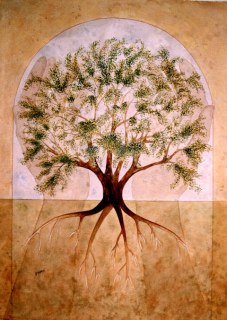
But before all that happens, we must come to terms with our struggle between life in this world, in the spirit and in the body, as Rabbi Tzvi Freeman relates:

The human mind despises the body that houses it, but the soul has only love.

The mind would soar to the heavens, but for a body that chains it to the earth. The mind would be consumed in divine oneness, but for the body’s delusion of otherness, as though it had made itself.

But the soul sees only G-d.

In that very delusion of otherness,
in that madness of the human ego,
even there, the soul sees only G‑d.
For she says, “This, too, is truth.
This is a distorted reflection of the Essence of all things,
of that which truly has neither beginning nor cause.”

And so she embraces the bonds of the body,
works with the body, transforms the body.
Until the body, too, sees only G-d.

—Basi LeGani 5712

Good Shabbos.

At the Table of Abraham, Isaac, and Jacob

On today’s amud we find that seeming to prefer one sefer Torah over the other is like besmirching the other sefer Torah.

Honoring the sefer Torah is a great mitzvah. Some people even purchase a special silver crown for the Torah to show honor and respect for it. In one shul they had several sifrei Torah but only one crown. Usually this was sufficient, since on most weekdays and Shabbosim only one sefer is removed from the aron hakodesh. But on days when more than one sefer was removed, they would put the crown on only one of the seforim—what choice did they have?

One talmid chacham pointed out that this may be a lack of honor to the second sefer. “The Chazon Ish told Rav Simchah Kaplan, the rav of Tzfas, that he should not allow them to make a special monument in the cemetery there for a certain tzaddik since this besmirches the many other great tzaddikim interred there. Presumably the same is true in our situation and we must either purchase another crown or refrain from putting the crown on either sefer?”

They agreed to ask Rav Chaim Kanievsky, shlit”a, and he ruled in his usual brief and to-the-point manner: “They can put the crown on whichever Torah they want.”

When this question and answer reached the author of Doleh Umashkeh, shlit”a, he explained why there is no proof from the Chazon Ish’s ruling regarding a memorial in the cemetery in Tzfas. “A special monument is a permanent way of distinguishing one tzaddik over the others, while a crown on a Torah is only worn for a short time.”

Mishna Berura Yomi Digest
Stories to Share
“The Torah’s Honor”
Siman 144, Seif 4

You may be wondering what this has to do with anything, but when I read this commentary, I couldn’t help but think of the conversation that’s been going on in another one of my “meditations” for the past week about debating fulfillment theology. Let me explain.

One of the issues regarding how we consider the “specialness” of the Jewish disciples of Jesus (or Jews in general) relative to the Gentile disciples is the concern that Gentiles will become “second-class citizens” of the Kingdom if Jews are viewed as having a different covenant relationship with God. My proposition has been that the Messianic or Davidic covenant which was initiated by the birth, death, resurrection, and ascension of Jesus Christ, did not overwrite or eliminate either the Abrahamic or Mosaic covenants that came before it, but rather, the Messianic covenant ratified the previous two covenants even as the Mosaic ratified but did not eliminate the Abrahamic covenant.

The first two covenants apply only to the Children of Israel but the third applies to Israel and to the nations. I know this is pretty confusing, and it’s probably easier for most Christians to do away with the complex nature of treaty and covenant relationships as they were understood in the ancient near east, by simply doing away with all but the most recent covenant, but that wouldn’t be accurate, fair, or Biblically honest. Yet, like the crown we see that can only be applied to a single Torah scroll, it seems as if only one scroll receives the highest honors with the other scrolls being subordinate. Just as with the concerns expressed in the commentary above, the Gentile disciples of Jesus (i.e. Christians) do not think it’s fair for the Jews to be crowned with a higher honor than the Gentiles and thus, one of the motivations for supersessionism is born. Instead of the Jews being ascendant over the Christians, the Christians become ascendant over the Jews. Using another Daf commentary, he’s a metaphor of how Christians see the Jews and the Torah.

Shulchan Aruch rules that a rented property that is used for a Beis HaKnesses does not have the sanctity of a Beis HaKnesses. The reason, explains Levush, is that although for the duration of the lease the property will be used for a Beis HaKnesses it is still considered only temporary since today or tomorrow the owner will take back the property. Only when a building was constructed in the first place to be a Beis HaKnesses or if it was purchased to be used as a Beis HaKnesses does it attain the sanctity of a Beis HaKnesses. Teshuvas Ravaz suggests that Shulchan Aruch is basing his ruling on our Gemara which states that a tenant cannot sanctify the rented property since it is not his. The rationale, suggests Teshuvas Ravaz, is that we do not find precedent that property could become sanctified for a limited period of time and then have the sanctity dissipate into nothing upon the end of the lease. As such one could assert that just as a tenant cannot sanctify the property that he is renting to the Beis HaMikdash, so too, he cannot sanctify rental property as a Beis HaKnesses for a limited period of time and then have that sanctity dissipate upon the end of the lease.

Beiur Halacha cites earlier authorities who maintain that Shulchan Aruch’s ruling is limited to the circumstances of Mahari ben Chaviv whose words are the source for Shulchan Aruch’s ruling. In the time of Mahari ben Chaviv the government did not allow property to be rented out to serve as a Beis HaKnesses. For that reason the rental of a property for a Beis HaKnesses was by nature very temporary since at any time the owner could contact the renters and inform them that they had to leave the premises. As such a property rented to be a Beis HaKnesses did not attain the sanctity of a Beis HaKnesses. In our times when it is acceptable for property to be used as a Beis HaKnesses and the owner cannot terminate the lease early a Beis HaKnesses that rents space does attain the sanctity of a Beis HaKnesses with all the halachos that go together with that.

Daf Yomi Digest
Halacha Highlight
“The sanctity of a Beis HaKnesess on leased property”
Arachin 21

The Mosaic covenant, the Torah which details its conditions, and the people who have been subject to that covenant, are all considered temporary or “placeholders” until the arrival of the Messiah. According to supersessionist thought, the Jewish people have no intrinsic value in and of themselves, to God or to the world. The Jews, the Torah, and the Mosaic covenant only existed to point to the Messiah and perhaps just to “fill up space” until Jesus was born.

Once the Messiah arrived and “completed” the work of the Law, the temporary covenant expired, according to supersessionism, and the Messianic covenant permanently replaced the Mosaic covenant, the conditions of the Torah for the Children of Israel, and the descendents of Israel, the Jewish people, forever. Any “sanctity” that the Jews possessed, like a Beis HaKnesses that is rented property, is considered temporary and perishable. In contrast, the Messianic covenant and the Gentile Christians (and any Jews who might choose to surrender their Jewish identity and succumb to becoming a Gentile by converting) rise to become the permanent inheritors of all the covenant promises God made and that were contained in the Abrahamic covenant, with the conditions of the Mosaic covenant (with minor exceptions) being swept away as inferior and even repulsive (which is probably where many Christians over the past 2,000 years got the idea that the Jews themselves were inferior and repulsive).

But is this really so? The two commentaries above do not have direct applications to the answer and I’m using them only as imperfect metaphors, but I think they’re very good imperfect metaphors. Let’s consider the “temporary” nature of Jesus Christ.

And the Word became flesh and dwelt among us… –John 1:14 (ESV)

And the Word became flesh, and did tabernacle among us… –John 1:14 (Young’s Literal Translation)

Most common English translations of John 1:14 say that the Word “dwelt among us” or “made his dwelling among us” or “lived among us”. Young’s translation implies that the “living among us” was temporary, because a tabernacle or a “tent” is not considered a permanent home (although it can be used over an extended period of time, even decades, as we see in the example of the wanderings of the Children of Israel in the wilderness). The Weymouth New Testament translates the same words as “and lived for a time in our midst”, which also emphasizes that Jesus was among us only temporarily.

Jesus, the Word, lived among human beings but only temporarily. Did that make him any less sanctified before God? Perhaps we shouldn’t be so quick to discard things we consider temporary. They could have a much longer “shelf life” than we might imagine.

“I will make with them a covenant of peace and banish wild beasts from the land, so that they may dwell securely in the wilderness and sleep in the woods. And I will make them and the places all around my hill a blessing, and I will send down the showers in their season; they shall be showers of blessing. And the trees of the field shall yield their fruit, and the earth shall yield its increase, and they shall be secure in their land. And they shall know that I am the LORD, when I break the bars of their yoke, and deliver them from the hand of those who enslaved them. They shall no more be a prey to the nations, nor shall the beasts of the land devour them. They shall dwell securely, and none shall make them afraid. And I will provide for them renowned plantations so that they shall no more be consumed with hunger in the land, and no longer suffer the reproach of the nations. And they shall know that I am the LORD their God with them, and that they, the house of Israel, are my people, declares the Lord GOD. And you are my sheep, human sheep of my pasture, and I am your God, declares the Lord GOD.” –Ezekiel 34:25-31 (ESV)

“For behold, in those days and at that time, when I restore the fortunes of Judah and Jerusalem, I will gather all the nations and bring them down to the Valley of Jehoshaphat. And I will enter into judgment with them there, on behalf of my people and my heritage Israel, because they have scattered them among the nations and have divided up my land, and have cast lots for my people, and have traded a boy for a prostitute, and have sold a girl for wine and have drunk it. –Joel 3:1-3 (ESV)

Lest you be wise in your own sight, I do not want you to be unaware of this mystery, brothers: a partial hardening has come upon Israel, until the fullness of the Gentiles has come in. And in this way all Israel will be saved, as it is written,

“The Deliverer will come from Zion,
he will banish ungodliness from Jacob”;
“and this will be my covenant with them
when I take away their sins.” –Romans 11:25-27 (ESV)

Unless God was leaving out some important details, He never seemed to indicate that the Children of Israel would be a people before Him only up to a certain time, and then He’d toss them aside like a bowl of hummus that had been left out in the sun too long. In fact, it seems as if He plans to judge all of the nations that have treated His people Israel poorly, so perhaps the rest of us should be a little cautious when we casually claim that we have replaced “the apple of His eye.” For those Christians who are reading this who are still convinced that Jews and Judaism are “dead” in the eyes of God and as seen through the lens of the Davidic covenant, remember that God can resurrect human beings and even a nation of “dry bones” (Ezekiel 37:1-14). Israel is not “cut off.” Israel has hope. God will place flesh upon all of Israel and Israel will be restored. In fact, God is restoring Israel right now, before our very eyes.

We have a picture, based on John 1 of the Messiah temporarily dwelling among his people Israel and then leaving again. We have a picture of the Jewish people, based on Romans 11 temporarily being “hardened” against the Messiah. We also have this.

And I heard the number of the sealed, 144,000, sealed from every tribe of the sons of Israel… After this I looked, and behold, a great multitude that no one could number, from every nation, from all tribes and peoples and languages, standing before the throne and before the Lamb, clothed in white robes, with palm branches in their hands, and crying out with a loud voice, “Salvation belongs to our God who sits on the throne, and to the Lamb!” –Revelation 7:4,9-10 (ESV)

Then the angel showed me the river of the water of life, bright as crystal, flowing from the throne of God and of the Lamb through the middle of the street of the city; also, on either side of the river, the tree of life with its twelve kinds of fruit, yielding its fruit each month. The leaves of the tree were for the healing of the nations. No longer will there be anything accursed, but the throne of God and of the Lamb will be in it, and his servants will worship him. They will see his face, and his name will be on their foreheads. And night will be no more. They will need no light of lamp or sun, for the Lord God will be their light, and they will reign forever and ever. –Revelation 22:1-5 (ESV)

Here we see that the “temporary” Lamb is now permanent and the “temporary” tribes of Israel are now permanent, and we also see that “a great multitude…from every nation, from all tribes and peoples and languages” will be “standing before the throne and before the Lamb.” Jesus is permanent though he was once temporarily on the Earth. The tribes of Israel are permanent though they temporarily were hardened to the Messiah for the sake of the Gentiles. The Gentiles are there with the tribes of Israel and with the Lamb, not as second-class citizens, but co-citizens with Israel in the Kingdom, and the Lamb is the Lamb for us all.

One God, One Lamb, One throne, One Kingdom. One shepherd over two folds in one pen.

I am the good shepherd. I know my own and my own know me, just as the Father knows me and I know the Father; and I lay down my life for the sheep. And I have other sheep that are not of this fold. I must bring them also, and they will listen to my voice. So there will be one flock, one shepherd. –John 10:14-16

I don’t know how it all works or how it will all work out, but I trust that it will all work out between God and His people Israel, and we Gentile Christians, His people who were placed in His hand by Jesus. And in the end, we will all be seated together at the feast of Abraham, Isaac, and Jacob (Matthew 8:11) and we will all be at peace and none will make us afraid (Micah 4:4) “for the mouth of the LORD of hosts has spoken.”

V’zot Haberachah: When the Party Ends

Hebrew FireAnd this is the blessing that Moses, the man of God, bestowed upon the Children of Israel before his death. He said: Hashem came from Sinai – having shone forth to them from Seir, having appeared from Mount Paran, and then approached with some of the holy myriads – from His right hand He presented the fiery Torah to them. Indeed, You loved the tribes grately, all its holy ones were in Your hands; for the planted themselves at Your feet, bearing [the yoke] of Your utterances: “The Torah that Moses commanded us is the heritage of the Congregation of Jacob.”Deuteronomy 33:1-4

The Rambam writes: “Moshe ordained that on every festival, the Jews should read [a portion of the Torah which reflects] its content.” He continues by listing the passages read on different festivals, and concludes that on Simchas Torah, we read Zos HaBerachah. This implies that the reading of Zos HaBerachah on Simchas Torah shares a connection with the holiday itself; it is not read at that time merely because it is customary to conclude the yearly cycle of Torah readings on that festival.

-Rabbi Eli Touger
In the Garden of Torah
“A Fountain of Blessing”
V’zos Haberachah
Chabad.org

The final portion of Deuteronomy is always read on Simchat Torah, the “Rejoicing of the Torah”, as one Torah cycle ends and another begins. It is a reminder that all things end and yet all things are new. The gift of God’s Torah to the Jews is celebrated with much laughter and dancing. In the synagogue, all of the Torah scrolls are removed from the ark and everyone carries them and dances and sings and cheers in joyous appreciation of God’s goodness. Shemini Atzeret and Simchat Torah also formally end the Jewish holiday season and, the following Shabbat, the reset button is pushed and Parashoat B’resheet starts another cycle of reading.

Yet in the midst of tremendous victory, Rabbi Touger chooses to remind his readers of one of Israel’s greatest tragedies.

In this context, however, a difficulty arises: Rashi explains that the final phrase of the Torah, l’einei kol Yisrael, “before the eyes of the entire Jewish people,” refers to the breaking of the tablets containing the Ten Commandments. Our Sages attach great importance to conclusions, explaining that they summarize the content of all the preceding concepts. Why then does the conclusion of the entire Torah and in particular, the conclusion of the reading V’Zos HaBerachah mention a subject which seemingly reflects the disgrace of the Jewish people, for the tablets were broken because of the nation’s sin in worshipping the Golden Calf.

However, to understand why such a time of shame should be introduced into the culmination of a season of celebration, we have to go back into the symbolism for both Sukkot and for Simchat Torah:

What is the inner content of Simchas Torah? When contrasting the sacrificial offerings brought during Sukkos to those brought on Simchas Torah, our Sages explain that the 70 bulls offered on Sukkos refer to the 70 nations of the world. The one bull offered on Simchas Torah refers to the Jewish people, the “one nation.”

Simchas Torah is a day when “Israel and the King are all alone.” This is a time when the essential bond between G-d and the Jewish people is expressed in joyous celebration. This concept is reflected in the name of the Torah reading, V’Zos HaBerachah, lit. “This is the blessing,” and its content, which focuses entirely on the blessings given the Jewish people, and the praise of their uniqueness.

PrayingThat Sukkot includes the nations and not just the Jews is perfectly understandable, given Zechariah 14:16-19, when all the survivors of the war against Israel from among the Gentile nations will be commanded to send representatives to Jerusalem for Sukkot and pay homage to the King in Messianic days. For a Gentile such as myself to celebrate Sukkot now is something of a taste of things to come. But there is something else.

If Sukkot is an invitation for everyone to join God and God’s chosen people, Simchat Torah is a time when, according to Rabbi Touger, the nations are “included out”. This rather punctuates the fact that the Torah was given just to Israel and that the special holiday of honoring the giving of the Torah at Sinai is just between God and His One Nation: the Jews. While God is the Father and Creator of the people of the world, it’s as if the Father wants to have a special day with only His first born. It is also a time when, remembering the Golden Calf, God consoles His special son and brings His son back from his past shame and returns the son to God’s love.

This also explains why Moses broke the first set of tablets, out of God’s great love for Israel:

To explain: When describing the reason for the breaking of the tablets, Rashi states:

To express with an analogy: A king journeyed to a distant country, leaving his betrothed with maids. Because of the depravity of the maids, the reputation of the intended also became tarnished. The bridesman took the initiative and ripped up the wedding contract, saying: “If the king will order to kill her, I will protest, saying that she was not yet his wife.”

The king is the Holy One, blessed be He; the maids, the mixed multitude [of converts who joined the Jews after the Exodus]. The bridesman is Moshe, and the betrothed…, the Jewish people.

Rashi’s intent is to explain that Moshe broke the Tablets to protect the Jewish people from G-d’s wrath. Here we see the unique importance of the Jewish nation. The Torah is G-d’s “delight, frolicking before Him at all times.” And within the Torah, the tablets on which the Ten Commandments were engraved were “the work of G-d… and the writing of G-d,” given to Moshe by G-d Himself. And yet when the future of the Jewish people was at stake, Moshe was willing to break the tablets without hesitation.

Why did Moshe take such a step? Because there is nothing not even the Torah which G-d cherishes more than a Jew.

For a Jew, this makes perfect sense, but for a Christian it is confusing. This is especially true in light of the explanation that the Golden Calf incident is attributed largely to the Gentile “converts” to Judaism, casting Gentiles in an untrustworthy light. But if a Jew considers himself God’s first born, a Christian acknowledges the first born of the Creator as ultimately expressed in the person of Jesus Christ:

About eight days after Jesus said this, he took Peter, John and James with him and went up onto a mountain to pray. As he was praying, the appearance of his face changed, and his clothes became as bright as a flash of lightning. Two men, Moses and Elijah, appeared in glorious splendor, talking with Jesus. They spoke about his departure, which he was about to bring to fulfillment at Jerusalem. Peter and his companions were very sleepy, but when they became fully awake, they saw his glory and the two men standing with him. As the men were leaving Jesus, Peter said to him, “Master, it is good for us to be here. Let us put up three sukkot – one for you, one for Moses and one for Elijah.” (He did not know what he was saying.)

While he was speaking, a cloud appeared and covered them, and they were afraid as they entered the cloud. A voice came from the cloud, saying, “This is my Son, whom I have chosen; listen to him.” When the voice had spoken, they found that Jesus was alone. The disciples kept this to themselves and did not tell anyone at that time what they had seen. –Luke 9:28-36

Simchat TorahWhat this all means, I don’t exactly know. I do know that the Jewish people have always been special to God and they always will be special, even above all the other people of the earth and yes, even above Christianity, those of us among the nations who have chosen to be disciples of the Master.

Even Paul went first to the Jews and only afterward to the Gentiles (Romans 1:16; Romans 2:10), though he was specifically sent as an emissary to the nations. This should be a message for those Christians who tend to get a little full of themselves contemplating the idea that somehow the church has replaced Israel, while ignoring Paul’s warning in Romans 11:24. Indeed, all of Israel will be saved (Romans 11:26).

But while we continue to eat and fellowship and enjoy Shemini Atzeret, this “extra” day of Sukkot, we are about to be escorted out of the hall and politely asked to leave the party, for Simchat Torah is a private affair between the Jews and God. The last day of the great celebration is limited to a very special people who have, above all the nations, endured extreme hardship and suffering for the sake of keeping God’s Torah and His Shabbat when the rest of the world was wallowing in pools of pagan savagery.

Waiting to danceHow then can the rest of us, though we know God is right, console ourselves as we stand on the outside of God’s special and unique love, looking in? How can we watch the dancing around the synagogue with the Torah while we sit alone in the dark? Only by remembering this and knowing that we are not completely rejected because of God’s love for the Jews.

For God so loved the world that he gave his one and only Son, that whoever believes in him shall not perish but have eternal life. –John 3:16

There are many kinds of barriers: Those from within and those from without. Barriers between people. Barriers that prevent you from doing good things.

Barriers of your own mind and your own hesitations. There are the barriers that exist simply because you are a limited being.

Joy breaks through all barriers.

-Rabbi Tzvi Freeman
“Joy Unleashed”
Based on letters and talks of the Rebbe
Rabbi M. M. Schneerson
Chabad.org

Someday, we will be asked to dance as well.

Falling

FallingIt does seem frightfully unfair that one man’s single transgression should consign all humanity to death. But it is equally unfair that one man’s righteousness also offers all of humanity the reward of righteousness: “the right to the tree of life.” (Revelation 22:14)

From: “The Life-giving Spirit”
Parasha B’reisheet commentary
First Fruits of Zion (FFOZ)

After man ate from the Tree of Knowledge, however, he acquired the intimate knowledge of and desire for evil. The evil inclination was no longer an external force, represented by the Serpent. It was within. Our physical flesh was now a confused mixture of good and evil. Death was introduced into the world: human flesh, separated from the spirit, was a creature of the finite, physical realm — one which must ultimately decay and die. Man would now face a much greater challenge than before. He would no longer battle a Serpent from without. He would have to battle his own sluggish yet desirous flesh within.

Rabbi Dovid Rosenfeld
The Primordial Sin, Part II
Pirkei Avos Chapter 6, Mishna 5(b)
Torah.org

This coming Saturday, we begin a completely new Torah cycle with Parasha B’reisheet and once again, we start by reading the first chapters of Genesis. Adam is coming, and I’m a little nervous. I know this may seem strange, since we are in the middle of Sukkot, a time of great joy, but it’s as if I am sitting in my sukkah, somehow looking at Creation from several moments before God said “Let there be light” (Genesis 1:3). Yet in that point of suspended time, I know everything that is going to happen after God speaks these words. It’s as if God has not yet created the universe and some part of me wants to stop Him. How can He create the Earth, Adam, Eve, the tree of the knowledge of good and evil, even the serpent, knowing what I know; knowing about the fall? How can He create the universe knowing about all of the pain, anguish, and suffering that is going to happen as a result?

What?

Do you doubt that God knew about what would happen once He started everything in motion? Don’t you realize that to be God, He must have known that Adam would disobey, give into temptation, and lead all of humanity down a dark and sinister road to the abyss?

God must have known, but He created us anyway. Still, waiting for next Shabbat to come is like waiting for it happen all over again, from moments before God brought all into being with His powerful Word, to forming the first man out of clay, breathing life into Him, splitting the man and making woman, placing them in the Garden, and then…and then…

I often despair at the state of the world. All I have to do is go online and start reading the news. I recently read a story on CNN about a toddler in China who was the victim of a hit-and-run accident. As bad as this is, what makes the story all the more horrible is that she was hit twice by two separate vehicles and neither driver stopped. Worse, numerous pedestrians walked right past her and did nothing. Finally, a “58-year-old scavenger named Chen Xianmei” stopped and pulled her out of the street. The CNN story states that the “grainy footage of the accidents went viral on Chinese Internet within minutes of posting”, and only then did anyone express “outrage”.

According to Rabbi Rosenfeld, as a result of what Christians call “the fall”, humanity is now is a state of confusion, trying desperately to tell the difference between good and evil and to understand what we are supposed to be doing about it. The Prophet Isaiah, in warning Israel, could also have been warning us:

Woe to those who call evil good
and good evil,
who put darkness for light
and light for darkness,
who put bitter for sweet
and sweet for bitter. –Isaiah 5:20

God holds the worldIt seems as if everything that God tells us is evil and wrong is touted by the world around us as right, positive, and desirable. In that sense, I feel very much a stranger in a strange land, an alien among humanity, a pariah standing against everything the world says is the right thing to do and being called cruel and bigoted because of it.

That’s why I want to stop God from creating the world. Because it will just start all over again and we’ll end up right back here, facing the same day, the same problems, the same moral confusion where right and wrong are literally turned inside out.

Do not repay anyone evil for evil. Be careful to do what is right in the eyes of everyone. If it is possible, as far as it depends on you, live at peace with everyone. Do not take revenge, my dear friends, but leave room for God’s wrath, for it is written: “It is mine to avenge; I will repay,” says the Lord. On the contrary:

“If your enemy is hungry, feed him;
if he is thirsty, give him something to drink.
In doing this, you will heap burning coals on his head.”

Do not be overcome by evil, but overcome evil with good. –Romans 12:17-21

…so Christ also, having been offered once to bear the sins of many, will appear a second time for salvation without reference to sin, to those who eagerly await Him. –Hebrews 9:28

I know, I know…he’s coming, too. Jesus, I mean.

The world is broken but not beyond repair. The principle of Tikkun Olam tells us that we are junior partners with God in the act of repairing the world. Of course, we all await the Messiah to come back and bring the job to its finale, restoring us to who and what we were before the serpent entered the Garden and in fact, restoring the Garden itself. I know. We will once again walk with God as Adam did and “each man will sit under his vine and under his fig tree, and none will make him afraid” (Micah 4:4).

Sukkah in the rainI just wish we didn’t have to fall in the first place, because it’s so hard to get back up.

Maybe that’s why Sukkot is happening right now. In an imperfect world, where our shelters don’t have solid walls and the roof leaks, we are like people living in a sukkah depending on God to keep us fed, warm, dry, and safe.

Adam is coming and he’s about to fall. But Jesus is coming to help pick him back up. I’m trembling in fear as it’s about to happen all over again. I’m watching, I’m waiting. I’m praying.

Having discovered all your faults, you are depressed.

Imagine you have just found a doctor with a diagnosis that explains all your afflictions over the past many years. And he’s written a prescription directing you on a sure path to good health.

Shouldn’t you jump with joy and relief?

-Rabbi Tzvi Freeman
“Joyful Prognostics”
Based on letters and talks of the Rebbe
Rabbi M. M. Schneerson
Chabad.org

A few months back, I wrote a three-part series on the lessons we are about to learn once more in Genesis. This might be a good time to read them again: Part I: Overcoming Evil, Part II: The Primordial Serpent, and Part III: Healing the Wounded.