Tag Archives: synagogue

Zetterholm, Ancient Antioch, and Today’s Messianic Judaism

It is a sad fact that our knowledge of the Judaism of the first century CE is rather limited. It is true that we know quite a lot about the ideology of different Jewish groups. The pioneering works of C.G. Montefiore, G.F. Moore, R.T. Herford, J. Parkes, and W.D. Davies, for instance, culminating in that of E.P. Sanders, have been of tremendous importance in showing that ancient Judaism was not a legalistic religion in which salvation was earned by merit, but a living religion of grace and forgiveness.

-Magnus Zetterholm
Chapter 3: “The Cultural and Religious Differentiation,” pg 53
The Formation of Christianity in Antioch: A Social-Scientific Approach to the Separation between Judaism and Christianity

I wish Pastors preached sermons based on the latest research performed by New Testament theologians and historians. What we hear from the pulpit, more often than not, is doctrine that is decades if not centuries (or longer) old, the same standard preaching that declares Judaism of ancient and modern times as a “religion of dead works.” Even in the church I attend, which has a very pro-Jewish perspective, Jewish people and national Israel are loved, but the Christians are very happy that the old Law is dead and replaced by grace. Jews are loved but Judaism is not, even the (Pharisaic) Judaism practiced by Paul and by Jesus and by all the apostles.

Zetterholm’s book seeks to understand and explain the early schism between the Judaism once called “the Way” and the emergent religious form adopted by Gentile believers known as “Christianity” from a sociological rather than a theological point of view. Of course, it’s impossible to keep theology completely at bay, but Zetterholm, who doubts the accuracy of certain sections of Luke’s Book of Acts and any part of the Bible that speaks of miracles, does his best.

That said, I find his research compelling because he doesn’t have a doctrinal ax to grind and he does establish and confirm certain things about Judaism as practiced by the believing Jews in first century CE Syrian Antioch.

It is generally accepted that the Judaism of the first century CE was not homogeneous but a complex, diversified phenomenon. At the same time these somewhat different realizations of Jewish life had something in common. E.P. Sanders has referred to what he calls “common Judaism” as “what the priest and the people agreed on.”

-ibid, pp 55-6

This isn’t the first time I’ve heard of this concept. Nearly a year ago, Rabbi Dr. Carl Kinbar had this to say in different comments on one of my blog posts:

The situation today is very different. There is no common Judaism or commitment to Torah that is shared by the streams of Judaism and, especially, by individual Jews. Second Temple Judaism varied from one form of Torah observance to another. Today’s diversity is from ultra-orthodoxy to atheism.

To avoid misunderstanding, let me put it this way: common Judaism had a core of practices that all communities of any size considered mandatory while also having a diversity of practice in other matters. Diversity does not mean that some Jews ate pork and did not daven.

That is, unless the Jerusalem leadership objected to the common Judaism of their time. If they did object, they may have engaged in the project of bringing about uniformity. Again, there’s no direct evidence one way or the other. However, there’s some indirect support that they did not teach or enforce uniformity — there is no record that they directed Paul (or anyone, for that matter) to teach or enforce uniformity of practice. There is also nothing in the apostolic letters to indicate that the Jerusalem leadership or other apostles mandated uniformity. If they practiced uniformly in Jerusalem, why would they be indifferent to the lack of uniformity elsewhere?

The Jewish people (in the Land of Israel in particular – I’m not as familiar with the rest) actually did quite well during the time of common Judaism (from late Second Temple times to at least 400 CE). (emph. mine)

In another portion of his book, Zetterholm explains that while each synagogue adhered to a core of common Judaism, they also diverged in meeting the various needs of their differing populations, as R. Kinbar described above.

Antioch was religiously a highly pluralistic milieu. Even though the “zeal for the law” also influenced the Jewish communities in the Diaspora, Judaism was but one of many religions practiced contemporaneously at Antioch.

-ibid, pg 65

.
The various Jewish communities in Antioch had to exist perhaps in some sort of “tension” between each other, depending of their differences, but they also had to exist in a wider environment of many other religious entities, many or most of which would have opposed monotheistic Judaism, which I can only believe was one of the core beliefs of the common Judaism these synagogues shared.

This speaks to me somewhat of the struggle of Messianic Judaism today. Messianic Judaism isn’t a single, monolithic unit that has a definition easily applied to all Messianic Jewish groups (and I define the different streams of Messianic Judaism as an overarching entity distinct from any of the expressions of Hebrew Roots, even though some [many…most] Hebrew Roots congregations define themselves as “Messianic Judaism”) and there is some variability between the different synagogues (in the U.S.) of which I am aware.

Messianic Judaism is trying to relate within it’s various groups as a Judaism as well as relating to the larger Jewish community (and the rest of the world) as a Judaism, all within a diaspora (again, I’m speaking of U.S. congregations) that is poly-religious and areligious.
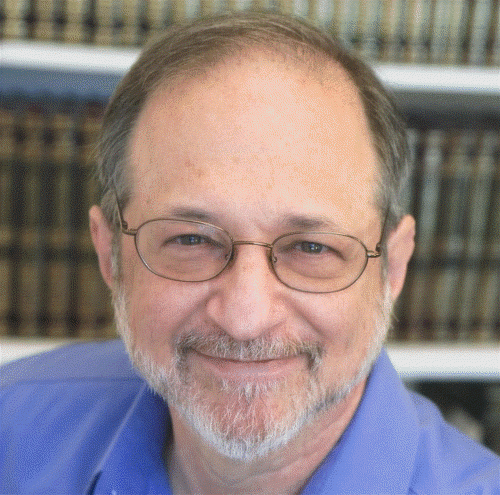
Carl Kinbar
Rabbi Carl Kinbar

I say all this acknowledging Rabbi Kinbar’s statement above that the modern Judaisms of today cannot be directly compared to the Judaisms of the first century because they lack a commonly held core set of convictions related to Torah . Nevertheless, I can see connecting threads, especially between modern, western Messianic Judaism and the Judaisms in first century Antioch.

A number of critics of modern Messianic Judaism emphasizing itself as a Judaism, complain that this emphasis bumps Messiah Yeshua (Christ Jesus) to the back of the bus if not off the bus altogether. Normative Christianity stresses that Judaism was indeed (they claim) replaced by a more generalized and generic faith in Jesus without tradition or ritual, and modern Hebrew Roots proposes that modern Rabbinic Judaism is adopted by Messianic Judaism in place of “Biblical Judaism” which was (they claim) practiced by both Gentiles and Jews in the first century Messianic community.

Their sons will, furthermore, be subject to compulsive epispasm since they will be “cut by physicians to bring forward their foreskins.” In 1 Corinthians 7:18, Paul admonishes the circumcised Jesus-believing Jews against having this operation performed.

-ibid, pg 72

Zetterholm goes on in pages 76 through 79 to provide numerous examples of what we may not get from just reading the Bible…the fact that Jews in the diaspora, perhaps many, many Jews, struggled with or just plain left the Jewish community, attempted to cover up the signs of their Judaism (males), and assimilated socially and religiously into Greek culture.

Do we have that today?

How many Jews have converted to Christianity and exist and worship as “Hebrew Christians” within the Church, having abandoned any and all practices of Judaism and Jewish identity and adopted living as “Goyishe Christians?” Even the observant Jews within Messianic Judaism are considered by most other Jewish communities (i.e. not Messianic) as “Jews for Jesus,” as converts to Christianity who have abandoned their own people and left Israel. To resist this impression as well as to resist the draw from the Church that says if you believe in Jesus, even as a Jewish disciple of the Jewish Messiah, you are a Christian and are “free from the Law,” the Messianic Jew must strictly adhere to a Jewish lifestyle, including observance of the mitzvot and the traditions.

…that most Jews, in Palestine as well as in the Diaspora, worshiped daily and weekly, kept the Sabbath, circumcised their sons, observed certain purity regulations and supported the temple. Despite mixed opinions on how this obedience would be realized, we can safely assume that the majority of the Antiochean Jews intended to live their lives obeying the torah.

-ibid pg 80

The Jewish communities in the diaspora including Antioch were at risk of assimilation and absorption into the wider Greek culture and religious milieu. The barrier to stave off this threat for Jewish communities was Jewish observance and adherence to Jewish identity as distinct and unique among the myriad people groups and religions existing in the galut.

Magnus Zetterholm
Magnus Zetterholm

Zetterholm cited (pp 83-4) the practice of Jews in Antioch refusing to use Greek-produced oil, but believes that it was more an indication of Jewish identity rather than outright devotion to the Jerusalem Temple. Nevertheless, this still indicates that these diaspora Jews were highly aware of the necessity to keep separate from the surrounding culture, even to the point of being selective about which source of oil they used.

Further, Zetterholm citing Sanders says:

Antioch was thus located in an area almost regarded as part of the Land of Israel, and there is evidence of a particularly strong connection between some Antiochean Jews at least and the temple in Jerusalem.

-ibid, pg 85

Zetterholm’s opinion isn’t quite in line with Sanders’, though.

I would therefore conclude that we may cautiously assume the existence of a group more strongly committed to Jewish life than the main body of Antiochean Jews…

-ibid, pg 86

While Zetterholm doesn’t give much credence to the Book of Acts as an accurate model for Jewish/Gentile interactions of the first century Jewish history in Antioch, he nevertheless states:

…we may assume that there was no intermarriage between Jesus-believing Jews and Jesus-believing Gentiles, because the Jesus movement was a completely Jewish one with an unusual openness towards Gentiles.

-ibid, pg 89

And…

While Antiochus had clearly left Judaism, most Jews who were interested in Hellenism and wanted to create a Hellenistic Judaism were at the same time concerned with the preservation of a Jewish identity and had no intention of ceasing to be Jewish.

-ibid, pg 90
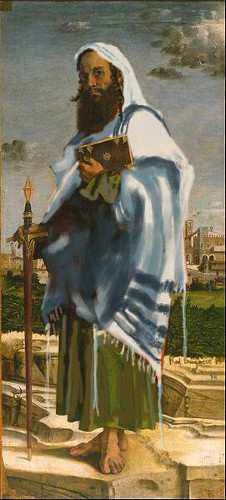
The Jewish PaulIf, as Zetterholm says, the first century “Church” was a wholly Jewish movement, albeit with a high tolerance for Gentiles in the community, then even if this represented a Judaism that was “open,” to some degree, to Hellenistic influences (though this is very dicey material to seriously consider), the “Jesus-movement” had no interest in abandoning Judaism and Jewish practice for something foreign to them or more in line with the religious practices of the Greeks. Paul, as we saw above, was not convincing Jews to give up Judaism. Quite the opposite. Zetterholm’s research and the sources he cites do not support at all the creation of an alien Gentile religion out of the teachings of a rural Jewish Rav who was known by his Jewish followers to be Moshiach.

Zetterholm covers the diversity of Antioch’s synagogues (pp 90-91), including (as I stated above) how they served diverse Jewish populations, and it seems likely that the synagogue Paul and his companions used as their “home church” throughout Paul’s three “missionary journeys” was one of the (perhaps) thirteen synagogues in Antioch. In fact, he says of the Jewish Jesus-believers:

…it is highly unlikely that the Jesus-believing Jews in Antioch were organized in any other way than the synagogue.

-ibid, pg 93

Zetterholm cites Mark Nanos (The Mystery of Romans: The Jewish Context of Paul’s Letters, pp 289-336) as well as a wide selection of scriptures from the Book of Acts, to support this position. This includes the most likely common usage of “ekklesia” to mean “synagogue.” Additionally, Zetterholm references James 2:2 and James 5:14 as evidence that James the Just, brother of the Master, considered the “assembly” and “community” of Jesus-believers to be the synagogue:

We can thus conclude that the terminology does not speak against the view that the Jesus movement in Antioch was originally a synagogue consisting of Jesus-believing Jews, and that the Jesus-believing Gentiles related to this synagogue as any Gentiles related to any Jewish community. (emph. mine)

-ibid, pg 94

What might we conclude from all of this?

Judaism in the first century CE (and in my opinion, much of Judaism today) was not a “works-based religion” but rather a vibrant, faith-based practice of devotion to God. While there were many variations of Judaism practiced in that day, there was a core or common Judaism that served to define and identify all communities of Jews as Jewish and those who worshiped the God of Israel. This would have included the Judaism then known as “the Way.”

Jewish identity, performance of the Torah mitzvot, and devotion to the Temple services were among the common qualities of the Jewish community, both in Roman-occupied Judah and in the diaspora. Jews in the diaspora were at risk of assimilation and absorption into Greek culture, even to the point of attempting to cover the marks of circumcision. There was likely little to no intermarriage between Jewish and Gentile believers and if intermarriage occurred, Jewish identity would be staunchly adhered to by the Jewish spouse. If not, it was more likely that the Jew would undergo apostasy and assimilate into Greek religious and social culture.

Paul was very much opposed to Jews in the community of believers undergoing the medical procedure to restore their foreskin (males) and continued to encourage and support the Torah observance of the Jewish believers. There is no evidence, based on Zetterholm’s research, that the combined community of Jewish and Gentile believers left the synagogue or that they left Jewish practice and formed a new religion that was opposed to the other Judaisms and core Jewish practice. The Way remained a Judaism that was distinguished only by its unusual acceptance of large numbers of Gentiles who were identified neither as proselytes or God-fearers but had a different legal status allowing them to remain Gentiles and equal co-participants in the community (It should be noted that the Way wasn’t the only Jewish community that has ever claimed to follow the Messiah, so Messianic claims are not all that distinguishing).

Many of these conclusions can be applied to Messianic Judaism (and to a degree, larger Judaism) today. My experience with Messianic Judaism is within the confines of the United States, so I’ll restrict my opinions to that population. Messianic Judaism, existing in the diaspora amid a nation of religious plurality including a strong emphasis of no religion at all, faces some of the same risks as its ancient counterpart in Antioch. There is a strong pull, especially for Jews who are believers in Jesus as the Messiah, to apostate from a Jewish faith in Moshiach and “convert” to Christianity, effectively becoming Gentile believers with Jewish DNA.
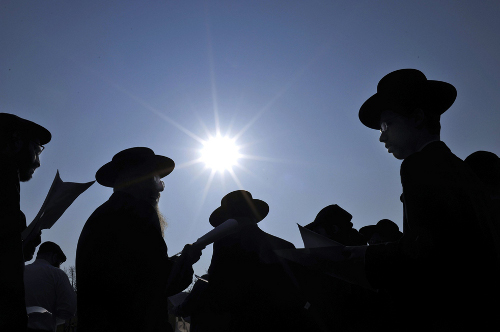
Orthodox JewsIntermarriage, although exceptionally common within Messianic Judaism and relatively rampant within all of the other Judaisms (with the likely exception of Orthodox Judaism) presents a risk or at least a challenge to the Messianic Jewish spouse to remain Messianic and Jewish in his/her observance of Torah and overall lifestyle. If this isn’t supported by the non-Jewish spouse, it could spell trouble for the marriage and/or the Jewish identity of the Jewish spouse. How the children are to be raised and their identity as Jewish vs. Gentile is also a serious consideration.

For these reasons, I reaffirm my previous assertion that a strong Messianic Jewish community be available, both for Jewish and for intermarried families who identify as Messianic. Furthermore, the Jewish Messianics should be allowed and encouraged to maintain and embrace a Jewish identity, and to consider themselves and the Messianic synagogues as part of larger Jewry. The continued effort by Messianic Gentiles and Hebrew Roots Gentiles (and some Hebrew Roots Jews), as well as the overall normative Christian community to demean any Jew in Messiah who continues to live a halachically Jewish life, and who further demands that Messianic Jews abandon Judaism as a practice, or observe some unobservable entity as “Biblical Judaism” vs “Rabbinic Judaism” must cease. Don’t argue.

It’s not our place as Gentiles within or outside the Messianic Jewish movement to dictate terms relative to how a Jew should or shouldn’t live as a Jew. A Jew’s relationship is and always has been with God.

No, I’m not throwing Jesus off the back of the bus and in fact, he’s at the center of all of this. Who lived a perfectly Jewish, halachically correct, completely Torah observant life as evidenced by the Gospels and the rest of the Biblical narrative? Only Yeshua Ben Yosef of Nazareth. Only he was born a Jew, of observant Jewish parents, within the borders of the Land of Promise, faithfully studying the scriptures and performing the mitzvot, and yet he was without sin and totally obedient to God.

What a role model for the apostles, all of the Jewish disciples, and for Messianic Jews today. Could anybody be more Jewish and live a more Jewish life than Messiah, Son of David? Will anyone live a more Jewish life in the Messianic Kingdom than the King of the Jews upon his return?

Zetterholm’s book has certainly confirmed a few things for me and opened up other doors. When next I revisit the pages of his book on this blog, I’ll further examine the relationship between Jews and Gentiles in the Messianic community in Syrian Antioch as Zetterholm’s research reveals it to us.

This series continues in my blog post Zetterholm, Ancient Antioch, and the Problem of the Gentiles.

The Candles in My Heart

Chanukah MenorayThat the spark of G-d within us will ponder G-d, what is the surprise?

But when the animal within us lifts its eyes to the heavens, when the dark side of a human creature lets in a little light, that is truly wondrous. How can darkness know light? How can earth know heaven?

Only with the power of He who is beyond heaven and earth, and so too is neither darkness nor light.

-Rabbi Tzvi Freeman
“Dark Knowing Light”
Based on letters and talks of the Rebbe,
Rabbi M.M. Schneerson
Chabad.org

The Candles in My Heart: An Unusual Chanukah Story

I think there must be something wrong with me. I don’t know what it is exactly, except I keep getting that square peg in round hole feeling. It happened last night, the first night of Chanukah (it’s early on Thanksgiving morning as I’m writing this), when I realized that my wife had lit the first candle in the menorah and hadn’t called me in to watch. Actually, I was a little surprised.

She was supposed to be back from work by mid-afternoon Wednesday night, but didn’t make it home until nearly sunset. I thought about getting out the menorah and setting everything up, but lately, she’s gotten a tad annoyed when I’ve intervened in “Jewish” matters around the house. So I let it be. I saw that she had bought candles but wasn’t sure if she’d light the menorah on the first night since she was late.

But she did and I missed it…

…and I miss it.

That’s what I mean about being strange or out-of-place. I, a Christian, going to a Baptist church, meeting with my Pastor for private talks every week about Christianity, and I still miss seeing the menorah being lit on the first night of Chanukah.

It’s almost like I’m this person (although, of course, I’m not Jewish).

Two years ago I was in Baltimore on business, and happened to pass by the public menorah in front of Johns Hopkins University just as the first light was being lit. My eyes welled with tears. Although I was raised a secular Jew, my family has always celebrated Chanukah. To be away from my family that first night of the holiday felt cold and lonely. Now, seeing the lights of the first night’s flames of that big menorah, my heart lit up also, and I felt the warmth of my people all around me.

-Laura P. Schulman
“The Menorah That Lit Up My Life”
Chabad.org

The story goes on about how the next day, Ms. Schulman was approached by a Jewish “young man in a black hat” and asked, “Excuse me, are you Jewish?” The transaction between them, as well as the gift of a “Chanukah kit,” complete with menorah, candles, and instructions, sent Schulman on a journey to rekindle the Jewishness of her soul and the unique covenant connection she has with God.

And she’s not the only one:

We talked about friends we had or hadn’t kept in touch with from high school. “You know, I talked to Artie right before my trip,” I told him. “He says he went to Hebrew school, already knows all about Judaism, thinks you’re flipping out, thinks I’m wasting my time. But you can’t believe how much I’ve learned in the last couple of months that he has no clue about – about Jewish law, and philosophy, and the meaning of historical events, and the return to the Land, and all that. He thinks because he knows something, he knows everything – and he knows practically nothing!”

Then Jake said, “That’s what I think about you!”

-Eric Brand
“When God Sends You a Message…”
Aish.com

jewish-handsIn this article, Brand talks of reuniting with an old friend after a lengthy separation, and discovering his friend had moved to Israel and “become religious”. His friend Jake, or rather Yerachmiel now, was thought to be crazy, even by his own mother. Brand thought so too for a while, only to realize that at a critical moment in the conversation over pizza, Yerachmiel was just a messenger. God was talking and calling Eric back to Him.

I think God calls to all of us, Jewish or not, to come to Him, but for Jewish people, it’s especially unique because Israel was called out of the nations to be a treasured people to Him first. I can see it in my wife. It’s like God flipped a switch and sent a signal to a homing beacon in her soul and she had to return to Him.

Granted, it comes in stages, as it does with the rest of us, so I can only hope and pray that as time goes on, she’ll move more in the direction God wants her to go.

Sometimes, because I’m not Jewish and particularly because I am a Christian, I think I get in the way of how far she could go, the distance that people like Laura Schulman and Eric Brand have traveled.

But then, if Jesus is indeed the Jewish Messiah, then ultimately, he’s the King to both of us, as he is to everyone. Ultimately, there will be no dissonance, even though, in the present age, the disconnect is huge.

An Israeli immigration judge has ordered the deportation of a Messianic Jewish man from England who was arrested last week for taking part in an evangelistic event in southern Israel.

Barry Barnett, 50, a worker with Jews for Jesus UK, was ordered on Sunday (Nov. 24) to leave the country by Dec. 3. Barnett, who is based in England, was volunteering at the Jews for Jesus “Behold your God Israel” campaign around the city of Be’er Shiva when he was arrested Wednesday (Nov. 20) at about 4 p.m.

According to his wife, Alison Barnett, six immigration control officers took him from Be’er Shiva, 125 kilometers (78 miles) south of Jerusalem, to an immigration office in Omer, just outside of the city. He was held there for several hours without charge, then transferred to an immigration-holding unit of a prison in Ramle, near Tel Aviv. He spent four days in jail before his court hearing.

-from “Israel Orders Deportation of Jews for Jesus Missionary”
Christianity Today

The thing is, Barnett hadn’t done anything illegal. According to the article:

…the ultra-Orthodox, anti-Christian group Yad L’Achim had followed the Jews for Jesus teams to their campaign sites in Israel since the event started. Yad L’Achim has a long-standing history of links with sympathetic government officials who issue legal actions on their behalf.

In the past, I’ve written quite a lot about Christian supersessionism or the theology that “the Church” has replaced Israel in all of God’s covenant promises. This is a reprehensible artifact of Church history and I deplore its continued expression in any sense in the community of Jesus.

But there’s a flip side to all of this. It’s an understandable flip side given the history of enmity between Christianity and Judaism, but it results in such actions as Barry Barnett’s illegal arrest and detainment without charges in Israel because he represents Jews for Jesus.

I even read a comment on the blog commentary for this story published at rosh pina project where a Jewish gentleman called Barnett a “murderer.”

So I suppose, putting things into context, me being not invited to the lighting of the menorah on the first night of Chanukah in my own home isn’t so bad.

candleBut I still miss it.

I find reading “testimonials” like those written by Ms. Schulman and Mr. Brand heartwarming; Jews being called back to Judaism and to God. Why don’t I have the same sort of feelings about people being called into the Church and to Christ?

It’s not as if I’m opposed to my own faith, but the cultural context gets in the way. No, it’s not like I’m in any way “culturally Jewish.” I’m about as white-bread American non-ethnic anything as it gets.

But I’d rather spend the festival of Sukkot once a year in a place like Beth Immanuel Sabbath Fellowship than all the Sundays there are in a traditional church setting. No, I don’t disdain worshiping with other Christians in the body of believers, but the music, the patterns of worship, the traditions, the prayers, the Torah readings, all call to me in a way that Christian hymns seem to lack.

I know I sound ungrateful. I’m not, really. I appreciate the opportunity God has afforded me to be with my fellow believers, to hear my Pastor preach each Sunday morning, to participate in Bible study after services in Sunday school, to meet and speak with people far closer to God than I.

But I’ve called myself a Gentile who studies Messianic Judaism for a reason.

I don’t know why, but when God set off my own “homing signal,” it called me in an unanticipated direction and that direction continues to pull at me. No matter where I am or whoever I’m with, I cannot be diverted from that path. Even if I never see another Shabbat candle lit, never hear another Hillel in Hebrew, never am present when a Torah scroll being removed from the arc, I cannot become that which I am not.

I’m not Jewish. I’m not Israel. I completely understand that. My wife once called me a “Jewish wannabe” and although that still stings a little, I can’t completely deny the validity of that statement. I just don’t know why it’s true of me.

I also can’t be a “traditional Christian,” although I think it would make my Pastor’s life a little easier if I’d just give in and assimilate theologically and culturally into the church environment as it exists in our little corner of Southwest Idaho.

I may never be invited to see the Chanukah menorah lit in my home or even the Shabbos candles, but I am not in darkness. God lights them in my heart and it’s by their illumination that I am guided to Messiah, particularly during this season.

For how do you know, O wife, whether you will save your husband? Or how do you know, O husband, whether you will save your wife?

1 Corinthians 7:16 (NASB)

And then, last Thursday evening, amid the frenzied activity of getting Thanksgiving dinner ready (and it was a wonderful repast), everything stopped as we all gathered around the menorah and my daughter said the blessings and lit the second light of Chanukah. And we, as a family, were blessed. May the lights of Chanukah and the light of God illuminate you.

Encouraging a Jewish Wife

apples-oranges-interfaithNo matter what the content, the fact that there are classes for Intermarried couples is a progress , because it is a doorway to observance and making a Jewish home, and even conversions. Sometimes it is the non-Jewish spouse who brings the Jewish partner back to Judaism so they need to be given a chance. This is different from being lenient about intermarriage. Since a lot of Jewish observance is done at home eg. Shabbat , people can be introduced to it and be encouraged because of the wonderful effect it has on family life, would be a good place to start with.

-Anonymous
Comment found on “What to Do about Intermarriage”
Aish.com

A lot of Jewish articles about intermarriage are difficult for me to read because many sound like “The goyim are bad for marrying Jewish men and women and causing them to assimilate.” Harold Berman’s article was much more refreshing, but Anonymous’s comment really hit home.

Sometimes it is the non-Jewish spouse who brings the Jewish partner back to Judaism so they need to be given a chance.

My daughter just returned from Israel a few days ago after spending nearly two weeks in the Land participating in the Birthright Israel program. While she was gone, one Friday afternoon, my wife got out the Shabbos candlesticks (sans actual candles). She didn’t light the candles, but she didn’t want me to put them away after Shabbos, either. They’re still sitting on our counter waiting and have been for two Friday evenings now, after gathering dust in our bookshelf for months.

Through casual conversation, I found out that my wife took our grandson for a visit to the home of the Chabad Rabbi and Rabbitzin. It came up when we were talking about a new Lego toy my wife bought our grandson, which was the result of him playing with the Rabbi’s children (I guess they’re heavily into Legos). Yesterday afternoon, my wife wasn’t home, but since she didn’t have to watch our grandson that day, I thought she was off doing errands and visiting friends. I was right, but not in the specifics. She’s spent the afternoon helping the Chabad Rabbitzin do some cooking. There was a hint that she might be planning on helping with some of the food preparation for the High Holidays as well.

birthright_taglitI couldn’t be happier. Well, yes I could. I’m delighted that the missus is becoming more involved with the Chabad community again. Actually, for all I know, she never stopped, but she stopped talking about it. I’m glad that part of her life is becoming more overt again. I keep wondering if she’s simply wishing that I would quit church and become more interested in Judaism.

It’s not like I didn’t try. After leaving my previous congregation, I suggested and hinted and finally asked about the two of us participating together in the Jewish community. Eventually it came out that it would be too embarrassing to have her “Messianic” husband meet with her Jewish friends. I guess a Christian husband is equally humiliating for her.

Welcoming is critical. But it’s not enough. And the question “how can we be welcoming” is the wrong starting point. Instead of asking how we can welcome interfaith families, we would serve them better by asking how we can help them transform themselves through Jewish life. Welcoming, without more, is simply a technique to get people in the door. But Jewish transformation goes to the heart of our passion and purpose as a people.

Helping intermarried families feel comfortable may encourage them to enter our doors. But it won’t help them grow. And it may not even convince them to stay. To be sure, being welcoming and effecting Jewish transformation is hardly an either/or equation, and notable examples of doing both well can be found. But the communal starting point is nearly always one of welcoming, hardly ever one of transformation, and in the meantime, the majority of intermarried families are either unengaged or under-engaged in Jewish life.

I’ve met intermarried couples who joined a synagogue because they were made to feel comfortable.

But I’ve never met an intermarried couple (or in-married, for that matter) who got excited about Jewish life, who gave their kids a rich Jewish education, who chose to become a Jewish family, simply because they felt comfortable. In virtually every case, they encountered a gifted Jewish teacher, had a meaningful experience in a service, or found that Judaism spoke profoundly to their worldview.

intermarriageNotice the first paragraph I’m quoting from Mr. Berman’s article says “interfaith” families, not just “intermarried.” Intermarried simply means that one member of the couple is Jewish and the other is Gentile but not necessarily religious (particularly Christian). Interfaith implies that the Jewish member is religiously Jewish on some level and the Gentile member is affiliated with another religion (probably Christianity).

The direction in which the article travels leads to not just welcoming interfaith/intermarried couples in the synagogue, but the drive to help them transform into Jewish families.

Another person commenting on the article said:

One cannot simultaneously believe that the Messiah has come & believe Ani Ma’anim with perfect faith in the coming of Moshiach. Raising children with nothing is nothing. Make a choice, give your child roots (whatever they are) so she IY”H can have wings.

Here we start moving into potentially hazardous territory. What happens to the Christian member of the marriage if the goal of welcoming interfaith/intermarried couples into Jewish life is to create Jewish families?

I know from a Messianic Jewish point of view what the answer could be but that doesn’t play if the Jewish person in the marriage does not have faith in Jesus as the Jewish Messiah.

My wife would never ask me to abandon my faith. I’ve considered saying I could cease all outward signs of my faith if it would help her to return to the synagogue and become more involved in Jewish community (I stop short of offering to abandon all internal signs of my faith), but first of all, I know she would decline, and second of all, it’s still a dangerous step for me to take.

And we’re not raising children. My youngest is twenty-five so as adults, my children are all responsible for their relationship with God and who they are (or aren’t) as Jews. The window of opportunity my wife and I had to instill a strong Jewish identity in our children has long since slammed shut.

woman_torahI want my wife and children to become as involved with the Jewish community, with the Torah, with the mitzvot as they want to be and in fact, as involved as God wants them to be. I would be more than happy to “go along for the ride,” so to speak, though as I said before, my presence would make my wife highly uncomfortable. I always come up against the same walls when I face being intermarried and I don’t know how to get over, around, or through them. No one in my church could understand and they’d probably be offended that I’m praying for my family to be more Jewish rather than for them to convert to Christianity.

But to the rest I say, not the Lord, that if any brother has a wife who is an unbeliever, and she consents to live with him, he must not divorce her. And a woman who has an unbelieving husband, and he consents to live with her, she must not send her husband away. For the unbelieving husband is sanctified through his wife, and the unbelieving wife is sanctified through her believing husband; for otherwise your children are unclean, but now they are holy. Yet if the unbelieving one leaves, let him leave; the brother or the sister is not under bondage in such cases, but God has called us to peace. For how do you know, O wife, whether you will save your husband? Or how do you know, O husband, whether you will save your wife?

1 Corinthians 7:12-16 (NASB)

I wonder if there’s an adaptation of Paul’s midrash on “intermarriage” that says the Christian husband can save the Jewish wife by leading her to be more Jewish? Probably not, but it’s a nice thought.

There’s an emphasis in certain corners of Messianic Judaism in general and in the First Fruits of Zion (FFOZ) ministry in specific that believes strongly that we Gentile Christians exist to provoke the Jewish people to zealousness in the mitzvot and a return to the Torah. I’ve come to believe this as well.

I just need to know how…or maybe the only answer is just for me to stay out of my wife’s way and let her do what she’s going to do. Maybe it’s just a matter letting go and trusting that God knows what He’s doing.

Where Does Faith Go When It Is Lost?

strange-landWhat happens when one day a rabbi discovers that he has lost his faith? Dr. Paul Shrell-Fox, a clinical psychologist and researcher asked himself that question – which turned into to a fascinating study.

Seven rabbis agreed to “talk about it” – three Conservative community rabbis in the United States, and four strictly Orthodox rabbis who live in Israel and have a double identity: Secretly atheists, and rabbis and believers openly.

-Tali Farkash
“Atheists in closet: Rabbis who lost God”
Published 07.28.13, 11:13, ynetnews.com

Over a year ago, I published a blog post on a very similar topic called When We’re Left Behind. It was based on an article written by Barbara Bradley Hagerty for NPR.org called “From Minister to Atheist: A Story of Losing Faith”.

How crushing would it be to love your Pastor or Rabbi, having attended his (or her) congregation for years and growing close to him (or her) as a model of faith, and then to discover that this “Holy person” has no faith in God at all and in fact is an atheist? What would that do you your faith (or mine)?

I don’t want to recycle something I’ve written before, but this brings up some new questions about the nature of religion (as opposed to faith) and how we live it out in our lives. While I certainly can’t deny the social role of church for Christians, we lack (in most cases) the connection to our religious community based on ethnicity, culture, and sometimes race. It is true there are churches that have such a basis, such as African-American churches and Korean churches, but for the most part, the Church as a social entity is just a group of people who (in theory) share the same theology and doctrine about God but who otherwise come from a wide spectrum of social, economic, educational, and employment backgrounds (this probably isn’t true in an absolute sense, but I’ll use it as a general principle for the sake of this essay).

Jewish synagogue life is a different thing because what is being shared is a lot of cultural, ethnic, traditional, religious, and even national and DNA components. It goes back to the difference between “What is a Jew?” and “What is a Christian?” You can’t just say people who have different religions. Being Jewish is enormously more complicated and in some ways, elusive in definition.

So I can see a Rabbi who becomes an atheist having a tougher time in leaving his/her community than a Pastor in the same situation (not that it wouldn’t be really hard on the Pastor as well). From a Rabbi’s point of view, if you are leading a shul in a small community, leaving the synagogue would be leaving behind your entire social, friendship, and possibly family circles. Your entire life, or most of it, probably flows through synagogue life. I suppose something similar could be said of a Pastor as well, but perhaps not quite to the same depth.

How about extending the topic beyond Rabbis and Pastors? My wife says that at our local Reform/Conservative synagogue, the Friday night service is aimed at more secular Jews who connect socially and through traditions, while the Saturday Shabbat service is more for “religious Jews.” The missus even says that some of the synagogue members wish that the current Rabbi would retire/move on (he’s still in his 40s, so is nowhere near retirement age) because he’s “too religious.”

At the opposite religious extreme are the Ultra-Orthodox or the Haredim, who seem to take the slightest infraction of the mitzvot, even among those Jewish people who are not Haredi, so, so seriously, to the point of being abusive and assaultive. It seems like something has gone horribly wrong in certain corners religious Judaism where, on the one extreme, God is all but ignored, and on the other, God is exceptionally tightfisted and punitive, and adherents experience no problem in actually attacking other human beings.

I don’t know if you get that exactly in Christianity, although to be sure, we have churches that are so extremely liberal that God seems like an afterthought and Biblical standards are as fluid as quicksand. We also have churches and groups so hyper-conservative that they too don’t care who they hurt or what damage they do to other human beings, even desecrating the funerals of military men and women for the sake of their distorted theology and need to push their weight around. I’d call that going horribly wrong, too.

It’s enough to make me lose my faith in religious people.

Waiting to danceBut what makes a person lose their faith in God? Of some of the folks and groups I’ve just mentioned, they probably didn’t have faith as such to begin with. Their religious venues are more a tradition-based, cultural, and social outlet, as opposed to a gathering where an encounter with God is sought. At the opposite extreme, it may not be God that anyone is looking for, but the need to impose internal punitive, restrictive, and ultra-conservative standards on the entire environment of human beings. As far as I can tell, God’s chosen method of operation isn’t to either ignore His standards or massively exaggerate them and then force them on others without so much as a by your leave.

I know my Pastor will disagree with me, but I believe we have a choice. I believe we have lots of choices in life, the first or at least the most important being whether or not we are going to have a relationship with God. After that, other choices follow. I believe God is like a Father or teacher (sometimes the roles overlap). Certainly if we act foolishly, we should fear Him, but fear isn’t the primary foundation upon which our relationship is built. Neither is hate. Neither is casualness and pandering to social agendas.

Once we have faith in God, and more importantly, trust, how can we lose that? Some folks say you can’t unless you never had it in the first place:

My sheep hear My voice, and I know them, and they follow Me; and I give eternal life to them, and they will never perish; and no one will snatch them out of My hand. My Father, who has given them to Me, is greater than all; and no one is able to snatch them out of the Father’s hand. I and the Father are one.”

John 10:27-30 (NASB)

That creates a problem because here we see people, Pastors and Rabbis, who have lost their faith (although Jews, because they are born into covenant, are accountable whether they have faith or not). Did they have it in the first place or did something else happen? What if they actually have faith somewhere at their core, faith in God that is, but lost something else instead? What if they lost their faith in religious people or the mechanics of religion?

I don’t think I could lose faith in God but there are days I’d throw religion and religious people out the window, slam it shut, lock it, and never look out again. A life in community, whether in person or online, can be really frustrating at times. We have all of these high ideals about love, companionship, worship, and holiness, but our real lives are so messy by comparison. We don’t always treat each other well, even when we intend to.

Some people are cranky by their nature or because they have adopted a victim stance and out of that, are perpetually defensive (I know bloggers who write out of that position pretty much all the time). Some people are generally OK until you hit one of their “hot button topics,” and then watch out (I wonder if that’s how I’m going to be next week in Sunday school?). Being in community with religious people is like walking through a mine field or living in an alcoholic family. You never know when the peace will be shattered by an abrupt and devastating explosion.

If I ever lost my faith, it wouldn’t be in God, it would be in human beings.

“You must not lose faith in humanity. Humanity is an ocean; if a few drops of the ocean are dirty, the ocean does not become dirty.”

-Mahatma Gandhi

There are times when I think it’s the ocean that’s dirty and only a few drops are clean.

Until you can see the good within a person, you are incapable of helping him.

-Rabbi Tzvi Freeman
“Helping”
Based on letters and talks of the Rebbe, Rabbi M. M. Schneerson
Chabad.org

desert-islandAnd sometimes that’s an amazingly difficult thing to do. Reading quotes from Gandhi and Rabbi Freeman present a very pleasant picture, but life in the trenches of religion is anything but, at least for those folks who are struggling with faith (and don’t we all at some point).

I know why a Rabbi and Pastor (or probably just ordinary people) would stay in their religious communities after they’d lost faith in God…because of the continued social rewards. Most people who lose faith in people but not God would just leave the community and either try to find another or bail on community life entirely. But what if community life fails you but you still find God is present within the synagogue or church? What do you do then? Are you even aware that it’s God who’s holding you there? Maybe what feels like losing faith in God is just a protracted silence? God doesn’t always talk. But we’re supposed to have faith in the desert too.

I don’t have all the answers. Sometimes I don’t even know the right questions to ask. I just know that this religious life that is supposed to bring us closer to God isn’t pain-free, and it seems for some folks that the pain increases exponentially as we strive to approach Holiness. Maybe that’s why most religious people hit a comfortable plateau and just stay there, neither being too hot or too cold in their spirituality, but only lukewarm. Maybe that’s why some people quit completely, because being numb is better than being set on fire and writhing in the flames.

Where are the Gandhis and the Freemans with their soothing, supportive words? Where is the so called “community of faith?” Where is God?

The fault, dear Brutus, is not in our stars, but in ourselves…

-William Shakespeare
“Julius Caesar (I, ii, 140-141)”

73 Days: The Higher Road Less Travelled

The number of Americans who say they have no religious affiliation has hit an all-time high — about one in five American adults — according to a new study released Tuesday (Oct. 9) by the Pew Forum on Religion & Public Life.

Labeled “nones” because they claim either no religious preference or no religion at all, their ranks have hit 46 million people. Much of the growth is among young people — one in three U.S. adults under 30 are now considered nones.

The report also found that the number of self-described atheists and agnostics has hit a peak — 13 million people, or 6 percent of the U.S. population. That’s a rise of 2 percentage points over five years.

Still, claiming no religious identity does not mean an absence of religious beliefs, the report found.

The majority of “nones” — 68 percent, including some who say they are atheists — say they believe in God or some form of higher being. Half say they feel “a deep connection with nature,” and 20 percent say they pray every day.

-Kimberly Winston
“Losing our religion: One in five Americans are now ‘nones'”
Religion News Service story

Those who intermarry face barriers to religious affiliation. Interfaith families who want to educate their children in two religions often cannot affiliate with religious institutions. Many religious institutions discourage or even forbid families from belonging to more than one religious community, or enrolling their children in more than one religious education program. These families may turn for support and religious education to independent interfaith communities such as the ones in New York, Chicago, and Washington DC. Or they end up religiously homeschooling their children in both religions. Either way, they may become part of the “religious but not religiously affiliated” demographic documented in the study.

-Susan Katz Miller
“Interfaith Marriage and the Rise of the Religious ‘Nones'”
On Being Both blog

This is the other road I could take and in fact, it’s probably, to some degree, the road I’ve been walking lately. Although I do have a “religious affiliation,” it is self-declared and unsupported by any larger group or community, at least in the face-to-face world. I’m a Christian, but one who doesn’t go to church or interact with other Christians in any manner except online. Even then, most of the Christians I interact with are otherwise identified as “Messianics” and a significant number of my online peers are Jewish.

Yeah, I’m one strange Christian.

Until I read the Susan Katz Miller article, I had no idea to what extent my situation was rooted in being intermarried. Here’s more of what she wrote:

I am grateful to Pew for drilling down into data on the “nones” and discovering some of the rich complexity of religiously-unaffiliated spiritual life. In an interesting parallel, many of the early studies on interfaith families conflated “doing nothing” with “doing both.” Just because a family does not affiliate with a church or a temple does not mean they are doing nothing. On the other hand, families may claim to be doing both, or attempt to do both, but cannot always follow through successfully without the support of clergy, family, or like-minded interfaith families. It will be important in future studies to examine the full range of practices, beliefs and experiences of unaffiliated interfaith families.

I encourage you to read Susan’s entire blog post to get the full context of what she’s saying about being intermarried and being “religiously unaffiliated.” In some sense, it’s rather empowering to think that there are many more people like me who, rather than “splitting the difference” so to speak, and having husband and wife exist in different religious worlds, choose instead to live “outside of official religious institutions.”

But that puts me into a state of flux again. Should I start attending a church, or some activity held at a church, and thus associate with other Christians? If I don’t and instead, continue on my current path, does that qualify me as a “none” and a “nobody?”

In the beginning, G‑d created everything out of nothing. He could have decided to make everything out of something, but He knew that nothing is better material than something. Because something is already whatever something is, but nothing can become anything.

That’s why, at least as far as this universe is concerned, the only way to become a real somebody is by being a nobody first.

Many of us today are nobodies. That’s okay. The moon must disappear before it becomes full again. The seed must rot away before it becomes a great oak.

-Rabbi Tzvi Freeman
“How Nobody Became Somebody”
Chabad.org

Rabbi Freeman tells an entire story between the second and third paragraphs of the quote just above, so you’ll have to click the link to find the full details. But the core of the message is just what I posted: there is a required relationship between being “nobody” and “somebody;” there is a necessary process involved in being emptied so you can become filled.

I started this “days” series at 78 Days, giving myself that amount of time (my time expires on New Year’s Day, 2013) to either figure out where I belong in the online and face-to-face community of God, or give it up, the blog, and maybe even my faith (outwardly, anyway) and just let the world of vitriolic attack dogs and nudniks (pests) toddle along on the web without me. That has nothing to do with being intermarried, but a lot to do with my patience running out for so-called “Christians” who completely miss the point of the one commandment of Jesus that we should all obey. Tragically, it’s the one commandment of the Jewish Messiah that is most often ignored. More’s the pity.

But while the visigoths may be pounding at the (metaphorical) gate of my so-called “peace of mind,” ready to invade and visit wide-spread destruction on everything in their path, though I could escape simply by withdrawing from the web, I can’t withdraw from the world. I know I’m supposed to do something, but I continue to vacillate between my options. I know that God has placed me here for a reason, and that unpleasant experiences (and unpleasant people) are also here for a reason. I’m not supposed to give up on even the nudniks, (although I finally had to on one) so I guess that means I can’t give up on myself.

I’m still not sure of what the process is where I’m supposed to be emptied now and filled later, but in trying to live out that process in writing and in person, I prefer to think of myself as taking “the higher road less traveled” (and I’m indebted to Lrw in her comment on one of my blog posts for suggesting the title of today’s “extra” missive). Whether I ultimately choose to contact a church, to attend church-sponsored activities up to and including Sunday services, and whether I maintain a long-term relationship with a church or not, (and I’m discovering that I’m not the only Christian who is afraid of church) I do trust that I am walking with God on that “higher road less traveled,” and that one of the reasons I have so few “traveling companions” is that my situation as an intermarried spouse really is unique.

“You block your dream when you allow your fear to grow bigger than your faith.”

-Mary Manin Morrissey

There’s got to be a reason for this mess and for “messy” people. I just need to keep walking on my higher road, and may I uncover the sparks I’m supposed to find, and then release them to Heaven, returning them, and you, and me, to the God who made us all.

“Not all those who wander are lost.”

-J.R.R. Tolkien, British writer

75 Days: A Little Help, Please

All over people are fighting. Religious fighting, national fighting, family fighting. Some are even ready to die because they think they’re right. How are we ever going to put this world back together?

Way #11 is dik’duk chaveirim – literally “cut if fine with friends.” See the importance of sitting down, of reasoning together. Don’t assume your viewpoint is correct. Open yourself to the ideas of others. “You don’t have to kill me. If you persuade me that you’re right, then I’ll join you.”

We need real friends – someone you can trust, to discuss plans, feelings, ambitions. With a friend, you don’t worry about scoring points or winning ego contests. A good friend will listen to the pros and cons and give you straight, honest feedback.

This is especially important with decisions like: Should I marry so-and-so? Should I accept this job offer? Should I move into this neighborhood? Everyone has different insights. Amongst many people you’ll find many solutions.

Some roads can be traveled alone, but the road of life shouldn’t be one of them. Go with a friend.

-Rabbi Noah Weinberg
“Way #11: Work It Through With Friends”
From the “48 Ways To Wisdom” series
Aish.com

So James, have you thought in terms that you’re robbing people of your fellowship? You have something that is vitally needed to be heard by the Christian community. Not to mention your sweet and gracious nature that is a great example.

I will also respectfully say you’re limiting God. I find that if I trust Him enough to obey and not focus on all the reasons I can’t, shouldn’t, it’s too hard too, then He is faithful to work out the details that I have no control over (the heart condition of others). After all, he doesn’t ask me to control others, only to obey Him.

-Lrw in a recent comment on my blog

What do I do when my love is away
Does it worry you to be alone?
How do I feel by the end of the day
Are you sad because you’re on your own

No, I get by with a little help from my friends
Mm, I get high with a little help from my friends
Mm, gonna try with a little help from my friends

-Lennon and McCartney
With a Little Help from My Friends

I suppose that’s how we all get through things…with a little help from friends. As you can see, it’s been suggested to me that not only might I benefit from fellowship with like-minded believers, but that they might benefit from fellowship with me. Sounds egotistical of me to say it like that, but I think I know what Lrw is saying. This is especially true when, as I’ve been describing in this series, there seems to be so much fighting and feuding and jockeying for position in the religious blogosphere and particularly within the Hebrew Roots movement.

But I must say that religious fighting and religious “haters” aren’t limited to the small corner of cyberspace I happen to occupy. Here’s two examples. First, from the Jewish side of things:

Question: I recently stumbled on an anti-Semitic website and they had a whole list of Talmud sayings that sound very non-PC. One example was: “It is permitted to marry a 3-year-old girl,” which they said means that Judaism condones sexual abuse of a young child. Another example was: “The best of the Gentiles, kill.” Does the Talmud really say this stuff?

The Aish Rabbi Replies: Misquoting Talmudic texts or taking them out of context is an age-old method used to incite anti-Semitism.

In the example that you cite, that a Jew may marry a 3-year-old girl, it simply means that under the age of 3, a “marriage” contract has no validity. Beyond that, any “marriage arrangement” made at above the age of 3 must be accepted and validated by the girl herself at such time that she attains maturity. The Talmud is discussing a technical legal point, not condoning abhorrent sexual activities.

As for: “The best of the gentiles, kill,” the context here is very crucial. The question was raised, how could there be any horses chasing after the Jews with chariots (in Exodus 14:7), when they were all killed in the plague of hail (Exodus 9:19). The Midrash (Tanchuma – Beshalach 8) answers that the horses were owned by those who heeded God’s warnings and locked his animals indoors (Exodus 9:20).

The Midrash concludes that these God-fearing Egyptians — the best Egyptians — turned out to be the ones that gave their horses to chase the Jewish people. In other words, in this particular instance, even the best Egyptians turned out to be oppressors, too. Yet even they – “the best of the gentiles” – were deserving of death.

The Torah states unequivocally that ALL men were created in the image of God (Genesis chapter 1). In fact, the Talmud emphasizes that Adam was created from the dust of all four corners of the earth (so to speak), so that no one nation could claim superiority. And of course, it is forbidden for a Jew to kill a Gentile. (source: Talmud Sanhedrin 57a; “Taz” Y.D. 158:1).

So you see, one can change the meaning of anything by taking it out of context. And better not to waste time refuting these points one by one. God’s Torah is morally perfect, and if something ever sounds otherwise, it is because it is not understood properly.

“Misquoting the Talmud”
from the “Ask the Rabbi” series
Aish.com

Christianity in general has an issue with the Talmud and how it is used in Judaism, believing that it is of no value and that it is the “wisdom of the elders” being placed higher than the Word of God. The Hebrew Roots movement also tends to disdain the Talmud and thus, the last 2,000 years or so of Jewish culture and philosophy as well as Jewish art, literature, lifestyle, and just about anything else Jewish that isn’t, strictly speaking, “Biblical.” And yet, it’s impossible in virtually any sense, for anyone, Jew or Gentile alike, to observe the Torah mitzvot without referencing Talmud and granting the ancient Jewish sages the right and ability to render authoritative halakah. In fact, the very structure of the books, chapters, and verses in the Tanakh (Old Testament) was created by those self-same sages. Try to avoid that if you can.

However, this isn’t just a problem on the Jewish side of the equation:

If you want to see a good example of what be-devils any scholarly analysis of practically anything to do with Jesus and early Christianity, have a read of the postings of the Canadian TV self-promoter, Simcha Jacobovici here.

Jacobovici (who styles himself “the naked archaeologist” on his self-produced TV programmes, and offers no competence in anything relevant to the analysis of the fragment) notes that various scholars (particularly Coptologists and specialists in ancient Greek palaeography) have raised questions about the authenticity of the fragment (announced to the scholarly world in Prof. Karen King’s paper presented at a conference in Rome several weeks ago), and simply trashes all the scholars and queries as “sleeper agents of Christian orthodoxy”.

He claims that they give no basis for their hesitations, which is patently incorrect and misleading. The several scholarly analyses that I’ve seen all in fact present in considerable detail reasons for wondering about this fragment. I’ve seen none, not a one of the scholarly analyses in question, that raises any issue about “Christian orthodoxy”.

-Larry Hurtado
from “The ‘Jesus’ Wife’ Fragment: Self-Promoting Personal Attacks”
Larry Hurtado’s Blog

I suppose I was being rather self-centered or myopic in believing this problem was confined to the wee online community in which I participate. As you can see (and I have discovered), these sorts of problems exist elsewhere and probably everywhere. The only way to avoid them is to be completely disengaged from community, even online community which is as easy to take or lose as opening and closing a web browser.

On the one hand, the thought of facing such vitriolic commentary either online or face-to-face isn’t appealing in the slightest. On the other hand, I have to remember that there are some “religious people” who don’t use God like a blunt instrument with which to beat others repeatedly about the head and shoulders:

Rav Levi Yitzchok of Berditchev was known for his love and good will toward his fellow Jews always trying to assess the good in people rather than expose the bad.

Once on the Fast of Tish’a B’av he saw a Jew eating in a non-kosher restaurant. He tapped lightly on the window of the establishment and summoned the man outside.

“Perhaps you forgot that today is a fast day?” Rav Levi Yitzchok queried.

“No, Rebbe,” the man replied.

“Then perhaps you did not realize that this restaurant in not kosher.”

“No, Rebbe, I know it is a traife (non-kosher) eatery.”

Rav Levi Yitzchok softly placed his hands on the man’s shoulders and looked heavenward. “Ribbono Shel Olam, Master of the Universe,” he exclaimed. “Look at how wonderful your children are. They may be eating on a fast day. In a non-kosher restaurant to boot. Yet they refuse to emit a falsehood from their lips!”

-Rabbi M. Kamenetzky
“Eve of Life”
Commentary on Torah Portion Beresheet
Torah.org

As much as I lament the few rather vocal and hostile nudniks (pests) on the web, there are a lot more people who represent the spirit demonstrated by Rav Levi Yitzchok who continue to be an encouragement to me.

However, the next step, if I understand what is being asked of me correctly, will be a lot harder.