Tag Archives: Tent of David

God Was In Church Today

ChurchI went back to church today after a three-week absence. I’ll admit that I was avoiding Christmas. I’m OK with people in the general public wishing me a “Merry Christmas” but knowing the additional meaning those two words carry in Christianity, I thought it best to keep a low profile. No one mentioned my not being around and they probably just assumed I was spending the holidays out-of-town with relatives.

God reminded me that He is still in church today. No, I didn’t have a vision or hear a loud, booming voice or anything like that. Three things happened.

The first was a missionary to Ireland (I never heard of such a thing before) who was diagnosed with cancer back in August while serving on his mission, was in our church with his wife today (they attended our church until leaving for Ireland on their mission in 2005). He still walks with a limp and a cane, but the tumor was removed from the bone in his leg and the radiation treatments are done, so he’s finally beginning to heal and go into physical therapy.

I was surprised how young Dean (the missionary) was. Not a grey hair in his head. For some reason, I expected him to be older. He also was very gracious about having cancer. He said it opened up opportunities while in Ireland once word got around. People approached him with their own physical or medical difficulties or crises in relation to faith and their spiritual lives. Sure, maybe between him, his wife, and God, Dean had a lot of hurt and angry things to say, but you’d never know it by listening to him in church this Sunday.

The second thing that happened was Pastor Dave leading prayer. No, that’s not unusual of course, but he’s going in for some surgery tomorrow (three people in church are all having surgery on Monday). Dave is also a young guy, in his 40s but he looks younger to me (I guess that doesn’t hurt when you’re the youth Pastor). I didn’t write down the prayer and I don’t remember the words, but the “feeling” of graciousness is what sticks with me. I know that some people in Hebrew Roots and related movements have left “the Church” because of some harm (real or perceived) they endured at the hands of Christians, but even though I don’t always agree with the standard theology and doctrine, I will never criticize the people I worshiped with today for a lack of compassion and love of God and each other.

The third thing that happened was during the music. Pastor Bill (who is an older gentleman) sometimes leads the singing when the usual people who are more “officially” musical are unavailable. There are hymn books, but most people use the projection of the lyrics on the screen at the front of the room. At one point early in the first hymn, Pastor Bill stopped the singing. There was a lyric about surrendering everything to Jesus. He pointed out that it doesn’t mean just “Sundays” or just a few things, but everything. I wonder how many of us really, really have surrendered everything? I know I have a long way to go in working through my imperfections as a human being who purports to be a disciple of Messiah.

God was in church today.

Be the ChurchTrue, I felt a few disturbing tremors in Pastor Randy’s sermon, reminding me that he still reads my blog (though I could be reading too much between the lines of his message) and doesn’t always agree with my opinions, but his grasp of history related to scripture always opens up new worlds in the Bible for me. It’s also true that when I got to the Sunday school class, it was uncharacteristically dark, with no indication that the teacher or anyone else had set the room up for us. Since we have a “guest missionary” with us today, and since plans change at church quickly sometimes, I figured we weren’t having class after all, so I turned around and headed on home. I was disappointed, but things happen.

Pastor Randy’s been out-of-town for a few weeks for a family reunion, and I just found out that he’s going to be gone in relation to his doctorate program for most of January, so I guess our conversations are on an extended hiatus. Another disappointment.

But God was in church today, so that makes up for those few things that didn’t quite work out.

I’ve been struggling with church for a while now and being out for three weeks only made it that much more difficult to go back today. But instead of focusing on the differences I experience between my viewpoint and the “official story” of doctrine and dogma, I need to look at what we all have in common and what I am learning about God, the Bible, and myself.

God was in church today. Maybe He’ll be there next Sunday, too.

A Sketch of Christian Fundamentalism

How Christian Fundamentalists are seenChristian fundamentalists, who belong in the center field of Biblical theology, find themselves grouped by the media in the same category as militant political extremists, fascists, snake handlers, and Islamic fundamentalists. It’s about time somebody called foul!

The term “fundamentalism,” as Bible-believing Christians use it, identifies a system of beliefs that are foundational, or fundamental, to the Christian faith. Coined at the turn of the twentieth century, in an era of emerging, aggressive theological error, the term still stands as a watershed between truth and apostasy.

-from the pamphlet
“Fundamentally Sound: Understanding Our Faith”
Regular Baptist Press: Building Lives by the Book

(Note: I just want to point out that when you do a Google image search on “Christian fundamentalism” or “Christian fundamentalists,” the results are never pretty).

A Challies Chronicles Interlude

I’ve been trying not to mention my Pastor and my church to any extent in my blog posts to avoid even the hint that I am being critical of either, but there’s no other way to write this “meditation.” Pastor brought to my attention that I might not quite understand the term “fundamentalism” and have even been using it in a pejorative manner. He also explained some differences relative to how Reformed theology is understood.

In an effort to be fair, and to cement this in my memory, I decided to construct a little summary of “what is Christian fundamentalism.” I won’t go into the history (though I took copious notes of Pastor’s discussion), however, after a series of annual conferences held by leading Christian thinkers from America and Canada starting in 1890 and extending to 1930, the “Fundamentals of the Faith” were established, recorded, and published. The first five were fully agreed upon and the sixth was debated and later added. Here’s the list as we have it today:

  1. The Inspiration and Authority of Scripture: God authored the entire Bible — every word of it and every part of it (2 Tim. 3:16). The Bible is God’s Truth (John 17:17). It is without error!
  2. The Deity of Jesus Christ: He is fully God as well as fully man. He has always existed as God, and He always will be God (John 1:1; 20:31; 1 Tim. 3:16).
  3. Christ’s Virgin Birth and Miracles: Jesus was born of the virgin Mary (Isa. 7:14; Matt. 1:18-25) and was sinless (Hebrews 4:15; 1 Peter 2:22). He performed miracles to authenticate His credentials as Israel’s Messiah (John 20:30, 31).
  4. Christ’s Blood Atonement for Sin: Jesus shed His blood as the payment for our sins. Without the shedding of His blood, there would be no remission of sin (Romans 3:24-26; Col. 1:13, 14; Heb. 9:14-28; Rev. 1:5).
  5. Christ’s Bodily Resurrection: Jesus arose bodily from the grave, triumphing over death and assuring believers of their future resurrection (Luke 24:1-12, 34-38; 1 Cor.15:1-20).
  6. Christ’s Personal Return: Jesus assured His disciples that He will come again (John 14:1-3). Angels announced His return (Acts 1:1), and the apostles taught that He will return (1 Thess. 4:13-17; Titus 2:13; 2 Peter 3:1-10; 1 John 3:2).

This describes the core beliefs of fundamentalist Christianity and as far as I can tell, these six points are generally accepted by most if not all Christians. In fact, if you dispute any one of these points, according to a fundamentalist point of view, you can’t really be called a Christian.

It’s funny how much the topic of apostasy has come up in the Christian, Hebrew Roots, and Messianic Jewish areas of the blogosphere lately.

I don’t doubt that many of you out there will have something to say about this list. I copied it word for word from the aforementioned pamphlet, so as far as it goes, I’m just transmitting information, not engaging in editorial commentary (that comes later).

christian-fundamentals-101It all sounds so simple on the surface, but even accepting those six points, there’s still room for a huge amount of variability beneath the overall Christian “umbrella.” As I mentioned to my Pastor last Wednesday, everyone who claims Yeshua-faith as well as religious Jews who deny Yeshua (Jesus) was/is the Messiah all state that scripture supports their positions. Even when considering the rules of Biblical interpretation, there is always the filter of interpretive tradition each religious stream in Christianity and Judaism utilizes to color understanding and meaning. No one has pure, unbiased access to the Bible.

We are all on a journey attempting to discover truth, attempting to achieve ever higher fidelity to the original, that is, the truth of God, and yet we all fall short. This isn’t to say we should all give up, and it isn’t to say that we can’t come closer to truth as we continue our efforts, but achieving the mind of God is like traveling at the speed of light. To do so would require the expenditure of infinite energy and would result in us laboring under infinite mass.

In other words, no matter how hard we try, and what technologies we use, pushing an object in space faster and faster and faster will get us (marginally) closer and closer to the light speed limit, but we will not only fail to ever achieve it, we will probably fall significantly short of our target.

But that doesn’t mean we will ever stop trying, and in fact, NASA continues to look into developing warp drive.

People of faith continue to strive to break the bonds of our humanity in an effort to touch the Divine. The moral equivalent of developing “warp drive.”

My Pastor suggested that it might be helpful for me to listen to some sermons and to gain some actual experience and perspective on Christian thought and Christian leaders. We discussed John MacArthur, R.C. Sproul, Steven J. Cole, and Chuck Swindoll.

I didn’t tell Pastor this (but since he reads my blog posts, he’s about to find out), but I gave up listening to sermons on Christian radio well over a decade ago. Even as a “young Christian,” I found some of the sermons too elementary, some too confusing, and most too critical of Judaism and Israel to be of much help. Sooner or later, the speaker would say something that would make my blood boil, and my commute home from work would be shot as would my mood when I got home.

I listen to the 1960s “oldies” station now and am much happier on my drives.

I’m a guy sitting on a fence. I go to a Christian church, but I think like a “Messianic” (however you want to define the term). More to the point, I think and enjoy Biblical lessons that focus on understanding scripture from the Judaic thought process, linguistic, social, ethnic, and yes, Rabbinic context of the times when those scriptures were authored, and from the viewpoint of the intended Jewish (in most cases) audience.

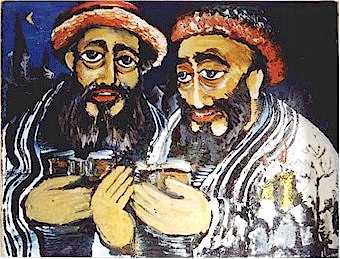
Hillel and ShammaiKnowing the original languages isn’t enough, because how we interpret what was actually being said has been stripped of most of its contextual meaning. From a Messianic viewpoint, you can’t read the teachings of Jesus without, in some cases, summoning up Hillel and Shammai, who taught a generation before Christ. They were Jewish teachers, Jesus was a Jewish teacher. In many ways, Jesus had a lot more in common with Hillel and Shammai than he has with MacArthur, Sproul, Cole, and Swindoll. I’m not trying to be mean or insulting. It’s a statement of fact. Jesus wouldn’t call himself a “Christian.” He wouldn’t say that the Law was “nailed to the cross.” He wouldn’t disdain the Shabbat, New Moons, or other Biblical festivals.

To understand Jesus, or Paul, or Peter, or James, it makes more sense to seek out sources closer to them, not only historically and linguistically, but culturally, ethnically, ethically, as well as in terms of what Jewish traditions and interpretative methods were in play in that place at that time.

I’m not sure how men like MacArthur or even the very user-friendly Chuck Swindoll would approach such a context. I don’t want to be unfair, but I do want to be realistic.

This all goes back to Boaz Michael’s book Tent of David and my recent review of who I am and what I mean within the cultural and theological context of Christianity as an institution.

So far, I see one of three outcomes of my “church experience:”

  1. I stay at church and “assimilate,” becoming a “regular Christian” and abandoning any mental, emotional, theological linkage with Messianic Judaism, Hebrew Roots, and any “Judaic” viewpoint on the Bible.
  2. I stay at church but maintain my current perspective, even expanding it though self-study and contact (real or virtual) with others who share my basic viewpoint, generally being a curiosity, a pain in the neck, or ideally, a refreshing conveyer of the Messianic perspective within the church environment.
  3. I give up on Christianity as an institution entirely, leave church, and pursue a life of faith as an independent “free-agent.”

As the end of my first year in church approaches (or has it arrived by now?), I feel like I’m crossing some sort of milestone or threshold. A year in church as resulted in me learning more about the history and institution of Christianity, but it hasn’t diminished the perspective I possessed when I went back to church a year ago. If anything, having to debate my perspective has driven me to do even more reading and studying, strengthening my belief in a Jewish Yeshua and the continuance of Jewish Torah observance for all Jews of faith, including Jews in the body of Messiah.

Every time I enter into such a brain bending set of debates and discussions, I have to get away for a while afterward and be alone with God. God may not be entirely knowable, but He isn’t confusing, either. He is a listener. He doesn’t have much to say most of the time when I pray, but it’s good to be able to tell Him how crazy religion makes me sometimes.

praying-aloneI’m glad He’s there. I’m glad I can remember that regardless of all the religious preachers and pastors and rabbis and sages rolling around human history and the current theological landscape, there is an eternal God who is the point of everything everyone is trying to do. In the end, it doesn’t matter who wins the arguments. In the end, God reigns supreme. In the end, God will stop listening and start talking. Then, if we are wise even to the slightest degree, we will stop talking and listen.

It’s in moments like these that I continue to pursue God, moments when it is dark and quiet, and the only sound is the passage of my voice to the Heavens. God listens. Being with Him is very peaceful and comforting. The chaos of human religion seems miles away.

I’ll return to my review of the Strange Fire conference soon.

In the meantime, tomorrow’s latest review of an episode of First Fruits of Zion’s television series and Wednesday’s follow up on that content continues the discussion of who I am as a believer. I said above that I was sitting on a fence. Wednesday, you will see me hopping off and I will show you on which side of the fence I land.

Returning to the Tent of David: The Clay Jar

eph-2-10-potter-clayDo you wrestle with dreams?
Do you contend with shadows?
Do you move in a kind of sleep?
Time has slipped away.
Your life is stolen.
You tarried with trifles
Victim of your folly.

Dirge for Jamis on the Funeral Plain, from “Songs of the Muad’Dib” by the Princess Irulan
quoted from pg 126 of Frank Herbert’s novel
Dune

This book outlines a vast mission and vision. At first it can seem overwhelming both in the scope it entails and in the sacrifice it requires.

-Boaz Michael
“Strategic Mission,” pg 164
Tent of David: Healing the Vision of the Messianic Gentile

Part of the Returning to the Tent of David series

Ever since I’ve been writing about my “re-review” of Boaz’s TOD book and the re-evaluation of my “mission” in my local church, I’ve received a certain amount of pushback in various online venues, speaking of “coming out” of the church, as if the church was some kind of prison or trap. Some people talk about being “unequally yoked,” as if the “Messianic Gentile” and the church-going Christian are not the same and are even diametrically opposed spiritual beings.

The quote from Boaz’s book I posted above reminds me of the difference between the first day of class and mid-terms. I remember in any class I took, no matter how difficult the subject, the first day was always a breeze because there were no expectations of me yet. By the time mid-terms rolled around though, I always knew if I was going to be OK, or if I was in way over my head.

I took a lot of notes as I was going over TOD again, but I decided I wasn’t going to use most of them. I don’t want to re-analyze every page of what Boaz wrote. I want to analyze how I am now against who I was a year ago when I was anticipating a return to church. I struggled greatly against my own inhibitions. It finally took the mocking of someone I disagree with a great deal to push me forward. He too “went back to church,” even as he complained about it (and the irony is not lost on me as I type these words).

True imitation of our Master was practiced by no one better than Paul, who left Jerusalem, the Temple, and the apostolic community behind to go through the Diaspora and spread the message of the kingdom.

-Michael, TOD
“Becoming a Shaliach,” pg 94

If I look at my TOD experience in church as a “diaspora” experience, I’ll forever be alienated from church and only be a perpetual visitor. On the other hand, the model of Boaz’s TOD book is focused on the “Messianic Gentile” as a messenger, an emissary, a “sent out one.” Paul founded many Gentile churches, but though he was united with the non-Jewish disciples in Messiah, he was never a part of them in many other ways. He was a Jew, a Pharisee of Pharisees, a Benjaminite, circumcised on the eighth day, obedient to the mitzvot, bound to the Torah of Moses and the Temple, even as he was bound to Messiah.

But the flip side of the coin is that the “Messianic Gentile” isn’t in church to illustrate how different he or she is from Christians but that it is the Jewish Messiah King who unites them…who unites all of us.

I have a Jewish friend who has been very kindly encouraging me to realize that Jesus is a false Messiah and that I should join the ranks of the Noahides; become a “righteous Gentile.” He sees Christianity, no matter how well intended, as ultimately anti-semitic, just as my wife sees the Church. If he’s right, then my efforts in emulating the Master and his emissaries are doomed to failure. If Boaz is right, then imitating my Master makes me stronger than anyone could possibly imagine.

I can do all things through Him who strengthens me.

Philippians 4:13 (NASB)

But such strength must be in God’s service.

These are all vitally important concepts, but cannot compare to the work of God in reconciling humanity to himself and consummating his entire creation through Yeshua the Messiah.

-ibid, pg 102

jewish-handsLater in the same chapter, Boaz speaks of the Chabad chasidim who are sent out into the world and who believe their efforts are watched over by the Rebbe. How much more should disciples of Messiah feel the watchful eye and empowerment of our Master in our endeavors?

Boaz also speaks of setting priorities, not losing the vision, and being silent rather than talking as the situation demands. As I went through his book again, I found I could argue against a lot of his optimism, but if that’s true, then maybe I’m the wrong man for the job…or I just want to be.

I can make excuses or I can persevere. If I am doing the will of my Master, then I will continue. If I’m not, then whatever I do will fade.

For some time ago Theudas rose up, claiming to be somebody, and a group of about four hundred men joined up with him. But he was killed, and all who followed him were dispersed and came to nothing. After this man, Judas of Galilee rose up in the days of the census and drew away some people after him; he too perished, and all those who followed him were scattered. So in the present case, I say to you, stay away from these men and let them alone, for if this plan or action is of men, it will be overthrown; but if it is of God, you will not be able to overthrow them; or else you may even be found fighting against God.”

Acts 5:36-39 (NASB)

No, I am not comparing myself to the apostles in any sense. I am not worthy to wash the dust from their feet. And yet, the principle is sound. I do nothing on my own, but only what I do when I’m in my Master.

I am the vine, you are the branches; he who abides in Me and I in him, he bears much fruit, for apart from Me you can do nothing.

John 15:5 (NASB)

Even in pleading with critics of this “mission” to not see the “Messianic Gentile” and “Christians” as separate things, I’ve been making the distinction myself. Even considering myself on a “mission” in church makes the distinction. That’s intolerable because in making such a distinction, I’m implying that I’m somehow “better” or “higher” than the people I worship with every week. But I’ve forgotten something.

In fact, I’ve forgotten the most important thing of all: to seek God where ever I happen to be. If I’m in a church, my purpose is to seek an encounter with God. If I’m in a synagogue, that it is also my purpose. It’s the same if I’m praying alone at home, if I’m in Sunday school, if I’m meeting a few Christian men for coffee, if I’m meeting my Pastor in his office.

If that “mission” is forgotten, the overwhelming priority to meet with God and serve God in every situation and circumstance, then everything that follows is a mere shadow by comparison or in fact, nothing at all.

But if I believe I am serving God, encountering God, encouraging others to encounter God by envisioning Jesus Christ as the Jewish Messiah King, the Moshiach, the Holy One of Yisrael, then I must be in the Church and of the Church without having my convictions and my vision dissolved.

Another step to blessing the church is to maintain your distinctiveness as a Messianic Gentile. Be different; exemplify the change you wish to see in mainstream Christianity.

-ibid, “Restoring the Tent of David,” pg 148

You must be the change you wish to see in the world.

-Mahatma Gandhi

I must be who I am and who I am learning to be, because it is God who made me. No matter where I am and what I’m doing I must be that person. To me, this is the only way to be in church and to live out what I’m seeing in the TOD book. To see it any other way, is to be disingenuous in my Christian worship and to possess ulterior motives in every conversation I have with other believers.

sparksThe interface, the transactions, the meetings, the worship, the study, everything I do in church and with Christians (or anywhere else) is the crucible in which we burn away the differences and the inconsistencies and finally arrive at the true Jesus, the Messiah, the King, the High Priest in the Heavenly Mishkan (Tabernacle).

It’s not being the change I wish to see, but being the person God wants me to be. Then, if God choses, that person people see will be one of His agents of change. If what I have to say and the life I’m living is worthy, then Messiah will be visible through me as who he really is, the King of Israel, the final inheritor of the Throne of David ben Yishai.

As I was reading the last pages of Boaz’s book, I was feeling the weight of his words. After all I’ve just written, I am, in the end, just flesh and blood. How could so much ride on someone like me?

Arrakis teaches the attitude of the knife — chopping off what’s incomplete and saying: “Now, it’s complete because it’s ended here.”

-from “Collected Sayings of Muad’Dib”
by the Princess Irulan
quoted from pg 137 of Frank Herbert’s novel
Dune

If I am indeed the branch in the vine, then I will not be cut off. If I’m not, nothing can keep me from being “complete” in the manner of the quote above. I must have faith that God did not give me life for a vain purpose.

The day is short, the task is abundant, the laborers are lazy, the wage is great, and the Master of the house is insistent.

-Pirkei Avot 2:20

He is indeed. And I must listen more carefully to his voice, tarry on each command, ponder his meaning, savor his teachings, sit at his feet as does the faithful servant, and in letting him show me how to become myself, the man God made me to be, the clay jar in the potter’s hand, I will be the shaliach, the lamp, and the light that goes forth into the world, not for my sake, but for God’s.

This is the end of my Tent of David review. I only ask one thing. If there are other TOD shaliach online, perhaps we could dialog with each other. Is anybody out there?

Returning to the Tent of David: Notes from an Emissary

notes-in-the-darkMany Christians have chosen the path of the Messianic Gentile. They have seen their lives changed for the better as a result of the strides they have taken towards an understanding of their Jewish roots. They have studied, learned, and grown. At a certain point in this process of growth, though, it is not always obvious what to do next. I am frequently contacted by Messianic Gentiles who are debating what do to with their new understanding. I have connected with many communities in which this is a serious problem.

For the most part, Messianic Gentiles want to share the Messianic renewal with other believers. Grasping hold of one’s Jewish roots is a wonderful thing. It is a beautiful feeling to learn about the biblical feasts, the Sabbath, and other Jewish practices which our Master embraced and taught. Our love for Yeshua makes these things precious to us. For disciples of Yeshua, finding our Jewish roots is like discovering a beautiful, long-lost treasure.

-Boaz Michael
“Introduction,” pg 18
Tent of David: Healing the Vision of the Messianic Gentile

Part of the Returning to the Tent of David series

Here is where I come in. I should say that I’m not really a typical “Messianic Gentile.” I think the model may have been more appropriate back in the day, but not so much anymore, primarily because I’m a believer going to a church, and the missus is Jewish and not a believer. Furthermore, as Boaz says several times in his book, a “Messianic Gentile” is indeed a “Christian.” I’ve adopted the latter “title” to clarify my vision: that there’s nothing about a Messianic perspective on Messiah and the Bible that should be considered separate or apart from Christians and the Church (big “C”).

The other reason I don’t call myself a “Messianic Gentile” is that I don’t “keep Torah” in many of the ways someone on a Messianic community might. Even at the height of my so-called “observance,” I still drove on Shabbat, cooked on Shabbat, ate what you might call “Kosher-style” rather than what my local Chabad Rabbi would consider kosher, used the Siddur poorly, had (and still have) by and large no command of Hebrew at all, and so forth. I was a lousy “Messianic Gentile” in my practice. But the study and the information flow was and is fabulous.

Among the many things our Master taught us was the command to love each other as he loved us (John 13:34).

-ibid

This is a core of the message and the vision. If we don’t do these “Tent of David” experiences out of love rather than some other motivation, we lose and the Church loses.

And that’s not easy.

What is easy is to get involved in theological and doctrinal debates trying to show who is wrong and who is right. That’s no different from the typical “dust ups” we have in the religious blogosphere, and I’ve been critical of those before.

Becoming a living and active part of the church community isn’t always easy. I go to services, attend Sunday school, visit weekly with the Pastor, but that’s about it. Oh, I’ve taken on a special project that has required I work with one of the Associate Pastors and some of the staff, but I don’t know if that qualifies me as part of the community. Maybe it just takes more time or maybe I’m holding back.

Can one live as a Messianic Gentile among Christians who don’t yet embrace his lifestyle or viewpoint?

-ibid, pg 19

boaz-michael-beth-immanuelAs Boaz says on the previous page, “Yet this is not always easy. Churches can be resistant to the message of the Messianic Gentile.” But is my mission and purpose to go into church with the idea of changing people? This is one of the most difficult parts of the “TOD” experience. The vision is vast and glorious, but living it out day by day is difficult, especially when I’m not a gifted teacher, theologian, and publisher, but rather, just a guy “on the ground,” so to speak.

I don’t really try to live my life as a “Messianic Gentile” in the church. I just try to be me, which I suppose is both my greatest strength and my staggering weakness.

And why should the church listen to the rather odd sounding message of the “Messianic Gentile?” I mean, it’s their home ground. They hold all the keys that open all of the doors in their realm. They are comfortable with what they are being taught and what they believe fundamentalist and evangelical Pastors and their books and sermons tell them. Saying something like the Torah is not canceled is not just different or new information, it’s radical and potentially “dangerous”. It flies in the face of everything the average Christian in the pew has ever been taught.

The Gentile believers, as part of the commonwealth, had a unique and vital role in the process of building the Tent of David, using their numbers and resources to empower and bless the Jewish community and spread the message of the kingdom in their own culture. In this way, the apostles envisioned the imminent restoration of the Tent of David and the establishment of Yeshua’s hegemony over the entire world…It would hardly be an overstatement to say that this apostolic vision is Christianity’s raison d’être, its reason for existing.

-ibid, pg 22

That’s only vaguely how most Christians and most Christian churches see themselves. Frankly, it took me awhile to even see this aspect of my “reason for existing” and even longer to get comfortable with it. A tremendous amount of internal struggle along with lots of prayer and studying had to take place before I was able to put together all the pieces of the puzzle and to recognize that the completed picture was “me.” I’ve spent many months trying to communicate on this blog what I see and while the people who already share that vision are enthusiastic, those who don’t are going to be just as blind to it as I was.

As disciples of the Messiah, Messianic Gentiles must live out by personal example the teachings of Yeshua…

-ibid, pg 24

I read this sentence and immediately thought about Sukkot. I happened to mention to my Sunday school teacher that I built a sukkah in my backyard, as I do every year, and a little bit about the customs around Sukkot. He seemed interested and enthusiastic, but not in the way I anticipated. It was more like a novelty item to him…something interesting and curious to look at but nothing that had to do with him and his lived experience. The idea of him building a sukkah would be seen in the same way as the idea of living in a Buddhist monastery in Tibet for a year. A fascinating thought but in no way connected to his experiential reality.

Who will show the institutional church its blind spot?

-ibid, pg 26

Who says they want to see it? The most interesting part of this experience is not the response, but the silence. I recently had a bit of a disagreement with my Sunday school teacher over the meaning of Acts 15:1-2. He says that the Jewish people who stated that Gentiles needed to be circumcised were “Satanically-inspired” and I said that they were Jewish people who had a legitimate theological question that needed to be resolved.

hereticBut we were the only two engaged on this issue. Everyone else in the room was silent. What were they thinking? Did they imagine I’d flipped out or was I just a heretic? OK, probably nothing that strong, but I really don’t think most of the Christians in that room had a clue how to deal with the idea that first century Jews requiring Gentiles to covert to Judaism as the only way to be saved were at all people expressing a valid concern, as opposed to a bunch of trouble makers and Judaizers.

“The church desperately needs creative heretics. A “creative heretic,” an independent thinker, is an example of the “unbalanced” force to which Newton refers in his first law of motion. Only the person who breaks with tradition can change the direction of an institution. A heretic is not an enemy of God but one who is more interested in truth than in tradition.”

-John Sloat, A Handbook for Heretics

Imparting the vision of the “Messianic Gentile” within a church setting requires a great deal of tact. I’ve tried as best I can to restrain myself. I almost always pick just one question (out of the many I could cite) to ask in Sunday school so as not to appear like I’m trying to argue. I can be candid with my Pastor but that’s part of our relationship, and all of those conversations only involve the two of us.

This can only happen, though, if those Christians who understand their Jewish roots choose to remain in their churches as faithful congregants.

-Boaz, pg 26

I’ve had this discussion before about whether or not the “Messianic Gentile,” that is, “me,” should join the church as an official member. My good friend with whom I have coffee every other Sunday afternoon says absolutely “yes.” I must join the church as a full member in order to be accepted and integrated into the body.

But I don’t know if I’d ever by a good Baptist when their’s so much about the theology involved with which I don’t agree. If being a good Calvinist is required, then it’s a “showstopper.”

Which brings me to the question of who changes? Boaz mentioned previously in his Introduction about the challenges of living as a Messianic Gentile in the Christian church. Part of the difficulty as I see it is that the church is exerting an effort to change the Messianic Gentile even as the Messianic Gentile is making the same effort to change the church. Boaz says that all committed Christians want to know Jesus better, and while I believe that’s true, they also anticipate that Jesus won’t look too “Jewish” as they draw nearer to him. The portrait of Moshiach I have to paint is far more semitic than any Jesus they’ve ever seen or want to see.

darkmirrorThe Tent of David book is designed to reach out to a vast population of Messianic Gentile and Hebrew Roots Gentile people in our country and either support them in the churches they already attend, or encourage some of them, like me, to return to the church as emissaries of the Messianic viewpoint on the Jewish Messiah. We’re not “secret agents” on a covert mission, we’re representatives of an idea and a perspective that isn’t common in the church. We’re part of Boaz’s vision of reaching the church with a new (or renewed) way of conceptualizing the Jewish Jesus. And we are only one stream among several they are trying to produce, another such stream being their A Promise of What is to Come television series (available for free over the Internet), which is designed to impart much of this information at a very accessible level for most Christians.

You are not required to complete the task, you are not free to withdraw from it … but be aware that the reward of the righteous will be given in the World to Come.

-Pirkei Avot 2:21

That sounds incredibly noble, but I’ve always had a tough time seeing myself as incredibly noble. I know too much about myself to see the reflection of a hero in the mirror when I shave in the morning.

So after nearly a year, who do I see when I look at my reflection? Most mornings, it’s easy to ignore the question. I’m getting ready to go to work or if it’s Saturday, I’m mulling over my “honey do” list for the day. If it’s Sunday, then I’m anticipating Pastor’s sermon and considering what I’m going to say in Sunday school, and then thinking about what the rest of the day will bring.

But this blog post series (assuming I write future entries) is about stopping and taking the time to look at the scruffy older guy in the mirror. Am I living up to my mission as an emissary to the church, as it were? Have I been successful in delivering my message and more importantly, in living it out?

I can’t say I’ve been wildly successful. A few people have expressed an interest in what I have to say, but they seem to only just get started on the trail and then stop. I have had conversations with one of the older Associate Pastors who is interested in Hebrew Roots but when I directed him to the First Fruits of Zion website to access some resources, I got the impression that he was quite overwhelmed.

I think there is a desire to learn more about the Jewish Jesus in the church, but there are two issues of concern. The first has to do with what Christians expect to learn. They expect that the Jewish Jesus will look and act just as they imagine him to be. They think the “Messianic Gentile” will teach them “more of the same” but maybe with some interesting but minor details. What they don’t expect is to learn anything different and especially anything challenging. The second issue comes out of the first: getting people to think outside the box without feeling like they’re being heretics or, heaven forbid, being brought “under the Law.”

That second part is really important, because if people aren’t willing to even consider a paradigm shift to a new perspective, they’ll never accept what the “Messianic Gentile” has to offer beyond the superficial.

thinking-inside-the-boxMy impression is that the mission of the Messianic Gentile in the church is a lengthy if not life long process. It also requires a great deal of commitment, not only to the church, but to God. My Crossing the Ford of the Jabbok blog post illustrates how I see what I need to do, not only for the sake of the mission but for the sake of my relationship with God. I do no one any good if I neglect dedication and devotion to Hashem, Master of Legions, Lord of Creation, while otherwise beating my brains out against the stucco walls of the church (or in the blogosphere).

If I am ever to be successful in showing the Christian world around me a true portrait of the Moshiach, the Jewish Messiah King who has come once and who will come again, then I must spend every possible moment at his feet studying, learning from his wise teachings, and becoming an ever more dedicated disciple of my Master.

Addendum: It has come to my attention that I need to be spending a lot more time sitting at the feet of my great Teacher than doing many other things. I’ll speak more on this in tomorrow’s “morning meditation,” but things are going to change.

Crossing the Ford of the Jabbok

PrayingHear my prayer, O Lord, Give ear to my supplications! Answer me in Your faithfulness, in Your righteousness! And do not enter into judgment with Your servant, For in Your sight no man living is righteous. For the enemy has persecuted my soul; He has crushed my life to the ground; He has made me dwell in dark places, like those who have long been dead. Therefore my spirit is overwhelmed within me; My heart is appalled within me. I remember the days of old; I meditate on all Your doings; I muse on the work of Your hands. I stretch out my hands to You; My soul longs for You, as a parched land. Selah.

Psalm 143:1-6 (NASB)

Part of the Returning to the Tent of David series

This is the “flip side” to this morning’s meditation, The Christianization of Acts 15. Every couple of weeks or so, I have coffee and conversation with a friend who is smarter and wiser than I am. Certainly, his spirit is far closer to God than mine. I often tell him of my thoughts and feelings and he is direct and forthright in his response.

This is a continuation of my Returning to the Tent of David series since it has a direct connection to my reacquaintance with the church and how I have been conducting myself within its walls.

Apparently, I haven’t been doing so well.

I spend a fair amount of time expressing my point of view on this blog. I guess that’s OK since, after all, it is my blog, my platform for talking about my experiences as they occur. But I also air out my opinions of and frustrations with the church and its members on occasion. I commented to my friend that I felt my Sunday school teacher is rather dogmatic in how he presents his lessons. And the instant the words left my lips, I knew what he was going to say.

So am I, just with a different point of view.

I’ve been spending a lot of time presenting and expressing my opinions. But what about God? That is, who is expending the effort here and whose purpose is being served, mine or God’s? In my friend’s view, it’s the former, totally.

No, he isn’t being too hard on me and in fact, I have every reason to believe he speaks not only with an honest heart, but from the heart of God. I’ve been studying and using what I’ve learned as a sword or a club to “go after” those with whom I disagree, and without the slightest concern about God’s desires. I guess I assumed that if I was doing this, it must be what God wants, but that was arrogant presumption on my part. I never even considered the possibility that I wasn’t in the right spiritual frame from which to conduct such activities.

No, it doesn’t mean I’m going to stop going to church, attending Sunday school, or meeting with my Pastor (unless none of them will have me anymore). It does mean I need to take a step backward and start “preparing” for these actions in a different way.

Yes, studying the Bible is good. Studying intelligent and informative commentaries is good. But is it the mind and will of God that makes change, not the efforts of mere men.

There’s little doubt that my Pastor and I, in meeting together, are each trying to help the other change in a particular direction. Of course, I learn a great deal from these conversations, but I’m also hoping to impart something as well. But so far, I’m the only one doing the imparting. Has God been in my voice? Am I even aware of His presence in the Pastor’s office? For that matter, am I aware of God’s presence in the chapel during services or in the classroom during Sunday school?

Man aloneThe vast majority of the time, I must say “no.”

My friend keeps suggesting I “meditate” on the Bible, but the word “meditate” seems indistinct to me. He says it’s matter of considering a portion of scripture and mulling it over. What does it mean? What does it mean to me? What can it tell me about God and about myself? What scripture should I choose?

I meditate on all Your doings;
I muse on the work of Your hands.

I read books, including the Bible, as fast as I can, as if I’m in some sort of race to cover the maximum amount of territory in the least amount of time. I’m only mortal and my span on this sphere is exceptionally limited. God is infinite and forever. He can afford to take His time. After all, it is His time; He made it. Time exists only within His will and should He desire, time would cease to exist and scurry back to the nothingness from whence it came.

“In that day I will raise up the fallen booth of David,
And wall up its breaches;
I will also raise up its ruins
And rebuild it as in the days of old;
That they may possess the remnant of Edom
And all the nations who are called by My name,”
Declares the Lord who does this.

Amos 9:11-12 (NASB)

I keep coming back to these verses because they define my purpose within a “Hebraic” and “Messianic” context. I say “my purpose” but it’s really the purpose of any non-Jewish disciple of Messiah, “the nations who are called by My Name,” says the Lord. It’s the “job description” for Gentile disciples of the Jewish Messiah who perceive that they are operating within a Jewish religious and spiritual context and not necessarily inside of “goyishe Christianity.”

I’m not trying to be insulting, but consider who our King is and from where he will reign. Can there be any doubt that Moshiach our King is and will be King of Israel, King of the Jews, and only out of all that is he King of the World?

But I’m getting ahead of myself again. Humility is something I didn’t think far from my grasp, but a guess I am farther from its sheltering arms than I imagined. This isn’t my battle. I didn’t come here to fight. I came here to serve God. What an interesting thought, since it never occurred to me to say it that way before. I always thought, harkening back to Boaz’s book, that I returned to the church to help breach the gap between the traditional fundamental and evangelical perspective on Jesus, the Bible, and everything and how it all should be seen within the Jewish context, using Jewish terms, Hebrew language, and especially removing the paint from “Joseph’s” alien face (Genesis 45:4) to reveal the son of Jacob or more to the point, the son of David…the Jewish son and firstborn of Israel. The son of God.

man-without-a-coatIf this is how you want me to serve you God, then I have to admit I haven’t been doing such a good job. If this isn’t what you’ve wanted me to do, then I’ve been doing an even worse job than I thought.

How can I promote any form of healing at all by “banging heads” with other people or by beating my head against a wall? When Jacob wrestled the Divine, in midrash, it is said that Jacob wrestled with his doubts, or his evil inclination, or his own dark angel. He had to conquer something in himself before he could take the next steps back into the Land his descendants would one day inherit, the Land of Promise. Is that my mission as well, to conquer something within myself?

That I should slow down, take time with scripture, mull and turn over the Word in my mind and heart, meditate on His wisdom day and night is all worthy and right, and I’ve been in too much of a hurry to actually do it. Where will my spirit and the Spirit of God find a common meeting ground? Jacob arose at night, crossed the ford of the Jabbok and was left alone. There he encountered God. Jacob wrestled for the rest of the night and when the sun began to dawn, the battle was still raging. Jacob’s “companion,” seeing he had not prevailed, injured Jacob, permanently disabling him (see Genesis 32:22-32). But Jacob also received a blessing, a new name, and a mission to form a dynasty; to  ultimately become the father of a mighty nation that belongs only to God.

I seriously doubt my destiny is such a great thing in God’s eyes or in man’s. And yet there must be some reason for my existence, else God would have long since extinguished me, like I might blow out a candle. Not that I’m such a great light or even a small one. Who can glory in their own light when confronted with the blazing inferno of an Everlasting God? Only a fool. I pray that I am no fool, though I know I’ve been foolish.

God will judge us not according to how much we endured, but how much we could love.

-Richard Wurmbrand

Whatever God wants me to do could easily fail if it was all up to me. Having launched myself in a particular direction for nearly a year, I haven’t looked back and I haven’t checked the map. I just figured if I went in a nice, straight line, I’d end up where I’m supposed to be. But there are no nice straight lines in my terrain, only back alleys, narrow corridors, dark tunnels, and labyrinthine passages. Getting lost if I am the only navigator is a foregone conclusion.

…but whatever your original intentions, you have become truly lost.

-Ducard (played by Liam Neeson)
Batman Begins (2005)

extinguished_candleIs that me? Maybe. Or maybe it’s what I’m on my way to becoming. But according to my friend, it’s not too late. I can slow down the horse, so to speak, take stock of my surroundings, renew my connection to God, through the Bible, through meditation on His Word, through prayer, through sincere repentance. Like a watchman on the walls of the city at night, I rely on the Presence of God as I await the dawn, considering His mighty deeds, recalling Days of Old, meditating upon Him in my heart.

My voice rises to God, and I will cry aloud;
My voice rises to God, and He will hear me.
In the day of my trouble I sought the Lord;
In the night my hand was stretched out without weariness;
My soul refused to be comforted.
When I remember God, then I am disturbed;
When I sigh, then my spirit grows faint. Selah.
You have held my eyelids open;
I am so troubled that I cannot speak.
I have considered the days of old,
The years of long ago.
I will remember my song in the night;
I will meditate with my heart,
And my spirit ponders…

Psalm 77:1-6 (NASB)

And my spirit ponders…as I cross the ford of the Jabbok and am left alone in the dark…waiting.

The Christianization of Acts 15

phariseesSome men came down from Judea and began teaching the brethren, “Unless you are circumcised according to the custom of Moses, you cannot be saved.”

Acts 15:1 (NASB)

In Acts 15:1-2 and 15:24, Now with what Satanically-inspired and dogmatic false teaching did these “certain men from Judaea” try to infect the church at Antioch, and why according to Galatians 2:4-5? (emph. mine)

-From the notes for Sunday School class on Acts 15:1-21
For September 29, 2013

Part of the Return to the Tent of David Series

This past Sunday, Pastor’s sermon was on Acts 15:1-21. I knew from our conversations that I was going to disagree on some of his points, and I knew by “doing my homework” for Sunday school class, that I was going to disagree with my teacher.

I’m making this part of my Returning to the Tent of David series, since it chronicles how I’m doing in my church after nearly a year. I can’t say that in last week’s Sunday school experience, I covered myself in glory.

I know my teacher tends to be rather dogmatic and inflexible on his points, but I felt he was so far off base with his “Satanically-inspired” comment directed to “the men from Judea” we find in Acts 15:1, that I had to speak up. I’ve expressed opinions that conflicted with his in the past, but usually they’re easily set aside, however there was real tension in the air as we had our exchange of words this time. I promised that this issue would be the only one I’d argue with him about and kept silent for the rest of class. Boy, was that a challenge.

There was another fellow there who is older, both chronologically and as a believer, and wiser, who also took our teacher to task about certain of his assumptions. Because this gentleman has been a long-time church member and is well-respected, I think he was tolerated more easily than I am.

Which brings me to a point that I struggled with when I first returned to church. Just how long would it be before I’m accepted within the ranks of the church as a “regular?” The answer may be “never.” Yes, most Wednesday evenings find me in Pastor’s office for a one-on-one discussion on the book of Galatians and the interface between fundamental Christianity and my understanding of Messianic Judaism, but that doesn’t necessarily add to my “cred” with the congregation as a whole.

Every time I open my mouth, I risk alienating someone. I know my teacher struggled with my idea that the “men from Judea” not only weren’t “Satanically-inspired” but had a legitimate theological concern, but who knows how many other people in that class were equally put out by my comments? No one else said a word.

There is such a misconceptualization about what happened in Acts 15 and the relationship between Torah (law) and saving grace that it’s hard to get enough information expressed to correct the errors. The basic argument is that you are only saved by grace and not through obedience to the Torah, which is true, but since the Law doesn’t save, the assumption is that it is of no use at all and thus is bad, wrong, awful, and aren’t we glad James and the boys made the decision to get rid of it once and for all. Most Christians can’t see that for a Jewish believer, yes faith saves, but this doesn’t annul the Sinai covenant and the command to live a certain lifestyle in obedience to God.

My frustration in this situation was compounded by the Bible Study Fellowship (BSF) model of teaching being used by my instructor. It emphasizes getting the maximum amount of class notes presented with a minimum of questions and interactions between teacher and student. Sure, teacher asks if we have any questions, but the class has about sixty seconds to respond before being shut down and the next point in the notes being addressed. Any serious attempt at debate over a questionable item in the teaching gets almost no “air time.”

ancient_beit_dinNot only did I press my point that the men from Judea had good reason to make the statements they did (yes, they were wrong, but it was going to be an uphill battle to convince most first century Jewish authorities that Gentiles didn’t have to be circumcised and convert to Judaism in order to have a saving relationship with God), but that the “private meeting” (Acts 15:6-11) involving the apostles and elders was actually a judicial body attempting to make a legal decision (akin to the function of a Beit Din) about how to admit Gentiles into a wholly Jewish religious stream as equal members and not require conversion.

How do you see Peter’s wisdom as he waited God’s timing before speaking?

-Class notes referring to Acts 15:7-11

If this was a legal proceeding, which makes a lot of sense to me, then Peter’s wisdom and God’s timing had less influence than the idea of a series of witnesses each giving testimony one at a time. It just happened to be Peter’s turn to testify. If there was any cross talk or overlapping discussions, they were probably analogous to how spectators in a modern courtroom can sometimes get out of hand and start talking. At that point, the Judge has to regain order.

I won’t quote from all of the notes for this class but they are a testimony to the “Christianization” of the Bible and in this particular case, Acts 15. This is not unlike what I previously said about the Rabbinization of Abraham, where the Jewish sages anachronistically apply Rabbinic concepts to the lives of Abraham and the other patriarchs. It’s also akin to what my teacher was speaking against, the “Judaizing” of the Gentile believers.

In each episode of FFOZ TV: A Promise of What is to Come, First Fruits of Zion teacher Toby Janicki strongly emphasizes the absolute necessity of reading the Jewish Biblical texts from the Jewish perspective of the original writers and audience. While Christians may not realize it on the surface, the New Testament texts are Jewish. Reading them through “Christian-colored lens” will produce a false effect, and lead to lots of misunderstanding.

But some of the sect of the Pharisees who had believed stood up, saying, “It is necessary to circumcise them and to direct them to observe the Law of Moses.”

Acts 15:5 (NASB)

In his sermon, Pastor said that the Pharisees were the “fundamentalists” of their day and he further said that if we lived in those days (and were Jewish), we, that is, the people in his church, would be Pharisees. He said that Jesus had issues with those Pharisees who started making up their own extra-Biblical rules, but Pastor praised the Pharisees as the movement in first century Judaism that supported using the Bible (Torah) as the guide to righteous living.

My Sunday school teacher uses the works of Pastor and theologian John MacArthur as the main source material for his classes. I praise MacArthur for his efforts to direct Christians back to reading the Bible, but in many other ways, he drives me nuts. According to my teacher, he said the “men from Judea” we find in Acts 15:1 and the believing Pharisees we see in Acts 15:5 are two separate groups with two separate perspectives and agendas.

I, on the other hand, believe they may have been the same or similar enough to have identical concerns and the legitimate question of what to do with the Gentiles pouring into the Jewish religious movement of “the Way.”

bang-head-hereAfter almost a year of being back in church, last Sunday’s “Tent of David” experience for me was one of almost beating my head against a brick wall. It’s frustrating to see things so clearly from a particular perspective, and yet to be shut down so abruptly and completely by an alternate perspective that is greatly divorced from the ancient Jewish context of the ancient Jewish text.

I may be in a position to be making my voice heard, and I may even be gingerly choosing my moments and words in expressing my opinion, but will that ever result in people hearing and actually considering that opinion, or am I always going to on the outs with my “fellow Christians?”

Now, having said all that, there is a flip side to the coin, which I’ll present in an extra meditation later today.