Tag Archives: Torah Portion

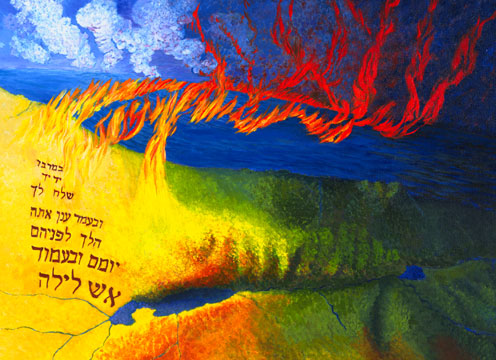
Shlach: The Miraculous Messenger

The Torah portion of Shlach relates how the men sent to spy out Eretz Yisrael returned and reported that the country was unconquerable. The Jewish people, they said, would be unable to enter the land, since “The inhabitants of the land are mighty.” (Bamidbar 13:28.)

Furthermore, say our Sages, (Sotah 35a.) the spies went so far as to say that even G-d would not be able to wrest the land from its inhabitants. Their words caused great consternation among the Jews, who feared that they would be unable to enter Eretz Yisrael.

How was it possible for the spies to mislead the Jewish people and convince them that even G-d could not help them, when the Jews themselves had constantly witnessed the miracles performed on their behalf, e.g., G-d provided their daily food and drink in a miraculous manner — manna from heaven and water from Miriam’s well.

Commentary on Torah Portion Shlach
from “The Chassidic Dimension” series
Based on Likkutei Sichos Vol. XVIII, pp. 171-174
and the teachings of the Lubavitcher Rebbe
Rabbi Menachem M. Schneerson
Chabad.org

Like the logic applied in our initial conundrum, the spies argued that after God created the laws of nature, He ruled that even He Himself would not be able to change those laws. God bound His own hands, as it were, by means of the laws that He Himself instituted. Until now, God’s leadership in the wilderness had been one of supernatural miracles that defied the laws of nature again and again. It was clear though that entering thelandofIsrael, for all its holiness, meant entering the confines of nature and living by its laws. This was why the ten spies thought that the Jewish people could not overcome the giants who lived in the land. They believed that God had indeed created a rock that could not be lifted. Moses himself used this argument in his prayer asking for God’s forgiveness, saying that destroying the Jewish people, God forbid, for their sin, would be proof for the surrounding nations of the erroneous claim that “God lacked the ability to bring this nation to the land which He swore to them…” (Numbers 16:14-15).

Joshua and Caleb, the remaining two spies, also saw that conquering the land was a supernatural task, but they said, “Yes, God can create such a rock that He cannot lift, but He can still decide to pick it up if He wants to.” They realized that on entering theHoly Land, God could paradoxically empower the Jewish people themselves with supernatural powers and this would become their very nature.

-Rabbi Yitzchak Ginsburgh
“The Rock that God Can Carry”
Commentary on Torah Portion Shlach
Wonders from Your Torah

I hadn’t heard this particular perspective on the “sin of the ten spies” before and that they believed that there was “a rock that God Himself couldn’t lift,” so to speak. I did however, realize that anyone who is “sent out” for a particular purpose is called “shlach,” including us.

I know it doesn’t sound like these two things are connected, but I can explain.

Go therefore and make disciples of all nations, baptizing them in the name of the Father and of the Son and of the Holy Spirit, teaching them to observe all that I have commanded you. And behold, I am with you always, to the end of the age.” –Matthew 28:19-20 (ESV)

WalkingThat command was originally given by the Master to the “eleven disciples (who) went to Galilee, to the mountain to which Jesus had directed them.” (v16) However, it has been inherited by every disciple who is called by his name, Jew and Gentile alike, and we have carried that mission upon us for nearly 2,000 years.

How are we doing so far?

Actually, not that bad. But we could be better, especially in the present age. It’s not so much that the Good News of Jesus Christ isn’t being spread to the four corners of the earth and that the vast, vast majority of the human race hasn’t heard of God, the Bible, and Jesus. They certainly have heard the Good News, however many of those people; perhaps most of those people, don’t see it as “good news” at all. Many people experience Christianity as “bad news.” They see us as superstitious, as old fashioned, as out of touch, as bigots, sexist, racist, anti-gay, anti-political correctness, anti-progressive.

Some of that is true, whether we intend it to be or not. Where have we gone wrong?

In the days of Moses, the ten spies gave an “evil report,” not because they were dumb or evil or cowards, but because they believed that the supernatural power of God would not go with them when they entered the land of Canaan. They believed that without the power of God, in terms of mere human strength, they would have no chance at defeating the mighty giants of the land. They felt abandoned and afraid.

Every time I read the words of “the great commission” as recorded in Matthew 28:19-20, I always puzzled over Christ’s final statement:

“And behold, I am with you always, to the end of the age.”

Now I realize what he was trying to say. He was trying to say that his disciples would not be alone in the enormous mission of taking the word of the Jewish Messiah to the nations of the world. Remember, nothing like that had even been dreamed of before let alone attempted. In a world full of false gods and polytheistic idol worshipers, how would the Word of the One God of Israel and the Messiah King of the Jews be received by the Gentiles? Would they listen to the Gospel message at all, or listen and then merely incorporate God into their panthenon of other gods, worshiping the God of Heaven as if he were just another idol of stone, wood, or bronze?

The Bible didn’t record the reaction of Christ’s “great commission” but it would be another fifteen years or so before any one of them would attempt to respond. Even then, Peter needed the prompting of not only a vision on a rooftop (Acts 10:9-16), but that of a messengers sent by the God-fearing Roman Cornelius with an unusual request. (Acts 10:17-23). The rest of this chapter in Acts tells the tale of God showing just how possible it was to carry the message of the Messiah to the Gentiles and how indeed, many Gentiles were eager to hear it.

Receiving the SpiritAnd in seeing that the Gentiles could receive the Holy Spirit, even as the Jews had already done (Acts 10:44-48), it was confirmed that the supernatural power of the Spirit of Messiah was with them “always, to the end of the age.”

That age hasn’t expired yet and neither has our calling. Not all of us enter what the church calls “the mission field” in a formal sense, but in truth, we are all “missionaries” or “sent ones.” We are shlach in the way we live our lives. Every word we speak and every action we take tells the tale of our Lord and Master, for good or for ill. Every deed of honor and praise glorifies the Name of God, and every mistake and mean-spirited act we commit drags that Name through the mud.

Joshua and Caleb understood that God would enable the Israelites to take the land, not by a series of supernatural miracles, but by making the people of Israel the miracle. We see in the book of Joshua and beyond how true this was. They didn’t have to believe in the miracles. They just needed faith in God. That first generation out of Egypt couldn’t overcome their “slave mentality” and when faced with such challenges, they balked. They didn’t have faith in themselves, let alone a God they felt would cease to provide protection from Heaven (I know, I’m applying midrash here, but I think it fits).

As believers and disciples of the Jewish Messiah, our teacher, our Master, and our King, what have we learned, not only from his lessons but from the lesson of the Shlach among the Israelites? Jesus already said that he would continue to be with us for the amount of time it takes to fulfill the directive to spread the Word of hope. He asks us to have faith. Faith in our Master, faith in the One Holy God of Israel…and faith in ourselves.

We see from the Biblical record that the taking of Canaan and the forging of Israel was no easy task, even though God was with the Children of Jacob. We see from the record of Paul’s letters that even though he was personally comissioned by the Messiah to be the “shlach to the Gentiles,” his task was at times brutally difficult. Our tasks are not easy, either. Living a life of faith and swimming against the tide or a world determined to deny God never is. We are reviled, called foul names, laughed at, ridiculed, and that’s only in the western nations. In other parts of the world, Christians are raped, beaten, tortured, and murdered for the sake of Jesus Christ. Under such terrific pressure, our sin is never in doing our best and failing, but only in failing to try.

“In fact, the spies’ sin, in fact any sin, can be understood using the same principles just applied. Sin is like a rock that by nature cannot be “lifted,” that is forgiven…But we know that even after sin, God remains open to teshuvah (repentance and return to God).”

-Rabbi Yitzchak Ginsburgh

“You do not always succeed, but you always have to try.”

-Gutman Locks
“Tefillin After 72 Years”
Stories of the Holocaust series
Chabad.org

A life of faith and miracles isn’t begun by waiting for God to make the first move. He’s waiting for us. So is everyone else. You can be the answer to someone’s prayer. All you have to do is try.

Good Shabbos.

Behaalotecha: The Presence of Light and Compassion

lightThe Lord spoke to Moses, saying: Speak to Aaron and say to him, “When you mount the lamps, let the seven lamps give light at the front of the lampstand.” Aaron did so; he mounted the lamps at the front of the lampstand, as the Lord had commanded Moses.

Numbers 8:1-3 (JPS Tanakh)

The Almighty is not in need of our light. On the contrary, we are in need of His. For this reason the Torah guides us in the proper way of taking full spiritual advantage of the light of the Menorah: The lamps must radiate toward themselves, meaning that the light they give should not only illuminate others, but it must come back and shine on the Menorah itself.

This returning light is at once a fact and a commandment. It applies especially in our day and age when the Temple and the Menorah are no longer standing, and when we must fill the void of the reflecting light that the Menorah once provided.

When the light we radiate around us by leading Torah lives returns to us, enhancing our spirituality and improving our behavior to one another, we will have fulfilled both the fact and the commandment of “When you light the lamps opposite the front of the candlestick the seven lamps shall give light.”

-from “Light That Returns”
A commentary on Torah Portion Behaalotecha
VirtualJerusalem.com

“You are the light of the world. A city set on a hill cannot be hidden. Nor do people light a lamp and put it under a basket, but on a stand, and it gives light to all in the house. In the same way, let your light shine before others, so that they may see your good works and give glory to your Father who is in heaven.”

Matthew 5:14-16 (ESV)

I suppose this week’s commentary on the Torah Portion is only loosely based on the Parashah, but I must admit that I need a little extra “light” in my world. With that in mind, I’m “tweaking” my “meditation” to favor “light.”

The Virtual Jerusalem commentary compares the commandment of lighting the Menorah in the Tabernacle to the “light” of spirituality, goodness, Torah study, and scholarship. To a Christian, praying, singing hymns, and preaching the Word might all seem like more worthwhile activities than studying the Bible, but for some Jews, studying Torah is directly associated with obeying its commands to do good and to show kindness to others. When you take in the light of the Torah, it shines in the world around you as well.

That very well could be related to what the Master was thinking when he said the words we have recorded in Matthew 5:14-16. We shine our light because we have received that light from our Master and teacher. It extends out into the world but it also is reflected back toward us as those we have touched in a meaningful way received our light (which comes from our Master) and it returns to us as a blessing.

Yes, we need blessings and renewal because even among the body of believers, it can be a trying world. If you’ve been reading the comments made on my blog over the past week or so, you know that tempers became heated, nerves became frayed, and some among the body of Christ seemingly forgot that our Master taught us a new commandment to love one another (John 13:34). Of course, there is the concept of “tough love” or “I’m only telling the truth,” but the Bible is replete with teachings about how to approach a brother privately to solve a dispute (Matthew 18:15-18).

Of course, Jesus goes on to say:

Again I say to you, if two of you agree on earth about anything they ask, it will be done for them by my Father in heaven. For where two or three are gathered in my name, there am I among them.” –Matthew 18:19-20 (ESV)

Naturally, the two have to actually agree on something, which seems easier said and done, and perhaps that “two or three..gathered in my name” means gathering face-to-face and not virtually in the blogosphere.

Yes, the “magic” of brotherhood I experienced at the Shavuot conference I recently attended has dissipated and once again, I encounter the actuality of “religious conversations,” where one can be accused of various misdeeds when the only “crime” that occurred was saying to the other person, “I don’t agree with you.” Failing to unreservedly honor another’s sacred cow can be a terrible thing (and I know a little something about pursuing sacred cows).

Tsvi Sadan calls the Messiah the concealed light, in part because the light of the Jewish King has been temporarily concealed from his Jewish brethern for the sake of the nations (see Romans 11). Rabbi Tzvi Freeman, in presenting the wisdom of the Lubavitcher Rebbe, of righteous memory, says:

It all began with an infinite light that filled all and left no room for a world to be. Then that light was withheld so the world might be created in the resulting void.

Then the world was created, with the purpose of returning to that original state of light — yet to remain a world.

All the world’s problems stem from light being withheld.

Our job then, is to correct this. Wherever we find light, we must rip away its casings, exposing it to all, letting it shine forth to the darkest ends of the earth.

Especially the light you yourself hold.

The Light was concealed. But its Source was not. The Source of Light is everywhere.

For those of you with little tolerance for Chassidic mysticism, I prefer to think of these writings as metaphorical. If indeed we shine some of the “concealed light” of our Master, the Messiah, Jesus Christ, as he taught us, we must not let the light be concealed. We must “rip away its casings” and expose that light to others. But what light are we talking about and what happens when it shines?

“Blessed are the poor in spirit, for theirs is the kingdom of heaven.

“Blessed are those who mourn, for they shall be comforted.

“Blessed are the meek, for they shall inherit the earth.

“Blessed are those who hunger and thirst for righteousness, for they shall be satisfied.

“Blessed are the merciful, for they shall receive mercy.

“Blessed are the pure in heart, for they shall see God.

“Blessed are the peacemakers, for they shall be called sons of God.

“Blessed are those who are persecuted for righteousness’ sake, for theirs is the kingdom of heaven.

“Blessed are you when others revile you and persecute you and utter all kinds of evil against you falsely on my account. Rejoice and be glad, for your reward is great in heaven, for so they persecuted the prophets who were before you. –Matthew 5:3-12 (ESV)

I suppose I could have quoted from any number of the Master’s teachings, but this one seemed particularly appropriate. Who is blessed? The poor in spirit, mourners, the meek, people who are passionate for righteousness, the merciful, the pure of heart, peacemakers, those persecuted for the sake of righteousness, the reviled, those falsely accused on account of the Master.

If you toss the Beatitudes into a big bowl, take a large wooden spoon and stir vigorously, you can come out with the idea that if you are persecuted, reviled, falsely accused, or just plain “bad mouthed,” you should still respond with meekness, act mercifully, be peacemakers, and mourn for the souls of those who need to personalize conflict in the name of Christ. What an odd way to react to a verbal slap in the face, but then the Master also said something about turning the other cheek (though probably not literal in meaning).

Sorry, I just needed to ponder those thoughts and to consider that even the world of religious discourse (some would say especially the world of religious discourse) is no less filled with landmines and tripwires than any secular conversation.

He could have placed streetlamps along all the pathways of wisdom, but then there would be no journey.

Who would discover the secret passages, the hidden treasures, if all of us took the king’s highway?

Toward the light Rabbi Freeman uses light and darkness to describe the presence or absence of wisdom and knowledge of God, but I choose to see this as a metaphor illustrating peace, mercy, and righteousness, or their absense. A movie I’ve seen a few times starring Harrison Ford as (of all people) the President of the United States, contains one of my favorite lines of dialog:

Peace isn’t merely the absence of conflict, but the presence of justice.

In my case, I’d settle for only the occasional absence of conflict (since, after all, this is the Internet and human beings are involved), the presence of compassion, and the soft glow of a bit of kindness, like candlelight, holding the darkness at bay.

Good Shabbos.

Naso: Bridegroom of the Sabbath

The Torah portion of Naso discusses the law of Sotah: (Bamidbar 5:11-31) When a husband warns his wife not to be alone with a certain man and she disobeys him, then even if she did not sin with that man, the very fact that she was alone with him causes her to become a sotah — a woman “straying from the path of modesty.” (Rashi, ibid., verse 12.)

The relationship between husband and wife in this world is analogous to the relationship between the A-lmighty and the Jewish people, who are deemed “husband and wife.” (See Likkutei Sichos , Vol. III, p. 984.) Thus all the laws of sotah apply to the relationship between G-d and the Jews.

The “warning” that G-d issues to the Jewish people is the command: “You shall have no other gods before Me.” (Shmos 20:3.) This is similar to the warning: “do not conceal yourself with a certain man.”

The Chassidic Dimension
Commentary on Torah Portion Naso
Based on Likkutei Sichos, Vol. IV, pp. 1032-1034
and the teachings of the Lubavitcher Rebbe
Rabbi Menachem M. Schneerson
Chabad.org

The Bible is replete with marriage metaphors, usually contrasting God and Israel as husband and wife. We also have a great deal of similar imagery in the Apostolic Scriptures depicting Jesus as husband and the church as his bride.

Wives, submit to your own husbands, as to the Lord. For the husband is the head of the wife even as Christ is the head of the church, his body, and is himself its Savior. Now as the church submits to Christ, so also wives should submit in everything to their husbands.

Husbands, love your wives, as Christ loved the church and gave himself up for her, that he might sanctify her, having cleansed her by the washing of water with the word, so that he might present the church to himself in splendor, without spot or wrinkle or any such thing, that she might be holy and without blemish. –Ephesians 5:22-27 (ESV)

Many Christian women take great comfort in these metaphors but more than a few men struggle with the role of “bride” relative to the Messiah. But let’s not be incredibly literal, since the Bible writers are using metaphors to describe a level of close intimacy between the Messiah and his disciples that can only be likened with the closeness and love experienced by two people who are intertwined by devotion. But Israel and the church aren’t the only “bride” metaphors we know of.

The chorus of the classic Sabbath hymn Lekhah Dodi states in part:

Let’s go, my beloved, to meet the bride,
and let us welcome the presence of Shabbat.

But in this instance, if the Shabbat is the bride, who is the bridegroom? The traditional Jewish tradition casts God in that role, but we also have this:

Or have you not read in the Law how on the Sabbath the priests in the temple profane the Sabbath and are guiltless? I tell you, something greater than the temple is here. And if you had known what this means, ‘I desire mercy, and not sacrifice,’ you would not have condemned the guiltless. For the Son of Man is lord of the Sabbath.” –Matthew 12:5-8 (ESV)

The oldest text we have for this passage is in Greek, but if we try to “retrofit” these verses back into the Hebrew thoughts of the Jewish writer of Matthew, when he says “the Son of Man is lord of the Sabbath,” what word did he use for “lord?”

“Adon” seems to be fitting under the circumstances, but a week ago, I heard a different interpretation by a young Jewish scholar (yes, I’m “borrowing” this from you, Nick) who offered a sort of midrash on this topic.

The word Baal is derived from the common Hebrew verb (ba’al), own, rule, possess. The verb is even used to indicate the husband’s relationship to his wife (Deuteronomy 24:1) and is applied to the relationship between God and man, “For your husband (ba’al) is your Maker…” (Isaiah 54:5).

-quoted from the
abarim-publications.com website

ShabbatBaal can mean both “lord” and “husband” but by deliberately applying the latter meaning, we can discover something about the relationship between Messiah and the Shabbat as well as something about the Messiah and us.

When we read the passage as “‘lord’ of the Shabbat”, we think of someone in charge or in command or with authority. These are very powerful images, but they don’t fit very well with how a loving groom should be approaching his bride. However, if we say, “‘husband’ of the Shabbat,” we completely change the meaning. Suddenly, we have an intimate, warm, caring interaction between the Messiah and the Shabbat.

Some Jewish sages state that the Shabbat is actually a small taste of the life in the world to come; Paradise, if you will. Creating the picture of a husband, the Messiah, welcoming his beloved bride, the Shabbat, into his arms, we can see something of the peace we will experience when he finally returns and fixes our broken world and our broken hearts.

He will wipe away every tear from their eyes, and death shall be no more, neither shall there be mourning, nor crying, nor pain anymore. –Revelation 21:4 (ESV)

This also fits very well back into what we saw in Ephesians 5 in comparing Jesus and the church with a husband and wife.

I know I’m being more than a little poetic here, but I take a certain amount of comfort in applying the lessons of both this week’s Torah Portion and the Shabbat to my walk of faith, and realize that Shabbat is not only a way for God to comfort us in the midst of our weekly trials, but His promise that He will always love us and, through the Messiah, grant us eternal peace.

Why should we stray after others to be alone with them when we can be the bride of the Moshiach and receive boundless intimacy with our bridegroom.

Good Shabbos.


Bamidbar and Shavuot: Souls in the Desert

“Numbers” may be the name by which the fourth of the Five Books of Moses is commonly called, but in the Hebrew original it is known as Bamidbar, or “In the Wilderness.” It is interesting to note that this parsha is always read immediately before the festival of Shavuot, “the season of the giving of the Torah.” What is the connection?

The Sages teach that it is not enough for G-d to give us the Torah, we have to be ready to receive the Torah. What makes us worthy recipients of this most precious and infinite gift from G-d? This is where the “wilderness” idea comes in. A wilderness is a no-man’s land. It is ownerless and barren. Just as a desert is empty and desolate, so does a student of Torah need to know that he is but an “empty vessel.” Humility is a vital prerequisite if we are to successfully absorb divine wisdom.

-Rabbi Yossy Goldman
“Wisdom from the Wilderness”
Commentary on Torah Portion Bamidbar (Numbers)
Chabad.org

When the day of Pentecost (that is, Shavuot) arrived, they were all together in one place. And suddenly there came from heaven a sound like a mighty rushing wind, and it filled the entire house where they were sitting. And divided tongues as of fire appeared to them and rested on each one of them. And they were all filled with the Holy Spirit and began to speak in other tongues as the Spirit gave them utterance.

Now there were dwelling in Jerusalem Jews, devout men from every nation under heaven. And at this sound the multitude came together, and they were bewildered, because each one was hearing them speak in his own language. And they were amazed and astonished, saying, “Are not all these who are speaking Galileans? And how is it that we hear, each of us in his own native language?”

Acts 2:1-8 (ESV)

I’m not sure what I’m supposed to write about. On my “morning meditation” for Fridays, I usually create a commentary on the weekly Torah Portion, which this week is the beginning of Numbers. However, we are also on the cusp of Shavuot and the two cannot be neatly divided and separated. In my quote from Rabbi Goldman, he even asks about the connection between the two. Fortunately, he also gives us an answer.

However, for those of us who are disciples of the Jewish Messiah and devoted to Jesus Christ, there is an added dimension to offering the Torah to the wilderness within all our souls. There is the giving of the Spirit and God. This isn’t to say that Jews do not have access to the Spirit of God. Far from it. But in accepting the Messiah into our hearts and recognizing that it is Jesus who is Lord of life and firstborn from the dead, we enter into a covenant that not only preserves us in the present world, but one that will endure beyond the next and into all eternity, even as Heaven and Earth pass away (Matthew 5:18).

But we are still here and we exist in what we call “now,” which is approaching Shabbat and a day later, Shavuot. We look to the past, to Mount Sinai and the Torah and to that room in Jerusalem and the Apostles being filled with the Spirit, and we rejoice. But it’s not all about the past.

Unlike Passover or Sukkos, or even the minor Rabbinic holiday of Purim, Shavuos comes with no special observances, no unique Mitzvos to be performed on that day. The “only” thing that sets Shavuos apart is that it is the day when G-d gave the Torah, His most precious gift, to the Jewish people.

Each year, we don’t merely revisit or even relive that experience. Kabbalistic sources teach that the unique spiritual powers of each holiday return to this world every year on that same day. On Shavuos, we have a special power to take our portion in Torah, each and every year.

Every year, many of us skip out on this unique opportunity. We deny ourselves the closeness to G-d which is within our grasp. And there is a fascinating Medrash concerning the giving of the Torah, which hints that this isn’t an entirely new phenomenon.

-Rabbi Yaakov Menken
“Shavuos”
Torah.org

Rabbi Menken doesn’t say this explicitly, but the reason we study Torah, observe the festivals, and remember the holy acts in the lives of the Apostles is to not just relive them today, but to experience them as new, fresh, living events that are happening to us for the very first time. Many Christians speak of a need for renewal in the church and yet Judaism has built into its calendar multiple times of renewing each and every year. Jews and Christians are at such a time now. Before our awareness of God, we existed as a wilderness, empty and barren in our soul. This is especially tragic for Jews since they are members of the Covenant and a chosen people, even if they acknowledge God not at all. We who are Gentiles, if we are without God, we are as Paul described us; far off and without hope (Ephesians 2:12).

The Jews were joined with God at the foot of Sinai in the desert, where the Torah was given to them. We who were once far off were offered the opportunity to also draw close to God at the foot of the cross and in that room in Jerusalem, when we were washed by blood and filled with Spirit. We were made alive and spiritually aware of God through Christ.

Rabbi Goldman concludes his commentary on Numbers and Shavuot by saying:

May we receive the Torah with joy and earnestness so that this important festival will be both memorable and meaningful.

Paul says in Ephesians 12:22 (ESV):

And in him you too are being built together to become a dwelling in which God lives by his Spirit.

Open your minds, your hearts, and your spirits to God. Today we become new again.

A Happy Shavuos and Good Shabbos.

(Shavuot begins Saturday evening right when Shabbat ends, so my next “morning meditation” will be posted online Monday morning. Blessings).

Behar-Behukotai: Seeking Crowns

The majority of this Torah reading focuses on the rewards granted for observance of the Torah, and the punishments ordained for failure to observe. One might ask: When a person has internalized the self-transcendence of Bechukosai, of what interest is reward? As the Alter Rebbe would say: “I don’t want Your World to Come. I don’t want Your Gan Eden. All I want is You alone.” (As quoted in Derech Mitzvosecho, Shoresh Mitzvos HaTefillah, ch. 40. See also Rambam, Hilchos Teshuvah, ch. 10.)

In truth, however, only a person who genuinely “wants You alone” can appreciate the full measure of reward G-d has associated with the Torah and its mitzvos. As long as a person is concerned with his individual wants and desires, he will interpret the reward received for observance in that light. When, by contrast, a person has transcended his individual will, instead of these petty material concerns, he will appreciate the essential good and kindness which G-d conveys. (See Likkutei Sichos, Vol. XV, p. 312)

This will create a self-reinforcing pattern, for the purpose of the rewards granted by the Torah is to enable an individual to further his study and observance. (Rambam, Mishneh Torah, Hilchos Teshuvah 9:1.)

As this pattern spreads among mankind, we will merit the full measure of blessings mentioned in the Torah reading, with the return of our people to our land, led by Mashiach. Then “Your threshing season will last until your grape harvest…. You shall eat your bread with satisfaction…. I will grant peace in the land, and none shall make you afraid.” (Leviticus 26:5-6.)

-Rabbi Eli Touger
In the Garden of the Torah
“Real Growth”
Commentary on Torah Portion Behukotai
Leviticus 26:3-27:34
Chabad.org

“Blessed are you when others revile you and persecute you and utter all kinds of evil against you falsely on my account. Rejoice and be glad, for your reward is great in heaven, for so they persecuted the prophets who were before you.Matthew 5:11-12 (ESV)

What we get out of our relationship with God is a matter of perspective. As Rabbi Touger illustrates, how we perceive our “reward” depends on how we perceive ourselves. I’ve written a number of commentaries on Rabbi Joseph Soloveitchik’s book The Lonely Man of Faith including my most recent missive, Burning the Plow. Soloveitchik presents “two Adams” using the two depictions of the creation of the first man in Genesis to show us two sides of the person of faith, the material and the spiritual. How we function in relation to God is how we see what God can do for us.

That probably sounds selfish, and it’s meant to be, at least in part.

The material man sees his relationship with God in terms of the world of here and now. He prays for success in business, good weather for planting crops, health for his family, and so on. There’s nothing wrong with this of course, but it is the general limit of the material man’s vision of his relationship with God. Man is the majestic steward of the world God created, and in return, he desires that God reward him with the benefits related to that creation.

It is written in Pirkei Avot Chapter 4, Mishna 2, that “the reward of a mitzvah is a mitzvah” (quoting Rabbi Dovid Rosenfeld). Thus the continued cycle I have described in the previous paragraph is self-perpetuating as long as the perspective of the material man does not change.

And for many people of faith, it never does.

However, Rabbi Touger’s commentary, quoting the Alter Rebbe, shows us a different path:

“I don’t want Your World to Come. I don’t want Your Gan Eden. All I want is You alone.”

On an emotional level, most of us can more or less understand this desire. We want to “feel” closer to God, to love Him with great zeal and to pour our heart and our life into pools of mystic wonder where only God exists. However, such a desire is difficult to grasp for very long for most of us, and we tend to believe that only saints or holy men or mystics who live in caves or monasteries can truly exist in a sustained state of “All I want is You alone.”

It’s hard for most Christians to imagine that Jews might express such a desire to want to walk with God alone, since Judaism is seen as a largely “behavioral” religion. An observant Jew tends to be defined by the mitzvot, by Torah study and obedience to the commandments. By contrast, Christians see their faith as more metaphysical, residing in the realm of belief and pure faith and grace, than in the raw mechanics of feeding a hungry person or donning tallit and tefillin before prayer.

But what about the Jews who first came to the realization that Jesus was and is the Messiah? Where is the meeting point between classic Judaism and traditional Christianity? Where did it all begin before man artificially split the two faiths (or was that split all part of God’s plan as Paul describes in Romans 11:25)?

For I am already being poured out as a drink offering, and the time of my departure has come. I have fought the good fight, I have finished the race, I have kept the faith. Henceforth there is laid up for me the crown of righteousness, which the Lord, the righteous judge, will award to me on that Day, and not only to me but also to all who have loved his appearing. –2 Timothy 4:6-8 (ESV)

What is this “crown of righteousness” of which Paul speaks? Is it a literal crown he wears in the Heavenly court? Is it the sheer experience of bliss and wonder in God’s “Gan Eden” (Garden of Eden or Paradise)? Or could it be “God and God alone?”

Around the throne were twenty-four thrones, and seated on the thrones were twenty-four elders, clothed in white garments, with golden crowns on their heads. –Revelation 4:4 (ESV)

And whenever the living creatures give glory and honor and thanks to him who is seated on the throne, who lives forever and ever, the twenty-four elders fall down before him who is seated on the throne and worship him who lives forever and ever. They cast their crowns before the throne… –Revelation 4:9-10 (ESV)

The passages from Revelation 4 certainly seem to indicate real, physical crowns as the rewards, but this could be deceptive, since John’s vision of the Heavenly court and the events he witnessed is highly mystical and may not represent actual, literal actions. But look at what the twenty-four elders do with their crowns when they “give glory and honor and thanks to him who is seated on the throne.” They “cast their crowns before the throne” and say:

“Worthy are you, our Lord and God,
to receive glory and honor and power,
for you created all things,
and by your will they existed and were created.”

In addressing “the Lord God Almighty” (v 8), what does it mean to cast your crowns before His throne?

I’m no theologian so it’s impossible for me to say with any authority what John was really witnessing in this act of supreme worship of the Ein Sof God Almighty, “who was and is and is to come.” But let’s pretend what they were/are all doing was/is fulfilling this desire:

“I don’t want Your World to Come. I don’t want Your Gan Eden. All I want is You alone.”

When I was a child and I tried to imagine Heaven, I thought it sounded pretty boring. There was nothing to do there except constantly worship God. I thought it sounded like one, infinitely long church service where you had to sit in a hot sanctuary in sticky, itchy clothes, and be quiet, and listen to organ music, and pray and recite stuff, and endlessly say:

“Holy, holy, holy, is the Lord God Almighty,
who was and is and is to come!”

Didn’t anybody ever have fun in Heaven? What kind of reward was all this “holy, holy, holy” stuff anyway?

Most children tend to be “material man,” lacking the ability to see beyond their immediate, temporal needs and desires. Many adults, even in the community of faith are like this, too.

Beyond majestic, material man is the person seeking to simply walk with God; who perceives his path as illuminated by an ineffable light. When we desire “God alone” there is no way we can truly understand what we are asking for. Who could possibly imagine what the crowns of Paul or the elders in John’s vision actually were, and if they existed materially or not? I choose to believe that there is so much more to the rewards awaiting covenantal, spiritual man and that, attempting to imagine them from the viewpoint of the material human being, we miss the point completely.

Pray not for Heaven or for Paradise or for crowns of gold. Let your only desire for reward be God Himself.

Then let awe and wonder in every corner of your existence take hold and realize that He is already here. Life is a miracle and your soul is the soul of your Creator. Once you know this, the mitzvot will take care of themselves for they will be inseparable from the ineffable light of God.

He could have made a world where the nature of each thing may be deduced from its parts. A predictable, orderly world. A world devoid of wonder. And then we would say, “Things are this way because they must be this way.” G-d would be a stranger in His own world.

Instead, at each step a whole new world emerges, one we could never have predicted from anything we knew before. Until we must conclude that our finite world somehow contains infinite possibilities, that both nothing and everything is possible, that things are the way they are only because He desires they be that way.

He has made our world wondrous, so that it has room for Him.

-Rabbi Tzvi Freeman
“The Unnatural Nature of Things”
Based on letters and talks of the Rebbe
Rabbi M. M. Schneerson
Chabad.org

Good Shabbos.

Singing the Monkey House Blues, Part 2

Frequently, we may look at other people, and feel jealousy. We wonder why this person was born wealthy, this one with a brilliant mind, this one with great beauty. Others may also look at the Torah, and wonder why this group is different from that group, or why the Rabbis gave certain responsibilities to one group and not another.

The truth behind the distinctions of the Kohanim should teach us. Jewish thought does not tell us to seek fame and glory. Our lives are not about power and privilege. The Torah tells us that we are here to seek and to serve our G-d, through performance of Mitzvos and good deeds.

-Rabbi Yaakov Menken
“Privileged People”
Commentary on Parshas Emor
Torah.org

Disclaimer: As I mentioned in part 1 of this two-part series, I am expressing my viewpoint on Jewish uniqueness and distinctiveness in the community of Messianic believers and suggesting that Jews and non-Jews embody different, or at least, overlapping sets of responsibilities and duties to God while remaining absolutely equal in God’s love and in His salvation. Chances are, some of you reading this will not be happy with me and will disagree with my perspectives. I understood that when I started writing “Monkey House.” Now let’s continue and see how the various parts of the Bible and the perspective of the sages can illuminate this issue.

I know I’m probably going to make some people reading this unhappy, but it’s important to understand that if groups of Jews in the Messianic movement need to preserve their distinctiveness relative to the Torah and God, it isn’t an attempt to “cut out the Gentiles” or to make themselves more exalted. It’s a response to the Torah and the covenant of Sinai. The specific distinctions between Jews and non-Jews in modern Messianism is just as valid and legitimate as the distinctions between the Kohenim class and the larger body of Israel in ancient (and arguably modern) times.

Rabbi Menken said something very important that most Christians should pick up on:

Jewish thought does not tell us to seek fame and glory.

Compare that to this parable of the Master:

Now he told a parable to those who were invited, when he noticed how they chose the places of honor, saying to them, “When you are invited by someone to a wedding feast, do not sit down in a place of honor, lest someone more distinguished than you be invited by him, and he who invited you both will come and say to you, ‘Give your place to this person,’ and then you will begin with shame to take the lowest place. But when you are invited, go and sit in the lowest place, so that when your host comes he may say to you, ‘Friend, move up higher.’ Then you will be honored in the presence of all who sit at table with you. For everyone who exalts himself will be humbled, and he who humbles himself will be exalted.” –Luke 14:7-11 (ESV)

The reason the Torah is a story about God’s interaction with humanity and not just about God’s interaction with Israel, is because the Bible is a tapestry woven with the very threads of human nature. It’s human nature to want what we can’t have. It’s human nature to desire what another person possesses by right or ability and to think it’s unfair if we can’t be exactly like them. It’s human nature to sometimes want to be someone we’re not.

Perhaps this is the human dynamic that lead the Levites to be jealous of the Kohenim as well that what’s going on in the Messianic community these days. It may even be the original root of early supersessionism in the church.

I once read a short story in Kurt Vonnegut Jr’s anthology Welcome to the Monkey House where no one was allowed to be better at anything than anybody else. For example, using the slowest runner in society as a baseline, anyone who could run faster was made to wear weights to slow them down to the same speed as the slowest runner. That way the slowest runner wouldn’t have to feel bad knowing that other people could run faster. The entire society was organized this way so that even the perception of greater or lesser ability and privilege was eliminated for the sake of absolute uniformity.

I’m sometimes reminded of Vonnegut’s story when I encounter the desire for uniformity by non-Jews in the Messianic movement.

But God didn’t make us uniform. He didn’t make the Kohenim uniform with the rest of the tribe of Levi or with the Israelites in general. God also didn’t make Jews in the Messianic movement uniform with the larger Gentile Messianic, Hebrew Roots, and mainstream Christian community.

I know that if the lessons in the Bible cannot overcome human nature in the body of faith, my one little blog has no hope of doing so. Nevertheless, since Rabbi Menken’s Torah commentary speaks to this theme, I thought it appropriate to adapt it for a somewhat different audience. We need to understand that different doesn’t mean “better” or “worse,” it just means different. If someone else has a job as a writer because that is their special skill set, it doesn’t make them better than you, it just makes them different based on natural ability. The same goes for people who are skilled musicians, artists, and computer programmers.

Rabbi Menken ended his commentary with the following words, and I suppose I should do the same:

G-d gave us the Torah to assist us in our search. We need not wonder why some of us are Kohanim, some Levites, some Israelites, and why our tasks and responsibilities are different – because just as each individual is different, what will help one person to grow could be harmful to another. And when we perform our tasks correctly, and succeed in our mission, then these outside distinctions do not determine who is considered truly worthy: “An ill-begotten scholar is preferable to an ignoramus priest.” It is not how we were born that makes us – it is how we die.

We can either try to learn from these lessons or be stuck in the “monkey house” singing the blues.

There is no one for whom to pride oneself. We must toil strenuously. With patience and friendliness we can prevail in all things, with G-d’s help. With a denigrating attitude toward others and inflating our own importance we lose everything, G-d forbid.

Hayom Yom: Iyar 20, 35th day of the omer
Compiled by the Lubavitcher Rebbe
Translated by Yitschak Meir Kagan
Chabad.org

NOTE: Oh, neither the title of this blog post nor my choice of comparing the Korah rebellion with some of the conflicts in the Messianic movement are intended to be disrespectful. As I said, the dynamics between the Kohenim and the Levites is very similar to that of Jews and Gentiles in Messianism. And having recalled the name of Vonnegut’s anthology, I had to figure out a way to weave it into my little missive. I just liked the imagery.