Tag Archives: Torah Portion

Chukat: Walking Into Darkness

extinguished_candle

“I don’t get no respect.”

-Rodney Dangerfield

“Rebbe!” the man cried. “Nobody gives me respect! Everybody steps all over me and my opinions!”

—“And who told you to fill the entire space with yourself, so that wherever anyone steps, they step on you?”

-Rabbi Tzvi Freeman
“Smaller”
Based on letters and talks of the Rebbe, Rabbi M. M. Schneerson
Chabad.org

The Torah states:

“And Moshe and Aharon gathered the Assembly (the whole of the Jewish people) before the rock and he (Moshe) said to them, ‘Hear now, you rebels.’ ” (Numbers 20:10).

Was Moshe correct to call them rebels?

Dvar Torah for Chukat
based on Love Your Neighbor by Rabbi Zelig Pliskin
quoted by Rabbi Kalman Packouz
Aish.com

I don’t think most of us could blame Moses for losing his temper every once in a while. After all, for almost forty years, he’s had to put up with millions of grumpy, ungrateful, temperamental, and complaining people. He’s worried about getting them to where God wants them to go. He’s worried that they’ll complain again resulting in a plague that will kill tens of thousands of them. He’s worried that some upstart will challenge his and Aaron’s authority. And as we see in this week’s Torah portion, he’s got to watch his brother and sister die.

It’s not easy being Moses. No wonder he also gets grumpy from time to time. No wonder he called the Israelites “rebels,” whether they deserved it on that occasion or not. He’s not getting a lot of respect, given that he’s the greatest prophet ever to arise out of Israel.

And we know that based on the incident recorded in Numbers 20, he loses the right to enter the Land alongside Israel, his brothers, his children. But what did he do that was so wrong?

The Dvar Torah quoted by Rabbi Packouz continues:

The Midrash tells us that whoever serves as a leader of the Jewish people must be very careful how he addresses them. According to one opinion — because Moshe said, “Hear now, you rebels,” he was told, “Therefore, you shall not bring the assembly into the Land which I have given them” (Bamidbar 20:12).

The prophet Yeshayahu (Isaiah) said to the Almighty, “I am a man of unclean lips, and I dwell in the midst of a people of unclean lips” (Isaiah 6:5). For this statement he was severely punished.

The prophet Eliyahu (Elijah) said to the Almighty, “I have been very zealous for the Lord God of hosts; for the Children of Israel have forsaken Your covenant” (1 Kings 18:10). He was severely punished for his statement.

Rabbi Avuhu and Rabbi Shimon ben Lakish were traveling to a certain town. Rabbi Avuhu asked Rabbi Shimon ben Lakish, “Why should we go to a place of blasphemers?” Upon hearing this, Rabbi Shimon ben Lakish strongly reprimanded Rabbi Avuhu and told him, “God does not want us to speak evil about the Jewish people.” (Yalkut Shimoni 764)

Moses-Mount-NeboIf you are a Christian, you may be asking yourself what makes the Jewish people so special that they shouldn’t be criticized? After all, God criticized the Israelites on more than one occasion up to and including circumstances that led to the death of thousands. Is this midrash even valid? Why should we pay attention?

Let’s expand the viewpoint a bit. God entrusted Moses with a great responsibility: to lead the Children of Israel to the Promised Land and, failing that, to lead them in the desert for four decades, teaching them God’s commandments and ordinances and preparing the next generation to enter into and conquer the Land.

You can’t do that without respect but more importantly, you can’t do that unless you love and respect those you are leading. This lesson is easily applied to anyone in leadership. It can be applied to a Pastor, a Priest, a boss, a parent, a teacher, a writer, anyone who has an audience that depends on the “leader” for guidance in some fashion. That usually means all of us at one point or another in our lives.

Not many of you should become teachers, my brothers and sisters, for you know that we who teach will be judged with greater strictness. For all of us make many mistakes. Anyone who makes no mistakes in speaking is perfect, able to keep the whole body in check with a bridle.

James 3:1-2 (NRSV)

I don’t know anyone who is perfect in speech, least of all me.

One of the reasons I stopped teaching at my former congregation and subsequently resigned from leadership was because of this verse. I felt that I was not aptly qualified for the position (though no one seemed to complain). I am not formally trained in theology and my conclusions can certainly be wrong. As a blogger exploring my own personal and spiritual “space,” I’m not actually a teacher and all I’m doing really is just chronicling my daily exploration into my relationship with God.

But it’s not as simple as that. If anyone reads what I write and accepts what I write, I have a responsibility to that person. If they can find fault in what I am presenting, I need to look at that comment, take it seriously, and if I see that they are correct, make a correction within me, and then reflect it back out on my blog.

Rabbi Pliskin, as quoted by Rabbi Packouz, shows us several examples of why midrash believes the crime of Moses against the Children of Israel was speaking evil against the Jewish people. He failed to show love and respect to those who God loves and respects. Moses had been called the most humble man in the world (Numbers 12:3) and I believe that is a qualification that great leaders should possess.

It’s kind of hard to find humility on the Internet and particularly in the blogosphere. It’s difficult to always suppress “ego” on the web.

I suppose I could go into specifics about who said what about whom, but what would be the point? Every time I allow myself to enter into one of those conversations, the only one who gets “beaten up” is me, and I did it to myself. No, that’s not quite true. Anyone who is associated with me, even by the thinnest of threads, is also hurt by my behavior. Although it’s not my intent, those who are considered my “friends” or “allies” are dragged down into the mud hole that I created simply because I didn’t ignore temptation. In that way, I continue to provide a disservice to the Messiah and continue to create distance between me and those I care about. My words and opinions are my own. I’m not anyone’s puppet. But I’ll never convince some people of that, so the damage is done anyway.
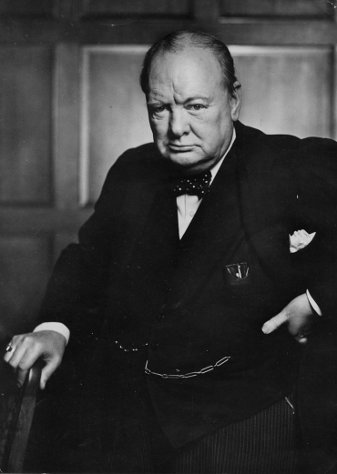
Winston_Churchill_1941But who cares about all the mud slinging on the Internet? What does it matter if one person has an opinion and I have another? Sadly, a good many people. Winston Churchill once said, “A lie gets halfway around the world before the truth has a chance to get its pants on.” Churchill also said “The British nation is unique in this respect: they are the only people who like to be told how bad things are, who like to be told the worst.”

While criticism doesn’t have to be a lie, for some reason lies, criticisms, and gossip seem to travel farther and faster than truths and complements. I disagree with Churchill that only the British people like to hear bad news, I think most people like to hear bad news, at least if it’s about someone else. Just hop on the Internet and go to several of the major news sites. What sort of news dominates the headlines? Bad news. Why not good news? Good news doesn’t sell, but a good scandal, disaster, or crime story will attract readers in droves.

How many people comment on a good, wholesome, inspirational blog post vs. one that is filled with criticism, controversy, and hostility? A “mean-spirited” blog post is like a big car crash. It’s horrible to look at but it draws people in herds.

Is that what I’m supposed to be “selling” on my blog as a disciple of the Jewish Messiah…bad news? Am I supposed to contribute gossip and “tell tales out of school,” even tangentially when I comment on another’s blog?

The words of a talebearer are as wounds, and they go down into the innermost parts of the belly.

Proverbs 26:22 (KJV)

For every species of beast and bird, of reptile and sea creature, can be tamed and has been tamed by the human species, but no one can tame the tongue—a restless evil, full of deadly poison.

James 3:7-8 (NRSV)

If you can’t say something nice… don’t say nothing at all.

-Thumper, quoting his father
Bambi (1942)

As believers, we have to be particularly mindful of what we’re saying and why. This is especially true of me since I am acutely aware of my own failures because of participating in areas on the web that have done harm to others. By my participation, I’m part of creating that harm. Why am I doing this? Am I seeking my own gratification at the expense of another human being? That’s not my intent and in fact, that’s exactly what I am trying to speak against.

Among Rabbi Pliskin’s numerous and highly useful quotes, there is this:

If your mind is focused on an insignificant incident, it can destroy your happiness if you allow it to. To feel happy, your mind has to be free of pains and misfortunes.

Learn to differentiate between productive thinking about problems as a means of solving them, and counterproductive dwelling on misfortunes which gains nothing positive and destroys your quality of life.

praying-aloneVery often people who appear very angry, or self-righteous, or abusive are actually very hurt. The problem is, it is very difficult to get past “angry” in order to help “hurt.” The first best way we can help someone like that is to find a way to reach the “hurt” part of them and help them learn to heal. I’d like to do that but my efforts almost always backfire so I guess I should stop.

As writers, we have a teaching function, whether we want it or not. Therefore, if the role is upon us, we should carefully choose our topics and our words so that we can be as encouraging and as uplifting as possible while still getting our point across. We should also question the motivation for making our points and verify that we are not deliberately trying to hurt someone else because we believe they hurt us (whether they actually did or not).

The audience or consumers of blogs should also be mindful of the function of writers and teachers as well as our limitations and faults and keep in mind that just because we put something on the Internet doesn’t mean it’s right. It may not be right in terms of being factual and it may not being right in terms of moral correctness (even if it is factual).

Moses may well have been factual when he called the Children of Israel “rebels,” but at least according to midrash, he was absolutely wrong morally in doing so.

Blowing out someone else’s candle won’t make yours shine any brighter.

-Anonymous

In fact, if you have to blow out someone else’s candle for the sake of your own, chances are you are walking in darkness anyway. The sun is setting and it’s getting harder to see. It would be comforting to see the lights of the Shabbos candles as I walk into darkness, but as a writer, disciple, and just one lone human being, I have miles to go before I have any hope of illumination.

Good Shabbos.

103 days…or 32 days. Still making up my mind.

Korach: Learning How to Dance

korach-buried-aliveThere are two rebellions this week. First, Korach, a Levite, was passed over for the leadership of his tribe and then challenges Moshe over the position of High Priest. No good rebellion can be “sold” as a means for personal gain, so Korach convinces 250 men of renown that they must stand up for a matter of principle — that each and every one of them has the right to the office of High Priest (which Moshe had announced that God had already designated his brother, Aharon, to serve).

Fascinatingly, all 250 followers of Korach accept Moshe’s challenge to bring an offering of incense to see who God will choose to fill the one position. This meant that every man figured he would be the one out of 250 to not only be chosen, but to survive the ordeal. Moshe announces that if the earth splits and swallows up the rebels it is a sign that he (Moshe) is acting on God’s authority. And thus it happened!

The next day the entire Israelite community rises in a second rebellion and complains to Moshe, “You have killed God’s people!” The Almighty brings a plague which kills 14,700 people and only stops when Aharon offers an incense offering.

-Rabbi Kalman Packouz
“Shabbat Shalom Weekly”
Commentary on Torah Portion Korach
Aish.com

A fanatic is someone who redoubles his efforts while losing sight of his goal.

-George Santayana

You’d think after seeing the deaths of Korach and the 250 rebels that the rest of the Children of Israel would have been frightened enough to back away from speaking against Moses, Aaron, and ultimately God. Unfortunately, they seemed to have panicked and panic has no reason. Neither does fanaticism which is defined as “a belief or behavior involving uncritical zeal, particularly for a religious or political cause or with an obsessive enthusiasm…the fanatic displays very strict standards and little tolerance for contrary ideas or opinions.”

Since I blog in the world of religion, I suppose that someone could come along and accuse me of being a fanatic when I defend a particular point of view and don’t acquiesce to another’s contrary viewpoint. But then I hope there is a difference between steadfast determination and being a fanatic.

Korach and the 250 didn’t back down and neither did the Israelite community until after over 14,000 people died. What does it take for the rest of us to look at a situation, know when to press ahead with our point, and know when to back away?

In describing in his commentary how not to argue, Rabbi Packouz lists nine points. One of them is:

Turn the argument into a discussion. Don’t defend a position; set forth an idea or problem to be clarified. People of good will who reason together can come to a common conclusion. Listen with an open mind. Be a judge, not a lawyer!

calvinism-vs-arminianismIn the blogosphere, it’s difficult to keep a discussion into spilling over the threshold of civility into an argument. A lot of religious people take a “my way or the highway” stance with the theologies and doctrines to which they adhere. My exploration into Calvinism vs. Arminianism is a good example of such a dialog. So far, no one has come along on my blog to take me to task for my viewpoint in that debate, but if I found the right venue for the discussion, I’m sure a “passionate” exchange would occur. There have indeed been such debates in the comments section of my blog in the past.

So how do we know when we are defending a position for our faith and for the sake of God as opposed to our own ego and bullheadedness?

This week’s Torah portion tells the story of Korach’s dispute with Moshe. The mishna (a teaching) in Pirke Avot 5:20, states that “Any dispute that is for the sake of Heaven will be of lasting worth and one not for the sake of Heaven will not be of lasting worth. Which dispute was for the sake of Heaven? That of Hillel and Shamai. Which was not for the sake of Heaven? That of Korach and his company.”

That’s part of the Dvar Torah presented in Rabbi Packouz’s commentary. Here’s something similar.

When they heard this, they were enraged and wanted to kill them. But a Pharisee in the council named Gamaliel, a teacher of the law, respected by all the people, stood up and ordered the men to be put outside for a short time. Then he said to them, “Fellow Israelites, consider carefully what you propose to do to these men. For some time ago Theudas rose up, claiming to be somebody, and a number of men, about four hundred, joined him; but he was killed, and all who followed him were dispersed and disappeared. After him Judas the Galilean rose up at the time of the census and got people to follow him; he also perished, and all who followed him were scattered. So in the present case, I tell you, keep away from these men and let them alone; because if this plan or this undertaking is of human origin, it will fail; but if it is of God, you will not be able to overthrow them—in that case you may even be found fighting against God!”

Acts 5:33-39 (NRSV)

I suppose this isn’t the first time this passage from Luke’s Acts of the Apostles has been compared to the Korach rebellion. The trick is to know our own motivation, which is harder than you may think. A good many people have been utterly convinced that they were arguing and even fighting for what is good and right, only to ultimately discover that their motives were totally selfish. Human beings are very good at self-delusion, sometimes with disastrous results.

“Not everyone who says to me, ‘Lord, Lord,’ will enter the kingdom of heaven, but only the one who does the will of my Father in heaven. On that day many will say to me, ‘Lord, Lord, did we not prophesy in your name, and cast out demons in your name, and do many deeds of power in your name?’ Then I will declare to them, ‘I never knew you; go away from me, you evildoers.’”

Matthew 7:21-23 (NRSV)

Woman in the darkThat’s a terrifying thought. I don’t doubt that those of whom the Master speaks sincerely believed (some of them, anyway) that they were “fighting the good fight,” speaking prophesies in his name, casting out demons in his name, and doing many other powerful things in the name of Christ. What bitter disappointment will they suffer when they find they are completely rejected and in fact have been following the wrong path all along.

And how do I know for sure that the path I am following is the right one? How do I know if I will be among those accepted in the Kingdom or tossed out in the dark?

Remember, self-delusion is incredibly common with people.

The mishna should have said that the dispute not for the sake of Heaven was that of Korach and Moshe, not between Korach and his fellow conspirators! Why didn’t the mishna mention Moshe as the antagonist? Korach started the dispute for his own personal gain (not for the sake of Heaven) while Moshe was upholding the Almighty’s word and the Almighty’s honor (you can’t get more “for the sake of Heaven” than this!)

Why then does the mishna mention that a dispute not for the sake of Heaven is the one between “Korach and his company”? We might think that Korach and his company were united in their argument with Moshe. The mishna is telling us that each of the 250 was challenging Moshe for his own gain (remember, each one brought incense to see if he himself would be chosen as the Cohen Gadol, High Priest.) In truth, Korach and his congregation were in dispute amongst themselves as to who should be the High Priest.

The mishna points us in a direction, but the effort to maintain an understanding of our motives belongs to us. Every time we take a strong position, we must ask ourselves, “am I doing this for the Master’s glory or for my own?” When my opinion is challenged and I strongly defend my point of view, I must ask if it is for the sake of Heaven that I do this or only because I want to be “right?”

If confronted with the knowledge that I’m acting for my own interests, would I be willing to admit I am wrong? In such a discussion is it very wise to make such an admission. Rabbi Packouz comments.

No one is ever totally right. Find something to apologize for, to take responsibility for. The other person will feel better and may even own up to some mistakes of his/her own.

I spent nearly a year writing about my journey of discovery and ultimately had to admit I was wrong about my original “one law” assumptions that I had made years before and never questioned.

I don’t think that I made my assumptions solely out of self-interest or ego, but once my assumptions were confronted by others, my ego and the need to be “right” was definitely engaged. I can tell you that it is a difficult and painful thing to realize many of the attitudes and beliefs I held were incorrect, and letting them go was one of the hardest things I’ve ever done.

But if I didn’t let them go, especially in the face of overwhelming evidence and with the realization of the damage I was doing, especially in my home, the price to be paid would have been much, much more dear.

“When you are invited by someone to a wedding banquet, do not sit down at the place of honor, in case someone more distinguished than you has been invited by your host; and the host who invited both of you may come and say to you, ‘Give this person your place,’ and then in disgrace you would start to take the lowest place. But when you are invited, go and sit down at the lowest place, so that when your host comes, he may say to you, ‘Friend, move up higher’; then you will be honored in the presence of all who sit at the table with you. For all who exalt themselves will be humbled, and those who humble themselves will be exalted.”

Luke 14:8-11 (NRSV)

Waiting to danceThis is a good test for fanaticism, because a fanatic cannot be humble. It feels too “dangerous” to back down, too vulnerable to be silent about something that’s important. Rabbi Packouz suggests that being silent and, when talking, speaking with a soft voice are two ways to avoid arguing. If you can maintain your composure, agree with the points being made by the other person you feel are correct, and admit it when you know you are wrong (letting yourself even consider that you could be wrong is a step in the right direction), then it is very likely that you are not being fanatical about what you’re trying to communicate.

Then your mind and heart are most likely clear enough to determine when you are tempted to argue for the sake of your own ego or sense of vulnerability, and when you are standing up and being a voice for the sake of Heaven.

But you have to be sure to constantly be your own critic, questioning what you’re doing and why.

Leslie (Diana Muldaur – voice): “You seem quieter than usual tonight.”
Batman (Kevin Conroy – voice): “Every time I come here, I wonder if it should be the last time. . . Put the past behind me. . . Try to lead a normal life.”
Leslie: “Santayana says that ‘those who forget the past are condemned to repeat it’.”
Batman: “He also said ‘a fanatic is someone who redoubles his efforts while losing sight of his goal.'”

-from the episode “I Am the Night”
Batman: The Animated Series (1992)

“One who romanticizes over Judaism and loses focus of the kingdom of Heaven can be compared to a carpenter who is infatuated with the hammer, rather than the house it was meant to build.”

-Troy Mitchell

I often question why I write this blog at all. What good does it do? Am I doing it to help build the Kingdom of Heaven or just because I like to see my words posted on the web? Blind certitude is something I can’t afford. I don’t think it’s something any of us can afford. This isn’t a matter of fighting to see who wins and who loses, but the pursuit of interaction and cooperation so that we can mutually seek out an encounter with God.

Our work involves trying to dance when others only know how to wrestle.

-Rabbi Carl Kinbar

The lesson of Korach is that we need to learn not how to wrestle, but how to dance.

Good Shabbos.

110 days.

Shelach: Going Up

Rising IncenseBut the men who had gone up with him said, “We cannot attack that people, for it is stronger than we.” Thus they spread calumnies among the Israelites about the land they had scouted, saying, “The country that we traversed and scouted is one that devours its settlers. All the people that we saw in it are men of great size; we saw the Nephilim there — the Anakites are part of the Nephilim — and we looked like grasshoppers to ourselves, and so we must have looked to them.”

Numbers 13:31-33 (JPS Tanakh)

Then the two men came down again from the hills and crossed over. They came to Joshua son of Nun and reported to him all that had happened to them. They said to Joshua, “The Lord has delivered the whole land into our power; in fact, all the inhabitants of the land are quaking before us.”

Joshua 2:23-24 (JPS Tanakh)

Have you ever wondered about these two events? What set apart one generation from the next? There’s actually an involved set of sociological, psychological, and experiential factors that come into play about why the generation who came out of Egypt couldn’t conquer the Land but their children could.

However, according to Rabbi Kalman Packouz’s commentary on Torah Portion Shlach:

The Kotzker Rebbe said that the mistake of the spies was in the words “and so we were in their sight.” It should not bother a person how others view him. (Otzer Chaim)

A person who worries about how others view him will have no rest. Regardless of what he does or does not do, he will always be anxious about receiving the approval of others. Such a person makes his self-esteem dependent on the whims of others. It is a mistake to give others so much control over you. Keep your focus on doing what is right and proper. Work on mastering the ability to have a positive self-image regardless of how others view you.

The Chofetz Chaim commented, “When you view yourself as inferior, you will assume that others also view you in this manner. The truth could very well be that the other person views you in a much higher manner. As the Yalkut Shimoni states, “The Almighty said, ‘Who says that you were not in their eyes as angels?’ ” (HaChofetz Chaim, Vol 3, p. 1060)

It has been said that “you are what you think,” or in other words, your “attitude” about a person or situation tends to dictate how you’ll respond. If you believe you are a “grasshopper” in the sight of others, often it’s because that’s how you see yourself in comparison to those others (or anyone). The result is what you do or what you fail to do.

Here’s another comparison:

And they were bringing children to him that he might touch them, and the disciples rebuked them. But when Jesus saw it, he was indignant and said to them, “Let the children come to me; do not hinder them, for to such belongs the kingdom of God. Truly, I say to you, whoever does not receive the kingdom of God like a child shall not enter it.” And he took them in his arms and blessed them, laying his hands on them.

Mark 10:13-16

And as he was setting out on his journey, a man ran up and knelt before him and asked him, “Good Teacher, what must I do to inherit eternal life?” And Jesus said to him, “Why do you call me good? No one is good except God alone. You know the commandments: ‘Do not murder, Do not commit adultery, Do not steal, Do not bear false witness, Do not defraud, Honor your father and mother.’” And he said to him, “Teacher, all these I have kept from my youth.” And Jesus, looking at him, loved him, and said to him, “You lack one thing: go, sell all that you have and give to the poor, and you will have treasure in heaven; and come, follow me.” Disheartened by the saying, he went away sorrowful, for he had great possessions.

And Jesus looked around and said to his disciples, “How difficult it will be for those who have wealth to enter the kingdom of God!”

Mark 10:17-23

camel-eye-of-a-needle-gateI suppose another way of putting it is how can a child be compared to a rich man when they attempt to enter the Kingdom of Heaven?

But what does that have to do with the generation with Moses who failed to enter the Land and the generation with Joshua who did?

It’s all a matter of perspective. What is the world a child sees as opposed to someone who is quite wealthy when confronted with bringing the Kingdom of Heaven near?

What did the rich person have to lose and what were the children being brought to Jesus experiencing? When we become secure in our situation for whatever reason, there’s a tendency not to want to leave that security. But children don’t worry about jobs, income, and wealth. They take it for granted that the adults in their lives who love them will take care of them. They focus on the matter at hand which for them is just being a child.

When Jesus said ‘whoever does not receive the kingdom of God like a child shall not enter it,” he wasn’t saying that maturity or education had no value. He wasn’t even saying that having wealth or material comfort was such a bad thing. He was saying that we must learn to trust and value the Master and the “gifts” of the Kingdom of Heaven most of all.

The first generation of Israelites who left Egypt in some sense never really left. Whenever they encountered trouble, they responded by longing to return to the only home they ever knew: Egypt. The fact that they lived as slaves and endured terrible hardships was what they found familiar. No matter how much more beneficial it was to be free and to be protected by the King of Heaven, that life was unfamiliar and frightening. They never really learned to trust God at the core of their beings, regardless of how many miracles they witnessed.

But their children grew up trusting God and Moses rather than the Egyptians. They learned to love God as children and continued that “child-like” trust into their adulthood as they faced the Land of Canaan across the Jordan.

No, they weren’t perfect people, but the Biblical record shows us that no one who obeyed God and followed His precepts was a perfect person. Noah wasn’t, Abraham, wasn’t, neither were Isaac, Jacob, Joseph, Moses, Joshua, David, and so on.

And yet, some part of those people who spoke with God “face-to-face” and who were called people after God’s own heart all had a quality in common with the children who were being brought to Jesus. Those who did not obey thought they had too much to lose by following the Master, even if what they were clinging to was actually degrading, humiliating, and even agonizing.

conference2In my Torah commentary for last week, I discussed my hesitancy at attending the First Fruits of Zion Shavuot conference at Beth Immanuel Sabbath Fellowship in Hudson, Wisconsin. As much as I wanted to just step through the doors of the synagogue and immediately feel at home, I didn’t. I mainly live in a Christian world now, so re-entering a traditional Jewish prayer service was a rough transition. I eventually adjusted, but it was the people I encountered at the conference that finally made me feel at home.

But looking back, I understand that it was the story I told myself about who I am now and what attending a Jewish festival in a traditional setting means. In order to feel more “at home” in church and even to be comfortable in calling myself a “Christian,” I’ve had to put a lot of other stuff away and change my attitude about what it all means.

I was cleaning out my closet recently and came across the box where I have stored my tallitot, tefillin, and other items I previously used when I had adopted a more “Jewish” worship style. I’ve become more comfortable not employing those holy objects in my prayers but I’d be lying if I said that part of me didn’t miss them.

“One who romanticizes over Judaism and loses focus of the kingdom of Heaven can be compared to a carpenter who is infatuated with the hammer, rather than the house it was meant to build.”

Troy Mitchell

At the conference, someone at the synagogue asked Rabbi Carl Kinbar to let them know if their services could be improved in any way. As I recall (so this is hardly word-for-word), Rabbi Kinbar had no complaint and indeed, had a compliment. He said he’s been in other synagogues and the services were technically very correct, but the prayers were horizontal. That is, the services seemed “flat.” There was excellent form but no substance or quality that ascended to Heaven.

Rabbi Kinbar said that the prayers at Beth Immanuel were “vertical.” They ascended up to the Throne of God.

In my own life (and probably in the lives of most people of faith), we have a tendency to let the context in which we worship define who we are as servants of the Most High. That first generation out of Egypt allowed their slavery to define themselves, even after they were free, and slaves cannot conquer a nation. The only difference between them and their children, was that they knew their master was God, not an Egyptian slaver.

looking-upChildren tell themselves one story about life and rich people tend to tell themselves a different story. As a result, it is easier for the former to enter the Kingdom of Heaven than the latter. The story I tell myself about who I am, at its core, cannot be a “Jewish” story (and certainly not, since I’m not Jewish) or a “Christian” story (even though I am a Christian). Who I am must be based less on religous ritual and context than on a child’s trust and faith that regardless of circumstance, knows God is always there, providing, protecting, and loving, just like any good Father.

I can be praying in church, in synagogue, at home, or even in a desert, but it is not where I am that defines me, but who I am in Messiah. And then, like sweet incense, my prayers go up.

Children live in a natural state of awe. To reclaim that energy, identify what fascinates you the most about life. Set goals for living and pursue them with relentless fascination.

Rabbi Noah Weinberg

When G‑d told Noah to build an ark before the world would be destroyed, Noah built an ark.

But when G‑d told Abraham He was about to destroy the cities of Sodom and Gomorrah—cities corrupt and evil to the core—Abraham argued. He said, “Perhaps there are righteous people there! Will the Judge of All the Earth not do justice?”

Abraham felt a sense of ownership for the world in which he lived. If there was something wrong, it needed to be changed. Even if it had been decreed by the will of G‑d.

Moses took ownership of the dark as well as the light. He argued not just for the righteous, but also for those who had failed.

When the people angered G‑d with a golden calf only 40 days after the revelation of Absolute Oneness at Mount Sinai, Moses had to admit they had wronged. Yet he did more than plead for them: he put his entire being on the line for them.

“Forgive them!” he demanded. “And if you do not forgive them, then wipe me out from Your book that You have written!”

-Rabbi Tzvi Freeman
Noah and Abrahamand Moses
Based on letters and talks of the Rebbe, Rabbi M. M. Schneerson
Chabad.org

Good Shabbos.

117 days.

Behaalotecha: The Journey of Grass

desert-islandThen Moses said to Hobab, son of Reuel the Midianite, Moses’ father-in-law, “We are journeying to the place about which the L‑rd said, ‘I will give it to you.’ Go with us, and we will be good to you.”

Numbers 10:29

Note that Moses said that the Israelites would journey to Israel, whereas Jethro was invited to go to Israel. The difference between “going” and “journeying” is that going can mean to travel physically but remain emotionally unwilling. The body moves along, but the heart remains in place. Journeying means to go physically and mentally—the entire person journeys to the destination.

It is possible to go without journeying. One can board a plane and travel with reluctance. Your heart and spirit are with your family, but you have no choice, because circumstances force you to make the trip.

As we read these lines, we can reflect on our own lives. Those of us privileged to be born into Judaism are in possession of a gem we don’t fully value. It is incumbent on us to learn from righteous proselytes (The same applies to those holy souls who do teshuvah midstream in life and adapt to a whole new lifestyle) how to value the privilege of Judaism.

-Rabbi Lazer Gurkow
“Live Every Moment”
Commentary on Torah Portion Behaalotecha
Chabad.org

Last week I was in the middle of a journey, at least I hope it was a journey. To tell the truth, I always think of myself as in the middle of a journey, but last week at this time, as you read my Friday missive, I was also far from home. Specifically, I was attending the First Fruits of Zion (FFOZ) Shavuot conference at Beth Immanuel Sabbath Fellowship in Hudson, Wisconsin.

Although I had made my airline reservations months in advance and on some level was looking forward to attending the conference, part of me wanted to cancel everything and just stay at home. It’s more comfortable at home, more predictable…it’s safer. I suppose I was “going” to the conference but not “journeying,” to borrow Rabbi Gurkow’s metaphor. But then again, I was forgetting something.

Now the Lord said to Abram, “Go forth from your country, And from your relatives, And from your father’s house, To the land which I will show you…

Genesis 12:1

That’s how the verse is translated in the NASB version of the Bible. Now let’s look at how the Aish Ask the Rabbi writer translates the same verse and then read his brief commentary.

God appears to Abraham and commands him: “Go to yourself” (“Lech Lecha”) – away from your country, your relatives, and your father’s house.” God is telling Abraham that in order to become truly great, he must “cut the umbilical cord,” and embark on a journey of growth and self-discovery – away from the familiar routine.

In commanding Abraham to go away from his country, his family, everything he ever knew, God is also commanding him to “go to himself.” We can understand this as going to the Land of Promise, to Canaan, to the Land that would one day be known as Israel. This was the core of everything God intended Abraham to be as the Father of Judaism and the spiritual father of all of those who turn to the God of Abraham through faith in Messiah.

Go to yourself.

In some sense, that’s what I discovered (or rediscovered) in returning to Hudson last week. I expressed some misgivings about going to the conference right before my trip and it turns out, on that first Tuesday night as I sat in services and listening to the teachers, I was right to feel that way. Instead of everything feeling comfortable and familiar, I felt like a literal “stranger in a strange land.”

boaz-michael-beth-immanuelEven as Boaz Michael was welcoming all of the attendees that first night, encouraging those who were completely unfamiliar with synagogue worship to engage in the process on whatever level they felt they could, it was as if I was standing on the outside looking in through a dirty window. I realized that I was at the intersection, or some might say, the point of collision, between the Shavuot conference and my Tent of David experience.

Seven months ago or so, I started attending church again. In spite of the discomfort I felt on multiple levels, I eventually settled into a sort of “rhythm” in my church attendance, in my fellowship with other Christians, in my weekly conversations with Pastor Randy, and everything has gradually become “normal.”

But in sitting in the pew at Beth Immanuel on the first night of the conference, I was struck by how familiar and unfamiliar everything was. Even as I moved through the subsequent days of the conference and gradually re-acquainted myself with Jewish worship, eventually drawing a sense of comfort and even enjoyment in the Jewish expression of encountering God, I realized what it was really like to stand between two worlds. In some ways, the typical Sunday worship service at church couldn’t hold a candle to the Jewish prayer and Torah services, the depth they generated in me, and the complex pattern that davening in a synagogue weaves in my personal fabric.

But while I realized that the synagogue wasn’t my world, it reminded me that the church really isn’t my world either. I started wondering about the consequences of Calvinism and perhaps I was one of those consequences. What happens when a person who God doesn’t choose for salvation ends up on the House of God anyway? What happens when he wants to love an encounter with God but feels completely foreign to the attempt?

Was this God’s way of telling me that I didn’t belong? Were others called to “journey” but I was merely “going” along for the ride?

Go to yourself? But exactly where does “myself” reside?

I declare to you today, that you shall surely perish. You shall not live long in the land that you are going over the Jordan to enter and possess. I call heaven and earth to witness against you today, that I have set before you life and death, blessing and curse. Therefore choose life, that you and your offspring may live, loving the Lord your God, obeying his voice and holding fast to him, for he is your life and length of days, that you may dwell in the land that the Lord swore to your fathers, to Abraham, to Isaac, and to Jacob, to give them.”

Deuteronomy 30:18-20

Tree of LifeIf Calvin is right, then how dare God tell the Children of Israel as a corporate body to “choose life” knowing that He had deliberately programmed some of them to not choose life? Talk about setting people up for destruction. Was that what God did to me? Did he program me for destruction and then allow me to find myself among the people of God? If that was so, then my sitting in Beth Immanuel listening to the prayers, listening to the Torah being read, listening to the Spirit of God speaking to the hearts of everyone around me except me was a cruel and horrible jest.

Behold, the LORD’s hand is not shortened, that it cannot save, or his ear dull, that it cannot hear…

Isaiah 59:1

No, the arm of the Lord is not too short that it cannot save, if God actually chooses to save. Was God choosing to save me or condemn me as I sat among those at Beth Immanuel on the first night of the conference?

Either Calvin was having a hardy laugh from Heaven (or from the grave…whatever) or I was being kicked in the gut by bilateral, bicultural ecclesiology.

I realized looking around me at Beth Immanuel, how vitally important it is to create and preserve a fully religious, cultural, and halachic Jewish experience within the context of Jewish disciples of Messiah. This must feel like “home” to the Messianic Jews (and not a few Gentiles) in attendance, both those who had traveled far to be there, and those who attend every week.

But as I cruised into the synagogue at a pretty good clip emotionally, I suddenly hit a major cultural wall and dropped from warp speed down to sublight down to a full, complete, and abrupt stop. It was like being dropped from an airplane down, down into the ocean. Splash! I was underwater and I couldn’t breathe. Which way was up? Would I drown?

I eventually found the surface and oriented myself. Eventually things got better. While I didn’t always understand everything that was happening around me, it was the people who made me feel at home.

“One who romanticizes over Judaism and loses focus of the kingdom of Heaven can be compared to a carpenter who is infatuated with the hammer, rather than the house it was meant to build.”

Troy Mitchell

Troy was kind enough to let me know the actual words of his midrash, which Boaz was quoting from memory at the conference.

It was the teachings at the conference that helped me focus on what’s truly important, which is building the Kingdom of God. I’ve already blogged on what that means and will continue to do so from different perspectives and through the eyes of different teachers as I keep writing into next week. When we proceed forward under our own effort or feel as if we’re being dragged along for the sake of social or moral obligation, we are merely “going.” To actually, willingly follow the Spirit on the path of God, it is then we are on a “journey.”

The goal of humankind is to reach beyond the state of Adam and Eve in the Garden—to a state where any sense of ego is meaningless. A place called Eden, which is beyond the Garden, the place of Essential Being from where all delights flow . . .

“And a river went out from Eden to water the Garden.”

And now you know the secret of why such a tree was created.

-Rabbi Tzvi Freeman
“Beyond”
Based on letters and talks of the Rebbe, Rabbi M. M. Schneerson
Chabad.org

Over every single blade of grass, there is a heavenly force that whispers to it and commands, “Grow!”

-Bereishis Rabbah 10:7

Hands of the GardenerAccording to Rabbi Abraham J. Twerski, midrash says that human beings must struggle against two forces as we strive for spiritual growth, inertia, which affects all things, and the yetzer hara, which is unique to people.

While Christianity sees our “sin nature” wholly as an impediment to be done away with, Jewish thought considers both inertia and the yetzer hara as motivators, urging us on, pushing us to achieve more, to climb higher, to plumb ever greater spiritual depths, to strive toward the sun, the light, the air…to overcome who we are in order to become who we were meant to be.

That’s what I found at the intersection, or even the terrific, horrific collision of this year’s Shavuot conference and my Tent of David experience in the church. Rabbi Twerski’s commentary puts the finishing touches on my journey like this:

If a lowly blade of grass has both a tendency towards inertia and a spiritual “mentor” which demands that it fulfill itself, we human beings, with two adversaries, certainly have even more powerful forces urging us to achieve our full potential. We should be aware of what can hamper our achievement and make the effort to overcome it.

Today I shall…

…bear in mind that there are numerous obstacles to spiritual growth, and that I must try to triumph over them.

May it be so by the will of God.

Good Shabbos.

124 days.

Bamidbar: Desperately Loving a Prostitute

hosea-and-gomerOn the face of it, the connections between the sedra and the haftarah of Bamidbar are slender. The first has to do with demography. Bamidbar begins with a census of the people. The haftarah begins with Hosea’s vision of a time when “the number of the children of Israel will be like the sand on the seashore, which cannot be measured or numbered.” There was a time when the Israelites could be counted; the day will come when they will be countless. That is one contrast between the future and the past.

-Lord Rabbi Jonathan Sacks
Chief Rabbi of Great Britain and the British Commonwealth
“Love as Law, Law as Love”
Commentary on Torah Portion Bamidbar
Chabad.org

It’s not often that I write about both the Torah and Haftarah portions of a weekly Torah reading, but in trying to decide on my sources, both seemed to tell the same story: the story of God’s love. I know most Christians read the beginning of the Book of Numbers and mentally shut down the instant the census begins, but this is why the Torah is not just any other book. This is why the Bible is to be discovered and explored like a lost continent, like a prehistoric forest, like the ruins of the grand halls of the antediluvian Kings.

Because the words on the surface are deceptive and only the superficial person sees merely black text on white paper.

So Moses and Aaron took those men, who were designated by name, and on the first day of the second month they convoked the whole community, who were registered by the clans of their ancestral houses — the names of those aged twenty years and over being listed head by head.

Numbers 1:17-18 (JPS Tanakh)

When the census was taken in the desert, families were recorded by the names of their fathers. Now that’s unfair! Who insisted on having these children in Egypt over their husbands’ protests? Who defied Pharaoh’s decree and risked their lives to carry, give birth to and nurse these children? Now that the children are to be counted, the mothers are no longer noteworthy? (See Rashi’s commentary on Exodus 38:8)

In truth, no one needs a census to identify his mother. Every child knows his mother. Every child knows his mother. She raised him, nursed him, nurtured and loved him. The question is, who is the father? How many children can answer that question with certainty? For that we need a census.

-Rabbi Lazer Gurkow
“The Jewish Father”
Chabad.org

Rabbi Gurkow goes on in his commentary to discuss how each child of a Jewish mother naturally knows his mother and then links this to the census and the importance of the Jewish father. He “smooths out” the apparent dissonance introduced by the “black and white” sense of the census and then says…

Children need both. They need to know that curiosity is normal and that answers are available to those who seek them. But they also need to know that moral standards are not negotiable. The young cannot expect to understand everything. Even adults don’t understand the reason for every moral standard. That is why we call them imperatives, not philosophies. On the deepest level, we don’t embrace morality because we understand its importance, but because we know it to be the right path.

The need for a mother and a father in parenting may contradict certain recent news stories addressing parenting and gender identity that we’ve all been hearing about, but in traditional Jewish (and Biblical) values, both are necessary and required for the proper raising of children. Both a mother and a father are necessary to teach children how men and women uniquely understand the world and in illuminating the different aspects of God. This is one way we learn to love, not just what it’s like to love and be loved by our parents (and others), but how to love and be loved by God.

The Sages tell us these were no ordinary censuses. Each time the Jewish people were counted, it was an expression of G‑d’s love for His people and His concern for every individual…

Yet this great power that the stars possess is not at all obvious. To us on earth, looking with the unaided eye and perhaps not thinking too much about the matter, the stars seem tiny and insignificant. Yet in fact, each star is a powerful and unique force.

So too is the case with each individual. In the context of the big wide world, he or she might feel insignificant. Yet, in truth, within each one of us there is an inner source of tremendous spiritual power, tailored to the unique and essential task we must carry out in the course of our lives.

-Dr. Tali Loewenthal
“Numbers and Stars”
Chabad.org

Under heavenThe Prophet Isaiah said of the stars that God knows each individual one by its name and counts each one as it rises and sets which, for a human being given the vastness of the stars of heaven, would be an insurmountable task. But it is also said that God knows each one of us by our names and “counts” us, and we too are precious to Him. Like a child with many brothers and sisters, it’s easy to fell “lost in the crowd, but this isn’t how God sees us. Though our numbers are legion, still God, our Father, loves each and every one of us with a love that is unique and special to each of His sons and daughters.

Are not two sparrows sold for a penny? And not one of them will fall to the ground apart from [the will of] your Father. But even the hairs of your head are all numbered. Fear not, therefore; you are of more value than many sparrows.

Matthew 10:29-31

But what of the Haftarah Portion for Bamidbar? Rabbi Sacks states quoting Hosea 1:16, 17:

The second goes deeper. The sedra and the book that bears its name are called Bamidbar, “in the wilderness.” The book is about the wilderness years in both a physical and spiritual sense: a time of wandering and internal conflict. Hosea, however, foresees a time when G‑d will bring the people back to the desert and there enact a second honeymoon:

. . . I will lead her into the wilderness
and speak tenderly to her . . .
There she will respond as in the days of her youth,
As in the day she came out of Egypt.

It’s important to understand something here. It’s important to understand the relationship between the Prophet and his wife, Gomer.

The story of Hosea is one of the strangest of that great chain of visionaries we call the prophets. It is the story of a marriage. The prophet married a woman called Gomer. He was deeply in love with her. We can infer this because, of all the prophets, Hosea is the most eloquent and passionate on the subject of love. Gomer, however, proved faithless. She left home, had a series of lovers, was serially unfaithful, and was eventually forced to sell herself into slavery. Yet Hosea, caught between anger and tender longing, found that he could not relinquish his love for her.

The love of Hosea for his wife Gomer, who “whored” herself after many lovers and finally who sold herself into prostitution is like God’s love for Israel, who “whored” herself after many “gods” and was equally faithless to her husband Hashem.

What man could embrace such a wife after this awful betrayal? No one (except God) would have blamed Hosea if he totally abandoned Gomer and pursued a more righteous wife (and how many other women were less righteous?). No one would have held it against him if he, the victim, would have walked away from Gomer and left her to the consequences of her decisions. But if he did so, if Hosea had cast Gomer aside, does that mean God should have done the same to Israel?

Lest you be wise in your own sight, I do not want you to be unaware of this mystery, brothers: a partial hardening has come upon Israel, until the fullness of the Gentiles has come in. And in this way all Israel will be saved, as it is written,

“The Deliverer will come from Zion,
he will banish ungodliness from Jacob”;
“and this will be my covenant with them
when I take away their sins.”

As regards the gospel, they are enemies for your sake. But as regards election, they are beloved for the sake of their forefathers. For the gifts and the calling of God are irrevocable. For just as you were at one time disobedient to God but now have received mercy because of their disobedience, so they too have now been disobedient in order that by the mercy shown to you they also may now receive mercy. For God has consigned all to disobedience, that he may have mercy on all.

Romans 11:25-32 (Isaiah 59:20,21; 27:9 [see Septuagint]; Jer. 31:33,34)

Wayward SonIf we know how to read the Torah and Haftarah properly, they tell us a tale of love that is immense and beyond human comprehension. The Torah is the Law of Love, not condemnation. We shouldn’t forget the timing either. Rabbi Sacks points out that Hosea is the portion from the Prophets always read on the Shabbat directly preceding Shavuot, which is the festival celebrating the giving of the Torah at Sinai.

The fact that tradition chose this of all prophetic passages tells us something deeply moving about how the Jewish people understood this festival, and about the Torah itself as the living connection between a people and G‑d.

I wrote yesterday about the relationship between love and the Bible and it seems like there is no escaping that theme as Shabbat approaches. We see that in spite of all rationality and reason, God loves Israel, and that such love is inescapably linked to Jewish love of God and the Torah. What is it then that God has done by giving us the Bible? What is the message beyond the simple words on the page? How does the very existence of the Bible mean Good News for the Jews, that the love of God can never be lost?

And what is the Good News for the Gentiles?

For God so loved the world, that He gave His only [unique] begotten Son, that whoever believes in Him shall not perish, but have eternal life.

John 3:16 (NASB)

I know that last verse is terribly over-quoted but how else am I to say what needs to be said?

Israel will not be lost! The Jewish people will never be abandoned. To believe otherwise is to completely misunderstand the Scriptures. And if we from among the nations who are called by His Name cling to Messiah and to the promise of his life and resurrection, then by the grace of God, neither will we.

Good Shabbos.

138 days.

Behar-Bechukotai: Christians by Choice

panicBut if you will not listen to me and will not do all these commandments, if you spurn my statutes, and if your soul abhors my rules, so that you will not do all my commandments, but break my covenant, then I will do this to you: I will visit you with panic, with wasting disease and fever that consume the eyes and make the heart ache. And you shall sow your seed in vain, for your enemies shall eat it. I will set my face against you, and you shall be struck down before your enemies. Those who hate you shall rule over you, and you shall flee when none pursues you. And if in spite of this you will not listen to me, then I will discipline you again sevenfold for your sins, and I will break the pride of your power, and I will make your heavens like iron and your earth like bronze. And your strength shall be spent in vain, for your land shall not yield its increase, and the trees of the land shall not yield their fruit.

Leviticus 26:14-20

But a convert did not have to become Jewish. No one forced him or her into it. If anything, those electing to join the Jewish faith are aware of something called Antisemitism. Do they need it in their lives? Are they suicidal, or just plain stupid? Why would anyone in their right mind go looking for tzorris?! Says the Midrash, one who does make that conscious, deliberate choice to embrace the G-d of Abraham despite the unique unpopularity of the Children of Abraham, is someone worthy of G-d’s special love. A Jew by choice is a Jew indeed.

-Rabbi Yossy Goldman
“Jews By Choice”
Commentary on Torah Portion Behar-Bechukotai
Chabad.org

I haven’t considered converting to Judaism for a long time and this isn’t me revisiting those thoughts at all. But Rabbi Goldman’s Torah commentary made me wonder about the pluses and minuses of being Jewish and converting to Judaism, and particularly about all those non-Jews who, while they didn’t convert to Judaism, did enter into a Jewish religious space as disciples of the Jewish Messiah way back in the days of James, Peter, and Paul.

Were they crazy? Hasn’t they heard that hanging out with Jews wasn’t exactly popular? “Why would anyone in their right mind go looking for tzorris?!”

OK, they weren’t actually converting to Judaism and wouldn’t be identified as Jews. They wouldn’t (and I know this opinion is controversial in certain circles) have to take on board a Jewish Torah observant lifestyle, and they could continue to be seen as Gentiles and not Jews.

“The brothers, both the apostles and the elders, to the brothers who are of the Gentiles in Antioch and Syria and Cilicia, greetings. Since we have heard that some persons have gone out from us and troubled you with words, unsettling your minds, although we gave them no instructions, it has seemed good to us, having come to one accord, to choose men and send them to you with our beloved Barnabas and Paul, men who have risked their lives for the name of our Lord Jesus Christ. We have therefore sent Judas and Silas, who themselves will tell you the same things by word of mouth. For it has seemed good to the Holy Spirit and to us to lay on you no greater burden than these requirements: that you abstain from what has been sacrificed to idols, and from blood, and from what has been strangled, and from sexual immorality. If you keep yourselves from these, you will do well. Farewell.”

So when they were sent off, they went down to Antioch, and having gathered the congregation together, they delivered the letter. And when they had read it, they rejoiced because of its encouragement.

Acts 15:23-31

The-LetterThis is the content of the letter sent out by James and the Council of Apostles in Jerusalem to the Gentile believers in the diaspora along with the response of those Gentiles to that letter. As you can see, it was good to the Jewish believers, good to the Gentile believers, and good to the Holy Spirit, for the Gentiles to not convert to Judaism, but instead to accept a modified set of “burdens” that was much less than the full yoke of the Torah commandments. Neither was circumcision required of the men among the Gentile believers.

Of course, this didn’t mean that the Gentile believers avoided all of the conflicts that confronted the Jews and eventually, they would be persecuted in their own right, but eventually, they would also overwhelm the Jewish Messianic movement, consume, and finally evict the Jewish believers.

But let’s not go there right now.

Now those who were scattered because of the persecution that arose over Stephen traveled as far as Phoenicia and Cyprus and Antioch, speaking the word to no one except Jews. But there were some of them, men of Cyprus and Cyrene, who on coming to Antioch spoke to the Hellenists also, preaching the Lord Jesus. And the hand of the Lord was with them, and a great number who believed turned to the Lord.

So Barnabas went to Tarsus to look for Saul, and when he had found him, he brought him to Antioch. For a whole year they met with the church and taught a great many people. And in Antioch the disciples were first called Christians.

Acts 11:19-21, 25-26

After Cornelius and his household (see Acts 10), these were the first Gentiles to come to faith in Jesus, probably Gentile God-fearers attending one or more of the synagogues in Syrian Antioch. Verse 21 says “a great number” came to believe, while verse 24 says “a great many people were added to the Lord.” But who were these “great number” of Gentiles who were “added to the Lord?”

As it is said, “And in Antioch the disciples were first called Christians.”

You may consider applying the term “Christians” to the ancient congregation in Antioch rather anachronistic and not connected to the people we call “Christians” today. In church last Sunday, Pastor preached on Acts 11 and he said that the Greek word translated as “Christians” can be rendered “little Christs.” This gives the sense of followers of Christ or more appropriately, Messiah, so the Gentile believers were followers or disciples of the Jewish Messiah in the sense of being more or less little “copies” of their teacher. This doesn’t mean they became Jewish or took on a Jewish identity, but it does mean they exhibited a sense of extreme devotion to their Master, forsaking all other “gods” and religious practices for the sake of their new faith.

According to Clarke’s Commentary on the Bible for Acts 11:26:

The word χρηματισαι in our common text, which we translate were called, signifies in the New Testament, to appoint, warn, or nominate, by Divine direction. In this sense, the word is used, Matthew 2:12; Luke 2:26; and in the preceding chapter of this book, Acts 10:22. If, therefore, the name was given by Divine appointment, it as most likely that Saul and Barnabas were directed to give it; and that, therefore, the name Christian is from God…

Vincent’s Word Studies for the same text gives an even more pointed definition:

The disciples were called. They did not assume the name themselves. It occurs in only three passages in the New Testament: here; Acts 26:28; and 1 Peter 4:16; and only in the last-named passage is used by a Christian of a Christian. The name was evidently not given by the Jews of Antioch, to whom Christ was the interpretation of Messiah, and who wouldn’t have bestowed that name on those whom they despised as apostates. The Jews designated the Christians as Nazarenes (Acts 24:5), a term of contempt, because it was a proverb that nothing good could come out of Nazareth (John 1:47), The name was probably not assumed by the disciples themselves; for they were in the habit of styling each other believers, disciples, saints, brethren, those of the way. It, doubtless, was bestowed by the Gentiles. Some suppose that it was applied as a term of ridicule, and cite the witty and sarcastic character of the people of Antioch, and their notoriety for inventing names of derision; but this is doubtful. The name may have been given simply as a distinctive title, naturally chosen from the recognized and avowed devotion of the disciples to Christ as their leader.

world-in-his-handsI’m going to assume (yeah, I’m going out on a limb here) the object of the “title” was the body of new Gentile believers and thus does not render the Jewish and Gentile believers as a single, homogeneous unit or identity. It doesn’t look like all of the believers, Jewish and Gentile, were called “Christian,” since the title seems tied to the context of large numbers of Gentiles coming to the faith. I get the picture that, just as James and the Council would subsequently issue halachah that was specifically unique to the Gentile disciples, the Gentiles were also called by a specific identifier that differentiated them from the Jewish “Nazarenes.” Admittedly, I’m “stretching” the text out of shape, but the word “Christians” seems directly aimed at the Gentiles of Antioch.

The Way, as I see it, was the entire unit, the container, the Ekklesia for the Jewish and Gentile believers, but within that container, the “body of Messiah,” were two basic populations of human beings. I’ve talked about this a lot lately, so I probably don’t have to repeat myself at this point.

While Rabbi Goldman has a great deal of praise for the Gentile who chooses to become a Jew, we might also want to praise the Gentile who becomes a Christian. To become a Christian is to leave a life of self-indulgence and to turn toward a greater purpose, a purpose of serving God and other human beings. It is also accepting a special and even vital role that was assigned to us by God, a “Divine appointment,” as stated in Clarke’s Commentary on the Bible. However, that commentary probably doesn’t describe the “Divine appointment” I have in mind.

In Romans 11, however, we learn another divine strategy in Paul’s mission to the Gentiles. Gentiles received mercy through Israel’s failure to embrace the gospel; now Gentiles would become a divine vehicle of bringing Jewish people to Christ. What did this reversal involve? Scripture promised that God would restore and exalt his people in the time of their ultimate repentance (e.g., Amos 9:7-15; Hosea 14:4-7).

They (Gentiles) would in turn help the Jewish people by provoking repentance.

-Craig Keener
“Chapter 17: Interdependence and Mutual Blessing in the Church” (pp 190-1)
Introduction to Messianic Judaism: Its Ecclesial Context and Biblical Foundations
ed. David Rudolph and Joel Willitts

Christianity and Judaism in their mainstream expressions today, do not anticipate this sort of interdependence and mutual blessing between Jewish and Gentile believers, especially after Gentile Christianity and Judaism have described divergent courses across the last nearly 2,000 years of human history. But accepting Keener’s understanding of our relationship for a moment, being a “Christian” is not only a great joy but a great responsibility, not for just each other and not just for the unsaved, but especially for the Jewish people and for Israel.

Rabbi Kalman Packouz at Aish.com says that “The second portion for this week, Bechukosai, begins with the multitude of blessings you will receive for keeping the commandments of the Torah. (Truly worth reading!)” It’s easy for many Gentile believers who have a special attraction to Judaism to see the blessings for the Jewish people and the beauty of the mitzvot, and feel somehow “dissatisfied” with being only a Christian.

Rabbi Packouz also says:

Also included in this portion: redeeming land which was sold, to strengthen your fellow Jew when his economic means are faltering, not to lend to your fellow Jew with interest, the laws of indentured servants. (emph. mine)

jews_praying_togetherIt seems your fellow Jew is really special, and when some of we Gentile Christians read those portions of the Bible, we can feel left out or believe we are somehow “second-hand citizens” in the Kingdom of God. It seems like the Jews get to play with all the “cool toys.”

So when Gentiles take on some of the more obvious mitzvot that typically, visibly, and behaviorally identify a person as Jewish, it can raise a few concerns among Jewish people, similar to how Rabbi Goldman describes why some people who are born Jewish are suspicious of Gentiles who convert to Judaism:

There remains a difficult passage in the Talmud (Yevamot 47b) that begs some elucidation. “Converts are as difficult for Israel as a blight!” Not a very flattering depiction. A simple explanation might be that when converts are insincere and they are not really committed to living a full Jewish life–perhaps they converted for ulterior motives, like to marry a Jew–then their failure to observe the commandments brings disrepute to Judaism and may have a negative ripple effect on other Jews.

Even if a Gentile does not convert to Judaism by going through a recognized Rabbinic authority, does a Gentile wearing a tallit gadol and laying tefillin during prayer indicate an “ulterior motive?” What about a Gentile Christian who prominently wears a kippah and lets his tzitzit from a tallit katan dangle visibly from under his shirt while he is out in public?

Rabbi Goldman says an alternative explanation for a convert being considered a “blight” is because…

Some understand the suggestion that converts are a blight upon Israel to mean that they give born Jews a bad name. Why? Because all too often converts are more zealous than any other Jews in their commitment to the faith. Have we not seen converts who are more observant and more passionate about Judaism than most born Jews? “A blight upon Israel” would then mean that their deeper commitment and zealousness puts us to shame.

This brings us back to Romans 11:11.

So I ask, did they stumble in order that they might fall? By no means! Rather through their trespass salvation has come to the Gentiles, so as to make Israel jealous.

I know some Gentile believers who have adopted Jewish practices and even mannerisms believe they are “provoking the Jews to jealousy.” But it’s one thing to be converted to Judaism and thus have voluntarily adopted all of the obligations to the mitzvot and then being considered a “blight” by born Jews because of “deeper commitment and zealousness,” and another thing entirely to take on practices that obviously identify a person as a Jew and Shomer Shabbos without having made the complete commitment to Judaism via conversion.

In old-fashioned terms, it’s the difference between a man and woman co-habitating vs. actually making a life long marital commitment. Worse, in the co-habitating scenario, it could be seen as a man moving into a woman’s place and using her stuff, saying that they’re “sharing”  and being “inclusive,” all against the woman’s will.

lifting-torahBut converting to Judaism for a Gentile Christian is fraught with difficulties, not the least of which is that traditional Rabbinic authorities who oversee such conversions usually require the convert to surrender all other religious commitments (which typically means “Christianity” or any belief the Jesus is the Messiah). It’s like that part of old-fashioned wedding ceremonies that said, “…and forsaking all others…”

But we don’t have to do all that. God doesn’t require it. In fact, we have been “Divinely appointed” to a very special role of our own as Christians. Most Christians don’t realize this, but we are responsible for uplifting, supporting, and encouraging Jews to return to Torah, return to God, and to cherish King Messiah, longing for his return.

Ben Zoma would say: Who is rich? One who is satisfied with his lot. Who is honorable, one who honors his fellows.

-Pirkei Avot 4:1

We, who were first called Christians at Antioch, are rich when we realize the “lot” that God has given us and accept that it is more than abundant for our needs and desires. We are also honorable when we learn to honor our Jewish brothers and sisters, from whom we receive the rich blessings of salvation and relationship with the God of Israel.

Ben Zoma also said that a wise man is one who learns from every man, and we must sometimes learn what we don’t want to hear. And he also said that one is strong who overpowers his inclinations, and so we too much differentiate between the will of God and the desires of our heart, and when our desires conflict with God, we must “overpower” our contrary “inclinations.”

Rabbi Eleazar further stated: “What is meant by the text: ‘And in thee shall the families of the earth be blessed [Genesis 12:1]?’ The Holy One, blessed be He, said to Abraham, ‘I have two goodly shoots to engraft on you: Ruth the Moabitess and Naamah the Ammonitess.’ All the families of the earth, even the other families who live on the earth are blessed only for Israel’s sake. All the nations of the earth, even the ships that go from Gaul to Spain are blessed only for Israel’s sake.”

-b.Yevamot 63a

Good Shabbos.

145 days.