Tag Archives: Torah Portion

Shabbat Chol HaMoed Pesach: Mercy

hosea-and-gomerSo Moses cut two tablets of stone like the first. And he rose early in the morning and went up on Mount Sinai, as the Lord had commanded him, and took in his hand two tablets of stone. The Lord descended in the cloud and stood with him there, and proclaimed the name of the Lord. The Lord passed before him and proclaimed, “The Lord, the Lord, a God merciful and gracious, slow to anger, and abounding in steadfast love and faithfulness, keeping steadfast love for thousands, forgiving iniquity and transgression and sin, but who will by no means clear the guilty, visiting the iniquity of the fathers on the children and the children’s children, to the third and the fourth generation.” And Moses quickly bowed his head toward the earth and worshiped. And he said, “If now I have found favor in your sight, O Lord, please let the Lord go in the midst of us, for it is a stiff-necked people, and pardon our iniquity and our sin, and take us for your inheritance.”

Exodus 34:4-9

Moses pleads with the Almighty not to send an angel in His place, but to accompany the Jewish people Himself through the trek in the wilderness even though they had sinned with the Golden Calf. Moses asks the Almighty to reveal how He interacts with the universe (it is a mystical interchange). Then the Almighty commands Moses to carve two stone tablets and to ascend Mt. Sinai so that He can engrave the replacement tablets for the set that Moses broke at the transgression with the Golden Calf.

The Almighty reveals his Thirteen Attributes of Mercy (Exodus 34:5) which we repeat on Yom Kippur and other times of seeking the Almighty’s mercy. Moses asks the Almighty to forgive the Jewish people. The Almighty renews the Covenant with the Jewish people commanding us not to enter into a covenant with the inhabitants of the land, not make molten gods, to observe the Festival of Matzos, laws of first born issue, to keep the Shabbat, celebrate Shavuot and Sukkot and ends with assorted laws of offerings.

-Rabbi Kalman Packouz
“Shabbat Shalom Weekly”
Commentary on Shabbat Chol HaMoed Pesach
Aish.com

Based on yesterday’s extra meditation, I’m having second thoughts about God’s attribute of mercy. I realize that I’m still caught up in the dynamic interplay between the actual nature of God and what we draw from the Bible about Him. We can’t know God fully since He’s an infinite being. We can (sort of) know the Bible, since it is a finite document, though as I repeatedly discover, it’s a tough book to know.

There is so much that is beautiful in the Bible, so much mercy, so much grandeur, so much compassion from our infinite God.

And then there are some pretty difficult things to try to understand about God, at least based on how we understand the Bible.

But I should talk.

I keep trying to convince Christians that God didn’t cancel Torah observance for the Jewish people just because of Jesus. It’s an “unfortunate truth” of the Bible (well, not unfortunate for me) for many Christians, once they see it. So why am I complaining about Pastor Randy pointing to another “unfortunate truth” about the Bible that I don’t want to face. He doesn’t want to accept that Jewish believers in Jesus still wanted to keep the Torah and were still obligated to keep the Torah, even though the Gentile disciples had no such obligation. I don’t want to accept that God chooses which people are going to be saved and which ones aren’t going to be saved from before they were born.

shattered-glassYou either draw the winning lottery ticket and get saved or you don’t draw it and well…tough luck on you.

I have to write these “morning meditations” one day early so you’ll have them when you wake up each day. That means what you are reading for Friday, I’m writing on Thursday, when I’m still stinging about the whole “Divine Election” thing. I don’t really have a plan for this blog post, I just need to have something ready for Friday and I still need to let off steam. But I’m feeling a little shattered now and I need to hear something from God.

There will come a time, very soon, when we will be shown miracles so great, they will make the Ten Plagues and the splitting of the Red Sea appear as ordinary as nature itself.

So great, no mind can begin to fathom them;
so powerful, they will transform the very fabric of our world, elevating it in a way that the wonders of the Exodus never did.

For then, our eyes will be opened and granted the power to see the greatest of miracles: Those miracles that occur to us now, beneath our very noses, every day.

-Rabbi Tzvi Freeman
“Greater Miracles”
Based on letters and talks of the Rebbe
Rabbi M. M. Schneerson
Chabad.org

Before difficulties arise, think in advance about what could go wrong, and then try to work out potential solutions. By devising a variety of solutions, you will be prepared to cope in a productive manner with whatever contingency may arise.

Today, think of one potential difficulty that might arise in your life. Brainstorm with yourself and think of five possible solutions.

-Rabbi Zelig Pliskin
“Daily Lift #772, Plan for Difficulties”
Aish.com

The problem is, I never saw this one coming. I was completely blindsided. So here I sit, munching on a bit of matzoh and cream cheese (foregoing the morning bagel) and pondering God’s “mercy.”

Or man’s.

I have to remember that doctrine is what human beings come up with when they read the Bible (or any holy book, I suppose) and codify beliefs into a body of teachings or instructions that are then meant to be consumed and absorbed by the “faithful.”

Often doctrine specifically connotes a corpus of religious dogma as it is promulgated by a church, but not necessarily: doctrine is also used to refer to a principle of law, in the common law traditions, established through a history of past decisions, such as the doctrine of self-defense, or the principle of fair use, or the more narrowly applicable first-sale doctrine. In some organizations, doctrine is simply defined as “that which is taught”, in other words the basis for institutional teaching of its personnel internal ways of doing business.

Wikipedia

A little over a week ago, I said that the problem with religious people is that they all want you to believe what they believe. I guess that’s the problem with me too, since I keep sharing my point of view on both ancient and modern Jewish disciples of the Messiah, and how I believe that a Jew having faith in Jesus is not incompatible with a life of Torah observance for that Jewish person.

Yeah, I guess I can’t complain…but I’m going to, anyway.

Passover is supposed to be the commemoration of coming out of slavery and into redemption and freedom thanks to God. For a Christian, we can see a picture of our coming out of slavery to sin and into redemption and freedom by faith through the grace of Jesus Christ. I just need that to include all human beings everywhere, not that everyone will be saved, but everyone needs to have a chance. Otherwise, why did God create 99 percent of the human race?

But do not overlook this one fact, beloved, that with the Lord one day is as a thousand years, and a thousand years as one day. The Lord is not slow to fulfill his promise as some count slowness, but is patient toward you, not wishing that any should perish, but that all should reach repentance.

2 Peter 3:8-9

HopeThis gives me some small comfort. God, according to Peter, doesn’t desire that any should perish, but that all should reach repentance.

God desires that for us, but some small part of it has to be up to us. A free gift is only a gift if it is accepted. God holds a package calls “salvation” in his hand and offers it to us. The package is wrapped in pretty paper and has an attractive bow, but we can’t see inside the box. Some of us accept it and maybe more don’t. But everyone gets the opportunity to reach out, touch the hand of God, and take the gift.

If God only offers the package to those He knows will accept it and ignores the others, what does that make God?

I need to end this on a hopeful up note, not only for your sake, but for mine. Here goes.

Therefore, beloved, since you are waiting for these, be diligent to be found by him without spot or blemish, and at peace. And count the patience of our Lord as salvation, just as our beloved brother Paul also wrote to you according to the wisdom given him, as he does in all his letters when he speaks in them of these matters. There are some things in them that are hard to understand, which the ignorant and unstable twist to their own destruction, as they do the other Scriptures. You therefore, beloved, knowing this beforehand, take care that you are not carried away with the error of lawless people and lose your own stability. But grow in the grace and knowledge of our Lord and Savior Jesus Christ. To him be the glory both now and to the day of eternity. Amen.

2 Peter 3:14-18

But then, someone commented on yesterday’s “extra meditation” with this:

Does not Scripture teach that one’s final salvation depends on the state of the soul at death? As Yeshua himself tells us, “He who endures to the end will be saved” (Matt. 24:13; cf. 25:31–46). One who dies in the state of friendship with God (the state of grace) will go to heaven. The one who dies in a state of enmity and rebellion against God (the state of sin) will go to hell.

Did not Yeshua die on the cross freely for our sins….. and has He not returned to heaven to appear before God on our behalf? Has He, Himself, not provided for our salvation? (And while that does not mean there is no process by which this is applied to us as individuals, surely, we do have assurances.) And yet, while we, like Adam and Eve, can become unreconciled with God and need to come back and be reconciled again with HIM … is that not ALWAYS an option?

Maybe I’m not crazy after all for believing that God does love everyone and is not willing for anyone to be condemned without having a fair chance to get to know Him.

God please have more mercy than we think you do.

Good Shabbos.
Tzav: Ashes at Dawn

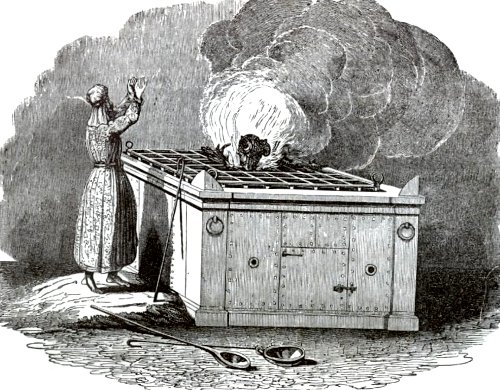
burnt-offering-altarHe shall then take off his vestments and put on other vestments, and carry the ashes outside the camp to a clean place.

Leviticus 6:4 (JPS Tanakh)

What lesson do we learn from the ceremonious taking out the ashes from the altar each morning?

Rabbi Samson Raphael Hirsch comments that the taking out of the ashes that remained on the altar from the previous day expresses the thought that with each new day, the Torah mission must be accomplished afresh, as if nothing had yet been accomplished. Every new day calls us to our mission with new devotion and sacrifice. The thought of what has already been accomplished can be the death of that which is still to be accomplished. Woe unto him who with smug self-complacency thinks he can rest on his laurels, on what he has already achieved, and who does not meet the task of every fresh day with full devotion as if it were the first day of his life’s work!

“Carry forth the ashes out of the camp.” Every trace of yesterday’s sacrifice is to be removed from the hearth on the Altar, so that the service of the new day can be started on completely fresh ground. Given these considerations, we can understand the law that prescribes the wearing of worn-out garments when one is occupied with the achievements of the previous day. The past is not to be forgotten. However, it is to be retired to the background, and is not to invest us with pride before the fresh task to which each new day calls us. (Rabbi Hirsch’s commentary)

-Rabbi Kalman Packouz
“Shabbat Shalom Weekly”
Commentary on Torah Portion Tzav
Aish.com

I have been accused of being a very simplistic, very lyrical player, and that’s okay. That just comes from the blues, which is my background. But every day you wake up and transcend. You can’t ever rest on your laurels.

Carlos Santana

I could probably find dozens of similar quotes to illustrate this single point. But it’s a difficult point. Rabbi Packouz uses this lesson to tell us that our past successes do not transfer into the present. No matter how well you’ve done in anything, even serving God, you are only as good as you are today. Serving God well yesterday and then not serving God today just means you’re not serving God. Your “laurels” are already wilting, so to speak.

Carlos Santana says that “every day you wake up and transcend.” The Rebbe, Rabbi M. M. Schneerson said this:

When you awake in the morning, learn something to inspire you and mediate upon it, then plunge forward full of light with which to illuminate the darkness.

Each day is a new opportunity to live, to serve God, to serve other people. Each day is a new opportunity to discover something new and exciting about yourself. It is why observant Jews recite the following blessing as their very first blessing to God, even before getting out of bed in the morning.

“I gratefully thank You, living and existing King
for restoring my soul to me with compassion.
Abundant is your faithfulness.”

But the sentiment works in another direction as well.

Success isn’t permanent and failure isn’t fatal.

-Mike Ditka
US football player and coach

failureI’ve noticed a good many people working in sales have that particular quote jotted on a sticky note or written on a white board in or around their work area. Success isn’t permanent. Rabbi Packouz and Carlos Santana both agree on that. But failure isn’t fatal, either. It only feels that way sometimes.

We were told to transcend limitations — but that doesn’t mean just jumping into the air with no idea of where you’re going to land!

-Rabbi Tzvi Freeman
Based on letters and talks of the Rebbe
Rabbi M. M. Schneerson
Said to one who fell into enormous debt trying to achieve miracles
Chabad.org

Adding all this up, you might say, success isn’t permanent, serve God today as well as yesterday. Failure isn’t fatal, but don’t do anything stupid that will likely result in you failing God.

And Jesus answered him, “It is said, ‘You shall not put the Lord your God to the test.’”

Luke 4:12 (ESV)

You may be eager to serve God but good intentions aside, eagerness is not enough. In fact misdirected, eagerness can get you in a lot of trouble. One horrible modern example is the “eagerness” of the Westboro Baptist Church which results only in demonstrations of bigotry and increasing the grief of the families of our fallen military personnel who gave their lives in the service of our nation.

Here’s another example of misguided eagerness and zealousness.

And there arose on that day a great persecution against the church in Jerusalem, and they were all scattered throughout the regions of Judea and Samaria, except the apostles. Devout men buried Stephen and made great lamentation over him. But Saul was ravaging the church, and entering house after house, he dragged off men and women and committed them to prison.

But Saul, still breathing threats and murder against the disciples of the Lord, went to the high priest and asked him for letters to the synagogues at Damascus, so that if he found any belonging to the Way, men or women, he might bring them bound to Jerusalem. Now as he went on his way, he approached Damascus, and suddenly a light from heaven shone around him. And falling to the ground he heard a voice saying to him, “Saul, Saul, why are you persecuting me?” And he said, “Who are you, Lord?” And he said, “I am Jesus, whom you are persecuting.

Acts 8:1-3, 9:1-5 (ESV)

Fortunately, Paul’s zealousness took a turn for the better, but he had to encounter the Master in a dramatic and startling way and be robbed of his sight before Paul could begin to see that he needed to travel in a different direction. Before that, he jumped into the air but didn’t realize where he was going to land.

Serving God is a partnership. It’s not just what you do and it’s not just what God does. We know we have a God who neither slumbers or sleeps (Psalm 121:4) and He is at work continually in the lives of human beings. But He requires that we work each day in His service, and that our work be considered and mindful, not random and reckless. This is why we not only read the Bible but study it. This is why we seek out fellowship with sober and mindful believers. This is why we pray for guidance and direction from the Holy Spirit. This is why we strive to do His will rather than our will.

“Father, if you are willing, remove this cup from me. Nevertheless, not my will, but yours, be done.”

Luke 22:42 (ESV)

Landron Paule_Histoire Sainte_Première Alliance_Droguet Ardant_Limoges 1991We don’t often think about the Master having a choice as to being crucified. It’s an uncomfortable thought that Jesus could have just said “no,” and escaped that night as he prayed in Gethsemane rather than surrender to God’s will and death.

But he had a choice. He could have said “no.” Instead, he said, “not my will, but yours, be done.”

Jesus had served God and human beings flawlessly for three years. He was without sin, so for his entire lifetime, we have to believe he never sinned. But it wasn’t about what he did yesterday. It was always about what he was going to do next with each coming dawn. So it should be with us.

Soon, Christians and believing Jews will mourn the loss of our Lamb and rejoice in the resurrection of our King. He teaches us that there are days when we dine on ashes, but then, the ashes of the offering are removed. Then it is time for us to rise from those ashes at dawn and to serve God anew. Some days we feel as if we have failed and have been burned out. But there is a new day coming, like the resurrection from the dead. If we fail to serve God today, it is as if we are still in the tomb. If we resolve to approach the service of the King as the dawning light of a new day, then we rise with him and in some small measure, share in his glory.

Remove the ashes of yesterday’s service for it is done. The sun has set and darkness is here. Then rise from the cold and dead ash and fly up like sparks into the flaming dawn. Today is bright and clear. It is life from the dead.

Good Shabbos.

Vayikra: Drawing Closer

eph-2-10-potter-clayThe Lord called to Moses and spoke to him from the Tent of Meeting, saying: Speak to the Israelite people, and say to them: When any of you presents an offering of cattle to the Lord, he shall choose his offering from the herd or from the flock.

Leviticus 1:1-2 (JPS Tanakh)

The book of Vayikra (Leviticus) primarily deals with what are commonly called “sacrifices” or “offerings.” According to Rabbi Samson Raphael Hirsch: a “sacrifice” implies giving up something that is of value to oneself for the benefit of another. An “offering” implies a gift which satisfies the receiver. The Almighty does not need our gifts. He has no needs or desires. The Hebrew word is korban, which is best translated as a means of bringing oneself into a closer relationship with the Almighty. The offering of korbanot was only for our benefit to come close to the Almighty.

-Rabbi Kalman Packouz
“Shabbat Shalom Weekly”
Commentary on Torah Portion Vayikra
Aish.com

Leviticus is one of the books of the Bible that many Christians can’t stand. It’s so boring. “Anyway,” we say to ourselves, “aren’t we done with all of those icky, bloody sacrifices?”

According to blogger and author Derek Leman, the sacrifices teach us a good many things about Jesus or Yeshua Our Atonement, as he titles his new book. No, I’ve not laid eyes on it yet but at some point, I’ll probably need to get a hold of a copy so I can review it. In the meantime, I’ll just have to offer what meager insights I have on this week’s Torah Portion and what it means for Christians.

The clue is in what Rabbi Packouz says about the nature of sacrifices or “korbanot” which has the meaning not so much of slaying an animal to appease God, but to bring an offering to God in order to draw closer to Him. Where else do we see this imagery?

I appeal to you therefore, brothers, by the mercies of God, to present your bodies as a living sacrifice, holy and acceptable to God, which is your spiritual worship. Do not be conformed to this world, but be transformed by the renewal of your mind, that by testing you may discern what is the will of God, what is good and acceptable and perfect.

Romans 12:1-2 (ESV)

As you come to him, a living stone rejected by men but in the sight of God chosen and precious, you yourselves like living stones are being built up as a spiritual house, to be a holy priesthood, to offer spiritual sacrifices acceptable to God through Jesus Christ.

1 Peter 2:4-5 (ESV)

Paul calls us to be living sacrifices and Peter says to offer God spiritual sacrifices. Obviously, in neither case are they suggesting that we bring animal sacrifices to the Temple or to offer (gulp) our own bodies as physical sacrifices on the pyre, though as I once mentioned, every soul can be considered to be on the altar of God.

Peasants-Carrying-Straw-MontfoucaultWhen we connect our lives to making a “sacrifice for God,” we usually think of depriving ourselves of something, doing without, even suffering pain and torture. I can’t say that’s not what God will ask of us. After all, in China and elsewhere in the world, Brother Yun and many others like him have suffered greatly and sacrificed much for the sake of the gospel of Jesus Christ.

But regardless of what God may ask of you or me, whatever it is, it’s not a matter of what we are doing without but what immeasurable treasures we gain, the greatest of which is the drawing closer to God.

Sometimes it’s not a matter of waiting around to see what God will ask. Sometimes it’s a matter of looking around and seeing what needs to be done.

Rabbi Moshe Leib of Sassov once came to the marketplace in Yaroslav. He was passing among the vendors, checking the quality of the straw and hay for sale, when he met his friend Rabbi Shimon of Yaroslav.

“Rebbe, what are you doing here?” R. Shimon asked in surprise.

“Leave out my ‘rebbe’ and your ‘rebbe,’ and come with me to carry a bale of hay to a poor widow who had no hay or straw upon which to lay her broken body,” the Sassover replied pungently.

The two holy leaders went together, hauling a bale of hay on their shoulders. Astonished bystanders stared in wonder and moved aside to make room for them to pass.

As they went, Rabbi Moshe Leib remarked, “Were the Holy Temple standing today, we would be bringing sacrifices and libations. Now we bring straw, and it is as though we have all the kavanot (spiritual intentions) that come with offering the minchah sacrifice.”

Rabbi Moshe Leib of Sassov’s father, R. Yaakov, would take a job before Passover grinding wheat at the mill—not for himself, though he was also a poor man, but for a widow and orphan who lived in his neighborhood. And he did this despite his great and abiding love for the Torah, which he learned constantly.

Moshe Leib, his son, followed in his father’s footsteps. Despite his greatness in Torah, he did not worry about his honor when it came to performing acts of kindness for his fellow Jew with his own hands, even if they were beneath his status in the eyes of others.

-Adapted by Yerachmiel Tilles
“In Place of a Temple Offering”
from Stories My Grandfather Told Me
quoted from Chabad.org

practicing_loveWe are the closest to God when we are the closest to other human beings, especially those who have needs far greater than our own. Here we see that two men, two Rebbes who normally did not carry their own straw much less carry straw for a poor widow drew closer to God by looking around, seeing a need, and responding unreservedly. Or as the Master taught:

The greatest among you shall be your servant. Whoever exalts himself will be humbled, and whoever humbles himself will be exalted.

Matthew 23:11-12 (ESV)

Drawing closer to God is inconsistent with claiming self-righteousness, self-exaltation, and self-privilege. Servitude, humility, kindness, and a spirit willing to help with no expectation of return draws Creator and creation into close proximity. Seeking who we are in God brings us closer to God. Seeking who and what somebody else is in God as if it were our own will only bring trouble.

This is the way of Torah: eat bread with salt, drink water by measure, and sleep on the earth.

-Ethics of the Fathers 6:4

Does observance of Torah require living a life of poverty and depriving ourselves of all the niceties of the world.

Certainly not. The Talmud is elaborating upon another Talmudic statement: “Who is wealthy? One who is content with his portion” (Ethics of the Fathers 4:1).

People who can be happy with the basics of life – food, clothing, and shelter – can truly enjoy the luxuries of life, because they can be happy even without them. Those whose happiness depends upon having luxuries are likely to be perennially dissatisfied, in constant need of more, and consequently unhappy, even if they have everything they desire.

A wise man once observed a display of various items in a store window. “I never knew there were so many things I can get along without,” he said.

If bread and water can satisfy us, then we can enjoy a steak. If we are not satisfied unless we have caviar, we will discover that even caviar is not enough.

Today I shall…

…try to be content with the essentials of life and consider everything else as optional.

-Rabbi Abraham J. Twerski
“Growing Each Day, Nisan 2”
Aish.com

open-your-handAs Rabbi Twerski says, this isn’t an invitation to pursue self-deprivation, to give all our belongings to the poor, and then move to India to work with lepers. It’s not even an invitation to abandon motivation and striving to better ourselves, our incomes, and our positions in life. It is, however, an invitation to consider that after we’ve done all we can in taking care of ourselves, our families, and our neighbors, to look around, take stock of our environment, and to realize that we should be satisfied with the gifts of God’s providence. It is from those gifts that we give back to others and give back to God, for everything belongs to Him anyway, and who we are and what we have only exists so that we may serve Him.

And by serving God and serving others, we serve ourselves, for what we then achieve is union and belonging and closeness to who and where we came from in the first place.

Good Shabbos.

Vayakhel-Pekudei: Come Together

Mount SinaiMoses then convoked the whole Israelite community and said to them: These are the things that the Lord has commanded you to do.

Exodus 35:1 (JPS Tanakh)

The verb vayakhel – which gives the portion its name – is crucial to an understanding of the task in which Moses is engaged. At its simplest level it serves as a motiv-word, recalling a previous verse. In this case the verse is obvious:

When the people saw that Moses was so long in coming down from the mountain, they assembled around Aaron and said, “Come, make us gods who will go before us.” (32:1)

Moses’ act is what the kabbalists called a tikkun: a restoration, a making-good-again, the redemption of a past misdemeanour. Just as the sin was committed by the people acting as a kahal or kehillah, so atonement was to be achieved by their again acting as a kehillah, this time by making a home for the Divine presence as they earlier sought to make a substitute for it. Moses orchestrates the people for good, as they had once been assembled for bad (The difference lies not only in the purpose but in the form of the verb, from passive in the case of the calf to active in the case of Moses. Passivity allows bad things to happen – “Wherever it says ‘and it came to pass’ it is a sign of impending tragedy”. (Megillah 10b) Proactivity is the defeat of tragedy: “Wherever is says, ‘And there will be’ is a sign of impending joy.” (Bemidbar Rabbah 13)

At a deeper level, though, the opening verse of the portion alerts us to the nature of community in Judaism.

In classical Hebrew there are three different words for community: edah, tsibbur and kehillah, and they signify different kinds of association.

-Chief Rabbi Lord Jonathan Sacks
From the “Covenant and Conversation” series
“Three Types of Community”
Commentary on Vayakhel
Aish.com

There’s a tendency in certain corners of Christianity to struggle with the definition of words like “kahal” and “kehillah” vs. the word “ekklesia.” Does “ekklesia” mean “church” or is it associated with one of the words that has to do with “Jewish” gatherings? Certainly “ekklesia” and “synagogē” although related, tend to be split in our modern world to mean (Christian) church and (Jewish) synagogue. But digging just under the surface, here’s what we find.

At its most basic level, “ekklesia” means “a gathering of citizens called out from their homes into some public place, an assembly.” (see BibleStudyTools.com). This strips the word of all its religious connotation and gives us the “nuts and bolts” understanding. An ekklesia can be any gathering of citizens called out into a public place. They could be football fans or a lynch mob. They don’t have to be “the church.”

Interestingly enough, one definition provided by my source says, “the assembly of the Israelites,” but there’s no way to understand in that context if we are to take “Israelites” as strictly Jewish people or rather to overlay a Christian understanding and include Gentile believers as “Israelites.” Given that ekklesia tends to be considered a compound word made up of “ek” (out of, from, by) and “kaleo” (to call, to invite, to give a name to), it seems more likely that the application in this sense, is recognizing “Israelites” as those called by God in the original “called” or “chosen” manner at Sinai. I don’t see the idea of a “mixed” population of Jews and Gentiles being called collectively “Israelites” here.

By contrast:

A synagogue (from Koine Greek: συναγωγή transliterated synagogē, meaning “assembly”), sometimes spelt synagog, is a Jewish or Samaritan house of prayer (When broken down, the word could also mean “learning together” – from the Greek συν syn, together, and αγωγή agogé, learning or training) that emerged at first essentially within the context of Hellenistic Judaism in the diasporas of Greece and the Hellenized regions of the MENA area (Cilicia, Syria and Alexandria) in the second half of the Second Temple period, then progressively became the typical place of Jewish worship and education after 70 CE, when Roman persecutions accelerated the geographic dispersion process that accompanied the abrupt ending of Temple worship and priestly rituals and traditions.

Wikipedia

So synagogue seems to be more related to “house of assembly,” “house of prayer,” or “house of study,” but within a specifically Jewish context (we do see God-fearing Gentiles periodically attending synagogues in the late Second Temple period, but they were clearly non-Jewish guests within a Jewish venue). People don’t typically ever say something like “Christian synagogue” or “Jewish church.”

calvin-susie-conflictBut why am I delving into all of this and why should you care?

This week, I’ve been discussing (complaining) about the interactions and friction that seem to occur between certain groups of believing Jews and certain groups of believing non-Jews (i.e. Christians). One of the questions that comes up in such transactions is how closely those groups are related. Are they a single group with a single identity, differentiated only by a bit of DNA and a slice of culture, or are they defined as more distinct and separate on the level of community and covenant?

Let’s take a look at what we know about “ekklesia,” which is how we commonly think of the community of disciples of Jesus Christ, and compare it to Rabbi Sacks’ definitions for different communities of Jews (and I’m setting “synagogue” aside for the sake of this conversation). First, Rabbi Sacks’ discussion:

Edah comes from the word eid, meaning “witness.” The verb ya’ad carries the meaning of “to appoint, fix, assign, destine, set apart, designate or determine.” An edah can be a gathering for bad as well as good. The Israelites, on hearing the report of the spies, lose heart and say they want to return to Egypt. Throughout, they are referred to as the edah (as in “How long will this wicked community grumble against Me?” Bemidbar 14: 27). The people agitated by Korach in his rebellion against Moses and Aaron’s authority is likewise called an edah (“If one man sins, will You be angry with the whole community?” Bemidbar 16: 22). Nowadays the word is generally used for an ethnic or religious subgroup. An edah is a community of the like-minded. The word emphasises strong identity. It is a group whose members have much in common.

By contrast the word tsibbur – it belongs to Mishnaic rather than biblical Hebrew – comes from the root tz-b-r meaning “to heap” or “pile up”. (Bereishith 41:49) To understand the concept of tsibbur, think of a group of people praying at the Kotel. They may not know each other. They may never meet again. But for the moment, they happen to be ten people in the same place at the same time, and thus constitute a quorum for prayer. A tsibbur is a community in the minimalist sense, a mere aggregate, formed by numbers rather than any sense of identity. A tsibbur is a group whose members may have nothing in common except that, at a certain point, they find themselves together and thus constitute a “public” for prayer or any other command which requires a minyan.

A kehillah is different from the other two kinds of community. Its members are different from one another. In that sense it is like a tsibbur. But they are orchestrated together for a collective undertaking – one that involves in making a distinctive contribution. The danger of a kehillah is that it can become a mass, a rabble, a crowd.

The beauty of a kehillah, however, is that when it is driven by constructive purpose, it gathers together the distinct and separate contributions of many individuals, so that each can say, “I helped to make this.” That is why, assembling the people on this occasion, Moses emphasises that each has something different to give: Take from what you have, an offering to God. Everyone who is willing to bring to God an offering of gold, silver and bronze … All you who are skilled among you are to come and make everything the Lord has commanded …

Moses was able to turn the kehillah with its diversity into an edah with its singleness of purpose, while preserving the diversity of the gifts they brought to God…

And to sum up his definitions, Rabbi Sacks states:

To preserve the diversity of a tsibbur with the unity of purpose of an edah – that is the challenge of kehillah-formation, community-building, itself the greatest task of a great leader.

Kehillah seems to be what God, through Moses, was trying to forge from the Children of Israel. Each type of group had something valuable to offer but those elements needed to be brought together and combined within a single container to result in both diversity and unity being focused on constructive purpose.

How does that compare to our understanding of ekklesia?

In a Christian sense:

  • an assembly of Christians gathered for worship in a religious meeting
  • a company of Christians, or of those who, hoping for eternal salvation through Jesus Christ, observe their own religious rites, hold their own religious meetings, and manage their own affairs, according to regulations prescribed for the body for order’s sake, those who anywhere, in a city, village, constitute such a company and are united into one body
  • the whole body of Christians scattered throughout the earth
  • the assembly of faithful Christians already dead and received into heaven

many peopleBut ekklesia can also mean “any gathering or throng of men assembled by chance, tumultuously.”

It’s as if ekklesia is trying to mirror the Jewish (or at least Rabbi Sacks’) understanding of kehillah. Ekklesia is taking the general understanding of a group of people who are called out, in some sense, who are dissimilar, who can also be assembled by random chance, but who also, when given a purpose by God, gather together from widely diverse backgrounds to be united into one body of believers for the sake of Jesus Christ.

I know that some people don’t think being gathered together for the sake of Christ is a “constructive purpose.” Certainly the vast majority of Christian history has shown us we haven’t been very “constructive” in relation to the Jewish “kehillah.” Many atheists would also agree that, based on their perception of “Christian bias,” the body of believers is hardly constructive and especially not “progressive.”

But for those of us who authentically and honestly seek out God through being disciples of the Master, being gathered together in the ekklesia of Messiah very much is a constructive purpose. Feeding the hungry, comforting the grieving, visiting the sick and imprisoned is all “constructive purpose” as far as I’m concerned and as far as the teachings of Jesus and the Torah are concerned.

Pulling all this together within the widest possible sense of the body of believers, just how close a comparison can we make between the Messianic Jewish kehillah and the Christian (including Hebrew Roots) ekklesia? I’m unwilling to say that the only difference between Jewish and Gentile believers is a string of DNA or a bit of cultural context and rather, believe that the manner in which God distinguished the Children of Israel at Sinai continues to distinguish their descendants, the Jewish people, even within the community of Messiah. I also believe, going back to Rabbi Sacks and his commentary, that community must be active and not passive, we must live holy lives, not just talk about holiness.

In other words believing Jews and Gentiles are and aren’t different at the same time. We are different in that Sinai is the defining moment for the Children of Israel and always will be relative to their special “called out-ness” from the nations. All Jews are born into this covenant relationship whether they want to be or not. But what believing Jews and Gentiles have in common is that we all had to consciously and willingly hear the voice of Messiah and respond to him, and to accept the good news of salvation from sin and the promise of the restoration of national Israel under her King.

There are groups who want to separate the believing Jews and believing Gentiles completely and have us live in two parallel but isolated silos. There are other groups who want to pour us all into a single silo like so many millions and millions of grains of wheat, completely indistinguishable form one another.

black-and-white-sheepI believe we are more like two sheep pens united in a single flock with a single shepherd. Not all sheep look the same. Not all sheep act the same. Some of the sheep, a relatively small number, have a more specified purpose within the flock than the vast majority of other sheep in the flock. In spite of that, we have one shepherd whose voice we all listen to and who we all respond to in faith and trust. Since we’ve originally come from two separate pens, we have two separate histories and we different sheep have a lot to learn about one another. Sometimes, that means we “butt heads,” so to speak. The shepherd, seeing this, encourages us to live at peace with one another, not as identical drones or dough stamped out from the same cookie cutter, but as sheep from the Jewish pen and sheep from the Gentile pen in the flock of Messiah.

Kehillah/Ekklesia: different and distinct but brought together for a common and constructive purpose, offering our distinctive talents and identities in a unified container all for the sake of Messiah and by the plan of God.

Come together, right now
Over me

-John Lennon (credited to Lennon-McCartney)
Come Together (1969)
from the Beatles album Abbey Road

Good Shabbos.

Tetzaveh: Our Children Are Watching

The Rebbe and the ChildA rabbi was sitting next to an atheist on an airplane. Every few minutes one of the rabbi’s children or grandchildren would inquire if they could bring him something to eat or drink or if there was anything they could do for him. The atheist commented, “It’s wonderful the respect your children and grandchildren show you; mine don’t show me that respect.” The rabbi responded, “Think about it. To my children and to my grandchildren, I am one step closer in a chain of tradition to the time when God spoke to the whole Jewish people on Mt. Sinai. To your children and grandchildren — unfortunately, you are considered to be one step closer to being an ape.”

Are children more inclined to respect their parents if they think they are one step closer to being an ape or if they believe that their parents are one step closer to being created by the Almighty who heard God speak?

-Rabbi Kalman Packouz
“Shabbat Shalom Weekly”
Commentary on Torah Portion Tetzaveh
Aish.com

No, I’m not taking a cheap shot at atheists but I would like to wake up a few religious people about the commandment to honor parents and what it all means. According to Rabbi Packouz, the original commandment regarding parents and the related scriptures (see Exodus 20:12, Deuteronomy 5:16, and Leviticus 19:13) actually describe two separate commandments:

We see from these verses that there are two mitzvot (commandments): 1) To honor your parents and 2) To revere your parents. Love motivates one to do positive things; fear keeps one from transgressing the negative.

We are to love and fear (revere) our parents. This may seem more apparent when one is a child. As an adult, we may still love our parents, but we typically don’t fear them anymore. After all, can an eighty year old father or mother send their fifty-eight year old son to “time out?”

But then again, we may be missing something about the full implications of this commandment.

And he said to him, “You shall love the Lord your God with all your heart and with all your soul and with all your mind. This is the great and first commandment. And a second is like it: You shall love your neighbor as yourself. On these two commandments depend all the Law and the Prophets.”

Matthew 22:37-40 (ESV)

We have a Father in Heaven who we are also commanded to love. In fact, in some ways, it’s by having a Father on earth that we can even begin to conceptualize the Father in Heaven. Of course, the analogy is far from perfect. A human Father can be flawed, selfish, distracted, drunk, abusive, overbearing, hostile, wishy-washy, the list goes on. God is perfect and therefore, all of His actions toward us are perfect.

In quoting Rabbi Packouz above, I immediately thought that the Rabbi’s children would only see their Father as closer to God if he acted in a manner consistent with that impression. It’s not like all kids of all Rabbis, Pastors, and other clergy people offer their Dad’s equal reverence. Sometimes it has little to do with the sort of job the Dad has or what the family’s religious tradition is, but children very much are affected by what their father’s actually do, and mold their opinions about him and about Dads in general based whether or not he acts consistently with his stated principles and ideals.

And sometimes how we relate to our earthly Father is how we relate to our Father in Heaven. If we haven’t learned to respect, love, revere, and honor our own Father and Mother, what sort of model do we have for respecting, loving, revering, and honoring our Father in Heaven?

But then, it can work in the opposite way, too. I’ve heard stories of people who have had horrible and abusive Dads, Dads who have sexually molested their children, brutalized them, neglected them, abandoned them. And yet some of those kids have learned to trust their Father who is perfect in Heaven in spite of the cruelty they had to endure from their Father on earth.

children-watchingI don’t think the Rabbi and the other airplane passenger had different relationships with their children because the children of the former saw him as one step closer to God while the children of the latter saw him as one step closer to the apes. I think the difference is who each person was as a Father and a man and how each one of them treated his children and most likely his wife, the children’s mother. Children are more likely to respond by what they see their parents doing rather than what their parents say or who their parents even are (a Rabbi vs. an Atheist). It’s a little scary to think that how we relate to our kids may strongly affect how they relate to God.

But how we behave as a parent and as a human being depends on who we are, what we believe, and then how we choose to act out of all of that.

Gather together and I will tell you what will befall you at the end of days.

Genesis 49:1

Prior to his death, the Patriarch Jacob wished to disclose to his children the future of the Jewish nation. We know only too well what those prophecies were, and Jacob knew that revealing the enormous suffering that the Jews were destined to experience would be devastating to his children. The only way they could hear these things was if they “gathered together” and, by virtue of their unity, could share their strengths.

What was true for our ancestors holds true for us. Our strength and our ability to withstand the repeated onslaughts that mark our history lie in our joining together.

Jacob knew this lesson well. The Torah tells us that “Jacob remained alone, and a man wrestled with him” (Genesis 32:25). Jacob discovered that he was vulnerable only when he remained alone.

Some people feel that they must be completely independent. They see reliance on someone else, be it others or God, as an indication of weakness. This destructive pride emanates from an unhealthy ego. [There is sometimes an] apparent paradox that a humble person is one who is actually aware of his strengths, and that feelings of inadequacy give rise to egocentricity and false pride.

Not only are we all mutually interdependent, the Torah further states that when we join together, our strengths are not only additive, but increase exponentially (Rashi, Leviticus 26:8). Together, we can overcome formidable challenges.

Today I shall…

…try to join with others in strengthening Judaism and in resisting those forces that threaten spirituality.

-Rabbi Abraham J. Twerski
“Growing Each Day, Adar 9”
Aish.com

Part of the Rabbi’s “success” as a father in the original quote was his perception of himself as a Rabbi and as a Jewish man. Without his sense of spirituality and his identity as a Jew who is connected to all other Jews, both in the present, and back across history, how he would behave as a Father and how his children would respond to him might be very different. It might also be very different how his children would choose (or if they would choose) to respond to God.

If you’re a parent, teaching your children about the commandments related to honoring and revering you as parents (which extends also to how they should respond to their grandparents) is a very good thing, but you may be having a much greater impact on your kids than you might imagine. In forging a relationship with your children, teaching them what God expects of parents and children, you are also teaching them what they should expect from God and how to respond to Him as a Father.

family-praying-picnicAs a Christian and a parent, you have a specific identity and source to draw from to define yourself and to define the relationship you have with your children based on what you know of God from His Spirit and from the Bible. While the Rabbi’s children were born Jewish (assuming they had a Jewish mother, and I think this is likely), a Christian’s children aren’t “born Christian.” A Christian doesn’t inherit his or her relationship with God the way a Jew does. Although Jewish children can, Heaven forbid, choose to reject their relationship with God and with Judaism, children born of Christian parents are one more step removed because every Christian must choose their path in life, including a path of faith. It’s even more important for us as parents and grandparents to behave in accordance with our stated beliefs and our faith because unless our children actually see that, we have no hope of transmitting Christian faith to the next generation. Even Jewish parents have a tough time transmitting Jewish faith and values to the next generation, so you can imagine what challenges there are for Christian parents.

That’s why we must make sure that God is continually with us so that our children can see that holiness is our constant companion.

When someone walks the street and thinks words of Mishna or Tanya, or sits in his store with a Chumash or Tehillim – that is more valued today than it was when the streets were bright with the light of Torah. We must not go about in the street with a vacant heart. We must have some Torah memorized, to take with us into the street.

“Today’s Day”
Sunday, 9 Adar I, 5703
Compiled by the Lubavitcher Rebbe
Translated by Yitschak Meir Kagan
Chabad.org

For a Christian, that means living, eating, reading, and breathing our faith, spending time in the Bible, associating with friends who are believers, and behaving in every aspect of our lives in complete consistency with what we know we should be doing as a Christian. This is also why it is vitally important for Jewish parents to perform the mitzvot, regularly daven, recite the Shema, and keep kosher.

No pressure, eh?

But what choice do we have? After all, our children are watching.

Good Shabbos.

Terumah: Why Do You Do Good?

menorah“Take for Me an offering from everyone whose heart impels him to give.”

Exodus 25:2

Rashi, the great commentator, tells us that “Take for Me” means that all donations for the Tabernacle should be given for the sake of the Almighty. The question: What difference does it make what a person’s intentions are as long as he does a good deed?

Rabbi Yehuda Leib Chasman clarifies the role of intentions with an illustration. Suppose there is a man who wants to ensure that every child in the community has wholesome milk for breakfast. Rain or shine he delivers milk every morning. What would you say about that man? Likely you would count him amongst the great tzadikim, righteous people, a person of great kindness.

However, what would be your opinion of the man if you knew he delivered the milk only because he was getting paid? No longer is he a great tzadik, now he is just a plain milkman.

Similarly, in everything we do. If we keep in mind that we are fulfilling the Almighty’s command to do kindness, even the mundane interactions at work can be elevated to a higher spiritual level. The bus driver is no longer just driving the bus, he is helping people get to work or to shop for their families. The deed may be a good deed with or without one’s intention, but our growth in character and spirituality depend on our intentions!

-Rabbi Kalman Packouz
“Shabbat Shalom Weekly”
Commentary on Torah Portion Terumah
Aish.com

I suppose you could link this back to commentary on last week’s last week’s Torah portion. In the Aish.com commentary for that week, we looked at the story of a young Jewish woman who was seeking spirituality and felt actually insulted that her Jewish teachers suggested she could find it in “the (Torah) laws regarding returning a lost item.” She abandoned her pursuit of spirituality within the context of Torah and Judaism and proceeded to India. But she found that the behavior of her guru in response to his finding a lost wallet containing a large sum of money showed her that spirituality, responsibility, justice, and mercy must all go together.

In this week’s commentary, we see that even doing what is good may not be enough if the motivation of the person performing the action is less than stellar.

But let’s take two people performing an identical mitzvah. Say both of our hypothetical people are donating food to a local food bank. They both give abundantly in money and goods and many people are fed through their efforts. The first man is primarily motivated by the desire to do good to the people of his community and to serve God. The second man is primarily motivated by the tax break he’ll receive and the recognition he’ll get from his friends and family as a “good guy.”

Which one would you say is the more “spiritual” man? Obviously the first one. But regardless of motivation, people are still fed. Even the man whose motivation is only for his self-interest is doing better to serve others than the person who has “nice, warm, fuzzy” spiritual feelings toward his neighbor but donates not even a single hour, dollar, or can of chicken soup to the food bank (or any other mitzvah).

So speak and so act as those who are to be judged under the law of liberty. For judgment is without mercy to one who has shown no mercy. Mercy triumphs over judgment.

What good is it, my brothers, if someone says he has faith but does not have works? Can that faith save him? If a brother or sister is poorly clothed and lacking in daily food, and one of you says to them, “Go in peace, be warmed and filled,” without giving them the things needed for the body, what good is that? So also faith by itself, if it does not have works, is dead.

But someone will say, “You have faith and I have works.” Show me your faith apart from your works, and I will show you my faith by my works. You believe that God is one; you do well. Even the demons believe—and shudder! Do you want to be shown, you foolish person, that faith apart from works is useless? Was not Abraham our father justified by works when he offered up his son Isaac on the altar? You see that faith was active along with his works, and faith was completed by his works; and the Scripture was fulfilled that says, “Abraham believed God, and it was counted to him as righteousness”—and he was called a friend of God. You see that a person is justified by works and not by faith alone. And in the same way was not also Rahab the prostitute justified by works when she received the messengers and sent them out by another way? For as the body apart from the spirit is dead, so also faith apart from works is dead.

James 2:12-26 (ESV)

charity-tzedakahJesus said that you shall know a tree by its fruit (Matthew 7:20) and every tree that does not bear good fruits will be cut down and thrown in a fire (v19). James, the brother of the Master, connects faith with actions, the latter arising from the former. Jesus tells us that our very nature is revealed by our behavior. In this week’s Torah reading, God commands Moses to “accept gifts for Me from every person whose heart so moves him,” (Exodus 25:2) connecting the nature and amount of the gift with the nature of the giver. Rabbi Packouz says that regardless of motivation, an act that helps others is still of value to those being helped, “but our growth in character and spirituality depend on our intentions!”

If all we want is a tax break and to look good to others, we can perform acts of charity and help many people…as long as we are unconcerned about our relationship with God and growing within that relationship spiritually. On the other hand, if we are trying to take our relationship with God seriously, it’s not just what we do but why we do it that matters. Human beings can only see our behavior but God sees the heart.

This should be a no-brainer, but I find that in the community of faith, we are just as vulnerable to bad motivations, bad attitudes, the desire for self-righteousness rather than God’s righteousness, and the need to “be right,” as anyone operating in the secular world. Just look at the various religious blogs and discussion boards on the web and you’ll see what I mean.

Even a casual reading of the New Testament should tell any Christian who is having trouble with this concept of what to do and why to do it. It really isn’t hard to pick a mitzvah representing “the weightier matters of the Torah,” such as donating a couple of cans of soup of chili to the food bank, shoveling snow off your neighbor’s driveway and sidewalk, or holding the door open for someone who is entering the same place right behind you because it’s what Jesus has commanded us to do.

If you find yourself paying more attention to a belief that certain “ceremonial” mitzvot are your “right” while neglecting matters of “justice and mercy and faithfulness,” (Matthew 23:23), or worse, performing no acts of charity and kindness at all thinking your “faith” is all the covering you’ll need, then you might earn the same ire from the Master as did the scribes and Pharisees Jesus was originally addressing.

There is much in the Torah of Moses for everyone and it acts as the rock upon which the Prophets, the Writings, and the Apostolic Scriptures firmly rest. However, as we see, application isn’t meaningful in a spiritual sense unless we are actually using what we know to do good to others and for the right reasons.

The words of Torah should be as fresh to you as if you first heard them today.

-Rashi, Deuteronomy 11:13

Excitement often comes from novelty, but novelty is exciting only as long as it is new. Someone who buys a car fully loaded with options may feel an emotional high, but after several weeks, the novelty wears off and it is just another vehicle.

Spirituality, too, suffers from routine. Human beings may do all that is required of them as moral people and observe all the Torah’s demands in terms of the performance of commandments, yet their lives may be insipid and unexciting because their actions have become rote, simply a matter of habit. The prophet Isaiah criticizes this when he says, “Their reverence of Me has become a matter of routine” (Isaiah 29:13). Reverence must be an emotional experience. A reverence that is routine and devoid of emotion is really no reverence at all.

Path of TorahThus, the excitement that is essential for true observance of Torah depends upon novelty, upon having both an understanding of Torah today that we did not have yesterday and a perception of our relationship to God that is deeper than the one we had yesterday. Only through constantly learning and increasing our knowledge and awareness of Torah and Godliness can we achieve this excitement. Life is growth. Since stagnation is the antithesis of growth, it is also the antithesis of life. We can exist without growth, but such an existence lacks true life.

Today I shall…

…try to discover new things in the Torah and in my relationship to God.

-Rabbi Abraham J. Twerski
“Growing Each Day, Adar 4”
Aish.com

“And in the end, the love you take is equal to the love you make.”

-Lennon/McCartney
The End (from the Abbey Road album)

Good Shabbos.