Tag Archives: Torah

Writing Letters from Outside of Israel

GOOD MORNING! Rosh Chodesh Elul, the beginning of the Hebrew month of Elul will be August 26th and 27th. This means that there is one month and counting to Rosh Hashanah (Wednesday evening, September 24th). Many people might ask, “So, what?” or might think, “Thanks for the reminder to buy a brisket!” However, the answer to “So, what?” is that we have one month to prepare for Rosh Hashanah … and Yom Kippur.

Why would one want to prepare for Rosh Hashanah? Rosh Hashanah is the Day of Judgment when the Almighty decides “Life or death, sickness or health, poverty or wealth.” Does it make sense to prepare for a day of judgment? You bet! However, for many it has the same emotional impact as their cardiologist telling them that they need to lose weight to avoid heart attacks and strokes… a wonderful idea between meals!

-Rabbi Kalman Packouz
“Shabbat Shalom Weekly,” Commentary on Re’eh 5774
Aish.com

I’m depressed. Well, maybe not depressed but discouraged, or something like that. I’m not really sure what I’m feeling. A bunch of people are trying to convince me that I’m a citizen of Israel and so is every other Christian on Earth.

I have two problems with this. The first is that everything in my intellect, beliefs, and passions tells me it’s wrong. The second is that some of the folks (particularly one of them) are people I respect for their intellectual prowess and spiritual integrity.

I mean, it’s not like it’s a secret that I’m attracted to Jewish learning and study, at least after a fashion (I’m hardly a Talmudic or any other kind of scholar). So why are people hammering away at me (it feels like that) trying to get me to, what in effect for me feels like, commit a home invasion or rip off someone’s birthday present or family heirloom?

I don’t get it.

To me, my interest in Jewish studies and Torah are more like how Rabbi Packouz describes preparing for the High Holy Days:

Why is living in a hurricane zone a benefit? It teaches you a very important lesson: Be real with life! Usually, the weather bureau (N.O.A.A. — National Oceanic and Atmospheric Administration) gives a week’s heads up. You know that in 7 days a Force 3 or 4 or 5 hurricane will hit. You generally know for sure whether it will hit land, you just don’t know whether for sure it will hit YOU until perhaps a day or a few hours before landfall.

What happens during that week? The hardware store sells out all of its plywood (used for covering windows) and batteries. They have to make special shipments from neighboring states! The grocery stores shelves are cleared out or seriously diminished of canned goods and water. People are scrambling to buy generators to provide electricity needed to keep the lights on, fans going and the refrigerator and freezer working. There is a mad dash for last minute preparations because the STORM IS COMING!

What’s the difference between a hurricane and Rosh Hashanah? The hurricane MAY hit your area; Rosh Hashanah DEFINITELY will touch you!

So, if one believes in a God who has set a standard for behavior and observance in the Torah and who will judge us, does it make sense to make some preparations? It would be reasonable to think so.

How can one prepare for the Day of Judgment?

shofar-rosh-hashanahPreparing for Rosh Hashanah and Yom Kippur is like living in Florida and stocking up on needed supplies for the coming hurricane season. Doesn’t seem very “spiritual,” does it? On the other hand, it sounds incredibly practical. It also doesn’t worry about boundaries, barriers, and why I can’t wear the tzitzit behind door number one (game show reference). It “worries” about preparing for an encounter with God.

Why can’t we focus on that too in our little corner of the blogosphere?

How do you prepare for Rosh Hashanah? Rabbi Packouz has ten suggestions:

  1. Take a spiritual accounting. Each day take at least 5 minutes to review your last year — a) your behavior with family, friends, associates and people you’ve interacted with, and b) your level of mitzvah observance.
  2. Attend a class or classes at a synagogue, Aish center, a yeshiva on how to prepare. Read articles on aish.com and listen to world-class speakers on aishaudio.com .
  3. Study the Machzor (Rosh Hashanah prayer book) to know the order of the service and the meaning of the words and prayers. You can buy a copy of the The Rosh Hashanah/Yom Kippur Survival Kit, by Rabbi Shimon Apisdorf (possibly available at your local Jewish bookstore or at Amazon.com — about 50 left).
  4. Make sure that you have given enough tzedakah (charity) and have paid your pledges (One is supposed to give 10% of his net income). It says in the Machzor that three things break an evil decree — Teshuva (repentance), Tefilla (prayer) and Tzedakah (charity). Why not maximize your chance for a good decree?
  5. Think of (at least) one person you have wronged or feel badly towards — and correct the situation.
  6. Make a list of your goals for yourself and your family — what you want to work towards and pray for.
  7. Limit your pleasures — the amount of television, movies, music, food — do something different so that you take this preparation time seriously.
  8. Do an extra act of kindness — who needs your help? To whom can you make a difference?
  9. Read a book on character development — anything written by Rabbi Zelig Pliskin would be great!
  10. Ask a friend to tell you what you need to improve. A real friend will tell you … but in a nice way!

Not all of these would apply to me, but then R. Packouz is writing to a Jewish audience, not a Christian with a Messianic twist.

Certainly taking a spiritual accounting makes sense and any person of faith should engage in such an activity. Attending a class relative to Judaism isn’t an option for me unless it’s online such as at Aish Audio. Even then, because the classes are geared to a Jewish audience, there’s a limit to their ability to apply to me.

Study the Machzor? I could. But I won’t be attending Rosh Hashanah services, so if the intent is to familiarize me with said-services, this also doesn’t apply.

I believe in tzedakah but I don’t think how much or how little I give will affect how God judges me, at least all by itself, particularly at a certain time of year. People are hungry every day of the week, so we should try to contribute as often as we can, not just around Rosh Hashanah.

blind-loveIt’s good to right the wrongs we’ve done to others, so I can certainly agree with this one. It’s also good to make goals, to dedicate yourself to becoming a better person and help the family draw closer to God (although in my family, we are so spread out about spiritual perspectives, that we virtually live in our own separate bubbles).

I don’t know that limiting pleasures makes much difference, but every opportunity to act with kindness should be observed.

Read a book? I’m reading all the time, trying to learn more, hoping it’ll make a difference…and Rabbi Pliskin is a wonderful author.

Ask a friend what I need to do to improve? Here we are back at people trying to make me believe that I’m a citizen of Israel again. That’s what I’ve been hearing lately about how I need to improve.

Part of the Rabbi’s commentary on Re’eh states:

One of the indications of the existence and necessity of the Oral Torah — an explanation and clarification (later redacted as the Talmud) of the written Torah (The Five Books of Moses) — comes from verse 12:21 “You will slaughter animals … according to the manner I (God) have prescribed.” Nowhere in the Torah are we instructed in the manner of shechita, ritual slaughter. One might conclude that there was a very sloppy editor. Or — one might conclude that there are additional teachings (the Oral Law/Talmud) clarifying and amplifying the written Word.

There are some people who believe that there is only “Biblical Judaism” and not “Rabbinic Judaism” and that the Bible tells you everything you need to know about observing the mitzvoth.

Except that R. Packouz just demonstrated that it doesn’t. That’s one of the assumptions of some of the people who want me to have citizenship in Israel along with the natural citizens, the descendants of Abraham, Isaac, and Jacob…the Jewish people.

My friend Tom sent me a link to a website he said would explain what he’s been trying to tell me. I went there and read through it. I felt like telling the site owner, “1998 called. They want their website back” (I have this “thing” about archaic web design).

Anyway, this is part of what struck me besides having to scan completely from one side of my monitor to another just to read a single sentence:

I am very encouraging to people who want to embrace Jewish tradition, making the lifestyle of Judaism, their own. I offer this personal caution however: as you adopt traditional halacha and make it your own, do not make the traditional halacha a matter of conscience. That is truly your choice. Distinguish between the literal commandment, and the traditional “how to” in walking out that commandment.

Don’t let your fences become walls. Walls that keep out the blessing of a healthy relationship with HaShem, or walls that make your circle of brothers and sisters ever more small.

Like I said, “Biblical” Judaism” vs. “Rabbinic” Judaism. It’s like listening to someone say they love Israel but not Jewish Rabbis, Sages, and Tzadikim. How would the website owner observe the commandment of shechita given that he embraces the “literal commandment” (which is not described at all in the Torah) but not the “traditional ‘how to'”?

How can I reconcile sentences such as:

Jew and Gentile, One in Messiah. We have One King, we are One People, and we have been given One Torah…

…with statements like:

Standing in Prayer with all Israel

How? It doesn’t make sense.

The bottom line is that I’m not going to tell me wife that I have as much right as she does (she’s Jewish) to the Land of Israel and that I intend on davening with a Jewish minyan (because if I’m under the same obligation as observant Jews, I should have the right to become part of a minyan), keeping Glatt Kosher (actually, if my wife made that choice, I’d do so as well because we live together), wearing a kippah and talit katan during my waking hours, and keeping “Biblical” Torah whilst ignoring thousands of years of Jewish interpretation on just how to do that.

Not only would it be bad for family life, I don’t see that being said in the Bible.

I also have no intention of using this as another platform for getting into another “he said/she said” debate over One Law vs. distinctive application of Law. If it comes up again as part of my reading and studying, so be it. I’m certainly going to continue reading and studying. But these debates are not the focus of my life, They can’t be.

They are a spiritual dead-end.

praying-aloneLook at what Rabbi Packouz was paying attention to. He was advising anyone reading his words (well, any Jewish person) to prepare themselves physically and spiritually for the upcoming High Holidays. While not all of us observe those events, it might not be a bad idea to take the portions of his advice that apply more universally to us…to me.

What do all these arguments have to do with a relationship with God? If God, for some strange reason, chooses to give me an inheritance in Israel, I will be totally shocked and probably overjoyed. On the other hand, if He doesn’t (and I hardly expect such a thing), it won’t come as a surprise and frankly, we are all fortunate to get what God gifts us with. I’ll take what He gives me out of His abundant graciousness which includes every day He allows me to live.

You open your hand and satisfy the desires of every living thing.

Psalm 145:16

What’s wrong with just accepting what God gives us, whatever that may be? Sure, as Rabbi Packouz says, there are plenty of things we all can do, Jew and Gentile alike, to help improve our situation, to learn more, to help others more. These are the things of God. Therefore, these are the things I choose to make important to me.

If I’m putting up fences, then the only thing they keep in or out is me. If I choose to put a fence around Israel to protect her from me, then that’s a choice I make and it affects no one but me. If God chooses to discipline me for that choice, as the Righteous Judge, that’s His right.

But I can’t imagine that He would punish loving and protecting Israel or His Chosen People. If I’m going to err, I’ll err on that side of the debate and let God treat me as He will.

But we have this treasure in earthen vessels, so that the surpassing greatness of the power will be of God and not from ourselves; we are afflicted in every way, but not crushed; perplexed, but not despairing; persecuted, but not forsaken; struck down, but not destroyed…

1 Corinthians 4:7-9 (NASB)

Addendum: Revisiting a blog post written by Derek Leman over two years ago called We’re Not All the Same. The reader comments along with Derek’s article makes for good reading and reminds me that this argument has been around for awhile and will probably be around when Messiah comes to teach us how to be better disciples.

Another Addendum: Consider this Part 2.

What Brings Us Near to the Kingdom of God?

Did you ever wish you could change someone’s negative feelings toward you into positive ones? Consider the following story:

In the days of Rabbi Chaim of Volozhin, it occurred that a butcher was angry at the Rabbi of his city for rendering a decision that the meat of a cow he wanted to sell was not kosher. In his anger, he devised a scheme to murder the Rabbi. On a pretext, he had the Rabbi travel with him on a lonely road. Along the way, the butcher took out his sharp knife and wanted to kill the Rabbi.

At first the Rabbi pleaded with the butcher to have compassion on him. But this was to no avail. When the Rabbi saw that nothing he could say would make a difference, he started to mentally focus on all of the positive qualities and attributes of the butcher. Suddenly there was an amazing transformation. The butcher began to cry, kissed the Rabbi, and begged his forgiveness.

The lesson: Love others and they can’t help but to love you!

(see Rabbi Chaim Zaitchyk – Maayanai Hachaim, vol.3, p.191; Rabbi Pliskin’s “Consulting the Wise”)

-Rabbi Zelig Pliskin
“Radiate Love”
Aish.com

A heart is not judged by how much you love; but by how much you are loved by others.

-The Wizard of Oz (Frank Morgan) to the Tin Man (Jack Haley)
The Wizard of Oz (1939)

This morning, in a comment I made in response to Rabbi Carl Kinbar, I said in part:

The Internet is a very judgmental place where often the rules of civil social discourse do not apply. People are accused of all sorts of things on little or no evidence. When terms like “Bilateral Ecclesiology” start getting thrown around, people don’t see complex individuals, they just see “types”. To be fair, we make “types” out of people behind labels such as “One Law” and a lot of other names as well. Even though we are bound to disagree with each other on a number of issues in the religious blogosphere, if we tried to recognize each other as not only real people but as fellow disciples of Messiah, maybe we’d treat each other a little better. What would it be like if instead of dialoguing via the Internet, we suddenly all found ourselves in a coffee shop somewhere having this discussion over cups of hot java? I suspect the conversation would be different.

I periodically make such pleas on my blog, trying to encourage civility in the midst of disagreement. They are usually my least popular blog posts and attract little attention and fewer replies.

And yet all of our protestations and arguing make us liars if we call ourselves disciples of the Messiah or just plain “Christians”.

If anyone says, “I love God,” and hates his brother, he is a liar; for he who does not love his brother whom he has seen cannot love God whom he has not seen.

1 John 4:20 (ESV)

maskThe Bible, including the Apostolic Scriptures, is replete with passages about loving one’s brother and neighbor, and yet how much love do we see in these dialogues about our various theological perspectives? Almost none. But I would be a liar myself if I said they didn’t exist at all:

I would have to respectfully disagree. McKee’s research is precisely what we need to peel back the layers of this onion and find the original intent of the Author in His unchanging, everlasting Word. Then, we can understand what it truly means to return to the ancient paths and walk in the ways that demonstrate our love for God.

-Pete Rambo
“The ‘ger,’ the Chumash and Anachronism”
natsab.com

This is part of Pete’s rebuttal to comments I made in Part 2 of my review of J.K. McKee’s book (and boy is he getting a lot of free publicity from me) One Law for All: From the Mosaic Texts to the Work of the Holy Spirit. I’m not going to write a detailed rebuttal to Pete’s rebuttal of my review, because then he’d write a rebuttal and I’d write a rebuttal, and there’s a limit to how much time and energy I have available for a this sort of thing.

But it’s the way Pete responded that’s virtually unique to these transactions. Generally people on both sides of the aisle get pretty worked up when labels like “Bilateral Ecclesiology” or “One Law” are inserted into the mix. We tend to respond with our emotions first and our intellect second or more accurately, we respond with anger, hurt and outrage first and never consider applying compassion, empathy, and understanding to the other person’s point of view at all.

If we were the Rabbi in Rabbi Pliskin’s midrash facing an angry butcher with a sharp knife, we’d all end up sliced and diced and buried in a shallow grave in the middle of nowhere.

For a people will dwell in Zion, in Jerusalem. You will not have to weep; He will surely show you grace at the sound of your outcry, when He hears, He will answer you. The Lord will give you meager bread and scant water; your Teacher will no longer be hidden behind his garment, and your eyes will behold your Teacher.

Isaiah 30:19-20 (Stone Edition Tanakh)

Next Wednesday, my review of D. Thomas Lancaster’s sermon The Inner Torah, part of his Holy Epistle to the Hebrews series, includes this portion of scripture and something of Lancaster’s commentary about it.

It is said by some of the Jewish sages that one of the things Messiah will do when he comes (returns) is to teach Torah correctly, including the hidden things of Torah. It is also said that the Torah we have now, the actual physical object and its textual contents, is a “copy and shadow” of the heavenly, supernal Torah, the literal will and wisdom of God that resides in the Heavenly Court. The Torah we have was “clothed,” so to speak, when it was given at Sinai so it could exist in the physical realm and be understood and consumed by human beings.

They will no longer teach — each man his fellow, each man his brother — saying ‘Know Hashem!’ For all of them will know Me, from their smallest to their greatest — the word of Hashem — when I will forgive their iniquity and will no longer recall their sin.

Jeremiah 31:33 (Stone Edition Tanakh)

dear_godThe New Covenant promises that the Word of God will be written on our hearts and we will all ‘Know Hashem,’ from the least of us to the greatest, in a manner that can only be compared with the great prophets of old. There will no longer be a need for one person to teach another because our Teacher will be inside of us, no longer hiding His face; no, we shall see Him and know Him.

But not now, not yet.

Until then, we don’t know, hence we disagree, and sadly, hence we personalize conflict and get mad at people who don’t agree with us.

Disagreement isn’t the problem. Failure to love is. But if we fail to love people then we are failing to love God. How can we say we follow God and not love Him? Yes, one believer can disagree with another and yet they can love each other and they can love God. The traditional model of learning in Yeshiva is based on debate and yet it is not based on hate but love and the desire for learning.

It is said that Herod’s Temple was leveled, Jerusalem razed, and the Jewish people exiled from their Land, not because of lack of observance of the mitzvot, not because the Torah was not being studied (and certainly not because the “Jews rejected Jesus”), but because of baseless hatred of one Jew for another.

It doesn’t look like we Gentile disciples of the Master (i.e. “Christians”) have learned very much from that lesson.

Our Sages gathered these sections in an order … according to the requisite steps (Introduction to Path of the Just).

While character refinement is an important and desirable goal, we must be careful to stride toward it in a reasonable and orderly manner. Overreaching ourselves may be counterproductive.

Physical growth is a gradual process. In fact, it is not even uniform; the first two decades are a sequence of growth spurts and latency periods. Generally, the body does not adjust well to sudden changes, even when they are favorable. For instance, obese people who lose weight too rapidly may experience a variety of unpleasant symptoms. Although the weight loss is certainly in the interest of health, the body needs time to adjust to the change.

If we are convinced, as we should be, that spirituality is desirable, we might be tempted to make radical changes in our lives. We may drop everything and set out on a crash course that we think will lead to rapid attainment of the goal. This plan is most unwise, because psychologically as well as physically, our systems need time to consume new information, digest it, and prepare ourselves for the next level.

Luzzato’s monumental work on ethics, The Path of the Just, is based on a Talmudic passage which lists ten consecutive steps toward spirituality. Luzzato cautions: “A person should not desire to leap to the opposite extreme in one moment, because this will simply not succeed, but should continue bit by bit” (Chapter 15).

Today I shall…

…resolve to work on my spirituality gradually and be patient in its attainment.

-Rabbi Abraham J. Twersky
“Growing Each Day, Av 21”
Aish.com

And so it goes with us, at least ideally, slow and steady growth and gaining in understanding.

It’s not just in areas of learning and knowledge we strive to grow, but we must also nurture advancements in wisdom, compassion, spirituality, and Godliness. Without such, we can be as intelligent as Einstein and as learned as the Rambam and still know and be nothing.

If I speak with the tongues of men and of angels, but do not have love, I have become a noisy gong or a clanging cymbal. If I have the gift of prophecy, and know all mysteries and all knowledge; and if I have all faith, so as to remove mountains, but do not have love, I am nothing. And if I give all my possessions to feed the poor, and if I surrender my body to be burned, but do not have love, it profits me nothing.

Love is patient, love is kind and is not jealous; love does not brag and is not arrogant, does not act unbecomingly; it does not seek its own, is not provoked, does not take into account a wrong suffered, does not rejoice in unrighteousness, but rejoices with the truth; bears all things, believes all things, hopes all things, endures all things.

Love never fails; but if there are gifts of prophecy, they will be done away; if there are tongues, they will cease; if there is knowledge, it will be done away. For we know in part and we prophesy in part; but when the perfect comes, the partial will be done away. When I was a child, I used to speak like a child, think like a child, reason like a child; when I became a man, I did away with childish things. For now we see in a mirror dimly, but then face to face; now I know in part, but then I will know fully just as I also have been fully known. But now faith, hope, love, abide these three; but the greatest of these is love.

1 Corinthians 13:1-13 (NASB)

Standing before GodEven if you “win” the argument but you fail to love, you have won nothing. Of all of the mitzvot we strive to perform, if we fulfill them all flawlessly but we fail to love, we have failed to observe all of the Torah and we have desecrated the Name of God.

One of the scribes came and heard them arguing, and recognizing that He had answered them well, asked Him, “What commandment is the foremost of all?” Jesus answered, “The foremost is, ‘Hear, O Israel! The Lord our God is one Lord;  and you shall love the Lord your God with all your heart, and with all your soul, and with all your mind, and with all your strength.’ The second is this, ‘You shall love your neighbor as yourself.’ There is no other commandment greater than these.” The scribe said to Him, “Right, Teacher; You have truly stated that He is One, and there is no one else besides Him; and to love Him with all the heart and with all the understanding and with all the strength, and to love one’s neighbor as himself, is much more than all burnt offerings and sacrifices.” When Jesus saw that he had answered intelligently, He said to him, “You are not far from the kingdom of God.”

Mark 12:28-34 (NASB)

How near or far from the Kingdom of God are you?

Book Review of J.K McKee’s “One Law for All,” Part 1

When I write a book review, I normally start at the beginning of the book and move through to the end. I don’t know why. I guess I’m just kind of linear that way. But J.K. McKee’s book One Law for All: From the Mosaic Texts to the Work of the Holy Spirit was organized in such a way that I decided to start in the middle and work my way out from there.

A little background. McKee in the center of his work, is comparing what has been called “Divine Invitation” (which is an unfortunate label for reasons I’ll address later in this review) with “Covenant Obligation”. These are difficult issues to discuss with a general audience since they require a great deal of specialized knowledge and tend to apply to only very small subgroups within both Christianity and Judaism, specifically movements called Hebrew Roots and Messianic Judaism.

The question, within those particular contexts, is whether non-Jewish believers in Jesus as the Jewish Messiah, are allowed to observe some, most, or even all of the commandments in the Five Books of Moses, also known as the Pentateuch in Christianity and the Torah in Judaism, or if Christians are actually under a covenant obligation to observe all of these commandments exactly or at least more or less like religious Jewish people?

I should say that even addressing what this sort of observance looks like, regardless of it being voluntary or mandatory, is highly variable. How the mitzvot (commandments) are to be observed aren’t always agreed upon even between different branches of Judaism. And particularly in Hebrew Roots, there’s a tendency to believe one can disregard any Jewish authority or opinion regarding how one is to perform a mitzvah and choose your own method based on whatever reason you want as long as you deem it “Biblical.”

In the introduction to the book (p. x), McKee states:

It can be definitely said that a ministry like Outreach Israel and TNN Online adheres to a One Law position, after a fashion.

Here’s where things start to get interesting. Unless otherwise stated, all emphasis in a quote from the “One Law” book belong to McKee.

A question that I have been asked by more than a few people is which option they are to choose: Is the Torah a Divine Invitation to non-Jewish Believers, or is it a Covenant Obligation upon non-Jewish believers? Is the Torah mandatory for Jews to follow, and an option for non-Jews to follow? Or is the Torah something mandatory for all of God’s people to follow?

-McKee, p. 83

First Fruits of Zion (FFOZ) Founder and President Boaz Michael coined the phrase “Divine Invitation” some years ago in explaining how FFOZ had shifted its theological stance from supporting a single standard of observance for both Jewish and Gentile Messianic believers to a viewpoint that advocated Jewish distinctiveness and the understanding that certain of the mitzvot are exclusively reserved for the Jewish people. He never intended it to become a theology all its own but unfortunately, the label stuck. The idea is better expressed as Gentiles in Messiah indeed being obligated, but to a certain subset of the Torah commandments (see Toby Janicki’s article “The Gentile Believer’s Obligation to the Torah of Moses” in the Winter 2012 issue of Messiah Journal for a detailed discussion on this matter) as opposed to a single, uniform application of the mitzvot for all human beings.

McKee’s commentary seems to assume that a Gentile is obligated to exactly zero Torah commandments or all of them, with no variability based on covenant role, identity, nationality, gender, geolocation, and so on.

McKee opposes the position of “divine invitation” which I expected, stating that it is bound to be confusing to non-Jewish Messianics relative to which parts of the invitation to accept, which parts to turn down, and just how one accepts the various invitations (do Gentiles have to perform an accepted mitzvah in exactly the same way as a Jewish person?). At one point in his criticism of this “theology,” he seems to attack Jewish Torah observance as well, replacing it with a more “Christian” concept of “Jewish identity”:

More importantly, though, if there is anything seriously being overlooked about the unique distinctiveness of Jewish people, it is that “salvation is from the Jews” (John 4:22), with Yeshua the Messiah Himself being the quintessential Jew. This is far more significant than Torah-keeping being what apparently makes the Jewish people distinct.

-ibid, p.85

Just a few paragraphs later however, he surprises me by saying something I more or less agree with.

For Messianic Believers today, our family has always emphasized the need to love people into this — rather than issue condemning and mean-spirited words. Much of the “pagan” rhetoric that one sees in fringe parts of the Messianic world has significantly impeded progress for the Kingdom of God, and is a major blight that is not spoken against enough. Yet at the same time, if Divine Invitation presents Shabbat, the appointed times, or kosher eating as entirely optional, what is keeping someone from turning it down?

-p. 86

one law bookThe only parts I didn’t agree with were McKee’s identifying the “pagan rhetoric” against the Christian Church as originating in the “Messianic world”. I organize Messianic Judaism and Hebrew Roots (One Law is a subset group within larger Hebrew Roots) as two separate movements with only a superficial overlap, usually at the level of the non-Jewish believer who is attracted to Judaism to some degree. I don’t typically hear Messianic Jews or Gentiles denigrate Christianity and find the “pagan rhetoric” confined to certain circles within Hebrew Roots (although, to be fair, as McKee said, they are “fringe parts” of the movement or even “fringe individuals”).

The other part I question is if something is considered an option, then there’s nothing preventing a person from saying, “No, I don’t feel led to do that.” That’s what optional means. You don’t have to. McKee’s commentary about Christians and Torah observance becomes confusing and even mysterious just a few pages later.

But before that, in addressing Covenant Obligation, McKee says:

If Believers are “obligated” to “keep Torah,” then this can quite easily lead to a few people thinking that their Torah-keeping will earn them their salvation, and can manifest itself in rather rigid and legalistic assemblies forming.

-ibid

Born again Believers are not required to keep God’s Torah as though it were some kind of debt or obligation (cf. Galatians 5:3); on the contrary, we are told, “Owe nothing to anyone except to love one another; for he who loves his neighbor has fulfilled the law” (Romans 13:8).

-p. 87

On the one hand, I was pleasantly surprised to see a supposed One Law proponent recognize some difficult truths about the movement, but on the other hand, he had to denigrate all Torah observance, even for Jewish believers, by saying loving one’s neighbor fulfills (abrogates, demolishes, deletes) the law. McKee seems to miss the nuances Paul is injecting into Romans 13 and how they connect back to what Jesus calls “the Two Greatest Commandments” (Matt. 22:35-40; Mark 12:28-31; Luke 10:25-28 citing Deut. 6:4-5 and Lev. 19:18).

But that can’t possibly be what McKee’s saying because of the major theme of the book, which is to advocate for Torah observance for Gentiles. I find this author to be a sometimes confusing blend of One Law and Wesleyan perspectives (McKee states that he had a Wesleyan upbringing to which he apparently still adheres) and as I was reading through the rest of this section, I started to think of him as a “One Law Wesleyan.”

McKee continued to defend the Church and to criticize One Law adherents for throwing Christianity under the bus, so to speak:

I have constantly asked various individuals who are “One Law” why they criticize elements of today’s Church who follow well over ninety-percent of the Torah that can be followed today, and why they treat our Christian brothers and sisters as some kind of perpetual “enemy.”

-p. 88

This is one of McKee’s confusing messages. He defends the Church as it is and states they are already observing most of the mitzvot, and yet he is pushing (apparently) for greater “jewishly” Torah observance by (One Law) Christians.

Further…

Our ministry has never advocated that today’s evangelical Christianity is some kind of illegitimate impostor religion, more in touch with accomplishing the objectives of the Adversary than in achieving the mission of God. We have advocated that the Church has flaws to be certain, but that it is the responsibility of Messianic Believers to build on a positive legacy of faithful Christian men and women who have preceded us in the faith…

p. 93

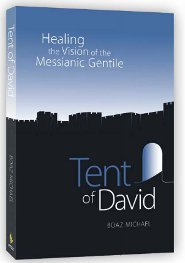
The last paragraph I quoted was startling to me because it reminded me of what Boaz Michael wrote in his book Tent of David: Healing the Vision of the Messianic Gentile:

The church is good but the church needs to change.

Tent of DavidI’ve written a number of different commentaries on his book including this one, and acknowledge that what Boaz produced challenged me personally to set aside my discomfort about going back to church and to “take the plunge,” which was nearly two years ago. Boaz was instrumental in getting me to see what is good in the Church, which is the same message McKee is delivering.

I applaud McKee for maintaining a high view of Christianity and the faithful men and women in the Church, which he acknowledges is practically unknown within One Law communities, but if he does not advocate for One Law anymore than “divine invitation,” and he apparently does not identify with mainstream Christian assembly (although he protects and defends Christians), what else is there that could be considered “One Law”?

As it turns out, McKee’s third viable option is:

Obeying the Lord is neither an optional invitation nor a mandated obligation, it is a supernatural compulsion enacted by the perfecting activity of the Holy Spirit on the human soul.

p.91

I’m disappointed. I expected a much stronger approach to his application of One Law. But this is like just redressing the One Law argument in spiritual rather than covenantal language. The Holy Spirit (supposedly) compels the individual to desire to observe the 613 commandments or something like them, give or take your opinion on the halachah established by the various Rabbinic sages in the numerous streams of Judaism across thousands of years of history.

Actually, I know where he’s getting this:

“Behold, days are coming,” declares the Lord, “when I will make a new covenant with the house of Israel and with the house of Judah, not like the covenant which I made with their fathers in the day I took them by the hand to bring them out of the land of Egypt, My covenant which they broke, although I was a husband to them,” declares the Lord. “But this is the covenant which I will make with the house of Israel after those days,” declares the Lord, “I will put My law within them and on their heart I will write it; and I will be their God, and they shall be My people. They will not teach again, each man his neighbor and each man his brother, saying, ‘Know the Lord,’ for they will all know Me, from the least of them to the greatest of them,” declares the Lord, “for I will forgive their iniquity, and their sin I will remember no more.”

Jeremiah 31:31-34 (NASB)

Unfortunately, McKee has a couple of problems. The first is that the New Covenant was made exclusively with the House of Judah and the House of Israel and does not presuppose any other nations or people groups at all (least of all he and me). Yes, there is a New Covenant application for Gentiles which I summarized here, but up to this point in the book, while McKee mentions various aspects of the New Covenant, he jumps from Jeremiah 31 straight to the Last Supper (Matt. 26:17-30; Mark 14:12-26; Luke 22:7-39; and John 13:1-17:26) without making the connection explicit. I know how it works (and it took me months of study to figure it out) but chances are many of McKee’s readers don’t (or they don’t understand it correctly).

The other major problem is that the New Covenant hasn’t been fully enacted yet. It’s not here. Jesus inaugurated it with his life, death, and resurrection, but until his return, we are only living in what you might consider the leading edge of the Messianic Age. What that means is until the resurrection and until Messiah returns to us here on Earth and ascends the Throne of David in Holy Jerusalem, we are still living in Old (Sinai) Covenant times!

So we don’t have the Torah supernaturally written on our hearts yet and thus, neither Jews and certainly not Gentiles have the Holy Spirit granted ability to naturally obey God and never sin, which is what the New Covenant is all about…the forgiveness of all sins and the ability to never sin again and obey God’s law (as it applies to each individual and each people group).

And yet he says:

A position of Supernatural Compulsion does advocate that a Torah obedient walk of faith is expected of all God’s people but it is to be found as an individual grows in holiness and spiritual maturity…

-McKee, ibid

While “expected” and “obligated” sound really similar to me, I like that, at least, McKee is acknowledging not everyone is going to adopt the various mitzvot at the same rate or to the same degree. It’s a matter of spiritual growth and maturity. Interestingly enough, I’ve heard many stories of secular Jews who became “religious” and this is more or less how they approach the vast body of mitzvot, taking a mitzvah at a time and growing into it.

But for a Christian, there are additional roadblocks, such as a lifetime of being taught that the law is dead.

ChurchMcKee said in his book that he advocates for a gentle, educational approach rather than going into a church and beating Christians over the head with a Torah scroll. In some sense, this is reminiscent of my own Tent of David experience. It’s sort of like evangelizing the church by encouraging them to consider a more Messianic perspective on the Bible, but where I desire to educate about how the New Covenant works and thus alter Christian perceptions on the primacy of national Israel and the Jewish people in the age to come, McKee is hoping to encourage more “Torah observant” behavior in normalized Christianity.

This is still refreshing because a lot of One Law people I’ve encountered in person and online hate the Church, call it “Babylon,” “pagan,” and “apostate,” and encourage Christians to abandon the Church. His attitudes about the Church are very similar to mine.

But here’s one more surprise I didn’t see coming:

Does a ministry like Outreach Israel and TNN Online think the Torah is for everyone? Yes. Does this include things like Shabbat, the appointed times, and kosher? Yes. But such an affirmative also needs to be tempered with another question: Are these aspects of God’s Torah for everyone right now in the 2010s? This is something that only God, in His plans for an individual’s or a family’s life, especially evangelical Christians, knows for sure — and I cannot fully answer.

-p.93

As I am reading McKee, I think he’s saying that believing non-Jews can and should observe the mitzvot in a more or less “Jewish” manner and to the same degree as Jewish believers (and Jewish unbelievers), but that such standards cannot be imposed from the outside by human agency. Even if one worships with other One Law advocates, that community has no right to direct a person or a family to observe this or that mitzvah. Such a directive will only come from the Holy Spirit and only in the way God’s plan is designed for the individual or family and through the process of spiritual growth and maturity.

I’m a little uncomfortable saying that Christians who don’t have a One Law or even a Messianic Gentile perspective are spiritually immature. I happen to know some people at the church I attend who are models of spiritual maturity and who I admire greatly. Just associating with such people is an honor. From a Jewish perspective, they could be referred to as tzaddikim (“righteous ones”). A Christian would say “saints”.

In the first century C.E. before the destruction of the Temple and the exile of the Jewish people from Israel, Paul’s Gentile disciples in Syrian Antioch and the various communities he established in the diaspora probably behaved in a distinctively Jewish manner, much more so than Christians would consider “normal” today, even acknowledging the “Jewish roots of the faith.” In those days there was no such thing as “the Church” or “Christianity,” there was only the Jewish movement of “the Way,” the “Ekklesia of Messiah” which included Jewish and Gentile members.

I suspect that after the resurrection and in the reign of King Messiah, we will have something similar, not a Church and then a Judaism but rather an Ekklesia with two distinct populations: Israel or the Jewish people, and the people of the nations who are called by His Name. This isn’t exactly what McKee is advocating because he believes Jesus-worshiping Jews and Gentiles are all citizens of Israel, but it’s kind of similar.

What McKee may be shooting all around but not quite hitting is the fact that the New Covenant age has yet to arrive (although we’re currently experiencing a foretaste of the promises yet to come) and that the Torah will only be written on our hearts in the future. While some non-Jews will acquire an apprehension of the centrality of the Jewish people in God’s redemptive plan prior to that time, many others, and probably most Christians, won’t.

white-pigeon-kotelI think the reason McKee can’t answer the question about when or how Gentile Christians will be drawn to naturally obey God is because it’s not going to happen until after we are resurrected and perfected in Messiah by the power of the Holy Spirit and in accordance to God’s New Covenant promises.

With the center of McKee’s book laid as a foundation, I’ll use it to build my review of the first and last parts of his text in part 2 of my “meditation” on One Law for All.

Addendum: My partner in this endeavor, Pete Rambo, just published Part 1 of his own review of McKee’s book.

Acting Jewishly But Not Jewish, Part 1

Paul’s “Jewish Assemblies” rather than “Paul’s Gentile Churches”? “Paul’s Jewish non-Jews” instead of “Paul’s Christian Gentiles?”? Paul bringing Non-Jews into “Judaism” rather than into “Christianity”? Am I really going to argue that these are more accurate labels for discussing the non-Jews who Paul brought to faith in Jesus Christ and the gatherings of them with Jews sharing that conviction, as well as the communal ways of life into which Paul sought to enculturate them? “Yes” — and “No.”

Dr. Mark D. Nanos
‘Paul’s Non-Jews Do Not Become “Jews,” But Do They Become “Jewish”?: Reading Romans 2:25-29 Within Judaism, Alongside Josephus,’ p.1
forthcoming in The Journal of the Jesus Movement in its Jewish Setting (2014)
and presented as a paper at the SBL Annual Meeting in 2013, Baltimore, MD.

Since this cites a portion of Romans 2, it would be prudent to review that part of scripture before proceeding:

For indeed circumcision is of value if you practice the Law; but if you are a transgressor of the Law, your circumcision has become uncircumcision. So if the uncircumcised man keeps the requirements of the Law, will not his uncircumcision be regarded as circumcision? And he who is physically uncircumcised, if he keeps the Law, will he not judge you who though having the letter of the Law and circumcision are a transgressor of the Law? For he is not a Jew who is one outwardly, nor is circumcision that which is outward in the flesh. But he is a Jew who is one inwardly; and circumcision is that which is of the heart, by the Spirit, not by the letter; and his praise is not from men, but from God.

Romans 2:25-29 (NASB)

How did the Apostle Paul see the distinction between Jesus-believing Jews and Gentiles in Jewish worship and community space? I’ve written on this topic numerous times, often utilizing the research and publications of both Mark Nanos and Magnus Zetterholm in such “meditations” as Nanos, Paul, and the Consequences of Jewish Identity in Messiah, Nanos, Ancient Antioch, and the Problem with Peter, and Zetterholm, Nanos, Ancient Antioch, and Some Implications. In this more recent paper by Nanos, one that should be published later this year, we see an interesting development in how Nanos presents Paul relative to Romans. Did Paul see the non-Jewish disciples of the Jewish Messiah as practicing Judaism or behaving “jewishly” without converting to Judaism or taking on identical obligations and roles with the Jews?

Being identified as a Jew and behaving like a Jew are readily recognized to represent two related yet not identical matters (p.2).

This behavior can be referred to by the adverb “jewishly,” and as the expression “jewishness.” In colloquial terms, one who practices a Jewish way of life according to the ancestral customs of the Jews, which is also referred to as practicing “Judaism”… (p.3).

Mark Nanos
Mark Nanos

Nanos distinguishes between being born ethnically Jewish and (as a male) being circumcised on the eighth day and acting “jewishly” (the lower-case “j” is used deliberately by Nanos), as having significant overlap, but not precisely being same. Even a Jewish person born of two Jewish parents and circumcised may choose not to observe any of the mitzvot and nevertheless will be considered Jewish, albeit apostate.

A Gentile who chooses to observe some or even all of the Jewish behaviors associated with the mitzvot can be said to be acting “jewishly” or practicing “Judaism,” but that does not mean the person is actually considered Jewish.

But where is the dividing line? How far could a Gentile Jesus-believer go in Paul’s time, and how far can a Gentile Jesus-believer go in our time in “acting Jewishly” without actually being Jewish? Can we use Paul to establish any rules or guidelines for Gentile Christians today who are attracted to Jewish practices or learning and yet do not desire to convert to Judaism because of their Christian faith?

Because ethnic identity (Jew/s) and ethnic thinking and behavior (Jewish / jewishly / jewishness / Judaism) are clearly related, but not synonymous, interchangeable terms, an interesting phenomenon arises when seeking to describe groups as Jewish. Although “Jewish” can be and is most often used to refer to Jews specifically, and thus gatherings of Jews: they are Jewish, the Jewish people, a Jewish service, and so on, as we will see, “Jewish” can also refer to groups or activities that include non-Jews: that group is Jewish, although it includes non-Jews who appear to think and behave like Jews (p. 6).

Nanos could easily be describing almost any synagogue I’ve ever been in. I’m a Christian married to a Jew. It’s very common to find a mixed Jewish/Gentile group in our local Reform/Conservative synagogue and of course at the Chabad, a number of intermarried couples attend, and yet both venues are undeniably Jewish. The same may be said for some Messianic Jewish synagogues that have at least a core population and leadership of Jews but that also houses a large number of Gentiles who are involved in Jewish practices, such as listening to the Torah readings, davening from a siddur, praying in Hebrew, and so forth.

In all of the contexts listed in the above paragraph, the participating Gentiles can be considered as acting “jewishly” within a Jewish community while remaining fully Gentile. But as I said before, how far can we take the concept of “Gentile jewishness” and consider it a valid method of “practicing Judaism?”

orthodox-talmud-studyAlmost two years ago, I stopped searching for an identity and declared myself a Gentile who studies Messianic Judaism. While my practice isn’t all too “Jewish” (or “jewish”), my thought processes, study materials, and some of my study methods borrow heavily from traditional Judaism.

Of course, I can be a Gentile studying Judaism in the same sense as a 21st century American studying 16th century Greek cuisine. I don’t have to be the thing that I’m studying. Learning the typical dishes of Greece of the 1700s doesn’t require that I be Greek.

But it’s a little different in the world of religion and religious lifestyle. I could study Torah as an abstract collection of knowledge the way some people study the Bible as literature or as history, but the Bible is unique and the Torah is designed to change lives. To be a Gentile student of Messianic Judaism involves not only specific study methods and materials but the required context in which to live it all out.

To continue from Nanos:

What if a group mostly made up of non-Jews with some Jews in leadership behaves jewishly? What if it is made up exclusively of non-Jews yet founded or advised by Jews? What if it consists of only non-Jews and functions independent of any Jews and yet bases its thinking and behavior on Jewish Scriptures, traditions and ways of life? (pp. 6-7)

As I read these passages from the Nanos paper, I can’t help but see a progression from Messianic Judaism (MJ) into Hebrew Roots (HR). The closer the Gentile is to the MJ side of the scale, in a mixed group of Jews and Gentiles to a group of Gentiles with a core leadership of Jews or even arguably, a group of only Gentiles that is advised and guided by Jewish mentors, that group is or could be considered “Jewish” or at least perceived correctly as acting “jewishly”.

However, once to you approach the opposite side of the scale, which would be defined by a group made up exclusively of Gentiles with only Gentiles in leadership, even if they are using Jewish educational materials and religious artifacts (siddurs, kippahs, Tallits, the Chumash, and so on), that group may still appear to be acting “jewishly,” but they are not a Jewish group. They can study Judaism, but they aren’t a Judaism, thus a group made up exclusively of Gentiles with no ties to Jewish oversight cannot, in this paradigm, call itself “Messianic Judaism” and is better defined as “Hebrew Roots” or by some other label.

This directly reflects back to the communities Paul established or in which he was involved such as the “synagogue of the Way” in Syrian Antioch (see Zetterholm’s The Formation of Christianity in Antioch as well as Nanos’ The Mystery of Romans).

The level of “jewishness” practiced by Gentile disciples of the Master may have been in direct proportion to the involvement and influence of Jesus-believing Jews operating in the same religious and social community. The less influence exerted by Jewish mentors on the Gentiles, the less “jewish” were the behaviors and lifestyles of the Gentiles.

The Jewish PaulWe see something of this in Paul’s Epistle to the Romans. Historically, we know that for a time, Jews were banned from Rome. Prior to that event, there were both Gentiles and Jews who co-mingled as disciples of Jesus. Once the Jews were banned and (presumably) Rome was without a Jewish population, the Gentiles became solely in charge of their own social and religious dynamic, including how “jewishly” they chose to behave. When the Jews were allowed to return and attempted to resume their prior relationship with the Gentiles in Messiah, they discovered the Gentiles were riding on their “high horses,” so to speak, pushing back against Jewish synagogue authority and even criticizing the Jews for lack of strict adherence to Jewish Torah practice.

The chapter (Romans 2) within which this text appears begins with a challenge to anyone judging others, based on the argument that the very act of knowing there is a standard to which the other is held logically involves knowing that one has also failed to achieve it. Realizing that God is the judge who is fully aware of both one’s own intentions and actions as well as that of one’s neighbors, the message Paul drives home is to focus on one’s own responsibilities to do what is required of one, to judge oneself and leave the judging of others to the Judge… (p.19)

And again, Nanos states:

Paul’s argument is constructed to encourage non-Jews to avoid making the same mistake they are quick to recognize in this diatribal caricature. Paul calls them to concentrate on being faithful to what they are responsible to do in service instead of judgment toward the other, including the one who may be judging them… (p. 31)

Nanos is specifically referencing Romans 2:25-29 which I quoted at the top of this blog post, and is saying that those Gentiles who were choosing to judge their Jewish counterparts for any errors or lapses in Torah observance would be better advised to pay attention to their own responsibilities and let the Righteous Judge of Israel judge Israel.

Which, given the current conversation, begs the question of what behaviors of theirs should the Gentiles in Rome have been attending to? Put another way, should the Roman Gentile disciples have been paying attention to the proper execution of their “jewish” behaviors? What does it mean to “concentrate on being faithful to what they are responsible to do?”

Paul argued that these uncircumcised non-Jews were full and equal members of the family of God alongside of the Jewish members, indeed, equally children of Abraham and co-heirs of the promises made to him and his seed, not simply welcome guests (p. 7).

That sounds good but it doesn’t complete the picture.

In the next argument, vv. 12-16, Paul makes it plain that God judges according to the faithful behavior, which is not expected to represent precisely the same standards for Jews and non-Jews; indeed, each is held to the standard of what they know to be proper behavior (p. 19). (emph. mine)

studying_tanakh_messiahSeveral chapters in Romans seem to toggle back and forth between the responsibilities of Jews and Gentiles relative to God and the potential for hypocrisy among the Jews who claim the advantages of being Jewish but who, while teaching the Gentiles what is proper for God (for Gentiles), fail themselves to perform what is proper before God (for Jews). It should have been fairly clear to the Jewish people involved what their roles and responsibilities were, but were the Gentiles just supposed to “wing it,” hoping to know what is right and wrong?

We know that Paul had certain expectations of the Gentiles. Although he opposed Gentiles in Christ from undergoing the proselyte rite, he also discouraged them from continuing any idolatrous practices (Rom 3:29–4:25; 6; 1 Cor 7:17-22; Gal 4:8-10; 1 Thess 1:9-10).

Of the Gentiles taught by Paul, Nanos says:

Paul was exhorting non-Jews turning to God in Christ to seek to discover within themselves the noble values of jewishness, what being a Jew ideally signifies. They should learn to internalize jewishness as the highest value for themselves, albeit remaining non-Jews… (p. 32). (emph. mine)

But here’s a strong caveat:

His letters consist precisely of instruction in the Jewish way of life for non-Jews who turn to Israel’s God as the One God of all the nations; he enculturates them into God’s Guidance (Torah) without bringing them under Torah technically, since they do not become Jews/Israel. They are non-Jews who are learning, by way of Paul’s instructions, to practice Judaism! (p. 33) (emph. mine)

I can see where you might think all this is as clear as mud.

How can Gentiles learn to draw their values from Judaism and even practice Judaism to the degree that outside observers would say the Gentiles are acting “jewishly” and yet still operate under an overlapping but distinct set of standards from the Jews, not be considered under the Torah, and not be considered either Jews or Israel?

From the Didache (6:2), it is said:

For, on the one hand, if you are able to bear
the whole yoke of the Lord, you will be perfect;
but if, on the other hand, you are not able,
that which you are able, do this.

quoted from The Didache: Text, Translation, Analysis, and Commentary, pg 19
by Aaron Milavec

The Didache is considered a set of formalized instructions for Gentile initiates who were seeking to become disciples of Jesus. The document is traced to the second century C.E. and probably represents an earlier form of oral instructions and traditions, possibly originating with the Apostles or their immediate disciples. These standards would have been the basis Jewish mentors used to train the Gentile initiates in preparing them to become baptized and enter into their role as disciples.

beth immanuelFrom here we see that it is likely the Gentiles were encouraged to bear “the whole yoke of the Lord” Torah, in order to be “perfect,” but if they were not able, it was allowable that they should perform whatever was within their capacity. Again, please keep in mind, that a Gentile acting “jewishly” was both voluntary and was designed to occur within a Jewish communal context.

Given space limitations and the patience of those of you reading this, I’m going to stop here and pick it up in a subsequent blog post. There’s still much to explore about a Gentile acting “jewishly” in ancient times and what happens when he or she is outside a Jewish space. Also, what are the implications for those of us today who are Gentiles who study Messianic Judaism, both inside a Jewish context and outside?

Addendum: I’ve published the second part of this two-part series including a correction to some mistakes I’ve made in part one. I want to thank Dr. Mark Nanos for bringing what I’ve misunderstood about his paper to my attention and allowing me the opportunity to fix my mistakes.

Reflections on Romans 4

What then shall we say was gained by Abraham, our forefather according to the flesh?

Romans 4:1 (ESV)

Remember that in my reflection on Romans 3, Paul was toggling back and forth between Jewish obligation to the Law (Torah) and justification by faith, making sure that his audience, probably Jewish and Gentile believers in the synagogues in Rome (but talking about Gentile relationships with non-Jesus-believing Jews), understood the proper association, that Jews had many advantages including those Jews who had not yet come to faith in Messiah Yeshua, (Christ Jesus) but that only faith ultimately justifies one before the Almighty.

It must have been a struggle, especially for the Gentile Jesus-believers, to comprehend the relationship between faith and Torah observance. My reading of Romans tells me that these Gentiles might have been getting pretty arrogant, especially in relationship with the non-Jesus-believing Jews they encountered, because they had the Torah but not faith in Messiah. The Gentiles may have concluded that they were justified before God as were their Jewish Jesus-believing counterparts, but not the non-believing (in Jesus) Jews. After all, keeping the Law doesn’t justify.

Paul was trying to correct the error of the Gentiles’ thinking. Christians today tend to mess this up as well, but if we apply Paul to today’s Jewish communities, we see they too must have many advantages, and that God has not abandoned them or replaced them with the Church or even with the community of Jesus-believing Messianic Jews.

Chapter four sees Paul continuing to make his point and expand upon it.

What then shall we say that Abraham, our forefather according to the flesh, has found? For if Abraham was justified by works, he has something to boast about, but not before God. For what does the Scripture say? “Abraham believed God, and it was credited to him as righteousness.” Now to the one who works, his wage is not credited as a favor, but as what is due. But to the one who does not work, but believes in Him who justifies the ungodly, his faith is credited as righteousness…

Romans 4:1-5 (NASB)

Paul continues to state that Abraham wasn’t justified by what he did, by any works, including circumcision, he was justified by faith and his faith was credited to him as righteousness, even as faith is credited to his readers and to us as disciples of the Master.

But that didn’t mean Abraham wasn’t subject to behavioral expectations by God. That doesn’t mean he didn’t have to obey:

So Abram went forth as the Lord had spoken to him; and Lot went with him. Now Abram was seventy-five years old when he departed from Haran. Abram took Sarai his wife and Lot his nephew, and all their possessions which they had accumulated, and the persons which they had acquired in Haran, and they set out for the land of Canaan; thus they came to the land of Canaan.

Genesis 12:4-5 (NASB)

Now it came about after these things, that God tested Abraham, and said to him, “Abraham!” And he said, “Here I am.” He said, “Take now your son, your only son, whom you love, Isaac, and go to the land of Moriah, and offer him there as a burnt offering on one of the mountains of which I will tell you.” So Abraham rose early in the morning and saddled his donkey, and took two of his young men with him and Isaac his son; and he split wood for the burnt offering, and arose and went to the place of which God had told him. On the third day Abraham raised his eyes and saw the place from a distance. Abraham said to his young men, “Stay here with the donkey, and I and the lad will go over there; and we will worship and return to you.” Abraham took the wood of the burnt offering and laid it on Isaac his son, and he took in his hand the fire and the knife. So the two of them walked on together. Isaac spoke to Abraham his father and said, “My father!” And he said, “Here I am, my son.” And he said, “Behold, the fire and the wood, but where is the lamb for the burnt offering?” Abraham said, “God will provide for Himself the lamb for the burnt offering, my son.” So the two of them walked on together.

Genesis 22:1-8 (NASB)

Abraham was faithful to God and obeyed him, even at great personal cost. Picture what it must be like to, at the word of God, pack up your family and all your possessions and head out in a direction with no stated destination in sight.

The AkedahBut that pales in comparison to the commandment to take your son and serve him up on the altar like a lamb to slaughter. As a father and grandfather, I can only imagine how Abraham’s heart must have been in anguish at knowing not only that his son would die, but that he would have to bind him and kill him with a knife.

Midrash says that Abraham believed that God would allow the sacrifice of Isaac but that God would resurrect him. However, the Torah is silent about this area of Abraham’s thoughts, so we’ll never be sure this side of Messiah what Abraham did and didn’t believe.

We only know that out of faith in God, he obeyed. Thus we can’t say that faith replaces obedience, only that it precedes it. From this I extrapolate that Paul is saying once justified by faith, Jews are expected to continue to observe the mitzvot and that in fact, their observance will have more depth of meaning because of faith.

But there’s something else:

David also speaks of the blessing on the man to whom God credits righteousness apart from works:

“Blessed are those whose lawless deeds have been forgiven, And whose sins have been covered. “Blessed is the man whose sin the Lord will not take into account.”

Is this blessing then on the circumcised, or on the uncircumcised also? For we say, “Faith was credited to Abraham as righteousness.” How then was it credited? While he was circumcised, or uncircumcised? Not while circumcised, but while uncircumcised; and he received the sign of circumcision, a seal of the righteousness of the faith which he had while uncircumcised, so that he might be the father of all who believe without being circumcised, that righteousness might be credited to them, and the father of circumcision to those who not only are of the circumcision, but who also follow in the steps of the faith of our father Abraham which he had while uncircumcised.

Romans 4:6-12 (NASB)

In short, the forgiveness of sins is by faith, not by performance of the mitzvot, thus both Jews and Gentiles receive forgiveness by their faith and the Gentiles don’t have to be concerned that their sins will be counted against them if they don’t also observe the mitzvot in the manner of the Jews.

Remember I said that I thought the Gentiles were probably getting arrogant in their status of saved by faith apart from the Torah? It’s possible that the non-believing (in Jesus) Jews were “pushing back” with their advantage as Jews, having the Torah, the oracles of God, and maybe getting back at the Gentiles among them by pointing out what the Jews had that the Gentiles would never have.

If indeed there was a “war of egos” going on between the Jesus-believing Gentiles and the non-Jesus-believing Jews (with the Jesus believing Jews caught in the middle), then each party would be pressing their own perceived advantage against the other. Paul’s writing this letter to even things out. He’s saying that yes, non-Messianic Jews continue to have the advantages under the Abrahamic and Sinai covenants, but that under one of the blessings of Abraham, it is faith that removes sin for all, not Torah observance, so everyone who has faith will be saved.

DaveningAlso remember that the non-believing (in Jesus) Jews weren’t faithless. They had faith, probably great faith, not in Jesus being Messiah but rather in Hashem, God of Creation, Master of Legions. Yes, faith in Messiah as the first fruits of the dead is the next logical, historical, and Biblical step in Jewish faith in God and the advancement of God’s plan to bring the New Covenant into the world, but non-believing (in Jesus) Jews were not totally abandoned by God, nor were they bereft of His compassion.

For the promise to Abraham or to his descendants that he would be heir of the world was not through the Law, but through the righteousness of faith. For if those who are of the Law are heirs, faith is made void and the promise is nullified; for the Law brings about wrath, but where there is no law, there also is no violation.

Romans 4:13-15 (NASB)

This sounds like one of those either/or statements about faith being good and the Law bringing wrath, but what about the Law brings wrath?

If someone depended on their behavior alone with no faith in God and with the absence of intent to serve God, the response would be wrath, for without faith, no one can be saved from the consequences of their sin and from God’s righteous judgment. Yes, the Jews had the promises and they were (and are) heirs to the Land of Israel, but if observance is what you believe justifies you before God, then “faith is null,” as Paul wrote. Of course, the other side of that wrath is a Jew who claims to have faith in God but who is not observant. The Torah is clear about the consequences of disobedience or abandoning God’s Law for a Jew. But what about Gentiles in Messiah?

We see that there are two standards of judging obedience. They may overlap, but they’re hardly identical. If the Gentile disciples of the Master were not expected to observe the Torah in the manner of the Jews as per the legal ruling of the Council of Apostles and Elders (see Acts 15), then those without the Law (Torah), that is, the Gentile disciples, are not under the wrath of the Law. They are not expected to obey thus if they fail to observe the mitzvot, there is no transgression.

But as I said above, the other wrinkle is that even if a Jew has great faith and is justified before God, if he or she does not observe the Torah commandments (the conditions of fulfilling the Sinai Covenant), imagining somehow that they are like the Gentiles (and I can imagine that a few Jews may have taken this as Paul’s meaning), then that Jewish person would be under condemnation. Abandoning the Torah is written all over the history of the Israelites.

But to the wicked God says,
“What right have you to tell of My statutes
And to take My covenant in your mouth?
“For you hate discipline,
And you cast My words behind you.”

Psalm 50:16-17 (NASB)

Just to show you that I’m not making up the idea that a Jew could misunderstand Paul’s intent in teaching Jewish Torah obligation and Gentile non-obligation…

And when they heard it they began glorifying God; and they said to him, “You see, brother, how many thousands there are among the Jews of those who have believed, and they are all zealous for the Law; and they have been told about you, that you are teaching all the Jews who are among the Gentiles to forsake Moses, telling them not to circumcise their children nor to walk according to the customs.

Acts 21:20-21 (NASB)

Apparently some Jewish people got the idea that because Paul was teaching the Gentiles that they did not have to observe the Torah commandments (Moses) and they didn’t have to circumcise their sons, that Paul was also teaching the Jews the diaspora the same thing. Maybe some Jews reading Paul’s letters or hearing him teach actually thought he was applying the same “freedom” he was preaching to the Gentiles to Jewish believers in Yeshua.

Here was James’ solution to the problem and his attempt to clarify what Paul was really doing:

Therefore do this that we tell you. We have four men who are under a vow; take them and purify yourself along with them, and pay their expenses so that they may shave their heads; and all will know that there is nothing to the things which they have been told about you, but that you yourself also walk orderly, keeping the Law. But concerning the Gentiles who have believed, we wrote, having decided that they should abstain from meat sacrificed to idols and from blood and from what is strangled and from fornication.”

Acts 21:23-25 (NASB)

The Jewish PaulPaul was to pay the expenses of four Jewish men under a vow (probably a Nazarite vow) in order to graphically illustrate that he continued to observe the mitzvot and that there was nothing to the erroneous rumors about him teaching “lawlessness” to diaspora Jews. Verse 25 presents the distinction for the Gentile believers, citing the Acts 15 letter, which limits the observance of the Messianic Goyim to a subset of the commandments.

Thus Paul was not teaching Jews that their level of observance was reduced to that of the Gentile disciples but rather, Paul remained a Torah-observant Jew teaching other Jews to keep to the commandments while at the same time, teaching the Gentile disciples a different or overlapping set of observances that were not nearly as strict or involved.

No wonder the Romans letter seems so difficult to follow. Paul was trying to explain circumstances that were (and are) very difficult to understand.

The common denominator for Jews and Gentiles in Messiah is faith. Faith justifies, makes one righteousness, and erases all guilt of sin (after repentance, of course), and only afterward are we to live a life of obedience by faith. Only then will God judge our hearts and hold us accountable to the level of our observance as specifically assigned to Jew or Gentile.

I know I’m going to get some “push back” for all that, but it’s the only way to explain what Paul is saying that makes any sort of sense to me.

For this reason it is by faith, in order that it may be in accordance with grace, so that the promise will be guaranteed to all the descendants, not only to those who are of the Law, but also to those who are of the faith of Abraham, who is the father of us all, (as it is written, “A father of many nations have I made you”) in the presence of Him whom he believed, even God, who gives life to the dead and calls into being that which does not exist. In hope against hope he believed, so that he might become a father of many nations according to that which had been spoken, “So shall your descendants be.”

Romans 4:16-18 (NASB)

Like I said, faith is the common denominator in accordance with grace. Abraham has two lines of descendants, those who are of the Law, that is, the Jewish people, and those who are of the faith of Abraham, that is, the Gentile believers. This isn’t to say that the Jews have only the Law and Gentiles are the ones with all the faith. Like I said, faith is the common link between Jews and Gentiles. But we Gentiles are joined to the covenant blessings by faith and we do not have the Law.

The Law, that is, the Torah, the conditions of the Sinai covenant between God and Israel, is particularly identifying of Jews. That’s why (in my opinion), Paul structured his sentence as he did. The Jews are the ones whose obligations to God are specifically defined in the Torah. The Gentiles, by contrast, are specifically identified, not by the Law obviously, but as children of Abraham by faith alone. The Gentile behavioral conditions are summarized in the Acts 15 letter. Remember, the Jews were also physically children of Abraham, so they had their link back to the Patriarch both by faith and by bloodline. Gentiles are Abraham’s children by faith alone. This is how Abraham would be the father of the Jews but also the “father of many nations.”

sarah and isaacThe final verses of this chapter pull Paul’s points together, citing Abraham’s faith in the promise of an offspring, even in the face of both his and Sarah’s great age, and repeating that Abraham’s faith was credited to him as righteousness. Paul then points all this back to Jesus, the keeper of the New Covenant promises, the seed of Abraham (Galatians 3:16; 3:29), the one God raised from the dead, the one who was delivered over to sinful men for the transgressions of the world, for the sake of the Jews but also the Gentiles, that through faith in him and the resurrection, we have the hope of living in the New Covenant age, in an age of peace and tranquility, in an age without strife or sin, with Messiah the King.

Where Do We Encounter God?

They shall make for Me a Sanctuary and I shall dwell among them.

Exodus 25:8

The Midrash notes that God did not say, “I shall dwell within it” (the Sanctuary), but “I shall dwell among them” (the Israelites), i.e. the Divine Presence will be within each person.

-Rabbi Abraham J. Twerski
“Growing Each Day,” Tammuz 26
Aish.com

That sounds incredibly like this:

When the day of Pentecost had come, they were all together in one place. And suddenly there came from heaven a noise like a violent rushing wind, and it filled the whole house where they were sitting. And there appeared to them tongues as of fire distributing themselves, and they rested on each one of them. And they were all filled with the Holy Spirit and began to speak with other tongues, as the Spirit was giving them utterance.

Acts 2:1-4 (NASB)

Well, maybe not exactly. Actually, the “Pentecost event” sounds more like this:

The Lord descended in a cloud and spoke to him, and He increased some of the spirit that was on him and bestowed it on the seventy elders. And when the spirit rested upon them, they prophesied, but they did not continue.

Numbers 11:25 (Chabad Torah Commentary)

So we have two examples from the Bible, Numbers 11:25 and Acts 2:1-4, where we witness the Holy Spirit of God being imparted to groups of devout Jews and whereupon they prophesy. Then we have a Midrash on a portion of the Torah that says it was God’s intent to dwell among Israel by dwelling within each individual Israelite, rather than in (or in addition to) the Sanctuary itself.

When the Midrash states God did not say, “I shall dwell within it” (the Sanctuary), but “I shall dwell among them”, it seems more like clever word play than an obvious interpretation leading to the aforementioned conclusion.

Still, it’s a compelling thought, since it summons images of God desiring, even as He commands the Mishkan to be built, to dwell within the devout of His people.

But dwelling among His people can also be compared to this:

They heard the sound of the Lord God moving about in the garden at the breezy time of day; and the man and his wife hid from the Lord God among the trees of the garden. The Lord God called out to the man and said to him, “Where are you?”

Genesis 3:8-9 (JPS Tanakh)

Here too we see God “dwelling” among His people in Gan Eden (the Garden of Eden) but we don’t see the Divine Presence dwelling within Adam and Havah (Eve). Can we say that the Divine Presence dwelt among Israel with the Tabernacle (and later the Temple) as the focus of His presence in the same manner as He dwelt (or at least visited) the Garden?

After all, the Midrash presented by Rabbi Twerski isn’t the only one referencing Exodus 25:8:

And they shall make Me a sanctuary: And they shall make in My name a house of sanctity.

Rashi’s commentary on Exodus 25:8

Rabbi Prof. David Golinkin

Rabbi Professor David Golinkin, President of the Schechter Institute of Jewish Studies in Jerusalem, wrote a commentary on Exodus 25:8 in 2003 called Why Do We Need Synagogues in which he offered numerous Midrashim on this particular verse.

Of all of the Midrashim proffered, he believes this one best defines the reason for the commandment to build the Mishkan:

This whole matter of the Menorah, the Table, the Altar, the boards, the Tent, the curtains, and the utensils – what is it for? Said Israel before the Holy One Blessed be He: Lord of the Universe, the kings of the nations have a tent and a table and a menorah and incense and these are the trappings of kingship, for every king needs this. You are our king, our redeemer, our savior – shouldn’t you have the trappings of kingship until all people know that you are the king? God said to them: My children, flesh and blood need all that, but I do not, because I don’t eat or drink and I don’t need light… [Finally God relented:] If so, do what you want, but do it as I instruct you: As it is written: “And let them make me a sanctuary… make the menorah… make the table… make the altar…” (Midrash Aggadah to Parashat Terumah, p. 170).

The Jewish people built the mishkan and later the mikdash and later the synagogue because they – like all human beings – had a need for a physical place in which to worship God.

We are physical beings designed to live in the material world. God is Spirit and exists outside of Creation and indeed, there is no place where God does not and cannot exist. We are limited and He is limitless. So if He desires to dwell among us, where do we meet? We cannot go to His realm for how does a finite human visit infinity? He must somehow “reduce” Himself and come to us where we live. It was for us that all of Creation was made.

And who knows what aspect of the Almighty was “moving about in the garden” on that breezy day?

But R. Golinkin also quoted his father Rabbi Noah Golinkin from the senior R. Golinkin’s booklet Say Something New Each Day (1973, p. 18):

God, where are You?
Where do I find You?
You do not live here.
You have no address.
The Universe is filled with Your glory.
You live in every mountain
and in every valley
and on the busy turnpike outside.
You live in the beautiful riot of many colors
of the Indian summer;
and You live in my soul.

“You live in my soul.” But there’s more:

And yet
I have built for You a special building,
Beautiful, dignified, majestic,
Intimate, warm and friendly.
For whom did I build it?
For You and me.
For our conversations together.
For Your glory, O God,
And for my humble need.
I should be talking to You –
When I see You in the beautiful sunrise,
When I see You in the innocent smile of a child
When I see You in the kind deed of a man.

Inner lightIt seems there doesn’t have to be an inconsistency between God dwelling among us and God dwelling within our souls. He speaks to us from within ourselves but also meets with us in Holy places of worship.

I should say that, particularly in Judaism, personal worship and study is conducted in the home and the synagogue is reserved for communal worship and study. Jews pray individually but to join a minyan, must go to the synagogue.

Then the LORD God said, “It is not good for the man to be alone…

Genesis 2:18 (NASB)

Behold, how good and how pleasant it is For brothers to dwell together in unity!

Psalm 133:1 (NASB)

In the Garden, in the Mishkan, in the Temple, in the Synagogue, and dare I say it, in the Church, people were not meant to encounter God as individuals, because we can do that anywhere, including within our souls. God commanded the Mishkan to be built so that the community, the nation of Israel could gather and dwell with God.

The indwelling of the Spirit is inexorably coupled with the New Covenant:

Moreover, I will give you a new heart and put a new spirit within you; and I will remove the heart of stone from your flesh and give you a heart of flesh. I will put My Spirit within you and cause you to walk in My statutes, and you will be careful to observe My ordinances.

Ezekiel 36:26-27 (NASB)

“Thus you will know that I am in the midst of Israel,
And that I am the Lord your God,
And there is no other;
And My people will never be put to shame.
It will come about after this
That I will pour out My Spirit on all mankind;
And your sons and daughters will prophesy,
Your old men will dream dreams,
Your young men will see visions.
Even on the male and female servants
I will pour out My Spirit in those days.”

Joel 2:27-29 (NASB)

In Gan Eden, human beings had an unparalleled intimacy with God which they took for granted because they had never known separation from God. It was only after the first act of disobedience that they truly understood was it was to be separated from God, the anguish, and agony of having known God and then becoming alienated from Him. How like our Master when he took upon himself the sins of humanity, thus for the first time also becoming separate from the Father:

About the ninth hour Jesus cried out with a loud voice, saying, “ELI, ELI, LAMA SABACHTHANI?” that is, “MY GOD, MY GOD, WHY HAVE YOU FORSAKEN ME?”

Matthew 27:46 (NASB)

exileHumanity has been separated from God for virtually all of human history. And yet not only has God desired to once again dwell with us, but as the Midrash testifies, we have yearned to dwell with Him. But once broken, shattered, torn asunder, intimacy with God is not so easily recovered. We see a series of steps, from the Mishkan, to the Temple, to the Master (John 1:14) and the Master’s Good News that the New Covenant was (is) near, to the giving of the Spirit to the Jews (Acts 2) and the Gentiles (Acts 10).

But the best is yet to come.

While most Christians don’t give much serious thought to Midrash, it’s a reminder that the desire for intimacy with God is much older than the Church and that the people who authored the Bible also witnessed the Divine Presence descending upon a structure that man built at the command of God.

Then the cloud covered the tent of meeting, and the glory of the Lord filled the tabernacle. Moses was not able to enter the tent of meeting because the cloud had settled on it, and the glory of the Lord filled the tabernacle. Throughout all their journeys whenever the cloud was taken up from over the tabernacle, the sons of Israel would set out; but if the cloud was not taken up, then they did not set out until the day when it was taken up. For throughout all their journeys, the cloud of the Lord was on the tabernacle by day, and there was fire in it by night, in the sight of all the house of Israel.

Exodus 40:34-38 (NASB)

The Divine Presence of God descended upon the Tabernacle but God also dwelt within the souls of each individual Jew. Messiah will someday come to rebuild the Temple, but Paul also called our bodies Temples of the Holy Spirit (1 Corinthians 6:19). We don’t have to conclude that an infinite God can only reside within one domicile within our world, for nothing is impossible with God.

But if not for human frailty and folly, where would God be to be among us?

The purpose of the tabernacle and the subsequent Temples was “they shall make me a sanctuary that I may dwell amongst them” (Exodus 25:8).

The great kabbalist Rabbi Isaiah Halevi Horowitz (1560-1630), author of the monumental work the Sheloh, writes that since the verse employs the plural “them” rather than the singular, the Torah must be referring not to the sanctuary but to the people themselves.

According to this mystical interpretation, God’s commandment was never for a home of gold, silver and marble. Rather, God’s desire is that we create a space in our hearts and souls for him to abide in. Our very beings should function as portable temples that elevate our lives to be sanctified wherever we are.

-Rabbi Shlomo Zarchi
“Torah: Why do we pursue justice? The answer lies inside all of us” – March 7, 2013
JWeekly.com

R. Twersky concludes his commentary on a similar note:

If my relationship to God is limited to going to the Sanctuary and praying for my needs, then I am merely using Him, and God becomes an external object. But when I make His will mine, then His will resides within me and He becomes part of me. This is undoubtedly what the Zohar means by, “Israel, the Torah, and God are one unit,” because the Torah, which is the Divine will, is inseparable from God, and when one incorporates the Torah with one’s own code of conduct and values, one unites with God.

PrayingWe meet God in multiple venues in the present world, within our churches and synagogues, but also within ourselves. But even as God resides within our souls and as His Spirit infuses our flesh, the union is still incomplete. The word is not yet written upon circumcised hearts. The Messiah has not yet brought that to us.

So we yearn. Our souls groan for what they don’t know but have once known in antediluvian ages past. May the Spirit of God quicken within us and may Messiah come soon and in our days.

Amen.