Tag Archives: Torah

What God Expects of the Jew and Also the Gentile

R’ Moshe Feinstein (in his Darash Moshe) explains that greatness is not defined by a person’s accomplishments, but rather by the person’s success in fulfilling the tasks for which Hashem equipped him and sent him to this world. Every person enters the world with unique abilities and a specific set of tasks to accomplish. Some are given tremendous ability, and are expected to achieve a great deal, while others are endowed with lesser abilities, and correspondingly, smaller tasks. But every person’s job is identical — use the skills you have been given to the utmost, to accomplish as much as you can.

-from “A Torah Thought for the Day,” p.75
Tuesday’s commentary on Parashas Va’eira
A Daily Dose of Torah

From a rationalist’s point of view it does not seem plausible to assume that the infinite, supreme Being is concerned with my putting on Tefillin every day. It is, indeed strange to believe that God should care whether a particular individual will eat leavened or unleavened bread during a particular season of the year. However, it is that paradox, namely, that the infinite God is intimately concerned with finite man and his finite deeds; that nothing is trite or irrelevant in the eyes of God, which is the very essence of the prophetic faith.

-Abraham Joshua Heschel
from “Does God Require Anything of Man?” p.102
Man’s Quest for God

You may not think the two quotes just above have much to do with one another, but bear with me. The former is addressing how each human being is placed on earth to fulfill his or her specific potential understanding that we all have different potentials, and the latter is discussing, not generally human response to God, but a Jew’s response to Hashem through performance of the mitzvot.

There are many problems which we encounter in our reflections on the issue of Jewish observance. I would like to discuss briefly several of these problems, namely, the relation of observance to our understanding of the will of God; the meaning of observance to man; the regularity of worship; inwardness and the essence of religion; the relevance of the external deeds.

-Heschel
“To Obey or to Play with the Will of God.” p.102

Is Heschel using “man” and “Jewish” as interchangeable terms, or can we infer that he means that all human beings are responsible for obeying God, and then drawing out Jewish observance as distinct from God’s expectations for the rest of us?

I doubt Heschel meant to include that meaning into his writing but I’m going to “force” the issue based on my particular perspective.

You see, not only do I believe that each individual human being was placed here in life for a purpose that has been assigned to us by God, but I believe that God has placed the Jewish people and the Gentile nations here to fulfill specific purposes depending on which corporate body we are born into (aside from some Gentiles converting to Judaism).

praying_jewIn other words, there are specific tasks God placed Jewish people here to perform, and we Gentiles have specific tasks we also are here to perform, all in the service of God.

But those Jewish and Gentile tasks aren’t necessarily the same (though there’s probably some overlap).

I know that will ruffle a few feathers out there, but I’ve said this often enough and in so many different ways, it shouldn’t really surprise anyone by now.

As for the “equality” of women in Torah, a great deal depends on what you think “equality” means. In Torah, it does not mean that every member of the community is authorized to perform the identically same roles and tasks. Leviim may not perform some tasks reserved for Cohanim. Other Jews who are not in these categories may not perform the tasks reserved for priestly categories (with some rare and constrained exceptions). Men may not bear children nor are they exempt from time-critical tasks required of them (the men, not the children [:)]). Women may not perform certain tasks required specifically of men. Children are constrained from performing adult tasks and are not to be relied upon to perform adult responsibilities (though their training will include learning by doing, emulating such tasks). None of these categories are less to be valued because of what they may not do; and each is to be highly valued for what they *are* given to do. They are all equally valuable and honorable; but they are not identical in their assignments nor may they trade off their specific responsibilities, though some tasks may be shared by more than one of these categories.

-from a comment made by “ProclaimLiberty”
on my blog post Jews Defining Their Own Relationship With God And The Torah

While the conversation was about male and female equality of roles within Jewish religious and communal space, I chose to expand the concept to include Jewish and Gentile roles within that same space and particularly within Messianic Judaism.

Individuals are granted potentials to fulfill and so are people groups, namely Jewish and Gentile. After all, the Torah was given to Israel at Sinai, not all of the human beings living on the Earth. So if there were a Gentile “mixed multitude” also standing at Sinai saying as one man, “all that you have said we will do” (Exodus 19:8; 24:3), those from outside Israel either assimilated into the tribes, losing their Gentile heritage forever, or they left without so much as a “by your leave” to return to the rest of the nations, probably the lands from which they came.

But what about the rest of us? I mentioned that I thought the nations had specific tasks hard-coded into our potential as well. I suppose I could start with Genesis 9 which is the basis for what in Judaism is referred to as The Seven Laws of Noah, but I can go further than that.

“Therefore it is my judgment that we do not trouble those who are turning to God from among the Gentiles, but that we write to them that they abstain from things contaminated by idols and from fornication and from what is strangled and from blood. For Moses from ancient generations has in every city those who preach him, since he is read in the synagogues every Sabbath.”

Acts 15:19-21 (NASB)

But concerning the Gentiles who have believed, we wrote, having decided that they should abstain from meat sacrificed to idols and from blood and from what is strangled and from fornication.”

Acts 21:25

It would seem, at least from my point of view, that the Bible presupposes a distinction in the duties human beings have to God depending on whether or not you’re Jewish.

Yet we all wholeheartedly accept Micah’s words: “He has showed you, O man, what is good, and what does the Lord require of you, but to do justice, and to love kindness and to walk humbly with your God” (Micah 6:8). If we believe that there is something which God requires of man, then what is our belief if not faith in the will of God, certainty of knowing what His will demands of us?

-Heschel
“Does God Require Anything of Man,” p.103
Toby Janicki
Toby Janicki

But from a “Messianic Gentile’s” perspective, what is the “certainty of knowing what His will demands of us?” The overly simplistic answer some have selected is that “one size fits all.” In other words, there are 613 commandments that Jews are obligated to perform (though many of them are in abeyance since we are without a Temple, a Levitical Priesthood, and a Sanhedrin in Israel), and God has only one standard of piety and righteousness for the whole human race, that is, the aforementioned 613 commandments, the Torah.

But if we accept that, then we must accept that God first chose Israel to be a light to the nations, then at some point, “unchose” her, and instead, chose all followers of Jesus Christ (Yeshua HaMashiach). Except that’s exactly what the Christian Church believes. Christians believe that God “unchose” Israel and the Torah and then chose “the Church,” the worldwide body of believers in Jesus. Hebrew Roots generally (but not universally) believes that (again, please bear with me) God “unchose” Israel and then chose all followers of Messiah Yeshua and applied the Torah to his latter selection in the same manner as He did with His former selection (and as I’ve said before, I don’t for a split second believe that Gentile disciples actually become “non-Jewish Israel”).

It is so difficult from a western egalitarian mindset to imagine that God would be so “unfair” as to have different standards and different expectations for different people groups. And yet, He is God and His will be done.

Heschel calls observing the mitzvot “the Jewish way of life,” (p.105) and he takes Christian theology and specifically the writings of the Apostle Paul to task for emphasizing that a man is justified by faith apart from the Law (p.108 citing Romans 3:28), which he doesn’t consider to be a particularly Jewish attitude.

The highest peak of spiritual living is not necessarily reached in rare moments of ecstasy; the highest peak lies wherever we are and may be ascended in a common deed. There can be as sublime a holiness in fulfilling a friendship, in observing dietary laws, day by day, as in uttering a prayer on the Day of Atonement.

-ibid
“There is No Exterritoriality,” p.111

I agree, however Heschel seems to have missed this:

What use is it, my brethren, if someone says he has faith but he has no works? Can that faith save him? If a brother or sister is without clothing and in need of daily food, and one of you says to them, “Go in peace, be warmed and be filled,” and yet you do not give them what is necessary for their body, what use is that? Even so faith, if it has no works, is dead, being by itself.

James 2:14-16

Of course James (Ya’akov or Jacob), the head of the Council of Apostles and Elders and brother to the Master was (and is) also Jewish so it stands to reason that he and Heschel might have some common insights on a Jewish response to God.

One of the questions I am asked when I bring up this subject is what specifically does God expect of the Gentile in Messiah? I’ve tried to answer that question on multiple occasions over the past several years, most recently in The Duty of Messianic Gentiles and Christians to the Jews, Messianic Judaism for the Rest of Us and Gentiles Studying Torah for the Sake of Doing. But in reading Heschel another detail came to mind.

While not prescribing a diet — vegetarian or otherwise — or demanding abstinence from narcotics or stimulants, Judaism is very much concerned with what and how a person ought to eat. A sacred discipline for the body is as important as bodily strength.

-Heschel, pp.111-12

So God isn’t concerned about what a Gentile ought to eat?

Or do you not know that your body is a temple of the Holy Spirit who is in you, whom you have from God, and that you are not your own? For you have been bought with a price: therefore glorify God in your body.

1 Corinthians 6:19-20

No longer drink water exclusively, but use a little wine for the sake of your stomach and your frequent ailments.

1 Timothy 5:23

The Kosher laws aren’t exclusively a list of “health foods” and in fact, some of the dietary requirements God has for the Jewish people defy logic, but let’s say God does care what we eat (he cares about everything we do, but I’ll use this as an example). Since the Jewish people, God’s nation Israel, has been called out forever from the rest of the nations, which includes the people of the nations who have come to faith in Yeshua, His list of expectations maps to what he has “wired” into them as a set of “potentials”. That goes to every little detail in life, as Heschel alluded to above, including food.

Now let’s say that God also has dietary expectations for the rest of us but that those requirements are less stringent. What if the specific examples we see Paul issuing in his epistles all come down to a general principle (or a few of them if you include the Jerusalem letter) of “eating right?” After all, Paul in his missives seems to be mainly concerned on matters of health, probably for the sake of the Gentile disciples honoring God by behavioral performance (praying, doing good deeds), which is better done if you aren’t sick.

I’m limiting this to food but there’s a lot of things we can do with our bodies to either sanctify or desecrate the Name of God.

kosher deliWhat I’m getting from all this is that God’s behavioral expectations of the Jewish people are much more specific and strict than His expectations for the rest of us because that’s the role He assigned them in this life. He assigned the Gentiles a more “generic” but no less important role and thus the expectations attached to our role are more “relaxed” as reflected in the quotes from Acts 15 and Acts 21.

This isn’t to say that a Gentile disciple can’t go “above and beyond” as a matter of personal conviction. After all, God allowed Jewish people to go “above and beyond” by taking a Nazarite Vow (Numbers 6). However, we are no more required to behave beyond our basic assigned requirements than a Israelite was required to undergo the Nazarite ritual (with notable exceptions such as Samson, Samuel, and John the Immerser who were all life-long Nazarim).

It’s not that the Jews have the Law and the Christians (all non-Jewish believers in Messiah) have Grace. We all have Law and we all have Grace. It’s just that the “Law” for the Gentile disciple isn’t as highly specific as it is for the Jew. There’s more flexibility built into our lives than there is for the Jewish people. God expects them to uphold a higher standard and they bear a greater responsibility. Being “chosen” isn’t always a walk in the park.

That’s not the end of the discussion and there are a lot more details involved, but for those, I’ll refer you to Review of the Gentile Believer’s Obligation to the Torah of Moses and The Gentile Believer’s Obligation to the Torah of Moses Revisited.

I know this won’t satisfy some of you out there, but I don’t expect to be able to do so. This is just me refining my understanding of who I am as a Messianic Gentile and my duties to God as a disciple of the Master, may he come soon and in our day.
Much Ado About the Oral Law

I adored my younger sister and felt very connected to her, but I wasn’t there for her physically or emotionally during her turbulent teens. I was far away in university or traveling, and then in Israel, where I learned in a seminary, married and became in her eyes, a foreign entity: a religiously observant Jew.

Despite the distance, I didn’t see an unbridgeable gap. I could relate to my sister because I saw and felt all our common ground. I was once a teenager, part of the artistic sub-culture of Greenwich Village. I understood what her life was like, even if there weren’t skinheads in my day. I had once been like her, but she definitely didn’t feel like she was anything like me – an “ultra-Orthodox fanatic” against intermarriage, abortion, nudity, atheism, hanging out with guys. I never had a chance to say how I felt about any of these topics; she just assumed everything about my beliefs without any discussion. She could not relate. Or more accurately, she did not want to relate.

-Naomi Freeman
“Repairing the Gap”
Aish.com

For a lot of Christians, the sort of “gap” between Jewish people doesn’t seem to exist. After all, in Church, we generally are taught to view Jews and particularly religious Judaism as a single, unified entity. It’s difficult for many believers (or non-Jews in general) to picture multiple viewpoints among Jewish people (even though it is said “two Jews, three opinions”). And yet, there can be different groups, even within religious Judaism, that are highly polarized.

Consider this recent video that has been circling the various social media venues. Here we have Jewish people saying some rather unkind and perhaps inaccurate things about the “Oral Law” and Rabbinic Judaism.

This is the sort of thing Christians eat up with a spoon.

And they have, or at least one Christian group has within the Hebrew Roots movement as represented by TorahResource.com (For reference, I’ve included a screenshot below taken from Facebook of a discussion on this video by Hebrew Roots proponents).

Oral Law opinionI don’t feel particularly comfortable “calling out” people or groups, but in this case, I think it’s important to illustrate that there are different points of view involved. What your Pastor preaches from the pulpit about Jews and Judaism may not be the only way we disciples of Yeshua (Jesus) are “allowed” to think. I say this coming off of two years attending a local Baptist church where its members do authentically love the Jewish people and the nation of Israel but who are also at least “uncomfortable” if not downright opposed to the practice of religious Judaism. They would, with all good intent, love to see all Jewish people convert to Christianity and leave all but the most superficial practices of the mitzvot behind.

More’s the pity.

Earlier today, Rabbi Stuart Dauermann wrote a blog post called On Not Bashing the Oral Law and the Rabbis of Israel. Here’s part of what he had to say and how he ended his missive:

I don’t think the rabbis are always right. Nor are they always wrong. But I do think it is wrong to attack the rabbis as a class. After all, it wasn’t the ministers and Christian Bible students that kept the Jews and their Judaism alive in the blood- and tear-soaked exilic wanderings of the seed of Jacob. What kept the Jews alive and in faith was the work of the rabbis and the religion they presented and subscribed to.

We owe something to the rabbis of Israel. But is not contempt and mistrust. It is gratitude and admiration, even where and when they disagree with us.

And to the extent that we have entertained the kinds of spurious and nasty arguments I outlined here, we owe them one thing more.

An apology.

You can click on the link I provided to read his entire message and I encourage you to do so.

I’ve already rendered my opinion on interpretation as tradition so I won’t repeat that message except to say that, like R. Dauermann, I don’t believe that the Rabbis are always right in their rulings or opinions. Nevertheless, the Oral Law in post-Biblical times, was (and is) highly instrumental in sustaining the Jewish people and without what we call “Rabbinic Judaism,” it’s quite possible the Jewish people would have faded from the pages of history long before now.

Of course the Jews have always been protected and nurtured by God but who is to say that the existence and process of the Rabbis was not His method of preserving Jewish people and Jewish practice of the mitzvot. After all, the Sinai Covenant (all of the covenants, actually) didn’t vanish (and it certainly wasn’t replaced) simply because of the Temple’s destruction and the dispersion of the Jewish people among the nations. In fact, about a week ago I mentioned the opinion that one of the functions of the Jewish people being in exile was to be a light to the rest of us. This “being a light to the nations” wouldn’t have been possible without the Mishnah and Rabbinic Judaism.

Why am I saying all this? Just to throw my hat into the ring on this topic?

Not exactly, although that’s part of it.

While we can somewhat separate an opposition to Rabbinic Judaism from how we feel about Jewish people, at least in theory, it’s important to remember that there are those who have no love at all for Jewish people, Judaism, and national Israel, and reports of one of their more heinous acts has been all over the news lately.

Talmud StudyAs was said on a Hebrew Roots blog recently, we aren’t going to agree on a great many things in the realm of religion, and that’s not really the problem. As I’ve already mentioned, there is a significant amount of debate and disagreement within the various streams of Judaism including Messianic Judaism, let alone all of the expressions of the Christian faith including what I think of as “Christian Hebrew Roots.”

I know I’m probably going to get some pushback for that last comment, but I think of Hebrew Roots as Gentile Christians expressing their devotion to Messiah using Hebraic practices within primarily non-Jewish community, and Messianic Judaism as Jews and associated non-Jews, expressing their devotion to Messiah within a wholly Jewish religious, cultural, and community context.

Given those definitions, it stands to reason that Hebrew Roots will take a traditionally Christian stand, that is a “low view” on many aspects of Judaism including the authority of the Rabbis and Oral Law, while Messianic Judaism, as a Judaism, will take a “high view” of those same elements.

However, depending on which perspective we employ, our attitudes about Judaism and thus Jewish people will be affected. This doesn’t mean that holding a low view of Oral Torah necessarily equals taking a low view of Jewish people or even the Jewish practices in general, but it does require making an effort not to let what one believes about the Rabbis spill over into other Jewish realms, particularly if you are supposed to believe that “One Law” fits all (though I obviously don’t subscribe to the One Law perspective).

If you have a low view on Oral Torah and the Rabbinic Sages, you are certainly within your rights to hold such an opinion, but it doesn’t mean that those who have a high view of Rabbinic Judaism are bad or even particularly wrong. It does mean they’ve made a decision about how to express their faith on the level of lifestyle as well as belief. If that is not your decision also, that ‘s fine and dandy, but please don’t denigrate someone who has taken a different path from your own. For them, that path is right and correct, particularly if they are Jewish and you’re not.

For more on this topic, read Rabbi Stuart Dauermann’s article Who Needs Oral Torah? On Living a Jewish Life.

Also, you can read what Rabbi Mark Kinzer has to say about Messianic Judaism and the Oral Torah in a paper (PDF) located at Ourrabbis.org (which can also be found in the body of Rabbi Dauermann’s blog post and over at the Rosh Pina Project).

Addendum: I’ve written something of a sequel on this topic called Jews Defining Their Own Relationship With God And The Torah. I invite you to have a read and let me know what you think.

Gentiles Studying Torah for the Sake of Doing

Although the word “chassid” is generally translated to mean exceedingly pious or devout, conjuring up visions of fasting, prayer, and religious zeal, its origin is in the concept of “chesed,” giving freely of oneself for the benefit of others. It is a quality practiced by Hashem, as described in many verses, and which we are encouraged to emulate as part of the obligation to follow in Hashem’s ways.

-from “A Closer Look at the Siddur,” p.158
Friday’s commentary on Parashas Vayigash
A Daily Dose of Torah

“Serve the Almighty with joy, come before Him with singing” (Psalms 100:2).

The verse is recited daily in the morning prayers. But we have to internalize its message. Repeat this verse as often as possible, while thinking about what it means and how you can apply it.

This is especially important for a person with a tendency towards sadness. A sad person mentally repeats hundreds of sad messages a day. Repeating a verse with a positive, joyous message will serve as a good counter-balance.

(see Rabbi Pliskin’s “Gateway to Happiness,” p.110)

-Rabbi Zelig Pliskin
from Daily Lift #207 “Worth Repeating”
Aish.com

I sometimes envy devout Jewish people. At least in my studying Torah and the Jewish writings, their lives of devotion to God through the prayers and the mitzvot seem so ordered and unambiguous. Although living according to the requirements of Orthodox or Conservative Judaism has great complexity, it seems as if a Jewish person’s path is predictable and comprehensible with no gray areas within which they struggle.

Of course, that’s an illusion and I have no doubt that observant Jews struggle with their faith as much as anyone, even me. Still, there is such purpose in studying Torah, not for the sake of studying or acquiring knowledge, but to learn what God expects of us and then to do it.

However, that understanding isn’t limited to the Jewish people. All of us who are considered disciples of the Master, whether we’re called “Christians” or “Messianic Gentiles” have a duty to God and arguably to the Jewish people. We study the Bible, not just to learn the Word of God, but to put that Word into action in the world around us and in our everyday lives.

This point can be lost for many who are associated with Messianic Judaism or Hebrew Roots. For decades, the emphasis for Gentiles exiting “the Church” and entering Messianic synagogues or Hebrew Roots congregations has been Torah, Torah, Torah. We have gotten into the bad habit of getting hung up on how to properly tie tzitzit, lay tefillin, and styles of kippot to place on our heads that we’ve forgotten about the weightier matters of Torah:

“Woe to you, scribes and Pharisees, hypocrites! For you tithe mint and dill and cummin, and have neglected the weightier provisions of the law: justice and mercy and faithfulness…”

Matthew 23:23 (NASB)

PhariseesThe verse goes on with the Master instructing his Pharisaic audience to perform the weightier matters without neglecting the others (tithing mint, dill, and cumin), but then, he was speaking to Jewish Pharisees, not Gentile disciples.

Still, it’s a lesson that applies to us. Messianic Gentiles and Hebrew Roots Christians revel in their/our Torah knowledge but what do we do with it? If “knowing” is the full extent of our studies, then we know nothing. Only in doing, and I don’t mean tying tzitzit, are we fulfilling the mission to which God has assigned us.

But what is that mission?

He has told you, O man, what is good;
And what does the Lord require of you
But to do justice, to love kindness,
And to walk humbly with your God?

Micah 6:8

I sometimes say there’s more than a bit of overlap in the mitzvot that apply to both Jewish and Gentile disciples of the Master and I would say that doing justice, loving kindness, and walking humbly before God definitely qualifies as part of that overlap.

I was reminded of this during my visit with my parents this week. My Dad had cancer treatments (thanks, he’s doing much better) in Salt Lake City just before Christmas (it’s not a dirty word) but because his vision was compromised by the treatments and my Mom’s vision is not so good, my folks asked me to fly down to SLC and drive them back home to their place about five or six hours away.

Of course I did and I’m staying with them for a week to make sure they’re doing OK.

So I’m away from home and my regular routine and doing what I can to be of service to my parents, both of whom are still quite independent minded though in their early eighties.

Putting the needs and desires of others ahead of our own is what God wants above all else. Though my “observance” is rather minimal these days, I still maintain a particular level of dietary and other practices that aren’t exactly compatible with how my parents live. But whose needs am I here to meet though, mine or theirs?

I know some people will pop off and respond that the requirements of God (Shabbat observance, dietary laws) trump even the needs of one’s parents, but I respectfully disagree:

“Honor your father and your mother, that your days may be prolonged in the land which the LORD your God gives you.”

Exodus 20:12

Children, obey your parents in the Lord, for this is right. Honor your father and mother (which is the first commandment with a promise), so that it may be well with you, and that you may live long on the earth.

Ephesians 6:1-3

ShabbatThe commandment in Torah directed toward the Israelites and coupled with their living long in the Land of Promise is interpreted by Paul to be applied to the Gentiles as a condition of having long lives, or so it seems from the dual quotes above.

If given a choice between honoring my parents and the rote lighting of candles or what “work” one does on Shabbos, I’ll accept doing love and kindness to my folks as the higher commandment; the weightier matter of the Law. I don’t believe God will condemn me for honoring them.

But that leads to the larger mission for Messianic Gentiles which has a very particular focus. Although I can’t find the exact quote, a Messianic Jew mentioned in a Facebook discussion (in a closed group, so I can’t pass on the link) that one of the roles of the Messianic Gentile is to serve in supporting Messianic Jews in greater observance of Torah.

Actually, I’ve written before on the duty of Messianic Gentiles to the Jewish people, as well as why I’m a Messianic Gentile (Part One and Part Two). I believe we have a duty to preserve the Jewish people as Jewish and to assist in any way to support their covenant fidelity to God. This is a duty routinely abandoned by the Church and we Messianic Gentiles must take it back and uphold it:

The problem of Jews assimilating with the nations while in exile is an existential danger that is discussed by many commentators throughout Tanach. Meshech Chochmah, commenting on the verse: “God spoke to Yisrael in night visions…and said…have no fear of descending to Egypt, for I shall establish you as a great nation there (Bereishis 46:2,3), notes that only with respect to Yaakov do we find the description of a prophecy as “night vision.”

-from “Mussar Thought for the Day,” p.165
Commentary on Shabbos for Parashas Vayigash
A Daily Dose of Torah

The Christian Church in well-meaning but mistaken efforts, has believed that the only way to “save the Jews” was to have them convert to (Goyishe) Christianity, effectively destroying the Jewish people as Jews, decoupling them from the covenants, and assimilating them into the Gentile world as “Hebrew Christians”.

Messianic Gentiles, in my opinion, are specifically assigned by God with the duty to serve the Jewish people in maintaining and increasing their level of observance to the mitzvot. Gentiles acting like Jews does nothing. Gentiles encouraging and supporting Jews in greater covenant fidelity does much and may even hasten the return of Moshiach.

The Church, in attempting to separate Jews from the covenants, has been destroying Christian salvation, because only through the promises God made to Israel can God’s redemptive plan for Israel, as mediated by Messiah, be extended to the nations of the Earth.

Also, those who assume that there is “One Law for the Jew and the Gentile” inhibit or even fail the Gentile mission to the Jews by usurping Jewish covenant uniqueness (I’ve said this many times before in numerous ways, so I’m sure this message is familiar to my regular readers). If I, as a Gentile, were to don a tallit gadol and lay tefillin, it might make me feel good but it accomplishes nothing. If I encourage a “Hebrew Christian” to return to the mitzvot (or take them up for the first time) and thus don a tallit and lay tefillin, I have done much:

He said, “I have come to realize that as a Jew, I am called to live out the Torah.” Goldberg explained that the prophetic-kingdom promise of the new covenant in Jeremiah 31 had revealed to him that the Torah is part of the new covenant: “I will put my law within them, and I will write it on their hearts” (Jeremiah 31:33). Moreover, he had come to realize that the Jerusalem Council of Acts 15 which exempted Gentiles from circumcision and obligation to the Torah’s Jewish identity markers said nothing at all about exempting Jews from any aspect of the Torah. Since the Jerusalem Council did not address Jews in their ruling, he deduced that they intended Jewish believers to remain faithful to Torah.

-Boaz Michael
from The Director’s Letter: “Four Different Views on Messianic Judaism,” p.10
Messiah Journal, issue 118/Winter 2014/5775

prayer-hitbodedutI’ve quoted the words of Alec Goldberg before and I guess you can say this current “meditation” is an extension of the previous one, because it addresses somewhat the definition of Messianic Judaism and particularly the role of the Gentile within such a Jewish framework.

I quoted the “Daily Lift” above because it speaks of internalizing what we study and the message of the morning prayers. So too must we internalize what the Bible teaches us about a Gentile’s duty to Jewish Israel and the needs of individual Jewish people:

“Then the King will say to those on His right, ‘Come, you who are blessed of My Father, inherit the kingdom prepared for you from the foundation of the world. For I was hungry, and you gave Me something to eat; I was thirsty, and you gave Me something to drink; I was a stranger, and you invited Me in; naked, and you clothed Me; I was sick, and you visited Me; I was in prison, and you came to Me.’ Then the righteous will answer Him, ‘Lord, when did we see You hungry, and feed You, or thirsty, and give You something to drink? And when did we see You a stranger, and invite You in, or naked, and clothe You? When did we see You sick, or in prison, and come to You?’ The King will answer and say to them, ‘Truly I say to you, to the extent that you did it to one of these brothers of Mine, even the least of them, you did it to Me.’”

Matthew 25:34-40

I learned a new interpretation of these verses from a wise Sunday School teacher in church about two years ago. I used to think this was a description of our general duty as believers to attend to the needy in general, but he pointed out that he understands this scripture to describe the duty of Christians to the needy among Israel.

Do you see how all this is playing out? Our duty speaks of subduing our personal needs for the greater good of, in this case, Jewish Israel and specifically Messianic Jews. If Messianic Gentiles have any role in the Messianic Jewish synagogue, it is to facilitate and encourage Torah observance of the Jewish disciples of the Master. This means setting our own wants, needs, and desires to one side and doing the “Torah” that is applied to we non-Jewish disciples.

I’ve known this for some time, but was reminded of it again in my visit with my aging parents. We do kindness out of love and we learn love from Torah (Bible) study. The Torah teaches us to honor our fathers and mothers, but I also believe Messiah teaches we Gentiles to honor Israel for only through her comes salvation for the world (John 4:22).

MessiahNo one comes to the Father except through the Son and only Messiah Yeshua is the keystone of our faith. If we wish to serve our Master, we must continually set aside ourselves and serve the least of his brothers, the Jewish people.

This is who we are as Gentile disciples and this is why we study Torah. So we can do.

For more on the duty of Gentiles to the Jewish people and the relationship this is supposed to forge, please read Rabbi Dr. Stuart Dauermann’s article Everlasting Love: The Continuing Election of The Jewish People.

Bitachon and Hishtadlus for the Rest of Us

How does one balance these two seemingly contradictory ideas? It all depends on the person’s spiritual level. The closer a person is to perfection in his belief in Hashem, the more he is expected to rely on Hashem, and his level of hishtadlus (effort) must drop accordingly. Until a person reaches that level he may — and must — work, to achieve whatever he needs to function and sustain himself and his family. As his belief and trust in Hashem grow — and he must work on this mitzvah constantly, to reach ever higher levels of bitachon (trust) — he must adjust his level of hishtadlus and rely more on Hashem.

-from Torah Thought for the Day, p.56
Commentary for Parashas Mikeitz for Sunday
A Daily Dose of Torah

As I mentioned yesterday, for a person to trust God for his every need and be content in every circumstance as was the Apostle Paul (Philippians 4:10-13), that person would already have to be operating at a very high level spiritually. For the rest of us…well, we worry sometimes.

But I don’t entirely agree with the Rabbinic statement I quoted above. It seems that it could be abused by some people who state that they have achieved so high a spiritual level that they don’t (or shouldn’t) have to work to support themselves and their families at all, and instead, should be allowed to study Torah uninterrupted almost every waking moment. We can see such an example in the Ultra-Orthodox Jewish population of Israel who refuse mandatory military service and many who choose not to work and have the Israeli government providing them with support.

I suppose any principle can be taken too far. The Bible is replete with examples of very holy men who were close to God and who nevertheless also labored to support themselves.

workI do agree with the principle of hishtadus, which is that we are to work to support ourselves and not to rely on God’s miracles for our “daily bread,” so to speak. But I don’t think that necessarily changes as we learn to believe and trust in God to greater degrees over our lifetimes. Sure, God could cause us to win the lottery by a miracle, but don’t count on it.

As I’ve also previously mentioned, we know that at the end of last week’s Torah portion, we saw that Joseph is in prison. After giving the Chamberlain of the Cupbearers a favorable interpretation of his dream, Joseph asked that the Chamberlain put in a good word for him to Pharaoh, King of Egypt (Genesis 40:14-15). But according to midrash, this was a mistake (although what mistake Joseph actually made is debated by the Rabbis) and as a result, Joseph spent two more years in prison.

The plain text of the scripture doesn’t seem to indicate this and it seems more likely that once the Chamberlain of the Cupbearers had regained his freedom, he simply didn’t bother himself with the request of one insignificant Hebrew slave.

But we do see in this example the delicate balance between trust in God and the necessity of our own efforts. Technically, there was nothing wrong with Joseph asking for help and indeed, God may have arranged this very situation. After all, we find that two years later, the Chamberlain does remember Joseph, but only because Pharaoh has a dream that no one can interpret (Genesis 41:1-13). If the Chamberlain had spoken to Pharaoh two years previously, Pharaoh could either have denied the request or in granting it, possibly make Joseph unavailable when he was needed to interpret Pharaoh’s most important dream.

Sometimes bitachon or trust in God isn’t a matter of asking or not asking a person’s help in a tough situation. Sometimes and perhaps quite often, it’s a matter of asking and then waiting.

The true description of bitachon is the belief that there is no coincidence in this world, and that everything that transpires occurs with Hashem’s approval and instruction.

When a person finds himself in a situation which appears dangerous according to the natural way of the world, and he is powerless to help himself, he must overcome his fear by realizing that the One Who controls everything in this world can cause a positive outcome just as easily as a negative one. This is called bitachon.

-from A Mussar Thought for the Day, p.60
Commentary for Parashas Mikeitz for Sunday
A Daily Dose of Torah

Sometimes we know that saying something will make a situation worse. We can tell ourselves to, “Just keep silent.” If we feel tempted to speak negatively about someone, we can strengthen our resolve not to say it by telling ourselves, “Just keep silent.”

The more difficult it is to keep silent, the greater the resulting spiritual elevation. When you tell yourself, “Just keep silent,” your silence isn’t just a passive state of being. Rather, it is an act of remaining silent.

In Tehillim (Psalms 34), King David tells us: “Who is the person who wants life and loves days that he may see good? Guard your tongue from evil and your lips from speaking deceit.” Remaining silent instead of speaking against others enhances and lengthens life.

(from Rabbi Zelig Pliskin’s book: “Conversations With Yourself”, p.145) [Artscroll.com])

-from Just Keep Silent
Daily Lift #194
Aish.com

SilenceThat last quote is more directed at a person who wants to say something to another person, usually something insulting, but who choses for the sake of Heaven to refrain, but I think it fits in our current discussion as well. Sometimes we can only say and do so much, and when we reach the limit of our ability to positively affect our situation, then all we can do is rely on God’s mercy.

The issue though is that even a complete trust in God is no guarantee that the outcome will always be good. True bitachon enables a person to realize that good or bad, everything comes from the hand of God.

And that is a very difficult middah, yet there is hope, at least according to the Sages:

Chazon Ish states that just as there are levels in other middos, such as mercy, humility, etc., there are many levels of bitachon. As long as one possesses even a small trace of bitachon, he is not excluded from the group of believers, and will merit ultimate redemption.

-from A Mussar Thought for the Day, p.60

Sacrificing Serenity for Spirituality

And Yaakov sat…

Braishis (Genesis) 37:1

Rashi cites the Sages who say that Yaakov wanted to live in peace and serenity. But this was not to be, and the troubles of his son Yosef began. The Almighty said, “Is it not sufficient for the righteous that they receive their reward in the world to come? Why do they need to live in serenity in this world?”

The question arises: why is it wrong to want to live in serenity? Yaakov desired serenity not so that he could devote his time to personal pleasures, but rather to be able to engage in spiritual pursuits.

-Rabbi Zelig Pliskin
“Keep your focus on growth, not serenity,” p.102
Commentary on Torah Portion Vayeishev
Growth Through Torah

When I’m stressed, when things aren’t working out right, when relationships are strained, more than anything, I want peace and serenity. I want to relax. I sometimes want everyone just to get along, and at other times, I just want to be alone to follow both personal and spiritual pursuits without interruption and distraction.

So midrash aside, I can very much empathize with Jacob’s desire for peace and serenity.

But I think Rashi, as interpreted by Rabbi Pliskin, has a point. We weren’t put here by God to seek peace and serenity, we were put here to serve Him. Serving God is rarely very peaceful. Just look at lives such as Abraham’s, Jacob’s, Joseph’s, Moshe’s, David’s, Jeremiah’s, and of course, our Master Yeshua’s (Jesus’) life. Also consider the apostles, particularly Paul. Was their service in spreading the good news of the Moshiach to the Jews and to the nations particularly peaceful? Most of the time, it was ultimately fatal in a violent and premature sense.

May God not wish me to serve him in such a manner for I know my faith and trust pale in comparison to even the least of the Biblical tzaddikim (righteous ones or “saints”).

But R. Pliskin said “growth, not serenity,” which I take to mean that rather than seeking peace, we should be seeking to experience our lives as the platform upon which we strive to grow spiritually, to grow closer to God.

This, said Rav Yeruchem, is an attitude we should all internalize. Every occurrence in this world can make you a better person. When you have this awareness your attitude towards everything that happens to you in life will be very positive. Before, during, and after every incident that occurs reflect on your behavior and reactions. Ask yourself, “What type of person am I after this happened? How did I do on this test? Did I pass it in an elevated manner?” (Daas Torah: Barishis, pp.222-3)

-ibid

The Jewish PaulThis means that regardless of our circumstances, good or bad, we should approach the experience in the same manner, as a test or a “training session” designed to assist us in becoming more spiritually elevated. Of course, to be in a position to look at everything from ecstasy to agony in this way probably requires that we be in a fairly elevated state already. I don’t think I’m there yet, but maybe being aware that it’s possible will give me something to shoot for.

But I rejoiced in the Lord greatly, that now at last you have revived your concern for me; indeed, you were concerned before, but you lacked opportunity. Not that I speak from want, for I have learned to be content in whatever circumstances I am. I know how to get along with humble means, and I also know how to live in prosperity; in any and every circumstance I have learned the secret of being filled and going hungry, both of having abundance and suffering need. I can do all things through Him who strengthens me.

Philippians 4:10-13 (NASB)

If the ancient and modern Rabbinic sages can apply this principle to Jacob, I think it’s reasonable to apply it to Paul as well. This gives it a more universal usage which means it comes right back to my front door, so to speak. The goal of trust and faith in God and living a holy life then, is not to find peace in our circumstances, but regardless of what is happening to us, to find peace in God as Paul did.

“And Yosef was brought down to Egypt.”

Braishis (Genesis) 39:1

Anyone viewing the scene of Yosef being brought down to Egypt as a slave would have considered it a major tragedy. His brothers sold him into slavery and he was being taken far away from his father and his homeland. But the reality was that this was the first step towards his being appointed the second in command of Egypt. He would eventually be in charge of the national economy of Egypt and would be the mastermind behind the complex program to prepare for the years of famine during the years of plenty.

-Rav Pliskin
“Realize that you can never tell how events will actually turn out in the end,” p.110

Being limited, temporal beings, our major focus is what is happening to us right now or what has just recently occurred. If it’s something unpleasant, then we tend to believe that it is also undesirable. Joseph probably felt that way when he was being sold into Potipher’s household and certainly would have that experience upon being sent to prison.

If only you would think of me with yourself when he benefits you, and you will do me a kindness, if you please, and mention me to Pharaoh, then you would get me out of this building. For indeed I was kidnapped from the land of the Hebrews, and even here I have done nothing for them to have put me in the pit.

Genesis 40:14-15 (Stone Edition Chumash)

After two years in prison, Joseph’s words give us no indication that he was viewing his continued incarceration as anything but a miscarriage of justice, and an unfair and unpleasant circumstance. He had not “learned to be content in whatever circumstances” he found himself in. With great respect to the Rabbis, I don’t think midrash sufficiently describes Joseph’s personality or spirituality. While he did indeed have great faith and trust in God, he really wanted to get out of prison and he was willing to ask for help from a potentially influential person, a bit of quid pro quo, as it were.

Joseph in prisonPerhaps Joseph realized what God had done in retrospect, but it doesn’t seem that he realized it when he was still locked up. Nevertheless, we shouldn’t lose sight of the fact that Joseph acted with utmost integrity and morality, both as a slave and as a prisoner. If he had given up hope and surrendered to despair, engaging in the baser behaviors of a prison inmate, then he certainly would not have been in position to take the next step in God’s plan.

The take away from this is that regardless of circumstances, even if you (or I) can’t possibly see how they can be beneficial at the time they’re happening, we must continue to behave (or start behaving) in a moral and upright manner for who knows how you can affect what happens next by what you decide to do now? And if you (or I) fail in this, there’s still time to repent, but that time is not limitless:

He took up a parable and said: A certain man had a fig tree planted in his vineyard. He came to seek fruit from it, but he did not find any. He said to the vinedresser, “Look, for three years I have come to seek fruit in the fig tree, but I have not found any. Cut it down; why should it waste the ground?” He answered and said to him, “My master, leave it alone for another year, until I have dug around it and given it some manure. Perhaps it will produce fruit. If it does not produce, then cut it down the following year.”

Luke 13:6-9 (Delitzsch Hebrew Gospels)

Keep Practicing Repentance

I was thinking about the Parable of the Prodigal Son (Luke 15:11-32) while driving in to work this morning (Friday) and in relation to the stream of repentance, atonement, and forgiveness related blog posts I’ve been writing lately. The parable is only twenty-two verses long, just a couple of paragraphs, but if it were a true to life experience, the events being described could have taken months or even years.

A selfish son demanded of his father his inheritance, which one usually doesn’t receive until the father dies. This was a rather cold-blooded thing to ask for, but his father relented. This son, the younger of two brothers, did what most young people would do with a lot of money they didn’t have to earn by working. He blew it all on what the NASB translation calls “loose living” and ended up impoverished, that is, flat broke. All that money, presumably a sizable sum, and it’s all gone.

So he went and hired himself out to one of the citizens of that country, and he sent him into his fields to feed swine. And he would have gladly filled his stomach with the pods that the swine were eating, and no one was giving anything to him. But when he came to his senses, he said, ‘How many of my father’s hired men have more than enough bread, but I am dying here with hunger! I will get up and go to my father, and will say to him, “Father, I have sinned against heaven, and in your sight; I am no longer worthy to be called your son; make me as one of your hired men.”’

Luke 15:15-19

Like I said, it could have taken this young person months or even years to reach this dead-end in his life. What was he doing in the meantime? Apparently enjoying himself. Until the money ran out, he probably didn’t give a second thought to the cruel way he had treated his father and how he had deserted his family in pursuit of his own pleasure and enjoyment.

Once he ended up broke, we don’t really have a sense of how long he was working as a hired laborer, but if he wasn’t eating even as well as the pigs he fed, it probably wasn’t too long. Assuming he was just really hungry and not literally starving, it would have still been weeks or months before he hit that hard wall and finally overcame his pride, self-indulgence, and then shame and fear at the thought of turning back to his father.

Shame and fear?

Sure.

Look at what he did. He pretty much demanded his father (virtually) die so this kid could have whatever he would have inherited of his father’s estate upon Dad’s death. I doubt the guy was ever planning to see or speak to his father again, so after throwing the supreme insult in his Dad’s face, what was it like to even imagine being confronted by his father again? By rights, Dad should have told him to get lost and slammed the door in his face, leaving this boy homeless, abandoned, and alone. What a tremendous risk it would be, emotionally and physically, for him to walk back home and to ask to be treated, not as a son, but as a hired hand.

However, as we see in the parable, the kid had gotten to the point where he had nothing to lose. He was starving anyway. The pigs got fed but no one was giving him any food. Why not take the chance? Who knows? Maybe his father would have pity on him and at least give him a job in the fields or tending the sheep.

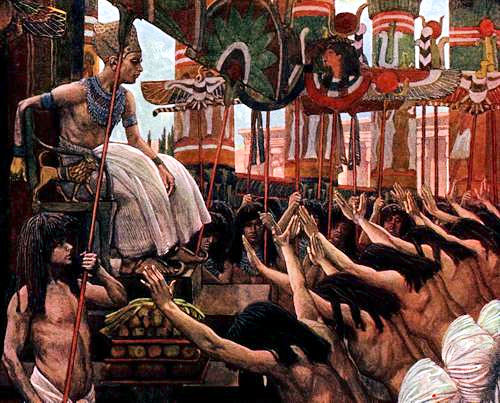
Joseph of EgyptI was also thinking about the story of Joseph. It’s not until Parasha Va-yiggash (Genesis 44:18-47:27) when Jacob and his family descend into Egypt and Joseph is reunited with his father. Of course, ever since being sold into slavery in Egypt, Joseph’s behavior was exemplary, first as a slave in Potiphar’s household, and then as a prisoner in the King’s prison. His wrongdoing (in spite of how the Rabbinic sages seem to explain it away) ended when his brothers threw him into a pit with the intention of killing him. Teenage arrogance was tempered by trial and suffering which ultimately turned his talents toward saving the world from famine.

But I wonder if there’s a secondary lesson in all this? Both Jacob and Joseph suffered from their long separation. Jacob thought Joseph dead for long decades, while his brothers suffered the guilt and shame of knowing they had contributed to their favored sibling’s disappearance, and then lied about it to their father. They too suffered and Joseph in testing them, delivered stern consequences upon them until they admitted their wrongdoing.

Can Joseph, certainly a Messiah-like figure, be compared to the prodigal son? Was there a lesson he had to learn before he merited reunification with his family? It seems more likely that the brothers were the prodigals and it was what they needed to learn before being reunited with Joseph and being given the relative comforts the land of Goshen had to offer.

But consider:

He had sent Judah ahead of him to Joseph, to point the way before him to Goshen. So when they came to the region of Goshen, Joseph ordered his chariot and went to Goshen to meet his father Israel; he presented himself to him and, embracing him around the neck, he wept on his neck a good while. Then Israel said to Joseph, “Now I can die, having seen for myself that you are still alive.”

Genesis 46:28-30 (JPS Tanakh)

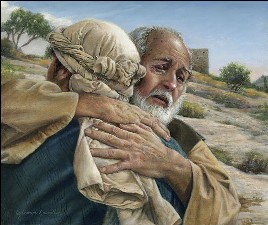
So he got up and came to his father. But while he was still a long way off, his father saw him and felt compassion for him, and ran and embraced him and kissed him. And the son said to him, ‘Father, I have sinned against heaven and in your sight; I am no longer worthy to be called your son.’ But the father said to his slaves, ‘Quickly bring out the best robe and put it on him, and put a ring on his hand and sandals on his feet; and bring the fattened calf, kill it, and let us eat and celebrate; for this son of mine was dead and has come to life again; he was lost and has been found.’ And they began to celebrate.

Luke 15:20-24 (NASB)

Admittedly, except for the tearful reunion between father and son, there isn’t much of a comparison. Joseph is a Prince in Egypt, the most powerful man on Earth, except for Pharaoh King of Egypt, and Pharaoh denies Joseph nothing. Jacob and his family are saved from famine by going down to Egypt and accepting Pharaoh’s generosity (admittedly for the sake of Joseph who had saved Egypt). Conversely, it is the returning prodigal son who is saved by his father’s generosity, mercy, and joy.

Wayward SonBut in all the years Joseph had been in Egypt, not once did he send a message to his grieving father that he was alive and well, even if he couldn’t tell him the exact circumstances for his long absence. Certainly a man of Joseph’s means could have sent a secret messenger into Canaan to let Jacob know he was alive. In this, he was like Jacob himself who, upon returning to Canaan with his family after serving Laban for twenty years and then escaping association with Esau, never let Isaac and Rebecca, who were both still alive at the time, know that he had returned. In fact, the only mention of Jacob and Isaac being together again was when Jacob and Esau buried their father upon his death (Genesis 35:28-29).

At least the prodigal son didn’t wait that long. He returned to his father while Dad was still alive. For all Joseph knew, his father could have already died, which is why he urged his brothers, when they still didn’t know who Joseph was, to tell him about Jacob and Benjamin (Genesis 45:3 for example).

There are many things that we should do, but we procrastinate. We delay taking action. Doing nothing is often much easier then taking action. What can you say to get yourself moving? You can say, “Just do it.”

Sometimes we really have a good reason or reasons for hesitating. Deep down we may feel that it’s better for us not to take the action we’re postponing. But we aren’t yet clear about the entire matter. If you have an intuitive feeling that it might be unwise to take action, then wait. Think it over some more. Consult others.

But when you know that you or others will benefit if you take action and you don’t have a valid reason for procrastinating, tell yourself, “Just do it.”

(from Rabbi Zelig Pliskin’s book: “Conversations With Yourself”, p.141) [Artscroll.com])

-Rabbi Zelig Pliskin
from Daily Lift #192 “Just Do It
Aish.com

Hillel says, “If I am not for myself, who will be for me? But if I am only for myself, who am I? If not now, when?”

-Ethics of the Fathers, 1:14

How long did it take for Joseph to call his father, brothers, and family to come and join him in the safety of Egypt during a world-wide famine? How long did it take for the prodigal son to hit rock bottom and in humiliation, return to his father?

Years. Decades.

How long will it take you and how long will it take me to finally return to our Father? What holds us back, the comfort and pleasure of the still wealthy prodigal? The power and control of Joseph, Prince of Egypt? Or the humiliation, shame, and fear of the dead broke prodigal son?

guiltyA single, impulsive act of disobedience is one thing and we can quickly apply correction and immediately repent and return. A lifetime of separation and self-indulgence isn’t swept aside so easily, and it can take time to reach the final conclusion that we have nothing left to lose and everything to gain if we turn around and go back where we came from. Even Joseph, who had every material comfort in the world, was still missing something without his family, for as a Hebrew, he was still utterly alone without his community, without his family, a servant of God amid a nation of pagans. That too is a habit difficult to break. Not that Joseph worshiped idols, but what about his wife and children? Maybe they didn’t either, but what about his in-laws? What about Pharaoh?

It took a long time before both of these men finally came to the point where they had to return to their families and become part of their community again.

Consider three things, and you will not approach sin. Know whence you came, whereto you are going, and before Whom you are destined to give an accounting.

-Ethics of the Fathers, 3:1

If we all considered these three statements with the proper gravity, we would be far less likely to sin and then keep on sinning (or sin, repent, sin, repent, sin…). But having reached a point to where you and I desire to return, these three things are dauntingly inhibiting, like staring up the summit of some great mountain that we realize we need to climb.

And being daunted and inhibited, we hesitate. Why now? Why not in a little bit? But then Hillel’s words come back to haunt us: “If not now, when?”

My rabbi once told me that even when I don’t feel like praying, I should still make an effort. Even if I feel completely disconnected from the action that I’m doing. Why? Because there will come a day when I will feel like praying, and if I haven’t been keeping my muscles in shape, I won’t be able to connect to my Creator through the vehicle of prayer. It will be so foreign to me that it will impede my attempt to connect.

By going through the motions, even in times of spiritual famine, I am keeping the lines of communication clear. I’m weeding my spiritual garden, even though I may not be harvesting any vegetables at the time.

-Rivki Silver
“Just Do It”
Aish.com

praying at masadaThe practice of Judaism really is a matter of practice. Judaism isn’t so much a matter of believing as doing. As Ms. Silver tells us in her brief article, a relationship with God is something you perform, saying the blessings and doing the mitzvot, even when you don’t feel like it, and sometimes you don’t practice at all or at least not as much as needed.

Judaism is very much a religion of practice, of doing. In the morning, I wake up and thank God for creating me and giving me another day. Then I ritually wash my hands. If I’m really on it, I’ll say my morning blessings after that (though sometimes they get said a little later).

When you do something every day, it becomes routine. And then something which is really quite sublime can become rote. And then the emotional component of spirituality which is, for many people, a big draw, can become separated from the physical component of spirituality. And then you can wake up one morning and realize that you’re just going through the motions.

I know. I’ve been there. I AM there in some areas of my practice.

Time to give up? Not so fast.

As the previous quote from Ms. Silver states, even “going through the motions” serves as a sort of “place holder” until we are ready to stop being “spiritual zombies”. Speaking of which:

This doesn’t mean that it’s okay to stay a spiritual zombie. While the reality of my morning blessings may be that I don’t have the best concentration while saying them, that doesn’t exempt me from trying to improve their quality.

We’re not perfect, and that’s okay. When Jascha Heifetz first picked up a violin, he wasn’t perfect either. It took years of practice and determination to become great.

And that’s something I find encouraging when I’m not feeling particularly “spiritual,” when doing a mitzvah might even feel like one more thing to check off my to-do list. I know that by continuing to practice, I am continually improving, much like a musician who is working on a piece of music.

Have you ever considered that true repentance takes time and practice as well? I’ve always imagined repentance to occur in an instant. Just repent of your sins to God, change your behavior, and it’s all done.

Well, no. I think that’s why so many people trying to break a long pattern of sinful behavior have such a difficult time. If you expect repentance, atonement, and forgiveness in an instant and it doesn’t actually happen in an instant, it’s demoralizing. Imagine thinking you’ve repented only to give in to the temptation to return to sin. It’s a horrible thing. What if it means repentance doesn’t work? You’re trapped.

Time to give up? Not so fast.

The “just do it” slogan made famous by Nike, doesn’t always mean do it once, do it right, and do it permanently. I’m not excusing the revolving door method of sin, repentance, sin, and so on. I’m saying that what has taken years to build up won’t always get torn down in a single day. Ever watch an old building being demolished? Sure, it doesn’t take as long to knock it down as it took to construct it, but it still takes time. Further, it takes planning, the right equipment, and the right execution. So too repentance.

father and sonThe journey from the pig farm in a foreign country to home must have taken some time, even after the prodigal son made his decision. So too with us. Maybe his trip was uneventful or maybe there were barriers along the way that Jesus (Yeshua) didn’t include in his parable. They probably weren’t relevant to the point the Master was making, but maybe they’re relevant to us.

Repentance takes practice, like a Jewish person trying to overcome being “stuck” on a particular mitzvah. But it’s like a young child learning how to walk. The would-be toddler never gives up and decides to keep crawling for the rest of his or her life. They keep at it. They’re driven to learn to walk and eventually they do. The child’s parents don’t give up on the little one for standing and falling and standing and falling and taking a step and falling. As long as the child keeps trying, there’s nothing to be concerned about and most parents are pretty patient with the whole process.

How much more so is our Heavenly Father patient with us…

…as long as we keep trying and practicing and we don’t give up.