Tag Archives: Torah

Bo: When We Finally Leave Egypt

The command to confront Pharaoh and negate his influence is given to Moshe, representative of mankind, because the negation of selfishness is a fundamental dimension of man’s service. Man was given the mission of making this world a dwelling for G-d, and this is possible only when selfishness is nullified. Haughty self-interest prevents the Divine Presence from being manifest.

And yet, this nullification of self cannot be accomplished by man alone; it requires G-d’s power. For this reason, Moshe shrank at G-d’s command; he realized that the task was beyond him. That is why G-d instructed him: “Come to Pharaoh,” i.e., come with Me, and not “Go to Pharaoh.” G-d would confront Pharaoh together with Moshe.

-Rabbi Eli Touger
“Confronting Pharaoh”
Commentary on Torah Portion Bo
Adapted from
Likkutei Sichos, Vol. XXI, p. 48-49; Vol. XXXI, p. 32-33;
Sichos Shabbos Parshas Bo, 5733, 5751
Chabad.org

The primary function of the mitzvot is to enable man to permeate the world with goodness and holiness.

“Sanctifying Time”
Commentary on Torah Portion Bo
Adapted from the works of the Lubavitcher Rebbe, Rabbi Menachem M. Schneerson, of righteous memory. (Likkutei Sichos Vol. XXVI, pp. 59-65.)
Chabad.org

And all the Israelites did so; as the Lord had commanded Moses and Aaron, so they did. That very day the Lord freed the Israelites from the land of Egypt, troop by troop.Exodus 12:50-51 (JPS Tanakh)

As I wrote in last week’s Torah commentary Exodus: Challenge in Exile, one of the ways we can think of the exile of the Israelites in Egypt is as an “exile” into their own humanity and as a result, they were distanced from God. Yet, they could not release themselves from their own slavery without God’s intervention, thus God sent Moses as His agent to free the people, to lead them out of slavery, and to redeem them to Himself.

However, what did the Children of Israel have to surrender in order to be free?

I suppose that’s an odd question, since who wants to be a slave? What possible reason would a slave have for not “surrendering” their slavery in order to be free? What about all of the harmful things that enslave us? Pharaoh is a perfect example of this. After the terrible plagues that God had caused upon the land of Egypt, it was in Pharaoh’s best interest to release his slaves and allow them to leave. Even after the plague of the firstborn, when the Israelites finally looted Egypt and left, Pharaoh “strengthened” himself and sent his army to retrieve the Hebrews. As we see, even in the face of overwhelming adversity from God, Pharaoh found it impossible to surrender his “self” in order to protect his nation and his people. He reaped utter destruction as a result.

Is that how we sometimes destroy ourselves, even in the face of the living God who desires to redeem us? The Children of Israel were redeemed when they left Israel and they were saved from themselves. Pharaoh and Egypt could have been redeemed by just letting Israel go at God’s command. Rabbi Touger’s commentary concludes thus:

Penetrating and nullifying self-orientation makes possible the revelation of a positive dimension. And thus the Zohar refers to the House of Pharaoh as: “the place where all lights are revealed in an unrestrained manner.”

Carrying this concept further, the Exodus from Egypt is connected to the ultimate Redemption. Indeed, had the Jews merited, they would have entered Eretz Yisrael immediately after leaving Egypt.

As it is, the entire period from the Exodus until the final Redemption is referred to as “the days of your exodus from Egypt.” For nullifying the selfishness of Pharaoh and breaking through the limitations of Egypt began and begins for each of us as we relive the Exodus a self-reinforcing dynamic destined to take our nation beyond all natural limitations and lead to the Redemption.

And once redeemed, then what? Remember the true purpose of the mitzvot as I mentioned above:

The primary function of the mitzvot is to enable man to permeate the world with goodness and holiness.

The purpose of our redemption, our freedom, and our status as sons and daughters of the Most High is not to exalt ourselves but to “permeate the world with goodness and holiness.” The Master commanded us not to continually resist the insults of “one who is evil” but to turn the other cheek to him (Matthew 5:39). Jesus didn’t teach us to refuse to go a mile with someone by force, but instead, to go with him for two (Matthew 5:41). Yesterday, I tried to say that there are times we must stand resolute before evil as an iron wall against the storm, but there are also times we must bend and be supple like a reed before the wind.

The prophet Isaiah teaches:

a bruised reed he will not break, and a faintly burning wick he will not quench; he will faithfully bring forth justice. –Isaiah 42:3

Yet for all I’ve just said, we cannot free ourselves from ourselves alone. We must rely on God for that strength and that sense of direction which leads us out of our personal Egypt, across the desert, to the redemption promised to all who serve as disciples of the Messiah. If we refuse, even though we claim his name as Master, and continue on our own egotistical and self-destructive course, we’ll find our freedom is an illusion and discover that we never left Egypt at all.

When the time for redemption came, G-d did not keep them for even the blink of an eye

Rashi’s commentary

In the Passover haggadah we say: “Had G-d not taken our forefathers out of Egypt, we, our children, and our children’s children would still be enslaved to Pharaoh.”

After two centuries of exile and subjugation there was little to differentiate the Jewish people from their idol-worshiping masters. So deeply had they sunk into the pagan depravity of Egypt that their redemption came at the very last possible moment, when they were but a hairsbreadth from spiritual annihilation.

Nachmonides

Ironically, we don’t always find redemption when we ask or even beg for it. God waits until we are totally lost within our own worlds of self-indulgence and sin and when we’ve forgotten God completely. Then our redemption comes as Moses came for the unwilling children of Israel.

Said the Zeidehof Shpoli to the Almighty: “Master of the Universe! The sages of the Talmud pleaded before You to bring the Moshiach. You chose not to do so. The holy Ari begged You to bring Moshiach – again You were unwilling. We have reached the point where it is left to someone of my ilk to ask for the redeemer. Still You are holding out.

“Mark my words. There will come a generation who will have no interest in You or Your Moshiach. Then You will have no choice but to bring him.”

-Rabbi Yanki Tauber
“Mark My Words”
Commentary on Torah Portion Bo
Once Upon a Chasid
Chabad.org

This week, there have been many discussions on my “morning meditations” and they do not reflect well on we who claim the cause of Christ. As disciples of Jesus, we have lost our way and are like the Children of Israel in their Egyptian slavery. We say we belong to God but we act like we have completely forgotten Him. We stand up and demand our “rights” for this or that under God, and completely forget that the primary message of Jesus was not one of individual rights but rather, our responsibilities to God and to other people. Christ had the “right” to claim Kingship of the world and its people 2,000 years ago, but instead of standing up for his “rights” (and this is how the adversary tempted him), he submitted to the will of the Father, surrendering even to the horrible death on the cross. If he had “stood up for his rights”, humanity would have no hope. Only by Messiah’s humility and submission have we all been reconciled to God and saved by grace and mercy.

The message has been lost. We must take it back.

Good Shabbos.
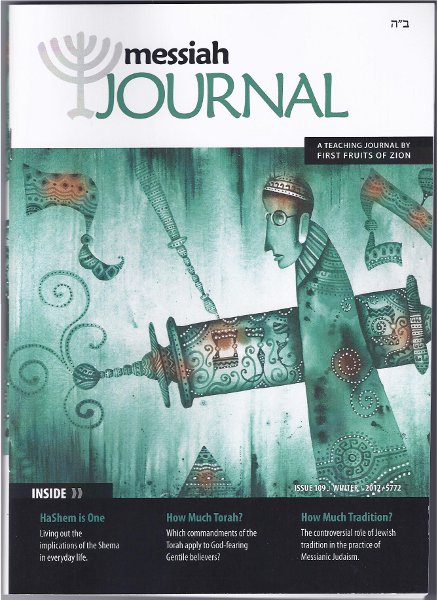
Review of “The Gentile Believer’s Obligation to the Torah of Moses”

At the same time, believers sometimes assume that HaShem’s Torah applies only to Jews and not to Gentile disciples at all. Nothing could be further from the truth. Despite the fact that the apostles “loosed” the Gentiles from these sign commandments, for the most part they are bound to the rest of the Torah’s mitzvot. It should be emphasized that Gentiles in Messiah have a status in the people of God and a responsibility to the Torah that far exceeds that of the God-fearer of the ancient synagogue and that of the modern-day Noachide (Son of Noah). Through Yeshua, believing Gentiles are been (sic) grafted in to the people of God and become members of the commonwealth of Israel. While membership has its privileges, it also has its obligations.

-by Toby Janicki
“The Gentile Believer’s Obligation to the Torah of Moses”
Messiah Journal
Issue 109/Winter 2012, pg 45
First Fruits of Zion (FFOZ)

Excuse me. What did you say?

A few days ago when I received the latest issue of Messiah Journal (MJ) in the mail, I commented that was looking forward to reading Toby’s article, but I wondered if what he was addressing was just a rehash of previous write ups on the same topic.

No, it’s not.

Toby does something I’ve never seen done before (not that somebody else couldn’t have written about this and I’m just not aware of it). He takes the four basic prohibitions outlined in the Acts 15 “Jerusalem Letter” and deconstructs them, expanding the specific details underlying the directives of James and the Council, and then tying them all back into the relevant portions of the traditional 613 commandments. Basically, Toby uses Acts 15 as the jumping off point to explain the nature and character of a non-Jewish disciple’s obligations (yes, I said “obligations”) to the Torah given at Sinai.

I did something similar over a year ago, but my jumping off point was Matthew 28:18-20, which is commonly referred to as “the Great Commission.”

To get the true flavor of what Toby is suggesting, let’s review the basics of “the letter:”

For it has seemed good to the Holy Spirit and to us to lay on you no greater burden than these requirements: that you abstain from what has been sacrificed to idols, and from blood, and from what has been strangled, and from sexual immorality. If you keep yourselves from these, you will do well. –Acts 15:28-29

As Toby points out, on the surface, it seems as if the Gentile disciples of Jesus had very few responsibilities to God, but this is deceiving. As he points out in the subsequent pages of his article, each of these prohibitions has an amazing depth all its own that isn’t apparent until you dig into it. This is, as Toby muses, probably why James also said “from ancient generations Moses has had in every city those who proclaim him, for he is read every Sabbath in the synagogues” (Acts 15:21). The Gentile disciples would need to attend the synagogues to learn and understand the many and subtle details involved in just complying with their responsibilities to these “simple” prohibitions.

I won’t go into those details because then, I’d have to recreate large portions of Toby’s article (and you’d be better off getting a copy of MJ 109 and reading the whole thing for yourself). However, Toby doesn’t limit himself to the “Jerusalem Letter.” He responds to some of the criticisms about Christians being limited to “the letter” by explaining some of the more obvious prohibitions against murder, theft, and coveting, which were not written down and were considered “Duh…obvious commandments” (quoting D. Thomas Lancaster from his book The Holy Epistle to the Galatians [pp 252-253]). These “Oh duh” commandments also include loving your neighbor, although I notice Toby did not cite the most apparent example found in the Master’s own teachings:

But when the Pharisees heard that he had silenced the Sadducees, they gathered together. And one of them, a lawyer, asked him a question to test him. “Teacher, which is the great commandment in the Law?” And he said to him, “You shall love the Lord your God with all your heart and with all your soul and with all your mind. This is the great and first commandment. And a second is like it: You shall love your neighbor as yourself. On these two commandments depend all the Law and the Prophets.” –Matthew 22:34-40

Beyond that, Toby digs further and presents some commandments that apply to the Gentile disciples that are not “Oh duh” and not found in Acts 15:

They can rather be derived from a careful reading of the Apostolic Writings in light of Jewish thought. One such set of mitzvot is the Gentile’s responsibility of honoring the Temple.

-Janicki, pg 53

What? The Temple? Most people don’t realize that during the Second Temple period, a non-Jew actually could bring an acceptable sacrifice to Herod’s Temple and expect that it would be received.

While Gentiles were not to bring certain offerings at certain times such as guilt..or sin..offerings, they were permitted and encouraged to bring burnt (olah) and peace (shelamin) offerings. The priest would attend to these offerings just as if an Israelite offered them up, and Gentiles were required to follow the same standard requirements for the sacrifices, e.g., their sacrifices were to be unblemished (Leviticus 22:21) and from an animal seven days or older (Leviticus 22:27).

-Janicki pg 54

Toby goes on to describe how the laws regarding ritual purity relate to the Gentile, as well as the application of set times for prayer (see my article The Prayer of Cornelius for additional details) and mealtime blessings.

Toby’s article does restrict certain of the mitzvot to the descendents of the Hebrews such as the mitzvah of circumcision (brit milah). I had a brief phone conversation with Boaz Michael (founder of FFOZ) yesterday, and he mentioned how the picture of circumcision in Paul’s letters seems like such an obvious demarcation line in terms of those who are fully under the Torah’s yoke, with Titus and Timothy cited as the clearest examples. Yet even in this, Toby said something very surprising:

Gentiles are specifically enjoined not to be circumcised for the ritual covenantal status. We can assume that, like Maimonidies, the apostles would have no problem with Gentiles voluntarily being circumcised for the sake of the mitzvah, but to do so complete with expectation of covenantal status as Jews would be to “seek circumcision” in the Pauline sense.

-Janicki pg 58

I must admit that a lot of this took me by surprise. As I mentioned earlier, I’ve never seen the prohibitions in the Acts 15 letter expanded in terms of their scope and tied back into the Torah. I have seen the Seven Noahide Laws expanded into between 80 or 90 different sub-commandments, but traditional Judaism doesn’t generally connect these sub-commandments to the Torah of Sinai (even though they have many thematic and operational similarities). I have seen traditional Judaism confirm that, at least in the time of the Third Temple, that sacrifices of the Gentiles would be accepted, so that part wasn’t a stretch for me.

Has FFOZ changed it’s stance regarding Gentiles and the Torah? I’m not sure (I didn’t specifically query Toby before writing this review). On the one hand, it isn’t quite the same position as the viewpoint FFOZ has previously referred to as “Divine Invitation”. Being “invited” to take on board additional mitzvot beyond a Gentile’s obligation is voluntary and pretty much a “take it or leave it” approach. On the other hand, this article states that a significant portion of what we refer to as “Torah commandments” are obligations the Gentile disciples (Christians) must perform and to fail to do so constitutes a sin against God. It seems (and this is just a guess) that FFOZ is doing what I’m doing: continuing to explore and investigate God, the Bible, and a life of faith and allowing their understanding of each of these to evolve progressively.

Wow!

There are a couple of obvious concerns.

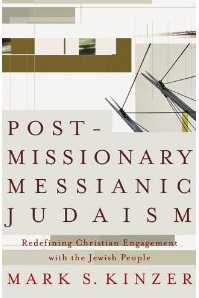
The first is that other Messianic Jewish organizations, such as the Union of Messianic Jewish Congregations (UMJC) may take exception to the idea that Gentiles have a greater Torah obligation than previously advertised. UMJC and similar “Jewish-oriented” groups, tend to take a more definitive stance on Gentile vs. Jewish distinctiveness in worship of the Messiah, with advocates such as Tsvi Sadan proposing a complete separation between Messianic Jewish and Christian/Gentile worship of the Jewish Messiah. The content of Mark Kinzer’s book Postmissionary Messianic Judaism: Redefining Christian Engagement with the Jewish People, which has gained a “foundational” status in the modern Messianic Jewish movement, likely operates in less then perfect accord to many of the points in Toby’s article as well.

The other concern is how all this applies to the church. It’s one thing to say that the Gentile Christian is “allowed but not commanded” to pray at fixed times (as Cornelius did), keep a “sort of” Shabbat,” and refrain from sexual relations with their wives during their menstrual periods, and another thing entirely to say these are all obligations. Once FFOZ states that there are aspects of the Acts 15 directives and other portions of the New Testament that actually obligate the Gentile believers to specific parts of Torah obedience, then we come to the realization that a very large part of the Christian world is (unknowingly) disobeying God.

OK, maybe I’m overstating the point, but Toby’s article seems to open up that can of worms and it also takes the One Law vs. Messianic Judaism debate to a whole new level. I’ve been actively participating in that debate (again) on this blog for the past several days (and I have the headaches to prove it) and I must admit, Toby’s article tosses some of the arguments presented into a cocked hat, so to speak.

As far as the debate regarding Gentile Christians, the Acts 15 letter, and the refactoring of Christian obligations to the Law are concerned (traditional Christians reading this blog cannot fail to be intrigued and maybe dismayed at this point), Toby Janicki’s article “The Gentile Believer’s Obligation to the Torah of Moses” may have put us into a whole new ballgame (please forgive the mixed metaphors). I highly recommend that you buy a copy of Messiah Journal, issue 109 for this article alone. Toby’s article is nothing less than landmark.

Messiah Journal: Excerpt from “Origins of Supersessionism in the Church”

Yeshua not only defined himself as the gateway to salvation, but commanded his Jewish disciples to do something that had never been done before. Yeshua commanded his Jewish disciples to make non-Jewish people disciples in a Jewish sect that followed the Messiah and worshiped the God of Israel. Yeshua identifies his Jewish disciple Peter as the rock upon which he will build the Messianic community (Matthew 16:18). Acts 4 shows us that thousands of Jews came to faith in the Messiah well before the time when Paul began to actively seek non-Jewish disciples. We also see in Acts 15 that the Jewish Jerusalem council exercised authority over the Gentile assembly of the Messiah. With the foundation of the early Messianic community being so thoroughly Jewish, how did a concept like supersessionism even come into being? Actually, the seeds of this rather ugly plant began to sprout early.

Excerpt from the article
“Origins of Supersessionism in the Church”
by James Pyles
Messiah Journal
Issue 109/Winter 2012

I just received my advance copy of the latest edition of Messiah Journal (MJ) and of course, as it contains my first article published in religious literature, I’m more than thrilled. I showed my wife and she said that she will have to read it, which is even more intriguing (as surprising as it may sound, she doesn’t often read my material). I hate to admit this, but like many authors, I really enjoy seeing my work in print. I suppose it is the same feeling a painter has when he or she sees their work on display in an art gallery.

But I shouldn’t forget everything else this issue of MJ has to offer. I haven’t had the opportunity to read it yet (so I can’t review its contents), but I’ve looked through this issue and there are definitely some submissions I’m anxious to dig into.

There’s an article written by Tsvi Sadan called “Halachic Authority in the Life of the Messianic Community”. Apparently, it was delivered as a lecture to Messianic leaders in Israel in September of 2008 as the “final chord of a debate between those Messianic Jews who teach to live according to Jewish tradition and those who view this tradition as ‘the leaven of the Pharisees and Sadducees.'” This discussion has taken place in the Messianic blogosphere fairly recently, such as in Judah Himango’s blog post Kosher Jell-O, and whether Messiah’s disciples need our own ruling body, as well as on my own blog in the write up Tradition! (and as always, some of the most interesting parts are in the comments sections).

I must admit, I will probably dive into Sadan’s article first, but I also want to read Russ Resnik’s “Shema: Living the Great Commmandment” (Part 1). I’m also very interested in Toby Janicki’s article “The Gentile Believer’s Obligation to the Torah of Moses”, which is also a topic of great interest among non-Jews who are attracted to Jewish religious lifestyle and worship. I believe MJ has had similar articles in the past and want to find out if this is just a reworking of material with which I’m already familiar or something entirely new. I know I’ve been challenged on this topic by comments made on my own blog very recently, both in Defining Judaism: A Simple Commentary and The Focus and the Lens, so I’m hoping for some “re-enforcement” to augment my own knowledge in this area.

For tomorrow’s “morning meditation,” I’m posting a blog on Gentiles and the Shabbat, and Aaron Eby has an article in the current issue of MJ called “Fire by Night: Lighting the Shabbat Candles” which (you should pardon the pun) should prove illuminating. That’s not all of the contents of issue 109 of MJ but those are the highlights. Of course, if you find all of that tantalizing, don’t forget my own article on the origins of supersessionism in the church, how the seeds were first planted, who the major players were, and how the history points to modern times.

If you don’t already regularly receive issues of Messiah Journal, go to the First Fruits of Zion (FFOZ) website and order issue 109 today. I’m really looking forward to reading it myself.

Defining Judaism: A Simple Commentary

Talmud StudyWe find on today’s amud that one who is called up to the Torah has to have heard at least three verses—two if three is impractical—for his aliyah to count.

Someone once presented Rav Moshe Feinstein with a very common concern. He asked, “What if someone failed to hear some words of the Torah reading? Did he discharge his obligation if he missed a few? Many great scholars and tzaddikim were very careful and would make up any word missed by joining another minyan during their reading. But perhaps such stories are not because of any halachic obligation. Maybe they are merely a stringency?”

Rav Moshe ruled decisively, “It is obvious that one should not skip even one word of the reading if it is at all possible. Post facto, if one skipped and it was a day where we lain three verses, on the surface it would appear as though one does discharge his obligation. It is not permitted to read less than three verses. Since the person in question did not hear the minimum, he did not discharge his obligation. This is no different than the case of one who was called up to the Torah and they did not lain three verses—he also did not discharge his obligation if he did not hear the minimum number of verses.

Rav Moshe concluded, “If the reading contains more than three verses and he heard three he discharges his obligation with this aliyah, and if he heard another two aliyos he has fulfilled his obligation. Of course, on Shabbos and Yom Tov one has the problem that if he missed a part of the reading he will not merit to finish the public reading of the Torah for that year. However, in such a case one often has no recourse since he cannot have them repeat the reading only for him!”

Mishna Berura Yomi Digest
Stories to Share
“The Minimum”
Siman 137, Seif 5-6

Recently Dan Benzvi on his blog Fellow Heirs challenged me to discuss the relationship between the Torah, Oral Law, and the Talmud in his blog post The oral Torah. Authority of God or man. I’m not sure we “solved” anything, but at least we got the opportunity to (again) air our different perspectives on the matter.

Dan really does bring up some good questions, though. Can we believe that everything in the Mishnah and all of the rulings in the Talmud are indeed directly tied to the oral Laws God gave Moses at Sinai (assuming you believe that event actually took place) and that a Jew must obey all of the relevant Rabbinic rulings?

Take a look at the example I posted above from Mishna Berura Yomi Digest. There’s nothing in our written Bible that lends itself to describing the traditional Jewish Torah readings in anywhere near this level of detail. Can we believe that God gave these specific details to Moses? If so, why is there a question here? If not, then where did these questions and answers come from and why are they considered binding in Judaism?

If you’re a (non-Jewish) Christian, this entire discussion is moot. People who aren’t Jewish aren’t considered bound by any of the Rabbinic judgments under any circumstances, so we don’t have to give all this a second thought. But what about if you’re Jewish, and especially if you’re a believer (i.e. a “Christian” or a “Messianic Jew”)? If it’s not in the written Bible we have with us today but rather, in the extended Jewish documented wisdom, does it really matter?

Indeed, the Mishnah contains not a hint about what its authors conceive their work to be. Is it a law code? Is it a schoolbook? Since it makes statements describing what people should and should not do, or rather, do and do not do, we might suppose it is a law code. Since, as we shall see in a moment, it covers topics of both practical and theoretical interest, we might suppose it is a schoolbook. But the Mishnah never expresses a hint about the authors’ intent. The reason is that the authors do what they must to efface all traces not only of individuality but also of their own participation in the formation of the document. So it is not only a letter from utopia to whom it may concern. It also is a letter written by no one person – nor by a committee, either. Nor should we fail to notice, even at the outset, that while the Mishnah clearly addresses Israel, the Jewish people, it is remarkably indifferent to the Hebrew Scriptures.

The Mishnah makes no effort at imitating the Hebrew of the Hebrew Bible, as do the writers of the Dead Sea Scrolls. The Mishnah does not attribute its sayings to biblical heroes, prophets or holymen, as do the writings of the pseudepigraphs of the Hebrew Scriptures. The Mishnah does not claim to emerge from a fresh encounter with God through revelation, as is not uncommon in Israelite writings of the preceding four hundred years; the Holy Spirit is not alleged to speak here. So all the devices by which other Israelite writers gain credence for their messages are ignored. Perhaps the authority of the Mishnah was self-evident to its authors. But, self-evident or not, the authors in no way take the trouble to explain their document’s audience why people should conform to the descriptive statements contained in their holy book.

from the introduction to
The Mishnah: A New Translation
by Jacob Neusner

Talmud Study by LamplightThat description of the Mishnah is fairly similar to others I’ve read from various sources such as The Cambridge Companion to the Talmud and Rabbinic Literature, edited by Charlotte Fonrobert and Martin Jaffee. But given all of that, what can we say about Mishnah, Talmud, and Gemara?

I’m not particularly qualified to respond, not being a scholar in Jewish studies or anything related, but from what I gather, it’s extremely important to Judaism that these texts, opinions, commentaries, and judgments do exist. Here’s why.

After the destruction of the Second Temple in 70 C.E. and the subsequent eviction of most of the Jews from the Holy Land, what existed to define Judaism? Prior to this point, it was always the Holy Temple in Jerusalem. Even in the times between the Temples of Solomon and Herod, it was the ideal of the Temple and the Torah that, more than anything else, defined Jewish identity in exile. The longing for the Jewish people was always the return to Israel, both as nation and paradigm, and to worship again “as in days of old and as in previous years” (Malachi 3:4).

With the Second Temple reduced to scorched and shattered rubble, and the vast majority of the Jewish people exiled to the diaspora, what was to prevent the eventual assimilation of the Jews into the nations surrounding them and outnumbering them?

Judaism was always about being distinctive, as the scripture says, “and you shall be to me a kingdom of priests and a holy nation” (Exodus 19:8 [ESV]). All of the laws we see given to the Israelites in the Torah were designed to impact every area of their lives, serving as national constitution, penal and civil law, business ethics, social mores, and even personal and behavioral guides. In virtually every way, the nation of Israel was to stand out and stand apart from the nations of the world, primarily to lead its inhabitants to a holy life with God, but also to be a “light to the nations” (Isaiah 49:6, Isaiah 51:4), leading the world to God by example.

But a huge amount of the Torah laws apply only if you have a Temple, a functional priesthood, a system of courts including the Sanhedrin, and live within the geographic boundaries of the Land God gave in perpetuity to the Jewish people.

The Romans took all of that away, and then subsequent conquerors kept the Land and national self-rule from the Jews for the next 2,000 years.

Why didn’t the Jewish people assimilate and disappear into the pages of history? Many, many other people groups and religious traditions from that time have utterly vanished from our view. Why did the Jews, though extremely small in number, remain a people vitally alive with purpose and function; with faith and identity?

What do you think of when you think of a religious Jew?

The stereotypes some people have are guys in black hats and coats, wearing some sort of string off of their waistline, having large, bushy beards, and bowing over and over again when they pray. Some people think of “Jewish prayer shawls and prayer books” while others think of events such as Passover or Chanukah. Whatever religious stereotypes seem to identify the Jews, the activities are almost always different than any other people group in the world. Jews worship in different places than anyone else, pray differently, pray in a different language than anyone else, wear different clothes (at least sometimes), have different holidays, eat differently, sing differently and…well, you get the idea.

I can hardly say that the Mishnah and Talmud are direct representations of the “Oral Law” that goes back over 3,500 years to Moses and God on Sinai, especially given the description (or lack thereof) of the origins of the Mishnah. What I can say, is that what the Jews have as “people of the book”, are a set of laws and rulings that set them apart from any other nation and group on earth, and that has defined them and kept them and preserved them when everyone else was doing their best to completely annihilate the Jewish people.

No, I’m not denying God’s involvement in the preservation of Judaism and in fact, I’m counting on it. As God went down into Egypt with Jacob (Genesis 46:3-4), so too did He go into the death camps with the Jews during the Holocaust. So too did he go with the Jews into the newly created state of Israel and He is there with them now.

But in a very great way, one of the primary mechanisms that has maintained Judaism as Judaism for the past twenty centuries has been the Talmud. It has now taken on the status of “Holy” among the Jews, especially the Orthodox, and it has many critics, including within more liberal religious and secular Judaism. But without it, would there be a man or woman alive today that we could point to and know he or she is a Jew?

You can love the Talmud or you can hate it, but if you are a Jew, no matter who you are, you cannot dismiss its existence or its role in preserving your existence.

As an afterword, I want to apologize to all of the Jewish people reading this. I’m not trying to pass myself off as some sort of expert (I’m anything but an expert on Judaism) or to co-opt anything belonging to Judaism. I am just presenting the perspective of one Christian writer on why I think the Talmud is not just important, but historically vital for the existence of the Jewish people. Please keep that in mind when or if you decide to comment.

Va’eira: Peace in the Valley of Landru

When the Torah names a place, the name describes not only a geographic location, but also a state of mind, and a spiritual set of circumstances. In this context, Mitzrayim, the Hebrew name for Egypt, serves as a paradigm, teaching us what exile is, and demonstrating the essence of the spiritual challenge which our people have confronted throughout history.

Mitzrayim relates to the Hebrew word meitzarim, meaning “boundaries,” or “limitations.” Material existence confines and limits the expression of G-dliness in the world at large, and the expression of the G-dly spark within our souls. This is exile, an unnatural state. For the true reality that the world was created to be a dwelling for G-d, and that a person’s soul is an actual part of G-d is concealed. In such a setting, a person becomes absorbed in the daily routine of his life. Spiritual values if he considers them at all are interpreted according to his own world view.

Moreover, exile naturally perpetuates itself. Our Sages relate that not one slave could escape from Egypt. Similarly, any setting in which a person lives creates an inertia that resists change. To borrow an expression from our Sages: “A person in fetters cannot set himself free.” Since every person’s thought processes are today shaped by the environment of exile, many find it difficult to see beyond that setting.

-Rabbi Eli Touger
In the Garden of Torah
“Seeing and Believing”
Commentary on Torah Portion Va’eira
Adapted from
Likkutei Sichos, Vol. XVI, p. 52ff; Vol. XXXI, p. 25ff;
Sichos Shabbos Parshas Va’eira, 5743;
and Sichos Chof-Vav Nissan, 5751
Chabad.org

Have you ever wondered how Aaron, the brother of Moses, was able to escape the land of Egypt in order to join his brother in Midian (Exodus 4:14)? After all, Aaron was a slave. Certainly there were people watching him while he toiled under his harsh labors. Certainly there were guards at the border of Egypt to make sure slaves didn’t just wander out. Moses had a very difficult time escaping and was almost killed in the process. How did Aaron leave with such apparent ease?

I don’t know if the slavery of Israel in Egypt is the way Rabbi Touger explains. After all, we see in this week’s Torah Portion that Moses and Aaron tried time and again to get Pharaoh, king of Egypt to release Israel, and time and again, Pharaoh refused, even after temporarily agreeing in order to end each plague. If Israel had basically enslaved themselves through their own limited spiritual awareness, why couldn’t they free themselves by just getting up and walking out? It would have been pretty difficult for even the entire army of Egypt to stop two or three million people if they decided to do something in a united fashion.

OK, Rabbi Touger’s analysis is more midrash and metaphor than historical fact, but it does teach us something about the nature of exile, slavery, and human nature. Often, we can be “enslaved” to something that is extremely unpleasant and even damaging and we beg God to release us from our captivity. Yet all the while, it is within our power to release ourselves. All we have to do is become aware of our freedom of spirit, take off our chains, stand up, and walk out of the “land of Egypt.”

But is it that easy? Rabbi Touger doesn’t seem to think so.

And yet, although man may not be able to free himself, G-d refuses to allow exile to continue indefinitely. The first step of redemption is a direct revelation of G-dliness. Since the fundamental characteristic of exile is the concealment of G-d’s presence, the nullification of exile involves a clearer revelation of G-dliness. This will shake people out of their self-absorption and open them to spiritual awareness.

This is the message of “Parshas Va’eira”. “Va’eira” means “And I revealed Myself.” The root of Va’eira is the word “re’iyah”, meaning “sight.” Va’eira refers to something that can be seen directly. This theme is continued throughout the Torah reading, which describes seven of the ten plagues open miracles which had a twofold purpose, as the Torah states: “I will display My power,… I will bring forth My hosts from Egypt…. And Egypt will know that I am G-d.”

So, it’s not that easy but we do have a roadmap in the realization of a revealed God. We can’t free ourselves from our own exile in “the land of sin,” but fortunately, God is not willing to allow us to suffer indefinitely. He will intervene on our behalf, sometimes even when we don’t want Him to. We may want to stay in our sin, in our specific problems, in our booze, in our drugs, in our depression, in our anger and frustration, maybe because we’ve lost hope. It’s at those times when God will come in and shake up our “status quo” and we might not feel too comfortable about it. While the plagues were aimed at Pharaoh and the Egyptians, what were the Israelites feeling? While they didn’t suffer the consequences of the plagues, were they worried about what would happen to them next? We see in future parts of the Torah how the Israelites, when encountering challenges along the road to Israel, rebelled against God and even longed to return to Egypt, as if slavery were better than freedom.

The rabble with them began to crave other food, and again the Israelites started wailing and said, “If only we had meat to eat! We remember the fish we ate in Egypt at no cost—also the cucumbers, melons, leeks, onions and garlic. –Numbers 11:4-5

Was the food given to slaves really so superior to what they got from God, or were they really having a difficult time separating themselves from a lifetime of servitude and the “comfort” of having Egyptian masters? It’s hard to imagine, but sometimes people who have been in prison for many years, once released, will commit a crime, just to go back to the relative “security” of the penal system. A person who has turned to God and found freedom from sin and degradation may abandon a life of holiness and return to their former world, even though they know they’ll suffer pain, hardship, and even potentially death. It’s hard to give up what we are familiar with, even when what we have become accustomed to hurts and degrades us.

The story of the Exodus from Egypt isn’t just a story of a population of slaves being redeemed in order to serve God and inherit the Land of Promise. It’s the story of personal and corporate redemption from slavery to sin and exile of the spirit in a place not inhabited by God. God can do all of the “heavy lifting”, defeat the plans of our “slave masters” (who are often ourselves), and open the door to freedom, but we must be willing to remove our chains, stand up, and walk out of prison and into freedom. Then, we must be willing to tolerate the “insecurity” of being free and have the courage to explore a life that is new with the presence of God. Our enemy in this endeavor doesn’t have to be some external, supernatural force. Most of the time, it’s the person we see whenever we look in the mirror.

The potential spiritual growth of a man about to be married who wants to be uplifted is certainly significant. When he marries, all of his sins are forgiven. The Chasam Sofer, zt”l, writes that a groom is compared to the tzaddik of the generation throughout the entire week of sheva berachos. Who can tell to what heights he can reach if he puts in the spiritual work necessary during these special days?

The Lev Simcha, zt”l, gives us an idea of what the spiritual potential of a chosson is like. “Our sages say that a groom is compared to a king. In Sukkah 52 our sages say that the tzaddikim see their yetzer hara as a mountain. And in Arachin 6 we find that a king has the power to uproot mountains. If a chosson workshard enough on this, he can literally uproot his yetzer hara!”

Daf Yomi Digest
Stories Off the Daf
“Uprooting Mountains”
Arachin 6

He said to them, “Because of your little faith. For truly, I say to you, if you have faith like a grain of mustard seed, you will say to this mountain, ‘Move from here to there,’ and it will move, and nothing will be impossible for you.” –Matthew 17:20

God gives us the power to move mountains. These may not be the snow-capped mountains we see in winter, that we ski upon, or that possess trails into the pine covered wilderness. These may be the mountains of the evil we have nurtured within us and that weigh us down, preventing our spirit from taking flight as does the eagle.

You may still feel as if you’re in jail, trapped behind a locked cell door. But stand up and look around. You’ve been Sitting on the Keys.

Good Shabbos.


The Finger of God is Writing

Once, Rav Elchonon Wasserman explained the greatness of those who learn Torah which touched upon a famous statement of Rava: “How foolish are those who stand for a sefer Torah but not for people great in Torah!”

Rav Elchonon related a story to illustrate the point: “Once, the Netziv of Volozhin, was carrying a sefer Torah to the bimah when he slammed into a bench and fell down, and the sefer fell with him. As the bnei yeshivah rushed to pick them up, the Netziv’s son-in-law, Rav Itzel Volozhiner, gave an astounding order, “First pick up the Rosh Yeshiva, then the sefer Torah!”

Rav Elchonon explained, “This is what Rava means in Makkos 22. It is only people’s foolishness that causes them to respect a sefer Torah more than a true Torah scholar. After all, why should one respect a sefer Torah inscribed on parchment more than a sefer Torah housed in living flesh and bone?”

The Divrei Shmuel explains this statement similarly, “Tzaddikim are themselves holy like a sefer Torah. A sefer Torah is merely the Torah written on parchment; how much more is it incumbent upon us to honor a sefer Torah inscribed on one’s heart! As the verse states: ‘Write them on the tablet of your heart.’”

`But Rav Reuven Margolios points out that this distinction does not apply to just any scholar. “The gemara uses the expression ‘gavra rabbah’—‘a great man’—rather than the more common ‘tzurba d’rabanan,’ which implies an ordinary scholar. This teaches that this halachah only applies if the scholar in question is one of the gedolei hador. It is only in such a case that it should be obvious to any thinking person that it is fitting to treat him with more honor than a sefer Torah. But if one is a regular talmid chacham, he is not to be more respected than a sefer Torah.”

Mishna Berura Yomi Digest
Stories to Share
“A Living Sefer Torah”
Simin 136, Seif 1

And the Word became flesh and dwelt among us, and we have seen his glory, glory as of the only Son from the Father, full of grace and truth.John 1:14 (ESV)

You shall therefore lay up these words of mine in your heart and in your soul…Deuteronomy 11:18 (ESV)

For when Gentiles, who do not have the law, by nature do what the law requires, they are a law to themselves, even though they do not have the law. They show that the work of the law is written on their hearts…Romans 2:14-15 (ESV)

Sorry for the lengthy list of quotes, but they were all necessary to create the foundation for today’s “morning meditation”. If you’ve been reading my blog lately, you know that I’ve written a four-part series on Exploring Messianic Divinity which investigates the idea that Jesus is God. As part of that investigation, I took a look at the various mystical and metaphorical writings that point to the Messiah as The Living Word of God. In my quote from the commentary on Simin 136, Seif 1, we see that such a concept is applied, not necessarily to the Messiah, but to a Torah scholar who is “gavra rabbah” or “a great man”. And yet, can we find any greater tzaddik in all the world than the Master and redeemer of our souls? Who else but the most exalted Messiah could redeem the world with his blood?

The murder of Rabbi Elazar Abuhatzeira, the “Baba Elazar,” on Thursday night saved the people of Israel from other tragedies, leading rabbis said Friday.

“Harsh punishments were decreed on the people of Israel, and he wanted to nullify them,” said the slain rabbi’s brother, Rabbi Baruch Abuhatzeira, also known as the Baba Baruch, speaking at Rabbi Abuhatzeira’s funeral.

by Maayana Miskin
“Rabbi Abuhatzeira Bore the Burden of Evil Decrees”
IsraelNationalNews.com

I’ve quoted this article before to establish that in traditional Judaism, it is conceivable that the death of a great tzaddik can atone for the sins of Israel. If the holiness of the tzaddik were great enough, could his death not atone for a world?

…so Christ also, having been offered once to bear the sins of many, will appear a second time for salvation without reference to sin, to those who eagerly await Him. –Hebrews 9:28

In Judaism, as we saw in my aforementioned quote, a scholar becomes great, very great, through intense Torah study such that he imbues his heart with the same holiness attributed to the Sefer Torah, because Torah is written on the tablet of his heart. We also see in Deuteronomy, that the Children of Israel have been commanded to write words of Torah on their hearts. From Paul, we see that though the Gentiles did not (and do not) have the commandments of Torah given to them (us) at Sinai, nevertheless, our actions show that the Torah is written on our hearts when we “do what the law requires”. In other words, when we do what our “living Sefer Torah” does, like any good disciples, we are imitating the works of our Master and living out his lessons. Having the Torah “written on our hearts” is like a spiritual overlay of righteousness upon the physical nature of our lives; a “Tree of Life” superimposed on a living tree with its grafted in branches.

I suppose we could be tempted to say that if the Law is written on the hearts of Gentiles who follow the teachings of Jesus, that we are obligated to “do what the law requires” in the same manner and fashion as the Jewish people, but that would be taking Paul out of context. We do see a bridge of sorts between Deuteronomy 11:18 and Romans 2:14-15 in terms of the law being upon our hearts, but does that really mean that any Gentile disciple of Jesus must respond to the mitzvot in precisely the same manner as the Jews who inherited Sinai?

I believe I’ve already answered that question, at least to my own satisfaction. The Word, but not the Jewish identity, is what is being actively written on our hearts. Jews and Christians are united under the Messianic covenant as “one new man” (Ephesians 2:15) in our ability to approach the Throne of God as adopted sons, with the Jews being adopted at Sinai and we Christians being adopted at the foot of the cross. However, while the “Covenant of the Cross” accepts the Jew as an extension of Sinai because of the promise of the Moshiach, it does not link the Gentile back to what was already given to Israel through the tablets of Moses. We non-Jews, like Abraham, access God by faith alone, through Jesus, without the requirement of Moses.

What then shall we say was gained by Abraham, our forefather according to the flesh? For if Abraham was justified by works, he has something to boast about, but not before God. For what does the Scripture say? “Abraham believed God, and it was counted to him as righteousness.” –Romans 4:1-3

One of the things (and I’ve mentioned this earlier) about being a disciple, is that we learn from our Master by imitating him. Traditionally, Jewish disciples studying under a great Rabbi and tzaddik, will imitate everything about him, including how he dresses, his vocal inflections, his physical mannerisms, even how he eats; every little detail. All this is in addition to memorizing his teachings, learning his teaching style, and living out his understanding of Torah. I’m not suggesting we try to imitate Jesus down to such a specific level, if for no other reason than most of that kind of information is unavailable.

However, I am suggesting we imitate him in the most important aspects of his life and learning.

But when the Pharisees heard that he had silenced the Sadducees, they gathered together. And one of them, a lawyer, asked him a question to test him. “Teacher, which is the great commandment in the Law?” And he said to him, “You shall love the Lord your God with all your heart and with all your soul and with all your mind. This is the great and first commandment. And a second is like it: You shall love your neighbor as yourself. On these two commandments depend all the Law and the Prophets.” –Matthew 22:34-40 (ESV)

I believe that it is this teaching more than any other, that is written on our hearts if we are his true disciples and followers of “the Way”. If the Torah were written perfectly on the heart of Jesus Christ, should we not imitate him and continually allow the “finger of God” (Exodus 31:18, Luke 11:20) to write the Word on our hearts? Is this not what it means to be Holy? But how is this done?

We never got used to Egypt. We never felt we belonged there. We never said, “They are the masters and we are the slaves and that’s the way it is.” So when Moses came and told us we were going to leave, we believed him.

Everyone has their Egypt. You’ve got to know who you are and what are your limitations. But heaven forbid to make peace with them. The soul within you knows no limits.

-Rabbi Tzvi Freeman
“No Limits”
Based on letters and talks of the Rebbe
Rabbi M. M. Schneerson
Chabad.org

The biblical slavery of Egypt represents bondage to your own self. Every day, every moment, must be an exodus from the self. If you’re not leaving Egypt, you’re already back there.

-Rabbi Tzvi Freeman
“Leaving Egypt”
Based on letters and talks of the Rebbe
Rabbi M. M. Schneerson
Chabad.org

I’ve heard it taught in certain circles, that Egypt represents the realm of sin. This isn’t traditionally taught in Judaism and we see from the Chassidic perspective, that whatever bondage Egypt represents spiritually and emotionally, is our bondage not to sin, but to our egos, and whatever suffering we may have brought upon ourselves. This can include our sins and shortcomings, but Egypt represents less of an external force for evil and more of our internal capacity for pain, suffering and harm. In order to imitate our Master, we must learn to erase whatever “script” that is currently scribbled within us and replace it with Words of true holiness.

These are Words that can only be written with the power of the “finger of God” and we cannot do it alone. We must open our hearts and be willing “tablets” so that the finger can write. Though the final Words of Torah (which means “teaching” as I’m using it here) will never be completely written before the Messiah returns to us, we can allow the ongoing transforming of our minds and our hearts and our spirits so that we become more and more like the one we follow. In this, we continue to travel the path and draw ever nearer to God who is our goal.

The finger continues to write. There’s still time. Open your hearts.