Tag Archives: Torah

The Gift of the Postdiluvian King

This week’s reading tells the story of Noah, the father of all humanity. We learn that G-d spoke to him and his children, directing them to follow seven laws for just and moral lives. Most religions say that they offer an exclusive path, but our Talmud teaches that “the righteous of all nations have a share in the World to Come.” Maimonides says that this applies to anyone who accepts upon him or herself to observe the Seven Commandments given to Noah.

-Rabbi Yaakov Menken
Director, Project Genesis – Torah.org

“But flesh, when its soul is with its blood, you shall not eat it… He who spills the blood of man, by man shall his blood be spilled, for in the Image of G-d did He create man.”Genesis 8:4,6

Where was God when the descendants of Noah needed salvation? Christians believe we are saved through the blood of Jesus Christ and Jews believe they merit a place in the world to come by obeying the 613 mitzvot (OK, it’s more complicated than that, but that’s “salvation” in a nutshell). But what about the time before the birth of Christ and before Moses at Sinai? We know that people were aware of God. Certainly Noah was a “righteous man; he was blameless in his age” and he “walked with God” (Genesis 6:9) and certainly God spoke to Abraham when He said, “Go forth from your native land and from your father’s house to the land that I will show you” (Genesis 12:1), but what allowed a person to have a relationship with God, particularly in Postdiluvial times?

We see hints that the people in those days were aware of “Torah” requirements. Even Noah was commanded of “every clean animal you shall take seven pairs, males and their mates, and of every animal that is not clean, two, a male and its mate”, telling us that well before Sinai, clean and unclean animals were an understood concept. We don’t see God going through an extensive set of explanations telling Noah the difference between these two general types of creatures, so he must have already known about this. We even know that when Abel offered his sacrifice to God (Genesis 4:3-4), it was a clean animal appropriate for sacrifice.

The commentaries in the Stone Edition of the Chumash make significant reference to the kosher vs. non-kosher animals such as in this example:

Genesis 6:19 “Two of each.” As the following verse explains, these animals were to be one male and one female, so that the species could be replenished after the Flood. In the case of the kosher species that could be used for offerings, Noah was later commanded to bring seven pairs (7:2), so that he could bring offerings of gratitude and commitment after returning to dry land.

The Chumash commentary for Genesis 8:20-21 even refers the reader to Leviticus for details on the sacrificial offerings, their names, and terminology, again suggesting that Noah would have had to possess some of this information in order to give a proper sacrifice to God after the Flood. Yet man, at that time, was not to divide animals into kosher and non-kosher for eating, as illustrated in Genesis 9:3:

Every creature that lives shall be yours to eat; as with the green grasses, I give you all these.

We see that certain parts of the “Torah knowledge” available to both the antediluvian and postdiluvian peoples was later applied specifically to the Children of Israel as part of the Torah, but what about the rest of humanity? Ten generations followed Noah before the birth of Abram (Abraham). The Bible glosses over the details of the lives of these people, but we presume at least some of them continued their worship of and devotion to Hashem. Also, during the lives of Abraham, Isaac, and Jacob, there were members of their households who were not Hebrews yet who learned of the God of Noah and turned their hearts to Him. What about the Egyptian members of Joseph’s house when he was a viceroy of Pharaoh, King of Egypt (see Torah Portions Miketz and Vayiggash)? Perhaps Joseph taught some of them about the God of his father Jacob. Most assuredly, he taught his Egyptian wife and sons.

Unlike most other religions, Judaism does not declare that they are the only path to righteousness, well not exactly anyway. Rabbi Yaakov Menken has this to say.

Unlike the other religions of the world, Judaism does not believe that everyone must become a Jew in order to approach G-d or earn a place in the World to Come. When King Solomon built the Holy Temple in Jerusalem, he asked of G-d that He hear the prayers of all who pray towards that Temple: “Also a gentile who is not of your people Israel, but will come from a distant land for Your Name’s sake… and will come and pray toward this Temple, may You hear in Heaven Your dwelling-place, and do according to all that gentile calls out to You…” [I Kings 8:41-43]
MosesIt is the subject of much debate as to whether or not there were “Noahides” or Ger Toshav among the Hebrew people between the days of Noah and Moses, but it is more than possible that they existed. Abraham sent his most trusted (non-Hebrew) servant to find a wife for his son Isaac (Genesis 24:1-9) and Rabbinic commentary identifies this man as a Noahide. If this servant had not been righteous before God, how could he have risen to such a high position in Abraham’s household and why would Abraham have trusted him to find a suitable wife for Isaac? We even see the Bible’s first recorded personal prayer uttered by this man.

He made the camels kneel down by the well outside the city, at evening time, the time when women come out to draw water. And he said, “O Lord, God of my master Abraham, grant me good fortune this day, and deal graciously with my master Abraham: Here I stand by the spring as the daughters of the townsmen come out to draw water; let the maiden to whom I say, ‘Please, lower your jar that I may drink,’ and who replies, ‘Drink, and I will also water your camels’-let her be the one whom You have decreed for Your servant Isaac. Thereby shall I know that You have dealt graciously with my master.” –Genesis 24:11-14

From a Christian point of view, there are apparent “gaps” in God’s plan of salvation for mankind. Discussions of hypothetical situations occasionally occur in Bible studies, such as what would have happened to a person before the birth of Christ who otherwise was “good” but had no way to confess Jesus as Lord and Savior? Perhaps God answered that question when He spoke to Moses in Genesis 9:1-17, which is the basis for today’s Noahide Laws.

I recently investigated the concept of the Ger Toshav as a possible “interface” between Christians and Jews but only hit a brick wall. Observant Jews do not consider Christians to be “righteous Gentiles” if, for no other reason, than they believe we worship a man as a God and indeed, worship three Gods rather than the One. However, the Ger Toshav may have enjoyed a life of righteousness that included a relationship with the God of Adam and Noah, perhaps into the time of Jesus, Peter, and Paul.

The centurion replied, “Lord, I do not deserve to have you come under my roof. But just say the word, and my servant will be healed. For I myself am a man under authority, with soldiers under me. I tell this one, ‘Go,’ and he goes; and that one, ‘Come,’ and he comes. I say to my servant, ‘Do this,’ and he does it.”

When Jesus heard this, he was amazed and said to those following him, “Truly I tell you, I have not found anyone in Israel with such great faith. I say to you that many will come from the east and the west, and will take their places at the feast with Abraham, Isaac and Jacob in the kingdom of heaven. –Matthew 8:8-11

At Caesarea there was a man named Cornelius, a centurion in what was known as the Italian Regiment. He and all his family were devout and God-fearing; he gave generously to those in need and prayed to God regularly. –Acts 10:1-2

As soon as it was night, the believers sent Paul and Silas away to Berea. On arriving there, they went to the Jewish synagogue. Now the Berean Jews were of more noble character than those in Thessalonica, for they received the message with great eagerness and examined the Scriptures every day to see if what Paul said was true. As a result, many of them believed, as did also a number of prominent Greek women and many Greek men. –Acts 17:10-12

The covenant of Christ allows we who are not Jewish to enter into a deep and abiding relationship with the God of all Creation that, in its holiness, is on par with the people of the Mosaic covenant (Galatians 3:26-29) so we non-Jews can go beyond the boundaries of the Noahide. Yet, the Acts 15 letter issued by the Jerusalem council, in some ways, mirrors the laws of Noah. Becoming disciples of the Master does not remove the obligation of a Christian to shun worship of idols, murder, theft, blasphemy, and sexual immorality. The Noahide prohibition to not eat the limb of a living animal may seem strange, but we also would find such as act abhorrent. Creating a court system is an act of establishing justice and as Christians, being just and merciful should not seem odd.

Shofar as sunriseIf the Messianic covenant has not removed or replaced the Noahide covenant but instead, has enhanced it and greatly expanded our access to God, how can we say that the covenant of the Messiah has replaced the Mosaic covenant for the Jews? The Noahide covenant paints a rainbow-colored portrait of God’s love of and provision for all of humanity from the days of the Flood up until the current age. He never abandoned the vast throng of mankind from Noah to Jesus but gave them a gift of Himself, even into the times of Abraham, Moses, and David. For the past 2,000 years, we have had Jesus to turn to for an even greater relationship with God.

But as I just said, if we can learn one lesson for the Gentiles in the story of Noah, including that there is no conflict between Noahide and Messianic covenants, then perhaps we can also learn that no conflict exists between the Mosaic laws and the teachings of the Messiah. Moses and Jesus are not enemies and in fact, for a Jew, what they illuminate goes hand in hand, just as the teachings of Noah and Jesus do for the Gentile.

Where to Find Jesus

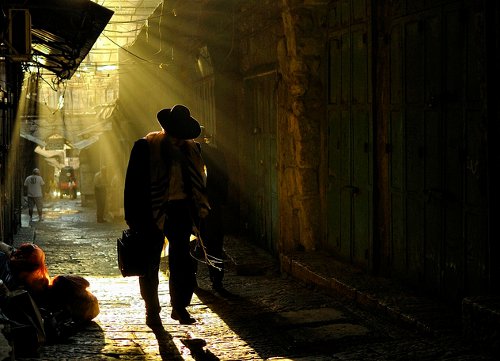
Hasid AlleywayIt is important that before we dig into the Gospel texts themselves we understand some of the cultural background regarding ritual purity in the late Second Temple period. The Tosefta tells us that during this time “purity broke out among Israel.” Archeological evidence verifies that in the decades preceding the fall of the Temple in 70 CE ritual purity had become a major concern even among the common people throughout the land of Israel.

-Toby Janicki
“The Master and Netilat Yadayim”
Messiah Journal
Issue 108 – Fall – 2011/5772 p. 27

This isn’t the first time I’ve discussed netilat yadayim or the ritual handwashing, but I’m not making it my main focus this time. Rather, I want to address how Janicki supports his argument for Jesus advocating, or at least not dismissing this portion of First Century Jewish halacha. The clue is right in the quote that is just above. Not relying on the Bible alone to interpret the Bible.

That’s probably going to raise a few eyebrows among some people reading this. I’ve heard it said often enough that we should “let scripture interpret scripture”, which I take to mean using one part of the Bible to interpret another part. I wonder if that’s always possible or if we shouldn’t also take into consideration other information, such as the “archeological evidence” Janicki mentions. Of course, that’s not the only supporting data he cites.

While the washing of hands before eating bread is not specifically commanded in the Torah, the sages of the Talmud attempted to find a scriptural basis for it in various biblical passages. For example in Leviticus 15:11 there is the injunction, “Anyone whom the one with the discharge touches without having raised his hands in water.” They felt that the Torah made allusions to the entire scope of this practice in a roundabout way (citing Chullin 106a). -Janicki p. 27

I know that Mark 7 seems to be very clear that Christ disapproved of the hand washing ritual, but can we rely just on the text as translated into English without any contextual frame of reference to tell us the entire story? I know that Christians (and many “Messianics”) are rather squeamish when it comes to the Talmudic wisdom, especially since it was documented decades to centuries later than the events in Mark 7, but halachah did exist in Christ’s day, he was (and is) a Jew, and despite what supersessionist church teachings may say to the contrary, Jesus did not play fast and loose with his being a Jew.

I’m saying all this (and it’s not the first time) to illustrate that we cannot simply pick up a Bible, read a passage, and immediately know all of the details and subtle nuances that are being communicated. In fact, we don’t know what is being said and often, we don’t bother to try and find out. We, meaning Christians, tend to rely on the traditional church interpretation of the passage and believe that Jesus was talking about how all meats were clean and ham sandwiches were forevermore a really cool snack. However, a close reading of even the English text (minus Christian perspective) will reveal that he wasn’t talking about food at all.

Interestingly enough, from the Jewish point of view, scripture is interpreted by tradition as well, although the tradition points to the sages and the Mishnah. This is something completely foreign to Christians and many “Messianics” who say they embrace the “Jewish Jesus.” But from our early 21st century perspective, do we really know just how foreign Jesus would be to us if we could go back and meet him on the streets of his home village or in the courts of the holy Temple in First Century Jerusalem?

Connecting to the Master and thus to the God of our faith means entering worlds where we are considered strangers. We have to cross the barriers of time, culture, and education. We have to set aside our western preconceptions and look at the person Jesus as an ancient near-eastern man living in an occupied nation; a former carpenter turned itinerant Rabbi. This isn’t the Jesus you learned about in Sunday school or the European-looking actor you’ve seen portray him in half a dozen films.

To learn about the true “Maggid of Nazaret”, you’ll need to do what Toby Janicki did in researching the Master and the Netilat Yadayim. You’ll need to look for him in all of the ancient Jewish places, in all the traditional Hebrew texts. You won’t find him any place else.

Living in the Echo of Genesis

And Hashem God made for Adam and his wife garments of skin, and He clothed them.Genesis 3:21 (Stone Edition Tanakh)

Not only did God Himself make them comfortable garments, He Himself clothed them to show that He sill loved them, despite their sin. -R’Bachya

If Judaism had relied exclusively on the human resources for the good, on man’s ability to fulfill what God demands, on man’s power to achieve redemption, why did it insist upon the promise of messianic redemption? Indeed, messianism implies that any course of living, even the supreme human efforts, must fail in redeeming the world. It implies that history for all its relevance is not sufficient to itself.

There are two problems: the particular sins, the examples of breaking the law, and the general and radical problem of “the evil drive” in man. The law deals with the first problem: obedience to the law prevents evil deeds. Yet, the problem of the evil drive is not solved by observance. The prophets answer was eschatological…”Behold, days are coming, says the Lord, and I will form a covenant with the house of Israel…not like the covenant that I formed with their forefathers…I will place My law in their midst and I will inscribe it upon their hearts” (Jeremiah 31:30-33). “And I will give you a new heart, and a new spirit will I put within you, and I will take away the heart of stone out of your flesh, and I will give you a heart of flesh. And I will put My spirit within you and bring it about that you will walk in My statutes and you will keep My ordinances” (Ezekiel 36:26-27).

-Abraham Joshua Heschel
God in Search of Man : A Philosophy of Judaism (p. 379)

Creation, existence, devotion, obedience, sin, failure, humiliating shame, but still love.

The story of Genesis is the story of humanity. We are born into the universe and spend our lives trying to understand who we are and why we exist, and then we attempt to live up to what we believe is the purpose of our lives. Those us who have an awareness of God and a faith in our Creator strive to connect to the object of our faith and to join with Him in creating acts of holiness in the world around us.

I acknowledge You, for I am awesomely, wondrously fashioned; wondrous are Your works, and my soul knows it well. My frame was not hidden from You; that which I was made in concealment, which I was knit together in the lowest parts of the earth. –Psalm 139:14-15 (Stone Edition Tanakh)

But we fail, not all the time, but often. How like Adam and Eve we sometimes feel shame and stand naked and exposed in our transgressions against Him.

But love and the struggle to continue in the face of our failures for the sake of Heaven is also the story of Genesis.

Man’s ability to transcend the self, to rise above all natural ties and bonds, presupposes further that every man lives in a realm governed by law and necessity as well as in a realm of creative possibilities. It presupposes his belonging to a dimension that is higher in nature, society, and the self, and accepts the reality of such a dimension beyond the natural order. Freedom does not mean the right to live as we please. It means the power to live spiritually, to rise to a higher level of existence…Freedom is an act of self-engagement of the spirit, a spiritual event. -Heschel p. 411

It is for freedom that Christ has set us free. Stand firm, then, and do not let yourselves be burdened again by a yoke of slavery. –Galatians 5:1

The irony in Paul’s words is in how the church has misunderstood them to believe that the Torah was slavery and that grace and “lawlessness” was the only freedom. In fact, we are declared free the first moment we touch the hem of the garment of God and acknowledge that we are not chained to the laws of an earthly existence. In the spiritual person’s freedom, we escape the shackles that secular man rattles proudly in our faces as evidence of his emancipation from “religion”.

Religion becomes sinful when it begins to advocate the segregation of God, to forget that the true sanctuary has no walls. -Heschel p. 414

The mysterious forbidden fruit and the deceit of the serpent are failure, sin, and slavery, but God’s love for us and our bond with Him are our continued freedom. For Christians and Jews and Muslims and all the other traditions struggling to understand the nature of man and God, even “religion” can become a barrier when it becomes an idol in our lives and a greater force than God Himself. For Jews, Heschel (p. 415) says something even more startling.

Even the laws of the Torah are not absolutes.

Only God is absolute and the Torah, the mitzvah, the prayers, all of them exist as the interface by which we connect with God to perform His will, but like the stars in Heaven and the great seas, they are creations, not the Creator.

The ultimate concept in Greek philosophy is the idea of cosmos, of order; the first teaching in the Bible is the idea of creation. Translated into eternal principles, cosmos means fate, while creation means freedom…The essential meaning of creation is, as Maimonidies explained, the idea that the universe did not come about by necessity but as a result of freedom. -Heschel pp.411-12

Under heavenChristianity, in depending on the Greek philosophy imposed on church’s understanding of the New Testament due the original language of the text, accidently or perhaps deliberately filters out the Jewish meaning of the teachings and wonder of Jesus Christ. As the Apostle Paul said in Galatians 5, we are not possessed by God nor owned by the Master, though our Master he is, but we are free of the weight of human frailty and sin. We are free to allow ourselves to be clothed in not only righteousness but in the performance of the mitzvah, joining as humble partners with God in the task of repairing the world and preparing the way for the coming of the Messiah.

The next day the great crowd that had come for the festival heard that Jesus was on his way to Jerusalem. They took palm branches and went out to meet him, shouting,
“Hosanna!”
“Blessed is he who comes in the name of the Lord!”
“Blessed is the king of Israel!” –John 12:12

As the people in Jerusalem spread palm branches in the road, paving the way for the entry of Christ, so by our faith and our deeds do we pave the road for his return, in triumph, glory, and splendor, for as sin has made man a slave on earth, the King of Kings will break our bonds and we shall be free under his reign and under God.

Hashem, what is man that You recognize him; the son of frail human that You reckon with him? –Psalm 144:3 (Stone Edition Tanakh)

For God so loved the world that he gave his one and only Son, that whoever believes in him shall not perish but have eternal life. –John 3:16

We must continue to ask: what is man that God should care for him? And we must continue to remember that it is precisely God’s care for man that constitutes the greatness of man. To be is to stand for, and what man stands for is the great mystery of being His partner. God is in need of man. -Heschel p. 413

After the failure at Eden, we continue to ask ourselves why God loves us. We try and comprehend beyond our own small ability to reason, that God’s love is boundless and timeless and does not depend on our ability to adequately love Him, for we have no such power. In our weakness, He is strong and gives us strength to love an unknowable God. However, we must grasp onto that strength, lest we fail and fall away.

Man’s survival depends on the conviction that there is something that is worth the price of living. -Heschel p. 422

This is especially true of the Jewish people, but it is no less true for the rest of us.

In trying to understand Jewish existence a Jewish philosopher must look for agreement with the men of Sinai as well as the people of Auschwitz. -Heschel p. 421

We must cling to our God as tightly as possible for only in that attachment may we remain nourished in His love and find our way along the path. Only with God can we survive the failure of humanity and achieve the glory for which we were truly created, both for the Jew and the Gentile.

Israel is the tree, we are the leaves. It is the clinging to the stem that keeps us alive. -Heschel p.424

I am the vine; you are the branches. If a man remains in me and I in him, he will bear much fruit; apart from me you can do nothing. –John 15:5

If some of the branches have been broken off, and you, though a wild olive shoot, have been grafted in among the others and now share in the nourishing sap from the olive root, do not consider yourself to be superior to those other branches. If you do, consider this: You do not support the root, but the root supports you. You will say then, “Branches were broken off so that I could be grafted in.” Granted. But they were broken off because of unbelief, and you stand by faith. Do not be arrogant, but tremble. For if God did not spare the natural branches, he will not spare you either.

Consider therefore the kindness and sternness of God: sternness to those who fell, but kindness to you, provided that you continue in his kindness. Otherwise, you also will be cut off. –Romans 11:17-22

ForgivenessThe antidote to the cruelty of this broken world is kindness and love, not just to those who are kind and loving to us, but to everyone, because God loves everyone, the sinner and the saint alike, with equal passion and devotion, for we are all devoted sons and daughters but we are also prodigals and wayward.

We cannot hate what God loves. Rabbi Aaron the Great used to say: “I wish I could love the greatest saint as the Lord loves the greatest rascal.” -Heschel p. 424

Both Christians and Jews await the return of the Messiah and the hope of the world to come, though each tradition denies the validity of the other’s interpretation. God is God and He is One, in spite of how we misunderstand and misconstrue. A Christian waits for the end of Revelation and a Jew waits for this and remembers.

We remember the beginning and believe in the end. We live between two historic poles; Sinai and the Kingdom of God. -Heschel p. 426

A person of faith is caught between two realities; the one we live in now and the one we hope for, when God will reign and tears and dread are banished forever. We cannot ignore one for the other. We cannot live in the present without the hope of the future, but we cannot look at the end of the tale without realizing that it will never occur unless we work with God here and now to bring the Moshiach. We live in the echo of Genesis while awaiting the sound of the final Shofar of Messiah. In between, we have palm branches to gather in order to prepare his way.

Genesis: Rerolling the Torah Scroll

IRolling the Torah Scrollf G-d is “perfect,” as Judaism says, what prompted Him to create the universe? What void was He seeking to fill?

The answer provided in Jewish Mysticism is that G-d desired marriage. Marriage necessitates the existence of someone distinct from yourself with whom to share your life, a union of husband and wife. G-d chose humanity as His bride. According to the Kabbalah, the High Holiday season is the annual experience of the cosmic matrimony between G-d and humanity.

-Rabbi Yosef Y. Jacobson
“Souls in the Rain”
Commentary on Sukkot and Simchat Torah
Chabad.org

It is impossible to decide whether in Judaism supremacy belongs to halacha or to agada, to the lawgiver or to the Psalmist. The Rabbis may have sensed the problem. Rab said: The world was created for the sake of David, so that he might sing hymns and psalms to God. Samuel said: The world was created for the sake of Moses, so that he might receive the Torah (Sanhedrin 98b). (p.340)

-Abraham Joshua Heschel
God in Search of Man : A Philosophy of Judaism

Genesis. The very familiar and very confusing Biblical rendition of God’s creation of the universe, our planet, and man and woman. Why did He create all of this and us? In a previous blog post, I took a rather dim view of creation, given how things have turned out so far, and if I were standing at some sort of cosmic reset point, where God were about to create time and space all over again for the first time, I might say to Him, “Do you really want to do this? You know how it turns out.”

Indeed, we do know. God gives man and woman exactly one thing to do and they blow it. Put another way, long before God gives Moses the Torah, with its 613 mitzvot for the Children of Israel, He gave only one to Adam. If a mitzvah contained the same intrinsic meaning for man in the first days of the Garden as it does for a Jew today, then this one task, to refrain from partaking of the fruit of the tree of the knowledge of good and evil, was not simply a matter of obeying (or disobeying) God, but something that Adam and Eve actively participated in with God as part of a cooperative effort. God, speaking from a Jewish perspective, is just as “bound” to the mitzvot as man.

Heschel (p. 361) illustrates the importance of a mitzvot to a Jew this way:

Just as salvation is the central concept in Christian piety, so does mitsvah serve as a focus fo Jewish religious consciousness.

That sentence, more than any other in Heschel’s book, should send shivers down a Christian’s spine. Any believer knows just how much they value their salvation through the blood of Jesus Christ. But Christian, whether you understand it or not, a mitzvah to a Jew is every bit as important to him as your salvation is to you. The difference is that, once you accept Jesus as Lord and Savior, your job is done. Accepting salvation upon yourself is a passive act. God does it all by grace. By contrast, a Jew is always in motion with the mitzvot, acting upon the world and working with God to make it a better place. It’s not as if failing a mitzvah puts the Jew’s soul at risk or that grace isn’t in operation every single moment (to put it in Christian terms), but performing the mitzvah is the active ingredient in any Jew’s faith and life.

In fact, it is said “Without mitsvot one is naked” (Genesis Rabba 3,7). It is thought that one does not perform a mitzvah so much as one “acquires” it. A Jew might say “Adorn thyself with mitsvot before Him” (Sanhedrin 17a) as if the mitzvot were clothing. That is how Heschel (pp. 362-3) can come to this statement:

The supreme dignity of mitsvah is of such spiritual power that it gained a position of primacy over its antonym, namely, sin or averah. Even the sin of Adam was described as loss of mitsvah. After the forbidden fruit, we are told, their eyes were unclosed and “they knew that they were naked” (Genesis 3:7). “One mitsvah was entrusted to them, and they had stripped themselves of it.” (Genesis Rabba 19,17).

Knowing all of this, why did God create the world? Why did he create man? For marriage? For the supreme union between man and God? My, how we made a mess of things early on in the relationship and continue to do so. As Rabbi Yonah writes on the Jewlicious blog:

Jewish tradition teaches that God created the world to infuse it with goodness. However, this stands in contrast to the world we see. Even with the rose-colored glasses of privilege and faith in humankind, we have to admit that the world is full of misery and suffering. Finding God in this mess becomes difficult, if not impossible, for many of us.

failurePerhaps this terrible condition of the world is the only environment where humanity could exist for any length of time. We were going to fall. It was a matter of God deciding whether or not we should be given life, not whether we would fail in that life or not. Perhaps God’s boundless love would never have been understood or appreciated unless we were still loved by Him after we completely failed.

As we learned recently from Yom Kippur, God made time in such a way that it can be rolled back to the beginning. All wrongs can be made right. All hurts can be healed. We can be as we were “in the beginning”. The intensity and whirlwind of activities that mark the Days of Awe are about to collapse in on themselves and suddenly, time will be rolled back to Genesis even as Torah scrolls are rolled back to the beginning.

I haven’t experienced the joyous highs that most people have who celebrate this time of year, but my experience is unique and my situation has a limited context. Although I am a Christian, I am not a typical cog in that machine, nor do I fit into the Jewish world because of my faith. I have read through many Torah cycles, but this year, going back to the beginning is like making a fresh descent into the abyss of man’s failure without being able to see his future.

How did Abraham arrive at his certainty that there is a God who is concerned with the world? Said Rabbi Isaac: Abraham may be “compared to a man who was traveling from place to place when he saw a palace in flames. Is it possible that there is no one who cares for the palace? he wondered. Until the owner of the palace looked at him and said, ‘I am the owner of the palace.’ Similarly, Abraham our father wondered, ‘Is it conceivable that the world is without a guide?’ The Holy One, blessed be He, looked out and said, ‘I am the Guide, the Sovereign of the world.’ ” (Genesis Rabba 39) The world is in flames, consumed by evil. Is it possible that there is no one who cares? -Heschel p.367

There’s a well-known idiom in Hebrew that says, “Yeridah Letzorech Aliyah” meaning “descent for the sake of ascent”. I am descending into Genesis and will once again watch man fail God. Each day that I live, I live the life of a man who has failed God. But as the days and weeks progress and the Torah scroll is rolled further into Genesis, I pray that this will also be an ascent for the sake of my descent. Man has failed God and yet is still loved by God. However tenuous it may seem to me just now, that means there must be hope.

As a father has compassion on his children,
so the LORD has compassion on those who fear him;
for he knows how we are formed,
he remembers that we are dust. –Psalm 103:13-14

Good Shabbos.

V’zot Haberachah: When the Party Ends

Hebrew FireAnd this is the blessing that Moses, the man of God, bestowed upon the Children of Israel before his death. He said: Hashem came from Sinai – having shone forth to them from Seir, having appeared from Mount Paran, and then approached with some of the holy myriads – from His right hand He presented the fiery Torah to them. Indeed, You loved the tribes grately, all its holy ones were in Your hands; for the planted themselves at Your feet, bearing [the yoke] of Your utterances: “The Torah that Moses commanded us is the heritage of the Congregation of Jacob.”Deuteronomy 33:1-4

The Rambam writes: “Moshe ordained that on every festival, the Jews should read [a portion of the Torah which reflects] its content.” He continues by listing the passages read on different festivals, and concludes that on Simchas Torah, we read Zos HaBerachah. This implies that the reading of Zos HaBerachah on Simchas Torah shares a connection with the holiday itself; it is not read at that time merely because it is customary to conclude the yearly cycle of Torah readings on that festival.

-Rabbi Eli Touger
In the Garden of Torah
“A Fountain of Blessing”
V’zos Haberachah
Chabad.org

The final portion of Deuteronomy is always read on Simchat Torah, the “Rejoicing of the Torah”, as one Torah cycle ends and another begins. It is a reminder that all things end and yet all things are new. The gift of God’s Torah to the Jews is celebrated with much laughter and dancing. In the synagogue, all of the Torah scrolls are removed from the ark and everyone carries them and dances and sings and cheers in joyous appreciation of God’s goodness. Shemini Atzeret and Simchat Torah also formally end the Jewish holiday season and, the following Shabbat, the reset button is pushed and Parashoat B’resheet starts another cycle of reading.

Yet in the midst of tremendous victory, Rabbi Touger chooses to remind his readers of one of Israel’s greatest tragedies.

In this context, however, a difficulty arises: Rashi explains that the final phrase of the Torah, l’einei kol Yisrael, “before the eyes of the entire Jewish people,” refers to the breaking of the tablets containing the Ten Commandments. Our Sages attach great importance to conclusions, explaining that they summarize the content of all the preceding concepts. Why then does the conclusion of the entire Torah and in particular, the conclusion of the reading V’Zos HaBerachah mention a subject which seemingly reflects the disgrace of the Jewish people, for the tablets were broken because of the nation’s sin in worshipping the Golden Calf.

However, to understand why such a time of shame should be introduced into the culmination of a season of celebration, we have to go back into the symbolism for both Sukkot and for Simchat Torah:

What is the inner content of Simchas Torah? When contrasting the sacrificial offerings brought during Sukkos to those brought on Simchas Torah, our Sages explain that the 70 bulls offered on Sukkos refer to the 70 nations of the world. The one bull offered on Simchas Torah refers to the Jewish people, the “one nation.”

Simchas Torah is a day when “Israel and the King are all alone.” This is a time when the essential bond between G-d and the Jewish people is expressed in joyous celebration. This concept is reflected in the name of the Torah reading, V’Zos HaBerachah, lit. “This is the blessing,” and its content, which focuses entirely on the blessings given the Jewish people, and the praise of their uniqueness.

PrayingThat Sukkot includes the nations and not just the Jews is perfectly understandable, given Zechariah 14:16-19, when all the survivors of the war against Israel from among the Gentile nations will be commanded to send representatives to Jerusalem for Sukkot and pay homage to the King in Messianic days. For a Gentile such as myself to celebrate Sukkot now is something of a taste of things to come. But there is something else.

If Sukkot is an invitation for everyone to join God and God’s chosen people, Simchat Torah is a time when, according to Rabbi Touger, the nations are “included out”. This rather punctuates the fact that the Torah was given just to Israel and that the special holiday of honoring the giving of the Torah at Sinai is just between God and His One Nation: the Jews. While God is the Father and Creator of the people of the world, it’s as if the Father wants to have a special day with only His first born. It is also a time when, remembering the Golden Calf, God consoles His special son and brings His son back from his past shame and returns the son to God’s love.

This also explains why Moses broke the first set of tablets, out of God’s great love for Israel:

To explain: When describing the reason for the breaking of the tablets, Rashi states:

To express with an analogy: A king journeyed to a distant country, leaving his betrothed with maids. Because of the depravity of the maids, the reputation of the intended also became tarnished. The bridesman took the initiative and ripped up the wedding contract, saying: “If the king will order to kill her, I will protest, saying that she was not yet his wife.”

The king is the Holy One, blessed be He; the maids, the mixed multitude [of converts who joined the Jews after the Exodus]. The bridesman is Moshe, and the betrothed…, the Jewish people.

Rashi’s intent is to explain that Moshe broke the Tablets to protect the Jewish people from G-d’s wrath. Here we see the unique importance of the Jewish nation. The Torah is G-d’s “delight, frolicking before Him at all times.” And within the Torah, the tablets on which the Ten Commandments were engraved were “the work of G-d… and the writing of G-d,” given to Moshe by G-d Himself. And yet when the future of the Jewish people was at stake, Moshe was willing to break the tablets without hesitation.

Why did Moshe take such a step? Because there is nothing not even the Torah which G-d cherishes more than a Jew.

For a Jew, this makes perfect sense, but for a Christian it is confusing. This is especially true in light of the explanation that the Golden Calf incident is attributed largely to the Gentile “converts” to Judaism, casting Gentiles in an untrustworthy light. But if a Jew considers himself God’s first born, a Christian acknowledges the first born of the Creator as ultimately expressed in the person of Jesus Christ:

About eight days after Jesus said this, he took Peter, John and James with him and went up onto a mountain to pray. As he was praying, the appearance of his face changed, and his clothes became as bright as a flash of lightning. Two men, Moses and Elijah, appeared in glorious splendor, talking with Jesus. They spoke about his departure, which he was about to bring to fulfillment at Jerusalem. Peter and his companions were very sleepy, but when they became fully awake, they saw his glory and the two men standing with him. As the men were leaving Jesus, Peter said to him, “Master, it is good for us to be here. Let us put up three sukkot – one for you, one for Moses and one for Elijah.” (He did not know what he was saying.)

While he was speaking, a cloud appeared and covered them, and they were afraid as they entered the cloud. A voice came from the cloud, saying, “This is my Son, whom I have chosen; listen to him.” When the voice had spoken, they found that Jesus was alone. The disciples kept this to themselves and did not tell anyone at that time what they had seen. –Luke 9:28-36

Simchat TorahWhat this all means, I don’t exactly know. I do know that the Jewish people have always been special to God and they always will be special, even above all the other people of the earth and yes, even above Christianity, those of us among the nations who have chosen to be disciples of the Master.

Even Paul went first to the Jews and only afterward to the Gentiles (Romans 1:16; Romans 2:10), though he was specifically sent as an emissary to the nations. This should be a message for those Christians who tend to get a little full of themselves contemplating the idea that somehow the church has replaced Israel, while ignoring Paul’s warning in Romans 11:24. Indeed, all of Israel will be saved (Romans 11:26).

But while we continue to eat and fellowship and enjoy Shemini Atzeret, this “extra” day of Sukkot, we are about to be escorted out of the hall and politely asked to leave the party, for Simchat Torah is a private affair between the Jews and God. The last day of the great celebration is limited to a very special people who have, above all the nations, endured extreme hardship and suffering for the sake of keeping God’s Torah and His Shabbat when the rest of the world was wallowing in pools of pagan savagery.

Waiting to danceHow then can the rest of us, though we know God is right, console ourselves as we stand on the outside of God’s special and unique love, looking in? How can we watch the dancing around the synagogue with the Torah while we sit alone in the dark? Only by remembering this and knowing that we are not completely rejected because of God’s love for the Jews.

For God so loved the world that he gave his one and only Son, that whoever believes in him shall not perish but have eternal life. –John 3:16

There are many kinds of barriers: Those from within and those from without. Barriers between people. Barriers that prevent you from doing good things.

Barriers of your own mind and your own hesitations. There are the barriers that exist simply because you are a limited being.

Joy breaks through all barriers.

-Rabbi Tzvi Freeman
“Joy Unleashed”
Based on letters and talks of the Rebbe
Rabbi M. M. Schneerson
Chabad.org

Someday, we will be asked to dance as well.

For the Sake of God

Jewish in JerusalemThe law, stiff with formality, is a cry for creativity; a call for nobility concealed in the form of commandments. It is not designed to be a yoke, a curb, a strait jacket for human action. Above all, the Torah asks for love: “thou shalt love thy God; thou shalt love they neighbor” (Deut. 6:5; Lev. 19:18). All observance is training in the art of love. To forget that love is the purpose of all mitsvot is to vitiate their meaning. “Those who think that the performance is the main thing are mistaken. The main thing is the heart; what we do and what we say has only one purpose: to evoke the devotion of the heart. This is the essence and purpose of all mitsvot: to love Him wholeheartedly.” (Hachayim, ms. Munich, in Otsar Hasafrut, vol. III, p. 66.)

-Abraham Joshua Heschel
God in Search of Man : A Philosophy of Judaism (p.307)

Hearing that Jesus had silenced the Sadducees, the Pharisees got together. One of them, an expert in the law, tested him with this question: “Teacher, which is the greatest commandment in the Law?”

Jesus replied: “‘Love the Lord your God with all your heart and with all your soul and with all your mind.’ This is the first and greatest commandment. And the second is like it: ‘Love your neighbor as yourself.’ All the Law and the Prophets hang on these two commandments.”Matthew 22:34-40

It seems as if Rabbi Heschel and Jesus have something in common: their understanding about what is most important about the Torah, which is love of God and love of human beings. A few days ago, I quoted some of Heschel’s criticisms of Christianity as compared to Judaism, but then Rabbi Heschel was focused on the teachings of Paul and not Jesus himself. I’ve heard more than one Jewish person say they have nothing against Jesus, but Paul and what Paul did to the teachings of Christ is another matter.

Unfortunately, both Judaism and Christianity for the most part, misunderstand Paul the same way, believing he taught against “the Law” and replaced the Torah with a religion of grace, and no behavioral components.

To be fair, there is a general misunderstanding, even among many Jews, as to the nature of the Torah and the mitzvot. Fortunately, Heschel clarifies this.

The translators of the Septuagint committed a fatal and momentous error when, for lack of a Greek equivalent, they rendered Torah with “nomos”, which means “law”, giving rise to a huge and chronic misconception of Judaism and supplying an effective weapon to those who sought to attack the teachings of Judaism. That the Jews considered Scripture as teaching is evidenced by the fact that in the Aramaic translations Torah is rendered with “oraita” which can only mean teaching, never law. (p. 325)

The error Heschel describes was transmitted to the Greek used in our earliest texts of the New Testament, so whenever the Torah is referenced, the word “nomos” is used and thus in English is read as “law” (the next time you are reading one of Paul’s letters and come across the word “law”, mentally substitute the word “teaching” and see how the meaning changes for you).

When Heschel says “an effective weapon to those who sought to attack the teachings of Judaism”, I can only imagine he’s referring to Christianity, and I’m sure he’s right. Christians tend to see Judaism as a religion of acts and behaviors but no faith and spirit. Heschel tries to correct this misconception.

It is a distortion to say that Judaism consists exclusively of performing ritual or moral deeds, and to forget that the goal of all performing is in transforming the soul. Even before Israel was told in the Ten Commandments what to do, it was told what to be: a holy people. (p. 310)

Jesus said something very similar:

Therefore you are to be perfect, as your heavenly Father is perfect. –Matthew 5:48 (NASB)

Praying with tefillinObeying God is simply the means by which we act out who we are as people of faith. This is just as true for the Jew as for the Christian. In another recent blog, I quoted Heschel when he says, a “mitsvah is an act which God and man have in common”, and my response was “I realize that the mitzvot belong to Him and well as us and that when we obey God, we are also working with God.”

When a Christian observes a Jew praying with tefillin, observing the Shabbat by not driving, separating meat and dairy dishes, the Christian could easily conclude that following Judaism is a matter of performing the mechanics without feeling, without heart, and probably without God. This is a terrible mistake, for only God can see inside the individual’s heart of intent. What if the Jews is thinking and feeling this?

The main function of observance is not in imposing discipline but in keeping us spiritually perceptive. Judaism is not interested in automations. In its essence obedience is a form of imitating God. That we observe is obedience; what we observe is imitation of God (see Sotah 22b). (p. 310)

Halacha must not be observed for its own sake but for the sake of God. The law must not be idolized. It is a part, not all, of the Torah. We live and die for the sake of God rather than for the sake of the law. (p. 326)

I criticize Christians for misunderstanding the intent of the observant Jew and seeing only a people who obey halacha for its own sake, but Torah obedience has been devoid of life at times in Israel. A lack of kavanah has been one of the greatest mistakes within Judaism and it has resulted in terrible consequences.

Why was Jerusalem destroyed? Because her people acted according to the law, and did not act beyond the requirements of the law (see Baba Metsia 30b.). (p. 327)

They failed to fulfill it (Torah) “for its own sake”, for the sake of God. The land was destroyed because there was no kavanah, no inner intention. It was in the spirit of such a radical demand for inner purity that the word of the Psalmist (119:113), “I hate those who are of a divided mind”, was applied to those who serve the Lord out of fear rather than out of love. We must always remember the words of Isaiah 29:13. “This people draw near with their mouth and honor Me with their lips, while their hearts are far from Me, and their fear of Me is a commandment of men learned by rote.” (p. 328)

I find the last quote to be especially illuminating, since Isaiah 29:13 is also quoted by Jesus (Matthew 15:8-9) and his words are used by the church (and some Messianics) to condemn observance not only written Torah, but particularly halacha. Reading Heschel shows me (and hopefully others) that Christ was criticizing neither Torah nor halacha, but rather rote obedience of commands.

Heschel goes on (p. 329) to say that we can call Judaism a religion without faith only if we intend to forget Abraham’s willingness to sacrifice Isaac at the Akedah (Genesis 22:1-24) and “Job’s avowal, “though He slay me, yet will I trust Him” (Job 13:15). Both Paul (Romans 4) and the writer of Hebrews (Hebrews 11:8-9) cite Abraham as the author of faith for the Jewish people and for the rest of us, and Abraham is Heschel’s example and prototype for Jewish faith as well.

PaulIt seems as if, after a little digging, that Heschel’s understanding of the intent and meaning of Torah, halacha, and observance is more like what Jesus, Paul, and the Hebrews writer understood than we previously would have imagined. Said a different way, how Heschel, a modern Jewish Rabbi, understands the complex interweaving of a Jew with Torah, halacha observance, and God, is very much like how Second Temple period Jews such as Jesus, Paul, and the writer of Hebrews understood those same concepts, behaviors, and intentions.

The part that we as Christians should take from all this, is that our understanding of the Christ, our Savior and Lord, needs to adjust to take on this more accurate perception of Jesus as an observant Jew. We cannot claim love for the Jewish Messiah and at the same time disregard the modern Jew as lost, and his faith and observance dead and irrelevant. Perhaps some individual Jews do simply go through the motions but so do some individual Christians. We cannot condemn Jewish observance of halacha, Talmud study, and the very faith of Judaism as dead and at the same time believe that the grace and love of Jesus Christ is alive. Jesus and grace were and are perfectly consistent and harmonious with the Torah and halacha.

If you see a Jew, especially a Jew who professes faith in Jesus (probably calling him “Yeshua”) as the Jewish Messiah, and who continues to observe the traditions of his fathers; this Jew is not confused, lost, or “under the Law”. I believe he is doing what Jesus advocated, living out his faith by imitating God. This Jew is joining God as a partner in building a sukkah, lighting candles on Shabbos, and laying tefillin with Him, not just in response to the Torah, but for the sake of God. A Jew living by the Torah is living a life doing not only what God wants him to do, but is also doing what God is doing. Jesus did this, too.

Jesus gave them this answer: “Very truly I tell you, the Son can do nothing by himself; he can do only what he sees his Father doing, because whatever the Father does the Son also does.” –John 5:19