Tag Archives: Yeshua

Sermon Review of the Holy Epistle to the Hebrews: Shadow and a Copy

Now the main point in what has been said is this: we have such a high priest, who has taken His seat at the right hand of the throne of the Majesty in the heavens, a minister in the sanctuary and in the true tabernacle, which the Lord pitched, not man. For every high priest is appointed to offer both gifts and sacrifices; so it is necessary that this high priest also have something to offer. Now if He were on earth, He would not be a priest at all, since there are those who offer the gifts according to the Law; who serve a copy and shadow of the heavenly things, just as Moses was warned by God when he was about to erect the tabernacle; for, “See,” He says, “that you make all things according to the pattern which was shown you on the mountain.”

Hebrews 8:1-5 (NASB)

Teaching on Hebrews 8:1-5 regarding the Temple as a Shadow and a Copy of the supernal Temple above with references to Colossians 2:16-17 which describes the festivals and holy days as shadows of things that are to come–the substance of Messiah.

-D. Thomas Lancaster
Sermon Twenty-nine: Shadow and a Copy
Originally presented on November 2, 2013
from the Holy Epistle to the Hebrews sermon series

I should also start out by quoting someone who commented on one of my previous reviews of this series:

While I don’t know how Lancaster approaches the passage you cited, one aspect that most folks don’t appreciate is that the background view is one in which the heavenly sanctuary and the earthly one are operating simultaneously in parallel, with the earthly one reflecting the operations of the heavenly one and receiving its authorization therefrom. The lack of this perspective also is responsible for a less-than-accurate English translation of the passage. For example, the word rendered as “change” can mean simply “difference”; hence what was intended as a comparison becomes falsely tainted with a sense of replacement. The encouragement offered in the Hebrews sermonic letter is that operations of the heavenly sanctuary continue to be effective even if those of the earthly one become unavailable, or are interrupted, or the sanctuary is destroyed outright (all of which occurred either just before or just after this letter was circulated).

I hope you got the distinction being made in the aforementioned quotation. If not, read it again slowly and carefully. It’s important.

Todays’ sermon is just loaded with great information so let’s get started. Lancaster began by quoting from Ezekiel 43 where we see the prophet being taken spiritually to the Third Temple that will exist in Jerusalem in the Messianic Era, effectively inventing time travel (at least according to Lancaster).

Then he led me to the gate, the gate facing toward the east; and behold, the glory of the God of Israel was coming from the way of the east. And His voice was like the sound of many waters; and the earth shone with His glory. And it was like the appearance of the vision which I saw, like the vision which I saw when He came to destroy the city. And the visions were like the vision which I saw by the river Chebar; and I fell on my face. And the glory of the Lord came into the house by the way of the gate facing toward the east. And the Spirit lifted me up and brought me into the inner court; and behold, the glory of the Lord filled the house.

“As for you, son of man, describe the temple to the house of Israel, that they may be ashamed of their iniquities; and let them measure the plan. If they are ashamed of all that they have done, make known to them the design of the house, its structure, its exits, its entrances, all its designs, all its statutes, and all its laws. And write it in their sight, so that they may observe its whole design and all its statutes and do them. This is the law of the house: its entire area on the top of the mountain all around shall be most holy. Behold, this is the law of the house.”

Ezekiel 43:1-5; 10-12 (NASB)

Ezekiel's TempleGod is telling Ezekiel that His Divine Presence will dwell in this Messianic Age Temple forever! God commands the prophet to describe the Temple he sees in the vision to the Israelites so they will be ashamed and repent of their sins. Why? Because it was their sins that resulted in the destruction of the Temple as it existed in their day, for Ezekiel was physically in exile in Babylon and the Temple in Jerusalem was in ruins.

At this point in the sermon, I couldn’t help but think about how Judaism sees the cause of the destruction of Herod’s Temple as baseless hatred between one Jew and another. Rabbi Tzvi Freeman writes a rather lengthy midrashic description of this baseless hatred against the backdrop of recent events in modern Israel in the article The Tunnels That Rebuilt Jerusalem.

He also wrote this:

To the Rebbe, the exile of the Shechinah was a painful reality. To the rest of us, well, we have other concerns. Again and again, the Rebbe struggled to bring us to his perspective:

Perhaps, for you, this exile is not so bad. And you feel you are doing whatever you can about it, anyway.

But it is not just you alone in exile. Abraham, Isaac and Jacob and all the generations of their children, as well all the heavenly host—in fact, the entire creation—all is unfulfilled, in exile and imprisoned. Even the Creator, blessed be He, locks Himself into prison along with His creation.

Until you get us out of here.

-from Pity on the Cosmos

As you read this, Tisha B’Av is less than a day in the past and yet once you have fully entered a period of mourning, is it so easy to hold back the tears at its end? Not only should we be grieved at our loss but we should be ashamed of our sins. We should repent and repent quickly for our master the King could return at any moment.

To return to Lancaster’s sermon, he next visits Exodus 25:

Let them construct a sanctuary for Me, that I may dwell among them. According to all that I am going to show you, as the pattern of the tabernacle and the pattern of all its furniture, just so you shall construct it.

Exodus 25:8-9 (NASB)

I recently wrote a commentary on these verses relative to where and how we come close to God, but the more plain meaning of the text tells us something wonderful. It tells us that God laid out the pattern, the blueprint if you will, of the Heavenly Temple Court for Moses and instructed him to construct what amounts to a scale model of the Heavenly Court on Earth in the form of the Tabernacle. For everything in the Tabernacle and about the Tabernacle was an earthly replica of the Heavenly originals…everything…and everyone.

jerusalem-at-nightThat means every object you see described in Exodus that is used in the Tabernacle has a counterpart in Heaven. It also means that every person, the High Priest, the other Aaronic priests, the Levites, everyone, have Heavenly counterparts. Imagine.

Not only that, but Lancaster said that even earthly Jerusalem, the Holy City, is a replica of sorts of a Heavenly Jerusalem. This isn’t as farfetched as it may seem:

And I saw the holy city, new Jerusalem, coming down out of heaven from God, made ready as a bride adorned for her husband.

Revelation 21:2 (NASB)

Just think. If you’ve ever visited Jerusalem and particularly the Old City (sadly, I have not), then you could choose to see just the streets and stones and tourists, or you could allow yourself to envision Jerusalem as a sort of earthly reflection (though a mirror dimly) of the perfected Jerusalem.

And even though we don’t currently have the Temple with us, we know from Ezekiel that we will, and that when it existed and when it will exist again, every action of every one of the Priests on Earth will be a reflection of the Angelic Priests in Heaven. What is it like when an Angel offers incense on the altar before God I wonder?

We know from the two previous sermons in this series, Melchizedek and The Bypass that Yeshua (Jesus) is the High Priest in the Heavenly Temple. We have to believe that there are also Angelic Priests who attend and assist him in his priestly duties, just as God commanded the earthly Priests to assist and attend the Aaronic High Priest.

We also learned during these prior sermons, that the earthly Tabernacle and later Temple and the earthly Priesthood were considered “weak” only because they could not deliver what the Heavenly Temple and Priesthood do: permanent absolution from sin and resurrection immortality.

But then the earthly Temple and Priesthood weren’t designed to do any of those things. I’ve been exploring how Torah observance was never, ever meant to justify anyone before God in my Reflections on Romans series, so this is certainly a parallel.

At this point, Lancaster is finished with his introduction and proceeds to read Hebrews 8:1-5. So we have such a High Priest in Yeshua in the Heavenly (original and eternal) Temple, who is a “minister” in the “true tabernacle” which was “pitched” not by man but by God.

Verse 3 hints at what “gifts and sacrifices” are offered by Yeshua the High Priest, but that won’t be covered in today’s sermon. However, verse 4 says something important:

He would not be a priest at all [on Earth], since there are those who offer the gifts according to the Law…
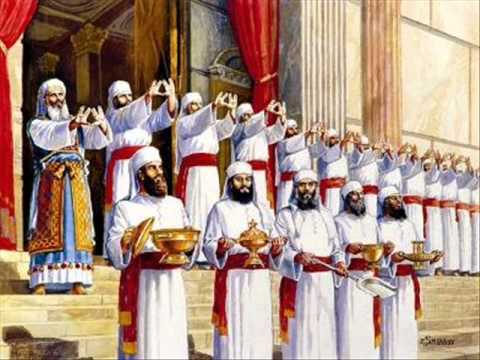
LevitesYeshua, of the tribe of Judah and the house of David, would not be a Priest on Earth and will not be when he returns. He does not overturn or override the Law of the Temple, since only Aaronic Priests of the tribe of Levi may serve there (and will serve there in the Messianic Age). Yeshua’s priesthood doesn’t replace the Levitical priesthood, it exists altogether separately in a completely different venue.

So Yeshua will not be High Priest on Earth upon his return and will not function as a Priest in “Ezekiel’s Temple” in Jerusalem. But he still will have to perform an inauguration:

Now the king and all Israel with him offered sacrifice before the Lord. Solomon offered for the sacrifice of peace offerings, which he offered to the Lord, 22,000 oxen and 120,000 sheep. So the king and all the sons of Israel dedicated the house of the Lord. On the same day the king consecrated the middle of the court that was before the house of the Lord, because there he offered the burnt offering and the grain offering and the fat of the peace offerings; for the bronze altar that was before the Lord was too small to hold the burnt offering and the grain offering and the fat of the peace offerings.

1 Kings 8:62-64 (NASB)

Yeshua will be the great King and perform duties in relation to the Third Temple just as Solomon the King inaugurated the first Temple.

…who serve a copy and shadow of the heavenly things…

Hebrews 8:5 (NASB)

Here’s where we encounter what Lancaster calls “Christian theological bias.” When we read “copy and shadow,” we’ve been taught in the Church to think “empty,” “meaningless,” “vain,” and even “forgery.” We’ve been taught that all that “stuff,” the Temple, the Priesthood, the sacrifices, and of course, the Torah (Law) had a temporary use but it was all meant to expire and be replaced by the Holy, Heavenly, originals and specifically by Jesus, the High Priest of our hearts, for we replace the stone Temple as little, flesh and blood, spiritual temples.

But that’s not it at all.

To understand this better, Lancaster takes us to Colossians 2:16-17. The quote below is taken from the NASB translation:

Therefore no one is to act as your judge in regard to food or drink or in respect to a festival or a new moon or a Sabbath day—things which are a mere shadow of what is to come; but the substance belongs to Christ.

Some background. Lancaster says this was part of Paul’s argument against the ascetics, those people who believe that one can only be spiritual by disdaining anything that might be physically pleasurable and imposing severe self-discipline and abstention upon themselves.

While there are some practices in Judaism that follow an ascetic pattern (Tisha B’Av and Yom Kippur), the majority of Jewish observances (and remember, Paul was an observant Jewish Pharisee who advocated for Jews in Messiah performing the mitzvot, including Shabbat and the Festivals) such as Pesach (Passover), Shavuot (Festival of Weeks), Sukkot (Festival of Booths), and Shabbat (the Sabbath) were and are celebrated largely by eating and drinking.

Lancaster is interpreting Colossians 2 in a way that says when we observe the festivals, Rosh Chodesh (the observance of the New Moon), and Shabbat, we are experiencing a foretaste of what it will be like in the New Covenant age to feast at the table of Messiah:

I say to you that many will come from the east and the west, and will take their places at the feast with Abraham, Isaac and Jacob in the kingdom of heaven.

Matthew 8:11 (NIV)

Sukkah in the rainThis could well support Gentile Christian observance of the Biblical holidays in the present age since Yeshua (Jesus) was not just speaking of Israel but of the people of the nations “from the east and the west”. If you or I as non-Jewish disciples of the Jewish Messiah were to keep a proper Shabbos, observe the festival of the New Moon, and build a sukkah in our backyard this fall, in performing each of these acts, we are also experiencing a “shadow or copy,” a scale model, a brief tasty little treat of the magnificent banquet that we will be permitted to join in the Messianic Age.

So shadows and copies aren’t cheap knockoffs or poor imitations that need to be cleaned out to make way for the originals. They are previews, coming attractions of the main event, like watching the previews of a biggest, best movie ever to be made in anticipation of one day seeing the entire film in 3D.

But…

…but here we find “Christian theological bias” again, this time in how these verses are translated. Lancaster offered a couple of examples:

Therefore do not let anyone judge you by what you eat or drink, or with regard to a religious festival, a New Moon celebration or a Sabbath day. These are a shadow of the things that were to come; the reality, however, is found in Christ.

Colossians 2:16-17 (NIV)

Therefore no one is to act as your judge in regard to food or drink or in respect to a festival or a new moon or a Sabbath day—things which are a mere shadow of what is to come; but the substance belongs to Christ.

Colossians 2:16-17 (NASB)

I put in bold the words “were” and “however” in the first quote and the word “mere” in the second. Why? Because Lancaster says they don’t exist in the Greek. Later translators added those words to insert an anti-Torah bias into the text. If you just read and understand the Bible in English (or probably a lot of other translations), you’ll completely miss it.

I compared English translations and found the Holman Christian Standard Bible to be just slightly more honest:

These are a shadow of what was to come; the substance is the Messiah.

Unfortunately, it still uses the word “was” which isn’t in the Greek. The Shabbat, Rosh Chodesh, and the other observances are shadows cast by the Holy observances that will enter our world with the Messiah’s return. They are not past, they are present and future.

In other words, the Shabbat, Rosh Chodesh, Passover, Shavuot, Sukkot are all tasty hints and treats, samples from the dessert tray, so to speak, of what is to come, but the full meal deal, so to speak, is the Messiah. Yes, he is the full substance, but we have been provided with previews so we can look forward to what’s coming and experience some of that wonder and delight in the here-and-now.

What Did I Learn?

I felt I already had a pretty good handle on Hebrews 8:1-5 from the background of my general knowledge plus Lancaster’s prior sermons, but what I didn’t expect was how Colossians 2 was so easily applied to the same usage of “copy and shadow.” I was also unconscious of how modern Christian translators have been guilty of some “hanky-panky by apparently playing fast and loose with the oldest Greek manuscripts we have of the text, inserting anti-Torah, anti-Festival, and anti-Jewish bias into Christian minds and hearts.

Face it. Most of us don’t read the Bible in the ancient languages and we rely upon our English Bibles. I find great meaning and truth in the Bible, but on some level, I also feel betrayed. This is a good illustration as to why we must learn to educate ourselves and not depend solely upon traditional Christian learning sources. It’s not even that anyone is lying, but the history of the Church is fraught with traditions stemming from the earliest days of Gentile Christianity, when every effort was made by those pulling away from their Jewish teachers and mentors in the Messianic faith to re-interpret the scriptures in a manner that rendered them totally devoid of their original (Jewish) meaning and truth.

Small wonder most Jews really hate Paul. They’ve learned to interpret him in exactly the same way as most Evangelical Christians, only Christians see Paul’s (supposed) anti-Torah writings as a virtue rather than a curse.

temple-of-messiahI hope you conclude, as I have, that there is nothing about the Heavenly Malkizedekian Priesthood or the Heavenly Tabernacle that undoes, makes obsolete, or terminates the effectiveness and authority of the Torah, the Temple, and the Priesthood here on Earth. When Messiah does return and rebuild the Temple (actually, the Temple Mount is too small to hold the Temple described by Ezekiel, so the geography of Jerusalem is going to have to change somewhat), those Torah Laws that govern the Temple, the Priesthood, and the sacrifices that have been put into abeyance for nearly twenty centuries will be applicable again.

Until that day however, we remain in exile with just the periodic precursors of the age to come to comfort us.

When the Holy Temple was destroyed, there was a wailing voice heard throughout the whole world. The Ministering Angels said to G-d, “Master of the Universe, do You have such emotions of sadness? Isn’t it written ‘Splendor and glory are before You?’ ”

G-d answered: “My House is destroyed, and My children are manacled in chains. Shouldn’t I be suffering?”

Midrash, Yalkut Shimoni, Tehillim 679

From the day that Jerusalem and the Holy Temple were destroyed, there is no joy before G-d… until Jerusalem will be rebuilt and the Jewish People will return to it.

Midrash, Yalkut Shimoni, Eychah 7009

From my father’s sichot: When Mashiach will come (speedily in our time, amein), then we shall really long for the days of the exile. Then we will truly feel distress at our having neglected working at avoda; then will we indeed feel the deep pain caused by our lack of avoda. These days of exile are the days of avoda, to prepare ourselves for the coming of Mashiach, speedily in our time, amein.

-from Tanya: Ch. 11. This subject (p. 379) …infinitely more so. (p. 381).
Compiled and arranged by the Lubavitcher Rebbe, Rabbi Menachem Mendel Schneerson, of righteous memory, in 5703 (1943) from the talks and letters of the sixth Chabad Rebbe, Rabbi Yosef Yitzchak Schneersohn, of righteous memory; translated by Yitschak Meir Kagan

How long, Moshiach? How long?

What I Learned in Church Today: God Suffers Our Pain With Us

Today in church (as I write this), Pastor preached on Acts 27:1-12 and Paul’s rather “stormy” trip toward his final destination (in more ways than one) Rome. What I found most useful in today’s sermon were the notes at the conclusion. Normally, this part of the sermon doesn’t “float my boat” since these notes are usually an attempt to take ancient events, spiritualize them, and anachronistically apply them to everyday life in 21st century America.

But this time, I decided to see if these notes could be applied to my life. There are three of them.

Do you believe that God is sovereign over all the storms in your life?

As opposed to what? No, really. As an abstract concept believing what I believe about God, my immediate answer has to be “yes,” but it’s more complicated than that. It’s one thing to say that “God is in control” and that “we win in the end,” and another thing entirely to receive a diagnosis of cancer (no, I don’t have cancer) or that your child was in a serious car accident and is in ICU (don’t worry, my kids are all fine).

Then, no matter how much you “think” God is sovereign over every single detail of your existence, suddenly the pit of your stomach drops out and at least momentarily, panic sets in with the vengeance of a really angry Grizzly Bear. Sure, given enough time, you can regain your emotional equilibrium and refocus on God, but for those first few seconds or minutes (or longer), unless you are a terrifically spiritual person and always totally in tune with God, you’re going to lose it.

Here’s the first thing I wrote down in my notes when Pastor asked the question:

Yes, but that doesn’t mean I still won’t drown.

Here’s the second thing I wrote down.

We don’t have an absolute view into God’s plans for us as individuals.

God can be absolutely sovereign over the storms in our lives and we can still lose a leg in a car crash. We can still end up with a child in intensive care. We can still die a long, lingering, painful death.

God’s sovereignty contains no guarantee at all that our lives won’t be painful and end tragically. When we think of God being “in control,” we really mean that God would never let anything bad happen to us. But just look at Paul’s life. God let everything bad happen to Paul.

But the key is, no matter what happened, Paul still served God faithfully, with an almost supernatural focus (I’m being slightly tongue-in-cheek here) on Yeshua (Jesus) as the author of his faith and the “perfecter” of his existence, both in this world and the one beyond.

Which brings us to Pastor’s second question:

What are you doing to learn to trust God in the storms of life?

I remember a scene from the film Finding Nemo (2003). Dory (voiced by Ellen DeGeneres) and Marlin (voiced by Albert Brooks) are inside of a whale, basically hitching a ride to Sydney, Australia. The water inside the whale starts to drain. As usual, Marlin senses disaster while Dory is willing to trust. Marlin is hanging onto some part of the whale’s insides to keep from falling back into the throat. Dory translates the message from the whale.

It’s time to let go.

praying at the kotelI think that’s what trusting God is about, but it’s best to learn to trust him before your life turns to dog poop. While you still have the time, pray with an especially focused Kavanah for an encounter with God. Strive to draw nearer to Him and plead that He reveals Himself to you before you need Him. I promise that if you don’t do this now, you will be doing it once you need God’s help more than anything you’ve ever needed in your life.

Last question:

Do you realize that God is able to use the storms in your life to give guidance to others?

As first, I didn’t read the to give guidance to others part and just saw the question as asking if I realized God could use the storms in my life. Then I realized what was really going on.

Had they trusted in God and followed Moshe, the entire nation would have gone into Eretz Israel led by him. The Holy Temple would have been built, never to be destroyed; the people would have sat, every man under his grape vine and under his fig tree, never to be exiled; and the still longed for, final redemption under God’s chosen anointed would have come. But they didn’t trust and they didn’t obey. So the exodus from Egypt remained eternal, but the entry into the Land was to be transitory.

-Rabbi Meir Zlotowitz
Megillas Eichach (Lamentations), pg 34

If all of the twelve spies Moses sent into Canaan (Numbers 13, 14) had given a positive report instead of just two, obeyed Moses, and obeyed God, the history of Israel would have been written quite differently.

But they didn’t and history unfolded as it did.

The same is true of Israel in the days of Jesus:

“Jerusalem, Jerusalem, who kills the prophets and stones those who are sent to her! How often I wanted to gather your children together, the way a hen gathers her chicks under her wings, and you were unwilling. Behold, your house is being left to you desolate! For I say to you, from now on you will not see Me until you say, ‘Blessed is He who comes in the name of the Lord!’”

Matthew 23:17-39 (NASB)

If Israel had repented in the days of Herod’s Temple, Yeshua would have initiated the Messianic Kingdom immediately, the Romans would have been defeated, the Temple would have been preserved, there would have been no exile, and King Messiah’s reign of peace, mercy, and justice over all of the world would have started and be with us to this very day.

But they didn’t, and untold suffering has resulted.

In the 1982 film Star Trek II: The Wrath of Kahn, Admiral James T. Kirk (William Shatner) gave this sage piece of advice to Lt. Saavik (Kirstie Alley):

How you face death is at least as important as how you face life.

Regardless of how God provides and what God allows and how God disciplines, your circumstances are less important than how you respond to them. Consider how Israel is responding, not to just all of the rockets Hamas keeps throwing at her, but how the rest of the world is mistreating Israel, believing she is disproportionately responding to these terrorist acts simply by defending herself.

The whole world is watching Israel and waiting for her to blink. So it is true when anyone who professes faith in Christ, especially when we are under duress.

Fortunately, Pastor said that he’s hardly perfect in this area and that there have been plenty of occasions when he’s been stressed and yet taken it out on his family rather than having greater trust in God. There’s a sort of myth, both inside the Church and outside of it, that says when a Christian is having a particularly tough time of it, he or she should be completely calm if their faith in Jesus is solid. Only a failure of faith results in a Christian who cries or yells or begs.

Like I said, it’s a myth.

Father, if you’re willing, take this cup from me…

Luke 22:42 (NASB)

This is Jesus at Gethsemane pleading with God the Father to take away the cup of his crucifixion, his agony, his desperate suffering from him.

This is Jesus saying this. This is Jesus not wanting to suffer. This is Jesus acting just like the rest of us. But the second half of the sentence tells the tale.

…yet not my will but Yours be done.

But he still begged. Flesh and blood, human right down to his DNA Jesus still begged that the cup be taken from him.

There’s no shame in anguish as long as there’s also trust.

Because of the surpassing greatness of the revelations, for this reason, to keep me from exalting myself, there was given me a thorn in the flesh, a messenger of Satan to torment me—to keep me from exalting myself! Concerning this I implored the Lord three times that it might leave me. And He has said to me, “My grace is sufficient for you, for power is perfected in weakness.”

2 Corinthians 12:7-9 (NASB)

If Jesus wasn’t immune, certainly Paul wasn’t either. How many of his Psalms did David dedicate to his own pain and suffering, withering before a Holy God with his flesh melting and his bones turning to dust?

Save me, O God,
For the waters have threatened my life.
I have sunk in deep mire, and there is no foothold;
I have come into deep waters, and a flood overflows me.
I am weary with my crying; my throat is parched;
My eyes fail while I wait for my God.
Those who hate me without a cause are more than the hairs of my head;
Those who would destroy me are powerful, being wrongfully my enemies;
What I did not steal, I then have to restore.

Psalm 69:1-4 (NASB)

We struggle all our lives between our faith and our humanity, between Divine glory and human weakness. The spirit is willing but flesh…oh the flesh is very weak. Even the best of us, when put to the test, are like a snow cone in a blast furnace.

anguishTo know that God is sovereign and to trust in Him in adversity doesn’t mean you have to be superhuman and it doesn’t mean you don’t get scared. It means when 99% of you is in full panic mode, some tiny voice in the back of your consciousness is still crying out to God, not in terror but in faith, that even if you should drown or be incinerated in the next half-second, if you are not supposed to live (in this life) with God, then you will certainly die in His Presence and live with Him in the resurrection.

Living with God in suffering is like being a terminally ill child. You know you are going to die and you know your Mom and Dad love you very much. But you also know they can’t save your life. You’re still scared and you still don’t want to be away from them, but you know as long as they love you, you’re not alone.

God’s sovereignty in our lives when we suffer doesn’t (necessarily) mean God will stop the suffering. It means He will never abandon us as we are suffering and in some sense, He suffers, too.

The night when hope was enveloped in darkness was about to begin, so God came to Jacob ‘in the visions of the night’ to show him that Jews might be exiled from their land, but they could never be exiled from their God.

-R. Zlotowitz, pp 46-7

When they were exiled to Babylon, the Divine Presence was with them.

-Megillah 29a

And so He is with us.

Sermon Review of the Holy Epistle to the Hebrews: Melchizedek

For this Melchizedek, king of Salem, priest of the Most High God, who met Abraham as he was returning from the slaughter of the kings and blessed him, to whom also Abraham apportioned a tenth part of all the spoils, was first of all, by the translation of his name, king of righteousness, and then also king of Salem, which is king of peace. Without father, without mother, without genealogy, having neither beginning of days nor end of life, but made like the Son of God, he remains a priest perpetually.

Now observe how great this man was to whom Abraham, the patriarch, gave a tenth of the choicest spoils. And those indeed of the sons of Levi who receive the priest’s office have commandment in the Law to collect a tenth from the people, that is, from their brethren, although these are descended from Abraham. But the one whose genealogy is not traced from them collected a tenth from Abraham and blessed the one who had the promises. But without any dispute the lesser is blessed by the greater. In this case mortal men receive tithes, but in that case one receives them, of whom it is witnessed that he lives on. And, so to speak, through Abraham even Levi, who received tithes, paid tithes, for he was still in the loins of his father when Melchizedek met him.

Now if perfection was through the Levitical priesthood (for on the basis of it the people received the Law), what further need was there for another priest to arise according to the order of Melchizedek, and not be designated according to the order of Aaron? For when the priesthood is changed, of necessity there takes place a change of law also. For the one concerning whom these things are spoken belongs to another tribe, from which no one has officiated at the altar. For it is evident that our Lord was descended from Judah, a tribe with reference to which Moses spoke nothing concerning priests. And this is clearer still, if another priest arises according to the likeness of Melchizedek, who has become such not on the basis of a law of physical requirement, but according to the power of an indestructible life. For it is attested of Him,

“You are a priest forever
According to the order of Melchizedek.”

Hebrews 7:1-17 (NASB)

The story of Abraham’s encounter with Melchizedek and Hebrews 7:1-17. Was Melchizedek actually a pre-incarnate appearance of Christ in the Old Testament? Who is the mysterious priest and what is his relationship to Yeshua?

-D. Thomas Lancaster
Sermon Twenty-seven: Melchizedek
Originally presented on October 12, 2013
from the Holy Epistle to the Hebrews sermon series

We finally exit the elementary principles of the faith and get back into that “meat” the writer of the Epistle to the Hebrews was talking about. That meat starts with Melchizedek.

Lancaster started out by quoting from Lech Lecha:

When he returned from defeating Chedorlaomer and the kings with him, the king of Sodom came out to meet him in the Valley of Shaveh, which is the Valley of the King. And King Melchizedek of Salem brought out bread and wine; he was a priest of God Most High. He blessed him, saying,

“Blessed be Abram of God Most High,
Creator of heaven and earth.
And blessed be God Most High,
Who has delivered your foes into your hand.”

And [Abram] gave him a tenth of everything.

Genesis 14:17-20 (JPS Tanakh)

So who was Melchizedek? He’s the King of Righteousness. The King of a place called Salem, which is an ancient name for Jerusalem. He’s also called a King of Peace. Sound familiar?

melchizedekLancaster says (and I’ve heard this before as well) that many people believe that Melchizedek is a “pre-incarnate Jesus”. In other words, Jesus showed up in disguise in the Old Testament to honor Abraham. I’ve always had trouble with this interpretation, as it cheapens the incarnation of Jesus being born of woman (much later in history) by having him just appear and disappear in this sequence of events. Fortunately, Lancaster also has a problem with this. But then what is Melchizedek’s relationship to Jesus?

Here’s one connection (sort of). Lancaster says that Melchizedek shows up bringing bread and wine to give Abraham a banquet foreshadowing the banquet of Abraham in Messianic Days. What banquet you ask?

I say to you that many will come from east and west, and recline at the table with Abraham, Isaac and Jacob in the kingdom of heaven…

Matthew 8:11 (NASB)

Oh. That banquet.

So Jesus is supposed to give Abraham a banquet in the Messianic Kingdom? Seems kind of reversed. You’d think Abraham would hold a banquet in honor of King Messiah. On the other hand Abraham did give Melchizedek a tenth of everything after receiving a blessing, but we’ll get back to that.

Lancaster did bring up the midrash in Judaism that suggests Melchizedek was actually Shem, the son of Noah. While this works in terms of the chronology of events, it can’t be true because the writer of Hebrews says that Melchizedek is without genealogy or ancestry, which Shem definitely had.

Lancaster, dispelling the midrash in this case, then quotes the following:

This hope we have as an anchor of the soul, a hope both sure and steadfast and one which enters within the veil, where Jesus has entered as a forerunner for us, having become a high priest forever according to the order of Melchizedek.

Hebrews 6:19-20 (NASB)

We know about the order of the priesthood of Melchizedek from this:

The Lord says to my Lord:
“Sit at My right hand
Until I make Your enemies a footstool for Your feet.”
The Lord will stretch forth Your strong scepter from Zion, saying,

“Rule in the midst of Your enemies.”
Your people will volunteer freely in the day of Your power;
In holy array, from the womb of the dawn,
Your youth are to You as the dew.
The Lord has sworn and will not change His mind,
“You are a priest forever
According to the order of Melchizedek.”

Psalm 110:1-4 (NASB)

All this seems to indicate that the Priest/King Melchizedek had established a priestly order. What do you have to do to join this order?

For this Melchizedek, king of Salem, priest of the Most High God, who met Abraham as he was returning from the slaughter of the kings and blessed him, to whom also Abraham apportioned a tenth part of all the spoils, was first of all, by the translation of his name, king of righteousness, and then also king of Salem, which is king of peace. Without father, without mother, without genealogy, having neither beginning of days nor end of life, but made like the Son of God, he remains a priest perpetually.

Hebrews 7:1-3 (NASB)

the letterLancaster admits that on the surface, this sounds a great deal like Melchizedek could be Jesus. On the other hand, saying he was without father and mother just means that the Torah doesn’t mention them, not that they didn’t exist. Also, it says Melchizedek had no genealogy, but Jesus has a very specific genealogy. He has to in order to qualify as the Messiah King.

Lancaster directs us back to his understanding of why this letter was first authored. The Greek-speaking, Jesus-believing Jews in Jerusalem were going through a crisis of faith. They had been persecuted by the Sadducees who were in control of the Temple. They had been cut off from the Temple, from the sacrifices, and from the (Aaronic) priesthood. And as Lancaster said in past sermons, no one approaches Hashem without a priest.

But the Hebrews writer is saying that they did have a priest, just one of a different order than that of the Aaronic priesthood. But how could that be?

You shall gird them with sashes, Aaron and his sons, and bind caps on them, and they shall have the priesthood by a perpetual statute.

Exodus 29:9 (NASB)

This is a fancy way of saying that the priesthood descending from Aaron was established forever. It was never-ending. It could not be ended or replaced.

So how could Messiah, of the tribe of Judah and the house of David be a priest?

Because he belonged to a different order of priests. The order of Melchizedek. But is there such an order or was the writer of Hebrews speaking metaphorically?

I asked before, what would you have to do if there were such a priestly order and you wanted to join it? According to Psalm 110:4, you had to be immortal because it says, “a priest forever.” As far as we can tell, Melchizedek was not immortal, even though the Bible never records his death (or birth for that matter).

If Melchizedek was a literal King/Priest of the city of Salem, which at that time a Jesubite city ruled by a Canaanite King, then this couldn’t have been a role that Jesus just “popped in” for and then popped back out again up into Heaven after a brief chat and a nosh with Abraham. He would have had to rule over Salem on a day-to-day basis, being the head of a very real government in a very real city with very real human citizens.

Doesn’t seem likely that this is Jesus.

We do know something about Melchizedek as a priest, though. He blessed Abraham and Abraham paid Melchizedek.

But without any dispute the lesser is blessed by the greater. In this case mortal men receive tithes, but in that case one receives them, of whom it is witnessed that he lives on. And, so to speak, through Abraham even Levi, who received tithes, paid tithes, for he was still in the loins of his father when Melchizedek met him.

Hebrews 7:7-10 (NASB)

AbrahamIn almost any context, Abraham, having received the promises from God, was the biggest wheel at the table, so to speak. No one was of a higher authority than Abraham relative to the purposes of God. If anything, Abraham should have blessed Melchizedek, since only the greater blesses the lesser, just like fathers bless their children. That Melchizedek, the Priest of the Most High God, blessed Abraham, then he was superior to Abraham. Also, Melchizedek should have given a “tithe” to Abraham if Abraham were truly in the catbird seat.

If, as the above-quoted verses from Hebrews 7 attest, Aaron and his descendants were “still in the loins of” Abraham, it would be as if, in blessing Abraham, Melchizedek were blessing Aaron and his sons, thus establishing that Melchizedek and his priestly order was superior to Aaron and the Levitical priestly order. This is also why Melchizedek would receive a tithe instead of paying one.

Now if perfection was through the Levitical priesthood (for on the basis of it the people received the Law), what further need was there for another priest to arise according to the order of Melchizedek, and not be designated according to the order of Aaron? For when the priesthood is changed, of necessity there takes place a change of law also.

Hebrews 7:11-12 (NASB)

This makes it seem as if the Melchizedekian order replaces the Aaronic order of priests, and thus Jesus replaces the Levitical priesthood, the Temple, the sacrifices, and the Torah.

Lancaster says he’ll address all that in a subsequent sermon, but in short, Jesus being in the order of the priesthood of Melchizedek doesn’t replace Aaron’s priesthood (and the sacrifices, the Temple, and the Torah), but he represents a different order that exists in a different venue, the Heavenly Temple Court, while the Aaronic priesthood has authority over the earthly Temple and sacrifices.

As I’ve already mentioned, verse 14 addresses the differences between the ancestry of Melchizedek (whose ancestors are not mentioned) and Jesus (who had a very specific ancestry).

And this is clearer still, if another priest arises according to the likeness of Melchizedek, who has become such not on the basis of a law of physical requirement, but according to the power of an indestructible life. For it is attested of Him,

“You are a priest forever
According to the order of Melchizedek.”

Hebrews 7:15-17 (NASB)

Notice this says someone “in the likeness of Melchizedek” and not Melchizedek himself. Also, this order of the priesthood of Melchizedek is not established through a “physical requirement,” that is, who you are descended from, but rather, “according to the power of an indestructible life.” By being the “first fruits of the dead,” (1 Corinthians 15:20), Jesus was the first to have the power of an indestructible life, thus only he was and is qualified to enter into the priestly order of Melchizedek. It comes down to the writer of Hebrews saying that Jesus can be a Priest of a different order than the Aaronic priesthood because Melchizedek had previously been accepted as a Priest of Hashem and was not a descendant of Aaron.

All this I more or less knew, though Lancaster nicely filled in some of my information gaps…

…but…

What Did I Learn?

Take silver and gold, make an ornate crown and set it on the head of Joshua the son of Jehozadak, the high priest. Then say to him, ‘Thus says the Lord of hosts, “Behold, a man whose name is Branch, for He will branch out from where He is; and He will build the temple of the Lord. Yes, it is He who will build the temple of the Lord, and He who will bear the honor and sit and rule on His throne. Thus, He will be a priest on His throne, and the counsel of peace will be between the two offices.”’ (emph. mine)

Zechariah 6:11-13 (NASB)

Compare this to the following:

“Behold, the days are coming,” declares the Lord,
“When I will raise up for David a righteous Branch;
And He will reign as king and act wisely
And do justice and righteousness in the land. (emph. mine)

Jeremiah 23:5 (NASB)

LevitesBoth of these are Messianic prophesies. The passage from Zechariah describes the Israelites returning to their Land after the Babylonian exile. The Temple was in ruins. Prophesy said the Messiah should have arrived at that point, rebuilt the Temple and restored Israel. Where was he?

According to Lancaster, Zechariah’s answer was to prophesy that a (righteous) Branch would come to rebuild the Temple. Then the prophet commanded that a crown be made and placed on the head of Joshua the High Priest, and that he would represent the Branch who would one day come to rebuild the Temple and to sit on the King’s Throne, and that the Branch would also be a Priest, and that he would bring peace between the office of the priesthood and the office of the King.

The kicker is that the High Priest’s name is “Joshua”, which is “Yehoshua” in Hebrew (transliterated), but the Jews coming out of Babylon were speaking Aramaic, not Hebrew. They would have pronounced his name “Yeshua,” which we translate into English as “Jesus.”

The writer of the Book of Hebrews is trying to encourage his readers by saying they really do have a High Priest, one who is in Heaven, even though they are cut off from the earthly High Priest. Based on the precedents set in Psalm 110 and Genesis 14, that High Priest is King Messiah, who like Melchizedek, is both a King and a Priest, which was also prophesied by Zechariah.

This was good news for the Jesus-believing Jews reading this letter, but it’s also good news for us. Even though Kohens are identifiable today, there is no Temple in which they can offer sacrifices. Yet no man comes to God without a priest. But we, like the readers of the Hebrews letter, do have a High Priest, one who brings us near to God. we have Yeshua, we have Jesus, who is both King and Priest in the order of Melchizedek.

What I Learned in Church Today: Partakers in Tribulation, Kingdom, and Perseverance

I, John, your brother and fellow partaker in the tribulation and kingdom and perseverance which are in Jesus, was on the island called Patmos because of the word of God and the testimony of Jesus.

Revelation 1:9 (NASB)

John sees himself as a “brother and fellow partaker” with the Asian Christians in three things which are “in Jesus”. Does this mean that these are part of God’s design for them? Explain your answer.

-Charlie’s notes on Rev 1:9-20
for Sunday School class

As I mentioned last week, as a teacher, Charlie has few questions and presents limited material so that we can explore the great depths the Bible has to offer.

I won’t attempt to go over all that we discussed in class today, but I thought that the “three things” Charlie says John identifies as “in Jesus” were particularly interesting. What three things are we “fellow partakers” in?

Tribulation, Kingdom, and Perseverance.

When I saw those three words together, they just “clicked”.

Consider.

When Jesus died and was resurrected, he inaugurated the very beginning of the entry of the New Covenant into our world. In fact, even before the crucifixion, the central message of Jesus was “the Kingdom of Heaven is near,” as if the Kingdom could burst into our world at any second, even as he was speaking (Matthew 3:2, 4:17, 10:7, Mark 1:15).

seek first the kingdomBut even as the Kingdom is entering our reality, it will not reach fruition until the Messiah returns to us as King. We are to live in the present world, we believers that is, as if the Kingdom is already here and as if Jesus were already enthroned in Jerusalem as King Messiah. As D. Thomas Lancaster preached in his Epistle to the Hebrews sermon series, we are freedom fighters or partisans, fighting against the world’s current tyranny, against the brokeness of a world that thinks it’s getting better every day, and fighting for our allegiance to the King, who is steadily coming nearer and soon to return.

Until then, we will indeed face great adversity and tribulation, even as the freedom fighters in Nazi occupied France did during World War Two. But we fight for a great cause, and we represent the King’s justice and mercy. We are fellow partakers in this troubled world, in the hope of the coming Kingdom, and we must maintain patient endurance until the Master comes back and establishes his reign over Israel and nations of the world.

After I was done laying out my answer (and I was feeling really proud of myself), Charlie asked for Biblical support for all that. Oops. I didn’t put that in my notes. Pride indeed goes before a fall. Fortunately, other class members stepped up to the plate and provided what I was missing. I guess there’s some truth in what Paul E. Meier said in his article for Messiah Journal issue 116 Christian Theology and the Old Testament:

Scripture points out that the understanding of individual believers is fragmental; each one of us has been granted a different degree of insight (1 Corinthians 13:9-10). The dimensions of God’s love are so vast that the whole body of believers is needed in order to comprehend them (Ephesians 3:18). God may give more insight to some than to others; he gives to each one according to the measure of his grace (Romans 12:3, Ephesians 4:7).

In other words, it “takes a whole village” or in this case, a whole Sunday school class to properly interpret the Bible. No one of us holds all the keys or can open all the doors to the Word of God, since we’re all apportioned gifts of different types and to different degrees by the mercy of Hashem.

Torah at SinaiThat means, we are all fellow partakers in the tribulations, the kingdom, and in perseverance with each other as we are all in Yeshua our Master, the Messiah King and Priest. But I wouldn’t have put all this together the way I have without an understanding of how the New Covenant works and what the Kingdom of God, the Kingdom of Heaven really means (see The Kingdom is Now, Seek First the Kingdom, Thy Kingdom Come, Keys to the Kingdom, and Foretaste of the Kingdom).

John’s Revelation, his mystic vision of the exalted Messiah King, is the source of a great deal of mystery and I can’t pretend to understand it all, but I do understand that we have one whose “voice [is] like the sound of a trumpet” as our High Priest.

So it came about on the third day, when it was morning, that there were thunder and lightning flashes and a thick cloud upon the mountain and a very loud trumpet sound…

Exodus 19:16 (NASB)

I was in the Spirit on the Lord’s day, and I heard behind me a loud voice like the sound of a trumpet…

Revelation 1:10 (NASB)

Yes, my Master and Lord. May your Kingdom come soon.

He who testifies to these things says, “Yes, I am coming quickly.” Amen. Come, Lord Jesus.

Revelation 22:20 (NASB)

Amen.

The Servant Prepares for the Sabbath

In 1922 the highly respected Jewish scholar Joseph Klausner claimed that any sound methodology critically examining the historical Jesus must meet at least two requirements. First, critical research must place Jesus believably among the Jewish people in first-century Israel. Second, the historical analysis should explain how the church and the synagogue parted ways, resulting in the formation of the new Christian religion. In 1985 Sanders upheld the validity of these foundational principles in his widely acclaimed book, Jesus and Judaism. Since one-third of the recorded sayings of Jesus appear in parables, these Gospel illustrations have the potential to solve a number of mysteries surrounding the nascent faith. Who is Jesus of Nazareth and how did Christianity originate? How has the presence of Jewish traditions in the parables of Jesus influenced Christianity?

-Brad H. Young
Epilogue: Jesus, the Parables, and the Jewish People, pg 297
The Parables: Jewish Tradition and Christian Interpretation

I sometimes (often) think that last question should read, “Do the presence of Jewish traditions in the parables of Jesus influence Christianity at all?” Even in the church I currently attend which is “Jewish-friendly” and “pro-Israel,” I’d have to say, “not very much.” Here’s what I mean:

He thereupon says to them, “Permit me to go repent!” And they answer him and say, “You fool! Do you know that this world is like the Sabbath and the world whence you have come is like the eve of the Sabbath? If a man does not prepare his meal on the eve of the Sabbath, what shall he eat on the Sabbath?”

-from Ruth Rabbah 3:3
quoted by Young in
Chapter 15: Death and Eschatology: The Theology of Imminence, pp 281-2

In this rabbinic parable, two wicked men have associated together in doing evil in this world for many years. Before they die, one repents and the other does not. The man who did not repent sees his friend who did repent standing among the righteous while he stands among the wicked. He “reasons” that a wicked man can repent and appeals to the company of the righteous but is rejected, for he failed to repent while still alive.

This compares well to Jesus’ parable of the Wise and Foolish Maidens (Matthew 25:1-13) as well as to the following:

“Now there was a rich man, and he habitually dressed in purple and fine linen, joyously living in splendor every day. And a poor man named Lazarus was laid at his gate, covered with sores, and longing to be fed with the crumbs which were falling from the rich man’s table; besides, even the dogs were coming and licking his sores. Now the poor man died and was carried away by the angels to Abraham’s bosom; and the rich man also died and was buried. In Hades he lifted up his eyes, being in torment, and saw Abraham far away and Lazarus in his bosom. And he cried out and said, ‘Father Abraham, have mercy on me, and send Lazarus so that he may dip the tip of his finger in water and cool off my tongue, for I am in agony in this flame.’ But Abraham said, ‘Child, remember that during your life you received your good things, and likewise Lazarus bad things; but now he is being comforted here, and you are in agony. And besides all this, between us and you there is a great chasm fixed, so that those who wish to come over from here to you will not be able, and that none may cross over from there to us.’ And he said, ‘Then I beg you, father, that you send him to my father’s house—for I have five brothers—in order that he may warn them, so that they will not also come to this place of torment.’ But Abraham said, ‘They have Moses and the Prophets; let them hear them.’ But he said, ‘No, father Abraham, but if someone goes to them from the dead, they will repent!’ But he said to him, ‘If they do not listen to Moses and the Prophets, they will not be persuaded even if someone rises from the dead.’”

Luke 16:19-31 (NASB)

the-teacher2This illustrates that the parables of the Master compared favorably with other rabbinic parables. His audience would have known well what he was communicating since what Jesus taught was similar to the topics and methods employed by other teachers in late second-temple period Israel (and remember what I’ve said before about repentance and eternal judgment).

But what you may have missed earlier is the comparison of the current life to the eve of Shabbat and the life of the world to come to the Shabbat.

Particularly in Orthodox Judaism, Friday afternoon can be a rush to get everything ready before Shabbat arrives at sundown. All the meals that will be consumed during Shabbat must be prepared ahead of time, the Shabbat table must be set, special clothes should be laundered and ready to wear, everything that must be purchased and organized before the Shabbat has to be taken care of, all with an eye on the lowering Sun and the purpose for all the labor…the Shabbat rest and the drawing near to God.

This is a pattern that happens every week. For one-seventh (and a little more) of the week, observant Jews experience a foretaste of the world to come, of the Messianic Era of peace and tranquility when the problems of the world and regular life are set aside and a greater apprehension of God through the Torah study, prayer, and worship becomes available.

But day-to-day life is just like the afternoon prior to Shabbat. We have our work, our labors, our worries, our concerns. What we are working for makes a difference. If we are working just to accumulate wealth and the illusion of material security, when the “Sabbath” comes, when we die, when we are judged, we finally realize that all of our work has been wasted.

If, on the other hand, we are working to authentically prepare for “Shabbat,” that is, to prepare our lives and our souls for an encounter with God in a life beyond this one, after the resurrection, in the face of Divine judgment, then our work is not in vain and will be rewarded. We will have prepared our home in the Kingdom.

But if you’re a Christian who has no true understanding of a Jewish Sabbath, all of this will be missed in reading the parables of Jesus. What a pity.

But there’s more we’re missing:

It is like a consort who had a Cushite maidservant. The consort’s husband went off to a foreign province. All night the maidservant said to the consort: I am more beautiful than you. The king loves me more than he loves you. The consort replied: Let morning come,and we will know who is more beautiful and whom the king loves.

Similarly, the nations of the world say to Israel: Our deeds are more beautiful, and we are the ones whom the Holy One, blessed be He, desires. Therefore Israel says: Let morning come, and we will know whom the Holy One, blessed be He, desires — as it is said, “The watchman replied, Morning comes” (Isa. 21:12): Let the world to come, which is called morning, arrive, “and you shall come to see the difference between the righteous and the wicked” (Mal. 3:18).

-See Midrash Tanchuma, ed. Buber (Num. Rab. 16:23); trans. Stern, Parables in Midrash, 116
quoted by Young, pg 286

Roger Waters
Roger Waters

This parable can be applied in a number of ways, not the least of which is how arrogantly western nations, the mainstream news media, and the sadly deluded BDS crowd believe they are so much more “righteous” than “apartheid” Israel. However, at least historically, this parable also tells us a tale about the Church and how Christianity has viewed itself in comparison with Judaism and the Jewish people. Classic supersessionism is illustrated in the above-quoted parable, with the Church believing itself more beautiful than Israel and more loved than Judaism, as if the maidservant would ever be able to replace the consort in the heart of the King.

Imagine this to be the result of the arrogance of such a belief:

“Not everyone who says to Me, ‘Lord, Lord,’ will enter the kingdom of heaven, but he who does the will of My Father who is in heaven will enter. Many will say to Me on that day, ‘Lord, Lord, did we not prophesy in Your name, and in Your name cast out demons, and in Your name perform many miracles?’ And then I will declare to them, ‘I never knew you; depart from Me, you who practice lawlessness.’

Matthew 7:21-23 (NASB)

I’ve previously applied this parable to those disciples of Jesus who failed to count the cost of following him and thus failed to commit the effort required to serve the great King of Israel. However, as part of being the King’s slave, we must be prepared to serve what he deems as his first love, Israel. If we place ourselves as Gentile servants higher than the Jewish nation, are we not committing lawlessness? For after all, even the Master said “Salvation comes from the Jews” (John 4:22) [to the nations], not the other way around.

And He began speaking a parable to the invited guests when He noticed how they had been picking out the places of honor at the table, saying to them, “When you are invited by someone to a wedding feast, do not take the place of honor, for someone more distinguished than you may have been invited by him, and he who invited you both will come and say to you, ‘Give your place to this man,’ and then in disgrace you proceed to occupy the last place. But when you are invited, go and recline at the last place, so that when the one who has invited you comes, he may say to you, ‘Friend, move up higher’; then you will have honor in the sight of all who are at the table with you. For everyone who exalts himself will be humbled, and he who humbles himself will be exalted.”

Luke 14:7-11 (NASB)

hagar_and_sarahThere are still many Christians who believe because they “have Christ,” they are inherently better than Jewish people, sometimes even those Jews who are considered “Messianic”. If you believe God replaced Israel with the Church, then you believe you deserve the bridegroom’s place at the head of the banquet table. And you believe you, the maidservant, are more beautiful and better loved by the King than the consort.

And you are wrong.

But if some of the branches were broken off, and you, being a wild olive, were grafted in among them and became partaker with them of the rich root of the olive tree, do not be arrogant toward the branches; but if you are arrogant, remember that it is not you who supports the root, but the root supports you. You will say then, “Branches were broken off so that I might be grafted in.” Quite right, they were broken off for their unbelief, but you stand by your faith. Do not be conceited, but fear; for if God did not spare the natural branches, He will not spare you, either. Behold then the kindness and severity of God; to those who fell, severity, but to you, God’s kindness, if you continue in His kindness; otherwise you also will be cut off. And they also, if they do not continue in their unbelief, will be grafted in, for God is able to graft them in again. For if you were cut off from what is by nature a wild olive tree, and were grafted contrary to nature into a cultivated olive tree, how much more will these who are the natural branches be grafted into their own olive tree?

Romans 11:17-24 (NASB)

See how all this fits together? How can we believe anything else except what Jesus taught and what Paul wrote about?

But some of you reading this may think that I’m saying Christian faith is meaningless because we are not Jewish, we are not Israel. I’m saying nothing of the kind. I just don’t want you to “reverse causality.” It is through the covenant promises God made to Israel that the people of the nations even have a shot at repentance, redemption, and salvation, through faith in King Messiah, the King who is in a far off land but who will soon return.

Let the morning come and show who the King loves, but let us put our hearts and lives in order, as if we were preparing our homes for the coming Shabbat. Then we will be ready when the bridegroom arrives.

In many ways, the Gospel parables belong to the rich cultural heritage and folklore traditions of the Jewish people. No one will grasp the meaning of Jesus’ parables without an extensive knowledge of ancient Judaism. Christian interpretations have tended to sever the parables from their cultural roots and apply them to new situations. In the destiny of humankind, the transcendence of the colorful illustrations goes beyond a single interpretation at one time and place in history.

-Young, pg 298

I sometimes encounter words and phrases such as Sola Scriptura, “let scripture interpret scripture,” and “Biblical sufficiency” as indicators that we only need a Christian reader and a Bible to fully and completely derive all of the meaning of the teachings of Jesus. I hope that I (and Young) have been successful in bringing into question the validity of such a simple equation.

We want the Bible to be easy to understand because otherwise, it would take a lot of time and effort to even begin to comprehend the parables in a similar manner to the original first-century Jewish audience. We want to think that when Jesus was speaking, he was speaking to us…to 21st century American Christians.

He wasn’t. Not even close.

jewish-davening-by-waterNo, I’m not saying that his teachings don’t apply to our lives today, but in order to see just how they apply, we must attempt to grasp how they were understood and applied to Jewish lives nearly twenty centuries ago in a land, culture, and linguistic context far removed from our own.

I can only say that the more I study, the more I’m convinced that in order to understand Jesus, you have to understand the Judaism in which he lived and taught. You have to study ancient and arguably modern Judaism. It is said that a disciple is a student who learns from doing, from imitating his or her Master. We are disciples and we are slaves. Our Master is a great teacher and a King. Learning through imitation isn’t a matter if cheap pantomime or cosplay where we play “dress up” and attempt to superficially mimic our Master, it’s drawing near to his every wish, desire, and command in order to deeply comprehend his meaning and intent in all things. Only then can we apply this to our lives and behave in obedience in every aspect of our daily existence.

Only then will we be worthy of his praise when he says to us, “Well done, good and faithful slave” (Matthew 25:21). Only then will we be properly prepared for the Sabbath. Let the morning come.

The Cost of Serving the King: Lessons in Discipleship

For which one of you, when he wants to build a tower, does not first sit down and calculate the cost to see if he has enough to complete it? Otherwise, when he has laid a foundation and is not able to finish, all who observe it begin to ridicule him, saying, ‘This man began to build and was not able to finish.’ Or what king, when he sets out to meet another king in battle, will not first sit down and consider whether he is strong enough with ten thousand men to encounter the one coming against him with twenty thousand? Or else, while the other is still far away, he sends a delegation and asks for terms of peace. So then, none of you can be My disciple who does not give up all his own possessions.

Luke 14:28-33 (NASB)

The twin parables of the Tower Builder and the King Going to War (Luke 14:28-33) focus on the self-examination necessary to make a decision for surrendering to the call of Jesus. The ultimate commitment is demanded of every disciple. No one should make such a decision rashly. Just as cost estimation is needed to build a tower in a field and intense strategic planning is required to wage war, the one considering discipleship must weigh the cost. To complete the task successfully, one must consider each demand in Jesus’ teachings concerning the kingdom of heaven. Only after intensive self-testing should the decision be made to follow Jesus in his call to radical discipleship.

-Brad H. Young
“Chapter 12: The Decision: The Tower Builder and the King Going to War,” pg 222
The Parables: Jewish Tradition and Christian Interpretation

I can’t believe the day after I published this blog post discussing, in part, what it is to truly surrender our lives to Messiah and acknowledge him as Lord, that I should read the opening words of this chapter which address the same thing.

Many Evangelicals consider their work done when they inspire a person to accept Jesus as Savior and Lord by making some sort of initial statement. That person is “saved.” Move on to the next poor, lost soul.

Except I think the process of “salvation” may be more than a point event. I think it’s a process, sometimes a long process, before anyone actually arrives at the place where they recognize the very real cost of becoming a disciple of the Master and what it will really take to “surrender all” and to follow him. We are told to count the cost of becoming a disciple, making what, for all intents and purposes, is an irrevocable vow, and then binding ourselves in servitude to him, following our Master in all he desires from us.

D. Thomas Lancaster in his Holy Epistle to the Hebrews sermon series, addressed the ancient practice of teaching initiates into Messianic discipleship in two messages: Instructions About Washings and The Initiation. By comparison, what do we do today in the Christian Church to prepare those we have brought to the beginning knowledge of Christ to count the cost, leave their former lives behind them, pick up their cross and to follow him?

Not darn much, for the most part.

No disciple should begin training in the kingdom of God unless he or she has recognized fully the insistent demands of total commitment and has determined to shoulder the responsibilities with unrelenting resolve.

-ibid

How many of us, as believers, possess “unrelenting resolve,” especially in America where we are pretty much fat and happy? And if we are not prepared for the challenges of being a disciple, will be face the same consequences as one who starts building a tower and cannot finish or a King who goes into war and has his army smashed?

An ignominious defeat will ruin a king, destroy his kingdom, and cost him everything. The disciple’s defeat can be just as devastating.

-ibid, pg 223

FallingIn response to a “leap-before-you-look” kind of religious zeal that leads many people to “accept Christ” before knowing anything about him and what he requires, Rabbi Zelig Pliskin, in his book Growth Through Torah (pg 358) responds with this advice:

“A Torah scholar should be consulted whenever questions arise.”

In the case of Christianity, the very people who are out evangelizing should be the ones urging each potential initiate to be cautious. Do not be premature. Learn. Study. Discover who this Jesus Christ is and what you must truly pay in order to follow him on his path.

For Luke these parables form a complex of teachings focusing on radical discipleship. Hating one’s parents or dying for one’s beliefs are concepts that perplex and challenge.

-Young, pg 223

Unfortunately, potential disciples are not told the truth of Messiah upfront. Often they (we) take months, years, or even decades to discover (if we are fortunate ever to do so) the cost of following the King of the Jews.

For Christianity, the cross has become more a symbol of salvation than a call to radical discipleship.

-ibid, pg 224

We tell people about salvation, forgiveness of sins as a free gift of Christ, an eternal life of bliss up in Heaven with Jesus, and all the really attractive stuff. We never tell them what they have to do once they “sign on the dotted line.”

But the danger of diluting Jesus’ radical call to action by spiritualizing his practical teachings is never very far removed from the preaching of salvation through the cross. In the teachings of Jesus, in contrast, the image of the cross was a call to radical discipleship. One must hear and obey. The stress was not on salvation but on obedience. The fear of God is rooted in the wisdom obtained through Torah learning and active involvement in fulfilling wisdom’s teaching.

-ibid

By wisdom a house is built,
And by understanding it is established;
And by knowledge the rooms are filled
With all precious and pleasant riches.
A wise man is strong,
And a man of knowledge increases power.
For by wise guidance you will wage war,
And in abundance of counselors there is victory.

Proverbs 24:3-6 (NASB)

Knowledge and wisdom are absolute requirements before beginning to design and build a structure, whether it be a tower or a house. If you go in blind, depending on taking someone else’s word that everything will work out fine if you just “accept Jesus into your heart,” the walls could end up falling down around your ears.

Young ponders whether or not Jesus had Proverbs 24 in mind as he crafted his parables and believes it is likely. I suppose it’s possible Paul also was thinking in that direction:

Brethren, my heart’s desire and my prayer to God for them is for their salvation. For I testify about them that they have a zeal for God, but not in accordance with knowledge.

Romans 10:1-2 (NASB)

In my previous commentary on these verses, I mentioned that information was not lacking among the Jewish devout, but specific knowledge about how Jesus was and is the goal, the aim, the focusing crystal and makes the meaning of the Torah so much more clear was lacking in some, just as the basic, elemental principles of Christian faith are often lacking, not just in new converts to the faith today, but people who have been in the Church for years.

It is true that works without faith is dead, but what about an uninformed faith? Can you consent to give your life to something you don’t understand? Are you held accountable to words you cannot fathom? Actually, I believe you can.

“Not everyone who says to Me, ‘Lord, Lord,’ will enter the kingdom of heaven, but he who does the will of My Father who is in heaven will enter. Many will say to Me on that day, ‘Lord, Lord, did we not prophesy in Your name, and in Your name cast out demons, and in Your name perform many miracles?’ And then I will declare to them, ‘I never knew you; depart from Me, you who practice lawlessness.’

Matthew 7:21-23 (NASB)

awareness-of-godJesus connects lawlessness with those who bear no fruit, that is, they do not lead lives transformed by their faith, and there is no evidence of the Spirit in their daily lives and no obedience to God. How can this be unless they have not actually, truly surrendered all of who they are (we are) to the demands of a very demanding King and Master. If Jesus is the Lord of our lives, then he may command anything and we must obey.

For I also am a man placed under authority, with soldiers under me; and I say to this one, ‘Go!’ and he goes, and to another, ‘Come!’ and he comes, and to my slave, ‘Do this!’ and he does it.”

Luke 7:8 (NASB)

The Roman Centurion “got it,” but that’s what we can expect of a man who served in a brutal military hierarchy under the reign of an unrelenting Emperor.

Like I said, in America, in the church as well as anywhere else, we’re too “fat and happy”. We think discipline is going to the gym three or four days a week.

R. Samuel bar Nahman said in the name of R. Jonathan: By what parable may the verse just above be explained? By that of a king who lived in a certain principality. When the people of the principality provoked him, the king was angered [and would not abide in their midst]. He removed himself some ten miles from the city before he stopped. A man who saw him went to the people in the city and said: Know that the king is angry at you and may well send legions against the city to destroy it. Go out and appease him before he removes himself still further away from you. Thereupon a wise man who was standing by said to the people: Fools, while he was in your midst, you did not seek him. Now, before he moves further away, seek him out. He may receive you. Hence it is said “Seek ye the Lord while He may be found” (Isa. 55:6)…

See Pesik. Rab Kab., suppl. 7:3 (Pesikta Derav Kahana, ed. Mandelbaum, 2:472; English trans., Braude and Kapstein, Kahana, 491). Cf. the discussion of McArthur and Johnson, Parables, 194, as quoted by Young pg 227

But it is also said:

How then will they call on Him in whom they have not believed? How will they believe in Him whom they have not heard? And how will they hear without a preacher? How will they preach unless they are sent?

Romans 10:14-15 (NASB)

And yet in verse 13, Paul states, “Whoever will call on the name of the Lord will be saved.”

But you can’t call on someone you do not know. And you cannot know someone unless you learn of them, spend time with them, discover the desire of their heart. You cannot commit unless you are willing. You cannot commit unless you understand and agree to the price of commitment. We’re all taught about the “free gift of salvation” but never about the “real cost of discipleship.”

Joshua the son of Perachia and Nitai the Arbelite received from them. Joshua the son of Perachia would say: Assume for yourself a teacher…

-Pirkei Avot 1:6

It’s ironic that in considering the cost, some might believe it is too high and then choose not to follow. However in the end, the cost of refusing to become indentured servants of the great King is higher still.