Articulating an Encounter with God

saul-on-the-roadNow there was a disciple at Damascus named Ananias. The Lord said to him in a vision, “Ananias.” And he said, “Here I am, Lord.” And the Lord said to him, “Rise and go to the street called Straight, and at the house of Judas look for a man of Tarsus named Saul, for behold, he is praying, and he has seen in a vision a man named Ananias come in and lay his hands on him so that he might regain his sight.” But Ananias answered, “Lord, I have heard from many about this man, how much evil he has done to your saints at Jerusalem. And here he has authority from the chief priests to bind all who call on your name.” But the Lord said to him, “Go, for he is a chosen instrument of mine to carry my name before the Gentiles and kings and the children of Israel.

Acts 9:10-15 (ESV)

This is part of the section of Acts 9 Christians typically call “the Conversion of Saul” (Acts 9:1-19). It is what Pastor Randy’s message was about during last Sunday’s sermon, and it is what Charlie taught to the Sunday school class I attended after the worship service.

There’s just tons and tons and tons I could comment on, especially regarding the material and discussion in Charlie’s class, but I’m going to address almost none of it in this week’s “church report.” If I did, I’d probably start more of a messy debate than I really want to deal with. But rather than talk about the things I don’t always agree with the church about, I want to talk about something that actually “clicked” for me.

In fact, when I heard some of the folks in class mention this, I practically wanted to jump for joy. I’d never heard Christians talk like this before. It was as if they were reading my mind.

Let me explain.

Have you ever heard any Christian say something like, “And then the Lord told me to do such-and-thus?” How about this one: “I felt that it was a calling from the Lord for me to do such-and-thus?”

I’ve heard those phrases from time to time and I’ve always wondered about how those Christians could know that what they were experiencing was from God vs. a “message” they were telling themselves based on what they wanted to hear from God. When I’ve made such a statement before, I’ve usually been criticized for not understanding how the Holy Spirit moves in people’s lives. But get this…the members of my class who were vocal about it agreed with my assessment. One gentleman even said it gives him goosebumps in a “creepy” way when people talk like that.

Wow!

I even felt comfortable enough to weigh in with my own opinion.

Now just to be clear, no one was saying that God doesn’t work in our lives, direct us in our actions, and require that we serve Him.

It’s just not based on a “calling” such as we see in Paul’s encounter with Jesus in Acts 9. An interesting opinion that’s been coming out of the church I attend for the past several weeks is that Acts is a “transitional” book and doesn’t describe what we can typically expect in a Christian life. We can’t expect to have a “Paul on the road to Damascus” encounter with Christ. We aren’t going to (probably) see a blinding white light or hear a Bat Kol from Heaven. And we aren’t going to receive an amazingly clear-cut calling to perform a specific set of actions from Jesus the way Paul received it.

Or for that matter, we won’t have an experience like this one, either.

Now there was a disciple at Damascus named Ananias. The Lord said to him in a vision, “Ananias.” And he said, “Here I am, Lord.” And the Lord said to him, “Rise and go to the street called Straight, and at the house of Judas look for a man of Tarsus named Saul, for behold, he is praying, and he has seen in a vision a man named Ananias come in and lay his hands on him so that he might regain his sight.” But Ananias answered, “Lord, I have heard from many about this man, how much evil he has done to your saints at Jerusalem. And here he has authority from the chief priests to bind all who call on your name.” But the Lord said to him, “Go, for he is a chosen instrument of mine to carry my name before the Gentiles and kings and the children of Israel. For I will show him how much he must suffer for the sake of my name.” So Ananias departed and entered the house. And laying his hands on him he said, “Brother Saul, the Lord Jesus who appeared to you on the road by which you came has sent me so that you may regain your sight and be filled with the Holy Spirit.” And immediately something like scales fell from his eyes, and he regained his sight. Then he rose and was baptized; and taking food, he was strengthened.

Acts 9:10-19 (ESV)

covering-eyesDon’t get me wrong. It would be great for Christ to talk to us and we could talk back, just like the conversation Ananias had with the Master, but such is not to be (to the best of my knowledge). It would be great if we could receive such specific information and even better if, like Ananias in verses 13 and 14, we could respond back, even questioning our instructions. Of course, that sort of communication presupposes that, again like Ananias, we would then respond in obedience, even if it was against our better (human) judgment, and do what we were told to do, That sort of communication presupposes that we would even act in obedience to restore the sight of someone who, up until a few days ago, had been a bitter enemy bent on imprisoning us and even killing us. It would mean we would have to obey the Lord and learn to address our enemy sincerely and with compassion as “brother.”

That doesn’t happen too often.

It must have been a difficult thing for Ananias to do, but he did it because he was a Jew and a disciple of the Master who was obedient to God.

But that doesn’t particularly mean what Paul and Ananias experienced transfers in any way to what we experience. Paul heard a voice from Heaven. When a modern-day Christian says, “the Lord spoke to me,” what do they “hear” if anything at all? We are not Paul. We are not Ananias. There’s no real evidence in New Testament scripture of Christians receiving a “calling” as many believers use the expression. I think the best we can hope for is this.

Now there are varieties of gifts, but the same Spirit; and there are varieties of service, but the same Lord; and there are varieties of activities, but it is the same God who empowers them all in everyone. To each is given the manifestation of the Spirit for the common good. For to one is given through the Spirit the utterance of wisdom, and to another the utterance of knowledge according to the same Spirit, to another faith by the same Spirit, to another gifts of healing by the one Spirit, to another the working of miracles, to another prophecy, to another the ability to distinguish between spirits, to another various kinds of tongues, to another the interpretation of tongues. All these are empowered by one and the same Spirit, who apportions to each one individually as he wills.

1 Corinthians 12:1-11 (ESV)

The entire chapter of 1 Corinthians 12 describes how we are all different and all possess varying skill sets within the body of believers, but our gifts originate from a single Spirit and we serve One God.

I’m sure you have noticed what you’re good at and what you’re not so good at. I’m sure you have been in situations where what you’re good at can (and hopefully has) been applied to serving other people and serving God. Beyond specific skills, anyone can donate a can of food to their local foodbank. Anyone can visit a sick friend in the hospital. Anyone can listen to a friend who is going through a tough time tell you their troubles for an hour or so just because you don’t want them to feel alone.

But it doesn’t mean that God has “called” you to do this or that or such or thus.

So the question came up, how do you know you are where you are and doing what God wants you to do?

That’s a tough one. It really is. We tossed that one around in class for a bit. Some folks think that if they’re in a situation and there’s no adversity, then that’s where God wants them to be. Problem is, sometimes God puts you in a spot where you’re going to experience adversity, such as what Christian missionaries face in certain African countries. Just because there are problems doesn’t mean you’re in the wrong place to serve God.

My own litmus test (and this is just me) is that when I find myself doing something I never would have chosen for myself in a million years and it is something that is helping other people and serving God, then that’s where God wants me to be.

walking-side-by-sideNo, it’s not like God always puts me in uncomfortable and even miserable situations. In fact, on Saturday, I had a meeting with Pastor Randy to discuss some work I wanted to do for the congregation (yes, I met with him on Shabbos…if that bothers you, then you’re going to have to get past it). We ended up talking about a great many topics near and dear to my heart. I discovered that we have many attitudes and opinions in common and I even managed to bring up subjects with him that I thought might be premature, given how little time we’ve had to get to know one another.

I’ve had my doubts in the recent past that this church was where God wanted me to be. No, I haven’t heard even a single audible word from God for or against my being at this church, but the way things seem to be presenting themselves, I can see that there’s a fit between this church and me (no one was more surprised than I was).

Am I being “called?” Nah, probably not. But God does work in our lives in ways we can’t always explain or even understand. Beyond what I’m saying in today’s “church report,” I can’t really articulate the experience. I just know that like my bi-monthly coffee companion said not to long ago, I have encountered God in church.

Imagine that.

Distinctions

distinctionsFor before certain men came from James, he was eating with the Gentiles; but when they came he drew back and separated himself, fearing the circumcision party. And the rest of the Jews acted hypocritically along with him, so that even Barnabas was led astray by their hypocrisy.

Galatians 2:12-13 (ESV)

Who were these certain men from James? In the Greek of the period, the term “a certain man” usually indicates someone of prestige. By saying that they were certain men from James, Saul (Paul) indicated that they were from the Evyoinim, the Jerusalem community fo believers. The “certain men” from James must have been prestigious members of Jerusalem’s community, perhaps apostles, members of the Twelve, or even members of the Master’s extended family such as sons of Clopas. Whoever they were, their approval or disapproval seems to have carried weight.

Luke does not tell us why they came to Antioch, but when they arrived, they expressed their disapproval about the free intermingling of Jewish and Gentile believers. Saul referred to them as “the circumcision,” a term he uses to indicate Jewish believers.

-D. Thomas Lancaster
Torah Club, Volume 6: Chronicles of the Apostles
from First Fruits of Zion (FFOZ)
Torah Portion Va’era (“and I appeared”) (pp 366)
Commentary on Galatians 2:1-18, Acts 12:25

One of the things I’ve been trying to communicate lately is that no religious or faith community is perfect and free from conflict. As we see above, that includes the early community of “the Way” as Paul was taking the message of the Jewish Messiah to the non-Jews in the diaspora. While Paul obviously felt very strongly about his mission to the goyim, there were apparent difficulties, one being the “free intermingling of Jewish and Gentile believers.” Peter himself was instrumental in bringing the first household of Gentiles into full covenant relationship with Jesus (Acts 10) and yet, when “certain men from James” came to Antioch, Peter, who had previously felt comfortable eating with the Gentile believers, suddenly became intimidated and drew back from them. According to Lancaster’s interpretation, there was a difference of opinion among the “high-ranking” Jews of the Way as to the appropriate level of contact (or lack thereof) between Jews and non-Jews who shared a faith in the Christ; the Moshiach.

One of the things I sometimes hear from folks in the Hebrew Roots movement is that there was originally a sort of “super-unity” between the First Century Jewish and Gentile believers, and that, apart from a string of DNA indicating that one had Hebrew lineage and another did not, they became identical “co-heirs” in the Kingdom, sharing everything, including covenant identity and covenant responsibilities relative to the Torah mitzvot. While I agree that the early Gentile Christians, those who lived in the day of James, Peter, and Paul, most likely did live a worship and daily lifestyle that appeared far more “Jewish” than we Christians do today, it is obvious from this section of Paul’s letter to the Galatians and Lancaster’s commentary on the matter (which he no doubt borrowed from his “must have” book on the topic The Holy Epistle to the Galatians) that there was already “trouble in paradise.”

Lancaster, referencing material from Magnus Zetterholm’s book Approaches to Paul: A Student’s Guide to Recent Scholarship (Fortress Press, 2009) states the following:

The Jewish believers from James argued that, if the Gentile believers were fellowshipping and worshipping and eating within Jewish space, they should go the full distance and become Jewish. If they chose not to do so, they should be set outside the Jewish community – quarantined, so to speak – so that the distinction between Jew and Gentile remained perfectly clear. In expressing that opinion, they may or may not have been expressing the opinion of James, the brother of the Master.

-Lancaster, pg 367

PaulNot only does Lancaster introduce the idea that representatives of James did not approve of a completely free intermingling between Jews and Gentiles in the movement and advocated for a separation between the two groups socially, we see strong signs of disagreement on this very matter between different groups of Jews in the apostolic community.

But what about Paul? According to Lancaster:

Saul saw that the separation could only result, ultimately, in two different faith communities, two different religions, and two different peoples: a Gentile ekklesia and a Jewish ekklesia, and he did not care for that prospect. He took a bold step; he even stepped out of line and rebuked Simon Peter.

-ibid

But when Cephas came to Antioch, I opposed him to his face, because he stood condemned.

Galatians 2:11 (ESV)

Paul called Peter out on his hypocrisy in having table fellowship with Gentiles when the “big wigs” weren’t around but shying away from his Gentile brothers when they were. Paul doesn’t seem to be a person who really cared about appearances and he had a lot invested in his relationship with the Gentiles he mentored.

James, Peter, Paul, and the rest of the Jewish apostles and believers were Jews who lived a halakhic Jewish lifestyle consistent with that period of time and who maintained that their faith in the God of Israel through the Jewish Messiah was wholly Jewish. Integrating non-Jews without requiring them to convert to Judaism (and Peter knew this since he deliberately did not have Cornelius and his household circumcised after receiving the Holy Spirit and before baptism by water – see Acts 10:44-47) was an amazingly difficult task. How was it to be done?

While the men from James felt that the Gentiles should either be circumcised and convert to Judaism or be completely segregated from the Jewish community, Paul had grave misgivings about the separation of believing Jews and Gentiles, and yet, this is the same Paul who likely foresaw just such an event.

Lest you be wise in your own sight, I do not want you to be unaware of this mystery, brothers: a partial hardening has come upon Israel, until the fullness of the Gentiles has come in. And in this way all Israel will be saved…

Romans 11:25-26 (ESV)

traintracksAs much as he may have resisted it and even dreaded it, Paul could very well have known that the Gentiles and Jews would ultimately travel divergent trajectories across future history and indeed, that is exactly what has happened.

After all, Paul came to forcefully realize the depth of the Jewish struggle in attempting to accept Gentiles within a Jewish religious and identity context:

When the seven days were almost completed, the Jews from Asia, seeing him in the temple, stirred up the whole crowd and laid hands on him, crying out, “Men of Israel, help! This is the man who is teaching everyone everywhere against the people and the law and this place. Moreover, he even brought Greeks into the temple and has defiled this holy place.” For they had previously seen Trophimus the Ephesian with him in the city, and they supposed that Paul had brought him into the temple.

Acts 21:27-29 (ESV)

When I was reading this part of Lancaster’s commentary on Galatians 2, I couldn’t help but think of the struggles in the modern Messianic Jewish and Hebrew Roots communities over the very same matters. How are Jews and Gentiles supposed to interact with each other within a Hebraic worship context? What role should a Gentile Christian take in a Messianic Jewish fellowship? Should Jews and Gentiles all say the same prayers? Should we all wear tzitzit? Will a Jewish Cantor or Rabbi call a Gentile worshiper up to an aliyah to read a Torah Portion during Shabbat services?

I know I mine this particular nugget of information often, but Rabbi Dr. Michael Schiffman’s article Messianic Judaism and Christianity: Two Religions With The Same Messiah speaks volumes about the current struggle that we also find in Paul’s letter to the ancient Galatians.

I’m not sure what to do about it but then again, I’m in no position to do anything about it. I’m not in charge of any aspect of any movement that would allow me to take a definitive action impacting Jewish and Gentile relationships within the Hebrew/Jewish Roots or Messianic Jewish communities (or the larger traditional Christian communities for that matter). According to Lancaster, Paul desired a unity that extended up to the level of table-fellowship, but it seems unlikely that he would have advocated for a complete fusing of Jewish/Gentile identities. He never advocated for Gentiles becoming fully Jewish:

Look: I, Paul, say to you that if you accept circumcision, Christ will be of no advantage to you. I testify again to every man who accepts circumcision that he is obligated to keep the whole law.

Galatians 5:2-3 (ESV)

On the other hand, Lancaster said this of Paul:

Saul pointed out that, if Simon Peter, of all people, built a sharp division between Jew and Gentile by removing himself from table-fellowship with Gentiles, he was rebuilding the barrier that he had originally torn down (see Galatians 2:18)…If he agreed that Jews and Gentile believers should limit their social and table interaction, then he had erred by tearing down that wall of division in the first place and proved himself to have been living in sin and transgression.

-Lancaster, pg 369

Let me tell you a story.

I heard this story very recently and I was impressed.

A certain Christian was traveling with a tour group in Israel led by a number of Jews. Each morning, the Jews would rise early and form a minyan to pray shacharit. The Christian would also rise early to pray, but never approached the Jewish minyan. He sat in the back of the room where the minyan had gathered, reading his Bible and praying. When the minyan was finished with prayers, the Christian was finished with prayers and they joined each other for breakfast. In a way you might not expect, this formed a bond between the Jewish men and the Christian, one of mutual respect and perhaps even a realization that Jew and Christian mutually shared a devotion to God.

SuccothThe Christian now lives in America and still keeps in touch with some of the Jewish men he traveled with in Israel based, in part, on what they “shared” in morning prayers.

I’m not necessarily suggesting that a complete division between believing Jews and Gentiles is the way to go. Paul seemed to believe there should be some sort of interaction between the two groups, though how far he would have taken it is questionable. Jewish believers such as Rabbi Dr Schiffman recognize that Jews and Christians must maintain separate religions, as the emissaries from James supported, to preserve Jewish covenant identity. Yet like Paul (and Lancaster), there are other groups within Messianic Judaism where Jews and Gentiles do worship together and share table-fellowship in peace.

Halalaic Jews in the movement of Messianic Judaism are still a minority population, with the majority of worshipers and leaders being non-Jews. But there are enough Jews present to beg the questions we see expressed in Galatians 2. We debate back and forth and occasionally, arguments become heated, but the struggle in which we’re engaged is very old. I don’t know if Paul ever solved his dilemma or if he and James (or the men he sent to Antioch) ever came to an agreement on the matter. I only know what Peter finally concluded as he addressed James and the Council.

And God, who knows the heart, bore witness to them, by giving them the Holy Spirit just as he did to us, and he made no distinction between us and them, having cleansed their hearts by faith.

Acts 15:8-9 (ESV)

May we who possess the Spirit of God within us and who humbly attempt to walk in the dust of the footsteps of our Master be granted wisdom and fellowship in the presence of Christ, the Messiah.

Va’eira: Is This Egypt?

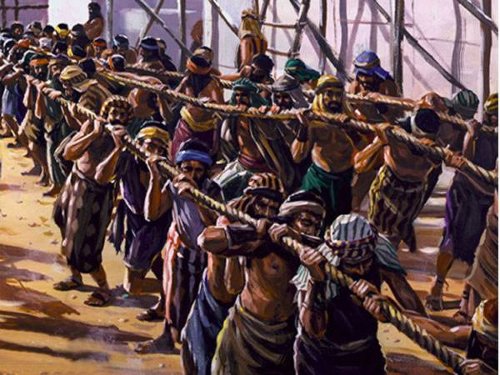
hebrew_slaves_egyptSay, therefore, to the Israelite people: I am the Lord. I will free you from the labors of the Egyptians and deliver you from their bondage. I will redeem you with an outstretched arm and through extraordinary chastisements. And I will take you to be My people, and I will be your God. And you shall know that I, the Lord, am your God who freed you from the labors of the Egyptians.

Exodus 6:6-7 (JPS Tanakh)

G‑d reveals Himself to Moses. Employing the “four expressions of redemption,” He promises to take out the Children of Israel from Egypt, deliver them from their enslavement, redeem them, and acquire them as His own chosen people at Mount Sinai; He will then bring them to the land He promised to the Patriarchs as their eternal heritage.

from “Va’eira in a Nutshell”
Commentary on Torah Portion “Va’eira
Chabad.org

I had coffee with a friend after work on Wednesday. We see each other irregularly these days, but our conversations are always good. The main reason we met was because he wanted to borrow my copy of Boaz Michael’s book Tent of David: Healing the Vision of the Messianic Gentile. This, of course, was also one of the primary topics of our talk as I sipped my coffee and he sampled his tea.

One of the things I value about our relationship is that we don’t always see eye-to-eye. We never argue and conversations never become heated, but we do see things from different points of view. I think he’s interested if not intrigued about my return to church (although this could be projection on my part) and he struggles with the implications of going back into the church after having been “redeemed” from it. It’s an interesting metaphor.

In our discussion, he likened leaving the church to the Children of Israel leaving Egypt. It’s not a complementary picture of the church that he’s painting, but it’s one that I’ve encountered on numerous occasions during my sojourn in the Hebrew Roots movement. Egypt represents nothing good spiritually and morally and leaving Egypt is always seen as a positive action on the part of God toward the Israelites. But can non-Jewish believers leaving the church be seen in the same way? If the church equals Egypt, torment, and slavery, and being released from all that means coming closer to God, then when a Christian leaves church, where do they (we) go that is better and what do they (we) do when they get there?

Let’s back up a minute. In Judaism the process of God rescuing the ancient Hebrews from their slave status in Egypt and bringing them to Himself at Sinai involves what is called the “four expressions of redemption” based on the above-quoted Exodus 6:6-7. But what are these four expressions and what do they mean?

According to the Ask the Rabbi column at Ohr Somayach, they are:

  1. “I will take you out from under Egypt’s burdens – Vehotzeiti
  2. “And I will save you from their servitude – Vehitzalti
  3. “And I will redeem you – Vega’alti
  4. “And I will take you as My nation – Velakachti

This is actually a commentary on the four cups we see during a traditional Passover seder. The Ohr Somayach Rabbi further states:

We didn’t go from a slave nation to being the Chosen People at Mount Sinai overnight. There were different stages of redemption. The above phrases described these different stages. Each cup of wine represents one of these levels.

leaving_egyptThat’s fine as far as it goes, but to me, it’s not very revealing, especially if we are trying to compare these four expressions to how we might view a non-Jewish Christian leaving the church (which is being equated to Egypt).

OU.org expands on the meaning of the four expressions thus:

According to R. Bachya (Spain, 1263-1340), the explanations of the Four Expressions are as follows:

  1. “I will take you out” – Hashem would remove the slavery even before the Jews left Egypt, from all the Tribes of Israel, because of the growing perception by Egypt of Hashem, the G-d of Israel, as the One Almighty G-d.
  2. “I shall save you” – Hashem would take the Jews out of Egypt with plagues visited upon the Egyptians, their Pharaoh and their gods, “with a strong hand and an outstretched arm.”
  3. “I shall redeem you” – Hashem would perform the miracle of “Kriat Yam Suf,” the Splitting of the waters of the “Yam Suf,” and the creation of a dry path for the Children of Israel to walk upon as they crossed the Sea of Reeds. Then Hashem caused the piled-high waters to descend in a tidal wave upon the Egyptian Army, to permanently crush the World-dominating power of Egypt.
  4. “I shall take you” – Hashem took the Jewish People to Himself as a Kingdom of Priests and a Holy Nation. This was the spiritual component of the Redemption from Egypt. In fact, the spiritual Redemption was the Reason for the Physical Redemption.

The fifth expression, “I shall bring you to the land,” refers, of course, to the Land of Israel…

I must admit, I’m having a tough time mapping what I’ve been quoting from above to any image of why Christians should leave the church and where they are supposed to go. On the other hand, I’m kind of biased and truth be told, it wasn’t that many years ago that I might have accepted my friend’s metaphor relative to the Hebrew Roots movement.

But consider this. If Hebrew Roots is supposed to be the “Sinai” for Christians leaving the church, is it an attainable goal and is it right and accurate to say the church is Egypt in a spiritual (or any other) sense?

The Christians who, throughout the ages, have propagated this message and tried to soothe the hurting, feed the hungry, and speak to social injustice have been keeping the weightier matters of the Torah. Both Yeshua (Mark 12:31) and the Sages (Rabbi Hillel in b.Shabbat 31a and Rabbi Akiva in Sifra, Kedoshim 4:12) taught that love of neighbor is the essence of Torah. These are non-trivial accomplishments which speak to the robust, biblical ethical system which many devout Christians have embraced.

-Boaz Michael
“Chapter One: The Church is Good,” pg 49
Tent of David: Healing the Vision of the Messianic Gentile

You’ll have to read all of Boaz’s book to get the full flavor of why the church is good, but I believe he paints a very convincing picture of the modern “body of Christ” as it lives and breathes within the multitude of churches in our communities and around the world. Even today in the lives of people I know, Christians are doing wonderful acts of kindness in the name and spirit of Messiah.

We are seriously getting love aimed at us by a little church nearby. Out of the blue, the pastor had contacted me wanting to know if some of their members could do anything for us and he wouldn’t take no for an answer unless it really was no.

Today some amazingly nice folks showed up and hauled off to the dump our junk too big for our own vehicle, in one of the guy’s large truck.

Meanwhile, the ladies scoot in to do some cleaning while visiting with Heidi.

And meanwhile another great guy is walking me around our deck, explaining to me how he is going to prep the bannister and then paint it for us.

And they’re coming back tomorrow!

-Joe Hendricks

I originally quoted Joe in a blog I published last June. Sadly, since that time, Joe’s wife Heidi passed on, but the church he mentions continues to be a support in his life as he grieves and as he yet looks to the future by the grace of Christ.

afraid-of-churchThe church isn’t perfect. In fact, It’s taken quite awhile for me to overcome my own misgivings about going back to church (which can be reviewed in all their glorious details in my recent “Days” series, which culminated at Day Zero). In fact, I still periodically have to review Pastor Jacob Fronczak’s blog post Why I Go to Church to remind myself that a community can be imperfect and still be the will of God for the good.

So if the church isn’t Egypt, then do we have to be delivered from it? Is there someplace better to go to and what do we call it?

I can’t answer for every person out there who has once been in the church and, for whatever reasons, left it, either for some other religious organization or to pursue God as a solidary individual or family. I can only speak for myself and how I express my evolving understanding of God’s will for my life.

I don’t think we can get back to the “root” of our faith. I know that’s disappointing and maybe some of you disagree with me, but hear me out. At some point about 2,000 years ago, a sect  called “the Way” rose among the other movements in Judaism in the late Second Temple period. The Jewish disciples were devoted to a “dead Rebbe” rather than a living teacher, one who they said not only died, but rose again. He is the Mashiach, the Son of the Living God (Matthew 16:16), who sits at the right hand of the Father (Psalm 16:8, Psalm 110:1, Acts 2:33), and who is the High Priest in the Court of Heaven (Hebrews 4:14).

The “Christianity” of that moment in history was a wholly Jewish religious movement and it co-existed with numerous other Jewish movements in Roman occupied “Palestine” in those days. Acts 10 shows the first non-Jew who came into discipleship under Messiah within this sect without converting to Judaism, and the “ministry” of Paul, who as an emissary to the Gentiles, preached a Gospel not given by men but by Jesus Christ (Galatians 1:11-12). As more and more Gentiles in the diaspora began to hear the “good news” of the Jewish Messiah and apply it to their lives, slowly the Gentiles and Jews within the “Jesus movement” began to trace somewhat divergent trajectories. Those slight deviations in trajectory would later lead them on completely different paths through the progression of history, and for centuries now, they have both identified themselves as two completely different religions that once shared a common point.

Should Christians seek to leave the church and travel backward across the timeline, trying to recapture whatever idealized or “perfected” Christianity that may (or may not) have existed somewhere around the mid 40s CE? Is it even possible?

Or does the path that God has set before us lead forward into the future…a future that will summon the risen Messiah to come out of the sky in the clouds (Revelation 1:7), who will redeem his people Israel, and who will also gather his disciples from the nations? If this future-oriented path is the true one, then perhaps there is no “perfect Christianity” to go back into upon “leaving the church.” Regardless of whatever Christian or Jewish worship venue to which you are attached (including any form of Hebrew Roots or Messianic Judaism), chances are, you don’t belong to a perfect community. Chances are people in your congregation make mistakes. Chances are, when scrutinized by the King of All Glory, your theology may not be absolutely and totally 100% “kosher.”

Chances are, there is no perfect church, synagogue, community, or congregation for you or for any of us to join upon leaving “church.” Face it. All congregations that involve human beings and human relationships are “messy.” We have to start with where we are, not where we’d like to be.

Yes, the church could be improved. That’s the other very valuable (to me) chapter in Boaz’s book, “Chapter 2: The Church Needs to Change.” Frankly, we could also probably say, relative to God’s perfect understanding, that the synagogue needs to change as well. A better way to say it is that we all need to change, to be better, to draw nearer to God, to refine our understanding of who He is and who we are in Him, Jew and Christian alike. We travel upon our divergent trajectories but we have one Shepherd and one King, and God is One. Not that our ultimate unity under Him as His “peoples” means uniformity, but it does mean unity of devotion and fealty.

The Messiah will come. He will return Israel to its place as the head of all the nations, rebuild the Temple, defeat evil, and establish a reign of peace and tranquility for all peoples of the earth. All the Jewish people will be gathered unto him in their nation Israel, and we believers who reside across the four corners of the Earth will bow our knees to him and call him Lord over all (Romans 14:11, Philippians 2:10). That is our future.

But we’re not there yet.

two-roads-joinWe have to start where we are. If we are non-Jewish Christians in church, we should stay in church. We should bring our understanding of the Jewish Messiah King to where we are, not remove it from our fellow believers and hoard it for ourselves. If we are Gentiles in a Messianic community, then we should stay there (though there may be exceptions who will also attend a church) and use other platforms for communicating our understanding to the Christians we know or will come to know (compare to 1 Corinthians 7:18). For myself, I go to church not to change anything but to encounter God and His purpose for me, whatever it may be.

We may not always see the good in the church but it’s there. We may not see it because when we were introduced to the Hebrew Roots movement (for those of you reading this who are or were involved in Hebrew Roots), we were told the “church is Egypt.” However, if it’s been awhile since you’ve taken a look at the church, at the Christians in your community, at the believers you work with, live near, and consider friends, maybe it’s time you took another look. There are indeed two paths involved, but they’re not the two you have been imagining.

There are two paths:

One: Everything is for the good. Perhaps not immediately, but eventually good will come out from it.

The other: Everything is truly good—because there is nothing else but He who is Good. It’s just a matter of holding firm a little longer, unperturbed by the phantoms of our limited vision, unimpressed by the paper tiger that calls itself a world, and eventually we will be granted a heart to understand and eyes to see.

Eventually, it will become obvious good in our world as well.

-Rabbi Tzvi Freeman
“Believing in G-d”
Based on letters and talks of the Rebbe
Rabbi M. M. Schneerson
Chabad.org

To modify Rabbi Freeman’s commentary slightly, everything we encounter is for the good, and eventually good will be demonstrated by the church. We must be patient and help as we can. Also, everything in church is truly good because nothing else exists in our world but God who is Good (Mark 10:18). It’s just a matter of us holding on a little longer where we are, not allowing our limited vision of how we see Christianity to limit God’s work in the church.

Eventually, the good of God and of the body of Christ in our world will become obvious to us as the time for the return of our Master draws near.

Good Shabbos.

Remembering Jerusalem

poor-israel…and when James and Cephas and John, who seemed to be pillars, perceived the grace that was given to me, they gave the right hand of fellowship to Barnabas and me, that we should go to the Gentiles and they to the circumcised. Only, they asked us to remember the poor, the very thing I was eager to do.

Galatians 2:9-10 (ESV)

James, Peter, and John gave Saul and Barnabas “the right hand of fellowship.” They commissioned them to go to the Gentiles while they themselves continued to witness Messiah to the Jewish people. Saul says, “They only asked us to remember the poor – the very thing I also was eager to do” (Galatians 2:10). How should this single caveat be understood?

It does not mean the apostles laid upon the Gentile believers no greater obligation to Torah than the commandment of giving charity generously to the poor. Saul did not say, “Only they asked the Gentiles to give charity to the poor.” He said, “Only they asked us to remember the poor.” In this context, “us” must be Saul and Barnabas.

In his commentary on Galatians, Richard Longenecker identifies “the Poor” in Galatians 2:10 as a shorthand abbreviation for the longer title that Paul gives them in Romans 15:26, where he refers to them as “the poor among the saints at Jerusalem…” Saul and Barnabas were to remember the Poor Ones of the apostolic assembly of believers in Jerusalem: the pillars, the elders, the assembly of James and the apostles.

D. Thomas Lancaster
Torah Club, Volume 6: Chronicles of the Apostles
from First Fruits of Zion (FFOZ)
Torah Portion Va’era (“and I appeared”) (pp 362-3)
Commentary on Galatians 2:1-18, Acts 12:25

I’ve talked about charity very recently. It was less than two months ago that I discovered that some folks at the church I attend believe that Christians have a special duty to support the poor of Israel based on the following:

Then the righteous will answer him, saying, ‘Lord, when did we see you hungry and feed you, or thirsty and give you drink? And when did we see you a stranger and welcome you, or naked and clothe you? And when did we see you sick or in prison and visit you?’ And the King will answer them, ‘Truly, I say to you, as you did it to one of the least of these my brothers, you did it to me.’

Matthew 25:37-40 (ESV)

I was trying to describe this to my (Jewish) wife just the other day, but I’m not sure she believed me. It’s not typical behavior from many churches. On the other hand, as we see from Lancaster’s teaching on Galatians 2, there is a rather clear Biblical precedent for the Gentile believers to “remember” the poor of Israel.

OK, I know that according to Lancaster, James and the Apostolic council was telling Saul (Paul) and Barnabas to remember the poor of Israel, but look at the context. On the very heels of the council validating Paul’s mission to the Gentiles to bring them to covenant relationship with God through Messiah without requiring that the Gentiles convert to Judaism, and sending Paul and Barnabas back to the Goyim with their good graces, James, Peter (Cephas), and John added the caveat to remember the poor. How could that message then not be transmitted by Paul from the Apostolic council to the Gentiles in the diaspora?

Still don’t believe me?

Now concerning the collection for the saints: as I directed the churches of Galatia, so you also are to do. On the first day of every week, each of you is to put something aside and store it up, as he may prosper, so that there will be no collecting when I come. And when I arrive, I will send those whom you accredit by letter to carry your gift to Jerusalem.

1 Corinthians 16:1-3 (ESV)

We want you to know, brothers, about the grace of God that has been given among the churches of Macedonia, for in a severe test of affliction, their abundance of joy and their extreme poverty have overflowed in a wealth of generosity on their part. For they gave according to their means, as I can testify, and beyond their means, of their own accord, begging us earnestly for the favor of taking part in the relief of the saints…

2 Corinthians 8:1-4 (ESV)

Which “saints” do you think Paul was taking about?

It sure looks like Paul was imploring, directing, even commanding the Gentile churches in the diaspora to take up a collection to be used as a donation to the poor among the Apostolic community in Jerusalem, even from the poor among the Gentile churches.

poor-israel2I’m not trying to beat a dead horse, I’m trying to inspire some life in the one we have, but the one we often ignore, most likely through ignorance. I said just yesterday that we translate and interpret the Bible based on our traditions and theologies. The obligation of the Christian church to support the poor among Israel has fallen through the cracks of our creaky theology for nearly twenty centuries. It’s time to fix the floorboards, firm up the foundation, and take back the responsibility that we were given by the first Apostles and the men who walked with Christ.

This does not absolve us of our responsibility to the poor of the nations, the poor of our country, our city, within our neighborhoods and our own churches. But it opens the door in our lives and in our spirits to remember Jerusalem, to remember Israel, and God’s special covenant people, our mentors, and the root of our salvation.

If I forget you, O Jerusalem, let my right hand forget its skill! Let my tongue stick to the roof of my mouth, if I do not remember you, if I do not set Jerusalem above my highest joy!

Psalm 137:5-6 (ESV)

If you’re hard pressed to know where to begin, then consider visiting meirpanim.net, colelchabad.org, or chevrahumanitarian.org. That’s just for starters.

Searching for the Writer of Life

writer-of-lifeThe Jews recognized that God no longer spoke to them in the same way as in the past. The prophets who persisted in seeing heavenly visions and hearing heavenly voices saw and heard in a manner very different from those of earlier times. As a consequence (cause?) of the cessation or permutation of prophecy, the Jews began to seek the word of the Lord not from people but from texts. The sacred traditions of the past were compiled and redacted, and the Torah was created. The words of the great prophets of the past were similarly compiled and redacted. This process, whose ultimate result was the formation of the Bible, raised two important questions. First, which books were to be considered canonical? Second, how were the canonical books to be interpreted, and who was authorized to interpret them?

-Shaye J.D. Cohen
Chapter 5: Sectarian and Normative, pg 126
From the Maccabees to the Mishnah, 2nd Ed

It is one of the oldest puzzles in the world. Investigators have been wrestling with it practically since the Bible was completed. As it happens, it did not start as an investigation into the authorship of the Bible. It simply began with individuals raising questions about problems that they observed in the biblical text itself. It proceeded like a detective story spread across centuries, with investigators uncovering clues to the Bible’s origin one by one.

It began with questions about the first five books of the Bible: Genesis, Exodus, Leviticus, Numbers, and Deuteronomy. These books are known as the Pentateuch (from Greek, meaning “five scrolls”) or the Torah (from Hebrew, meaning “instruction”). They are also known as the Five Books of Moses. Moses is the major figure through most of these books, and early Jewish and Christian tradition held that Moses himself wrote them, though nowhere in the Five Books of Moses themselves does the text say that he was the author. But the tradition that one person, Moses, alone, wrote these books presented problems.

-Richard Elliott Friedman
Introduction: Who Wrote the Bible? pp 15, 16-17
Who Wrote the Bible?

Yes, this is a continuation of yesterday’s morning meditation. I was prompted by the mention of Friedman’s book on Derek Leman’s blog post to check and see if my local public library had a copy available. It did and so I checked it out over my lunch hour (I work about a ten minute walk from the Boise Public Library’s main branch).

Depending on your thoughts and feelings about the origins of the Bible we have today, this could be dangerous stuff. In fact, questioning the traditions we have about the Bible has historically been very dangerous stuff.

At the first stage, investigators still accepted the tradition that Moses wrote the Five Books, but they suggested that a few lines were added here or there. In the eleventh century, Isaac ibn Yashush, a Jewish court physician of a ruler in Muslim Spain, pointed out that a list of Edomite kings that appears in Genesis 36 named kings who lived long after Moses was dead. Ibn Yashush suggested that the list was written by someone who lived after Moses. The response to his conclusion was that he was called “Isaac the blunderer.”

-Friedman, pp 18-19

But that’s not the half of it.

He (Bonfils) still thought that the passages in question were written by “one of the later prophets.” He was only concluding that they were not written by Moses. Still, three and a half centuries later, his work was reprinted with the references to this subject deleted.

Van Maes suggested that a later editor inserted phrases or changed the name of a place to its more current name so that readers would understand it better. Van Maes’ book was placed on the Catholic Index of Prohibited Books.

De la Peyrere’s book was banned and burned. He was arrested and informed that in order to be released he would have to become Catholic and recant his views to the Pope. He did.

Spinoza had been excommunicated from Judaism. Now his work was condemned by Catholics and Protestants as well. His book was placed on the Catholic Index, within six years thirty-seven edits were issued against it, and an attempt was made on his life.

Simon was attacked by other Catholic clergy and expelled from his order. His books were placed on the Index. Forty refutations of his work were written by Protestants. Of the thirteen hundred copies printed of his book, all but six were burned.

-Friedman, pp 18-21

jewish-traditionAt least up to the 17th century, it was worth your life to suggest that Moses didn’t literally write every single word that appears in the first five books of the Bible. Jewish, Catholic, and Protestant tradition vehemently defended this viewpoint and if you were a scholar who studied such matters, it was better to keep any opinions that deviated from tradition strictly to yourself.

But what about now? Are we as a body of believers more tolerant of serious, scholarly study of the Bible?

The answer is probably yes and no. I don’t believe that anyone in the modern era has ever been put in prison or (gulp) executed for having non-traditional beliefs about the Bible, but you rarely hear controvertial views on scripture spoken of in a Sunday morning sermon. For that matter, how much controversy about the Bible makes its way into the Rabbi’s discussion of the Torah portion on Shabbat?

In addition to the written scriptures we have an “Oral Torah,” a tradition explaining what the above scriptures mean and how to interpret them and apply the Laws. Orthodox Jews believe G-d taught the Oral Torah to Moses, and he taught it to others, down to the present day. This tradition was maintained only in oral form until about the 2nd century C.E., when the oral law was compiled and written down in a document called the Mishnah.

-from “Torah: Oral Torah, the Talmud”
Judaism 101

Within these four methods of understanding Torah, there exist countless possible avenues of understanding. For example: There are many different ways to understand the Torah according to Peshat. That’s why there are many Torah commentators who concentrate on Peshat — Rashi, Ibn Ezra, Rashbam and many more – and they will very often (it seems, more often than not…) disagree on the literal meaning of a verse. In fact, according to Kabbalastic teachings there are 600,000 ways to understand Peshat, 600,000 ways to understand Remez, 600,000 ways to understand Drush, and 600,000 ways to understand Sod!

Any insight in Torah is acceptable as long as it (makes sense and) does not contradict any of our fundamental beliefs.

-Rabbi Naftali Silberberg
“How is the Torah Interpreted?”
Chabad.org

My wife tells me that in Judaism, one does not interpret Torah outside of tradition, so at least from an Orthodox point of view (her perspective was likely learned from the local Chabad Rabbi), it would be unacceptable practice to consider interpreting Torah from any viewpoint other than established Jewish halachah.

But what about Christianity?

The Bible is God’s Word. But some of the interpretations derived from it are not. There are many cults and Christian groups that use the Bible, claiming their interpretations are correct. Too often, however, the interpretations not only differ dramatically but are clearly contradictory. This does not mean that the Bible is a confusing document. Rather, the problem lies in those who interpret and the methods they use.

We need, as best as can be had, the guidance of the Holy Spirit in interpreting God’s Word.

Because we are sinners, we are incapable of interpreting God’s word perfectly all of the time. The body, mind, will, and emotions are affected by sin and make 100% interpretive accuracy impossible. This does not mean that accurate understanding of God’s Word is impossible. But it does mean that we need to approach His word with care, humility, and reason. Additionally, we need, as best as can be had, the guidance of the Holy Spirit in interpreting God’s Word. After all, the Bible is inspired by God and is addressed to His people. The Holy Spirit helps us to understand what God’s word means and how to apply it.

On the human level, to lessen the errors that come in our interpretations, we need to look at some basic biblical interpretive methods. I’ll list some of the principles in the form of questions and then apply them one at a time to a passage of Scripture.

-Matt Slick
“How to Interpret the Bible”
Christian Apologetics and Research Ministry

You can click on the link I provided to read Mr. Slick’s ten principles for interpreting the Bible and everything else he has to say. I selected this resource basically because it was at the top of the Google search results for the “how do christians interpret the bible” search string. However, Mr. Slick and the carm.org web site don’t address the role of tradition in interpreting the Bible (except unintentionally by mentioning more than once that in Christian tradition, the Holy Spirit is required and considered always available to interpret the Bible).

How the Bible is translated from its ancient languages to English, for example, is driven by theology and tradition. Consider how Christian and Jewish translators address the text of the “Old Testament” let alone how they interpret its meaning. Sure, for the most part, reading a Christian Old Testament and a Jewish Tanakh will produce a similar experience, but it won’t be identical. Also consider, for example, how the text of Isaiah 56 is interpreted between Christians and Jews. Christianity largely believes that the Messiah, that is, the Christ, is being described, while its traditional in Judaism to say that Israel itself is the “suffering servant.”

Sofer-Sefer-TorahNot only is the origin of the Bible understood by various traditions, but what the text is supposed to mean is also interpreted in that manner, at least for the most part. I don’t doubt that there are certain individuals who are willing to take a wider look and a less dogmatic approach to the Bible, and certainly there are numerous scholars who will broach the subject of the authorship of the Bible, but how many of us, the “rank and file” of the church (or synagogue) are willing to take such a risk?

I say “risk” because if we aren’t able to detach our traditions from our faith, at least temporarily, in the study of the Bible, then we are likely to find ourselves approaching the edge of a very steep precipice and risk falling into the abyss of crisis. For some people, faith hangs in the balance.

But so does enlightenment. Frankly, if your faith can’t stand being shaken up a time or two, it probably isn’t very strong. Also, no one grows spiritually by playing it safe. Sure, it’s comfortable, and nice, and warm, and cozy inside the cocoon of tradition and pre-programmed belief systems, but who we are as disciples of the Master requires a modicum of courage at a minimum. Paul commended the Bereans (Acts 17:11) for examining the scriptures daily in order to verify what Paul was teaching. Can we do any less when addressing the scriptures themselves, including their sometimes mysterious authors?

Some people who do this, exit faith completely, unable to reconcile their relationship with God with the dissonance about the Bible. Some people abandon critical examination of the Bible and retreat into their former comfort zone, manufacturing some explanation about why such an examination is in error if not heretical. But some people actually grow.

I’m finding that Cohen’s and Friedman’s books seem to work well when read in parallel. However, it is important (to me, anyway) to stay grounded in the world of faith and not to stray too far into the area of objectification of the Bible. I still “just plain read” the Bible every day and more recently, I go to church every week. Every other week, I meet with a friend who has been a Christian for forty years. All this acts as an anchor on the shore as I also choose to explore deep (well, deep for me) waters.

In his book (Chapter 5), Cohen writes:

Judaism is a relativistic construct of human beings, and no variety of Judaism is any more correct or authentic than any other. This is the perspective of the historian.

Judaism is a body of absolute truths revealed by God and/or sanctioned by tradition, and those interpretations of Judaism that are more nearly approximate these absolute truths are truer and more authentic than those that do not. This is the perspective of the believer.

Following those definitions, of himself, Cohen writes:

In this book, I write as a historian.

I can see how the above definitions can be applied to how we view Christianity as well as Judaism, so it is possible to look at the Bible and its origins from either the historian’s or the believer’s point of view. I’m a believer but it is my opinion that my life as a believer can be enhanced by also looking at the Bible as a historian (with the aid or real historians and scholars such as Cohen and Friedman). It’s an adventure and as such, it presents a set of challenges and dangers.

If that doesn’t scare you off, I invite you to participate in the adventure along with me as I continue to read and comment upon Cohen and Friedman and their revelations about the Bible, tradition, history, and faith. May we all learn together and may we all draw closer to the One who is the Author of our lives and the Lover of our souls.

Missing Author

empty-bibleWho wrote the Torah? Most people you ask — depending on your circle of friends — will answer, “A group of very wise men got together and wrote it.” For the past 3,300 years the Jewish people have lived with the consciousness that the Almighty dictated the Torah to Moses who wrote it down word for word, letter by letter. Every Torah-educated Orthodox Jew believes that. Are they fools, fantasizers, misguided religious fanatics?

It will surprise some people to know that for the past 3,300 the Jewish people have taught their children the evidence for the belief that there is a God and that He dictated the Torah to Moses. Actually, I am sure that for the first hundred or two hundred years after the giving of the Torah at Mt. Sinai the authorship of the Torah was not even a question. For generations all a Jewish child had to do was to ask his father if he was at Mt. Sinai or if his father or grandfather was there. Even Moses himself tells all generations to “Go and ask … has a people ever heard the voice of God speaking … as you have heard and survived?” (Deuteronomy 4:32-35).

-Rabbi Kalman Packouz
“Shabbat Shalom Weekly”
Commentary on Torah Portion Vaeira
Aish.com

This post may trouble some readers. It really shouldn’t. Religious leaders in some circles have sought to suppress the overwhelming evidence that something like the Documentary Hypothesis is true. Attacks against this idea usually claim that those who believe this theory simply disbelieve God. Such attacks also tend to refer to Julius Wellhausen and his views, which actually do not represent what is essential about the Documentary Hypothesis. The Documentary Hypothesis (DH) has many forms and is better known as JEDP. In my opinion, the best developed understanding of the DH is found in Richard Friedman’s work, including the very readable Who Wrote the Bible? (which was a bestseller).

-Derek Leman
“Exodus 6:2-3 and the Documentary Hypothesis”
Messianic Jewish Musings

I haven’t revisited this topic in a long time and even after I read Derek’s blog post, I was determined not to regurgitate it again from the murky depths so that it could come back up into the cold light of day. Then I read Rabbi Packouz and I was reminded that there is a fair distance between the stories we tell ourselves about the Bible and the story that the Bible tells us about itself (I know these gentlemen are specifically discussing the Torah, the Five Books of Moses, but I’m choosing to expand the discussion to the Bible as a whole).

I don’t mean the story the Bible tells in the actual text, but the history and evolution of the creation of the Bible as we have it today. I’m no scholar, but even I’ve read enough to realize that the Bible has lots and lots of warts, bruises, wrinkles, and other imperfections. No reliable and trustworthy Bible scholar would suggest that God literally dictated the Bible word-for-word to its various human authors.

So where is God in the Bible? No I don’t mean where is God mentioned, but is there anything of God in the actual composition of the Bible? Or is the Bible just the stories we tell ourselves about it? Frankly, we have told ourselves some pretty interesting stories about the Bible.

One way to establish and support an acceptance of Talmudic interpretation and judgment relative to Torah for post-Second Temple Judaism is to project the values and even the “reality” of Talmud (and later, Kabbalah) not only forward in time but backward. Peering at the Patriarchs through this lens, we can indeed “see” Abraham, Isaac, and Jacob studying Torah and Talmud in the study house of Shem when by historical knowledge and a plain reading of the Torah, such events seem very unlikely to have actually taken place.

-from my blog post:
The Rabbinization of Abraham

study-in-the-darkI periodically wrestle with this issue. Back on my previous blog, I wrote such articles as Reading the Bible in the Dark, The Bible is a Mystery Novel, and Who to Believe. I manage to “tame” the questions and conundrums by reading the Bible as if it were a series of Chassidic, or in my case, Messianic Tales. Maybe that’s the only way to make sense of the Bible, and especially the Gospels.

He read the Gospels in German. Then he obtained a Hebrew version and reread them. Though he was in the midst of a Gentile, Christian city where Jesus was worshiped in churches and honored in every home, Feivel felt the Gospels belonged more to him and the Chasidic world than they did to the Gentiles who revered them. He found the Gospels to be thoroughly Jewish and conceptually similar to Chasidic Judaism. He wondered how Gentile Christians could hope to comprehend Yeshua (Jesus) and His words without the benefit of a classical Jewish education or experience with the esoteric works of the Chasidim.

Taken from Jorge Quinonez:
“Paul Philip Levertoff: Pioneering Hebrew-Christian Scholar and Leader”
Mishkan 37 (2002): 21-34
as quoted from Love and the Messianic Age

But this presents a problem. During last Sunday’s sermon, Pastor said (I don’t have my notes with me, so what I’m about to write isn’t an entirely accurate quote) that the only way to show an unbeliever how to encounter God and come to faith in the Father through Jesus Christ is by reading and using scripture.

Um…whoa. Waitaminute.

Given everything I’ve said above, plus Derek’s commentary, plus just a boatload of Biblical scholars , scripture is not and cannot be the literally dictated words of the God of Heaven as whispered into the little, shell-like ears of the prophets and other writers of the books of the Bible.

In fact, I’m hard-pressed to tell you what the Bible is and who actually wrote it. Even portions of the New Testament weren’t in all likelihood, written by the people whose names are attached to them. Not all of the epistles written by Paul? Probably not. Did the Apostle John who (supposedly) wrote the Gospel of John also write Revelation?

Once you stop taking the Bible for granted, a lot of new territory opens up in front of you…in front of me.

In defense of the Bible (the Torah actually), Rabbi Packouz has this to say:

Perhaps the most powerful example is Shmitah (the Sabbatical year for the land). Modern agriculture science has taught us the value of letting the land rest and replenish itself. A sensible law would be to divide the Land of Israel into 7 regions and each year let one region lie fallow while people eat from the crops of the other 6 regions. However, that’s not the law of the Torah! The Torah writes, “For six years you may plant your fields … but the seventh year is the Sabbath of the land in which you may not plant your fields nor prune your vineyards (Leviticus 25:36).

The WHOLE land is to rest all at the same time! What happens to an agrarian society that stops farming for one year? Starvation! And how long does a religion last that advocates letting the whole land rest in the 7th year? My guess … about 6 years!

Perhaps they could avoid starvation by buying food from surrounding countries? A good idea and a reasonable idea … but the Torah has other plans. The Almighty says, “I have commanded My blessing to you in the sixth year and you will have produce for three years” (Leviticus 25:20-22).

Either one has to be God to have the “audacity” to make a law for the whole land to rest and then to promise a bounty crop 3 times as large as usual in the sixth year — or a stark raving mad lunatic!

Yet, the Jewish people neither starved nor abandoned the Torah! 3,300 years later a sizable portion of our people still adhere to the laws of Torah and still trust in the promises of the Almighty!

How could any human being promise in writing something that requires powers totally beyond his control?

And furthermore, why would anyone be willing to risk his own credibility and the legitimacy of his religion, when it would be easier to present a more rational solution and avoid the credibility issues.

Going to GodCan we accept that somewhere in the pages of the Bible we might actually be able to encounter the Divine? If so, where and how (apart from Shmitah)? If we can’t take the Bible as literally, page-by-page, the Word of God, then what do we consider it? If God is in there somewhere, then is it an intellectual and scholarly race to discover the secret location of the well of God’s Spirit?

Derek Leman seems to think that it’s possible to have a very questioning view of the Bible and yet still have faith:

People get from their religious background the idea that “Moses wrote all” or “Moses wrote almost all” of the Torah. For example, people will say “Moses wrote Genesis.”

This is complicated by things like Yeshua referring to “Moses and the prophets.” People take this to mean that Yeshua, who they suppose was omniscient during his earthly sojourn (but he was not) affirmed that Moses wrote all of Gen-Deut. He did not. His references to Moses actually writing all concern commandments, not narratives. With Moses as the originator of the commandments (or original vessel through whom they were revealed), all the five books are called “of Moses” but this need not mean authorship.

Anyway, because some of the earliest people to doubt Moses as the final author of Torah were skeptics, it is common for people to think anyone with a more complicated view than “Moses wrote it” are doing so because of a small faith or a lack of faith or a dislike of faith.

But I’ve never heard a satisfactory explanation of how other people do it. I only have how I do it and my “method” requires usually suspending disbelief for the sake of faith. I have encountered God before, so in an extraordinarily subjective way, I know He is real, He is alive, and He is God. I’m not going through the crisis of faith I had when I first faced this particular realization, but I do allow myself to periodically become aware of just how fragile a knowledge of God is if based solely on the Bible. On the other hand (and I’ve alluded to this already), basing knowledge of God solely on our experiences with the Holy Spirit can be just as hazardous, because most human beings have very little ability to tell the difference between an emotional experience and a spiritual one (barring the occasional saint or tzaddik).

I may not be able to take everything I read in the Bible and everything that Christianity and Judaism says about those events as actual, factual events (though some of them probably are), but I can still take what I read and what I study and try to apply them so that I can learn to live a better life.

The Patriarch Abraham was tested (by God) ten times and withstood them all. This proves Abraham’s great love for God.

-Ethics of the Fathers 5:3

Abraham was tested with ten trials of progressively increasing severity, ultimately culminating in the test of sacrificing his beloved son Isaac if God so willed.

Abraham successfully passed all the tests. Still, while he did demonstrate his intense loyalty and devotion to God, how did it prove his love for God?

In yesterday’s message we learned that God does not challenge people beyond their capacities. It follows, then, that as they advance in spiritual growth and strength, they actually render themselves vulnerable to trials of greater intensity. In the course of his many trials, Abraham detected this pattern. He could have logically decided to avoid any further spiritual progression, because it might subject him to even greater ordeals than those he had already sustained.

Abraham decided otherwise. He desired so much to come closer to God that he was willing to pay any price. Thus, when he was put to the ultimate task – to sacrifice Isaac – Abraham was not taken aback. He had fully anticipated such an eventuality.

We are not of the mettle of Abraham, and we pray every day, “Do not put us to test.” While we indeed wish to advance spiritually, we ask to be spared the distress of trial. Yet, should we experience adversity in life, we would do well to realize that this may be a testimony to our spiritual strength.

looking-upToday I shall…

try to advance myself spiritually. Although I pray to be spared from distress, I will try not to recoil if adversity does occur.

-Rabbi Abraham J. Twerski
“Growing Each Day, Tevet 26”
Aish.com

Thomas Gray once penned the famous words, “Where ignorance is bliss, ’tis folly to be wise” (in the poem “Ode on a Distant Prospect of Eton College,” 1742). I suppose many “Bible-believing Christians” feel very blissful as long as they don’t consider the rather troubling questions I’m bringing up this morning. On the other hand, once the “bliss bubble” is popped, then we can only face the painful trial of reality, if not the wisdom, of whatever we have left.

Chances are, Abraham never faced the ten challenges, at least as we see chronicled in Pirkei Avot (but not the Bible). Chances are Abraham, Isaac, and Jacob never studied Torah in the academies of Shem and Eber as we learn from the Talmud. Maybe the only place we really encounter God is in our prayers. Or maybe we encounter God everyday, as long as we continue to seek Him.

According to Gedaliah Nigal’s book The Hasidic Tale, some of the goals of the hasidic story are to “rouse its hearers into action for the service of God” and to win “adherents, among them some outstanding individuals, to hasidim.” In relation to this, I’ve said:

The “Chasidim” of Jesus also made sure the stories of their Master were passed on from generation to generation, eventually being recorded and passed on to the future…to us.

Paul Philip Levertoff thought that the teachings of Jesus read like a collection of Chasdic tales. Perhaps as Gentile Christians reading tales of the Chasidim, we can also find a connection to the Messiah, the Prophet, and the greatest Tzadik, whose own death atoned for not just a few, but for all.

Having gone through all this again, I feel reassured.