All posts by James Pyles

James Pyles is a published Science Fiction, Fantasy, and Horror author as well as the Technical Writer for a large, diversified business in the Northwest. He currently has over 30 short stories published in various anthologies and periodicals and has just sold his first novella. He won the 2021 Helicon Short Story Award for his science fiction tale "The Three Billion Year Love" which appears in the Tuscany Bay Press Planetary Anthology "Mars."

The Sukkot Season of Joy

have-sukkah-will-travelSeven days shall you dwell in booths (Leviticus 23:42) … and you shall only be rejoicing (Deuteronomy 16:15).

Succos is the festival designated as the season of our gladness. Yet the commentaries state that one of the symbolisms of the succah, a temporary hut, is that we dwell in it for seven days to symbolize man’s temporary sojourn on earth for his average life span of seven decades (Psalms 90:10).

Human mortality is a rather sobering thought; it is hardly conducive to rejoicing. Most often we do not think about our mortality, and when circumstances force us to face it, we quickly dismiss it from our minds and go on acting as though we will live forever.

How different Torah values are from secular values! The Torah teaches us that there is an eternal life, a wholly spiritual life, whose bliss is far greater than the human mind can imagine. We are placed on this planet for our ephemeral earthly existence only to give us an opportunity to prepare for the eternal life.

The Torah teaches us to enjoy life, and if it restricts some pleasures, it is because we should enjoy life in a manner that befits a human being. Furthermore, our joy of living should not be diminished by the awareness of our mortality, nor need we deny it. The succah – the symbol of our temporary stay on earth – is beautifully decorated, and we enjoy our festive meals therein. Even our temporary existence can be beautiful and happy, and our faith in the eternal life should enhance that happiness.

Today I shall …

… try to enjoy life as befits a spiritual person, knowing that the true life of man is not the fleeting one, but that of eternity.

-Rabbi Abraham J. Twerski
“Growing Each Day, Tishrei 15”
Aish.com

I have to admit that at this time of year, sometimes I envy Jewish people. The traditions surrounding the celebration of Sukkot are so rich and full of life. Sure, I can build a sukkah and I can observe, to some degree, the same traditions, but I wonder what it must be like to have a life-long experience of such celebrations. What memories do Jewish people have of childhood, eating in a sukkah each year, “partying” with relatives and friends, singing, dancing, rejoicing?

I’ve come to the party far too late and worse, I was too late to bring my children. If I had been more timely, perhaps, my son would build a sukkah for his wife and child each year. Face it, in terms of traditions and spiritual depth, Sukkot has got Christmas beat all hollow.

I recently came across a Facebook page called Jewish People Around the World. The stories and photos of Sukkot observance are just fabulous. Certainly if, as Rabbi Twerski says, the Torah teaches us to enjoy life, then Sukkot is one of the crowning jewels of that Torah sentiment.

Rabbi Twerski also said this:

God wants us to enjoy worldly goods, but to do so in a manner that befits a spiritual people, a kingdom of priests and a holy nation.

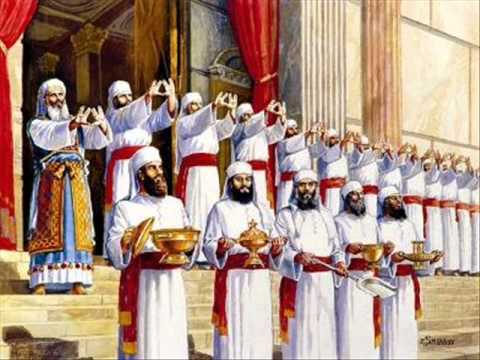
Sukkot_Priestly_BlessingSukkot, for all its focus on being a “season of joy” does not focus on just the individual seeking his or her own joy as another of Rabbi Twerski’s commentaries notes:

Rabbi Mordechai of Nesh’chiz looked forward all year to the mitzvah of the Four Species on Succos. Since a fine esrog was costly and Rabbi Mordechai was hardly a man of means, he would accumulate small coins all year round, even depriving himself of food, in order to be able to afford an esrog.

A few days before Succos, Rabbi Mordechai joyfully took the money he had saved, and in high spirits, went off to buy the coveted esrog. On the way, he encountered a man sitting at the side of the road, weeping bitterly. He inquired as to the reason for the man’s grief, and the latter told him, “Woe is to me! I earn my living with my horse and wagon, and this morning my nag died. How am I to feed my wife and children?”

“How much do you need to buy another horse?” Rabbi Mordechai asked.

The sum that the man specified was exactly the amount that Rabbi Mordechai had laboriously saved all year long for the esrog. Without giving it another thought, he gave his purse to the man. “Here, my dear man. Go buy yourself a horse’

After the man joyfully left with the money, Rabbi Mordechai said, “Oh well. All of Israel will be fulfilling the mitzvah of the Four Species with an esrog, but I will do so with a horse.”

Rabbi Mordechai’s sacrifice of his personal comfort all year round teaches us how precious is the mitzvah of the Four Species, but his final act teaches us that the mitzvah of tzedakah (charity) is even greater.

Today I shall…

… try to realize the greatness of the commandment of charity, to make certain that another person has the means to survive.

I mentioned Christmas before, which I suppose is the closest thing in Christian tradition to Sukkot (apart from Thanksgiving, which strictly speaking, isn’t a “Christian” holiday). I think for some Christians, teaching charity and giving is the focus of that holiday, but for most people, including most Christians, all attention is drawn on buying and consuming material goods for their own sake and for ours, not for the sake of other people.

Also, as we read in the first quote from Rabbi Twerski, Sukkot teaches us the difference between temporal, material values and those for the sake of Heaven, and yet even eternal values are celebrated with the joys of our material world. Our mortal life is much like living in a sukkah, while what is beyond can be compared to basking in the glory of God on His Throne.

If it comes down to experiencing our own joy and providing joy to others in material ways that summon the eternal, I say, is it too much to ask for both?

A Question of the Division of Abijah

levites-aaronic-blessingIn the days of Herod, king of Judea, there was a priest named Zacharias, of the division of Abijah; and he had a wife from the daughters of Aaron, and her name was Elizabeth.

Luke 1:5 (NASB)

I very recently wrote a blog post called Was He Born in a Sukkah and, based on a teaching by First Fruits of Zion (FFOZ) theologian and teacher D. Thomas Lancaster, I suggested that Jesus was not born either on Christmas or on Sukkot. I received some pushback as a result and some readers provided further evidence on how the Master was very probably born on Sukkot.

My original source was an article in Messiah Journal 111 (Fall 2012 issue) called “The Birth of Yeshua at Sukkot: Evidence from an Old Source” but I later listened to an audio CD of Lancaster teaching the same material. The audio contained more information that expanded upon Lancaster’s reasons as to why we can’t really know if Jesus was or wasn’t born on Sukkot.

I just found Lancaster’s sermon online at the Beth Immanuel Sabbath Fellowship website. If you click that link, you’ll be taken to the Audio page specific to the material. To listen to the relevant recording, scroll down until you locate “Birth of Yeshua at Sukkot.” At about 8:29 on the audio, Lancaster introduces the information about Zacharias (father of John the Baptist) that I’m also going to summarize here.

The strongest evidence anyone has presented me about Yeshua (Jesus) being born on Sukkot has to do with the timing of Zacharias’ service in the Temple. But let’s take a step backward:

Now in the sixth month the angel Gabriel was sent from God to a city in Galilee called Nazareth, to a virgin engaged to a man whose name was Joseph, of the descendants of David; and the virgin’s name was Mary. And coming in, he said to her, “Greetings, favored one! The Lord is with you.” But she was very perplexed at this statement, and kept pondering what kind of salutation this was. The angel said to her, “Do not be afraid, Mary; for you have found favor with God. And behold, you will conceive in your womb and bear a son, and you shall name Him Jesus. He will be great and will be called the Son of the Most High; and the Lord God will give Him the throne of His father David; and He will reign over the house of Jacob forever, and His kingdom will have no end.” Mary said to the angel, “How can this be, since I am a virgin?” The angel answered and said to her, “The Holy Spirit will come upon you, and the power of the Most High will overshadow you; and for that reason the holy Child shall be called the Son of God. And behold, even your relative Elizabeth has also conceived a son in her old age; and she who was called barren is now in her sixth month.

Luke 1:26-36 (NASB)

Here we see the angel Gabriel announcing to Miriam (Mary) that she has been chosen to be the mother of Jesus, and popular opinion states that at this time Mary was already pregnant or would become pregnant very soon afterward. We also see that her cousin Elizabeth was six-months pregnant with her child, John the Baptist. The Priest Zacharias is John’s father.

Remember, Zacharias is a Priest in the division of Abijah and we know, based on 1 Chronicles 24, the order of the service of the Priestly divisions. We know that the division of Abijah, like the other divisions, served twice a year for a full week each time. If we could figure out when the course of Abijah was, we could figure out when Elizabeth became pregnant (since she became pregnant immediately after the end of Zacharias’ service in the Temple), count ahead six months and then nine months, and then figure out the birthdate of Jesus.

But Lancaster says it’s not that easy.

First of all, there were 24 courses which meant that each division cycled through the year twice making 48 week-long courses in a year. But in the solar calendar, there are 52 weeks in a year, so unless there was some way to compensate, each course would drift across the calendar making it very difficult to determine when a particular division was serving at any given year.

D.T. LancasterThe assumption though is that the Abijah division was serving in the spring or the fall. But Luke doesn’t tell us what season it was when describing Zacharias’ service, so we have no way of knowing if it was during springtime or autumn.

On top of that, one out of every three years in the Jewish religious calendar contains 13 months. Rabbinic sources don’t tell us how or if the priesthood compensated for an extra four weeks in their calendar every three years. We assume that they must have, but without knowing the exact method they used, we’re stuck as far as calculating the timing of the service of divisions.

And after all that, the entire priesthood was called to serve during each of the three pilgrim festivals: Pesach, Shavuot, and Sukkot, and Lancaster says we can’t rule out that it was during one of the festivals that Zacharias was serving.

The icing on the cake, so to speak, is that experts don’t agree on whether the priestly rotation began on Nisan 1 or Tishrei 1.

Add all this up, and it becomes impossible to calculate when Zacharias served in the Temple in the Luke 1 text, and thus the entire basis for calculating the birth of Messiah disintegrates like wet tissue paper.

Since this is just a summary, I encourage you to click on the link I provided above and listen to the entire recording for yourself. I can’t speak for Lancaster, but unless some additional data comes to light that modifies everything I just said, the information about Zacharias and the Abijah division of priests is a dead-end in terms of discovering the birthdate of the Master.

V’Zot HaBerachah: Hanging on a Peg

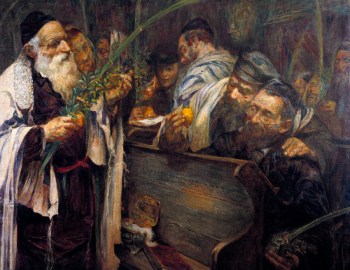
Sukkot In The Synagogue. Leopold Pilichowski (1869-1933). Oil On Canvas.“And this is to Yehudah, and he (Moshe) said, ‘Listen Almighty to the voice of Yehudah”

Deuteronomy 33:7

What does this verse refer to?

Rashi teaches us that Moshe is referring to the prayers of the kings of Yehudah: David, Asa, Yehoshofot and Chizkiyah.

The Midrash elaborates: There were four kings and each one asked the Almighty for different things. King David asked that he should be able to pursue his enemies and vanquish them. King Asa said, “I don’t have the ability to kill my enemies. Rather, I will pursue them and You Almighty should vanquish them.” King Yehoshofot stood up and said, “I don’t have the ability to vanquish my enemies or even to pursue them. Rather, I will pray and You Almighty should vanquish them.” Chizkiyah stood up and said, “I do not have the ability to vanquish, to pursue or to pray. Rather, I will stay home and sleep and You Almighty should vanquish my enemies.”

What is the meaning of not being able to pursue or pray? Why should anyone find this difficult since the Almighty will be involved? Rabbi Chaim Mordechai Katz used to explain: Regardless of what we ourselves do to be successful in any area, we must be aware that ultimately it is the Almighty Who causes the victory. Everything is dependent on His will, but we must do our share.

Dvar Torah based on Growth Through Torah by Rabbi Zelig Pliskin
“Shabbat Shalom Weekly”
Commentary on Shabbat Chol HaMoed Sukkot and Torah Portion V’Zot HaBerachah
Aish.com

But our share of what? In the above midrash, we are taught that regardless of how much or how little we are able to do in our lives, it is actually God who is the source of everything. There are some people who don’t like that idea, especially well accomplished people who have worked very hard to achieve a measure of success. Imagine a renowned classical pianist being told, “God was so good to you to have given you such talent,” and then hearing the pianist reply something like, “God, nothing. Where was God when I spent endless hours over the past forty years practicing and learning? Thanking God for my talent totally invalidates all of the hard work I did to achieve my current musical skill.”

From an atheist’s point of view, I can see how a Christian saying such a thing would be very insulting. It’s difficult to see the interplay between God’s sovereignty and His expectation of our participation. On the other hand, there’s also a very real danger that by giving God all the glory and then some (not that we shouldn’t give all the glory), we believe we have no responsibility to produce any of the effort God expects of us.

But as I said before, what effort is expected of us? Well, that depends.

… in order that his (the king’s) should not be lifted above his brethren, and that he should not deviate from the commandment to the right or to the left.

Deuteronomy 17:20

The Torah requires that even one who is in a position of leadership and prominence must retain his humility. Moses and David are outstanding examples of leaders who were extremely humble.

How can one remain humble when one exercises great authority and is the recipient of homage and adulation? “Simple,” said Rabbi Moshe of Kobrin. “If a king hangs his crown on a peg in the wall, would the peg boast that its extreme beauty drew the king’s attention to it?”

While an organized society needs leaders, and in Judaism there is a need for Kohanim and Levites who have special functions, an intelligent person should never allow a particular status to turn his head and make him think that he is better than others. Nor should men consider themselves superior to women because they have certain mitzvos from which women are exempt, and women should not think that they must attain equality by rejecting these exemptions and performing these mitzvos. There is no need to attain something that one already has. Men and women, Kohanim and Levites, leaders and kings – we are all “pegs in the wall” which the King uses for His purposes as He sees fit.

True, we should always strive for that which is above us, but this means striving for greater wisdom and spirituality, and not for positions of superiority. The latter are not at all “above” us; one peg may be higher on the wall than another, but that does not make it a better peg.

Today I shall…

…try to realize that I, like all other people in the world, am but an instrument of God, wherewith He wishes to achieve the Divine will.

-Rabbi Abraham J. Twerski
“Growing Each Day, Tishrei 13”
Aish.com

hat-on-a-pegOur share or what is expected of us depends on which peg we are. No one, not even the King or the Kohen Gadol (the High Priest) is more important than anyone else, but they still have special functions. The local village water carrier could not step in and fulfill the functions of either. For instance, in the days of the Temple, you wouldn’t see the King entering the Holy of Holies on Yom Kippur to offer atonement for the nation. Only the Kohen Gadol could do that. Not that the Priest was more important or more exalted than the King, only that his function was highly specialized.

What we do as servants of God’s Divine will depend on who we are. No one person is more important than another but that doesn’t mean they’re all the same, either.

Which brings me to this:

It is not with us, it is with Israel, and by accepting Israel’s Messiah we get to partake in Israel’s blessings. As an example, if my husband receives a family inheritance, then as his wife I would obviously partake in it too. However, it isn’t “MY” inheritance, and my receiving any benefit from HIS inheritance requires connection to him.

I don’t see God covenanting with Gentiles in the Bible, rather, we receive blessings of Israel as we draw near to them.

That was a comment made on one of my recent blog posts.

That revelation is actually very humbling. It hardly contributes to the feeling of significance of a Christian (or any non-Jewish believer) in relation to God. I have written on multiple occasions about how it is only through Israel that we have a doorway at all into any blessings from God. Without the covenant relationship that Israel, the Jewish people, have with God, we people of the nations who are called by His Name (Amos 9:11-12), cannot be called by His Name. In fact, only three verses in the Bible create the link that allows anyone but the physical descendants of Abraham and Isaac and Jacob to have a covenant relationship with God at all:

Now the Lord said to Abram,

“Go forth from your country,
And from your relatives
And from your father’s house,
To the land which I will show you;
And I will make you a great nation,
And I will bless you,
And make your name great;
And so you shall be a blessing;
And I will bless those who bless you,
And the one who curses you I will curse.
And in you all the families of the earth will be blessed.”

Genesis 12:1-3 (NASB)

Not to put too fine a point on it, but only that last sentence at the end of verse 3 creates the link. Paul’s commentary on this part of God’s covenant with Abraham brings forth some illumination:

Now the promises were spoken to Abraham and to his seed. He does not say, “And to seeds,” as referring to many, but rather to one, “And to your seed,” that is, Christ.

Galatians 3:16 (NASB)

You have to read that whole chapter in Galatians and then interpret it carefully to realize that Paul was not invalidating the Torah (Law) for Jewish people, but then again, he wasn’t applying the Abrahamic covenant (or any other covenant God made with Israel) as a total unit to his Gentile audience either. He was only applying the blessing from a single condition of the Abrahamic covenant to the non-Jewish believers, as recorded in a tiny slice of Genesis 12:1-3. Misinterpretation of this part of Paul’s letter to the churches in Galatia has led to generations of Christians believing that they would physically have an inheritance in the Land of Israel, either replacing or at least crowding out the Jewish people.

Square Peg in a Round HoleOther misinterpretations have led many people in recent years to believe they inherit not only all of the blessings that result from God’s covenant with Abraham, but all of the covenants (and their blessings) God made with Abraham, Isaac, Jacob, and the Children of Israel, effectively deleting any distinction between Gentile believers and Jewish people everywhere.

Just because the Jewish pegs aren’t more important or better loved by God than the Gentile pegs doesn’t mean that just anyone can take the crown from the King’s peg and put it on their own head. Only the King is King. Only the High Priest is the High Priest. Only the Jewish people are Jewish and bear the Jewish responsibilities assigned to them by God. Only the people of the nations who are called by God’s Name are who we are and only we have the special responsibility to encourage, support, and nurture Jewish return to God and to Torah in order to facilitate the return of Messiah.

I know that by just saying such a thing, I’ve become a square peg in the world of round holes. I don’t fit in either the Christian church by having such an opinion, nor do I reasonably fit in any traditionally Jewish realm. Even Messianic Judaism doesn’t know what to do with me because I go to church, and Hebrew Roots can’t tolerate me because of the idea of not being equal sharers in, or owners of, all blessings and all covenants across the board (but isn’t equal access to God’s love, mercy, grace, and salvation enough?).

Equality but not homogeneity is an extremely difficult concept to grasp, and it’s even more difficult to live out. Believe me, I know. I strive to live it out every day. There’s a horrible temptation to see myself not only as not equal to other believers (Jewish or Gentile), but not even significant to God.

But it becomes easier when I realize that it’s not human relationships, human priorities, or human judgments that are the key, but a relationship with God.

It is better to take refuge in the LORD Than to trust in man.

Psalm 118:8

Do not trust in princes,
In mortal man, in whom there is no salvation.
His spirit departs, he returns to the earth;
In that very day his thoughts perish.
How blessed is he whose help is the God of Jacob,
Whose hope is in the Lord his God,
Who made heaven and earth,
The sea and all that is in them;
Who keeps faith forever;
Who executes justice for the oppressed;
Who gives food to the hungry.
The Lord sets the prisoners free.

Psalm 146:3-7

Stop regarding man, whose breath of life is in his nostrils; For why should he be esteemed?

Isaiah 2:22

That said, there are people I admire and esteem for their holiness and their knowledge, but it is hardly wise to base one’s relationship with God on what some other human being says you should or shouldn’t do. Not that there aren’t good teachers and good books to help along the way. But the buck does not stop with such good teachers and good books, and it most assuredly doesn’t stop with most of the silliness we find in most of the religious blogosphere.

Recently, Rabbi Carl Kinbar said to me:

You asked, “But if God is our teacher and perhaps ultimately, our only teacher, where can we go to learn from Him without having to endure endless layers of human filters?” Our Teacher has placed us in complex relationships with these “human filters” who sometimes have to be “endured” (as they have to endure us) but at other times inspire us (as we hope to inspire them. Not to mention our traditions, which are also marked by joy and pain.

Hopefully, we also experience those very rare moments of utter love and holiness with God himself – moments of simplicity that do not transcend life but help direct us in the midst of its complexities and uncertainties.

love-in-lights…those very rare moments of utter love and holiness with God himself… As Rabbi Kinbar said, we have been placed as pegs among many other pegs to sometimes “endure” each other, but also, we pegs have been placed among each other to inspire each other. True, we also sometimes discourage each other, which is often the place from which I write. That is why, as much as we pegs need to be with each other, whether I am a square peg or a round one, it is not only important, but it is vital that I seek out, that we all seek out, those very rare moments of utter love and holiness with God himself – moments of simplicity that do not transcend life but help direct us in the midst of its complexities and uncertainties.

Everything is dependent on His will, but we must do our share. Even understanding who we are and what “share” we must do can be terribly complex. For some people it may be easy, but for many others, it only seems that way, because uncertainty and dissonance is extremely uncomfortable. Saying, “God wants me to do this” (whether He really does or not) is a lot easier than saying (and feeling) “I’m not sure what God wants so I turn to Him in my uncertainty and let His will guide me, not my own.”

I’m glad we are in the days of Sukkot. What better place to be than sitting in my sukkah, looking dimly up at the sky and the clouds, listening to the fabric of the sukkah fluttering in the breeze, seeking a very rare moment of utter love and holiness with God himself.

Good Shabbos.

5 days.

Was He Born in a Sukkah?

born_in_sukkahWhen was Yeshua born? The Gospel writers either did not know when the event happened or they did not feel the information was important enough to pass along. We can only speculate.

Two centuries after it happened, Clement of Alexandria discussed the dating of the Master’s birth, but he did not mention December 25 or January 6 at all. Instead, Clement reported one tradition corresponding to April 20 on our civil calendar and another tradition corresponding to May 20. By the middle of the fourth century, however, the Roman church had begun to honor December 25 while churches in the East, Asia Minor, and Egypt observed Jesus’ birth on January 6. Both are late developments and unsupported by early tradition or biblical evidence. No trace of a tradition from the early Jewish believers connects the birth of the Messiah with December 25 or January 6.

-D. Thomas Lancaster
“The Birth of Yeshua at Sukkot: Evidence from an Old Source,” pg 21
Messiah Journal, issue 111 (Fall 2012)
Published by First Fruits of Zion (FFOZ)

This is normally the sort of conversation you have in December when the vast majority of the Christian world prepares to celebrate the birth of Christ. One thing we can be certain of is that Jesus was born nowhere near December 25th. But it has been suggested that he might have been born on or near the festival of Sukkot. Could this be true?

I recently had a private request for any information I knew about this possibility. Alas, it’s not something I’ve written on before (although I’ve heard some commentaries on the topic). Fortunately, D. Thomas Lancaster has written on this in the above quoted article in Messiah Journal 111, which was published last year. Does Lancaster conclude that the Master was born during this season and if so, what is his evidence?

Other Sukkot-theory proponents claim, “Yeshua was born in a sukkah because the word ‘stable’ is sukkah in Hebrew.” These arguments are not at all convincing and fall apart under scrutiny. Is there any legitimate evidence of a Sukkot birth, or is the birth of Yeshua at Sukkot just more Hebrew roots movement apocrypha?

-Lancaster, pg 22

That doesn’t sound too encouraging. As much as the symbolism may attract us and fit into the theories and emotional dynamics of certain individuals and groups, is there any real evidence to establish the idea that Jesus was born during Sukkot? What line of reasoning and investigation could we use to support or refute this viewpoint?

Lancaster suggests that we could compare the birth narrative of John the Baptist to that of Jesus. We know, based on Luke 1:26 and 1:36 that the conception of Jesus came about six months after the conception of John, thus we can assume that Jesus was born about six months after John was. If we could determine when John was conceived and/or born, we could reasonably deduce when Jesus was born.

And now you will be silent and not able to speak until the day this happens, because you did not believe my words, which will come true at their appointed time.”

Luke 1:20 (NIV)

And now you will be dumb and unable to speak until the day when this has taken place; because you did not believe my words–words which will be fulfilled at their appointed time.”

Luke 1:20 (Weymouth New Testament)

zechariahThese are the only two translations of the New Testament where it specifically mentions “appointed time,” which is important because of the following:

“Is anything too difficult for the LORD? At the appointed time I will return to you, at this time next year, and Sarah will have a son.”

Genesis 18:14 (NASB)

But what’s “appointed time” got to do with it? Doesn’t it just mean some random date God selected for the birth of John the Baptist and Isaac, the son of Abraham and Sarah?

In the Torah, the biblical festivals are called “appointed times.” According to one Jewish interpretation, “the appointed time” at which Sarah gave birth to Isaac was the first day of Passover:

And how do we know that Isaac was born at Passover? Because it is written, “At the appointed time I will return to you […and Sarah will have a son].” (b.Rosh Hashanah 11a)

In the Gospels, John the Immerser comes in the role and spirit of Elijah. Jewish tradition maintains that Elijah will appear at Passover to announce the coming of Messiah. For that reason, we read Malachi’s prophecy about the coming of the Messiah on the Sabbath before Passover, and Jewish homes set a place at the Passover Seder table for Elijah.

-Lancaster, ibid

Lancaster covers two other traditions. One involving the Biblical record of Joseph and Mary traveling (supposedly) to Jerusalem to attend the festival of Sukkot, and they happened to be near Bethlehem when Mary went into labor. If Bethlehem were on the pilgrim trail to Jerusalem, the multitude of travelers going up to Jerusalem for the festival could account for all the “no vacancy” signs at the inns.

The other tradition has to do with assigning a double meaning to the phrase “the Eighth Day.” Of course, all Jewish boys were to be circumcised on the eighth day after birth, but the last day of Sukkot, which is actually a separate festival, Shemini Atzeret, is also referred to as the “Eighth Day.” This would mean Jesus would have been born on the first day of Sukkot and circumcised on the eighth day of the festival. Pretty neat timing.

Admittedly, this is all speculative. The Gospels do not actually indicate that John was born on the first day of Passover, that Yeshua was born on the first day of Sukkot, or that he was circumcised on the eighth day of Sukkot.

-ibid, pg 23

Lancaster’s article goes on for another page or so where he quotes from a “medieval collection of anti-Christian Jewish folklore titled The story about Shim’on Kefa (Aggadta DeShim’on Kefa),” which may offer certain hints suggesting that the early Jewish believers could have commemorated the Master’s birth at Sukkot, but all in all, support for this perspective is very thin.

Sukkah in the rainI’m not saying it couldn’t work out this way and I suppose it would be very symbolic if it did work out that Jesus was born on Sukkot, but in fact, we just don’t know. Evidence from the Gospels and from various Christian and Jewish sources simply do not provide enough light on this matter to bring it to any sort of resolution. Thus, for Christians and other Gentile believers involved in the Hebrew Roots and Messianic Jewish movements, we must find other reasons to celebrate Sukkot. Don’t worry, we have reasons enough, as one person said on my blog recently.

It is appropriate, not only that you have built the family sukkah, but also that you should participate in its celebration, as an anticipation of the prophetic fulfillment in the Messianic Era when the nations will come up to Jerusalem to celebrate this feast (or suffer drought), as described by Zacharyah. Indeed, Jewish tradition perceives reflections of a sort of Yom Kippur repentance and redemption for the non-Jewish nations in the Sukkot celebration.

As for Messiah, he temporarily lived among people once in the fragile shelter of a human body. Some day, he will return and be with us forever.

I’ve been reviewing some of my past Sukkot related blog posts and thought you’d find these interesting:

Sukkot: Drawing Water from Siloam.

Plain Clothes Sukkah.

May you drink from springs of living water. Chag Sameach Sukkot!

Addendum: This conversation is continued in A Question of the Division of Abijah.

Asking to Walk with God

father-son-walkingOn further reflection, a person might also become disheartened, G‑d forbid, wondering how is one to fulfill adequately one’s real purpose in life on this earth, which is, to quote our Sages, “I was created to serve my Creator” — seeing that most of one’s time is necessarily taken up with materialistic things, such as eating and drinking, sleeping, earning a livelihood, etc. What with the fact that the earliest years of a human being, before reaching maturity and knowledgeability, are spent in an entirely materialistic mode of living.

-Translation of a letter from the Rebbe, Rabbi Menachem M. Schneerson
“Is Most of My Life a Waste?”
Chabad.org

Some people feel discouraged. They then assume that these feelings are facts: since they feel discouraged that is a “proof” there is no hope. But feelings only represent a person’s present state of mind, they cannot predict the future.

They can ask themselves: “Do my present feelings actually prove that there is no hope?” Of course not. There is never absolute proof that your situation will not improve. By believing you have no hope, you are causing yourself great harm. Adopt the attitude: “It is always possible that the future will turn out much brighter than I presently feel it will. What constructive action can I take for improvement?”

-Rabbi Zelig Pliskin
Daily Lift 943: “Feelings Aren’t Facts”
Aish.com

Last Sunday afternoon, a friend challenged me. I hate these sorts of challenges because they always mean that I have to crawl out of my comfort zone. Yes, we all have one. The place where we spend most of our lives or want to, anyway. The place where we excel. The place where people see us as competent, and significant, and see all of the good things in us we want them to see.

And we see them in ourselves.

But…

…but there isn’t so much to actually achieve there. The comfort zone is where you exercise all of the skill sets you are already really good at. There’s nothing more to learn in the comfort zone. Oh, you may learn some stuff, but it’s stuff that never really surprises you. It never shocks you. It certainly never scares you.

That’s why when my friend suggested that I get out of my comfort zone and ask God to show me more of Himself…a real encounter with Him, I experienced true dread. I know that sounds horrible. After all, in the realm of religious people, who doesn’t ask, plead, beg to experience a closer walk with God?

Most of us. A closer walk with God means having to change, not just a little bit and not in the direction we feel comfortable changing (or not changing and just pretending to change). I mean real, unanticipated, unpredictable, uncomfortable, “I don’t wanna go there” change.

Yuck! Who wants that?

But what’s the alternative?

My soul thirsts for You; my flesh pines for You.

Psalms 63:2

One Yom Kippur, after the Maariv (evening) services that ended the 25-hour fast, Rabbi Levi Yitzchok of Berdichev exclaimed, “I am thirsty! I am thirsty!” Quickly someone brought him water, but the Rabbi said, “No! I am thirsty!” Hastily they boiled water and brought him coffee, but again he said, “No! No! I am thirsty!” His attendant then asked, “Just what is it you desire?”

“A tractate Succah (the volume of the Talmud dealing with the laws of the festival of Succos).” They brought the desired volume, and the Rabbi began to study the Talmud with great enthusiasm, ignoring the food and drink that were placed before him.

Only after several hours of intense study did the Rabbi breathe a sigh of relief and break his fast. The approaching festival of Succos with its many commandments – only five days after Yom Kippur – had aroused so intense a craving that it obscured the hunger and thirst of the fast.

It is also related that at the end of Succos and Pesach, festivals during which one does not put on tefillin, Rabbi Levi Yitzchok sat at the window, waiting for the first glimmer of dawn which would allow him to fulfill the mitzvah of tefillin after a respite of eight or nine days.

Today I shall…

…try to realize that Torah and mitzvos are the nutrients of my life, so that I crave them just as I do food and water when I am hungry or thirsty.

-Rabbi Abraham J. Twerski
“Growing Each Day, Tishrei 11”
Aish.com

plead1Particularly in Jewish thought, performing the mitzvot are the nutrients of life but what you do lacks meaning if you do not employ kavanah, otherwise known as “intention” or “direction of the heart.”

When asking for a closer connection with God, it’s always important to consider that time-honored caveat, “Be careful what you ask for.”

It’s sort of like dying of thirst but being afraid to drink because you might drown. It’s like dying of thirst, but the only source of water is at the bottom of a massive waterfall. You only need a few drops or a glassful, but your only option is a raging torrent.

How about just a little revelation, God…something I can handle, something not too scary or overwhelming. Let’s warm up with that and see where we should go from there.

Believing in God is easy. Trusting God is hard, and yet we have this.

Do not trust in princes,
In mortal man, in whom there is no salvation.
His spirit departs, he returns to the earth;
In that very day his thoughts perish.
How blessed is he whose help is the God of Jacob,
Whose hope is in the Lord his God,
Who made heaven and earth,
The sea and all that is in them;
Who keeps faith forever;
Who executes justice for the oppressed;
Who gives food to the hungry.
The Lord sets the prisoners free.

Psalm 146:3-7 (NASB)

I have plenty of experience being disappointed in human beings, including me. I don’t think I’ve ever been disappointed by God, but then again, have I ever given Him the chance?

Has this ever happened to you?

Sukkot: From Sticks and Leaves

Under the sukkahYou won’t find any intimacy with G-d by keeping the so-called “Noahide laws”. If all you need is to be ethical then you don’t need the Bible. Everyone has a conscience and already knows how to be ethical.

But the Tanak says that G-d wants more than ethical followers–He wants INTIMACY with us. The prophets all say that the Gentiles will be joined to G-d and joined to His People (Israel), that they will flock to Jerusalem/Zion to learn the Torah, they will keep Shabbat, Sukkot, etc. Have you read Isaiah 56, Isaiah 2, Micah 4, Joel 2, Amos 9, etc, etc?

Here’s something else: you will FAIL to keep the Noahide laws, which means you NEED atonement. As it happens, tonight is Yom Kippur so it’s a good time to consider how you have no atonement unless you accept Yeshua. Your Orthodox friends have deceived you but you need to realize that Yeshua is G-d. Thus, to deny Yeshua is to deny HaShem. That’s it! There’s no way around it!

Shalom,

Peter

-from a comment on
orthodoxmessianic.blogspot.com

The High Holy Days don’t play to our strength. The extended services put a premium on prayer, an activity at which we are no longer very adept. Yom Kippur asks of us to spend an entire day in the synagogue immersed in prayer. But we find it easier to believe in God than to pray to God.

-Ismar Schorsch
Commentary on Yom Kippur
“Why Pray? To Help Us Hold Up the Heavens,” pg 660
Canon Without Closure: Torah Commentaries

Why am I starting a blog post about Sukkot by quoting people talking about Yom Kippur? Patience. The answers are coming.

I don’t often engage Peter, especially by referencing his home ground (his blog). There is a great deal about which we disagree and endless rounds of “head butting” have produced nothing but bruises and headaches. I can do without both.

Occasionally, however, he makes a good point, such as saying that simply engaging in ethical behavior for its own sake or imagining that it is only what we do that pleases God misses the point. As Professor Schorsch points out, in the end, it’s our engagement of God on God’s own terms, in prayer, devotion, supplication, and “brokenness” that forges a relationship and helps to deepen the bonds between mankind and our Creator.

But Peter also misses the point in imagining that a Gentile going beyond the Noahide laws and attempting to keep the full 613 mitzvot as the Jewish people are commanded somehow will make the difference. Does keeping the Torah mitzvot (a much longer list of activities than the Noahide laws), in and of itself, foster intimacy with God and spiritual growth within our souls? Didn’t Peter say something about atonement and a believer’s relationship with God?

Dependence is part of the human condition, of which we are also reminded by the fragile nature of the sukkah itself. Our feelings of thanksgiving and anxiety, of uplift and unease, are united by the inescapable sense of how subordinate we humans actually are to God’s will.

-Schorsch
Commentary on Sukkot
“An Undertone of Angst,” pg 674

Not all sages agreed, however, that sukkot were huts. Rabbi Eliezer ben Hyrcanus early in the second century contended that the protection came in the form of a divinely provided cloud cover (ananei kavod). That is, for the duration of their forty-year sojourn in the wilderness, the Israelites were fed by manna and sheltered by clouds, beneficiaries of a caring God.

-ibid, “Huts of Clouds?” pg 683

rainningWhile Judaism richly interweaves faith, prayer, and mitzvah performance, it is still less what we do than who we depend upon in our weakness as human beings, as if a Christian (non-Jewish believer in Jesus), by either wearing or not wearing tzitzit periodically during prayer, or even continually during waking hours by donning a tallit katan, will cause God to grant or withhold favor, blessings, and intimacy. If I fail to wear tallit and tefillin in prayer or refrain from building a sukkah in my backyard this year, will God frown upon my Christian soul if I choose to approach God in earnest prayer, with supplication, with a wounded spirit, and a broken and contrite heart? Is it only prayer, devotion, and tzitzit and sukkah construction efforts that create the “magic” combination and gets God’s attention?

This year, as in past years, I have built my little sukkah (it’s a kosher sukkah kit my wife and I ordered from Israel some years ago), but I didn’t build it because I thought that not doing so would result in my being sent to Hell without so much as a pitcher of ice water and an electric fan. I didn’t even do so because I thought God would withdraw his lovingkindness from me if I didn’t. I didn’t even do so because there’s a commandment in the Torah to build and live in a sukkah for eight days.

That’s not the point.

But I didn’t say that Christians are to totally refrain from all of the Torah mitzvot either. In fact, Christians who show true fruits of the spirit and authentically transformed lives actually do observe many, perhaps most of the Torah mitzvot, which in part, was the intent of the Jerusalem Council’s letter to the Gentiles we see recorded by Luke in Acts 15. We just don’t adopt those practices that have been given specifically to Israel, the Jewish people, because being people of the nations who are called by God’s Name (Amos 9:11-12) doesn’t make us Jewish or Israel.

I build a sukkah every year for two simple reasons. One, because my wife and children are Jewish and as the head of my family, it is my responsibility to build a sukkah for them, supporting and encouraging their Jewish Torah observance. Two, because, as Professor Schorsch says, building a sukkah illustrates the vulnerability all human beings experience in a universe created by God, and how we very much depend on Him for shelter from the elements and even for every single morsel of food we need to sustain our lives.

You open Your hand And satisfy the desire of every living thing.

Psalm 145:16 (NASB)

It may have been huts or tents and not literally clouds that spared the Children of Israel from wind, and rain, and harsh desert heat for those forty years in the desert, but the handiwork of man only goes so far. After that, only God can protect and nurture.

In short, grace in Judaism is not undeserved. If we take the first step, God will meet us more than halfway.

-ibid, “Creating Settings of Holiness,” pg 682

rain_on_meI agree, we (not just Jewish people, but everyone in relationship with God) cannot be inactive in God’s grace, and in fact, God expects us to actually do something in participation with Him, but it’s God who does the heavy lifting and in the end, even if we fail completely in our attempts to interact with His Holiness, He is more than gracious enough to meet us, not only more than halfway, but all the way, as we crawl and bleed into the desert sand, in order to lift us up, hold us lovingly, and shelter us from harm.

For it is obvious and known that nothing we can do in and of itself can “force” God to draw nearer if it is against His Will. Our deeds are not righteous, and though He greatly desires obedience, it is not obedience that “makes” God become intimate with us or shelter us from the storm. It’s the fact that in the eyes of God, we are more helpless than newborn babies, unable to do anything for ourselves, as measured by an infinitely powerful and Holy God. It is only out of grace, mercy, and even pity that God takes the fragile sticks and leaves we build from our lives and makes them capable of withstanding even the mightiest of hurricanes.

This year, Sukkot begins tonight at sundown.

Chag Sameach Sukkot!