All posts by James Pyles

James Pyles is a published Science Fiction, Fantasy, and Horror author as well as the Technical Writer for a large, diversified business in the Northwest. He currently has over 30 short stories published in various anthologies and periodicals and has just sold his first novella. He won the 2021 Helicon Short Story Award for his science fiction tale "The Three Billion Year Love" which appears in the Tuscany Bay Press Planetary Anthology "Mars."

Book Review of “Paul within Judaism: The State of the Questions”

I may not be inclined to agree with the late Christopher Hitchens that religion poisons everything, but in the case of Pauline studies it could, however, easily be argued that research discipline has indeed been negatively affected by Christian normative theology.

-Magnus Zetterholm
from the Introduction of his essay
“Paul within Judaism: The State of the Questions”
Paul within Judaism: Restoring the First-Century Context to the Apostle (Kindle Edition)

This is how Zetterholm begins his contribution to the Paul within Judaism book, and no doubt it could be a disturbing statement for many Christian scholars, Pastors, and laypeople within the Church. How can “Christian normative theology” negatively affect Pauline studies? At least that’s probably the question they’d ask.

But the common thread running through the different articles within this book is removing Paul from within that normative Christian theological paradigm and inserting him (or re-inserting him) into a first century Jewish context, the context in which the Apostle lived, taught, and wrote.

Zetterholm points out that it’s primarily Christians who study the New Testament (or Apostolic Scriptures as I prefer to think of them) using (naturally) a classic set of Christian traditions. This includes a body of traditions used to study the letters of Paul. But tradition isn’t always the best basis to perform scientific and historical research. Zetterholm suggests something called “methodological atheism” as the preferred method, which isn’t to necessarily divorce our faith from our scholarly endeavors, but to set aside our tradition-based biases and to examine the text on its own terms.

From a methodological point of view, the Christian ideological perspectives that continue to characterize much of the ostensibly historical work done in New Testament studies is problematic.

The original understanding possessed by the first Jewish and non-Jewish disciples of Yeshua (Jesus) was a specifically first century Jewish (and largely Pharisaic) perspective on the teachings of Paul and, of course, the earlier teachings of Messiah. However, during and certainly after the particularly gruesome divorce the Gentiles required from their Jewish mentors, the theological landscape within the newly minted non-Jewish religion known as “Christianity” was significantly altered from what came before it.

Anti-Jewish propaganda started promptly within early Christianity.

But beginning in the early second century we find harshly critical statements from non-Jewish followers of Jesus that seem to indicate that some form of division based on ethnicity has taken place.

Zetterholm quoted from Ignatius, the bishop of Antioch, and his Letter to the Magnesians (8:1) for emphasis:

“…not [to] be deceived by strange doctrines or antiquated myths, since they are worthless. For if we continue to live in accordance with Judaism, we admit that we have not received grace.”

Or the even more damning statement (from the same letter, 10:3):

…”utterly absurd [atopon estin] to profess Jesus Christ and to practice Judaism.”

What was born in the second century has had a lasting impact on how the Church views Christianity and Judaism today:

The binary ideas that Christianity has superseded Judaism and that Christian grace has replaced Jewish legalism, for example, appear to be essential aspects of most Christian theologies.

two-roads-joinMore than that, we have the fixed notion that Christianity and Judaism are wholly separate things with, at this point in history, nothing in common besides a distinct shared “ancestor,” that is, the Torah and the Prophets.

Zetterholm’s goal is:

…what we herein prefer to call Paul within Judaism perspectives–believe and share the assumption that the traditional perspectives on the relation between Judaism and Christianity are incorrect and need to be replaced by a historically more accurate view. It is Christian theology that must adjust…

As history progressed in those first few centuries after the death of Paul, “Christian propaganda” against the Jews and Judaism only increased and diversified. Along with that, Paul’s central focus was also purposefully changed:

While Paul’s problem seems to have been how to include the nations in the final salvation or how the categories “Jew” and “non-Jew” would be rescued from their respective constraints, the interest changes to the salvation of the individual.

This is precisely the matter I was attempting to address yesterday. I believe it’s possible that nearly two-thousand years of inadvertent and deliberate distortion and corruption of Biblical interpretation has resulted in not only a fundamental misunderstanding of Paul the Jew and Pharisee, but confusion about the nature of his mission to the Gentiles. As I read Zetterholm, I believe that Paul was not “preaching” about saving individual souls from Hell, but attempting to reconcile the nations with the blessings of the New Covenant and integration into Jewish religious and social community.

Even within the early Gentile Christian community, there was still a “tug of war” going on between the Jewish and Christian perception of many theological issues. Zetterholm cites the example of a monk named Pelagius who “appeared in Rome around 380…”:

Pelagius also denied any form of original sin that had so corrupted the human soul that it was impossible for one to choose to do what God commanded. Against this, Augustine claimed the opposite: humans can in no way please God, even choose to want to please God, and are…incapable of doing what God demands.

This fourth century Monk seemed to possess a decidedly Jewish perspective of “the fall” in Genesis, and yet it was Augustine’s opinion that became “Gospel,” so to speak, and is staunchly believed in the Church today. But if our faith had remained Jewish and retained Paul’s original teachings faithfully, what would we believe today?

Many Christians, and I used to go to a church just like this, hold fast to the Reformation, to Martin Luther and those like him, who saw the corruption in the Catholic Church, and founded Protestantism as the solution. It would have been nice if they could also have corrected the many flaws that had crept into the Church’s theology and doctrine since the second century onward, but such was not the case. In fact:

During the Reformation, the already wide gap between Judaism and Christianity would widen even further and find new theological bases upon which to build. While the church had adopted a modified form of Augustinianism…Martin Luther returned to Augustine’s original doctrine of justification. Luther, however, developed several dialectical relations that would result in an even sharper contrast between Judaism and Christianity.

Luther
Martin Luther

In this aspect of theology, Luther and his peers reformed nothing. Actually, they took the misunderstanding of Paul’s teachings and amplified them.

Zetterholm referenced Luther’s infamous On the Jews and Their Lies, mentioning:

…that synagogues and Jewish schools should be burnt, rabbis should be forbidden to teach, and Jewish writings should be confiscated.

And from this, the 21st century Church has inherited:

Luther’s interpretation of Paul became established as an indisputable historical fact.

It’s small wonder that when questioning the traditional Christian view on Paul among Pastors and parishioners, it is as if you are questioning the existence of God. From Augustine to Luther, it has been the Church Fathers and Men of the Reformation who have manufactured how Christians understand Paul today, not Paul, not his Apostolic peers, not his Jewish and Gentile students, and not his original historic and cultural Jewish context.

During the nineteenth century the idea of a distinction between Judaism and Christianity was theologically well established. This dichotomy would eventually develop a kind of scientific legitimacy, predominantly within German scholarship.

I’m sure you see where this is going. With Holocaust Remembrance Day beginning this evening at sundown, the terrible legacy of Augustine, Luther, and so many others, reached its bloody climax in Shoah and the memory of six million Jewish deaths we continue to live with and must never forget.

Zetterholm didn’t make this point, at least not very strongly, but I felt it necessary to do so. No, it was not the intent of anyone, any Christian scholar or leader over the many long centuries to create the horrors of Hitler’s camps, but they were the inevitable result.

We can’t allow the possibility of another Holocaust to exist by allowing the traditional Christian misinterpretation of Paul to continue.

The solution is this:

Sanders did what Weber had done, but not so many after him–he reread the Jewish texts in order to see if he could find a religious pattern, common to all texts from 200 BCE to 200 CE.

This is what we should do. This is what the Church should do. Break from tradition and go back to the source material, reconstructing its meaning without twenty centuries of mistakes and disinformation getting in the way.

This revision of ancient Judaism changed the rules of the game quite significantly for New Testament scholars. It now seemed apparent that previous scholarship on Paul was based, not on an adequate description of ancient Judaism, but on a Christian caricature.

Paul the Christian Caricature.
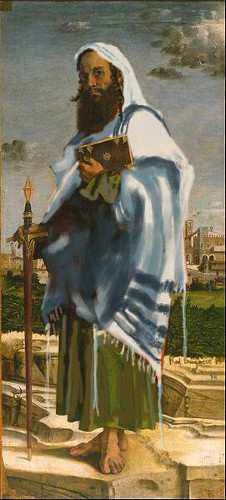
The Jewish PaulNo, I can’t assign malice or any other ill intent upon modern Christians. Those who did create our traditions, some of them with malice, lived many centuries ago. With the passage of time, we’ve forgotten that these are the interpretations of men with a theological ax to grind, and we have forgotten that our understanding of “truth” and “fact” is in fact, a set of traditions, and that those traditions resulted from a hermeneutic that was specifically designed to remove every last vestige of Jewish learning and Jewish legitimacy from our devotion to the Jewish Messiah and the Jewish King of Kings, ruler of the Jewish nation Israel, and Son of the God of Israel.

Don’t worry, the article has a happy ending.

Zetterholm covered the “birth” of the new and even radical perspectives on Paul, citing Sanders, Dunn, Gaston and others. From them, he concludes:

The search for the historical Paul cannot be limited to finding a Paul who makes theological sense for the present-day church, but one who makes sense in a first-century context, before Augustine and Luther entered the scene.

Paul (must be) firmly rooted within Judaism.

A Paul within Judaism would not have taught that Jews and Gentiles in Messiah left their nationality and ethnicity behind and became a “third race,” a “one new man”. A Torah observant Paul within Judaism, still faithful to Judaism, faithful to the Temple, faithful to the God of Abraham, Isaac, and Jacob, needs to be read within that context. His letters are the same, but the lens by which we view them creates a dramatically different perspective.

One thing to consider given what I just wrote, is that:

…all Paul’s authentic letters seem to be addressing non-Jews might give us a hermeneutical key. Is it possible that Paul only objected to non-Jews observing the Torah or to non-Jews becoming Jews and thus under Torah on the same terms as Jews?

Zetterholm goes on to state (and I’ve said this before as well) that there were different ideas on the table about how the Jewish disciples of the Master were supposed to integrate the new Gentile disciples. They ranged from a sort of open-arms acceptance of Gentiles coming into community with Jews to absolute rejection, the very idea of Gentiles in synagogues being loathsome.

There is also ample evidence indicating that many non-Jews were attracted to Judaism and imitated a Jewish life style, probably as a result of interaction with Jews who believed that also non-Jews would benefit from observing the Torah.

Or at least some of the Torah. Zetterholm considers the existence of some “non-Jews who could be regarded as partly Torah observant” in ancient times. This may have implications on modern “Messianic Gentiles” and what sort of praxis we might maintain as an expression of our faith.

But that creates what Zetterholm calls a “complex social situation” between Jews obligated to the mitzvot and Gentiles taking on at least some of the commandments as a matter of preference and a natural consequence of being part of Jewish community, sharing a common table.

The problem this young movement had to overcome was how to incorporate non-Jews, not only to find ways of socializing safely with non-Jews, but how to include non-Jews in the eschatological people of God. Paul evidently believed that non-Jews should remain non-Jewish, and that they should not observe Torah, which possibly meant that they should not base their relation to the God of Israel on the Torah but on Jesus-the-Messiah.
messianic judaism for the nationsYesterday, I quoted from a sizable block of Colossians 1 in which Paul emphasized the centrality of the Messiah specifically for the Gentile. Given Zetterholm, Paul’s meaning takes on additional dimension.

However, he also cited the Didache which includes an injunction for the Gentile disciple to voluntarily take on as much of the Torah as possible or reasonable, yet remaining a Gentile.

I maintain that this all speaks to the nature of Jewish and Gentile relationships in the Messianic Jewish and Hebrew Roots movements today, as does the following:

It is quite natural and most likely that the process of self-definition was complicated and led to harsh conflicts.

Unfortunately, those conflicts ultimately resulted in Gentiles and Jews taking different trajectories in their expression of Yeshua-faith and finally the invention of Christianity, which split from its Jewish predecessors entirely.

While Paul believed that he represented the perfection of Judaism, the church quite swiftly became a religious movement opposed to the practice of Judaism.

Even those modern Christians who express a love for the Jewish people and for Israel continue to oppose the practice of Judaism, both in normative Judaism and for Jews in Messiah.

I’ll continue with my reviews soon.

After the Meal of the Messiah has Ended

Now I rejoice in my sufferings for your sake, and in my flesh I do my share on behalf of His body, which is the ekklesia, in filling up what is lacking in Messiah’s afflictions. Of this ekklesia I was made a minister according to the stewardship from God bestowed on me for your benefit, so that I might fully carry out the preaching of the word of God, that is, the mystery which has been hidden from the past ages and generations, but has now been manifested to His saints, to whom God willed to make known what is the riches of the glory of this mystery among the Gentiles, which is Messiah in you, the hope of glory. We proclaim Him, admonishing every man and teaching every man with all wisdom, so that we may present every man complete in Messiah. For this purpose also I labor, striving according to His power, which mightily works within me.

For I want you to know how great a struggle I have on your behalf and for those who are at Laodicea, and for all those who have not personally seen my face, that their hearts may be encouraged, having been knit together in love, and attaining to all the wealth that comes from the full assurance of understanding, resulting in a true knowledge of God’s mystery, that is, Messiah Himself, in whom are hidden all the treasures of wisdom and knowledge. I say this so that no one will delude you with persuasive argument. For even though I am absent in body, nevertheless I am with you in spirit, rejoicing to see your good discipline and the stability of your faith in Messiah.

Therefore as you have received Messiah Yeshua the Lord, so walk in Him, having been firmly rooted and now being built up in Him and established in your faith, just as you were instructed, and overflowing with gratitude.

Colossians 1:24-2:7 (NASB – adj)

I’m temporarily interrupting my reviews of the Nanos and Zetterholm volume Paul within Judaism: Restoring the First-Century Context to the Apostle in order to address a conversation I had with my friend over coffee last Sunday. Yes, this is the same friend who previously issued the pesky challenge (I say that tongue-in-cheek) of considering a return to church or some such congregation for the sake of fellowship.

Last Sunday, the challenge was to consider all that Messiah has done for me.

No, it’s not like I don’t have a sense of gratitude, but the way he put it, it’s like I am to consider only two beings in existence: Messiah and me.

The Death of the MasterSo often in the Church, over and over again, I’d hear “It’s just me and Jesus” like the rest of the human population of this planet didn’t matter. It also sounds like God’s overarching redemptive plan for Israel, and through Israel, the world, wasn’t important. All that’s important is the individual Christian and Jesus.

I look at Messiah through the lens of the entire Biblical narrative and what his death and resurrection means in terms of that narrative. I think of Messiah less as dying for me the individual, and more as dying and being resurrected as a definitive confirmation of God’s New Covenant promise to Israel; His promise of Israel’s personal and national resurrection and the life in the world to come. Messiah’s resurrection is definite proof of the resurrection for the rest of us. It certainly was to the direct witnesses of “the risen Christ,” and by their testimony, was accepted as evidence by many other Jews and Gentiles who through faith, became disciples of the Master.

I have a problem pulling Messiah out of that context, isolating his death and resurrection from God’s global redemptive plan, and making it all about “saving” me. When Paul wrote about “salvation,” he was talking about reconciling humanity with the God of Israel, not saving my one little soul so I could go to Heaven and live with Jesus when I die. Paul was “preaching” the New Covenant promises and their blessings to the Gentiles, who needed to do considerable catch-up work not having the benefit of even a basic Jewish education.

I think that’s what he’s saying in the above-quoted block of scripture. He’s writing to Gentiles. They/we who were once far off (Ephesians 2:13) and who had/have been brought near to the promises of God through the faithfulness of Messiah.

There’s no denying that without Messiah, the Gentiles are totally cut off from the God of Israel. The Jews were already near based on being born into the Sinai covenant. Yes, even they could be cut off (Romans 11:20) due to unbelief, but since they are natural branches, think of how much more easily can they be reattached to the root.

My friend said that those who deny Messiah, Jew and Gentile alike, are cut off from God. This at least suggests if not outright demands that God’s presence be manifest only with those Jews and Gentiles who have become disciples of Yeshua and He is apart from everyone else.

working handsI don’t believe that. For the Jews, I believe there’s close and closer. No, it’s not like there is no benefit for Jewish faith in Messiah. I outlined how unbelieving Jews can still be close to God and how believing Jews have a great benefit in being disciples of the Master in my review of D. Thomas Lancaster’s sermon The Holy Epistle to the Hebrews: Faith Toward God. Mark D. Nanos characterizes the text of Romans 11:25 as unbelieving Jews being temporarily “callused” against Messiah. But the text continues:

For I do not want you, brethren, to be uninformed of this mystery—so that you will not be wise in your own estimation—that a partial hardening has happened to Israel until the fullness of the Gentiles has come in; and so all Israel will be saved; just as it is written,

“The Deliverer will come from Zion,
He will remove ungodliness from Jacob.”
“This is My covenant with them,
When I take away their sins.”

From the standpoint of the gospel they are enemies for your sake, but from the standpoint of God’s choice they are beloved for the sake of the fathers; for the gifts and the calling of God are irrevocable.

Romans 11:25-29

Paul, in part, is referring to this irrevocable promise of God to Israel:

They will not teach again, each man his neighbor and each man his brother, saying, ‘Know the Lord,’ for they will all know Me, from the least of them to the greatest of them,” declares the Lord, “for I will forgive their iniquity, and their sin I will remember no more.”

Jeremiah 31:34

So how do I understand my friend’s statement that all people, Jews and Gentiles, are alienated from God if they do not have faith in Messiah? Am I to believe that God abandoned the Jewish people at the cross?

I can’t do that.

I can believe, based on God’s faithful promises to His people Israel, that although many Jews temporarily do not see Yeshua for who he truly is as Messiah, one day everything will be revealed, and then they will all receive the promise of forgiveness of sins and thus “all of Israel will be saved.”

I have no problem believing that all means ALL! In fact, I’m counting on it.

However, God made no such promise to the Gentile nations of the world. We don’t directly benefit from those promises, though as Paul tells us, we do benefit from their blessings through faithfulness. In His mercy, God allows not just Israel, but also the Gentiles to receive the blessings of the resurrection, the indwelling of the Spirit of God, and the promise of life in the Messianic Age and beyond as members of the Master’s ekklesia and vassal subjects of the King.

But in my struggle to reframe the traditional Christian narrative into one that takes into greater account the first century Jewish context of Paul’s letters as they relate back to the promises God, I’ve gotten “stuck” with my panoramic view of the Messiah’s role in Biblical and human history.

Restoration
Photo: First Fruits of Zion

My fight has always been to communicate this Judaic view of ALL scripture, including the Apostolic Writings, as Jewish and centered on national redemption of Israel, and then through Israel, the nations.

Admittedly, I’m having a tough time changing my focus and allowing myself the “conceit” of realizing that there is (or could be) a personal relationship between me and the Master. Frankly, I don’t see why that shouldn’t intimidate the living daylights out of anyone, especially me. How can the King of the future Messianic Era also be, as many Christians might say, my “best friend?”

The presence of Mashiach is revealed on Acharon Shel Pesach, and this revelation has relevance to all Israel: Pesach is medaleg,1 “skipping over” (rather than orderly progress), and leil shimurim,2 the “protected night.” In general the mood of Pesach is one of liberty. Then Pesach ends, and we find ourselves tumbling headlong into the outside world. This is where Mashiach’s revealed presence comes into play – imbuing us with a powerful resoluteness that enables us to maintain ourselves in the world.

-Compiled by the Lubavitcher Rebbe; Translated by Yitschak Meir Kagan
Chabad.org

I too find myself “tumbling headlong” into unprotected territory. It’s become very easy for me to relate to Yeshua as a lowly subject relates to a King. But how can (or should) this “Messianic Gentile” gain an apprehension of a one-on-one relationship with my Master Yeshua?


1. Shir HaShirim 2:8. Midrash Raba on that verse describes the Exodus as medaleg, “skipping over” calculations and rationales for redemption, bringing Israel out of exile regardless of their merit, regardless of the length of the exile. Later in that section the Midrash applies the verse to Mashiach.

2. Sh’mot 12:42, as Rashi notes, the night destined for redemption.

Book Review of “Paul within Judaism,” The Introduction

A new perspective in Pauline scholarship is represented in this volume. This perspective is readily distinguishable from other interpretations of the apostle, including the collection of views now formally recognized as “the (!) New Perspective on Paul” and, all the more, the views mounted in opposition to it because of the New Perspective’s challenge to major tenets of traditional Christian interpretation.

Mark D. Nanos
from the Introduction to
Paul within Judaism: Restoring the First-Century Context to the Apostle
Edited by Mark D. Nanos and Magnus Zetterholm

I’d known for sometime that Nanos and Zetterholm were collaborating on a new book about Paul, but it wasn’t until I read Toby Janicki’s brief review of the book in the current issue of Messiah Journal that I discovered it had already been published (back in January, actually). Throwing caution and my credit card to the winds, I quickly purchased it at Amazon and downloaded it to my Kindle Fire.

There are nine individual contributors to this volume, including Nanos and Zetterholm, and while they all operate within what has been termed the New Perspective on Paul (more on that in a minute), they aren’t in total agreement with each other. So much the better. Generally within any discipline there is not unanimous agreement on all points, which invites discussion to hone what we can learn in said-discipline. I’m optimistic that because of this “honing,” “Paul within Judaism” will bring into sharper focus who Paul was within his first century Jewish framework as the emissary to the Gentiles.

Since I’m facing nine separate essays inspired by “a session entitled ‘Paul and Judaism’ at the Society of Biblical Literature in 2010” plus an Introduction, I intend to review each essay as a stand-alone presentation. That means yet another multi-part review for me to write and offer to anyone who wishes to read them.

I mentioned above something about “The New Perspective on Paul,” but considering the diverse group of scholars whose work we will be evaluating, Nanos states:

The diverse expressions of their research have been variously described in recent years collectively as the “Radical New Perspective,” “Beyond the New Perspective,” and “Post-New Perspective.” Yet these monikers do not fully communicate the major emphases of this research paradigm, since it is not primarily a new development within the New Perspective…

See what I mean?

This volume marshalls the talents of “an international group of scholars” in challenging “major tenets of traditional Christian interpretation” of Paul, using an “alternative approach, for which the phrase the ‘Paul within Judaism’ perspective seems most appropriate.”

Nanos argues that the current prevailing understanding of Paul anachronistically places him within Christianity rather than Judaism, and what keeps Paul within a Christian context is the Church’s long history of tradition regarding the Apostle. The result is:

…profound discontinuities arise between the Paul constructed in this new paradigm and the theological traditions constructed around Paul in the past.

Paul within JudaismI should say these past-constructed traditions about Paul are equally applied by Christianity and normative Judaism, the former to justify reinventing an ancient branch of Judaism as Gentile Christianity, and the latter to condemn that invention and Paul along with it.

However, a Christianity and Judaism that clings to such erroneous and yet enduring traditions on the Apostle results in their failure to see Paul as perhaps he truly was: a Jew operating within a Judaism that was devoted to the revealed Messiah and that had a remarkably liberal view of Gentile admission into their community.

Speaking of the contributors to the New Perspective, Nanos writes:

It also draws deeply from the scholars responsible for the so-called “Sonderweg” trajectory, which detects in Paul’s letters the belief in a “special way” for non-Jews to be included in salvation through Christ alongside the historical Sinai covenant with Israel. (emph. mine)

I bolded “alongside” above to notify anyone who may be concerned that this perspective on Paul defines Jewish and Gentile roles and responsibilities within the ancient (and modern) Ekklesia of Messiah differently. How differently, we will discover as we proceed through the various reviews including this one.

I mentioned above about Christianity’s and Judaism’s anachronistic view of Paul as a “Christian.” To clarify that point of view, the Introduction says in part:

He (Paul) is often enough described simply as a “Christian,” as are his “churches”; he is a “missionary.”

…because it is built on the conviction that there is something fundamentally, essentially “wrong” with, and within Judaism. Further, what is wrong with Judaism is generally analogized with what Paul is understood to have found wrong with “paganism”…

In other words, Nanos shows us that the traditional interpretation of Paul is that he found both Judaism and paganism to contain the same sorts of “wrongs,” necessitating that he create a separate religious stream called “Christianity” that departs from both, taking both Jewish and non-Jewish adherents with him. Paul then ceased the practice of Judaism and identifying himself as a Jew through his “conversion” to “Christianity.”

In this light, it’s small wonder that most non-Jewish (and Jewish) Christians in the Church revere Paul while most Jews consider him a traitor and revile him.

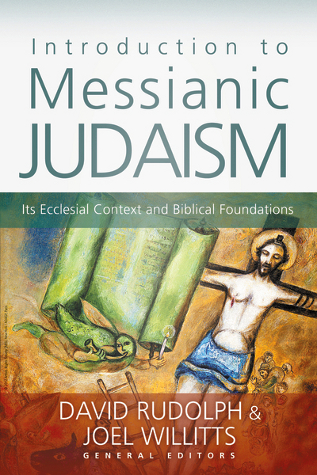
introduction to messianic judaismI’d love to send a copy of this book to every Christian Pastor, Preacher, Minister, and Priest in America but I suppose it would do no good. As the old saying goes, “you can lead a horse to water…” I tried that on a much smaller scale some time ago by purchasing a copy of Rudolph’s and Willitts’ volume Introduction to Messianic Judaism: Its Ecclesial Context and Biblical Foundations and giving it to the Head Pastor of the church I used to attend, in the (vain) hope that such an august collection of scholars writing on the merits of a Messianic Jewish perspective would at least get him to consider changing some of his views.

It didn’t work. He clung too tightly and too dearly to his Fundamentalist Christian “hashkafah,” as Boaz Michael puts it, and was unable to travel the distance necessary to view God, Messiah, and the Bible from a distinctly different, and in my opinion, a more Biblically sustainable, vantage point.

Nanos speaks to this:

If one might say that the latter oppose the New Perspective for being too new for their traditional theological positions to embrace, the contributors to this volume oppose it for being not new enough.

And…

…and the consistency of their answers with the fundamental views attributed to Paul in various traditional Christian theologies, not least the way that Jewish identity and Judaism are portrayed.

…some oppose the New Perspective because it undermines the traditional view that what Paul found wrong with Judaism was its works-righteousness and legalism.

This view of how Christianity sees Paul in relation to the “wrong” in Judaism is contrasted with:

Judaism was characterized by “covenantal nomism,” which recognizes the initial role of divine grace and of faith to initiate the relationship, but also perceives the consequent responsibility to behave according to the terms of the agreement into which participants have entered.

More simply put, the Jewish people entered into a relationship with God by grace and faith and from that, agreed to a set of covenant conditions requiring a specific set of responses, that is, observance and performance of the Torah mitzvot.

Unfortunately, “the ineluctable sin of arrogance at least since Augustine” has resulted in a radical distortion and refactoring of Paul, wholly removing him from his original context, and placing him in one that would have been completely foreign to a first century Jew, that is, Christianity.

And yet, the Church continues to insist that those of us who view Paul as a Jew within Judaism are guilty of:

…the supposed sin of ethnic particularism, variously described and named. On the premises of the New Perspective, this “wrong” is assumed to be the necessary sin involved in celebrating and guarding the boundaries of Jewish identity and behavior, as if claiming to be set apart for God was inherently arrogant, mistaken , and evidence of bigotry.

Not only does larger Christianity hold this viewpoint against those various streams of modern Messianic Judaism, but so does much of the Gentile Hebrew Roots movement. In Part 1 of a recent blog post, I quoted Carl Kinbar as stating he has hesitated to express such views of Jewish particularism for fear of inadvertently offending non-Jews in Messianic Judaism and the wider body of faith in Yeshua (Jesus).

Speaking to the presence of Jews and non-Jews in the ancient Ekklesia, Nanos writes:

This also means that the “assemblies” that he (Paul) founded, and to which he wrote the letters that still provide the major basis for this research…were also developing their (sub)culture based upon their convictions about the meaning of Jesus for non-Jews as well as for Jews within Judaism.

Magnus Zetterholm
Magnus Zetterholm

Of course, it needs to be understood that non-Jews finding the meaning of Messiah within a Judaism does not mean they become Jews nor does it mean, even remaining Gentiles, that they (or we) inherit the obligation of the Sinai covenant to observe the mitzvot.

…even though many if not most of those who were joining these subgroups were and remained non-Jews.

Nanos spent the remainder of the Introduction briefly describing each contributor to the volume and summarizing each of their articles. I won’t go into this portion of the Introduction except to draw something from what Nanos says of the first essay, written by Magnus Zetterholm, the co-editor of this work:

Moreover, if one postulates that Paul still observed Torah, as do Zetterholm and several contributors, then the idea that Paul dismissed it as obsolete or antithetical to the goals of Christ-following Jews is illogical. Zetterholm explains that Paul was not against Torah observance for Jews, including himself; rather, he was adamantly against the observance of Torah by non-Jews who became followers of Christ.

We’ll have to wait until I read and review Zetterholm’s essay to get the full details of his perspective, but this statement does address what I mentioned above about a central view in much of Messianic Judaism, that there remains a distinctiveness between Jew and non-Jew in the Ekklesia of Yeshua relative to the Torah mitzvot and our specific responsibilities to each other and to God.

This next part also needs to be expressed:

However, since this Jewish “faction” drew in many non-Jews, who would naturally be thereafter practicing the Jewish norms of communal life, even if not under Torah technically as non-Jews, this led to various conflicting views about the standing and behavior to be expected of these non-Jews from within the movement and from those outside of it, to which Paul’s letters attest.

And this is exactly what we find happening in Messianic Jewish communities today, particularly those containing a non-Jewish majority membership (which is the vast majority of Messianic Jewish synagogues in the United States today). This is another excellent reason to radically revise how we read Paul. If he knew the answer to the problems vexing non-Jewish participation in modern Messianic Judaism, we need to find out what they are.

Next time, I’ll begin my review of the first essay out of nine, written by Magnus Zetterholm called “Paul within Judaism: The State of the Questions.”

Abraham, Ephesians 2, and the Unique Jewish Mission, Part 2

For He Himself is our peace, who made both groups into one and broke down the barrier of the dividing wall, by abolishing in His flesh the enmity, which is the Law of commandments contained in ordinances, so that in Himself He might make the two into one new man, thus establishing peace, and might reconcile them both in one body to God through the cross, by it having put to death the enmity.

Ephesians 2:14-16 (NASB)

This text indicates that the two identified in Ephesians 2:11 as Gentiles and Jews, have become one in Christ. Jesus broke down the barrier dividing the two in order to create “one new man” in which there is peace and reconciliation. “One new man” is a metaphor for the church but, in spite of its apparent simplicity, two diametrically opposing views of its nature appear in the literature. Each of these views is underpinned by antithetical perspectives on Israel in the present era inaugurated by the Christ-event.

-David B. Woods
“One New Man, Part 1 of 2” p.51
from Issue 119/Spring 2015 of Messiah Journal

Continued from Part 1.

The above-quoted scripture is the foundation for both Woods’ commentary in the current issue of Messiah Journal and Derek Leman’s commentary on his blog. Leman addresses “the wall” and what it might actually be from a Judaically-oriented interpretive perspective, and Woods takes on who this “one new man” might be.

Woods quoted Martyn Lloyd-Jones (“God’s Way of Reconciliation” [vol. 2. of “An Exposition on Ephesians”; Edinburgh, Scotland: Baker Book House, 1972], 275) to exemplify the currently held viewpoint of the “one new man” within Evangelical Christianity:

The Jew has been done away with as such, even as the Gentile has been done away with, in Christ…nothing that belonged to the old state is of any value or has any relevance in the new state.

-ibid, p.52

If you’re familiar with my views on supersessionism, otherwise known as replacement theology or fulfillment theology, then you know from my perspective, those are “fighting words.

Conversely, Woods quoted the Union of Messianic Jewish Congregations (UMJC) (“Introducing Messianic Judaism and the UMJC” [Albuquerque, NM: Union of Messianic Jewish Congregations, 2010], 24) to illustrate the “flip side” of the coin:

One new man does not mean that the distinction and mutuality between Jews and Gentiles are obliterated. Instead, it means that Jews as Jews and Gentiles as Gentiles, with their differences and distinctions, live in unity and mutual blessing in Yeshua…they do not become a new generic, uniform humanity.

-ibid

AbrahamThis harkens back to certain passages of Carl Kinbar’s article from the same issue of Messiah Journal: “The Promises to Abraham, Isaac, and Jacob, Part 1” which I mentioned in my previous blog post. God endowed the Jews, through the patriarchs, with certain blessings and responsibilities, and one of those responsibilities is, through Abraham, being a blessing to the Gentiles. This operates through the faithfulness of Messiah and Gentile faith in the God of Israel through Messiah Yeshua, and it only works if Israel, that is, the Jewish people, remain distinct from the Gentile disciples in the Ekklesia of Messiah.

Distinction theory is my term for the theological framework which understands Jewish and Gentile believers in Jesus as distinct in certain significant theological senses, including identity and function (role, service) in the economy of God’s kingdom. That is, a biblical differentiation exists between Israel and the nations within the church similar to that which existed before Christ. This distinction results in a twofold structure within the church that I label “intra-ecclesial Jew-Gentile distinction.” In this framework, the “one new man” or “humanity” as I shall explain, comprises Jews and Gentiles who together are devoted to Jesus.

-ibid, p.53

I know that statement won’t sit well with some people reading this, namely more traditional, mainstream Christians, and certainly many Hebrew Roots proponents. Woods intends on showing from his analysis of scripture, how his view is more Biblically sustainable than those views that insist on the obliteration of Jewish uniqueness of identity and corporate covenant responsibility, either by, in essence, “Gentile-izing” them (and recall that Kinbar says you can’t “unJew” a Jew) or erasing Jewish distinction by assigning Jewish roles and responsibilities to both Jews and Gentiles equally.

To do this, Woods proposes to take the phrase “one new man” and analyze the Greek (and Hebrew) one word at a time. Unfortunately, by the time he ended part 1 of his article, he had addressed only the first word.

His explanation is complex, but in short:

Hena assuredly means one, but Jewish and Christian scholars alike are aware that the word is laden with theological import. God, says Deuteronomy 6:4, is one (…echad–or heis in the Septuagint, where heis and hena are inflections of the same word).

-ibid, p.54

Relative to the Shema and “the LORD is One”, it is just as accurate to translate echad as “unique” or “alone”. Applied to the “one” in “one new man,” this changes the meaning somewhat, from a single fused entity, to a grouping that has the potential to contain other groupings. Certainly “alone” could be compared to “called out”.

Also echad might not imply so much that God is “one and indivisible,” but…

…rather that God alone is to be worshiped to the exclusion of all other gods.

-ibid

Woods also considers basar echad or “one flesh” (Genesis 2:4) and states:

The marriage relationship is dependent on the distinction between husband and wife; thus “unity implies distinctiveness and yet is complementary.”

-ibid

beth immanuel
Beth Immanuel Sabbath Fellowship

Looking back upon the “one new man” as the Messiah’s Ekklesia, we can see that it’s possible to have a group of called out ones that are echad and yet not only can contain sub-groups that are distinct, but that the Ekklesia’s very existence is dependent upon the Jewish and Gentile sub-groups within the larger “one” group remaining distinct and also complementary.

Woods cites Ephesians 2:11-22 in that it notes:

…that the principle distinction between members of the body is their status in Israel: They are either members of Israel (Jews), or they are drawn from among the nations (Gentiles/non-Jews) into fellowship with Israel–yet without becoming Jews.

-ibid, p.55 (emph. mine)

I might change that last part to say that we Gentiles in the Ekklesia are drawn “into fellowship with Israel without becoming Israel.” We have fellowship with Israel without replacing or usurping Israel’s unique covenant relationship with and responsibility to God.

Woods continues building his case for several more pages, but I believe I’ve presented sufficient examples to illustrate where he’s going. However, he won’t begin discussing his understanding of the word “new” until the next issue of Messiah Journal which will be published this coming summer.

Turning now to Derek Leman’s blog post on the Dividing Wall:

I attended a paper in 2013 on the meaning of the dividing wall passage of Ephesians 2. A year and a half later, the interpretation put forward by Jesper Svartvik still looks good to me. I include here a postlude concerning the meaning of “abolishing the law of commandments in decrees.”

So based on Leman’s presentation of the conclusions of Svartvik’s 2013 paper, how are we to understand the “dividing wall” that Yeshua was to have “broken down in his own flesh?”

From Leman’s perspective (taking from Svartvik), the Christian misunderstanding of this “wall” is based on the Christian misunderstanding of the Temple’s sacrificial system:

First, Svartvik said we need to keep in mind a Jewish understanding of sacrifice and the Temple worship, as opposed to same later Christian re-interpretations. Sacrifice at the Temple was about staying in the covenant and not getting in. People were not trying to “get saved” or “be born again” in offering a lamb. They already were in and sacrifices were part of keeping right relation with God.

Second, sacrifice in the Bible is about nearness, the spatial metaphor of “drawing near” to God. The verb most used for offering a sacrifice means literally “bring near.” (As a Hebrew Bible devotee, I can tell you, this is not only true, it is one of the most profound things I wish people knew about the sacrifices and it is one of the major issues I discuss in my book, Yeshua Our Atonement). We might notice that in Ephesians 2 the same nearness issue is being discussed: those who were far off are now brought near.

The Jewish people were near to God and the Gentiles were far off. So how could those who were far off be brought near to those who were already near (the Jews)? How was the enmity between Jews and Gentiles to be resolved? By doing away with Jewish obligation to Torah? By mandating that Jewish obligation to Torah also be assigned equally to the Gentile?

As we see from Woods, forming an “echad” Ekklesia of Jews and Gentiles doesn’t require that both groups be eliminated to form a new, homogenous entity with no distinctiveness contained within it.

As I quoted Leman in my previous blog post, the dividing wall can be understood differently than the four prevailing theories, the “soreg” or literal fence forming the “Court of the Gentiles” in the Temple, the Talmudic “fence” around the Torah commandments, a theological dividing wall between heaven and earth, or, most commonly, the Torah itself. The dividing wall can be understood as a metaphor for the “mistrust and enmity between Jews and Gentiles in the Greco-Roman world in which the apostles founded a movement of faith.”

intermarriageLet’s go back to Woods’ comparison of “one” as the “echad” of a marriage. A man and a woman meet and fall in love. They desire to marry, but there are “issues” that stand between them that must be resolved before they can enter into a life-long commitment to one another. You might say that they have to overcome any “mistrust and enmity” between them before they can be joined as “one flesh” and become something new, not two individuals, male and female, living apart, but “one flesh”, male and female, living in a single family and yet requiring they maintain their distinctiveness.

You can go to Leman’s blog to read the entire text of his essay as well as view the ongoing discussion, but hopefully, I’ve adequately summarized his main point regarding the nature of the “dividing wall” that was torn down through the Messiah. The dividing wall is just a metaphor for the mistrust and enmity that previously existed between Jew and Gentile. In Messiah, those barriers are gone and Jewish and Gentile disciples of the Master can co-exist within the Ekklesia while remaining Jewish and Gentile. This is the same thing as a man and woman getting married and remaining male and female within the family.

Now before someone asks, Leman ends his blog post…

By the way, I should say the theory I just put out there concerning the meaning of “law of commandments in decrees” could never be fully verified as it is an example of trying to fill in a gap left by the writer. We can only guess what fills in the gap. The guess that “law of commandments in decrees” means the whole Torah has huge problems, not least of which is that is a strange way of describing Torah as a whole.

My take away from reviewing Kinbar’s, Woods’ and Leman’s work is that the concept of two unique and complementary groups, one made up of Jews and the other of Gentiles, operating within a single Ekklesia, and indeed, providing mutual blessings to one another, is certainly supportable from a Biblical viewpoint that is Israel-focused and Judaically-oriented, and may well represent the Apostle Paul’s original viewpoint.

Adopting that viewpoint requires divorcing ourselves from the more traditional Christian exegetical perspective on Paul in particular and the Bible in general, so that we may attempt to recapture the actual context and meaning of Paul and the other Bible writers, who were attempting to communicate how God’s vast, sweeping redemptive plan for Israel and the nations was to unfold, first through the Torah, then the Prophets, and finally the revelation of Messiah.

Reviews, by their nature, can only capture a snapshot of the works being reviewed. Again, I encourage you to go to Leman’s blog, and to read the articles written by Kinbar and Woods in the current issue of Messiah Journal to get the full message of what they are presenting. While not everyone who reads my blog may agree with what they have to say, you will see that there are compelling counterarguments to the traditions that have been handed down in the Church for so many centuries. I believe those counter-perspectives must be considered and ultimately accepted by believers in order for Jews and Gentiles in the Body of Messiah to apprehend the true meaning of “one new man.”

JerusalemIn Part 1, I said that in order to understand the role and purpose of the Messianic Gentile, we needed to understand the role of the Messianic Jew in the Ekklesia. So what did we Gentiles learn about ourselves? Hopefully, I illustrated that our role is to be joined with Israel, not to become or replace Israel. And as I’ve stated before, our purpose in the Ekklesia, in response to being blessed by the Jewish people and the promises God made to Abraham, is to support and encourage Jewish Torah observance and covenant obedience, for without an Israel oriented toward God, there is no redemption for the world.

Abraham, Ephesians 2, and the Unique Jewish Mission, Part 1

I am writing this article to a specific segment of this generation of Jews: those who follow Messiah Yeshua, whether we are in Messianic congregations, synagogues, churches, groups of various kinds that meet in homes, or not actively part of a group. I call us all “Messianic Jews,” but the name is not important; what counts is our connection with Messiah.

We are members of both the body of Messiah and what Michael Wyschogrod calls “the body of Israel.” It is essential that we fulfill our calling and destiny in both communities.

To be frank, many Messianic Jews, myself included, have avoided speaking openly and in depth about the meaning and significance of Jewish existence because we do not want to inadvertently offend others. For now I want to say that the “tasks begun by the patriarchs” that are now entrusted to this generation of Jews have positive and profound implications for the nations. Therefore, if you are not Jewish, I invite you to pull up a chair and listen in. You are welcome here.

-Carl Kinbar
“The Promises to Abraham, Isaac, and Jacob, Part 1 of 3” p.34
from Issue 119/Spring 2015 of Messiah Journal

At two separate seminars I attended in 2009, two speakers presented a different interpretation of Ephesians 2:15; they both claimed that the unity of the “one new man” does not imply, let alone require, a flattening of its Jewish and Gentile members into homogeneity. Instead, the unity spoken of in Ephesians 2:14-16 strengthens the case that Jewish identity of Jews who believe in Jesus is fundamental.

-David B. Woods
“One New Man, Part 1 of 2” p.52
from Issue 119/Spring 2015 of Messiah Journal

Regarding the fourth and most common Christian interpretation, Svartvik said something profound: how would that view fit with “peace to those near” in Ephesians 2? In other words, Yeshua came to bring peace to those near (Jewish people) and far (Gentiles). If he came to nullify God’s covenant with Israel, how is this peace with Israel?

Thus, Svartvik offers a fifth and new suggestion: the dividing wall is not physical or tangible, but is exactly what the text says it is, the mistrust and enmity between Jews and Gentiles in the Greco-Roman world in which the apostles founded a movement of faith.

He offers a comparison with another first century text in which a wall is used as a metaphor for something abstract. In 2 Baruch 54:3-5 the image of a wall refers to a block in understanding or perception: “You pull down the enclosure for those who have no experience and enlighten the darkness.”

-Derek Leman
“The Dividing Wall in Ephesians 2”
Published April 9, 2015 at the
Messianic Jewish Musings blog

You may notice that the common thread running through all three of the above-quoted paragraphs (besides Messianic Judaism in general) is the special status and mission of the Jewish people, particularly those who are disciples of Messiah Yeshua, as distinct and separate from the body of believing Gentiles, whether they are affiliated with Christianity, Hebrew/Jewish Roots, or the Messianic Jewish movement.

Derek Leman
Derek Leman

Each article provides an excellent springboard by which to launch ourselves into further investigation of the relationship between Jews and Gentiles who are attached to Yeshua, and to define the unique roles and purposes of each population as we exist within the Ekklesia of Messiah.

When I first started reading Kinbar’s article and saw that he had specifically written it to a Jewish audience, I felt as if I’d opened and was reading someone else’s letter, at least until he invited non-Jews to “pull up a chair” and become part of the audience. For it is in the definition of the special tasks that the current generation of Jews, both in Messiah and otherwise, have inherited from the patriarchs, that we find a contrasting role for “Messianic Gentiles”.

Both Woods and Leman tackle this topic through the lens of Ephesians 2, with Woods addressing the so-called “One New Man” (Ephesians 2:15) made out of two peoples, Jews and Gentiles, and Leman focusing on the breaking down of the “barrier of the dividing wall” (Ephesians 2:14 NASB) that previously separated those two groups but, “by the blood of Christ” (v.13) have been made one.

They both, as you might imagine, disagree with the traditional Christian interpretation of what “one new man” is supposed to mean, or what the result of tearing down the “dividing wall” was supposed to bring about. Christianity believes that annihilating that wall and creating one new man eliminated distinctions between Jews and Gentiles by obliterating Jewish and Gentile identity. The “one new man” was “neither Jew nor Greek” (Galatians 3:28) but an entirely new creation in Jesus Christ.

Except that’s not how these gentlemen interpret these scriptures.

I should also say it is a shame that Paul’s letters can only be read in their Jewish context via a “radical” and “new” perspective. That is, of course, how they should have been read all along. But a few issues have understandably blocked Christian readers from seeing the Jewishness of Pauline letters and Ephesians in particular. To make a complex issue simple let me just list a few things. Paul’s letters do not address Jewish believers and their concerns, but rather his burgeoning Gentile mission of the earliest Yeshua-movement. Paul does not give us a theology of Jewish identity in relation to Messiah Yeshua because that identity was already well-known and assumed in the background. Jewish identity in Messiah remained rooted in the covenants with Abraham and at Sinai and through David, but the coming of Yeshua marked a new stage in God’s revealing his plan to Israel. It was only later, when the church interpreted Paul as saying there was a break away from Sinai and God’s covenant with Israel, that Jews must now become Christians, that the idea occurred that it would become “radical” and “new” to read Paul as a Jewish writer who had not abandoned his prior beliefs and practices.

-Leman (emph. mine)

Carl Kinbar
Rabbi Carl Kinbar

It is difficult to distill an analysis of all three articles into a blog post or two, so I’ll just hit the highlights, so to speak. Also, since both Kinbar and Woods are writing multi-part missives, and the latter submissions are not yet publicly available, the picture you are going to receive here will be, by necessity, incomplete. I encourage you to read Leman’s blog post and acquire copies of Messiah Journal, issue 119 and the subsequent two issues, to read their complete messages.

In order to “flesh out” the role of the “Messianic Gentile” related to Messianic Judaism and the Jewish people (in and out of the movement), it is necessary to understand to some degree, the role and mission of Jewish people as a covenant people within Judaism and as devoted disciples to Messiah.

Our loyalty to Messiah must be so powerfully integrated into our lives that we are simply unable to conceive of life without him. He must be part and parcel of our lives.

At the same time, being Jewish is a fact of our existence: whether we were born Jewish or converted, it is not even possible to “un-Jew” ourselves. To minimize, ignore, or deny this fact is to minimize, ignore, or deny the meaning and significance of our existence. That said, the fullness of our Jewish identity needs to be internalized just as our loyalty to Yeshua does. Our identity as Jews must be part and parcel of our lives.

Our identity as Jews and our loyalty to Messiah must be internalized and brought into harmony.

-Kinbar, p.35

That harmony is not easy to achieve, and I know of at least three Jewish people, one of whom I am very close to, who fully integrated and internalized their Jewish identities by way of entirely dispensing with their devotion to Yeshua.

What Kinbar said reminds me of an article Stuart Dauermann wrote for issue 114 of Messiah Journal called “The Jewish People are Us – Not Them,” which I reviewed nearly eighteen months ago.

In their separate articles, both Kinbar and Dauermann emphasize the vital importance in Messianic Jewish loyalty and affiliation to the Jewish people and national Israel, but while Kinbar makes his points very well regarding Jewish covenant responsibilities to the Torah mitzvot, to their fellow Jews, and to Hashem, what does this say about we Gentiles?

It all seems to come down to Abraham:

Shaul of Tarsus explains how we receive the blessings in Romans 4, where he writes that when Abraham believed God’s promise that he would have a son, God counted his faith as righteousness. Since this took place before Abraham was circumcised, the blessing is not reserved for the circumcised — that is, for Jews. It is available to anyone who follows in Abraham’s footsteps by relying on God, “who raised Yeshua our Lord form the dead, he who was delivered up for our trespasses and was raised for our justification.” Thus, God’s promise statement that he has made Abraham “the father to many nations” is being fulfilled in the body of Messiah…

-ibid, p.40

Kinbar made what I thought was a very interesting point on the same page:

This changed dramatically when Abraham’s name became more broadly known through the distribution of the Apostolic Writings among the nations of the world. In my opinion, it is not an accident that Abraham’s name appears proportionately more often in the Apostolic Writings than in the Tanach.

And again he says:

Were it not for the Apostolic Writings and the body of Messiah, “the families of the earth” would not have known that they may be blessed in Abraham.

But blessed with what? The evidence is in scripture itself as previously quoted above:

“who raised Yeshua our Lord form the dead, he who was delivered up for our trespasses and was raised for our justification.”

MessiahOur faith and the faithfulness of Messiah results in we Gentiles receiving the promise of the resurrection, the forgiveness of sins, and justification before the Almighty. But remember, these promises are universal because they were given to Abraham before the circumcision. There are responsibilities incumbent only upon the Jewish people based on what was promised to Abraham after circumcision and subsequently promised to Isaac and Jacob:

Everyone who is devoted to Messiah should fear God, but Jews and Jewish communities are uniquely entrusted with the tasks begun by the fathers so that we can confirm the promises that God made to them. Engaging in these tasks is part and parcel of the meaning of Jewish existence: to be a source of blessing to the rest of humanity.

-ibid, p.49

So how are we to understand Woods, Leman, and Ephesians 2 in terms of what I’ve written above? For the sake of keeping this “morning meditation” reasonably short and thus of readable length, I’ll save the answer to that question for Part 2.

Review of Loving God When You Don’t Love the Church: The Conclusion

This should be quite a bit shorter than the previous seven reviews I wrote about Pastor Chris Jackson’s book Loving God When You Don’t Love the Church.

chris jackson
Pastor Chris Jackson

The first part of his book seems to be Pastor Jackson’s acknowledgement of how the Church can be a hurtful place, how Pastors, lay staff, and regular members can be heavy-handed instead of open-hearted, and why thousands upon thousands of people have legitimate reasons for walking away from their local churches if not their faith in Jesus.

Jackson was reasonably transparent in describing how he’s been hurt in church and how he has sometimes caused hurt.

Then he attempted to lure his disenfranchised readers back into church using a number of incentives. One was his belief in a third Great Awakening, a national or even world-wide revival of the Church in response to the moral nosedive of current western progressive culture.

He also described how desperately God loves each and every individual Christian as if each person were His favorite son or daughter. He emphasized how each person was born into this day and age to fulfill a unique role in God’s plan of redemption.

But we can only fulfill that role if we are not only part of the universal Church, but fellowship at a local church. Yes, church can be a pretty uncomfortable place and people can be mean or just plain thoughtless. If one church doesn’t work, go to another. He makes it sound pretty simple.

I read a number of the reviews of this book at Amazon.com. Those who didn’t like the book or who were lukewarm to its message said that it didn’t speak to the specific reasons they left, and I have to join this group.

I left church, not because anyone was mean to me, but simply because my theological and doctrinal viewpoints were so different. Hashkafah is a Hebrew word without an exact English equivalent, but basically it’s one’s worldview, specifically regarding your ideology and the reasons behind your ideology. My “Hashkafah” was inconsistent with that of my local church and after two years, the two viewpoints weren’t even beginning to mesh.

I had spent most of that time meeting regularly with the Head Pastor. We developed a friendship, or so I thought, and we each shared our own personal understanding of the Bible, Jesus, and how God’s redemptive plan was supposed to work. As it turned out, he was trying to convince me to change my mind and adopt his viewpoint and I was doing the same thing.

When he preached from the pulpit against my specific viewpoint, I knew I was being asked to change or leave.

Parting was on good terms, but I haven’t heard from anyone at that church since the day I left. At first, I thought Pastor might keep in touch, but he never called or emailed.

Pastor Jackson encouraged people to make amends and either return to the churches they left or find another church to join. The one thing absent from his book is exactly how to do that. He didn’t develop a “re-entry” plan. He just pumped up his audience with how important they were to God and God’s plan, how important the Church is in the next great revival, and how, to be a part of it all, his readers needed to go back to church.

Glasses on Open BibleBut like I said, he didn’t describe that process. It didn’t help that I disagreed with some of his key interpretations of the Bible and the full purpose of how God plans to redeem the world. In fact, at many points in his book, he reminded me of why I left church in the first place, not because the people were unkind, actually, most of them were very compassionate, but because I was totally alienated among them, a “stranger in a strange land,” if you will. I could only attempt to force a square peg into a population of round holes so long.

I downloaded and read Pastor Jackson’s book, not because I was really looking for a way back in, but because a friend of mine expressed his concern that I was without regular fellowship, as if being alone in my faith opened me up to some sort of “spiritual predator.” I re-examined my original decision using Jackson’s book as a lens. In the end, the view showed me what I’d seen in my local church before.

The Church contains a large number of kind, good-hearted, gentle people who desire to serve Jesus and to preach the gospel message as they’ve been taught. But a church is as much a culture as it is anything else, and I learned (or re-learned) from Pastor Jackson’s book that “church” is not my culture.

I’m sure his book serves his target audience well. It just didn’t serve me, at least not in the way he probably intended.