All posts by James Pyles

James Pyles is a published Science Fiction, Fantasy, and Horror author as well as the Technical Writer for a large, diversified business in the Northwest. He currently has over 30 short stories published in various anthologies and periodicals and has just sold his first novella. He won the 2021 Helicon Short Story Award for his science fiction tale "The Three Billion Year Love" which appears in the Tuscany Bay Press Planetary Anthology "Mars."

Messianic Jews and the Torah

I know I’m probably opening up a big can of worms here, but I’ve read a couple of things online today (yesterday as you read this) that really have me scratching my head (in puzzlement, not because I have an itch).

The first was from the “Ask the Rabbi” column at Aish.com. Someone asked:

I get upset when I see different Jewish denominations at odds with each other. Why doesn’t everyone just accept everyone else? Or perhaps is there a way to know which of the denominations is the most correct?

I’ll only quote part of the Rabbi’s answer:

Historically, any Jewish group which denied the basic principles of Jewish tradition – Torah and mitzvah-observance – ultimately ceased to be part of the Jewish people. The Sadducees and the Karites, for instance, refused to accept certain parts of the Oral Law, and soon after broke away completely as part of the Jewish People. The Hellenists, secularists during the Second Temple period, also soon became regarded as no longer “Jewish.” Eventually, these groups vanished completely.

Early Christians were the original “Jews for Jesus.” They accepted the Divine revelation of the Torah, but not the eternal, binding nature of the commandments. Initially, these Jews were reliable in their kashrut, and counted in a minyan. But the turning point came when Paul, realizing that Jews wouldn’t accept the concept of a dead Messiah, opened up membership to non-Jews. At that point, these “Jews” experienced a total severing of Jewish identity.

My understanding of the early Jewish disciples of Yeshua (Jesus) puts me at odds with this Rabbi. The Rabbi pre-supposes that Paul “opened up” membership into the First Century CE Jewish religious stream once called “the Way” to the Gentiles because “Jews wouldn’t accept the concept of a dead Messiah.” Except the record in the Apostolic Scriptures shows that Yeshua (Jesus) commanded his apostles to make disciples of the Gentiles (Matthew 28:19-20), and that he later commanded Paul to be an emissary to the Gentiles (Acts 9). The Biblical record also doesn’t present the issue of a “dead” (resurrected) Messiah as one of the objections some synagogues had to Paul’s message.

In fact, based on the following, a great many Jews initially accepted devotion to Messiah:

Now when they heard this, they were pierced to the heart, and said to Peter and the rest of the apostles, “Brethren, what shall we do?” Peter said to them, “Repent, and each of you be baptized in the name of Jesus Christ for the forgiveness of your sins; and you will receive the gift of the Holy Spirit. For the promise is for you and your children and for all who are far off, as many as the Lord our God will call to Himself.” And with many other words he solemnly testified and kept on exhorting them, saying, “Be saved from this perverse generation!” So then, those who had received his word were baptized; and that day there were added about three thousand souls.

Acts 2:37-41

As Paul and Barnabas were going out, the people kept begging that these things might be spoken to them the next Sabbath. Now when the meeting of the synagogue had broken up, many of the Jews and of the God-fearing proselytes followed Paul and Barnabas, who, speaking to them, were urging them to continue in the grace of God.

Acts 13:42-43

You see, brother, how many thousands there are among the Jews of those who have believed, and they are all zealous for the Law…

Acts 21:20

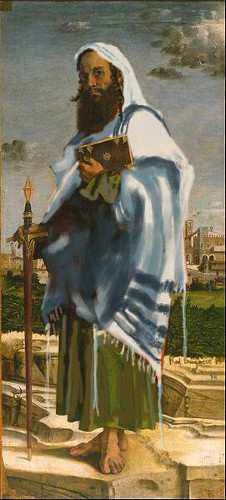
The Jewish PaulI don’t perceive that Paul switched his emphasis of going first to the Jews with the good news of Messiah and then only to the Gentiles (Romans 1:16), nor that he was encouraging Jews to abandon the Torah (as he was falsely accused of). And yet these seem to be common themes that run through most Jewish objections to Yeshua and particularly to Paul.

I do think the Rabbi is somewhat correct in saying that the large influx of Gentiles into the ancient Messianic movement ultimately resulted in a messy Jewish/Gentile schism that did not remove Jewish identity from Jewish Yeshua believers, but did transform the movement into the new Gentile religion of Christianity (which was done by the early Gentile “church fathers,” not by Paul). Jewish participation in Yeshua-devotion as a Judaism subsequently dwindled and finally was extinguished for many centuries.

But the Aish Rabbi said something else that is interesting if not entirely accurate:

Early Christians were the original “Jews for Jesus.” They accepted the Divine revelation of the Torah, but not the eternal, binding nature of the commandments. Initially, these Jews were reliable in their kashrut, and counted in a minyan.

My opinion based on scripture is that the early Yeshua-believing Jews very much did accept the Divine revelation of the Torah and the eternal and binding nature of the commandments.

There was no dissonance between Jewish identity and performance of the mitzvot and the revelation of the resurrected Messiah.

(I suppose I should say that yet another typical misconception many Jewish people make is equating the specific organization Jews for Jesus with both the ancient and modern Messianic Jewish communities.)

That was pretty much going to be my point for today’s missive, but then I read an article on the Rosh Pina Project’s blog called Rabbi Telushkin: If Jews believed Messiah has come, they wouldn’t keep Torah. The title alone is baffling and I hope I’m reading this wrong, but I truly don’t understand what’s being said here:

Here at RPP, we very much believe that Messianic Jews are free to observe the Torah, or not to, according to their consciences. There is certainly no obligation to keep Torah.

Some Messianic Jews still keep Torah as a “witness” to other Jews. If we keep Torah, the logic goes, Orthodox Jews will realise that it’s okay to be Jewish and believe in Jesus. When it comes to “witness”, however, we think that continued Messianic Jewish Torah observance has the opposite effect.

It sends a mixed message to the Jewish community. According to Judaism, when Messiah comes the Torah is abolished. Messiah’s followers now keep to a new law, not Torah.

So when Jews see us claiming the Messiah has come, but we should still keep the Torah, we are sending a mixed message. We are saying Messiah has come already, but we’ll act as if nothing has changed by continuing to keep Torah.

According to Judaism, when Messiah comes, there is no more Torah.

In order for Messianic Judaism to act consistently with the values of Judaism, Messianic Jews would have to abandon Torah.
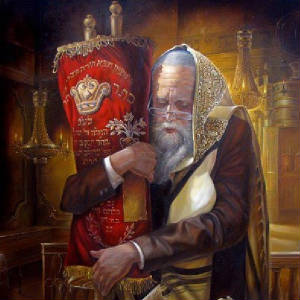
TorahUm…since when have Jews believed that when Messiah comes they will stop observing the mitzvot? I’ve never heard of such a thing before. In fact, according to this Jewish source…

The King Messiah and the Sanhedrin will restore the Sabbatical system and the Jubilee (which involve seven-year counts and a fifty-year count), as well as all other Commandments that we are unable to fulfill today. He will uphold and restore complete performance of the commandments and complete obedience to Hashem and His Torah. He will cause all Jews in the entire world to fulfill the Commandments of the Torah, and to uphold and strengthen the one and only true Judaism. Likewise, he will succeed in getting all the nations of the world, everyone alive, to acknowledge and serve the One True G-d, Hashem. This does not mean that they will convert and become Jews. It means that they will keep the Seven Laws that Hashem commanded the children of Noah.

The King Messiah will be extremely learned in Torah and absolutely observant of all the Commandments as taught and explained in the Oral and Written Torah.

The Messiah will not need to perform any miracles to prove who he is. Nor would the miracles be very significant. The Messiah’s purpose is to bring about the return of the Jews from exile, to restore our united practice of the Commandments of the Torah, to raise our conciousness to a high level of fear and love of Hashem, and to reinstate the Jewish kingdom in the Holy Land of Israel as Hashem originally established it under King David. Those are the Messiah’s essential purposes. Even bringing peace and affluence to the world will be only so that the world will be able to peacefully pursue our purpose of serving Hashem through Torah study and prayer — Jews as Jews, and Gentiles as Gentiles. Performing miracles is not particularly meaningful, since the Messiah will be an obviously righteous man, and the Torah commands us to obey the righteous.

What I’m driving at here is that all the miracles in the universe do not make someone Messiah, if he is not righteous. jesus, who contradicted the Torah, could not have been the Messiah, no matter how many miracles they claim he performed. The real Messiah, when he comes, may or may not perform miracles, but he will certainly not contradict the Torah in any way, shape or form.

-from the article “What the Messiah is Supposed to Do”
BeingJewish.com

Sorry about the really long quote, but I wanted to make sure that I got the point across (and to that end, I bolded the word “Torah” above) that the Jewish understanding of Messiah does not require the removal of Torah observance and in fact, Messiah and Torah are inexorably intertwined. The RPP writer is entitled to their opinion, but I really don’t see that such a viewpoint is sustainable based on the Tanakh, Apostolic Scriptures, or Jewish traditions.

Jews, Messianic or otherwise, are required to observe the mitzvot because the mitzvot are eternal. Even the Master is famously quoted as saying so:

“Do not think that I came to abolish the Law or the Prophets; I did not come to abolish but to fulfill. For truly I say to you, until heaven and earth pass away, not the smallest letter or stroke shall pass from the Law until all is accomplished. Whoever then annuls one of the least of these commandments, and teaches others to do the same, shall be called least in the kingdom of heaven; but whoever keeps and teaches them, he shall be called great in the kingdom of heaven.”

Matthew 5:17-19

Restoration
Photo: First Fruits of Zion

You should also watch this thirty-minute episode of First Fruits of Zion‘s television program The Torah is not Canceled (free to be viewed online).

I say all this in support of Jewish Torah observance, whether Messianic, Orthodox, or otherwise. Messianic Jewish observance of the mitzvot isn’t a “witness,” it is obedience based on covenant obligation. The Jewish view of the New Covenant makes this plain.

I’m forced to disagree with both the Aish Rabbi and the RPP author that Jewish devotion to Yeshua results in loss of Jewish identity and abandoning Jewish covenant responsibilities to Hashem (or making Torah observance optional for Jews). Granted, in the long history of Christianity, the Church has required that Jews surrender their identity when coming to faith in Messiah, but all that has changed. Gentile Christianity no longer is the sole keeper of the Keys to the Kingdom, and Jews now have an avenue by which they can reclaim their own King and their own Kingdom and remain Torah observant Jews.

I realize that I’ve most likely really offended a bunch of people by writing and publishing this and certainly that’s not my intention. I am quite aware that opinions differ widely within Messianic Judaism as to just how “Jewish” Jews in Messiah should be. I suppose some would see me as a radical for my belief that Messianic Jews should remain firmly rooted in Jewish identity, Jewish community, and Jewish devotion to Torah and to keeping and guarding the commandments. Yes, I’m speaking of an ideal state of the movement rather than the fractured reality of today’s Messianic Judaism, but I believe there will come a time when all Jews will be drawn back to the Torah by Messiah.

If anything, and I’ve said this just recently, the job of Gentiles in Messiah is to help facilitate Jewish observance of the mitzvot. A Christianity (or Messianic Judaism) that preaches otherwise denies the New Covenant promises God made to Israel.

The Language of the Soul

I recently read an online article at Aish written by Sara Debbie Gutfreund called The Blind Woman at the Gym, but it wasn’t what Ms. Gutfreund wrote that captured me. Someone named Sarah commented and what Gutfreund wrote (November 18, 2012 4:31 a.m.) and it was her story that prompted me to write my morning meditation (her comment was a single block of text which I’ve broken up into paragraphs to make her missive more readable):

This story reminds me of something that happened to me 19 years ago when I was doing my undergraduate degree. Our university required us to take a PE class. Being an English and French major at the time, I considered a PE class a waste of time and so I chose something ‘easy’ called “fitness walking”.

The first day of class, the gym teacher told each of us to pick a walking partner because we were to travel in two’s in a line. As I looked up from my books and surveyed the room for someone I knew, I found no familiar face. Then, at the very edge of class, in a corner, sat a blind girl and her leader dog who was an adorable black lab with soft brown eyes. The first thing I noticed was the other classmates looking toward her nervously, then back at each other, and then pairing off with each other and avoiding her because of their own discomfort. I thought to myself, ‘thank Goodness she can’t see their faces.’

I walked over and cheerfully said to her, “Hi, I am Sarah and I would love to be your walking partner this semester.’ The blind girl, with her beautiful long brown curly hair and eager smile quickly introduced herself as Angie and her dog as Sarge. All three of us, Angie, Sarge, and me walked together all semester and became great friends.

We regularly got together even after the class ended and remained friends until I moved 2,000 miles away.

That’s normally the end of the tale, two close friends move away from each other and never see or hear from one another again. But this is the age of social media, so finding anyone on Facebook should be a snap, right? Well, that’s not exactly how this next part happened.

Angie and I lost touch over the years, but the other day she found my parent’s phone number, called them and asked to be put in touch with me. We talked for hours that day and she told me about her marriage and her two children.

I’m leading up to the part of the tale that is the point of my writing this blog post. Here it is:

Then, she hesitated and said, “My daughter, my first born…I named her Sarah– after you…” Tears came to my eyes and I told her I was touched. She continued, “I met you when I was a freshman. You were a senior– and you weren’t disabled. And you took me in as family at a scary time in my life.” After we ended the call, I gave gratitude to G-d for giving me such an opportunity to meet Angie.

I don’t know why this final piece of Sarah’s commentary got to me. Maybe because it tells me that we may never realize how we affect people, for good or for ill, even after knowing them for years.

A chance meeting nearly two decades ago brought two young women together, one who was actively avoided by most of her classmates because she’s visually impaired, and their friendship meant so much to the young Angie, that even after the two parted, when she had her first child, a daughter, Angie named her “Sarah,” after the friend who meant so much to her.

We poor, pathetic human beings think we’re so powerless most of the time. We get cancer and we can’t cure it. We get into car accidents when we’re late for work. Our governments wage wars and we citizens can’t stop our soldiers, our fathers, brothers, and sons, from being maimed and killed. All the time we pray to an infinite and all-powerful God to rescue us from the consequences of being human.

And then Sarah tells the story of her friendship with Angie and in a sudden flash of realization, the power we all wield, to heal or to harm, to inspire or to discourage, stands in stark contrast to the impotency we were feeling just moments before.

I’ve spoken before about why all our religious arguments don’t work to serve the purpose of God, why only God can speak to our souls. Sarah’s story shows us that we can speak to each other’s souls. We just have to say the right words or rather, we have to actually show caring for another living being. Love and compassion are the language of the soul. It speaks even in eternal darkness and paints portraits even the blind can see.

Renewing Her Relationship with Shabbos and Hashem

And the Lord said to Moses: Speak to the Israelite people and say: Nevertheless, you must keep My sabbaths, for this is a sign between Me and you throughout the ages, that you may know that I the Lord have consecrated you.

Exodus 31:12-13 (JPS Tanakh)

The Talmud (Shabbos 10b) describes Shabbos as a special gift the Almighty gave to the Jewish people.

-Rabbi Zelig Pliskin
from “Observing Shabbos is a sign of your relationship with the Almighty,” p.218
Commentary on Torah Portion Ki Tisa
Growth Through Torah

My wife is continuing to renew her relationship with Hashem. Today (Shabbos, as I write this), she went to the Chabad for Shabbat services. I couldn’t be more delighted.

Why? Let me explain.

I’ve mentioned before that I believe the duty of non-Jews in Messiah and particularly those of us who identify as Messianic Gentiles, is to support, and if possible, inspire a return to greater Torah observance for Jewish people, and frankly, whether they’re disciples of Yeshua or not.

But without me doing a thing, something remarkable happened this morning. My wife (who is not Messianic in the slightest) went to Shabbat services. As I said above, I couldn’t be more delighted. She’s been lighting the Shabbos candle in our home somewhat intermittently over the past few months, but this is the first time in a long time when I’ve found her all dressed up and heading out the door to go to the Chabad to worship.

Shabbat candlesI’ve tried my hand at personal Shabbat observance and let’s say the results weren’t spectacular. Shabbat observance for anyone requires a great deal of discipline and preparation and really, I think it can only be done when it is fully integrated into your lifestyle. It would probably be best if you grew up in an observant home, but short of that, practicing and striving to observe Shabbos over the course of months, ideally with a knowledgable Jewish person guiding you, would certainly be effective.

But after my own “experiment,” and especially knowing my wife would not support me observing Shabbat (my “honey do” list has certain duties I must perform on Saturday), I decided that if it’s more important for her to observe Shabbat than it is for me, then my observing Shabbat, in the grand scheme of things, doesn’t really matter all that much. I think Rabbi Pliskin would probably agree:

The Chofetz Chayim gave two parables to illustrate how Shabbos serves as a sign of the relationship between the Jewish people and the Almighty. When two people are engaged to be married they send each other gifts. Even if difficulties arise between them, as long as they keep the gifts that they received from each other we know they still plan to get married. But if we see that they have returned the gifts, then we know that the relationship between them is over. Similarly, as long as a person observes Shabbos we see that he still has a relationship with the Almighty.

-ibid

Granted, she drove to services and it’s possible she will perform other melachah today, but this is still a powerful leap forward.

The effect of observing the Sabbath properly has another dimension. The Midrash (Shemos 25) states: R’ Levi said, “If the Jews will observe Shabbos properly, even one day, the son of David will arrive (i.e. we will return to Eretz Yisrael).” Why? For it is considered the equivalent of all the mitzvos, as the verse states (Tehillim 95:7): “For He is our God and we are the flock He pastures and the sheep in His charge — even today, if we but heed His call!”

from A Mussar Thought for the Day
Sunday’s commentary on Torah Portion Vayakhel
A Daily Dose of Torah

Yes, this is midrash so we might not be able to take it literally, but I believe there is a certain truth involved in Jews performing the mitzvot with Kavanah, the return of Messiah, and the New Covenant promises of God to Israel, the Jewish people, being realized.

Then I will sprinkle pure water upon you, that you may become cleansed; I will cleanse you from all your contamination and from all your idols. I will give you a new heart and put a new spirit within you; I will remove the heart of stone from your flesh and give you a heart of flesh. I will put My spirit within you, and I will make it so that you will follow My decrees and guard My ordinances and fulfill them. You will dwell in the land that I gave to your forefathers; you will be a people to Me, and I will be a God to you.

Ezekiel 36:25-28 (Stone Edition Tanakh)

No, I’m not discounting the Messiah, and I know that no one comes to the Father except through the Son:

I am the bread of life. Anyone who comes to me will not be hungry, and one who believes in me will not thirst again.

John 6:35 (Delitzsch Hebrew Gospels)

MessiahI don’t believe that Yeshua-devotion and the New Covenant promises of God to Israel are mutually exclusive. In fact, they are inexorably tied to one another, since Messiah is the mediator of the New Covenant and he came the first time to lay the foundation and to make the first down payment of the New Covenant.

This may be for some of you as was said in the synagogue in Kefar Nachum (John 6:59-60), “This word is difficult. Who is able to hear it?”

Rabbi Derek Leman has been spending the past several weeks on his blog laying out his theological perspective on a Jewish understanding of the Bible including the Apostolic Scriptures, as it describes Hashem’s relationship with the ancient and modern Jewish people. One of the things he said, and I agree with him, is that God didn’t abandon the Jewish people, and switch to the Christian Church at the end of the Biblical narrative. He can be found just as commonly in the Synagogue as in the Church (and having worshiped in a synagogue setting in years past, I can attest that His Presence was there).

So I don’t believe that God has abandoned my Jewish wife anymore than He has abandoned me for being a Christian (or Messianic Gentile if you prefer). I do believe that God expects my wife, as a Jew, to observe the mitzvot, including the Shabbat, since they were given specifically to the Children of Israel (as opposed to all mankind) at Sinai. The existence of a large number of “grafted in” Gentiles does not take away uniquely Jewish obligations and duties to God, and if my being a disciple of Yeshua means anything at all, then it should mean that I will do everything in my power to support and encourage my wife to observe the mitzvot associated with Shabbos.

The first of the zemiros that many people sing on Friday night begins with the words: “Whoever hallows Shabbos as befits it, whoever safeguards Shabbos according to the law [and refrains] from desecrating it, his reward is exceedingly great, in accordance with his deed.”

from A Closer Look at the Siddur
Sunday’s commentary on Torah Portion Vayakhel
A Daily Dose of Torah

So even if she didn’t light the Shabbos candles last night but she davened at shul (today) on Shabbos, then in accordance with her deeds, may Hashem reward her.

Of course, this should only be the beginning:

Rashi comments on this that rest on Shabbos should be a permanent rest and not merely a temporary rest. I heard from Rabbi Chayim Shmuelevitz the following explanation: A temporary rest means that a person has not really changed his inner traits, but he merely controls them on Shabbos. He still has a bad temper and has a tendency to engage in quarrels, but because of the elevation of Shabbos he has self-discipline and these traits are not manifest. But the ultimate in Shabbos observance is that a person should uproot those negative traits which are contradictory to peace of mind on Shabbos. One needs to uproot such traits as anger and the tendency to quarrel with others. Only then is your rest on Shabbos a complete rest.

-Rabbi Zelig Pliskin
from “To have peace of mind on Shabbos you need to have mastery over your traits,” p.220
Commentary on Torah Portion Ki Tisa
Growth Through Torah

intermarriageI’m choosing to interpret this a bit differently than I think Rashi and Rabbi Pliskin have in mind. I think that when a Jewish person observes some portion of Shabbos but not others, they are achieving a sort of temporary rest. Only when a Jewish person observes all of the aspects of Shabbos do they achieve the permanent rest they find in the complete acceptance of Hashem’s gift to Israel.

I’m keenly aware that my wife very likely sees me as an obstruction to her Shabbos observance since, after all, not only am I not a Jewish husband, I am in fact, a Christian husband, and like most Jews, she sees Christian theology, doctrine, and practice as the antithesis to religious Judaism and Torah observance.

More’s the pity.

I probably embarrassed her this morning, though I didn’t mean to. I spent about an hour and a half at the gym and when I got home covered in sweat, she was just coming out of our bedroom dressed quite nicely. I was startled and although I thought I knew the answer, I asked where she was going.

“Where do you think?” she responded.

I was thrilled she was going to services but she said I was “acting weird about it.” I guess I didn’t get my actual emotions across, but then I know she doesn’t want me to comment too much about her observance or relationship with Jewish community.

In the end, if my staying home and doing chores on Shabbat somehow frees her to go to synagogue, daven with Jewish community, and to observe more of the mitzvot, then I am content to be in that role. This is the role, at least from my tiny viewpoint, that I believe God has assigned me as a Messianic Gentile. The rest is in Hashem’s hands.

One Perspective on Messianic Judaism

Long-time commentator ProclaimLiberty (PL), in response to Chaya, another of my enduring readers, has framed a detailed outline of his perspective on the Messianic Jewish viewpoint on God, Messiah, and the Bible. After a bit of editing on his part, he’s asked me to post it here, and I agreed. From here to the end is what PL has crafted. The comments section is open. Since I didn’t author what you’re about to read, please direct any specific questions to PL. Thank you.

—————————————————

@Chaya — You wrote:
“@James, @PL and others, I would like to know what you view as the, “MJ viewpoint,” because, according to my understanding, there are many viewpoints and the situation continues to evolve/change.”

I would answer that I see two possible ways of trying to envision what is “the MJ viewpoint”. One would be some sort of aggregate summary of whatever those who claim to represent MJ seem to be expressing. Since there seem to be a great many conflicting expressions extant, I suggest that this method is intractable. It lacks a coherent objective model by which to qualify the various subjective views and how well or badly they actually reflect “genuine” MJ. The other method, which I believe to be more accurate and much easier to define, is a theoretical or philosophical construct or model. Hence I would answer that the definition of “the MJ viewpoint” may be stated simply, though its ramifications can be elaborated broadly. I would like to outline it thusly:

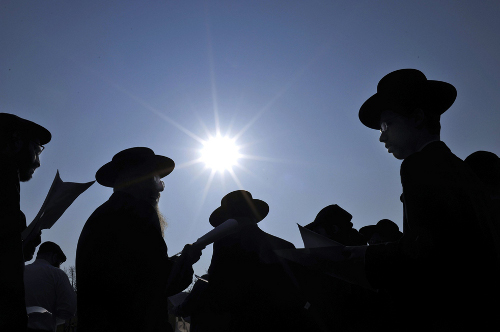
Orthodox JewsPoint 1. Messianic Judaism (“MJ”), or Jewish messianism, begins and ends with Jews and Jewish behavior and outlook. It is, however, the nature of HaShem’s choice of the Jewish people that they affect all of humanity because ultimately all humans are one Adamic (or even Noa’hide) family. Nonetheless, Jewish messianists must define themselves within Judaism and the Jewish people; and their lifestyle must reflect the traditions that are definitive of the Jewish people and their (our) four millennia of developing civilization. MJs must not view themselves as factional separatists (“minim”) at odds with other Jews.

An MJ organization in the USA called “Hashivenu” (@ hashivenu.org) expressed this as one of their core principles with the phrase: “The Jewish people are ‘us’, not ‘them’.”. They elaborated it, with a degree of perspective developed from prior Hebrew-Christian experiences, as follows:

Like a boat that had drifted from its moorings, we were not cognizant of what was happening to us until a key event, conversation, or combination of factors jolted us awake to the realization that we were farther from our Jewish moorings than we had realized.

For most of us, experience in evangelical contexts taught us to look at Jews only as people to whom we ought to witness. For us, the subtext of every family gathering became “How can I bring the subject up?” and the objective in our relationships with Jewish family, friends and acquaintances became “How can I witness to them without their closing the door on the Gospel and on me?” As important as these issues are, we realize now how wrong it was for these evangelistic concerns to be the sole axis of measurement of relationship with other Jews, even our own family members. We became church-culture chameleons, adept at blending in, showing that even though we were Jews, “we weren’t like the other Jews”: we were real Christians, too. More often than we were prepared to admit, though, we felt ourselves uneasy strangers in a strange land of potluck suppers, hallelujahs, and obligatory right-wing politics. But we had been taught, “You can’t go back to what you were. This sense of distance from the Jewish people, Jewish ways, and from family is the cost of discipleship, the cross you are called to gladly bear. Rejoice and be exceedingly glad.” One day we discovered that we had become habituated to speaking of the Jewish community in third person. We awoke with a start.

Now we know we can go home again. In fact, we must go home again for, truly, there is no place like home. And home for Jews is Jewish life. No doubt, we will have to remodel that home a bit to properly accommodate Yeshua, our Messiah, but better to remodel our own home than to be a permanent guest at someone else’s address.

We dare to believe that among the many mansions prepared for Yeshua’s people, some have mezuzot on the doors. We dare to believe that by rediscovering and reclaiming our own identity as Jews, we will be better brothers and sisters to Gentiles who love our Messiah. In all aspects of life, we want to live in a Jewish neighborhood socially, culturally, conceptually so that we and our children and our children’s children will not only call Yeshua Lord but also call the Jewish people “our people” and Jewish life “home.”

MessiahPoint 2. MJ is a Jewish messianism that views Rav Yeshua ben-Yosef ben-David as a valid candidate for the position of the ultimate Jewish King Messiah, on the basis of his teachings, his example, his piety, and his resurrection from death. His qualifications are derived from the Tenakh and elaborated in later Jewish literature. The qualifications for Messiah cited by the RamBam focus on only a portion of overall messianic qualifications, which are termed the “ben-David” Messiah who will restore the Jewish kingdom and rule therein as the “conquering king”. His rather “Johnny-come-lately” perspective on the Messiah neglects other messianic qualifications that have been described as a separate messiah-figure termed the “ben-Yosef” Messiah who suffers and dies because of the sins of Israel and on our behalf. Without benefit of a resurrection, it would be rather difficult for a single messiah to fulfill the entire set of qualifications. While it can be argued that Rav Yeshua has not yet fulfilled most of the requirements for the conquering king ben-David Messiah, hence the prophecy and expectation of his return to do so at the proper time, he has fulfilled the purposes of the ben-Yosef suffering servant Messiah admirably well, and he has been suitably positioned via resurrection and ascension to enable such a return and task-completion. Meanwhile a proper understanding of the Torah perspectives he taught enables would-be Jewish disciples to pursue a form of ‘Hasidut that would demonstrate the validity of his messiah-ship.

Point 3. MJ derives its view of Rav Yeshua from the writings of his disciples who were commissioned to teach his perspective on how to apply Torah toward Jewish living. These disciples were all Jews (though one may have been a convert, or at least a former Hellenist). Rav Yeshua’s teachings were essentially Pharisaic in character, particularly with regard to their interpretive methodology. From a much later Jewish perspective we would describe him as a ‘Hasidic “admor” and “tzaddik”. However, these “apostolic writings” were adopted and preserved by non-Jews who professed to follow their teachings; and these non-Jews, who called themselves Christians, were excessively influenced by political influences by which they distorted the interpretations of the apostolic testimony to exclude its particularistic Jewish application and perspective, and to denigrate Jews and Judaism — even creating a fictitious Greek-styled demigod, known today in English as “Jesus”, in place of the original Israeli rabbi Yeshua in his natural context. Nonetheless, MJs have identified and continue to research correspondences between the apostolic writings and other Jewish literature in order to re-develop their native Jewish character and improve general understanding of what Rav Yeshua and his apostles actually intended and taught. Their exegesis is not derived from traditional Christian doctrines but from the Jewish text and its context.

Point 4. Because of historical persecutions of Jews by Christians during at least 15 centuries (some would say as much as 18 or 19), Jews in general resist any involvement with Rav Yeshua or the apostolic writings, and mistakenly assume that anyone who does so must be some sort of a Christian or to have joined forces with them against Jews. Regrettably, there are well-known historical examples of just such treachery by Jewish converts to Christianity. Hence MJs who attempt to reclaim and restore the original Jewish character of the apostolic literature about Rav Yeshua frequently are required to assert that they are not Christians, and that neither they nor the writings are anti-Jewish. However, since some modern Christians have learned to eschew the anti-Semitism of past Christian tradition, and even to become ardent supporters of Jews and Israel, MJs do interact positively and cooperatively with them when possible.

Rabbi Isaac Lichtenstein

Point 5. Among the implications in the Jewish apostolic literature is a view of how Jewish redemption can be extended to the rest of non-Jewish humanity, which is the basis on which the non-Jewish religion of Christianity began (before it became directed against Jews and Judaism). Therefore, many non-Jews seeking the authentic roots and origins of faith in Rav Yeshua have turned to MJs for help in their parallel quest to understand the Jewish context of the apostolic writings. However, for MJs such assistance must be prioritized as secondary to MJ re-development and restoration of Jewish praxis and knowledge, without which there is little or nothing meaningful to offer that can support the non-Jewish request for help. Regrettably, this left somewhat of a vacuum during the initial decades of MJ development, which has become filled with a wild mixture of notions that falsely claim an MJ or related label.

The Hashivenu website offers a few additional core values elaborating its statements of MJ principles. Though their formulation is, at this stage, somewhat dated, I would still recommend them as worthwhile reading. I suspect that “the MJ viewpoint” described above is not much different from the views of Rabbi Isaac Lichtenstein in 19th-century Hungary, a century prior to the formulation of the MJ paradigm of the 1970s in the USA and just as different from the HC viewpoint as it was from the 19th-century views of the Jewish Christian Feivel (Paul Phillip) Levertoff. Consequently I would not place much credence in the notion that “there are many viewpoints and the situation continues to evolve/change”. I see two basic models, which I would associate with “MJ” (Lichtenstein) and “HC” (Levertoff), respectively, and which have persisted for more than a century. The MJ model re-emerged in the 1970s, but still it has been overshadowed by the HC model, despite the latter’s adoption of terminology more suited to MJ. The strength of HC has been its appeal to Jews who wish to maintain a semblance of Jewish culture and identity within an otherwise foreign Christian religious environment. A weakness of MJ (in terms of popular perspective and appeal) has been its somewhat insular Jewish perspective and its more demanding requirement to conform with Torah-based Jewish culture that differs from the surrounding mainstream environment and which is therefore often denigrated or disdained. Perhaps we should also consider a form of the perspective mentioned in statement #5 above, which may be termed the gentile seekers of “Hebrew Roots” (“HR”). While this is not at all a part of MJ, in some ways it resembles HC, adopts MJ terminology, and associates itself with MJ. That might offer an appearance that the “MJ movement” (so-called) comprises three perspectives and a lot of developmental confusion. However, much of HR suffers from effects derived from the supercessionism developed by earlier versions of Christianity. HR tends not to recognize continuing Jewish distinctiveness and validity, as it focuses on trying to distinguish itself otherwise from traditional Christianity by trying to act in some manner that it perceives to be Jewish in some first-century sense. It suffers from the lack of clear MJ guidance cited above in statement #5, because it is true that MJ is still challenged by the need to develop itself by elaborating an otherwise stable MJ viewpoint into stable, well-defined, and wide-spread praxis.

A significant consideration in current discussions of “Judaism” is the notion of “continuity”, which is a reflection of a primary reason mentioned in Torah for why HaShem so favored Avraham Avinu (in addition to his extraordinary faith). He, as the primary of three visitors to Avraham, in Gen.18:19, is quoted as “saying”: “For I have known him, so that he will command his children and his household after him, that they may keep the way of the LORD, to do righteousness and justice; so that the LORD may bring upon Abraham that which He hath spoken of him.”. It is well-recognized that various forms of Orthodox Judaism have diligently continued the practice of teaching Jewish children thoroughly to perform both private and communal aspects of Judaism, generation after generation. The modernized halakhah practiced by Conservative Judaism has only been tested for a few generations so far, and there is some question about whether it can successfully maintain itself or whether it will succumb to assimilationist pressures and the effects intermarriageof intermarriage with non-Jews. Reform Judaism has been through a cycle of recognizing that many aspects of Jewish practice that they previously discarded left their children with little by which to distinguish themselves as Jews or with which to identify, which has contributed to their assimilation, their intermarriage with non-Jews, and their loss to the Jewish people. Within the current generation they have re-adopted some of the distinctive forms, within religious contexts rather than lifestyle ones, in order to stem this loss. Even newer forms of so-called Judaism have arisen within the current generation, and these have not been tested for their ability to maintain Jewish continuity. Messianic Judaism has included examples of multi-generational families that have maintained at least as much Jewish identity as the Reform or Conservative movements, even among those whose praxis and theology is more like that of Hebrew-Christians, but the movement still faces assimilationist and intermarriage pressures arising from close association with Christians of one sort or another who still don’t quite grasp or support the Jewish responsibility to remain a distinct people. It has been stated in various places that if the Jewish people does not maintain its communal distinctiveness, thus ceasing to exist as an identifiable people, then Hitler wins a posthumous victory. Some would note that such a victory also belongs to the spirit of Amalek, and to HaShem’s ancient adversary known as HaSatan. Regardless of whether anyone grants credence to such pessimism, I would insist that a proper response is to ensure that no actions taken by any Jew should ever contribute toward such an outcome – and we might extend such a principle to apply it to anyone who seeks HaShem’s favor. Therefore I would like to reiterate from my defining statement #1 above that MJs should conduct themselves as Jews, preserving Jewish tradition in their actions and in their teaching to their children (and to anyone else who may care to listen). Incidentally, we can see from Rav Yeshua’s observation in Mt.5:19 that this is also a recipe for greatness in the kingdom of heaven. May it be so for all MJs, and for the gentiles who affiliate with us (and let us say, “Amen”).

—————————————————

Up to Jerusalem

Why All Our Arguments Will Never Whisper To The Soul

faithIn the comments section of my previous meditation, a number of people debated over their various theological beliefs and offered a number of “proofs” to support their points of view. At about the same time, I read an article called “Why is there no evidence of G-d” at Chabad.org. This inspired a few thoughts about the nature of “truth” and why (probably) no one person or religious organization has the complete corner market on truth. But in the sidebar of the aforementioned article was a series of links to related articles. I clicked the one that said What Does it Mean to “Believe in G-d”?.

The statement, “I believe there is a G‑d” is meaningless. Faith is not the ability to imagine that which does not exist. Faith is finding relevance in that which is transcendent. To believe in G‑d, then, means not that you’re of the opinion that He exists, but that you have found relevance in Him. When a person says “I believe in G‑d” what s/he really means is “G‑d is significant in my life”.

In discussing our relationship with G‑d, the question we first need to ask, is, Who cares? In what way is He relevant?

For some people, G‑d is relevant because they are concerned with the origins of existence. For others, G‑d is relevant because they are concerned with the afterlife, and faith is a prerequisite for getting to heaven. Finally, for others, G‑d is relevant because they believe that life has purpose.

Certainly Christians convince others to come to faith because of the promise of the afterlife (“If you died tonight, do you know what would happen to your soul?”). The Church convinces “sinners” to convert to Christianity based, at least initially, on the fear of going to Hell and suffering for all eternity, and that by being “saved,” they are promised they’ll avoid Hell and ascend to Heaven when they die to be with Jesus.

That seems kind of cheesy. It’s like we have faith in God because it’s all about us and our salvation. Even coming to faith so we have some “grounding” in the origins of the universe, people, and the existence of everything still seems kind of self-centered.

But what about believing because we want life to actually mean something?

In Judaism, particularly in Chassidism, the interest in G‑d comes from the conviction that life has meaning. The recurring question in Chassidic thought is: Why is a soul sent into the world to suffer in a physical body, for 80, 90 years? We know there is a purpose, that G‑d is the author of that purpose, and we want to know and understand it.

One who lives by his heart exclusively, trusts only what he feels. One who lives by his mind exclusively, trusts only what fits. But neither of these tells you the truth. The mind demands that logic be trusted, the heart demands that the emotions be trusted. Yet both can be mistaken. They do not reveal inherent truth. For that, we turn to the soul, the neshamah. Because the soul is a part of the Divine — and that is truth. When we have faith, when we find relevance in G‑d, we are trusting that instinct in the soul that tells us that G‑d is the purpose of life.

In pragmatic terms, the mind, the heart and the soul must each fulfill their function: when we know all that can be known, when we come to the edge of knowledge and logic itself tells us that we have reached its outer limits and it cannot handle what lay beyond this point, faith enters. Where the mind is no longer adequate, the soul responds to truth. This is faith.

Let’s look at the central message:

The mind demands that logic be trusted, the heart demands that the emotions be trusted. Yet both can be mistaken. They do not reveal inherent truth. For that, we turn to the soul, the neshamah.

soulIn an ultimate sense, we can use evidence to support facts but not the truth. Being nice or being smart don’t really lead us to truth, but then we have a problem. How can you or I convince another person of “the truth” since that exists only in the purview of the soul?

This is why in Chabad-Lubavitch it is our approach to invite a Jew — even one who claims not to believe — to do a mitzvah, before we engage them in a discussion on faith. Because in consideration of the existence of the soul, we can assume that we don’t have to convince people of life’s Divine purpose. We just have to get them started, and with each mitzvah they do, their neshama asserts itself more, and questions become answered of themselves. By way of analogy, if a woman’s maternal instinct appears to be absent, you don’t argue the philosophy of motherhood with her. Just put the baby in her lap and her maternal response will emerge.

I can’t even imagine how a Christian would evangelize using this method. In Christianity, doing only matters after believing and is only a reflection of believing. Granted, the Church has a strong practice of charity and service to others, but it’s not the driving force that causes a person to convert to Christianity in the first place (could you imagine being a Christian and approaching a “sinner,” inducing them to join the Church with the promise of a lifetime of service to God and humanity?).

However, that’s more or less what Rabbi Manis Friedman is suggesting in his article. That’s why the Chabad will ask a Jew who is not at all religious to perform at least one mitzvah. Because the mitzvot are what connects a Jew to God.

To encounter God is a transcendent experience that goes beyond thought or emotion, but in order to “operationalize” that encounter, a Jewish person “does”. That is, he or she connects the soul to the author of the soul by performing mitzvot. This isn’t to say that prayer and worship don’t connect Jewish people to God, but at least from the Chabad’s perspective, it all starts with performing a single mitzvah, and then another, and then another, until they are living an increasingly Jewish life.

Christianity has the opposite approach in that reading the Bible, praying, and worshiping come first, and then eventually as the believer’s life is transformed by their faith, they come to the place where they are “doing” Christianity by helping other people.

argumentWhen we argue with each other for the supposed purpose of correcting what we believe others have gotten wrong about the Bible, about God, and about Messiah, and we say we are doing so because we care about those people, we are missing a vital element. We can’t reach their soul, at least not directly, with logical arguments or by appealing to their emotions.

Whether it’s by a Christian having a person they’re evangelizing praying to be saved, or by a Chabad representative having a Jew lay tefillin, the appeal is to the soul, and although we have different actions we put people through to make this happen, it’s really God who is speaking to the neshamah. That’s why, except in very rare instances, our blog conversations will never really be able to convince someone to admit that their theology is wrong, to change their minds, and to adopt a different religious discipline.

Speaking of changing religions, I found this article and it seemed relevant.

The Meaning of Purim for the Christian Church

I posted this one last year and I think the message needs to be repeated. Purim definitely has applications to the Christian Church. If only they would listen.

James Pyles's avatarMorning Meditations

Super girlI haven’t thought much about Purim in awhile. It’s not something we observe in our home and I tend to think of Purim as being primarily for children, dressing in costume, playing games, telling jokes, that sort of thing. Back in the day, the congregation I used to attend observed Purim with a children’s play, which often took on some sort of Star Wars or other fantasy theme. But those days are gone, my children are grown, and my grandson isn’t even aware of Purim.

I received an audio CD from First Fruits of Zion (FFOZ) a number of days ago, but I didn’t get a chance to listen to it until I was weeding the backyard over the weekend. It’s interesting trying to pull weeds out of muddy plant beds, listening to D. Thomas Lancaster lecture about Purim to the congregation at Beth Immanuel Sabbath Fellowship, and periodically grab my pen and notebook to…

View original post 2,668 more words