All posts by James Pyles

James Pyles is a published Science Fiction, Fantasy, and Horror author as well as the Technical Writer for a large, diversified business in the Northwest. He currently has over 30 short stories published in various anthologies and periodicals and has just sold his first novella. He won the 2021 Helicon Short Story Award for his science fiction tale "The Three Billion Year Love" which appears in the Tuscany Bay Press Planetary Anthology "Mars."

Is There More Than One Right Way To Be An Observant Jew?

Shabbat Shalom, everyone. And I know that the Orthodox way has its charm, its appeal, but the cost of living like the old days in this postmodern world is very high. This article is about the real price of being Orthodox in Atlanta and completely following the traditions.

-Derek Leman
as quoted from Facebook

I don’t mean to be unkind to Derek, but my impression of the above-quoted comment is that keeping an Orthodox lifestyle is “quaint, ” impractical, and largely unnecessary for Jewish living. Maybe I’m getting Derek all wrong, but I think he’s missing the point.

But first things first. Derek is commenting on an article written by Asher Elbein for Tablet Magazine called Grappling With the Rising Cost of Being Orthodox.

Here’s a sample:

For Orthodox Jews everywhere, the cost of being observant has always been high; day schools, kosher food, and housing have always been expensive. But those costs have risen dramatically in recent years. And for residents of Toco Hills (a Modern Orthodox enclave near Atlanta, GA), where housing costs have climbed even as the recession has lowered people’s incomes and reduced their savings—and many breadwinners have lost their jobs—the costs have become a major burden. According to Rabbi Ilan Feldman, leader of Congregation Beth Jacob, a grand shul at the center of the community, 100 of the 600 families living here are on federal or local assistance, a number that has risen gradually but consistently since 2010.

The article highlights Tzivia Silverstein, an Orthodox Jew and an unemployed single mother.

Her mother is helping out, Silverstein says, and she’s getting some child support from her husband, but making ends meet is a continuous struggle. Most of her time is now spent looking for work, preferably something steady, like bagging or cashiering at a local grocery store. But finding a position that doesn’t require weekend time has been difficult. “That’s been a classic challenge of American Jewry, you know?” she said. “Do you work on Shabbat or not? You have trouble earning money because you can’t work on Saturday, and you have to take off for holidays.”

In the Facebook conversation regarding this article, Derek commented that Conservative Judaism “is a good middle ground,” but is this really such an easy choice, like choosing which food items to put on your plate at the local Golden Corral restaurant? Although Tzivia was born into a Reform home, many Jews are born and raised in Orthodox Judaism. It is, for them, more than a “lifestyle.” It’s a life.

The Orthodox Jewish community has a certain mystique.

Whether it’s because we look, act or believe differently, people are intrigued by stories about the Orthodox Jewish community. Media outlets often oblige but whenever I read these stories, they don’t quite resonate with me. They don’t look like the Orthodox community I know. So I’d like to share a few things that happened to me over the last year that give a more accurate insight into the real Orthodox Jewish community.

-Shimon Rosenberg
“The Orthodox Community I Know”
Aish.com

Even in other branches of Judaism, the Orthodox (and there’s more than one expression of Orthodox Judaism, from Modern to Chasidic) are looked at somewhat askance. They are seen as rigid, judgmental, archaic, and even uneducated. Many hold to a very literal understanding that the Earth is 5,774 years old (the current year on the Jewish religious calendar is 5774).
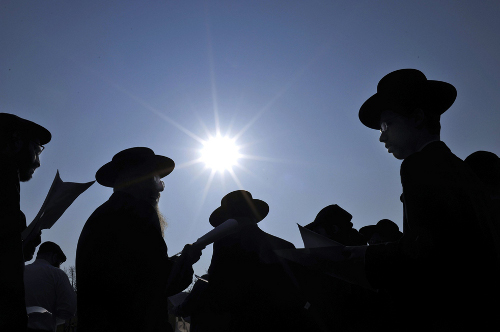
Orthodox JewsOn top of that, the Orthodox are considered the most “rule heavy” expression of Judaism and, as the Tablet Mag article attests, being Orthodox and strictly observant is very expensive.

Contrary to popular belief, not all Jews are wealthy or even comfortably middle-class. Some Jews, like Tzivia Silverstein, are barely making it. But what else is Orthodox Judaism? Let’s return to Shimon Rosenberg’s answers:

My wife and I have experienced fertility problems. We thankfully had been blessed with two children but as they grew older we had been trying for some time to have another child to no avail. One day I was speaking with my rabbi about our situation and I conveyed to him that my wife and I wanted to pursue fertility treatments but because of the steep cost, we were having second thoughts. A few days later my rabbi said that he spoke with an anonymous individual with means in the Jewish community who had agreed to sponsor fertility treatment for young Jewish couples if they could not afford it. He would not know who we were and we would not know who he was. He was motivated purely out of a sense of loyalty to the continuity of the Jewish People.

That’s the Orthodox community I know.

I’ll admit to experiencing a certain amount of dissonance between the Tablet Mag and Aish articles, since you’d think Rosenberg’s Orthodox Judaism would somehow step in and help out Silverstein to the degree that she could acquire a job with an adequate income and not struggle so hard to make ends meet.

I also experienced the same dissonance with how Sue Fishkoff described the Chabad in her book The Rebbe’s Army in relation to some of the experiences my wife has had with the local Chabad Rabbi and Rebbitzen (no, they’re not bad people, but they are human, not the morally and ethically superhuman people Fishkoff often described in her book).

But the costs involved in living Orthodox in Toco Hills continue to rise and there’s only so much help available for lower-income Jewish families:

Many Orthodox families, especially those on the lower end of the economic ladder, simply can’t keep up with the prices. So, they turn to underground charities like Yad L’Yad, an Atlanta-based organization that works exclusively with the area’s Jewish community. According to Esther Pranskey, the organization’s head, the number of recipient families more than doubled when the recession struck and has continued to rise steadily. More than 30 families—including the Silversteins—currently receive provisions of flour, rice, pickles, and other essentials. While basic, the deliveries help ease the pressure. The Silversteins rarely go out to eat, and their meals aren’t extravagant affairs, but they stay fed and they stay kosher.

shabbosBut as Rosenberg attests in his continuing chronicle of his daughter’s birth, there are other occasional helpers:

The excitement began early Friday morning and as the day progressed I started thinking about Shabbat. What would we eat? How would I recite Kiddush? Light candles? I remembered hearing about an organization called Bikkur Cholim which means “visiting the sick.” It’s a volunteer-driven charity that looks after the needs of people in hospital. I called them and within a couple of hours someone came to our hospital room with literally bags of food, grape juice for Kiddush, electric candles to serve as Shabbat candles, even spices for havdallah. The food is free and the person delivering it is a volunteer. In the few moments I had to speak with him I learned that he was just a regular guy — an accountant — who takes off Fridays from work to volunteer for Bikkur Cholim. I asked him why he does it and he replied simply that it’s what God wants of us.

That’s the Orthodox community I know.

The Tablet Mag article doesn’t exactly end on an up beat, but it does describe why being Orthodox isn’t just a casual choice:

“I know it’s not the smart thing to do,” Wittenberg said. “I’d love to sell my house and move out somewhere cheaper. There’s not a day goes by when my wife and I don’t talk about it. But I’m a baal teshuvah. I’m choosing to be observant. And if I’m going to struggle through this Torah, then my kids need to have friends. They need to be in the community.”

For Silverstein, it comes down to value instead of cost. In terms of personal and spiritual fulfillment, she says, the neighborhood pays for itself. As heavy as the expenses are, they are necessary sacrifices for belonging to the community. “I see maybe one movie a year,” she said. “I choose to put my kids through religious school instead of buying a nicer car. It’s astounding, the amount of money that other people have, to spend on things like renovating their house or buying a bigger TV. To me, my most important relationship is with God. The material world is a means to an end.”

I’d love to copy and paste all of Rosenberg’s write-up here but I’ll restrain myself to its ending as well:

After two weeks in the hospital, the doctors told us we could go home. In the end, they said they would monitor her condition, but over time it would likely go away on its own.

Our two kids at home were delighted at the return of their baby sister. They helped her and cared for her and nurtured her. As a parent, there’s no better feeling than seeing your children care for one another. Likewise, when God watched how my community took care of my family in our time of need, I think He too had that parental pleasure, so to speak.

I wish I could thank my community publicly for everything that they’ve done but I am writing this under a pseudonym to protect the privacy of my family. But I know that my community doesn’t want a public thank you. They were just doing what they do.

That is the Orthodox community I know.

Derek Leman
Derek Leman

Getting back to the Facebook commentary, why would being Orthodox seem to be such as casual selection (and I apologize if I’m mischaracterizing the motives or intent of Derek and the others dialoging in the thread)?

One person made the following comment:

I think Yeshua will be a conservative Jew. Orthodoxy is more interested in keeping Torah( or the rabbinical interpretation of Torah) with rigidity. Creating it to be a burden, and simple works that do not bring us closer to Hashem . Reform is too liberal, and mostly a social club than a house of worship. I believe all Jews want to serve Hashem,they just have different interpretations on how to do it. The MJ I attend leans towards the conservative tradition.

I suppose we all have our own theories on what sort of Judaism Yeshua (Jesus) will advocate and teach upon his return (although Christians probably don’t imagine he’ll practice Judaism at all), but we are operating in a vacuum. We don’t know that Messiah will formally support a currently existing branch of Judaism. But if you read Matthew 23:1-3 as I do, you see Jesus not only agreeing with the teachings of the Pharisees but stating that they had the right to issue binding halachah (legal rulings) for their community, which apparently included Yeshua’s disciples.

That would at least hint that in the future Messianic Age, he will support a more strictly observant lifestyle which probably will include a variety of traditions such as Netilat Yadayim (ritual hand washing). That’s a guess, but I hope it’s an educated guess.

Of course modern Messianic Judaism, like all of the other more normative Judaisms, doesn’t represent a single, overarching identity or philosophy. Derek is affiliated with the Union of Messianic Jewish Congregations (UMJC) which he describes as “the oldest (and best) network of Messianic Jewish congregations in the U.S.” If you go to the Introduction page of the Standards section of the Messianic Jewish Rabbinical Council, which provides the oversight for the training and ordination of UMJC Rabbis such as Derek, you can find a PDF document called Standards of Observance which outlines in some detail the “worship, ethics, education, (and) halakhic standards” established by this body. Without going into exquisite detail, those standards seem largely to be Reform with some elements of Conservative Judaism.

I don’t doubt that those particular standards were selected with the majority Gentile attendance of UMJC synagogues in mind. Although I know more than a few non-Jewish people who have basically run out of their churches and into a Messianic Jewish lifestyle of one sort or another, almost all of them are not observing halachah to the level of an Orthodox Jew or anywhere near it.

Messianic Judaism is even now just beginning to emerge into its own as an authentically Jewish expression of Yeshua-faith, but it has a long way to go. As a relatively new branch of Judaism (I realize I’m going to receive a lot of “push back” by calling Messianic Judaism a Judaism at all), it’s still trying to “find its feet,” so to speak. UMJC is only one organization representing Messianic Judaism and its codified standards only apply to the affiliated Rabbis and synagogues under the UMJC banner. Other Messianic Jewish groups (as opposed to One Law/One Torah, Two House, Ephraimite, or Sacred Name groups) may follow different standards, either established by a different umbrella organization or at the level of the individual synagogue/congregation.

Even within those groups, Jewish individuals and families may hold to varying degrees of observance, some more stringent and some less than their faith communities. I’ve found that to be true of many of the Jewish families who attend the local Reform/Conservative shul. I’ve heard some people there comment that they think the Rabbi is “too religious”.

Modern IsraelI say all this not to be unkind to Derek, anyone who has conversed with him on Facebook, the UMJC in particular or Messianic Judaism in general. I am saying that religious Jews all over the world make decisions about what being observant means to them and what their duties to Hashem are in this world.

Both Wittenberg and Silverstein in the Tablet Mag article say they’ve made their choices and that being Orthodox, though sometimes a terrific financial struggle, is worth it to them. They seem to join with Rosenberg in saying that the community life of Orthodox Judaism is woven not just across the collective community, but in each of their individual lives, binding one Jew to another.

Even watching my Jewish wife, who has a fairly relaxed observance, particularly compared to Chabad, relate to other Jews and to the Jewish community (regardless of synagogue affiliation) testifies to this bond between Jews, a bond I can’t be a part of and admittedly don’t really understand. Although my wife wasn’t raised even as a secular/cultural Jew (long story), the “Jewish connection” seems to come from her very DNA and is firmly anchored to her soul. It just needed an expression which my wife has since discovered.

So while I can recognize, at least on the outside (far, far outside) looking in, that living as an Orthodox Jew can be a struggle, I can also see that it has many rewards. I certainly don’t see the justification in criticizing a Jewish person’s decision about how to be a Jew. I know if I tried that with my spouse, she’d promptly explain to me in no uncertain terms that she didn’t need my advice or permission on how to be Jewish (that happened exactly once and I’ll not cross that boundary again).

I apologize if I’ve ruffled feathers, but we must admit that in the present world, there seems to be more than one acceptable manner by which an observant Jew can live as a Jew. When Moshiach comes and teaches Torah, then we will know more.

In the meantime, we should not criticize the level of a Jewish person’s observance, especially if it’s more strict than our own (or rather than another Jew’s observance). The world, including the Christian world, has tried for thousands of years to destroy the Jewish people and Judaism using many and varied means. The current method of choice is assimilation by reducing the Jew’s observance and sense of Jewish identity to zero or close to it, thereby turning that Jewish person into a Gentile with Jewish genes.

I know no one has suggested this, but it’s the natural result of telling a Jew not to be so “religious.”

Utilize every opportunity to become aware of the Almighty’s kindness. This awareness will motivate you to emulate the Almighty and make the attribute of kindness an integral part of your personality.

-Rabbi Zelig Pliskin

Sermon Review of the Holy Epistle to the Hebrews: Melchizedek

For this Melchizedek, king of Salem, priest of the Most High God, who met Abraham as he was returning from the slaughter of the kings and blessed him, to whom also Abraham apportioned a tenth part of all the spoils, was first of all, by the translation of his name, king of righteousness, and then also king of Salem, which is king of peace. Without father, without mother, without genealogy, having neither beginning of days nor end of life, but made like the Son of God, he remains a priest perpetually.

Now observe how great this man was to whom Abraham, the patriarch, gave a tenth of the choicest spoils. And those indeed of the sons of Levi who receive the priest’s office have commandment in the Law to collect a tenth from the people, that is, from their brethren, although these are descended from Abraham. But the one whose genealogy is not traced from them collected a tenth from Abraham and blessed the one who had the promises. But without any dispute the lesser is blessed by the greater. In this case mortal men receive tithes, but in that case one receives them, of whom it is witnessed that he lives on. And, so to speak, through Abraham even Levi, who received tithes, paid tithes, for he was still in the loins of his father when Melchizedek met him.

Now if perfection was through the Levitical priesthood (for on the basis of it the people received the Law), what further need was there for another priest to arise according to the order of Melchizedek, and not be designated according to the order of Aaron? For when the priesthood is changed, of necessity there takes place a change of law also. For the one concerning whom these things are spoken belongs to another tribe, from which no one has officiated at the altar. For it is evident that our Lord was descended from Judah, a tribe with reference to which Moses spoke nothing concerning priests. And this is clearer still, if another priest arises according to the likeness of Melchizedek, who has become such not on the basis of a law of physical requirement, but according to the power of an indestructible life. For it is attested of Him,

“You are a priest forever
According to the order of Melchizedek.”

Hebrews 7:1-17 (NASB)

The story of Abraham’s encounter with Melchizedek and Hebrews 7:1-17. Was Melchizedek actually a pre-incarnate appearance of Christ in the Old Testament? Who is the mysterious priest and what is his relationship to Yeshua?

-D. Thomas Lancaster
Sermon Twenty-seven: Melchizedek
Originally presented on October 12, 2013
from the Holy Epistle to the Hebrews sermon series

We finally exit the elementary principles of the faith and get back into that “meat” the writer of the Epistle to the Hebrews was talking about. That meat starts with Melchizedek.

Lancaster started out by quoting from Lech Lecha:

When he returned from defeating Chedorlaomer and the kings with him, the king of Sodom came out to meet him in the Valley of Shaveh, which is the Valley of the King. And King Melchizedek of Salem brought out bread and wine; he was a priest of God Most High. He blessed him, saying,

“Blessed be Abram of God Most High,
Creator of heaven and earth.
And blessed be God Most High,
Who has delivered your foes into your hand.”

And [Abram] gave him a tenth of everything.

Genesis 14:17-20 (JPS Tanakh)

So who was Melchizedek? He’s the King of Righteousness. The King of a place called Salem, which is an ancient name for Jerusalem. He’s also called a King of Peace. Sound familiar?

melchizedekLancaster says (and I’ve heard this before as well) that many people believe that Melchizedek is a “pre-incarnate Jesus”. In other words, Jesus showed up in disguise in the Old Testament to honor Abraham. I’ve always had trouble with this interpretation, as it cheapens the incarnation of Jesus being born of woman (much later in history) by having him just appear and disappear in this sequence of events. Fortunately, Lancaster also has a problem with this. But then what is Melchizedek’s relationship to Jesus?

Here’s one connection (sort of). Lancaster says that Melchizedek shows up bringing bread and wine to give Abraham a banquet foreshadowing the banquet of Abraham in Messianic Days. What banquet you ask?

I say to you that many will come from east and west, and recline at the table with Abraham, Isaac and Jacob in the kingdom of heaven…

Matthew 8:11 (NASB)

Oh. That banquet.

So Jesus is supposed to give Abraham a banquet in the Messianic Kingdom? Seems kind of reversed. You’d think Abraham would hold a banquet in honor of King Messiah. On the other hand Abraham did give Melchizedek a tenth of everything after receiving a blessing, but we’ll get back to that.

Lancaster did bring up the midrash in Judaism that suggests Melchizedek was actually Shem, the son of Noah. While this works in terms of the chronology of events, it can’t be true because the writer of Hebrews says that Melchizedek is without genealogy or ancestry, which Shem definitely had.

Lancaster, dispelling the midrash in this case, then quotes the following:

This hope we have as an anchor of the soul, a hope both sure and steadfast and one which enters within the veil, where Jesus has entered as a forerunner for us, having become a high priest forever according to the order of Melchizedek.

Hebrews 6:19-20 (NASB)

We know about the order of the priesthood of Melchizedek from this:

The Lord says to my Lord:
“Sit at My right hand
Until I make Your enemies a footstool for Your feet.”
The Lord will stretch forth Your strong scepter from Zion, saying,

“Rule in the midst of Your enemies.”
Your people will volunteer freely in the day of Your power;
In holy array, from the womb of the dawn,
Your youth are to You as the dew.
The Lord has sworn and will not change His mind,
“You are a priest forever
According to the order of Melchizedek.”

Psalm 110:1-4 (NASB)

All this seems to indicate that the Priest/King Melchizedek had established a priestly order. What do you have to do to join this order?

For this Melchizedek, king of Salem, priest of the Most High God, who met Abraham as he was returning from the slaughter of the kings and blessed him, to whom also Abraham apportioned a tenth part of all the spoils, was first of all, by the translation of his name, king of righteousness, and then also king of Salem, which is king of peace. Without father, without mother, without genealogy, having neither beginning of days nor end of life, but made like the Son of God, he remains a priest perpetually.

Hebrews 7:1-3 (NASB)

the letterLancaster admits that on the surface, this sounds a great deal like Melchizedek could be Jesus. On the other hand, saying he was without father and mother just means that the Torah doesn’t mention them, not that they didn’t exist. Also, it says Melchizedek had no genealogy, but Jesus has a very specific genealogy. He has to in order to qualify as the Messiah King.

Lancaster directs us back to his understanding of why this letter was first authored. The Greek-speaking, Jesus-believing Jews in Jerusalem were going through a crisis of faith. They had been persecuted by the Sadducees who were in control of the Temple. They had been cut off from the Temple, from the sacrifices, and from the (Aaronic) priesthood. And as Lancaster said in past sermons, no one approaches Hashem without a priest.

But the Hebrews writer is saying that they did have a priest, just one of a different order than that of the Aaronic priesthood. But how could that be?

You shall gird them with sashes, Aaron and his sons, and bind caps on them, and they shall have the priesthood by a perpetual statute.

Exodus 29:9 (NASB)

This is a fancy way of saying that the priesthood descending from Aaron was established forever. It was never-ending. It could not be ended or replaced.

So how could Messiah, of the tribe of Judah and the house of David be a priest?

Because he belonged to a different order of priests. The order of Melchizedek. But is there such an order or was the writer of Hebrews speaking metaphorically?

I asked before, what would you have to do if there were such a priestly order and you wanted to join it? According to Psalm 110:4, you had to be immortal because it says, “a priest forever.” As far as we can tell, Melchizedek was not immortal, even though the Bible never records his death (or birth for that matter).

If Melchizedek was a literal King/Priest of the city of Salem, which at that time a Jesubite city ruled by a Canaanite King, then this couldn’t have been a role that Jesus just “popped in” for and then popped back out again up into Heaven after a brief chat and a nosh with Abraham. He would have had to rule over Salem on a day-to-day basis, being the head of a very real government in a very real city with very real human citizens.

Doesn’t seem likely that this is Jesus.

We do know something about Melchizedek as a priest, though. He blessed Abraham and Abraham paid Melchizedek.

But without any dispute the lesser is blessed by the greater. In this case mortal men receive tithes, but in that case one receives them, of whom it is witnessed that he lives on. And, so to speak, through Abraham even Levi, who received tithes, paid tithes, for he was still in the loins of his father when Melchizedek met him.

Hebrews 7:7-10 (NASB)

AbrahamIn almost any context, Abraham, having received the promises from God, was the biggest wheel at the table, so to speak. No one was of a higher authority than Abraham relative to the purposes of God. If anything, Abraham should have blessed Melchizedek, since only the greater blesses the lesser, just like fathers bless their children. That Melchizedek, the Priest of the Most High God, blessed Abraham, then he was superior to Abraham. Also, Melchizedek should have given a “tithe” to Abraham if Abraham were truly in the catbird seat.

If, as the above-quoted verses from Hebrews 7 attest, Aaron and his descendants were “still in the loins of” Abraham, it would be as if, in blessing Abraham, Melchizedek were blessing Aaron and his sons, thus establishing that Melchizedek and his priestly order was superior to Aaron and the Levitical priestly order. This is also why Melchizedek would receive a tithe instead of paying one.

Now if perfection was through the Levitical priesthood (for on the basis of it the people received the Law), what further need was there for another priest to arise according to the order of Melchizedek, and not be designated according to the order of Aaron? For when the priesthood is changed, of necessity there takes place a change of law also.

Hebrews 7:11-12 (NASB)

This makes it seem as if the Melchizedekian order replaces the Aaronic order of priests, and thus Jesus replaces the Levitical priesthood, the Temple, the sacrifices, and the Torah.

Lancaster says he’ll address all that in a subsequent sermon, but in short, Jesus being in the order of the priesthood of Melchizedek doesn’t replace Aaron’s priesthood (and the sacrifices, the Temple, and the Torah), but he represents a different order that exists in a different venue, the Heavenly Temple Court, while the Aaronic priesthood has authority over the earthly Temple and sacrifices.

As I’ve already mentioned, verse 14 addresses the differences between the ancestry of Melchizedek (whose ancestors are not mentioned) and Jesus (who had a very specific ancestry).

And this is clearer still, if another priest arises according to the likeness of Melchizedek, who has become such not on the basis of a law of physical requirement, but according to the power of an indestructible life. For it is attested of Him,

“You are a priest forever
According to the order of Melchizedek.”

Hebrews 7:15-17 (NASB)

Notice this says someone “in the likeness of Melchizedek” and not Melchizedek himself. Also, this order of the priesthood of Melchizedek is not established through a “physical requirement,” that is, who you are descended from, but rather, “according to the power of an indestructible life.” By being the “first fruits of the dead,” (1 Corinthians 15:20), Jesus was the first to have the power of an indestructible life, thus only he was and is qualified to enter into the priestly order of Melchizedek. It comes down to the writer of Hebrews saying that Jesus can be a Priest of a different order than the Aaronic priesthood because Melchizedek had previously been accepted as a Priest of Hashem and was not a descendant of Aaron.

All this I more or less knew, though Lancaster nicely filled in some of my information gaps…

…but…

What Did I Learn?

Take silver and gold, make an ornate crown and set it on the head of Joshua the son of Jehozadak, the high priest. Then say to him, ‘Thus says the Lord of hosts, “Behold, a man whose name is Branch, for He will branch out from where He is; and He will build the temple of the Lord. Yes, it is He who will build the temple of the Lord, and He who will bear the honor and sit and rule on His throne. Thus, He will be a priest on His throne, and the counsel of peace will be between the two offices.”’ (emph. mine)

Zechariah 6:11-13 (NASB)

Compare this to the following:

“Behold, the days are coming,” declares the Lord,
“When I will raise up for David a righteous Branch;
And He will reign as king and act wisely
And do justice and righteousness in the land. (emph. mine)

Jeremiah 23:5 (NASB)

LevitesBoth of these are Messianic prophesies. The passage from Zechariah describes the Israelites returning to their Land after the Babylonian exile. The Temple was in ruins. Prophesy said the Messiah should have arrived at that point, rebuilt the Temple and restored Israel. Where was he?

According to Lancaster, Zechariah’s answer was to prophesy that a (righteous) Branch would come to rebuild the Temple. Then the prophet commanded that a crown be made and placed on the head of Joshua the High Priest, and that he would represent the Branch who would one day come to rebuild the Temple and to sit on the King’s Throne, and that the Branch would also be a Priest, and that he would bring peace between the office of the priesthood and the office of the King.

The kicker is that the High Priest’s name is “Joshua”, which is “Yehoshua” in Hebrew (transliterated), but the Jews coming out of Babylon were speaking Aramaic, not Hebrew. They would have pronounced his name “Yeshua,” which we translate into English as “Jesus.”

The writer of the Book of Hebrews is trying to encourage his readers by saying they really do have a High Priest, one who is in Heaven, even though they are cut off from the earthly High Priest. Based on the precedents set in Psalm 110 and Genesis 14, that High Priest is King Messiah, who like Melchizedek, is both a King and a Priest, which was also prophesied by Zechariah.

This was good news for the Jesus-believing Jews reading this letter, but it’s also good news for us. Even though Kohens are identifiable today, there is no Temple in which they can offer sacrifices. Yet no man comes to God without a priest. But we, like the readers of the Hebrews letter, do have a High Priest, one who brings us near to God. we have Yeshua, we have Jesus, who is both King and Priest in the order of Melchizedek.

John MacArthur: What’s the Biggest Danger to the Church?

Famed pastor John MacArthur of Grace Community Church in Sun Valley, California, recently reacted to denominations that have taken more liberal approaches to gay marriage, among other issues, telling The Blaze that “they have no allegiance to the Bible.”

MacArthur, author of “Being a Dad Who Leads,” said that these denominations — like Presbyterian Church (U.S.A.), which recently voted to allow same-sex nuptials — and their associated seminaries have been skirting scriptural tenets for decades.

He patently described them as “false churches” that fail to teach biblical truths.

-Billy Hallowell
‘They Are Satan’s Church’: Famed Pastor’s Tough Message for Christian Denominations Condoning Homosexuality, Jul. 14, 2014
The Blaze

I guess you could say that John MacArthur is at it again. Nearly a year ago, he held his infamous Strange Fire Conference where he and a group of like-minded Pastors took Charismatics and the Pentecostal Church to task for their various failings as MacArthur sees them.

Now, he’s come up with a new label: “Satan’s Church.”

In this case, that appellation is used to describe the Presbyterian Church (U.S.A.) (PCUSA) specifically because of their support of and advocacy for gay marriage in their churches. I wonder if there is another conference in MacArthur’s near future to be closely followed by another published book? I suppose he could save himself the trouble, since Michael Brown recently wrote his own book on gays and the church called Can You Be Gay and Christian?: Responding With Love and Truth to Questions About Homosexuality. Coincidentally, this book was released very soon after Matthew Vines’ God and the Gay Christian: The Biblical Case in Support of Same-Sex Relationships which I reviewed a couple of months back. I have also addressed other commentaries on this topic including a brief article describing MacArthur’s advice to Christian parents with gay children.

But believe it or not, I’m not going to talk about gays in the church (or gays at all) in this “meditation.” I’m not super-duper concerned about some liberal churches offering inclusiveness and equality to disenfranchised populations such at the LBGTQ community. If I have anything against the PCUSA church at all, it has to do with their current strategy of disinvestment from Israel. You know, Israel, where there’s currently a war going on (I picked that story from Arutz Sheva just because it is the most recent one published as I write this)?

It seems as if MacArthur’s reputation, what I know of it anyway, is built upon who or what he is against rather than who or what he supports. This is a pretty common tactic and I run into it all the time in the religious blogosphere. Actually, some of the more “notorious” blogs within my awareness have been rather quiet lately. Maybe people are learning that continually engaging in controversy and fomenting “us vs. them” arguments within the community of faith doesn’t really serve the cause of Heaven (but then, what am I doing now?).

Seems MacArthur hasn’t gotten the memo on this yet.

Frankly, if I had to choose between being upset because a church advocates for marriage equality or a church advocates throwing national Israel and the Jewish people under a bus, I’d get upset over the latter. If MacArthur wants to impress me (and I’m sure he doesn’t since my existence would be less than nothing to him…thankfully), he can stand up in support of Israel’s struggle against terrorism.

So I became curious. What does MacArthur think…not of the final destiny of Israel in God’s plan, but of Israel as she exists today?

It wasn’t easy to find out, at least in text form. I finally found a short video (two minutes, eleven seconds) where “Mac” put his opinion in a nutshell.

John MacArthur
John MacArthur

Basically he says that national Israel today is vulnerable, in constant danger, and the Jews are an abused and beleaguered people. Why? Because of God’s Divine judgment against Israel for rejecting her Messiah.

I hate to sound snarky but I sometimes wonder if MacArthur ever reads the Bible. I know he must because MacArthur is a staunch advocate of reading and studying the Bible (though I have issues with some of his study recommendations). It’s one of his strengths and he encourages every Christian to read the Bible frequently:

Bible study begins with reading. Yet, quite frankly, a lot of people never get to that point. At best, they nibble at the text. They may read books about the Bible or devotional materials loosely based on it, but they don’t read the Bible itself. Good Christian books and magazines that supplement your Bible reading are fine, but there is no substitute for reading Scripture.

Which makes it all the more difficult for me to understand where MacArthur got the crazy idea that God would ever judge or punish Israel for rejecting the Messiah. The Torah is replete with the conditions Israel must meet to obey God and the consequences for disobedience. Over the many years I’ve been reading and studying the Torah and the rest of the Bible, I have never found even a single verse where God directly addresses Israel stating that they would be exiled, abused, punished, judged, beleaguered, or anything else, specifically for rejecting the Messiah.

In fact, the Torah, the whole Tanakh (Old Testament) really, barely addresses the Messiah, particularly in terms of Israel’s acceptance or rejection of him. There are no blessings for recognizing and welcoming the Messiah and no consequences for failing to recognize or rejecting the Messiah.

Period.

So Israel’s exile from her Land nearly two-thousand years ago, the destruction of the Temple, the razing of Jerusalem, had nothing to do with “rejecting Jesus.” Orthodox Judaism tends to believe the most recent exile was due to the baseless hatred of one Jew for another although there are other opinions. If you want a more Biblical approach, study Torah Portion Ki Tavo (Deuteronomy 26:1-29:8) and read a few commentaries for good measure. If you find anything in the curses about rejecting Jesus, please let me know.

IsraelWhile MacArthur’s opinion about the reason for Israel’s exile can’t be supported by the Bible, he also believes Israel continues to exist because God is going to save Israel. In the above-mentioned video, MacArthur states that just before all the nations of the Earth turn against Israel and go to war against her, God will save Israel by having them accept Jesus as the Messiah. Once they do and the worldwide attack against the Jewish nation begins, God will defend Israel:

“I will pour out on the house of David and on the inhabitants of Jerusalem, the Spirit of grace and of supplication, so that they will look on Me whom they have pierced; and they will mourn for Him, as one mourns for an only son, and they will weep bitterly over Him like the bitter weeping over a firstborn. In that day there will be great mourning in Jerusalem, like the mourning of Hadadrimmon in the plain of Megiddo. The land will mourn, every family by itself; the family of the house of David by itself and their wives by themselves; the family of the house of Nathan by itself and their wives by themselves; the family of the house of Levi by itself and their wives by themselves; the family of the Shimeites by itself and their wives by themselves; all the families that remain, every family by itself and their wives by themselves.

Zechariah 12:10-14 (NASB)

In searching for material regarding MacArthur’s views on the modern state of Israel, I came across a 2009 commentary by Russell D. Moore called Should We Support Israel? which says in part:

Dispensationalists have served the church by pointing us to our responsibility to support the Jewish people and the nation of Israel through a century that has seen the most horrific anti-Semitic violence imaginable.

We need not hold to a dispensationalist view of the future restoration of Israel (and I don’t) to agree that such support is a necessary part of a Christian eschatology (and I do).

Novelist Walker Percy pointed to the continuing existence of Jewish people as a sign of God’s presence in the world. There are no Hittites walking about on the streets of New York, he remarked.

There does appear to be a promise of a future conversion of Jewish people to Christ (Rom 9-11). The current secular state of Israel is not the fulfillment of God’s promise to Abraham; Jesus is.

That seems to be more or less what MacArthur is saying. There’s nothing “special” about current, secular Israel and its only unique quality is that God made an eternal promise to that nation above all other nations and God will fulfill His promise by redeeming Israel in the eschatological future. He seems to miss that Israel’s existence at all is a miracle of God and the beginning of His fulfillment of His promises to restore national Israel and return the Jewish exiles to their Land. In fact, less than a week ago, 400 Jews made aliyah from France even in the face of the current hostilities with Hamas. Those French Jews returning to their homeland are a dramatic indication that God, even now, is making good on His prophetic Word to Israel.

But along with Moore, MacArthur appears to think that all of the Jewish people will turn to Jesus, that is, convert to Christianity (though they’ll remain ethnically Jewish) and only then God will save them from their enemies.

JerusalemThat’s hardly the way I’d put it since such a viewpoint devalues current Israel and all Jewish people living today, and also replaces the Jewish people as a distinct entity with “the Church”.

Based on MacArthur’s video, he likely sees the current battles between Israel and Hamas as just another expression of God’s Divine judgment against an unbelieving Jewish nation. That would make the vicious terrorist organization Hamas an instrument of God’s judgment against the Jews, the latest in a long, long list, according to how a lot of Evangelicals see Jewish history. The Church can be very hard on Israel. More’s the pity.

In Sunday school class recently, when Charlie was asking for prayer requests, I asked for prayer for Israel. Apparently citing Psalm 122:6, he said we (Christians) are commanded to pray for the peace of Israel. You don’t hear about Christians being commanded to do very much typically, particularly in a Church setting. It was refreshing.

Yes, we should pray for the peace of the only nation that has had God as their King, the world’s only fully functional theocracy, and the only nation that is the direct object of all of the New Covenant promises of God.

MacArthur needs another windmill to tilt at and this time he’s chosen the Presbyterian Church (U.S.A.) because of their views on gay marriage. Will gays in the Church be a big focus of God’s as His redemptive plan for Israel and the rest of the world continues to move forward? How many prophecies are there regarding homosexuality within the covenant community vs. how many are there about the New Covenant, the Messianic Kingdom, and the redemption of national Israel? I’ll let you do the math.

For me, at the end of the day, it’s not that I’m against PCUSA, but rather that I stand with Israel because God stands with Israel…and He will take care of her.

“And I will make you a great nation,
And I will bless you,
And make your name great;
And so you shall be a blessing;
And I will bless those who bless you,
And the one who curses you I will curse.
And in you all the families of the earth will be blessed.”

Genesis 12:2-3 (NASB)

What I Learned in Church Today: Partakers in Tribulation, Kingdom, and Perseverance

I, John, your brother and fellow partaker in the tribulation and kingdom and perseverance which are in Jesus, was on the island called Patmos because of the word of God and the testimony of Jesus.

Revelation 1:9 (NASB)

John sees himself as a “brother and fellow partaker” with the Asian Christians in three things which are “in Jesus”. Does this mean that these are part of God’s design for them? Explain your answer.

-Charlie’s notes on Rev 1:9-20
for Sunday School class

As I mentioned last week, as a teacher, Charlie has few questions and presents limited material so that we can explore the great depths the Bible has to offer.

I won’t attempt to go over all that we discussed in class today, but I thought that the “three things” Charlie says John identifies as “in Jesus” were particularly interesting. What three things are we “fellow partakers” in?

Tribulation, Kingdom, and Perseverance.

When I saw those three words together, they just “clicked”.

Consider.

When Jesus died and was resurrected, he inaugurated the very beginning of the entry of the New Covenant into our world. In fact, even before the crucifixion, the central message of Jesus was “the Kingdom of Heaven is near,” as if the Kingdom could burst into our world at any second, even as he was speaking (Matthew 3:2, 4:17, 10:7, Mark 1:15).

seek first the kingdomBut even as the Kingdom is entering our reality, it will not reach fruition until the Messiah returns to us as King. We are to live in the present world, we believers that is, as if the Kingdom is already here and as if Jesus were already enthroned in Jerusalem as King Messiah. As D. Thomas Lancaster preached in his Epistle to the Hebrews sermon series, we are freedom fighters or partisans, fighting against the world’s current tyranny, against the brokeness of a world that thinks it’s getting better every day, and fighting for our allegiance to the King, who is steadily coming nearer and soon to return.

Until then, we will indeed face great adversity and tribulation, even as the freedom fighters in Nazi occupied France did during World War Two. But we fight for a great cause, and we represent the King’s justice and mercy. We are fellow partakers in this troubled world, in the hope of the coming Kingdom, and we must maintain patient endurance until the Master comes back and establishes his reign over Israel and nations of the world.

After I was done laying out my answer (and I was feeling really proud of myself), Charlie asked for Biblical support for all that. Oops. I didn’t put that in my notes. Pride indeed goes before a fall. Fortunately, other class members stepped up to the plate and provided what I was missing. I guess there’s some truth in what Paul E. Meier said in his article for Messiah Journal issue 116 Christian Theology and the Old Testament:

Scripture points out that the understanding of individual believers is fragmental; each one of us has been granted a different degree of insight (1 Corinthians 13:9-10). The dimensions of God’s love are so vast that the whole body of believers is needed in order to comprehend them (Ephesians 3:18). God may give more insight to some than to others; he gives to each one according to the measure of his grace (Romans 12:3, Ephesians 4:7).

In other words, it “takes a whole village” or in this case, a whole Sunday school class to properly interpret the Bible. No one of us holds all the keys or can open all the doors to the Word of God, since we’re all apportioned gifts of different types and to different degrees by the mercy of Hashem.

Torah at SinaiThat means, we are all fellow partakers in the tribulations, the kingdom, and in perseverance with each other as we are all in Yeshua our Master, the Messiah King and Priest. But I wouldn’t have put all this together the way I have without an understanding of how the New Covenant works and what the Kingdom of God, the Kingdom of Heaven really means (see The Kingdom is Now, Seek First the Kingdom, Thy Kingdom Come, Keys to the Kingdom, and Foretaste of the Kingdom).

John’s Revelation, his mystic vision of the exalted Messiah King, is the source of a great deal of mystery and I can’t pretend to understand it all, but I do understand that we have one whose “voice [is] like the sound of a trumpet” as our High Priest.

So it came about on the third day, when it was morning, that there were thunder and lightning flashes and a thick cloud upon the mountain and a very loud trumpet sound…

Exodus 19:16 (NASB)

I was in the Spirit on the Lord’s day, and I heard behind me a loud voice like the sound of a trumpet…

Revelation 1:10 (NASB)

Yes, my Master and Lord. May your Kingdom come soon.

He who testifies to these things says, “Yes, I am coming quickly.” Amen. Come, Lord Jesus.

Revelation 22:20 (NASB)

Amen.

Reflections on Romans 1 and 2

For I am not ashamed of the gospel, for it is the power of God for salvation to everyone who believes, to the Jew first and also to the Greek. For in it the righteousness of God is revealed from faith to faith; as it is written, “But the righteous man shall live by faith.”

Romans 1:16-17 (NASB)

When I was preparing for last week’s Sunday school class for the study on Romans 10:1-13, I decided to read the entire Epistle to the Romans. I’ve studied Romans before, principally using the Mark Nanos book The Mystery of Romans, but there’s something to be said for just reading the Bible and letting it speak to you.

I prefer, when I can, to read entire books in the Bible rather than just a few verses at a time. Imagine reading your favorite novel three or four sentences at a time, then putting the book down for four days, picking it up and reading another few sentences.

First of all, it would take you forever to get through the novel and secondly, you probably would have a tough time keeping the book’s overarching narrative in your mind as a complete story.

But we think nothing of treating the Bible or any of the books it contains as if it were a large collection of “sound bytes”.

Paul wrote each of his letters to be read as a whole, including Romans. Why don’t we read them that way? The impression we get of the epistle (or any other single book in the Bible) will probably be different and perhaps yield a more complete impression in the mind of the reader.

Alas, I can’t review the whole epistle to the Romans in a single blog post, so I’ll have to break my own rule. But I can use a series of blog posts to communicate my overall impression of Romans a few chapters at a time? Hopefully, that will be sufficient.

None of this is scientific or scholarly. I don’t read Biblical Greek and I didn’t use any references or other study aids while reading Romans. I just read Romans and took notes on the margins of the pages as I was reading. That’s what I’m going to share with you.

Oh, these are just impressions. Little bits and pieces that I picked up in my overall read of the letter. I’m not going to comment on all the verses in each chapter. Just what prompted me to write a note down.

Take it for what it’s worth.

The first thing I noted in my reading of Romans was the above-quoted verses. Paul was not ashamed of the Good News of Messiah. That good news is the “power of God for salvation to everyone who believes, to the Jew first and also to the Greek.”

What is “salvation?” We like to think that it’s as simple as being saved from the consequences of our sins and being reconciled to God, but remember, for Jesus and for Paul, based on the New Covenant promises, having your sins forgiven is only the first step.

The New Covenant promises are aimed solely at the Jewish people and the nation of Israel, and include restoring national Israel to its former glory and elevating her as the head of all the nations of the world. It’s the promise that Israel’s Messiah King will rule with justice and mercy, not over just Israel, but the nations of the Earth. It’s the promise that Messiah will completely end the Jewish exile and return all Jews to their nation. It’s the promise to rebuild the Temple and to restore the sacrificial system in accordance to the commandments. It’s the promise to defeat all of Israel’s enemies and bring them (us) under subjugation. It’s the promise to establish a reign of worldwide peace and tranquility. It’s the promise of the resurrection for the just, that they (hopefully, we) will live in the resurrection under Messiah’s reign, for that is the hope of our faith. It is the promise…

You get the idea.

So when Paul says something as simple as “power of God for salvation to everyone who believes, to the Jew first and also to the Greek,” he’s really saying all of the stuff I put into the previous, large paragraph. That’s why it’s first to the Jew. Because promises were made to the Jewish people. Gentiles, by God’s mercy and favor, get to come along for the ride…but I’ll get to that in a subsequent blog post.

For even though they knew God, they did not honor Him as God or give thanks, but they became futile in their speculations, and their foolish heart was darkened.

Romans 1:21 (NASB)

balaam_israelI read this the same weekend I read Torah Portion Pinchas and hopefully you’ll see the connection. After Israel was spared being cursed and was in fact blessed by the Gentile prophet Balaam, Balaam had the “brilliant” suggestion to have Moabite and Midianite women seduce the men of Israel sexually to incite them to worship their (foreign) gods.

It worked. If not for the zeal of the Kohen Pinchas (Phinehas), the plague of Hashem might have consumed the whole nation:

The Lord spoke to Moses, saying, “Phinehas, son of Eleazar son of Aaron the priest, has turned back My wrath from the Israelites by displaying among them his passion for Me, so that I did not wipe out the Israelite people in My passion. Say, therefore, ‘I grant him My pact of friendship. It shall be for him and his descendants after him a pact of priesthood for all time, because he took impassioned action for his God, thus making expiation for the Israelites.'”

The name of the Israelite who was killed, the one who was killed with the Midianite woman, was Zimri son of Salu, chieftain of a Simeonite ancestral house. The name of the Midianite woman who was killed was Cozbi daughter of Zur; he was the tribal head of an ancestral house in Midian.

The Lord spoke to Moses, saying, “Assail the Midianites and defeat them—for they assailed you by the trickery they practiced against you—because of the affair of Peor and because of the affair of their kinswoman Cozbi, daughter of the Midianite chieftain, who was killed at the time of the plague on account of Peor.”

When the plague was over…

Numbers 25:10-19 (JPS Tanakh)

The Israelites knew God but they did not honor Him.

There’s also the corresponding Psalm for this Torah Portion:

But to the wicked God says,
“What right have you to tell of My statutes
And to take My covenant in your mouth?
“For you hate discipline,
And you cast My words behind you.
“When you see a thief, you are pleased with him,
And you associate with adulterers.
“You let your mouth loose in evil
And your tongue frames deceit.
“You sit and speak against your brother;
You slander your own mother’s son.
“These things you have done and I kept silence;
You thought that I was just like you;
I will reprove you and state the case in order before your eyes.
“Now consider this, you who forget God,
Or I will tear you in pieces, and there will be none to deliver.
“He who offers a sacrifice of thanksgiving honors Me;
And to him who orders his way aright
I shall show the salvation of God.”

Psalm 50:16-23 (NASB)

Even in the condemnation of the faithless and the wicked, God still offers a path back to salvation and redemption.

Or not…

And just as they did not see fit to acknowledge God any longer, God gave them over to a depraved mind, to do those things which are not proper, being filled with all unrighteousness, wickedness, greed, evil; full of envy, murder, strife, deceit, malice; they are gossips, slanderers, haters of God, insolent, arrogant, boastful, inventors of evil, disobedient to parents, without understanding, untrustworthy, unloving, unmerciful; and although they know the ordinance of God, that those who practice such things are worthy of death, they not only do the same, but also give hearty approval to those who practice them.

Romans 1:28-32 (NASB)

teshuvahGod always offers a way back, but you have to be willing to take it. You can only access the path of teshuvah and return to God if you repent of your sins. If you don’t, if you are guilty of what the above-quoted verses state, if you fail to acknowledge God, then God, according to how I read Paul, will give you enough rope to hang yourself with.

Or do you think lightly of the riches of His kindness and tolerance and patience, not knowing that the kindness of God leads you to repentance?

Romans 2:4 (NASB)

God doesn’t always “drop the hammer” the minute we stray from the path of light and into darkness. In fact, often he just lets us do what we want to do, and it’s easy to take that as a sign that God doesn’t seem to mind. No, that’s not it. He’s giving us the rope with which to hang ourselves, but he’s also giving us time to realize how badly we’ve messed up. He’s giving us time to repent. For when our time is up, then and only then will it be too late.

He thereupon says to them, “Permit me to go repent!” And they answer him and say, “You fool! Do you know that this world is like the Sabbath and the world whence you have come is like the eve of the Sabbath? If a man does not prepare his meal on the eve of the Sabbath, what shall he eat on the Sabbath?”

-from Ruth Rabbah 3:3
quoted by Young in
Chapter 15: Death and Eschatology: The Theology of Imminence, pp 281-2
The Parables: Jewish Tradition and Christian Interpretation

I quoted this yesterday and for the same reason. To illustrate that we have lots and lots of time, at least as humans measure time (but maybe not as much time as we think), but in the end, God’s justice prevails. Don’t take God’s patience lightly.

There will be tribulation and distress for every soul of man who does evil, of the Jew first and also of the Greek, but glory and honor and peace to everyone who does good, to the Jew first and also to the Greek. For there is no partiality with God.

Romans 2:9-11 (NASB)

I found this rather sobering. God puts the Jew first in both good and evil. If the blessings of the New Covenant come to the Jew first, so does tribulation and distress. There’s a definitely negative aspect to being at the center of God’s attention. I read “no partiality” both as God delivering consequences equally upon the Jew and Greek and as God not being partial to Israel giving her only good but not evil.

For all who have sinned without the Law will also perish without the Law, and all who have sinned under the Law will be judged by the Law…

Romans 2:12 (NASB)

under-law-torahIt seems that Jews will be held to a higher standard than Gentiles. But was Paul writing to believing and unbelieving Jews and to pagan Gentiles when he said “under the Law” and “not under the Law”? Paul was writing to the “church” in Rome, which Nanos said was more likely to the believing and non-believing Jews and the believing Gentiles in the synagogue. Paul had no audience with the pagans and his letter wasn’t addressed to them. So who is under the Law and not under the Law? Were the believing Gentiles under the Law?

…for it is not the hearers of the Law who are just before God, but the doers of the Law will be justified. For when Gentiles who do not have the Law do instinctively the things of the Law, these, not having the Law, are a law to themselves, in that they show the work of the Law written in their hearts, their conscience bearing witness and their thoughts alternately accusing or else defending them, on the day when, according to my gospel, God will judge the secrets of men through Christ Jesus.

Romans 2:13-16 (NASB)

This is getting very close to something like having the law “written on hearts,” for how would Gentiles who were not given the Law at Sinai “instinctively” know to do the things of the Law? And what did they do? Did Gentiles “instinctively” put tzitzit on their garments and lay tefillin? Did they “instinctively” start observing the Shabbat and keeping kosher? Or is being kind, gracious, and compassionate a more “instinctive” response in doing the Law?

If Paul is talking about Gentiles who are already disciples of Jesus, then they would possess the Holy Spirit and the finger of God would be just beginning to write the Law upon their hearts.

But the Jewish believers (and non-believers) already had the Law.

But if you bear the name “Jew” and rely upon the Law and boast in God, and know His will and approve the things that are essential, being instructed out of the Law, and are confident that you yourself are a guide to the blind, a light to those who are in darkness, a corrector of the foolish, a teacher of the immature, having in the Law the embodiment of knowledge and of the truth, you, therefore, who teach another, do you not teach yourself?

Romans 2:17-21 (NASB)

Is it possible to take a gift for granted. Were there Jews who relied on outward behavior alone to justify them before God. Yes, it is the “doer” of the Law who is made righteous, but only by faith. Performing the mitzvot without faith is not effective. See Psalm 50 above if you don’t believe me.

Hopefully, a believing Jew would not take the Torah for granted, but if Nanos is right, Paul was also writing to Jews who were not believers in Jesus as the Messiah, and some of them may have strayed from their faith, relying on behavior and ethnic identity alone to justify them before Hashem. This is Paul’s dire warning to his brothers.

…you, therefore, who teach another, do you not teach yourself? You who preach that one shall not steal, do you steal? You who say that one should not commit adultery, do you commit adultery? You who abhor idols, do you rob temples? You who boast in the Law, through your breaking the Law, do you dishonor God? For “the name of God is blasphemed among the Gentiles because of you,” just as it is written.

Romans 2:21-24 (NASB)

Hypocrisy? Jesus accused his brothers among the Pharisees of hypocrisy more times than I can count.

Then Jesus spoke to the crowds and to His disciples, saying: “The scribes and the Pharisees have seated themselves in the chair of Moses; therefore all that they tell you, do and observe, but do not do according to their deeds; for they say things and do not do them.”

Matthew 23:1-3 (NASB)

PhariseesI’ve quoted Noel S. Rabbinowitz’s paper Matthew 23:2-4: Does Jesus Recognize the Authority of the Pharisees and Does He Endorse Their Halakhah (PDF) more than once to illustrate while Jesus accused at least some of the Pharisees of not practicing what they taught, he confirmed that what they taught was correct, and that they had the proper authority to be teachers in Israel.

Applying that forward to Paul, he may well have accused some of the Jews in the Roman synagogues of hypocrisy but at the same time acknowledged what they taught was correct and that they had the authority to teach in the synagogues. Thus, Paul was criticizing the hypocritical practices of some of his audience, not their validity as Jews nor the validity of the Torah as a continued covenant obligation for Jews.

But someone may well say, “You have faith and I have works; show me your faith without the works, and I will show you my faith by my works.” You believe that God is one. You do well; the demons also believe, and shudder. But are you willing to recognize, you foolish fellow, that faith without works is useless? Was not Abraham our father justified by works when he offered up Isaac his son on the altar? You see that faith was working with his works, and as a result of the works, faith was perfected; and the Scripture was fulfilled which says, “And Abraham believed God, and it was reckoned to him as righteousness,” and he was called the friend of God.

James 2:18-23 (NASB)

Faith and works are required. They come as a set. You cannot properly separate them. Faith without works is dead but so is works without faith.

Make no mistake though. God fully intended (intends) for Jews to observe the mitzvot.

“For this commandment which I command you today is not too difficult for you, nor is it out of reach. It is not in heaven, that you should say, ‘Who will go up to heaven for us to get it for us and make us hear it, that we may observe it?’ Nor is it beyond the sea, that you should say, ‘Who will cross the sea for us to get it for us and make us hear it, that we may observe it?’ But the word is very near you, in your mouth and in your heart, that you may observe it.

Deuteronomy 30:11-14 (NASB)

That completely shoots down any Christian argument that God gave the Jews the Law to prove how impossible it would be to keep, thus showing them that they could only be “saved” by faith and grace alone, apart from the Torah.

For indeed circumcision is of value if you practice the Law; but if you are a transgressor of the Law, your circumcision has become uncircumcision. So if the uncircumcised man keeps the requirements of the Law, will not his uncircumcision be regarded as circumcision? And he who is physically uncircumcised, if he keeps the Law, will he not judge you who though having the letter of the Law and circumcision are a transgressor of the Law? For he is not a Jew who is one outwardly, nor is circumcision that which is outward in the flesh. But he is a Jew who is one inwardly; and circumcision is that which is of the heart, by the Spirit, not by the letter; and his praise is not from men, but from God.

Romans 2:25-29 (NASB)

If a Jew fails to perform a mitzvah, does he stop being a Jew? Does he become “uncircumcised?” This used to puzzle me. The whole “For he is not a Jew who is one outwardly, nor is circumcision that which is outward in the flesh” thing has been used to justify calling Christians “spiritual Jews” and to support the old, tired theology of supersessionism. But I don’t think that’s what Paul is saying.

Paul is trying to inspire zeal for the Torah and for faith in Messiah in his non-believing Jewish brothers in Rome. How would he do that by insulting them and rejecting them? Worse, how would he do that by denigrating the Torah? He couldn’t.

JewishBut he could be saying that a Jew is justified before God if he is outwardly a Jew, that is, if he is obedient to the commandments, and if he is inwardly a Jew, that is, if he has faith in God and that faith is the motivation for obedience. The two go together…faith and works.

I had intended to cover Chapter 3 as well in this first “reflection” but I can see this “meditation” is long enough as it is.

This is an experiment of sorts, so let me know what you think. Should I continue writing my reflections of Romans for the entire epistle?

Next up: Reflections on Romans 3.

The Servant Prepares for the Sabbath

In 1922 the highly respected Jewish scholar Joseph Klausner claimed that any sound methodology critically examining the historical Jesus must meet at least two requirements. First, critical research must place Jesus believably among the Jewish people in first-century Israel. Second, the historical analysis should explain how the church and the synagogue parted ways, resulting in the formation of the new Christian religion. In 1985 Sanders upheld the validity of these foundational principles in his widely acclaimed book, Jesus and Judaism. Since one-third of the recorded sayings of Jesus appear in parables, these Gospel illustrations have the potential to solve a number of mysteries surrounding the nascent faith. Who is Jesus of Nazareth and how did Christianity originate? How has the presence of Jewish traditions in the parables of Jesus influenced Christianity?

-Brad H. Young
Epilogue: Jesus, the Parables, and the Jewish People, pg 297
The Parables: Jewish Tradition and Christian Interpretation

I sometimes (often) think that last question should read, “Do the presence of Jewish traditions in the parables of Jesus influence Christianity at all?” Even in the church I currently attend which is “Jewish-friendly” and “pro-Israel,” I’d have to say, “not very much.” Here’s what I mean:

He thereupon says to them, “Permit me to go repent!” And they answer him and say, “You fool! Do you know that this world is like the Sabbath and the world whence you have come is like the eve of the Sabbath? If a man does not prepare his meal on the eve of the Sabbath, what shall he eat on the Sabbath?”

-from Ruth Rabbah 3:3
quoted by Young in
Chapter 15: Death and Eschatology: The Theology of Imminence, pp 281-2

In this rabbinic parable, two wicked men have associated together in doing evil in this world for many years. Before they die, one repents and the other does not. The man who did not repent sees his friend who did repent standing among the righteous while he stands among the wicked. He “reasons” that a wicked man can repent and appeals to the company of the righteous but is rejected, for he failed to repent while still alive.

This compares well to Jesus’ parable of the Wise and Foolish Maidens (Matthew 25:1-13) as well as to the following:

“Now there was a rich man, and he habitually dressed in purple and fine linen, joyously living in splendor every day. And a poor man named Lazarus was laid at his gate, covered with sores, and longing to be fed with the crumbs which were falling from the rich man’s table; besides, even the dogs were coming and licking his sores. Now the poor man died and was carried away by the angels to Abraham’s bosom; and the rich man also died and was buried. In Hades he lifted up his eyes, being in torment, and saw Abraham far away and Lazarus in his bosom. And he cried out and said, ‘Father Abraham, have mercy on me, and send Lazarus so that he may dip the tip of his finger in water and cool off my tongue, for I am in agony in this flame.’ But Abraham said, ‘Child, remember that during your life you received your good things, and likewise Lazarus bad things; but now he is being comforted here, and you are in agony. And besides all this, between us and you there is a great chasm fixed, so that those who wish to come over from here to you will not be able, and that none may cross over from there to us.’ And he said, ‘Then I beg you, father, that you send him to my father’s house—for I have five brothers—in order that he may warn them, so that they will not also come to this place of torment.’ But Abraham said, ‘They have Moses and the Prophets; let them hear them.’ But he said, ‘No, father Abraham, but if someone goes to them from the dead, they will repent!’ But he said to him, ‘If they do not listen to Moses and the Prophets, they will not be persuaded even if someone rises from the dead.’”

Luke 16:19-31 (NASB)

the-teacher2This illustrates that the parables of the Master compared favorably with other rabbinic parables. His audience would have known well what he was communicating since what Jesus taught was similar to the topics and methods employed by other teachers in late second-temple period Israel (and remember what I’ve said before about repentance and eternal judgment).

But what you may have missed earlier is the comparison of the current life to the eve of Shabbat and the life of the world to come to the Shabbat.

Particularly in Orthodox Judaism, Friday afternoon can be a rush to get everything ready before Shabbat arrives at sundown. All the meals that will be consumed during Shabbat must be prepared ahead of time, the Shabbat table must be set, special clothes should be laundered and ready to wear, everything that must be purchased and organized before the Shabbat has to be taken care of, all with an eye on the lowering Sun and the purpose for all the labor…the Shabbat rest and the drawing near to God.

This is a pattern that happens every week. For one-seventh (and a little more) of the week, observant Jews experience a foretaste of the world to come, of the Messianic Era of peace and tranquility when the problems of the world and regular life are set aside and a greater apprehension of God through the Torah study, prayer, and worship becomes available.

But day-to-day life is just like the afternoon prior to Shabbat. We have our work, our labors, our worries, our concerns. What we are working for makes a difference. If we are working just to accumulate wealth and the illusion of material security, when the “Sabbath” comes, when we die, when we are judged, we finally realize that all of our work has been wasted.

If, on the other hand, we are working to authentically prepare for “Shabbat,” that is, to prepare our lives and our souls for an encounter with God in a life beyond this one, after the resurrection, in the face of Divine judgment, then our work is not in vain and will be rewarded. We will have prepared our home in the Kingdom.

But if you’re a Christian who has no true understanding of a Jewish Sabbath, all of this will be missed in reading the parables of Jesus. What a pity.

But there’s more we’re missing:

It is like a consort who had a Cushite maidservant. The consort’s husband went off to a foreign province. All night the maidservant said to the consort: I am more beautiful than you. The king loves me more than he loves you. The consort replied: Let morning come,and we will know who is more beautiful and whom the king loves.

Similarly, the nations of the world say to Israel: Our deeds are more beautiful, and we are the ones whom the Holy One, blessed be He, desires. Therefore Israel says: Let morning come, and we will know whom the Holy One, blessed be He, desires — as it is said, “The watchman replied, Morning comes” (Isa. 21:12): Let the world to come, which is called morning, arrive, “and you shall come to see the difference between the righteous and the wicked” (Mal. 3:18).

-See Midrash Tanchuma, ed. Buber (Num. Rab. 16:23); trans. Stern, Parables in Midrash, 116
quoted by Young, pg 286

Roger Waters
Roger Waters

This parable can be applied in a number of ways, not the least of which is how arrogantly western nations, the mainstream news media, and the sadly deluded BDS crowd believe they are so much more “righteous” than “apartheid” Israel. However, at least historically, this parable also tells us a tale about the Church and how Christianity has viewed itself in comparison with Judaism and the Jewish people. Classic supersessionism is illustrated in the above-quoted parable, with the Church believing itself more beautiful than Israel and more loved than Judaism, as if the maidservant would ever be able to replace the consort in the heart of the King.

Imagine this to be the result of the arrogance of such a belief:

“Not everyone who says to Me, ‘Lord, Lord,’ will enter the kingdom of heaven, but he who does the will of My Father who is in heaven will enter. Many will say to Me on that day, ‘Lord, Lord, did we not prophesy in Your name, and in Your name cast out demons, and in Your name perform many miracles?’ And then I will declare to them, ‘I never knew you; depart from Me, you who practice lawlessness.’

Matthew 7:21-23 (NASB)

I’ve previously applied this parable to those disciples of Jesus who failed to count the cost of following him and thus failed to commit the effort required to serve the great King of Israel. However, as part of being the King’s slave, we must be prepared to serve what he deems as his first love, Israel. If we place ourselves as Gentile servants higher than the Jewish nation, are we not committing lawlessness? For after all, even the Master said “Salvation comes from the Jews” (John 4:22) [to the nations], not the other way around.

And He began speaking a parable to the invited guests when He noticed how they had been picking out the places of honor at the table, saying to them, “When you are invited by someone to a wedding feast, do not take the place of honor, for someone more distinguished than you may have been invited by him, and he who invited you both will come and say to you, ‘Give your place to this man,’ and then in disgrace you proceed to occupy the last place. But when you are invited, go and recline at the last place, so that when the one who has invited you comes, he may say to you, ‘Friend, move up higher’; then you will have honor in the sight of all who are at the table with you. For everyone who exalts himself will be humbled, and he who humbles himself will be exalted.”

Luke 14:7-11 (NASB)

hagar_and_sarahThere are still many Christians who believe because they “have Christ,” they are inherently better than Jewish people, sometimes even those Jews who are considered “Messianic”. If you believe God replaced Israel with the Church, then you believe you deserve the bridegroom’s place at the head of the banquet table. And you believe you, the maidservant, are more beautiful and better loved by the King than the consort.

And you are wrong.

But if some of the branches were broken off, and you, being a wild olive, were grafted in among them and became partaker with them of the rich root of the olive tree, do not be arrogant toward the branches; but if you are arrogant, remember that it is not you who supports the root, but the root supports you. You will say then, “Branches were broken off so that I might be grafted in.” Quite right, they were broken off for their unbelief, but you stand by your faith. Do not be conceited, but fear; for if God did not spare the natural branches, He will not spare you, either. Behold then the kindness and severity of God; to those who fell, severity, but to you, God’s kindness, if you continue in His kindness; otherwise you also will be cut off. And they also, if they do not continue in their unbelief, will be grafted in, for God is able to graft them in again. For if you were cut off from what is by nature a wild olive tree, and were grafted contrary to nature into a cultivated olive tree, how much more will these who are the natural branches be grafted into their own olive tree?

Romans 11:17-24 (NASB)

See how all this fits together? How can we believe anything else except what Jesus taught and what Paul wrote about?

But some of you reading this may think that I’m saying Christian faith is meaningless because we are not Jewish, we are not Israel. I’m saying nothing of the kind. I just don’t want you to “reverse causality.” It is through the covenant promises God made to Israel that the people of the nations even have a shot at repentance, redemption, and salvation, through faith in King Messiah, the King who is in a far off land but who will soon return.

Let the morning come and show who the King loves, but let us put our hearts and lives in order, as if we were preparing our homes for the coming Shabbat. Then we will be ready when the bridegroom arrives.

In many ways, the Gospel parables belong to the rich cultural heritage and folklore traditions of the Jewish people. No one will grasp the meaning of Jesus’ parables without an extensive knowledge of ancient Judaism. Christian interpretations have tended to sever the parables from their cultural roots and apply them to new situations. In the destiny of humankind, the transcendence of the colorful illustrations goes beyond a single interpretation at one time and place in history.

-Young, pg 298

I sometimes encounter words and phrases such as Sola Scriptura, “let scripture interpret scripture,” and “Biblical sufficiency” as indicators that we only need a Christian reader and a Bible to fully and completely derive all of the meaning of the teachings of Jesus. I hope that I (and Young) have been successful in bringing into question the validity of such a simple equation.

We want the Bible to be easy to understand because otherwise, it would take a lot of time and effort to even begin to comprehend the parables in a similar manner to the original first-century Jewish audience. We want to think that when Jesus was speaking, he was speaking to us…to 21st century American Christians.

He wasn’t. Not even close.

jewish-davening-by-waterNo, I’m not saying that his teachings don’t apply to our lives today, but in order to see just how they apply, we must attempt to grasp how they were understood and applied to Jewish lives nearly twenty centuries ago in a land, culture, and linguistic context far removed from our own.

I can only say that the more I study, the more I’m convinced that in order to understand Jesus, you have to understand the Judaism in which he lived and taught. You have to study ancient and arguably modern Judaism. It is said that a disciple is a student who learns from doing, from imitating his or her Master. We are disciples and we are slaves. Our Master is a great teacher and a King. Learning through imitation isn’t a matter if cheap pantomime or cosplay where we play “dress up” and attempt to superficially mimic our Master, it’s drawing near to his every wish, desire, and command in order to deeply comprehend his meaning and intent in all things. Only then can we apply this to our lives and behave in obedience in every aspect of our daily existence.

Only then will we be worthy of his praise when he says to us, “Well done, good and faithful slave” (Matthew 25:21). Only then will we be properly prepared for the Sabbath. Let the morning come.