All posts by James Pyles

James Pyles is a published Science Fiction, Fantasy, and Horror author as well as the Technical Writer for a large, diversified business in the Northwest. He currently has over 30 short stories published in various anthologies and periodicals and has just sold his first novella. He won the 2021 Helicon Short Story Award for his science fiction tale "The Three Billion Year Love" which appears in the Tuscany Bay Press Planetary Anthology "Mars."

The Non-existent Scar

Impeached witnesses are not considered guilty until they have impeached themselves.

-Makkos 5a, Rabbeinu Chananel

When someone says something uncomplimentary to us, we are of course displeased. The intensity of our reaction to an unkind remark, however, depends upon ourselves.

A former patient called me one day, sobbing hysterically because her husband had told her that she was a poor wife and a failure as a mother. When she finally calmed down, I asked her to listen carefully to me.

“I think that the scar on your face is very ugly,” I said. There was a moment of silence. “Pardon me?” she said.

“I spoke very distinctly, but I will repeat what I said. `The scar on your face is repulsive.’

“I don’t understand, doctor,” the woman said. “I don’t have a scar on my face.”

“Then what did you think of my remark?” I asked.

“I couldn’t understand what you were talking about,” she said.

“You see,” I pointed out, “when I say something insulting to you, and you know that it is not true, you do not become hysterical. You just wonder what in the world it is that I am talking about. That should also have been your reaction to your husband’s offensive remarks. Instead of losing your composure, you should have told him that he is delusional. The reason you reacted as extremely as you did is because you have doubts about yourself as to your adequacy as a wife and mother.”

-Rabbi Abraham J. Twerski
from “Growing Each Day” for Sivan 30
Aish.com

Sorry to start of today’s “morning meditation” with such a long quote, but I think it was worth it. R. Twerski’s therapeutic intervention was absolutely brilliant (I have a Bachelor’s degree in Psychology and a Masters in Counseling and formerly was a family therapist and Child Protective Services social worker). It’s so simple and yet so profound, and it speaks not only to this one woman’s situation but I think to all of us in our lives.

I couldn’t help but relate this article to recent events in my online life. After all, I’m human and I have doubts just like any other man. When someone calls me on my issues, real or imagined, I have to pause and consider whether they could be right about me, and if so, to ask if this is a “call to action” for me to make changes.

despairMany times, especially online, but also in “real life,” we are insulted, accused, harassed, and maligned, often by the people we love and care about, the people we’re most vulnerable to. As we see in R. Twerski’s example above, a woman was insulted by her husband about her poor performance as a wife and mother. Nothing could cut deeper to her heart than those statements and the person making them.

How we react should depend on whether or not the allegations are true, but that’s not how most of us typically respond. It’s like driving down the road and having someone suddenly cut us off in traffic, honk their horn, and then give us “the finger.” They’re not only being aggressive but behaving as if we’ve done something wrong.

How do we react to that? Either we get scared or angry…or both. Incidents of road rage start this way.

But what if, assuming we’ve done nothing wrong, we were to respond with bewilderment? “What the heck set that guy off,” we might ask ourselves.

And if someone blows up at us on the web or in person, again, assuming what they’re saying isn’t true about us (we don’t have a scar on our face), what prevents us from also simply becoming confused but not experiencing anger or pain?

Because we fear that there really is something wrong with us. I think that’s the result of sin and guilt.

Face it. You’re not perfect. Neither am I. Far from it in fact. We have sinned. Chances are we will sin against God and other people today. It is very likely that we will sin again tomorrow…or we fear that we will.

feverIf a person goes around always worried about who they are, their past failures, their fear of future failures, and whether or not their shortcomings are obvious to everyone around them, then it’s easy to respond with anger or pain when insulted. We’ve already primed ourselves to go off half-cocked when someone gives us a reason.

But for most people, most of the time, the issues they worry about are more imagined than real.

It’s like the woman in Rabbi Twerski’s commentary. She didn’t have an ugly scar on her face, and R. Twerski at least implies that she’s not a bad mother and wife either. She only reacted as if she were because she feared that this was the truth of her existence, even when it wasn’t.

All the elaborate proofs, all the philosophical machinations, none of that will ever stand you firmly on your feet. There’s only one thing that can give you that, and that’s your own inherent conviction.

For even as your own mind flounders, you yourself know that this is so, and know that you believe it to be so. It is a conviction all the winds of the earth cannot uproot that has carried us to this point in time, that has rendered us indestructible and timeless.

For it comes from within and from the heritage of your ancestors who believed as well, back to the invincible conviction of our father, Abraham, a man who took on the entire world.

The doubts, the hesitations, the vacillations, all these come to you from the outside. Your challenge is but to allow your inner knowledge to shine through and be your guide.

Inside is boundless power.

-Rabbi Tzvi Freeman
“Conviction”
Based on letters and talks of the Rebbe, Rabbi M. M. Schneerson
Chabad.org

revenge-and-happinessKnowing yourself is very helpful for a number of reasons. If you know who you are and what you are about, then whenever someone accuses you of something that is untrue, you cannot be hurt. Even if the person who is upset with you is very dear to you, if they are wrong about you, it may injure you somewhat, but not in the same way as if what they said were the truth. If you are accused of being a failure, if you really aren’t, how does that affect you vs. how you react if you fear being a failure?

Also, knowing yourself helps you recognize when you have sinned and reveals to you your own faults. This is an opportunity to make corrections, to improve yourself, to repent, to return to God, to make right the wrongs you’ve committed against others, to make the person you will be tomorrow better than the person you were yesterday.

Stealing is abhorrent to most people. They would never think of taking something which does not belong to them. Still, they may not be bothered in the least by making an appointment and keeping the other person waiting for a few minutes. Rabbi Luzzato points out that this double standard is a fallacy, because stealing others’ time is no less a crime than stealing their possessions.

Moreover, stealing time is worse in one aspect: stolen objects can be returned, but stolen time can never be repaid.

-Rabbi Abraham J. Twerski
from “Growing Each Day” for Sivan 29
Aish.com

Worry, guilt, and self-recrimination are thieves. They steal your time and your peace of mind. If someone steals your money, that can always be returned, but once a moment in time has elapsed, you can never get it back. Also, even if you achieve peace of mind in the future, you have wasted time worrying in the past (and in the present) needlessly, when you could have been devoting that time to improving yourself, to helping others, to serving God.

Which is more important: five minutes or five cents? Everyone will say that “time” is more important. But still we throw it away more often than money. And in Jewish consciousness, killing time is suicide… on the installment plan.

“Relax”
from the “Ask the Rabbi” column
Aish.com

Rabbi Twerski also writes:

If someone has wrongfully infringed on our time, it is proper that we should call it to his or her attention. As with other offenses, we should try to sincerely forgive if the offender changes his or her ways. If we have infringed on someone else’s time, we must be sure to ask forgiveness and to remember that teshuvah consists of a sincere resolution not to repeat the same act again.

If someone points something out to you that needs correction, something you may have been unaware of or something you’ve been avoiding dealing with, they’re doing you a favor. Assuming their intent isn’t malicious and their attitude isn’t hostile or condescending, they are acting as an agent of change and providing you with the opportunity to improve.

soaring_hawkIf, however, a person’s intent is hostile or vindictive, and their desire is to injure you, perhaps because they feel you’ve injured them…if their allegations are wholly untrue, then you should ask yourself, “Why are they acting this way? What could have prompted this outburst?”

That’s certainly better than responding by feeling guilt or shame or by lashing out at the other person, perpetuating the cycle of “You hurt me, now I’ll hurt you.” Every time you give in to that temptation, you are stealing time from that other person and wasting your own. You’re also destroying your peace of mind and their’s and stealing our time and service from God.

“Face the facts of being what you are, for that is what changes what you are.”

-Soren Kierkegaard

Chukat: The Last Question of the Disciple of Peace

When all the congregation saw that Aaron had died, all the house of Israel wept for Aaron thirty days.

Numbers 20:29

Hillel and Shammai received from them. Hillel would say: Be of the disciples of Aaron—a lover of peace, a pursuer of peace, one who loves the creatures and draws them close to Torah.

-Pirkei Avot 1:12

Note: This was written before my blog post The Broken Saint.

Last week, I started something of a minor storm in my little corner of the blogosphere by writing a blog post (actually, a series of them) based on Fruit Fruits of Zion‘s (FFOZ) commentary on Torah Portion Shelach. This week, I thought I’d try something different, using FFOZ’s commentary on Torah Portion Chukat to set a more gentle tone.

Why did Israel weep for Aaron thirty days? Aaron was 123 years old when he died, a ripe old age, full of years, yet all Israel wept for Aaron thirty days. Thirty days is the customary term of mourning for a close relative, and Aaron, as high priest over the congregation, was like a close relative to all Israel. According to Jewish tradition, Aaron was especially beloved by all Israel because he was known as a peacemaker.

-FFOZ Torah Commentary

There were thousands in Israel who were called by the name of Aaron, for if not for Aaron, they would not have come into the world. Aaron made peace between husband and wife so that they came together, and they named the child that was born after him.

-Avot d’Rabbi Nattan

Perhaps you are not a fan of midrash and don’t consider Rabbinic commentary to be a valid method of relating to the Bible. Nevertheless, I believe these statements can say a great deal about who we are as disciples of the Master today, or at least they can say something about me.

“They went down to the pit alive” (Numbers 16:30) – even in the grave they think they are alive. There is a blessing contained in “They went down to the pit alive,” as with “the sons of Korach did not die,” (ibid. 26:11) – “a place was established for them (Gehinom; see Megilla 14a) and they repented.” For teshuva, repentance, is effective only while one is still alive. This, then, is the blessing – that even in the pit they will live, and they will be able to effect teshuva.

-from “Today’s Day”
Tuesday, Sivan 26, 5703
Compiled by the Lubavitcher Rebbe; Translated by Yitschack Meir Kagan
Chabad.org

This refers to last week’s Torah portion and is a midrash on the fate of Korach and the others who went down into the pit with him. We know that Korach’s sons survived, and we see here the Rabbinic commentary on how they did so (though I do not take this as literal fact).

But the midrash provides encouragement that even when we have descended so low that everything seems totally hopeless, God will still find a way to redeem us if we repent, if we make teshuvah, if we turn away from our sin and back to Him…perhaps by becoming a peacemaker.

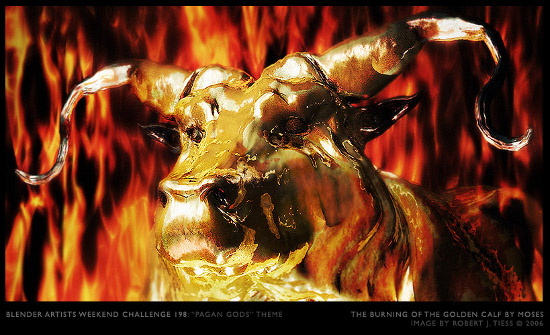
Aaron said to them, “Tear off the gold rings which are in the ears of your wives, your sons, and your daughters, and bring them to me.” Then all the people tore off the gold rings which were in their ears and brought them to Aaron. He took this from their hand, and fashioned it with a graving tool and made it into a molten calf; and they said, “This is your god, O Israel, who brought you up from the land of Egypt.” Now when Aaron saw this, he built an altar before it; and Aaron made a proclamation and said, “Tomorrow shall be a feast to the Lord.”

Then Moses said to Aaron, “What did this people do to you, that you have brought such great sin upon them?” Aaron said, “Do not let the anger of my lord burn; you know the people yourself, that they are prone to evil. For they said to me, ‘Make a god for us who will go before us; for this Moses, the man who brought us up from the land of Egypt, we do not know what has become of him.’ I said to them, ‘Whoever has any gold, let them tear it off.’ So they gave it to me, and I threw it into the fire, and out came this calf.”

Exodus 32:2-5, 21-24

golden calfThe incident of the Golden Calf was perhaps Aaron’s greatest failure, but as we see in this week’s Torah portion, by the time of his death, he was beloved and mourned as one mourns for a father as the commentary said above, Israel mourned Aaron like a close relative.

Redemption is possible, even when everything seems hopeless and everyone is against you…everyone.

Frankfurt, Germany is closed down on Christmas, and I took the opportunity to visit Heidelberg, an hour away by rail. I walked through the train looking for a window seat where, guidebooks in hand, I could follow all the storied towns along the way. My eyes fell upon a young man wearing a black skullcap. An Orthodox Jew, I thought. Despite the pallid face of a yeshiva bocher, and the yarmulke clasped to his hair in traditional style, there was something troubling about the identification.

“Funny, you don’t look Jewish.” The punch line from a joke about Chinese Hebrews tickled my mind. The face looked German and the hair in careful, casual wisps gently falling over the forehead suggested mod or punk rock.

-Burton Caine
“Strangers on a Train in Germany”
Aish.com

Caine’s chance encounter with another Jew on a train from Frankfurt initially seemed a little odd but the mystery deepened considerably as their conversation progressed. Caine’s traveling companion was a German, born of German parents, and except for a few years of study in Israel, the young gentleman had lived all his life in his native country.

Caine inquired and found the fellow studied Bible, Talmud, and Hebrew in West Berlin, even though opportunities to do are not common there. He was traveling to Darmstadt, the place of origin of the famous 15th century manuscript of the Haggadah.

But why was Caine so bothered by the other man’s appearance. He didn’t look Jewish. Do all Jews necessarily look “Jewish”? What cues was Caine picking up on that told him there was a lot more to this person’s story?

The train was slowing down now and time was running out. Had I missed every clue? Calm down, I whispered to myself; not every Jew in Germany has a saga. He bent down to put his books into his bag, and the black skullcap now confronted me as a blatant proclamation of his orthodoxy. Why that suggested to me the key question, I cannot imagine, but I blurted it out.

“How do your parents react to your piety?”

“Badly,” he said with a wan smile as he buttoned his coat. “They are very hostile.” He spared me the final question. The train stopped; we had reached Darmstadt. He turned to go and paused only to add, “They were Nazis and are bitter anti-Semites. I converted to Judaism,” which he repeated in English as if he was not sure of the Hebrew word.

“They never forgave me. I am going home to visit them on Christmas.”

This story was originally published in the Christian Science Monitor in 1987 and the dating of the original encounter seems like it should be years before that.

Man alone in a caveOne young man’s answer to the Holocaust, to his parents being Nazis and bitter anti-Semites, was to convert to Judaism. Perhaps that was the only way he could atone and make teshuvah. Who is to say (according to midrash) how the sons of Korach made teshuvah in the pit, suspended between life and death, and thus were saved? Was this one person’s way to become a peacemaker, by turning away from the path of his parents and turning toward the world of their victims?

Imagine, a Jew going home to visit his anti-Semitic parents for Christmas in the heart of Germany. How much more alone could he possibly feel?

Although (hopefully), the religious blogosphere isn’t as hostile as I imagine it was for a Jewish convert visiting his ex-Nazi parents for Christmas, it isn’t always a friendly place, either. It seems as if there’s an endless series of taunts and barbs being tossed back and forth, either as an active “dialog” or, as I recently discovered, “covert” blog posts based on private email exchanges. It seems that you can’t say anything, publicly or privately, without it becoming grist for the mill.

Not only that, but even within the same, basic theological construct, interpretations and opinions vary widely and each side holds fast to their position, defending it vigorously, taking no prisoners.

Who wants to be a part of that? If this is the “Church” established by Jesus Christ, the “ekklesia” of Messiah for his disciples and the worshipers of the God of Israel, why would I want to be a member of such a divisive “club”?

I periodically think of quitting. As I write this, I haven’t been to church in a couple of weeks. Once was because it was Father’s Day and I used that as a justification for “taking it easy” at home. Last Sunday, I was just tired, I had done my Sunday school homework, it wasn’t particularly stimulating, and I felt I could get more mileage out of just studying at home.

But if I am committed to worshiping with a community, then it’s not right to “dodge” them. I did have coffee with a good friend that afternoon, a devout believer for over forty years. We periodically toss about the idea of starting a small Torah study, but who would we invite who would (or could) be interested and illuminated by such an endeavor?

And then there’s the online religious world. There are days I could drop the whole thing like a hot rock. I know it seems odd for me to say that, since I’m such a prolific blogger, even when I try not to be. But who needs opponents and “frienemies” taking pot shots at you, while people you thought were your friends don’t say anything at all?

But then, on Rabbi Packouz’s Torah commentary, I found this:

Failure is when one stops trying, not when one doesn’t succeed.

-Anonymous

There are times when I don’t even know what I’m trying to succeed at but I know that whatever I’m doing, if I quit, I’ve failed.

Meriam Ibrahim
Daniel Wani and Meriam Ibrahim

This probably comes under the heading of first world problems since none of my “religious issues” (and recently, I was confronted on exactly that) even come close to the persecution Christians experience around the world, not the least of which is the plight of Pastor Saeed Abedini and his family or Miriam Ibrahim’s struggles, though praise God, she was released from prison and no longer faces the death penalty (but then I recently heard she was re-arrested trying to leave the country).

Christian persecution always has external sources, people, other religious groups, nations, who are against the disciples of Christ. But Christianity is also its own worst enemy (and for the sake of this one blog post, I’ll toss the Hebrew Roots and Messianic Jewish movements and their many variants into the mix). We’re always worse off when the world doesn’t attack us because then we attack each other. So much for “blessed are the peacemakers” (Matthew 5:9).

Which brings us back to Aaron and this week’s Torah Portion. As the first High Priest of God and brother to Moses, Aaron lived a larger-than-life existence. Just being among that first generation of Israelites that left Egypt, to see all they had seen would have been marvelous and terrifying.

But Aaron also lived a very human existence, he was flawed and he struggled, in some ways, just like the rest of us. But it’s not always just about what you’ve left behind, but how you’ve lived, and Aaron lived before God, presided in the Tabernacle as Kohen Gadol, provided atonement for all of Israel in the Most Holy Place once a year.

And yet, Hillel and Shammai remembered him first and foremost as a maker of peace, and adjured others to be like Aaron’s disciples.

What is it to be like Messiah’s disciples? What are we to do in the face of an imperfect life, existing within an imperfect “Church” (and I use the term in the widest possible sense), filled with imperfect people?

I wish I had an answer to give you. I’d love to have that answer myself. But the only thing I keep returning to is not how to succeed but how to avoid failure. As much as I sometimes want to, I can’t give up. It’s not that I’m some sort of guru or wise man (or wise guy) or visionary. I’m only me. One ordinary human being who happens to worship the God of Abraham, Isaac, and Jacob and who is constantly challenged by the enormity of that role (and make no mistake, you’re in the same boat I am…being an “ordinary” believer doesn’t mean fading into the woodwork).

I have no long-term plans. I live in a world where God can turn human plans on their ear in a heartbeat. In such a place, I simply stand before God and ask, “Here I am, God. What do I do now?” I think the answer God gave Aaron was, “live, serve, and die, and after that, continue to live before God”. Regardless of the paths we each travel along in our faith, that’s probably the only answer any of us will receive.

He said, “Naked I came from my mother’s womb, and naked I shall return. The Lord gave and the Lord has taken away. Blessed be the name of the Lord.”

Job 1:21

“The opposite of defeat is hope.”

-Anonymous

The Broken Saint

James, you are the most confusing person. I think sharing your confusing life on a blog is doing more harm than good. I’ve seen you change more directions than the wind and I’m convinced you still don’t know where you’re going. My advice, do what I did, shut down the blog until you can get a grip on your own life before sharing with others. Or, stick with things your 100% sure of and write on that. You have a wide reader base and writing articles for FFOZ has gained you even more. This is the kind of stuff that causes confusion and arguments in MJ and frankly it’s embarrassing. Based upon this article (and forgive me if I am wrong), I would say, make sure you don’t keep the Sabbath. Go out and mow the grass just to make sure you’re not resting on that day. Also, eat pork at least twice a week, preferably in public, so you’re not keeping kosher. Go to church, keep your mouth shut and be a good christian. I’ve cut down my visits to your blog to about once a week. Now, I think I’ll be un-bookmarking this site and I’d suggest the same for others as well. I’m a very nice, easy-going guy, but somethings just light my fire. Sorry you were the match, James. Much love, my brother. Just think about it.

-Keith
Comment on one of my blog posts

While I tried to take this comment in the spirit it was written, I have to admit, my first response was to want to “bite back” a little bit. I probably communicated some of that “sting” in my actual reply, which I regret, but my reaction must mean Keith has a valid point. After all, did I create this blog just to whine about what could be called first world problems in Christianity?

My reply (since I should be honest) to Keith was this:

I’m not “required reading,” Keith. People who think I don’t make sense (sometimes life and living don’t make sense and people experience dissonance and contradiction) and who are disturbed by that don’t have to read my blog. As of 2013, there were an estimated 152,000,000 blogs on the Internet. I’m only one of them.

It’s not my intention to do harm, it’s my intention to illustrate a real, lived experience as a person of faith. I’m not a textbook and I’m not the Bible. I don’t live a linear life and I’m not trying to say that I’ve got it all together. Clearly, I don’t.

However, I suspect most, real, live, human beings who are disciples of the Master (or anything else) don’t have life completely settled, either.

I appreciate that you are commenting for my sake, and maybe at some point, I’ll stop blogging, but when and if I do, that will be a decision I make in relation to my understanding of God and who I am in him.

Cheers, Keith.

Too snarky?

walkingI hope not. But I think I make a really valid point, too. Unlike most other, similar blogs, I didn’t create “Morning Meditations” to just be about my theological and doctrinal conclusions, but rather, about my theological and doctrinal journey.

A journey implies a changing landscape as one progresses in their travels. If I were to take a road trip from Boise to New York City, I’m sure the scenery, what I’d see and experience, would change, sometimes rather dramatically, as I was moving along down the road.

I believe that’s true of any journey in life, particularly one in the company of God and God’s (imperfect) people.

But I can see Keith’s point. I often toggle between some review or assessment of a theological “product,” such as a book, sermon series, lecture, article, whatever, and my personal reactions and responses to what it’s like being a “Messianic Gentile,” dealing with other people’s expectations, dealing with my own expectations, as well as just kvetching and complaining.

The downside to reading such a blog is that it can seem like I’m terribly inconsistent. The upside, or so I’ve been told, is that my writing can seem raw, authentic, real, and relatable by (many) others who are going through the same or similar experiences on the trail to “faithland”.

“You don’t need to be perfect to be impressive.”

-Anonymous

That isn’t a direct quote. I derived it from something I read in an article by Marc Chernoff called 12 Common Lies Mentally Strong People Don’t Believe which was posted on Facebook. I generally avoid inspirational blogs, stories, and speakers because the effect they create is like eating a spoonful of sugar. You get an immediate boost but soon afterward, there’s a profound let down as well as the realization that what you’ve eaten is nutritionally deficient. I looked up the “About” page for the article’s source, Marc and Angel Hack Life, and the youthful appearance of the authors made me question if they’ve experienced enough life to qualify them to suggest how to “hack” it to others, especially “old guys” like me.

But if nothing else, I found several other quotes and “quasi-quotes” that were useful and applicable to my current situation and perhaps a new project.

In order to avoid the confusion Keith speaks of, I’ve been toying with the idea of creating two “environments” in which to write, one for more uplifting commentaries, reviews, and the like, and the other being more gritty and human, a place specifically designed for me to be able to “let my hair down,” so to speak, “tell it like it is,” and yes, to kvetch.

Broken AngelI have a couple of options in mind. The first is administratively the easiest. I can just create an additional page to “Morning Meditations” (It would appear as another navigation tab across the top) called something like “The Broken Saint” and write separate content in that venue. The other would take a greater investment in work and a few extra bucks but be more creative. I could make a second blog, solely for the purpose of expressing my humanity as a person of faith, and actually call that blog something like “The Broken Saint” (I’ve yet to settle on a final title). I could place “buttons” on each blog, linking to the other, so readers could navigate easily between them if they desired.

It’s still the middle of the week as I write this but approaching Shabbat, so I’ll give myself the weekend (maybe) to mull things over. What do you think? Would you visit two related blogs, reading uplifting and informative commentaries on “Morning Mediations” and pursuing my personal humanity in living faith day-by-day on “The Broken Saint”?

“If religion is a crutch, who isn’t limping?”

-Anonymous

Sermon Review of the Holy Epistle to the Hebrews: The Initiation

Therefore leaving the elementary teaching about the Christ, let us press on to maturity, not laying again a foundation of repentance from dead works and of faith toward God, of instruction about washings and laying on of hands, the resurrection of the dead, and eternal judgment. And this we will do if God permits.

Hebrews 6:1-3 (ESV)

On the subject of Baptism and Instructions regarding Immersions in Hebrews 6, we look at the evidence from early Christian documents. Find out how the second-century Christians welcomed new converts into the body of Messiah. This teaching contains quotations from Justin Martyr’s First Apology, from the Didache, and from the Apostolic Constitutions. The quotations are available in the PDF document below titled “Initiation Texts.”

-D. Thomas Lancaster
Sermon Twenty-three: Laying on of Hands
Originally presented on July 7, 2013
from the Holy Epistle to the Hebrews sermon series

This is one of the shorter sermons in the series (barely thirty minutes long) as well as a short chapter in Lancaster’s book Elementary Principles. In this sermon, Lancaster proposes to show how the basic foundational principles he has covered in previous sermons, particularly as mapped to the Didache, were carried forward in time to the second and even the third century CE, using classic Christian documents.

To review these first four principles covered so far:

  1. Repentance from dead works (sin)
  2. Faith toward God (through Messiah)
  3. Instruction about washings (elemental instructions of the faith prior to immersion in the name of Messiah)
  4. Laying on of hands (to confer discipleship and possibly the Holy Spirit)

Lancaster outlines the challenge in what he’s trying to do, since the writer of the Epistle to the Hebrews felt the six principles were so basic that he didn’t bother to write them down. Neither did any of the other New Testament writers. Lancaster states that he believes Paul taught these principles orally, and that by the time the Hebrews writer was composing his letter, it was just assumed everyone knew all about this “milk”.

But we know nothing about them today since they weren’t written down in much detail, if at all.

Lancaster turns to three Christian documents to prove his point that these elemental principles were indeed carried forward in time with Christianity:

  1. Justin Martyr’s “First Apology”
  2. The Didache
  3. The Apostolic Constitutions

first apologyI’ve posted the link above to the relevant document, but here it is again. Click the link to open the PDF and you’ll find the list of documents and specific quotes Lancaster uses.

He uses these quotes to map back to the specific phrases in Hebrews 6:1-3 that list the six elementary principles.

Justin Martyr was writing around 150 CE and Lancaster paints a brief portrait of Martyr’s environment. The Bar Kochba rebellion ended in failure. Jerusalem has been destroyed, Herod’s Temple razed, and a pagan temple built on its ruins. The Jewish people have been exiled and in the midst of all that, the new religion Gentile Christianity and the original Jewish Messianic movement of “the Way” have just gone through a nasty divorce.

Martyr wrote his document, which we call “The First Apology” to the Roman Emperor as an appeal that the Empire stop persecuting Christians.

It’s Lancaster’s contention that these later Christian documents, especially the Didache, were based on much earlier writings and oral traditions going back to the second and even the first century, and perhaps even reflecting the teachings of the apostles.

Lancaster’s handout is organized as follows:

  1. Instructions before Immersion (Apostolic Constitutions 7.39.2-4)
  2. Preparing for Immersion (Justin Martyr, First Apology 61)
  3. Fasting Before Immersion (Didache 7:1-4)
  4. The Immersion (Justin Martyr, First Apology 61, Didache 7:1-3)
  5. The Investiture (Laying on of Hands) (Justin Martyr, First Apology 65)
  6. Prayer for the New Disciple (Apostolic Constitutions 8.6.5-8)
  7. Breaking the Fast (Justin Martyr, First Apology 65)

I won’t go into all of the details. You can read the PDF and listen to Lancaster’s sermon (only half an hour) for the details, but there are some questions.

What Did I Learn?

Lancaster has a talent for pulling together information and documents from (sometimes) widely disparate sources and then attempts to make them work together. To the degree that he’s comparing ancient Christian documents, I can see where he’s going, but Lancaster admits that these are documents originating in different time periods, so care should be taken in making very close comparisons.

messianic judaism for the nationsAlso, he states that the “nasty divorce” between Jesus-believing Jews and Gentile Christians had already occurred, and except for arguably the Didache, the other two documents Lancaster is using are from the Gentile side of the equation. Why is that important? Because Lancaster’s purpose in this investigation is to uncover the practices of ancient Messianic Judaism so we can practice this way, too.

But a lot of what he introduces isn’t from, strictly speaking, Jewish sources. These are interpretations made by Christian Gentiles who, after the aforementioned “nasty divorce,” have no reason to spread any sort of love for their Jesus-believing Jewish counterparts.

In fact, quoting Paul Meier from his recent Messiah Journal article which I reviewed:

Marcion’s contemporary Justin Martyr was one of the first to articulate a position of replacement theology, also known as displacement, transfer, or supersessionist theology. Avner Boskey succinctly described this theological stream as “an expression of Gentile triumphalism in the early church.”

-Meier, pg 81

I’m not saying Lancaster is wrong, and he’s certainly more studied and better educated in these matters than I am, but I don’t want to get too excited about drawing firm conclusions from a little bit of documentation and a lot of supposition.

That said, I don’t know if it would hurt to add some or a lot of this structure to modern Christian practice. Think about it. As you follow the train of Lancaster’s logic and observe the linear fashion by which an ancient novice disciple of the Master is initiated, educated, and baptized into the faith, becoming a Christian in the first and second centuries was a much more formal affair than it is in Evangelical Christianity today.

The initiate had to give a great deal of serious consideration to their decision to become a disciple, study quite a bit, deeply repent of their sins, dedicate themselves to a life-long pattern of righteousness, and be willing to take a solemn vow before God prior to baptism.

Can you say that all or even most professing Christians today take their faith that seriously and were that prepared even before baptism? How many Christians today came to faith simply by raising their hand at a Christian camp meeting or answering an altar call at church? Even after years or even decades, many Christians still may just be “going with the flow” and have never come to the realization of what they’ve committed to.

This is where I see Lancaster making his point very strongly. Today, we don’t even know much about what the writer of the Book of Hebrews took for granted to be the “milk”, the “baby food”, the six elemental principles of the faith. They were so basic and so well-known, that they were never documented, at least not in any text we have with us today.

Orthodox JewsLancaster’s point, as I understand it, is that we should return to the formal seriousness and dedicated preparedness of inducting novices into true discipleship, taking time to make sure that the person is ready to enter this tremendously august relationship, and only after all that, actually proceed forward, pressing “on to maturity” (Hebrews 6:1).

Lancaster is quite serious about rediscovering the ancient teachings and practices of Messianic Judaism as it existed in the first century and into the second, and that desire has merit, but is it do-able? All of the other ancient streams of Judaism from that era either were extinguished or progressed forward, morphing and evolving across the long centuries. What was Pharisaic Judaism in the days of Jesus and Paul is now called “Rabbinic Judaism,” although there are indeed multiple Judaisms in our day and age.

I guess I could say that Orthodox Judaism (although there is no single expression of Orthodox Judaism in modern times) is the most direct inheritor of ancient Pharisaic Judaism, but you many not be able to directly compare the two. So much has happened, the definition of practicing Judaism in Orthodox thought is quite different from how the Pharisees saw themselves.

Should we contrast modern Messianic Judaism with the ancient Jewish practice of “the Way” in the same manner? If “the Way” was most closely compared to the Pharisees in the first century, what does that say about the relationship between modern Orthodox Judaism and Messianic Judaism or what should it say?

I don’t know that Lancaster has set a completely achievable goal for himself and particularly for his (mostly Gentile) congregation. If he’s been lobbying for a mikvah to be built for the past several years but support hasn’t been overwhelming among his constituency, is that indicative of how difficult it is for we modern Gentiles coming out of our church experiences to fully embrace a strongly observant Jewish lifestyle?

I’m not trying to be a wet blanket, but even most of the Messianic Gentiles in Messianic Judaism may not be ready to take on board the full yoke of Torah, either as it was expressed in the days of Paul, or as we understand it in Orthodox Judaism today, assuming that is the model to be followed.

Why I am a Messianic Gentile, Part Two

And Korach, the son of Yitzhor, the son of K’hos, the son of Levi, took …

Numbers 16:1

Rashi explains that the key reason for Korach’s rebellion against Moshe was that he was envious of another relative who received honor while he didn’t.

Envy is destructive. It prevents a person from enjoying what he himself has. When you focus on the success of another person and feel pain because of it, you are likely to do things that are highly counterproductive. Envy is one of the three things that totally destroy a person (Pirke Avos 4:28). The downfall of Korach was because of this trait. Not only did he not get what he wanted but he lost everything he already had.

-Rabbi Zelig Pliskin
Commentary on Torah Portion Korach, pg 332
Growth Through Torah

I mentioned in Part One of this two-part series, that I have many good reasons for being a student and disciple of Yeshua (Jesus) within a Messianic Jewish context. And while the status I have accepted upon myself may make me appear as a “second-class citizen” within the ekkelsia of Messiah and the Kingdom of Heaven, in fact, who I am and where I stand has been defined for me by God. Even if I sometimes chafe at that position based on my personality flaws, that does not change the will of God for my life. Any reaction that leads me to envy of the Jewish people for their distinctiveness and unique role in the plan of the Almighty will also lead to my “destruction” (though I probably won’t be incinerated or fall into a pit).

The blessings of God in my life are great. Far be it from me to cause God to take them all away:

While they were listening to these things, Jesus went on to tell a parable, because He was near Jerusalem, and they supposed that the kingdom of God was going to appear immediately. So He said:

“A nobleman went to a distant country to receive a kingdom for himself, and then return. And he called ten of his slaves, and gave them ten minas and said to them, ‘Do business with this until I come back.’ But his citizens hated him and sent a delegation after him, saying, ‘We do not want this man to reign over us.’ When he returned, after receiving the kingdom, he ordered that these slaves, to whom he had given the money, be called to him so that he might know what business they had done. The first appeared, saying, ‘Master, your mina has made ten minas more.’ And he said to him, ‘Well done, good slave, because you have been faithful in a very little thing, you are to be in authority over ten cities.’ The second came, saying, ‘Your mina, master, has made five minas.’ And he said to him also, ‘And you are to be over five cities.’ Another came, saying, ‘Master, here is your mina, which I kept put away in a handkerchief; for I was afraid of you, because you are an exacting man; you take up what you did not lay down and reap what you did not sow.’ He said to him, ‘By your own words I will judge you, you worthless slave. Did you know that I am an exacting man, taking up what I did not lay down and reaping what I did not sow? Then why did you not put my money in the bank, and having come, I would have collected it with interest?’ Then he said to the bystanders, ‘Take the mina away from him and give it to the one who has the ten minas.’ And they said to him, ‘Master, he has ten minas already.’ I tell you that to everyone who has, more shall be given, but from the one who does not have, even what he does have shall be taken away. But these enemies of mine, who did not want me to reign over them, bring them here and slay them in my presence.”

Luke 19:11-27 (NASB)

Rabbi Levi Yitzchok of Berditchev (Kdushas Levi) commented that a truly righteous person’s main goal in all that he does is to give pleasure to the Almighty. To such a person there is no difference if he or another righteous person causes that pleasure.

But if a person’s main focus is on his personal reward, he wants to do everything himself. Therefore, our verse states that Korach took. He wanted to take for himself and therefore felt resentment about the attainment of others.

-R. Pliskin, pp 332-33

coinsWe not only see the dire consequences of envy leading a person to self-aggrandizement, but that such a person has lost their focus on what is to be the true motivation of a servant of God, to please God rather than their own human desires.

If God has assigned a specific role, function, and purpose for the Jewish people, then it is foolish for we non-Jewish disciples of the Master to seek their place and their role. In having those desires and particularly in acting them out, we are rebelling against God and seeking our own personal pleasure. Not only that, we are actually denying ourselves the pleasure of fulfilling the role God assigned to us, one that really would be pleasing to God.

And they gathered against Moshe and Aharon. And they said to them, “You have taken too much power for yourselves. The entire congregation is Holy, and the Almighty is in their midst. Why do you take leadership over the congregation of the Almighty?”

Numbers 16:3

Remember that the Sages say that when a person finds fault with others he frequently is just mentioning his own faults which he can wrongly assume someone else has. Be very careful not to accept negative information about others as the truth without careful examination.

-R. Pliskin, pg 334

mirrorIt is not uncommon for people to sometimes project their own worse character traits onto another person and then blame that other person for what they don’t like about themselves. The irony is that this attribution can happen below the level of consciousness. That is, the person may truly not be aware of their negative character trait but attribute it to someone they don’t like or with whom they disagree. It’s as if they are using their adversary as a mirror to reflect their own behavioral and emotional flaws.

So, if I am to take R. Pliskin’s advice and apply it to every time I’m criticized for my stance as a Messianic Gentile, one way to interpret their criticism (though it might not be true in every case) is that the critic may be assigning me traits or motivations they themselves possess. I guess that’s why it’s a good idea for me to always be aware of what I’m doing and why I’m doing it, so I don’t start believing things about who I am and my behavior that are not true. I must also be careful in my assessment of others to make sure I’m not guilty of projecting my own flaws upon them.

That has always been the normative view of Judaism, enunciated in the rabbinic principle that “one who performs a deed because it is commanded is deemed more praiseworthy than one who does it voluntarily” (Bavli Kiddushin 31a). Actions that come instinctively fail to stretch us. Growth results from reaching beyond ourselves.

-Ismar Schorsch
“Reaching Beyond Ourselves,” pg 534, June 22, 1996
Commentary on Torah Portion Korach
Canon Without Closure: Torah Commentaries

If one desires or even covets obligation to the full yoke of Torah as a Gentile, where is the “stretch”? How are we participating in growth if we not only are doing what we want, but performing mitzvot that do not belong to us? However, if we recognize the legal structure that defines Gentile inclusion in Messianic Judaism (Acts 15) and obey those commandments, we are not only pleasing God, we are participating in our own spiritual growth and elevation (see the ancient Jewish/Christian document The Didache and D. Thomas Lancaster’s latest book Elementary Principles for more).

Going back to what R. Pliskin said about pleasing God by allowing another righteous person to perform mitzvot that are commanded of them, to encourage Jewish believers to perform mitzvot such as davening with a minyan or observing Shabbos is what fulfills our function as righteous Gentiles in Messiah. For only Jewish Torah observance will bring Messiah’s return nearer, therefore, by encouraging Jewish Torah fidelity within the Messianic community, we are helping others to be righteous, participating in our own growth as disciples, and blessing the heart of God.

At least that’s how I see myself as a Messianic Gentile (in an ideal state, and I can say, that I’m hardly an ideal person).

The arrogant person thinks, “If I honor this person, what will people think of me? Will it raise or lower my stature in the eyes of others?” But the humble person makes no calculations of this kind. He treats each person according to the Torah ideals of how people should be treated. Ultimately this only elevates a person’s true stature regardless of how other people might react.

-R. Pliskin, pg 336

HumbleI’ve met very few truly arrogant people, that is people who really think they’re the “greatest thing since the invention of sliced bread.” Most people who appear arrogant and self-assured are actually the opposite. They feel threatened and insecure when others experience success or if put in a situation where they must give deference to another. While I can hardly call myself truly humble, if I strive in that direction as a goal, then acknowledging Jewish “specialness” in covenant relationship with God does not diminish me or reduce my stature in the eyes of others. If someone else believes I am being reduced by recognizing Jewish covenant status, then that is their projection and perhaps their own personal fear.

Imagine how Gentile Christians will react when, upon Messiah’s return, they realize to their chagrin that the Church is not the center of the Kingdom of God, it is Israel. This may be at the core of why many Christians have difficulty with Messianic Judaism and the continuation of Jewish Torah observance within the Jesus-believing Jewish community. It illustrates how, over the long centuries of Church history, Christianity has reversed causality in placing itself above and before God’s covenant people, Israel.

Also your brethren the tribe of Levi, the tribe of your father, shall you draw near with you, and they shall be joined to you and minister to you. You and your sons with you shall be before the Tent of the Testimony. They shall safeguard your charge and the charge of the entire tent…

Numbers 18:2-3

After the death of Korach and the rebels, the Levites especially among the Children of Israel were demoralized and terrified. They felt their own worth and stature was lower than ever after the failed rebellion. Yet God was kind and reminded the Levites that they had a special status and duty to Hashem above the other Israelites and that they also were of the tribe of Levi, just as were Aaron and his sons, the Kohenim.

That’s what I think is missing every time someone believes that I’ve allowed myself to be put at the back of the bus in the Messianic community; the lack of realization that Messianic Gentiles have a highly important role that cannot be fulfilled by the Jewish people. Messianic Jews and Gentiles are interdependent and the Messianic Jewish ekklesia cannot achieve wholeness unless we join together in our complementary roles. We need each other.

So the next time I find myself missing donning a tallit in prayer or being present at the lighting of the Shabbos candles, I must remind myself of everything I’ve just written. Because the minute I give in to the attitude of I want to be like them” or worse, “I deserve to be like them,” not only have I insulted God and betrayed the Jewish people in Messiah, I’ve lost my way and forgotten my God-assigned purpose in life. A righteous person serves God, not his own desires. May God grant me humility and peace. May He grant this to all of us who call ourselves Messianic Gentiles.

Final note: Last year, I also wrote a two-part series on Korach and what this rebellion tells us about who we are today.

Why I am A Messianic Gentile, Part One

I consider myself a Christian in the sense that I am a disciple of Jesus Christ but more specifically, I am a student of Messianic Judaism because I believe that discipline represents a perspective on the Bible, the Good News of Messiah, the New Covenant, and Israel that is scripturally sound and that describes the Bible as the single, unified expression of God’s desires, intent, and plan, first for Israel, and then, by Israel’s light, for the rest of the world.

And yet, to do that, I have learned to accept a few things that other people, that is, Christians, don’t like. I accept that the New Covenant was made exclusively with the House of Israel and the House of Judah (Jeremiah 31:31) and not with humanity in general. Further, I accept that when God, through the prophet, says “the House of Israel and the House of Judah,” He is referring specifically to the physical descendents of the Israelites who stood before God at Mt Sinai and accepted the covenant relationship between God and Israel (Exodus 20) in perpetuity (Jeremiah 31:35-36), who are today the Jewish people, and that the eternal inheritance of the Jews is the nation of Israel, which we have with us now.

I accept that the Gentiles are to be attracted to Israel as a light (Deuteronomy 4:5-8, Isaiah 49:6) with the strongest light being King Messiah, Son of David (John 8:12) as God’s emissary, agent, and deliverer of the promises God has made, causing the New Covenant age to be inaugurated with his death and resurrection, that the Jews might believe God will deliver on His promises to them, and that the Gentiles might be grafted into the blessings of those promises, taking the fringes of a Jewish man and going with him, for God is with him (Zechariah 8:23).

I’ve heard it said that the Jewish man in question is not just any Jewish person, but specifically is Messiah. That we from the nations approach God and His holiness by attaching ourselves to Israel through Messiah and going up with him to Jerusalem, to the House of Prayer for all the peoples (Isaiah 56:7).

So what’s wrong with all of that? Apparently, plenty.

From a Christian’s point of view, which includes some in the Hebrew Roots movement who say they disdain the Church, God made a covenant with Israel at Sinai that had effect and potency until the birth, death, and resurrection of Jesus. Then everything changed. The Jewish people no longer were automatically included in the Sinai covenant (although the Abrahamic covenant remained in force) and in order to re-enter a covenant relationship with God, they had to enter into the New Covenant, represented by a brand new entity wholly divorced from Judaism called “the Church”.

From Christianity’s point of view, this means Jewish people remain Jewish but must surrender Judaism and convert to Christianity, along with the Gentiles, and live, for all intents and purposes, a Gentile Christian lifestyle free of “the Law” and solely under grace (as if the two are mutually exclusive). There must be absolutely no distinction between Jew and Gentile in the Church.

beth immanuelFrom a Hebrew Roots perspective, this means Jewish people remain Jewish and continue practicing Judaism, but the “one new man” entity they must join requires that all Gentile disciples are totally and completely the same as their Jewish counterparts, and must observe the identical set of Torah commandments as the Jew. There must be absolutely no distinction between Jew and Gentile in Hebrew Roots congregations, many of which inaccurately call themselves “Messianic Judaism.”

But the Messianic Judaism I study and adhere to has a different perspective, one that recognizes a specific distinctiveness between Jews and Gentiles within the ekklesia of Messiah, such that each group in the body serves different, although sometimes overlapping functions.

I accept, for instance, that it would be inappropriate for me to claim an obligation to don tzitzit and lay tefillin when praying, to keep kosher in the manner of the Jews, to observe, in the present age, a Shabbat, and to say that it would be a sin if I did not perform any of those mitzvot.

That isn’t to say, especially being married to a Jewish wife, that I’m forbidden to keep kosher or observe the Shabbat (though at present, I only keep “kosher-style” and both my wife and I have elected to work on the Shabbat — may the day come when our observance is more faithful). I even know Gentile Messianics who choose to don tzitzit and lay tefillin privately in prayer, but who do not declare that they are obligated to do so.

I also accept that the New Covenant was made only with the Jewish people and that my only access is through faith in Messiah, not because of any inherit worth I have ethnically or nationally as a non-Jew.

MessiahMy understanding of the Jewish covenant relationship with God is that it extends continually from Exodus 20 forward in time and into the modern age. While Jesus inaugurated the New Covenant with his death and resurrection, getting the ball rolling, so to speak, it won’t reach any sort of fruition until his second coming, when he destroys all of Israel’s enemies, making the Gentile survivors vassal nations under Israel’s sovereignty, and establishing a unprecedented world-wide reign of peace. Then the Jewish people will be restored to their Land, to Israel, and the Gentiles who are called by His Name will come alongside Israel and serve her King, for he is our King, and worship God on the Temple Mount.

No new body is created in Acts 2, it’s an extension of the all of the previous covenants God made with Israel including the New Covenant, and the precursor to the ultimate fulfillment of God’s promises to Israel and to the nations. A subset of all the Jewish people in existing in the first century accepted the Good News of Messiah, and they represent an unbroken stream that goes all the way back to the Exodus and even to Abraham. And the Jewish people who did not accept the Good News remain under the Sinai covenant and in God’s love and compassion, and as God declares in the New Covenant:

“I will put My law within them and on their heart I will write it; and I will be their God, and they shall be My people. They will not teach again, each man his neighbor and each man his brother, saying, ‘Know the Lord,’ for they will all know Me, from the least of them to the greatest of them,” declares the Lord, “for I will forgive their iniquity, and their sin I will remember no more.”

Jeremiah 31:33-34

One day, God will forgive Israel’s sins, and the Jewish people will make teshuvah and return.

“Jerusalem, Jerusalem, who kills the prophets and stones those who are sent to her! How often I wanted to gather your children together, the way a hen gathers her chicks under her wings, and you were unwilling. Behold, your house is being left to you desolate! For I say to you, from now on you will not see Me until you say, ‘Blessed is He who comes in the name of the Lord!’”

Matthew 23:37-39

Israel will one day say “Blessed is He who comes in the name of the Lord” and on that day, the Gentiles will join with Israel at feast of Abraham, Isaac, and Jacob (Matthew 8:11).

the crowdDoes that make me and all the non-Jewish disciples of Messiah who study Messianic Judaism into second-class citizens in the Kingdom of God? To be honest, there are days when I think so. I suppose it’s my innate attraction to Jewish worship and scholarship that periodically has me longing to be able to join a minyan or to be called to the bema for an aliyah (not that I speak or read Hebrew). I sometimes see Jews in Messianic synagogues worshiping and praying the prayers and wish I could be a part of them. Sometimes I feel I should leave any sort of affiliation to Messianic Judaism behind and just keep my peace silently, communing only with God, because I feel I can never truly be part of Jewish people in Jewish community.

But I don’t fit in at church either, so that cannot be my sole connection to fellowship. Also, I must admit that any issues I may have feeling any disconnection with Messianic Judaism are my personal issues and hardly the fault of Jewish needs or requirements in community, since after all, the “chosenness” of Israel is a decision of God, not of man, and I must obey God before the will of any human being, even (especially) my own will (Acts 5:29).

That is why I call myself a “Messianic Gentile” and choose to study within a Messianic Jewish framework. That is why it is OK, even if I am a “second-class citizen” (which I’m actually not), because my citizenship is in the Kingdom of God, among the ekklesia, both ancient and modern, in the tradition of every Gentile who has ever come alongside Israel because we have heard God is with them, from the days of Moses to the days of the apostle Paul.

And Korach, the son of Yitzhor, the son of K’hos, the son of Levi, took …

Numbers 16:1

Rashi explains that the key reason for Korach’s rebellion against Moshe was that he was envious of another relative who received honor while he didn’t.

-Rabbi Zelig Pliskin
Commentary on Torah Portion Korach, pg 332
Growth Through Torah

Rabbi Zelig Pliskin
Rabbi Zelig Pliskin

If I were to allow envy of the obligations and privileges of the Jewish people in the Messianic community to affect me, I would be as Rashi characterized Korach and his band: rebellious. May it never be.

Rabbi Pliskin’s Torah commentaries speak more to me about my own state as a Gentile studying and learning within a Jewish context, being attached to but not the same as the Jewish co-participants in the body of Messiah. In Part Two of this series, I’ll discuss more of my perspective using R. Pliskin’s missives as a foundation.

For more on the Korach rebellion, which was last week’s Torah portion, read “The Importance of Unity” at ProjectGenesis.org.