All posts by James Pyles

James Pyles is a published Science Fiction, Fantasy, and Horror author as well as the Technical Writer for a large, diversified business in the Northwest. He currently has over 30 short stories published in various anthologies and periodicals and has just sold his first novella. He won the 2021 Helicon Short Story Award for his science fiction tale "The Three Billion Year Love" which appears in the Tuscany Bay Press Planetary Anthology "Mars."

Sermon Review of the Holy Epistle to the Hebrews: Solomon’s Porch

At the hands of the apostles many signs and wonders were taking place among the people; and they were all with one accord in Solomon’s portico.

Acts 5:12 (NASB)

Sermon Three: Solomon’s Porch
from the Holy Epistle to the Hebrews sermon series

In this third sermon on the Epistle to the Hebrews, Beth Immanuel Sabbath Fellowship teacher D. Thomas Lancaster expands on why the writer of the Book of Hebrews constructed this word of exhortation to the letter’s recipients and further identifies them as Jewish disciples of Messiah living in or around Jerusalem sometime in the early 60s CE (common era).

Where did the first Christians go to church?

This is how Lancaster started his sermon. He says the question is nonsensical because the first Christians were actually Jews. They didn’t go to church because the modern concept of “church” didn’t exist. Neither did the modern concept of “Christianity.” The first Christians were Jews and they practiced Judaism. As you saw in the quote at the top of the page, the first Jewish believers commonly met in an area on the east side of the Temple called Solomon’s Colonnade.

Lancaster speculates that, because of the prophesy in Zechariah, saying the Messiah would descend upon the Mount of Olives and enter the Temple through the eastern gate, the disciples met there in anticipation, since the Mount of Olives was plainly visible from Solomon’s Colonnade.

Then Lancaster diverted his sermon, taking the audience back in time twenty years or so, recalling a conversation he had with his Father who had been a Baptist minister. Somehow, they got to talking about the Book of Hebrews and his Father, remember, this was twenty years ago, twenty years before Lancaster thought of producing this sermon series on Hebrews, commented on Hebrews 13:22:

But I urge you, brethren, bear with this word of exhortation, for I have written to you briefly.

Thirteen chapters is hardly brief and in fact, Hebrews is one of the longest epistles in the New Testament. Lancaster’s father suggested that Hebrews was originally written in two parts: a longer sermon intended to be delivered to a Jewish audience and a shorter letter accompanying the sermon as an explanation.

That’s pretty much was Lancaster suggested in last week’s sermon.

Lancaster’s father said something else rather interesting. He said he thought that Hebrews was written to a group of believing Jews who had been kicked out of the Temple and who didn’t know what to do next. This was a group of Jews who, if they renounced Yeshua (Jesus) as Messiah, would be allowed to return to the Temple. Hebrews then, was a letter and a word of consolation to those Jews to not give up their faith but to hold fast to their devotion to Messiah.

Traditional Christian teaching about the Book of Hebrews states that the epistle was a warning to believing Jews to not “backslide” into Judaism and return to Temple worship, so the senior Lancaster’s suggestion was the exact opposite of how most of the Church understands the meaning of Hebrews.

But Lancaster’s Dad’s interpretation has several advantages, according to the younger Lancaster:

    1. It doesn’t anachronistically require a fully-developed Christian identity that is separated from the normative Judaisms of the mid-first century CE.
    2. It doesn’t require that Jesus abolish the Torah or the Levitical system.
    3. It better explains the arguments within Hebrews (which will be covered in subsequent sermons).
    4. It fits much better with what we know about the early Jewish believers and their relationship with the Temple.

The Early Jewish Believers and the Temple

This part of the sermon fits within the realm of established fact as we see in the scriptures and doesn’t require any speculation. It does require setting aside traditional Christian doctrine about the early “Jewish Christians” and taking the scriptural text, primarily in Acts, at face value.
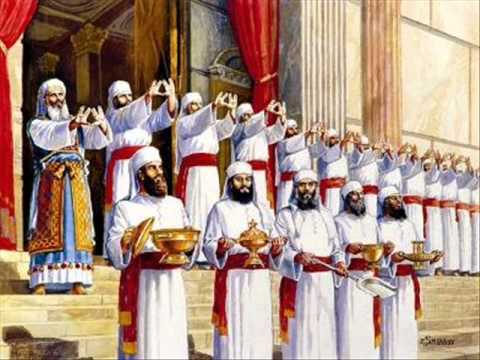
levites-aaronic-blessingWhat was the relationship of the early believing Jews to the Temple? They revered it, just as their Master Jesus revered the Temple.

Lancaster covered those portions of the Gospels that demonstrated Jesus’ devotion to the Temple, his first recorded appearance there as a boy to debate the scholars, evicting the moneychangers, calling the Temple “my Father’s house,” and so on. You can listen to the recording to get the details, including how Jesus, when he returns, will rebuild the Temple and reinstitute the Temple services.

After the ascension, the disciples returned to the Temple. They may have received the Spirit while praying at the Temple (Acts2). Acts 2:46 mentions their presence at the Temple. Acts 3:1-3 speaks of the disciples participating in prayer services at the Temple. And Acts 5:42 asserts that the disciples were in the Temple daily teaching and preaching of the Messiah.

It is strongly believed in normative Christianity that the disciples must have given up the Temple sacrifices since Jesus fulfilled them all, and yet Acts also speaks of many Priests in the Temple coming to faith in Messiah because of the devotion of the disciples. According to Lancaster, these Priests didn’t give up their jobs and stop administering the sacrifices, but rather, found greater meaning in their Priestly duties, seeing Messiah’s blood in each of their services.

In fact, the only occasions on which the disciples were accused of speaking against the Temple, were when they were accused by false witnesses. The trial of Stephen before the Sanhedrin is an example, and Stephen took a full chapter in Acts to deny and refute the false accusations.

Lancaster also points out that the Bible never, ever says that the disciples stopped offering the sacrifices. This would have been a big deal and if it were so, you’d think Luke would have mentioned it. It’s assumed by most Christians that the Jewish disciples stopped offering Temple sacrifices based on doctrines that were much later established by the Christian church, not because it says so in the Bible.

If we look at Acts 24:17 and the surrounding text, we can see how, thirty years later after the crucifixion, resurrection, and ascension of the Master, Paul was encouraged to offer sacrifices at the Temple to show many other believing Jews that the accusations stating Paul was teaching against Torah and against the Temple were utterly false.

Maybe you can accuse Paul of vainly clinging to obsolete Jewish customs by offering sacrifices but what about James, brother to Jesus, steward of the Throne of David, head of the apostolic community? If anyone should have known the truth about the teachings of Jesus, it should have been James. If Jesus had taught against the Temple and abolished the sacrifices, James should have known about it and advocated for that position. Obviously, he didn’t.

A plain reading of the relevant passages, without being filtered through Christian anti-Torah, anti-Jewish, anti-Temple bias reveals this. Except as viewed through the heavily-colored filter of Christian tradition, there’s nothing in the Bible that says the Torah, including the Temple sacrifices, were ever to be abolished. If you want more information about this, watch the First Fruits of Zion television episode The Torah is Not Canceled. It’s only thirty minutes long and well worth your time.

History records the death of James the Just, the brother of Messiah, the leader of the Council of Apostles and head of the entire body of believers, as happening in 62 CE. Lancaster dates the Book of Hebrews at just a few years later. According to Lancaster, this was also about the time issues came to a head between the disciples in Jerusalem and their arch foes, the Essenes, the group of corrupt Rome-collaborators who illegally had control of the Temple. The Essenes wanted the disciples out of the Temple and wanted them to renounce their faith in Jesus as Messiah.

Speculation

This next part can’t be firmly established through scripture or historical texts and is extrapolated from Lancaster’s understanding of the content in Hebrews. He believes that after the death of James, the Essenes held their own Sanhedrin, leaving out the Pharisees, and forbade the Jewish believers from Temple participation, cutting them off (“Koret”) until such time as they renounced Yeshua.

The Master even predicted this would happen in John 16:2. And this was the purpose of the sermon and letter of Hebrews: to encourage and support the Jewish believers in Jerusalem who had been removed forcefully from Temple participation to keep the faith, keep faith in Yeshua, and not to break faith, even for the sake of returning to the Temple.

MessiahYes, Temple devotion was appropriate and desired. Every year during the pilgrim festivals thousands upon thousands of Jews from all over ancient Palestine and the diaspora nations would converge on Jerusalem to offer sacrifices at the Temple in obedience to the commandments.

But devotion to Moshiach and devotion to the Temple were not to be considered mutually exclusive and the writer of Hebrews was earnestly imploring the Jews in Jerusalem to not forsake Messiah in the face of being removed from the Temple.

For even if removed, and even after the Temple was destroyed, it has been promised in Messianic Days that the Temple will be rebuilt and Jews as well as many, many people from all the nations will go up to the Mountain of the Lord and the House of the God of Jacob and worship Him there in Jerusalem.

What Did I Learn?

Well, again, quite a lot. I was wondering how Lancaster was going to firm up his suppositions from last week and I admit he did a pretty good job of it in this sermon. His point kind of wavers when he suggests last week that the disciples were Greek speaking Jews and this week they seemed more likely to be Jews who were native to the Land, but I suppose it could go either way, or even involve a more general population of Jewish believers.

I’m certainly getting a very different picture of the Book of Hebrews than I imagined, and indeed, one more consistent with my understanding of the over all message of the “good news” to the Jewish people.

At the very end of this sermon, Lancaster said he was finally finished setting up the required background and that in next week’s sermon, we’ll begin to actually study the Epistle to the Hebrews. I know that I’ve been turning some of the more difficult passages of this part of scripture over in my head and wondering how they can be seen as consistent with the overarching message Lancaster is presenting. Can all of the book of Hebrews, even the “pesky” parts, really be interpreted as an encouragement for believing Jews in Jerusalem to keep the faith in Messiah, even though denied access to the Temple, which both they and the Master revered? In my next review, we’ll begin to discover the answer.

Edit: Where it says above that the “Essenes” were involved in the death of James and in opposition to the believing Jews in Jerusalem, it should read “Sadducees”.  I apparently misunderstood what was said on the recording and apologize for the error.

A Brief Introduction to Tent Builders

The church is the biggest stumbling block for the people of Israel to see the true message, the redemptive message of the Messiah.

The church is fundamentally good but the church needs to change.

-Boaz Michael
from a short video introducing his
Tent Builders Seminar

I have inserted the link to the YouTube video at the bottom of this page, so you can see Boaz’s entire presentation below. It’s not quite seven minutes long, so it won’t take much of your time to review.

I’m writing this for a couple of reasons. The first is that I received a DVD in the mail from First Fruits of Zion (FFOZ) that contains an eighty-two minute “sampler” of Boaz’s eight-hour Tent Builders Conference, which he presented in various venues across North America (registration is now closed so I assume there’ll be no additional conferences).

This is, or was, the training companion piece to Boaz’s book Tent of David: Healing the Vision of the Messianic Gentile, which I most recently reviewed last October 6th and October 10th.

I haven’t had a chance to view the DVD yet, but I feel it’s necessary because in spite of all of my efforts and my reading and re-reading of Boaz’s book, something’s still wrong.

I’ve gotten this sense of “wrongness” most recently from writing the first part of my review on MacArthur’s sermon series From Judaism to Jesus. If you’ve read that review, you know that I’m appalled and dismayed at MacArthur’s approach not only to the early Messianic Jews of the apostolic era, but to their modern-day counterparts, the Messianic Jews of the twenty-first century.

Boaz MichaelI’ve already read the second part of MacArthur’s three-part series and have written the review (it will appear online next Sunday morning). I can’t say my opinion of John MacArthur or any of his perspectives on Judaism has improved. More’s the pity, because Pastor MacArthur is one of the significant voices if not “the voice” of the modern Evangelical Fundamentalist movement in Christianity today. He’s been writing and preaching for over forty years and even though I had never heard of him before  last year, his name is practically a household word among the members of many churches.

I wanted to view the Tent Builders DVD sampler but only have the ability to currently hear Boaz’s brief introductory video on YouTube. He describes Tent Builders as a missionary effort which provides a purpose in which each Christian can participate. The “mission field,” so to speak, is the Church. Christians in the church or “Messianic Gentiles” who have left the church, can find in Tent Builders, a path back, a path that can lead to teaching that the church must see itself in partnership with Israel, not in competition with or as a replacement for Israel.

Another question that comes in…in relationship to something that’s happening in our current church scene today is explain why we have Messianic Jewish temples. What is the need for them? Are you familiar with this? Recently, there has been a…a…a surge of Messianic Jewish temples.

But what’s happened is, I think that many well-meaning Christian people, evangelical people, are catering more to a sociological minority movement than they are to the Word of God. Because the Bible would never tolerate a Jewish church and a Gentile church.That is the one thing that the Apostle Paul spent the last months of his ministry trying to resolve…

Dr. Feinberg said to me one day, he says, “I don’t know why everybody thinks because we’re Jewish Christians, we’re something special. We’re not.” Something special to God. Something marvelous to be Jewish, but not something for which you deserve an entire church all to yourselves. And now they have Christian bar mitzvahs. What is a Christian bar mitzvah?…You know, there were some people who filled out applications to go to Talbot Seminary, and they applied because they wanted to become Christian rabbis. Dr. Feinberg said to me, “What is a Christian rabbi?” They’re out of their mind. They think a church wants a Christian rabbi? They think a synagogue wants a Christian rabbi? No, neither want either.

So you know what they do? They start their own Messianic temple. Some of these dear people really mean well; and I…I pray God that they’ll win people to Christ; but that isn’t what it’s all about.That’s, in a sense, Judaizing. I don’t see any need for that at all. I praise God for the Jewish people in our…in our church. All you have to do is read Acts chapter 13, and you read about the five pastors there. Some of ’em were Jews. Some of ’em were Gentiles. Some of ’em were white. Some of ’em were black. Read it, Acts 13. They all pastor the same church. We don’t have the Grace Community Irish-American Church. Don’t see the point.

-John MacArthur
“Bible Questions and Answers, Part 5”
Grace to You: Unleashing God’s Truth One Verse at a Time
scribd.com

Well, tact isn’t exactly one of MacArthur’s strong suits but beyond that, he obviously has definite, though incredibly uninformed opinions about Messianic Judaism. Do you think a few Tent Builders graduates in his church are going to make much headway?

In the video I’m referencing, Boaz does say that the goal is to find receptive churches who may have never considered the Messianic perspective on the good news of Jesus Christ and help them understand what it is to partner with Israel. The implication is that not all churches are going to be receptive based on a variety of factors, not the least of which is the doctrine of the church and how married they are, especially the Pastoral staff and Board of Directors, to said-doctrine.

Boaz says it’s important, even vital to change the church for the sake of Israel.

But what can one person do?

Tent BuildersYes, I did hear Boaz’s “pep talk” in the brief video, how easy it is to get discouraged, how we can be part of the hope for the future in summoning the Messianic Age.

Either God introduced me to a brick wall I’m incapable of breaching in any respect, or He put me in a situation I should be very capable of managing, but instead, I’ve managed to fail.

True, I’m not in John MacArthur’s congregation, but his thoughts, opinions, and presence are written all over the walls of the church I do attend.

How important is it to you that your children follow in your footsteps as Jews and that they marry Jews? If it is important, then you have to realize that you are their role model. Your love of Judaism and things Jewish is what will communicate to your children. You can’t legislate feelings — they are felt and internalized. When Jews came to America and found the difficulties facing them in living Jewishly, the lament was often heard, “Oy, it’s tough to be a Jew!” If it’s tough to be a Jew, then why would your child want to be Jewish? You have to feel the joy, the meaning, the beauty in being a Jew — it’s GREAT to be a Jew! Then you have hope with your kids.

-Rabbi Kalman Packouz
“Shabbat Shalom Weekly”
Aish.com

MacArthur would never understand in a million years that even as a Christian husband and father, it is very important for me that my Children live as Jews. I’ve really dropped the ball on this one, especially when my kids were growing up. If I knew twenty-five years ago what I know now, the course of my life and their lives would be very different, but in a universe created by God, you don’t get “do overs”. There are no time machines, and I can’t send radio waves back to the past to talk to my younger self.

Boaz called the church “the biggest stumbling block for the people of Israel to see the true message, the redemptive message of the Messiah,” but the church, or at least MacArthur’s version of it, is also a stumbling block for me. If he were the only example of what it is to be a Christian when I was about to come to faith nearly twenty years ago, I’d have dropped Christianity like an angry rattlesnake.

Boaz said that if there is not a healthy Messianic community available to a “Messianic Gentile,” they should join a church for the sake of fellowship. After all, the mission of Tent Builders only works in the context of relationship.

But given men like MacArthur and the Calvinistic and supersessionistic shroud he has cast over church worship and teaching, what am I supposed to do with that relationship now? I’m hoping Boaz’s DVD has some answers.

Review: John MacArthur on Judaism, Part 1

Coming to the 18th chapter of Acts, I’ve entitled this particular message, “From Judaism to Jesus.” The story of the book of Acts has proven to us to be a study in transitions. I want to belabor the point for a moment, because I think it’s important for you to understand that.

The book of Acts, written by Luke, describing the early years of the church after its beginning, is really a book of transitions. It’s a book of beginnings. In a sense, it’s the genesis of the New Covenant. It’s all of the beginnings as the church begins to find itself and form itself and sever itself from Judaism. It was particularly a time of transition for the Jews of the early church. The old things of Judaism faded out very slowly, slowly, and the new gradually phased in.

The writer of the book of Hebrews gives us the theology of the transition, or the theology of the change from Judaism to Jesus. He very clearly lays it out. He says, for example, that Moses and David and Joshua and Aaron and all of the priests and all of those great characters of Judaism have all been replaced, as it were, by Jesus. He goes beyond that, and he says that the laws and the ceremonies and the rituals and the patterns of the Old Testament have given way to a whole grace kind of life. No longer are you ruled by externals but you’re ruled by the Spirit within.

God’s people, Israel, have given way to God’s people, the church. The system of multiple sacrifices has given way to the one final sacrifice. All the way through Hebrews, as we studied it some months ago, we saw the tremendous viewpoint of the New Covenant as it means the old is set aside. The writer of the book of Hebrews even says, “The old decays and fades away.”

John MacArthur
“From Judaism to Jesus, Part 1: Paul in Transition”
Commentary on Acts 18:18-23, January 13, 1974
GTY.org

As Borowsky has already said, Christian scholars, educational organizations, and other groups are already changing their own assumptions which previously provided for the continuation of supersessionism and attempting to pass down their knowledge to the church. But how well is that knowledge being passed down to the families who worship in their churches every Sunday?

The answer is, not very well. This may not be the fault of church leaders and scholars but of the individual Christian. Human nature tends to lead us on the path of least resistance in whatever activities we may find ourselves, including how we understand God and the Bible. While believers may go to church diligently, attend Sunday school classes, participate in mid-week Bible studies and the like, most won’t “go the extra mile” and actively pursue the latest research in New Testament studies, fresh understanding of Scripture, and become involved in interfaith activities. Most people get to a certain level in their lives, whether it is in marriage, at work, or in their faith, and then they’ll plateau and just stay there.

James Pyles
“Origin of Supersessionism in the Church:
Part 4: “Leaving Supersessionism Behind”
Messiah Journal, December 2012/Issue 112
First Fruits of Zion

When I wrote, “This may not be the fault of church leaders and scholars but of the individual Christian,” perhaps I should have clarified that this can include the individual Christian Pastors and teachers, particularly those who either don’t keep up with the latest developments in Biblical scholarship or who choose to discard them in favor of centuries old Christian tradition.

I’ve been encouraged to take a look at some of the sermons of various Christian Pastors including John MacArthur. But where to start? In terms of MacArthur’s recorded messages, at the Grace to You website, if you go to the Sermons page, you’ll see a list of sermons that goes all the way back to 1969. Assuming that MacArthur’s messages were recorded for every Sunday spanning from 1969 to today, that’s a lot of material. How should I choose something representative?

I decided to do a search on a topic that is of particular interest to me. What is John MacArthur’s opinion of Messianic Judaism?

I don’t know. The search didn’t turn up any sermons that specific, but I did come across a three-part series called “From Judaism to Jesus.”

The title alone is provocative because it full-out states that Judaism has nothing to do with the Jewish Messiah, as if Judaism and the Messiah are mutually exclusive terms. That seems not only inaccurate but a little crazy. The Jewish people from ancient days have been longing for the coming of the Messiah as the savior and deliverer of Israel, as the King of the Jewish nation, and as the Monarch who would place Israel at the head of all the nations and inaugurate an age of world-wide peace.

So how could there be a “transition” from Judaism to Jesus as if Jesus was an entirely new and unanticipated “thing” in the plan of God?

John MacArthurAccording to John MacArthur, Jesus replaced Judaism. This is classic supersessionism, also known as fulfillment theology and replacement theology. I’ve been assured that MacArthur is not anti-Semitic, but I don’t know what else to call someone who advocates a theology that in part has resulted in every persecution and pogrom that has ever victimized the Jewish people, culminating in the worst of all atrocities, the Holocaust.

In part one of MacArthur’s sermon series, he invokes the Epistle to the Hebrews to support his position. The primary reason I’m reviewing D. Thomas Lancaster’s sermon series Holy Epistle to the Hebrews is to see an alternate interpretation of this book of the New Testament, one that more accurately portrays the intent of the anonymous author toward his Jewish audience and that flows more evenly with the letters of Paul, which I believe also have been misunderstood, and which I believe, when correctly interpreted, offer messages of hope and good news to the Jewish people and to the normative Judaisms of his day (and for Judaism today) and only then also offer good news to the people of the nations as well.

MacArthur and other supersessionists like him, have put the cart before the horse and say that Paul, as well as the writer of the Book of Hebrews, offered “good news” to the Gentiles that grace had replaced the Law, and that if the Jews wanted a piece of it, they had to dismantle Judaism and leave its broken pieces behind them in the dirt, boarding the train to Heaven with Jesus in their new identities as goyishe Christians.

Finally, I want to acknowledge the victims of certain interpretations of Paul’s voice, especially those who have suffered the Shoah. Their suffering cannot be separated from the prejudices resulting from those interpretations any more than it can be wholly attributed to them. To them I dedicate the effort represented in this book.

-Mark D. Nanos
from the Acknowledgments, pg ix
The Irony of Galatians: Paul’s Letter in First-Century Context

You may remember this quote from my blog post Prologue to the Irony of Galatians. The traditional view of Paul and the mainstream historical interpretation of the message of the New Testament may seem totally benign and all but unquestionable to the Church, both across time and in the present, but the damage it has done to collective Jewry over the last twenty centuries has been incalculable.

Of course, men like MacArthur would counter that consequence aside, if how he preaches the “good news” is an accurate interpretation of the scriptures, he can only tell the truth of the Word of God. He can’t help how it’s been misused.

But he fails to ask himself the question (and frankly, I understand why) if he and the Church’s traditions and “ritual” interpretations of scripture are accurate. After all, these traditional interpretations of the Bible are based on the earliest writings of the “Church fathers” in the first few centuries of the common era, who unswervingly sought to distance the newly minted Gentile Christian “Church” from anything related to Jewish people, Judaism, and the Jewish nation that had been razed by the Romans and left wandering the diaspora without King, Temple, or Priesthood.

mj112The basic understanding of the writings of the Epistles has changed only somewhat for many Christians since the time of the Church fathers and the later Councils such as Nicaea, and for many Protestants, the core of Biblical interpretation has changed hardly at all in the five hundred years since the Reformation.

In the last part of my “Origin of Supersessionism in the Church” series for Messiah Journal, I wrote an optimistic message of how the Church was leaving behind this dark set of chapters from its past. Shocked out of apathy by Shoah, Christianity was seeking a way to reconcile with the Jewish people, and even in some cases, embracing the Jewish Roots of the faith. But that optimism may have been misplaced. I wrote it long before I read John MacArthur’s opinion on what Judaism means to Christianity today:

It was ordained of God. It’s a way of life, a point of pride, a divine institution, and it doesn’t die easily. We see that even today. Jewish people who come to Jesus Christ, if they’ve been involved in any depth of Judaism, and certainly Orthodox Judaism or Conservative Judaism in some cases, they become Christians, but it’s very difficult for them to break with all of those traditions. They very often hang on to those things.

Dr. Feinberg himself expressed to me that this is one of the tragedies or one of the problems the church has to deal with, and that is allowing the Jews to become a full part of the body of Christ. Very often, they themselves resist that. The statistics are staggering when you think that in LA there are multiple tens of thousands of Jewish believers and a few hundred of them are involved in local churches.

So it’s very difficult for the transition from Judaism to Jesus. The church needs to do everything it can to stretch out its arms of love to incorporate them in every way and at the same time allow those old institutions to die out.

It amazes me that MacArthur, in the same breath, can complain about how most believing Jews don’t join the local church and also make “from Judaism to Jesus” the key phrase of his diatribe.

Am I being too harsh in calling MacArthur’s sermon a diatribe, “a forceful and bitter verbal attack against someone or something”? Maybe. I don’t think (I’m trying to be fair) that MacArthur meant to attack the Jewish people in general and Jewish believers in particular, but imagine how all this sounds to Jewish people.

How does this sound?

In the character of the book of Acts, the church is born, and Judaism in God’s eyes is a dead issue…

I personally know Jewish people who are deeply involved in religious and cultural Judaism who are also disciples of Yeshua (Jesus) as the Messiah and not only do they not see Judaism and faith in Moshiach as mutually exclusive, they see their devotion to the Messiah as the logical and ultimate extension of their Jewish faith and Jewish identity.

John MacArthur would take that all away and replace it with a pale shadow of the richness of a Jew kneeling before the King of Israel in homage, devotion, and in celebration that Messiah, Son of David, has come and will one day return to restore all that has been lost, bringing the world to perfection in the coming Messianic Age.

It’s funny, because MacArthur saw this vision as well, he simply rejected it out of hand.

It indicates the difficulty in his mind of seeing Christianity as a unit all its own composed of Jew and Gentile, but rather, they saw it as an extension of Judaism. It’s understandable, right, because Jesus was their Messiah? He was the fulfillment of Judaism.

burning-the-talmudMacArthur couldn’t have mapped out his theology more openly (and notice that he said Jesus was – past tense – the Jewish Messiah, not is). Instead of seeing Biblical history extending forward across the Torah, the Prophets, and the Writings into the Apostolic scriptures and up through history to today, an extension of the original promises of God to Israel culminated in Messiah, he sees a total break in Biblical prophesy. The “extension” shatters at the first chapter of Matthew’s Gospel, and by the time Luke records the Acts of the Apostles, those promises have reformed into an entirely new and unanticipated entity. Jews are absorbed into the new thing called “the Church” where Jews and Gentiles are rendered as a completely homogenous mass, something like mixing the different ingredients for “Wonder Bread” into a bowl and baking it up in an oven. Once it’s fully baked, take out the loaf, slice it up, and each piece is pretty much like any other piece…

…anonymous and nutritionally deficient. Everything important has been bleached out.

You have to remember, then, that there was flux in the book of Acts, and that many of these Jewish people who are coming to Christ are finding it hard to get all the way over to the features of Christianity. Not only because of the strength of Judaism but watch this— Secondly, because all of the features of Christianity hadn’t been revealed yet. They really didn’t know what to substitute for it.

Christianity is a substitute for Judaism or rather, a replacement. As the missus would say, “Oy!”

In fact, the Romans considered Christianity a sect of Judaism. As they stood apart and looked at it, they just figured it’s a sect of Judaism. That’s how tightly tied it was.

I apologize, but there’s only one response to that last quote: Oh, duh!

To give you an idea of how entrenched he (the apostle Paul) was in Judaism, Galatians 1:13. He says, “You heard of my manner of life in time past in Judaism. Beyond measure I persecuted the church and wasted it. I profited in the Jews’ religion above many of my equals in my own nation. More exceedingly zealous in the traditions of my fathers.” He says, “I was a Jew in every sense, even beyond the normal pattern of my fellows.”

Philippians 3:5. “Circumcised the eighth day of the stock of Israel, of the tribe of Benjamin, a Hebrew of the Hebrews, touching the law, a Pharisee.” He was a superlegalist. “Concerning zeal, persecuting the church. Touching the righteousness which is in the law blameless.” He carried through every little nitpicking iota of the ceremonial legalist system. He was a Jew at the limit of Judaism’s capacities.

Yet he became a Christian. When he became a Christian, you can’t make a change even though the man’s heart was changed, and he was a new creation, the transformation of his person took time. I’ve always said, “You take a person with a rotten temper and a stinking disposition and get him saved, and you’ve got a Christian with a rotten temper and a stinking disposition.”

MacArthur says that Paul was “entrenched” in Jewish tradition, but in reading MacArthur’s sermon, it’s more than abundantly clear that his own entrenchment in Christian interpretive tradition has blinded him to what the Bible is actually saying. MacArthur’s shooting all around the target but even after decades, he’s still missing it.

In the quote above, MacArthur unfavorably compares Judaism to having “a rotten temper and a stinking disposition.” He had to know how this would sound. I guess his audience didn’t mind. I know I would have, though. In fact, I do mind it right now.

So what am I supposed to learn from reading the sermons of Christian Pastors? What am I supposed to learn from reading John MacArthur’s sermons? Granted, he delivered this sermon over forty years ago, but based on his more recent sermons and commentaries, I have no reason to believe he’s changed his viewpoints on Jews and Judaism one bit.

If I’m being offered a choice between MacArthur’s version of Christianity and a more Judaic and Messianic perspective, based on part one of “From Judaism to Jesus,” I know which direction to go in.

The road

Addendum: In his sermon, MacArthur said that by Acts 2, God considered Judaism to be a dead issue. I just read that in 1942, Adolf Hitler said something quite similar and planned to create “a Museum of Judaism, to remember the dead Jewish religion, culture and people.” Go to the small article at Aish.com and find out how Hitler’s intent completely backfired and ended up “as a living testimony to the indestructibility of the Jewish people.” I think that speaks to Christian assumptions about the “death” of Judaism as well.

For more, go to Part 2 of my review.

How Far Can We Explore the Bible?

The Bible is not a book but a library. It abounds with a spectrum of complementary, contrasting, and conflicting views, preserved by different sources and traditions. Diversity is not anathema. The Talmud records that books like Ezekiel, Proverbs, Song of Songs, Ecclesiastes, and Esther made it into the canon of Hebrew Scripture after much dispute, because they often contain often large chunks of theologically objectionable material. The editors did not put a premium on consistency and uniformity, but rather on assembling clashing voices driven by a hunger for the holy. A tolerance for diverse opinion and practice is imbedded in the foundation text of Judaism and in the vast exegetical literature that it inspired.

-Ismar Schorsch
“Conceiving of God,” February 13, 1999
Commentary on Torah Portion Mishpatim
Canon Without Closure: Torah Commentaries

Sounds kind of like how I relate to the Book of Hebrews and why I feel is it so problematic, but Schorsch’s commentary on the “theologically objectionable material” and its “clashing voices” in the “foundation text of Judaism” speaks to me of the whole Bible and especially those portions, like Hebrews, that “clash” with other portions. Perhaps that “clash” is deliberate (at least on God’s part) and exists not just to inform us, but to challenge us.

I must admit to being bothered by John MacArthur (yes, him again) and the Sufficiency of Scripture crew, because for them (as least as I read them), the Bible is to Christians what an auto repair manual is to a car mechanic.

You’ve probably heard of the “Bible” described by the acronym Basic Instructions Before Leaving Earth. Cute. There’s even a song with that title.

But it’s incredibly reductionistic and highly limiting of the power and the depth of the Word of God, as if the record of God’s interaction with man is just a history book, as if God were describing the workings of an internal combustion engine, which a sufficiently skilled human being can completely disassemble, describe the role and function of each and every part, and then reassemble and start-up with relatively no creative effort at all.

God is just a machine and the Bible is the instruction manual.

OK, it’s probably kind of unfair of me to say that, but there seems to be so much more “encoded” in the Bible, not necessarily though some arcane mystic means by which we must enter into an extraordinary metaphysical process to pry loose, but that requires we look at the scriptures as more than a book and even more than a library. If we believe that “all scripture is God-breathed,” (2 Timothy 3:16) then we must allow for the “breath of God” to be experienced as we open its pages and immerse in its waters. In other words, there’s a lot more to the Bible than meets the eye.

Even MacArthur’s commentary on scriptural sufficiency heavily, actually almost exclusively, references Psalm 19 and Psalm 119, both lyrical monuments to the glory, wisdom, and righteousness of the Torah of Moses. MacArthur just removes these passages from their original context and reforms them to suit his purposes.

This is probably why I have problems sometimes in Sunday school class. I expect to dive into a bottomless ocean of Biblical mystery and find myself wading in the shallow end of a swimming pool.

I’m being unfair again, but frankly, the Bible can take us just as far as we want to go and then, even farther. But just how far is that?

You’ll get a good idea of what I’m talking about if you’ll read Part 1 and Part 2 of my review on Boaz Michael’s lecture Moses in Matthew:

The two-hour seminar introduced many of the typologies throughout Matthew to Yeshua’s “Moses-like” fulfillment. The Gospels are composed in a thoroughly Jewish manner and need to be understood within that context to fully see what and why things take place and are said. The Moses in Matthew seminars are currently being offered at various locations and if you have the opportunity to attend one of these seminars, definitely do it! I found myself not only intellectually engaged and enlightened, but spiritually encouraged by this discussion.

-Rabbi Joshua Brumbach
“Moses in Matthew”
Yinon Blog

Gateway to EdenI’ve written before about the implications of treating Matthew and the other gospels as Jewish literature rather than Christian documents about Jesus and admittedly, the former is where my heart lies. It’s also where my head goes when I want to know more, learn more, see more clearly the path of God as He walks (metaphorically speaking) from Gan Eden (Garden of Eden) across early creation, on the road down to Egypt with Jacob, on the road up to Sinai with Moses, across the path of the Judges and the Prophets, and into the time of the apostles and beyond.

Why should God be so “Jewish” up until the end of the “Old Testament” (Tanakh, Jewish Scriptures) and then abruptly exchange His tefillin (and in Jewish legend even Hashem lays tefillin) for a cross around His neck (again speaking metaphorically)? Why would God set fire to the Torah scroll and when the flames have died out and the embers have cooled, sweep away the ashes and set a good ol’ King James Bible on the bema…uh, pulpit in front of Him to read to the Christian faithful as He evicts the Jews not only out of paradise but out of significance, love, hope, mercy, and completely off of the path of eschatology?

You think I’m kidding?

When Jesus came, everything changed, everything changed.… He didn’t just want to clean up the people’s attitudes as they gave their sacrifices, He obliterated the sacrificial system because He brought an end to Judaism with all its ceremonies, all its rituals, all its sacrifices, all of its external trappings, the Temple, the Holy of Holies, all of it.

-John MacArthur
“Understanding the Sabbath”
Grace to You

In other words, according to MacArthur and Protestant tradition, God destroyed everything that made the Jewish people Jewish, the Temple, the Torah, everything that defines Judaism, everything that sustains Jews. If you destroy what gives a people their life, don’t you destroy the people too?

My Pastor encouraged me to listen to some Christian sermons, probably since so much of my information comes from Jewish sources. I’m not sure that was such a good idea and the experience doesn’t seem to be producing the result I think he hoped for.

Why am I rehashing stuff I’ve rehashed and reheated many times before? What new information can I hope to produce? What new insights do I think will appear?

I suppose it’s one way to continue on the journey I declared couple of months ago. Challenged to stop sitting on the fence, I decided to hop off but not on the side I think my Pastor and the Church desired of me.

I’ve also been meaning to write some sort of commentary on Tzvi Freeman’s and Yehuda Shurpin’s series Is Midrash for Real?.

MidrashNow I’ve done it. I bet I’ve crossed somebody’s line in the sand. On the other hand, how do you get further into understanding the meaning of creation unless you break a few barriers and blow past a few “Do Not Enter” signs?

In a comment on one of my blog posts, I quoted from an article written by Adrian Kent called Our quantum reality problem or When the deepest theory we have seems to undermine science itself, some kind of collapse looks inevitable. I did this to illustrate how difficult it is for us to quantify and operationalize our observations of the universe. Shouldn’t our exploration into the deepest parts of a Spiritually inspired Bible, a Bible that was just as much authored by the finger of God as the pen of man contain just as much, if not more, difficulty and even “bizarreness?”

If God is truly infinite and unknowable in an absolute sense and even a created universe is only explained (and still imperfectly explained) by the shifting colors and currents described by quantum mechanics, how can we expect to experience the Bible as merely equivalent to the owner’s manual of a 1964 Volkswagen Beetle?

I’m not necessarily advocating for treating midrash as in any way the same as the Bible, but I am saying that we need to stop limiting ourselves by limiting the Word of God and thus limiting God. We must be willing to admit that God is God and He is not quantifiable. Even referring to God as “He” is a convention, just as the Bible describes God as having arms, or as walking. These are just literary devices to allow us to conceptualize the unimaginable.

“To claim absolute knowledge is to become monstrous. Knowledge is an unending adventure at the edge of uncertainty.”

-Leto, pg 275
Children of Dune by Frank Herbert (1976)

The Bible, among its other functions, sets up a basic framework for our faith. The framework exists as an environment in which to explore what that faith means, to discover our identity as God has given it to us, and what that identity means in relation to other people and in a relationship between the created and the Creator.

pathThe danger in this exploration is to read into the Bible what God did not put there, but there’s an equal danger in believing we have already discovered everything God breathed into the scriptures. Oversimplifying the matter, Christianity seems to be in danger of doing the latter and Judaism risks the former, at least in their most extreme expressions.

Somewhere there is a middle ground, a straddling path, a place where we can tether one foot in the pages of paper and ink and let the other one begin to stride among clouds. Even commentaries such as D. Thomas Lancaster’s Holy Epistle to the Hebrews sermon series (now, as I write this, at thirty-nine recordings and still counting) is just slightly slipping away from the Bible as a repair manual and entering the Bible as the barest beginning of an exploration into the hem of the garments of God.

For though by this time you ought to be teachers, you have need again for someone to teach you the elementary principles of the oracles of God, and you have come to need milk and not solid food.

Hebrews 5:12 (NASB)

If you think you have attained absolute knowledge of God and His Word, interestingly enough, you may still be dining on Gerber’s and have missed a few other culinary opportunities. The Bible contains an unending adventure of epicurean delights at the edge of uncertainty and I intend on tasting some delicacies.

“There is always an easy solution to every human problem — neat, plausible, and wrong.” -H.L. Mencken

Sermon Review of the Holy Epistle to the Hebrews: A Word of Exhortation

Pray for us, for we are sure that we have a good conscience, desiring to conduct ourselves honorably in all things. And I urge you all the more to do this, so that I may be restored to you the sooner.

Hebrews 13:18-19 (NASB)

Sermon Two: A Word of Exhortation
from the Holy Epistle to the Hebrews sermon series

In this second sermon on the Epistle to the Hebrews, Beth Immanuel Sabbath Fellowship teacher D. Thomas Lancaster thrusts his audience into a Biblical mystery and casts us all in the role of detectives who are trying to solve that mystery. What is the mystery? We have to answer a series of questions. We should attempt to answer these questions each time we study and analyze any book of the Bible.

The questions are:

  • What
  • When
  • Who
  • To Whom
  • Why

In other words, when considering any book of the Bible, we must try to discover what sort of literary genre it is, when was it written, by whom was it written, to whom was it written, and why was it written.

Lancaster prefaces his attempt to address this mystery by saying that some of his audience, the congregation at Beth Immanuel, might find this presentation long, tedious, and boring. Not the best way to introduce a topic and certainly he was risking alienating his audience. On the other hand, before you paint a masterpiece or write a classic symphony, you must learn the very basics of art or music. So too with Biblical studies.

What, When, Who, To Whom, and Why.

First off, while the Book of Hebrews is assumed to be an epistle, the title “The Epistle to the Hebrews” is traditional and probably wasn’t the original title of the document, if it had a title at all. It doesn’t come with a superscription, that is, it doesn’t say, from so and so to the community of such and thus at this place or that, the way most of Paul’s letters began. Also, according to Lancaster, it doesn’t even sound like an epistle until you get to chapters 12 and 13, especially chapter 13, part of which I quoted above.

What?

If it doesn’t read like a letter until nearly the very end of the document, then what else could it be?

But I urge you, brethren, bear with this word of exhortation, for I have written to you briefly. Take notice that our brother Timothy has been released, with whom, if he comes soon, I will see you. Greet all of your leaders and all the saints. Those from Italy greet you. (emph. mine)

Hebrews 13:22-24 (NASB)

The words I put in bold in the above-quoted scripture are the answer, but what exactly is a “word of exhortation?” What sort of literary genre is that?

But going on from Perga, they arrived at Pisidian Antioch, and on the Sabbath day they went into the synagogue and sat down. After the reading of the Law and the Prophets the synagogue officials sent to them, saying, “Brethren, if you have any word of exhortation for the people, say it.” (emph. mine)

Acts 13:14-15 (NASB)

Papyrus FragmentIn Acts 13, we see a traditional example of a Sabbath service in a synagogue in the diaspora (and probably in Israel) in the first century. Prayer services were conducted on every day of the week, but on Shabbat, there was also a Torah service which added a reading from the Torah, a reading from the Prophets (haftarah), and finally a sermon or drasha (Rabbinic commentary) on the Torah reading. When Paul stood up (v 16) and began to speak, he was starting to deliver his sermon, his drasha, his discourse, his teaching on Yeshua the Messiah based on the Torah portion that had just been read.

According to Lancaster, that’s how the vast majority of the Book of Hebrews reads. It’s not a classic epistle, it’s a sermon, probably delivered by the author, perhaps to whatever synagogue community to which the author belonged, or maybe a sermon the writer wanted to deliver to the intended recipients of this document, and then transcribed into a letter and sent to the remotely located recipients who were most likely very far away from where the author and his community were located.

I should say at this point that Lancaster told his own audience that we can’t really answer any of the “What, When, Who, To Whom, and Why” questions very well, and each opinion Lancaster offers resides firmly in the realm of educated guesses. Please keep in mind that neither Lancaster or I are saying that any suggestions offered in his sermon or in this blog post are definite facts. They aren’t. But they are attempts to address the mystery with some sort of credible hypothesis.

So, the suggested answer to “What is it” is, “a Drasha or Sermon”. The “word of exhortation” is a sermon.

When?

Does it matter? Yes. Imagine, as Lancaster suggested, you were reading Abraham Lincoln’s Gettysburg Address, but you thought it was delivered by an American President in 1963 rather than 1863. It would sure give a different meaning to what “four score and seven years ago” meant and thus change much or all of the meaning of this address.

The same is true of any Biblical document including Hebrews. Lancaster offered various proofs establishing that Hebrews must have been written earlier than the year 95 CE, and probably before 70 CE.

For every high priest is appointed to offer both gifts and sacrifices; so it is necessary that this high priest also have something to offer. Now if He were on earth, He would not be a priest at all, since there are those who offer the gifts according to the Law; who serve a copy and shadow of the heavenly things, just as Moses was warned by God when he was about to erect the tabernacle; for, “See,” He says, “that you make all things according to the pattern which was shown you on the mountain.”

Hebrews 8:3-5 (NASB)

Notice that the references to the high priest, the sacrifices, and the Temple are in the present tense (in Greek as well as in this English translation). Although there are detractors, Lancaster believes this is firm evidence that the Temple had to still exist when the letter, uh…sermon was written. He further places it in the mid-60s, maybe before 64 CE but not too much earlier, however you’ll have to listen to the recording to get the details.

Who?

Who wrote the letter, uh…sermon to the Hebrews? No one knows. It’s a mystery. The letter/sermon has no superscription (if it’s a sermon and not a letter, this is probably why it’s absent). The author is anonymous. Not that the intended audience thought the author was anonymous. They probably knew who wrote this missive.

Pray for us, for we are sure that we have a good conscience, desiring to conduct ourselves honorably in all things.

Hebrews 13:18 (NASB)

If the author said “Pray for us,” that likely indicates that the audience knew who to pray for and who “us” included.

D. Thomas LancasterI won’t go into the details about Lancaster’s proofs, but he’s really sure it couldn’t have been Paul. The style and theology are wrong and the Greek is a lot better than Paul’s. In fact, it shows no signs of having originally been written in Hebrew or Aramaic, and looks like it was written by a native Greek-speaker and probably to native-Greek speakers (more on that last part in a minute). The bottom line though, in Lancaster’s opinion, is that it wasn’t written by Paul or any of the apostles, but probably by someone close to Paul, someone who probably knew how Paul thought, perhaps someone close to other apostles, like the “number one disciple” to an apostle, like the role Peter fulfilled for Jesus or the role Timothy fulfilled for Paul.

But we just don’t know who wrote Hebrews. Please listen to the recording though to hear some of Lancaster’s rather intriguing suggestions for authors and the evidence that exists supporting each possible writer.

To Whom?

Who was the intended audience? Not us, that’s for sure. In fact, as Lancaster says, not one word in the Bible was written primarily for any person, Christian or Jew, in the 21st century. That doesn’t mean the Bible doesn’t apply to us, but a lot of believers read the Bible as if it were written directly to them (us). It wasn’t, and that makes a great deal of difference when we try to understand the Bible, including Hebrews.

The language and the contents provide the answer, or at least a good guess as to the answer.

The language was written (in all likelihood) by a native Greek speaker since the Greek is so much better than Paul’s. That indicates it must have been written to native Greek speakers. On the surface, that would seem to say that the audience was in the diaspora, but the sermon reads more like a Rabbinic commentary with lots of references to the Temple, to the sacrifices, and to the Torah, so it seems reasonable that the audience should be Jewish (to the Hebrews). But the present-tense references to the sacrifices present a problem.

Some people think the author was in Jerusalem or Judea and writing to Jews in the diaspora, perhaps in Rome, but Lancaster’s theory is that the intended audience was a group of Greek-speaking Jews in Jerusalem or Judea. The references to the Temple would have made much more sense to an audience who had direct and frequent access to the Temple and the sacrifices.

But was there a large group of Greek-speaking Jews in or around Jerusalem when Hebrews was written?

Now at this time while the disciples were increasing in number, a complaint arose on the part of the Hellenistic Jews against the native Hebrews, because their widows were being overlooked in the daily serving of food. So the twelve summoned the congregation of the disciples and said, “It is not desirable for us to neglect the word of God in order to serve tables. Therefore, brethren, select from among you seven men of good reputation, full of the Spirit and of wisdom, whom we may put in charge of this task. But we will devote ourselves to prayer and to the ministry of the word.” The statement found approval with the whole congregation; and they chose Stephen, a man full of faith and of the Holy Spirit, and Philip, Prochorus, Nicanor, Timon, Parmenas and Nicolas, a proselyte from Antioch. And these they brought before the apostles; and after praying, they laid their hands on them.

Acts 6:1-6 (NASB)

Apostle Paul preachingThere could be a problem with Lancaster’s theory here. After the stoning of the Greek-speaking Jew Stephen (Acts 7:54-60), there was a great persecution of the believing Jewish community in Jerusalem and except for the apostles, the Messianic Jews were “scattered throughout the regions of Judea and Samaria” (Acts 8:1-3) so the question here is, did the “synagogue of the Freemen” (for the Greek-speaking Jews in Jerusalem) exist when this sermon/letter was written?

As far as I’m aware, no one knows. Perhaps after the “heat” died down, a number of Hellenistic Jews returned to Jerusalem. The text above also says that the persecuted Hellenistic Jews were “scattered” to Judea, so if they remained in that area, Lancaster’s theory still makes sense.

Why?

According to Lancaster, the contents of Hebrews also answers this question. The letter is full of exhortations, that is, words of encouragement.

“Let love of the brethren continue. Do not neglect to show hospitality to strangers, for by this some have entertained angels without knowing it,” (Hebrews 13:1) “Remember those who led you, who spoke the word of God to you; and considering the result of their conduct, imitate their faith,” (v. 7), “Do not be carried away by varied and strange teachings; for it is good for the heart to be strengthened by grace, not by foods, through which those who were so occupied were not benefited.” (v. 9)

According to Lancaster, he believes that the author wrote this sermon/letter to encourage and support a group of Greek-speaking Jewish believers who were in dire danger of apostasy; of falling away from faith in Yeshua of Nazareth as the Messiah, and abandoning the specific stream of Jewish faith once known as “the Way”.

Lancaster concluded his lengthy sermon (just over forty-four minutes) with some interesting applications.

The first is that, even though he dates the letter/sermon at about 64 C.E, before the Jewish revolt against Rome, before the destruction of the Temple, and before the horrible exile from Israel and into the diaspora, the letter functions very much as a warning and a lesson of how Jewish believers were to continue to survive as Jewish believers in exile, without the Temple, the sacrifices, the priesthood, and without Jerusalem.

“Before the Holy One, Blessed be He, inflicts the wound, He prepares the remedy.”

A quick Google search didn’t render the source for that piece of Rabbinic commentary, but it is a principle, says Lancaster, that applies to Hebrews. Even though the original audience and probably the author, could not have known what was coming in the next few years, Hebrews, nevertheless, speaks to the believing Jewish population about how to survive faithfully in exile. Hebrews is the remedy for all future generations of Jews in the galut and across the long centuries, even into the present age.

The other issue Lancaster came up with is the danger of apostasy right here and now. I know there’s been a lot of concern about apostasy in my little corner of the blogosphere recently. Certainly, there have been believing Jews and Gentiles who have abandoned Yeshua-faith for more “normative” Judaism. But according to Lancaster, the anti-missionaries aren’t the “boogeyman” we should be afraid of.

It’s apostasy into secularism, into agnosticism, into materialism, modernism, hedonism, and “me-ism” that’s the real danger.

You must not turn aside, for then you would go after futile things which can not profit or deliver, because they are futile.

1 Samuel 12:21 (NASB)

The Prophet said this in response to the Israelites’ request for a human King, rather than serve Hashem as their King, and even as he called this “evil,” Samuel granted their wish, only to adjure them to continue to “serve the Lord with all your heart.” (v. 20)

Biblical history tells us that Israel’s first King, Saul, did not obey and neither did generations of Israelites, and yet God has always kept a remnant for Himself. (see 1 Kings 19:18)

What Did I Learn?

Everything. To be more precise, I have never taken up a serious study of Hebrews before, so I really didn’t have a context in which to approach it. The text, as Christian tradition renders it, is very anti-Jewish people/Judaism, anti-Torah, anti-Temple, and probably anti-Israel. As I said in my previous review, the Book of Hebrews, along with Galatians, is among the weapons in the Church’s arsenal to be used to destroy any suggestion or hint that anything “Jewish” survived the first century and continued into the historic progression of Christianity after the leveling of the Holy Temple and the razing of Jerusalem.

It is such Christian traditions that allow men like John MacArthur to say that Jesus “obliterated the sacrificial system because He brought an end to Judaism with all its ceremonies, all its rituals, all its sacrifices, all of its external trappings, the Temple, the Holy of Holies, all of it.”

conference2I personally believe nothing could be further from the truth, and I also believe that in order to make such an offensive and outrageous statement, Christian scholars, theologians, clergy, and laity have to not just tweak Biblical interpretation, but fold, spindle, and mutilate the original meaning of many portions of the Bible, deforming the intent of the Biblical authors (both the human ones and the Holy Spirit) in order to make a Jewish square peg fit with exceptional discomfort into a Gentile Christian round hole.

Every time I read, watch, or listen to a modern Messianic commentary on books like Galatians or Hebrews, I realize those writings don’t belong in a Christian “weapons depot” to be used against the Jewish people, Judaism, and a Jewish-oriented faith in Moshiach, but rather, they are to be an encouragement to Jewish and Gentile believers that the Gospel message is indeed first to the Jews as good news, and thereafter good news also to the Gentiles of the nations who are called by His Name.

Right now, based on this sermon of Lancaster’s, I have a working theory with which to approach the Book of Hebrews that doesn’t drive me crazy. Lancaster said the next sermon will go into more detail about the “Why” of this letter/sermon. I’m looking forward to hearing this lesson and reviewing it.

Precious Assumptions

If you believe certain words, you believe their hidden arguments. When you believe something is right or wrong, true or false, you believe the assumptions in the words which express the arguments. Such assumptions are often full of holes, but remain most precious to the convinced.

from The Panoplia Prophetica

Be warned…you can be immersed in the Babel Problem, which is the label we give to the omnipresent dangers of achieving wrong combinations from accurate information.

The Mentat Handbook

Both of the above-quoted paragraphs come from the original 1976 hardback edition of Frank Herbert’s novel Children of Dune (pages 250 and 259 respectively). I’ve been criticized before for quoting from this series, since Dune and the indigenous people, the “Freemen” are based on Arab tribal culture, which some consider offensive. I apologize if anyone is distracted or dismayed by my choice of literature, but I think these quotes say something very important.

For the past few days, I’ve been monitoring the conversation on Derek Leman’s recent blog post Responding (Belatedly) to Gene. This is a debate, primarily between Derek, a person who has converted specifically within the context of Messianic Judaism and subsequently was educated as a Rabbi, and Gene Shlomovich, a Jewish person who was previously Messianic but who exited the Messianic framework and is currently affiliated with normative Orthodox Judaism (I apologize if these descriptions are inaccurate and am quite willing to be corrected).

The discussion between them is whether or not Jesus is the Messiah, whether or not the Messiah must be God, and whether or not it is proper for people to worship the human Jesus as a God. It’s actually a lot more complicated, but I don’t want to replicate all of the details here.

There have been plenty of other people who have chimed in with their opinions in the comments section of Derek’s blog. I choose not to participate because I don’t think I can contribute anything within that particular context. One more voice, more or less, isn’t going to change the outcome.

At the start of his blog post, Derek did wisely state:

I do not expect logical arguments and text-based discussions will in and of themselves persuade me to abandon faith in the divinity of Messiah or Gene to take up faith again in Yeshua. Such a naive view of dialogue overlooks two things: the complexity of persons (we are not logic computers) and the nature of evidence (what we believe about almost any topic, like which brand of automobile is best, is rarely just logic).

In other words, don’t expect the final, definitive statement on this important matter to issue forth from this conversation. It won’t.

But it does get people to thinking. It got me to thinking but not necessarily about the specific topic at hand.

Actually, this thought occurred to me last Sunday at church. I don’t know what inspired it exactly. I think I was mentally comparing general revelation, that is the revealing of God in the nature of our created universe, and specific revelation, that is, the Bible.

I expect general and specific revelation to be complementary rather than competing. But when someone tells me that the universe is ten to twelve thousand years old max, and all of our scientific observations tell us that the universe is reliably estimated to be about 13 1/2 billion years old, that’s nowhere near any sort of agreement. And that puts the Bible (or certain interpretations of it) at odds with the observable universe, and all sort of Christian and Jewish rationalizations have to be created to explain away tons and tons of evidence that all point to an old universe and an old earth.

Most of those rationalizations make otherwise highly intelligent and educated people sound kind of dumb.

More than 1,700 years in advance, the author of the Zohar predicted a revolution of science and technology around the year 1840. There he describes the fountains of wisdom bursting forth from the ground and flooding the earth—all in preparation for an era when the world shall be filled with wisdom and knowledge of the Oneness of its Creator.

From this we know that the true purpose of all technology and modern science is neither convenience nor power, but a means to discover G‑dliness within the physical world.

-Rabbi Tzvi Freeman
“Scientific Revolution”
Chabad.org

Curious Tales of TalmudSome of my Christian acquaintances might have a problem with me quoting from Jewish sources, and the vast majority of them would have trouble with anything to do with the Zohar (and I don’t think the Zohar is nearly as old as advertised above). Nevertheless, Rabbi Freeman is saying something important. He’s saying that the observable universe reveals God, and that scientific pursuits fill the world with “wisdom and knowledge of the Oneness of its Creator.”

Some people relate to their religion as if it contains the complete totality of all knowledge of God and complete comprehension of everything in the Bible, and based on that, they believe their conclusions on complicated theological, doctrinal, social, political, and scientific issues are all correct 100% of the time. Other people relate to science and technology in exactly the same way. Both types of people are wrong.

Stars ejected by the black hole have a different composition from that of the newly discovered stars. The 20 new stars have the same makeup as normal disk stars do, so the team doesn’t think these newly discovered stars came from the galaxy’s core, halo or some other exotic place.

“None of these hypervelocity stars come from the center, which implies there is an unexpected new class of hypervelocity star — one with a different ejection mechanism.”

Precise calculations require measurements taken over decades, so some of the stars may not actually travel as fast as they appear to, Palladrino said. To minimize errors, the team performed several statistical tests.

“Although some of our candidates may be flukes, the majority are real,” she said.

What might have provided the needed galaxy-fleeing kick, however, is still a mystery.

-by Nola Taylor Redd, January 27, 2014
“Strange, Hypervelocity Stars Get Ejected from the Milky Way”
Space.com

I love astronomy. The first time I was an undergrad, I took a few classes and fell in love. Unfortunately, my total ineptitude in math prevented me from pursuing astronomy as a degree and a career. But I still like to peruse the popular astronomy publications from time to time.

As you can see, the universe still has plenty of surprises available, and new observations can challenge the assumptions and hypotheses built on previous observations. Astronomy in particular, and all of the scientific disciplines in general, are undergoing a constant state of growth. This isn’t to say that science, which is just a formal method of observation, and scientists, who after all, are only human beings, are perfect and that bias, for a variety of reasons, is incapable of entering into perceptions and conclusions, but such conclusions cannot or at least on principle, should not be considered forever static, immutable, and settled for all time.

ReformationNow let’s turn to what we understand about the Bible. In Christianity, although continual research is being conducted into the New Testament as well as the rest of the scriptures, many believers, including clergy and even some scholars, behave as if all is said and done. Much of what the normative Protestant church believes today hasn’t changed much since the Reformation, and some of what we believe today, even though Protestants think they are wholly separated from Catholic influence, has actually been inherited, almost unchanged, from the very first days of the Eastern and Western (Roman) churches of the first few centuries of Christian history.

Since the Protestant Reformation (c. 1517), studies of Paul’s writings have been heavily influenced by Lutheran and Reformed views that are said to ascribe the negative attributes that they associated with sixteenth-century Roman Catholicism to first-century Judaism. These Lutheran and Reformed views on Paul’s Writings are called the “old perspective” by adherents of the “New Perspective on Paul”. Thus, the “new perspective” is an attempt to lift Paul’s letters out of the Lutheran/Reformed framework and interpret them based on what is said to be an understanding of first-century Judaism, taken on its own terms. (Within this article, “the old perspective” refers specifically to Reformed and Lutheran traditions, especially the views descended from John Calvin and Martin Luther, see also Law and Gospel.)

Paul, especially in his Epistle to the Romans, advocates justification through faith in Jesus Christ over justification through works of the Law. In the old perspective, Paul was understood to be arguing that Christians’ good works would not factor into their salvation, only their faith. According to the new perspective, Paul was questioning only observances such as circumcision and dietary laws, not good works in general.

“New Perspective on Paul”
-from Wikipedia

This “new perspective” isn’t popular among many Christian NT scholars precisely because it challenges the old assumptions, but it’s important to remember that the original assumptions that were the foundation of the development of early church theology, doctrine, and tradition, were motivated by a strong attempt to separate the Gentile church from Jews, Judaism, and Jewish origins. Those original assumptions, based on Supersessionism, also known as Replacement Theology or Fulfillment Theology, were completely anti-Semitic and derived less from an objective study of the canonized or soon to be canonized texts about the teachings of Jesus and the apostles, and more on a heavy bias toward burying any connection to the persecuted normative Judaism of that day, and establishing that God, through Jesus, killed dead the Torah, the Temple, the Priesthood, and replaced them with rituals, traditions, and doctrine that resembled the practices of the church’s Jewish forefathers not in the least.

Unfortunately, plenty of Jewish people have been buried in bloody graves as a direct result of the church’s requirement to demonize Jewish people and Judaism in order to establish and elevate the “Goyishe Christ.”

I think it’s time for a change. I think it’s time for some new observations. Who knows? Maybe like certain astronomers have recently reported relative to hypervelocity stars, we’ll also find something unexpected. Astronomers observe a universe that is all around us and that has been all around us for over 13 billion years. You’d think that even in the mere few centuries we’ve been seriously studying the stars, we’d pretty much know all that there is to know by now.

sky-above-you-god1Except the universe is vast and our first stumbling efforts into astronomy have been slowly improving over time. Our methods and techniques for observation and information gathering and processing are becoming more accurate, bringing into focus a greater understanding of the mysterious universe that people have been staring into since man and woman stood together in Eden. Thus we continually collect data about the observable universe and add to, amend, or outright change our knowledge based on each new finding in order to sharpen our vision.

But it’s difficult to do that in religion, at least for some folks, because we are really reluctant to let go of obsolete dogma. I recently quoted a portion of a sermon delivered by John MacArthur in which he said:

When Jesus came, everything changed, everything changed.… He didn’t just want to clean up the people’s attitudes as they gave their sacrifices, He obliterated the sacrificial system because He brought an end to Judaism with all its ceremonies, all its rituals, all its sacrifices, all of its external trappings, the Temple, the Holy of Holies, all of it.

I believe MacArthur to be sincere, well-educated, and very intelligent, but he is definitely “old school” and I suspect highly resistant to re-examining any of the evidence and conclusions regarding what Paul said, why he said it, and what it all really means (to the best of our ability to arrive at “really means”).

It would be the moral equivalent of MacArthur, if he were an astronomer, ignoring the pesky mystery of the “Strange, Hypervelocity Stars Get Ejected from the Milky Way” or somehow explaining that what we appear to plainly see in our observations must be wrong because it disagrees with established scientific “canon”.

What does all this mean for Derek and Gene’s discussion of the past few days, and how Christianity and Judaism have been banging heads over who and what Jesus is for many, many centuries?

As one of my quotes from Herbert’s aforementioned book states, we can still put together “wrong combinations from accurate information.” The universe is the universe and the Bible is the Bible. General and specific revelation are available to all of us and they’ve been available for a long time. The universe changes slowly and the Bible changes not at all, and yet we argue and argue and argue over what they both mean and how someone must be right and everyone else must be wrong.

According to the gospels, a veil was torn when Yeshua breathed His last upon the cross. Scripture says, “And the veil of the temple was torn in two from top to bottom.” (Mark 15:38) The tearing of the veil is often wrongly understood as a sign that the old covenant, the Torah and the Temple system were all rendered defunct by the cross.

-from “Thought of the Week”
Commentary on Torah Portion Terumah
First Fruits of Zion (FFOZ)

Jesus said to him, “I am the way, and the truth, and the life; no one comes to the Father but through Me.”

John 14:6 (NASB)

We were studying the lives of King Saul and King David in Sunday school last week (“a man after God’s own heart”) and the teacher said something I found odd. He said the fact that God took His Spirit away from Saul did not necessarily mean Saul lost his salvation. It depended on how Saul was in relation to the Messiah; to Jesus.

MessiahI know that a lot of Christians have to retrofit John 14:6 into the ancient Hebrew Scriptures in order to make the Christian concept of “salvation” work, but it’s completely anachronistic. There is nothing wrong with Saul, David, or any of the other Hebrews or even Gentiles of those days being wholly devoted to the God of Israel and Him only.

Jesus did something new (though not what most Christians think) and revolutionary. First of all, he gave the entire world access to God without Gentiles having to enter into the Sinai covenant by converting to Judaism. I got what I’m about to say next from a comment made on my blog, but let’s think of Jesus as a doorway. When we open the door and walk through, what do we find inside but God. “No one comes to the Father except through me.” (emph. mine)

This doesn’t negate the vital role of Messiah and his mysterious and even mystic relationship to Hashem and God’s Spirit, all somehow Echad (and I don’t believe the Father, Son, and Holy Spirit are just identical and interchangeable components like so many spark plugs), but it does maintain a continual Biblical focus on the God of Heaven from Genesis, through the apostolic period, and beyond.

The FFOZ commentary continues:

According to the gospels, a veil was torn when Yeshua breathed His last upon the cross. Scripture says, “And the veil of the temple was torn in two from top to bottom.” (Mark 15:38) The tearing of the veil is often wrongly understood as a sign that the old covenant, the Torah and the Temple system were all rendered defunct by the cross.

In the book of Hebrews (10:19–20) we are told that the veil symbolized Messiah’s body. He is the veil. Just as the life was rent from His body, so too the curtain was rent with the result that we might have access to the most holy place through Him. This is not the same as abrogating the Temple worship system; rather, it is a vivid dramatization of what the death of Messiah accomplished: access to God.

Embroidered upon the veil were two cherubim. The cherubim invoke the imagery of the Garden of Eden and the way to the tree of life, as the Torah says in Genesis 3:24, “And at the east of the garden of Eden He stationed the cherubim and the flaming sword which turned every direction to guard the way to the tree of life.” The cherubim on the veil stood sentry in front of the Holy of Holies like the two cherubim that guard the way to the tree of life (immortality) and the Garden of Eden (paradise). As the curtain was rent into two pieces, a way between the cherubim was created.

We learn something new every day. I just did.

I’m not going to debate a “right or wrong” relative to Derek and Gene. I am going to say that just because someone zealously maintains a firm conviction in something doesn’t necessarily make that “something” factual. There are many mysteries left in the universe and many mysteries left in the Bible and in God. I happen to believe the “New Perspective on Paul” as related to the “Messianic Jewish” approach (and I realize that there are a ton of variations within those two general categories of study and knowledge) is the right way to go to re-evaluate all of the old assumptions which were based on some pretty bad motivations.

Discussions such as the one between Derek and Gene are, in my opinion, necessary, as long as they can be conducted without personalizing conflict, because they act as a crucible in which we can burn away many of the flaws in our beliefs and at least allow ourselves to question the “assumptions (that) are often full of holes, but remain most precious to the convinced.”

“A person often meets his destiny on the road he took to avoid it.”

-Jean de la Fontaine, French writer and poet