All posts by James Pyles

James Pyles is a published Science Fiction, Fantasy, and Horror author as well as the Technical Writer for a large, diversified business in the Northwest. He currently has over 30 short stories published in various anthologies and periodicals and has just sold his first novella. He won the 2021 Helicon Short Story Award for his science fiction tale "The Three Billion Year Love" which appears in the Tuscany Bay Press Planetary Anthology "Mars."

Christmas at Arm’s Length

Interfaith and InclusiveAs always, as an interfaith community, our aim is not to meld, mash-up, mix, water-down or confuse our two religions. Instead, we strive to celebrate each holiday, whether Jewish or Christian, with full respect and all the trimmings. So how and why are these celebrations different from those you would find in any church or synagogue? Often, we begin and end a celebration by reciting our interfaith responsive reading, which is not a statement of creed, but a recognition that some of us are Jews, some of us are Christians, some of us have interfaith identities, and we are all equal members of this community. For me, simply knowing that we are an interfaith community changes my perception of any event: ancient rituals, songs and prayers, shimmer with the newness of radical inclusivity.

-Susan Katz Miller
“Lessons and Carols: Interfaith Community”
On Being Both

It’s Sunday morning as I write this and I’m avoiding church until January. Why? Because of Christmas.

Wait! Let me explain.

While Susan Katz Miller belongs to a community that can honor the different religious observances of its members, I’ve been attending a more traditional Baptist church. I remember hearing about how some of the church members participated in an anti-abortion rally at a new Planned Parenthood building some months back. Among the protesters were people from local Mormon and Catholic churches. My Pastor spoke of the event, but I don’t recall if it was from the pulpit or in a personal conversation with me. He said that a Catholic Priest was one of the speakers at the event and the Priest addressed the group with words something like, “We are all believers” or “We are all Christians.”

The point my Pastor had to make, representing the general perspective of our church, is that, because of the significant theological differences involved, he doesn’t consider Catholics and Mormons as “fellow believers” but rather, as those who are outside the Christian “camp.” Sure, they all came together at the event because of a common purpose, but the barriers constructed between those different faith communities, as far as he was concerned, were firm and inviolate.

I don’t say this to speak poorly about my Pastor or the church I attend. I consider him and the people I worship with to be truly devoted to God and desiring to serve Him in all that they do. However, there are distinct boundaries that contain the church and one may cross those barriers only at their own risk.

Almost a month ago, I called myself a Christian who studies Messianic Judaism. What that means in a nutshell, is that I am a non-Jewish believer in Jesus as the Jewish Messiah, and that I choose to study the Bible within a framework that takes into account the Jewish environment, perspectives, customs, and culture in which the Bible was authored, using that as a lens in filtering my view of Jesus.

As you might imagine, that somewhat crosses one or more of the barriers that contains my church’s theology and doctrine. My periodic meetings and conversations with my Pastor attest to the differences between us, and we’ve been honest that we are both trying to convince the other of our individual points of view.

I must say, I’m learning a lot, not only about church history and the development of fundamentalism in Christianity, but about my own opinions and where they come from. You never learn more about what you believe and why than when you are required to defend it.

Children's Christmas PageantPastor and his wife are spending the rest of the month (or most of it) in Florida to celebrate Christmas with his family. It will certainly be warmer than the December I’ve been experiencing here in Idaho. But that leaves behind Christmas at the church and today (as I write this) there won’t even be Sunday School.

There will be the Children’s Christmas Pageant. The kids have been practicing for about a month and I’m sure they’re looking forward to their big moment.

But that was several days ago as you read this, even though as I am writing, it is still before dawn on Sunday morning.

My family and I left Christmas behind about ten years or so ago and we’ve never looked back. That’s pretty much a given for my wife and kids since they’re Jewish. My married son’s wife is very much into Christmas and while my son doesn’t resist her efforts to put up a tree, lights, and decorations, he doesn’t participate either. The rest of my family just tries to ignore the season, although one of my sister-in-laws has been sending email Christmas cards of a humorous nature to the missus.

I quoted Miller’s blog post because it is a portrait of not blending together different faith traditions into a mixing bowl, but rather, interfaith families choosing to honor each other’s traditions and celebrations without having to surrender anything about their own.

Another member of our community confessed to me this week that he had bought his wife a Christmas present for the first time, after decades of marriage. A most loving and supportive husband, as a Jew he just had not been able to transcend the bitter history of religious conflict and wrap his head around the idea of a Christmas gift. He credited our interfaith community with his shift in thinking, and his ability to finally arrive, bearing a gift from afar.

I never said it was easy, but apparently, it’s possible. It requires a certain amount of willingness and a great deal of courage to overcome the fears and inhibitions of a lifetime. I don’t have a community like that either in my family or corporately, and even if I had access to a corporate community, attendance would conflict with my home life. I’m not even sure how my family tolerates my attending an “ordinary” church.

I’ve chosen a path that I believe is right and that I believe is right for me. In doing so, I have to walk away from all other paths. I suppose, from an outside observer’s point of view, it must look like I’m trying to walk both sides of the street, Christianity and Judaism. This actually isn’t the case. My wife and any Jewish person I’ve ever encountered, consider me a Christian, and so I am. A Christian is simply a person (typically non-Jewish) who has faith that the Jesus Christ of the Bible is the promised Savior and Messiah and the one who will return as the King of Israel and the world.

The only difference, and it’s a big one, is that my perspective of how I perceive God, Messiah, the Bible, and everything all that means, is substantially different from most of the traditional Church (big “C”). Most religious communities permit little or no permeability of their distinctive boundaries and barriers that contain who they are and keep out everyone else. The price of admission is to adopt the theologies, doctrines, and dogmas within their specific container and disavow everything else.

But my container is somewhat unique. Oh sure, a lot of other people occupy my container (more or less) but my container is virtual. It exists “in the cloud,” so to speak. The people who share a large portion of my understanding exist all over the world, but few, if any, are right here in “River City.” And as I said, even if we did get together, it would violate certain family requirements for me to participate in any significant or regular way.

Blogging is about as close as it gets and even that’s dicey sometimes.

One of the requirements contained within the church I attend is Christmas. It’s the day the vast majority of Christians choose to honor the birth of Jesus, and a great deal of custom, tradition, and fanfare surround not only that day, but the entire month in which it occurs.

But it’s not “me.” I don’t resonate with Christmas as a Christian. Watching everyone at church get really excited about Christmas (my Pastor was listening to Christmas music in his office even before Thanksgiving) just accentuates my sense of alienation, my “not-belongingness.”

Helping the HomelessI don’t disdain those who choose to celebrate Christmas. In fact, some Christians use this time of year to exceptionally demonstrate their desire to serve God by behaving more “Christ-like” in giving to charity and showing kindness to others. If Christmas is their inspiration for doing good, who am I to argue?

Unlike Miller, I’m not “both,” I’m just “me,” whatever “me” is. Actually, I’m getting a better and clearer picture of what “me” is all the time. The mist is dissipating and the sun is beginning to shine on the path I have selected from all of the paths I’ve considered.

It’s just a path that doesn’t hold very many fellow travelers. And almost none of them celebrate Christmas. I’ll see what church is like after the lights and decorations have come down next month.

Addendum: I just wanted to add that some traditional Christians also don’t celebrate Christmas for a variety of reasons, I for one am not avoiding it out of some sense of paganoia (a term coined by First Fruits of Zion teacher and author Toby Janicki) or the irrational fear that celebrating Christmas automatically makes you an idol worshiper. It’s a matter of personal conviction and taking on board a more Judaic view of the Messiah. It’s as simple as that.

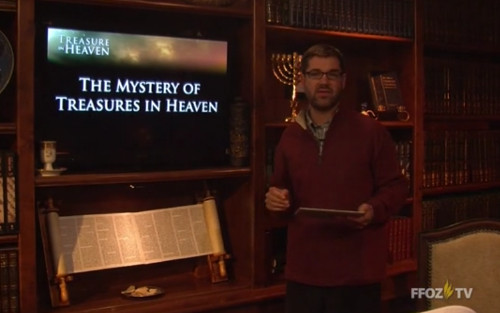
FFOZ TV Review: Treasure in Heaven

FFOZ TV episode 24Episode 24: What did Jesus mean when he told his disciples to store up treasures in Heaven? Episode twenty-four will take a look at the phrase “treasures in Heaven” through a Jewish lens. “In Heaven” in this phrase does not mean “in the sky” but rather “with God.” Jesus tells us that God rewards his children openly for what they do in secret. Viewers will learn that being disciples of Jesus means being a generous person, giving to the needy, doing the work of the kingdom, and not focusing on earthly gain.

-from the Introduction to FFOZ TV: The Promise of What is to Come
Episode 24: Treasure in Heaven (click this link to watch video, not the image above)

The Lesson: The Mystery of Treasure in Heaven

This episode went pretty much the way I expected with just a few small question marks. First Fruits of Zion (FFOZ) educators and authors Toby Janicki and Aaron Eby based today’s teaching on the following verses:

Do not store up for yourselves treasures on earth, where moths and rottenness consume them, and thieves break in and steal. But store up for yourselves treasures in heaven, where moths and rottenness do not consume them, and thieves do not break in and steal. For in the place where your treasure is, there your heart will be also.

Matthew 6:19-21 (DHE Gospels)

Toby asked about how one can actually store a treasure in Heaven? Is there some sort of cosmic retirement plan in the Afterlife? Is it possible to do something to store treasure in Heaven now so we’ll have it to spend after we die?

These seem like silly questions but throughout much of the episode, Toby kept returning to these points. I started to wonder what the traditional Christian teaching must be about this passage? Does the Church or some part of it believe that there is a literal treasure in Heaven that we get when we die?

For viewers who have been regularly watching this show, it should be apparent that the reference to “Heaven” doesn’t have to literally be the place where God lives. The Hebrew word for “Heaven” can also mean “sky”. However, given the general theme of this first season of the FFOZ TV show, “Heaven” is more likely being used as a circumlocution to avoid saying the most personal Name of God. For instance, the phrase “Kingdom of Heaven” actually means “Kingdom of God” as in the coming Messianic Era.

That would mean storing up “treasure in heaven” means something like storing up “treasure in the Messianic Kingdom.” But that’s still mysterious if you don’t understand certain Rabbinic concepts and idioms.

“So when you give to the poor, do not sound a trumpet before you, as the hypocrites do in the synagogues and in the streets, so that they may be honored by men. Truly I say to you, they have their reward in full. But when you give to the poor, do not let your left hand know what your right hand is doing, so that your giving will be in secret; and your Father who sees what is done in secret will reward you.”

Matthew 6:2-4 (NASB)

Toby JanickiThis should help provide clarity. Toby links “storing up treasure in heaven” to these earlier verses in the chapter. Jesus teaches a direct link between giving to charity in secret and being openly rewarded by God. This is also a Rabbinic concept, but one where Christianity treads lightly, since we are taught that salvation is a free gift and not tied to anything we can do, such as give to charity. Also, Isaiah 64:6 defines “righteous acts” as “filthy rags” so it would seem as if this interpretation of Jesus’ teaching contradicts not only older scripture but Christian doctrine as well.

We aren’t talking about “buying our way into Heaven” with our “filthy” righteous deeds, though. We are however, talking about a relationship between our giving to charity and some sort of reward from God. More specifically, we are talking about giving in secret, without using our “generosity” to draw attention to ourselves, and that is what God rewards openly.

As a side note, this makes me wonder why some churches today have listings on their walls or in some public document of the names of their larger contributors if Jesus taught to give in secret?

If you say, “See, we did not know this,”
Does He not consider it who weighs the hearts?
And does He not know it who keeps your soul?
And will He not render to man according to his work?

Proverbs 24:12 (NASB)

It looks like Jesus isn’t contradicting this older portion of scripture and in fact, he seems to be teaching the same lesson. “And will He not render to man according to his work?” So what we do here in this life does seem to matter to God and God responds to our actions by giving back to us in the manner we’ve given (or not given) to others.

This brings us to the first clue for this episode:

Clue 1: When Jesus tells us to “store up treasures in heaven,” he is not telling us to store up treasures in the Afterlife, but to store up credit with God.

Storing up “credit with God” still makes it sound like we’re opening up a credit line at the Bank of Heaven and then drawing against it, but that makes no sense at all. There’s got to be more to this lesson.

As it turns out, there is:

The lamp of the body is the eye, and if your eye is whole, your entire body will be illuminated. But if your eye is evil, your entire body will be darkened — and if the light within you is darkened, how great is the darkness.

A man is not able to serve two masters. For he will hate the one and love the other, or he will cling to one and despise the other. You are not able to serve both God and mamon.

Matthew 6:22-24 (DHE Gospels)

OK, maybe that didn’t clear everything up. To get a better handle on what Jesus is saying, the scene shifts to Aaron Eby in Israel for a Hebrew lesson on the term “the evil eye.”

So what is the “evil eye” and the “whole” or “good eye”? Aaron tells his audience that one interpretation of an “evil eye” is a description of what happens to a believer who looks at forbidden things. Another tells of a believer who is not spiritually perceptive. But in the overall context of these verses, which seem to be addressing money, that doesn’t make sense.

Aaron EbyAs it turns out, having an “evil eye” in Jewish idiom means being stingy. Also, the words translated as “whole eye” or “good eye,” given the idiomatic meaning being referenced, are better translated as “beautiful eye,” meaning generous. But how does it make sense that your “eye” can indicate stinginess or generosity? According to Aaron, it has to do with how you look at or perceive others. If you look at someone with good intent or in order to see the good in them, you are looking at them with a “beautiful” eye and are inclined to be generous toward them. However, if you look at people with poor intent or in a negative manner, you are inclined to be withholding from the needy and thus have an “evil” eye.

Returning to Toby in the studio, we come to the next clue:

Clue 2: Jesus’ words about storing up treasures with God are directly linked to “beautiful eye” and “evil eye.”

Now we seem to be zeroing in on the solution to today’s mystery. But if God rewards believers for giving generously and in secret to charity, what sort of reward is provided? Toby said that it is not along the lines of prosperity theology. It’s not a matter of giving large amounts of money to certain charities or churches in order to get back a boatload of cash in this world.

So what is the answer?

“For this reason I say to you, do not be worried about your life, as to what you will eat or what you will drink; nor for your body, as to what you will put on. Is not life more than food, and the body more than clothing? Look at the birds of the air, that they do not sow, nor reap nor gather into barns, and yet your heavenly Father feeds them. Are you not worth much more than they?

Do not worry then, saying, ‘What will we eat?’ or ‘What will we drink?’ or ‘What will we wear for clothing?’ For the Gentiles eagerly seek all these things; for your heavenly Father knows that you need all these things. But seek first His kingdom and His righteousness, and all these things will be added to you.

“So do not worry about tomorrow; for tomorrow will care for itself. Each day has enough trouble of its own.”

Matthew 6:25-26, 31-34 (NASB)

In a nutshell, this means that we shouldn’t worry about the basic necessities of life such as food, clothing, and shelter, because God knows we need these things and will provide. Instead of devoting our resources to accumulating material possessions, we should seek first the Messianic Kingdom, and “the basics” will take care of themselves.

By being generous, we come closer to entering the Kingdom of Heaven. Conversely, a stingy person is removed or retreating from entering the Messianic Kingdom.

This sort of reminds me of what I wrote about the FFOZ TV episode on The Golden Rule. How we treat others brings us closer or places us further away from entering the Messianic Kingdom. But as I said before, although we’re not talking about buying our way into Heaven, how can being generous or stingy admit or inhibit living in the Era of the Messiah?

Unless it’s somehow related to the lesson of the “sheep and goats” we find in Matthew 25:31-46, which is also talking about generosity and stinginess. Even a believer who is stingy or has exhibited the “evil eye” may be rejected by the King upon his return. What we do does matter. This reading of the Bible makes that inescapable, although it’s not always easy to understand.

The final clue is:

Clue 3: Storing treasure in heaven is the same as seeking the Kingdom of God.

It doesn’t mean that God will provide a one-to-one system of giving vs reward whereby if you give a certain amount to your church or to charity, that you’ll automatically get back the same or more than you “invested.” In fact, that sort of theology goes against what Jesus taught, since he commanded giving in secret, which at least implies the idea of giving generously with no thought of reward.

What Did I Learn?

I actually knew the vast majority of what was taught today, but some of what was said got me to thinking. As I see it (and this is just my opinion), by being generous in the here and now, we are somewhat foreshadowing the coming Messianic Kingdom, which will be characterized by kindness, generosity to all, and peace. Just as each weekly Shabbat is a foreshadow and a preview of the lasting Shabbat of Messiah, so too every mitzvah of giving we commit, each act of tzedakah, is a momentary snapshot of how all humanity will behave toward each other one day.

tzedakah-to-lifeI have a better “feeling” about this being part of the “reward” rather than necessarily admittance into or rejection from the Messianic Era, but as the passage from Matthew 25 indicates, there will be those believers who get in and those who are given the boot.

Also, as I said above, I don’t see any sort of formula being developed out of these scriptures and this lesson whereby the more you give, the more you get in cash or material goods. There have been far too many saints or tzaddikim who have lived and died in poverty, even though they were abundantly generous with whatever they had, to make me believe that giving to charity is some sort of insurance against poverty or some other bad things happening to me. “The Lord gives and the Lord takes. Blessed be the Name of the Lord” (Job 1:21). God does as He wills. Sometimes, even the most devout servants of God don’t have access to even the basics of food, water, clothing, or shelter, even though this seems to contradict the words of the Master.

But we don’t see this so much in the West because most of us can at least make ends meet if not live rather well, especially when compared to the kind of abject poverty we see in what we call “third-world countries.”

And He looked up and saw the rich putting their gifts into the treasury. And He saw a poor widow putting in two small copper coins. And He said, “Truly I say to you, this poor widow put in more than all of them; for they all out of their surplus put into the offering; but she out of her poverty put in all that she had to live on.”

Luke 21:1-4 (NASB)

I thought this deserved an honorable mention, since we are talking about giving generously. OK, so it’s not giving in secret if Jesus and his disciples can see how much everyone is giving, but we do see a woman living in great poverty, probably a state of lacking most of us have never experienced, giving all she had to live on for the sake of God and the Temple. I don’t think I could advise a person to do that, holding nothing back for themselves, but then again, maybe she was not worrying about her next meal, what clothes she was going to wear, or the place she was going to rest her head, just as Messiah taught.

It’s a hard lesson in this world of 401Ks, Medical Savings Accounts, and saving up to send the kids to college.

I seem to remember, probably from something Dave Ramsey said, that families should include charitable giving in their budgets in the same way as we budget for car repairs, groceries, clothing, and so on. This isn’t giving all we’ve got, but it is giving what we can if we are so inclined.

Only two more episodes in season one left to review.

The Mystery of Romans: Apostolic Decree and the Obedience of Faith

Apostolic DecreeIt is important to note that the major tenets of the decree were practiced by the early Christian gentiles for several centuries, although this fact is not considered by most scholars to demonstrate that Paul accepted or taught it in his gentile mission. Somehow it is assumed that Paul was generally unaware of the decree, or that if he was aware of it he did not accept it. Why has Christianity so overlooked this feature of Paul’s missionary teaching?

-Mark Nanos
“Chapter 4: The Apostolic Decree and the ‘Obedience of Faith,'” pp 201-2
The Mystery of Romans: The Jewish Context of Paul’s Letters

I’m finally able to get back to my series of reviews on this landmark book of Nanos’. I’m not going to pick through the entire chapter, but the section of Chapter 4 called “The Apostolic Decree and the Message of Romans” caught my attention. I’m rather interested in the legal decision of the Council of Apostles and Elders in Jerusalem (Acts 15) that established binding halachah on the Gentile disciples of the Jewish religious stream known as “the Way.” My opinion is that Paul very much had to know about this decree and certainly, if he considered himself under the authority of the Council, an authority established by Messiah, then agree or not, Paul had to accept it and even teach it.

And how could Paul not be aware of this decree?

Some men came down from Judea and began teaching the brethren, “Unless you are circumcised according to the custom of Moses, you cannot be saved.” And when Paul and Barnabas had great dissension and debate with them, the brethren determined that Paul and Barnabas and some others of them should go up to Jerusalem to the apostles and elders concerning this issue.

Acts 15:1-2 (NASB)

So Paul, Barnabas, and their Jewish opponents traveled to Jerusalem together to seek out the Council’s authority on the matter in dispute (whether or not Gentiles had to convert to Judaism and take on the full yoke of Torah as an obligation in order to enter into the Messianic religious order), which would include giving testimony and being present for the final verdict. I have no idea how any New Testament scholar could miss so obvious a passage of scripture.

As I did previously, I’m going to review my notes and “brain dump” the data here with just a bit of polishing. Hopefully, this will carry the meaning of this section of the chapter and my impressions of the information presented.

In stark contrast to this consensus, however, I see the apostolic decree operating in the background of Paul’s bold “reminder” to Rome. In addition to his clear agenda to explain the new status of the gentile believing in Jesus Christ as equal, though governed by the principles of behavior outlined for the “righteous gentile” in the Council’s apostolic decree, several specific references suggest that his addressees share with Paul the knowledge of the decree in its original, though certainly fluid format. We have seen how central the issue of accommodating the dietary concerns of the “weak” were in order to win them to faith in Christ. Further, I find traces in the formal feature of the opening and closing of the letter, in the rhetorical structure, and in several key phrases and concepts that Romans is actually Paul’s exposition, by way of reminder, of the apostolic decree in view of his intended visit, and yet necessary delay.

-Nanos, pp 206-7

My commentary on Chapter 3 mentioned that the “reminder” was Paul to the Gentile believers in Rome, reasserting the form and function of the Gentile’s role in “the Way” in relation to the Jewish believers in specific and Jewish people in general. The “weak” were not the Jewish believers who felt they had to continue observing the Torah mitzvoth as opposed to accepting the grace of Christ, but rather the Jewish non-believers who were struggling with accepting faith in Yeshua as Messiah. A large part of the apostolic decree was designed to allow a basic relationship between the believing Gentiles and Jewish people. The so-called “strong” were over-emphasizing their “freedom” from Torah at the expense of the Jewish non-believers they associated with in the synagogue, damaging the reputation of Messiah and “the Way” as a Judaism.

King Priest TorahWe see from the general message in Galatians that Paul did not support Gentile conversion to Judaism as a requirement for justification before God, and that he stated point-blank that if the Gentiles were to allow themselves to be circumcised and convert, they would be obligated to the full yoke of the Torah, and the sacrifice of Messiah would become useless (Galatians 5:1-2). Applying that to Romans, Paul knew that the Gentiles were not obligated to the Torah in the manner of the Jews and also knew that the apostolic decree established an alternate set of behavioral constraints and requirements that defined the role of the Gentile disciple, not only in relation to God, but to the Jewish people as well.

He is responsible for the “obedience of the Gentiles” that results from his apostolic preaching of the gospel (15:18-19, 20ff.) and he will not be satisfied with the situation in Rome until he has arrived to fulfill this obligation (1:14-15)…

Within this context, Paul is expecting the “obedience of the Gentiles” to conform to the apostolic decree for the sake of the unbelieving Jews that they may not be further alienated from Messiah, but drawn nearer. It was within the power of the Gentiles in Rome to “thumb their noses” as it were to the Jewish people, but that would result in pushing Jews who were already doubtful that the crucified Rabbi from Nazareth was the Messiah into complete rejection.

The key statement in this part of Chapter 4 is this:

It is Paul’s hope that the Romans will receive him and his message of their obligations with respect to the decree in the same positive way as we find Luke describes (Acts 15:30-31) Paul’s earlier missionary reception. For the decree was not an unwelcome burden, but a powerful declaration of the inclusion of gentiles as equals, by faith and without becoming Jews, in the people of God. It was a sign of the fulfillment of the eschatological promise of the blessings for all the world in Israel’s Christ. And it was understood to be a minimal demonstration of appropriate purity behavior for association with the Jewish community (Israel, the historical people of God), on the part of the gentiles who maintained they had become equal coparticipants in the promised blessings. Indeed, it bore witness to their indebtedness to Israel for her present suffering on their behalf.

-Nanos, pg 211

The apostolic decree was the minimum set of standards required of the Gentiles to honor their indebtedness to the Jewish people and Israel as a whole for the realized blessings that resulted in Gentiles being equal coparticipants in salvation and reconciliation with God without having to be circumcised (convert) and be obligated to the full Torah.

My understanding is that the Gentiles could accept more than the minimum requirements up to and including the full “yoke of the Lord,” but this was entirely voluntary. In Paul’s letter to the Romans, we see the opposite happening. The Gentile believers in Paul’s readership were not even achieving the minimums set out in the apostolic decree and failing to acknowledge the Jewish people as the source of the blessings they were so comfortably operating within.

Gentile obedience to the decrees of the Council would result in the proper display of the relationship between non-Jewish believers and the general Jewish community, and disobedience sacrifices the “weak” among the Jews in the Roman synagogue to a failure of faith in Messiah.

I find an interesting parallel in Paul’s writing in how the Church approaches the Jewish people today. Christianity in the modern era also flaunts its “freedom” to the Jews and conversely denigrates the Torah, claiming that Jews are now “free from the Law” as if that would be some great relief to Jewish people. Gentile Christians would blithely eliminate the Torah from the lives of Jewish converts to Christianity, ignoring the destruction of Jewish identity and ultimately the Jewish people as a separated and called out nation before God.

Today, we “gentilize” the Jews as well as the modern incarnation of Jewish religion of “the Way” (i.e. “the Church) in the same manner as the Gentiles Paul was addressing in Rome. We in the Church are just as disobedient to the binding decrees of those whom Jesus assigned authority to as were the Roman Christians in Paul’s letter. Granted, much has changed since the apostolic era, and the body of Christ is totally separated from its “Jewish roots,” but that condition is not permanent.

The programmatic “obedience of faith” echoes the spirit of the Jerusalem Council’s intentions in setting forth the need for the Christian gentiles of Rome to obey the particulars outlined in the apostolic decree. Paul was concerned to remind them boldly of proper monotheistic behavior for “righteous gentiles” in their association with non-Christian Jews, and specifically halakhic matters of dietary and sexual conduct (12:1-15:3).

…Whatever grammatical construct one might prefer, the “obedience of faith” articulated Paul’s uncompromising commitment to the deeper intentions of the Shema, embracing both the election of Israel and the inclusion of gentiles equally — for God is One! The contours of Paul’s argument have been overlooked because interpreters have misunderstood his focus on gentile inclusion through faith alone, ostensibly dismissing Torah obedience as obsolete. However, if we recognize that Paul was addressing Christian gentiles tempted to consider themselves as having supplanted Israel and thus no longer obligated to obey “the teaching” of the apostolic decree (for why would they need to be concerned with the “acceptance” of the “stumbling” of Israel and their “opinions” of the proper purity behavior for “righteous gentiles”; if Israel had been cut off they are free to eat all things!), then we can readily follow Paul’s nuanced discussion of circumcision and Torah.

-Nanos, pp 237-8

going-to-church-sketchesGentiles who consider themselves as having supplanted the Jewish people in the blessings of God due to their faith in Messiah do not enhance Jewish desire to approach Messiah-faith, but inhibit it. By considering the apostolic authority to bind the Gentile disciples to a set of principles as obsolete, along with the Torah, these Roman Gentile Christians were sowing the first seeds of dissention that would eventually lead to complete restructuring of “the Way” from one Jewish religious stream among several in the late Second Temple period, to a completely separate Gentile religion in the first decades of the common era, totally divorced from its origins and its apostolic Jewish mentors.

And “the Church” hasn’t stopped being disobedient yet. In fact, we’ve compounded the problem by insisting that the only proper response to the Jewish Messiah for a Jew is to abandon the Torah, abandon Judaism, and abandon being a Jew, convert to being a Gentile, and to also thumb their noses at the eternal relationship between God and Israel.

The Children of Israel shall observe the Sabbath, to make the Sabbath an eternal covenant for their generations. Between Me and the Children of Israel it is a sign forever that in a six-day period Hashem made heaven and earth, and on the seventh day He rested and was refreshed.

Exodus 31:16-17 (Stone Edition Tanakh)

Thus says the Lord,
Who gives the sun for light by day
And the fixed order of the moon and the stars for light by night,
Who stirs up the sea so that its waves roar;
The Lord of hosts is His name:

“If this fixed order departs
From before Me,” declares the Lord,
“Then the offspring of Israel also will cease
From being a nation before Me forever.”

Thus says the Lord,

“If the heavens above can be measured
And the foundations of the earth searched out below,
Then I will also cast off all the offspring of Israel
For all that they have done,” declares the Lord

Jeremiah 31:35-37 (NASB)

No amount of exegetical “tweaking” of the Bible can delete God’s promises of an eternal relationship with Israel, the Jewish people. Reading Paul as is done traditionally in Christianity requires a great deal of “retrofitting” of the older texts to somehow make God seem to be saying the exact opposite of what we read in Exodus 31 and Jeremiah 31. Mark Nanos and other New Testament scholars like him are boldly forging ahead into territory that restores the “Judaism” back to the Jewish text of the Bible. Paul is not praising the Gentiles for their “lawlessness” and castigating the believing Jews for their continued “addiction” to the Torah. Quite the opposite.

In this chapter, we see Paul continuing to urge the Gentile believers to cleave to the “obedience of faith,” the standards established by the Council in Jerusalem, for the sake of the Jewish people, particularly those Paul was desperate to have come to faith in Messiah.

Mark NanosI can only hope that books like The Mystery of Romans and ministries such as First Fruits of Zion (FFOZ) will eventually, and by the will and grace of God, restore the balance, even as Paul was attempting to restore the balance between the Gentile believers and the Jews in Rome. Paul’s efforts ultimately failed, as I think he suspected they would, but as the time of the Messiah’s return approaches, the Spirit is helping us to get out the message of restoration and renewal as God originally planned. Much has been lost to the believers in Jesus over these last twenty centuries. I believe that the time has come for us to take it back.

I hope to continue with my review of the Nanos book soon.

FFOZ Friends: Become Part of the Promise that is to Come

Boaz MichaelPerhaps at some point this month you would find it a worthy blog to talk about the FFOZ Friends program and encourage your readers to join with you, with us, by becoming an FFOZ Friend. If we are all going to make an impact we need to work together…FFOZ is a worthy cause to invest into with funds that have already been designated for giving. FFOZ as you know and noted today in your review are creating materials that are communicating a balanced and challenging message.

-Boaz Michael, President and Founder of First Fruits of Zion (FFOZ)
from a private communication

I’ve been reviewing the FFOZ educational television series A Promise of What is to Come for almost half a year now, and have covered the vast majority of the available episodes. I’ve found the teachings offered by Toby Janicki and Aaron Eby to be informative, well-balanced, and provocative. They’ve expanded my understanding of the Bible and gone a long way to helping me see that the truly inspired Word of God cannot “jump the tracks,” so to speak, between the Tanakh and the later Apostolic Writings. The scriptures can and must be interpreted rightly and in a way that does not require the ascendency of Israel and the Jewish people we see in the Messianic prophesies of old to be reversed and replaced with “the Church” as “the Church” interprets the New Testament.

Through Boaz’s graciousness, I am an FFOZ Friend. What’s that?

Basically, it’s a method of participating in a support structure that allows the “Friend” to donate a specific amount of funds on a regular basis in exchange for access to FFOZ’s printed and online educational material. It’s a “win-win” in which the participant receives a view of God, the Messiah, and the Bible that is edifying, rewarding, and summons the coming Messianic Kingdom, while also supporting and enabling this ministry to not only continue its operations, but to produce even more innovative resources, and additionally, to expand its scope in order to reach greater numbers of Gentile Christian and Jewish audiences.

The FFOZ Friends main page describes this opportunity far better than I can:

An FFOZ Friend shares our vision and mission with us, and is a co-laborer with us in this work of restoration. FFOZ Friends facilitate the development and dissemination of our shared vision, and invest into this work as we labor daily towards the kingdom of heaven, “a promise of what is to come.”

The generosity of our FFOZ Friends helps meet the core operating needs of the organization and makes outreach efforts possible. FFOZ Friends are the source of funding for the development of books, teachings, educational resources, television programming, and extensive commentaries on the Bible from its historical, linguistic, and cultural context. These resources bring together the latest scholarship, ancient Jewish sources, and extra-biblical literature to present a Messianic Jewish reading of the Bible and early Jewish-Christianity.

I described generally about what you can accomplish by joining this program, but this FFOZ Friends infographic lays it all out for you (yes, please click the link).

In short, by becoming an FFOZ Friend, you will be supporting four key missions:

  • Jesus is Jewish
  • The Kingdom of Heaven
  • The Validity of Torah
  • The Jewish People

The infographic provides the details of each of these missions, but what I’ve listed in four short bullet points contains a vast span of information, knowledge, and wisdom that expands both Christian and Jewish thinking about the identity of the Messiah, the promise of the Kingdom to come, the continuation of Torah in Jewish lives and its application to the Gentiles who are called by His Name, and the restoration of the Jewish people and of Israel.

ffoz-teaching-teamI can’t think of any other single ministry that is accomplishing so much and opening eyes in such a unique, beautiful, and illuminating manner. So what does it take to be an FFOZ Friend?

Basically, there are three different monthly support levels. Each support level provides access to a different set of resources (you can find additional details by clicking the links I’ve provided):

  • Companions: $25 (or less, or more)
  • Allies: $50 or more
  • Pillars: $100 or more

If you are a member or regularly attend a church, chances are that you tithe a specific amount on a regular basis, say, once a week. If you are a member of a synagogue, you probably pay annual membership fees. If you support a particular charity (for instance, my wife and I have supported World Vision and other such worthy causes over the years), you probably don’t just mail them a check once and then ignore them. If that charity or ministry is indeed worthy, you probably budget so that you can make regular donations for their continued support.

Becoming an FFOZ Friend is just like that. It’s supporting a cause you find worthy, a cause you believe in, a cause that not only gives to others but gives back to you.

In addition to what I’ve already mentioned, what will you be supporting? The FFOZ main website gives you access to a fund of information about who they are and what they do. There are a wide variety of online materials, books, and other resources. Sure, you can purchase all of these separately, but being an FFOZ Friend, depending on the support level, will allow you to receive many of these resources just by participating in the program.

There are also a lot of educational assets that are being planned or under development right now that are scheduled to become available in the next year or two. FFOZ is working hard to make information about the coming Kingdom, about Messiah, about the relationship of the Gentile and Jewish believer to the Sabbath, to the Torah, and to God increasingly accessible. I’m personally looking forward to Season 2 of the FFOZ TV series which is currently being filmed, as well as their book “The Apostolic Decree” (Acts 15 is a favorite topic of mine) which should be released late next year.

Other projects you can look forward to include making information that was only previously available through The Torah Club formatted in multi-volume book form, book and audio resources to support Sabbath observance among Messianic believers, commentary on the Didache, and a great deal more.

Becoming an FFOZ Friend is more than just donating regularly and receiving and consuming resources. The ultimate goal is to change the world and to pave the road upon which the Messiah will walk on his triumphant return to Jerusalem and his ascendency to the Throne of David. It’s the road upon which the exiles will return from the four corners of the earth, it’s the road that we, the disciples of Messiah, will line in droves as we exuberantly cheer the victory of the King and the restoration of Israel, his Kingdom, and the final truth of God living among His people at last.

Becoming an FFOZ Friend is joining an effort to bring all this about and to contribute to repairing the world, and preparing the world for the promise of what is to come.

Boaz appears at the end of each FFOZ TV episode to announce the topic for the following show and to encourage the viewers. He always ends his presentation with the words, “What are we waiting for? Let’s get busy.”

prophetic_return1Why wait? Join the laborers in the field which is ripe for harvest. The Master said the laborers are few but it doesn’t have to be this way. Join them, join us. Brighten the world by becoming a light, just as the Master commanded us. Illuminate the path as well as your spirit. Become part of something bigger than any one person.

Become an FFOZ Friend.

When Boaz asked if I could blog about being an FFOZ Friend, I knew that some people reading this would probably misinterpret my response and my intent, and would see all this as just some sort of marketing effort. Marketing is just a method of making information and opportunities public. It’s an offer that allows you, the reader, to become aware, to learn more, and to make a decision. If you believe in the missions FFOZ stands for and what they are doing, then being an FFOZ Friend is the perfect response. If you believe in the Messianic vision for Gentiles and Jews then don’t just stand on the sidelines and wait. Join. Participate. Help spread the word. Summon the vision.

Thank you. Peace.

Is Sola Scriptura Enough to Understand Paul?

Apostle-PaulIs the Torah to be considered as a dead husband that nobody liked anyway? This is the way many Christians interpret Romans 7:1-6: “For the woman who has a husband is bound by the law to her husband as long as he lives. But if the husband dies she is released from the law of her husband” (verse 2 of Romans 7:1-6). Paul refers to an ancient halachah (principle of the law) to illustrate his new relationship to the Torah because of his faith in Jesus. But one question is never asked when studying Romans 7:1-6. And it is only when the full impact of Paul’s Jewish heritage is understood in light of his entire teaching concerning the believer’s response to the Torah that this question can be carefully considered. Nonetheless, we must ask: Was Paul speaking about the death of the Torah or was he referring to the death of the flesh? Is the Torah, for Paul, a dead husband?

Brad H. Young
“Is Paul Against the Law?”
Biblescholars.org

Dr. Roy Blizzard promoted this article on his Facebook page, and since I’ve read both Blizzard and Young in the past, I was interested in seeing how their perspectives have developed.

What I read made me think of how I recently brought up the issue of sola scriptura in relation to a presentation given by Pastor Steve Lawson at John MacArthur’s Strange Fire conference last October.

I found myself wondering if sola scriptura as offered by Lawson would match up with how Young is interpreting Paul in Romans 7.

To interpret Paul correctly on this passage, it is first imperative to recognize that the saying, “when a person dies he is free from the law and the commandments” (kivan shemet adam naaseh chofshi men hatorah vehamitzvot), was a well-known concept in halachah, which probably was almost proverbial in ancient Jewish thought (b. Nidah 61b and parallels). When Paul says that he is writing to those who know the law (Romans 7:1), it is clear that he speaks concerning a practice of halachah with which the Jews in the congregation of Rome would be quite familiar. The marriage laws concerning a woman and her husband would also be fairly well known. Of interest to the issue is the fact that Rabban Gamaliel the Elder, who according to Luke was the teacher of Paul in his early days as a student in Jerusalem, addressed questions relating to these laws in the Mishnah. Gamaliel the Elder taught that a woman is free to remarry even if only one witness gives testimony that her husband had died (m.Yeb. 16:7). Scholars have noted that the passage in Romans 7:1-6 might well betray the influence of Paul’s teacher Gamaliel. While the similarity between Paul and Gamaliel on this point of halachah should not be denied, it is also true that such teachings were probably common knowledge to Jewish men and women who lived pious lives according to their devout faith. Paul could have been acquainted with this principle from many sources, including Gamaliel the Elder.

-Young, ibid

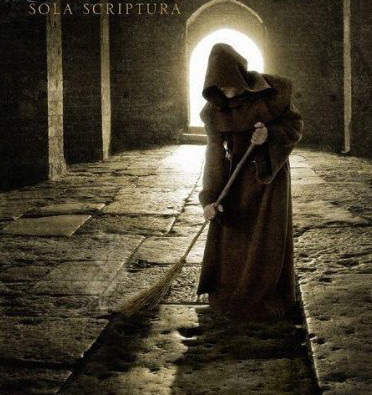
sola scripturaI tried to choose the most representative paragraph in Young’s brief article to illustrate that a thorough understanding of not only scripture but of Judaism (or the various Judaisms) as it (they) existed during Paul’s lifetime is absolutely essential to correctly understanding Paul. Without addressing the complete social, religious, historical, national context in which Paul was writing, plus his education and as much of his “psychology” as we can apprehend after all this time, we are quite likely to get Paul wrong and, as a result, construct completely erroneous theologies, doctrines, and dogmas based on our misunderstanding, all the while believing we are standing on the rock-solid foundation of “sola scriptura.”

But am I being unfair? After all, I do believe the Bible (correctly understood) is the basis for a life of faith. I just think it’s more complicated than reading the Bible and taking the text (especially in English) at face value.

I recalled that a gentleman named Tim Hegg, who is well-known in Hebrew Roots circles, took exception to another criticism of sola scriptura, written by First Fruits of Zion (FFOZ) author, Pastor Jacob Fronczak for Messiah Journal issue 111 (Fall 2012).

The full text of Hegg’s rebuttal can be found at TorahTalkOnline.com (PDF) but I’ll take the liberty of inserting the relevant quotes here.

According to Hegg, Fronczak asserted “it (the Bible) needs no outside help to be correctly interpreted”as a tenet of sola scriptura. Hegg responded:

Wrong!

Sola Scriptura holds that the Bible must be interpreted according to its historical, grammatical sense. This means that knowing the history, culture, and language in which the inspired word is given is necessary for receiving its divinely intended message. But Sola Scriptura also states that the Bible is self-interpreting, meaning that since it is God’s inspired word as a whole, it is never self-contradictory. Therefore, the truth of the Scriptures is found in the whole of the Bible’s message, allowing the whole to interpret the parts

The first part of Hegg’s response sounds good, but it is dependent upon how well the interpreter knows the “historical grammatical sense” and how much they’re willing to take into account the “history, culture, and language in which the inspired word” was given. In other words, would the interpreter who is an adherent of sola scriptura take into consideration ancient Jewish thought and Paul’s relationship with Rabban Gamaliel the Elder when attempting to understand Paul’s relationship with and description of the function of Torah in the community of first century Jewish believers?

Also, when Hegg says that “the Bible is self-interpreting, meaning that since it is God’s inspired word as a whole, it is never self-contradictory. Therefore, the truth of the Scriptures is found in the whole of the Bible’s message, allowing the whole to interpret the parts,” he seems to be leaving out the necessity of understanding the context to its fullest degree.

By that, I mean in order to resolve those areas of the Bible that seem internally inconsistent (how Paul in some parts of the Bible seems pro-Torah and in other parts seems anti-Torah), we have to employ a much wider net of information gathering than I think Christian interpretive tradition is willing to allow.

Here’s more about what I mean:

If Paul employs a known analogy from halachah in Romans 7:1-6, perhaps the Jewish tradition can throw light upon Paul’s message and the conclusion he desires to draw from the evidence he cites. The sage, R. Simeon ben Pazzi, taught “…and the servant is free from his master”(Job 3:19). A person, as long as he lives is a servant to two masters: the servant of his Creator and of his [evil] inclination. When he does the will of his Creator, he angers his inclination, and when he does the will of his inclination, he angers his Creator. When he dies, he is freed, ‘the servant is free from his master!’ (Ruth Rabbah 4:14, M. Lerner pp.78-80). Rabbi Simeon ben Pazzi’s saying, “When he dies, he is freed…” not only recalls Paul’s words in Romans 7:1-6, but also provides a clear parallel in thought to his discussion of the servant who either is enslaved to his evil inclination or to his Creator in the preceding chapter of Romans. In Romans chapter 6, Paul teaches that an individual is either a servant of sin to obey the flesh or a servant of righteousness to obey God.

-Young

In order to grasp the meaning of how Young is understanding Paul, not only is understanding other areas of scripture necessary, but understanding ancient, and to a certain degree, modern Judaism is required as well. If you had no idea Paul was employing “a known analogy from halachah in Romans 7:1-6,” you might not consider investigating Jewish tradition in order to “throw light upon Paul’s message.”

Rabban GamalielThe conclusion you draw about what Paul is saying can be dramatically altered by inserting or omitting the Jewishness of Paul’s thinking, education, life experience, personal history, and teachings. If Paul was a disciple of Rabban Gamaliel, we know, as a disciple, he would have memorized his Master’s teachings to the degree that he could teach from the same perspective and understanding. To the degree that Paul became a disciple of Jesus (although not in a traditional sense), Paul would also have studied and memorized all of the teachings of this Master. If we don’t understand the full impact of what that means in terms of the late Second Temple model of Jewish discipleship and look to the relevant sources that would support authentic comprehension of Paul’s letters, we’re going to miss the point of everything Paul wrote, and as a result, misunderstand the very fabric of what it means to be a Christian.

I encourage you to read the full content of Young’s commentary on Paul and Romans 7. It only takes a few minutes, but it may also open your eyes, not only to Paul as you’ve never seen him before, but to the level of complexity involved in approaching and interpreting the scriptures. Sola scriptura is a good, basic place upon which to stand, but if you aren’t employing the proper interpretive tools to correctly understand “scripture alone,” you aren’t going to have a very accurate view.

The Church created a basic set of interpretations early on in order to foster separation between Gentile Christianity and Judaism, with Judaism and the Jewish people cast in the role of the villain. We like to think we’ve come a long way in revising our understanding of the Bible, but the deep core of those original interpretations lives on, underground, unseen, and most Christians are unconscious of how much they permeate their (our) Biblical thinking. We have it within ourselves to dismantle those ancient assumptions and to take a fresh look at Paul. Interestingly enough, we’ll have to go back even before the so-called “Church fathers” to our “Jewish fathers” and their fathers, to the Jewish Paul and the Jewish Gamaliel, to see a vision of Jesus and of Paul that has been lost since the time of the apostles.

Only with such a lens can we see not only what Paul wrote, but the intent, the thought, the heart he used to pen his letters and what he wanted his original audience and us to understand.

Remembering Newtown: We Live to Love

9-11 Flag“When Jacob finished his instructions to his sons, he drew his feet into the bed and, breathing his last, he was gathered to his people.”

Genesis 49:33

“How utterly different was the cruel fate of those who perished in the Twin Towers, the Pentagon, and the hijacked planes on September 11. To its everlasting credit, The New York Times in its daily ‘Portraits of Grief’ has been compiling the fragments of eulogy for each individual whose life was so suddenly obliterated. Grief is compounded by the lack of preparation and by the absence of all remains. As I read these personal vignettes of largely young people bursting with zest, in pursuit of dreams and borne aloft by so many relationships, I must constantly remind myself that they are no longer. Nothing is left to mitigate the anguish of their loved ones but memories that need to last a lifetime.”

-Ismar Schorsch
“Portraits of Grief,” pg 180 (December 29, 2001)
Commentary on Torah Portion Vayechi
Canon Without Closure: Torah Commentaries

As I write this, it is the anniversary of the shootings at the Sandy Hook Elementary School in Newtown, Connecticut. As I write this, I recall reading earlier this morning that another school shooting has just taken place at a High School in Colorado, with the eighteen-year old shooter having killed himself and his fifteen-year old victim struggling for life in the hospital.

I have prayed for the victims in Newtown and I have grieved with their parents since I am both a parent and grandparent. The very idea of losing a child to a sudden and needless death is horrifying beyond imagination.

Schorsch’s commentary on the death of Jacob paints a portrait of a man who died with difficulty even as he lived. But he was also a man who had the time to prepare for death, to bless his children and grandchildren, and to be surrounded by a comforting family as he breathed his last and was “gathered to his people.”

In Judaism, there is a halakhic requirement to sit shiva or to mourn in solitude and withdrawal from the world for seven days following the death of a loved one. And on the anniversary of the loved one’s death, it is customary to observe yahrzeit by reciting the Kaddish, lighting a candle, and remembering the person who has died.

But these are not my loved ones nor am I Jewish, so what am I to do?

No man is an island, entire of itself; every man is a piece of the continent, a part of the main; if a clod be washed away by the sea, Europe is the less, as well as if a promontory were, as well as if a manor of thy friend’s or of thine own were; any man’s death diminishes me, because I am involved in mankind, and therefore never send to know for whom the bell tolls; it tolls for thee.

John Donne

Donne’s famous poem, which I learned forty years ago, reminds me that anyone’s death diminishes me because I am involved in humanity, because of my humanity and my mortality.

APTOPIX Connecticut School ShootingAccording to Schorsch’s commentary (pp 170-172), second century Jewish sage, Rabbi Meir’s midrash on the Creation account in Genesis was so controversial that it saw limited circulation during his lifetime. His interpretation of Genesis 1:31 where it is declared “And God saw all that he had made, and found it very good,” Rabbi Meir relates the Hebrew word “me’od” which is translated as “very” to “mot,” which is the Hebrew word for “death”.

In Christian doctrine, we believe that God introduced death into the world as a response to the fall of Adam and Eve. According to Rabbi Meir’s midrash…

…God did not inject death into the world later, as a punishment for human sin. Rather, death was part of life, for without its inescapable presence, humankind would never value or use life fully. The beauty of life flowed from its impermanence.

-Schorsch, pg 171

I’m sure this is little comfort to those who are mourning their children in this supposed season of joy. In abstract, we can philosophize that it is our mortality that defines our existence, and the shadow of death cast across our journey of life reminds us that every moment is precious.

But in reality, most people rarely consider their death until something shakes them out of apathy, such as a doctor’s dire report or the murder of a child.

There is a tremendous temptation to either sink into depressive despair or to cry out in anger and pursue the path of vengeance. We want and even need to do something, to respond in some way, either by withdrawal or violent projection, because of the senseless outrage of these deaths.

In the end, neither reaction does much good. The former honors no one and the latter is manipulated by the politicians and the media pundits to achieve their own agendas.

The only thing that makes sense to me, particularly in a universe where I acknowledge a loving, involved, and creative God, is to take the only option that remains…to love those who are left to me here and now, not just because I know they can be taken away at any moment, but because life has to be more than mere existence, pursuit of money, pleasure, and the consumable products in the latest ad campaign on television. If life isn’t the expression of love, especially to those who depend upon us for their every need (even as we all depend on God for our every need), then why were we given life in the first place?

As I write this, I mourn the loss of the young innocents, not just in Connecticut and Colorado, but everywhere, and for every person, because like God, I must be involved in humanity. It is said that when Jacob and the seventy went down into Egypt, God went with them. How He must have grieved knowing just how far down Israel’s children would descend in the following years and decades. It is said that when millions of Jews and other “undesirables” entered the Nazi camps, God entered with them and was imprisoned with them. How He must have grieved as He witnessed each individual death of the six million of His chosen little ones.

The only thing we have to keep us going in the face of death and disaster is our faith in God, that there is something more to life than what we can detect with our five senses, and that there is a greater meaning to it all. When a child dies, even great faith is shaken, for how could a loving God allow such a heinous act to occur?

But where we have faith, God has certainty of perception and knowledge. God knows. He knows the placement of each individual soul in this life and beyond. We live in a universe that is broken and under slow repair. In that universe, death occurs, injustice occurs, tragedy occurs. Tears and grief occur.

landonBut there is also hope.

I took a few days off of work last week to spend time with my grandson. We played with legos, I made him pancakes, we had “sword fights” in my snowy backyard, we went to the playground and slid down slides covered with melting ice. I dropped him off at pre-school and had the wonderful privilege of picking him up again as he ran toward me grinning and gleefully yelling, “Grandpa!”

I can’t say anything that will comfort the grieving and the dying except that if you still have someone precious in your life who needs you and who loves you, then they are the difference, the hope, and the faith that makes life more than just living day-to-day. This is what God does to open our eyes. This is what God does to open our hearts, to turn stone into beating flesh. This is why we are alive. We live to love.