Category Archives: Torah Portion

Vayeira: Those Whom God Has Blessed

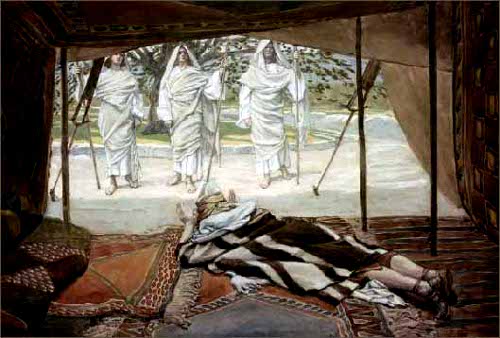
abrahams visitorsThe Lord appeared to him by the terebinths of Mamre; he was sitting at the entrance of the tent as the day grew hot.

Genesis 18:1 (JPS Tanakh)

The Lord took note of Sarah as He had promised, and the Lord did for Sarah as He had spoken. Sarah conceived and bore a son to Abraham in his old age, at the set time of which God had spoken. Abraham gave his newborn son, whom Sarah had borne him, the name of Isaac. And when his son Isaac was eight days old, Abraham circumcised him, as God had commanded him.

Genesis 21:1-4 (JPS Tanakh)

In this week’s Torah portion, Avraham is recovering from Bris Mila. Later, Isaac is born and has a Bris Mila. So, I thought to share a few insights on … Bris Mila!

-Rabbi Kalman Packouz
“Shabbat Shalom Weekly”
Commentary on Torah Portion Vayeira
Aish.com

The vast majority of people in the Church don’t imagine that baby boys born into Christian families must receive a ritual circumcision, called a Bris or Brit Milah, on the eighth day of life. It’s one of those things that we think of as uniquely “Jewish.”

But if we who are in the body of Christ are called the spiritual Sons of Abraham (Romans 9:8), and if we are “one body and one Spirit, just as you were called to one hope when you were called; one Lord, one faith, one baptism; one God and Father of all,” (Ephesians 4:4-6), then why are we too not obligated to be circumcised?

Then after an interval of fourteen years I went up again to Jerusalem with Barnabas, taking Titus along also. It was because of a revelation that I went up; and I submitted to them the gospel which I preach among the Gentiles, but I did so in private to those who were of reputation, for fear that I might be running, or had run, in vain. But not even Titus, who was with me, though he was a Greek, was compelled to be circumcised. But it was because of the false brethren secretly brought in, who had sneaked in to spy out our liberty which we have in Christ Jesus, in order to bring us into bondage.

Galatians 2:1-4 (NASB)

Paul came also to Derbe and to Lystra. And a disciple was there, named Timothy, the son of a Jewish woman who was a believer, but his father was a Greek, and he was well spoken of by the brethren who were in Lystra and Iconium. Paul wanted this man to go with him; and he took him and circumcised him because of the Jews who were in those parts, for they all knew that his father was a Greek.

Acts 16:1-3 (NASB)

A great deal has been made about why Paul did not have Titus circumcised but he did so for Timothy. The only obvious difference between them in scripture is that Timothy’s mother was Jewish but both parents of Titus were Greek (presumably, since Luke refers to Titus as “a Greek” in Acts 16).
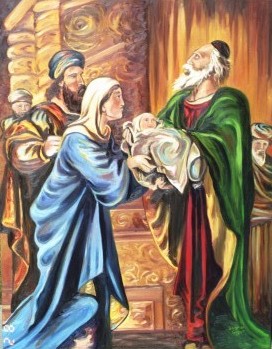
Brit_MilahToday, it is common in the various streams of Judaism to consider anyone Jewish who was born of a Jewish mother, regardless of whether or not the father was Jewish. In the days of Paul, this may not have necessarily been the case, but if Timothy wasn’t Jewish, we are at a loss as to why Paul made such a distinction between he and Titus.

But getting back to what I was saying before, should any distinction be made between Jews and Gentiles in the body of Christ. Aren’t we all one in Messiah with ethnic differences swept away by the hand of God as a scorching sirocco sweeps over the desert sands?

But wait a second.

The Almighty commanded Abraham, “… My covenant you shall keep — you and your descendants after you for all generations. This is my covenant which you shall keep between Me and you and your descendants after you — circumcise all males. And you shall circumcise the flesh of the foreskin and it shall be the sign of the covenant between Me and you. And at eight days old every male shall be circumcised throughout all of your generations … My covenant shall be in your flesh for an everlasting covenant” (Genesis 17:9-13).

-Rabbi Packouz

This is the “ethnic” part of God’s covenant with Abraham and his physical descendants through Isaac, Jacob, the Children of Israel, and beyond. I previously said that in this portion of the covenant ratified by God with Abraham…

God promises to make Abraham a father of many nations and of many descendants and the land of Canaan as well as other parts of Middle East will go to his descendants. God declares that circumcision is to be the sign of the covenant for Abraham and all his male descendants and that this will be an eternal covenant.

But the blessings of the earlier portion of the Abrahamic covenant God makes with Abram are significant because that portion can be applied outside the ethnic, genetic, biological stream of Abraham and his offspring.

And I will bless those who bless you, and the one who curses you I will curse. And in you all the families of the earth will be blessed.”

Genesis 12:3 (NASB)

We have to access Paul’s midrash on Abraham to make better sense of this.

Now the promises were spoken to Abraham and to his seed. He does not say, “And to seeds,” as referring to many, but rather to one, “And to your seed,” that is, Christ. What I am saying is this: the Law, which came four hundred and thirty years later, does not invalidate a covenant previously ratified by God, so as to nullify the promise.

Galatians 3:16-17 (NASB)

infant-jesus-templeThe “seed” is Messiah, Christ. He is the blessing, and this promise and blessing was established before the covenant was ratified and God required circumcision of Abraham and his offspring through Isaac, and through Jacob, and through all of Jacob’s offspring, and so on across the ethnic linkage that ultimately becomes the Jewish people.

In his letter to the churches in Galatia, Paul is strongly discouraging the Gentile disciples from being circumcised because, by that point in history, circumcision was the “shorthand” expression for ritual conversion to Judaism. If the Gentiles, through the blessings of Abraham’s seed (singular) and faith in Messiah, were already justified before God, and received the one Spirit, just as the Jews received that same Spirit, then for the purposes of justification, nothing else is required of the Gentile disciples.

Therefore I, the prisoner of the Lord, implore you to walk in a manner worthy of the calling with which you have been called, with all humility and gentleness, with patience, showing tolerance for one another in love, being diligent to preserve the unity of the Spirit in the bond of peace. There is one body and one Spirit, just as also you were called in one hope of your calling; one Lord, one faith, one baptism, one God and Father of all who is over all and through all and in all.

Ephesians 4:1-6 (NASB)

One body, one Spirit, one justification, one salvation, a unity of Spirit still doesn’t have to mean a uniformity of identity.

There’s a saying that goes, “everyone’s unique but no one is special,” but I don’t know if I can buy into that. I’m all for equal access to job opportunities and equal pay for equal work, but God did some really unique things. He chose the ethnic Jewish people, that is, those who were physically descended from Abraham, and Isaac, and Jacob, and Jacob’s sons, and the children of Jacob’s sons, who were all of the people led by Moses to Mount Horeb in the Sinai to receive the covenant and ultimately all of the promises, including the Land of Israel.

We can discuss the “mixed multitude” who eventually assimilated into the tribes after several generations and disappeared from the face of history, a process that cannot be anachronistically applied to modern times or even the time of James, Peter, and Paul. We can discuss ritual conversion to Judaism which existed in the time of James, Peter, and Paul and which exists today. I agree that you can’t “convert” to a tribal affiliation (which is why the ancient “gerim” in Torah were not converts). Judaism has long allowed for a few, select outsiders to join them, not because of ancestry, but by choice. But then, one choses to go “all the way,” so to speak, not retaining Gentile identity while living as a Jew. If we accept that God granted the Jewish community the authority to establish legally binding customs since antiquity, then we can accept Jewish converts.

But according to Paul and ultimately the Jerusalem Council (Acts 15), circumcision (conversion) is not required of the Gentile disciples of Messiah. We are one in Spirit and “co-inhabit” the body of Messiah. The body of Messiah is like the human body, which has different organs and structures, all of which are required for a healthy living person, and just like the body of Messiah, actually requires different parts.
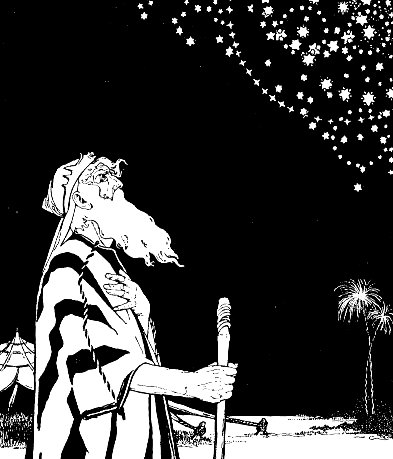
abraham1All of this was set into motion thousands of years ago with Abraham and it is a blessing that the whole world isn’t required to convert to Judaism in order to be reconciled to God. No stream of Judaism I’m aware of requires conversion and circumcision in order to be right with God. The Bible and God have always presupposed a world made up of Jews and Gentiles who are reconciled before our Creator. Messianic Judaism is the living example of a Judaism that recognizes the spiritual equality of Jews and Gentiles in Messiah without compelling circumcision and full Torah observance upon the Gentiles in the body (not that we can’t take on board more of the mitzvot voluntarily).

I know this won’t satisfy the Hebrew Roots Gentiles who believe in uniformity in the Messianic body, nor the traditional Christians who also require uniformity. But those alternatives either rob the uniqueness God gave to the Jewish people through circumcision, the Torah, and Israel by having Gentiles say “it belongs to us too,” or strips that uniqueness away, defying God’s will by Christians telling Jewish people they must cease their ethnic and religious uniqueness and performance of the mitzvot if they wish to worship Moshiach, requiring that Jewish believers live like the Gentiles in the Church.

Why has this mitzvah survived in strength while so many other mitzvot have fallen to the wayside by otherwise minimally observant Jews? Perhaps the answer is found in the 2,000 year old words of Rabbi Shimon ben Gamliel, “Every mitzvah that they (the Jewish people) accepted upon themselves with joy … they still perform with joy.” (Talmud, Shabbos 130a). Deep in our collective psyche we know that the Jewish people is eternal, that we have a mission to be a “Light Unto the Nations” and to perfect the world, that the Almighty loves us and watches over us — and that it is our great joy and privilege to be a part of that Covenant!

-Rabbi Packouz

However you choose to view this in terms of being Gentile members of the body of Christ, the creation of “the Church” didn’t eliminate the promises God made to Israel. Paul said (Galatians 3:17) that “the law, introduced 430 years later, does not set aside the covenant previously established by God and thus do away with the promise.” So too the work of Messiah did not annul the covenants previously established by God, but rather, Messiah was and is the crystallization of prophesy, the perfect expression of all of the covenants, the doorway allowing both people who are uniquely Jewish and those of us who are uniquely Gentile, to enter into relationship with God, co-inhabitants in a body that does require the heart, liver, lungs, spleen, stomach and many other organs, as opposed to being a single body, with a single organ, and a single identity, and a single function. A human being with only a stomach and no other parts couldn’t possibly live, so demanding absolute uniformity and canceling diversity within the body of Messiah kills the body.

Rabbi Packouz says the Jewish people are eternal. Circumcision is one of the signs of that eternal and unique existence before God. Opposing this is opposing God’s will. We can only be one in Messiah and possess the One Spirit of God by living in accordance with that One Spirit and that One God.

Therefore Jesus answered and was saying to them, “Truly, truly, I say to you, the Son can do nothing of Himself, unless it is something He sees the Father doing; for whatever the Father does, these things the Son also does in like manner.

John 5:19 (NASB)

I’ve often heard that we should imitate our Master, but I don’t think in this case it means so much what we eat or what we wear, but rather, how we treat those who God has uniquely blessed. If we bless the Jewish people, we too are blessed by Israel and by Messiah. Of course, there is the converse.

Good Shabbos.

Lech Lecha: Did You Hear the One About the Jewish Student and the Priest?

strangers-in-israelThe Lord said to Abram, Go forth from your native land and from your father’s house to the land that I will show you.

I will make of you a great nation, And I will bless you; I will make your name great, And you shall be a blessing. I will bless those who bless you And curse him that curses you; And all the families of the earth shall bless themselves by you.”

Abram went forth as the Lord had commanded him, and Lot went with him. Abram was seventy-five years old when he left Haran. Abram took his wife Sarai and his brother’s son Lot, and all the wealth that they had amassed, and the persons that they had acquired in Haran; and they set out for the land of Canaan. When they arrived in the land of Canaan, Abram passed through the land as far as the site of Shechem, at the terebinth of Moreh. The Canaanites were then in the land.

Genesis 12:1-6 (JPS Tanakh)

Thus Abraham took his first steps on a journey that would result in the vast and astonishing progression of the Jewish people across the grand panorama of human history. Abraham the Hebrew “crossed over” not just a geographical boundary, but a spiritual one.

I’ve said on a number of occasions that I thought one of the missions of the Christian church was to provoke zealousness among the Jewish people, to inspire Jews to return to Torah, return to Judaism, return to being who God made them to be.

Although I don’t believe God would allow it, there is a tremendous and ongoing concern, especially in America, that the Jewish population will continually assimilate, and ultimately vanish from our national landscape. And while many Christians believe that the only hope for the Jewish people is to convert to Christianity no matter what, there are some Jewish believers who insist that only when the Jewish people repent and return to Torah that the Messiah will finally return, and all of God’s promises to Israel and the people of the nations who are called by His Name (Amos 9:11-12) will finally come to pass.

In this week’s Torah portion, Avraham (Abraham) makes his way to the land of Israel and begins the journey of the Jewish people through history. Along that path we have seen nations rise and fall and have survived them, even through massive persecution. There were 2 million Jews during the Roman Empire 2,000 years ago. Demographers state that though there are approximately 14 million Jews identified worldwide, there are possibly 400 million halachic Jews (Jews whose mother’s were Jewish or converted according to Jewish law). Many Jews have fallen by the wayside of history. This week I share with you a story of one Jew who made his way back to identifying with the Almighty, the Jewish people and the Torah … albeit in a rather unusual way.

-Rabbi Kalman Packouz
“Shabbat Shalom Weekly”
Commentary on Torah Portion Lech Lecha
Aish.com

orthodox-talmud-studyRabbi Packouz goes on to tell the story of “Lance,” a young Jewish fellow who came from a family so assimilated that they sent him to a Catholic school to get the “best education.” One of Lance’s instructors, a Priest, found out that Lance was Jewish only by accident. Lance chose to write an essay about Rabbi Akiva for an assignment in the Priest’s class. Curious, the Priest asked Lance why he chose a great Jewish sage as the topic and Lance answered, “Because I’m Jewish.” This simple statement launched another journey into Judaism with some surprising twists:

The priest was surprised that he had a Jewish pupil and asked Lance if he had ever studied the Five Books of Moses with Rashi, the great commentator, or if he had ever learned the Mishna, part of the Talmud. When Lance told him “No,” the priest offered to teach him. For an hour a day after school, they learned together.

One day it occurred to Lance that Judaic studies were not the usual curriculum for the priesthood, so he asked his mentor, “How did you become so knowledgeable in Torah?”

The priest replied, “Before I entered the seminary, I traveled to Israel. While visiting the Western Wall a man asked me if I was Jewish. Curious as to why he asked, I answered ‘Yes.’ The man then asked me if I was interested in learning about my heritage. I figured it would be interesting, so I said, ‘Sure.’ He took me to a yeshiva in the Old City of Jerusalem and I was so impressed that I stayed for close to a year, never revealing that I wasn’t Jewish. I considered converting, but decided that it would be too difficult and too much of a shock to my family, so here I am.”

One Jewish young man who had grown up never knowing what it is to be Jewish and a Catholic priest who nearly converted to Judaism. What strange partners of God. A Priest encouraged his Jewish student, not to convert to Catholicism, but to become knowledgable in Torah and Mishnah. He encouraged “zealousness.”

Protestantism struggles with how to support the Jewish people but gets hung up on Jews who are not in the Church. They can’t always see that we can also “provoke zealousness” and that Messianic Judaism is the most likely vehicle for doing so. If Jesus is Jewish and the Messiah, then his Jewish followers will not abandon being Jewish and will not neglect Torah as his disciples.

Abraham took all that he had and, at the command of God, went to the Land of Promise in obedience. God put Lance and a Priest together and using a highly unlikely set of circumstances, sent one lost Jewish person on the correct path as well. According to Rabbi Packouz, Lance continued pursuing his Jewish studies and presumably became observant.

If you are a Christian, what does this tell you about what God wants you to do? If you are Jewish, where should you be going?

Good Shabbos.

Noah: Reminder of the Rainbow

rainbow-israelThe story of one righteous man in an evil generation. The Almighty commands Noah to build the ark on a hill far from the water. He built it over a period of 120 years. People deride Noah and ask him, “Why are you building a boat on a hill?” Noah explains that there will be a flood if people do not correct their ways (according to the comedian Bill Cosby, Noah would ask “How long can you tread water?”). We see from this the patience of the Almighty for people to correct their ways and the genius of arousing people’s curiosity so that they will ask a question and, hopefully, hear the answer.

The generation does not do Teshuva, returning from their evil ways, and God brings a flood for 40 days. ah leave the ark 365 days later when the earth has once again become habitable. The Almighty makes a covenant and makes the rainbow the sign of the covenant that He will never destroy all of life again by water (hence, James Baldwin’s book, The Fire Next Time). When one sees a rainbow it is an omen to do Teshuva — to recognize the mistakes you are making in life, regret them, correct them/make restitution, and ask for forgiveness from anyone you have wronged as well as from the Almighty.

-Rabbi Kalman Packouz
Torah Portion of the Week
Noah, Genesis 6:9-11:32
Aish.com

The rainbow is a sign to do teshuvah. I’d never heard of that before or, if I had, it leaked out of my memory somewhere along the way.

The Jewish world has just completed the period of the High Holidays including Yom Kippur, the Day of Atonement, the most Holy and solemn day on the Jewish religious calendar, a day when every observant Jew seeks to repent and to beg God’s forgiveness and the forgiveness of others. The rest of the world, including most Christians, don’t have much regard for Jewish holidays, but for Christians, you’d think we might take a cue from the rainbow.

Of course, since we have the blood of Jesus covering our sins and we’ve been washed white as snow, most Christians don’t give a great deal of thought to ongoing repentance, forgiveness, and atonement. More’s the pity.

But this is about me, not you. No, I’m not writing this as an exercise in narcissism, but rather as my effort to continue to turn toward God and to seek His face.

The heart of those that seek God shall rejoice. Seek God and His might, constantly seek His countenance

Psalms 105:3-4

As I write this, I didn’t sleep well last night. I thought about seeking God, about recounting His wonders, about remembering His marvels and judgments, but my mind was too clouded and distracted. Reading the Bible while fighting fatigue was unproductive. All I could do was to try to cling to God and pray that He would grant me at least a little bit of rest.

I’ve resolved to meditate on and even to memorize His Word (some of it, anyway) as a way to keep Him and His teachings close to my heart. Last night wasn’t a good time to do that and it reminded me of just how far a journey I must yet travel.

sandy-little-ferry-flooding-hmed-4a_photoblog500If I had known last night what I know this morning, I might have meditated on a rainbow.

Rabbi Yirmiyahu Ullman says that the rainbow is both a curse and a blessing. It’s a curse because it is a reminder that the world deserves to be destroyed for its sins, but that God has promised by covenant not to do so by flooding. Such a grim reminder of destruction that, in slightly smaller ways, we still suffer from today. But then, what else can we say about the rainbow? Rabbi Ullman states this:

The generation of the flood indulged in this worldliness to the point of perversion. Their wanton obsession with variety and variation resulted in their abusing the full gamut of their G-d given powers for the purpose of impurity. The flood purged the world of this impurity and the rainbow was given as a sign and reminder of what results from inundating the world with indulgence. However, the same rainbow simultaneously reminds us to repent from the relentless pursuit of multiplicity drawing us away from G-d. It urges us to direct the full spectrum of our powers and interests over the rainbow to the One on High.

In this way the rainbow is at once both curse and blessing; transgression and repentance; seductively appealing and pristinely beautiful. It depends on what you’re looking for in life. And perhaps that’s why, although it’s forbidden to indulge in the rainbow’s beauty, one may gaze at it – for the purpose of doing teshuva and directing one’s pluralities to G-d — in order to make the blessing.

I think the rainbow is visually appealing so that it will draw our gaze and having done that, remind us that we must continually seek to repent, to do teshuvah, to be reminded that we have a purpose in this world that goes beyond pursuing our individual desires.

I’ll never look at a rainbow the same way again.

One of the fundamental differences in Jewish Law and Noahide Law is that, Jews do not actively pursue Jewish converts, among non-Jewish nations.

The B’nai Noah are already under the Seven Laws, and have been permanently warned concerning their observance, so it is not a matter of trying to “convert” someone, from one religion to another; for the Noahide Code is not a “religion;” and all organized “religions,” are prohibited for the Noahide.

For the Noahide, it is a matter of Teshuva (return to G-d), not proselytization. Similarly a Jew who grew up atheist or agnostic, or who had strayed from the Torah and converted to an idolatrous religion; when he realizes his mistake and returns to Judaism, he does not “convert” back to Judaism; it is a matter of Teshuva, or returning.

It is the same for a Noahide. Others proselytize, Noahides return.

-Shlomo
“The Noahide Teshuva”
Gateway to Heaven

I include this quote because it suggests a very interesting idea. Jewish people are born into a covenant relationship with God whether they want to be or not. When a Jew leads a wholly secular life and later wants to return to God, as “Shlomo” says, that person doesn’t have to “convert” to Judaism, since they’re already Jewish and in relation to God. However, they do have to return to God, to do teshuvah, to repair the damage done in that relationship (I’ll argue that a Messianic Jewish person has not converted to Christianity but rather, made an even more complete return to God by becoming a disciple of Moshiach).

Blessed by GodMost Jewish people don’t recognize the Christian connection to God or that we are the beneficiaries of the blessings of the covenant God made with Abraham. However, they are quite willing to say, as “Shlomo” did above, that all non-Jews already have a covenant relationship with God through Noah. So, from that perspective, a Gentile does not have to “convert” to Judaism or anything else. The Gentile, like the Jew, is born already having a covenant relationship with God and on that basis, must return to God.

And in you all the families of the earth will be blessed.

Genesis 12:3 (NASB)

Now the promises were spoken to Abraham and to his seed. He does not say, “And to seeds,” as referring to many, but rather to one, “And to your seed,” that is, Christ.

Galatians 3:16 (NASB)

Christianity is something else. No one is born a Christian. Even if you are born to parents who are believers, you are not automatically a believer. Each person negotiates their own relationship with God. On the other hand, the covenant God made with Abraham is very old and spans across human history just waiting for any and all of us to grasp it and experience the blessings of the seed, of Messiah. In that sense, are we converting to Christianity or returning to something God intended for us all along?

The Lord is not slow about His promise, as some count slowness, but is patient toward you, not wishing for any to perish but for all to come to repentance.

2 Peter 3:9 (NASB)

Not that all of us will, of course. But we each have a responsibility to turn…to return to Him. It is not a casual act and it’s not something you do once and then it’s done forever. I neglect my relationship with God at my own peril. God created each of us in His own image, and endowed us with free will and a desire to seek Him. Many of us twist or distort those gifts and either go our own merry way in chasing our pleasures, or in seeking “something” we can’t define, become lost in the maze of religions and philosophies, imagining we are wise by worshiping what isn’t alive or even real.

Another Shabbos approaches. Another opportunity to welcome the Lord of the Sabbath (Matthew 12:1-8) beckons. Will the glow of the candles symbolize the warmth of God in my home and my heart? Will I fill in the “missing rainbow colors” in that glow and see the reminder to repent and return?

“A different world cannot be built by indifferent people.”

-Peter Marshall

Good Shabbos.

Genesis: Searching for the Self-Evident God

Simchat Torah

By contrast, on Simchat Torah we do not celebrate our national receiving of the Torah; we celebrate our personal one. God gave us the Second Tablets because He deemed us worthy of receiving them. He had just forgiven us on Yom Kippur and decided to take us anew. And we celebrate by each of us holding close that Torah God entrusted us with and dancing with it. And likewise every single member of the synagogue is called up to the Torah for the reading of a section.
-Rabbi Dovid Rosenfeld
“Simchat Torah: Just You and Me”
Aish.com

As you read this, it is Simchat Torah, the celebration of the end of one Torah cycle and the beginning of another. Yesterday was Shemini Atzeret which is considered the last day of Sukkot but in fact is a separate festival, the eighth day of assembly. Of course, sundown tonight begins the weekly Shabbat, and tomorrow in synagogues all over the world, the very first words of Genesis will be read again.

A lot is going on and almost all of it exclusively has to do with the Jewish people. Let me explain.

The seven days of Sukkot have a great deal of meaning, not the least of which is an invitation for guests to join a Jewish family in their sukkah. Some synagogues have congregational sukkot (plural of sukkah) and will invite in anyone who desires to enter. Especially the Chabad will invite non-religious Jews in order to reacquaint them with the Torah and Jewish religious practice, but it’s not unheard of for non-Jews to also join in on the fun.

But that’s for seven days. While Shemini Atzeret is considered an eighth day of Sukkot, it is not the same as the other days of the festival. I once heard a commentary stating that while guests are invited on the seven days of Sukkot and that everyone is engaged with each other and with God, the eighth day is more intimate, more of a personal encounter, a private exchange between the Jewish people and their loving Father. It’s like having a houseful of family and friends in your home for a seven-day party, but on the eighth day, the guests all go back to their homes, and the family spends one special day of closeness with their Father.

Doesn’t sound very flattering if you’re a guest but we understand that family is special and they need the time to be together as family.

But what if you’re a Christian? Aren’t you family? In terms of traditional Judaism, no (for the most part, Messianic Judaism would have a different take). It’s not that God isn’t the Creator of Jews and Gentiles, but Shemini Atzeret commemorates the unique relationship God has with the Jewish people and, as Rabbi Rosenfeld suggests relative to Simchat Torah, God commemorates His relationship on this day with each, individual Jew.

clinging_to_torahSimchat Torah celebrates the special relationship of the Jewish people and the Torah. While Shavuot (Pentecost) observes the anniversary of the giving of the Torah to the Jewish people at Sinai, Simchat Torah is the celebration of the unbroken joy of ending one cycle of readings and beginning another, dancing with the Torah and with God on the very final day of the holiday season, for tomorrow the Torah readings begin again.

And there’s something else.

“He stared at me for a moment seeming very moved by the idea that this Torah would help people come closer to Judaism. All of a sudden, he started crying — I mean really crying with tears streaming down his face. I was trying to get him to talk, but he literally couldn’t get any words out. Finally, he explained. He had drifted away from Judaism and married a Buddhist woman. This Torah scroll was his only connection, and at this point, he felt so cut off that he thought he might as well sell it. But when he found out that this Torah would help reconnect people to Judaism, he wanted to give it to me as a gift. In this way, he felt he would perhaps have the merit to be reconnected too and find his way home at last.

“I didn’t know what to say, but I certainly appreciated his incredible gift. I realized that this was a Torah that had been basically homeless for the past 50 years. There was no one to read it, hold it or keep it properly, and now God gave the Torah a home, and would hopefully bring this lonely Jew back in the near future as well.

“Now, what about an ark? That’s a story of its own. I found an online ad for an old Jewish artifact, a Jewish chest. The sellers weren’t Jewish, but they had bought it from a priest who told them it was of Jewish origin.

“When I opened the online pictures of the chest, I saw before me what seemed to be a beautifully crafted ark. It was small, so it wouldn’t be able to hold a regular sized Torah, but would be perfect for the Torah we had. But when I viewed a picture of the top of the ark, I almost fainted. There was a large cross attached to it.”

-Rabbi Binyomin Pruzansky
“The Lost Torah Scroll: Bringing Torah Home”
Aish.com

simhat-torahI’ve read Rabbi Pruzansky’s story in years past, and it’s a good one. He relates how he habitually held Shabbos meals in his home for 30 or 40 young Jewish people, Jews who for one reason or another, don’t feel comfortable entering a synagogue. In a more home-like setting, the Rabbi wanted to give these young Jews the opportunity to eat a kosher meal and even to have an aliyah, to be called up to read the Torah from a kosher scroll.

As you read, he had some difficulties acquiring a proper scroll for a reasonable cost and an authentic Jewish ark for the scroll. In different ways, the scroll and the ark had “strayed from the path,” so to speak, with the scroll all but neglected and the ark having been in possession of a Christian Priest.

“My dear friends, look at what we have here. A Torah that was neglected for so many years was finally given a home in an ark that had been used by a priest. Yet the message was clear that God would never give up on them. He had not forgotten about this lost ark and Torah scroll, and finally the two of them were brought together and can now be used to bring young men and woman back to their Father in Heaven as well.

“This Torah has not been danced with for over 50 years, and now we have the chance to welcome it home. Let’s give it the welcome it deserves.”

I know Gentile followers of Jesus who steadfastly maintain that the Torah belongs to both Jewish people and Gentile believers in exactly the same way, but I consider this not only to be untrue, but to be incredibly insensitive to the connection between the Jewish people and God. It’s not that I don’t believe God loves those of us from the nations who are called by His Name (Amos 9:11-12), but I do draw a distinction between the nature and character of God’s relationship with and purpose for the Jewish people and how God relates to the rest of us (yes, even the rest of us who are in Christ).

Yes, I firmly believe Christians have a special role and purpose that God has assigned us and that only we can accomplish and fulfill. Yes, I do believe that God loves us as much as He loves the Jewish people and that we are not second class citizens in the Kingdom of Heaven. But I also believe that the Jewish people are unique to God and have a place that is especially near to His heart. They are His treasured splendorous people (Exodus 19:5). I can hardly begrudge God and the Jewish people special times in which they meet just between the two of them to acknowledge, celebrate, and experience what is uniquely between God and the Jews.

Torah at SinaiWe need to acknowledge the complexity of human relationships with God, what makes the connection especially precious regarding the Jewish people, and what we all can share together as human beings who live in a universe authored by the Creator.

“In the beginning of God’s creating the heavens and the earth” “… God blessed the seventh day and sanctified it because on it He abstained from all His work which God created to make”.

Genesis 1:1, 2:3

These two verses encompass all of Creation. The opening three words end in the Hebrew letters taf, aleph, mem which comprise “emet” (truth), and the closing three words end in aleph, mem, taf which spells “emet”. Reb Simcha Bunim of P’shis’che cites the Talmudic statement, “The seal of God is emet” and comments, “It is customary for an author to place his name in the opening of his book. God placed His Name, emet, in the opening chapter of the Torah. Emet thus envelops all of creation, a testimony to God as the Creator.”

Divrei Shaul notes that all traits can be a matter of degree. There can be greater beauty and lesser beauty, greater wisdom and lesser wisdom, greater strength and lesser strength. Only one trait cannot be more or less: truth. Something is either true or it is not true.

God is identified with truth. Just as truth can never be altered, because altered truth is no longer truth, there can be no change in God (Malachi 2:6).

The Talmud says that emet is broad-based, consisting of the first letter of the alphabet, aleph, the middle letter, mem and the last letter, taf (Shabbos 55a). Truth, therefore, has stability and durability. Falsehood, on the other hand is the Hebrew word sheker, consisting of three letters near the end of the alphabet. Sheker is top-heavy and cannot endure.

To the extent that a person lives with truth is the extent one identifies with God. Any falsehood distances a person from God.

Dvar Torah for Beresheet
Based on Twerski on Chumash by Rabbi Abraham J. Twerski
as quoted by Rabbi Kalman Packouz
“Shabbat Shalom Weekly: V’Zot HaBracha-Bereishit”
Aish.com

seek-truthOne of the things we all have in common if we have any sort of relationship with God at all is that we are all truth seekers. If we can see God’s “signature” on His Creation and know that it is truth, then we will seek out that truth. We will discover God’s truth, and in order to foster closeness between us and God, we will increase the truth in us and remove the falsehood.

All truth passes through three stages. First, it is ridiculed. Second, it is violently opposed. Third, it is accepted as being self-evident.

-Arthur Schopenhauer, German philosopher (1788 – 1860)

Once we accept the truth, God’s love and grace will be self-evident in all of our lives, Jewish and Gentile alike.

“I do not ask on behalf of these alone, but for those also who believe in Me through their word; that they may all be one; even as You, Father, are in Me and I in You, that they also may be in Us, so that the world may believe that You sent Me. The glory which You have given Me I have given to them, that they may be one, just as We are one; I in them and You in Me, that they may be perfected in unity, so that the world may know that You sent Me, and loved them, even as You have loved Me.”

John 17:20-23 (NASB)

Good Shabbos.

V’Zot HaBerachah: Hanging on a Peg

Sukkot In The Synagogue. Leopold Pilichowski (1869-1933). Oil On Canvas.“And this is to Yehudah, and he (Moshe) said, ‘Listen Almighty to the voice of Yehudah”

Deuteronomy 33:7

What does this verse refer to?

Rashi teaches us that Moshe is referring to the prayers of the kings of Yehudah: David, Asa, Yehoshofot and Chizkiyah.

The Midrash elaborates: There were four kings and each one asked the Almighty for different things. King David asked that he should be able to pursue his enemies and vanquish them. King Asa said, “I don’t have the ability to kill my enemies. Rather, I will pursue them and You Almighty should vanquish them.” King Yehoshofot stood up and said, “I don’t have the ability to vanquish my enemies or even to pursue them. Rather, I will pray and You Almighty should vanquish them.” Chizkiyah stood up and said, “I do not have the ability to vanquish, to pursue or to pray. Rather, I will stay home and sleep and You Almighty should vanquish my enemies.”

What is the meaning of not being able to pursue or pray? Why should anyone find this difficult since the Almighty will be involved? Rabbi Chaim Mordechai Katz used to explain: Regardless of what we ourselves do to be successful in any area, we must be aware that ultimately it is the Almighty Who causes the victory. Everything is dependent on His will, but we must do our share.

Dvar Torah based on Growth Through Torah by Rabbi Zelig Pliskin
“Shabbat Shalom Weekly”
Commentary on Shabbat Chol HaMoed Sukkot and Torah Portion V’Zot HaBerachah
Aish.com

But our share of what? In the above midrash, we are taught that regardless of how much or how little we are able to do in our lives, it is actually God who is the source of everything. There are some people who don’t like that idea, especially well accomplished people who have worked very hard to achieve a measure of success. Imagine a renowned classical pianist being told, “God was so good to you to have given you such talent,” and then hearing the pianist reply something like, “God, nothing. Where was God when I spent endless hours over the past forty years practicing and learning? Thanking God for my talent totally invalidates all of the hard work I did to achieve my current musical skill.”

From an atheist’s point of view, I can see how a Christian saying such a thing would be very insulting. It’s difficult to see the interplay between God’s sovereignty and His expectation of our participation. On the other hand, there’s also a very real danger that by giving God all the glory and then some (not that we shouldn’t give all the glory), we believe we have no responsibility to produce any of the effort God expects of us.

But as I said before, what effort is expected of us? Well, that depends.

… in order that his (the king’s) should not be lifted above his brethren, and that he should not deviate from the commandment to the right or to the left.

Deuteronomy 17:20

The Torah requires that even one who is in a position of leadership and prominence must retain his humility. Moses and David are outstanding examples of leaders who were extremely humble.

How can one remain humble when one exercises great authority and is the recipient of homage and adulation? “Simple,” said Rabbi Moshe of Kobrin. “If a king hangs his crown on a peg in the wall, would the peg boast that its extreme beauty drew the king’s attention to it?”

While an organized society needs leaders, and in Judaism there is a need for Kohanim and Levites who have special functions, an intelligent person should never allow a particular status to turn his head and make him think that he is better than others. Nor should men consider themselves superior to women because they have certain mitzvos from which women are exempt, and women should not think that they must attain equality by rejecting these exemptions and performing these mitzvos. There is no need to attain something that one already has. Men and women, Kohanim and Levites, leaders and kings – we are all “pegs in the wall” which the King uses for His purposes as He sees fit.

True, we should always strive for that which is above us, but this means striving for greater wisdom and spirituality, and not for positions of superiority. The latter are not at all “above” us; one peg may be higher on the wall than another, but that does not make it a better peg.

Today I shall…

…try to realize that I, like all other people in the world, am but an instrument of God, wherewith He wishes to achieve the Divine will.

-Rabbi Abraham J. Twerski
“Growing Each Day, Tishrei 13”
Aish.com

hat-on-a-pegOur share or what is expected of us depends on which peg we are. No one, not even the King or the Kohen Gadol (the High Priest) is more important than anyone else, but they still have special functions. The local village water carrier could not step in and fulfill the functions of either. For instance, in the days of the Temple, you wouldn’t see the King entering the Holy of Holies on Yom Kippur to offer atonement for the nation. Only the Kohen Gadol could do that. Not that the Priest was more important or more exalted than the King, only that his function was highly specialized.

What we do as servants of God’s Divine will depend on who we are. No one person is more important than another but that doesn’t mean they’re all the same, either.

Which brings me to this:

It is not with us, it is with Israel, and by accepting Israel’s Messiah we get to partake in Israel’s blessings. As an example, if my husband receives a family inheritance, then as his wife I would obviously partake in it too. However, it isn’t “MY” inheritance, and my receiving any benefit from HIS inheritance requires connection to him.

I don’t see God covenanting with Gentiles in the Bible, rather, we receive blessings of Israel as we draw near to them.

That was a comment made on one of my recent blog posts.

That revelation is actually very humbling. It hardly contributes to the feeling of significance of a Christian (or any non-Jewish believer) in relation to God. I have written on multiple occasions about how it is only through Israel that we have a doorway at all into any blessings from God. Without the covenant relationship that Israel, the Jewish people, have with God, we people of the nations who are called by His Name (Amos 9:11-12), cannot be called by His Name. In fact, only three verses in the Bible create the link that allows anyone but the physical descendants of Abraham and Isaac and Jacob to have a covenant relationship with God at all:

Now the Lord said to Abram,

“Go forth from your country,
And from your relatives
And from your father’s house,
To the land which I will show you;
And I will make you a great nation,
And I will bless you,
And make your name great;
And so you shall be a blessing;
And I will bless those who bless you,
And the one who curses you I will curse.
And in you all the families of the earth will be blessed.”

Genesis 12:1-3 (NASB)

Not to put too fine a point on it, but only that last sentence at the end of verse 3 creates the link. Paul’s commentary on this part of God’s covenant with Abraham brings forth some illumination:

Now the promises were spoken to Abraham and to his seed. He does not say, “And to seeds,” as referring to many, but rather to one, “And to your seed,” that is, Christ.

Galatians 3:16 (NASB)

You have to read that whole chapter in Galatians and then interpret it carefully to realize that Paul was not invalidating the Torah (Law) for Jewish people, but then again, he wasn’t applying the Abrahamic covenant (or any other covenant God made with Israel) as a total unit to his Gentile audience either. He was only applying the blessing from a single condition of the Abrahamic covenant to the non-Jewish believers, as recorded in a tiny slice of Genesis 12:1-3. Misinterpretation of this part of Paul’s letter to the churches in Galatia has led to generations of Christians believing that they would physically have an inheritance in the Land of Israel, either replacing or at least crowding out the Jewish people.

Square Peg in a Round HoleOther misinterpretations have led many people in recent years to believe they inherit not only all of the blessings that result from God’s covenant with Abraham, but all of the covenants (and their blessings) God made with Abraham, Isaac, Jacob, and the Children of Israel, effectively deleting any distinction between Gentile believers and Jewish people everywhere.

Just because the Jewish pegs aren’t more important or better loved by God than the Gentile pegs doesn’t mean that just anyone can take the crown from the King’s peg and put it on their own head. Only the King is King. Only the High Priest is the High Priest. Only the Jewish people are Jewish and bear the Jewish responsibilities assigned to them by God. Only the people of the nations who are called by God’s Name are who we are and only we have the special responsibility to encourage, support, and nurture Jewish return to God and to Torah in order to facilitate the return of Messiah.

I know that by just saying such a thing, I’ve become a square peg in the world of round holes. I don’t fit in either the Christian church by having such an opinion, nor do I reasonably fit in any traditionally Jewish realm. Even Messianic Judaism doesn’t know what to do with me because I go to church, and Hebrew Roots can’t tolerate me because of the idea of not being equal sharers in, or owners of, all blessings and all covenants across the board (but isn’t equal access to God’s love, mercy, grace, and salvation enough?).

Equality but not homogeneity is an extremely difficult concept to grasp, and it’s even more difficult to live out. Believe me, I know. I strive to live it out every day. There’s a horrible temptation to see myself not only as not equal to other believers (Jewish or Gentile), but not even significant to God.

But it becomes easier when I realize that it’s not human relationships, human priorities, or human judgments that are the key, but a relationship with God.

It is better to take refuge in the LORD Than to trust in man.

Psalm 118:8

Do not trust in princes,
In mortal man, in whom there is no salvation.
His spirit departs, he returns to the earth;
In that very day his thoughts perish.
How blessed is he whose help is the God of Jacob,
Whose hope is in the Lord his God,
Who made heaven and earth,
The sea and all that is in them;
Who keeps faith forever;
Who executes justice for the oppressed;
Who gives food to the hungry.
The Lord sets the prisoners free.

Psalm 146:3-7

Stop regarding man, whose breath of life is in his nostrils; For why should he be esteemed?

Isaiah 2:22

That said, there are people I admire and esteem for their holiness and their knowledge, but it is hardly wise to base one’s relationship with God on what some other human being says you should or shouldn’t do. Not that there aren’t good teachers and good books to help along the way. But the buck does not stop with such good teachers and good books, and it most assuredly doesn’t stop with most of the silliness we find in most of the religious blogosphere.

Recently, Rabbi Carl Kinbar said to me:

You asked, “But if God is our teacher and perhaps ultimately, our only teacher, where can we go to learn from Him without having to endure endless layers of human filters?” Our Teacher has placed us in complex relationships with these “human filters” who sometimes have to be “endured” (as they have to endure us) but at other times inspire us (as we hope to inspire them. Not to mention our traditions, which are also marked by joy and pain.

Hopefully, we also experience those very rare moments of utter love and holiness with God himself – moments of simplicity that do not transcend life but help direct us in the midst of its complexities and uncertainties.

love-in-lights…those very rare moments of utter love and holiness with God himself… As Rabbi Kinbar said, we have been placed as pegs among many other pegs to sometimes “endure” each other, but also, we pegs have been placed among each other to inspire each other. True, we also sometimes discourage each other, which is often the place from which I write. That is why, as much as we pegs need to be with each other, whether I am a square peg or a round one, it is not only important, but it is vital that I seek out, that we all seek out, those very rare moments of utter love and holiness with God himself – moments of simplicity that do not transcend life but help direct us in the midst of its complexities and uncertainties.

Everything is dependent on His will, but we must do our share. Even understanding who we are and what “share” we must do can be terribly complex. For some people it may be easy, but for many others, it only seems that way, because uncertainty and dissonance is extremely uncomfortable. Saying, “God wants me to do this” (whether He really does or not) is a lot easier than saying (and feeling) “I’m not sure what God wants so I turn to Him in my uncertainty and let His will guide me, not my own.”

I’m glad we are in the days of Sukkot. What better place to be than sitting in my sukkah, looking dimly up at the sky and the clouds, listening to the fabric of the sukkah fluttering in the breeze, seeking a very rare moment of utter love and holiness with God himself.

Good Shabbos.

5 days.

Ha’azinu: Rain On Me

rain2Give ear, O heavens, let me speak; Let the earth hear the words I utter! May my discourse come down as the rain, my speech distill as the dew, like showers on young growth, like droplets on the grass.

Deuteronomy 32:1-2 (JPS Tanakh)

God’s word is like rain in a dry land. It brings life. It makes things grow. There is much we can do of our own accord: we can plough the earth and plant the seeds. But in the end our success depends on something beyond our control. If no rain falls, there will be no harvest, whatever preparations we make. So it is with Israel. It must never be tempted into the hubris of saying: “My power and the strength of my hands have produced this wealth for me” (Deut. 8: 17).

There is only one Torah, yet it has multiple effects. It gives rise to different kinds of teaching, different sorts of virtue. Torah is sometimes seen by its critics as overly prescriptive, as if it sought to make everyone the same. The midrash argues otherwise. The Torah is compared to rain precisely to emphasize that its most important effect is to make each of us grow into what we could become. We are not all the same, nor does Torah seek uniformity. As a famous Mishnah puts it:

When a human being makes many coins from the same mint, they are all the same. God makes everyone in the same image – His image – yet none is the same as another. (Mishnah Sanhedrin 4:5)

-Chief Rabbi Lord Sacks
“Ha’azinu: Let My Teaching Fall Like Rain”
Commentary on Torah Portion Ha’azinu
Aish.com

Torah is a lot of things including its teachings being like rain and dew. It’s nourishing and helps living things grow. Without it, all life dies. I suppose it’s even possible to immerse in Torah and drown.

But although it is highly variable in purpose and use, it is for everyone.

Question: Why do the Jewish people needs a covenant/Brit with G-d. Why do we have to be commanded to follow his Mitzvos? Why is the commitment necessary? Please let me know if you have any suggestions on further readings as well.

Answer: The Talmud asks your question, in a way. First, note that the Torah gives commandments to Gentiles as well, so evidently it is the Torah view that all humans need these. In fact, Adam, the 1st man, was commanded.

Second, you have to define Mitzvah. What is a Mitzvah? You say it’s a “commandment.” I say that’s a fine 2nd-grade answer. An adult definition is “an opportunity to create a spiritual connection to God.”

So you ask, why do I need specific Mitzvot rather than just to create my own? Answers the Talmud: it gives you a greater connection when you are told what to do than if you create your own. This is due to human nature. It is human nature to resist instructions. If I have to overcome that resistance, the spiritual connection is greater.

-Rabbi Seinfeld
“Commandments and Covenants”
JewishAnswers.com

rain_on_meNo, I’m not saying that the Torah is applied to Gentiles in the exact same way as to Jewish people. Chief Rabbi Lord Sacks says we’re not all the same, and Rabbi Seinfeld says that we all need Torah to create a spiritual connection to God, but the Torah isn’t the same for everyone.

Rabbi Seinfeld admits that even we Gentiles need Torah. But in what way? Chief Rabbi Lord Sacks replies:

On this, Rashi comments:

Why is this expression (“God of the spirits of all mankind”) used? [Moses] said to him: Lord of the universe, You know each person’s character, and that no two people are alike. Therefore, appoint a leader for them who will bear with each person according to his disposition.

One of the fundamental requirements of a leader in Judaism is that he or she is able to respect the differences between human beings.

And the prophet Joel says:

It will come about after this that I will pour out My Spirit on all mankind…

Joel 2:28 (NASB)

The Apostle Peter quotes the Prophet in Acts 2:17 to describe the giving of the Spirit to the twelve who had been waiting. We also know that “all mankind” wasn’t limited to Jewish apostles and disciples:

While Peter was still speaking these words, the Holy Spirit fell upon all those who were listening to the message. All the circumcised believers who came with Peter were amazed, because the gift of the Holy Spirit had been poured out on the Gentiles also.

Acts 10:44-45 (NASB)

But while Jews and Gentiles can equally receive the Holy Spirit of God, can we apply Rashi’s comments and the Torah in the same way? Chief Rabbi Lord Sacks states:

According to Maharsha, there are 600,000 interpretations of Torah. Each individual is theoretically capable of a unique insight into its meaning. The French philosopher Emmanuel Levinas commented:

The Revelation has a particular way of producing meaning, which lies in its calling upon the unique within me. It is as if a multiplicity of persons … were the condition for the plenitude of “absolute truth”, as if each person, by virtue of his own uniqueness, were able to guarantee the revelation of one unique aspect of the truth, so that some of its facets would never have been revealed if certain people had been absent from mankind.

Judaism, in short, emphasizes the other side of the maxim E pluribus unum (“Out of the many, one”). It says: “Out of the One, many”.

The miracle of creation is that unity in Heaven produces diversity on earth. Torah is the rain that feeds this diversity, allowing each of us to become what only we can be.

RainOf course, that explanation may not be entirely satisfying to non-Jewish people in traditional Christianity, Hebrew Roots, Messianic Judaism, and all their variant streams. There’s a tendency, especially here in America, to strive to make everyone exactly the same. Equality means homogenization and cookie cutter duplication, with no variations allowed. It’s hard to contrast this with a society that says it also values diversity.

The Master said that the rain falls on the just and the unjust alike (Matthew 5:45), but he didn’t say that the rain always means the same thing to each person upon whom it falls. We are all grafted into the same root and fed by the same sap, but that doesn’t mean the branches from the wild tree (Gentiles) transmutate into branches identical to the civilized tree (Jews). Children from different nations, races, and ethnicities could be fed by the milk of a single mother, but that doesn’t mean all of the children would become identical in national, racial, and ethnic origin to the mother.

What it does mean is that God all loves us with impartiality, even the unjust, for he feeds and waters them as well. If God did not love them, then there would be no hope for any of us, as no person ever came to God clean and unsullied by sin. In this season of repentance and renewal, we should not complain because we are different, but rejoice because we are all equally loved by our Father Who is in Heaven.

Only love,
Can make it rain,
The way the beach is kissed by the sea.
Only love,
Can make it rain,
Like the sweat of lovers laying in the fields.

Love, Reign o’er me.
Love, Reign o’er me, Rain on me.

-Peter Townshend
“Love Reign O’er Me” (1973)
from The Who’s “Quadrophenia” album

When Messiah returns, he will be able to treat us all with love and to respect us as Jews and Gentiles, and as human beings all created in God’s image, and yet with no two of those “images” being exactly alike.

One of the fundamental requirements of a leader in Judaism is that he or she is able to respect the differences between human beings.

Wishing you a good and sweet new year.

19 Days.