Category Archives: Uncategorized

Book Review: The King Jesus Gospel

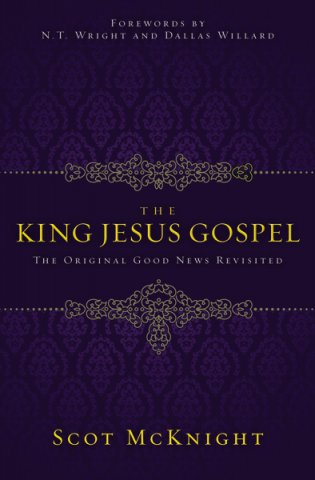
kjgospelContemporary evangelicals have built a ‘salvation culture’ but not a ‘gospel culture.’ Evangelicals have reduced the gospel to the message of personal salvation. This book makes a plea for us to recover the old gospel as that which is still new and still fresh. The book stands on four arguments: that the gospel is defined by the apostles in 1 Corinthians 15 as the completion of the Story of Israel in the saving Story of Jesus; that the gospel is found in the Four Gospels; that the gospel was preached by Jesus; and that the sermons in the Book of Acts are the best example of gospeling in the New Testament. The King Jesus Gospel ends with practical suggestions about evangelism and about building a gospel culture.

from the description of Scot McKnight’s book
The King Jesus Gospel: The Original Good News Revisited
at Amazon.com

Several months ago, D. Thomas Lancaster suggested this book to me and I was able to insert it into my reading list. I can see why Lancaster made the recommendation and while I generally agree with the core message McKnight is presenting, it seems like he could have made a few improvements (in my humble opinion).

But first things first.

The part I liked about McKnight’s book is that he was recasting the gospel message from one that only contains the message of personal salvation to one that is expanded to include the story of Israel.

In his Foreward to the book, N.T. Wright says:

…according to Scot, and I am convinced he’s right: “the gospel” is the story of Jesus of Nazareth told as the climax of the long story of Israel, which in turn is the story of how the one true God is rescuing the world.

Well, that’s true as far as it goes, but this statement illustrates what I see as one of the unfortunate limits of McKnight’s book. While he is correct in stating that the actual gospel message includes the return of Jesus as King of Israel and redeemer of the world (rather than just saving individuals one person at a time), he seems to end the story of Israel after the resurrection of Christ. The end. Israel’s story shifts to the story of a homogenized Kingdom of God in the Messianic Age.

I hope I’m wrong. I hope that McKnight’s vision of a future Israel just got lost between the lines, so to speak. Part of his main point, which he emphasized over and over again (the book was kind of repetitive) was:

Most evangelism today is obsessed with getting someone to make a decision; the apostles, however, were obsessed with making disciples.

I couldn’t agree more. But again, the story of the good news of Messiah goes much further than making disciples. It’s the story of Jesus as the Messiah, the King, the one who will establish his rule of peace on the Earth. This is part of McKnight’s message as well and again, I totally agree.

McKnight also addressed the question of whether or not Jesus and Paul preached the same gospel and (to me), amazingly, whether or not Jesus preached the gospel at all. I was astonished (I don’t know a great deal about the specific theological mechanics of organized Christianity in its various denominations) to discover some Pastors think it was impossible for Jesus to have preached his own good news about himself.

I replied, “A book about the meaning of gospel.”

“That’s easy,” he said, “justification by faith.” After hearing that quick-and-easy answer, I decided to push further, so I asked him Piper’s question: “Did Jesus preach the gospel?”

His answer made me gulp. “Nope,” he said, “Jesus couldn’t have. No one understood the gospel until Paul. No one could understand the gospel until after the cross and resurrection and Pentecost.” “Not even Jesus?” I asked.

“Nope. Not possible,” he affirmed. I wanted to add an old cheeky line I’ve often used: “Poor Jesus, born on the wrong side of the cross, didn’t get to preach the gospel.”

The above transaction gave me a cold chill. It’s terrifying to imagine that hundreds of thousands (or more) of Christians are attending church services, attending Sunday school, attending mid-week Bible classes, and being taught that Jesus could not possibly have understood the good news about himself. Doesn’t anyone read the Bible anymore?

And He came to Nazareth, where He had been brought up; and as was His custom, He entered the synagogue on the Sabbath, and stood up to read. And the book of the prophet Isaiah was handed to Him. And He opened the book and found the place where it was written,

“The Spirit of the Lord is upon Me,
Because He anointed Me to preach the gospel to the poor.
He has sent Me to proclaim release to the captives,
And recovery of sight to the blind,
To set free those who are oppressed,
To proclaim the favorable year of the Lord.”

And He closed the book, gave it back to the attendant and sat down; and the eyes of all in the synagogue were fixed on Him. And He began to say to them, “Today this Scripture has been fulfilled in your hearing.”

Luke 4:16-21 (NASB)

scot-mcknight1That’s pretty much Jesus preaching the good news of the Messiah in a nutshell. It was apparently missed by the above-mentioned Pastor because the gospel message to him is only “justification by faith.” It has nothing to do with Israel, King Messiah, or the national redemption of Israel at all.

I want to make clear at this point that I do believe Jesus does provide the Gentile and the Jewish person salvation from sins on a personal level, but like McKnight, I believe it goes so much further. The gospel message isn’t just about the plan of salvation. It’s the good news that Israel is to be liberated, the exiled Jewish people will be restored to their Land, and national Israel will be elevated to the head of the nations in the physical Kingdom of God.

But you don’t get this in most churches.

…the gospel has lost its edge and its meaning. Nothing proves this more than the near total ignorance of many Christians today of the Old Testament Story.

This is true. It’s impossible to comprehend the full meaning of the Apostolic Writings without a very good grasp of the Torah, Prophets and Writings (Old Testament).

McKnight spends a lot of time saying that to understand the gospel message, you have to start in 1 Corinthians 15. Frankly, that would never have occurred to me as a natural starting point, but then again, I’m not a Bible scholar or a theologian. In fact, to get a good summary of the meaning of the gospel, all you have to do is watch television for about thirty minutes.

Oh not just any show.

I wrote a review of the First Fruits of Zion TV series episode The Good News not too long ago. Here’s a description of the episode from the FFOZ TV web site:

Most Christians believe that the gospel message of Jesus is that he died for our sins and if we have faith in him we will be given the gift of eternal life. While certainly this is a major component of the gospel, it is not the whole story. In episode one viewers will learn that the concept of the gospel wasn’t invented by Jesus or the disciples, but rather was prophesied in the Hebrew Scriptures. The “Good News” was the promise of the coming messiah and that he would bring redemption to the children of Israel.

This sounds very similar to some of McKnight’s writing and I suppose it’s possible this book could have been available (it was published in 2011) to the writers of this television episode, but the content between the two isn’t identical.

Two of the problems I had with McKnight’s definition of the gospel message was that the story of Israel seemed to end with the coming of Messiah (which is a common theme in Christianity) and that he seemed to miss the ascendancy of the Nation of Israel as the core of the Kingdom Messiah is to establish on Earth upon his return. He didn’t say why the Messiah’s gospel message was good news to Jewish people. I summarized this good news for Jewish people in my review:

Toby Janicki, Aaron Eby, and the rest of the FFOZ ministry have “solved” the mystery of the gospel and clued us in on the rest of the message: Jesus came to die for our sins and to deliver the promise of everlasting life for all who believe. But, and this is extremely important, as Messiah King, he came to deliver the promise of good news to all of Israel that when he returns, he will release the captives in exile, restore sight to the temporarily blinded, free the oppressed Jewish people, and proclaim freedom for Israel, the year of favor from the Lord.

This is why I think that Luke 4:16-21 is a better summary of the gospel message of Messiah and proof that Messiah knew what the gospel message was and indeed preached it to Israel. Because the good news of Messiah is first and foremost aimed at Israel nationally and at the Jewish people. After all, Jesus said he came for “the lost sheep of Israel” not the “lost sheep of planet Earth.” Also, Paul always went “first to the Jews and also to the Gentiles.” Why? Because the gospel message is most focused on the Jewish people and made the most sense to the Jewish people.

If McKnight had gone that far, I’d have enjoyed his book a lot better. As it was, I think he made a very important point, but he stopped too soon. He also spent too much time going over and over his central point. I get that he wanted to be thorough and I get that often, an important message needs to be repeated so the reader “gets it,” but I “get it.” I just wanted to get more.

But maybe this is why I didn’t get more.

It is sometimes forgotten that “Christ” is the Greek translation of the Hebrew word Messiah. The word Messiah means “anointed King…”

ffoz-teaching-teamI wasn’t surprised when I saw something so elemental in McKnight’s book. I’d gotten past my surprise after writing my review of the FFOZ TV episode Messiah. Exactly the same point was made during this 30-minute episode: the fact that “Christ” is a word that contains a lot more information and meaning than just the “last name” of Jesus.

Like the FFOZ TV show, McKnight is likely writing to the widest possible Christian audience, attempting to tell the largest number of believers that they have been taught a common misconception about the gospel message. After all, if at least some Pastors have adopted a limited vision of the gospel, how can the people who sit in the pews every Sunday be held accountable for not knowing the wider meaning?

Again, I disagree that Jesus has completed Israel’s story at this juncture. Israel still has a story and it will continue to be central to the good news throughout the Messianic Age and beyond. Israel will be the head of the nations and the people of many nations will stream to the Temple in Jerusalem (Isaiah 2:2, Micah 4:1) in the days of Messiah.

McKnight’s book is readable and educational as far as it goes and I’d recommend it if you want to get out of the traditional rut of gospel equals plan of salvation, period, end of story. But I still wish he’d have taken the story further into the future and presented the Messiah as Israel’s King and his rule on the Throne of David in Jerusalem, his gathering of the exiled Jewish people to himself, and the total redemption of national Israel as well as the people of the nations who are called by his name.

Oh, and this is my 900th blog post on “morning meditations.”
Beyond Tisha B’Av

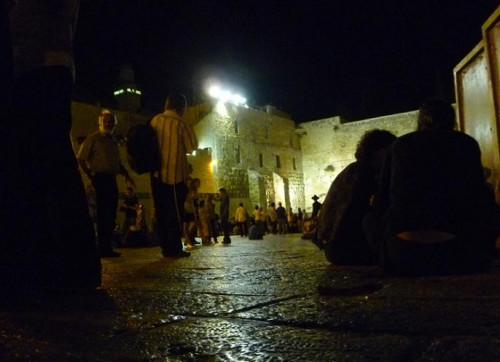
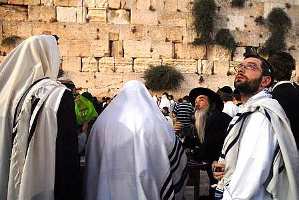
Tisha b'Av at the Kotel 2007In the fourth year of Jehoiakim the son of Josiah, king of Judah, this word came to Jeremiah from the Lord, saying, “Take a scroll and write on it all the words which I have spoken to you concerning Israel and concerning Judah, and concerning all the nations, from the day I first spoke to you, from the days of Josiah, even to this day. Perhaps the house of Judah will hear all the calamity which I plan to bring on them, in order that every man will turn from his evil way; then I will forgive their iniquity and their sin.”

Now in the fifth year of Jehoiakim the son of Josiah, king of Judah, in the ninth month, all the people in Jerusalem and all the people who came from the cities of Judah to Jerusalem proclaimed a fast before the Lord. Then Baruch read from the book the words of Jeremiah in the house of the Lord in the chamber of Gemariah the son of Shaphan the scribe, in the upper court, at the entry of the New Gate of the Lord’s house, to all the people.

Jeremiah 36:1-3, 9-10 (NASB)

For this our heart has become faint, for these things our eyes have grown dim. For Mount Zion, which has become desolate; foxes prowl over it. But You, O G‑d, remain forever; Your throne endures throughout the generations. Why do You forget us forever, forsake us so long? Restore us to You, O G‑d, that we may be restored! Renew our days as of old.

Lamentations 5:17-21 (Tanakh)

This year, the 9th of Av or Tisha B’Av begins at sundown on Monday, July 15th and ends on sundown on Tuesday the 16th. There is no more tragic day in the history of the Jewish people than Tisha B’Av. You can click the link I provided above to read the chronicles of this day of mourning for Israel, but I wanted to provide an additional perspective.

“But when you see Jerusalem surrounded by armies, then recognize that her desolation is near. Then those who are in Judea must flee to the mountains, and those who are in the midst of the city must leave, and those who are in the country must not enter the city; because these are days of vengeance, so that all things which are written will be fulfilled. Woe to those who are pregnant and to those who are nursing babies in those days; for there will be great distress upon the land and wrath to this people; and they will fall by the edge of the sword, and will be led captive into all the nations; and Jerusalem will be trampled under foot by the Gentiles until the times of the Gentiles are fulfilled.

Luke 21:20-24 (NASB)

When the Romans laid siege upon Jerusalem, when they breached her walls, when they utterly destroyed the Holy Temple, how many remembered these words Jesus spoke some forty years before? How many bewailed the tremendous loss, even as Jews all over the world have mourned for their losses since that time? What does the Kotel mean for millions of Jews today? And of the disciples of the Master who lived in the days of destruction, what happened next?

At its height, the Jerusalem community of disciples numbered around ten thousand. Several thousand of these spent the war years in Pella. Their migration back to Jerusalem probably did not happen all at once…

-D. Thomas Lancaster
from Torah Club Volume 6, Chronicles of the Apostles, pg 1135
read with Torah Portion Devarim
published by First Fruits of Zion

There is a three-week period of preparation for commemorating Tisha B’Av but what happens after the fast is over? Go on with regular life? Prepare for the coming week’s Torah reading? Anticipate the Days of Awe and the return of autumn?

After each tragedy, there is a long period of mourning and slow recovery. In the case of the vast majority of Jews after the destruction of Herod’s Temple, they must have struggled to understand how life could go on? How could they make the sacrifices commanded according to Torah? How could they worship God?

As Jewish history continued to unravel forward in time, almost all of the Jewish people were exiled from their land. Holy Jerusalem was renamed by the Romans “Aeilia Capitolina” as yet another insult to the Jews. Only a tiny remnant of Jewish people clung to life within the borders of Israel. According to Lancaster’s commentary, this included Jewish disciples of the Master.

Jewish disciples of our Master continued to live in Pella and the surrounding area at least into the fourth century. In his fourth-century treatise against heresies, Epiphanius complains about the Nazarene “heresy” which he describes as Jewish believers in Yeshua “who remain wholly Jewish and nothing else.”

-ibid

Tisha b'Av at the Kotel 2011Tragedy. Loss. Mourning. Adjustment. Hope.

But much past the fourth century, we must concede that the number of Jewish disciples of Jesus dwindled to few and then none. Like the Temple, Jerusalem, Israel and the Jewish people, Jewish faith in Yeshua of Nazareth as the Messiah went into a long exile and seemed completely lost forever.

But God is gracious. Nearly two years ago, on his blog, Rabbi Joshua Brumbach published a history of Jewish Rabbis who lived during the past several centuries who were also believers, and “who remained wholly Jewish and nothing else.” Both the first and second parts of Rabbis Who Thought For Themselves provide the beginning flickers of illumination after great darkness. Gentile Christianity has flourished in the centuries between the Temple’s destruction and the modern era and Judaism, though suffering greatly, continues to survive and even to thrive in various areas of our world.

But there has always been an enormous disconnect between the two.

That wound is very slowly healing.

In a very real way, Christians and devout Jews are all waiting for the same thing: the coming (or return) of the Jewish Messiah King. Our “visions” of just who is coming (or coming back) and what he will do are quite different, but the Messiah exists as an objective fact, regardless of our beliefs and dreams.

The world herself has been grieving for nearly two-thousand years awaiting the return of the Prince of Peace and the King of Righteousness to stop the bleeding, cease the wars, feed the hungry, and to bring repair and shalom to this broken planet…

…and to her broken people.

Thus said Cyrus king of Persia: Hashem, God of Heaven, has given to me all the kingdoms of the earth, and He has commanded me to build Him a Temple in Jerusalem, which is in Judah. Whoever there is among you of His entire people — may Hashem his God be with him, and let him go up!

2 Chronicles 36:23 (Stone Edition Tanakh)

He who testifies to these things says, “Yes, I am coming quickly.” Amen. Come, Lord Jesus. The grace of the Lord Jesus be with all.

Revelation 22:20-21 (NASB)

May Messiah come soon and in our day, and may he heal the broken and the broken-hearted.

Amen.

For God Rolled the Dice and the Universe Came to Be

roll-the-dicePhysics cannot describe what happens inside a black hole. There, current theories break down, and general relativity collides with quantum mechanics, creating what’s called a singularity, or a point at which the equations spit out infinities.

But some advanced physics theories are trying to bridge the gap between general relativity and quantum mechanics, to understand what’s truly going on inside the densest objects in the universe. Recently, scientists applied a theory called loop quantum gravity to the case of black holes, and found that inside these objects, space and time may be extremely curved, but that gravity there is not infinite, as general relativity predicts.

-by Clara Moskowitz
Space.com Assistant Managing Editor
“Space-Time Loops May Explain Black Holes”
Space.com

Clara had me at “space and time may be extremely curved, but that gravity there is not infinite.” About forty years or so ago, I took my first Astronomy class at UNLV. Yes, I know. That was back at the dawn of time when dinosaurs ruled the Earth, or at least it may seem that way to some of you. It certainly makes my knowledge of Astronomy rather antique compared to the advances science has made since that time. But I still enjoy reading a few popular (that is, easy to digest for the average person) articles on such topics.

In those undergrad days (the first time I was an undergrad), I wrote a couple of papers about areas of Astronomy that particularly interested me. One was the end products of stars. What happens to a star when it runs out of fuel to burn? If the star has a mass of three times or more of our own sun, it collapses into a black hole. When I was going to school, general relativity said that a black hole was a singularity and that its mass was infinite. Today, the latest theories suggest otherwise.

Exciting stuff.

My other favorite topic was Cosmology or the theory of the origin of the universe. I found a small book written by a Swedish scientist that involved Matter and Anti-Matter as active components in the origin of the universe, but it was a minority theory then. Today, it’s non-existent.

But Space.com has a really cool and readable article on what we know to date about the “Big Bang” and what followed afterward.

Probably a lot of Christians coming across this blog post are going to raise an eyebrow or two. At the little church were I worship, both the Head Pastor and one of the Associate Pastors have both told me they don’t believe in an “old universe.” They seem to believe, like many conservative Christians and not a few religious Jewish people, that the Earth is anywhere between about ten to fifteen thousand years old.

All of this millions and billions of years stuff as described in the Big Bang article doesn’t work for them. Why? Because of how they read the beginning chapter of Genesis which is literal. God created the Earth and everything else in six (they believe) literal days. The Hebrew word used for “day” in chapter one of Genesis is almost universally translated “day” as in a twenty-four hour period.

Given an inconsistency between human scientific observation and theory and the record of the Bible, they choose the Bible every single time. Biblical sufficiency pretty much demands it.

Or does it?

The heavens are telling the glory of God;
and the firmament proclaims his handiwork.
Day to day pours forth speech,
and night to night declares knowledge.
There is no speech, nor are there words;
their voice is not heard;
yet their voice goes out through all the earth,
and their words to the end of the world.
In the heavens he has set a tent for the sun,
which comes out like a bridegroom from his wedding canopy,
and like a strong man runs its course with joy.
Its rising is from the end of the heavens,
and its circuit to the end of them;
and nothing is hid from its heat.

Psalm 19:1-7 (NRSV)

sky-above-you-god1Especially the first verse of the above-quoted Psalm tells us that God is revealed by the universe itself. We should be able to look at the stars, examine the heavens, and understand that there is a God. This is known as general revelation or the environment and everything we observe in it reveals the existence of God. The more specific revelation, which gives us lots of other details, declares God as well. It’s the Bible.

But should the two revelations conflict? I would think not. We should see them both fitting together like interlacing fingers of the left and right hand of man. Even if a person has never seen a Bible or heard of Christianity and Judaism, simply observing the universe, all of creation in all of its details, is intended to illustrate that there is a God. The Bible reveals many of the specific details of how God interacts with human beings, using principally the Jewish people and the nation of Israel as a model.

So what do we do when the Genesis story and our astronomical observations and theories conflict? What do we do when the Bible says that the Earth (and presumably all of the universe) was created in six literal twenty-four hour periods, and astronomical observations and theories conclude that our solar system wasn’t formed until the universe was already nine billion years old?

A Bible literalist will say that the Bible is always correct and human scientific observation and theory is wrong. A scientist (one who is not religious) will conclude that the Bible is full of hogwash and our best scientific observations and theories present the facts accurately to the best of our ability to interpret them.

But what if they’re both right?

If we believe God and David as he wrote the nineteenth psalm, then the universe is supposed to be a revelation of God even as the Bible is, so they must agree.

But how can they both be right when on the one hand, we have a matter of six days and on the other we have billions and billions of years?

I don’t know.

Ultimately, I don’t have to know, but like Albert Einstein famously said, “God doesn’t play dice with the universe.” Actually, all that means was Einstein believed the universe should be founded upon solid, deterministic laws. He was probably thumbing his nose at Quantum Mechanics (QM) which is much more dependent on probably and uncertainty in the universe. But he sells the point that the universe should make some sort of sense, at least as far as communicating to human beings that only God could have brought the universe into being. The “Big Bang” was a “spoken Word” (If you’ll read the Big Bang article, you’ll see that the initial tiny, tiny fraction of a second of the start of the universe wasn’t an explosion as we think of such a thing).

Actually, it’s not the awesome vastness of the universe that communicates God to me but the incredible weirdness that QM describes. The idea that “atoms exist in quantized, discrete states, loop quantum gravity posits that space-time itself is made of quantized, discrete bits, in the form of tiny, one-dimensional loops” inside a black hole is beyond bizarre and this, more than anything, tells me there is a God, one whose mind is incredibly and infinitely creative. His universe is shouting at us to pay attention. None of this happens by accident and no human being could have cooked this up.

The more we look, the more incredible and the more surprising the universe gets. We used to think that the universe was composed pretty much of ordinary atoms, the stuff we can see all around us every day. Now, we think that only about 4.3 percent of the universe is made up of atoms (75% hydrogen and 25% helium, with just an itsy, bitsy fraction of the rest being heavier elements, including the stuff that makes you and me), while the rest if full of much more exotic energy and matter.

According to an article by Stephen Hawking, God may well “play dice” with (or introduce uncertainty and some randomness into) the universe (there’s a notice at the beginning of the article that says I can’t reproduce any portion of the content, so I can’t include a quote…maybe Hawking’s cranky over his rather sad boycott of Israel…but I digress). It’s this uncertainly that, rather than suggest the universe came about through a random or unguided (uncreative, unintelligent) process, was built into the universe, and was the product of an infinitely creative mind and force…God.

I have no problem believing that the universe is more or less as we experience it; extremely old from the point of view of a human time scale. Why should God care? He exists outside of His creation, He’s timeless. Theories vary widely about how old modern human beings are, but I think the story of those early humans, our Adam and Eve, are the record of God’s creation of us and the creation of His relationship with us.

black-holeMaybe the only meaningful or reasonable historical record of God’s interaction with people is what we’ve experienced over the past ten or fifteen thousand years.

Everything I’m saying along these lines is highly speculative and I’m most certainly attempting to reconcile what human beings know about our environment and ourselves with my faith and trust in the God of Israel. If that’s being more than a little self-serving, so be it. It helps me sleep at night, and God knows I can use the rest.

I once heard an attorney use the phrase “hide the ball.” At the time, I thought she was referring to a children’s game, but I recently found out it’s a legal term. It means to withhold legal evidence. Legal teams sometimes “hide the ball” or withhold evidence from the court (a big “no-no” which could get an attorney disbarred) if that evidence could result in them losing their case.

Rather than refer to dice, I prefer to say that God doesn’t play hide the ball with the universe. That is, God doesn’t withhold evidence. What we see in our environment, from the tiniest particle to the largest galaxy (to the best that we can understand what we see), is what we get. Otherwise, God created the appearance of the universe to tell us a tremendous lie, and why would He do that?

He wouldn’t. But if God didn’t lie about the universe and He didn’t lie about the Bible, and if six literal days is different from 13.7 billion years or so (the estimated age of the universe), then God didn’t screw up, we did somewhere along the line. Biblical literalists assume scientists have screwed up, but I have to say, that’s pretty unlikely unless the entire scientific community devoted to cosmology for the last century or so are idiots or liars. I don’t think Biblical literalists are idiots or liars either, but I do believe that the beginning passages in our Bible cannot be interpreted with absolute literalism. Genesis One isn’t God’s “cookbook” containing the recipe for Creation.

Like Stephen Hawking suggests at the end of his article (although there’s no indication that Professor Hawking believes in a God of any sort), God may have a few tricks of His sleeve. Bible sufficiently just means that it contains enough information for us, not that it contains everything. The Bible fills in blanks in our knowledge of God that the universe doesn’t supply. I think the process works both ways.

For he spoke, and it came to be; he commanded, and it stood firm.

Psalm 33:9 (NRSV)

One more thing. Please don’t imagine that I literally believe God rolled dice in order to create the universe. I just “warped” the above-quoted scripture to make the title. It sounded “creative.”

The Bible Between God and Man

Moses at NeboThis week’s Torah reading begins: (Deuteronomy 1:1.) “These are the words that Moshe spoke to the entire Jewish people.”

Noting the distinction between this book and the previous four, which are all “the word of G-d,” our Sages explain (Megillah 31b.) that Moshe recited the Book of Deuteronomy “on his own initiative.”

This does not, ח׳׳ו , mean that the Book of Deuteronomy is merely a mortal invention. Our Rabbis (Tosafos, op. cit.) immediately clarify that Moshe delivered his words “inspired by the Holy Spirit.” Similarly, when the Rambam defines the category of “those who deny the Torah,” (Mishneh Torah, Hilchos Teshuvah 3:8.) he includes: “a person who says that the Torah even one verse or one word does not emanate from G-d. If one would say, ‘Moshe made these statements independently,’ he is denying the Torah.”

Not a single commentator maintains that there is a difference in this regard between the Book of Deuteronomy and the four preceding books.

-Rabbi Eli Touger
“A Mortal Mouth Speaking G-d’s Word”
Adapted from Likkutei Sichos, Vol. IV, p. 1087ff; Vol. XIX, p. 9ff
Chabad.org

Reading this commentary on last week’s Torah portion reminded me of my ongoing discussion with my Pastor about the purpose of Torah. Pastor Randy has told me his particular understanding of the function of Deuteronomy, one I’ve never heard before (and I’ll refrain from sharing that with you at this time), but it also made me think of our discussions about the “inspired” nature of the Bible.

Rabbi Touger separates Deuteronomy from the rest of the Torah by saying the first four books were recorded by Moses just as they were given to him by God, but Deuteronomy involves a “relationship” between God’s inspiration and Moshe’s personality.

For the Book of Deuteronomy are merely Moshe’s words. Moshe’s identification with G-dliness was so great that when he states: (Deuteronomy 11:13.) “I will grant the rain of your land in its season,” he speaks in the first person although the pronoun “I” clearly refers to G-d. “The Divine Presence spoke from his mouth.” (See Zohar III, p. 232a; Shmos Rabbah 3:15.)

On the other hand, it is also clear that the book involves Moshe’s own thinking process. To give an example: there is a difference of opinion among our Sages as to whether the proximity (semichus) of two subjects in the Written Torah is significant or not. (Berachos 21b; Yevamos 4a.) One opinion maintains that it is, while the other explains that although when mortals structure their thoughts, order is important, but “Since the Torah was granted by the Almighty, the order of precedence is not significant.” (Raaban [Rabbi Eleazar ben Nasan], sec. 34.)

I’m reading this as saying Deuteronomy is inspired by God so much so that sometimes Moses speaks almost with God’s voice. On the other hand, Deuteronomy involves the words and thoughts of Moses and information provided by God is organized in Moses’s mind and presented in his oratory.

We have to believe that anything coming directly from God is perfect, at least at the moment of its delivery to mankind. What we do with it on the other hand, is another story. So how does that affect the Bible? When God inspired Moses (or any of the other human Bible writers), at that instant in time, perfect information flowed from the Divine to the mundane; from God to man. Through some process we don’t understand, the relationship was developed between that information and how it was interpreted and delivered by the human beings involved.

In Deuteronomy, Moses was speaking to the entire assembly of Israel and, I suppose, either he later wrote down everything he said, or someone was taking notes while he spoke. Tradition says that Moses wrote the entire Torah by his own hand including Deuteronomy. Scholars differ in their opinions, but I’m not going to get into that right now.

Is the Bible perfect?

Well, yes and no.

The Death of the MasterWe have to believe it contains the entire inspired Word of God, otherwise, the Bible is just another book, no different from any of the other supposedly holy books in other religious or philosophical traditions. On the other hand, the Bible does contain internal inconsistencies that we can’t resolve or “smooth out,” although both Jewish and Christian translators and theologians have tried over the long centuries.

I didn’t used to believe this until I was challenged to make the different gospel versions of the crucifixion map to each other. What day of the week exactly was Jesus executed? Don’t automatically say it was Friday, because that’s not a for sure thing. You have to understand that Passover was a special shabbat and that the Saturday shabbat was also observed. I won’t go into a lengthy explanation, but if you put the different gospel versions side by side, they do not match up. You can’t tell which day it was when Jesus died. It’s not the same day in all gospel versions.

Did God goof? God can’t goof. So did the various gospel writers goof?

Well, yes and no.

Yes, if you want to read the Bible like a newspaper or a legal document (though some portions are a legal document). No, if you realize that certain portions of the Bible are written like Chasidic tales, stories based on fact, but crafted for a specific audience, drawing from other, older Biblical and extra-Biblical texts, in order to communicate a particular message to the target audience.

If you read the Bible like Joe Friday would have wanted it (“The facts ma’am, just the facts”), it doesn’t work.

The explanation of the above concepts depends on the appreciation of the relationship between the Torah and our world. Our Sages state: “The Torah preceded the world.” Here, the concept of precedence is not chronological, for time like space is a creation, relevant only after G-d brought existence into being. Rather the intent is that the Torah is on a level of spiritual truth which transcends our material frame of reference. Although the Torah “descends” and “enclothes itself” in our world, speaking of seemingly ordinary matters such as agricultural laws, codes for fair business practice, and the proper structure for marriage and family relations, this is not its essence. The essence of the Torah is “G-d’s will and His wisdom,” united with Him in perfect unity. (See Tanya, ch. 4.)

This concept has always fascinated me. Even my Pastor believes that in God’s Heavenly Court, there exists a “perfect” Bible…God’s Word as it was given to humanity unaffected by the human mind, imagination, interpretation, or anything else. By inspiring people to write various portions of His Word, God, in effect, is “clothing” the Bible in humanity so that human beings can consume it.

Surely, this commandment that I am commanding you today is not too hard for you, nor is it too far away. It is not in heaven, that you should say, “Who will go up to heaven for us, and get it for us so that we may hear it and observe it?” Neither is it beyond the sea, that you should say, “Who will cross to the other side of the sea for us, and get it for us so that we may hear it and observe it?” No, the word is very near to you; it is in your mouth and in your heart for you to observe.

Deuteronomy 30:11-14 (NRSV)

This is the part of Torah I point to whenever Christians say that the Law was only given to Jews so that they’d realize the Law of God was too hard to keep and that they needed Jesus instead. It’s also a good scripture to bring out when I meet with Christians. The Torah, and in fact, the Bible as a whole, is a multi-dimensional, multi-layered, intertwining, interactive document that is more than a document, that was given to human beings to enact, ponder, study, discuss, argue over, and experience in awe.

The Bible was written by human beings in supernatural partnership with God and it digs as much into the living human psyche as it does into the Divine realm.

rabbi_child_and_sefer_torahI disagree (respectfully) with Rabbi Touger when he says that human beings as intermediaries and Bible writers are either derech ma’avir or “funnels” channeling God’s words and intent without altering them at all, or derech hislabshus in which the human intermediary puts what is given from God into his own words. I think that every word written by every Biblical writer was in some sense affected, transformed, or colored by the human writers, the derech hislabshus. Otherwise, God could have just written the whole thing with his “finger” as He did with the first tablets Moses took up to Sinai, the ones Moses smashed during the incident of the Golden Calf (and notice that God had Moses do the writing on the replacement tablets).

If there is a perfect Word of God, it resides with God. It is spiritual perfection, absolute wisdom, pure joy, intelligence, and love. But how could people understand any of it if it weren’t written in a human language and filtered through a human personality, vocabulary, cultural context, individual style, and so forth?

Enclothing the Torah in mortal intellect does not merely grant man the opportunity for advancement, it also introduces a higher quality to the Torah itself, as it were. For clothing limitless spirituality in the confines of mortal intellect represents a fusion of opposites that is possible only through the influence of G-d’s essence. Because His essence transcends both finiteness and infinity, it can weld the two together, bringing the spiritual truth of the Torah within the grasp of mortals.

My personal opinion is that the esteemed Rabbi Touger might be overstating his point just a bit. I’d prefer to say that the Bible acts as a sort of bridge between Heaven and Earth, between the existence of God and the existence of people. The split instant perfection entered our world, it became imperfect, hard to interpret, difficult to understand, internally inconsistent, all because human beings were allowed to affect what God provided. But this was allowed by design, otherwise man would have no part in God or His Word.

It is said that there are two revelations of God, the first being all of creation, hence no man has an excuse for not seeking God (Romans 1:20), and the Bible, God’s written revelation. Both are complementary. The universe and everything in it provides one set of information about God and the Bible a different but complementary data set.

But if our bridge is imperfect because we are imperfect, there is yet another revelation that has and will put everything in order.

And the Word became flesh and lived among us, and we have seen his glory, the glory as of a father’s only son, full of grace and truth.

John 1:14 (NRSV)

Jesus taught the Torah to his people Israel correctly and he interpreted many things, most of the time using parables. It is said in certain corners of Judaism that when Messiah comes (returns), he will teach Torah perfectly and we will all know. More than that, it will be written on our hearts so that we will all know.

No longer shall they teach one another, or say to each other, “Know the Lord,” for they shall all know me, from the least of them to the greatest, says the Lord; for I will forgive their iniquity, and remember their sin no more.

Jeremiah 31:34 (NRSV)

But that’s then, not now. Now we struggle, bicker, and argue about the purpose of Torah, the meaning of the Bible, how it should be interpreted, what we’re supposed to do with it, and how it’s supposed to guide our lives. As Paul said:

For now we see in a mirror, dimly, but then we will see face to face. Now I know only in part; then I will know fully, even as I have been fully known.

1 Corinthians 13:12 (NRSV)

Of course, it is both Christianity and Judaism that struggles to peer through Paul’s metaphorical “glass darkly” and to understand who we are and who God is:

Jews as a group rarely agree on matters of Jewish belief. How could we agree on the essence of another?

Rabbi Evan Moffic

aleph.jpgMoses spoke Deuteronomy to the entire assembly of Israel on the banks of the Jordan river as they were about to cross over and enter the Land. We too are on a similar journey, hearing the Word of God as filtered through human beings and waiting to “cross over,” so to speak, not with Joshua but with Messiah, into his Kingdom. This is the gospel message or the good news. Messiah will come as King and restore what was broken and lost, he will gather in his exiled children and restore Israel, Jerusalem, and the Temple. He will also gather in those among the nations who are called by his name.

But we must never forget today that God is not aloof and apart. The Word was given to man from Heaven and it is not far off. True, it’s not well comprehended, but it was meant to be understood, at least to the best of human ability, and to be lived out.

And though we only seem him dimly now, as through a darkened or dirty window, someday we’ll see him face to face.

And we will rejoice.

If Paul Had Circumcised Gentiles

under-law-torahWe are Torah Submissive, meaning that we try to obey to the divine instructions revealed in the Pentateuch. We recommend Torah observance for Christians (= believers in Messiah Yeshua) as the proper way of sanctification of their lifestyle. We do not believe however that eternal salvation is merited or gained by performing specific commandments. In other words, we are not legalists.

-from the Doctrinal Position page
at Messianic613’s Weblog

I once read a comment written by the author of the above-quoted statement on someone else’s blog saying that a “One Law” position seemed the most likely consequence of the requirement to integrate Gentiles into the first century Jewish movement called “the Way.” This was based on that author’s personal understanding of the New Testament record and the Bible as a whole.

I wish I could find the original comment but it’s lost in the vast wasteland of the blogosphere and I wouldn’t know how to retrieve it. Still, I hate not being able to adequately cite my source when crafting a response. (I also want to say at this point, that although I don’t agree with all of said-author’s opinions, I find this person to be intelligent and reasonable in all comments and rebuttals.)

Given all that, I found myself wondering this morning what was the easiest thing for Paul to do as Christ’s (Messiah’s) chosen emissary to the Gentiles. In the Book of Acts, Luke records in the first six or seven chapters how “the Way” was being established in Jerusalem and Judea. The Spirit was given to the Apostles in Acts 2:1-4 and afterward, Peter spoke boldly for the Messiah. Many Jews in Jerusalem, both native and visiting from the diaspora for Shavuot, became disciples (Acts 2:37-42). Peter began teaching at Solomon’s Portico (starting at Acts 3:11), the early Messianic community among the Jews was formed (starting at Acts 4:32), and in spite of persecution from the ruling Jewish authorities, the Messianic disciples did not cease in their work (Acts 5:41-42).

Acts 8 shows us how the gospel message of the Messiah began to spread out from Jerusalem and Judea, extending into other parts of Israel and into Samaria. Philip encounters the Ethiopian Eunuch (a study unto itself) which results in that message being taken south, at least to the descendants of those Jews who journeyed to that land in the time of Solomon. But God had further plans for the good news of Messiah than to have it shared only with Jews and Samaritans.

The Lord said to him, “Get up and go to the street called Straight, and at the house of Judas look for a man of Tarsus named Saul. At this moment he is praying, and he has seen in a vision a man named Ananias come in and lay his hands on him so that he might regain his sight.” But Ananias answered, “Lord, I have heard from many about this man, how much evil he has done to your saints in Jerusalem; and here he has authority from the chief priests to bind all who invoke your name.” But the Lord said to him, “Go, for he is an instrument whom I have chosen to bring my name before Gentiles and kings and before the people of Israel; I myself will show him how much he must suffer for the sake of my name.”

Acts 9:11-16 (NRSV)

Saul (Paul), the persecutor of Jewish disciples of “the Way” was chosen specifically by Messiah as his instrument to take the name of Messiah before the Gentiles as well as before kings and the people of Israel.

But what did it mean to take the name of Messiah before the Gentiles?

Woe to you, scribes and Pharisees, hypocrites! For you cross sea and land to make a single convert, and you make the new convert twice as much a child of hell as yourselves (emph. mine).

Matthew 23:15 (NRSV)

When the meeting of the synagogue broke up, many Jews and devout converts to Judaism followed Paul and Barnabas, who spoke to them and urged them to continue in the grace of God (emph. mine).

Acts 13:43 (NRSV)

These two, quick quotes tell us that it wasn’t particularly unusual for non-Jews to convert to sects of Judaism. We also know from Acts 10:1-2 and Acts 13:16 that Gentiles who were called “God-fearers” also attended synagogue and were devout but not necessarily on a “track” to convert, and God-fearing Gentiles, although they likely shared some religious and lifestyle practices with the Jewish people, were not considered Jewish or members of the covenants as were born Jews or the “devout converts to Judaism.”

Paul was specifically selected to fulfill the following mandate:

Go therefore and make disciples of all nations, baptizing them in the name of the Father and of the Son and of the Holy Spirit, and teaching them to obey everything that I have commanded you.

Matthew 28:19-20 (NRSV)

Apostle-Paul-PreachesBut how was he supposed to do that, exactly? I know, based on your understanding of the Bible and the last two-thousand years of Christian and Jewish history, you think the answer is obvious (although that answer isn’t the same for everyone), but it wasn’t actually that clear-cut back in the day.

Then certain individuals came down from Judea and were teaching the brothers, “Unless you are circumcised according to the custom of Moses, you cannot be saved.” And after Paul and Barnabas had no small dissension and debate with them, Paul and Barnabas and some of the others were appointed to go up to Jerusalem to discuss this question with the apostles and the elders.

Acts 15:1-2 (NRSV)

There seemed to be a disagreement, even among the Jewish disciples within the Way, as to just how to integrate the Gentiles. As we can see here, there were some Jewish people who advocated for the Gentiles to become devout converts to Judaism. Paul and Barnabas disagreed with that opinion. It took a decision by James and the Council of Apostles in Jerusalem to settle the matter, but even then, it wasn’t really settled (It was before God but not, apparently, before men).

When they heard it, they praised God. Then they said to him, “You see, brother, how many thousands of believers there are among the Jews, and they are all zealous for the law. They have been told about you that you teach all the Jews living among the Gentiles to forsake Moses, and that you tell them not to circumcise their children or observe the customs. What then is to be done? They will certainly hear that you have come. So do what we tell you. We have four men who are under a vow. Join these men, go through the rite of purification with them, and pay for the shaving of their heads. Thus all will know that there is nothing in what they have been told about you, but that you yourself observe and guard the law. But as for the Gentiles who have become believers, we have sent a letter with our judgment that they should abstain from what has been sacrificed to idols and from blood and from what is strangled and from fornication.”

Acts 21:20-25 (NRSV)

“After I had returned to Jerusalem and while I was praying in the temple, I fell into a trance and saw Jesus saying to me, ‘Hurry and get out of Jerusalem quickly, because they will not accept your testimony about me.’ And I said, ‘Lord, they themselves know that in every synagogue I imprisoned and beat those who believed in you. And while the blood of your witness Stephen was shed, I myself was standing by, approving and keeping the coats of those who killed him.’ Then he said to me, ‘Go, for I will send you far away to the Gentiles.’”

Up to this point they listened to him, but then they shouted, “Away with such a fellow from the earth! For he should not be allowed to live.”

Acts 22:17-22 (NRSV)

up_to_jerusalemAs we can see, even after the declaration by the Council about the status of Gentiles in the Jewish Yeshua (Jesus) movement, it appeared to be very confusing to even thousands of Jewish believers, all zealous for the Torah, just exactly what Paul was teaching to the Jewish and Gentile disciples in the diaspora. Was he teaching Jews to abandon Torah? Was he teaching uncircumcised Gentiles to observe Torah like the Jews? Paul appears to deny both allegations. Jews didn’t have a problem with what Paul taught about the Torah and Messiah. They only had a problem with the Gentiles being included without being circumcised and made to convert to Judaism!

It seems that the easiest thing for Paul to have done and the least dangerous way for him to fulfill his mission, was to enact the Matthew 28:19-20 mandate by converting Gentile disciples to Judaism! It would have solved all or at least most of his problems among the Jewish people. It would have been completely consistent with the practices of other branches of Judaism in his day. No one would have batted an eye.

So why didn’t he do that?

While Peter was still speaking, the Holy Spirit fell upon all who heard the word. The circumcised believers who had come with Peter were astounded that the gift of the Holy Spirit had been poured out even on the Gentiles, for they heard them speaking in tongues and extolling God. Then Peter said, “Can anyone withhold the water for baptizing these people who have received the Holy Spirit just as we have?” So he ordered them to be baptized in the name of Jesus Christ. Then they invited him to stay for several days.

Acts 10:44-48 (NRSV)

If Peter thought that Cornelius and his Gentile household should be made to convert in order to enter into the Messianic movement, between the Gentiles receiving the Spirit and baptism by water, the males should have been circumcised. But he didn’t order this to be done. We have no record in the Bible that this was ever done to Cornelius, the males in his household, or any of the male Gentile disciples of the Messiah (you may disagree based on Timothy, but remember that Titus was a specific example of a Gentile not being circumcised, see Galatians 2:3).

Peter presented his experiences with Cornelius as legal testimony in the Acts 15 proceedings.

The apostles and the elders met together to consider this matter. After there had been much debate, Peter stood up and said to them, “My brothers, you know that in the early days God made a choice among you, that I should be the one through whom the Gentiles would hear the message of the good news and become believers. And God, who knows the human heart, testified to them by giving them the Holy Spirit, just as he did to us; and in cleansing their hearts by faith he has made no distinction between them and us. Now therefore why are you putting God to the test by placing on the neck of the disciples a yoke that neither our ancestors nor we have been able to bear? On the contrary, we believe that we will be saved through the grace of the Lord Jesus, just as they will.”

Acts 15:6-11 (NRSV)

Peter saw first hand how Gentiles had their hearts cleansed by faith and received the Holy Spirit, even as the Jews did, but were not required to be circumcised and take on the full weight of the Torah in the manner of the Jews (for my opinion on the full implications of the Acts 15 decision on the Gentile disciples, see my multi-part Return to Jerusalem series).

john-the-naziriteMost Christians believe that what Paul did was to abandon the Torah and teach other Jews to do so, as well as teaching the Gentiles that grace replaced the Law. Paul denied this during multiple legal hearings and I don’t believe he was lying. Some people believe that Paul obligated the Gentile disciples to the full weight of the Torah mitzvot in the manner of the Jews without requiring them to convert, but my understanding of the NT record makes this unlikely as well (For more on this, see The Evidence of Luke and The Evidence of Acts 15).

It is also apparent, although it would have been the easiest option for Paul to use, that he did not require the Gentiles to convert to Judaism in order to become members of “the Way.” If that were his tactic, then I seriously believe very few Gentiles would have gone that route, which would have severely inhibited if not stopped cold dead the spread of the good news of the Jewish Messiah among the Gentiles.

Go to Acts 15:30-31 to find the statement supporting how the Gentiles felt about not having to be circumcised and not being obligated to take on the full weight of the Law which, as Peter said, was “a yoke that neither our ancestors nor we have been able to bear.” To force the full yoke of Torah upon the Gentile disciples, Peter said, would be “putting God to the test.” which, as we’ve already learned, is a “no-no.”

Jesus answered him, “It is said, ‘Do not put the Lord your God to the test.’”

Luke 4:12 (Deut. 6:16)

It might have been easier on Paul and easier on the Jewish people involved in “the Way” to have accepted a message of the good news that included Gentiles actually converting to Judaism, but I don’t think that’s what God wanted. From what I can tell, it would have severely inhibited mass Gentile adoption of faith in Messiah, if circumcision of the males and full adherence to the Law were necessary. It’s interesting to note that if those were indeed requirements, we probably wouldn’t have anything called “Christianity” today and we might even have (although this is debatable) a branch of Judaism that continued to worship a first century Rabbi/Prophet as Moshiach. If that were the case, Gentiles would be welcome to join that faith only if they were willing to convert, but otherwise, they would not be considered full members.

Given how few Gentiles convert to Judaism in the world today, how would the whole world be taught the good news of Messiah, come to faith, and believe? How would the Matthew 28:19-20 mandate be fulfilled?

Getting Dressed One Mitzvah at a Time

helping-with-tefillinSo I walk into a random office and ask a guy to put on tefillin. Perhaps just to get rid of me, he agrees. I strap him up, help him read Shema, shake his hand and leave. In and out in 3 minutes.

I’m at a circumcision. During the inevitable ten-minute delay waiting for the baby to be sent down to the ceremony, I persuade the nervous father to put on tefillin. I explain to him the connection between circumcision and tefillin, which are both referred to in the Torah as a sign of our connection to G‑d, and he confides to me that this is the first time he’s worn tefillin since his bar mitzvah.

But what have we gained from guilt-tripping a guy into tefillin? It’s just a one off, with no guarantee of any followup. Is he any more religious, committed or switched on than before I started nudging him?

-Rabbi Elisha Greenbaum
“What’s the Point of a One-Time Mitzvah?”
Chabad.org

This sort of article makes a lot more sense to Jews than to Christians since we in the church focus more on faith than activity. This isn’t universally true, but it’s all too common.

I’ve been following the conversation over at Judah Himango’s blog and he has a point in echoing James the Just in saying “faith without works is dead.” (James 2:17)

But can you approach a “lukewarm” Christian and inspire him or her by “guilting” them into a single act of Christian compassion? Even Rabbi Greenbaum asks if “guilting” a Jewish person into a “one-off mitzvah” is worth it. Would it do any good to twist a believer’s arm to donate a can of soup to the food bank or give ten dollars to help a kid go to summer camp? Once the “motivation” is gone, won’t any further “good deeds” go with it?

This question was once posed to the Lubavitcher Rebbe by a not-yet-religious individual. The Rebbe had compared adding extra mitzvahs into one’s daily routine to wearing a tie, which adds beauty and splendor to one’s whole ensemble. In response, the man asked what seems to be an ingenious question. He pointed out that the Rebbe’s analogy would hold true only for someone already wearing clothing; however, were a naked person to don a tie, rather than looking better, he’d look completely ridiculous.

The Rebbe agreed that a naked man wearing a tie might indeed look silly, but contended the very act of putting a tie would probably wake him up to the fact that he’s naked in the first place. Sometimes the incongruity of being simultaneously underdressed but over-accessorized can lead you to rush off to cover yourself up.

I can’t help but be reminded of this:

When the woman saw that the tree was good for food, and that it was a delight to the eyes, and that the tree was desirable to make one wise, she took from its fruit and ate; and she gave also to her husband with her, and he ate. Then the eyes of both of them were opened, and they knew that they were naked; and they sewed fig leaves together and made themselves loin coverings.

They heard the sound of the Lord God walking in the garden in the cool of the day, and the man and his wife hid themselves from the presence of the Lord God among the trees of the garden. Then the Lord God called to the man, and said to him, “Where are you?” He said, “I heard the sound of You in the garden, and I was afraid because I was naked; so I hid myself.” And He said, “Who told you that you were naked?

Genesis 3:6-11 (NASB)

tie-no-shirtWhat shows us that we are naked? We might never notice except when we put on an article of clothing, an accessory of some sort perhaps, and realize the rest of the outfit is missing. I think it’s that way for a lot of people who profess a sort of faith, both Christian and Jewish. We show up at our houses of worship, socialize, go to the obligatory classes, give charity, eat and drink together, but all that can be accomplished without the slightest awareness of God. Even if we are doing good deeds, are we performing such actions just because it’s expected in our social context? Are we doing so only because it makes us look like good people?

I agree that a life of faith as merely an internal state isn’t going to do much good to anyone, even ourselves. But faith and deeds must go together. Sometimes deeds happen without faith, even among religious people because we treat religion like a social club.

No, there’s nothing wrong with enjoying the company of others, but in the end, if that’s the only reason you go to church or synagogue, and if the only reason you give to charity is to impress your friends, then you’re doing everything in vain. The primary reason to congregate among our fellows is to experience an encounter with God. Then out of that encounter, everything else we do including charity and good deeds makes a great deal more sense.

If we’re religious for poor reasons, then being compelled into a “one-off mitzvah,” even as a Christian, can expose our nakedness. We’re forced to look in the mirror and realize that all we are wearing are the Emperor’s New Clothes, which is to say, nothing at all.

Making this illustration may be somewhat easier for a Jewish population than a Christian one since the mitzvot that define Jewish identity are more documented and apparent. Christianity does not have a “Law” as such, since most church-goers have been taught by tradition that grace has replaced behavioral expectations.

But it can still be done because most of Torah actually applies to the church, too. Christians are all too familiar with Torah, we just don’t call it that.

Here are some ideas:

  1. Carry ten dollars in ones in your wallet. Give one dollar each to the next ten homeless people you see on the street (I’ve actually seen this done). If you don’t encounter many homeless people throughout the course of your week, it’s OK. Just keep giving until the money’s gone. Then repeat periodically.
  2. Go to your local supermarket and buy some canned goods, then drive to your local foodbank or where food is being collected for the poor (your church may even have a donation site). Deposit canned goods in donation bin. Then repeat periodically.
  3. Carry jumper cables in your car and, when you encounter someone who has a dead car battery, volunteer to help out. (if you pay attention to your environment, this opportunity happens more often than you might imagine).
  4. Google a phrase such as “how to do good deeds.” Click on one of the links returned such as 21 ways to do a good deed. Read and follow the instructions.

helping-the-poorAre you feeling more dressed yet?

Of course, as I said, none of this is as effective as it could be if you’re doing it for the right reasons. I don’t recommend that you tell anyone about your project. That way, you can avoid the temptation to brag about yourself. I do recommend that you tell God about it (not that He doesn’t know) by praying for your heart to be softened by your performance of these mitzvot. Although doing good deeds helps those you are helping, the person who really benefits is you, the good deed doer. For in giving to others, you are not only learning how to love your fellow human beings, but God as well, which is another mitzvah.

Aside for the intrinsic standalone value that each mitzvah has, mitzvah observance can also be contagious. Agreeing to opt in, even just once, can have far-reaching effects. There have been untold thousands of Jews who have made permanent changes in their lives for the better, just because they agreed to try it once.

Now that you’ve put on the tie, you might want to follow up with a pair of pants and a shirt.

From my father’s sichot: When Mashiach will come (speedily in our time, amein), then we shall really long for the days of the exile. Then we will truly feel distress at our having neglected working at avoda; then will we indeed feel the deep pain caused by our lack of avoda. These days of exile are the days of avoda, to prepare ourselves for the coming of Mashiach, speedily in our time, amein.

“Today’s Day”
Wednesday, Menachem Av 3, 5703
Compiled by the Lubavitcher Rebbe; Translated by Yitschak Meir Kagan
Chabad.org