Category Archives: Uncategorized

God Within Us

pillaroffireThey shall make for Me a Sanctuary and I shall dwell among them.

Exodus 25:8

The Midrash notes that God did not say, “I shall dwell within it” (the Sanctuary), but “I shall dwell among them” (the Israelites), i.e. the Divine Presence will be within each person.

There are two types of possible relationships. A person may relate to an object, which is a one-way relationship, since the object cannot reciprocate, or a person may react to God and to people, which should be a two-way relationship. Another difference between relating to objects and to beings is that things should be used, whereas God and people should be loved. Unfortunately, the reverse may occur, wherein people fall in love with things but they use God and people. People who behave this way perceive God and people as if they were objects. Inasmuch as the love of oneself is an inevitable fact, love of God and people can occur only when they are permitted to become part of oneself, because then one loves them as one does one’s own eyes and ears.

If my relationship to God is limited to going to the Sanctuary and praying for my needs, then I am merely using Him, and God becomes an external object. But when I make His will mine, then His will resides within me and He becomes part of me. This is undoubtedly what the Zohar means by, “Israel, the Torah, and God are one unit,” because the Torah, which is the Divine will, is inseparable from God, and when one incorporates the Torah with one’s own code of conduct and values, one unites with God.

Today I shall…

…try to make my relationship with God more than an object relationship, by incorporating the Torah to be my will.

-Rabbi Abraham J. Twerski
“Growing Each Day, Tammuz 26”
Aish.com

The midrash suggests something about Judaism that most Christians don’t see…the idea that there is something of God’s essence or spirit inside each Jewish person and within Israel, the Jewish nation. We tend to think of the Holy Spirit as being given only at Acts 2 to the apostles and subsequently to each Jewish and non-Jewish person who comes to faith in Christ. In Jewish midrash, this event, or something like it, would have occurred at the end of the book of Exodus.

OK, midrash isn’t scripture, so I can’t say that indeed, a portion of the Divine Presence really did inhabit each and every Israelite who lived during the time of the Mishkan (Tabernacle) and beyond. But at least in post-Biblical times, if not before, Judaism had the concept of a personal “indwelling” of God as well as God’s general presence among corporate Israel.

No, I’m not forgetting this:

So Moses went out and told the people the words of the Lord. Also, he gathered seventy men of the elders of the people, and stationed them around the tent. Then the Lord came down in the cloud and spoke to him; and He took of the Spirit who was upon him and placed Him upon the seventy elders. And when the Spirit rested upon them, they prophesied.

Numbers 11:24-25 (NASB)

Not literally every Israelite had this Spirit, only Moses and the seventy elders. But this event is remarkably similar to the event of the giving of the Spirit in Acts 2 and the Spirit in both scriptures is given for the same reason: empowerment. The seventy elders required the Spirit of Hashem in order to judge with fairness and wisdom that matched God’s standards, and the apostles needed wisdom and empowerment to exceed their own human limits and to boldly go forth as emissaries of Moshiach to Jerusalem, Samaria, and beyond.

But Christianity tends to sell the average Israelite in the Tanakh (Old Testament) short. Some Christians hold themselves up as superior spiritually and personally to the Israelites because of the belief that the Holy Spirit automatically inhabited them when they confessed Christ during an altar call or other similar circumstance.
AbrahamI’m having a tough time believing that I have a closer relationship with God than men like Abraham (who we have no record of a Spirit coming upon) or Moses, both of whom spoke with God personally. What was the experience of an Israelite farmer or shepherd who brought a sacrifice to the Mishkah, who brought a Todah (thanksgiving) offering, who approached a God who actually, physically inhabited the Tabernacle as the Divine Presence? What was it like to actually see the pillar of cloud by day and the pillar of fire by night?

Can we say that the hearts and souls of the Children of Israel were empty of God as He dwelt among them in an incredibly tangible form?

In Torah-study the person is devoted to the subject that he wishes to understand and comes to understand. In davening the devotion is directed to what surpasses understanding.

In learning Torah the Jew feels like a pupil with his master; in davening – like a child with his father.

-“Today’s Day”
Thursday, Tammuz 26, 5703
Compiled by the Lubavitcher Rebbe; Translated by Yitschak Meir Kagan
Chabad.org

Sometimes Christians believe they are more “spiritual” than religious Jews, but one of the reasons I tend to read and quote from sources such as Chabad.org and Aish.com is that they show me a spirituality in Judaism that I don’t always find in Christianity. This isn’t to say that there isn’t great spirituality in the church, far from it. It’s just that I don’t believe we have to make an “either/or” selection. I think that God dwelt among and within His people Israel in the desert of Sinai. I think He did so in a very physical and human way during the days when Jesus walked the earth.

And I believe that God is among His people Israel, the Jewish people even today. This does not undo the fact that God is also among and within the Gentiles who are called by His Name in the church as well.

No man can claim to have reached the ultimate truth as long as there is another who has not.

No one is redeemed until we are all redeemed.

Ultimate truth is an unlimited light—and if it is unlimited, how could it shine in one person’s realm and not in another’s?

-Rabbi Tzvi Freeman
“All or No One”
Based on letters and talks of the Rebbe, Rabbi M. M. Schneerson
Chabad.org

messiah-prayerI’m not saying that coming to faith in the Messiah doesn’t mean anything, quite the opposite. I’m also not saying there are two paths to salvation, one for the Gentile and one for the Jew (although very soon, I plan on expanding the definition of the “good news” of Messiah considerably in one of my blog posts). I am saying that God didn’t leave His people Israel to save the Gentiles, since we Gentiles only have access to God through the Abrahamic covenant, which comes to us only through Israel; the Jewish people.

I’m also saying this:

The Lord is not slow about His promise, as some count slowness, but is patient toward you, not wishing for any to perish but for all to come to repentance.

2 Peter 3:9 (NASB)

This fits with what I just quoted from Rabbi Freeman (though I doubt the Rabbi would have applied it as such). In Christianity, we evangelize to take the good news of Messiah to all people. Judaism doesn’t evangelize but believes that all will be drawn to God through the Messiah, both Jews and Gentiles. From both points of view, God must be present and active in the lives of everybody everywhere, not just “special people.”

A friend of mine sent me a link to a commentary on last week’s Torah reading and pointed me to the last paragraph in the article:

The Midrash of Rav Yitzchak concludes that even today Elijah and Moshiach are still recording accounts of all our deeds to be included in future holy books. These works are sealed and affirmed by God Himself. From this we learn that our actions are not something between us and God alone, but must be done in such a way as to bring the respect and admiration of the surrounding society so as to promote the observance of Torah.

Again, this is midrash and not scripture, but it suggests something that “either/or” literalists may never consider. That the names of the “elect” in the book of the Lamb were written and sealed from before creation, and that names and acts are continually written inside the sealed book. If time were linear for God, words like “before,” “during,” and “after would mean something, but God exists quite outside of linear time. So when something was written before creation, since it is written outside of the linear stream of time and outside the bounds of a created universe, does our concept of “before” that exists within the universe even apply?

Who knows?

Inner lightI was talking earlier to some people at work about genius and “thinking outside the box.” Smart and clever people can be creative and even occasionally brilliant within their own “box” or how they conceptualize the world around them. Only a true genius or arguably a mystic can see themselves, how they think, and what they think about, from outside their own box, observing themselves, observing what they are considering, and realizing that there is an entirely different set of situations and circumstances outside of the box we continually are trying to put God in.

God’s Divine Presence was “contained” in the Tabernacle because God chose to allow it, but God also said that “Heaven is My throne, and the earth is My footstool” (Isaiah 66:1, Acts 7:49).

There are great mysteries about the nature of salvation, who is saved, and the role of Messiah in the salvation of Israel and the nations. While it is important for us to examine the meaning of all this, it is arrogant for us to assume that we can come to an understanding equal to God’s.

There are more things in heaven and earth, Horatio, than are dreamt of in your philosophy.

-Hamlet, Act 1, Scene 5

How is God with the Jewish people today? When God approaches us, are we able to respond to Him? Can we change our mind about God? How does God indwell human beings? I’m not convinced we should be absolutely sure how to answer any of those questions. All I know is that we should all sincerely seek God, and we should all sincerely seek peace, mercy, and justice by performing them day by day.

As it is said, when we study, we are a student and God is our Teacher. When we pray, we are a child and God is our Father. As it has also been said, “A disciple is not above his teacher, nor a slave above his master” (Matthew 10:24). Whether we see ourselves as students, as disciples, as children, or as slaves, we can only humbly turn to God, walk before Him, and wait His good pleasure to reveal what He will.

And only He will judge.

Addendum: See Rabbi Carl Kinbar’s comments below for some corrections to what I’ve written and quoted from in this blog post.

Schrödinger’s Free Will and God’s Sovereignty

quantum-mechanics-weirdAnyone who ventures more than ankle deep into the weirdness of quantum mechanics quickly realizes that reality is not what we once thought it was. From the time it was introduced, its most respected scientists have groped for new understandings of the nature of reality, often turning to mysticism and religion for answers.

Max Planck, who planted the first seed of the quantum model, was convinced by his studies that “There is no matter as such…the mind is the matrix of all matter.” Erwin Schrodinger, who established the basis of the wave mechanics behind QM, theorized that individual consciousness is only a manifestation of a unitary consciousness pervading the universe. Wolfang Pauli, another of QM’s most significant pioneers, turned to Carl Jung for clues of the mysteries with which he was dealing, writing essays about “the mystic experience of one-ness.”

In case you were hoping for a consensus, Nick Herbert (“Quantum Reality,” Random House, 1985, Chapter One) counts no less than eight diverse versions of reality generated by quantum physicists, several of them quite mystical, all of them—including the most pragmatic and most realist—exceptionally weird.

The real problem is that all of them seem to work.

-Rabbi Tzvi Freeman
“Quantum Reality and Ancient Wisdom”
Originally written for a symposium on the works of the Rebbe, Rabbi Menachem M. Schneerson, held at Brandeis University in the summer of 2000.
Chabad.org

I know that Quantum Mechanics (QM) and mysticism tend to turn people off, especially when you try to put them together, but for the way my mind works, this actually makes a lot of sense. I recently read John A. Sanford’s book Mystical Christianity: A Psychological Commentary on the Gospel of John, which applied Jungian psychology heavily to the symbolism in John’s gospel. While I thought Sanford’s attempt to do so was anachronistic, reading how QM pioneer Wolfang Pauli consulted Carl Jung in attempting to understand the “weirdness” of what Pauli was addressing makes me realize something else was going on.

I’m not going to attempt the creation of some grand literary treatment of mysticism and QM, but I do want to revisit an old mystery and attempt to use aspects of QM, not necessarily as a solution, but as a proposal.

I’ve written a number of blog posts on the Calvinism vs Arminianism debate, thanks to my discussions with my Pastor. This includes The Bible as a Quantum Cookbook, which tries to put QM, Calvin, Schrödinger’s cat, and Talmud in the same hypothetical room together.

But I’ve wanted to write this sequel for a few weeks now and the opportunity presented itself.

I’m not the first to have this idea, though. There’s even a comment on a blog post providing a parody on TULIP that is relevant:

In a quantum universe i don’t see why one can’t be 100% Calvinist and 100% Arminian. Even closer to home, I don’t see why one can’t be both a post- and a pre-millenarian. OK, I’ll confess I don’t know anything about physics or even whether Schrodinger’s cat is alive or dead. But I do know that human language is not adequate to frame propositional statements about eternal realities. This isn’t relativism…things which occured in time (and in the scripural account of time) like the resurection are subject to the law of non-contradition. It either happened or it didn’t. But we can’t be led into bad metaphysics by the soterological speculations of the 16th and 17th centuries…Calvin and Arminius respectively.

-Mark Sunwall

So what have I got?

Schrodingers_catProbably nothing new, except that I have the need to write this if, for no other reason, than to get a few things out of my head and into the blogosphere.

You can find out pretty much anything you want to know about Schrödinger’s cat at Wikipedia, but in short, Schrödinger’s cat is a thought experiment, sometimes described as a paradox, devised by Austrian physicist Erwin Schrödinger in 1935. That means no actual cat was killed or allowed to live simultaneously or in separate states as a result.

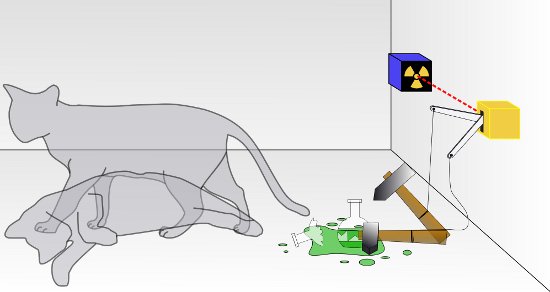
Schrödinger’s cat: a cat, a flask of poison, and a radioactive source are placed in a sealed box. If an internal monitor detects radioactivity (i.e. a single atom decaying), the flask is shattered, releasing the poison that kills the cat. The Copenhagen interpretation of quantum mechanics implies that after a while, the cat is simultaneously alive and dead. Yet, when one looks in the box, one sees the cat either alive or dead, not both alive and dead. This poses the question of when exactly quantum superposition ends and reality collapses into one possibility or the other.

What does that have to do with the Calvinism and Arminianism debate? As you probably already know, the debate centers around whether man has free will to choose salvation or if God’s sovereignty forces us to have no choice. Can man participate with God in his salvation or must God unilaterally choose for man?

When you come to a fork in the road, take it.

-Yogi Berra

If I apply Schrödinger’s thought experiment to the conflict, I come up with a resounding “I don’t know.” It’s the difference between Classical and Quantum physics.

For the Jew with traditional leanings, this could be welcome news. The old determinist view of reality accepted by Newtonian mechanics was certainly at odds with the classic Jewish worldview. Could QM allow once again for a world of divine providence, miracles and free choice, a world in which the creatures interact with their creator? Could it perhaps even provide us a better understanding of that legacy perspective?

-Rabbi Freeman

The heavens are telling of the glory of God; And their expanse is declaring the work of His hands. Day to day pours forth speech, And night to night reveals knowledge. There is no speech, nor are there words; Their voice is not heard. Their line has gone out through all the earth, And their utterances to the end of the world. In them He has placed a tent for the sun, Which is as a bridegroom coming out of his chamber; It rejoices as a strong man to run his course. Its rising is from one end of the heavens, And its circuit to the other end of them; And there is nothing hidden from its heat.

Psalm 19:1-6 (NASB)

Under heavenAccording to David, there is no inconsistency with our observation of the universe around us and our understanding of God. God made the universe and everything in it to point to the knowledge of Him. In other words, God doesn’t play “hide the ball” with the universe. What you see is what you get. Paul said the same thing in Romans 1:20, which is why no one has any excuse for a lack of knowledge of a Creative God.

But if Classical Mechanics doesn’t map to the Jewish view of the universe, is Judaism wrong or were the classical physicists? Again, that’s too big a question for me to answer, but I’m liking QM more and more all the time.

OK, no one really thinks that if you actually tried Schrödinger’s thought experiment with a real cat (which would be cruel) that you’d end up with a cat that is dead and alive at the same time. At the macro level, the cat would either be dead or alive. But Copenhagen interpretation of quantum mechanics works pretty well, at least in theory, at the subatomic level. What does it do when you enter into the realm of the supernatural and the mystical?

Chassidic thought doesn’t have a problem with incorporating mysticism into its internal map of how man journeys with God, but that’s not going to satisfy the either/or literalist. The problem is, the either/or literalist is probably going to have trouble with the uncertainty of existence proposed by QM and thus the latest models for how we think things work in the universe around us.

And if you think QM is strange and even bizarre, imagine how things would look to you if you could actually experience God the way Ezekiel did, the way Paul did, or the way John did in each of their mystic experiences as recorded in the Bible. Those events make the puzzle of Schrödinger’s cat seem as simple as riding a bicycle.

Need one remind our orthodox Jewish scientists, who still feel embarrassed about some old-fashioned Torah truths, in the face of scientific hypotheses, that Heisenberg’s principle of indeterminacy has finally done away with the traditional scientific notion that cause and effect are mechanically linked, so that it is quite unscientific to hold that one event is an inevitable consequence of another, but only most probable? Most scientists have accepted this principle of uncertainty (enunciated by Werner Heisenberg in 1927) as being intrinsic to the whole universe. The 19th century dogmatic, mechanistic, and deterministic attitude of science is gone. The modern scientist no longer expects to find Truth in science. The current and universally accepted view of science itself is that science must reconcile itself to the idea that whatever progress it makes, it will always deal with probabilities; not with certainties or absolutes.

-Rabbi Freeman quoting the Rebbe, Rabbi Menachem M. Schneerson

I’m sure this or any other part of Rabbi Freeman’s article won’t convince anyone who thinks in either/or terms to entertain the idea that, from a human being’s point of view, man has total free will and God is totally sovereign at the same time, and yet that’s the only reasonable answer that I can see. Until we actually look in the box, the cat is both dead and alive. Until we can acquire God’s point of view of the free will/sovereignty process, we have total free will and God is totally sovereign at the same time.

The thing is, Schrödinger can look inside the box anytime he likes and that sets the status of the cat on one side or the other: it’s either dead or alive once the box is opened. People can’t access God’s point of view directly. When we “lift the lid of the box,” we are opening the Bible. But the Bible is God’s viewpoint turned into human language. In the moment of “translation” from God’s thoughts to text on paper, we lose a great deal of meaning. We shift from perfection to sufficiency. We open the Bible and the cat is either dead or alive. But the state of the cat depends on which part of the Bible we’re reading.

Torah at SinaiHuman free will or a totally sovereign God? Somehow the answer is both. But if QM experts are weirded out by their own work, how much more should we be weirded out by the universe that God created us to live in?

If you absolutely have to come down on one side or the other of this debate, go right ahead. That means you are picking and choosing those parts of the Bible that either support man’s free will or that support God’s absolute sovereignty. That means you are dragging God and the Bible down into the mud with you. OK, Deuteronomy 30:11-14 says that the Torah is in the mud with us, so to speak, but I believe God, through Moses, was telling the Children of Israel that observing the mitzvot wasn’t an impossible task, not limiting the nature and character of the Word of God itself.

I think the Bible acts as sort of a “translation” of the Divine thought of God as filtered through the personalities and lives of the human writers. By definition, God and human beings had to enter into a partnership to create the Bible. Sure, God could have written it all by Himself without any human involvement, but he chose to let us participate. Does that make God any less sovereign and His Word any less perfect because people were also involved in the Bible’s creation?

The Copenhagen interpretation of quantum mechanics implies (if I may take some liberties) that Calvinism and Arminianism are simultaneously correct and incorrect. Yet, when one “looks in the box,” so to speak, it seems to be one or the other. Only God knows what’s going on in the box without lifting the lid.

The Christian faith is kaleidoscopic, and most of us are color-blind.

-N.T. Wright
from his Forward to the book
The King Jesus Gospel by Scot McKnight

Being Kept By Shabbos

hillel_shammaiYou shall honor it [Shabbos] by refraining from your usual weekday practices, nor pursuing your business, nor speaking thereof.

Isaiah 58:13

The observance of Shabbos and the festivals is characterized by not only abstinence from work, but also from all types of “weekday” activities, including even how one converses.

“Your conversation on Shabbos should not be similar to your weekday conversation”

-Shabbos 113b

A personal incident illustrates that by properly honoring the Shabbos and festivals, one achieves the respect of others.

As a resident in psychiatric training, I explained to the program director that I was unable to work on the festival days, and that these should be considered vacation days and deducted from my allotted vacation time.

The director shook his head. “No need for that,” he said. “Non-Jewish people can do anything they wish on their holidays. If they can wash the car, paint the garage, or go to the theater, then they can just as well come to work. In your case, you are not permitted to do anything, so obviously you cannot come to work, and this need not affect your vacation time.”

It has been said, “Even more than Israel has kept the Shabbos, the Shabbos has kept Israel.” If we honor the Shabbos properly, the Shabbos will honor us.

Today I shall…

…dedicate myself to a full observance of Shabbos and the festivals.

-Rabbi Abraham J. Twerski
“Growing Each Day – Tammuz 24”
Aish.com

This, as much as anything, illustrates the difference between the Jewish Shabbat and the Christian Sunday or “Lord’s Day.” I don’t doubt that the very first non-Jewish disciples of the Jewish Messiah observed a Shabbat in the same or similar manner as the Jewish disciples. Frankly, they wouldn’t have known any better, and a Sunday “Lord’s Day” probably wouldn’t even have occurred to them. Why would it?

Shifting the primary day to gather for worship from Saturday (Friday night to Saturday night, actually) to Sunday was most likely one of those acts designed to create a definition between Judaism and a Gentile Christianity. I can understand, to some degree, the desire to honor the day of Messiah’s rising from the tomb (although in Jewish reckoning, Jesus rising on the first day of the week could have happened anytime after sundown on Saturday), there’s nothing clear cut in the New Testament that says it was God’s intent.

However, there are just tons of references in the Tanakh (Old Testament) that speak of the Shabbat being observed on the seventh day, and as I said, the fact that Messiah came, taught, died, resurrected, and ascended never caused a ripple in Jewish Shabbat observance, just as it never caused a ripple in Jewish observance of any other part of the Torah or the normative halachah of the day.

But even if Gentile Christianity intended to lift Shabbat as a unit and move it over by about twenty-four hours, that wasn’t the end result. As Rabbi Twersky’s commentary tells us, an observant Jew’s response to Shabbat is quite a bit different than how a Christian spends his or her time on Sunday.

According to Chabad.org, there are thirty-nine melachot or forms of work that are prohibited to a Jewish person on Shabbos. Besides just the raw list presented at that site, how they are interpreted adds to the understanding of what must be avoided. From a Christian point of view, it all seems terribly restrictive and burdensome, and most Gentile believers having read such a list no doubt would rejoice in their “freedom in Christ.”

shabbat-candle-lightingBut our “holy day” isn’t all that holy if we don’t actually set it apart by behaving and even speaking differently.

I’ve discussed this with my Pastor and he believes the Ten Commandments, which includes the commandment to observe Shabbat, have universal applications. However, he does not believe that the day of the week is strictly fixed. I’m not sure what his rationale is for such a belief. He is usually very exact in his thinking and his attitude about Shabbat seems a little “fluid.”

I know that most Jewish people would deny that there is any direct command from God to the Gentile believers to observe Shabbos, especially in the manner of the Jewish people. There are some Gentiles who believe they are commanded and, in some manner or fashion, they do observe Shabbat. I don’t believe there are many who do so exactly like a modern, Orthodox Jew, and I’ve had a conversation with one Gentile believer who observes the Shabbat but who told me he retains the right to not make it burdensome (for instance, he feels free to turn light switches on and off, drive his car, use elevators, and so forth).

I used to keep a “sort of” Shabbat, but it was nowhere near the level of observance of most religious Jews. My wife is Jewish and, sad to say, not particularly observant (for the moment…I’m hoping that will change), and so in our household we don’t have much of a Shabbat. If I have the opportunity, I try to spend most of my day reading the Bible or related texts but if the situation calls for it (including the “honey-do list” situation), I can be found violating quite a few of the melachot.

But I think there is something special about setting aside one day of the week as Holy to God and dedicating ourselves to observing that day, to using the time to draw closer to God and to withdraw somewhat from the world around us.

I can’t imagine the Messianic age not including a Shabbat observance for all of the disciples of Messiah. It would seem strange at that point to segregate such observance by Jewish and Gentile populations and, after all, even the Gentile nations will be commanded to observe Sukkot and to send representatives to Jerusalem.

Then it will come about that any who are left of all the nations that went against Jerusalem will go up from year to year to worship the King, the Lord of hosts, and to celebrate Sukkot. And it will be that whichever of the families of the earth does not go up to Jerusalem to worship the King, the Lord of hosts, there will be no rain on them. If the family of Egypt does not go up or enter, then no rain will fall on them; it will be the plague with which the Lord smites the nations who do not go up to celebrate Sukkot. This will be the punishment of Egypt, and the punishment of all the nations who do not go up to celebrate Sukkot.

Zechariah 14:16-19 (NASB)

I replaced the phrase “the Festival of Booths” with “Sukkot” in the above-quoted passage to emphasize the nature of what is being commemorated. “Festival of Booths” somehow puts a “Christian spin” on what is quite obviously Jewish.

And yet, the nations are commanded to commemorate Sukkot in Messianic Days. So too the Shabbat?

“Also the foreigners who join themselves to the Lord,
To minister to Him, and to love the name of the Lord,
To be His servants, every one who keeps from profaning the sabbath
And holds fast My covenant;
Even those I will bring to My holy mountain
And make them joyful in My house of prayer.
Their burnt offerings and their sacrifices will be acceptable on My altar;
For My house will be called a house of prayer for all the peoples.”
The Lord God, who gathers the dispersed of Israel, declares,
“Yet others I will gather to them, to those already gathered.”

Isaiah 56:6-8 (NASB)

Shabbat candlesIt would certainly seem, based on this passage, that the nations (foreigners) who are joined to God not only will be required to observe Shabbat, but will also be allowed to pray in the Temple and to even bring sacrifices.

I’m certainly in no position to go around pointing fingers at Christians about what they do with their time on Saturday or Sunday, but I do want to suggest that some day, our rather casual attitude about Shabbat will have to change. There are many passages in the New Testament telling us that the Master will return “like a thief in the night” and that we will have no idea the day or hour of his coming back to us. We are told to be constantly be prepared and ready, day and night, for the bridegroom’s return.

“Even more than Israel has kept the Shabbos, the Shabbos has kept Israel.”

If the Master’s return comes that suddenly and unexpectedly, then our only hope of being ready is to always be ready. Maybe it wouldn’t hurt for us to practice a more focused Shabbat or two before he gets here.

Prophesies of the Master

jewish-revolt-against-romeDo the prophesies of Jesus Christ about the final tribulation really mean what we think they mean?

By the time the Jewish revolt against Rome began, only a few of the Master’s original twelve disciples remained alive. Most had already fallen asleep in various places throughout the world. Thomas continued his work in India; tradition says he died in 70 CE. Simon the Zealot followed up on the work of Thaddeus in Armenia and Parthia, but according to “The Golden Legend,” he did not escape martyrdom, and he may have already been dead by the outbreak of the war with Rome. John continued his labors in Asia Minor where he kept a low profile through the years of the Jewish revolt. James the Less appears to have been still alive in Galilee near the end of the Jewish revolt.

-D. Thomas Lancaster
“War in Perea and Judea,” pg 1037
Torah Club, Volume 6: Chronicles of the Apostles
First Fruits of Zion (FFOZ)

This is how Lancaster begins the study of the “Acts of the Apostles” for the week of Torah Portion Balak. This part of Volume 6 of the Torah Club covers the time of the Jewish revolt against Rome, which leads up to the siege of Jerusalem and culminates in the destruction of the Holy Temple and the dispersion of most of the Jewish inhabitants of Israel into the diaspora.

I thought it was appropriate, since we are currently in the three weeks of mourning between 17 Tammuz and Tish’a B’Av, that I cover a little bit of that “territory” in the history of the Jewish people.

Actually, what captured my interest in the Torah Club study, were the prophesies of the Master regarding this period in Israel’s history. Within this particular lesson, Lancaster recounts several prophesies of the Messiah that not only provide a direct revelation regarding this tragic time for the Jewish people, but which, in my opinion, tells us something new about the words of Christ. For the sake of length, I’m only going to comment on three of the prophesies.

“Therefore, behold, I am sending you prophets and wise men and scribes; some of them you will kill and crucify, and some of them you will scourge in your synagogues, and persecute from city to city, so that upon you may fall the guilt of all the righteous blood shed on earth, from the blood of righteous Abel to the blood of Zechariah, the son of Berechiah, whom you murdered between the temple and the altar. Truly I say to you, all these things will come upon this generation.”

Matthew 23:35-36 (NASB)

The Zealous implemented a state of martial law in the city. They positioned guards at all the exits and allowed no one to leave as they rounded up men culpable in the uprising against them.

-Lancaster, pg 1041

Lancaster recounts the general circumstances in Jerusalem during the Shevet-Tevet, 68 CE time period as recorded by Josephus in Jewish War. In describing the events associated with the above-quoted prophesy of the Master, he relates how the original Sanhedrin was executed by the Zealots and an illegal court was created in its place. But at the “trial” of Zecharyah ben Baruch, a wealthy citizen in Jerusalem who was thought to be a Roman collaborator, Zecharyah’s defense was so convincing, that the Zealot’s puppet court found him innocent of the charges.

But the Zealots were not out for justice and their response fulfilled the Master’s prophetic words:

The Zealous rose up in fury. Two of the Zealot leaders unsheathed their swords and ran the plaintiff through. They said, “You also have our verdict. We acquit you too.” Then they dragged his body into Solomon’s Colonnade and threw it from that height into the valley below. The other Zealots struck the seventy legislators with the flats of their swords and drove them from the Temple. That was the last trial a Sanhedrin conducted in the city of Jerusalem.

The incident fulfills a word spoken by Yeshua in reference to the murder of Zecharhiah the son of Jehoiada in the Temple.

-ibid, pg 1042

The second of the prophesies of Jesus I’m citing here is even more illuminating and perhaps controversial.

I tell you, on that night there will be two in one bed; one will be taken and the other will be left. There will be two women grinding at the same place; one will be taken and the other will be left. [Two men will be in the field; one will be taken and the other will be left.”] And answering they said to Him, “Where, Lord?” And He said to them, “Where the body is, there also the vultures will be gathered.”

Luke 34-37 (NASB)

nyc-sandy-aftermathMost Christians believe they have a complete understanding of the meaning of these verses, and it provides a great deal of theological comfort to them. But notice that the section in brackets is not contained in the oldest manuscripts, which may hint at something about the meaning of what Luke is trying to communicate.

The Zealots kept the city under their martial law. They punished all crimes with death, regardless of how serious the offense. They refused to allow anyone to leave lest he defect to the Romans. They struck down those they discovered escaping and left them unburied. Corpses lay along the roadways into the city. They refused to allow burial for any man they put to death.

To the people of Jerusalem, it seemed as if the Zealots had declared war against Rome and God both. They left the dead bodies to putrefy in the sun. They put to death anyone who dared to bury one of their victims. Josephus says, “He that granted the favor of the grave to another soon stood in need of a grave himself.” In those days, the words of the Master were fulfilled.

-Lancaster, pg 1043

This is a very different interpretation of the Master’s prophesy I quoted above than what we are used to hearing. There is no relation to “the rapture” at all (and I know I’ll probably “get in trouble” for even quoting Lancaster’s interpretation). One is taken by the Zealots for various crimes, real or imagined, and the other, who is not a suspect, is left behind. And where the dead bodies are left in the street, there the vultures gather.

You may have heard stories of Hitler’s Gestapo kidnapping political enemies in the middle of the night from their homes and from their beds. Similar stories have been told of the KGB in the Soviet Union. Under any despotic rule, citizens can be taken away without due process, imprisoned, or killed. There is no justice and no mercy. Why then could this not be the fate of many in Jerusalem during the Roman siege against the city as the Zealots ruled inside the city’s walls with brutality and force?

For then there will be a great tribulation, such as has not occurred since the beginning of the world until now, nor ever will. Unless those days had been cut short, no life would have been saved; but for the sake of the elect those days will be cut short.

Matthew 24:21-22 (NASB)

This is another prophesy that is attributed, in Christian tradition, to “the rapture,” stating that “the elect” will be whisked into Heaven before things get too bad on earth in the last days before the Messiah’s return.

However, according to Lancaster’s commentary, this prophesy may well have been fulfilled during the Fall of Perea in the month of Adar, 68 CE. Again, Lancaster’s source is Josephus’ Jewish War.

As the springtime drew near, Vespasian commenced his campaign. The rebels in Perea held the city of Gadara (or Gedora), which Josephus called “the capital of Perea and a city of some strength.” The leading men of Gadara had sent ambassadors to Vespasian urging him to come and liberate their city from the rebels. Vespasian took the tenth legion from Scythopolis (Beth-shan) and marched them to Gadara. On the fourth day of Adar, the legion came within sight of the city. At the sight of the approaching legion, the rebels abandoned the city and fled. Gadara surrendered immediately.

Vespasian left his tribute Placidus and five hundred cavalry and three thousand footmen to pursue the fleeing rebels. He returned to Caesarea.

-Lancaster, pg 1043

Placidus pursued and harassed the rebels, killing them as they ran and eliminating the populations of any hapless villages the rebels happened to take refuge in. Finally the rebel forces were trapped, hemmed in between the rain-swollen Jordan river and Placidus and his men.

By the time it was all over, more than fifteen thousand corpses floated down the Jordan and washed into the Dead Sea. Placidus continued his assault all the way to the Dead Sea, taking all the villages and towns of Perea except the fortress Macherus.

This slaughter happened just south of Pella where the Jewish believers had taken refuge inside the walls of that city. From their perspective in the city, it seemed as if the Master’s words had come to pass.

They prayed ardently for the coming of the Son of Man to cut the days of tribulation short. They looked for a sign of the Son of Man in the sky, and they listened for the sound of His shofar, but He did not come.

-ibid, pp 1043-44

Broken FaithLancaster presents more prophesies of Jesus as applied to the says that preceded the fall of Jerusalem, verses that most Protestant churches attribute to a final tribulation in which the faithful will be taken up and those who are not chosen are “left behind.”

Can I say what these prophesies mean? No, of course not. I present this interpretation from the Torah Club for two reasons. The first I’ve already mentioned, to recount and commemorate these three weeks of mourning in solidarity with the Jewish people. The second is to illustrate that prophesy is one thing and theology and doctrine based on long-held Christian tradition is something else entirely.

I’ve often wondered what would happen in the final days of tribulation, before the return of Christ, if we all finally realized that there is no rapture…what would happen to us…what would happen to the faithful?

However, when the Son of Man comes, will He find faith on the earth?”

Matthew 24:8 (NASB)

If there is no rapture, if terrible times arrive and we are not rescued, if like the believing Jews who sought refuge in Pella, we look to the sky and pray, if like those devout ones, we gaze up to in the air and the Master does not come in the clouds when we expect him to, what happens to us? What will become of our faith if we fail to hear the sound of his shofar? Then, when Messiah does come at the time appointed by the Father, will he find that we still have faith…or will it have fled along with our courage as our theological expectations and the traditions of the church turn to dust?

FFOZ TV Review: Messiah

ffoz_tv2Episode 02: The term Christ is one of the most important terms in all of Scripture and yet is seldom fully understood by followers of Jesus. In episode two we will explore the prophecies of the Hebrew Scriptures and learn about the Jewish people’s expectation of the coming messiah. We will study the Hebrew Scriptures and learn that they speak of a coming anointed one, a king who will come to redeem mankind, defeat Israel’s enemies, and set up his kingdom.

The Lesson: What Does Messiah Mean?

In Episode 2: Messiah, the First Fruits of Zion (FFOZ) television series A Promise of What is to Come takes the audience through what to me was like “The Name of Christ 101.” I don’t mean to be flippant or disrespectful in saying it that way, but I guess I didn’t realize that there were so many Christians in the world today who still labor under a lack of comprehension of the meaning of the title “Christ”.

FFOZ teacher and narrator Toby Janicki starts off this episode correcting what most of us probably believed as children, if we were believers as children, that “Christ” is not simply the last name of Jesus. It’s a title and more than that, probably the most important concept in the Bible, particularly to the Jewish people. It not only tells us what Jesus did but what he is going to do.

Let’s look at two ways we can view Peter’s revelation that Jesus is “the Christ.”

And he asked them, “But who do you say that I am?” Peter answered him, “You are the Christ.”

Mark 8:29 (ESV)

He asked them, saying, “And you, what do you say about me — who am I?” Petros answered and said to him, “You are the Mashiach!”

Markos 8:29 (DHE Gospels)

By reading this verse using two different translations, Toby illustrates how the declaration of Peter can be viewed in two quite different ways. I find it interesting that Toby used the ESV translation, since in my Pastor’s opinion, it is actually one that promotes more of a supersessionistic or replacement theology viewpoint. Obviously, the Delitzsch Hebrew Gospels are designed to “retro-translate” the Greek into Hebrew and then translate that Hebrew forward into English to give the reader a more Jewish context for understanding the gospel message.

As in other episodes, information is cast as a mystery and we are provided with three clues in order to solve the mystery. Today, we confront the Mystery of Christ.

Toby uses John 1:41 and especially the text, “We have found the Messiah” (which means Christ) in order to show us the relationship or equivalency between the English words “Messiah” and “Christ.” This text was written for the sake of what John anticipated was a mixed Jewish and non-Jewish audience but as Toby points out, the original readers of this gospel weren’t provided with a definition of the term “Messiah.” That means the Jewish people involved, including Andrew and Simon Peter, already knew what “Messiah” meant. Yeshua (Jesus) did not invent a new role, “the Christ” but came to fulfill a pre-existing role: “Messiah.”

This gives us Clue 1:

The Title “Christ” was not new.

aaron-ebyThe scene shifts to Aaron Eby in Israel who provides the audience with a language lesson about the meaning of “Messiah” or rather, the Hebrew word “Moshiach.” He tells us that the Hebrew word “Mashach” means “to smear with oil.” We have examples in the Old Testament of both Kings and High Priests being inaugurated into office by literally having oil poured or smeared all over them.

For instance:

Then Samuel took the flask of oil, poured it on his head, kissed him and said, “Has not the Lord anointed you a ruler over His inheritance?

1 Samuel 10:1 (NASB)

So he said to his men, “Far be it from me because of the Lord that I should do this thing to my lord, the Lord’s anointed, to stretch out my hand against him, since he is the Lord’s anointed.”

1 Samuel 24:6 (NASB)

The “one who is anointed” or “anointed one” is “Moshiach” in Hebrew. When this Hebrew word had to be translated into Greek, the Greek word for “smeared with oil” was used, “Christos.” When the Greek was translated into English, rather than render it as “anointed one” or even “Messiah,” translators created a brand new word in English: “Christ.”

The scene returns to Toby for the rest of the message and we arrive at the final two clues.

Clue 2:

Messiah = Anointed One

And Clue 3:

Old Testament prophesies talk about the anointed one.

No one in the days of Jesus had to define what “Messiah” meant because every Jewish person already knew.

Philip found Nathanael and said to him, “We have found Him of whom Moses in the Law and also the Prophets wrote—Jesus of Nazareth, the son of Joseph.”

John 1:45 (NASB)

Messiah had been written about in the Torah of Moses and in the Prophets. Toby provides some key texts citing an anointed King such as David or Solomon and linking them to the anointed King: Messiah. He also reminds us of the two roles that Messiah fulfills, being both King, which we have already seen, and High Priest:

He became to all those who obey Him the source of eternal salvation, being designated by God as a high priest according to the order of Melchizedek.

Hebrews 5:9-10 (NASB)

In addition to quoting from Psalm 2 and Psalm 132, Toby relates the Messianic prophesies from Daniel 9:25, where we learn that Messiah will come to rebuild the ruins of Jerusalem, and Isaiah 61:1-3 where Messiah speaks in his own voice through the prophet. This is also the scroll that Jesus read in the synagogue as he declared himself as Moshiach before his people.

The scroll of Yeshayah the Prophet was given to him, and he opened the scroll and found the place where it is written:

The spirit of HaShem is upon me in order to anoint me to bring good news to the humble. He has sent me to care for the brokenhearted, to proclaim freedom for the exiles, and for the blind an opening release … to send the oppressed away free … to proclaim a year of favor for HaShem.

When he rolled up the scroll, returned it to the chazzan, and sat, the eyes of all who were in the synagogue were focused on him. He began saying to them, “Today this passage is fulfilled in your hearing.”

Lukas 4:17-21 (DHE Gospels)

But all is not fulfilled. The Messiah came once but, as we saw in the previous episode The Good News, the Messiah has yet to establish Israel as the head of all nations, redeem her people, and bring peace to Israel and the nations.

As we Christians wait for his return, Jews all over the world wait also for Messiah, as it is said:

I believe with great faith in the coming of Messiah, and even though he may delay, nevertheless, I still believe every day that he will come.

the twelfth declaration of faith

ffoz-tv-messiah
Maimonides, also known as the Rambam, wrote that declaration over a thousand years ago, and still Jews all over the world await the Messiah in great and perfect faith.

And so do we.

What Did I Learn?

Not to put too fine a point on it, I have heard most or all of this information about the meaning of “Christ” and “Moshiach” before. I guess you don’t have to spend too much time in the Hebrew Roots or Messianic movements before the subject comes up. Also, I believe this information is (or should be) largely available in most churches.

If I learned anything new, it was that, by creating this specific episode, the content planners at FFOZ must believe that this is new and valuable information for a traditionally Christian television audience. If that’s the case, then many Christians must have a great need for even the most basic information about the “Jewish Jesus” or Yeshua HaMoshiach.

If you found this message about the true meaning of the title “Christ” interesting and illuminating, I highly encourage you to watch the complete episode and all of the other episodes available at tv.ffoz.org. It is First Fruits of Zion: A promise of what is to come.

I hope to review the next episode very soon.

DOMA, Prop 8, and a Guy Named Moshe

gay_marriage_scotusGrowing up in an ultra-Orthodox family in Brooklyn in the 1970s, Moshe struggled with his homosexuality. “I went to yeshiva and there were no gay characters on television,” said Moshe, who asked that we not use his real name. There was no discussion of gay issues at the yeshiva, either, he remembers: Everyone was implicitly taught that the only way to channel their sexuality was to get married—to women, of course. At 22, Moshe did just that, hoping he could “marry the gay away.” “We dated for 12 days,” he recalled. That was in 1994, before the popular advent of the Internet. At the time, Moshe didn’t realize there were other Orthodox men grappling with their sexuality, too.

-Michael Orbach
“For LGBT Orthodox Jews, Growth of Social Media Creates a Safe Space Online”
Tablet Magazine

I would be remiss if I ignored the historic happenings of today. That is, that the Supreme Court of the United States (SCOTUS) struck down both Prop 8 and a portion of the Defense of Marriage Act (DOMA). This is huge. Finally, the “land of the free” is beginning to honestly recognize a neglected portion of its population. We are at a time when 12 states within the nation allow for same sex marriage and more are following suit. (Except for my state, Indiana, with its regressive HJR-6.) The ruling that section 3 of DOMA is unconstitutional is a step in the right direction for everyone. Hello, 21st century! While the whole thing needs to be scrapped, at least it allows all citizens who are legally married to be recognized at the federal level.

One big reason I left Christianity was its position on LGBT rights. I plan to write more about this in my post about my spiritual journey to Judaism, however I am going to bring it up here because, well, it is a big deal for me.

-Lynn
“Historic Day for America”
FollowingRuth.com

I’ve been debating on whether or not to even speak to the recent U.S. Supreme Court decisions that relate to the LGBT community and what has been called “marriage equality.” This isn’t the first time I’ve blogged on the intersection (or collision) between faith and homosexuality but I seem to do so sparingly (which I’m sure is a good thing).

I actually started to blog on the Supreme Court’s decision and it’s impact last week, but finally decided against publishing my comments and, uncharacteristically for me, deleted the entire blog post. However, I subsequently read Michael Orbach’s missive at Tablet and it took the hoopla, liberal marketing spin, and mainstream news media hype out of the equation and presented instead a human face full of human pain.

At least as far as the Torah goes, homosexual acts between two men in the covenant are prohibited (the section I emphasized is important) while Torah seems to be silent on sexual acts between two women (Torah has more to say about prohibiting sex between a man and an animal or between various relatives).

The New Testament relates prohibitions against sexual immorality, but some say it’s up to interpretation to determine if this includes sexual acts between two men or not (but they may not have read 1 Corinthians 6:9 along with other such verses). Given that what we call “morality” in the Bible tends to survive intact between the testaments, I’m willing to accept that if the prohibition of sexual contact between two men under covenant is valid in the Old Testament, it’s valid in the New.

I know what you’re going to say. Eating pork and shellfish is prohibited in the Old Testament of the Children of Israel, but it presents no problem at all for Christians. In addition, more liberal elements of both Christianity and Judaism have chosen to reinterpret and reapply older sections of the Bible to mean now what they didn’t seem to mean previously.

But I always get a creepy feeling when churches and synagogues do this, as if those communities are made up of people who don’t really want to give up “religion” but don’t want to appear contrary to the social imperatives of the 21st century either. The “safe” bet is to turn down the Biblical rhetoric and to rev up political correctness. Then everybody’s happy, right?

I’ve spoken before on the question of just how far we can stretch hermeneutics to accommodate human needs and frankly, human wants and emotions. Any Biblical purest would rein in such hermeneutics considerably, but while I’m conservative, I’m not entirely rigid.

lgbt-safe-zone-jewishIf we must maintain a prohibition against same-sex sex within Christianity and Judaism, let us admit that it is within Christianity and Judaism. We can’t hang our morals around the necks of those people who choose not to join those religious traditions, and having said that, we don’t generally complain about men and women living together and having children without the parents being married, Christians don’t complain about unbelievers who choose to mow their lawns and go shopping on Sunday (although many Christians choose to mow their lawns and go shopping on Sunday as well), and observant Jews don’t complain if the goyim choose to enjoy a big, hot, steaming plate of scrimp scampi or devour a (pork) pepperoni, (pork) sausage, and cheese pizza (mixing meat and dairy along the way).

But Christianity and Judaism tend to go out of their way to hold homosexual acts as a special sin that somehow is more “icky” than opposite sex unmarried sex or just about any other sin we can think of.

But what about “Moshe” (not his real name) who is an Orthodox Jew and who has struggled with his homosexuality most of his life?

The Episcopalian church and the Reform synagogue would have no problem with a gay person being in their midst, being openly gay, being in a relationship with another gay person, and worshiping within their communities. Moshe would find a home within Reform Judaism, but Moshe is Orthodox. His life would be a lot easier if he chose a different religious path (or no religious path at all), but as far as I can tell from the article, that is not who he is.

Gays may be celebrating in San Francisco and in Hollywood, but not in Crown Heights (Brooklyn). The Tablet article states that the Internet has provided a semi-safe haven for Orthodox Jews to discuss their homosexuality, but for Moshe, that wasn’t enough.

Surprisingly, the outing wasn’t as bad as Moshe feared. While there was a backlash, it was nowhere near what he had expected. He doesn’t physically live in that community anymore, but he still considers himself Orthodox. When he returns to visit, Moshe said, he’s greeted with kindness and respect. “What ended up happening is I broke the stereotype,” he said. “People started seeing me as Moshe who happens to be gay, not as the homosexuality defining me. … I feel honest. I feel whole. I feel like I’m done hiding who I am.”

I suppose that’s why I’m writing this now. Moshe (who happens to be gay) has a human face. He’s not a monster. He’s not evil (depending on your point of view, I suppose). He’s a person, just like you and I are people.

And Moshe isn’t an anomaly in his environment.

At last count, there are several Orthodox LGBT support groups with an online presence, in addition to Keshet, including Eshel, which was started by a collaborative effort that included Rabbi Steve Greenberg, the first openly gay Orthodox rabbi; the Dina Listserv for Orthodox and formerly Orthodox transsexuals; Tirzah: a community of Frum Queer Women; and Temicha, an online support group for Orthodox Jewish parents of gay children. There are countless blogs, from teens writing about their experiences being openly gay inside a Modern Orthodox environment, and a blog from an openly gay Orthodox man living in the Syrian Jewish community, the melancholy It’s Like Disapproving of Rain blog, to an Orthodox teenager writing about her life with gay parents. A quick search on Facebook with the words “Jewish” and “gay” will lead to several pages, from a gay pride minyan on the Upper West Side to small group called Orthodox Jews Against Homophobia.

frum_lgbt_internetUm…wow.

One of my sons has two close friends who he’s known from childhood who are gay. I’ve had next door neighbors in my suburban community in southwestern Idaho who are gay. People of faith, like it or not, encounter gay men and women, perhaps every day. We can’t keep treating them as if they are walking, talking sin. We can’t keep treating them as if they are not human beings. We can’t keep treating them as if they weren’t created in the image of God.

We live in a nation of laws. Last week, the U.S. Supreme Court interpreted a portion of the constitution to mean that within particular contexts, men married to men and women married to women have certain rights. The State of California is very likely to join twelve other states in our union in offering same-sex couples the opportunity to marry under state law. But while gay couples in California start making wedding plans and while the married spouse of a same-sex partner who works for the Federal government is arranging to be put on his or her spouse’s medical insurance plan, what are we planning to do in the church…if anything?

Or should we be planning to do anything at all?

The apostle Paul spent a great deal of his time crisscrossing various portions of the Roman empire, which was a legal structure that permitted or commanded a wide variety of activities that violated his personal and corporate ethical and moral code. Did Paul arrange protests in Rome to demand that the empire change their laws? Did he make homosexual activities between non-believing Romans and Greeks the main focus of his letters or his preaching?

We don’t see any of this. It is true that he focused much of his time on what he saw as immoral actions within the community of faith. I think that’s as far as we get to go as religious people, but having said that, it would mean the Orthodox Jewish community does have rights to hold members of that community to certain behavioral standards, just the same as the church, and just the same a Paul held his churches to the standards he considered right and proper as a disciple of Jesus.

But to the degree that Paul didn’t try to lead a revolution to change the laws of Rome relative to homosexual behavior or anything else, what should we religious people do once the Supreme Court interprets the Constitution to say that the laws of our nation cannot interfere with what are considered rights between two same-sex individuals who want to be legally married?

jewish-traditionMoshe seems to have found a space that he can live inside of and still be an Orthodox Jew. Whether you or I agree with that doesn’t really matter because we aren’t Orthodox Jews (well, I’m not, anyway) and we aren’t in charge of Moshe’s life. If he’s accountable to God, then it is God who will judge, just as God will judge you and me. If being gay is a sin, then God will judge that sin just like the sins of sex between opposite sex couples outside of marriage, theft, murder, tax evasion (another form of theft), cursing at the person who cut us off in traffic last week, and all of the other sinful things that religious and non-religious people do on a more or less daily basis.

I’m not willing to get all worked up because something happened in the U.S. government that I may not personally agree with. If I did, I’d constantly be upset about something (and I know people who are constantly upset and just for that reason). As my wife recently reminded me, I’m pretty good are reading about religion and writing about religion, but truth be told, I could be better at doing religion.

Blogging is like complaining about gay people: it’s easier and safer to do than to actually live a life that is consistent with our high-flying morals. I…all of us, can either curse sinners or live righteously. Which one do you think will matter more to the people around you and to God?

However, I have a few parting thoughts. Although you may think what I am about to say is not specifically related to the Supreme Court’s recent decisions, the shifting of laws and perceptions as related to the LGBT community in our nation and around the world are sending now and in the future, wide reaching ripples that we should not ignore

I am deeply concerned (if it is true) about the relationship between adult clergy at the Vatican and underage boys. This is an unsubstantiated allegation, but regardless of what the LGBT community may perceive as its “rights,” one of those rights is not to impose its political, social, or sexual imperatives on children. One of its rights is not to compel underage children to have sexual contact with adults, regardless of “orientation.”

coy-mathis-story-transsexualSpeaking of children, while the LGBT community may be celebrating a victory in terms of six-year old Coy Mathis, a child born as a boy but who now lives as a girl (Coy’s parents sued their school district and Coy is now allowed to use the girls restroom at school), I can’t imagine how any sane and responsible licensed clinical psychologist can determine that a child, at age four years (which is when Coy’s parents took Coy to the psychologist), is “transsexual.” I would definitely like to see the clinical research studies and the battery of testing involved that even makes this diagnosis possible.

I am deeply concerned that the adults involved in Coy’s life, that is Coy’s parents and the aforementioned psychologist, are imposing their own personal, social, and political agendas on a child who can not possibly understand the implications of such a decision. I know that adults impose decisions on children all the time “for their own good,” and most of the time, those decisions are necessary for the child’s well-being, but I do not understand how supporting this sort of identity shift on one so young is at all reasonable, responsible, and healthy.

I’m willing to exceed my own stated limits and the limits of the Bible in defense of children. The rights of adults relative to sexuality, lifestyle, and the legal and social bonds of marriage are one thing, but projecting such profound needs, wants, and desires on vulnerable and easily influenced children is quite another story.

And I wish they’d just leave Bert and Ernie out of it.