Category Archives: Uncategorized

Early in the Morning – Late in Life

Running out of timeMoshe ascended early in the morning and descended early in the morning.

-Shabbos 86a

Rabbi Menachem Bentzion Sacks used to expound upon this theme. The climb to God, the spiritual drive to perfection, must begin early in one’s life. In reference to Moshe’s receiving the second tablets (34:2), the Torah similarly emphasizes: “Be ready in the morning, and go up in the morning to Mount Sinai, and be placed there before Me at the top of the mountain.” Within these words is contained a message for all generations. Namely, one must prepare in the “early morning” of one’s life and begin an ascent in order to stand before Hashem when one reaches the peak of one’s maturity.

Our sages have praised those who partake of a hearty morning meal. We are told (Bava Kama 92b): “I will remove illness from amongst you.” (Shemos 23:25). This refers to the removal of eighty-three maladies associated with the disease called “marah”. Also among the benefits gained by eating a morning meal is that one is granted the ability to study Torah and to teach.

Finally, “Sixty men may pursue one who has early meals in the morning, but they will not overtake him.” All of these advantages can be applied as well to one who partakes of spiritual food. “Torah is compared to water, as in Yeshayahu 55:1.” – Bava Kama 17. The more a young person is nourished early in the morning by studying in the dawn of his life, the stronger and more solid are the fibers of his spiritual foundation. By means of this reinforced and vitalized internal charge, our youth can merit to study Torah, to teach Torah, and to have the knowledge of Torah permeate their beings. Shlomo HaMelech has written (Mishlei 22:6): “Educate a child in the way he should go, and when he is old he will not depart from it.” This system serves to immunize children from illnesses of the soul which otherwise infect them with ‫ .מרה‬Only when our youth are equipped with Torah ideals can they withstand the difficult and corrupting challenges which the world will present to them later.

Daf Yomi Digest
Gemara Gem
“Early in the Morning – Early in Life”
Commentary on Shabbos 86a

Fortunate are we that our youth has not caused us embarrassment in later life.

-Succah 53a

Many people gain wisdom in their later years. When they look back on their youth, they regret having squandered so much time. Some people’s “golden years” are unfortunately marred with regret over the time they lost.

Young people can learn from their elders. People who reflect on the past during their last days often say, “My greatest regret is that I did not spend more time with my family.” Has anyone ever said, “My greatest regret is that I did not spend more time at the office”?

While experience teaches most efficiently, some things are simply too costly to be learned by experience, because the opportunity to apply these lessons may never arise. Our learning too late that we have spent time foolishly is a prime example.

Ask your father and he will tell you; your elders and they will say it to you (Deuteronomy 32:7). In his last words, Moses gives us this most important teaching: “Why learn the hard way when you can benefit from the experience of others who have been there?” We should regularly ask: “How pleased will I be in the future about what I am doing now?”

Today I shall…

try to examine my actions with the consideration of how I will look back at them in the future.

-Rabbi Abraham J. Twerski
“Growing Each Day, Tevet 15”
Aish.com

None of the above is at all comforting to those of us who came to faith later in life. Worse, since my initial coming to faith was not within a Jewish context and there were a lot of “mixed messages” between Christianity and Judaism traveling in my household when my children were young, I was unable to communicate a distinct Jewish “intent” for my children who now, as young adults, operate only marginally within the Jewish lifestyle and not at all within one of religious observance and faith.

interfaithMore’s the pity and certainly as the Father, it is my fault.

Not that my children blame me, I suppose, but given the dangers we hear about intermarriage and assimilation as delivered by the Jewish community and by Jewish history, I feel the weight of responsibility rests upon my shoulders.

Patrick Stewart (in the role of Captain Jean-Luc Picard on Star Trek: The Next Generation) once delivered the line…

Remembrance and regrets, they, too, are a part of friendship…And understanding that has brought you a step closer to understanding humanity.

Being human and given my particular background, I may understand humanity, but I am no less vulnerable to human foibles and failures as the next man. I suppose, from the Jewish point of view, at least if I use the above quoted commentaries as my guide, I’ve arrived at the party far too late and wearing the wrong suit for the occasion. Only the Master suggests that it may be otherwise.

“For the kingdom of heaven is like a master of a house who went out early in the morning to hire laborers for his vineyard. After agreeing with the laborers for a denarius a day, he sent them into his vineyard. And going out about the third hour he saw others standing idle in the marketplace, and to them he said, ‘You go into the vineyard too, and whatever is right I will give you.’ So they went. Going out again about the sixth hour and the ninth hour, he did the same. And about the eleventh hour he went out and found others standing. And he said to them, ‘Why do you stand here idle all day?’ They said to him, ‘Because no one has hired us.’ He said to them, ‘You go into the vineyard too.’ And when evening came, the owner of the vineyard said to his foreman, ‘Call the laborers and pay them their wages, beginning with the last, up to the first.’ And when those hired about the eleventh hour came, each of them received a denarius. Now when those hired first came, they thought they would receive more, but each of them also received a denarius. And on receiving it they grumbled at the master of the house, saying, ‘These last worked only one hour, and you have made them equal to us who have borne the burden of the day and the scorching heat.’ But he replied to one of them, ‘Friend, I am doing you no wrong. Did you not agree with me for a denarius? Take what belongs to you and go. I choose to give to this last worker as I give to you. Am I not allowed to do what I choose with what belongs to me? Or do you begrudge my generosity?’ So the last will be first, and the first last.”

Matthew 20:1-16 (ESV)

That helps me but it doesn’t help my family, particularly my children who, as young adults, are now responsible for making their own decisions without any sort of “parental influence” from me, at least the unwanted kind.

But if I didn’t arrive early enough, perhaps it’s still not too late.

Hearken and hear Israel, (Devarim 27:9) this is the time marked for the redemption by Mashiach. The sufferings befalling us are the birth-pangs of Mashiach. Israel will be redeemed only through teshuva. (Jerusalem Talmud, Taanit I:1) Have no faith in the false prophets who assure you of glories and salvation after the War. Remember the word of G-d, “Cursed is the man who puts his trust in man, who places his reliance for help in mortals, and turns his heart from G-d” (Yirmiyahu 17:5). Return Israel unto the Eternal your G-d; (Hoshei’a 14:2) prepare yourself and your family to go forth and receive Mashiach, whose coming is imminent.

“Today’s Day”
Wednesday, Tevet 15, 5703
Compiled by the Lubavitcher Rebbe
Translated by Yitschak Meir Kagan
Chabad.org

early_morning_skyI wish I could prepare my family to go forth and receive Mashiach, but the best I’m able to do at the moment is attempt to prepare myself. On the other hand, my wife recently confided in me that she feels I blog more about my feelings of going back to church than I ever discuss with her. I was rather shocked at hearing this, since I had no idea she had any interest in my church activities at all. Maybe what I do to prepare myself to go forth and receive Mashiach is more noticeable than I thought.

On the one hand, God and faith seem to be happening too late to do much good in my life and in the lives of those I love the most. On the other hand, Rabbi Tzvi Freeman had this to say about the Rebbe’s lessons, which may also apply to me.

There is a recurring theme in the volumes of stories told of the Rebbe: The tale of the man who was in the right place at the right time.

There are the stories of someone embarking on a trip to some distant place, and the Rebbe gave him a book to take along, or asked him to do a certain thing there, or to meet a certain person. Or the Rebbe simply asked someone to go to a place, with little direction of what to do there.

And then, in these stories, it always works out that just at the right time the right person turns up in the right place and all the story unfolds. It’s all a matter of making connections: Every soul has certain sparks of light scattered throughout the world that relate to it in particular. The Rebbe sees the soul and senses, like a geiger counter, the sparks that await this soul. All that was needed is to bring the two within a reasonable proximity and the rest takes care of itself.

The stories are meant as a teaching as well. The Rebbe was revealing to us the wonder of our own lives, that there is purpose latent in whatever you are doing.

To extend the metaphor and express it as a question, is God still writing my story with purpose and intent in what I am doing today? Is it still possible for my life to draw others to God?

“A wise man changes his mind, a fool never”

-Spanish Proverb

Tent of David: Return of the Christian

restoring-davids-fallen-tentYet even before delving into an appraisal of the institutional church, it is important to recognize the common ground on which we stand. By any biblical definition, all believers in Yeshua the Messiah (Jesus Christ) are part of one body, the ecclesia of God. All who have made Yeshua their master are subjects of one kingdom, the kingdom of heaven.

I believe the term “Messianic” is an easy-to-understand descriptor that helps Christians who understand their Jewish roots to find a concrete identity and definition. Yet to be a “Messianic Gentile” does not make one something other than “Christian.”

-Boaz Michael
“Chapter One: The Church is Good,” pg 36
Tent of David: Healing the Vision of the Messianic Gentile

I started my somewhat unique review of Boaz’s book in yesterday’s extra meditation so you may want to go back and read it before continuing here. I’m only “sort of” reviewing the book, as I’m not presenting my assessment in a single chunk, nor am I trying to look at it with an objective eye. The book is primarily intended to impact the Christian already in the church who has become somewhat “Judaically-aware.” That doesn’t describe me, since I left the church for many years and have only recently returned, and I am writing my response to Tent of David from the viewpoint of my personal experience as a church “returnee.”

Boaz continues to talk about the definition of a Christian in relation to being a “Messianic Gentile,” which he began in the Introduction of his book. I think identity is very important because so many people have left behind the church and the identity of “Christian” out of a sense of disillusionment, seeking something more authentic in other realms, particularly that venue we tend to call Messianic Judaism.

I’ve received quite a bit of encouragement to return to the church recently, both from a friend and from my Mom (hi, Mom). I’ve concluded that God must want me in the church, regardless how I may feel about it and that there is some intended good in my returning there, and perhaps even in the particular church I currently attend. Of course it’s important, as Boaz points out in the first chapter of his book, to remember that there is much good in the Christian church, even if you’ve been told otherwise.

The first good mentioned is community, but the nature and scope of that community may not be what you expect. In the quote above, Boaz mentioned that everyone who is a believer in Jesus Christ is a member of the ecclesia of God. But just who is that exactly?

As a Messianic Jew, I am a Jewish follower of the Jewish Messiah; Gentile believers have also attached themselves to the same Messiah. So we are all Christians according to the word’s original, lexical meaning – Christ-followers. God forbid, that the term “Messianic” should foster an “us vs. them” mentality toward Christians who do not accept the Messianic viewpoint; this attitude is counterproductive, unbiblical, and unnecessary.

-Michael, pg 37

Boaz means to communicate that those Christians who consider themselves (ourselves) “Messianic” should not allow their (our) identity to separate them (us) from Christians who do not necessarily see themselves in the same light, relative to the Torah, the mitzvot, and Jewish practice. However he uses himself as a Messianic Jew in the example and that might not fit the metaphor, at least not according to Rabbi Dr. Michael Schiffman in his blog post Messianic Judaism and Christianity: Two Religions With The Same Messiah.

Messianic Judaism affirms that the Jewish people, believing in Yeshua or not, have been, are, and will always be the chosen people of God. The only nation God ever linked His name to in Scripture is Israel, calling Himself, the God of Israel. Scripture tells us His promises to Israel are eternal, and extend to the sons of Jacob, the House of Israel, known today as the Jewish People. Those leaders of the church did not affirm this. To them, 2000 years of post-Yeshua Jewish history, a history of spirituality and suffering for being Jewish, was worthless. In their view, 2000 years of Jewish unbelief in Yeshua means Twenty centuries of Jews went to hell. I have to confess that the concept doesn’t sit well with me. For Yeshua to be the Messiah of Israel, he would have to be good for the Jews. If his coming resulted in twenty centuries of Jewish people going to hell, the bottom line is, he wasn’t very good for the Jews. Either he wasn’t the Messiah, or the doctrinal understanding is wrong. I believe the latter. Yeshua brings salvation, but is that the only reason to believe in Him; for something we get? I think we should believe in Him because he is the Messiah, and being in relationship to Him brings us closer to God, and increases our kavvanah, or spiritual connection with God.

What they don’t grasp, is the idea put forth by R. Kendall Soulen in his book, The God Of Israel In Christian Theology, that after the first century, the Jewish Yeshua was virtually unrecognizable as a Jew, and therefore, as the Messiah. Jewish rejection of Yeshua was not an act of infidelity towards Yeshua, as much as it was an act of fidelity towards His Father.

infinite_pathsWhile Rabbi Dr. Schiffman has assured me that his writings were not intended to be anti-Gentile, they do draw a sharp distinction between what Jews do and who Jews are within a Messianic Jewish context, and what Gentile Christians do and who we are (Messianic Gentiles or otherwise) within a church or other primarily Gentile believing context. One God, One Messiah, two religions.

If I were to return to Boaz’s definition, then I’d have to believe that at some “meta-religious” level, both the Jewish and Gentile believers of the Jewish Messiah King must belong to the “Kingdom of God,” however you want to define it (In a recent conversation with Boaz, he talked about devoting a great deal of First Fruits of Zion’s (FFOZ’s) resources to address the nature of the Kingdom of God in the coming year. You can get a preview of what he’s talking about at tv.ffoz.org).

But now in Christ Jesus you who once were far off have been brought near by the blood of Christ. For he himself is our peace, who has made us both one and has broken down in his flesh the dividing wall of hostility by abolishing the law of commandments expressed in ordinances, that he might create in himself one new man in place of the two, so making peace, and might reconcile us both to God in one body through the cross, thereby killing the hostility. And he came and preached peace to you who were far off and peace to those who were near. For through him we both have access in one Spirit to the Father. So then you are no longer strangers and aliens, but you are fellow citizens with the saints and members of the household of God, built on the foundation of the apostles and prophets, Christ Jesus himself being the cornerstone, in whom the whole structure, being joined together, grows into a holy temple in the Lord. In him you also are being built together into a dwelling place for God by the Spirit.

Ephesians 2:13-22 (ESV)

Is this where Paul tries to describe that “meta-level” where both the Jewish and Gentile disciples of the Master exist in some sort of common framework? If so, then I have to conclude, going back to Rabbi Dr. Schiffman, that said-framework is virtual, spiritual, supernatural, or even mystical, since a united platform of Jews and Gentiles as believers cannot exist and yet maintain two separate and distinct religious identities.

In any event, that meta-level can’t really help me right now if I must adopt a specific Christian persona within a traditional church context. And yet the concept of identity gets complicated even if we just stick to Christians.

It is not anyone’s place to pass judgment on those who are infants in their faith, who have not taken on this or that mitzvah. James wrote in his epistle (4:11-12), “Do not speak evil against one another, brothers. The one who speaks against a brother or judges his brother, speaks evil against the law and judges the law. But if you judge the law, you are not a doer of the law but a judge. There is only one lawgiver and judge, he who is able to save and to destroy. But who are you to judge your neighbor?”

In essence, this passage communicates to us that the pace of someone else’s spiritual development is God’s concern alone…God has not appointed us to judge someone else based on his or her level of observance; to do so is tantamount to judging the law itself. James even goes so far as to say that one who judges another’s level of observance has ceased to observe the Torah himself.

-Michael, pg 38

I know Boaz intended to address the “Messianic Gentile” in the church or returning to the church, but that person isn’t me. In the past several weeks, Christians have shown me where I am immature in my faith. I have no judgment to offer anyone in the church, who have been performing the “weightier matters of the law” for much longer than I’ve even been considering them. Heck, on Christmas, I found out that one of the local Boise restaurants volunteered free meals to the hundreds and even thousands of homeless. My wife told me someone she works with volunteers for this project every year. Imagine that. I didn’t even know about it. Organizations such as the Boise Rescue Mission, Lighthouse Rescue Mission, City Light Home for Women and Children and Interfaith Sanctuary Housing Service, the CraftWorks Foundation, and others in the local Boise community regularly perform these “mitzvot,” so I along with many others, should be careful who we judge. I certainly have no room to say that who I am and what I do is better than any of these people and agencies.

That’s a rather humbling realization (I’ve been having a lot of them lately) when facing the daunting task of returning to God’s ecclesia and trying to find a place among them.

divergence0-3-negative_pointsBut “levels of spiritual development” aren’t always a simple set of stairs. For me, the different spiritual paths of the people around me and my own path look like a set of divergent vectors, different not only in level, but in character, trajectory, and “texture.”

In his book, Boaz says that some people who become “Judaically-aware” modify their trajectory to adapt their new experiences within the church context, but others allow it to drive their entire course, altering it so drastically, that it carries them completely out of the church and out of Christian fellowship. Of the former group, Boaz has this to say.

I know a number of Christian pastors who have seen the merit in Messianic theology and practice, and have embraced the feasts and even the dietary law on some level, but have no desire to leave their denominations, or their particular theological and cultural distinctiveness, behind. One, an Independent Fundamental Baptist, restricts himself to clean meat and attends Erev Shabbat dinners, yet still puts on his suit and tie for church every Sunday morning and evening, and goes door-to-door every Saturday. Another, a Methodist, erected a sukkah in his backyard last year, yet proudly supports his denomination at the state and national level.

-Michael pp 46-7

These people are the opposite of me. Instead of being in the church as my “home” and extending myself outward toward some modest Judaic awareness, I’m trying to reinsert my Judaically-aware self back into the church and discovering, much to my shock, that I’ve been terribly wrong about a good many things. It isn’t the church that has been resisting me, but rather me resisting the church, and from what I’ve been able to tell so far, they know a great deal more about the “weightier matters of Torah” than I do.

The Christians who, throughout the ages, have propagated this message and tried to soothe the hurting, feed the hungry, and speak to social injustice have been keeping the weightier matters of the Torah. Both Yeshua (Mark 12:31) and the Sages (Rabbi Hillel in b.Shabbat 31a and Rabbi Akiva in Sifra, Kedoshim 4:12) taught that love of neighbor is the essence of Torah. These are non-trivial accomplishments which speak to the robust, biblical ethical system which many devout Christians have embraced.

-Michael, pg 49

The one thing Boaz doesn’t do, and this is where I will have to watch my balance, is he doesn’t “chase the Gentiles back into church” with no inherit connection to the origins of our faith as it was born in ancient Judaism.

One thing Messianic Gentiles must learn is that they do not have a direct, unmediated relationship with God. Jews have many covenants with God by virtue of their very existence as descendants of the Patriarchs. In contrast, Ephesians 2:12-13 describes the state of Gentiles as “separated from Christ, alienated from the commonwealth of Israel and strangers to the covenants of promise, having no hope with out God in the world. But now in Christ Jesus you who once were far off have been brough near by the blood of Christ.”

-Michael, pg 50

I know I quoted from Ephesians 2 earlier but Boaz uses it in a different manner. He’s talking about what links the Gentile to Messiah and God and that link only exists through the covenants God established with Israel and the Jewish people. Without them, we Gentiles would have no connection to Jesus and to God. I’ve tried to explore this in my own covenants series, but it’s a very complex and elusive topic of investigation. Even trying to isolate and examine Ephesians 2 led to a divisive “discussion.”

Nevertheless, Boaz tells us that going back to the basis of our faith, the Jewish Messiah King, and his Jewish apostles, we see that we owe a debt of gratitude to them and their inheritors.

Pirkei Avot 6:3 contains a profound teaching that is particularly relevant here:

One who learns from his fellow a single chapter, or a single law, or a single verse, or a single word, or even a single letter, he must treat him with respect. For so we find with David, king of Israel, who did not learn anything from Achitofel except for two things alone, yet he called him his “master,” his “guide” and his “intimate,” as is stated, “And you are a man of my worth, my guide and intimate friend.” [Psalm 55:13] Surely we can infer a fortiori: if David, king of Israel, who learned nothing from Achitofel except for two things alone, nevertheless referred to him as his master, guide and intimate, it certainly goes without saying that one who learns from his fellow a single chapter, a law, a verse, a saying, or even a single letter, is obligated to revere him. And there is no reverence but Torah, as is stated “The sages shall inherit honor” [Proverbs 3:35] “and the integral shall inherit good” [Proverbs 28:10]; and there is no good but Torah, as is stated, “I have given you a good purchase; My Torah, do not forsake it.” [Proverbs 4:2]

Messianic Gentiles would do well to heed the teaching of this mishnah. Showing reverence towards one’s teacher, even if what they learned was small – a single letter or verse – is showing reverence toward God and the Torah. Conversely, dishonoring one’s teacher is in fact dishonoring God’s work in one’s life.

Michael, pp 51-2

Out of the darknessFor me, the door swings both ways. Not only must I maintain a sense of honoring my ancient and modern Jewish teachers (since I often quote from modern Jewish teachers and scholars), but I must also sustain my respect and honor for the Pastors and Bible teachers at the church I’m attending. That can extend to Christian friends with whom I meet and from whom I learn a great deal.

I suppose in addition to this being a commentary on one of the chapters in the Tent of David book, it could also be part of my “Days” series (though I haven’t titled it as such), but it’s pretty much a foregone conclusion at this point that I’ll be going back to church next Sunday and continuing to go in coming year. But while Tent of David may be a guide for Pastors who build a sukkah or who have decided to eat kosher meat, I don’t know if is particularly aimed at me. Boaz told me that between the preliminary drafts, which I previously reviewed, and the current, final publication, the intended audience shifted from people like me who left and are now returning (or considering returning) to church, to those Christians who are currently in the church and part of its culture, and who have also recently become aware of the Jewish origins of Christianity and the significance of Torah as the foundation of Christian faith.

It’s not like I’m without a guide and in fact, I may even have found a mentor of sorts, but I am unlikely to be able to use Boaz’s book as a direct mapping to my own, personal experience. As I continue to read what he’s written, attend services at church, and record my experiences a chapter at a time, I will share that with you and we will see together how accurate my prediction is…and where I go from here.

Being Light in the Darkness

light_from_withinHe explains there that tzaddikim are classified in two general categories. The first is that of the “complete tzaddik,” also known as the “ tzaddik who possesses (only) good.” Such a tzaddik has succeeded in completely transforming the evil of his animal soul to good and holiness. A tzaddik of the second category, that of the “incomplete tzaddik,” or the “ tzaddik who possesses evil,” is one who has not yet completely converted his animal soul to good; he still retains a vestige of its native evil. This remaining fragment of evil, however, is completely nullified within the far greater proportion of good.

from “Today’s Tanya Lesson”
Likutei Amarim, Chapter 11
Lessons in Tanya
Chabad.org

A certain individual was condemned to Rabbi Schneur Zalman of Liadi as a hypocrite. “He has such a high opinion of himself,” the rebbe was told, “and has assumed all sorts of pious customs and practices. He acts like a real holy fellow. But it’s all superficial: on the inside, his character is as coarse and unrefined as ever.”

“Well,” said the rebbe, “in that case, may he meet the end that the Talmud predicts for such people.”

The informers were taken aback. They had merely desired to “warn” the rebbe about this individual. But now, what sort of calamity had the chassidic master called down upon him?

Rabbi Schneur Zalman explained: At the end of Tractate Pe’ah, the Talmud discusses the criteria for a pauper to be eligible to receive charity. The section concludes with the warning: “One who is not in need, but takes . . . one who is not lame or blind but makes himself as such, will not die of old age until he is indeed as such.”

“In the same vein,” concluded the rebbe, “one who makes of himself more than he is in matters of righteousness and piety ‘will not die of old age until he is indeed as such.’ Acting like a better person will eventually make him a better person.”

“Make Believe”
Translated/adapted by Rabbi Yanki Tauber
in “Once Upon a Chassid” (Kehot, 1994)
Chabad.org

“The mind is everything. What you think you become.”

-Gautama Siddharta

Setting the mystic aspects of the quotes above to one side, I have to say that I know all this. I’m supposed to know all this. But knowledge and insight aren’t the same as integrated wisdom. What’s the difference between knowledge and wisdom?

“Never mistake knowledge for wisdom. One helps you make a living; the other helps you make a life.”

-Sandra Carey

This is hardly the first time I’ve pursued such a question, but it means something more or at least something different then what it did before. I’m not sure I want to tell you the whole story yet, but part of it has to do with a recent encounter both with a friend and with God. But before getting on to that, I suppose I should review my own previously stated understanding of knowledge and wisdom.

There is knowledge and then there is wisdom. Studying will provide knowledge and knowledge, in and of itself, isn’t always “good” or “bad”, but sometimes it is “relevant” and “irrelevant”. Wisdom tells us how or if that knowledge can be applied to us. The “path of wonder the Torah takes to come into our world” is not a path that Christians can readily follow and even if somehow we can, it’s not a path we are always called to walk. As Rabbi Freeman points out, “Every wise person prefaces his pursuit of wisdom by acknowledging, ‘This I will not be able to explain. This will remain in wonder.’”

what-you-thinkI suppose putting all that together and using Rabbi Tauber’s commentary as a guide, to gain wisdom, we must behave out of our knowledge of what is good, desirable, and pious, even if it’s not who we really are or what we can readily pursue, until it becomes integrated into the very fabric of our being. Then we may become wise and not just a “bucket” containing information.

Then we will become who we really are.

I’ve been standing on a threshold for a long time. Not that I’m a total facade, but I know I’m not the person I’m supposed to be, and probably not the person most people reading this blog believe me to be.

The quote from Siddharta can be condensed down into the simple phrase, “you are what you think.” But despite the Bible’s proscription to gain control of our very thoughts (2 Corinthians 10:5) it’s not all that easy to manage what we think about habitually. There’s a reason that anxiety and anxiety control meditations are a tremendous part of the medical and psychopharmaceutical fields today.

But our thoughts and worries are also addressed in abundance in other realms as well.

The reason you have a business is to reconnect all these fragments back to their Creator. And the gauge of your success is your attitude.

If you see yourself as a victim of circumstance, of competitors, markets and trends, that your bread is in the hands of flesh and blood . . .

. . . then your world is still something separate from your G‑d.

But if you have the confidence that He is always with you in whatever you do, and the only one who has the power to change your destiny is you yourself through your own acts of goodness . . .

. . . then your earth is tied to the heavens, and since in the heavens nothing is lacking, so too it shall be in your world.

-Rabbi Tzvi Freeman
“Attitude”
Based on letters and talks of the Rebbe
Rabbi M. M. Schneerson
Chabad.org

Rabbi Freeman’s commentary on the Rebbe’s advice deals specifically with earning a livelihood, which is very important of course, but what about things that are even more basic?

We all have a constant flow of thoughts and mental pictures in our minds.

These mental creations have a tremendous impact on how we feel, what we say and how we say it, and what we do and don’t do.

People who are self-confident have very different mental pictures and thoughts than people who lack self-confidence. People who feel very insecure feel that way because of what they say to themselves and what they picture about the past and the future. When they upgrade their self-talk and their mental images, they experience life very differently.

-Rabbi Zelig Pliskin
“Daily Lift #680, Your Mind Impacts Every Experience”
Aish.com

blind2Supposedly, it’s not really what happens to you that matters, but the story that you tell yourself about what happens to you. Three people can undergo the same experience, the first can tell himself that things are a disaster and he’ll never recover, the second can say that it’s an interesting experience, but he won’t let it change him, and the third can say that it was an enlightening experience and that it will impact him for the better…

…regardless of what the experience happens to be.

That’s kind of simplistic since there are events that would overwhelm just about anyone, either with uplifting joy or abject sorrow. But over time, once the person adjusts to the emotional impact, they can tell themselves a story, sometimes telling it in different ways, until whatever the event is can be seen in a useful and positive light.

Obviously, things that happen to us that are good aren’t that hard to adapt to a positive story, but in the news lately, we’ve seen things happen that can only lead to tremendous pain.

You and I can face immense hardships and sorrow in our lives, and yet we see others who have suffered much worse and continued to go on, sometimes achieving true greatness.

In 1944, Simon Wiesenthal barely escaped death at the Janwska concentration camp. Wiesenthal had been imprisoned in a total of 12 concentration camps, and at the time of his liberation from Mauthausen in May 1945, his six-foot frame weighed just 99 pounds. Nearly all of Wiesenthal’s close relatives were murdered by the Nazis, and after the war he worked for the U.S. Army gathering documentation for Nazi war crimes trials. Wiesenthal continued this work privately, and became known as the “Nazi hunter” whose research led to capture of Adolf Eichmann in Argentina, and dozens of other war criminals including Karl Silberbauer, the Gestapo officer responsible for the arrest of Anne Frank. Wiesenthal said: “When history looks back I want people to know the Nazis weren’t able to kill millions of people and get away with it.” The Simon Wiesenthal Center, which operates the Museums of Tolerance, is named in his honor. In 1981, the Center’s film, “Genocide,” won the Academy Award for Best Feature Documentary. Wiesenthal died at age 96 in Vienna and was buried in Herzliya, Israel.

Tevet 13
This Day in Jewish History
Aish.com

This isn’t to minimize difficult experiences for the rest of us who didn’t have to endure the Holocaust, but it shows us that it’s possible to survive and even to achieve great things after suffering terribly. Others besides Simon Wiesenthal survived the camps and continued to have a life for decades afterward, but perhaps not all of the survivors told themselves the same “story” about what it all meant to them. It would be understandable to give up, to surrender to depression or rage after such an experience, and no one would fail to have compassion, but the story Simon Wiesenthal told himself lead to a different path.

light-has-dawnedCertainly, this can be the path to holiness and a closer relationship with God, but there must also be a story that leads to a better relationship with yourself. Ultimately, I believe that both paths and both goals yield the same result, but what happens when you are injured and even devastated. You find yourself sitting in a very dark place, feeling yourself sink lower, hovering at the edge of the endlessly deepening abyss. How do you find your path when everything you are, particularly your thoughts and feelings, lead downward into the waiting embrace of oblivion?

Where a lantern is placed, those who seek light gather around – for light attracts.

Likutei Sichot, Vol. 10, p. 294.
from “Today’s Day”
Monday, Tevet 13, 5703
Compiled by the Lubavitcher Rebbe
Translated by Yitschak Meir Kagan
Chabad.org

Knowledge is like consuming the writings of the great sages, and it illuminates like a lantern or a small candle shining in the darkness. Wisdom is letting your thoughts and feelings not just experience the light, but absorb and become the light.

Do not seek to follow in the footsteps of the wise. Seek what they sought.

-Basho, Matsuo

“You are the light of the world. A city set on a hill cannot be hidden. Nor do people light a lamp and put it under a basket, but on a stand, and it gives light to all in the house. In the same way, let your light shine before others, so that they may see your good works and give glory to your Father who is in heaven.

Matthew 5:14-16 (ESV)

Instead of sinking down and becoming the darkness, you can rise up with the sparks and become light, even if you continue to be surrounded by darkness.

5 Days: Practicing Christianity

pakistani-christians-singing-hymnsBoth the Jews and gentiles recognized that the Jews denied the gods of the nations and claimed that their God alone was the true God, the Lord of the universe, but for both Jews and gentiles the boundary line between Judaism and polytheism was determined more by Jewish observances than by Jewish theology. Josephus defines an apostate as a Jew who “hates the customs of the Jews” or “does not abide by the ancestral customs.” He defines a convert to Judaism as a gentile who, through circumcision, “adopts the ancestral customs of the Jews.”

-Shaye J. D. Cohen
Chapter 3: The Jewish “Religion”, Practices and Beliefs
From the Maccabees to the Mishnah, 2nd ed.

Many years later, as recorded in Acts 21, the apostles reaffirmed that the Jewish believers in Jerusalem were all “zealous for the Law.” To clarify the key difference between Jewish and Gentile believers, they continued: “But as for the Gentiles who have believed, we have sent a letter with our judgment that they should abstain from what has been sacrificed to idols, and from blood, and from what has been strangled, and from sexual immorality” (Acts 21:25).

Based on this ruling and on the revelation Christ gave to him personally, the apostle Paul staunchly fought for the right of Gentile believers to remain Gentiles. This is actually what Paul was arguing for in Galatians 3:28: “There is neither Jew nor Greek, there is neither slave nor free, there is no male and female, for you are all one in Christ Jesus.” In other words, the body of Messiah accepts everyone as they are – it doesn’t matter whether you’re slave or free, male or female, Jew or Gentile. You don’t have to become something you’re not in order to follow Yeshua.

-Boaz Michael
Introduction, pg 20
from his book
Tent of David: Healing the Vision of the Messianic Gentile

That’s comforting to know. God is the ultimate supporter of diversity. No matter who you are, where you come from, what your race, ethnicity, nationality, language, heritage, or anything else is, you can be reconciled to the Father through His Son, Jesus Christ, Yeshua HaMashiach, the Savior of the world and the Jewish Messiah King.

Only let each person lead the life that the Lord has assigned to him, and to which God has called him. This is my rule in all the churches. Was anyone at the time of his call already circumcised? Let him not seek to remove the marks of circumcision. Was anyone at the time of his call uncircumcised? Let him not seek circumcision. For neither circumcision counts for anything nor uncircumcision, but keeping the commandments of God. Each one should remain in the condition in which he was called.

1 Corinthians 7:17-20 (ESV)

This is Paul, saying the same thing we read in Galatians 3:28 and it fits very well with how Cohen states Josephus defines a convert to Judaism. Since we know that Paul opposed Gentile believers becoming circumcised when they came to faith in God through the Messiah, then we understand that the Gentiles did not convert to Judaism. They retained their Gentile identities. If we compare the message of Acts 21 with the rest of the definition of a convert as presented by Josephus, we can reasonably believe that the Gentile disciples of Messiah were not required to adopt the full yoke of the Torah and not commanded to perform the entire body of mitzvot.

I know I’ve talked about this before in The Uncircumcised Convert, Part 1 and Part 2, but when I started reading my actual, official, published copy of Boaz Michael’s book Tent of David (yes, it finally arrived) and in parallel, took up Cohen’s book again (I couldn’t access it for a while because I needed to get my Kindle Fire replaced – battery problems), I immediately saw how what both Michael and Cohen wrote dovetailed into this message.

christian-coffee-cultureI know it seems as if I’m off on another religious harangue designed to bring the so-called “One Law” or “One Torah” movements within Hebrew Roots (as opposed to Jewish roots and as more opposed to Messianic Judaism) to task, but this is more personal, or more to the point, this has more to do with my personal identity.

After a recent encounter, I’ve received a very strong message that I need to redouble my efforts to return to church, stay there, and become part of the body of believers within their walls and their context. Part of that effort is picking up, to whatever degree I’m able, the identity of a Gentile believer, a Christian. Boaz Michael in his book plainly defines a “Messianic Gentile” as:

While these believers are still Christians, for the sake of clarity and definition I will call them by the term “Messianic Gentile” (the term “Gentile” meaning nothing more than “non-Jew”). A Messianic Gentile is a non-Jewish Christian who appreciates the Torah, his relationship with Israel, and the Jewish roots of his faith.

-Michael, pg 17

There are probably a fair number of Christians in churches who are also “Messianic Gentiles” based on that definition, but who just haven’t thought of themselves in such a light.

Based on my recent coffee encounter as well as other factors, not the least of which is Boaz’s book, I know I have to go to church and stay in church. It still doesn’t particularly thrill me at this stage, but I must proceed hopefully. And I know I’m not going in to change anyone or to present myself as some sort of “expert.” I’m certainly not going to bill myself as a “Messianic Gentile,” though I suppose the definition fits me after a fashion.

But who I am needs to fit better with other Christians. I can study the Jewish texts forever, and forever I will be isolated and alone because I’m not Jewish. It’s not my “Messianic Gentileness” I’m taking into the church and it’s not even my Christianity…it’s my desire to encounter God within the context of his non-Jewish disciples. Perhaps at some point, my voice will be added to theirs but for now, I need to be a learner and not a teacher.

I know I’m not a Jew and I know based on the Bible, that I’m not required or directed to act like one. Yes, the very early Gentile believers took on a number of the mitzvot such as giving to the poor among Israel, donating to build synagogues, studying the Law of Moses, and the fixed times of prayer.

All these texts imply that the recitation of prayers was a prominent feature of Jewish piety, not just for sectarians like the Jews of Qumran but also for plain folk. Jews who lived in or near Jerusalem prayed regularly at the temple. This is the plausible claim of Luke 1:10, “Now at the time of the incense offering, the whole assembly of the people was praying outside [the temple],” and Acts 3:1, “One day Peter and John were going up to the temple at the hour of prayer, at three o’clock in the afternoon.”

-Cohen, Chapter 3

PrayingWe know the early Jewish disciples met at Solomon’s colonnade (John 10:23, Acts 3:11, 5:12) at the Temple for daily prayers. The later Gentile converts to “the Way” most likely adopted the times and “the prayers” in their own worship (Acts 10:3) as well as other Jewish customs and practices, but of course, as we’ve seen above, they were not considered converts to Judaism nor obligated to the mitzvot, although it seems like they were certainly allowed to perform the mitzvot in a number of instances. That had limits, particularly in terms of access to the Temple.

When the seven days were almost completed, the Jews from Asia, seeing him in the temple, stirred up the whole crowd and laid hands on him, crying out, “Men of Israel, help! This is the man who is teaching everyone everywhere against the people and the law and this place. Moreover, he even brought Greeks into the temple and has defiled this holy place.” For they had previously seen Trophimus the Ephesian with him in the city, and they supposed that Paul had brought him into the temple.

Acts 21:27-29 (ESV)

We may never recapture the full history of what the relationship was like between the early Jewish and Gentile disciples of the Master, but we can take what information we have and use it to reasonably recognize who and what we are today as Christians. For me, that means pursuing a course of action that requires following both the timeless footsteps of the first Christians such as Cornelius (Acts 10) and the modern Gentile believers, with the firm conviction of who I am and who the Jewish people are in relation to God. If God permits, maybe my role will one day be of some use to Him among His people in the church, but for now, I just need to practice being who I am…a Christian.

5 Days: Encounter

meeting-a-strangerOne who responds “Amen” after a blessing surpasses the one who recites the blessing.

-Berachos 53b

“Amen” is an expression of confirmation, whereby we attest that what the other person has said is indeed true. Thus, when someone recites a blessing expressing gratitude to God or asserting that God has commanded the performance of a particular mitzvah, one is making a declaration of one’s faith. When we respond by saying “Amen,” we are essentially stating, “What you have said is indeed true,” and thereby we are not only concurring with what was said and expressing our own faith, but also reinforcing the other person’s statement and strengthening the other person’s faith.

There are things that one can do that will strengthen other people’s faith in God, and things that will weaken it. In Torah there is a concept of arvus – mutual responsibility – by virtue of which one is obligated to try to strengthen other people’s belief and trust in God. Although every person has free will, and God does not intervene to deter someone from committing a wrong, people who have suffered because of someone’s misdeeds often feel that God has abandoned them. Thus, if we deal unfairly with others, we may not only cause them to be angry at us, but also bring them to doubt God for allowing an injustice to happen. While such reasoning is faulty, the one who caused it is nevertheless responsible for causing the victim to feel that way. On the other hand, when we behave in the manner which God wishes, the result is kvod shamayim – bringing glory and honor to God, and strengthening people’s faith. Our actions can and do affect how other people will think and act.

Today I shall…

try to behave in a way that will result in people having greater respect for and trust in God.

-Rabbi Abraham J Twerski
“Growing Each Day, Tevet 11”
Aish.com

On Sunday afternoon, I had my periodic “coffee meeting” with a friend of mine. It was cold, windy, and threatening to snow, which is the perfect time to sit in a coffee shop, sip some hot java, and chat.

Oh, the conversation started out with small talk but that’s not where it ended up.

Have you ever been in a situation where someone said something to you and your internal response was “I wish he hadn’t said that,” not because it wasn’t true, but because it was true and you didn’t want to hear it?

I think most of us have at one point or another in our lives and last Sunday afternoon was the most recent occurrence in mine.

Can you encounter God in church?

I know that sounds like a silly question if you’re a Christian, but church was the last place I thought I’d ever encounter God in a meaningful way.

Let me explain.

My most recent “church experience” has been like a process of steps. I walk into the church, Bible in hand. I get the program, the pamphlet or whatever it’s called from the older lady standing near the door. We greet each other and I move on. I weave my way through the crowd of people chatting with each other and head for the door of the sanctuary. At the doorway, I’m greeted by several other gentlemen, one or two of which may engage me in brief, light conversation. Once that’s done, I try to find a seat near the rear of the chapel where I’ll be out of the way.

I busy myself before services by reading the contents of the pamphlet, paying extra attention to the outline for the day’s sermon. I’m usually greeted a couple more times by people I’ve made a casual acquaintance with.

People enter, settle down, and services begin.

The service has a pattern which is almost always the same. There’s singing, praying, the reading of the daily Bible passage, sometimes an appeal for donations for missionaries or other worthy causes and needs, the passing around of the plate for offerings, more singing, and the Pastor delivers his message while I rapidly take notes.

I usually slip out to use the men’s room during the last hymn because afterwards, the service ends and everyone floods out and lines start to form. I might even manage to get a cup of coffee before Sunday school.

Then I go to Sunday school. For the first few minutes, there’s the usual casual conversation between everyone else since they are all friends. I politely listen. Class begins and I struggle not to say too much, aiming for not saying anything at all.

Class ends, church ends, and I go home.

waiting-for-mannaAt what point in all that would I encounter God?

Oh, I’ve encountered God in a meaningful, supernatural manner that I can’t even begin to articulate, but those “meetings” are quite rare.

And I believe I encountered God over coffee last Sunday afternoon, but it wasn’t what you would call supernatural. I forgot that God can insert people into the stream of your life who will tell you what you need to hear (though not necessarily what you want to hear).

He said several things.

  • People go to church to encounter God.
  • Anyone who wants to encounter God should spend time in prayer and reading the Bible, asking and expecting to encounter God.
  • Don’t seek Judaism and don’t seek Christianity, seek God.

Oh.

He said a lot more too, particularly on the dynamics of how to make connections and relationships. The following metaphor is my own but it applies.

If you are single and you want to make an impression on a girl, you don’t do so by showing up for dates only sometimes. If you have a standing date with your girlfriend every Sunday morning, if you like her and want to develop a relationship with her, you’ll show up for your date every Sunday morning unless something serious comes up to prevent it. You don’t just go hit and miss and still expect her to want to develop a relationship with you. She won’t think you’re very trustworthy and reliable. She won’t spend the time and energy to try to connect with you if she doesn’t see you making the same effort.

Oh.

I’ve been viewing going to church as only an obligation. Who in their right mind dates a girl if it’s only an obligation and not a desire?

And let us consider how to stir up one another to love and good works, not neglecting to meet together, as is the habit of some, but encouraging one another, and all the more as you see the Day drawing near.

Hebrews 10:24-25 (ESV)

That sounds like an obligation but an obligation of love.

To be honest, I don’t always want to encounter God in a meaningful way, because some of those encounters aren’t easy to take.

Then Job arose and tore his robe and shaved his head and fell on the ground and worshiped. And he said, “Naked I came from my mother’s womb, and naked shall I return. The Lord gave, and the Lord has taken away; blessed be the name of the Lord.”

Job 1:20-21 (ESV)

If he should set his heart to it and gather to himself his spirit and his breath, all flesh would perish together, and man would return to dust.

Job 34:14-15 (ESV)

Fear of the Lord may be the beginning of wisdom but it’s also fear.

But God cannot be avoided and without God, life is nothing.

Man’s life is dependent on the air around him. Without air he cannot live and the quality of life is dependent on the quality of air. In an atmosphere of Torah and mitzvot there is healthy life. In a G-dless environment life is diseased, and one is constantly threatened with the possibility of being stricken with contagious maladies.

“Today’s Day”
Shabbat, Tevet 11, 5703
Compiled by the Lubavitcher Rebbe
Translated by Yitschak Meir Kagan
Chabad.org

torah-tree-of-lifeThe Rebbe goes on to describe how we can purify our environment by studying words of Torah, but taking the message down to basics, what is being said is that God must inhabit our environment for us to be who He designed us to be. We must encounter Him in order to live the life He has planned for us.

No matter how uncomfortable or even frightening those encounters may be.

Obey your leaders and submit to them, for they are keeping watch over your souls, as those who will have to give an account. Let them do this with joy and not with groaning, for that would be of no advantage to you.

Hebrews 13:17 (ESV)

That reminds me of what Pastor Randy said to me the second Sunday after Thanksgiving. I skipped going to church the Sunday after Thanksgiving because I was wiped out and wanted some rest. Pastor made some remark, supposedly joking, asking where I was the week before. I figured I wasn’t very important to anyone at the church and my missing a Sunday or two wouldn’t be a big deal. Maybe it’s a bigger deal than I thought. I still don’t feel important at church, which isn’t necessary, but I don’t feel even slightly significant, either. But that’s my fault.

If church is an opportunity to encounter God rather than just a Biblical and social obligation, then it becomes something entirely different from what I first thought. Next Sunday is the last day of my countdown to zero and the end of the year.

Or, it’s a new beginning and a fresh encounter.

So This Is Christmas

jewish-christmasAnd that “calendar conflict” seems to bother some Jews. Of course our problem with Christmas is nothing like the one that afflicted my parents in Poland. The only way we are assaulted today is by way of our eardrums, forced to endure the seemingly endless carols and Christmas songs that have become standard fare for this season. There are no attempts at forced conversions. No one makes us put up a miniature replica of the Rockefeller Center tree in our living rooms. No one beats us up because we choose not to greet others with a cheerful “Merry Christmas.” But still…

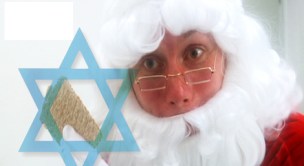
I hear it all the time. Jews verbalizing their displeasure with public displays of Christian observance. Jews worried that somehow a department store Santa Claus will defile their own children. Jews in the forefront of those protesting any and every expression of religiosity coming from those with a different belief system than ours. Christmas, they claim, is by definition a threat to Judaism and to the Jewish people.

And I believe they are mistaken.

-Rabbi Benjamin Blech
“Is Christmas Good For the Jews?”
Aish.com

Jesus has become a stranger to Jews just as he has become the property of Christians. What needs to happen is for many Christians to examine whether the Jesus of their faith has replaced Judaism or whether he is Judaism-friendly. It won’t be enough to say that Jesus was raised a Jew and that He kept Torah. The problem is that much Christian theologizing . . . and hymnody . . . enshrines a Jesus who outgrew or replaced Judaism. And as long as Christians think that way, don’t be surprised if Jews think of Jesus as at best a former Jew. And that is a concept as cold as a Brooklyn December.

-Rabbi Dr. Stuart Dauermann
“Toward Making Christmas Once Again A Jewish Holiday”
The Messianic Agenda

“So, this is Christmas,” to quote John Lennon. You’d expect Christians to be blogging about Christmas left and right, but what about so many Jews blogging about Christmas? In America, you can’t avoid Christmas no matter who you are, but what could possibly make Christmas a good thing for a Jew?

I’ve been critical of Christmas lately, not so much on theological or historic grounds as on the expectation that is presented by Christmas; the directive that one must be happy and of good cheer because of the holiday. If you read all of Rabbi Blech’s commentary, you know that at one point in the lives of his parents, Christmas in Poland was not such a good thing.

My parents told me many times how much they dreaded the Christmas season.

Living in a little shtetl in Poland, they knew what to expect. The local parish priest would deliver his sermon filled with invectives against the Jews who were pronounced guilty of the crime of deicide, responsible for the brutal crucifixion of their god and therefore richly deserving whatever punishment might be meted out against them.

No surprise then that the Christian time of joy meant just the opposite to the neighboring Jews. The days supposedly meant to be dedicated to “goodwill to all” were far too often filled with pogroms, beatings, and violent anti-Semitic demonstrations.

Rabbi Dr. Dauermann writes on a somewhat overlapping theme, seeing as how the birth of the Jewish Jesus has not been good news for Jews for a very long time.

Besides conceiving of Jesus as Judaism-friendly, there is a second challenge for those Christians who would have their Jewish friends see him as not only good news for the Jews, but also Jewish good news. And that challenge is for fine and aware Christians to reconnect with how the Christ who was born in Bethlehem, died at Calvary, and rose from the dead, remains the Lion of the Tribe of Judah, the Son of David, the King of the Jews who one day will return to bring to fruition all the promises God made to that chosen nation. The many Christians who deny that this is how the story ends should not be surprised when there is no room for their Jesus in the Jewish inn.

But while Rabbi Dauermann’s apparent goal is to reintroduce Jesus as the Jewish Messiah King to multitudes of Christians, Rabbi Blech sees Christmas presenting a different opportunity for Jews.

To be perfectly honest, Christmas season in America has been responsible for some very positive Jewish results. This is the time when many Jews, by dint of their neighbors’ concern with their religion, are motivated to ask themselves what they know of their own. To begin to wonder why we don’t celebrate Christmas is to take the first step on the road to Jewish self-awareness.

My parents were “reminded” of being Jewish through the force of violence. Our reminders are much more subtle, yet present nonetheless. And when Jews take the trouble to look for the Jewish alternative to Christmas and perhaps for the first time discover the beautiful messages of Chanukah and of Judaism, their forced encounter with the holiday of another faith may end up granting them the holiness of a Jewish holiday of their own.

family-chanukah-mea-shearimChristmas lights and music and decorations may have a wide variety of meaning to you, depending on who you are and what you believe. Very often, the religious aspects of the holiday conflict with the politically correct priorities of the culture around us, and a battle ensues over something as simple as saying “Merry Christmas” vs. “Happy Holidays.” But what Rabbi Blech points out as good news for Jewish people is actually good news for all of us. Christmas, even if we don’t celebrate it and even if don’t like it, offers us an opportunity, in observing those who do use Christmas as an overt expression of their faith, to take a look at who we are and what we believe. Even an atheist can take this opportunity to re-examine themselves and to either re-affirm their beliefs or reconsider their choices.

For those of us who are people of faith, we can do the same. If you’re a Christian, you can take Rabbi Dauermann’s advice and start viewing the Savior of the world as a Jew with good news for Jewish people. If the Christmas songs say “Born is the King of Israel,” then take the opportunity to look at Jesus as Israel’s King who will restore Israel as a nation above all other nations, and who will rebuild the Temple in Holy Jerusalem for the Jewish people.

If you’re a Jew who is not acquainted with the idea that there are Jews who seriously believe Jesus is the Jewish Messiah and are disciples of the “Maggid of Nazaret,” you might want to become familiar with some of these Jews, such as the Rabbi who loved Jesus (his identity and family line may surprise you).

If you are among the “Bah! Humbug!” brigade as I sometimes am, no matter how dismal you find the Christmas season, try to put that aside this year and see if watching those who truly do worship the “King of Israel” may, by example, have something to say to you. Take some time to ask yourself who you are, what you believe, and out of that, what you’re doing with your life.

If you don’t like the answer, then it’s time for a change.

Regardless of what you do or do not believe and celebrate about this day, may God grant you His mercy and kindness now and all the days of your life.