
 And he said to them, “You yourselves know how unlawful it is for a Jew to associate with or to visit anyone of another nation, but God has shown me that I should not call any person common or unclean. So when I was sent for, I came without objection. I ask then why you sent for me.”
–Acts 10:28-29 (ESV)
Simon Peter still had no idea why he had been called to Caesarea. The notion of Gentile inclusion in the kingdom had not occurred to him. Though the Master had told the apostles to “make disciples of all the nations” and to witness on His behalf “even to the remotest part of the earth,” He had never implied that this might mean accepting Gentiles as Gentiles (see Matthew 28:19; Acts 1:8). Simon naturally assumed that any Gentiles entering the kingdom and taking on the yoke of discipleship would necessarily convert to become Jewish first.
Torah Club, Volume 6: Chronicles of the Apostles
from First Fruits of Zion (FFOZ)
Torah Portion Vayeshev (“And he dwelt”) (pp 231-2)
Commentary on Acts 9:32-11:18
I don’t know where D. Thomas Lancaster discovered that bit of information about Peter in his commentary on Acts 10 or even if it’s simply an interesting opinion, but if true, then it begs the question, did Peter or any of the other apostles actually convert a Gentile to Judaism as part of the process of making disciples of Yeshua (Jesus) from the nations? As far as I’m aware, there’s no record in the New Testament prior to Acts 10 of the apostles converting a Gentile to Judaism, or allowing a Gentile to enter into the kingdom without conversion in the context of Jesus discipleship. The thousands we see coming to faith in the Jewish Messiah in Acts 2 and later are almost certainly all Jews. For that matter, what do we know of the Ethiopian eunuch encountered by the apostle Philip prior to Peter being summoned by Cornelius?
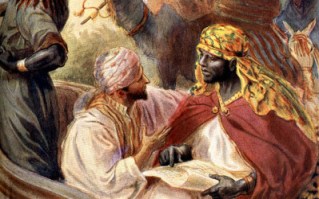
And he rose and went. And there was an Ethiopian, a eunuch, a court official of Candace, queen of the Ethiopians, who was in charge of all her treasure. He had come to Jerusalem to worship and was returning, seated in his chariot, and he was reading the prophet Isaiah.
–Acts 8:27-28 (ESV)
The Ethiopian eunuch is sometimes considered the first Gentile convert (E.g., Eusebius, Ecclesiastical History 2.1.13). That seems unlikely. Luke makes no issue about his non-Jewish status as he does regarding Cornelius in Acts 10. Ethiopia was home to a continuous Jewish presence from the days of Solomon up until the modern era. Beta Israel Jews, also known as Ethiopian Jews, claim Jewish ancestry reaching back to the Solomonic Era. One may safely assume that an Ethiopian who went to the trouble of making a pilgrimage to Jerusalem to worship the LORD in His Temple was Jewish. Luke says, “He had come to Jerusalem to worship” (Acts 8:27). The eunuch had traveled a great distance to reach Jerusalem, more than a month’s travel time. He had probably come to attend one of the pilgrimage festivals. While in Jerusalem, he purchased several Greek versions of the scrolls of the prophets – reading material for the trip home.
Torah Club, Volume 6: Chronicles of the Apostles
from First Fruits of Zion (FFOZ)
Torah Portion Vayetze (“And he went out”) (pp 176-7)
Commentary on Acts 8:1-40
I think we have to accept that Lancaster is making some assumptions here, as he says, but they are certainly compelling assumptions. Luke indeed makes “no big deal” of the Ethiopian eunuch’s conversion to the “Jesus sect” but draws a tremendous amount of attention to Cornelius and his household of Gentiles when they receive the Holy Spirit.
While Peter was still saying these things, the Holy Spirit fell on all who heard the word. And the believers from among the circumcised who had come with Peter were amazed, because the gift of the Holy Spirit was poured out even on the Gentiles.
–Acts 10:44-45 (ESV)
Peter and his Jewish companions were astonished that the Gentiles could also receive the Holy Spirit while Philip…but wait. Did the Ethiopian eunuch receive the Spirit during his encounter with Philip?
And the eunuch said to Philip, “About whom, I ask you, does the prophet say this, about himself or about someone else?” Then Philip opened his mouth, and beginning with this Scripture he told him the good news about Jesus. And as they were going along the road they came to some water, and the eunuch said, “See, here is water! What prevents me from being baptized?” And he commanded the chariot to stop, and they both went down into the water, Philip and the eunuch, and he baptized him. And when they came up out of the water, the Spirit of the Lord carried Philip away, and the eunuch saw him no more, and went on his way rejoicing.
–Acts 8:34-39 (ESV)
Immediately after rising from the water, Philip is taken away by the Spirit, but there is no mention at all of the Ethiopian eunuch receiving the Spirit as did Cornelius and his household in Acts 10 or the apostles in Acts 2. Of course in Acts 10 the Gentiles received the Spirit (verse 44) and then were baptized in water (verse 48). Did the Ethiopian eunuch receive the Spirit prior to immersion and the event was simply not mentioned by Luke?
Now when they heard this they were cut to the heart, and said to Peter and the rest of the apostles, “Brothers, what shall we do?” And Peter said to them, “Repent and be baptized every one of you in the name of Jesus Christ for the forgiveness of your sins, and you will receive the gift of the Holy Spirit. For the promise is for you and for your children and for all who are far off, everyone whom the Lord our God calls to himself.” And with many other words he bore witness and continued to exhort them, saying, “Save yourselves from this crooked generation.” So those who received his word were baptized, and there were added that day about three thousand souls.
–Acts 2:37-41 (ESV)
 Notice that Peter tells his Jewish audience that to receive forgiveness of sins, they will receive the gift of the Holy Spirit, but when Luke describes the results in verse 41, he only says, “So those who received his word were baptized, and there were added that day about three thousand souls.” He doesn’t say that after they received his (Peter’s) word, they received the Spirit and then were baptized. It’s possible, given that these were Jews being discussed, Luke assumed his readership would know that they received the Spirit based on verses 1-4. That same thought process might have been in use when Luke describes the baptism of the Ethiopian eunuch in Acts 8. However this is just guess-work on my part.
But while the Jews who received the good news of the Moshiach in Acts 2 came to faith in Jesus but did not have to convert to Judaism (and arguably, neither did the Ethiopian eunuch), what about Cornelius and his household in Acts 10? If Lancaster’s assumption is correct, Peter should have expected Gentiles to convert to Judaism as a part of becoming disciples of the Jewish Messiah.
I mentioned in a previous meditation that Shaye J.D. Cohen in his book, From the Maccabees to the Mishnah, Second Edition said it was not uncommon for those from the various sects of late Second Temple era Judaism to make converts from the Gentiles including the God-fearers. If Peter expected, as did the other Judaisms of his day, that Gentiles would have to convert to Judaism in order to enter into discipleship, then he should have had Cornelius and the other male God-fearers present circumcised as part of the conversion process.
When Simon Peter heard the Gentiles speaking in the languages and saw that they had received the Spirit just as he and the other Jewish believers had, he could no longer theologically exclude them from participation in the kingdom or discipleship. (see Acts 10:47-48) They had not gone through a legal conversion to become Jewish, nor had they been circumcised. They were still Gentiles, yet they had experienced the Spirit of God, just as the Jewish believers had.
Simon Peter explained to the six men that had accompanied him from Joppa, “Surely no one can refuse the water for these to be baptized who have received the Holy Spirit just as we did, can he?” By skipping circumcision and going directly to immersion, Simon Peter inverted the process by which a Gentile might ordinarily become a disciple of Yeshua. Prior to that occasion, he and the other disciples required a Gentile to first submit to conversion/circumcision. Immersion could follow later.
-Lancaster, pg 235
This presentation on Lancaster’s Torah Club commentary went longer than I originally planned, so I’m splitting it into two parts. Please join me tomorrow for the second and final part in Monday’s “morning meditation.”







 Morning Meditations