Category Archives: Uncategorized

21 Days: An Island Within an Island

waiting-in-the-antechamberAnother church report. I have to admit, this morning (as I write this), I dreaded going to church. I was afraid of what I’d find when I got there. Well, not during services since they’re rather predictable, but Sunday school. But first things first. The sermon was on Acts 8:1-8.

And Saul approved of his execution.

And there arose on that day a great persecution against the church in Jerusalem, and they were all scattered throughout the regions of Judea and Samaria, except the apostles. Devout men buried Stephen and made great lamentation over him. But Saul was ravaging the church, and entering house after house, he dragged off men and women and committed them to prison.

Now those who were scattered went about preaching the word. Philip went down to the city of Samaria and proclaimed to them the Christ. And the crowds with one accord paid attention to what was being said by Philip when they heard him and saw the signs that he did. For unclean spirits, crying out with a loud voice, came out of many who had them, and many who were paralyzed or lame were healed. So there was much joy in that city.

And so begins the great persecution of the church and the spreading of the Good News outside of Jerusalem and Judea to Samaria and eventually to the rest of the world. Pastor used these verses as a platform to encourage his audience (the people in church listening to the sermon) to preach the Good News ourselves in our environment. Since he had previously been a missionary and is the son of missionaries, he also suggested we shouldn’t consider a foreign mission trip outside of the realm of possibility for us.

I found out something interesting, at least I think I did. Pastor made it a point to say that there wasn’t a priority necessarily for the Good News to first be preached in Jerusalem, then in Judea, then in Samaria, and then in the diaspora, but rather those who were scattered preached the Gospel wherever they went. I guess a lot of Christians look at this passage and figure that you are first to preach the Gospel in your own community, which somehow translates into having no desire to go to foreign places and do God’s work there. Pastor emphasized that there are many spiritual problems in the U.S. and a great need for the Word to be spread here, but we have lots and lots of churches. There are places where there is no access to the Word of God whatsoever and those are the places that need evangelists and missionaries.

Listening to Pastor, I realized that I didn’t know how some Christians looked at the Bible at all and what they thought it was supposed to be telling them. I had no idea that this part of Acts could be interpreted relative to whether or not it encourages Christians to do missionary work.

Of course, I also encountered a significant bias toward missionary work in foreign lands, both in terms of preaching the Word and helping with physical needs, but I don’t think there’s anything wrong with that. It’s just the emphasis of the Pastor and of the church (they use a significant portion of their resources to support missionaries).

The theme continued in Sunday school. A couple who were visiting the class had spent decades as missionaries in the Congo. Interestingly, the wife had grown up there (her parents were also missionaries) and her husband had spent the last 25 years or so with her in the Congo. They told us that whatever we do or don’t see on the news isn’t like what is actually happening. Another fellow, who had just returned from Turkey (not as a missionary..his job just takes him there) said he had met a “war photographer” on the return flight who showed him his work. The photographer said that 95% of this photos would never make it into the media because Americans don’t want to know what’s really happening in the world (I tend to believe that’s the perception of a censored and biased press, but he’s probably right). There’s a lot of persecution of Christian missionaries in Muslim countries that the Western press never, ever talks about, even though there’s amble information and evidence, such as the photos in that war photographer’s camera.

walking-alone-on-frozen-lake1I was listening to all of this as an outside observer. I really didn’t have anything to contribute to the conversation and at those moments when I was tempted, I wrote in my notes “bite your tongue.” I know that missionaries living and working in the “foreign mission field” really do live in a different world from mine, but just being in that class felt like a different world too. I was sitting in class reflecting on my experience of being at church and realized that people were starting to get used to me being around. I knew that when I realized that fewer people were greeting me. A few people said “hi” but it wasn’t with the same frequency and intensity. I guess they’re probably saying, “the ball is in your court.” In other words, what am I going to do to become a member of this community?

I have no idea.

As I was going out the door to go to church, my wife said, “Have fun.” I wasn’t anticipating having fun and when she asked me why I was going, I blurted out something about a sense of obligation…that I had a responsibility to be “in community.” I go to church because I feel obligated to go, not because I get a lot of “pizzazz” out of it. I suppose I shouldn’t expect a lot of pizzazz. I managed to get through singing the Christmas hymns and listened to Pastor’s sermon which often is the highlight of my church experience. What’s “fun” or “pizzazz” got to do with it?

Charlie, the leader of the class I attend, announced that he would be leaving class at the end of December. I guess he doesn’t feel well, but I’d have to be able to read between the lines to understand more. He asked for people to volunteer to take over leading the class and if no one did, the class would disband. So one of my very tenuous holds in church, this class, is probably going “bye-bye.” There are a number of other adult classes being offered so I suppose I could attend one of them, but do I want to and what would be the point?

A Russian congregation had been using the church building for their services on Sunday afternoons but Charlie mentioned that they had disbanded last week. There are about thirty or so Russian-type congregations in the Boise area and I used to know some of the folks involved (they occasionally attended the One Law group where I used to worship). Charlie mentioned that whatever bond had held the Russians together (and they had been persecuted for their faith in their own land) had dissolved and it made me realize that “bonding” to the people at this church is a real struggle. In listening to different people in the class talk, I found out that many of these people had known each other for decades, sometimes back into childhood, and that many had an unbroken Christian faith also going back that far.

That’s one of the reasons I’ve found it difficult to “bond” with religious people in general…my being a “Johnny-come-lately” as far as my faith. In some ways, sitting there in that Sunday school class, I felt like I had just become a Christian and outside of that knowledge, was completely disconnected from whatever else it means to be a Christian. I also discovered that those people feel disconnected and isolated too, but in this case, it’s because of “rampant sin in the world” that the world “dresses up” sin to look acceptable, and the world wants the rest of us to accept it, too (they were probably talking about recent changes in the laws in some states allowing gay marriages).

A life of faith is isolating and in visiting this church it’s like I’m an island visiting a somewhat larger island. While I feel I’ve reasonably resolved my personal uncertainty about remaining online, at least here in the blogosphere, remaining at church past my deadline is still a big, fat question mark. The people and groups in the church who feel alienated from the larger culture have each other in their community, but I’m a stranger in their very strange land. You can’t get to know people at church between the service, the singing, the prayers, the sermon, the Sunday school class discussion, but I don’t know how to form connections to take it to a more meaningful level.

alone-at-churchIt wouldn’t be any different in other church and it wouldn’t be any different in a synagogue or other social setting. When my wife and I first started a church experience many years ago, we already knew some of the other families attending, so we had a way “in.” I don’t know how to do that here and I don’t know that I should. On the other hand, I’m afraid of simply giving up too soon, especially if (and I know this will sound “churchy”) God has some sort of plan for me to continue here.

I feel like a person who has been handed an anonymous note telling him to enter a room and introduce himself to the stranger he discovers inside. There’s no context, no reason, no apparent purpose to the encounter and only a minimal and mysterious set of instructions that act as guide.

Will there be church after the next three weeks? I don’t know. If there is, then I can’t imagine what I’ll be doing there. If it’s where God wants me to be, then I guess I’ll go to services, go to Sunday school, and remain a tiny island visiting a larger island for about three hours every Sunday. I’ll follow the instructions on the note, enter the room, introduce myself to the person I find inside, and then we can both wonder what we’re supposed to do next.

Reality Check: After writing all of the above, I had coffee on Sunday afternoon with a friend who has been at his current church for four years. He’s been a believer for most of his life (we’re about the same age) and he’s been through many different churches and movements over the course of a life of faith. He told me it will take at least a year for me to feel any sort of integration into church at all. A year?

The Uncircumcised Convert, Part 2

mikveh-project“Can anyone withhold water for baptizing these people, who have received the Holy Spirit just as we have?” And he commanded them to be baptized in the name of Jesus Christ. Then they asked him to remain for some days.

–Acts 10:47-48 (ESV)

When Simon Peter heard the Gentiles speaking in the languages and saw that they had received the Spirit just as he and the other Jewish believers had, he could no longer theologically exclude them from participation in the kingdom or discipleship. (see Acts 10:47-48) They had not gone through a legal conversion to become Jewish, nor had they been circumcised. They were still Gentiles, yet they had experienced the Spirit of God, just as the Jewish believers had.

Simon Peter explained to the six men that had accompanied him from Joppa, “Surely no one can refuse the water for these to be baptized who have received the Holy Spirit just as we did, can he?” By skipping circumcision and going directly to immersion, Simon Peter inverted the process by which a Gentile might ordinarily become a disciple of Yeshua. Prior to that occasion, he and the other disciples required a Gentile to first submit to conversion/circumcision. Immersion could follow later.

Torah Club, Volume 6: Chronicles of the Apostles
from First Fruits of Zion (FFOZ)
Torah Portion Vayeshev (“And he dwelt”) (pg 235)
Commentary on Acts 9:32-11:18

If you haven’t done so already, please read Part 1 of this commentary before continuing here.

This is the second time in his commentary on Acts 10 that Lancaster suggests Peter or the other Jewish apostles may have previously converted Gentiles to Judaism by first having them circumcised and then entering them into Jesus discipleship. As I mentioned in Part 1, I can’t think of any record in the Bible that points in this direction. I do note however, that Philip also did not require the Ethiopian eunuch to be circumcised prior to immersion. However, that more than likely means the eunuch was Jewish (and did not need to convert) since Luke makes no point of the eunuch being a Gentile as he does of Cornelius (although as previously mentioned, there are a number of assumptions in play).

What Lancaster says regarding circumcision and conversion of Gentiles does fit nicely into Shaye J.D. Cohen’s opinion (see his book, From the Maccabees to the Mishnah, Second Edition) of how Gentiles were made into Jewish disciples as I mentioned in another commentary.

However, as the history of Israel progressed, the concept of conversation to Judaism for the Gentile began to become more formalized. Cohen cites three essential elements of conversion to Judaism: belief in God, circumcision, and joining the house of Israel. Again, this is a definition of a convert to Judaism, not conditions required for the Gentile to join “the Way” as disciples of Christ. Cohen even references the difference:

For Paul, circumcision represents subjugation to the demands of the Torah (Gal. 3-5).

In other words, while Paul did not see circumcision and thus full obedience to the mitzvot as a requirement for the Gentile Christians, he did see it as a necessary step for full conversion to Judaism. The natural conclusion then is that a Gentile becoming a disciple of the Jewish Messiah in the time of Paul was not the same as a Gentile converting to Judaism.

Another indication that Gentiles entering into Jesus discipleship were not converting to Judaism is found in the aftermath of Peter’s experience with Cornelius.

Now the apostles and the brothers who were throughout Judea heard that the Gentiles also had received the word of God. So when Peter went up to Jerusalem, the circumcision party criticized him, saying, “You went to uncircumcised men and ate with them.”

–Acts 11:1-3 (ESV)

This wasn’t exactly a friendly inquiry on the part of Peter’s fellow Jewish apostles.

Rumors of his (Peter’s) activities among the Gentiles preceded him. It did not take long for word of Simon’s Peter’s theological leap and halachic faux pas to reach the rest of the Judean apostolic community. The inclusion of the Samaritans had been controversial enough. Simon’s fraternization with Gentiles raised astonishment and disbelief.

No one objected to Gentiles joining the assembly of Yeshua so long as they first went through a proper conversion, but according to the rumor, that had not happened. People were even saying that Simon Peter had entered the home of the Roman soldier, eaten with him, and invited him to immerse for the name of Yeshua.

Such an association of Gentiles with Jews, and the Gentiles being allowed into discipleship within a Jewish sect without first converting to Judaism, must have seemed outrageous to the Jewish apostolic community in Jerusalem. Luke points out in verse 2 that “circumcision party criticized him,” meaning the people present were Jews, either people born Jewish or converts to Judaism. A Jew eating with a Gentile was a violation of halachah. Lichtenstein in “Commentary on the New Testament” on Acts 11:3 considers this matter further.

“You went to uncircumcized men and ate with them” (Acts 11:3). This does not present a difficulty, for Cornelius was a God-fearer and certainly had kosher food. And the objection of the circumcised men is only about [Peter’s] approaching uncircumcised men and eating with them, for Jews were forbidden to approach a foreigner.

-Lancaster, pg 236

Cohen might not entirely agree with Lichtenstein, since he believes God-fearers were still polytheists, integrating the God of Israel into a panthenon of other “gods.” However, it is quite likely that Peter and the six Jews in his company would not have eaten with Cornelius unless the food was kosher and there’s nothing to say, Cohen aside, that Cornelius must have been polytheistic.

ancient-rabbi-teachingIn his defense, Peter and the other Jews who accompanied him recounted the events that occurred prior to entering the Roman’s home and what happened once Peter engaged Cornelius, including the giving of the Spirit to the Gentiles. (see Acts 11:4-17) Fortunately, upon hearing the explanation, the other apostles understood the graciousness of God, even to the Gentiles.

When they heard these things they fell silent. And they glorified God, saying, “Then to the Gentiles also God has granted repentance that leads to life.”

–Acts 11:18 (ESV)

Lancaster presents his final interpretation of the “Cornelius event,” raising another interesting question.

The apostolic leadership accepted Simon Peter’s testimony and the corroboration offered by the six men from Joppa. The were forced to concede that Sinon had acted properly in setting aside the halachah about the uncleanness of Gentiles. More than that, they realized that God accepted the Gentiles into the kingdom. They did not determine whether or not the new Gentile believers should be encouraged to remain God-fearers or go on to full conversion. They only determined that they should receive Gentile brethern without objection as fellow disciples and heirs of the kingdom.

Uncertain of what else to make of the situation, they blessed God.

-Lancaster, pg 237

As we can see, both from the text in Acts and in Lancaster’s interpretation, the early Jewish apostles struggled to understand how to integrate the Gentile disciples into the Jewish Messianic community. The realization that Gentiles may not have to convert to Judaism (and according to Lancaster, at this point the jury was still out on this matter) in order to become disciples was revolutionary. All other sects of Judaism who were actively pursuing Gentiles as disciples required that the Gentiles convert to Judaism as a matter of course. In other words, it was a “no brainer.” Only in the Jesus sect was the method of entering Gentiles into a Jewish sect still something of a question mark. God didn’t just flip some sort of “spiritual switch” and suddenly, all of the apostles “just knew” what to do with the Gentiles and what it all meant.

But if the Gentiles didn’t have to convert; if they didn’t have to accept circumcision, then how was Torah and halachah to be applied to them? As we saw above, Paul and Cohen’s commentary on Paul understand that conversion to Judaism and circumcision meant the Gentiles would be fully obligated to the Torah mitzvot. As of the events in Acts 11 that question hadn’t even been brought up let alone answered. The apostles had no idea what was coming next. Neither did Cornelius and his household or any other Gentiles who subsequently became disciples.

It will be weeks before Lancaster’s Torah Club commentary addresses the events in Acts 15 which presumably will answer these questions. I hope you are looking forward to the future revelations of Volume 6 of the Torah Club as much as I am.

The Uncircumcised Convert, Part 1

corneliusAnd he said to them, “You yourselves know how unlawful it is for a Jew to associate with or to visit anyone of another nation, but God has shown me that I should not call any person common or unclean. So when I was sent for, I came without objection. I ask then why you sent for me.”

–Acts 10:28-29 (ESV)

Simon Peter still had no idea why he had been called to Caesarea. The notion of Gentile inclusion in the kingdom had not occurred to him. Though the Master had told the apostles to “make disciples of all the nations” and to witness on His behalf “even to the remotest part of the earth,” He had never implied that this might mean accepting Gentiles as Gentiles (see Matthew 28:19; Acts 1:8). Simon naturally assumed that any Gentiles entering the kingdom and taking on the yoke of discipleship would necessarily convert to become Jewish first.

Torah Club, Volume 6: Chronicles of the Apostles
from First Fruits of Zion (FFOZ)
Torah Portion Vayeshev (“And he dwelt”) (pp 231-2)
Commentary on Acts 9:32-11:18

I don’t know where D. Thomas Lancaster discovered that bit of information about Peter in his commentary on Acts 10 or even if it’s simply an interesting opinion, but if true, then it begs the question, did Peter or any of the other apostles actually convert a Gentile to Judaism as part of the process of making disciples of Yeshua (Jesus) from the nations? As far as I’m aware, there’s no record in the New Testament prior to Acts 10 of the apostles converting a Gentile to Judaism, or allowing a Gentile to enter into the kingdom without conversion in the context of Jesus discipleship. The thousands we see coming to faith in the Jewish Messiah in Acts 2 and later are almost certainly all Jews. For that matter, what do we know of the Ethiopian eunuch encountered by the apostle Philip prior to Peter being summoned by Cornelius?

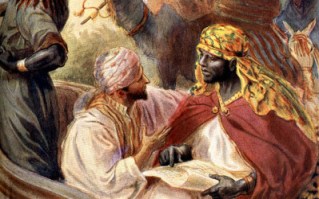
And he rose and went. And there was an Ethiopian, a eunuch, a court official of Candace, queen of the Ethiopians, who was in charge of all her treasure. He had come to Jerusalem to worship and was returning, seated in his chariot, and he was reading the prophet Isaiah.

–Acts 8:27-28 (ESV)

The Ethiopian eunuch is sometimes considered the first Gentile convert (E.g., Eusebius, Ecclesiastical History 2.1.13). That seems unlikely. Luke makes no issue about his non-Jewish status as he does regarding Cornelius in Acts 10. Ethiopia was home to a continuous Jewish presence from the days of Solomon up until the modern era. Beta Israel Jews, also known as Ethiopian Jews, claim Jewish ancestry reaching back to the Solomonic Era. One may safely assume that an Ethiopian who went to the trouble of making a pilgrimage to Jerusalem to worship the LORD in His Temple was Jewish. Luke says, “He had come to Jerusalem to worship” (Acts 8:27). The eunuch had traveled a great distance to reach Jerusalem, more than a month’s travel time. He had probably come to attend one of the pilgrimage festivals. While in Jerusalem, he purchased several Greek versions of the scrolls of the prophets – reading material for the trip home.

Torah Club, Volume 6: Chronicles of the Apostles
from First Fruits of Zion (FFOZ)
Torah Portion Vayetze (“And he went out”) (pp 176-7)
Commentary on Acts 8:1-40

I think we have to accept that Lancaster is making some assumptions here, as he says, but they are certainly compelling assumptions. Luke indeed makes “no big deal” of the Ethiopian eunuch’s conversion to the “Jesus sect” but draws a tremendous amount of attention to Cornelius and his household of Gentiles when they receive the Holy Spirit.

While Peter was still saying these things, the Holy Spirit fell on all who heard the word. And the believers from among the circumcised who had come with Peter were amazed, because the gift of the Holy Spirit was poured out even on the Gentiles.

–Acts 10:44-45 (ESV)

Peter and his Jewish companions were astonished that the Gentiles could also receive the Holy Spirit while Philip…but wait. Did the Ethiopian eunuch receive the Spirit during his encounter with Philip?

And the eunuch said to Philip, “About whom, I ask you, does the prophet say this, about himself or about someone else?” Then Philip opened his mouth, and beginning with this Scripture he told him the good news about Jesus. And as they were going along the road they came to some water, and the eunuch said, “See, here is water! What prevents me from being baptized?” And he commanded the chariot to stop, and they both went down into the water, Philip and the eunuch, and he baptized him. And when they came up out of the water, the Spirit of the Lord carried Philip away, and the eunuch saw him no more, and went on his way rejoicing.

–Acts 8:34-39 (ESV)

Immediately after rising from the water, Philip is taken away by the Spirit, but there is no mention at all of the Ethiopian eunuch receiving the Spirit as did Cornelius and his household in Acts 10 or the apostles in Acts 2. Of course in Acts 10 the Gentiles received the Spirit (verse 44) and then were baptized in water (verse 48). Did the Ethiopian eunuch receive the Spirit prior to immersion and the event was simply not mentioned by Luke?

Now when they heard this they were cut to the heart, and said to Peter and the rest of the apostles, “Brothers, what shall we do?” And Peter said to them, “Repent and be baptized every one of you in the name of Jesus Christ for the forgiveness of your sins, and you will receive the gift of the Holy Spirit. For the promise is for you and for your children and for all who are far off, everyone whom the Lord our God calls to himself.” And with many other words he bore witness and continued to exhort them, saying, “Save yourselves from this crooked generation.” So those who received his word were baptized, and there were added that day about three thousand souls.

–Acts 2:37-41 (ESV)

philip_and_the_ethiopianNotice that Peter tells his Jewish audience that to receive forgiveness of sins, they will receive the gift of the Holy Spirit, but when Luke describes the results in verse 41, he only says, “So those who received his word were baptized, and there were added that day about three thousand souls.” He doesn’t say that after they received his (Peter’s) word, they received the Spirit and then were baptized. It’s possible, given that these were Jews being discussed, Luke assumed his readership would know that they received the Spirit based on verses 1-4. That same thought process might have been in use when Luke describes the baptism of the Ethiopian eunuch in Acts 8. However this is just guess-work on my part.

But while the Jews who received the good news of the Moshiach in Acts 2 came to faith in Jesus but did not have to convert to Judaism (and arguably, neither did the Ethiopian eunuch), what about Cornelius and his household in Acts 10? If Lancaster’s assumption is correct, Peter should have expected Gentiles to convert to Judaism as a part of becoming disciples of the Jewish Messiah.

I mentioned in a previous meditation that Shaye J.D. Cohen in his book, From the Maccabees to the Mishnah, Second Edition said it was not uncommon for those from the various sects of late Second Temple era Judaism to make converts from the Gentiles including the God-fearers. If Peter expected, as did the other Judaisms of his day, that Gentiles would have to convert to Judaism in order to enter into discipleship, then he should have had Cornelius and the other male God-fearers present circumcised as part of the conversion process.

When Simon Peter heard the Gentiles speaking in the languages and saw that they had received the Spirit just as he and the other Jewish believers had, he could no longer theologically exclude them from participation in the kingdom or discipleship. (see Acts 10:47-48) They had not gone through a legal conversion to become Jewish, nor had they been circumcised. They were still Gentiles, yet they had experienced the Spirit of God, just as the Jewish believers had.

Simon Peter explained to the six men that had accompanied him from Joppa, “Surely no one can refuse the water for these to be baptized who have received the Holy Spirit just as we did, can he?” By skipping circumcision and going directly to immersion, Simon Peter inverted the process by which a Gentile might ordinarily become a disciple of Yeshua. Prior to that occasion, he and the other disciples required a Gentile to first submit to conversion/circumcision. Immersion could follow later.

-Lancaster, pg 235

This presentation on Lancaster’s Torah Club commentary went longer than I originally planned, so I’m splitting it into two parts. Please join me tomorrow for the second and final part in Monday’s “morning meditation.”

An Opinion of a Shabbos Goy

grandma-wheelchairQuestion: My granddaughter is becoming bat mitzvah, and my 92-year-old mom is saying she will not be able to go because she cannot drive on Shabbat. But is it allowable—for this special occasion—for her to violate Shabbat just this once? The way I see it, this is a once-in-a-lifetime situation, making it quite okay to drive. This is her first great-granddaughter to reach bat mitzvah, and unfortunately she probably will not be around to celebrate this milestone with any of her other great-grandchildren.

Answer: This is an important question, for it leads us to a central theme in Judaism.

It’s easy to relate to a mitzvah as tradition or symbolism. Perhaps, taking it one step further, a mitzvah is divine advice on how to live the best life possible—the most meaningful, the most blessed.

If we would accept either of those definitions, we would have to agree that fulfilling mitzvot depends on the situation. We would say that yes, tradition is important, living a meaningful life is important, but in this situation there is something else more traditional and more meaningful—so we would use our judgment as to what takes precedence.

But that isn’t so. A mitzvah is precious not just because it is a tradition and has meaning to us. A mitzvah is G‑d’s own will and infinite wisdom. If so, a mitzvah’s incredible power and the blessing it brings is infinite in nature. It’s a connection to an infinite G‑d, way beyond our own understanding. It goes beyond the benefits and meaning we sense—though that’s important as well—for it is part of the divine. And a G‑dly formula for living is not subject to man deciding whether it is or isn’t relevant in a particular situation. (It is only when the Torah itself instructs us to put aside Shabbat, as in to save a life, that Shabbat laws should be disregarded.)

We might feel that a hike to the top of a mountain will be a more spiritual experience than a trip to the synagogue. Or that the pastrami from the new “kosher style” delicatessen will make the bat mitzvah a more joyous experience. Or, in a far more subtle manner, the situation here: that a great-grandmother being at the family celebration outweighs the prohibition of driving. And that’s when we remember that a G‑dly mitzvah is eternal, and extends far, far past the benefits we happen to sense . . .

Your grandmother should most certainly be at this bat mitzvah. It is only that you will need to find a way for this to happen in a permissible manner. Have you looked into her staying within walking distance from the synagogue? If this is not a possibility, you can speak to the rabbi about having a non-Jew wheel her to the synagogue (a subject beyond the scope of this e‑mail).

Mazel tov, and may you have much nachas from the entire family!

-Rabbi Yisroel Cotlar
“Can We Drive Grandma on Shabbat?”
Chabad.org

I suppose, even if I were currently tempted to convert to Judaism, this is one of the reasons I could never be a Jew. I understand, at least to a degree, the principle that Rabbi Cotlar is trying to communicate, but from my point of view, human compassion has to take a back seat to obedience to the mitzvot regarding not driving on Shabbos (maybe saying that makes me a bad person, I don’t know). Worse than that, I don’t understand the Rabbi’s advice about having a non-Jew wheel her to the synagogue (if it would help and if this were happening now in my community, I’d be more than willing…but there seems to be a problem).

It is forbidden for us to tell a gentile to perform work on the Sabbath on our behalf, although they are not commanded [to observe] the Sabbath. [This applies] even when the instructions were conveyed to them before the Sabbath and we do not require [the products of] their work until after the Sabbath.

The above is forbidden as a Rabbinical prohibition to prevent the people from regarding the Sabbath lightly, lest they perform [forbidden] labor themselves.

On the other hand…

[The following rules apply] when a gentile performs a [forbidden] labor on the Sabbath on his own accord: If he performed it on behalf of a Jew, it is forbidden to benefit from that labor until one waits the amount of time necessary to perform the labor on Saturday night.

[The latter leniency is granted] provided the matter is not public notice – i.e., everyone knows that a particular task is being performed for a person on the Sabbath.

If [the gentile] performed [the labor] for his own sake alone, it is permitted to benefit from it on the Sabbath.

Halacha 1 and Halacha 2 from
Chapter six of Mishnah Torah, Sefer Zemanim, Shabbos
Translated by Rabbi Eliyahu Touger
Chabad.org

Shabbat candlesLacking the educational background (as well as an ethnic, cultural, and lived Jewish experience), I admit that I can’t really interpret what is being said here and whether or not a non-Jew would really be permitted to “wheel grandma” to the synagogue on Shabbos if asked by her Jewish relatives. It seems a little dodgy to me, but then again, admittedly the nuances of interpreting Mishnah Torah escape me.

On the other hand, what should we say…that man was made for the Shabbat rather than the Shabbat being made for man?

One Sabbath he was going through the grainfields, and as they made their way, his disciples began to pluck heads of grain. And the Pharisees were saying to him, “Look, why are they doing what is not lawful on the Sabbath?” And he said to them, “Have you never read what David did, when he was in need and was hungry, he and those who were with him: how he entered the house of God, in the time of Abiathar the high priest, and ate the bread of the Presence, which it is not lawful for any but the priests to eat, and also gave it to those who were with him?” And he said to them, “The Sabbath was made for man, not man for the Sabbath. So the Son of Man is lord even of the Sabbath.”

–Mark 2:23-27 (ESV)

I included the entire section of scripture relevant to this situation rather than just quoting verse 27 because I’m aware that the circumstances Jesus was describing may not be directly associated with “driving grandma to synagogue.”

If grandma could stay Friday night within walking distance of the synagogue (assuming she can walk adequately at age 92), then I understand that would be acceptable. If grandma could stay the night within walking distance of the synagogue but could not walk, while I am “unclear” of the legitimacy of asking a “Shabbos Goy” to wheel her to shul, I’d accept that as an alternative from my Christian perspective. But if no halachically acceptable alternative were available, and grandma really, really wanted to attend her great-granddaughter’s bat mitzvah (and/or great-granddaughter really, really wanted great-grandma to be there for this once-in-a-lifetime event), then I’d drive grandma to shul (I know…she would be violating Shabbos by even accepting the ride).

I know this isn’t a life or death situation but I can’t set aside the feelings of the great-grandmother in question or her great-granddaughter either. Besides, according to one person’s comment on the matter, there is precedent for an alternative:

I think of the Rev that chopped wood and made soup for a helpless woman in her bed on Yom Kippur -she had just given birth) Sometimes it is necessary to hurt ourselves spiritually in order that another rmay grow or even live. However, I am loving ths suggestion of staying with her family for the entirety of Shabbat or the motor home. How important will the young ladies’ Bat Mitzvah be to her without Grandma there? How will that affect her walk with Hashem? We will never know. Some souls are mighty sensitive. Will this suck out all of the girl’s joy, what a sin that would be. Have her expectations been considered?

-Emily

I remember reading of this “Chasidic tale” so I think there is a value in Judaism that would allow an individual to violate Shabbos for the sake of another, even when their life is not at risk.

Here are a few more comments:

I proposed some questions to Rabbi Manis Friedman years ago relating to the halachot of shabbos. His answer? Shabbos is shabbos. End of story.

-Anonymous

I wasn’t raised Orthodox and don’t have a full understanding of this. But my argument would be that just because rabbis declared that driving, or even riding in a car, violates the Sabbath, doesn’t make it so. I don’t know, but my guess is that at the time, there were probably arguments going both ways.

-R. Baron

i’m a committed but not orthodox Jew and am fascinated by the question and your response.

The alternatives you gave were good; you may want to consider a nearby hotel for Friday night also. But to the heart of the matter, you mentioned consideration of what is ‘most meaningful, etc.’

I believe keeping the great-grandmother away from attending and participating would be cruel. since the question comes up –and Chabad is consulted –it implies she has done a great job in raising a Jewish family.

shabbat_walkI do not believe the divine would want her to miss it and this is not a question of climbing a mountain on shabbat or going to a ‘kosher style deli.’

-Oppie

Apparently, this isn’t a clear-cut issue for at least some Jewish people, either. I know. I’m probably going to “catch heck” from my Jewish friends who read this blog and maybe a few “Judaically-aware” Christians as well. I know that if someone who is shomer Shabbos is lenient on a rare occasion, it may lead to greater lenience and finally to habitually “cheating” on the Shabbat, but on the other hand, isn’t it possible to be too rigid? If a “hedge” is placed around the mitzvot to prevent a Jew from even coming near to violating Shabbos, isn’t it possible the hedge can become too extreme?

My perspective can be easily dismissed with a “you aren’t Jewish and so you don’t understand,” but as I mentioned (and demonstrated) above, even other Jewish people have a hard time with this one. My response (and this is quite a counterpoint to my Shabbat commentary from the other day), all other reasonable alternatives failing, is that I’d find a way to get grandma to shul for the bat mitzvah. I don’t think God would really mind, but then again, how am I to tell?

Tasting Chicken Soup

chicken-soup-with-matzah-ballsPicture the scene: Dead, feathered birds are lying on the kitchen counter; a bag of flour has spilled onto the floor, along with a orange juice—and so, the two-year-old is having a lovely time creating edible mud pies from the mix. From upstairs, a scream shakes the house—it’s the little one furious at the big one for making her bathtub too hot. Meanwhile, the big one is kvetching at the top of her voice because “there’s nothing for me to wear.” The father of the house is hiding somewhere, in full knowledge that if he shows his head, he’ll be sent out again on another urgent, last-minute errand.

At this point, the doorbell rings. It’s the nudnik guest, delivering his gift bottle of wine in advance, certain that the lady of the house has nothing better to do this afternoon than stand at the door and chat. She is careful to open the door only a slight 20 degrees, wedging herself into the space—first, so that the guest won’t see the state of affairs within; but also to prevent the little one who has just escaped from his hot tub from running out naked into the street.

The guest sniffs the air, and sighs, “Ahhh . . . Shabbos!”

Shabbos? Shabbos is a day of rest! Of peace! Of harmony! This is a total disaster zone!

But the guest smells what is coming. And the inhabitants of this house know as well. They know the dead birds will become a sumptuous chicken soup, the remainder of the flour will become fresh-baked challah, the children will be neatly dressed in their finest clothes, the father will turn up again, and they will all sit together at the table, singing in harmony and telling the stories and words of Torah they learned in school that week.

When you know the story, the scene becomes a different scene. The gadget in your pocket, the news on the tab before this one, the financial chaos and the promises of technological breakthrough, the void of leadership and the medical miracles that keep failing to come—think of those as the dead, feathered birds on the kitchen counter, soon to become a sumptuous chicken soup.

Science has opened our eyes to the awesome harmony of our world. The Kabbalah of the Ari, explained in the language of Chabad, can open anyone’s eyes to the G‑dliness behind that harmony. Shortly, we will sit at the Shabbos table with Moshiach, who will show how the earthly wisdom and the heavenly wisdom complement one another. While we are yearning for that knowledge, what is stopping us from tasting a spoonful of the soup right now?

-Rabbi Tzvi Freeman
“The Last Day of History”
Chabad.org

This is the climax to a rather lengthy and challenging article my wife shared with me the other day. I must admit to having skimmed over much of the content, but this portion is not only straightforward but rather the point of it all. I don’t mean that it’s the point of the article, although I suppose it is, I mean that it’s the point of everything.

For we who have believed enter that rest…

–Hebrews 4:3 (ESV)

The writer of Hebrews and Rabbi Freeman seem to be drawing their respective audiences to the same point: that we will one day enter into that final rest with the Messiah. What is especially attractive about Rabbi Freeman’s perspective is that a foretaste of that rest exists right now. Jews experience a small sampling from the “menu” of the Messiah’s table every Shabbat. Some Christians who are attached to the traditional Jewish community, Messianic Judaism, or Hebrew Roots, also have the opportunity to experience that “rest” and sample from the “menu” to varying degrees.

As far as I can tell, most Christians don’t.

Shabbat-Made-Easy-paintingI think that “Christ’s rest” is something that is more conceptual within Christianity. Most Christians anticipate being “raptured” and going up to Heaven of course, but there’s no idea that you can get a preview of the event before the event, at least not very frequently. There’s no manner of experiencing such an event in the material world because the “Messiah’s rest” is thought to be wholly spiritual.

More’s the pity.

I miss even the tiniest sliver of Shabbos observance in which my family used to participate. Hopefully, by God’s mercy, my wife will desire to observe the Shabbat again as her life calms down, and our home will be illuminated and warmed by the Shabbos candles once more.

I’m sure what I’m saying seems totally alien to most Christians. How can we experience the return of Jesus Christ before he returns? It must seem ridiculous.

But think about it.

In the U.S., we’ve recently celebrated Thanksgiving and most Christians are anticipating Christmas in just a few weeks. One of my favorite parts of Thanksgiving is the aroma of delicious foods in the kitchen. I traditionally barbecue the turkey in a Weber on the back patio, so in tending to it, I get to enjoy the smells of the slowly roasting bird as the smoke curls into the air. These smells all by themselves are highly pleasurable and also herald the grand feast that is to come.

And that is Shabbat. We know the feast will come but we also have a role in preparing for the feast. How many “feast” metaphors did Jesus use to describe the preparations for his own return and King and Bridegroom? Here’s just one of them.

“Then the kingdom of heaven will be like ten virgins who took their lamps and went to meet the bridegroom. Five of them were foolish, and five were wise. For when the foolish took their lamps, they took no oil with them, but the wise took flasks of oil with their lamps. As the bridegroom was delayed, they all became drowsy and slept. But at midnight there was a cry, ‘Here is the bridegroom! Come out to meet him.’ Then all those virgins rose and trimmed their lamps. And the foolish said to the wise, ‘Give us some of your oil, for our lamps are going out.’ But the wise answered, saying, ‘Since there will not be enough for us and for you, go rather to the dealers and buy for yourselves.’ And while they were going to buy, the bridegroom came, and those who were ready went in with him to the marriage feast, and the door was shut. Afterward the other virgins came also, saying, ‘Lord, lord, open to us.’ But he answered, ‘Truly, I say to you, I do not know you.’ Watch therefore, for you know neither the day nor the hour.

–Matthew 25:1-14 (ESV)

There’s preparation. There’s work to be done. There’s waiting. And then finally, sometimes unexpectedly, the Prince arrives and the feast begins.

But in cooking a meal, how many chefs manage to taste a bit here and a bit there, making sure the seasoning is just right, adding a spice or an herb to enhance the flavor?

I suppose that’s what Christmas is to most Christians…celebrating the birth of Jesus and his first entry into the world in anticipation of the second. That’s probably why Easter is also observed with such zeal (and a meal), to rejoice over the risen Jesus and to pray that he returns soon.

But while Judaism also has its great festivals, they also have Shabbos, the weekly reminder. Going to church on Sunday just doesn’t compare.

challahFor a Jew, six days of the week are spent in pursuit of the mundane, taking care of business, and sometimes letting life take over or overwhelm. Shabbos is bringing order to chaos and peace to turmoil. Even the preparations for Shabbos can seem maddening, much like life itself, but the result is wonderful, much like Messiah’s coming.

In God’s wisdom, He gave the Shabbat to the Jewish people as a sign of His covenant with them. Alas, it did not transfer to we Christians when we were brought into the fold. But sometimes you need rest and refreshment in order to summon courage for what is to come and to lay down the burden of what’s already happened. I don’t observe Shabbat these days, but I hope I will again. You may not observe Shabbat either, but it’s something you can access if you choose.

Messiah may come today, tomorrow, next year, or a thousand years hence. But Shabbos comes every week. Why wait? The Challah is rising in the oven and pots are steaming and bubbling on the stove. Have a taste of chicken soup now. It’s delicious.