Category Archives: Uncategorized

Why Do Christians Hate Judaism?

This is the decree of the Torah, which Hashem has commanded, saying…

Bamidbar/Numbers 19:2

Rashi explains that the unusual introduction of “this is the decree of the Torah” (rather than an introduction specific to the subject of parah adumah), is a response to Satan and the nations, who tauntingly ask, “What is the purpose of this commandment?,” to which the Torah answers that it is a decree from Hashem, and it is not for anyone to question it.

-from “A Torah Thought for the Day,” p.62
Sunday’s commentary on Parashas Chukas
A Daily Dose of Torah

I’m continuing to write on the general theme of the role of non-Jews in Messianic Jewish community, a study started in this blog post and most recently addressed in yesterday’s morning meditation.

Chana Sara in her blog post from a few years back asks Where Do I Fit? It’s certainly a question I keep asking myself, both in relation to my decision to study the Bible through the lens of Judaism and particularly Messianic Judaism, and the larger existential question of where do I fit in my relationship to God.

Once you accept that any sort of connection to God must go through Israel, the Jewish people, and especially through the exceedingly Jewish Messianic King, then you must come to the realization that in order to relate to God you must enter into a completely alien world, that is, alien for the non-Jew. You must enter a Jewish world or at least a worldview.

Even many secular Jews feel, when attempting to observe a mitzvah or when attending a synagogue prayer service, that they are also “strangers in a strange land.” True, they are Jews in the midst of Jewish community, but the traditions, the customs, the halachah, the Hebrew, if you haven’t been raised in an observant home nor had the benefit of a traditional Jewish education, can seem even to the ethnic Jew, like a trip down the rabbit hole to “wonderland.”

And most people become uncomfortable when faced with the unfamiliar and the unknown. People become defensive and even hostile when thrown abruptly into an alien environment. We prefer what we’re used to.

Chana Sara wrote in the aforementioned blog post:

As a ba’alat teshuva, I have a lot of questions when it comes to where I “fit” within Judaism. I was born into a conservative Judaism family, meaning that my mother can’t part from the egalitarian idea of the conservative movement, but keeps conservative standards of kosher and Shabbat.

As soon as I had my bat mitzvah I don’t remember going back to shul for any reason. Possibly the high holidays, but possibly not even then.
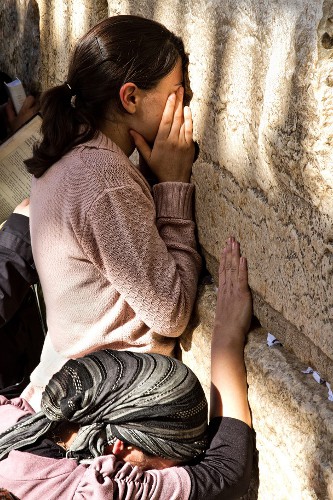
jewish women prayingThis is a commentary on a Jewish journey into Yiddishkeit, which is also a journey my wife embarked upon a number of years ago. I remember the struggles she faced in her first attempts to connect to Jewish community and Jewish observant praxis. How much more difficult is it for the non-Jew, with no direct connection to Jewish community and lifestyle, to face the challenge of entering the Jewish world in order to comprehend and obey the Jewish Messiah?

I understand that God is not just the God of Israel but also the God of the nations, but every shred of Biblical content that we have with us today was produced by Jews, and, for the most part, for Jews. Only certain sections of the Bible directly address the nations, and not all of those references relate to us kindly. Amalek comes to mind.

The commentary I quoted from at the top of the page, specifies those commandments in the Torah that have no discernible reason or purpose, but nevertheless must be followed because they are God’s will for the Jewish people. Rashi’s interpretation of the above-quoted verse from Numbers supposes that HaSatan, the adversary, and the Goyim, the Gentiles, would criticize the Israelites for observing such commands or would actually bring into question the Torah as the Word of God based on what appears to be a collection of meaningless decrees.

And therein lies the root of my question, “Why Do Christians Hate Judaism?” I know “hate” is a strong word and I use it in part for dramatic emphasis as opposed to literal meaning. Most Christians don’t actually hate the Jewish religion or form of worship, but they do believe that it is merely a religion of works which exists in opposition to Christ and the Christian doctrine of salvation by grace.

I also don’t mean to indicate that Christians hate the Jewish people or the state of Israel. Many Evangelical churches say they love the Jewish people, and no doubt, they are sincere. Of course, that love for Jews and national Israel is predicated on a very Christian understanding of the eschatological meaning of the existence of Jews and Israel relative to the second coming of Christ.

This brings us back to those Christians who have come to realize that what they’ve learned from the pulpit or in Sunday school isn’t, strictly speaking, the exact Gospel message Messiah and his apostles taught in the late Second Temple period. Once we have learned that the Church’s current theology and doctrine is all based on a two-thousand year old mistake and is the result of a violent divorce between the early Jewish and Gentile Yeshua disciples, then we’re faced with a horrible reality.

In an ekklesia that is wholly Jewish and that can be only understood and communicated with through a wholly Jewish process, a process alien to anything we were formerly taught as Christians in our churches, who are we, what do we do, and where do we go to pursue our faith given this totally Jewish contextual reality?

unworthyDo you see where this might cause some anxiety or even a crisis of faith among the devout Gentiles when facing a life within Jewish community and educational space?

Do you see why Christianity was invented in the first place, as an alternative to this crisis, as a means to take control over worship of God and devotion to Christ by redefining it as Gentile and not Jewish?

Although my father’s recent illness is the primary reason I chose to abandon plans to be in Israel right now, another reason was the idea that, as a Gentile (and a flawed, imperfect human being) who is oriented toward but can never be a part of Israel, who am I to set foot in the Holy Land?

However, there are other responses to this crisis. There are some Christians who have walked away from the Church but who still do not feel comfortable surrendering their identity to Jewish interpretation. They have invented a world of their own which states that while they are not ethnically Jewish, nevertheless, they are Israel as much as the Jewish people are, and thus they are as obligated to the Torah of Moses as any observant Jew.

But there’s a caveat.

They still reject Judaism, or at least Judaism as it has evolved over the past nearly twenty centuries. They reject, for the most part, that entity we know as Rabbinic Judaism, the “traditions of the elders,” the so-called “made up” laws that add on to or perhaps even defy the plain meaning of the written Torah.

Now here’s the trick.

If we Messianic Gentiles accept Messianic Judaism as a Judaism, and accept the validity of the teachings of the Jewish Sages, teachings which, for the most part, have nothing to do with us, then what does that mean for us? For understandable reasons, as much as Christianity has rejected Judaism, Judaism has rejected Christianity. They aren’t on speaking terms and can barely stand being in the same room with each other.
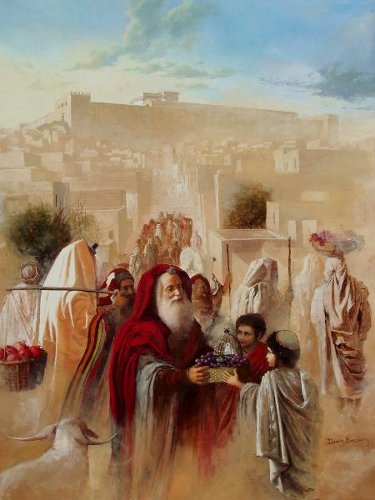
JerusalemOnce we Gentile believers come to a Messianic Jewish understanding of the Bible, the Messiah, and God, once we see how much God loves Israel, how special Israel is to God, and how we people of the nations are only saved through Israel and not because the nations have any sort of direct covenant connection with God, what is our most likely initial response?

The Torah states, “And Korach, the son of Yitzhor, the son of Kehas, the son of Levy, took …” Why does the Torah take the time to tell us his lineage?

Rashi, the great French commentator, explains that the key reason for Korach’s rebellion was his envy of his cousin, Elizaphan the son of Uziel, who was appointed prince of the tribe of Levy. Moshe’s father was the first of four brothers and his sons were the leader of the Jewish people and the High Priest; Korach figured that since he himself was the firstborn of the second son, that he should have been appointed the Prince of the Tribe of Levy.

Envy is destructive. It prevents a person from enjoying life. If ones focus is on other’s success and possessions, it will cause pain and lead to highly counterproductive behavior. No wonder that Pirkei Avos, Ethics of the Fathers 4:28, lists envy as one of three things which destroy a person (the other two are lust and desire for honor).

To overcome envy, focus on what you have and what you can accomplish in this world. The ultimate that anyone can have in this world is happiness. The secret to happiness is focusing on what you have. And if you are happy, you won’t envy others!

-Rabbi Zelig Pliskin
based on his commentary on Parashas Korach in
Growth Through Torah
as found at Aish.com

Especially in our modern western egalitarian culture, the idea that any one group might be special and especially privileged is abhorrent to most of us. When encountering certain Biblical realities, we attempt to refactor them by applying our modern worldview, thus reinterpreting the Bible beyond all reasonable credibility. We make statements to the Jewish people in Messiah that are the moral equivalent of the politically correct comment to check your privilege:

“Check Your Privilege” is an online expression used mainly by social justice bloggers to remind others that the body and life they are born into comes with specific privileges that do not apply to all arguments or situations. The phrase also suggests that when considering another person’s plight, one must acknowledge one’s own inherent privileges and put them aside in order to gain a better understanding of his or her situation.

Rebbe
Rabbi M.M Schneerson, the Rebbe

While the concept of “check your privilege” is, in my opinion, somewhat questionable, or at least has the potential to be grossly misused, applying it to the relationship between Messianic Gentiles and Messianic Jews (or any group of Jews) is Biblically unsustainable.

So where does that leave us?

I don’t have an answer, at least not a whole one. I do have a clue, also written by Chana Sara in her recent blog post My Experience with the Rebbe:

But he was more than just a rebel. He was a person with a fervor for life, for Yiddishkeit and for people. Everyone was important, Jew or non-Jew, male or female, child or adult. Every person was important and he wanted to do good for all mankind. The U.S. has dedicated Education and Sharing Day as a tribute to the Rebbe and steps he took toward the betterment of education for all U.S. children. He stressed the importance of the Noahide laws. He wanted to make sure that all of mankind was healthy and well and ready to take on the world in the way Hashem desires them to. He was really into everyone being the best that they can be and being able to help them realize their potential. The world isn’t finished being built, and the Rebbe wanted to make sure we were aware of that and are putting on our best faces to be able to finish making this world a dira b’tachtonim, a dwelling place for Hashem.

While there are voices within Messianic Judaism who advocate for a strict bilateral relationship between Jews and Gentiles, it is also part of the process of tikkun olam for Jewish and non-Jewish scholars and teachers within Messianic Judaism to make their lessons available to the Messianic Goyim so that we may learn and understand the teachings of the Master within his own context and turn our praxis and our devotion to God accordingly.

While there are plenty of resources available including those authored by Christian Pastors writing from within a Messianic context, as far as my experience goes, there are still no real answers.

If we acknowledge that Christian tradition does not adequately or accurately reflect the Jewish context of the Bible, and if we admit that Jewish praxis is not Gentile praxis in any form, including one that adopts the appearance of Judaism while rejecting the last eighteen hundred years or so of Jewish teaching and writing, what do we have left?

A mystery and no answers.

In previous comments on other blog posts I’ve written on this topic, it has been suggested that Gentile identity within Jewish space will have to evolve over a long period of time, decades if not centuries (barring the timing of King Messiah’s return, of course).

But courageous Jewish leaders such as the Rebbe, Rabbi Menachem M. Schneerson of righteous memory, indeed, had a heart not just for the Jewish people but for all people. Although his special mission and devotion was for Yiddishkeit, he understood that Messiah’s coming would herald the redemption of all of humanity in an unparalleled era of peace.

That’s the heritage of not just Israel but of all mankind, of you and me, all of us.

rebbe yahrzeit
People visit the grave site of the late Lubavitcher Rebbe Rabbi Menachem Mendel Schneerson

The twenty-first yahrzeit of the Rebbe has just passed and perhaps, if I may be so bold, in his merit, we can remind ourselves that somewhere, somehow, the people of the nations have a place in God’s redemptive plan, too. However, that plan and how we figure into it, isn’t very clear when viewed through a Jewish lens, since that lens was designed to reveal God’s relationship with the Jewish people and with Israel.

But it is the only lens we have that most accurately reveals the true reality of God’s message to the world, one that doesn’t diminish or destroy Jewish people, the nation of Israel, or the traditions, writings, and praxis of Judaism.

However uncomfortable or disorienting it may be to live life as a Gentile poised on the edge of our understanding of the God of Israel, the Jewish Messiah, and the Jewish scriptures, our best response should never be envy, supersessionism, or disdain. Instead, let us don the garments of humility, wonder, and awe, and then begin walking our path, one that is uncharted and unknown, toward the undiscovered country of who we are, which isn’t really defined by Judaism or even Christianity but rather by God.

I saw no temple in it, for the Lord God the Almighty and the Lamb are its temple. And the city has no need of the sun or of the moon to shine on it, for the glory of God has illumined it, and its lamp is the Lamb. The nations will walk by its light, and the kings of the earth will bring their glory into it. In the daytime (for there will be no night there) its gates will never be closed; and they will bring the glory and the honor of the nations into it; and nothing unclean, and no one who practices abomination and lying, shall ever come into it, but only those whose names are written in the Lamb’s book of life.

Then he showed me a river of the water of life, clear as crystal, coming from the throne of God and of the Lamb, in the middle of its street. On either side of the river was the tree of life, bearing twelve kinds of fruit, yielding its fruit every month; and the leaves of the tree were for the healing of the nations. There will no longer be any curse; and the throne of God and of the Lamb will be in it, and His bond-servants will serve Him; they will see His face, and His name will be on their foreheads. And there will no longer be any night; and they will not have need of the light of a lamp nor the light of the sun, because the Lord God will illumine them; and they will reign forever and ever.

-Revelation 21:22-22:5 (NASB)

Notice that it’s not just Israel who exists in the presence of God and of the Lamb. The nations are there…we are there, too, and we will be healed.

The tzadik is one with G-d.

We recognize him because within each of us is also a tzadik who is one with G-d.

Inside each of us is a spark of Moses.

-Rabbi Tzvi Freeman
From the wisdom of the Lubavitcher Rebbe, of righteous memory
Chabad.org

Within each of us is a spark of the Messiah. Have faith and courage.

Up to Jerusalem

The Blossoming Staff

Speak to the Children of Israel and take from them one staff for each father’s house…twelve staffs; each man’s name you shall inscribe on his staff. And the name of Aharon you shall inscribe on the staff of Levi…It shall be that man whom I shall choose — his staff will blossom.

Bamidbar/Numbers 17:17-18;20

Ramban (earlier, 17:6) explains that although the Jews were convinced that Aharon was chosen by Hashem to be the Kohen Gadol, they still questioned and protested the removal of the rights of the firstborn to do the avodah, which was given over to the entire tribe of Levi. Levi was split into two branches — Kohenim and Leviim, who together performed all the services of the Mikdash. The rest of the Jews wanted all the tribes to have at least some representation in the Beis HaMikdash. In answer to this request, Hashem showed them the miracle of Aharon’s staff. The staff belonged to the entire tribe of Levi, and its blossoming indicated that specifically the tribe of Levi had been chosen by Hashem to displace the firstborn of His servants.

There is possibly Rashi’s intent as well in verse 18, when he comments “for there shall be one staff.” That is, Hashem was saying: Although I divided them into two families — the family of Kohanim and the family of Leviim, nonetheless it is a single tribe.

-from “A Torah Thought for the Day,” p.32
Thursday’s commentary on Parashas Korach
A Daily Dose of Torah

This is sort of a part 2 of my blog post Are Messianic Gentiles Korach in that it addresses a similar theme: how roles can be different among diverse populations and yet all of the different groups are contained in a single body.

I wish there was an “almond staff test” for Jews and non-Jews in Messianic Judaism or the wider world of Hebrew Roots. I wish there was a visible, physical way to demonstrate to anyone who may doubt, that there is a fundamental difference between the duties and responsibilities of the Jewish people and those assigned to what I call “Messianic Gentiles,” or those non-Jews somehow associated with Messianic Judaism within the much wider body of the ekklesia of Messiah.

aaron's staffIt would make things so simple. See! There’s the Jewish staff sprouting blossoms. None of the Gentile staffs blossomed. So God is showing us all the He has assigned specific duties and responsibilities to the Jews that we Gentiles cannot share.

If you’re at all egalitarian, that may rub you the wrong way. After all, doesn’t this mean God isn’t playing fair with most of the human race? Isn’t He giving all the “cool stuff” to the Jews and saying the Gentiles can’t have any of it?

According to the midrash I quoted above, most of the Children of Israel, or at least the firstborn of the tribes, may have felt the same way. Why should the Kohanim and the Leviim have all the fun in the services in the Mikdash? Aren’t the firstborn of all the tribes just as worthy, just as much children of Hashem?

God settled the matter. God doesn’t have to be egalitarian. God is God. Deal with it.

Although we mentioned a difference between the gifts that the Kohanim receive and those of the Leviim (see “A Torah Thought for the Day”), there is a common denominator when it comes to their obligation to feel and express gratitude and appreciation to Hashem, Who graciously gave them these appointments and rewards.

-from “A Mussar Thought for the Day,” p.45
Friday’s commentary on Parashas Korach
A Daily Dose of Torah

But even as God differentiates, He also unites, providing a common denominator, so to speak, between the two diverse groups within the ekklesia of Messiah.

There is neither Jew nor Greek, there is neither slave nor free man, there is neither male nor female; for you are all one in Christ Jesus. And if you belong to Christ, then you are Abraham’s descendants, heirs according to promise.

Galatians 3:28-28 (NASB)

For He Himself is our peace, who made both groups into one and broke down the barrier of the dividing wall, by abolishing in His flesh the enmity, which is the Law of commandments contained in ordinances, so that in Himself He might make the two into one new man, thus establishing peace…

Ephesians 2:14-15

diversityJust as the Children of Israel are one people, they were also twelve different and unique tribes. Just as the tribe of Levi was one tribe, they were comprised of two different families, the Kohanim and the Leviim, and both of these groups had different rights and responsibilities in their service in the Mikdash. Even among the Leviim, there were clans that each had separate and non-transferable responsibilities and duties in the Mikdash.

Just as the ekkelesia of Messiah is one in faith and devotion, it is composed of two peoples, the Jewish people or Israel, and the Gentiles who have come to faith in Messiah, representing the nations.

Each group, although having a common denominator of being a “new man” metaphorically speaking, retains specific duties and responsibilities that cannot be transferred to the other group.

I know, it doesn’t follow the spirit of egalitarianism. It’s not “fair”.

But it is the Word of God.

The Mussar Thought for Friday states that we must respect those who have been privileged to achieve something special in their avodas Hashem that the rest of us have not, for this isn’t just an honor bestowed upon them, but a responsibility…one with consequences.

Someone who does not add to his service of Hashem when he is blessed with unique blessings, says Chovos HaLevavos, will eventually fail to fulfill even the basic obligations that are required of all [Jewish] people. In the end, he will throw off the yoke of Torah from himself completely.

I’ve mentioned in previous blog posts why I think it’s important to encourage greater Torah observance among the Jewish people, but here we see one of those reasons is that if the Jewish people do not perform the mitzvot, they are dismissing God’s blessings upon them and falling away from God and the Torah.

There are so many secular people who are ethnically and culturally Jewish but that’s about it.

jewish-assimilationEven among those Jews who are observant, that observance may only be partial. There are Jews who only attend Shabbat services sometimes and who, on other Sabbaths, will work. There are Jews who keep only “Leviticus 11 kosher” but who do not separate diary and meat. There are Jews who daven with a minyan on Shabbos but not during the rest of the week.

Their staff has blossomed indicating that Hashem has something special for them. But only they can pick up their own staff and walk on the path it illuminates for the Jews. It’s their staff, not ours. Even if some don’t pick it up, that doesn’t mean we Gentiles get to.

The firstborns among the Israelites do not serve in the Mikdash. The Leviim and even the other Kohanim do not enter the most Holy of Holy places on Yom Kippur, only the Kohen Gadol.

And the Gentiles do not observe the Torah mitzvot in the manner assigned only to the Jewish people.

That staff belongs to them, not us.

Book Review of Paul Within Judaism, “The Question of Politics: Paul as a Diaspora Jew under Roman Rule”

The measure of Paul’s Jewish identity remains a matter of considerable controversy in current scholarship. As Pamela Eisenbaum observes, the question has provoked anxiety among some scholars, and not surprisingly, since the study of Paul “continues to be the arena of discourse where Christians (and recently some Jews) work out their religious identity.” It is an indication of that anxiety that today, some thirty years since the announcement of a New Perspective on Paul, it remains profoundly difficult for many interpreters to escape the constraining categories of the older “Christianizing” view of the apostle.

-Neil Elliott
from the beginning of the essay
“The Question of Politics: Paul as a Diaspora Jew under Roman Rule”
Paul within Judaism: Restoring the First-Century Context to the Apostle (Kindle Edition)

This could be the introduction to any of the essays contained in the Nanos and Zetterholm volume or even the introduction of the volume itself.

I know using the term “Christianizing” when referring to the Church’s traditional understanding of Paul would seem puzzling if not insulting to most lay-Christians, Pastors, and even many New Testament scholars. After all, what is “unChristian” about the Apostle Paul who brought Christianity to the Roman Empire while showing the Jews the uselessness of living by the Law?

Well, that’s how some or most Christians might see it.

But I don’t think that many of these Christians would feel anxiety about the New Perspective so much as they would consider it misguided, misleading, or totally false…unless they entertained the thought, even for a few seconds, that Paul might be better understood within the context of the Judaisms as they existed in the late Second Temple period.

Who am IThen these Christians might actually break out in a cold sweat because, as Elliott suggests above, it is through Paul that we gain any understanding of our identity as believers at all. If Paul turns out to be totally different from who the Church has imagined him to be for most of the past two-thousand years, it means we have to totally reinvent ourselves.

Which is what a lot of us have been talking about lately.

One consequence is that significant political aspects of Paul’s context (and of our own) continue to be minimized or marginalized in interpretation.

According to the older, Christianizing view, we must understand Paul fundamentally as someone whose thought and experience–however these may have been formed by his background in Judaism–had been decisively reshaped by his encounter with the risen Christ…

It’s not that Paul’s encounter with Moshiach wasn’t a game changer. Certainly it was. But it might not have been the sort of game changer imagined by most Christians.

Elliott compares and contrasts two major themes in this essay: Paul as the Mystic/Visionary seeking apocalyptic revelation, and the New Covenant meaning of being sent to the Gentiles with the goal of turning large populations of Goyim to the God of Israel.

Consider Paul’s “Damascus experience” in Acts 9 as compared to 2 Corinthians 12:

I know a man in Christ who fourteen years ago—whether in the body I do not know, or out of the body I do not know, God knows—such a man was caught up to the third heaven. And I know how such a man—whether in the body or apart from the body I do not know, God knows—was caught up into Paradise and heard inexpressible words, which a man is not permitted to speak. On behalf of such a man I will boast; but on my own behalf I will not boast, except in regard to my weaknesses. For if I do wish to boast I will not be foolish, for I will be speaking the truth; but I refrain from this, so that no one will credit me with more than he sees in me or hears from me.

2 Corinthians 12:2-6 (NASB)

The man Paul describes as being “caught up to the third heaven” is commonly believed to be Paul himself. He describes a highly mystical experience, something uncommon to most modern Christians, and something many modern Christians prefer not to dwell upon too much.

On the other hand, Paul’s “Damascus experience” is thought of primarily as Paul’s “conversion” to Christianity from Judaism and the mystic aspects aren’t given a second thought nor even a first one.

paul's visionBut what if we were to consider Paul a mystic who actually sought out such vision? What if his Damascus vision wasn’t his first?

Admittedly, this is a bit of supposition on Elliott’s part, and even if you consider it a really big stretch, it does get us to think in previously unexplored directions.

Instead of Paul “jumping ship” from Judaism to Christianity, or making an abrupt departure from Judaism and creating a new religion based on these “radical interruptions,” what if his change from persecuting the Jewish disciples of Yeshua (Jesus) to actively making new disciples from the Goyim was all consistently part of how Paul understood being Jewish within Judaism in the First Century?

In contrast, Alan F. Segal understood Paul’s visionary experience of Christ in context of the apocalyptic-mystical tradition of early Judaism…

…Rather, here “Paul reveals modestly that he has had several ecstatic meetings with Christ over the previous fourteen years.” Participants in Jewish mysticism, “and perhaps apocalypticism as well, sought out visions and developed special practices to achieve them.”

Like I said, at least a bit of a stretch. But if it’s true, then it means that all of Paul’s experiences, before and after the Damascus Road encounter, were part of Paul’s lived existence as a Pharisaic Jew.

There’s more:

…that he perceived in heaven a divine figure at the right hand of the Ancient of Days (cf. Dan. 7:9-14), one such experience was the first in which that figure was perceptible to Paul as the crucified Jesus. Just here Segal provided us with a powerful explanation of the “apocalypse” of Christ on fundamentally Jewish terms.

But what about Paul and the crucifixion of Messiah? I’ve been told by a number of Jewish people that the death of Jesus on the cross automatically a “show stopper” because a Jew hung on a tree is cursed (Deuteronomy 21:23).

In no Jewish writing of the period, Paul included, do we find crucifixion itself taken to indicate a death cursed by God or by the Law. To the contrary, archaeological evidence shows that crucified Jews were buried and memorialized honorably. The notion that Paul (or any Jew) would have regarded a crucified Jew as “cursed” is historically improbable.

The Death of the MasterIt could even have been likely, given Elliott’s perspective, that a crucified Messiah may have fit very well within Paul’s apocalyptic viewpoint of Judaism in terms of the Gentile disciples and under the Rule of the Roman Empire.

But what about that?

…the original apostles so readily accepted these Gentiles because they saw in their response, as with their leader’s resurrection, yet one more sign that the Kingdom approached…

And…

We must suppose that as a Jew, as an apocalyptist, and as a Pharisee, [Paul] assumed that God’s triumph over the Romans was inevitable, however indeterminate…

Paul the Mystic connected the dots to determine that his vision of a resurrected Messiah and his mission to turn the hearts of a multitude of Gentiles to Israel’s God was all part of the apocalyptic plan to restore Israel and elevate the Jewish nation to the head of the nations, defeating Israel’s enemies and placing them under Israelite dominion, with the knee of every Gentile bending to Hashem.

Elliott states that Paul (Saul) originally persecuted the communities of Yeshua disciples, not out of some fanatical zeal to impose the Torah of Moses over the Grace of Christ, but as a matter of national security. Groups of Jews running around declaring that their Messianic King had risen and would overthrow Roman tyranny, from Paul’s previous viewpoint, would only inspire greater persecution against Israel by Rome.

But then…

“The vision would have confirmed to [Paul] that what the apocalypses promised God would do someday, God had in fact begun to do now. The consequence would have been an abrupt about-face from persecuting assemblies, but this turn would have been motivated and remains completely explicable within categories supplied by the Jewish apocalypses.

As well as…

I suggest that there is nothing “essentially” Christian about a Pharisee experiencing a visionary ascent to heaven and seeing the resurrected Jesus there.

I’m choosing to review only a small portion of Elliott’s overall essay. It’s so densely packed with information that I’m concerned I’ve already done this scholar a disservice by attempting summarize such a complex set of factors.

Most of this seems highly speculative, especially since I haven’t included the references to all of Elliott’s source material, but this is one of the most compelling visions of Paul that I’ve read about. It seems to, in my way of thinking, explain both to Christians and to observant (and non-Messianic) Jews a rationale for why Paul said and did the things we read about in the Bible.

The Jewish PaulHe was always zealous for the Torah, zealous for the Temple, and zealous for Hashem. He persecuted “the Church,” that is, Jewish disciples of a sect in Judaism that claimed a resurrected Messiah King, not out of any belief that they were not Jewish or opposed Moses or the Temple, but because they represented a fundamental danger to the nation of Israel as well as the diaspora Jews by provoking Rome against them, much as we’ve seen how the Romans responded to other Jewish revolts. Paul, however misguided, persecuted the believing Jews as the defender of Israel and protector of the Jewish people.

As a apocalyptist and a mystic who constantly sought visions of the Heavenly realms, while his encounter with the risen Messiah on the road to Damascus in Acts 9 may have been a startling game changer, it also fit perfectly with Paul’s orientation within Jewish mysticism. Paul’s zeal was unquenched and merely redirected based on the revelation that this sect of “Messianics” weren’t delusional in believing Yeshua was the risen King. Paul saw the vision and heard the bat kol for himself. The Messiah was revealed and alive.

Now realizing that the Messiah was resurrected, and that he had directed Paul to fulfill the next step in bringing about the Kingdom of Heaven now by recruiting large numbers of Gentile disciples as Gentiles (rather than having them undergo the proselyte rite), the apostle attacked his current task as he had his previous one, with passion and devotion, never relenting in his service to God.

Everything Paul did as we see him recorded in the Apostolic Scriptures including his own epistles, was wholly and thoroughly consistent with his praxis within First Century Judaism. In a very real way, there was nothing “Christian” about it or him.

Only two essays left to review. I’ll post my next one soon.

What is the Romans 11 Olive Tree?

But if some of the branches were broken off, and you, being a wild olive, were grafted in among them and became partaker with them of the rich root of the olive tree, do not be arrogant toward the branches; but if you are arrogant, remember that it is not you who supports the root, but the root supports you. You will say then, “Branches were broken off so that I might be grafted in.” Quite right, they were broken off for their unbelief, but you stand by your faith. Do not be conceited, but fear; for if God did not spare the natural branches, He will not spare you, either. Behold then the kindness and severity of God; to those who fell, severity, but to you, God’s kindness, if you continue in His kindness; otherwise you also will be cut off. And they also, if they do not continue in their unbelief, will be grafted in, for God is able to graft them in again. For if you were cut off from what is by nature a wild olive tree, and were grafted contrary to nature into a cultivated olive tree, how much more will these who are the natural branches be grafted into their own olive tree?

Romans 11:17-24 (NASB)

I’m writing this “morning meditation” just to preserve something I know I’ll forget if I don’t document it (as I get older, I find that my memory is becoming somewhat “leaky”).

I want to talk about trees.

Actually, I want to talk about one specific tree, an olive tree, the one Paul mentioned in the above-quoted portion of his Holy epistle to the Romans.

What in the world does that tree represent? Some of the common responses are “Israel,” “Judaism” or the “Jewish people,” or maybe “Jesus,” although that last suggestion doesn’t exactly make sense from the Jewish point of view given that the tree has existed for as long as the Jews have existed if they are natural branches.

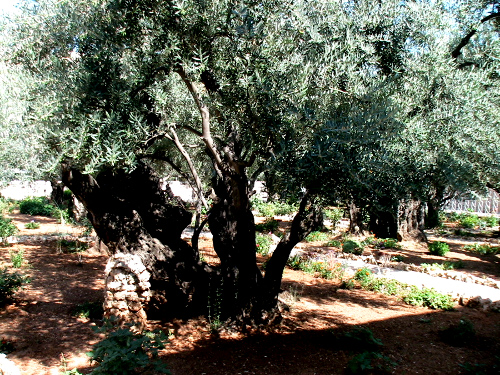
ancient_olive_treeI discovered (or maybe rediscovered, given the “leakiness” of my memory) a plausible answer, one that is in fact more plausible than any I’ve suggested above.

The first element to understand is that this tree represents all those who share faith in HaShem, who trust Him. Verse 20 is the key that shows the definition of this tree, because unbelief is the mechanism that breaks a branch off of the tree, and faith is the mechanism by which one remains on the tree. At one time, the only branches on that tree were the natural native ones, which is to say Jews. The cultivation of that tree represents the principles of the Torah covenant that inculcated faith into the entire culture of the Jewish people – thus Jews were a people who had been acculturated to the notion of faith or trust. Being broken off of the tree refers to a loss of faith or a rejection of it. Being grafted onto the tree represents acquiring faith (or regaining it if it had been lost or rejected). Wild branches represent non-Jews from cultures that were not acculturated to faith in HaShem. They were not naturally accustomed to it, but they could learn faith by means of the teachings of Rav Yeshua and thus be “grafted” onto the tree of faith to which they were not native, “contrary to nature” (meaning by means of deliberate intervention by a gardener). The sap of the tree must then represent the nourishment of Torah knowledge, perspective, and insight that Jews have cultivated for many centuries to elaborate the meaning of a life of faith. The root of the tree is thus the source of this nourishment, the Torah.

-a comment of Proclaim Liberty from
June 15, 2015 at 4:06 a.m on my blog post What am I, Chopped Liver?

That’s only part of PL’s rather lengthy missive, but it does serve to illustrate that, from his perspective, the Romans 11 tree isn’t Judaism, the Jewish people, or even Israel. The olive tree is a metaphor for faith and trust.

I provided a link above that points directly to PL’s comment so you can read the content in full (or re-read it given the current context). Frankly, I’ve puzzled over the nature of this tree for more hours than I care to think about without coming to a conclusion. I ended up setting the matter aside, figuring the answer would land in my lap eventually.

I think it finally has.

Of course, given the mention of the Torah being the nourishment the tree provides both to the natural (Jewish) and grafted in (Gentile) branches, what’s to prevent someone from concluding that both types of branches are equally obligated to the mitzvot?

PL responses to this in part:

Now, this analogy doesn’t quite answer the questions about Torah observance for non-Jews, though Acts 15 offers a starting point to differentiate between two discipleship types, and perhaps it also explains Rav Shaul’s reference to two different versions of gospel: one addressed to the circumcised, and the other to the uncircumcised (viz:Gal.2:7), neither of which is to be dismissed as merely so much “chopped liver”. [:)] It may be suggested, however, that an acculturation to faith certainly does occur as wild branches reside on the tree and absorb Torah nutrients, and receive treatment from the Gardener (e.g., pruning) comparable to that given the native branches. Moreover, by faith does it become possible to set aside insecurities, so as to enable facing the discomfort of working to distinguish between applications of Torah which apply to everyone (including wild branches) and those which apply only to someone else (i.e., only to the native ones). We can also consider what might be the implications for this analogy in the present era when so many wild branches come from cultures that have been already at least partially accustomed to the notion of faith in G-d, even if that faith has been contaminated with views that are contrary to Torah or Jews or Judaism or related notions.

James and the ApostlesActs 15:21 hints at the responsibility for non-Jews to learn Torah, even after it had just been clarified that their legal obligations to specific performance were very limited. Why then to learn? I would suggest that making the distinctions I described in the above paragraph requires a depth of Torah understanding, because even common principles of Torah might result in different praxis for Jews and for non-Jews to obey. For example, I recently was looking closely at the text of Is.56 (vs.2&6) to consider the characteristics of how the “foreigner”, who is being commended by HaShem for clinging to His covenant, actually approaches the Shabbat. He is described only as keeping from profaning it; whereas Jews are elsewhere commanded to actually sanctify it and guard it. This suggests some sort of difference in the specific behaviors associated with it. I’m still grappling with what that may mean, and how gentile obedience and compliance to this may thus differ from what I know as my Jewish responsibilities and praxis. But it does show that what constitutes obedience for one may be disobedience if another tries to do the same rather than what is appropriate to his or her categorical situation.

I know this is really long by Internet standards, but there is a lot of good information to absorb here. I think (my opinion) that PL is describing how complex and nuanced the Gentile’s “grafted-in-ness” is. There’s no easy black-and-white answer as to who we are and what we’re supposed to be doing as non-Jewish disciples, except that it’s not identical to what observant Jews are supposed to be doing.

We have clues, hints, and starting points, but I think it’s up to us to struggle with how we’re going to build our lives on the foundation of the Bible, and particularly how the Apostolic Scriptures present the lives of non-Jews in Messiah.

I just didn’t want to lose track of the very concept of the Romans 11 tree as a metaphor for Faith and Trust. Lack of faith may get a natural branch knocked off the tree temporarily, but it doesn’t turn a Jew into a non-Jew. Nothing can do that. Being grafted into the tree does not turn a Gentile into a Jew. We’ll always be Gentiles. It also doesn’t turn us into Israelites. Only Jews are Israel.

But being grafted in means we’ve come to faith in Hashem, the God of Israel, and we are nourished by the principles of Torah as applied to the Goyim.

faithI’m not writing this to present an answer or declare some amazing Biblical insight (particularly because the insight isn’t even mine). I’m just putting this here as another piece of the puzzle of our lives in God that may help to fill in the picture.

Oh, one more thing:

For I do not want you, brethren, to be uninformed of this mystery—so that you will not be wise in your own estimation—that a partial hardening has happened to Israel until the fullness of the Gentiles has come in; and so all Israel will be saved; just as it is written,

“The Deliverer will come from Zion,
He will remove ungodliness from Jacob.”
“This is My covenant with them,
When I take away their sins.”

From the standpoint of the gospel they are enemies for your sake, but from the standpoint of God’s choice they are beloved for the sake of the fathers; for the gifts and the calling of God are irrevocable.

Romans 11:25-29

Immediately after writing “if you were cut off from what is by nature a wild olive tree, and were grafted contrary to nature into a cultivated olive tree, how much more will these who are the natural branches be grafted into their own olive tree?”, Paul goes into how Israel’s “hardening” is only partial, that is, temporary, and will only last until “the fullness of the Gentiles has come in.” Then “The Deliverer will come from Zion” and “remove ungodliness from Jacob” so that “all of Israel will be saved.”

This is clearly New Covenant language and, as I’ve said many times before, I believe God will truly redeem all of Israel just as He promised. Paul was telling the Gentiles not to let being “grafted in” go to their (our) heads. The olive tree of faith has belonged to the Jews from the beginning. Any of the natural branches knocked off temporarily for the sake of the Gentiles, for our sake, will all be rejoined to the tree by Messiah. Even in being knocked off, temporarily losing the “faith connection,” it was done for the sake of the nations, so we owe a debt of gratitude, even to those Jews who currently reject the notion that Yeshua could possibly be the Messiah. That’s the majority of Jews across the past twenty centuries. Without their temporary absence from the root (and who is to say how absent they are since they cleave with great faith to Hashem), there would be no room for us.

Any Christian or non-Jew who calls themselves a “Messianic Gentile” or “Messianic whatever” who also disdains non-believing (let alone believing) Jews is guilty of ingratitude, not only to Israel but to God who arranged it all. Remember, the “promises are irrevocable.”

Let that sink in.

Connecting to the Tzaddik

“You ask how can you be bound (m’kushar)[1] to me when I do not know you personally…”

“…The true bond is created by studying Torah. When you study my maamarim, read the sichot[2] and associate with those dear to me – the chassidic community and the tmimim[3] – in their studies and farbrengens, and you fulfill my request regarding saying Tehillim[*]and observing Torah-study times – in this is the bond.”

-from “Today’s Day” for
Sunday, Sivan 24, 5703
Compiled by the Lubavitcher Rebbe; Translated by Yitschak Meir Kagan
Chabad.org

This sort of relates to the rather lengthy discussion taking place in the comments section of my What am I, Chopped Liver blog post. It speaks of one person being bound to another, even if they don’t personally know each other and even if they are separated by great distances (and maybe even by time).

In this case, it’s the bond between a Chassid and his (or her) Rebbe, and it’s established and maintained by the Chassid studying the informal and formal teachings of their Rebbe, as well as associating with current and former students of the Rebbe.

Yes, this is discussing a very specific relationship in the Lubavitcher community, however, I think I can adapt it for a somewhat different but related connection.

We’ve been discussing the status and halachah of non-Jews who are in some manner associated with the Messianic Jewish community, if only through how and what we study.

Mark Nanos
Mark Nanos

For instance, in reading, studying, and reviewing the Nanos and Zetterholm volume Paul within Judaism: Restoring the First-Century Context to the Apostle, I’m  attempting to gain a greater understanding of the Jewish Apostle Paul as applied to both the ancient and modern community of Jews and Gentiles in Messiah. In this, it can be said that I’m associated or connected to the Messianic Jewish community by my choice of study materials and how I’m allowing the essays in the aforementioned volume to modify and shape my understanding of the Apostolic Scriptures.

In other words, I’m a Gentile Christian who studies Messianic Judaism in order to stand on the Jewish foundation of the Bible.

Actually, it’s not just the foundation of the Bible that’s Jewish but the entire collection of books.

So what am I doing?

Adapting the quote above, I’m studying the teachings of my Rebbe (and all of the related teachings) in order to bind myself to my Master, even though he and I are separated by culture, nationality, history, and even death. Not that he’s dead of course, but I must go through death and resurrection one day as his disciple.

According to the second requirement, I must also associate with his students. That’s a tough one. Who do I associate with? The most obvious answer would be other Messianic Gentiles, but I only regularly see one in my little corner of Idaho and we don’t always speak to each other on matters of faith.

Can there be association via the Internet? If the answer is “yes,” then I regularly associate with Messianic Gentiles and a few Messianic Jews via conversations on this blog spot.

Again, this is a rather loose adaptation of a very specific process among the Chassidim.

Why do I bring this up?

MessiahBecause it gives us a loose set of guidelines as to how we are to relate to Yeshua and to each other. Chances are, just about everyone reading these words, or at least my regular readers, are already doing these things. We are already reading the Bible, including the Torah and the Prophets, studying the teachings of Yeshua in the Gospels, and of his disciples and apostles in the Epistles and Apocrypha. We also study related commentaries that offer additional insight into Jewish thought, not with the idea that we are obligated to take up all of the mitzvot, but to attain greater closeness to our own “Rebbe”.

In all likelihood, we are all, in some way, associating with other students of our Master, in the face-to-face or virtual worlds or both. Technically, we could go to a traditional church and associate with the Master’s students, but their understanding of his teachings are sometimes radically different from our own, so much so, that it seems as if we are speaking different languages to one another.

So I’m using some snippet of information from the Jewish world, applied very specifically to Chassidic Jews and adapting it for potential (or actual) use by Messianic Gentiles.

While periodically our bond with Messianic Jews, some of them anyway, can seem rather tenuous, based on the needs of the Messianic Jewish community, the bond between any disciples and their Rebbe, whether Jew or Gentile, should never come into question. It definitely should not come into question because we are “just” Gentiles.

After all:

For you are all sons of God through faith in Christ Jesus. For all of you who were baptized into Christ have clothed yourselves with Christ. There is neither Jew nor Greek, there is neither slave nor free man, there is neither male nor female; for you are all one in Christ Jesus. And if you belong to Christ, then you are Abraham’s descendants, heirs according to promise.

Galatians 3:26-29 (NASB)

Of course Paul is not obliterating the covenant distinctions between Jews and Gentiles anymore than he is destroying gender distinctions between men and women, but he is saying that we all have equal standing in the ekklesia of Yeshua. We are all “clothed in Messiah,” as it were, so that regardless of our social roles in the Messianic community, we can all consider ourselves as belonging to Messiah and descendants of Abraham’s based on God’s promise to Abraham that he would be the father of many nations.

AbrahamGentiles are not heirs of the Sinai covenant, as are the Jews, but we are all Abraham’s children spiritually, though the Jews are also physical descendants through Isaac, and then Jacob, and then all of Jacob’s offspring.

Even if you don’t always feel close to the Jews in the Messianic Jewish community, or for that matter, some of the non-Jews, the words of Paul attest that we can and are close to our Master, the mediator of the New Covenant promises, he who through God’s mercy and the Master’s faithfulness, brings those of us  who were once far off to be close to our Master for the glory of Hashem.

I just wanted you to know that.

Footnotes

1. The bond between Chassid and Rebbe is termed hitkashrut (see Elul 10).
2. Informal talks, as distinct from maamarim which are formal dissertations of chassidic philosophy.
3. Present as well as former students in the Lubavitcher yeshivot are known as “Tmimim.
*. “At the time this letter was written, it had not yet become widely known about the establishment of the practice to study Chumash with Rashi daily, and to study Tanya as apportioned for every day of the year.” Footnote 4, Page 328, Sefer Hamaamarim Basi Legani.

Book Review of Paul within Judaism, “The Question of Worship: Gods, Pagans, and the Redemption of Israel”

Paul’s convictions about the impeding dawn of God’s kingdom place him securely within the world of the late Second Temple Jewish apocalyptic hope. But Paul’s biblical tradition was Greek, not Aramaic or Hebrew. His audience–unlike that of Jesus and of the earliest disciples–was pagan, not Jewish. And he stretched his time-driven gospel over the spatial frame provided by antiquity’s map of the cosmos.

-Paula Fredriksen
from the beginning of her essay
“The Question of Worship: Gods, Pagans, and the Redemption of Israel”
Paul within Judaism: Restoring the First-Century Context to the Apostle (Kindle Edition)

I had a difficult time wrapping my head around Fredriksen’s essay at first but when I finally figured out where she was going, not only did everything click into place, but I saw the connections between what she was saying and what I wrote about not that long ago.

Fredriksen draws a sharp distinction between the teaching and mission of Jesus (Yeshua) and that of Paul. While Jesus operated almost exclusively within a Jewish context, speaking to Jews, drawing Jewish disciples, training Jewish apostles, Paul had an extremely different audience to contend with and an environment at odds with Jews and Judaism, the pagan arena of the diaspora.

While the message of Jesus, the repentance of the Jewish people and return to the Torah in preparation of the coming Kingdom of Heaven, was not particularly surprising, Paul’s role required him to do the astonishing. He had to bring Gentiles out of worshiping pagan gods and into exclusive devotion to the One God of Israel, while leaving them in their diaspora towns, cities, and countrysides, living among idol worshiping family, friends, and business associates.

The Church tends to take all this for granted, having Paul preached to them like any modern missionary they know or have read about, but in fact, he was charting a course through unexplored territory, doing what no one had ever done before, at least on such a large-scale, and dealing with Gentiles not only as different ethnicities, but as pagans.

Today, we separate one’s ethnic orientation from their religion, but in ancient times, no such distinction was made. Lifestyle, business, family life, everything tied together into one’s identity. So a Jew practiced Judaism and Gentiles practiced some form of pagan worship, although, as I said, it was really all a part of living your life as you had been born.

interfaithOccasionally, a non-Jew would undergo the proselyte rite and live among Jews as a Jew, but Paul was attempting to bring a large number of Gentiles into a form of Judaism, while having them remain wholly distinct from Jewish ethnicity and obligation to the Torah mitzvot.

What we think of as “religion” ancient people accordingly constructed as an inheritance: “mos maiorum, fides patrum, ta patria ethe, paradoseis ton patrikon (this last from Paul, Gal. 1:14). “Religion” as a category separable and separate from one’s “family”–household to empire–did not exist.

And…

Finally, gentile versus pagan masks the degree to which not only households but also cities were family-based religious institutions.

In some ways, what Jesus had attempted in the Jewish homeland among his own people was all but child’s play compared to the mission he gave to Paul. While Jesus was imploring the Jews around him to return to a Torah lifestyle that was their inheritance, Paul was directing pagan Gentiles to leave behind everything they had ever known to join with a foreign people, the Jewish people, in worshiping what for them would have been an alien God.

I suppose I’m leaving out the non-Jewish “God Fearers” who frequented synagogues in the diaspora nations, but according to Fredriksen, these “God Fearers,” while worshipping and praying to Israel’s God on Shabbos, also worshipped and prayed to the various pagan gods during the other days of the week. As long as they behaved themselves while in Jewish community, these “God Fearers” were not required to leave their other “gods” behind.

Changing gods “was tantamount to changing ethnicity” but without undergoing the formal rite of conversion, abandoning the pagan gods and worshiping the God of Israel only would seem not only bizarre, but an all but impossible act.

What was everyone, human and divine, so upset about? Paul (and others like him), in proclaiming the gospel, radically disrupted the long-lived and socially stable arrangements prevailing between synagogues, god-fearers, and the larger pagan community; and they disrupted relations within the pagan community itself, from those of immediate family right up through the larger family of fellow citizens and the cities’ gods.

It’s easy to see why just about everybody learned to hate Paul, from many of the Jews in the diaspora, to the citizens of the various pagan communities in which the Apostle operated. He was stirring up a hornet’s nest of trouble no matter who he talked to, Jew or Gentile. The Jews needed the good will of the Gentile community around them and the Gentiles needed to be able to live life as was expected of them by the self-same community. Paul threatened all of that.

Receiving the SpiritIt was a miracle that anyone bucked the system at all and came to faith, and yet it was a miracle God arranged.

But this, as I suggested above, put the Gentile disciples into an uncertain state:

But Paul’s pagans fell into neither category. Like converts, his pagans made an exclusive commitment to the god of Israel; unlike converts, they did not assume Jewish ancestral practices (food ways, Sabbath, circumcision, and so on). Like god-fearers, Paul’s people retained their native ethnicities; unlike god-fearers, they no longer worshiped their native gods. Paul’s pagans-in-Christ are neither converts nor god-fearers.

Then Fredriksen asked the poignant question:

So who and what are they?

The very same question I’ve been dealing with lately.

You may not like Fredriksen’s answer:

…they occupied a social and religious no-man’s land. Eschatologically, however, they represented a population long anticipated within centuries of Jewish restoration theology: they were pagans-saved-at-the-End.

Paul and the other apostles and elders in the ancient Messianic movement then known as “the Way,” would have seen these droves of Gentiles turning to Israel’s God through Jesus-devotion as the fulfillment of prophesy, that at the coming of the close of the present age, the Goyim would be redeemed as part of God’s overarching plan of redemption for Israel.

Seen from that perspective, it would have been a very exciting time for Paul. He couldn’t possibly have realized that nearly two-thousand years later, both Israel and the faithful among the nations would still be waiting for Messiah’s return. He may indeed have believed, as other Jews in Messiah did, that Yeshua’s coming back in power and glory was imminent.

I’ve mentioned in other blog posts, both related to this review series and otherwise, that in all likelihood, Paul had no idea how to fully resolve the social status of Gentiles in Jewish community, including the development of a complete and functional halachah for such a population.

If I’m reading Fredriksen right, he likely didn’t think this was a problem. If Messiah’s return was right around the corner, so to speak, why bother? The effort would be wasted and Yeshua would be back so quickly that he’ll be the one who will finish the job of establishing how Gentiles were supposed to be integrated.

Restoration
Photo: First Fruits of Zion

Or, given that all Jews were to be returned to Israel as part of the Messianic promise, all Israel’s enemies would be defeated and removed from the Jewish homeland, and all (or the vast majority) of Gentiles would reside in their own nations, the task of integration would be completely unnecessary. Except for events such as the moadim in which devoted Gentiles would come to Jerusalem to pay homage to God, Jews and Gentiles in the Messianic Kingdom might not do much mixing at all, at least as Paul may have seen things.

Here’s an important point Fredriksen made that I think should be shared:

What about Paul? Paul’s circumstances differed pointedly from those of the Baptizer and of Jesus. His “mission field” was the cities of the eastern empire. His hearers were not Jews but pagans. And these he called to repent not of “Jewish” sins (i.e., breaking the commandments), but of “pagan” sins (most especially idolatry and its perennial rhetorical companion, porneia).

I mentioned this above but here we see Fredriksen emphasizing the imperative of each population repenting of sins specifically connected to their own populations in terms of how they had come into relationship with God. For Jews, it was primarily the Sinai and New Covenants, and while the New Covenant blessings also could be applied to the Gentile believers in terms of the promise of the resurrection and giving of God’s Spirit, that overlap only covered just so much common ground.

One of the clearer commandments for the Gentiles was to worship the God of Israel only, but their/our lives were not so specifically defined and delineated as were the Jews.

The Gentiles were to practice righteousness and justice, but these concepts were less “about religious sentiment than about showing respect.”

So how were the Gentiles called to “fulfill the law” (Rom. 13:8-10; Gal. 5:14-15; 1 Cor. 14:34)?

The common translation of the Greek in Romans 5:1 is rendered “justified by faith” but Fredriksen suggests that this would better be understood as a directive for the non-Jewish disciples to practice piety toward God and justice (charity) toward others.

Piety toward God can be covered in commandments such as no other gods, no graven images (idols), and no abuse of God’s Name, while justice toward others is exemplified in no murder, no adultery (or other sexual sins), no theft, no lying, and no coveting.

So, reading Paul without anachronism, “fulfilling the law” for a Gentile means turning away from pagan idols and turning to God alone as the One God “through baptism into the death, resurrection, and impending return of his [God’s] son” and making “right toward each other by acting rightly toward each other–‘not like the ethne who did not know God’ (1 Thess. 4:5; cf. Rom. 1:18-32).”

JerusalemBut then “who enters the Kingdom,” as Fredriksen asks? This is also a question recently asked in the comments section of my aforementioned recent blog post.

Since approximately the second century, in part basing their view on their reading of Romans 9-11, most Christians have answered “only Christians.” This despite Paul’s insistence, in this very passage of Romans, that “the fullness of the ethne” and “all Israel” will be saved (11:25-26), and that God’s promises are “irrevocable” (11:29; cf. 15:8).

No, not “true Israel” or “new Israel” but “all Israel will be saved!” Exclamation point. End of story.

But Fredriksen says not just all Israel but “the fullness of the Gentiles”. That sounds like a lot, and that’s not a very Christian point of view.

God’s universalism, in short, is a very Jewish universalism. And his particular universalism is reflected in the ways that Paul imagines ethnicity in the eschatological community, both the proleptic one of the present ekklesia, before the Parousia, and the final community, once Christ returns.

In both present ekklesia and future Kingdom, Jews and Gentiles are “one in Christ” (Gal. 3:28) and yet Paul absolutely insisted that all those “in Christ” should and must remain Jew and Gentile, distinct from one another, and Paul “has no problem accommodating both difference and oneness.”

That may not have been a problem for Paul, especially as I said before, because he believed the present ekklesia was to be short-lived and Messiah would settle the matter once the Kingdom was established, but it’s a problem we struggle with today, if only for those of us who have left the anachronistic interpretive traditions of Christianity behind and who have chosen to engage with the Jewish scriptures on their own terms.

If the nations, through an eschatological miracle, now worship Israel’s god alone, then even though they remain ethnically distinct, they are spiritually joined to God’s family.

Even our ability to call God “Abba, Father” (Gal. 4:6; Rom. 8:15) is a deeply mystical mystery, one we may end up spending all of our lives exploring.

According to Fredriksen, the Jewish Paul believed “Eschatological Israel will stand together with but distinct from the other nations, for they are the nation long ago set apart by God.”

I completely and wholeheartedly agree, both with Fredriksen and with Paul (assuming Fredriksen’s understanding of Paul is correct).

The Jewish PaulIt may not seem so, but I’ve only scratched the surface of Fredriksen’s article regarding the connections between Gentile devotion to the God of Israel and the redemption of Israel herself.

So far, I’ve found all of the chapters I’ve read and reviewed to be very illuminating and edifying and I hope, if you choose to read the Nanos/Zetterholm volume, that you will as well.

There are only three essays left for me to consume, though it seems like I’ve gotten through little more than half the book.

I’ll post my next review soon.