Category Archives: Uncategorized

Listening for the Spirit Within Us

Hashem descended in a cloud and spoke to him, and He increased some of the spirit that was upon him and gave it to the seventy men, the elders; when the spirit rested upon them, they prophesied, but did not do so again.

Two men remained behind in the camp, the name of one was Eldad and the name of the second was Medad, and the spirit rested upon them; they had been among the recorded ones, but they had not gone out to the Tent, and they prophesied in the camp.

Numbers 11:25-26 (Stone Edition Chumash)

When the day of Pentecost had come, they were all together in one place. And suddenly there came from heaven a noise like a violent rushing wind, and it filled the whole house where they were sitting. And there appeared to them tongues as of fire distributing themselves, and they rested on each one of them. And they were all filled with the Holy Spirit and began to speak with other tongues, as the Spirit was giving them utterance.

Acts 2:1-4 (NASB)

As at least some of you may know, the first quote is from Torah Portion Beha’alotcha, which was read in synagogues all over the world last Shabbos.

The second quoted scripture is the famous Pentecost event when the Apostles received the Holy Spirit of God and began speaking in many different languages, languages they did not normally know.

As Christians, we are taught that anyone who comes to faith in Yeshua (Jesus) immediately receives the indwelling of the Holy Spirit and that the Spirit will guide us in all things. Yeshua said something to this effect.

These things I have spoken to you while abiding with you. But the Helper, the Holy Spirit, whom the Father will send in My name, He will teach you all things, and bring to your remembrance all that I said to you. Peace I leave with you; My peace I give to you; not as the world gives do I give to you. Do not let your heart be troubled, nor let it be fearful.

John 14:25-27

However, in each and every scripture I’ve quoted, the objects of receiving the Spirit and the audience of Yeshua’s words are Jews. So far, all we know (if we knew nothing else) is that Jews receive the Holy Spirit under certain circumstances, perhaps like the seventy elders and the Apostles, to prepare a specialized population for a highly specific set of duties.

But then there’s this:

While Peter was still speaking these words, the Holy Spirit fell upon all those who were listening to the message. All the circumcised believers who came with Peter were amazed, because the gift of the Holy Spirit had been poured out on the Gentiles also. For they were hearing them speaking with tongues and exalting God. Then Peter answered, “Surely no one can refuse the water for these to be baptized who have received the Holy Spirit just as we did, can he?” And he ordered them to be baptized in the name of Jesus Christ. Then they asked him to stay on for a few days.

Acts 10:44-48

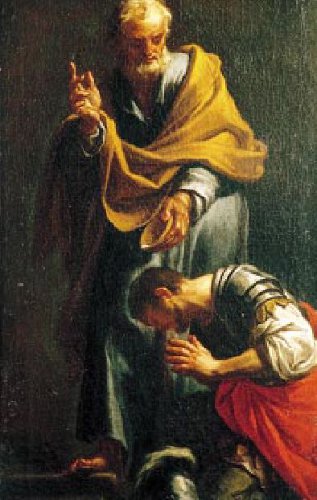
cornelius
Peter and Cornelius

Obviously the Roman (Gentile) Centurion Cornelius and all those other Gentiles in his household received the Holy Spirit. Peter and the Jews who were with him were direct witnesses to the event and it was something that was obviously apparent to them in a physical manifestation.

“These six brethren also went with me and we entered the man’s house. And he reported to us how he had seen the angel standing in his house, and saying, ‘Send to Joppa and have Simon, who is also called Peter, brought here; and he will speak words to you by which you will be saved, you and all your household.’ And as I began to speak, the Holy Spirit fell upon them just as He did upon us at the beginning. And I remembered the word of the Lord, how He used to say, ‘John baptized with water, but you will be baptized with the Holy Spirit.’ Therefore if God gave to them the same gift as He gave to us also after believing in the Lord Jesus Christ, who was I that I could stand in God’s way?” When they heard this, they quieted down and glorified God, saying, “Well then, God has granted to the Gentiles also the repentance that leads to life.”

Acts 11:12-18

Peter reported all this to the “apostles and the brethren” in Jerusalem, and after hearing his testimony, they glorified God saying “Well then, God has granted to the Gentiles also the repentance that leads to life.”

This was even confirmed later by Peter at the legal proceeding held by James and the Jerusalem Council for formally establishing the status of Gentiles in Messianic Jewish community:

After there had been much debate, Peter stood up and said to them, “Brethren, you know that in the early days God made a choice among you, that by my mouth the Gentiles would hear the word of the gospel and believe. And God, who knows the heart, testified to them giving them the Holy Spirit, just as He also did to us; and He made no distinction between us and them, cleansing their hearts by faith.”

Acts 15:7-9

Clearly, God intended for non-Jews to enter into the community of faith and be saved in a manner identical to the Jews, receiving the Holy Spirit, just as the Jewish believers did.

More than that, it was foretold long before these events that many nations would turn to the God of Israel:

Many nations shall become a people unto Me, but I will dwell among you — then you will realize that Hashem, Master of Legions, has sent me to you.

Zechariah 2:15 (Stone Edition Chumash)

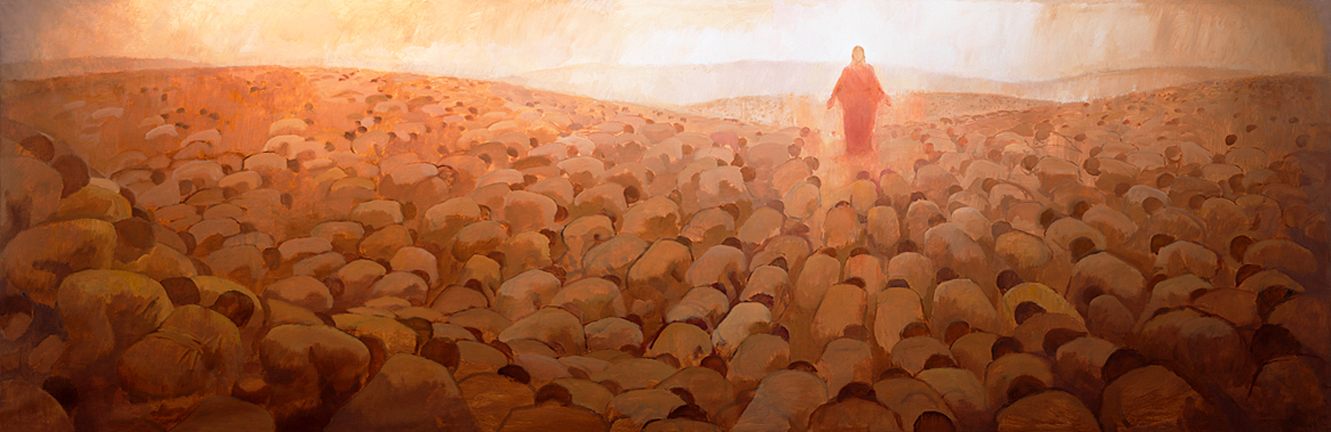
Every Knee Shall Bow
Photo credit: art.jkirkrichards.com

The Tanakh is replete with prophesies regarding the nations turning to God at the dawning of the Kingdom of Heaven, a Kingdom Yeshua’s advent inaugurated into our world, but I’ll only quote this one as it was part of last week’s Haftarah portion.

It seems my last blog post caused a disturbance among some of my non-Jewish readers relative to the uncertainty of our status in modern Messianic Jewish community. It was never my intension to upset or disturb anyone. Actually, quite the opposite.

I wanted to emphasize that even though, as we saw in the passage I quoted from Zechariah, God will dwell among Israel, even as He rules the entire world, Gentile lives matter, too. We’re not just an afterthought in God’s redemptive plan. We are not just God’s left-handed, red-headed step-children, the ones you hide in the closet when company comes over. We have a very specific purpose in the Kingdom.

But it’s sometimes easy to get the idea that Gentiles are indeed an afterthought given all the emphasis on Jews and Judaism on Messianic Jewish websites and blogs, and in such publications, and sermons.

However, I also brought up some uncomfortable ideas regarding our existence in my previous article: we don’t have a very exact roadmap regarding mitzvot or lifestyle, at least nothing as detailed as do the Jewish people.

I decided to focus on the Holy Spirit in today’s “morning mediation” for a few reasons:

I will give you a new heart and put a new spirit within you; I will remove the heart of stone from your flesh and give you a heart of flesh. I will put My spirit within you, and I will make it so that you will follow my decrees and guard my ordinances and fulfill them.

Ezekiel 36: 26-27 (Stone Edition Tanakh)

This is part of the New Covenant promises Hashem made to Israel, the giving of the Holy Spirit, which we saw fulfilled in Acts 2 when it was given to the Jewish Apostles, and in Acts 10 when Peter witnessed it being given to the faithful Gentiles in the household of Cornelius.

But it’s interesting that a promise made exclusively to Israel somehow was transmitted to those Gentiles who came to faith in Yeshua as the foretold Messiah.

Actually, we have another giving of the Spirit that needs to be included.

Then Yeshua came from the Galil toward the Yarden to Yochanan, to be immersed by him. But Yochanan tried to prevent him, saying, “I need to be immersed by you, and yet you come to me?” Yeshua answered and said to him, “Permit me, for so it is appropriate for both of us to fulfill the entire tzedakah,” so he permitted him. When Yeshua was immersed, he quickly came up out of the water. Heaven was opened to him, and he saw the spirit of God descending in the likeness of a dove, and it rested upon him.

Matthew 3:13-16 (Delitzsch Hebrew Gospels)
hebrews_letterPart of what I learned in listening to D. Thomas Lancaster’s sermons on the Holy Epistle to the Hebrews is that Yeshua, as the arbiter of the New Covenant, came, in part, to deliver “samples” of the New Covenant blessings to Israel, and apparently through them, to the Gentiles. This was to be evidence that God will indeed keep His promises to Israel (and somehow some of those promises also apply to the nations) at the appropriate time.

We see the New Covenant promise of the giving of the Holy Spirit in Ezekiel 36, we see Yeshua receiving the Spirit in Matthew 3, the Apostles receive the Spirit in Acts 2, and some faithful Gentiles receive it in front of Jewish eyewitnesses in Acts 10.

This should be pretty encouraging to some of the people who were dismayed at the content and discussion regarding my chopped liver blog post.

There’s just one problem:

The eunuch answered Philip and said, “Please tell me, of whom does the prophet say this? Of himself or of someone else?” Then Philip opened his mouth, and beginning from this Scripture he preached Jesus to him. As they went along the road they came to some water; and the eunuch said, “Look! Water! What prevents me from being baptized?” [And Philip said, “If you believe with all your heart, you may.” And he answered and said, “I believe that Jesus Christ is the Son of God.”] And he ordered the chariot to stop; and they both went down into the water, Philip as well as the eunuch, and he baptized him. When they came up out of the water, the Spirit of the Lord snatched Philip away; and the eunuch no longer saw him, but went on his way rejoicing.

Acts 8:34-39 (NASB)

The Ethiopian eunuch (a subject worthy of his own study), who was (in my opinion) most likely a Jew, did not receive the Holy Spirit, or at least Luke didn’t record it. But why, if he received the Spirit, would Luke have omitted this important point? If it was just assumed by Luke, then why did he include that the eunuch was baptized, which also could have been assumed?

Furthermore:

It happened that while Apollos was at Corinth, Paul passed through the upper country and came to Ephesus, and found some disciples. He said to them, “Did you receive the Holy Spirit when you believed?” And they said to him, “No, we have not even heard whether there is a Holy Spirit.” And he said, “Into what then were you baptized?” And they said, “Into John’s baptism.” Paul said, “John baptized with the baptism of repentance, telling the people to believe in Him who was coming after him, that is, in Jesus.” When they heard this, they were baptized in the name of the Lord Jesus. And when Paul had laid his hands upon them, the Holy Spirit came on them, and they began speaking with tongues and prophesying.

Acts 19:1-6

Apparently it’s possible to come to faith in Yeshua, to receive a water baptism, but not to receive the Holy Spirit.
tongues of fireI’m just shooting in the dark at this point, but as a believer for many years, while I can recall the moment I came to faith, no specific physical event occurred indicating that I had received the Holy Spirit. I was baptized in the Boise River along with my wife and children in August of 1999, but nothing like the Acts 2 or Acts 10 events occurred (although Acts 10 does not describe what Peter witnessed that told him Cornelius and his household had received the Spirit except that they spoke in tongues  and praised God).

Is it possible in the community of faith for some of us to possess the indwelling of the Spirit of God and others to not possess it? Further, with no physical evidence of the Spirit resting upon us as described in the multiple Bible quotes I’ve offered, how can we say the Spirit is on us or in us at all? Did you speak in tongues and utter prophesies? I didn’t.

I know that there’s a general consensus in Evangelical circles that the “age of miracles” ended when Christian Biblical canon was closed, but there are all sorts of anecdotal stories other Christians tell of spiritual manifestations and even miracles that happen all around us (though they seldom if ever make it into mainstream news reports).

I don’t have a definitive answer to all this. Maybe someone out there does. I have to take it on faith that I do possess the Holy Spirit, only because Christian tradition says I must if I’m a believer.

On the other hand:

Not everyone who says to me, “My master! My master!” will enter the kingdom of Heaven, but rather the one who does the will of my Father who is in heaven. It will be that on that day many will say to me, “My master, My master, did we not prophesy in your name and in your name drive out demons and in your name do many wonders?” Then I will answer them, saying, “I have never known you. Depart from me workers of evil!”

Matthew 7:21-23 (Delitzsch Hebrew Gospels)

That’s rather sobering.

Think about it. There’s a class of believers who are capable of performing actual supernatural acts, apparently in the name of Yeshua, and yet, the Master does not know them and even calls them “workers of evil”.

How about this?

But also some of the Jewish exorcists, who went from place to place, attempted to name over those who had the evil spirits the name of the Lord Jesus, saying, “I adjure you by Jesus whom Paul preaches.” Seven sons of one Sceva, a Jewish chief priest, were doing this. And the evil spirit answered and said to them, “I recognize Jesus, and I know about Paul, but who are you?”

Acts 19:13-15 (NASB)

I’m not sure this is an example of what Yeshua was talking about, but just paying the Master lip service, so to speak, doesn’t seem to be enough to get you “into the club,” as it were.

So what do we do as faithful Yeshua-followers?

Yeshua said to him, “Love HaShem your God with all of your heart, with all of your soul, and with all of your knowledge.” This is the greatest and the first mitzvah. But the second is similar to it: “Love your fellow as yourself.” The entire Torah and the Prophets hang on these two mitzvot.

Matthew 22:37-40 (Delitzsch Hebrew Gospels)

I know Yeshua was speaking to a Jewish audience, but I think that it is appropriate to consider this a commandment that also applies to us, that is, we non-Jews in Messiah. Why shouldn’t we also love God with all of our resources and love other human beings as we love ourselves? It would seem this “Torah” is one that also forms the core of our existence as disciples of the Master and worshipers of Israel’s God.

I still feel like I’ve opened a can of worms I can’t seem to close again. With all of this, what are we supposed to do next, particularly if we, in some way, exist either directly or tangentially in Jewish community?

That might take a long time to find out. Certainly an inventory of each and every instruction Paul gave in his epistles to the Gentile disciples, as viewed from a Paul Within Judaism perspective, would be in order.
109
Messiah Journal 109

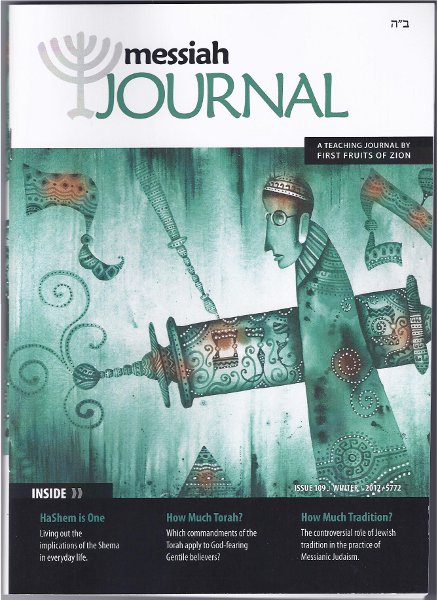
Actually, back in February 2012, First Fruits of Zion (FFOZ) published an article written by Toby Janicki in Messiah Journal issue 109 called The Gentile Believer’s Obligation to the Torah of Moses. Unsatisfied with my original review which I wrote at the time, I wrote another one over a year later (which was nearly two years ago now).

It doesn’t answer the conundrum regarding the Holy Spirit or how some people could sincerely believe they were serving Yeshua and yet be so horribly wrong, but as far as getting some sort of handle of who Gentiles are supposed to be in what is essentially, a Jewish religious form, it might be a good place to start, at least for those of you who are experiencing a crisis of community.

The rest will have to come along by the by.

What am I, Chopped Liver?

For the conductor with the neginos, a psalm, a song. May God favor us and bless us, may He illuminate His countenance with us, Selah. To make known Your way on earth, among all the nations Your salvation. The peoples will acknowledge You, O God; the peoples will acknowledge You — all of them. Regimes will be glad and sing for joy, because You will judge the peoples fairly and guide with fairness the regimes on earth, Selah. The peoples will acknowledge You, O God; the peoples will acknowledge You — all of them. The earth will then have yielded its produce; may God, our God bless us. May God bless us, and may all the ends of the earth fear Him.

Psalm 67 (Stone Edition Tanakh)

Forgive the somewhat whimsical title for today’s “morning meditation” along with the equally whimsical “featured image.”

When I read the above quoted Psalm on Shabbat, I was reminded that God has a redemptive plan, not just for Israel, the Jewish people, but for all the people of all the nations of the earth, that is, the Gentiles.

I suspect God has had this plan since before the creation of the universe, but we definitely know He had it when this Psalm was written, long before the birth of Yeshua (Jesus).

I strongly advocate Jewish return to the Torah mitzvot, whether they are Jews in the Messianic movement or otherwise. I strongly advocate for Jewish places of congregation and worship in Messianic Judaism, synagogues and communities by and for Jewish disciples of Messiah. I strongly believe in and advocate for the idea that without God’s plan of redemption for Israel, there can be no hope of redemption for the goyim.

All that said, there are times when I feel all of that Judaism weighing heavily upon me. In advocating for the Jewish right to cleave to their Messiah King and to have possession of their own Land and their own Torah, I don’t want to lose sight of the fact that God also recognizes and loves the rest of humanity, a non-Jewish humanity.

prayingGranted, there’s nothing in that Psalm that directly says “God so loved the world” (John 3:16), but it does say that the (Gentile) regimes will “be glad and sing for joy” because God will judge among us fairly. We will all acknowledge the God of Israel and the “earth will then have yielded its produce.”

The harvest is great, but the workers are few.

Matthew 9:38 (Delitzsch Hebrew Gospels)

Then those also who have fallen asleep in Christ have perished. If we have hoped in Christ in this life only, we are of all men most to be pitied. But now Christ has been raised from the dead, the first fruits of those who are asleep.

1 Corinthians 15:18-20 (NASB)

“Produce.” “Harvest.” “First fruits.” It seems that it is not only the Jews who are counted among the harvest, but the rest of us as well, all of us who trust in the promises of God as demonstrated by Messiah.

A person who comes to Torah on his own volition does so because of the beautiful and elevated ideas he hears about Torah principles. He made his decision on the assumption that those who follow the Torah will act towards him in accordance with all the Torah laws pertaining to interpersonal relations. If someone cheats him financially or in any other way wrongs him, he will not only suffer a monetary loss. Rather, he might also feel disillusioned with his decision to accept Torah as a way of life.

-Rabbi Zelig Pliskin
“Act with love and kindness towards converts,” discussing Bamidbar (Numbers) 5:6
Commentary on Torah Portion Naso, p. 312
Growth Through Torah

While Rabbi Pliskin is discussing converts to Judaism in this above-quoted statement, and while I don’t believe we “Messianic Gentiles” are called to Torah obligation in the manner of the Jewish people, I don’t think it’s entirely inappropriate or inaccurate to say that, in a way, we also come to the Torah, as it applies to us, “because of the beautiful and elevated ideas” expressed in the “Torah principles.”

I don’t feel put upon or mistreated by any Messianic Jews as such, but I do need to remind myself periodically that we non-Jews also have a role to play. More than that, I need to provide some much-needed perspective to who we non-Jews are in Messiah.

While I recently wrote that the identity of the Messianic Gentile, both in ancient and modern times, may be ill-defined by design, I’ve also offered my opinion on what I think we’re here for.

desert islandBut in addition, I believe that even one non-Jewish disciple of Yeshua could be stuck on a deserted island with nothing but his or her Bible, yes, adequate food, water, and shelter, but no other human companionship, Jewish or otherwise, and still have a relationship with a loving and caring God because of the faithfulness of Messiah. I think there are times when Messianic Jews should advocate for Gentile devotion to God and express the clear knowledge that God does cherish even the goyim. I believe the door should swing both ways within the ekklesia of Moshiach.

It is easy to focus on the differences among people and to consider yourself as separate from others. Truly no two people are exactly alike. But there are many common factors among people. By focusing on the fact that every human being is created in the image of the Almighty you will have greater identification with others and this will lead to greater unity.

-Rabbi Pliskin
“With unity there is a blessing,” p.316
Commentary in Torah Portion Naso, discussing Bamidbar (Numbers) 6:24

I suppose when Rabbi Pliskin wrote “differences among people,” he could and probably did mean “differences among Jews,” but in saying that “every human being is created in the image of the Almighty,” he opened the door to all of humanity, Jews and Gentiles alike.

While I have advocated for a strong recognition of the covenant distinctions between Messianic Jews and Gentiles, we also must counterbalance that knowledge with our unity in Messiah’s ekklesia. We may be in many ways separated from each other by those covenant distinctions, but while we are not a homogenous population, there aren’t two Messianic ekklesias, there is one, just as God is One and yet has many diverse names and many distinctive qualities.

Recently, Derek Leman wrote what I consider to be a pair of “bookends” on his blog: Why Non-Jews Are Drawn To Messianic Judaism and On Messianic Judaism As A Home For Jewish Believers.

Each blog post advocates for its named subject, Gentiles in one and Jews in the other.

In both Jewish and non-Jewish zeal to promote and elevate the Jewishness of Messianic Judaism, I’m glad to see some noteworthy Messianic Jewish writers and teachers specifically addressing both sides of the coin.

I think one of the reasons Gentile believers exited Jewish community nearly twenty centuries ago and why there are some Hebrew Roots promoters in the modern age who not only advocate but demand equal obligation to Torah as some sort of right, is as an attempt to create a significant and meaningful Gentile identity in the body of Yeshua-believers.

In the end, the first and second century believing Gentiles may not have been able to find that identity in Jewish community, so they made the worst possible decision and not only separated from the Jews, but “demonized” everything Jewish, reimaging the Jewish Messiah as the Gentile Christ, and warping everything ever taught by Yeshua and the Apostles, specifically Paul’s teachings.

the crowdI believe that many so-called “One Law” advocates cling to their views because the dissonance of differing and distinct roles and identities of Jews and Gentiles in the Messianic ekklesia is too difficult to bear. This probably also explains why a number of we Messianic Gentiles have mistakenly converted to some form of Judaism, Messianic and otherwise, in an attempt to find meaning and purpose in the service of God among Jewish community.

However, as a non-Jew and a devotee of the Jewish Messiah King, I do have meaning and purpose in the redemptive plan of God for our world. Yes, it’s first to the Jew and only afterward, to the Gentile, but it is to the Gentile at a specific point in that plan.

The plan has already entered our world and it has been slowly unfolding for the past two-thousand years. That plan has included an untold number of Gentiles and as important as Jewish Torah observance and devotion to Moshiach is, the plan will never be complete without the rest of us.

I just needed to remind you and especially me by saying all this. Thanks for reading.

Book Review of Paul Within Judaism, The Question of Identity: Gentiles as Gentiles–but also Not–in Pauline Communities

I have long puzzled over how to understand the gentiles in Paul, both from his perspective and their own perspective. I operate under the assumption that he is writing primarily to them and his goal is to articulate and manage just how they are connected to Israel through Christ. In the process, as I have discussed elsewhere, both he and they undergo various transformations in identity, changes that, I maintain, never separate him from Judaism and that affiliate gentiles with Israel but not as full members. They are not Jews and, in my view, they are not Christians…

-Caroline Johnson Hodge
Mark D. Nanos and Magnus Zetterholm, Editors
“The Question of Identity: Gentiles as Gentiles–but also Not–in Pauline Communities”
Paul within Judaism: Restoring the First-Century Context to the Apostle (Kindle Edition)

More than the previous essays I’ve reviewed from this volume, this one speaks in detail not only to the identity issues involved in being a “Gentile in Christ” in the time of the Apostle Paul, but also to those of us who call ourselves “Messianic Gentiles” today.

For the vast majority of mainstream Christians in churches, this identity conundrum does not exist. Being “Christians” is self-defining and self-explanatory and perhaps anachronistically, they believe they have direct one-to-one connectedness of identity with Paul’s own Gentiles. According to Hodge, nothing could be further from the truth, or at least further from the facts.

Many scholars use the term “Christian” for these gentile believers, even though there is fairly widespread agreement that it is anachronistic. There are good reasons not to use it: Paul does not use it himself…

At the scholarly level, it may well be agreed that Paul did not consider the Gentile disciples “Christians” nor that there is much, if any, comparison between the ancient ekklesia and the modern Church. Nevertheless, at the level of the local church and the local Pastor, I have heard it preached, specifically to Acts 20, that there are close comparisons that can be made between ancient believers and today’s Christian in the pew.

This is another case of the lag between academic discourse and what most Christians hear preached from the pulpit. It’s not so much because these Pastors are unaware of new research, but that such information does not make a good fit, either with the Pastors’ theology and doctrine or what would be accepted by their parishioners.

According to Hodge, Paul calls his Gentile disciples “beloved, holy ones, faithful ones, brothers and sisters, and a new creation,” but if they weren’t “Christians,” who were they?

She argues that defining their identity remains somewhat elusive and that these “gentiles occupy an in-between space, hovering around the borders of identities that they are not quite.”

ChurchThat’s not particularly satisfying but I know exactly how that “hovering” feels in my personal and congregational experience in various Messianic communities, or at least those few I’ve had the opportunity to visit.

Hodge’s line of pursuit in attempting to examine this “identity problem” is to trace how Paul “draws upon Jewish conceptions of gentiles, especially where they approach the boundaries of Jewish identity.”

Is it possible that there’s more than one kind of Gentile? According to Hodge, in the late Second Temple period when Paul was operating, there were two broad categories.

There’s the Jewish concept of the “generic” Gentile, that is, anyone who isn’t Jewish is a Gentile, regardless of how differentiated people from one culture or nation may be from another.

Then there are Gentiles in Christ, the disciples made by Paul and others.

And in Paul’s usage, this term has a doubleness to it in that there are two kinds of gentiles. First, there are the audiences of his letters, whom he addresses explicitly as gentiles in a number of places (Rom. 1:5-6, 13; 11:13; 15:6). Second, there are all the other gentiles who are not in Christ, the sort of gentiles that believers used to be.

That narrows things down but only a little. This believing group of Gentiles used to be, but no longer are, like the generic not-in-Christ Gentiles that populate the world. They used to be them but now they’re something else, occupying “a kind of liminal space between being those kinds of gentiles and now these kind of gentiles.”

Some of the characteristics of “these kinds of gentiles” in Christ include rejecting “idolatry and sexual immorality and [to] practice self mastery in holiness and honor.'”

Further:

Elsewhere Paul describes this as the life of the spirit, which they receive at baptism, so that, Paul says, “the just requirement of the Law might be fulfilled in us” (Rom. 8:4). But he is adamant that they not keep Jewish Law, especially with respect to circumcision for male gentiles. Indeed, gentiles-in-Christ are not quite gentiles and not quite Jews.

This level of ambiguity may have ultimately been unsustainable and resulted in the eventual schism between the Christ-believing Gentiles and the Messiah-believing Jews, although Hodge doesn’t address this point in her essay.

Who am IShe does say that while remaining gentiles, these non-Jewish believers did participate in Jewish community and Jewish practices, behaving “Jewishly” but not being Jewish, as Mark Nanos has previously stated.

In fact, there may have been “a sliding scale of gentile participation in Judaism” such that there was no one fixed standard for the behavior of non-Jews in Jewish community and worship space.

I hope I’m not being anachronistic in applying this to those modern “Messianic Gentiles” who operate within Jewish spaces such as Beth Immanuel (although arguably, Beth Immanuel could be recognized as a Gentile space that behaves very “Jewishly”) and Tikvat Israel. From personal observation, I’ve seen a wide degree of variability in just how “Jewish” many non-Jews behave within these communities and elsewhere.

Perhaps this isn’t a matter of a lack of accepted standards for Gentiles, but a reflection of the necessity of process for non-Jews in community with Jews.

Hodge approaches her investigation from two avenues: one that uses the logic of lineage and the other one that uses the logic of purity.

Seed of Abraham

Hodge cites Ezra, particularly Ezra 9, and Jubilees chapter 30 to illustrate how purity of lineage was used to create a strong distinction between the Jewish people and the rest of the world, effectively excluding Gentiles from community with Israel. Not just the priests, but each individual Jew was defined as “holy unto the Lord,” set apart, unique, special, particularly from the goyim.

Furthermore, Jubilees uses the holy seed idea to distinguish between gentiles and Jews. Although gentiles number among Abraham’s seed…

…they are not part of the holy seed that belongs with God…

And that holy seed that belongs with God” began with the progeny of Abraham’s son Isaac. It is of this holy lineage which Jubilees refers to as a “kingdom of priests.”

Paul uses the same argument, only leveraging it for Gentile inclusion rather than exclusion. His rather unique interpretation states that in the promise that Abraham will be the father to many nations, and that this promise was made before the giving of the Torah, the Gentiles-in-Christ inherit the role of “Abraham’s seed” due to the faithfulness of Messiah.

As I have discussed at length elsewhere, baptism in Paul is a ritual adoption, creating a kinship relationship between gentiles and Abraham (Gal. 3; Rom. 4)…

Indeed, one of these promises, foretold by Scripture to Abraham long ago, is that, “All the gentiles (ethnê) will be blessed in you” (Gal. 3:8; Gen. 12:3; 18:18).

Paul’s own creative interpretation of Scripture allows him to claim that these ethnê mentioned in Genesis are those gentiles who have been baptized into Christ. We should not be surprised at their inclusion in God’s plan; they were present in Abraham’s body at the time of the blessing.

puritySo, according to how I’m reading Hodge, Paul was employing not so much a literal interpretation of scripture, but using widely sweeping metaphors, his own personal midrash, to make linkages between Abraham and the Christ-believing Gentiles. Once having undergone baptism as a symbolic rite of adoption, a new kinship was formed between the faithful Gentiles and the Jews in Messiah.

However, the term “adoption” should not be assumed to be the same as the legal process in modern American courts whereby a child who is not biologically produced by two married people becomes legally indistinguishable from any children born to the marital couple.

Although the “Messianic Gentiles” who are “adopted” through the rite of baptism are equally “in Christ” with their Jewish counterparts, equally apprehending the blessings of the New Covenant, such as the Holy Spirit and promise of the resurrection, Hodge emphasized repeatedly that this “adoption” did not make the gentiles Jewish nor did it in any sense obligate them to observe the Torah mitzvot in the manner of the Jews.

Paul’s rather complex metaphorical language in his epistles was necessary to articulate a concept that even today is not well understood. Just how are Gentiles included in any of the blessings of a covenant God made exclusively with Israel? The “Abraham connection” is the key, but even then, as we continue to discover through Hodge’s article, exactly who and what we Gentiles are in Christ remains a puzzle, at least in the details.

Holy Bodies

The second tact Hodges employes is the sense of the Gentiles being set apart in Christ, being holy and in need of protection.

Paul does not develop a concept of a holy seed, but he does develop the idea of holy bodies for gentile believers. In 1 Corinthians 6, Paul offers a “before and after” assessment of the Corinthians…

Earlier in this review, I mentioned two types of gentiles in Paul’s day, believing vs. non-believing gentiles:

Here Paul seems to refer to their baptism with the term “washed,” implying that he understands it as a purifying rite that brings the gentiles into right relationship with God. In this passage and in others that similarly mark the baptized gentiles as now holy…

And…

As priestly bodies are “holy to the Lord,” Corinthian bodies “belong to the Lord” and not to porneia (1 Cor. 6:13, 19-20).

…so Corinthians are “members of Christ” (6:15) and must protect this holy body.

fragmented-bodyFrom Hodge’s perspective, the believing Gentiles in Corinth underwent “a material transformation that makes them into the Jewish body of Israel’s messiah.” Citing Benny Liew, she further states, “…on this multiethnic mixture, ‘Paul is engineering here nothing less than an inter-racial/ethnic bodily substitution….The Corinthian body…is, in other words, built on and through a racial/ethic other…'”

That’s a little difficult for me to get my brain around and it doesn’t seem to clear up who we “Messianic Gentiles” are supposed to be except that we are neither fish nor fowl, so to speak. The bottom line of this section of Hodge’s essay is that Gentiles in Messiah have a “holy, mixed identity.”

Gentiles as a Part of Israel’s Story

According to Hodge, the “seed of Abraham” argument and the “purity” discourse serve two separate rhetorical purposes. The Galatians “seed” commentary was focused primarily on explaining why Gentiles are not required to observe the Torah mitzvot as do the Jews. This is because their/our identity as “gentiles-in-Christ” and how we become part of Israel’s story is through Abraham and before Moses and the Sinai event. We are recipients of the promise to be Abraham’s children from the nations who can only fulfill that promise by remaining Gentiles.

While the Jews have a very specific set of responsibilities defining their identity, it’s not so clear what the obligations of the believing Gentiles are except:

In 1 Corinthians, Paul responds to competing ideas about how to live this new life in Christ. Throughout his letter he tries to control gentile bodies, urging harmony, cooperation, and self control. These persuasive aims are responsible at least in part for the ways Paul portrays gentile identity in each.

That’s bound to be a little disappointing to modern Messianic Gentiles who are hoping for something a little more codified. Nevertheless, we do have the general guidepost of separating ourselves from other, non-believing Gentiles and from our former lives, in order to live a life in Messiah that is pure, decent, and sanctified, being inhabited by the “pneuma” of Christ. We are called to worship the God of Israel as Gentiles and not as Israel. This was non-negotiable for Paul.

…when Christ returns to establish God’s kingdom, it is necessary for Israel and the gentiles to worship God not as one people, but as separate peoples–now worshipping together, as expected in the awaited age. Paul is clear in Romans 9-11, where he lays out this larger plan, that Jews and gentiles remain separate.

Rethinking the Question

maskSo, what is the real question?

If my analysis has shown that Paul’s portrayal of gentiles as mixed or ambiguous makes some sense in Jewish context of eschatological expectation, it simultaneously raises some important cautions about the concepts of identity. My initial question–who are the gentiles?–itself assumes that there is an answer…

But what if there isn’t an answer? What does that mean for Yeshua-believing Gentiles in Jewish communities today?

Hodge raises two problems. The first is that any assumption about the answer presumes an identity that is overly simplistic. While a nice, neatly wrapped gift of well-defined Gentile identity might be satisfying, it could also sell who we are in Messiah short, denying the complexity of our role and function in the Messianic ekklesia.

The other problem is that such an assumption confuses the strategies of the speaker, that is Paul, with a description of reality.

Remember, I called Paul’s letters an exercise in metaphorical or midrashic writing. Such commentaries are not meant to be taken in an overly literal manner, and yet much of Christian exegetical tradition does just that. If we’re attempting to build a literal model out of metaphorical material, no wonder we have chronically misunderstood Paul in the Church.

Hodge states:

…his [Paul’s] rhetoric is prescriptive, not descriptive, and his goal is to coax the gentiles to think and behave in certain ways.

Citing Brubaker, Hodge writes:

…that ethnic identity should be viewed as a process, a perspective on the world, rather than a thing that exists independent of human arguments.

I read that as Messianic Gentiles not having a fixed, static identity in Jewish space but rather, we are in the process of becoming, not just being. Also, that identity likely flexes depending on our specific circumstances and our relationship to Jewish community.

In the ancient world, there were “myriad social formations” that contributed to identity and I don’t think anything has changed relative to Gentile identity in Jewish space. While Galatians 3:28 defines both Jew and Gentile as “one in Christ,” that “oneness” does not imply identical identity in any manner. It does define a place where Jew and Gentile meet and whereby we take on a shift in identity from who we Gentiles were without God to who we are now with God.

But God is a God of Israel as well as the world and when a Jew comes to faith in Messiah, he/she changes less than does the Gentile.

The Jewish PaulThe Jew already has an identity with God as defined through the covenants. Faith in Messiah is the next step in the revelation of God to Israel, a continuation along the same, straight line. For the Gentile, the change in identity is radical to the extreme. Everything we were before as individuals and as people groups undergoes transformation. In ancient days, a lot of that transformation borrowed from Jewish praxis simply because no other model was available.

But now, as it existed then, Gentiles in Jewish community remain Gentiles and behave “Jewishly” on a sliding scale of behavior depending on role and circumstances, but still only vaguely defined. Being a Messianic Gentile is a continual journey of discovery, not a destination where we can hope to arrive, at least anytime soon.

I’ve found Hodge’s article thoroughly enjoyable and hopefully you will find it equally illuminating. Being Gentiles-in-Messiah isn’t about who we are but who we are becoming. Each day is new and we are new with the coming dawn.

Judaism is not all or nothing; it is a journey where every step counts, to be pursued according to one’s own pace and interest.

-from the Ask the Rabbi column
Aish.com

The Convert and the Disciple: A Shavuot Lesson

Question:

I attended synagogue services on the holiday of Shavuot morning, and we spent a half-hour reading the Book of Ruth. Is there any special connection between Ruth and Shavuot?

The Aish Rabbi Replies:

The Torah and prophetic reading on Yom Tov always relate to a deeper theme of the day.

In this case, Ruth is the ancestor of King David, who was born on Shavuot, and died on Shavuot.

Another reason is because Ruth is the quintessential Jewish convert, and on the very first Shavuot – when the Torah was given at Mount Sinai – each Israelite essentially became a “Jew by Choice.” That’s why the Talmud and Code of Jewish Law use the Sinai experience as a basis for determining the requirements of all future converts:

1) Mikveh – All converts must immerse in a Mikveh (ritual bath), as the Israelites did at Mount Sinai (Exodus 19:14, 24:8).

2) Milah – Male converts must undergo circumcision, as the Israelites did before leaving Egypt (Exodus 12:48 and Joshua 5:5).

3) Mitzvot – All converts must accept to observe all 613 mitzvot of the Torah, as the Israelites did at Mount Sinai (Exodus 24:3).

Interestingly, the Torah intimates that the souls of eventual converts were also present at Sinai, as the verse says: “I am making [the covenant] both with those here today before the Lord our God, and also with those not here today.” (Deut. 29:13)

From “Ruth and Shavuot”
the Aish Ask the Rabbi column
Aish.com

In my recent review of the Mark Nanos essay “The Question of Conceptualization: Qualifying Paul’s Position on Circumcision in Dialogue with Josephus’s Advisors to King Izates” as found in the book Paul within Judaism: Restoring the First-Century Context to the Apostle (Kindle Edition), citing Nanos, I commented that the Apostle Paul was very much against the non-Jewish disciples of Yeshua (Jesus) converting to Judaism, frankly, because it was unnecessary. In Messiah, Gentiles have an equal communal status with the Jewish disciples, the same indwelling of the Holy Spirit, and the same promise of the resurrection.

mikvahThe other major reason that Paul discouraged Gentiles from converting is that it would undermine God’s promise to Abraham that he would be the father to many nations. If we all converted to Judaism as a means of accessing a covenant relationship with God, then God’s promise that not just the Jewish people but all peoples would bow to Him, would be null and void. And as I hope you realize, it’s impossible to thwart the plans and promises of Hashem, God of Israel.

So is there any good reason for a Gentile in Messiah to convert to Judaism? There must be, because some few such converts exist (I have no statistics as to exactly how many there are or where they can be found and only personally know of one such person).

I also know that some critics of Messianic Judaism in the Hebrew Roots space believe that the practice of conversion is not presupposed in the Torah and thus is unbiblical, not to be recognized by those Gentiles who believe the Torah applies equally to all, Jew and Gentile alike.

However, as we see above, the Jewish people certainly do believe there is a precedent in the Torah that allows for ritual conversion of Gentiles, bringing them into Israel as (Jewish) children of Abraham.

Neither Christianity nor any branch of Judaism believes that Gentiles must convert to Judaism and indeed, Christianity sees converting non-believers to themselves is the desirable outcome, not becoming a member of the tribes, so to speak.

I also mentioned before that both in the late Second Temple period and today, those of us, that is, non-Jews who have some sort of connection with Judaism in general and Messianic Judaism in particular, often suffer from an identity crisis. More than once, the dissonance of who I’m supposed to be and what I’m supposed to do given my rather unique outlook on the Bible, has stirred a great desire in me to “throw in the towel” and stop associating with religious people altogether, both face-to-face and over the web.

It’s not an easy life.

Orthodox JewsSome non-Jews entering Messianic community have shot out the other end, so to speak, and converted to (usually Orthodox) Judaism as a way to end that dissonance and secure a religiously and socially acceptable identity within Judaism. To do so however, they had to surrender all fealty to Yeshua as Messiah and King, thus, from Christianity’s point of view, becoming apostates.

I believe, both in ancient and modern times, that God gave the Jewish people the ability to be “gatekeepers” into their realm. Nanos spoke of a “chronometrical gospel”, that is, a time-related good news event or set of events, a good news that entered our world heralding the advent of the New Covenant promises with the birth, life, death, resurrection, and ascension of the Master, the Messiah.

Prior to Yeshua, there was a mechanism in place whereby Gentiles who were drawn to the God of Israel could undergo a ritual allowing them to join Israel and thereafter be considered indistinguishable from the born Israelite. It was the only real option for such Gentiles, apart from the status of God-Fearers who had no covenant status relative to God (unless you count the Noahide covenant).

The process of conversion seemed to morph over time and was likely different in some manner to the process we see Ruth undergoing to convert to Judaism and become the eventual ancestor to King David and ultimately, Yeshua.

No one should question the authenticity of David’s let alone Yeshua’s Judaism because a convert was their ancestor.

But as I said before, if converting to Judaism were the only way for Gentiles to apprehend the blessings of the New Covenant (let alone Sinai), then as I said above, God’s promise to Abraham would fail.

two pathsSo through Messiah, another avenue was created, one that does not require we convert and become Israel. We are permitted now to come alongside Israel, not being them but being at the same table with them, partaking in the same blessings without being responsible for the same obligations. This makes it possible for the whole world to come to God, to be blessed by God, to attain the companionship of the Holy Spirit of God, and to receive the promise of a life in the world to come, all without conversion and all while remaining fully Gentile citizens of the nations.

In another Aish Ask the Rabbi column, the Rabbi states in part:

Being culturally Jewish, without belief in God, is compared to a cut flower. While it still retains much of its vitality, the flower has been cut off from its source of nutrition, and within a short time will wither and die. The ideals which have kept the Jewish people alive and thriving over the millennia – despite all odds – can only be transmitted with the framework that the Torah provides.

I’ve mentioned in this blog post and several others including this one, that we “Messianic Gentiles” actually have a very specific duty, that of encouraging and supporting Jews in Messiah (any Jew we may encounter, actually) to return to Torah and to more fully observe the mitzvot.

Without Jewish devotion to Torah, as the Aish Rabbi states, what God has preserved in the Jewish people will eventually fade…and without Israel, we Gentiles have no hope, because 100% of the promised blessings we receive God made with Israel, not us!

That’s why Yeshua is the King to the Jews first and only after, the King of the nations of the world. Whether the realization is comfortable or not, Israel is the gatekeeper, it guards all the doors, it holds all the keys, all through God’s covenants with Israel, and all through the person of Israel’s King, King Messiah, Son of David.

There may well be some valid reasons for Gentiles converting to Judaism, but they are all minimized within the Messianic Jewish realm simply because, as Paul pointed out repeatedly, it’s not necessary in order for a Gentile to have an authentic relationship with God. Particularly for the Gentile but also for the Jewish people, the cornerstone, the lynchpin to that relationship is Messiah. He opened the door that let the Gentiles into a full relationship with God, and he brought the very beginnings of what will someday be the completion of God’s New Covenant promises to Israel, and only through Israel, to the world.

aloneWe non-Jews should not dismiss or denigrate converts to Judaism, regardless of which branch they convert into, but we should rest assured that it is not a requirement either. This may be confusing relative to Gentile identity in Messianic community (which is why I suspect such Gentiles either covert to Judaism, return to the Gentile Church, or just give up on religion completely), but what Jews and Gentiles don’t yet understand about the non-Jew’s role and function among Israel, is well understood by God.

If I, as a non-Jew who studies within a Messianic Jewish framework, am never accepted as who I am, either by Gentiles or Jews, I can take comfort that in the privacy of my prayers and studies, I am still accepted by God. I can be a disciple and a Goy. I can be who I am. I don’t have to become someone else or pretend to possess another’s responsibilities to stand in the presence of the Almighty.

Chag Shavuot Sameach!

Book Review of Paul within Judaism, “The Question of Conceptualization: Qualifying Paul’s Position on Circumcision in Dialogue with Josephus’s Advisors to King Izates”

Jews practicing Judaism in the first century observed the rite of circumcision, so it may seem natural enough to conclude that Paul’s arguments depreciating, when not opposing, circumcision undermine the very idea that Paul should be interpreted as a representative of Judaism. But Paul’s position is much more nuanced than the readings on which the interpretive tradition’s conclusions depend; so too is the practice of the right within Judaism.

-Mark D. Nanos
from the beginning of his essay:
“The Question of Conceptualization: Qualifying Paul’s Position on Circumcision in Dialogue with Josephus’s Advisors to King Izates”
Paul within Judaism: Restoring the First-Century Context to the Apostle (Kindle Edition)

So begins this rather lengthy article of Dr. Nanos’ on why, contrary to what is typically believed within Christianity today, Paul actually was a very good representative of the Judaism of his day, and why, again contrary to Christian tradition, Paul did support ritual circumcision of Jewish boys on the eighth day of life, though this was not required of non-Jewish boys, even among those families who were devoted disciples of Yeshua (Jesus).

Even if I were just to quote those passages in Nanos’ paper I highlighted as significant, this blog post might become almost as long as the original article. I will try to be brief and also to capture the essential points being made in this fourth submission to the “Paul Within Judaism” book (and yes, I realize it’s been quite some time since I’ve offered a review of this material).

Paul within JudaismIn real estate, the predominant credo is “location, location, location.” In Biblical exegesis, it’s “context, context, context”. Our traditional view of Paul relative to Judaism and circumcision (and most other things) tends to disregard that context, that is, the first century Jewish context in which the Apostle wrote, taught, and lived.

According to Nanos, viewed and read within that context, alongside “similarly qualified statements made by other Jews,” Paul always remained properly observant to the Torah of Moses and upheld circumcision of Jewish males as a continued sign of the Abrahamic covenant between the Jewish people and God.

If Paul opposed circumcision, it was specifically regarding the proselyte ritual to convert a non-Jew to Judaism, as was the tradition of his day (and ours).

I should make clear that, as Nanos writes, Paul did not object to non-Jewish practicing Judaism alongside ethnic Jews and converts, or at least he didn’t object to them behaving “Jewishly” within a Jewish social and community context. This did not require these Gentile disciples to become obligated to the Torah mitzvot in the manner of the Jewish people. Rather, for the sake of social discourse with their Jewish mentors as well as elevating the non-Jews’ spirituality and moral/ethical behavior to the level Hashem expects of those who were created in His Image, they behaved, as I have just said, “Jewishly,” or in a way that an outside observer might believe is “Jewish”.

Nanos slowly builds his arguments (which are too long to cite in detail here) regarding how we can read Paul and how the Apostle uses the term “circumcision,” “circumcised” (for a Jew), and “foreskinned” (for Gentiles including Gentile Yeshua disciples) to show that Paul supported (male) Jewish disciples being circumcised but not so the Gentile believers. Paul only was against circumcising Gentile Yeshua-disciples and fully supported the circumcision only of Jewish Yeshua disciples along with all other Jewish males.

The gospel’s chronometrical claim creates the basis for Paul’s resistance to circumcision of Christ-following non-Jews. He believes that now they must represent those from the other nations turning to the One God of Israel, and thus, that they must not become Israelites…

Nanos turns to a story related by Josephus, the narrative about the circumcision of the non-Jew Izates, King of Adiabene. Rather than attempt to familiarize you with that story from Nanos’s full rendition, you can find a summary of the life and significant experiences of Izates, specifically his familiarity with and eventual conversion to Judaism, at Wikipedia (not the best of sources, but it will get you started…feel free to Google Izates for more).

In short, Izates, who was a contemporary of Paul, encountered a Jewish advisor named Ananias, who familiarized the young King with Judaism, so much so, that even without converting, Izates took on a number of “Jewish” behaviors and, to a casual observer, could have been mistaken for acting “Jewishly” if not being “Jewish”.

Ancient Rabbi teachingAnother advisor, Eleazar, told Izates that it was improper for him to study Torah without converting. Izates greatly desired to convert, but Ananias believed the King’s subjects would not accept the rule of a Jewish King (how ironic, since one day, the whole world will be ruled by a Jewish King, King Messiah).

Even uncircumcised, that is, as a Gentile, Izates (as well as his mother) were practicing a form of Judaism without being Jewish. And while the advice of Eleazar won out and the King did indeed convert, Nanos makes the point that both Paul and Ananias held quite similar points of view, that it was unnecessary for a non-Jew to convert in order to worship “[sebein; literally , ‘honor,’ ‘respect,’ or ‘fear’] God without circumcision…”

Here’s an important point Nanos made:

…Izates had not yet given up his desire to become circumcised: thus Eleazar “urged him [Izates] to accomplish ‘the work’ [or ‘the rite,’ ton ergon].” Eleazar is a Jew from the Galilee, and likely a Pharisee…

Terms such as “the act,” “deed,” or “work” as we find in Paul’s writings on “the works of the law” (see Galatians 3:2 for example) specifically refer to the Apostle’s disapproval of Gentiles undergoing ritual circumcision for the purpose of conversion in order to be justified before God. Again, Paul’s “works of the law” had nothing to do with forbidding Jewish Yeshua-disciples from being circumcised nor was Paul preaching against Torah observance for the Jewish followers of Messiah.

Nanos quotes Josephus (quoting Eleazar) as outright stating that one must be a Jew in order to be obligated to the commandments of the Torah of Moses. In Eleazar’s case, the only way to resolve the conflict of a non-Jew even voluntarily observing some of the mitzvot was for him to “complete the act,” “rite,” “work” of conversion through circumcision.

Ananias, on the other hand, like Paul, saw devotion to God and observing a life of moral and ethical excellence as a Gentile was Izates’ proper response “apart from becoming a Jew, and thus, apart from becoming under Torah on the same terms as a Jew (a distinction that people of his [Itazes] kingdom are represented as grasping…).”

Nanos dovetails off of Josephus to re-engage Paul, stating:

Moreover, this raises interesting comparisons with Paul’s insistence that faith(fullness) for Christ-following non-Jews requires abstaining from becoming Jews through circumcision, while at the same time insisting that they turn away from cults associated with familial and civic gods, which would be expected to apply to themselves in most Jewish groups…

synagogueSo Paul expected that Gentiles as Gentiles behave “Jewishly” but not become Jewish. However behaving “Jewishly” does not mean they became Jews without a bris and were in any manner obligated to the 613 commandments as were/are the Jewish people, either born or converted.

Further:

Such unorthodox behavior creates for them [Yeshua-believing Gentiles] an anomalous identity leading to sociopolitical marginalization, both from Jews, who do not share their chronometrical gospel claim to be neither guests nor proselytes but full members alongside of Jews, and, for different reasons, from their non-Jewish families and neighbors. If even those who become proselytes may be regarded with suspicion as atheists and traitors, then likely all the more threatening would be those who remained non-Jews if they simultaneously claimed the right to abstain from honoring their fellow non-Jewish people’s gods and lords.

I suppose a brief explanation of the term “chronometrical gospel” is in order. As I understand it, the term refers to a time-based event in the overarching salvational plan of God for Israel and the nations, whereby with the first advent of Messiah ben Joseph, Gentiles were granted, for the first time in human history, the opportunity to be equal partakers in the blessings of the New Covenant (Jer. 31, Ezek. 36) without becoming Gerim as was required in the time of Moses, and having the third generation of their offspring being accepted as an Israelites (thus partaking in the Sinai covenant), or in first century (and later) times by undergoing the rite of the proselyte and converting to Judaism.

From the life, death, resurrection, and ascension onward, non-Jews were provided a new and better path by which we can swear fealty to God through the faithfulness of the Jewish Messiah King.

We also see from the above-quoted passage, that Yeshua-believing Gentiles were accepted as social equals and sharers of the New Covenant blessings of the Holy Spirit and the promise of the resurrection, not only without being required to first convert, but without the identical obligation to perform the Torah mitzvot, an obligation that remains exclusive to born-Jews and proselytes.

Nanos brings up something especially relevant to the role of the “Messianic Gentile” today, the matter of identity ambiguity. Just like our first century counterparts, we modern Gentiles in Messiah, when within (Messianic) Jewish communal space, are not Jews but are also not allied with our former identities as non-believers. We are expected to take the moral high road, so to speak, and particularly in Jewish space, we say Jewish prayers (although our prayers are sometimes adapted due to us not being Israel), attend prayer services with Jews, attend the Torah service with Jews, eat kosher food when we dine with Jews, cover our heads when davening with Jews, and committing many other acts that look pretty “Jewish,” even though we are not Jews.

identityIn many ways, we are neither fish nor fowl, and the question of just what Messianic Gentile behavior actually is supposed to look like is often a matter of spirited debate.

Changing the discourse about Paul by adding a contextual tag to virtually every statement made about his standing on Jewish matters, such as the circumcision of non-Jews, is a good place to begin for those who are attempting to conceptualize Paul within Judaism…

It would be nice if our Bibles contained such “tags” to make Paul appear more within his own context to those of us reading him thousands of years later in a religious, cultural, and conceptual environment definitely outside of his original context.

Sadly, no such Bible exists (to the best of my knowledge), but Nanos does attempt to give us examples:

In the shortest sense, this could consist of no more than adding the phrase “…for Christ-following non-Jews” to statements made about them in order to avoid universalizing the matter under discussion.

And…

…such as, “for non-Christ-following Jews”

And again…

…by adding “for Christ-following non-Jews who are participating in Jewish communal life”

Or even…

“…who practice Judaism according to the teachings of Paul”

Or even better…

policy changes toward these non-Jews, hence… “for Christ-following non-Jews who practice Judaism according to the chronometrical claim of the gospel proclaimed by Paul and the other apostolic leaders of this Judaism.”

messianic judaism for the nationsYou get the idea. What would have been understood as a matter of course by the original readers of Paul’s epistles almost completely eludes lay-person, clergy, and Christian scholar (or most of them) twenty centuries later in our American churches, seminaries, and universities.

Getting back to the role of the ancient Messianic Gentile who was not expected to observe many/most of the mitzvot in the manner of the Jews, what God did (and does) expect of them (us)…?

…and Paul regarding what signifies faith(fulness) alone for non-Jews is striking…

Or in more detail:

This reasoning parallels Paul’s argument about Abraham’s becoming circumcised as a “sign” of his faithfulness (based upon Gen. 17:11); yet Abraham for Paul illustrates why faith(fulness) for Christ-following non-Jews is shown [specifically] by their [our] not becoming circumcised (Rom. 3:27-4:25; Gal. 3:1-4:7; passim). Paul insists that these non-Jews represent the children promised to Abraham from the other nations before he was circumcised…

…they [we] must remain non-Jews, that is, must not become members of Israel.

That, in a nutshell, so to speak, is the particular path of the ancient and modern Messianic Gentile. The evidence of our faith is to deliberately not become circumcised, that is, to avoid converting to Judaism, within the Messianic community or otherwise, and to fulfill our destiny as the children from the nations called by His Name, thus fulfilling the promise God made to Abraham about his gaining (faithful) children from the nations…that is, us.

By either converting, or unjustly claiming full obligation to the Torah as if we were converts without a bris, we are making a mockery of God’s promise to Abraham, and denying our own role as non-Jews in Messiah, further throwing God’s prophetic word back in His Face (as it were).

In contrast, Paul argues for faith(fulness) alone exclusive of circumcision as the decisive action for the Christ-following non-Jews he addressed, even though it came at the price of marginalization.

In other words, if you’re a Messianic Gentile and you at least sometimes feel marginalized, both in the Messianic Jewish world and in the Church among more traditional Christians (and I know what that feels like), that’s normal.

The Jewish PaulBut Nanos believes Paul was not seeking to bifurcate faith for the Gentile vs. actions/deeds for the Jews. Both Jews and Gentiles are saved by faith(fulness), but what is required by the faithfulness of the Gentiles does not include an identity transformation by becoming Jews and/or Israel. That identity is reserved and the faithful Jews are assigned obligations and duties not incumbent upon the Gentiles in Messiah.

Or as Nanos puts it…

Paul appeals to principle, not expedience. He defines the principle as faith(fulness) according to what is appropriate for them as non-Jews, which can be different in specific ways from that faith(fulness) might consist of for those who are Jews.

Bingo.

Hopefully, I’ve captured the essence of Nanos’ arguments. He tends to approach his core points from numerous different directions, and adding a great deal of detail that sometimes defies my ability to succinctly review him. Nevertheless, there are two major takeaways from this essay as I see it:

  1. Any statements made by Paul that appear to devalue or require the elimination of Torah observance and circumcision by all Yeshua-believers, when read within Paul’s original first century Jewish context, only apply to his non-Jewish audience, the Yeshua-believing non-Jews in the Messianic ekkelsia.
  2. Any statements made by Paul that appear to require full observance of the Torah commandments and circumcision by all Yeshua-believers, when read within Paul’s original first century Jewish context, only apply to his Jewish audience, the Yeshua believing Jews in the Messianic ekkelsia (although they would also apply to Jews who were not Yeshua-believers since all Jews have Jewish identity, being Israel, and obligation to the Torah of Moses at the core of their being Jews).

I’ll continue with my reviews as time allows.

Note: Edited at Portland International Airport using PDX’s free wifi and free electrical power in their business courtesy room.

A Schlub Contemplating Intrinsic Greatness

A person is obligated to say:

“The world was created for me” (Talmud – Sanhedrin 37a), and
“When will my deeds reach the level of Abraham, Isaac, and Jacob?”

The Torah attitude is that we are obligated to be aware of our greatness. Feel proud that you are created in the image of the Almighty. Pride in the elevation of your soul is not only proper, but is actually an obligation to recognize your virtues and to live with this awareness.

(Toras Avraham, p.49; Gateway to Happiness, p.119)

-Rabbi Zelig Pliskin
“Recognize Your Greatness”
Aish.com

I sometimes wonder when reading quotes from Orthodox Jewish sources if the author meant for a Gentile to take any of that advice. After all, I can only assume that the primary audience of Aish.com are Jews. Did Rabbi Pliskin mean “greatness as a Jew” when he wrote “greatness as a human being?”

Then again, Rabbi Pliskin is a noted psychologist as well as a Rabbi, author, and lecturer, so perhaps he really does mean that all human beings have the capacity of being great because we were all created in the image of Hashem.

Along the same lines, Rabbi Pliskin also wrote:

Rabbi Shlomo of Karlin used to say:

“The worst fault a person can have is to forget his intrinsic greatness as a human being.”

(Dor Daiah, vol. 1, p.172; Rabbi Pliskin’s Gateway to Happiness, p.131)

AbrahamI’m used to thinking that certain people are great and the rest of us are “Okay”. Abraham was great. Moses was great as well as exceeding humble (Numbers 12:3). Given the Biblical record as well as the long chronicle of human history, it’s difficult to imagine that the majority of the people across time possess “intrinsic greatness”. Frankly, it’s easier to imagine that most people have a talent for being an “intrinsic pain-in-the-neck”, myself included.

But then again, some people are more optimistic than others:

Be not afraid of life. Believe that life is worth living, and your belief will help create the fact.

–William James

Believe you can and you’re halfway there.

–Theodore Roosevelt

Of course, William James, Theodore Roosevelt, or even Rabbi Pliskin aren’t quoting directly from scripture, so perhaps they aren’t seeing human beings the way God sees us.

Or maybe I’m being cynical. I can see, at least in theory, that God most likely wants us all to live up to our highest potential, to be the very best people we can be, the people He created us to be. It’s just that none of us seem to live up to our very highest potential, at least most of the time.

Someone wrote to the Aish Ask the Rabbi column asking about certain Orthodox Rabbis who are caught committing illegal and immoral acts, such as bribing public officials. The Aish Rabbi responded in part:

First things first: The Torah is the guidebook for ethical perfection. All the values that the Western world takes for granted – education, equal rights, sanctity of life – are from the Torah. That is an inarguable fact of history.

Being orthodox does not guarantee that a person has succeeded in internalizing what he has been taught.

I would say that all Jews – religious and not – do not follow the Torah 100%. Everyone does the best he can, some making more of an effort than others. But no one is perfect.

But I would also say that almost without exception, an individual will be more kind, charitable and moral because he learns Torah and follows it.

The question is not: Why do some religious Jews behave badly? The better question – and this is what I ask myself whenever I see an Orthodox person doing something wrong – is: Would the same individual behave worse, or behave better, if he was not religious?

Talmud StudyThis feels a little bit like a “dodge” to me. It sounds like the Rabbi is saying that as bad as some religious Jewish people may be in terms of how they behave immorally and unethically, if they didn’t have their training in Torah, they would be so much worse.

Would they? I don’t know.

I do agree that, although we Gentile believers are not called upon Biblically to replicate a Jew’s observance of the mitzvot, we do have our own Torah for the nations which assigns all humanity with valuing the underlying principles, the very foundation of Torah.

We are all called upon to do good and, as the Aish Rabbi says (I’ll extrapolate his sentence beyond its context and apply it to all humanity), no one obeys the Torah principles and mitzvot as they/we are called to obey with anywhere near 100% fidelity.

The Aish Rabbi says that because one Orthodox Rabbi committed immoral acts does not mean that the Torah failed, just that one human being has failed. Rather than throwing the Torah and a religious life out the window because people don’t and can’t live up to God’s standards perfectly, we should strive to be better tomorrow than we are today. Obedience is a journey, not a mountain top where you sit sagely because you are always right.

On the other hand, the journey of obedience isn’t a pit or a cave where you are trapped forever because you are always wrong and can never succeed either.

Or so intimates the Aish Rabbi.

The Rabbi finishes his answer by saying:

I would also argue that if you are looking for a role model of righteousness, you are far more likely to find it in a great religious person than in the secular world. The act of purifying oneself through prayer, study, mitzvah performance, and devotion to helping others to reach the heights of Godliness.

True, the observant community does not exist in a hermetically-sealed bubble protected from all negative influences. But given a choice of one or the other, I think the choice is clear.

I suppose if we could receive an unfiltered and unedited view of the life of any person we might think of as a “role model of righteousness,” we’d be disappointed in them, at least in some sense. If no one is perfect, then all people have failed; they’ve failed other people, and they’ve failed God.

I once was at an event where a highly esteemed gentleman had just finished speaking to an audience, and many members of that audience heaped praises upon him. I was a little surprised at what I perceived as his lack of humility. I got the opportunity to speak to him about it, and he responded, “People need heroes.”

schlub
Chris Pratt as Andy Dwyer on the TV show “Parks and Recreation.” The guy’s a definite schlub.

I think I understand what he was saying, but it still bothers me a little. I know Moses had this one down pat, but how can you connect to your “intrinsic greatness” while also knowing what a schlub you are inside?

I don’t mean “you” or any other specific human being. I don’t have an unfiltered, unedited view into anyone else’s life except my own. That’s why this whole concept of “greatness” is difficult for me to understand.

I almost said that if I could talk to Moses for five minutes (assuming we had a common language), he could explain it to me, but our lives are absolutely incomparable. After all, who can live up to a man like Moses, who talked with God “face-to-face” as it were? Not me.

Even Moses had his faults, some of them as large as the life of greatness he led. But that being said, where does that leave the rest of us?