Category Archives: Uncategorized

Waking Up New

The Talmudic Sages ask: “Who is the wise man?”

The answer: “One who sees (i.e., thinks about) the outcome of his actions.”

Keep asking yourself, “What is the goal of my present behavior?” and “What are the potential harmful consequences?” These two questions will enable you to have greater control over your behavior.

(Talmud – Tamid 32a; Rabbi Pliskin’s Gateway to Happiness, p.258)

-Rabbi Zelig Pliskin
Daily Lift #222: “Outcome Thinking”
Aish.com

I would be wonderful if we all did this, especially when faced with a morally questionable decision or one that otherwise has the potential to hurt another person, but human nature seems to dictate that we consider the outcome of our actions only after we have acted.

The value of this principle is greatest when a person is in the process of making teshuvah and attempting to repair the damage his or her sins have already done. No, repentance doesn’t change the past, though we often wish it would, but considering the outcome of our actions can work to prevent us from repeating our mistakes.

In other words, we can’t “undo” previous sins, but we can consider the impact of present and future actions and keep ourselves from sinning again.

Our problem is how to live what we pray, how to make our lives a daily commentary on our prayer book, how to live in consonance with what we promise, how to keep faith with the vision we pronounce.

-Abraham Joshua Heschel
from “The Goal and the Way,” p.94
Man’s Quest for God

However, a sort of strange paradox can occur. As I said, we can’t change the past but we can change the future, so to speak, by considering our actions in the present. But what about all the damage we’ve done up to this point? What about all of the hurt we’ve caused, all the disappointment that’s already a result of what we’ve done? How can we possibly lift that kind of weight off our backs in order to even begin to move toward the future?

The very first prayer of the day is Modeh Ani, which is recited immediately upon awakening. The prayer ends with the words, “great is Your faithfulness.” This praise underscores the fundamental importance of our trust in Hashem’s faithfulness in watching over us. Iyun Tefillah relates this phrase to the verse in Eichah (3:23): “They are new every morning; great is Your faithfulness…

-from “A Closer Look at the Siddur,” p.63
Commentary for Sunday on Parashas Va’eira
A Daily Dose of Torah

Or, in other words…

Wash me thoroughly from my iniquity
And cleanse me from my sin.
For I know my transgressions,
And my sin is ever before me.
Against You, You only, I have sinned
And done what is evil in Your sight,
So that You are justified when You speak
And blameless when You judge.
Behold, I was brought forth in iniquity,
And in sin my mother conceived me.
Behold, You desire truth in the innermost being,
And in the hidden part You will make me know wisdom.
Purify me with hyssop, and I shall be clean;
Wash me, and I shall be whiter than snow.
Make me to hear joy and gladness,
Let the bones which You have broken rejoice.
Hide Your face from my sins
And blot out all my iniquities

Psalm 51:2-9 (NASB)

In terms of cause and effect in the present world, what we’ve done in the past is done and cannot be undone. But once a person has repented sincerely of his or her sins, God does not simply put them in the past, but it is as if the person had never sinned at all. Each new morning you wake up a completely new person with no debts to be repaid as far as God is concerned. God is faithful to forgive and to treat us as if we had never sinned, as if we were pure, faultless, and blameless.

And on that basis, we can wake up and consider ourselves a new person (2 Corinthians 5:17) with a brand new life waiting to be lived. Then, as we proceed throughout our day, at the point where we are making decisions, we can feel free to stop and consider the consequences of each action. Since we have a brand new life to live, using our experience with past failures as a guide, we can choose to avoid certain decisions in favor of others that will have a better outcome.

Going back to the Modei Ani, it’s not just that God is faithful in returning our souls each morning, and it’s not just that we put our faith in Him, but God has faith in us:

Chasam Sofer, commenting on this phrase, translates it to mean, “great is your faith in us.”

Though we are careless and abusive in the treatment of our souls, which Hashem has entrusted to us, He returns them to us again and again, confident that we will use them properly in His service.

-“A Daily Dose of Torah,” ibid

Shout joyfully to the Lord, all the earth.
Serve the Lord with gladness;
Come before Him with joyful singing.
Know that the Lord Himself is God;
It is He who has made us, and not we ourselves;
We are His people and the sheep of His pasture.
Enter His gates with thanksgiving
And His courts with praise.
Give thanks to Him, bless His name.
For the Lord is good;
His lovingkindness is everlasting
And His faithfulness to all generations.

Psalm 100

No matter what sort of past we’ve led, we can still have a bright future with God in His service. Only God can untie us from the tyranny of guilt and shame and free us to serve Him in joy and boundless gratitude, for great is His faith in us.

Jews Defining Their Own Relationship With God and the Torah

As the discussion that follows will demonstrate, I would not argue on behalf of all that Rabbinic authorities have asserted about Oral Torah. For example, I would not advocate the view that the teaching now found in the vast Rabbinic corpus was revealed to Moses at Sinai. Still, I would contend that the term is useful, for it rivets our attention on the central issues we must confront: Does the Written Torah require an ongoing tradition of interpretation and application in order to become a concrete reality in daily Jewish life? Does the tradition of interpretation and application of the Written Torah developed and transmitted by the Sages have any kind of divine sanction?

-Mark S. Kinzer
from “the 2003 Hashivenu Forum Messianic Judaism and Jewish Tradition in the 21st Century: A Biblical Defense of “Oral Torah,” pp.1-2
found at OurRabbis.org (PDF)

I assume that at least some of you who read my previous blog post about the “Oral Law” also clicked in the link I provided and read Dr. Kinzer’s paper. After I read it, I found myself pondering certain matters brought up by Kinzer, namely whether or not whatever we consider to be “Oral Torah” is at all authoritatively binding on the Jewish people as a whole or conversely, specific local communities of Jews.

Of course, why should I care? I’m not Jewish. Nothing we could consider a “Rabbinic ruling” was ever intended (perhaps with rare exception) to apply to a Gentile and particularly a disciple of Yeshua (Jesus).

But as I’ve mentioned before, Christians have used the Talmud and the wider concept of the Oral Law as one of their (our) clubs or blunt instruments with which we’ve battered, bruised, and bloodied (both literally and figuratively) the Jewish people across the history of the Church. If nothing else, it behooves us to take a closer look at our own behavior and whether or not we are actually opposing God in opposing Jewish traditions.

I know the concepts of “Oral Law,” “Jewish Tradition,” “Talmud,” and other similar labels are not exactly synonyms but they all point to the central question of whether or not the Torah contains all that a Jew needs to know to obey God and live a proper Jewish life. I’m not even arguing for the idea that the traditions as we find them today in Judaism were delivered whole to Moses on Sinai. I began this blog post quoting Kinzer who also does not believe such a thing.

What I want to explore is whether, both in ancient and modern times, those who lead or rule the Jewish people have the right, as appointed by God, to interpret the Torah and then to have those interpretive rulings be binding for general or local populations of Jews.

This idea probably seems a little ridiculous to many Christians, but I think Kinzer made a good point that it is at least possible that leaders in Israel have had and do have the divine right to issue halachah and expect that halachah to be adhered to, with penalties for non-compliance.

According to the terms of the law which they teach you, and according to the verdict which they tell you, you shall do; you shall not turn aside from the word which they declare to you, to the right or the left. The man who acts presumptuously by not listening to the priest who stands there to serve the Lord your God, nor to the judge, that man shall die; thus you shall purge the evil from Israel. Then all the people will hear and be afraid, and will not act presumptuously again.

Deuteronomy 17:11-13 (NASB)

This is one of the foundational scriptures that establishes a divinely appointed right of the Priests in Israel to issue authoritative rulings with consequences if their rulings are disregarded.

However, authority was not limited to the Priests:

The Lord therefore said to Moses, “Gather for Me seventy men from the elders of Israel, whom you know to be the elders of the people and their officers and bring them to the tent of meeting, and let them take their stand there with you. Then I will come down and speak with you there, and I will take of the Spirit who is upon you, and will put Him upon them; and they shall bear the burden of the people with you, so that you will not bear it all alone.

So Moses went out and told the people the words of the Lord. Also, he gathered seventy men of the elders of the people, and stationed them around the tent. Then the Lord came down in the cloud and spoke to him; and He took of the Spirit who was upon him and placed Him upon the seventy elders. And when the Spirit rested upon them, they prophesied. But they did not do it again.

Numbers 11:16-17, 24-25

PhariseesIt’s important to note that, as was established earlier (Exodus 18:17-26) these judges were to hear the common disputes among the individual tribes and clans of the people and issue binding rulings, and only the most difficult cases were to be brought to Moses. This means there were many local judges who had the authority to make legal decisions and establish binding procedures, resolving disputes, including any over how a particular mitzvah (commandment) was to be carried out.

It’s critical to realize that these seventy elders or judges were not relying only on their human wisdom, nor were they only appointed by Moses. We saw in the Numbers 11 passage these elders being appointed and approved of by God as evidenced by the Holy Spirit resting upon each of them.

Now that’s authority.

The importance of this central judiciary and its role as the latter day expression of the Mosaic office becomes clearer with a careful study of the pericope. The passage begins by directing that certain types of cases should be brought from the local courts to the central court. These are cases that are “too difficult for you (yipalay mi-mecha),” and that involve homicide (beyn dam le-dam), personal injury (nega), or disputes over the appropriate law (din) to apply (Deuteronomy 17:8). The meaning of this last type of case (beyn din le-din) will become clear in a moment. The central court shall hear the case, and render a decision. The persons involved are not free to disregard this decision, but “must carefully observe all that they instruct you to do” (ve-shamarta la’asot ke-chol asher yorucha) (Deuteronomy 17:10). The words “carefully observe” (shamarta la’asot) appear frequently in various forms in Deuteronomy, always enjoining obedience to the words of the Torah itself. Here they enjoin obedience to the high court.

-Kinzer, pp.6-7

Thus the Priests and Judges were divinely empowered to interpret the Torah and to issue what amounts to extra-Biblical halachah as to how to perform the mitzvot, and these rulings were legally binding for the immediate situation and across time.

We can certainly see where the later Rabbis get the idea that God authorizes all leaders and teachers of the Jewish people to be able to issue binding halachah.

But you are probably saying that in the Apostolic Scriptures, we only see the Holy Spirit being granted to disciples of Yeshua (Jesus). Doesn’t this mean that, even if this authority continues to exist, it is only available and effective within the Church?

If the answer to that question is “yes,” then God has abandoned the Jewish people, national Israel, and every single promise He made as part of the Sinai Covenant. But as you know, I don’t believe that the Sinai Covenant was rendered void because Yeshua inaugurated the very beginnings of the New Covenant, nor to I believe one covenant ever replaces another.

So if the Sinai Covenant remains in effect, then God’s relationship with all Israel remains in effect, both with Messianic and all other branches of Judaism. I’ve also said before that a Jew is the only person automatically born into a covenant relationship with God, whether he or she wants to be or not. You don’t have to be a religious Jew to be a part of the covenant, you just have to be a Jew.

So if under the Sinai Covenant, God established that Judges and Priests have the authority to issue binding rulings upon the Israelites, we can at least suggest that authority moved forward in time and across ancient and modern Jewish history.

But does having authority automatically make you right?

Then Jesus spoke to the crowds and to His disciples, saying: “The scribes and the Pharisees have seated themselves in the chair of Moses; therefore all that they tell you, do and observe, but do not do according to their deeds; for they say things and do not do them.

Matthew 23:1-3

I’ve previously referenced Noel S. Rabbinowitz’s paper (PDF) as evidence that Yeshua, though he had specific disagreements with the Pharisees, recognized that they had the authority to issue binding rulings on the Pharisaic community (and Yeshua’s teachings were very much in keeping with the Pharisees generally). If the Master acknowledged Pharisaic authority, this suggests that what once rested upon the Priests and Judges of ancient Israel was passed down to later authorities, and these authorities would eventually evolve into what we now call Rabbinic Judaism.

Yeshua didn’t always consider the rulings of the Pharisees correct, and even when he did, he recognized that they didn’t always obey their own decisions, so they could have authority and yet wield it imperfectly…but they did have authority

We even see Yeshua granting his own apostles that same authority; the ability to issue binding rulings upon the Jewish and Gentile disciples in “the Way”.

I also say to you that you are Peter, and upon this rock I will build My church; and the gates of Hades will not overpower it. I will give you the keys of the kingdom of heaven; and whatever you bind on earth shall have been bound in heaven, and whatever you loose on earth shall have been loosed in heaven.”

Matthew 16:18-19

Truly I say to you, whatever you bind on earth shall have been bound in heaven; and whatever you loose on earth shall have been loosed in heaven.

Matthew 18:18

FFOZ Bind and LooseThe concept of binding and loosing isn’t always well understood among some Christians. For an excellent treatment of what these legal terms mean in Judaism, please see the First Fruit of Zion (FFOZ) video teaching on binding and loosing which I reviewed some time ago. The video is only about thirty minutes long and well worth your time in helping you understand this important concept and how it applies to the current conversation (the image above isn’t “clickable” but the links in this paragraph are).

As far as how the ancient Messianic community applied this authority, the most famous example can be found in Acts 15.

Therefore it is my judgment that we do not trouble those who are turning to God from among the Gentiles, but that we write to them that they abstain from things contaminated by idols and from fornication and from what is strangled and from blood. For Moses from ancient generations has in every city those who preach him, since he is read in the synagogues every Sabbath.”

Acts 15:19-21

Here we have James the Just, head of the Jerusalem Council of Apostles and Elders, issuing a legal ruling after the Council had heard testimony, deliberated, and cited Biblical proof text. This ruling established the requirements and limitations regarding the entry of Gentiles within Messianic Jewish community, specifically exempting them (us) from having to undergo the proselyte rite and convert to Judaism as a requirement of admission.

The importance of this text for our purpose cannot be underestimated. Yeshua here employs the same verse to justify the halakhic legitimacy of the Pharisaic teachers as is later used in Rabbinic tradition to justify the halakhic legitimacy of the Rabbis. As we have seen, such a reading of Deuteronomy 17:10 suits well its original function within the Pentateuch. Though Matthew 23 proceeds to castigate those very same Pharisees for their unworthy conduct, this fact only throws the initial verses into bolder relief. In effect, the Pharisaic teachers have authority to bind and loose – even as the students of Yeshua have authority to bind and loose.

-Kinzer, p.27

Kinzer draws a line from the ancient Priests and Judges to the Pharisees and to Yeshua’s apostles as all having the authority from God to bind and loose, that is, to establish local interpretations that were not mere suggestions but had the force of law, even if those rulings were not explicitly stated within the written Biblical text. In fact, the purpose of “Oral Law” requires that it not be written or “hard-coded” into the mitzvot:

This view of the Oral Torah does not see it as a solidified code, given once for all to Moses on Sinai, and differing from the Written Torah only in its mode of transmission. Instead, it sees the Oral Torah as the divinely guided process by which the Jewish people seeks to make the Written Torah a living reality, in continuity with the accumulated wisdom of generations past and in creative encounter with the challenges and opportunities of the present. It thus presumes that the covenantal promises of Sinai – both God’s promise to Israel and Israel’s promise in return –remain eternally valid, and that the God of the covenant will ever protect that covenant by guiding His people in its historical journey through the wilderness.

-ibid, pp.18-19

I’ve heard the Torah compared to the United States Constitution. If the only Constitution we had was the original document from almost two-and-a-half centuries ago, it would be hopelessly archaic and incapable of dealing with many legal and social issues that exist in modern times but could never have been dreamed of by America’s Founding Fathers. If we didn’t have the ability to periodically amend the Constitution, we’d probably have to write new constitutions every so many years, just to keep the basis for our Government relevant.

So too with the Torah. Many of the issues facing modern Jews today could not have been taken into account when it was originally established. Even between the days of Moses and the days of Yeshua, hundreds, thousands, or more legal decisions and interpretations probably had to be made to address the shifting circumstances facing the Jewish people. After the fall of Jerusalem and the destruction of Herod’s Temple, with the Jewish people facing a seemingly endless exile, the Torah had to continue to be interpreted and legal rulings issued to ensure Jewish survival in a hostile world and across the changing landscape of history.

But you may disagree with my assessment and feel I haven’t proven my case. I really am not trying to provide definitive proof but rather, to open the doors to possibility. For many more details on this topic than I can provide here, I refer you to Dr. Kinzer’s original paper. All I’m saying is that, given the “paper trail” I’ve attempted to lay down and my faith that God has not abandoned the Sinai Covenant or His people Israel, I don’t think that what He once gave them, a method of continually evolving Biblical interpretation, died on the cross with Jesus.

I don’t think that God gave Moses what amounts to our modern understanding of the Talmud on Sinai 3500 years ago. I do think, at best, God gave Moses some general principles by which to interpret the written Law and gave other Priests and Judges (not just Moses) the authority to establish traditional methods of observing the mitzvot that aren’t explicit or even existent in the written Biblical text.

If that authority extends to the present, then we have to take another look at Rabbinic authority within the different streams of Judaism and the large and complicated body of work we collectively refer to as Talmud.
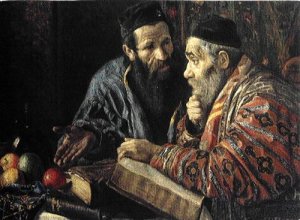
Talmudic RabbisA final note. Are all of the rulings of the Rabbis absolutely correct and is Talmud perfectly internally consistent? Probably not. To the degree that the Sages were human, then they were driven by human as well as divine priorities making them, like all men of authority (and all men everywhere) capable of all kinds of error. Yeshua, while he agreed (in my opinion) that the Pharisees had the authority to issue binding halachah, didn’t universally agree with their rulings (see Matthew 15:1-20; Mark 7:1-23 for example).

Even less often noticed is the fact that the ritual norms that Yeshua upholds in this text are not found in the Written Torah, but instead derive from Pharisaic tradition! The tithing of small herbs such as mint, dill, and cummin was a Pharisaic extension of the Written Torah. Yet, according to Matthew, Yeshua not only urges compliance with this practice – he treats it as a matter of the Torah (though of lesser weight than the injunctions to love, justice, and faithfulness). This supports our earlier inference that Yeshua’s teaching and practice encourage the Pharisees to think of him as one of their own. His criticism of the Pharisees (or, to be more precise, some of the Pharisees) is a prophetic critique offered by one whose commitments and convictions position him as an insider rather than an outsider.

-ibid, p.23

Assuming I’m right about all this, I suspect when Yeshua returns, he will perform a similar function among his modern Jewish people, the nation of Israel, and encourage corrections and improvements on existing halachah and the traditions of Torah interpretation. I believe he will do so as a matter of his love for the Jewish people, not as a matter of criticism or censure. I believe we Christians, or whatever we call ourselves, dismiss God’s love for the Jewish people and His presence among them and their Rabbis at our extreme peril. Our redemption comes from the Jews (John 4:22) not the other way around.

Much Ado About the Oral Law

I adored my younger sister and felt very connected to her, but I wasn’t there for her physically or emotionally during her turbulent teens. I was far away in university or traveling, and then in Israel, where I learned in a seminary, married and became in her eyes, a foreign entity: a religiously observant Jew.

Despite the distance, I didn’t see an unbridgeable gap. I could relate to my sister because I saw and felt all our common ground. I was once a teenager, part of the artistic sub-culture of Greenwich Village. I understood what her life was like, even if there weren’t skinheads in my day. I had once been like her, but she definitely didn’t feel like she was anything like me – an “ultra-Orthodox fanatic” against intermarriage, abortion, nudity, atheism, hanging out with guys. I never had a chance to say how I felt about any of these topics; she just assumed everything about my beliefs without any discussion. She could not relate. Or more accurately, she did not want to relate.

-Naomi Freeman
“Repairing the Gap”
Aish.com

For a lot of Christians, the sort of “gap” between Jewish people doesn’t seem to exist. After all, in Church, we generally are taught to view Jews and particularly religious Judaism as a single, unified entity. It’s difficult for many believers (or non-Jews in general) to picture multiple viewpoints among Jewish people (even though it is said “two Jews, three opinions”). And yet, there can be different groups, even within religious Judaism, that are highly polarized.

Consider this recent video that has been circling the various social media venues. Here we have Jewish people saying some rather unkind and perhaps inaccurate things about the “Oral Law” and Rabbinic Judaism.

This is the sort of thing Christians eat up with a spoon.

And they have, or at least one Christian group has within the Hebrew Roots movement as represented by TorahResource.com (For reference, I’ve included a screenshot below taken from Facebook of a discussion on this video by Hebrew Roots proponents).

Oral Law opinionI don’t feel particularly comfortable “calling out” people or groups, but in this case, I think it’s important to illustrate that there are different points of view involved. What your Pastor preaches from the pulpit about Jews and Judaism may not be the only way we disciples of Yeshua (Jesus) are “allowed” to think. I say this coming off of two years attending a local Baptist church where its members do authentically love the Jewish people and the nation of Israel but who are also at least “uncomfortable” if not downright opposed to the practice of religious Judaism. They would, with all good intent, love to see all Jewish people convert to Christianity and leave all but the most superficial practices of the mitzvot behind.

More’s the pity.

Earlier today, Rabbi Stuart Dauermann wrote a blog post called On Not Bashing the Oral Law and the Rabbis of Israel. Here’s part of what he had to say and how he ended his missive:

I don’t think the rabbis are always right. Nor are they always wrong. But I do think it is wrong to attack the rabbis as a class. After all, it wasn’t the ministers and Christian Bible students that kept the Jews and their Judaism alive in the blood- and tear-soaked exilic wanderings of the seed of Jacob. What kept the Jews alive and in faith was the work of the rabbis and the religion they presented and subscribed to.

We owe something to the rabbis of Israel. But is not contempt and mistrust. It is gratitude and admiration, even where and when they disagree with us.

And to the extent that we have entertained the kinds of spurious and nasty arguments I outlined here, we owe them one thing more.

An apology.

You can click on the link I provided to read his entire message and I encourage you to do so.

I’ve already rendered my opinion on interpretation as tradition so I won’t repeat that message except to say that, like R. Dauermann, I don’t believe that the Rabbis are always right in their rulings or opinions. Nevertheless, the Oral Law in post-Biblical times, was (and is) highly instrumental in sustaining the Jewish people and without what we call “Rabbinic Judaism,” it’s quite possible the Jewish people would have faded from the pages of history long before now.

Of course the Jews have always been protected and nurtured by God but who is to say that the existence and process of the Rabbis was not His method of preserving Jewish people and Jewish practice of the mitzvot. After all, the Sinai Covenant (all of the covenants, actually) didn’t vanish (and it certainly wasn’t replaced) simply because of the Temple’s destruction and the dispersion of the Jewish people among the nations. In fact, about a week ago I mentioned the opinion that one of the functions of the Jewish people being in exile was to be a light to the rest of us. This “being a light to the nations” wouldn’t have been possible without the Mishnah and Rabbinic Judaism.

Why am I saying all this? Just to throw my hat into the ring on this topic?

Not exactly, although that’s part of it.

While we can somewhat separate an opposition to Rabbinic Judaism from how we feel about Jewish people, at least in theory, it’s important to remember that there are those who have no love at all for Jewish people, Judaism, and national Israel, and reports of one of their more heinous acts has been all over the news lately.

Talmud StudyAs was said on a Hebrew Roots blog recently, we aren’t going to agree on a great many things in the realm of religion, and that’s not really the problem. As I’ve already mentioned, there is a significant amount of debate and disagreement within the various streams of Judaism including Messianic Judaism, let alone all of the expressions of the Christian faith including what I think of as “Christian Hebrew Roots.”

I know I’m probably going to get some pushback for that last comment, but I think of Hebrew Roots as Gentile Christians expressing their devotion to Messiah using Hebraic practices within primarily non-Jewish community, and Messianic Judaism as Jews and associated non-Jews, expressing their devotion to Messiah within a wholly Jewish religious, cultural, and community context.

Given those definitions, it stands to reason that Hebrew Roots will take a traditionally Christian stand, that is a “low view” on many aspects of Judaism including the authority of the Rabbis and Oral Law, while Messianic Judaism, as a Judaism, will take a “high view” of those same elements.

However, depending on which perspective we employ, our attitudes about Judaism and thus Jewish people will be affected. This doesn’t mean that holding a low view of Oral Torah necessarily equals taking a low view of Jewish people or even the Jewish practices in general, but it does require making an effort not to let what one believes about the Rabbis spill over into other Jewish realms, particularly if you are supposed to believe that “One Law” fits all (though I obviously don’t subscribe to the One Law perspective).

If you have a low view on Oral Torah and the Rabbinic Sages, you are certainly within your rights to hold such an opinion, but it doesn’t mean that those who have a high view of Rabbinic Judaism are bad or even particularly wrong. It does mean they’ve made a decision about how to express their faith on the level of lifestyle as well as belief. If that is not your decision also, that ‘s fine and dandy, but please don’t denigrate someone who has taken a different path from your own. For them, that path is right and correct, particularly if they are Jewish and you’re not.

For more on this topic, read Rabbi Stuart Dauermann’s article Who Needs Oral Torah? On Living a Jewish Life.

Also, you can read what Rabbi Mark Kinzer has to say about Messianic Judaism and the Oral Torah in a paper (PDF) located at Ourrabbis.org (which can also be found in the body of Rabbi Dauermann’s blog post and over at the Rosh Pina Project).

Addendum: I’ve written something of a sequel on this topic called Jews Defining Their Own Relationship With God And The Torah. I invite you to have a read and let me know what you think.

Things That Matter

There was a time when God became so distant that we were almost ready to deny Him, had psychologists or sociologists not been willing to permit us to believe in Him. And how grateful some of us were when told ex cathedra that prayer is not totally irrelevant because it does satisfy an emotional need.

To Judaism the purpose of prayer isn’t to satisfy an emotional need. Prayer is not a need but an ontological necessity, an act that constitutes the very essence of man. He who has never prayed is not fully human. Ontology, not psychology or sociology, explains prayer.

-Abraham Joshua Heschel
“An Ontological Necessity,” p.78
Man’s Quest for God

I suppose a definition of Ontology is in order:

Ontology is the philosophical study of the nature of being, becoming, existence, or reality, as well as the basic categories of being and their relations. Traditionally listed as a part of the major branch of philosophy known as metaphysics, ontology deals with questions concerning what entities exist or can be said to exist, and how such entities can be grouped, related within a hierarchy, and subdivided according to similarities and differences.

That sounds very abstract and even cold, especially when applied to the intimacy of prayer, but I see where Heschel is coming from. Periodically, you may read about studies that say people who pray have less anxiety than those who don’t, or they (we) recover from illnesses faster than those who don’t pray. Prayer, from this perspective, is put in the same category as meditation, which doesn’t necessarily acknowledge the existence let alone the absolute necessity of God in our human lives. Thus prayer has value from the atheist’s point of view because it is a psychologically valid method of reducing stress or otherwise providing for a state of well-being.

Abraham Joshua Heschel

But Heschel is saying that prayer is the reality of our existence, providing vital linkage with the source of our lives and the very author of all creation. Prayer is what gives a sense of completeness to our being, which is probably why Heschel says (outrageously, from an atheist’s point of view) that he “who has never prayed is not fully human.”

So in prayer we realize our full humanity, but in doing so, we collide head on with our vulnerability, our frailty, our mortality, with everything that separates us from God as well as what binds us to him.

Prayer also brings us perspective:

God grant me the serenity
To accept the things I cannot change;
Courage to change the things I can;
And wisdom to know the difference.

You probably recognize the Serenity Prayer which is regularly said at Alcoholics Anonymous meetings around the world. This prayer connects rather nicely with the image I placed toward the bottom of today’s “morning meditation” (scroll down).

I saw that diagram taped near the desk of one of my co-workers and, in considering the ongoing process of teshuvah, it made a great deal of sense. In the effort of making that 180 degree turn away from sin and toward God, a lot of information and emotion is thrown up in the air, like a sandstorm obscuring vision. How can I see when I’ve made my complete turnaround and know when I’m facing the right direction so I can begin to proceed if I’m confused by all the things that matter that I can’t control and all the things that don’t matter that I can?

The Serenity Prayer seems to be how to ask God to let you see through the sandstorm and pick out only those specific details that are necessary for you (or me) to start walking toward Him.

Why do we need serenity?

I know how to get along with humble means, and I also know how to live in prosperity; in any and every circumstance I have learned the secret of being filled and going hungry, both of having abundance and suffering need. I can do all things through Him who strengthens me.

Philippians 4:12-13 (NASB)

I maintain that only a person who is highly elevated spiritually can possibly stand in the eye of the hurricane and dispassionately watch the tempest rage and completely surround him. The rest of us would be running for the storm cellar.

But that doesn’t mean it isn’t a goal to shoot for, even if achieving it is years or a lifetime in the making.

I’ve mentioned before the seven steps in achieving teshuvah (repentance) which interestingly enough, are sort of connected to the 12 steps that are fundamental to Alcoholics Anonymous. It would seem that the process of recovering from additions can be extended to the process of “recovering” from all manner of sins, at least from the Jewish perspective.

thingsA couple of days ago I commented on something written by Rabbi Tzvi Freeman or rather, one of the comments made in response to his writing:

And 12-Step groups call this “Willingness.”
Wow – I keep seeing how the 12-step recovery coincides with Judaism, it is beautiful.

Would it sound too crazy to suggest something called “Teshuvah Anonymous?”

God help me to accept the things I cannot control, understand all the things that matter, and focus on those things that matter I can control. For only there will my efforts be successful in changing my life so that I behave toward others with greater compassion, kindness, and care, and only there will I find my path to You in prayer.

Longing for Mercy in an Ordinary Life

When Moses got up that morning and counted the sheep, he did not say to himself, “I think I’ll take the sheep out on the west side of the wilderness over by the Mountain of God.” Mount Horeb was simply Mount Horeb, an indistinct rock in the wilderness like so many other hills and mountains, completely ordinary looking. There was nothing special about it. Mount Horeb became Mount Sinai, the mountain of God, simply because God chose it, not because it was taller, mightier or holier than any of the surrounding hills and mountains.

-from “Ordinary Life” the Torah Club commentary on Shemot
First Fruits of Zion (FFOZ)

This topic pops up periodically in Christian circles, usually in response to a question such as:

How could God use me for anything? I’m no one special. I’m just an ordinary person with an ordinary life.

Another part of the answer goes like this:

Most of us do not regard ourselves as extraordinary people. You probably think of yourself as a fairly ordinary person with a fairly mundane life. From God’s perspective, that is perfect. You are the perfect person with whom He can do extraordinary things. He is not looking for prophets; He is looking for normal people who are carrying on under normal circumstances.

Frankly, I’d be elated to live an ordinary and mundane life perfectly or even just reasonably within the bounds of God’s expectations. I don’t have to be Moses. I don’t want to be Moses. I am unworthy to be anything like Moses. I just want to be “me” but a better “me” than I am today.

Teshuvah within an “ordinary life” is a lot of hard work with no guarantee that life will get immediately better even upon turning away from sin. An “extraordinary” life seems exhausting by comparison.

Of course with God, all things are possible (Matthew 19:26) but God is God and I’m just me.

When I became chief rabbi, I had to undergo a medical examination. The doctor put me on a treadmill, walking at a very brisk pace. “What are you testing?” I asked him. “How fast I can go, or how long?” “Neither,” he replied. “What I am testing is how long it takes, when you come off the treadmill, for your pulse to return to normal.” That is when I discovered that health is measured by the power of recovery. That is true for everyone, but doubly so for leaders and for the Jewish people, a nation of leaders (that, I believe, is what the phrase “a kingdom of priests” means).

-Rabbi Jonathan Sacks
“Light in Dark Times”
Chabad.org

Man alonePart how I measure my physical health is how quickly my heart rate recovers after a cardio workout. However, that principle can be applied to a completely different context. How quickly a person recovers after a major failure in making teshuvah and restoring relationships with God and people is also a measure of health.

Of course, there could be a problem:

Question: What if the person to whom you want to apologize won’t speak to you?

Answer: Here is what Maimonides writes on the matter:

If his colleague does not desire to forgive him, he should bring a group of three of his friends and approach him with them and request [forgiveness]. If [the wronged party] is not appeased, he should repeat the process a second and third time. If he [still] does not want [to forgive him], he may let him alone and need not pursue [the matter further]. On the contrary, the person who refuses to grant forgiveness is the one considered as the sinner.

-Rabbi Menachem Posner
Comments from the article:
“Teshuvah — Repentance”
Chabad.org

While facing God with your sin and asking for forgiveness as part of true teshuvah is daunting, we have certain promises in the Bible that God will indeed forgive us of our sin, cleansing us and making us white as snow (Psalm 51:7). However, with the people we have hurt, they are quite likely, at least initially, to react with blame, anger, and rejection.

In Rabbi Posner’s comment above citing Maimonides, we should repeatedly approach the offended party and continue to ask for their forgiveness. However, there is a limit as to how many times we are expected to extend ourselves and, at least from the Rambam’s point of view, anyone who refuses to forgive a true Baal Teshuvah is considered a sinner themselves.

Not that this is much help if you’re trying to repair relationships.

Every prayer of the heart is answered. It’s the packaging that doesn’t always meet our taste.

Maamar Vayigash Elav 5725, 6—based on a statement of the Baal Shem Tov, Keter Shem Tov.
Rabbi Tzvi Freeman
“Bad Packaging”
Chabad.org

Yes, we can pray for a positive outcome, and as Rabbi Freeman says, God answers all prayers, but the “packaging,” that is, exactly how God answers the prayers, may not be what we desired or hoped for.

Hearken and hear Israel (Devarim 27:9), this is the time marked for the redemption by Mashiach. The sufferings befalling us are the birth-pangs of Mashiach. Israel will be redeemed only through teshuva (Jerusalem Talmud, Taanit I:1). Have no faith in the false prophets who assure you of glories and salvation after the War (Note that this was during the early 1940’s). Remember the word of G-d, “Cursed is the man who puts his trust in man, who places his reliance for help in mortals, and turns his heart from G-d” (Yirmiyahu 17:5). Return Israel unto the Eternal your G-d (Hoshei’a 14:2); prepare yourself and your family to go forth and receive Mashiach, whose coming is imminent.

-from “Today’s Day” for Wednesday, Tevet 15, 5703
Compiled by the Lubavitcher Rebbe; Translated by Yitschak Meir Kagan
Chabad.org

praying aloneThis is heralding a very extraordinary time that will lead to the ultimate redemption of Israel and the nations, but in the meantime, there are still many mundane matters we all struggle with. I find it hard to always pray for the return of the Master when all I really want is to be successful in teshuvah, for God to grant me mercy and forgiveness, and for His Spirit to soften the hearts of those who have been hurt so they will be moved to mercy and forgiveness.

May God grant this to all of us, for who hasn’t failed?

He Who Fashions Our Hearts

Rambam cites the verse in Tehillim (33:15) as proof of this principle: “He who fashions all their hearts together, Who comprehends all their deeds.” According to Radak (Tehillim ibid.), this verse is explaining why Hashem has the power to see into men’s hearts; because He alone fashioned them, He alone has the ability to truly understand them.

-from “A Closer Look at the Siddur,” p.15
Monday’s Commentary for Parashas Shemos
A Daily Dose of Torah

I’ve always wondered just how much of human behavior God understands. After all, people can be afraid, but God is never afraid. People can be selfish, but God is never selfish. People can be weak, but God is never weak. How can God understand all of our faults and foibles when He has none of His own?

Of course, I always thought this was the answer:

For we do not have a high priest who cannot sympathize with our weaknesses, but One who has been tempted in all things as we are, yet without sin. Therefore let us draw near with confidence to the throne of grace, so that we may receive mercy and find grace to help in time of need.

Hebrews 4:15-16 (NASB)

That covers Yeshua (Jesus) understanding what it’s like to be tempted. The Master may not have sinned, but he did know what it was to be weak, put upon, exhausted, in need of help and comfort:

Then Jesus was led up by the Spirit into the wilderness to be tempted by the devil. And after He had fasted forty days and forty nights, He then became hungry.

Then Jesus said to him, “Go, Satan! For it is written, ‘You shall worship the Lord your God, and serve Him only.’” Then the devil left Him; and behold, angels came and began to minister to Him.

Matthew 4:1-2, 10-11

The Master even said this:

And He withdrew from them about a stone’s throw, and He knelt down and began to pray, saying, “Father, if You are willing, remove this cup from Me; yet not My will, but Yours be done.” Now an angel from heaven appeared to Him, strengthening Him.

Luke 22:41-43

These are very human words uttered by our Master in prayer to the Father. I wonder if he was afraid? I wouldn’t blame him if he were. Here too he needed help, and again, an angel come to comfort or “strengthen” him.

We always assume it was physically impossible for Jesus to sin but strictly speaking is that true? I mean, it’s not really a temptation unless there’s the possibility of giving in. It’s not a true victory unless you have overcome failure. I think the Master endured these things in part to show us that we can be tempted and overcome as well, even though we are broken down, faulty, lame, miserable human flesh.

No temptation has overtaken you but such as is common to man; and God is faithful, who will not allow you to be tempted beyond what you are able, but with the temptation will provide the way of escape also, so that you will be able to endure it.

1 Corinthians 10:13

This was one of the first verses I was encouraged to learn when I professed my faith many years ago, and I thought Paul was being rather smug and arrogant. Sure, it’s easy for him to say that God will provide a way of escape so we can endure temptation and not sin, but it certainly didn’t (and often still doesn’t) seem obvious to me which way led out of temptation.

father and sonBut going back to the first quote above, it never occurred to me before that God understands us completely because God made us, even though He is perfect and we are imperfect, even though He is immortal and we are passing away like grass in a blast furnace. I wonder if that’s why there are so many human-like metaphors for describing God in the Bible, not because He has a face, or arms, or hands, or breath, but so that we can, on some shallow level, relate to Him, even as He completely and totally understands us.

A person is constantly beset by warring impulses. Sometimes, he will succeed and triumph over his evil impulses; other times he may fail and succumb to his baser urges. To the human observer, this behavior may seem random and inconsistent. But Hashem “fashions all their hearts together;” He alone knows of the many components that make up a person’s mind and heart. Thus, it is possible for Him to “comprehend all of their deeds.”

I don’t think this means that God approves of all of our deeds, but He does understand, and hopefully, feels compassion for all of His children, including you and me.

Moreover, we must not overlook one of the profound principles of Judaism. There is something which is far greater than my desire to pray, namely, God’s desire that I pray. There is something which is far greater than my will to believe, namely, God’s will that I believe. How insignificant is the outpouring of my soul in the midst of this great universe! Unless it is the will of God that I pray, unless God desires prayer (See Exodus Rabba, 21, 5; Midrash Tehillim, 5, 7.), how ludicrous is all my praying.

-Abraham Joshua Heschel
“The Separation of Church and God,” p.58
Man’s Quest for God: Studies in Prayer and Symbolism

On the following page, Heschel wrote, “To live without prayer is to live without God, to live without a soul.”

At the heart of doing teshuvah, of repenting and returning to God, is prayer. While the seven points of doing teshuvah I posted at the top of this blog post make it seem as if teshuvah is largely a matter of exercising intellect and will, in fact even our ability to make the first step, to regret and be ashamed of our sins, is because God created us with an awareness of Him; we are made in His likeness.

Prayer is a requirement of repentance, for without God how can man repent at all, how can he turn away from evil and turn toward God and make a life-altering, permanent decision to abandon the way he previously walked?

But in the agony of teshuvah, being torn away from one life and struggling to achieve another, it’s easy to drown in prayers of petition to the point of begging.

But if You can do anything, take pity on us and help us!” And Jesus said to him, “‘If You can?’ All things are possible to him who believes.” Immediately the boy’s father cried out and said, “I do believe; help my unbelief.”

Mark 9:22-24

From God we need all of the building blocks necessary to make teshuvah, then we need help putting them together, and then we need help doing everything else we are responsible for doing to return to Hashem.

In the middle of all that, where do we find the will and the strength to praise Him?

For to Thee Lord our God, God of our fathers, are due songs and praise, hymn and psalm, power and dominion, victory, grandeur, might, homage, beauty, holiness, kingship, blessings, thanksgiving

-from the daily liturgy
quoted in Heschel, p.64

prayerWe can’t “flatter” God into responding to our requests and He certainly doesn’t need us to praise Him because He lacks anything, but as Heschel said before, we pray not because our prayers are powerful or worthy, but because God desires that we pray, and I might add, for our own sakes. For we need God more than He needs us, if He needs anything at all. God is waiting only for us to whisper our tiny prayers to Him so He can call out and draw us to Him.

As much as the human soul yearns to rise up and merge within the light of its Creator, so much more so does the Infinite Creator yearn to be found within the human soul.

If so, what force could stand between them? What could hold back the Creator’s infinite light?

Only His desire that this union occur with our consent, that we be the ones to crack open the door.

“Open for me just as wide as a pinhole,” G‑d pleads with us, “and I will open for you a vast, unbounded portal to My very core of being.”

-Rabbi Tzvi Freeman
“Open for Me”
Chabad.org

I know I’ve quoted this before but it’s a good quote. A number of people commented on these words (click the link above to read the comments) including someone named Harley A:

And 12-Step groups call this “Willingness.”
Wow – I keep seeing how the 12-step recovery coincides with Judaism, it is beautiful.

Someone named Ezra commented:

When G-d created the world he did it with the attributes of Mercy and Justice (female and male qualities). And if you look in Genesis 1:27 you see again that G-d created us in His image (male and female).

G-d made everything with its opposite, up down , left right front back, day night. We can not have one without the other, that’s just how G-d made everything.

We need the Shechina simple because without her, our lives would not only be incomplete but also out of balance. We would only know G-d as a god of vengeance and never have that opportunity to repent. That would be frightening. When G-d remembered our frailty He even gave us cities of refuge. HE IS SO GOOD!!

Enjoy His Sabbath and rest a while with Her.

Life is difficult. We are all fighting a hard battle every single day. God does not desire that we fight this battle alone. If we cry out to Him, if we repent, if we pray for the strength to repent and the endurance to see it through, He will respond in an instant, whether we’re always aware of it or not, and rescue us, and even if we aren’t aware of that either, we will merit a place in the resurrection in the Kingdom of Heaven where our sure reward is waiting:

“…and He will wipe away every tear from their eyes; and there will no longer be any death; there will no longer be any mourning, or crying, or pain; the first things have passed away.”

Revelation 21:4

Yes, Lord come. Maranatha.