Yehuda Glick, head of the LIBA Movement for Freedom of Movement on the Temple Mount, expressed his satisfaction that “for the first time in three years the Temple Mount has been opened to Jews on Tisha b’Av.”
“300 Jews have already come, including MK Shuli Muallem-Refaeli (Jewish Home). Afterward, we went to Commander of the Old City, David Avi Biton, and expressed our appreciation of the wonderful work the police were doing today,” Glick added.
Earlier this morning, masked Arabs arrived at the Temple Mount throwing stones and Molotov cocktails at the security forces. Police entered the area and dispersed the rioters. There were no casualties, and the police have remained in place to maintain order.
Last night the Jerusalem District Police arrested 27 Arabs suspected participating in the rioting in East Jerusalem.
Thus far, 457 suspects have been arrested for rioting, of which 160 have been served indictments. Additional arrests are anticipated.
“Temple Mount Open to Jews on 9th Av for First Time in 3 Years”
-found at VirtualJerusalem.com
I hadn’t planned to write on Tisha B’Av but the above-quoted article plus something else inspired me. To understand why, read this:
Tisha B’Av night we sit on the floor and read from the Book of Lamentations. In a mournful voice we chant “Alas, she sits in solitude! The city that was great with people has become like a widow. She weeps bitterly in the night and her tear is on her cheek.”
We grieve for our Temple that was destroyed. We recall a once golden Jerusalem that now sits in darkness, abandoned. The streets of the city run red with rivers of blood. Lamentations describes a glorious nation being led out in chains as the fires of destruction fill the air. We cry “for Mount Zion which lies desolate, foxes prowled over it.”
Observant Jews mourn the loss of both Solomon’s and Herod’s Temples on this date as well as commemorate many other tragedies that have occurred in Jewish history employing very specific practices. Personally, I’ve decided to fast but not to employ all of the traditions involved in Jewish observance to avoid giving the impression that I’m fulfilling the mitzvah. I fast, pray, and study in solidarity with the Jewish people, but I must consider their losses as theirs, not mine.
But while Tisha B’Av is a day of mourning, it is also a day of hope. The very fact that the Temple Mount was opened to Jews on Tisha B’Av for the first time in three years makes me want to smile, even though that is inconsistent with a state of mourning.
I did have to smile at the following, though:
My son was on the lookout the minute the plane touched down in Israel. I could see the ignited light in his little four-year-old eyes on the entire car ride from the airport as he viewed the Holy Land for the first time. He was a tiny man on a mission, to see the Beit Hamikdash, the Holy Jewish Temple, he was always hearing about.
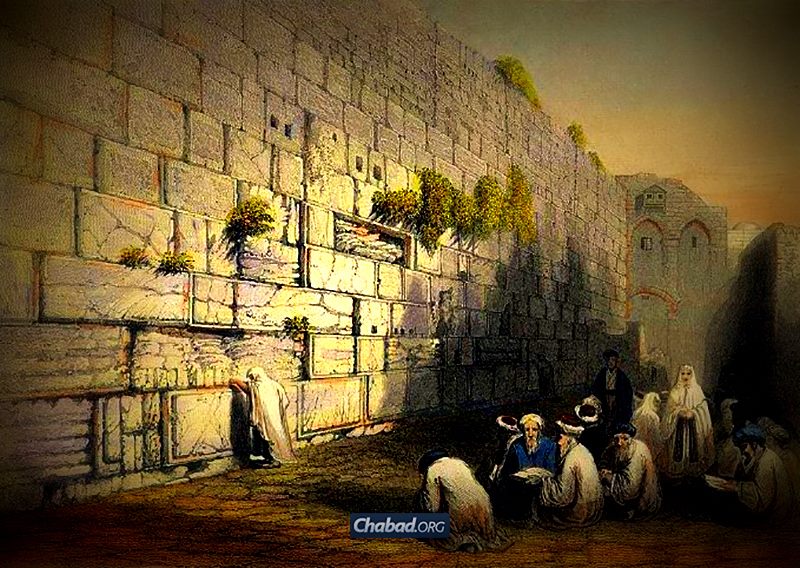
He learned in school the common Jewish notion that each mitzvah (good deed) a Jew performs adds a “brick” to rebuild the destroyed Temple. And he was expecting to see the third Temple in the process of being rebuilt, brick by brick, mitzvah by mitzvah. You can imagine how his face fell and heart was broken when we arrived at the site of the Kotel, the Western Wall.
-Beth Perkel (as told to her by R.S.)
“Searching for the Third Temple” Aish.com
Some among Israeli Jews believe the Third Temple should be rebuilt right now, while others (including me) think when the Messiah comes (returns), he will build it.
But the wonderfully innocent audacity of a four-year old little boy expecting the bricks of the Temple to miraculously appear one by one as Jews all over the world perform mitzvot is an obviously literal interpretation of midrash and also the perfect faith only a child could have.
“Mommy, this is it?”
“What do you mean this is it?”
“Where is the Beit Hamikdash? All I see is a wall Mommy, where are the bricks we have been working for, where are all the extra bricks?”
“They are coming precious child, someday, hopefully sooner rather than later, they are coming.”
But my answer wasn’t enough. He stood transfixed, woefully unsatisfied, hoping somehow that the bricks would miraculously appear. When they didn’t, he wandered around, the only one moping at the Kotel during the precious moments of our short visit there.
Ultimately, this searching Jewish child actually did find the bricks to the Temple at the Yad La-shiryon tank museum at Latrun, or more specifically, in the memorial wall, in which each brick is a representation of the mesirat nefesh or the self-sacrifice of the soldiers who died defending Israel.
“Mommy, this is it! We found the bricks! These are the bricks for the Beit Hamikdash!”
It brought tears to my eyes. Somehow, his soul had understood something so deep on this very spot where soldiers throughout Jewish history, from the time of the Tanach onward, had died glorifying God’s name, defending the Jewish homeland and helping us take steps towards our destiny. I could see the radiance on his face. He had found it – the bricks that showed him that God’s promise of redemption was on its way.
photo credit: Chabad.org
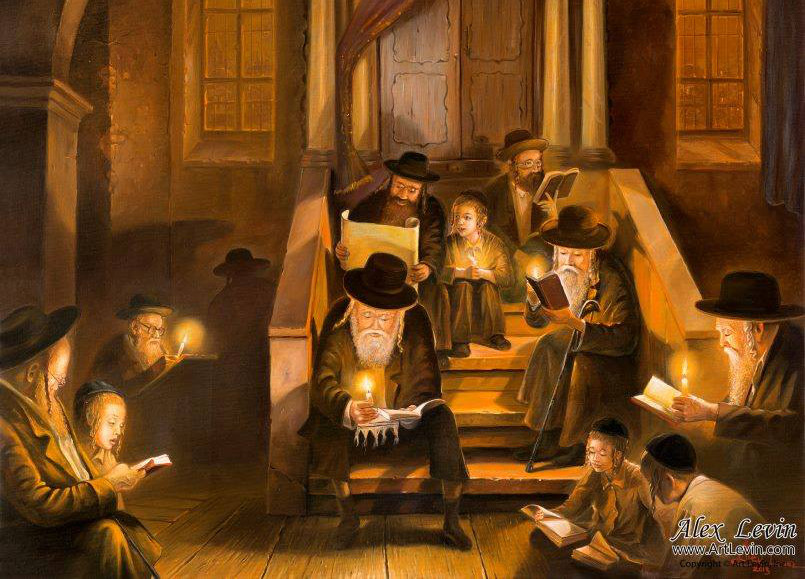
What will bring (back) the Messiah, what will rebuild the Temple, is hope, even during the darkest periods of life. That’s what Tisha B’Av is, hope in the darkness. Even as Jews study Lamentations by candlelight sitting on short stools (as is the custom), with some eyes welling with tears, there is always hope.
Hope is what has enabled the Jewish people to endure as a people for so long. Hope is what recreated the modern state of Israel from the sand and ashes of “Palestine”. Hope is what keeps the prophesy of Messiah alive and all that he will do to return the exiles, redeem God’s people, and restore the nation to its former glory.
I lift up my eyes to the mountains—where does my help come from? My help comes from the Lord, the Maker of heaven and earth.
–Psalm 121:1-2 (NASB)
Our hope is in the Lord, maker of Heaven and Earth. That is the Jewish hope but it must be the hope for the rest of us, otherwise we have nothing, for “Salvation comes from the Jews” (John 4:22).
Hope is a four-year old boy who sees the “extra” bricks for building the Temple in the memorial of Israel’s honored fallen heroes.
Today in church (as I write this), Pastor preached on Acts 27:1-12 and Paul’s rather “stormy” trip toward his final destination (in more ways than one) Rome. What I found most useful in today’s sermon were the notes at the conclusion. Normally, this part of the sermon doesn’t “float my boat” since these notes are usually an attempt to take ancient events, spiritualize them, and anachronistically apply them to everyday life in 21st century America.
But this time, I decided to see if these notes could be applied to my life. There are three of them.
Do you believe that God is sovereign over all the storms in your life?
As opposed to what? No, really. As an abstract concept believing what I believe about God, my immediate answer has to be “yes,” but it’s more complicated than that. It’s one thing to say that “God is in control” and that “we win in the end,” and another thing entirely to receive a diagnosis of cancer (no, I don’t have cancer) or that your child was in a serious car accident and is in ICU (don’t worry, my kids are all fine).
Then, no matter how much you “think” God is sovereign over every single detail of your existence, suddenly the pit of your stomach drops out and at least momentarily, panic sets in with the vengeance of a really angry Grizzly Bear. Sure, given enough time, you can regain your emotional equilibrium and refocus on God, but for those first few seconds or minutes (or longer), unless you are a terrifically spiritual person and always totally in tune with God, you’re going to lose it.
Here’s the first thing I wrote down in my notes when Pastor asked the question:
Yes, but that doesn’t mean I still won’t drown.
Here’s the second thing I wrote down.
We don’t have an absolute view into God’s plans for us as individuals.
God can be absolutely sovereign over the storms in our lives and we can still lose a leg in a car crash. We can still end up with a child in intensive care. We can still die a long, lingering, painful death.
God’s sovereignty contains no guarantee at all that our lives won’t be painful and end tragically. When we think of God being “in control,” we really mean that God would never let anything bad happen to us. But just look at Paul’s life. God let everything bad happen to Paul.
But the key is, no matter what happened, Paul still served God faithfully, with an almost supernatural focus (I’m being slightly tongue-in-cheek here) on Yeshua (Jesus) as the author of his faith and the “perfecter” of his existence, both in this world and the one beyond.
Which brings us to Pastor’s second question:
What are you doing to learn to trust God in the storms of life?
I remember a scene from the film Finding Nemo (2003). Dory (voiced by Ellen DeGeneres) and Marlin (voiced by Albert Brooks) are inside of a whale, basically hitching a ride to Sydney, Australia. The water inside the whale starts to drain. As usual, Marlin senses disaster while Dory is willing to trust. Marlin is hanging onto some part of the whale’s insides to keep from falling back into the throat. Dory translates the message from the whale.
It’s time to let go.
I think that’s what trusting God is about, but it’s best to learn to trust him before your life turns to dog poop. While you still have the time, pray with an especially focused Kavanah for an encounter with God. Strive to draw nearer to Him and plead that He reveals Himself to you before you need Him. I promise that if you don’t do this now, you will be doing it once you need God’s help more than anything you’ve ever needed in your life.
Last question:
Do you realize that God is able to use the storms in your life to give guidance to others?
As first, I didn’t read the to give guidance to others part and just saw the question as asking if I realized God could use the storms in my life. Then I realized what was really going on.
Had they trusted in God and followed Moshe, the entire nation would have gone into Eretz Israel led by him. The Holy Temple would have been built, never to be destroyed; the people would have sat, every man under his grape vine and under his fig tree, never to be exiled; and the still longed for, final redemption under God’s chosen anointed would have come. But they didn’t trust and they didn’t obey. So the exodus from Egypt remained eternal, but the entry into the Land was to be transitory.
If all of the twelve spies Moses sent into Canaan (Numbers 13, 14) had given a positive report instead of just two, obeyed Moses, and obeyed God, the history of Israel would have been written quite differently.
But they didn’t and history unfolded as it did.
The same is true of Israel in the days of Jesus:
“Jerusalem, Jerusalem, who kills the prophets and stones those who are sent to her! How often I wanted to gather your children together, the way a hen gathers her chicks under her wings, and you were unwilling. Behold, your house is being left to you desolate! For I say to you, from now on you will not see Me until you say, ‘Blessed is He who comes in the name of the Lord!’”
–Matthew 23:17-39 (NASB)
If Israel had repented in the days of Herod’s Temple, Yeshua would have initiated the Messianic Kingdom immediately, the Romans would have been defeated, the Temple would have been preserved, there would have been no exile, and King Messiah’s reign of peace, mercy, and justice over all of the world would have started and be with us to this very day.
But they didn’t, and untold suffering has resulted.
In the 1982 film Star Trek II: The Wrath of Kahn, Admiral James T. Kirk (William Shatner) gave this sage piece of advice to Lt. Saavik (Kirstie Alley):
How you face death is at least as important as how you face life.
Regardless of how God provides and what God allows and how God disciplines, your circumstances are less important than how you respond to them. Consider how Israel is responding, not to just all of the rockets Hamas keeps throwing at her, but how the rest of the world is mistreating Israel, believing she is disproportionately responding to these terrorist acts simply by defending herself.
The whole world is watching Israel and waiting for her to blink. So it is true when anyone who professes faith in Christ, especially when we are under duress.
Fortunately, Pastor said that he’s hardly perfect in this area and that there have been plenty of occasions when he’s been stressed and yet taken it out on his family rather than having greater trust in God. There’s a sort of myth, both inside the Church and outside of it, that says when a Christian is having a particularly tough time of it, he or she should be completely calm if their faith in Jesus is solid. Only a failure of faith results in a Christian who cries or yells or begs.
Like I said, it’s a myth.
Father, if you’re willing, take this cup from me…
–Luke 22:42 (NASB)
This is Jesus at Gethsemane pleading with God the Father to take away the cup of his crucifixion, his agony, his desperate suffering from him.
This is Jesus saying this. This is Jesus not wanting to suffer. This is Jesus acting just like the rest of us. But the second half of the sentence tells the tale.
…yet not my will but Yours be done.
But he still begged. Flesh and blood, human right down to his DNA Jesus still begged that the cup be taken from him.
There’s no shame in anguish as long as there’s also trust.
Because of the surpassing greatness of the revelations, for this reason, to keep me from exalting myself, there was given me a thorn in the flesh, a messenger of Satan to torment me—to keep me from exalting myself! Concerning this I implored the Lord three times that it might leave me. And He has said to me, “My grace is sufficient for you, for power is perfected in weakness.”
–2 Corinthians 12:7-9 (NASB)
If Jesus wasn’t immune, certainly Paul wasn’t either. How many of his Psalms did David dedicate to his own pain and suffering, withering before a Holy God with his flesh melting and his bones turning to dust?
Save me, O God,
For the waters have threatened my life.
I have sunk in deep mire, and there is no foothold;
I have come into deep waters, and a flood overflows me.
I am weary with my crying; my throat is parched;
My eyes fail while I wait for my God.
Those who hate me without a cause are more than the hairs of my head;
Those who would destroy me are powerful, being wrongfully my enemies;
What I did not steal, I then have to restore.
–Psalm 69:1-4 (NASB)
We struggle all our lives between our faith and our humanity, between Divine glory and human weakness. The spirit is willing but flesh…oh the flesh is very weak. Even the best of us, when put to the test, are like a snow cone in a blast furnace.
To know that God is sovereign and to trust in Him in adversity doesn’t mean you have to be superhuman and it doesn’t mean you don’t get scared. It means when 99% of you is in full panic mode, some tiny voice in the back of your consciousness is still crying out to God, not in terror but in faith, that even if you should drown or be incinerated in the next half-second, if you are not supposed to live (in this life) with God, then you will certainly die in His Presence and live with Him in the resurrection.
Living with God in suffering is like being a terminally ill child. You know you are going to die and you know your Mom and Dad love you very much. But you also know they can’t save your life. You’re still scared and you still don’t want to be away from them, but you know as long as they love you, you’re not alone.
God’s sovereignty in our lives when we suffer doesn’t (necessarily) mean God will stop the suffering. It means He will never abandon us as we are suffering and in some sense, He suffers, too.
The night when hope was enveloped in darkness was about to begin, so God came to Jacob ‘in the visions of the night’ to show him that Jews might be exiled from their land, but they could never be exiled from their God.
-R. Zlotowitz, pp 46-7
When they were exiled to Babylon, the Divine Presence was with them.
How did Judaism manage to survive the destruction of its central sanctuary? According to the Book of Deuteronomy, which we always begin to read on the Shabbat before Tishah B’Av, it was to be the only link between heaven and earth. All sacrifices were to be offered there and no place else. The exclusive cult restricted to a single Temple seemed to reinforce the fragile belief in a single, omnipotent God…
…The destruction of his Temple in 586 B.C.E. could have ruptured the ties between God and Israel…
…I should like to suggest that the answer to this historical conundrum lies in the etymology of a single Hebrew word.
Schorsch goes on to explain that the Hebrew word for the Holy of Holies in the Tabernacle and later the Temple is “devir”. He then traced a path from “devir” (Shrine) to “davar” (word), and across the ages to third century C.E. Babylonia and the founding of the rabbinic academy in Sura where the Persians used the proper noun “devir” for “book” (safra). For Judaism then, as Schorsch sees it, the survival mechanism employed once the Temple had been leveled by the Romans in 70 C.E. and the Jewish people were forcibly dispersed, was the investment in Talmud and Mishnah as the embodiment of the Holiness of the Temple; the conversion of the direct link between Jews and God from Shrine to Book.
This idea was also explored by the late Dr. Alan F. Segal in his book Rebecca’s Children: Judaism and Christianity in the Roman World. Dr. Segal suggested that with the destruction of the Temple and the elimination of a Judaism centered around the sacrifices and the Aaronic priesthood, two new religions emerged: Gentile Christianity and Rabbinic Judaism.
In a way, it’s not as farfetched an idea as it might seem but fails to take into account God’s planning for the continuation of His people Israel as well as the people of the nations who are called by His Name. While Judaism and Christianity both have “morphed” considerably over the past nearly two-thousand years and have traced divergent trajectories across history, we must remember that our course through space and time are always in the control of God and a single destination awaits us both: Messiah and the Kingdom.
As we rapidly approach the fast of Tisha B’Av, sorrow piles upon sorrow at the severe losses suffered by the Jewish people and the nation of Israel which, even now, is in a state of war and viciously maligned by the worldwide news media, multiple world leaders and celebrities, and people in general simply for defending themselves against the thousands of missiles and other attacks the terrorist group Hamas has launched against them.
And how do these events color Tisha B’Av this year? Like any other year, as Schorsch says elsewhere in his commentary:
No other religion is quite so self-critical. The Bible goes out of its way to record the flaws and errors of our people’s loftiest leaders. (pg 589)
As most of us should be doing whenever something goes wrong in our lives, the first place Israel looks for a cause when tragedy strikes is in the mirror and their relationship with God.
If a person sees that suffering befalls him, let him examine his deeds.
-Berachos 5a
Yes, one day the Messiah will rebuild the Temple, but it’s been so long and who knows when he will suddenly return? Yet in spite of all the tragedies that have befallen the Jewish people across the long centuries, God has always preserved them in many and varied ways, including, I believe, through what we refer to as Rabbinic Judaism and a devotion to studying Torah and Mishnah.
Most Christians believe that any legitimate connection between the Jewish people and God crumbled with the Temple and that their only hope is conversion to Christianity and worship of Jesus Christ. For most people in the Church, Rabbinic Judaism in all its expressions is a dry and vain effort, bereft of any presence of God; an invention of men who “missed the boat” of Messiah, so to speak, and now are continually bailing water out of a slowly sinking ship.
But let us suppose, on the eve of one of the most grief-stricken observances on the Jewish religious calendar, that God didn’t abandon His people Israel after the advent of Messiah and the destruction of Jerusalem. Let us suppose that God chose to go into exile with His people, even as He maintained His presence among the devout ones of the Gentile disciples of Messiah. Is that so unreasonable an assumption? Does God have to abandon Sinai in order to occupy Calvary?
Hence when our sages read the story of Jacob and Esau as the tale of Israel and Rome in the time of the Christian emperors, as they did, they did not conceive that theirs was a reading distinct from the author’s original intention. And how could such a conception have taken root, when, after all, they knew that Torah, oral and written, came from God to Moses, or was the work of the Holy Spirit, or otherwise transcended the particularities of time, space, and circumstance?
Professor Neusner is attempting to explain to an audience with little knowledge of Mishnah how it is possible and even reasonable for the Sages to create interpretations of books of scripture that (apparently) couldn’t have been the author’s original intent, and yet have those interpretations be correct for the generation in which they were made (and later).
That requires believing that the inspiration of the Holy Spirit both encodes the Bible with messages that continually unfold with the passage of human history and believing that God really did infuse the Jewish sages with the authority, wisdom, and Spirit to create valid interpretations of the Bible after formal canonization was considered closed.
That’s a lot for most Christians to take in, since our general conceptual platform is founded on Greek thought and philosophy which is sort of a “connect the dots” way of thinking coupled with being “binary.” That is, things are either this way or that, left or right, up or down, and we continually move forward in time, leaving the past permanently preserved in amber, forever unchangeable, including by interpretation, as we progress step by step toward the return of Jesus. There is no room in our thinking for a God who can take both forks in a road simultaneously (with apologies to Yogi Berra).
If we accept that God is infinite, that God is Spirit, and believe all of the other supernatural and metaphysical things we’re supposed to believe, then it behooves us not to put God in a box (Schrödinger’s or any other kind), and make Him obey the rules we’ve created for the Bible and ourselves. If God is transcendent, then so is His Word and, for that matter, so is His relationship with His people Israel. God’s relationship with Israel survived the destruction of Solomon’s Temple. It can survive the destruction of Herod’s as well, plus such and thus many thousands of years hence.
Neusner’s book takes us through an analysis of Lamentations Rabbah, and in Parashah II Lamentations 2:3 (pp 95-6), we read:
But when the Israelites repent, the Holy One, blessed be he, will put the horns back in place: “All the horns of the wicked I will also cut off, but the horns of the righteous shall be lifted up” (Ps. 75:11).
The horns which the Righteous One of the world had cut off [will be restored].
When will he restore them to their place?
When the Holy One, blessed be he, exalts the horn of his messiah: “And he will give strength to his king and exalt the horn of his anointed” (1 Sam. 2:10).
Even in sorrow and mourning, Israel always has hope in the Promises of God for return and restoration, the promises of King Messiah and the New Covenant age.
This is purely poetic interpretation on my part, but when I read of the wicked horns being cut off and the righteous horns being restored by Messiah the Righteous One, I couldn’t help but think of this:
But if some of the branches were broken off, and you, being a wild olive, were grafted in among them and became partaker with them of the rich root of the olive tree, do not be arrogant toward the branches; but if you are arrogant, remember that it is not you who supports the root, but the root supports you. You will say then, “Branches were broken off so that I might be grafted in.” Quite right, they were broken off for their unbelief, but you stand by your faith. Do not be conceited, but fear; for if God did not spare the natural branches, He will not spare you, either. Behold then the kindness and severity of God; to those who fell, severity, but to you, God’s kindness, if you continue in His kindness; otherwise you also will be cut off. And they also, if they do not continue in their unbelief, will be grafted in, for God is able to graft them in again. For if you were cut off from what is by nature a wild olive tree, and were grafted contrary to nature into a cultivated olive tree, how much more will these who are the natural branches be grafted into their own olive tree?
To call Messiah Horn (keren) is supported by “There I will make a horn to sprout for David; I have prepared a lamp for My anointed” (Psalm 132:17 ESV).
But as it also says in Sadan’s book (pg 156):
Using the name Branch (netzer) for Messiah comes from a clear messianic prophecy that says: “There shall come forth a Rod (choter) from the stem of Jesse, and a Branch (netzer) shall grow out of his roots” (Isaiah 11:1 ESV).
Played back over Lamentations Rabbah and Neusner’s commentary, we can see some obvious parallels to Yeshua (Jesus), but as I said, the connections are poetic and shouldn’t be taken for more than that. Still, we are pointed back to a hope for the Jewish people and the rest of the world, that out of the ashes of the Temple will rise a King, and lifted from the lakes and oceans of Jewish tears shed over hundreds and thousands of years is lifted up the Moshiach.
…and He will wipe away every tear from their eyes; and there will no longer be any death; there will no longer be any mourning, or crying, or pain; the first things have passed away.
–Revelation 21:4 (NASB)
But Israel has a part to play:
Israel is responsible for its own condition but also can so act to atone for what it has done and so regain God’s favor. A covenant governs Israel’s relationship to God, and therefore the condition of the holy people. When the covenant is broken, the result is God’s punishment; but then, when Israel atones, the covenant makes clear, Israel will repair its disastrous condition.
-Neusner, pg 104
But while the focus of disaster, repentance, and atonement is upon Israel, this also has applications on individual lives:
Rabbi Yisroel Salanter would utilize every opportunity to gain mussar insights and to motivate himself to further self-improvement. There were many occurrences when most people would think nothing of them, but Rav Yisroel would gain some lesson for growth. Rav Yisroel once was in the home of a shoemaker late at night and observed how he was doing his work by the light of the candle that was almost going out. “Why are you still working?” Rav Yisroel asked him. “It is very late and soon the candle will be extinguished.”
The shoemaker replied, “As long as the candle is still burning it is still possible to accomplish and to mend.”
Rabbi Salanter was very moved by this, and said, “If for our physical needs as long as the candle is burning one keeps mending, all the more so for our souls, as long as the light of the soul is still going we must make every effort to accomplish and mend.”
After this he would frequently repeat to himself, “As long as the candle is lit, accomplish and mend.” (Tnuas Hamussar, vol.1, p.315-6)
Light (or) to describe Messiah comes from the well-known verse, “And God saw the light, that it was good” (Genesis 1:4). Puzzled by this good light that was created before the sun and moon, the sages were drawn to another unique light, which David talks about when he says, “In Your light we see light” (Psalm 36:9).
This light within a light, says one midrash, is the light created on the first day, which David recognizes as King Messiah.
Yeshua also made this plain about himself:
Then Jesus again spoke to them, saying, “I am the Light of the world; he who follows Me will not walk in the darkness, but will have the Light of life.”
–John 8:12 (NASB)
This year, Tisha B’Av begins the evening of Monday, August 4th and ends some forty minutes after sundown the following day. We enter our own darkness when we face Jewish grief, for although the sin of baseless hatred caused the destruction of the Temple and the exile of the Jewish people, those acts of destruction were brought about by Gentiles. For the past twenty centuries, the Goyim, including the Christian Church, has been piling sorrow upon sorrow on the Jewish people and are at it to this very day.
The Jewish people fast, pray, and repent on Tisha B’Av but as the instruments of their suffering, we should fast, repent, and pray as well, entering our own darkness so we can recognize, through faith, the light of our hope.
The redemption of Israel and, through it, all the world, depends on how well man perceives and acts upon that faith.
In writing the review, I mentioned that I had gone back to J.K.McKee‘s A Part of Israel? as a resource for scholarly exposition of Scripture related to the place of non-Jews who come to Messiah. You’ll remember I lamented not having reviewed the book… Well, I started reading it again and couldn’t put it down! ‘Nuff said?
He is gracious in doing so, but is clear to demonstrate where there is error in various understandings of what the Kingdom of Israel looks like and who is in it! Example passages would be 30 pages dedicated to the predictably selected Ephesians 2:11-13 passage. He specifically addresses politeia, a Greek word we have looked at before, however, he understandably takes a much more coy approach as to whether non-Jews will have an inheritance in the land.
I normally ignore these sorts of topics since historically in the blogosphere, debating the issues involved in Jewish/Gentile relationships in modern Messianic Judaism and/or the ancient ekklesia of “the Way” have, at best, proven unfruitful, and at worst, hostile and abusive.
But I’ve always had good, civil, and friendly conversations with Pete, including in the comments section on another of his blog posts,. So when I read his review, I was prompted to consider responding. After all, the legal and community status of the ancient Gentile disciples of the Jewish Messiah King relative to the synagogue, Jewish co-participants, and ultimately national Israel not only have applications in modern Christianity, but ultimately will be realized in the Messianic Kingdom when the New Covenant Age comes toward completion.
I requested a review copy of McKee’s book from the publisher and received a very nice and prompt reply stating that they do not honor such requests. Fair enough, since self-publication does not usually allow for such an option.
When I read Pete’s review last night, I got stuck on a single word: politeia. My commentary rather narrowly focuses on this word and how it is used since I can’t comment more generally on what McKee has written.
The word “politeia” is used in the following passages of scripture:
Then the commander said, “I had to pay a lot of money for my citizenship.”
–Acts 22:28 (NASB)
…remember that at that time you were separate from Christ, excluded from citizenship in Israel and foreigners to the covenants of the promise, without hope and without God in the world.
–Ephesians 2:12 (NASB)
I’ve bolded the English word corresponding to the Greek word “politeia” which is rendered as “citizenship” in both cases in the NASB translation.
However, this creates a number of questions.
Is Paul telling us (or his readers) that non-Jewish members of the Messianic ekklesia are now legally citizens of national Israel by faith in Messiah?
If so, then does such citizenship automatically require that the Gentile disciples adhere to, by obligation, the same Torah mitzvot in the same manner as the Jewish disciples/citizens?
Can “politeia” be translated in any other way besides “citizenship” and if so, what are the implications for the relationship of Gentiles and Jews belonging to Messiah in relationship to national Israel?
As you can see from my source material, depending on the translation and in which part of scripture the word occurs, it can be translated differently. In Acts 22:28 using the KJV translation, it is rendered “freedom,” while in Ephesians 2:12, the NAS, KJV, and INT translations all present the word as “commonwealth”.
In fact, “citizenship” is only one of three major ways to translate”politeia”:
the administration of civil affairs (Xenophon, mem. 3, 9, 15; Aristophanes, Aeschines, Demosthenes (others)).
a state, commonwealth (2 Macc. 4:11 2Macc. 8:17 2Macc. 13:14; Xenophon, Plato, Thucydides (others)): with a genitive of the possessor, τοῦ Ἰσραήλ, spoken of the theocratic or divine commonwealth, Ephesians 2:12.
citizenship, the rights of a citizen (some make this sense the primary one): Acts 22:28 (3Macc. 3:21, 23; Herodotus 9, 34; Xenophon, Hell. 1, 1, 26; 1, 2, 10; (4, 4, 6, etc.); Demosthenes, Polybius, Diodorus, Josephus, others).
I’m not a linguistic scholar, but I’ve known enough of them to understand that any sort of translation from one language to another is much more complicated than saying a particular word in language A always means another particular word in language B, especially when those languages are separated by nearly two-thousand years of history.
I am absolutely not saying McKee is making such a “rookie error,” but I will say that we all read and translate the Bible from a particular perspective, usually one that supports our own biases (everyone has biases, it’s not a dirty word). And yes, it’s easy to read those two verses in the New Testament and conclude that Paul must be making Israeli citizens out of Gentile believers in Jesus.
Tel Aviv
A lot of Evangelical Christians believe we’re “spiritual” citizens of Israel too, and expect to take over physical, national Israel when Jesus comes back. Naturally, Jewish people object to being kicked out of their own Land (even by allegory) and those teachers in Messianic Judaism who I follow do not believe we Gentiles will be moving to Jerusalem, or Tel Aviv, or Haifa once Messiah ascends the Davidic throne.
So where does that leave us? What’s the “differential diagnoses?”
If indeed it is the case that in Christ these Gentiles have a portion in [Israel’s covenant membership and national eschatology], i.e. that they are saved as Gentiles, then it suffices to apply to them the same ethical principles that would in any case apply to righteous Gentiles living with the people of Israel, i.e. resident aliens.
-Markus Bockmuehl
“Jewish Law in Gentile Churches:
Halakhah and the Beginning of Christian Public Ethics”
(Grand Rapids, MI: Baker Academic, 2000), 165
While the gerim in the days of Moses were not Israelites as such and did not obtain full membership status in the nation due to lack of tribal affiliation, they did observe a large number (majority? nearly-full obligation?) of the Torah mitzvot in the days of Moses and beyond. The argument of some branches of the Hebrew Roots movement is that the gerim status can be wholly transferred to the Gentile disciples of Jesus and be used to justify Gentile Christian obligation to the full yoke of Torah. Lancaster has spent considerable effort in his commentary to illustrate how James and the Council exempted the Gentiles from the full yoke of Torah because they were not born Jews or converts. Now, he apparently brings in an element in explaining the four prohibitions that could reverse his argument.
The key to all this is in understanding what sort of decision the Council of Apostles and Elders made in Jerusalem about the legal status of Gentiles in “the Way”. The question was brought up (Acts 15:1-2) and after much debate, Paul and his detractors couldn’t make any headway toward a solution, so they took it to a higher authority in Jerusalem. After much deliberation, the Council rendered what amounts to a binding legal decision and issued halachah specific to the communal role and responsibilities of Gentile disciples of the Master. Did they have to undergo the proselyte rite and become wholly obligated to the Torah mitzvot? If not, how could they be included as equal co-participants in Jewish worship and community and yet not be Jewish? How could they be included in covenant?
How do we resolve the matter of the ancient Ger as applied to the late Second Temple Gentile God-fearing disciple? Lancaster doesn’t make that clear, but based on my own reading, particularly of Cohen, the full role of a Ger as it existed in the days of Moses was to allow a non-Israelite to live among the people of God as permanent resident aliens without being able to formally become national citizens due to lack of tribal affiliation. After the Babylonian exile, a tribal basis for Israelite society was lost and affiliation by clan was emphasized. By the time of Jesus, this clan affiliation basis was too lost, and thus the rationale for the status of Ger as it was originally applied no longer was valid. A Gentile in the days of Jesus or later, who wanted to join the community of Israel, in most cases, would convert to Judaism, since becoming a Ger was not an option.
Biblical law frequently refers to the “resident alien” (ger in Hebrew) who is grouped with the widow, the orphan, and the Levite. All of these are landless and powerless, and all are the potential victims of abuse. (An American analogy to the ger is the Chicano (specifically, undocumented alien) farmworker; a European analogy is the Turkish laborer in Germany.) The Bible nowhere states how a ger might ameliorate his status and become equal to the native born, because there was no legal institution by which a foreigner could be absorbed by a tribal society living on its ancestral land. Resident aliens in the cities of pre-Hellenistic Greece fared no better.
But there’s another authoritative source that should be considered:
and in order that the Gentiles might glorify God for his mercy. As it is written,
“Therefore I will confess you among the Gentiles,
and sing praises to your name”;
and again he says,
“Rejoice, O Gentiles, with his people”;
and again,
“Praise the Lord, all you Gentiles,
and let all the peoples praise him”;
and again Isaiah says,
“The root of Jesse shall come,
the one who rises to rule the Gentiles;
in him the Gentiles shall hope.”
–Romans 15:9-12 (NASB)
To which Nanos responds:
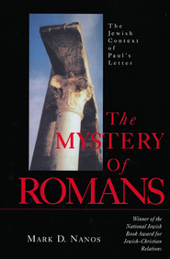
Christian gentiles worshiping the One God in the midst of the congregation of Israel — my point exactly! (emph. mine)
Paul is urging the Gentile believers to take note of their position, their role, and their halachic status as “resident aliens” within the midst of corporate Israel, which here is the synagogue context in Rome.
The alternative explanation, based Bockmuehl, Cohen, Lancaster, and Nanos, is that the Gentiles were included in the commonwealth of Israel but not as equal national citizens. It would be as if my wife, as a Jew, decided to make aliyah, become an Israeli citizen and live in Israel. As her husband, even though I’m not Jewish, I would be allowed a permanent status as a resident in Israel as well, but I do not have an automatic right to become a citizen, as does my wife, because I am not Jewish.
I would still have most or all of the same rights as Jewish Israelis and I would have most or all of the same obligations as Jewish Israelis, but none of that would make me Jewish, nor would the Chief Rabbis of Israel or any other Jewish religious authority expect me to observe Torah as they proscribe because I’m not Jewish.
I know you’re going to say that’s all secular law (with the exception of the authority of the Chief Rabbis) and has little or nothing to do with how God sees things, but I’m using the above example by way of analogy. When James and the Council issued their decision, it wasn’t some magical, spiritual event, it was a legal ruling on the same order as the authorities among the Pharisees made, and was binding halachah upon the community.
However, there is another citizenship I have and one in which I’m looking forward to living out in the age to come. It’s a status I currently possess since according to at least one interpretation of the New Covenant, I need to start living my life as if the world were already fully under the rule of Messiah, Son of David, as he is seated on his Throne in Jerusalem.
I consider myself a citizen of the worldwide Messianic Kingdom to come and many wonderful blessings come from this status. I will be resurrected from dead flesh and made immortal (assuming I die before Messiah’s return). I will have my sins fully, permanently cleansed from me. I will have the Holy Spirit poured into me to such fullness that I will have an apprehension of God in the same or even greater manner than the prophets of old. I will have my heart of stone turned to a heart of flesh and God will write His Word upon it so that it will be my natural inclination to always obey Him and not return to sin.
And as a Gentile of the nations, I will reside in a country that is a vassal state to national Israel, subservient to Israel which will be the head of all nations, and ultimately I and my nation of residence will be accountable to the King of Israel, Moshiach. I expect that I and everyone else like me will be planning our vacations around the festivals and making regular pilgrimages to Jerusalem to spend time with family and friends and pay homage and honor to our King.
The goyishness of Christianity is a sign of its success, not its failure!
-Rabbi Dr. Stuart Dauermann
“The Problem With Hebrew Roots, or, It’s Good to be a Goy” Interfaithfulness.org
Rabbi Dr. Stuart Dauermann
R. Dauermann makes a compelling argument that Gentiles who attach themselves to the God of Israel are intended by God to remain Gentiles. The prophets of the Tanakh who spoke of the Messianic Age all seemed to share that belief. I’ll only quote two of them:
And foreigners who bind themselves to the Lord
to minister to him,
to love the name of the Lord,
and to be his servants,
all who keep the Sabbath without desecrating it
and who hold fast to my covenant—
these I will bring to my holy mountain
and give them joy in my house of prayer.
Their burnt offerings and sacrifices
will be accepted on my altar;
for my house will be called
a house of prayer for all nations.”
–Isaiah 56:6-7 (NASB)
“In that day
“I will restore David’s fallen shelter—
I will repair its broken walls
and restore its ruins—
and will rebuild it as it used to be,
so that they may possess the remnant of Edom
and all the nations that bear my name,”
declares the Lord, who will do these things. (emph. mine)
–Amos 9:11-12 (NASB)
And to quote verse 14:
and I will bring my people Israel back from exile. (emph. mine)
which can also be interpreted as:
will restore the fortunes of my people Israel. (emph. mine)
In both of these prophetic examples describing Jews and Gentiles in the Messianic Age, it is clear that Gentiles will become attached to the God of Jacob as Gentiles and as citizens of the nations. While Isaiah paints for us a portrait of Gentiles offering sacrifices at the Temple of God (something which was allowed during the time of Herod’s Temple), Amos 9:14 makes a clear distinction between the Gentiles of the nations who “bear my name” and Israel!
It is true that Isaiah describes Gentiles keeping to the covenant, but after all, we will receive blessings because of our Abrahamic faith under the New Covenant, and in Messianic Days, I expect it will be more common for even the citizens of vassal nations to have laws and observances that more closely mirror national Israel’s including Sabbath keeping.
I’m not even saying (with apologies to R. Dauermann) that Gentiles in Messiah shouldn’t observe Sabbath in the present age. I’ve met many who do.
What I am saying is that none of what I see in the Bible, particularly the use of a single Greek word, absolutely mandates that all non-Jewish people who are disciples of Jesus be made into citizens of Israel, either in the present age or in the Messianic future.
God made a covenant with Abraham that was specifically and narrowly passed down to Abraham’s son Isaac (but not to Ishmael or any of Abraham’s subsequent children) and then to Isaac’s son Jacob (but not to Esau) and then to Jacob’s twelve sons who became the heads of the twelve tribes, who became the nation of Israel (but not to any other people group or nations).
That Abraham would also become the father of many nations and that through his seed (singular) Messiah, the nations would be blessed, does not abrogate the part of the covenant that specifically promises Israel only to the direct biological offspring of Abraham, and Isaac, and Jacob.
Having not read his book, I can’t say for sure, but if McKee comes to a different conclusion in his writing, then in spite of his stated education and scholarship, I’m forced to disagree with him.
I don’t write this against Pete or anyone else who holds to his views of scripture, but rather to illustrate that there are other valid and educated views of the Bible that come to other valid and educated conclusions.
I considered just making a few comments on Pete’s blog but as you see, the response requires a lot of words and it’s easier to write out my thoughts here and then just to share a link to my blog with him (and anyone else who is interested).
Considering all of the different viewpoints involved in this sort of discussion, I see the position of One Law/One Torah (OL/OT) as existing at one end of a continuum and what’s been called Bilateral Ecclesiology (BE) positioned at the opposite end. While I obviously am leaning closer to the BE end of the scale, I’m not sitting right on top of it.
Of those congregations I am aware of that I consider authentic Messianic Jewish synagogues, including Beth Immanuel, Tikvat Israel, and Ahavat Zion, they all have a majority membership/attendance of non-Jewish people worshiping the God of Israel and giving honor and glory to Yeshua HaMoshiach (Jesus Christ), with a smaller membership and usually leadership of Jews. In fact, the primary teacher at Beth Immanuel is a Gentile: D. Thomas Lancaster. And yet Beth Immanuel is a Jewish community and worship venue that adheres to specific standards of established halachah.
From my perspective, that’s the current state of Messianic Judaism, or at least those portions I know about in my little corner of the world.
That I don’t consider non-Jewish disciples to be literally citizens of national Israel does not exclude us from many incredible blessings or from association with our Jewish brothers and sisters in Messiah. I am quite comfortable inside of my own skin, so to speak, being a person among the nations who is called by His Name. Being married to a Jewish wife, I am content to recognize that she is among her people Israel and I’m dedicated to supporting her, and all other Jewish people I’m associated with, being and becoming closer to the God of Jacob as HIs people Israel through the mitzvot and within their unique community and nation which was established forever by Hashem.
What then shall we say was gained by Abraham, our forefather according to the flesh?
–Romans 4:1 (ESV)
Remember that in my reflection on Romans 3, Paul was toggling back and forth between Jewish obligation to the Law (Torah) and justification by faith, making sure that his audience, probably Jewish and Gentile believers in the synagogues in Rome (but talking about Gentile relationships with non-Jesus-believing Jews), understood the proper association, that Jews had many advantages including those Jews who had not yet come to faith in Messiah Yeshua, (Christ Jesus) but that only faith ultimately justifies one before the Almighty.
It must have been a struggle, especially for the Gentile Jesus-believers, to comprehend the relationship between faith and Torah observance. My reading of Romans tells me that these Gentiles might have been getting pretty arrogant, especially in relationship with the non-Jesus-believing Jews they encountered, because they had the Torah but not faith in Messiah. The Gentiles may have concluded that they were justified before God as were their Jewish Jesus-believing counterparts, but not the non-believing (in Jesus) Jews. After all, keeping the Law doesn’t justify.
Paul was trying to correct the error of the Gentiles’ thinking. Christians today tend to mess this up as well, but if we apply Paul to today’s Jewish communities, we see they too must have many advantages, and that God has not abandoned them or replaced them with the Church or even with the community of Jesus-believing Messianic Jews.
Chapter four sees Paul continuing to make his point and expand upon it.
What then shall we say that Abraham, our forefather according to the flesh, has found? For if Abraham was justified by works, he has something to boast about, but not before God. For what does the Scripture say? “Abraham believed God, and it was credited to him as righteousness.” Now to the one who works, his wage is not credited as a favor, but as what is due. But to the one who does not work, but believes in Him who justifies the ungodly, his faith is credited as righteousness…
–Romans 4:1-5 (NASB)
Paul continues to state that Abraham wasn’t justified by what he did, by any works, including circumcision, he was justified by faith and his faith was credited to him as righteousness, even as faith is credited to his readers and to us as disciples of the Master.
But that didn’t mean Abraham wasn’t subject to behavioral expectations by God. That doesn’t mean he didn’t have to obey:
So Abram went forth as the Lord had spoken to him; and Lot went with him. Now Abram was seventy-five years old when he departed from Haran. Abram took Sarai his wife and Lot his nephew, and all their possessions which they had accumulated, and the persons which they had acquired in Haran, and they set out for the land of Canaan; thus they came to the land of Canaan.
–Genesis 12:4-5 (NASB)
Now it came about after these things, that God tested Abraham, and said to him, “Abraham!” And he said, “Here I am.” He said, “Take now your son, your only son, whom you love, Isaac, and go to the land of Moriah, and offer him there as a burnt offering on one of the mountains of which I will tell you.” So Abraham rose early in the morning and saddled his donkey, and took two of his young men with him and Isaac his son; and he split wood for the burnt offering, and arose and went to the place of which God had told him. On the third day Abraham raised his eyes and saw the place from a distance. Abraham said to his young men, “Stay here with the donkey, and I and the lad will go over there; and we will worship and return to you.” Abraham took the wood of the burnt offering and laid it on Isaac his son, and he took in his hand the fire and the knife. So the two of them walked on together. Isaac spoke to Abraham his father and said, “My father!” And he said, “Here I am, my son.” And he said, “Behold, the fire and the wood, but where is the lamb for the burnt offering?” Abraham said, “God will provide for Himself the lamb for the burnt offering, my son.” So the two of them walked on together.
–Genesis 22:1-8 (NASB)
Abraham was faithful to God and obeyed him, even at great personal cost. Picture what it must be like to, at the word of God, pack up your family and all your possessions and head out in a direction with no stated destination in sight.
But that pales in comparison to the commandment to take your son and serve him up on the altar like a lamb to slaughter. As a father and grandfather, I can only imagine how Abraham’s heart must have been in anguish at knowing not only that his son would die, but that he would have to bind him and kill him with a knife.
Midrash says that Abraham believed that God would allow the sacrifice of Isaac but that God would resurrect him. However, the Torah is silent about this area of Abraham’s thoughts, so we’ll never be sure this side of Messiah what Abraham did and didn’t believe.
We only know that out of faith in God, he obeyed. Thus we can’t say that faith replaces obedience, only that it precedes it. From this I extrapolate that Paul is saying once justified by faith, Jews are expected to continue to observe the mitzvot and that in fact, their observance will have more depth of meaning because of faith.
But there’s something else:
David also speaks of the blessing on the man to whom God credits righteousness apart from works:
“Blessed are those whose lawless deeds have been forgiven, And whose sins have been covered. “Blessed is the man whose sin the Lord will not take into account.”
Is this blessing then on the circumcised, or on the uncircumcised also? For we say, “Faith was credited to Abraham as righteousness.” How then was it credited? While he was circumcised, or uncircumcised? Not while circumcised, but while uncircumcised; and he received the sign of circumcision, a seal of the righteousness of the faith which he had while uncircumcised, so that he might be the father of all who believe without being circumcised, that righteousness might be credited to them, and the father of circumcision to those who not only are of the circumcision, but who also follow in the steps of the faith of our father Abraham which he had while uncircumcised.
–Romans 4:6-12 (NASB)
In short, the forgiveness of sins is by faith, not by performance of the mitzvot, thus both Jews and Gentiles receive forgiveness by their faith and the Gentiles don’t have to be concerned that their sins will be counted against them if they don’t also observe the mitzvot in the manner of the Jews.
Remember I said that I thought the Gentiles were probably getting arrogant in their status of saved by faith apart from the Torah? It’s possible that the non-believing (in Jesus) Jews were “pushing back” with their advantage as Jews, having the Torah, the oracles of God, and maybe getting back at the Gentiles among them by pointing out what the Jews had that the Gentiles would never have.
If indeed there was a “war of egos” going on between the Jesus-believing Gentiles and the non-Jesus-believing Jews (with the Jesus believing Jews caught in the middle), then each party would be pressing their own perceived advantage against the other. Paul’s writing this letter to even things out. He’s saying that yes, non-Messianic Jews continue to have the advantages under the Abrahamic and Sinai covenants, but that under one of the blessings of Abraham, it is faith that removes sin for all, not Torah observance, so everyone who has faith will be saved.
Also remember that the non-believing (in Jesus) Jews weren’t faithless. They had faith, probably great faith, not in Jesus being Messiah but rather in Hashem, God of Creation, Master of Legions. Yes, faith in Messiah as the first fruits of the dead is the next logical, historical, and Biblical step in Jewish faith in God and the advancement of God’s plan to bring the New Covenant into the world, but non-believing (in Jesus) Jews were not totally abandoned by God, nor were they bereft of His compassion.
For the promise to Abraham or to his descendants that he would be heir of the world was not through the Law, but through the righteousness of faith. For if those who are of the Law are heirs, faith is made void and the promise is nullified; for the Law brings about wrath, but where there is no law, there also is no violation.
–Romans 4:13-15 (NASB)
This sounds like one of those either/or statements about faith being good and the Law bringing wrath, but what about the Law brings wrath?
If someone depended on their behavior alone with no faith in God and with the absence of intent to serve God, the response would be wrath, for without faith, no one can be saved from the consequences of their sin and from God’s righteous judgment. Yes, the Jews had the promises and they were (and are) heirs to the Land of Israel, but if observance is what you believe justifies you before God, then “faith is null,” as Paul wrote. Of course, the other side of that wrath is a Jew who claims to have faith in God but who is not observant. The Torah is clear about the consequences of disobedience or abandoning God’s Law for a Jew. But what about Gentiles in Messiah?
We see that there are two standards of judging obedience. They may overlap, but they’re hardly identical. If the Gentile disciples of the Master were not expected to observe the Torah in the manner of the Jews as per the legal ruling of the Council of Apostles and Elders (see Acts 15), then those without the Law (Torah), that is, the Gentile disciples, are not under the wrath of the Law. They are not expected to obey thus if they fail to observe the mitzvot, there is no transgression.
But as I said above, the other wrinkle is that even if a Jew has great faith and is justified before God, if he or she does not observe the Torah commandments (the conditions of fulfilling the Sinai Covenant), imagining somehow that they are like the Gentiles (and I can imagine that a few Jews may have taken this as Paul’s meaning), then that Jewish person would be under condemnation. Abandoning the Torah is written all over the history of the Israelites.
But to the wicked God says, “What right have you to tell of My statutes And to take My covenant in your mouth? “For you hate discipline, And you cast My words behind you.”
–Psalm 50:16-17 (NASB)
Just to show you that I’m not making up the idea that a Jew could misunderstand Paul’s intent in teaching Jewish Torah obligation and Gentile non-obligation…
And when they heard it they began glorifying God; and they said to him, “You see, brother, how many thousands there are among the Jews of those who have believed, and they are all zealous for the Law; and they have been told about you, that you are teaching all the Jews who are among the Gentiles to forsake Moses, telling them not to circumcise their children nor to walk according to the customs.
–Acts 21:20-21 (NASB)
Apparently some Jewish people got the idea that because Paul was teaching the Gentiles that they did not have to observe the Torah commandments (Moses) and they didn’t have to circumcise their sons, that Paul was also teaching the Jews the diaspora the same thing. Maybe some Jews reading Paul’s letters or hearing him teach actually thought he was applying the same “freedom” he was preaching to the Gentiles to Jewish believers in Yeshua.
Here was James’ solution to the problem and his attempt to clarify what Paul was really doing:
Therefore do this that we tell you. We have four men who are under a vow; take them and purify yourself along with them, and pay their expenses so that they may shave their heads; and all will know that there is nothing to the things which they have been told about you, but that you yourself also walk orderly, keeping the Law. But concerning the Gentiles who have believed, we wrote, having decided that they should abstain from meat sacrificed to idols and from blood and from what is strangled and from fornication.”
–Acts 21:23-25 (NASB)
Paul was to pay the expenses of four Jewish men under a vow (probably a Nazarite vow) in order to graphically illustrate that he continued to observe the mitzvot and that there was nothing to the erroneous rumors about him teaching “lawlessness” to diaspora Jews. Verse 25 presents the distinction for the Gentile believers, citing the Acts 15 letter, which limits the observance of the Messianic Goyim to a subset of the commandments.
Thus Paul was not teaching Jews that their level of observance was reduced to that of the Gentile disciples but rather, Paul remained a Torah-observant Jew teaching other Jews to keep to the commandments while at the same time, teaching the Gentile disciples a different or overlapping set of observances that were not nearly as strict or involved.
No wonder the Romans letter seems so difficult to follow. Paul was trying to explain circumstances that were (and are) very difficult to understand.
The common denominator for Jews and Gentiles in Messiah is faith. Faith justifies, makes one righteousness, and erases all guilt of sin (after repentance, of course), and only afterward are we to live a life of obedience by faith. Only then will God judge our hearts and hold us accountable to the level of our observance as specifically assigned to Jew or Gentile.
I know I’m going to get some “push back” for all that, but it’s the only way to explain what Paul is saying that makes any sort of sense to me.
For this reason it is by faith, in order that it may be in accordance with grace, so that the promise will be guaranteed to all the descendants, not only to those who are of the Law, but also to those who are of the faith of Abraham, who is the father of us all, (as it is written, “A father of many nations have I made you”) in the presence of Him whom he believed, even God, who gives life to the dead and calls into being that which does not exist. In hope against hope he believed, so that he might become a father of many nations according to that which had been spoken, “So shall your descendants be.”
–Romans 4:16-18 (NASB)
Like I said, faith is the common denominator in accordance with grace. Abraham has two lines of descendants, those who are of the Law, that is, the Jewish people, and those who are of the faith of Abraham, that is, the Gentile believers. This isn’t to say that the Jews have only the Law and Gentiles are the ones with all the faith. Like I said, faith is the common link between Jews and Gentiles. But we Gentiles are joined to the covenant blessings by faith and we do not have the Law.
The Law, that is, the Torah, the conditions of the Sinai covenant between God and Israel, is particularly identifying of Jews. That’s why (in my opinion), Paul structured his sentence as he did. The Jews are the ones whose obligations to God are specifically defined in the Torah. The Gentiles, by contrast, are specifically identified, not by the Law obviously, but as children of Abraham by faith alone. The Gentile behavioral conditions are summarized in the Acts 15 letter. Remember, the Jews were also physically children of Abraham, so they had their link back to the Patriarch both by faith and by bloodline. Gentiles are Abraham’s children by faith alone. This is how Abraham would be the father of the Jews but also the “father of many nations.”
The final verses of this chapter pull Paul’s points together, citing Abraham’s faith in the promise of an offspring, even in the face of both his and Sarah’s great age, and repeating that Abraham’s faith was credited to him as righteousness. Paul then points all this back to Jesus, the keeper of the New Covenant promises, the seed of Abraham (Galatians 3:16; 3:29), the one God raised from the dead, the one who was delivered over to sinful men for the transgressions of the world, for the sake of the Jews but also the Gentiles, that through faith in him and the resurrection, we have the hope of living in the New Covenant age, in an age of peace and tranquility, in an age without strife or sin, with Messiah the King.
For, on the one hand, there is a setting aside of a former commandment because of its weakness and uselessness (for the Law made nothing perfect), and on the other hand there is a bringing in of a better hope, through which we draw near to God. And inasmuch as it was not without an oath (for they indeed became priests without an oath, but He with an oath through the One who said to Him,
“The Lord has sworn
And will not change His mind,
‘You are a priest forever’”);
so much the more also Jesus has become the guarantee of a better covenant.
The former priests, on the one hand, existed in greater numbers because they were prevented by death from continuing, but Jesus, on the other hand, because He continues forever, holds His priesthood permanently. Therefore He is able also to save forever those who draw near to God through Him, since He always lives to make intercession for them.
For it was fitting for us to have such a high priest, holy, innocent, undefiled, separated from sinners and exalted above the heavens; who does not need daily, like those high priests, to offer up sacrifices, first for His own sins and then for the sins of the people, because this He did once for all when He offered up Himself. For the Law appoints men as high priests who are weak, but the word of the oath, which came after the Law, appoints a Son, made perfect forever.
–Hebrews 7:18-28 (NASB)
Does the priesthood of Messiah cancel the priesthood of Aaron and the Levitical system? The relationship between the Aaronic priesthood and the Melchizedekian priesthood explored in Hebrews 7:18-28.
This was a particularly interesting (and difficult) part of Hebrews to get through because I had to bypass (no pun intended) the traditional Christian reading (and what seems to be the plain reading) of the text and not believe that the Aaronic priesthood, the Temple, the sacrifices, and the Torah were all weak and useless and that Jesus replaced them as a better hope in bringing us closer to God.
By his own admission, Lancaster’s “bypass” analogy is flawed and by the end of the recording, he was asking his audience to forget he had even used it. But here it is anyway.
I’ll use my own location as an example. Just west of Boise is the community of Eagle, Idaho. When I first moved here nearly twenty years ago, State Street ran west out of Boise and directly through downtown Eagle. Now between Boise and Eagle, you could travel about fifty-five miles an hour but as you approached Eagle, you had to slow down considerably. This could be a pain if you were just passing through and your destination were further west.
Eventually, the highway department built a bypass. Now State Street completely avoids Eagle and folks can go fifty-five (or more), not go through Eagle at all, and get to where ever they’re going faster. Old State Street still goes through Eagle, but you have to specifically take that turnoff to get there.
Lancaster says the Aaronic priesthood is like Eagle, Idaho and that the priesthood of the Melchizedek “bypasses” it to better promises, as opposed to replacing it. Eagle is still there and still a destination. So is the Aaronic priesthood.
Yeah, it’s an imperfect metaphor. Here’s why.
The former priests, on the one hand, existed in greater numbers because they were prevented by death from continuing, but Jesus, on the other hand, because He continues forever, holds His priesthood permanently. Therefore He is able also to save forever those who draw near to God through Him, since He always lives to make intercession for them.
–Hebrews 7:23-25 (NASB)
Why is the Aaronic priesthood considered weak, imperfect, and useless? Was it really so? Was the Torah so weak and were the sacrifices so useless? It depends. It depends on what you are using them for. If you are using the Torah to give you eternal life in the resurrection and to justify you at final, eternal judgment, then yes, they are weak and useless…because they were never designed to be used for those purposes!
To employ another metaphor of Lancaster’s, it would be like using a screwdriver instead of a hammer to pound a nail into a board.
The Aaronic priesthood had a completely different purpose and it wasn’t an eternal purpose, even though the Aaronic priesthood itself is eternal:
Then you shall bring his sons and put coats on them, and you shall gird Aaron and his sons with sashes and bind caps on them. And the priesthood shall be theirs by a statute forever. Thus you shall ordain Aaron and his sons.
–Exodus 29:8-9 (NASB)
The priesthood belongs to the sons of Aaron by statute forever. They still have a job. It will be there waiting for them when Messiah returns and builds the Temple in Jerusalem.
But…
…but, Jesus as our priest in the order of Melchizedek has a different purpose than the Aaronic priesthood and it operates in a completely different venue, in the Heavenly Court or Temple.
Let them construct a sanctuary for Me, that I may dwell among them. According to all that I am going to show you, as the pattern of the tabernacle and the pattern of all its furniture, just so you shall construct it.
–Exodus 25:8-9 (NASB)
God instructed Moses to have the Israelites build what could be described as a scale model of the Heavenly Court on Earth, the mishkan or tabernacle. If you look at the specific instructions, all of the objects of the tabernacle, right down to the priestly robes, and the proportions of the tabernacle itself were all carefully modeled on their Heavenly counterparts.
That means for everything in the tabernacle, there was a counterpart in the Heavenly Court where Yeshua (Jesus) functions as the High Priest (and if it took a whole army of Aaronic priests and Levites to serve in the tabernacle, then there must be a host of priestly angels assisting Jesus our High Priest in Heaven).
So what Jesus does in Heaven as Priest, the sons of Aaron do in the earthly tabernacle and later the Temple in Jerusalem. They are not in competition, they’re complementary. The Heavenly Court then is not a “bypass” around the earthly Temple, they exist on two separate parallel roads, and they don’t even go to the same destination. It would be like modeling one interstate freeway system on a different, similar system.
Oh, “former” priests. Verse 23 is misleading in English. The Greek doesn’t say “former”. Lancaster tells us it says something like “those who are many who have become priests.” If you look at the context, you see the major difference between the Aaronic priests and Yeshua is that the sons of Aaron, like all men, die, while Jesus, having died and been resurrected, is immortal. There were no immortal Aaronic priests in the tabernacle or Temple.
Thus, Jesus is able to intercede for us forever, not just in terms of our immortal souls and salvation at the eternal judgment, but right now, today, Jesus is praying to the Father for us.
What about verses 20 and 21 where it mentions an oath? What oath?
The Lord has sworn and will not change His mind,
“You are a priest forever
According to the order of Melchizedek.”
–Psalm 110:4 (NASB)
Oh, that oath.
God swore an oath that an immortal Jesus would serve perpetually in the Heavenly Court as the eternal High Priest. No human priest in the Temple in Jerusalem was immortal and God swore no oath regarding them. Their mortality and imperfections, that is, their having sinned, made them “weak” and “flawed” and “useless” for the purposes of providing perpetual forgiveness of sins before the final judgment and eternal life through the resurrection (and remember, that’s not what they were designed to do). Jesus as High Priest is indeed “holy, innocent, undefiled, separated from sinners and exalted above the heavens.”
That’s the difference. That’s a much more consistent explanation of the comparisons and contrasts between the Aaronic and Melchizedekian priesthoods. That the latter is better doesn’t mean it replaces the former. It just means they function in different contexts and each one fulfills different job descriptions. Nearly two-thousand years of Christian interpretive tradition makes it seem otherwise.
What Did I Learn?
Just about everything. As I listened to Lancaster’s sermon, it all clicked into place, but trying to read Hebrews 7 without running it through this interpretive matrix made these passages seem terribly depressing when compared to my overall understanding of the New Covenant message.
That’s what this is all about. The “better promise” is what happens as the New Covenant enters our world and what happens when it reaches fruition. We are still in Old Covenant times. People are not perfected. We don’t have the Torah written on our hearts and our hearts have not yet been circumcised. We have received the indwelling of the Holy Spirit but not in its fullness so that we “know God” and obey His statues as a natural response.
Lancaster said that “perfection” refers to the resurrection and our perfected physical and spiritual states. Well, we certainly haven’t gotten that far yet.
Lancaster alluded to his What About the New Covenant lecture series which I suspect he incorporates into later sermons in his “Hebrews” series. The only way to understand Hebrews or any other part of the Apostolic Scriptures is to have a firm understanding of the New Covenant and how it works, which Lancaster provides in his New Covenant audio recordings.
Without that perspective, it is almost impossible to see the intent of the writer of the Epistle to the Hebrews in any accurate manner or in any way that is consistent with God keeping the promises He made to His nation Israel.
"When you awake in the morning, learn something to inspire you and mediate upon it, then plunge forward full of light with which to illuminate the darkness." -Rabbi Tzvi Freeman















 Morning Meditations