Sukkot: Drawing Water from Siloam

Pouring waterThe festival of Sukkot is the most joyous of the three biblically mandated festivals. In the holiday prayers, each festival is given its own descriptive name: Passover is the “Season of our Liberation,” Shavuot is the “Season of the Giving of our Torah,” but Sukkot is described simply as the “Season of our Rejoicing”! The Torah enjoins us no less than three times to rejoice, and be only happy, on Sukkot.

Sukkot is the holiday when we celebrate Jewish unity—as symbolized by the sukkah, whose holy walls bring us all together; and the Four Kinds, that symbolize the essential unity of all Jews, despite differing levels of Torah knowledge and observance. In the times when the Holy Temple stood in Jerusalem, on every night of the holiday (starting with the second night), there was a grand Water Drawing Celebration.

“Rejoice” from Chabad.org

Draw water with joy, from the wellsprings of salvation.Isaiah 12:3

In many ways, you could say that Sukkot is the happiest time of year, particularly after the solemn day of fasting and atonement just completed for Yom Kippur. There are many ways to celebrate the joy of fellowship with your people and with your God but I find this tradition to be particularly refreshing:

Unique to the holiday of Sukkot is the mitzvah to offer a water libation on the altar, in addition to the wine libation that accompanied all the sacrifices throughout the year. This water was drawn on the evening beforehand, amidst great fanfare, singing, reveling, and even acrobatic stunts performed by the time’s greatest sages.

In fact the Talmud states that “one who has not witnessed the Festival of the Water Drawing has not seen joy in his lifetime!”

I must admit that I have never witnessed the simchat beit hashoevah; the joy of the water-drawing, even as it is celebrated today, so I suppose, as the Talmud says, I’m missing out. Or am I?

Oddly enough, I woke up this morning wondering if Jesus ever built and lived in a sukkah. After all, during his lifetime, as the son of a carpenter growing up in a small rural village in occupied Roman Judea, his family must have observed Sukkot. We can only imagine that the family would make the trek to Jerusalem for the first day of Sukkot at least on some years. We know from Luke 2:41 that “Every year Jesus’ parents went to Jerusalem for the Festival of the Passover”, so it’s not hard to believe that they were obedient to the mitzvot of Sukkot as well. Why wouldn’t Yosef the Carpenter and his eldest son Yeshua ben Yosef build a small sukkah so that the family could take meals, welcome guests, and reside under the protection of God’s shelter as it says in the commandments?

In fact, we know that Jesus, the adult did attend Sukkot in Jerusalem, although, on one occasion, there was a bit of a conflict involved.

But when the Jewish Festival of Tabernacles was near, Jesus’ brothers said to him, “Leave Galilee and go to Judea, so that your disciples there may see the works you do. No one who wants to become a public figure acts in secret. Since you are doing these things, show yourself to the world.” For even his own brothers did not believe in him.

Therefore Jesus told them, “My time is not yet here; for you any time will do. The world cannot hate you, but it hates me because I testify that its works are evil. You go to the festival. I am not going up to this festival, because my time has not yet fully come.” After he had said this, he stayed in Galilee.

Not until halfway through the festival did Jesus go up to the temple courts and begin to teach. –John 7:2-9; 7:14

Leaving the Master for a brief moment, let’s take a look at a description of the celebration of water drawing based on Talmud, Sukkah 53:

What was the manner of the Water-Libation?

They used to fill a golden flagon holding three logs with water drawn from the Siloam (the siloam pool is an ancient site in Jerusalem, south of the Old City). When they reached the Water Gate they blew on the shofar a tekiah – teruah – tekiah. On the right of the Altar ramp were two silver bowls. They each had a hole like a narrow snout –one wide, the other narrow– so that both bowls emptied themselves together (the wider one was for wine, since wine flows out more slowly). The bowl to the west was for water and the one to the east was for wine.
Joy
Rabbi Judah said: They used to repeat the words, “We belong to G-d, and our eyes are turned towards G-d.”

The Pouring of the Water was held on all seven days [of Sukkot]…The one who was doing the pouring was told, “Raise your hands” (so that all could see him pouring the water on the altar). -Talmud, Sukkah 42b; 48b

Of a near-contemporary of the Master, a tale of the joy of Sukkot and of simchat beit hashoevah is told:

It was related of Old Hillel that when he was rejoicing with the joy of the Water-Drawing, he used to say, “…Where I love to be, thither my legs carry me.” And the Holy One, blessed is He, says, “If you come to My house, I will come to your house, and if you do not come to My house, neither will I come to yours.”

Sukkot is a time when we desire to come to His House with all our hearts and even though the Temple in Holy Jerusalem is not with us today, we can pray for its return, we can approach the Throne of Heaven within our souls, and we can invite God to reside with us, as much as we can recite the Ushpizin to invite Abraham, Isaac, Jacob, and many others, to join us as the Guest of our joy. With this image in mind, we can now return to the Master and see a perfect picture of the embodiment of living water in the House of God.

On the last and greatest day of the festival, Jesus stood and said in a loud voice, “Let anyone who is thirsty come to me and drink. Whoever believes in me, as Scripture has said, rivers of living water will flow from within them.” By this he meant the Spirit, whom those who believed in him were later to receive. Up to that time the Spirit had not been given, since Jesus had not yet been glorified.

On hearing his words, some of the people said, “Surely this man is the Prophet.”

Others said, “He is the Messiah.” –John 7:37-41

I deliberately ended my quote from this passage to remove the debate that existed (and that still exists) about the identity of Jesus, and I want to emphasize a point. The connection between the Master’s words and the joy of the water-drawing is unmistakeable, and yet how many Christians miss the reference because they choose not to find the Savior of the church in the teachings of the Jews? If Jesus not only rejoiced in the celebration of water-drawing, but became the simchat beit hashoevah, though I have not witnessed the celebration myself, how much more joy can I embrace as a disciple of living water? In drawing closer to God through the life of the Messiah, I can draw that living simchat beit hashoevah into me.

Jesus answered, “Everyone who drinks this water will be thirsty again, but whoever drinks the water I give them will never thirst. Indeed, the water I give them will become in them a spring of water welling up to eternal life.” –John 4:13-14

Under the sukkahAbraham Joshua Heschel in his book God in Search of Man, looks at the “wells of the Messiah” from a different direction.

“For if a man live many years let him rejoice (Ecclesiastes 11:8) in the joy of the Torah and remember the days of darkness, these are the days of evil, for they shall be many. The Torah which a man learns in this world is vanity in comparison with the Torah [which will be learnt in the days] of the Messiah.” (Ecclesiasties Rabba, ad locum).

Isaiah’s prediction for the days to come, “With joy shall ye draw water out of the wells of salvation” (12:2), is explained by Rashi in the following way: “Ye shall receive new teaching, for the Lord will widen your understanding…The mysteries of the Torah that were forgotten during the exile in Babylonia because of the distress Israel suffered, will be revealed to them.”

In reciting the mystic ushpizin, seven “supernal guests” are invited in sequence into a Jew’s sukkah on each of the seven nights of Sukkot: Abraham, Isaac, Jacob, Moses, Aaron, Joseph and David. The intent is to fill our sukkah, not only with heavenly guests, but with earthly ones as well, creating a meeting point and a joining between heaven and earth in joy and peace, in anticipation of the days of the Moshiach. But for those of us who have found the Messiah in the life of Jesus Christ, perhaps we can allow a slight adaptation to this ceremony, and to invite one other guest, our “mystery of the Torah”, into our shelters, our homes, and our hearts. For where you find the Messiah, you will also find God.

Where is it that you can find all of G–d? Wherever He wishes to be found.

Right now, He hides within some scattered branches placed upon an autumn hut.

-Rabbi Tzvi Freeman
“All of Him”
Based on letters and talks of the Rebbe
Rabbi M. M. Schneerson
Chabad.org

“A Jew never gives up. We’re here to bring Mashiach, we will settle for nothing less.” –Harav Yitzchak Ginsburgh

Sukkot begins tonight at sundown and this special Sabbath lasts until Friday evening. At that point, the weekly Sabbath begins. In honor of these events, my next “meditation” blog won’t be published until either Saturday evening after sundown or Sunday morning.

May you drink from springs of living water. Chag Sameach Sukkot!

The Empty Sukkah

The empty sukkahRabbi Pinchas of Koretz was a spiritual giant in his generation. At first, his greatness was mostly unknown to his contemporaries, but he had no regrets; indeed, it suited him just fine. He spent his days and nights in Torah-study, prayer and meditation. Rarely was he interrupted.

But then, the word began to spread, perhaps from fellow disciples of Rabbi Israel Baal Shem Tov, that Rabbi Pinchas was very, very special. People began to visit him on a regular basis, seeking his guidance, requesting his support, asking for his prayers and beseeching his blessing. The more he helped them, the more they came. The trickle to his door became a stream and the stream became a daily flood of personal stories and requests for help.

Rabbi Pinchas was overwhelmed. He felt he was no longer serving G-d properly, because he no longer had sufficient time to study, pray and meditate as he should. He didn’t know what to do.

-Rabbi Yerachmiel Tilles
“The Unpopular Tzaddik”
Chabad.org

Rabbi Tilles goes on to tell the story of Rabbi Pinchas and the disastrous results of his desire to, in essence, be left alone with God. Rabbi Pinchas forgot that he was put into a world full of people and as much as people can be distracting at times, we ignore them at our own peril.

As the story goes, Rabbi Pinchas asked for and received a boon from Heaven, that people no longer be attracted to him in the slightest. However, there is a saying: “Be careful what you ask for.” Sukkot is a terrible time to be alone for a Jew.

In those days in Europe, people desiring an invitation to a meal would stand in the back of the shul upon the completion of the prayers. The householders would then invite them upon their way out, happy to so easily accomplish the mitzvah of hospitality. Rabbi Pinchas, unfortunately, did not find it so simple. Even those without a place to eat and desperate for an invitation to a sukkah in which to enjoy the festival meal, turned him down without a second thought. Eventually, everyone who needed a place and everyone who wanted a guest were satisfied, except for the tzaddik, Rabbi Pinchas.

He trudged home alone, saddened and a bit shaken up at the realization that he might never have another guest, not even for the special festive meal of the First Night of Sukkos. Alas, that too was part of the price of his freedom…. It was worth it, wasn’t it?

Wasn’t it? Rabbi Levi Avtzon tells a different story about Sukkot, why it exists, and why we are here.

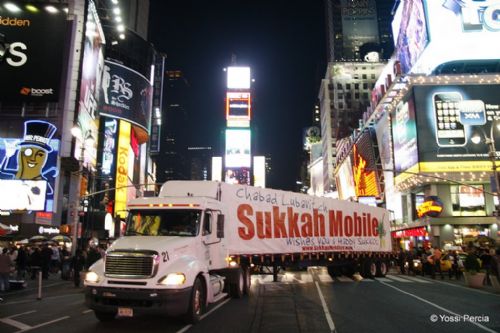
Thousands of Chabad rabbis and students go out to the streets in Sukkah Mobiles to meet fellow Jews and offer them the opportunity to shake the Four Kinds (“Please don’t shake them too hard!”), grab a bite in the sukkah, and just have a nice friendly chat (“You’re from Australia? How awesome! I have a cousin there. Do you know him?”). Unity.

At the core of the almost seven billion human beings walking the beautiful earth is a quest for unity: unity and harmony within ourselves, unity with our fellows and environment, and unity with our Creator. This quest can be covered with dust, concealed by hate and stigma, obscured by ego, and masked by bloodshed—but the quest never dies, and never will die until we bring peace and harmony to our world.

For seven days a year we dedicate ourselves to bringing unity to our world. On this holiday, united we sit.

What could have been more wrong than for Rabbi Pinchas to create a situation where he was completely denied unity and fellowship with other Jews at so joyous a season? And yet, was there a silver lining to his cloud? For a moment, it seemed so.

Pausing just inside the entrance to his sukkah, Rabbi Pinchas began to chant the traditional invitation to the Ushpizin, the seven heavenly guests who visit every Jewish sukkah. Although not many are privileged to actually see these exalted visitors, Rabbi Pinchas was definitely one of the select few who had this experience on an annual basis. This year, he raised his eyes and saw the Patriarch Abraham–the first of the Ushpizin and therefore the honored guest for the first night of the festival–standing outside the door of the sukkah, keeping his distance.

Rabbi Pinchas cried out to him in anguish: “Father Abraham! Why do you not enter my sukkah? What is my sin?”

Replied the patriarch: “I am the embodiment of Chessed, serving G-d through deeds of loving-kindness. Hospitality was my specialty. I will not join a table where there are no guests.”

The story of Rabbi Pinchas ends on a happy note. After much prayer, Heaven hears and answers and “throngs of people were again finding their way to his door; seeking his guidance, asking his support, requesting his prayers, and beseeching his blessing.” While by nature, Rabbi Pinchas was a solitary and studious person, thanks to Father Abraham, the interruption of his most cherish activities was no longer seen as a problem.

Chabad's mobileI find it interesting that Rabbi Avtzon characterized Sukkot as symbolic of “seven billion human beings walking the beautiful earth is a quest for unity: unity and harmony within ourselves, unity with our fellows and environment, and unity with our Creator.” This illustrates that somehow, it is not only the Jewish people who seek God, it is not only the Jewish people who seek His shelter, and it is not only the Jewish people who seek unity. Sukkot represents the quest for world-wide unity under God, and yet like Rabbi Pinchas, some of us will sit in our sukkah alone.

Rabbi Pinchas created his own problem and thanks to a lesson from Heaven, he also resolved it. Tonight begins the seven days of Sukkot (I put up the family sukkah in my backyard last night) and the world’s population of Jews (and a few Gentiles like me) will be entering a sukkah somewhere, taking meals, hopefully sharing company with many guests, and maybe even sleeping within their make-shift tents, relying on God to keep out the wind and rain in memory of the same shelter He provided to the Children of Israel in the desert.

The empty sukkah of Rabbi Pinchas was a bitter thing and even Abraham would not enter, but for those who are alone through circumstances or by choice, there is still some benefit in being an open and empty container.

The beginning of all paths and the foundation of all ascents is to open yourself to receive from Above.

And how do you receive from Above? By being empty—because a full vessel cannot receive, while an empty vessel has a hollow to be filled.

That is why we must run from depression; because a depressed person is so filled with his own self-pity, there is no room left to receive anything, no opening for life to enter.

But a humble, open spirit is vibrant with joy.

-Rabbi Tzvi Freeman
“Joyful Emptyness”
Meditations on Happiness”
Based on letters and talks of the Rebbe
Rabbi M. M. Schneerson
Chabad.org

Chag Sameach Sukkot!

And if you’re wondering about the “Sukkah-on-wheels” as shown in the second image in this blog post, learn about the world’s largest mobile sukkah at COLLive.com (rumor has it that even Spider-Man gets into the swing of things).

Island Under Heaven

Under heavenThere is no security this side of the grave.Harlan Ellison

Very little is needed to make a happy life; it is all within yourself, in your way of thinking.Marcus Aurelius

Joy is an overflowing, an explosion. Something enters a person’s life for which he could never be prepared and his previously tidy self erupts in song, dance and joy. Approach the Divine with a calculated mind and there is no window for joy. Embrace the infinite beyond mind and let joy surprise you.

-Rabbi Tzvi Freeman
“Explosive Joy”
Meditations on Happiness
Based on letters and talks of the Rebbe
Rabbi M. M. Schneerson
Chabad.org

I know in one sense, God does not require us to live happy or satisfied lives and certainly, many of His servants, the Prophets and the Apostles, did not live happy lives. In fact, most of them died under less than optimal circumstances. Nevertheless, Paul did say:

I know what it is to be in need, and I know what it is to have plenty. I have learned the secret of being content in any and every situation, whether well fed or hungry, whether living in plenty or in want. I can do all this through him who gives me strength. –Philippians 4:12-13

This tells me that our circumstances don’t have to dictate our perception of life or of ourselves as long as we rely on God as the source of our strength. Of course, in verse 14, Paul went on to say, “Yet it was good of you to share in my troubles”, so for Paul, having a community to share his experiences with was not out of the question.

I’ve been considering matters of community and connection along with learning and growing closer to God. For some time, I have desired to study and worship with my wife and, since she’s Jewish and doing so is not an option in a Christian format, I have sought to meet her where she is and to honor God in a synagogue setting. Also, and this should be obvious to anyone who has been following my blog posts, I find Jewish theology, philosophy, and mysticism fascinating and indeed, a window into the soul of the Messiah, so deepening my understanding within a Jewish context is also something I desire.

But there’s a difference between wanting and having and there’s a difference between ideals and human beings. While I find a great deal of meaning in many of the writings produced by Rabbi Tzvi Freeman and the Chabad as well as religious Judaism in general, I am also aware that there are real people with real lives behind what I read and study. No religion or group of religious people is perfect and if we are human, we are flawed. Those flaws can get in the way of reaching community, fellowship, and purpose and sometimes desiring community with people can be confused with desiring union with God.

In yesterday’s blog, I discussed the roadblocks preventing me from achieving my stated goals, but maybe I’m confusing the ideal of what I want with the reality what I’m encountering. I may also be confusing how God sees and judges me with how human beings see and judge me. I am aware that many of the traditional values held by Christianity are incompatible with Judaism, especially based on how both religions have evolved over the past 2,000 years or so. Yesterday, I quoted a Jewish person who brought this to light, at least on the Christian side of the equation.

“Christianity has to realize its error in deviating from what the original sect taught and practices before that connection can be made, before that door can be entered through. Only then will hope be found.” –said by S

Night trainI think part of what I’ve been looking for is both the Biblical and Rabbinic ideal in how God is understood and taught, but what I have been encountering is the problematic relationship between Christians and Jews in the real world. It’s also easy to get caught up in the idea that feeling like I’m being pushed aside or pushed away means that I’m not good enough for that group. At least that’s how I see it sometimes.

Given all this, some Christians reading this might wonder why, besides the fact that I am married to a Jew, I pursue the Jews as the keepers of the Bible and the gateway to its understanding?  Why won’t I abandon this particular path and pursue a more normative Christian journey? Rabbi Abraham Joshua Heschel in his book God in Search of Man quotes A. Jeremias, Juedische Froemmigkeit, p. 57 with the answer:

Christian..Gellert, when asked by Frederick the Great: “Herr Professor, give me a proof of the Bible, but briefly, for I have little time,” answered: “Majesty, the Jews.” (Heschel p. 246)

Heschel (p. 255) also quotes from Seder Eliahu Rabba, IX, ed. M. Friedman, Wein, 1902, p. 48 when he declares that the revelation of the Bible is not for the Jew alone.

There is a grain of the prophet in the recesses of every human existence. “I call heaven and earth for witnesses that every man, whether gentile or Jew, whether man or woman, whether man-servant or maidservant, according to the measure of his good deeds, the spirit of holiness rests upon him.”

How like the words of Paul in Galatians 3:28. Heschel further demonstrates why I look east to Jerusalem with my questions about God and punctuates my dilemma in wondering how I will ever get an answer.

Never before and never since has such a claim been expressed. And who will doubt that the claim proved to be true? Has not the word spoken to the people of Israel, penetrated to all corners of the world and been accepted as the message of God in a thousand languages? (p. 243)

Our problem, then, is how to share the certainty of Israel that the Bible contains that which God wants us to know and to hearken to; how to attain a collective sense for the presence of God in the Biblical words. In this problem lies the dilemma of our fate, and in the answer lies the dawn or the doom. (p. 246)

I know ideally (there’s that word again) that I should seek to please God and not people (Acts 5:29; Galatians 1:10), but as Paul pointed out in Philippians 4:14, it would be good to share myself with others. However, reality, whether “dawn” or “doom”, is what it is and given my particular theological preferences and the nature of a perfect world vs. a real one, I may have to accept that although drawn to the gates of Judaism, I am not always welcome in Jewish communities because of my faith. In that I must also realize I am still “good enough” as the person I am, even though I must stand apart from those people and from my goal. That part about being “good enough” is hard for me to understand though, in light of the value of continual self-improvement and especially knowing that no one is righteous (Ecclesiastes 7:20; Romans 3:10).

RainIt’s rather premature to declare my experiment a failure, but I may end up having to accept truncated results. While human beings have limits and construct barriers, God does not inhibit us from approaching Him with an open and contrite heart. Even in Judaism, it is acknowledged that God has not rejected the Gentiles (although how they believe God sees Christians is another story) and of course, the very heart of Christianity opens the door for the nations to have access to God, specifically through the person of Jesus Christ.

In the end, community or isolation, acceptance or non-acceptance, I can still pray, I can still read, I can still study, and I can still write and share who I am and what I am learning during these “morning meditations”. If anyone deems them of value, I am certainly grateful, but more than people, I must share who I am with God, not that He doesn’t know me already, but because part of a relationship is to share yourself with the other. Being a writer, this is how I best share and communicate what I experience when I immerse myself into the pools of God’s perfect wisdom. Again, Heschel has something to say on this point.

The Bible is holiness in words. (p. 244)

If God is alive, then the Bible is His voice. (p. 245)

Almost 400 years ago, John Donne wrote that “no man is an island”. I suppose in general, that’s true. At other times though, I can see myself as a single, tiny bit of flotsam floating on an infinite sea waiting for God to toss me a line and bring me to His shores. A better metaphor, given the approach of Sukkot, is to say that I’m that imperfect and incomplete booth or tent, empty of guests and exposed to the harsh elements, who also is sheltered by the roof of Heaven.

A voice says, “Cry out.”
And I said, “What shall I cry?”
“All people are like grass,
and all their faithfulness is like the flowers of the field.
The grass withers and the flowers fall,
because the breath of the LORD blows on them.
Surely the people are grass.
The grass withers and the flowers fall,
but the word of our God endures forever.” –Isaiah 40:6-8

The World that Doesn’t Exist

Sukkah…these I will bring to my holy mountain
and give them joy in my house of prayer.
Their burnt offerings and sacrifices
will be accepted on my altar;
for my house will be called
a house of prayer for all nations.”
The Sovereign LORD declares—
he who gathers the exiles of Israel:
“I will gather still others to them
besides those already gathered.”
Isaiah 56:7-8

When Jesus heard this, he was amazed and said to those following him, “Truly I tell you, I have not found anyone in Israel with such great faith. I say to you that many will come from the east and the west, and will take their places at the feast with Abraham, Isaac and Jacob in the kingdom of heaven.”Matthew 8:10-11

According to the prophets, the Feast of Booths celebrates a time when all nations will ascend to Jerusalem bearing tribute to King Messiah and celebrating the festival. In that day, all nations will ascend to His throne in Jerusalem in order to celebrate the Festival of Booths (Tabernacles). Obviously, this is a very important festival for disciples of Messiah today.

The Weekly eDrash
“A Tabernacle of Glory over Jerusalem”
First Fruits of Zion commentary on Sukkot
FFOZ.org

I’ve had my doubts.

No, I don’t doubt the word of God but on the other hand, given the division between different denominations of Christians and particularly between Christians and Jews, I wonder how we will all be able to sit down at the same table together “at the feast with Abraham, Isaac and Jacob in the kingdom of heaven” and rejoice in each other and in the Messiah?

Last week I hit a speed bump in my pursuit of the Ger Toshav as a possible model for a relationship between Christians and Jews, and today I was reminded of the state of discomfort and even enmity some Jews feel toward Christians based on this “wall photo” that was shared on Facebook. Add to that some of the comments from Jewish participants about Christianity:

“Christianity has to realize its error in deviating from what the original sect taught and practices before that connection can be made, before that door can be entered through. Only then will hope be found.” –said by S

“I’m saying that Judaism shouldn’t centralize the messiah. And in my opinion when it does, it’s a mistake. Christianity and the holocaust are results of such a mistake.” –said by A

“There are 2 paths in serving Creator: 613 commandments for Jews and Noahide Laws for gentiles. Thats the ideal modality. When gentiles invent their own religions or Jews don’t follow their commandments, they keep the world from reaching perfection which is the hallmark of the Messianic Age.” –said by V

…the reason you give for Christians accept Jews is impossible. a Jew is what he is. Why should he give up to a lesser level of spirituallity?

Your reason for Jews accept Christians, isn’t exactly that, but it has a reason… a reason found in Torah. As long as a gentiles thinks that a man is God, or that there are more than 1 God, or that the Torah given BY GOD to Moshe in Sinai isn’t valid, then a Jew cannot accept it. That’s Idolatry.

I, as a Jew don’t think that gentiles are lesser human beings!!!! NOT AT ALL!!! A Jew who call himself Jew but commits lashon haRa and proclaims hate, is a lesser human being than a gentile with a good heart for humanity. –said by X

From mainstream Judaism’s point of view, it is reasonable to expect this level of response in believing that Christians have misappropriated the concept of Messiah and bent it in very non-Jewish directions. But it also precludes any possibility of a Christian entering a synagogue setting (where it is known he or she is a Christian), learning of the wisdom of the sages, and even being a tiny part of the community, when that Christian’s basic faith would be seen as an affront. Both Jews and Christians pursue God in His vast and majestic Heavens, and yet we cannot build a simple bridge between our two worlds on here on Earth.

I can truly see how Jesus could say “when the Son of Man comes, will he find faith on the earth?” (Luke 18:8)

And yet the prophet says this:

This is what the LORD Almighty says: “In those days ten people from all languages and nations will take firm hold of one Jew by the hem of his robe and say, ‘Let us go with you, because we have heard that God is with you.’” –Zechariah 8:23

The Jews rely on the promises of God that “every man will sit beneath his own vine and fig tree and none will make them afraid” (Micah 4:4) while the Christians rely on the grace of Jesus and the word of the Apostle Paul when he said, “in all these things we are more than conquerors through him who loved us. For I am convinced that neither death nor life, neither angels nor demons, neither the present nor the future, nor any powers, neither height nor depth, nor anything else in all creation, will be able to separate us from the love of God that is in Christ Jesus our Lord” (Romans 8:37-39).

But each group believes God is speaking to only them and is excluding the other (and all others).

While Sukkot is a season of hope, in the present age it is also a season of despair, for while we (or at least Jews and those few Christians who will build a sukkah this year) are supposed to generously invite all guests into our sukkah for a meal and fellowship for the sake of God, how many people and groups will not be on the “approved” list?

JonahLike Jonah, we know the word and the will of God and yet we still seek to run away because it is against our human will to fulfill that word. God turned Jonah away from his mistaken path and delivered him to the great city to complete the job God gave to him, but how will God do that with us? It could begin with a single invitation into our homes and lives of someone we would otherwise not have considered letting in. It could begin with a Christian family accepting a single Jew into fellowship and the breaking of bread. It could begin with a Jewish family inviting a single Christian into their sukkah to enjoy a meal and the prayers. The question is, can it begin now, or must we wait for the Messiah to come (for the Jews) and come again (for the Christians)?

I’m not writing this for you who are “already onboard” with seeking a unity between Christians and Jews, but to those who seek to shelter themselves within their own groups and push away the rest of the world and the rest of the people God created. Is there a delight in committing one act of friendship and graciousness; an act of pure and simple love, not for your sake or mine, but for the sake of God?

G-d has many delights:

The delight that comes from a pure and simple act of love.

Greater than that, the delight that comes from an act of beauty sparkling in the darkness.

Greater than that, the delight when a child who has run away returns with all her heart.

Delight lies at the essence of all that is.

-Rabbi Tzvi Freeman
“Delights”
Based on letters and talks of the Rebbe
Rabbi M. M. Schneerson
Chabad.org

The Rabbi describes a world of people and ideals that does not exist, at least not yet. The hope that we all have in the Messiah is that one day, we will all be able to live in this world and be at peace with God, with all our neighbors, and most of all, be at peace within our own hearts. We will see that peace someday. But we have a very long way to go until “someday” gets here.

Immanu-El

Ending and Beginning“Men of Israel, listen to these words: Jesus the Nazarene, a man attested to you by God with miracles and wonders and signs which God performed through Him in your midst, just as you yourselves know – this Man, delivered over by the predetermined plan and foreknowledge of God, you nailed to a cross by the hands of godless men and put Him to death. But God raised Him up again, putting an end to the agony of death, since it was impossible for Him to be held in its power. For David says of Him,

‘I saw the Lord always in my presence;
For He is at my right hand, so that I will not be shaken.
‘Therefore my heart was glad and my tongue exulted;
Moreover my flesh also will live in hope;
Because You will not abandon my soul to She’ol,
nor allow Your Holy One to undergo decay.
‘You have made known to me the ways of life;
You will make me full of gladness with Your presence.’

“Brethren, I may confidently say to you regarding the patriarch David that he both died and was buried, and his tomb is with us to this day. And so, because he was a prophet and knew that God had sworn to him with an oath to his seat one of his descendants on his throne, he looked ahead and spoke of the resurrection of the Christ, that he was neither abandoned to She’ol, nor did his flesh suffer decay. This Jesus God raised up again, to which we are all witnesses. Therefore having been exalted to the right hand of God, and having received from the Father the promise of the Holy Spirit, He has poured forth this which you both see and hear. For it was not David who ascended into heaven, but he himself says:

‘The Lord said to my Lord
“Sit at My right hand,
until I make your enemies a footstool at your feet.”’

Therefore let all the house of Israel know for certain that God has made Him both Lord and Christ – this Jesus whom you crucified.”

Now when they heard this, they were pierced to the heart, and said to Peter and the rest of the apostles, “Brethren, what shall we do?” Peter said to them, “Repent, and each of you be baptized in the name of Jesus Christ for the forgiveness of your sins; and you will receive the gift of the Holy Spirit. For the promise is for you and your children and for all who are far off, as many as the Lord our God will call to Himself.” And with many other words he solemnly testified and kept on exhorting them, saying, “Be saved from this perverse generation!” So then, those who had received his word were baptized; and that day there were added about three thousand souls. They were continually devoting themselves to the apostles’ teaching and to fellowship, to the breaking of bread and to prayer.Acts 2:22-42 (NASB)

I have a personal tradition of reading this passage from the Book of Acts on Yom Kippur every year along with the other Yom Kippur readings. It is a reminder that people can be confronted with the truth and by the Spirit of God, change at the core and become new again in Him. These words provide hope and a certain warmth in my heart along with the Yom Kippur Haftarah portion:

If you refrain from trampling the sabbath,
From pursuing your affairs on My holy day;
If call the sabbath “delight,”
The Lord’s holy day “honored”;
And if you honor it and go not your ways
Nor look to yours affairs, nor strike bargains —
Then you can seek the favor of the Lord.
I will set you astride the heights of the earth,
And let you enjoy the heritage of your father Jacob —
For the mouth of the Lord has spoken. –Isaiah 59:13-14 (JPS Tanakh)

For another year, Jews all over the world feel a lightening in their souls as they approach the world and a new year with much excess baggage lifted from them. For Christians, there is no analogous time on our calendar in which we specifically approach the Throne of God in humility and perhaps in shame, and beg our Creator to make everything clean between us again. We can approach God through Jesus Christ on a daily basis, so there’s no need for a “Christian Yom Kippur”, right? Believe it or not, Jews think this way about Yom Kippur too and ask:

Question: Regarding Yom Kippur, why is there a necessity in Judaism to designate a particular day for atonement when one could atone any minute of the day as he or she chooses? Isn’t G-d listening all the time? Why designate a day that could potentially encourage sinful behavior during the year only to repent on Yom Kippur?

Answer: Maimonides addresses both your questions in his “Laws of Repentance”. In Chapter 2 he states,

Even though repentance is always good, during the ten days between Rosh Hashana and Yom Kippur it is more desirable, and is accepted [by G-d] immediately… Yom Kippur is the time for repentance for the individual and community, and it is the end time of forgiveness and atonement for Israel. Therefore everyone is obligated to repent at this time…

During the year, a person has the option. At this time it is obligatory, and easier to accomplish. Consider the difference between flicking a bug off the table, and pushing a tiger off the table.

In Chapter 4 he says that one who sins with the intent of obtaining forgiveness on Yom Kippur is held back from repenting. We all know, the guy who says, “my diet starts tomorrow” never loses weight.

Best Wishes,
Shlomo Soroka
JewishAnswers.org

Inner lightAre there times of year when God is closer and repentence is more at hand? Remember, traditionally Jews prepare for the Days of Awe for over a month prior to the actual Day of Atonement. I hardly think the intent and anguish built up over that period of time in anticipation of Rosh Hashanah and Yom Kippur can be compared to asking for God’s forgiveness in your prayers each morning (but who am I to know).

Rabbi Mordechai Dixler, Program Director at Project Genesis – Torah.org puts it this way:

Many have had the experience of offering an apology, only to be told that “sorry isn’t good enough.” It’s fundamental to Judaism that G-d always accepts a sincere apology, is always ready to welcome us back. There are, however, times that a person can commit such a breach that the relationship with G-d needs major repairs, where a simple apology is not enough by itself.

On Yom Kippur this all changes. The Nesivos Shalom writes (based on the Zohar) that Kol Nidrei‘s annulment of vows erases all spiritual decrees. Major repairs are no longer needed. The opportunity to approach G-d and ask forgiveness for the past and make a commitment for the future is suddenly open to everyone. That is why on Yom Kippur, a simple apology is indeed all it takes. As all obstacles vanish, all hearts and souls open up.

You may not see any validity in Jewish mystic teachings, but if your faith is a Jewish faith, then the entrance to the gates of Heaven are open a bit wider at a certain time of year than at other times. Even without a Jewish faith, in preparing yourself over the course of time to stand and face God as the person you are, you can only be assumed to have a greater readiness to pour your soul out like a drink offering at His feet in this most holy of encounters. We can see God’s desire for this, not only in the Yom Kippur service, and not only in Kaballah, but in Christianity’s own mystic writings:

And He who sits on the throne said, “Behold, I am making all things new.” And He *said, “Write, for these words are faithful and true.” Then He said to me, “It is done. I am the Alpha and the Omega, the beginning and the end. I will give to the one who thirsts from the spring of the water of life without cost. He who overcomes will inherit these things, and I will be his God and he will be My son. –Revelation 21:5-7 (NASB)

In Yom Kippur, we can see the imagery of “He who overcomes” and at the breaking of the fast, as “one who thirsts” we can receive “the spring of the water of life without cost.”

But the day after Yom Kippur is also like another day we have yet to see.

And he carried me away in the Spirit to a great and high mountain, and showed me the holy city, Jerusalem, coming down out of heaven from God, having the glory of God. Her brilliance was like a very costly stone, as a stone of crystal-clear jasper. It had a great and high wall, with twelve gates, and at the gates twelve angels; and names were written on them, which are the names of the twelve tribes of the sons of Israel.

I saw no temple in it, for the Lord God the Almighty and the Lamb are its temple. And the city has no need of the sun or of the moon to shine on it, for the glory of God has illumined it, and its lamp is the Lamb. The nations will walk by its light, and the kings of the earth will bring their glory into it. In the daytime (for there will be no night there) its gates will never be closed; and they will bring the glory and the honor of the nations into it… –Revelation 21:10-12; 22-26 (NASB)

Throughout the Bible, the chronicle of God’s interaction with human beings, we see an unbroken thread of God’s intent to live with us, from Eden, to the Mishkan in the desert, to the Temple in Holy Jerusalem, to the Spirit which has always lived in the heart of the faithful, and finally to a New Jerusalem descending from Heaven, with God and the Lamb as its Temple. Here, both Christianity and Judaism have a tradition of the Song of the Lamb (Revelation 15:2-3) and the Song of the Messiah representing “a new song, shir chadash”; a “universal vision of complete redemption and the perfection of the world” as a “promise of a glorious future for all humanity” and “one of Judaism’s greatest gifts to the world.”

The Lord is with youChristians tend to create a dichotomy between the secular and the holy, between man and God. We also see some of this symbolism of division in how Judaism presents the Shabbat in opposition to the rest of the week. We strive for God in His Heaven above while we struggle with our mortality and humanity on the earth below. Christians talk about “going to Heaven” to be with God when they die, but we see in the vision of Eden and New Jerusalem that in the end, we do not go to God; God comes to us…as it was in the beginning.

The teachings of the Rebbe are not just a collection of advice and nice thoughts —just as a year is more than the sum of 365 days. The teachings of the Rebbe make up one simple whole. All revolve around the same essential concept: The fusion of the loftiest spiritual heights with the most mundane physicality. In the Rebbe’s words, “the highest with the lowest”.

The concept is not only radical but powerful: It means I can be myself, living a “down to earth” existence, and yet fulfilling a transcendental goal. It means that there is nothing we are trying to escape – other than the notion that we must escape something. We don’t run away from this world to join a higher one, instead we work to fuse the two. We aren’t in the business of “making it to heaven” – we’re busy bringing heaven down to earth.

-Rabbi Tzvi Freeman
“Fusion”
Based on letters and talks of the Rebbe
Rabbi M. M. Schneerson
Chabad.org

It’s no coincidence that the expression of God’s desire to live among men comes right before the Festival of Sukkot which will be upon us in just a few days. We will pitch our tents in our backyards and at the synagogues and invite all His holy ones to dwell with us in an imperfect container, with God providing the sheltering roof over us, making the incomplete, complete.

May the expressions of my mouth and the thoughts of my heart find favor before You, HASHEM, my Rock and my Redeemer. –Psalm 19:14

God is with us.

Unanticipated Atonement

Shofar as sunriseIt’s all up to you. Everything about Yom Kippur, coming up this Friday night, points to you: In times of old, one High Priest serving our one G-d in His one Temple on His one holiest day on behalf of His one people elicited G-d’s atonement for the entire world. Today, one person, with one turn of his or her personal page, doing one good deed, or making one good resolution – can also change the course of the entire world for the good.

-Rabbi Zalman Shmotkin
Director, Chabad.org

Wait! Can you back up a second? What was that?

In times of old, one High Priest serving our one G-d in His one Temple on His one holiest day on behalf of His one people elicited G-d’s atonement for the entire world.

Now that’s confusing, at least to me. My reading of Leviticus 16 makes it seem rather obvious that the Yom Kippur service specifically atones for the sins of Israel, and it says nothing about atoning for the sins of the entire world. How could such a thing be possible?

There’s a profound lack of resources on the web (as far as I can tell) regarding Rabbi Shmotkin’s comment. I really hate to use Wikipedia as a source, but they’re about the only site that corroborates the Rabbi’s statement:

The following summary of the Temple service is based on the traditional Jewish religious account described in Mishnah tractate Yoma, appearing in contemporary traditional Jewish prayerbooks for Yom Kippur, and studied as part of a traditional Jewish Yom Kippur worship service.

While the Temple in Jerusalem was standing (from Biblical times through 70 C.E.), the Kohen Gadol (High Priest) was mandated by the Torah to perform a complex set of special services and sacrifices for Yom Kippur to attain Divine atonement, the word “kippur” meaning “atone” in Hebrew. These services were considered to be the most important parts of Yom Kippur because through them the Kohen Gadol made atonement for all Jews and the world.

Just to be clear, the source Wikipedia is relying on for this information is:

Arnold Lustiger, Michael Taubes, Menachem Genack, and Hershel Schachter
Kasirer Edition Yom Kippur Machzor With Commentary
Adapted from the Teachings of Rabbi Joseph B. Soloveitchik.
New York: K’hal Publishing, 2006. pp. 588–589 (summary); 590–618.

This pretty much balances with what Rabbi Shmotkin said but then maybe the Rabbi didn’t mean literally the whole world, but just all of the Jews in the world. Then again, maybe not.

Proceeding on the assumption that we’re talking about the whole world of everyone (it won’t be my last assumption), the difficult thing for me to grasp is that Yom Kippur, from the best of my understanding, provides atonement for the people of Israel (as stated in the Wikipedia quote) in part because the people of Israel want atonement. That is, there is a deliberate, cooperative desire among the Israelites to have their sins atoned for as a nation and the sense of tremendous anticipation as the High Priest enters the Holy of Holies on their behalf. It’s not as if Yom Kippur atonement works by remote control, whether you’re aware of it or not.

But that’s exactly how it would have to work if Aaron had entered the Holy of Holies in the Mishkan in the desert and made atonement for Israel and the entire population of the world.

Let’s take a few examples that are more familiar to the Christian community.

For God so loved the world that he gave his one and only Son, that whoever believes in him shall not perish but have eternal life. –John 3:16

But if anybody does sin, we have an advocate with the Father—Jesus Christ, the Righteous One. He is the atoning sacrifice for our sins, and not only for ours but also for the sins of the whole world. –1 John 2:1-2

Standing before GodHere we see the atoning sacrifice of Jesus being depicted as applying to the whole world, yet it doesn’t literally work that way, at least not without the active agreement and volition of the individuals populating the world. In other words, you have to agree to a certain set of conditions in order for the sacrifice of Christ to atone for your sins. It isn’t applied globally to all human beings whether they want it, or are even aware of it, or not.

But when Christ came as high priest of the good things that are now already here, he went through the greater and more perfect tabernacle that is not made with human hands, that is to say, is not a part of this creation. He did not enter by means of the blood of goats and calves; but he entered the Most Holy Place once for all by his own blood, thus obtaining eternal redemption. The blood of goats and bulls and the ashes of a heifer sprinkled on those who are ceremonially unclean sanctify them so that they are outwardly clean. How much more, then, will the blood of Christ, who through the eternal Spirit offered himself unblemished to God, cleanse our consciences from acts that lead to death, so that we may serve the living God!

For this reason Christ is the mediator of a new covenant, that those who are called may receive the promised eternal inheritance—now that he has died as a ransom to set them free from the sins committed under the first covenant. –Hebrews 9:11-15

Here is our High Priest in the Heavenly Temple; the Heavenly Holy of Holies, applying his own blood in place of bulls and goats, making atonement for the whole world, but it’s a world populated by people who are cooperating with and agreeing to being atoned for. It’s possible for there to be people who are not atoned for by the act of Jesus as High Priest, because (I know I’m being redundant) they haven’t agreed to being atoned for and for many people, they do not want it because they do not want to comply with the conditions required for atonement (namely coming to faith and living a Holy life).

In one of my recent blog posts I used the analogy of God as a gardener and humanity as plants in the garden. I made it a point to illustrate that we are plants who must cooperate with the gardener unlike actual plants which are completely passive as they are watered, given fertilizer, weeded, and so forth.

I realize that God desires that none should perish (2 Peter 3:9), but unlike tomato plants, we have to do something about it. Atonement and forgiveness don’t just happen by the will of God, they happen by human willingness, too. Even being healed by Jesus requires an act of faith on the part of the person being healed:

And a woman was there who had been subject to bleeding for twelve years, but no one could heal her. She came up behind him and touched the edge of his cloak, and immediately her bleeding stopped.

“Who touched me?” Jesus asked.

When they all denied it, Peter said, “Master, the people are crowding and pressing against you.”

But Jesus said, “Someone touched me; I know that power has gone out from me.”

Then the woman, seeing that she could not go unnoticed, came trembling and fell at his feet. In the presence of all the people, she told why she had touched him and how she had been instantly healed. Then he said to her, “Daughter, your faith has healed you. Go in peace.” –Luke 8:43-48

If an act of faith is required for healing, how much more should an act of faith be required for atonement, forgiveness, and reconciliation with God?

I had meant to write something more solemn and dignified, with just a hint of joy, on this final Day of Awe, as Erev Yom Kippur is at hand and Jews all over the world prepare for Kol Nidre, but this is what happened instead.

The Death of the MasterI know I lack the information and dimension to understand what Rabbi Shmotkin wrote and what it means. For all I know, I’ve gotten what he said completely wrong. But if indeed, the High Priest in the Holy Temple in Jerusalem did enter the Holy of Holies on Yom Kippur and atoned for the sins of the nation of Israel and every other nation on Earth while we did not have access to the Messiah and his covenant for humanity (I’m continuing to make assumptions here), then God is gracious in the extreme. That is an atonement in which we really did have to provide nothing and that was freely given by God to all people everywhere.

The world was atoned for every year by the Israelite High Priest, and yet the world was completely unaware. How much more should the world be aware that atonement is available now through the Jewish people in the body, blood, and spirit of Jesus Christ, who died once, so that we could live with God forever. What a wonderful and gracious Father.

Draw near to God and he will draw near to you. Cleanse your hands, you sinners, and purify your hearts, you men of double mind. Be wretched and mourn and weep. Let your laughter be turned to mourning and your joy to dejection. Humble yourselves before the Lord and he will exalt you. –James 4:8-10

Your child is not like everyone else; your child is you.

And yet, your child is not you; your child is his own person. A paradox.

Our souls are that paradox – on a greater scale: the nexus between G-d and His universe, where His own breath becomes His creation.

That is why we are called His children. And we call Him our Father.

-Rabbi Tzvi Freeman
“We Are the Child”
Based on letters and talks of the Rebbe
Rabbi M. M. Schneerson
Chabad.org

L’shanah tovah tikatev v’taihatem. May you be inscribed and sealed for a good year. May you also have an easy fast and may the blessings of the Messiah be upon you.

"When you awake in the morning, learn something to inspire you and mediate upon it, then plunge forward full of light with which to illuminate the darkness." -Rabbi Tzvi Freeman