The Hope of Healing in the Bilateral Ekklesia

I am getting interested in Judaism – reading the Bible, and trying to practice its many laws. But I am having a hard time accepting the Talmud and all its laws. Isn’t it enough just to do what’s written in the Bible?

The Aish Rabbi Replies:

Thank you for writing. This issue has bothered people throughout the ages, and in fact many break-away Jewish groups (Karaites, Sadducees, and even the Christians) did so over this very point.

But it is a huge mistake.

-from the “Ask the Rabbi” column
“Validity of Oral Law: Tefillin Example”
Aish.com

I know I’ve been spending a lot of time writing about how (or sometimes “if”) non-Jews can have a place within social and communal Messianic Judaism, but I think it’s time to return to the Jewish perspective (as best I can perceive it, my not being Jewish) for a bit. Maybe it’s there that we non-Jews can find some illumination if not orientation.

I know a lot of non-Jews (and some Jews) within both Hebrew Roots and Messianic Judaism have issues with the Oral Law and the wisdom and rulings of the Rabbinic Sages. The argument seems to center around sola scriptura and the sufficiency of scripture vs. recognizing the authority of the Sages to make halachic rulings for their various branches within Judaism, which apparently even Yeshua (Jesus) did.

The Aish Rabbi I quoted above undoubtedly agrees that the Oral Law is “a thing” and that the Jewish Sages were well within their God-given rights to set standards of observance and behavior for the various Jewish communities historically, and said-rulings are still considered authoritative among certain streams of Judaism today (it’s actually a lot more complicated than that, but a full examination of the Talmud and its influence on observant Judaism is well beyond the scope of this blog post).

But how does all that work in Messianic Judaism which, as Derek Leman says, is “a Judaism committed to Yeshua” and “…a Judaism [with the] core purpose…[of] provid[ing] a home for Jewish followers of Yeshua where we may live out our covenantal relationship with God based on the Abrahamic promise, the teaching from Sinai, and the revelation of God which is in Messiah Yeshua”?

Jewish movements such as the ancient Sadducees and the modern Karaites reject Rabbinic authority, so Jewish recognition of such authority isn’t universal. Given that Messianic Judaism is a Judaism that embraces Messiah Yeshua (whose multitude of Gentile members have historically rejected not only Rabbinic authority but Judaism as a valid religious and faith expression), what can we believe about the relationship between Messianic Judaism and Rabbinic halachah?
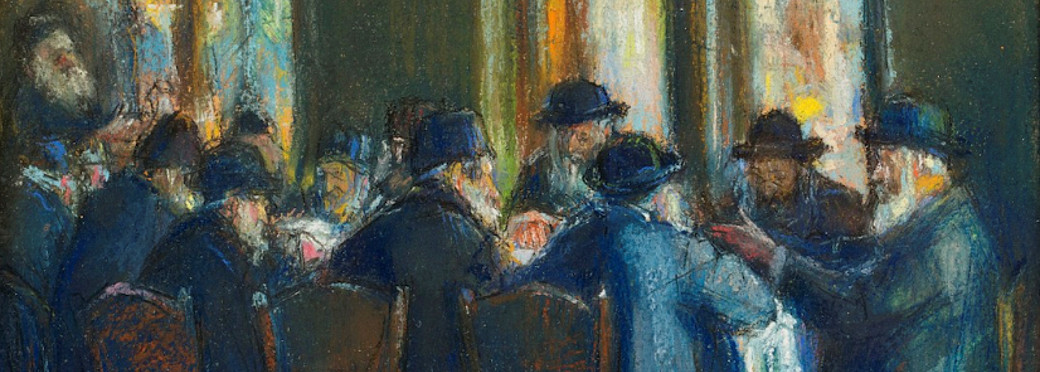
RabbisI know what you’re thinking. No, I don’t really, but it’s my favorite line of dialog from the old, 1980s TV show Magnum, P.I.. That said, I suspect some of you may be thinking that since historically the Sages have rejected any and all claims of Jesus possibly being the Messiah, and have treated any Jew who came to faith in Christ as an apostate, how could Messianic Judaism embrace, in any sense at all, what the Jewish Rabbis have to say, let alone consider the Talmudic rulings as having authority over the lives of Jewish disciples of Yeshua?

Let’s start with this:

Though the Sages of the rabbinic tradition are legitimate bearers of halakhic authority, they are not the only leaders with such competence. As the embodiment of heavenly Wisdom and the living Torah, Yeshua himself is the ultimate earthly source of halakhic authority. While he acknowledged the authority of some leaders in the wider Jewish community, he also formed his own messianic subcommunity and bestowed upon its designated leaders – the Apostles – the authority to bind and loose (Matthew 16:16–19; 18:18). In doing so, Yeshua was authorizing the Apostles to regulate the life of the messianic community according to their Master’s interpretation of the Torah and according to the guidance of his Spirit who writes the Torah on the hearts of his disciples (Matthew 28:18–20; John 14:26; Jeremiah 31:33; 2 Corinthians 3:2–3).

-from “Halakhic Authority: Halakhic Authority, the Bilateral Ekklesia, and the Wounded Two-Fold Tradition”
Messianic Jewish Rabbinical Council

So we know that not only did Yeshua affirm that the Pharisees of his day were the proper heirs, in some sense, of Moses and thus had valid authority to make halachah for their communities, but that he also conferred halachic authority to James and the Jerusalem Council, making their legal decisions binding on the Jewish and Gentile disciples of the Master. We see a clear example of the Council issuing a binding legal decision in the form of Gentile status within the ancient Jewish religious stream of “the Way” (Acts 15), which they only could have done through the authority of their Master, their “Rebbe” Yeshua.
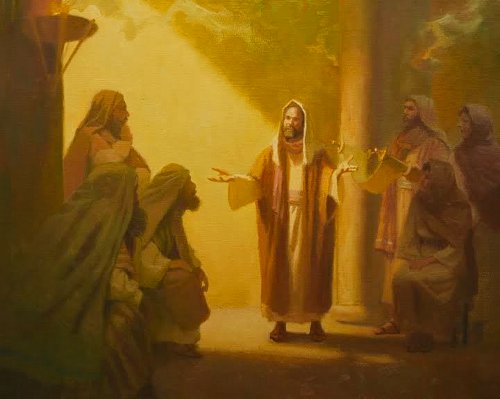
Apostle Paul preachingUnfortunately, that chain of Messianic Rabbinic authority was broken early on as ancient Messianic Judaism went underground and finally disappeared for nearly two-thousand years.

The same web article goes on to say:

The disappearance of a messianic ekklesia within the Jewish people also damaged the halakhic and prophetic capacity of “catholic Israel” – which remains incomplete without the presence of Jewish disciples of Yeshua at its very heart, and without a living connection to the multinational ekklesia which has been joined by the Messiah to Israel as its extension among the Gentiles. Nevertheless, in their many diverse historical expressions and traditions, the Jewish people and their recognized leaders have retained their legitimate halakhic authority, and God continues to operate among them and through them in order to shape their life in accordance with the Torah.

This seems to imply that the MJRC, representing a Judaism devoted to Messiah, also recognizes the historic Jewish leaders and their halachic authority as legitimate, at least in certain areas.

But in the next section of the article, “Halakhic Authority and the MJRC”, we find:

Within the context of the Messianic Jewish movement and its prophetic role, the MJRC sees itself as called to serve a particular halakhic function. The MJRC does not view itself as the only halakhic authority in the Messianic Jewish movement, nor does it claim to be the movement’s highest halakhic authority. It does, however, believe that it has halakhic authority for its own immediate sphere and for those beyond that sphere who look to it for guidance. The MJRC believes that its role is to be a pioneer in the development of a halakhic way of life among Messianic Jews, and thereby to stimulate serious halakhic thinking and practice within the movement as a whole.

Tikvat IsraelSo “yes” to Messianic Jewish halachah, at least for those synagogues and even individuals within the direct sphere of influence and authority of MJRC. I agree that there is no one central authority for all Jews in Messiah, but then again, there’s no one central authority for any of the other Judaisms as well. As one of my readers sometimes says, “Judaism has no Pope.”

Now here’s something interesting:

As is the case for the authority of our movement as a whole, the legitimacy of our claims cannot be determined unequivocally in the present but awaits a divine judgment to be rendered in the course of future events. If our claims are justified over time, then we are an integral part of a process in which the bilateral halakhic authority of the apostolic tradition is being restored, the bilateral ekklesia is being healed, and a corporate Torah-faithful witness to Yeshua is restored to the Jewish people.

This is a very wise statement. There’s no absolute claim of authority but rather a provisional one. While it seems the Rabbis involved in the MJRC are acting in good faith, only Yeshua, upon his return, can lend full legitimacy to MJRC halachic authority and the decisions they make for their communities.

But then again, I suspect that will be true of all the different streams of Judaism, both ancient and modern, as one of the things Messiah is supposed to do is to teach Torah correctly. Since, for most observant Jews, “Torah” includes both the Written and Oral Law as well as the entire compilation of Talmudic literature, Yeshua will likely make many rulings on the decisions arrived at by the legitimate Rabbinic authorities across the ages and what those rulings mean for Jews and even non-Jews in the Kingdom of Heaven.

two pathsHowever, that last quote also spoke of healing the “bilateral ekklesia,” that is, healing the relationship between Jews and Gentiles in Messiah, presumably clarifying our relationship and roles regarding one another.

And this is what I’ve been attempting to write about over the past several blog posts.

The MJRC article on halachah concludes:

We cannot know how the bilateral ekklesia would have developed had its Jewish corporate expression survived and thrived. Similarly, we cannot know how Jewish tradition would have developed had the Jewish disciples of Yeshua been accepted and respected by our entire people at an early stage of the development of Halakhah. We do not strive to articulate or re-create what might have been.

However, we cannot avoid engaging in the task of shaping today’s Messianic Jewish practice from the textual sources and other resources available to us today. This task places enormous demands on Messianic Jewish leaders, requiring of us a serious devotion to study, prayer, discussion, and corporate decision-making in a spirit of humility and charity. At the same time, we believe that the resurrected Messiah dwells among us and within us, and we rely upon his ongoing guidance as we seek to carry on his work of raising up the fallen tent of David within the people of Israel (Acts 15:14–18; Amos 9:11–12).

That conclusion isn’t particularly satisfying in terms of mapping out how this healing of the Jewish and Gentile bilateral ekklesia is to come about, but then again, it’s very likely that they just don’t know.

And so it comes back to that same troubling question, what does this all mean for us, the Gentiles in or near Messianic community (I say “in” or “near” even for those of us who do not directly have “Messianic community” but who nevertheless choose to study from that perspective)?

Our Master Yeshua took the loaves and fish. He told the twelve, “Have them sit down to eat in groups of about fifty each” (Luke 9:14). “The Gospel of Mark reports that the people “sat down in groups of hundreds and of fifties” on “the green grass” (Mark 6:39-40). “There was much grass in the place” (John 6:10). The green grass confirms that the story occurred in the spring when the slopes of the hills around Lake Galilee are still green. The scene invokes the Psalm of the Good Shepherd: “I shall not want. He makes me lie down in green pastures” (Psalm 23:1-2).

The Master had the people recline as they might do at a formal banquet or Passover Seder meal: “He commanded them all to recline (anaklino, ἀνακλίνω).” The reclining posture suggests the messianic banquet when the righteous will “recline at the table with Abraham, Isaac and Jacob in the kingdom of heaven” (Matthew 8:11). For those with eyes to see, the miraculous feeding of the multitude was a foretaste of the messianic banquet. Not unlike the miracle of transforming the water to wine, Yeshua offered a preview of the kingdom and God’s miraculous provision.

-from “A Prophetic Picnic”
First Fruits of Zion (FFOZ)

fish and breadI certainly hope the folks at FFOZ don’t mind my lifting this quote from their newsletter, but I find it quite valuable in illustrating that both Jews and Gentiles are invited to the formal banquet in the Messianic Kingdom.

On another one of my blog posts someone commented that he’d like an invitation to join that banquet, to which I replied that we have such an invitation. It was quoted above but I’ll repeat it here for emphasis:

I say to you that many will come from east and west, and recline at the table with Abraham, Isaac and Jacob in the kingdom of heaven…

–Matthew 8:11 (NASB)

Of course, the Master was looking at the endgame, so to speak, when all has been accomplished according to prophesy, but what about in the meantime?

That’s the tough part. Like the MJRC article said, if Messianic Rabbinic authority had continued unbroken throughout history, and it stood with the same God-given authority as the other Rabbinic sages and their rulings, things would look very much clearer.

But while the MJRC Rabbis and other organizations within larger Messianic Judaism recognize the need for healing between Jewish and Gentile disciples of the Master within (and beyond) Messianic Jewish space, we really are stuck in figuring out what that should look like in the here and now.

But, as ProclaimLiberty related:

I can’t give you a recipe for inviting a personal revelation. The emissary Yacov wrote (Jam.4:8): “Draw near to God and He will draw near to you. Cleanse your hands, you sinners; and purify your hearts, you doubtfully-minded.” However, the most famous revelations depicted in the scriptures were instigated by HaShem. Moshe wasn’t looking for a revelation, as far as we know, when he noticed an odd phenomenon on a desert mountainside, that turned out to be a bush that burned but did not burn up, whence the voice of HaShem began speaking to him. Rav Shaul had other things on his mind until a bright light spooked his horse to throw him before reaching Damascus, whence another revelation ensued. You can find other such examples for yourself. Regrettably, my own example will not likely help either, because I wasn’t looking for revelation when HaShem confronted me one night; and if someone could have warned me in advance what it would entail, I might just have tried very hard to be someplace else rather than to go through that experience. But subsequent experience lets me suspect that those who seek diligently and honestly to enter into the kingdom-of-heaven mindset, meditating on the teachings of Tenakh and on apostolic reflections of them, may just begin to experience similar insight. Who can tell what visions or dreams might ensue.

Sometimes God finds us when we’re not looking for Him. However, it is more likely we’ll recognize that encounter if we invite Him, rather than sit around waiting for His invitation to arrive in our mailbox, so to speak.

Formal halachah for the Gentiles will just have to wait. However, if we turn to Him, He will turn to us.


The Pilot Project for the Nations

Warning. This is pretty cynical. It’s been that kind of day.

@James — You wrote: “It does seem like the Bible is biased heavily in defining the roles and responsibilities of the Jewish people and is pretty skimpy with its “advice” to the Gentiles.” I think I mentioned somewhere above, in response to a similar comment from Drake, that this should be obvious because the literature was written by Jews for Jews, and its consideration of gentiles was only to provide a larger framework for the world in which Jews must exist as a part of that larger body of humanity. It was never intended to provide advice or guidelines for non-Jews, though such guidelines may be (and have been) inferred from it. I pointed out to Drake that it is inappropriate to “criticize” this literature for not providing such information, because that was not its purpose. One might as well criticize a cookbook for not including motorcycle-repair instructions, or a self-help book about quitting smoking for not addressing drug addictions in general. Now, it’s not entirely incidental, of course, that the instructions for a pilot program redeeming one of the families of the earth should contain information that can be generalized to other families; but to criticize a lack of generalized information is just not correctly appreciating the nature and purpose of the existing literature.

Comment by ProclaimLiberty (emph. mine)
Submitted 2015/06/30 at 10:53 a.m.
On Why Do Christians Hate Judaism

That explains a lot.

I actually like the references to the non-Jewish disciples of Yeshua (Jesus) in the Apostolic Scriptures (New Testament) being referred to as a “pilot program” (I know PL used “pilot program” as applied to the Jewish people and then generalized to the rest of us, but I think my interpretation fits better). It makes perfect sense. The phrase brings into clarity what I think we’ve been struggling with in the conversation taking place on the aforementioned blog post, as well as the one that started this whole thing out.

I don’t know if the Apostle Paul ever intended to flesh out his “pilot program” and develop a full-fledged halachah for the non-Jewish disciples. Maybe not. I’ve read more than one commentary stating that Paul believed the Messianic return was imminent, so he probably didn’t think he had to do anything but put band-aids on gushing arteries because Yeshua was going to be back so fast, he’d heal all our wounds.

Oops.

divorceThis also explains why, with the passage of time, the Gentiles decided to take matters into their own hands and, in a rather ugly divorce, separate themselves from their Jewish mentors and invent an identity of their own, one that diminished if not deleted the Jewish role in the redemptive plan of God through Moshiach (Christ).

Maybe I’ve been a little hard on the Church Fathers. Maybe they thought that turning against the Messianic Jews, all other Jews, and Israel was an unfortunate but necessary step if Gentile lives and souls were to mean anything at all, at least in a more fully developed form.

No real identity, role, or function for the Gentile disciples in Jewish space? No problem. Leave Jewish community and create an identity, role, and function for non-Jewish believers, excuse me, “Christians” that stands on its own legs, without any sort of need for Judaism. Heck, if they were stinging from being put on long-term hold in a “pilot program,” they’d just take it to the next level and write a theology that made Israel and the Jewish people the “bad guys”.

And it worked, at least, from a Christian perspective, for the past eighteen-hundred years or so.

Then, as Derek Leman recently wrote, Messianic Judaism had a “revival” in the late 19th and early 20th centuries, and then later in the 1960s. From there, after a few missteps, it picked up steam and is now beginning to realize itself as an authentic Judaism again.

And as I’ve said before, with Jewish realization of their identity in Messiah, there also came a Gentile realization that said, “I’m no longer the center of Christ’s attention, anymore” (not that we ever were).

And it’s not too far a walk from that point to, “I’m not only not the center of attention, but I’m pretty much irrelevant.”

Of course that defies certain statements in the Bible such as Galatians 3:28 which seems to establish some common ground between Jews and Gentiles in the Messianic ekklesia, but I think it stands to reason that if you admit the centrality of Israel, Judaism, and the Jewish people in God’s redemptive plan for the world, then the only place for Christians to go once they leave the pitcher’s mound is either the outfield, or more likely, the bleachers (the parking lot? …maybe a few miles away from the ballpark?).

shakespeareI’ve mentioned before that when Israel becomes the head of all the nations and King Messiah reigns from Jerusalem over not only Israel but over the rest of the world, the rest of the world will be composed of vassal nations, subservient to the head nation, the Jewish nation.

For some reason, Shakespeare’s Sonnet 57 comes to mind:

Being your slave, what should I do but tend
Upon the hours and times of your desire?
I have no precious time at all to spend,
Nor services to do, till you require.
Nor dare I chide the world-without-end hour
Whilst I, my sovereign, watch the clock for you.
Nor think the bitterness of absence sour
When you have bid your servant once adieu;
Nor dare I question with my jealous thought
Where you may be, or your affairs suppose,
But like a sad slave, stay and think of nought,
Save, where you are how happy you make those.
So true a fool is love that in your will
Though you do anything, he thinks no ill.

Of course, the accepted commentary on this sonnet states this is the lament of a neglected friend regarding a companion who has abandoned him and gone off adventuring with others, but I think it could be applied to the current discussion.

I know I’m probably exaggerating, but this series of blog posts are an evolutionary exploration into who or what non-Jews in Messiah are if at all in relationship with Jewish community.

In the blog post I mentioned at the top of today’s missive, I commented that the worst case scenario (for Gentiles) in the Messianic Age, given what I’ve just said, is a true “bilateral ecclesiology,” one extending world-wide with the Jewish people in Israel and the rest of us in our own nations, perhaps only visiting Israel on special occasions to pay homage to our Lord, but otherwise, as the defeated nations that had vainly attacked (or from the present’s point of view, will attack) Israel and were conquered and shamed for our efforts, we remain in our place and tend to our own affairs and only come to the King if summoned.

I wonder if the pilot program was ever meant to be developed further, even by Messiah, since the rather dystopian scenario (for Gentiles) I’ve just crafted doesn’t really need a lot more detail than said-pilot program provides.

solomon

I wonder if there’s a Gentile application to Solomon’s Ecclesiastes? We poor, dumb Christians rule and reign in our churches for eighteen-hundred years thinking we have the proverbial tiger by the tail, only to realize that we are the tail and we’re no tiger, not by a long shot.

Each and every insult, pogrom, persecution, injustice, and inquisition Christianity has ever visited upon the Jewish people in eighteen or so centuries is going to come back and land right on our collective necks with a solid, concrete “thump”.

Maybe the reason Gentiles don’t fit into Messianic Judaism is that we were never meant to. Maybe Mark Kinzer’s vision of separate silos for Jews and Gentiles is intended to be carried over into the Messianic Era. Maybe we had our chance to stay loyal to the Jewish people and Israel during the Age of the Apostles, but once we walked out of the house, so to speak, and slammed the door in Messianic Jewish faces, there was no going back…

…ever.

I see now why the Pastor and just about all of the other people I described Messianic Judaism to at that little Baptist church I used to attend didn’t accept a word of it. I know why “One Law” Hebrew Roots Christians (no, you aren’t “Messianic Judaism”) can’t accept it either. It’s a terribly humbling realization and one accepted only with great difficulty and personal reorganization of who we are. We can never be who we thought we were. Those people never existed, at least not to God.

What was Solomon’s point in writing Ecclesiastes again?

Oh, yeah.

The conclusion, when all has been heard, is: fear God and keep His commandments, because this applies to every person. For God will bring every act to judgment, everything which is hidden, whether it is good or evil.

–Ecclesiastes 12:13-14 (NASB)

Yes, God will judge us, may He have mercy on the nations. Except that keeping His commandments, if you mean the Torah mitzvot, only “applies to every person” (assuming Solomon didn’t mean “every Jew” since his primary audience was most certainly exclusively Jewish), in the broadest possible sense.

torahOf course, it’s dangerous to attempt to apply any of the Jewish scriptures (and even the Apostolic texts are Jewish scriptures written by Jews for Jews) to non-Jews in any sense, so I’m skating on proverbial thin ice (a very hazardous thing given that it’s triple digit highs in and around Boise for the foreseeable future).

Yes, I’m being pessimistic. Half the time, I want to take this “religion thing” and say “to heck with it…if I’m not supposed to belong to the club, I’ll leave.”

Maybe Thomas Gray was correct when he penned in his poem “Ode on a Distant Prospect of Eton College:”

“Where ignorance is bliss, ’tis folly to be wise.”

While Christians were ignorant of their/our true place in the ekklesia and their/our station in the future Kingdom of Messiah, we felt like Kings and Queens, reigning and ruling with Jesus, King of the Hill, Top of the Heap, and so on.

Given the “alternate reality” I’ve just constructed, we’d better duck and run when Messiah really does return for treating the Jewish people and Israel so badly, especially if all of the nations we live in (everywhere except Israel) are going to war against God’s precious, splendorous people, and, as the Bible says, we’re going to get our fannies whooped.

So wising up, I look around and find that I’m just part of a pilot project, a starter kit, a house made of cards with cotton candy for a roof and play-doh for a foundation.

No wonder I’ve felt so “unfinished” or maybe just “unmade” in my version of being a “Messianic Gentile.”

But it all fits. It explains everything, particularly why there are so many questions and so few, if any, answers.

We really were never meant to go as far as we tried to go, were never meant to rise as high as we tried to fly.

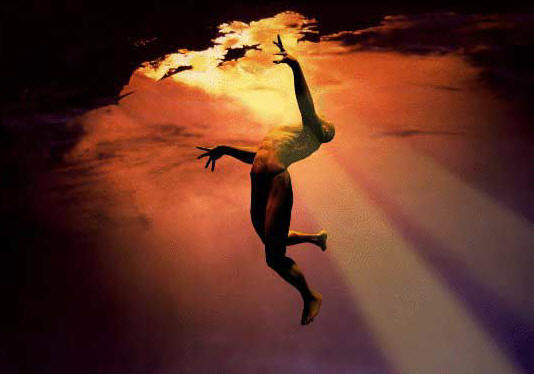
Like Icarus, now that I’ve flown close enough to the Sun to see the truth, my wax wings have melted and I plummet to earth like a broken angel, though I’m hardly angelic.

“Being your slave, what should I do but tend upon the hours and times of your desire” indeed.

icarusI think I’d better crawl on my knees in abject humility or humiliation for the incredible arrogance I’ve been guilty of in even imagining I could be more or, worse yet, that I was more.

I don’t think I’ve understood being a servant up until now, not really.

A fallen servant is one whose wings have melted, and wallowing in soggy, warm wax, all I can do to serve is to scoop up some of that gooey, messy stuff. Maybe it’ll be good enough to make into a few candles to light the way, should the King decide to return by the road that winds past my small place.

Why Does the Supreme Court Get to Define Marriage?

I wasn’t going to write about the recent Supreme Court ruling legalizing same-sex marriage nationally, but I read something on Facebook that changed my mind.

Actually, it was something I wrote in response to another person’s post, plus a few other comments I’ve seen crop up in the religious blogosphere that prompted this particular “meditation.”

What is marriage?

Oh gee, is that all. How do we define marriage?

Rather than go into a complex set of situational, societal, moral, and religious variables, let’s stick with whatever it is that gives SCOTUS the right to define same-sex marriage as a right.

After all, there seems to be some online conservative push back that wants “the State” to keep out of our marriages. What gives the State the right to poke their noses into the state of matrimony?

At the level of two individuals committing their lives to one another, the answer is “nothing.” Any two people can approach the clergy-person of their choice and ask to be married. The kicker comes in when you include a marriage license.

Why does something sanctioned by God need to be licensed by the State?

So they are no longer two, but one flesh. What therefore God has joined together, let no man separate.

–Matthew 19:6 (NASB)

Taking that quote in isolation, it seems to send a pretty clear message. The “institution” of marriage is sanctioned by God. Couples, in the context of the Bible in general and Matthew 19 specifically,  are made up of one man and one woman, are joined together by God and no person (or presumably human institution) should separate that union.

supreme court
The Supreme Court Justices

So if God joins two people together, why does anyone need a marriage license issued by the state where they are to be married?

So that the state, and the nation (and really, the world) will legally recognize that marriage.

Why do we need that?

Well, for tax reasons for one thing. Haven’t you made decisions about tax exemptions based on whether or not you’re married and how many kids you have?

What about making someone who was once a stranger legally into a family member. This has terrific advantages if you get into an accident and are hospitalized, since your legal spouse, but not someone you’re just living with, has rights as far as visiting you in such a medical setting.

And if, heaven forbid, the marriage doesn’t work out and you two don’t see eye-to-eye about things like alimony or child support payments, the fact that you were in a legal marital relationship allows the court to administer said-relationship’s dissolution and issue orders for the caretaking and well-being of the financially disadvantaged spouse (if necessary) and any dependent children.

If you remove the state from all that, then you may have a marriage sanctioned by God, but you’ll have a heck of a time managing or even acquiring anything close to the legal rights you have relative to each other as a married couple as well as those to your children (although, even if you aren’t married to your partner, if you have biologically created a child with that person, you automatically have parental rights to said-child under most circumstances).

gay marriageAnd so we come to the matter of opposite-sex marriage vs. same-sex marriage as a legal entity.

This really has nothing to do with how God sees things and what combination of human beings He sanctions to be joined within marriage. SCOTUS doesn’t get to say “boo” about what God desires and what He allows. A select group of five lawyers (the five Supreme Court Justices who voted to legalize marriage equality) are only empowered to decide how marriage is legally defined in the United States. It doesn’t determine how marriage is defined morally or religiously to the slightest degree.

So in reality, Gay and Lesbian couples could have gotten married in an emotional and relational sense (and even a religious sense given the number of liberal churches and synagogues available) for years or even decades (or longer) in this country (or anywhere).

It’s only the matter of the State (big “S”) granting gay couples the same legal rights that opposite-sex married couples often tend to take for granted that is the issue.

The United States of America has become the 21st nation on the planet to legalize same-sex marriage with no variation within its individual states, provinces, or territories. If we want to determine the social consequences of legalizing marriage equality, including the long-term results of same-sex parenting, we might want to see if any of those other nations can be compared to us.

I am more than aware there is what amounts to a collective panic attack within various religious spheres relative to “Sodom and Gomorrah” being legalized (and just exactly what the sin of Sodom and Gomorrah was that deserved a divine death penalty isn’t, at least Rabbinically, as straightforward as you might have been led to believe).

I’m also aware that of all the things Paul the Apostle addressed in his epistles, he never directly complained that idolatry and homosexuality were sanctioned within the Roman Empire.

He did preach against sexual immorality among the body of believers, but he never tried to change the laws of the prevailing society and culture in which these disciples lived.

Of course, there was no such a thing as “loving same-sex couples” or “marriage equality” in the Empire. To the best of my understanding, a Roman citizen could have a same-sex slave or non-citizen as a sexual partner as long (forgive me for being blunt) as the citizen was the “penetrator” and never the “penetratee”. Turns out these “relationships” were more about dominance and power and less (if at all) about love and affection, at least as far as the historical record is concerned.

Apostle Paul preachingSo if the matter of homosexuality was ever on the Apostle’s radar, it was only in terms of those individuals making up the ekklesia of Messiah. For the Jewish members, it probably was already a well-known norm and Torah commandment. Paul most likely only had to deal with those non-Jews coming out of paganism whereby same-sex sex may have been involved as part of the local cultic temple practices or some such thing.

Given Paul’s example, do we need to start a revolution and overthrow our government in order to stop the national “sin” of marriage equality? Rome fell (and if homosexual practices were part of the Empire’s downfall, I have no way of telling), and no doubt at some point, so will the United States. I don’t think we can stop it.

As much as that might be a heartbreaker for you or for me, the only nation that really matters to God as far as being eternal is Israel.

SCOTUS has made a ruling involving the legal definition of marriage for our nation as related to the rights and responsibilities of married and divorced (or divorcing) couples in terms of each other and their children.

Anyone who desires to become legally married is really wanting to enter into a contractual relationship with another human being to gain certain financial advantages and other rights. In that sense, any two reasonable human beings should have that right, since it primarily is a right they acquire relative to each other and to the government (remember tax exemptions). It’s also a legal entity that is designed, however imperfectly, to protect children should one or both parents decide they don’t want to behave responsibly.

I am aware that are a lot of other collateral issues that legalizing same-sex marriage nationwide brings up, but I’m not going to address any of them. Plenty of other bloggers, news writers, and social and religious pundits can, will, and probably have already done so.

I just thought the little but important detail of what marriage is legally as separated from its relational, romantic, moral, and religious reality needed to be teased out and brought to the forefront for a little bit, just so we could take a look at what SCOTUS did in context.

Jay Michaelson
Jay Michaelson

I’ve reviewed such books as God and the Gay Christian and God Vs. Gay: The Religious Case for Equality, and while I had to agree, based on what I read, that the “anti-Gay” message of the Bible isn’t nearly as definitive as Evangelical Christianity seems to believe, I also found no presumption for God’s sanctioning the marriage of “loving same-sex couples” within either the covenant people of Israel or the ekklesia of Messiah (body of Christ).

If two secular same-sex people want to get married, legally, in any state of the union, there’s nothing to stop them, and in most circumstances I can imagine, it has very little to do with we religious folk on a day-to-day basis.

On the other hand, if two same-sex people claim to be Christian or Torah-observant Jews and desire to become legally and God-sanctioned married, I still think there’s a problem, at least based on how I read the Bible.

Married same-sex couples are not represented or even presupposed in the Bible. I won’t speak to all of those secular gays who are married or who are going to become married. There are plenty of other laws in the U.S. I chafe against for various reasons, and some of them have more to do with my life as a believer and just plain human being than marriage equality.

All I will say, is that if you are Christian or a (an Orthodox) religious Jew, you’re gay, and you want your religious institution to sanction your marriage (believing God is sanctioning it, too), then I just don’t see a Biblical case for it. That’s out of the Supreme Court’s jurisdiction. God will have to make that judgment.

Oh, and if you haven’t figured it out already, then prepare to be inundated with all things rainbow in celebration of the SCOTUS decision. And I promise you that those rainbows have absolutely nothing to do with God’s covenant promise to all living things never again to flood the Earth.

We Are Students of Abraham Communing with God

We find that G-d’s love for our father Avraham was mainly because “…he will command (yetzaveh) his children and his household.”[1] Yetzaveh here connotes “bring into a communion (with G-d).” All of Avraham’s towering avoda in the tests to which he was subjected,[2] cannot be compared to his commanding others and bringing them into communion, i.e. to his bringing merit to others.

“Today’s Day” for Sunday, Tammuz 8, 5703/1943
Compiled and arranged by the Lubavitcher Rebbe, Rabbi Menachem Mendel Schneerson, of righteous memory, in 5703 (1943) from the talks and letters of the sixth Chabad Rebbe, Rabbi Yosef Yitzchak Schneersohn, of righteous memory.
Chabad.org

This is a follow up to yesterday’s morning meditation, and although it, and my previous missive, may seem a bit schmaltzy for some of you, I feel it’s necessary to add some spiritual “ascent” to counter balance some of the “descent” we’ve been discussing lately.

I know that the phrase from Genesis 18:19 where God references Abraham saying “so that he may command his children and his household after him to keep the way of the Lord by doing righteousness and justice,” has been taken by some to mean that, as spiritual children of Abraham, we should be obligated to the Torah mitzvot in the same manner as the descendants of Abraham’s offspring Isaac and Jacob, that is, the Jewish people.

This would make things deceptively easy (not that they’d actually be easy) in terms of defining the role of the non-Jew within Messianic Jewish space. We’d just have the same role as the Jewish participants and thus we’d all be one big, happy family (not really, but that’s wish, anyway).

But the commentary about the aforementioned portion of scripture is very interesting. It states “…he will command (yetzaveh) his children and his household,” as meaning he [Abraham] will “bring [his children and his household] into a communion (with G-d).”

Except, because of our Abraham-like faith in Hashem through Yeshua, we can and are brought into communion with God. Having a halachic path identical to the Jewish people is completely unnecessary. How complicated does coming into communion with God have to be?

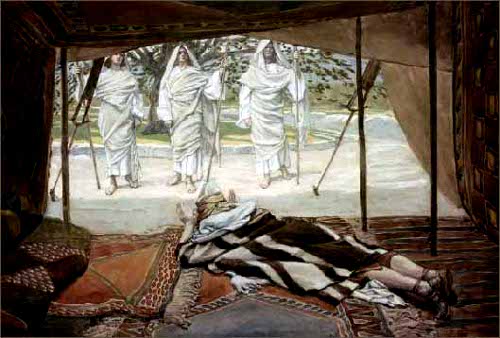
abrahams visitorsAlthough the Jewish Sages believe that Abraham kept all of the Torah mitzvot in the manner later commanded at Sinai, I don’t think we have to go that far in considering what Abraham may have taught, based on a reading of the plain meaning of the relevant texts.

At a very, very basic level, Abraham talked to God and God talked back. Their relationship was founded on Abraham’s unbounded trust in God, a trust that allowed Abraham to do the unthinkable; to trust God enough to place Isaac on the altar and risk losing his “child of promise.”

While I think most of us as parents have a terrifically difficult time imagining how Abraham was able to do this and what he was thinking (not to mention what Isaac was thinking when he allowed it) at the Akedah, we have to believe that Abraham trusted God and His promises enough to know that Isaac would not die or that, if he did, God would resurrect him.

After all, if Isaac was the sole source of Abraham’s future legacy, how could that be fulfilled if Isaac died, particularly by his father’s hand, before having children?

So to be in communion with God, to follow Abraham’s teachings may be as straightforward as continually talking with God and continually developing our trust in God so that we too may face our life difficulties with the same calm and grace as Avinu Avraham.

A lot of the issues we discuss among ourselves as “Messianics” have to do with how Jews and Gentiles are supposed to interact, particularly within a Jewish social and worship environment, but the question we seem to avoid is how are each of us as individuals (regardless of being Jewish or Gentile) supposed to relate to God?

Abraham and the starsIf following Abraham’s teaching for both his biological descendants and those of us who are counted as children of Abraham by our trust in God is the key, then the door we’re trying to open is the one that leads us into the presence of Hashem.

G‑d desires to have a presence in this world, and in each mitzvah we do, however it is done, He is there.

G‑d desires that His light shine in this world, and in every word of divine wisdom and every heartfelt prayer, His light shines.

G‑d desires yet more—that He be found here in all His essence, that which can neither be spoken nor kept silent, neither of heaven nor of earth, neither of being nor of not-being—that which transcends all of these and from which all extends.

And that is how He is found in a simple, physical deed that shines brightly with divine light.

Torat Menachem, vol. 34 (Likkutei Sichot, vol. 4), Parshat Korach; Maamar Hasam Ragleinu 5718.

-Rabbi Tzvi Freeman
“Acts of Light”
Chabad.org

Everything we do in the service of God brings a little bit more of His presence into our reality. That’s the meaning of Tikkun Olam or repairing the world.

In that, anything we do to elevate ourselves spiritually, and that delivers charitable, righteous, and just acts to our fellow human beings, is part of bringing light into the world and are the behaviors that result from our communion with God.

We are students of Abraham it seems, Jew and Gentile alike. We all just have our own unique ways of acting out what we’ve learned.

Touching on the Keb’ Mo’ YouTube video of his chart “I’m Amazing” which I posted yesterday, I’m inserting this link to Rabbi Freeman’s short article You Are the World (and so am I).

I encourage you to read it all (it’s not very long), but he ends his missive by saying:

As another ancient Jewish teaching goes, “Every person has to say, ‘The whole world was created with me in mind.’” Meaning, for me to tip the scales. For me to make the entire world the way it was meant to be.

Because you are the world.

Inner lightWhether you understand it or not, you (and I) were created to fulfill a specific purpose in life (and maybe more than one). As you are doing it, you may not even be aware of what or how you are part of God’s plan in the world. You may only realize it in the world to come when it is revealed.

Half the time, I have no idea what God wants out of me, either.

That’s where trust in God, the kind of trust Abraham had at the Akedah, comes in. We have to believe and live out our trust that the universe and our individual lives are unfolding as God intends them to.

Good Shabbos.

Footnotes

1. Bereishit 18:19.

2. Pirkei Avot 5:3.

You’re Amazing

It can take a long time until something is invented. But once one person has already broken through the creative barrier, others can easily follow suit and produce the same results. For example, it took many years until someone invented the first railroad train. But after one person invented it, many others built similar railroad trains. It doesn’t take a genius to model the work of a genius!

The same principle applies to spiritual growth. There were people in previous generations who reached great heights. They were innovators in the field of Jewish metaphysics. Since we now have them as models, the knowledge of how to reach spiritual greatness is available to all of us.

Today, think of five great people you have met or read about. What qualities do you most respect in each one? As you reflect on these qualities, consider how you would apply these same attributes to yourself.

(see Rabbi Yeruchem Levovitz – Daas Chochmah Umussar, vol. 2, p.40)

-Rabbi Zelig Pliskin
“Duplicate Spiritual Greatness”
Daily Lift #385
Aish.com

I’ve been spending a lot of time writing about and discussing the meaning and nature of non-Jewish identity within Jewish space, particularly within Messianic Jewish space. While it’s been suggested that most or even all non-Messianic Jewish synagogues would at least feel comfortable with non-Jews as guests (assuming these guests were polite and respectful), someone mentioned in a comment on another one of my missives that Messianic Jewish synagogues in Israel might not be so cool with that idea.

If it’s true, I can understand why.

I’ve heard it said that when a Jew makes aliyah and returns home to the Holy Land, they do one of two things: either increase their level of religious observance or become totally non-observant. There’s a single reason for both.

In Israel, a Jew has nothing to prove. They are Jewish. Israel is the Jewish homeland. End of story.

Except perhaps for Messianic Jews. I’m just supposing, since I’ve never been to Israel and I’ve never been to a Messianic synagogue in the Land, but if a Jew ever needs to prove he or she is an observant Jew in Israel, it’s when they are also a disciple of Yeshua (Jesus).

For thousands of years, any Jew who has been such a disciple has voluntarily converted to Christianity or been forcibly coerced into doing so. Though one process or another, they surrendered their Jewish practices and their Jewish identity and effectively became, at best, a “Hebrew Christian,” and at worst, a “Goyishe Christian”.

synagogueWhile there have been other Jews who have remained observant and become Yeshua-disciples historically, the weight of the Church’s requirement (demand) for Jews to abandon their covenant relationship with God so they can accept the grace of Jesus Christ is heavy on their shoulders.

Association with (Gentile) Christians in Messianic synagogues could easily be seen as compromising the Jewish identity and affiliations for Messianic Jews in Israel.

Like I said, this is based on a number of assumptions on my part and I’m sure PL or someone else can correct the mistakes I’m most likely making.

But particularly in Israel and certainly every place else, if non-Jewish disciples with a Messianic Jewish “leaning” can’t depend upon any sort of Jewish role model in order to understand ourselves (which I suppose could be rather “crazy-making” since, for a multitude of reasons, you can’t mix the two identities), where do we go?

Rabbi Pliskin no doubt was writing to a Jewish audience in the above quoted “Daily Lift” but he makes a suggestion I think we can all use.

Today, think of five great people you have met or read about. What qualities do you most respect in each one? As you reflect on these qualities, consider how you would apply these same attributes to yourself.

Think of five spiritually elevated people, five tzadikim, Jewish or Gentile. Consider what qualities they possess(ed) that you admire. Then incorporate those qualities over time into yourself.

Seems simple enough.

I know what you’re thinking…well, a few of you, anyway. You’re thinking “I want to imitate Jesus.” That’s fine and well. No better role model available. But then, what attributes or qualities about the Master do you want to emulate?

Yes, Yeshua donned tzitzit and laid tefillin but he was and is Jewish, so unless you’re a Jew (and if you are, you already have a set of traditions available to you that define the mitzvot for observant Jews), let’s just set those behaviors aside for now.

What about Yeshua’s kindness, his compassion for others, his wisdom, his sense of justice, his expression of duty and servitude to his followers, and even to strangers?

Those are all fine qualities to imitate, and you don’t even have to be Jewish to incorporate them into your own behavior.

kindnessLike Yeshua, you can give to charity. You can pray. You can “preach the Word”. You can urge others to repentance. You can look forward to the coming of the Kingdom and teach others to do the same.

There’s a lot you can do to imitate the Master. He gave plenty of examples that are accessible to any one of us right now.

Of course, you don’t have to limit yourself to Yeshua or even anyone you know about from the Bible. Pick anyone you can think of who you consider spiritually great, figure out why they had such greatness, choose some qualities they displayed, and then learn to integrate them into your own life.

Above, I said it seems simple enough, but it really isn’t. It’s not simple or easy at all.

In fact, it will take a lot of hard work.

But that’s OK because you’ve got the rest of your life to work on improving yourself. So do I.

There are two basic things you (and I) can do to start off with: when you consider yourself, think the best of yourself, and when you consider other people, think the best of them, too.

There’s a blues chart I heard the other day called “I’m Amazing” by Keb’ Mo’. I inserted a link to a YouTube video of his performance in one of my comments on a previous meditation, but I’m sure it’s going to get lost there.

So I’m posting it at the bottom of this blog post where it won’t get lost, at least not as easily. I think my way of lifting up our spirits where many of my blog posts lately have been bringing them down.

If you are (or I am) not sure where to go in your walk of faith and your life of devotion to God, and especially if you’re frustrated because that walk cannot be defined as “Jewish,” it doesn’t mean there aren’t Biblical and other holy examples available to you. I just outlined how you can imitate the most important and holy Jew who ever lived and who still lives, Yeshua, and you don’t even have to be Jewish (or Torah-compliant, Torah-observant, Torah-submissive, or whatever) to do it.

We’re all amazing. It’s OK for you to be amazing. It’s OK to realize everyone around you is amazing, too.

Why Do Christians Hate Judaism?

This is the decree of the Torah, which Hashem has commanded, saying…

–Bamidbar/Numbers 19:2

Rashi explains that the unusual introduction of “this is the decree of the Torah” (rather than an introduction specific to the subject of parah adumah), is a response to Satan and the nations, who tauntingly ask, “What is the purpose of this commandment?,” to which the Torah answers that it is a decree from Hashem, and it is not for anyone to question it.

-from “A Torah Thought for the Day,” p.62
Sunday’s commentary on Parashas Chukas
A Daily Dose of Torah

I’m continuing to write on the general theme of the role of non-Jews in Messianic Jewish community, a study started in this blog post and most recently addressed in yesterday’s morning meditation.

Chana Sara in her blog post from a few years back asks Where Do I Fit? It’s certainly a question I keep asking myself, both in relation to my decision to study the Bible through the lens of Judaism and particularly Messianic Judaism, and the larger existential question of where do I fit in my relationship to God.

Once you accept that any sort of connection to God must go through Israel, the Jewish people, and especially through the exceedingly Jewish Messianic King, then you must come to the realization that in order to relate to God you must enter into a completely alien world, that is, alien for the non-Jew. You must enter a Jewish world or at least a worldview.

Even many secular Jews feel, when attempting to observe a mitzvah or when attending a synagogue prayer service, that they are also “strangers in a strange land.” True, they are Jews in the midst of Jewish community, but the traditions, the customs, the halachah, the Hebrew, if you haven’t been raised in an observant home nor had the benefit of a traditional Jewish education, can seem even to the ethnic Jew, like a trip down the rabbit hole to “wonderland.”

And most people become uncomfortable when faced with the unfamiliar and the unknown. People become defensive and even hostile when thrown abruptly into an alien environment. We prefer what we’re used to.

Chana Sara wrote in the aforementioned blog post:

As a ba’alat teshuva, I have a lot of questions when it comes to where I “fit” within Judaism. I was born into a conservative Judaism family, meaning that my mother can’t part from the egalitarian idea of the conservative movement, but keeps conservative standards of kosher and Shabbat.

As soon as I had my bat mitzvah I don’t remember going back to shul for any reason. Possibly the high holidays, but possibly not even then.

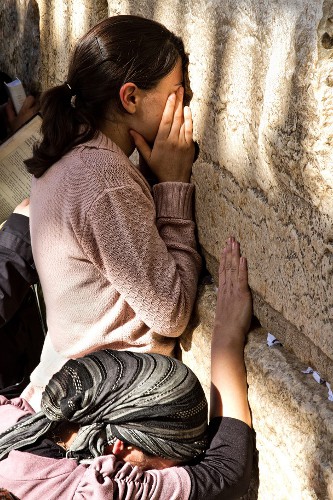
jewish women prayingThis is a commentary on a Jewish journey into Yiddishkeit, which is also a journey my wife embarked upon a number of years ago. I remember the struggles she faced in her first attempts to connect to Jewish community and Jewish observant praxis. How much more difficult is it for the non-Jew, with no direct connection to Jewish community and lifestyle, to face the challenge of entering the Jewish world in order to comprehend and obey the Jewish Messiah?

I understand that God is not just the God of Israel but also the God of the nations, but every shred of Biblical content that we have with us today was produced by Jews, and, for the most part, for Jews. Only certain sections of the Bible directly address the nations, and not all of those references relate to us kindly. Amalek comes to mind.

The commentary I quoted from at the top of the page, specifies those commandments in the Torah that have no discernible reason or purpose, but nevertheless must be followed because they are God’s will for the Jewish people. Rashi’s interpretation of the above-quoted verse from Numbers supposes that HaSatan, the adversary, and the Goyim, the Gentiles, would criticize the Israelites for observing such commands or would actually bring into question the Torah as the Word of God based on what appears to be a collection of meaningless decrees.

And therein lies the root of my question, “Why Do Christians Hate Judaism?” I know “hate” is a strong word and I use it in part for dramatic emphasis as opposed to literal meaning. Most Christians don’t actually hate the Jewish religion or form of worship, but they do believe that it is merely a religion of works which exists in opposition to Christ and the Christian doctrine of salvation by grace.

I also don’t mean to indicate that Christians hate the Jewish people or the state of Israel. Many Evangelical churches say they love the Jewish people, and no doubt, they are sincere. Of course, that love for Jews and national Israel is predicated on a very Christian understanding of the eschatological meaning of the existence of Jews and Israel relative to the second coming of Christ.

This brings us back to those Christians who have come to realize that what they’ve learned from the pulpit or in Sunday school isn’t, strictly speaking, the exact Gospel message Messiah and his apostles taught in the late Second Temple period. Once we have learned that the Church’s current theology and doctrine is all based on a two-thousand year old mistake and is the result of a violent divorce between the early Jewish and Gentile Yeshua disciples, then we’re faced with a horrible reality.

In an ekklesia that is wholly Jewish and that can be only understood and communicated with through a wholly Jewish process, a process alien to anything we were formerly taught as Christians in our churches, who are we, what do we do, and where do we go to pursue our faith given this totally Jewish contextual reality?

unworthyDo you see where this might cause some anxiety or even a crisis of faith among the devout Gentiles when facing a life within Jewish community and educational space?

Do you see why Christianity was invented in the first place, as an alternative to this crisis, as a means to take control over worship of God and devotion to Christ by redefining it as Gentile and not Jewish?

Although my father’s recent illness is the primary reason I chose to abandon plans to be in Israel right now, another reason was the idea that, as a Gentile (and a flawed, imperfect human being) who is oriented toward but can never be a part of Israel, who am I to set foot in the Holy Land?

However, there are other responses to this crisis. There are some Christians who have walked away from the Church but who still do not feel comfortable surrendering their identity to Jewish interpretation. They have invented a world of their own which states that while they are not ethnically Jewish, nevertheless, they are Israel as much as the Jewish people are, and thus they are as obligated to the Torah of Moses as any observant Jew.

But there’s a caveat.

They still reject Judaism, or at least Judaism as it has evolved over the past nearly twenty centuries. They reject, for the most part, that entity we know as Rabbinic Judaism, the “traditions of the elders,” the so-called “made up” laws that add on to or perhaps even defy the plain meaning of the written Torah.

Now here’s the trick.

If we Messianic Gentiles accept Messianic Judaism as a Judaism, and accept the validity of the teachings of the Jewish Sages, teachings which, for the most part, have nothing to do with us, then what does that mean for us? For understandable reasons, as much as Christianity has rejected Judaism, Judaism has rejected Christianity. They aren’t on speaking terms and can barely stand being in the same room with each other.

JerusalemOnce we Gentile believers come to a Messianic Jewish understanding of the Bible, the Messiah, and God, once we see how much God loves Israel, how special Israel is to God, and how we people of the nations are only saved through Israel and not because the nations have any sort of direct covenant connection with God, what is our most likely initial response?

The Torah states, “And Korach, the son of Yitzhor, the son of Kehas, the son of Levy, took …” Why does the Torah take the time to tell us his lineage?

Rashi, the great French commentator, explains that the key reason for Korach’s rebellion was his envy of his cousin, Elizaphan the son of Uziel, who was appointed prince of the tribe of Levy. Moshe’s father was the first of four brothers and his sons were the leader of the Jewish people and the High Priest; Korach figured that since he himself was the firstborn of the second son, that he should have been appointed the Prince of the Tribe of Levy.

Envy is destructive. It prevents a person from enjoying life. If ones focus is on other’s success and possessions, it will cause pain and lead to highly counterproductive behavior. No wonder that Pirkei Avos, Ethics of the Fathers 4:28, lists envy as one of three things which destroy a person (the other two are lust and desire for honor).

To overcome envy, focus on what you have and what you can accomplish in this world. The ultimate that anyone can have in this world is happiness. The secret to happiness is focusing on what you have. And if you are happy, you won’t envy others!

-Rabbi Zelig Pliskin
based on his commentary on Parashas Korach in
Growth Through Torah
as found at Aish.com

Especially in our modern western egalitarian culture, the idea that any one group might be special and especially privileged is abhorrent to most of us. When encountering certain Biblical realities, we attempt to refactor them by applying our modern worldview, thus reinterpreting the Bible beyond all reasonable credibility. We make statements to the Jewish people in Messiah that are the moral equivalent of the politically correct comment to check your privilege:

“Check Your Privilege” is an online expression used mainly by social justice bloggers to remind others that the body and life they are born into comes with specific privileges that do not apply to all arguments or situations. The phrase also suggests that when considering another person’s plight, one must acknowledge one’s own inherent privileges and put them aside in order to gain a better understanding of his or her situation.

Rebbe
Rabbi M.M Schneerson, the Rebbe

While the concept of “check your privilege” is, in my opinion, somewhat questionable, or at least has the potential to be grossly misused, applying it to the relationship between Messianic Gentiles and Messianic Jews (or any group of Jews) is Biblically unsustainable.

So where does that leave us?

I don’t have an answer, at least not a whole one. I do have a clue, also written by Chana Sara in her recent blog post My Experience with the Rebbe:

But he was more than just a rebel. He was a person with a fervor for life, for Yiddishkeit and for people. Everyone was important, Jew or non-Jew, male or female, child or adult. Every person was important and he wanted to do good for all mankind. The U.S. has dedicated Education and Sharing Day as a tribute to the Rebbe and steps he took toward the betterment of education for all U.S. children. He stressed the importance of the Noahide laws. He wanted to make sure that all of mankind was healthy and well and ready to take on the world in the way Hashem desires them to. He was really into everyone being the best that they can be and being able to help them realize their potential. The world isn’t finished being built, and the Rebbe wanted to make sure we were aware of that and are putting on our best faces to be able to finish making this world a dira b’tachtonim, a dwelling place for Hashem.

While there are voices within Messianic Judaism who advocate for a strict bilateral relationship between Jews and Gentiles, it is also part of the process of tikkun olam for Jewish and non-Jewish scholars and teachers within Messianic Judaism to make their lessons available to the Messianic Goyim so that we may learn and understand the teachings of the Master within his own context and turn our praxis and our devotion to God accordingly.

While there are plenty of resources available including those authored by Christian Pastors writing from within a Messianic context, as far as my experience goes, there are still no real answers.

If we acknowledge that Christian tradition does not adequately or accurately reflect the Jewish context of the Bible, and if we admit that Jewish praxis is not Gentile praxis in any form, including one that adopts the appearance of Judaism while rejecting the last eighteen hundred years or so of Jewish teaching and writing, what do we have left?

A mystery and no answers.

In previous comments on other blog posts I’ve written on this topic, it has been suggested that Gentile identity within Jewish space will have to evolve over a long period of time, decades if not centuries (barring the timing of King Messiah’s return, of course).

But courageous Jewish leaders such as the Rebbe, Rabbi Menachem M. Schneerson of righteous memory, indeed, had a heart not just for the Jewish people but for all people. Although his special mission and devotion was for Yiddishkeit, he understood that Messiah’s coming would herald the redemption of all of humanity in an unparalleled era of peace.

That’s the heritage of not just Israel but of all mankind, of you and me, all of us.

rebbe yahrzeit
People visit the grave site of the late Lubavitcher Rebbe Rabbi Menachem Mendel Schneerson

The twenty-first yahrzeit of the Rebbe has just passed and perhaps, if I may be so bold, in his merit, we can remind ourselves that somewhere, somehow, the people of the nations have a place in God’s redemptive plan, too. However, that plan and how we figure into it, isn’t very clear when viewed through a Jewish lens, since that lens was designed to reveal God’s relationship with the Jewish people and with Israel.

But it is the only lens we have that most accurately reveals the true reality of God’s message to the world, one that doesn’t diminish or destroy Jewish people, the nation of Israel, or the traditions, writings, and praxis of Judaism.

However uncomfortable or disorienting it may be to live life as a Gentile poised on the edge of our understanding of the God of Israel, the Jewish Messiah, and the Jewish scriptures, our best response should never be envy, supersessionism, or disdain. Instead, let us don the garments of humility, wonder, and awe, and then begin walking our path, one that is uncharted and unknown, toward the undiscovered country of who we are, which isn’t really defined by Judaism or even Christianity but rather by God.

I saw no temple in it, for the Lord God the Almighty and the Lamb are its temple. And the city has no need of the sun or of the moon to shine on it, for the glory of God has illumined it, and its lamp is the Lamb. The nations will walk by its light, and the kings of the earth will bring their glory into it. In the daytime (for there will be no night there) its gates will never be closed; and they will bring the glory and the honor of the nations into it; and nothing unclean, and no one who practices abomination and lying, shall ever come into it, but only those whose names are written in the Lamb’s book of life.

Then he showed me a river of the water of life, clear as crystal, coming from the throne of God and of the Lamb, in the middle of its street. On either side of the river was the tree of life, bearing twelve kinds of fruit, yielding its fruit every month; and the leaves of the tree were for the healing of the nations. There will no longer be any curse; and the throne of God and of the Lamb will be in it, and His bond-servants will serve Him; they will see His face, and His name will be on their foreheads. And there will no longer be any night; and they will not have need of the light of a lamp nor the light of the sun, because the Lord God will illumine them; and they will reign forever and ever.

-Revelation 21:22-22:5 (NASB)

Notice that it’s not just Israel who exists in the presence of God and of the Lamb. The nations are there…we are there, too, and we will be healed.

The tzadik is one with G-d.

We recognize him because within each of us is also a tzadik who is one with G-d.

Inside each of us is a spark of Moses.

-Rabbi Tzvi Freeman
From the wisdom of the Lubavitcher Rebbe, of righteous memory
Chabad.org

Within each of us is a spark of the Messiah. Have faith and courage.

Up to Jerusalem

"When you awake in the morning, learn something to inspire you and mediate upon it, then plunge forward full of light with which to illuminate the darkness." -Rabbi Tzvi Freeman