Tag Archives: Bible

Hiatus or Something Like It

Walking outRabbi Meir Hagar of Viznitz related that one of the great chassidic rabbis was once praying with much enthusiasm. His evil inclination came to him at a moment he was praying with the height of fervor, and whispered in his ear, “How can you be so insolent as to pray in such a manner? Yesterday you did improper things. You are unworthy of such prayers.”

The righteous man was not thrown by the evil inclination and mentally replied, “It might be true that yesterday I have erred. Moreover, it is possible that tomorrow once again I might err. But right now I am in the middle of praying, so get away from me!”

-Rabbi Zelig Pliskin
“Make the Highs Even Higher”
Aish.com

It is said that for every descent spiritually, there is an ascent. This blog and a good many other things are going into hiatus, or at least a significant slow down, for an indeterminate period of time which may be a few days to a few weeks, or even longer. Frankly, I’ve recently been reminded of my humanity and my fallibility (I came to this conclusion before my recent Nanos blog post, but the mess I caused didn’t help). I’ve always been concerned about putting my thoughts, feelings, and opinions about God, the Bible and everything out on the Internet, since I am only human, when the rest of the religious people in my space (and in all other religious spaces) in the blogosphere seem to be so “perfect” (not that anyone is perfect, of course).

I’m far from perfect. Very far.

I’ll miss the daily writing. I really enjoy it. But discussing theological issues should be less about personal enjoyment and more about enlightenment and truth. I told a friend over coffee last Sunday that I was stuck on the level of content as far as my faith goes. I like reading and writing about “stuff,” about opinions, and doctrine, and information.

But that’s not all that a life of faith is made of. A life of faith must be lived faithfully.

For however long I’m away, or however infrequently I visit, I bequeath the religious blogosphere to those of you who want it or need it. I’m going to see what life is like without living it on a daily basis. At one point, I thought blogging was a way to get closer to God, but now I see that it has become a barrier between me and Hashem, like many other things I have in my life.

Oh, just in case the “apostasy police” or anyone else is “concerned” by what my decision means, no, I haven’t lost faith or walked away from Jesus. I’m walking away from a public online discussion of my faith right now, thank you very much.

When will I be back? I don’t know exactly. I still have one more episode of First Fruits of Zion’s television program A Promise of What is to Come to review, and I know I’m going to watch it, but when will I write the review and post it for all to read? Soon I hope.

Even if I return to this blog in a few days or a few weeks, it’s pretty unlikely that I’ll return to daily blogging.  It’s more likely, though nothing is decided yet, that I could just stop by every once in awhile and share a few thoughts or insights or even a review on an irregular basis. Just a brief, intermittent presence.

What will I be doing now that I’m not regularly writing online? Praying, reading, studying, pondering, meditating. Who knows what else? God knows what He wants of me. I just have to discover what that is and then do it.

Lord, Thou knowest that I am growing older.

Keep me from becoming talkative and possessed with the idea that I must express myself on every subject.

Release me from the craving to straighten out everyone’s affairs.

Keep me from the recital of endless detail. Give me wings to get to the point.

Seal my lips when I am inclined to tell of my aches and pains; they are increasing with the years and my love to speak of them grows sweeter as time goes by.

Teach me the glorious lesson that occasionally I may be wrong.

Make me thoughtful but not nosy; helpful but not bossy.

With my vast store of wisdom and experience it does seem a pity not to use it all. But Thou knowest, Lord, that I want a few friends at the end.

-found at Aish.com
“A prayer for those growing older”

Blessings on all who have shared in my journey thus far. May it continue by the will and grace of God.

Good Shabbos and Good Night.

The Challies Chronicles: Tom Pennington and the Cessationist Argument

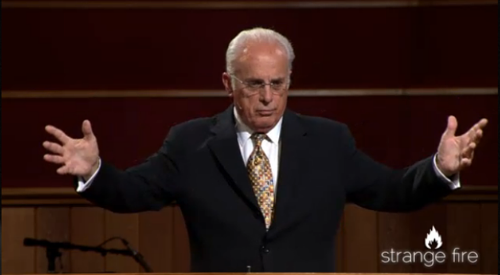
Tom Pennington at Strange FireToday Tom Pennington spoke at the Strange Fire conference and provided a case for cessationism. He offered seven biblical arguments for the cessation of the miraculous gifts of the Holy Spirit. Here is a summary of his session.

The label “Cessationism” is negative, but the real problem is that it has been easily caricatured as believing that the Spirit has ceased his work. But the fact is that we who are cessationists believe the Holy Spirit has continued his work. Nothing eternal happens in a person apart from the Holy Spirit. Temporal things can happen, but nothing eternal. We only believe the Spirit has ceased in one function: the miraculous gifts, such as tongues, prophecy, and healing.

-Pastor Tim Challies liveblogging
Strange Fire Conference: A Case for Cessationism,” October 17, 2013
Challies.com

That’s something of a relief, but sometimes I think “Cessationists” have only themselves to blame for being “easily caricatured as believing that the Spirit has ceased his work.” This is especially true when that category or branch of the Church places specific limits on the work of the Spirit but apparently acknowledges that evil spirits have full reign to do as they please.

OK, that’s probably an exaggeration, but not by much.

So Cessationism teaches that the Holy Spirit has ceased only “one function: the miraculous gifts, such as tongues, prophecy, and healing.” Of course, I haven’t been in a church where prayers for healing haven’t been requested, so I wonder why we’re praying for our friends and loved ones who are ill or injured if the Cessationist viewpoint is correct?

To be fair though, and remember, I’m trying to be fair, Pastor Pennington doesn’t say God doesn’t do miracles anymore, just that the Spirit no longer conveys upon believers any miraculous spiritual abilities or gifts as were given to the apostles. According to Pennington and the Cessationist perspective, “The primary purpose of miracles has always been to establish the credibility of one who speaks the word of God—not just any teacher, but those who had been given direct words by God.”

So the only purpose for miracles was to establish the validity of the prophet or apostle and the words he was speaking that were from God. Now that we have no apostles and prophets, I guess the point of miracles is moot…well, specific miracles such as prophecy, supernatural healing, and speaking in “angelic” languages.

Charismatic prayerI have to admit that I think there’s something to this. A friend of mine came to Christ many years ago at a local church that believed when someone professed faith during an altar call, they would speak in strange languages. Everyone around my friend had their own tutor or helper, a volunteer at the church, who would guide them in this, and my friend heard the others around him making noises that to him, sounded like gibberish. But no matter how hard my friend tried to open himself up to the Spirit, this spontaneous event didn’t happen to him. His helper urged him to try harder, especially as it was getting late and the helper’s wife was waiting for him out in the parking lot.

Now my friend happens to be multi-lingual, so in an act of desperation, he started speaking in the various languages he already knows. Apparently, that’s what this person from the church wanted to hear and the requirement was satisfied…

…except it wasn’t a miracle, my friend just happens to be gifted in this area and he had already learned those human languages (romance languages for the most part) through studying and travel.

I’ve never been to a church where I’ve heard anyone speaking in a non-human language, so if there’s any validity to this practice, it must not be widespread. Also, I’m highly dubious of anyone calling themselves a prophet, since the world is replete with men and women who claim to have made prophesies about the return of Jesus and absolutely none of them were correct (all of the predicted dates have long since passed, and yet Messiah has not returned).

But I can’t say that miracles absolutely don’t occur. True, I think practices such as holy vomiting (I kid you not) and holy laughter seem pretty ridiculous and in the former case, really disgusting, and of course, you don’t see examples of either in the Bible. On the other hand, I do have a copy of Gifts of the Spirit, which was produced by First Fruits of Zion and is a compilation of the presentations made at their Shavuot Conference last spring, which I attended and blogged about extensively (click the “gifts of the spirit” tag to see all related blog posts).

I’ll have to revisit those experiences through my previous blog posts and that book because, as I recall, there’s another side to living a spiritual life besides performing miraculous deeds, and gifts from God can take on many forms, including the ability to write, teach, pray, comfort, and express extraordinary kindness and compassion to others.

I’ve heard Christians, people I respect, say that one of the reasons we don’t experience gifts is because we are not open to the Spirit. I don’t want to reduce God to a formula because I think there are plenty of people who are open to God who do not overtly hear from Him, at least not “on command.” However, Cessationists tend to put God in a box, too. They have made up all of these rules that say what God is and isn’t doing. There is no room for exceptions. Who’s to say that God doesn’t heal miraculously according to His will?

heavenly-manAnd there are reports, presumably credible reports, that God does do miracles in places and through people when it is necessary to further his work of spreading the Good News. True, I haven’t witnessed any of this myself, but then again, I haven’t witnessed demon possession either, and yet people like John MacArthur say that’s absolutely real.

Cessationists say that certain miracles are done away with, such as healing, and they prove their points by quoting scripture. They say (or some of them do) that demons are real and continue to have influence in our world, and they prove their points by quoting scripture.

We live in a real, physical world, but it intersects with some pretty strange places, places I’m not qualified to discuss in any detail, places that, for the most part, are out of my lived experience. But I can’t put God in a box, either. Sometimes I think He does things, including supernatural things in our world, because He’s a Sovereign God. He doesn’t have to have a reason that we understand. All that said, none of those supernatural events in any way can contradict what we read in the Bible. The problem is, from a human standpoint,  correctly understanding what God is saying in scripture. We don’t always get it right.

I think that refuting or bringing to light some of the more outrageous claims of those who say the Spirit of God made them spontaneously vomit is a good thing, but that doesn’t mean God’s hands are tied if He wants to heal someone of cancer. It doesn’t mean He has to heal, but we don’t always understand God and we absolutely don’t get to tell Him what His limits are just because we’ve inferred things from the Bible (and inference of the scriptures is what the Cessationist argument primarily relies upon).

He [the God-fearing person] will not fear evil tidings, his heart being firm in his trust in God.

Psalms 112:7

If we seek an encounter with God, it may not manifest in a dramatic, public event. It may be in the small stillness of the night when your spirit is troubled and you need to be comforted. We don’t get to tell God what to do or how to do it, so neither side of this debate is in full control of God’s truth and His activities. But if we trust in God, then we know that when we need Him, He’ll be with us.

Standing on the Jewish Foundation of the Bible

ShabbatIt shall be that at every New Moon and on every Sabbath all mankind will come to prostrate themselves before Me, says Hashem.

Isaiah 66:23 (Stone Edition Tanakh)

Therefore no one is to act as your judge in regard to food or drink or in respect to a festival or a new moon or a Sabbath day—things which are a mere shadow of what is to come; but the substance belongs to Christ.

Colossians 2:16-17 (NASB)

On the surface, these two passages of scripture seem to contradict each other, at least according to traditional Christian interpretation. I pulled them from yesterday’s review of The Promise of what is to Come series episode What Day is the Sabbath, produced by First Fruits of Zion. I published my review a day early (usually, my reviews of the show appear every Wednesday morning) because I wanted to build on a specific point and attempt to arrive at a personal conclusion.

For some time now, I’ve been trying to explore what I consider inconsistencies between the ancient Jewish scriptures, also known as the Tanakh or the Old Testament, and the later scriptural writings, also refered to commonly as the New Testament. If we’re supposed to have one, unified Bible that is all “God breathed” (2 Timothy 3:16), that is, if everything we read from the first chapter of Genesis to the last words in Revelation all originate from the same source, from God, then everything in the Bible must be internally consistent and provide a single, cohesive revelation from God to humanity.

Human beings artificially divided the Bible into “Old” and “New Testaments,” not God, and we’ve applied many more divisions, filters, interpretations, and traditions to how these texts are now understood in “the Church.” But I have to remind myself that, like Judaism, Christianity isn’t a single, monolithic entity. There are many “Christianities,” just as there are many “Judaisms,” each with its own theology, set of doctrines, and sacred interpretations. Sure, there’s significant overlap. The fundamentals of the Christian faith should be shared by all valid Christianities, in spite of other differences, but the multiple ways different Christian streams understand what the Bible is saying are dizzying.

However, the problem I’m confronting now is more basic than just different denominational biases. I am attempting to resolve a more fundamental (sorry for employing that word so much) problem. Using the above-quoted scriptures, how are we to reconcile the apparent contradiction between the prophet Isaiah, who tells us that in the Messianic Age, all human beings will worship God on every Sabbath and every New Moon, and the apostle Paul, who says (apparently) that Sabbaths and New Moons are mere shadows of what is to come (presumably in the Messianic Age), and the substance (or meaning or fulfillment) is in Christ? It seems as if Paul is undoing what Isaiah prophesied.

We have some options:

  1. Both scriptures are correct but traditional Christian interpretation of Paul is flawed, leading the Church to come to a false conclusion. A new paradigm is required to understand Paul and Isaiah (and the entire Bible) within the same Judaic context.
  2. The Christian doctrine of progressive revelation allows for Paul to provide additional meaning to Isaiah’s prophesy, expanding upon our understanding of the earlier text.
  3. In Christ, the function of the Law was fulfilled at the cross, and thus later prophesies and holy scriptures replace or supersede earlier texts, with the later texts (on the right side of the cross) always “winning” in any apparent contradiction.
  4. The Tanakh or the Jewish holy scriptures were the only revelation of God given to man through the Jewish prophets. The later apostolic writings, and especially Paul, were a distortion of the teachings of Jesus and created a new, non-Jewish religion that was ultimately called Christianity.
  5. The Bible is broken and unreliable.

Let’s handle the easy items first and then proceed to the more challenging points.

tallit-prayerItem 5 is what atheists would say. The Bible is a series of ancient tribal writings and can no more be considered as originating from a Divine supernatural being than any other “holy book” ever written in human history. Christianity and Judaism are fantasies and superstitions that have no place in the modern age.

Item 4 is what traditional observant Jews would say, including groups such as Jews for Judaism. A Jewish man named “Yeshua” or “Yeshu” may have lived in the late second Temple period and taught along with many other itinerant Rabbis, but if he thought he was the Messiah, his death proved he was not. The Tanakh is the extent of God’s revelation to mankind. The New Testament is a radical distortion of the teachings of Jesus, and Paul, in writing letters directly contradicting the Torah and the Prophets, was a liar, hypocrite, and a traitor to the Jewish people, to the Torah, and to God.

Item 3 is the most traditional, historical Christian interpretation. Jesus fulfilled the Law at the cross, and when he died, the Law died with him, along with any prophesies that contradict the later Gospels and Epistles. This is called supersessionism or replacement theology and it has been the bedrock for Christian interpretation of the Bible for nearly 2,000 years. Although the Christian Reformation may have changed a good many things, this foundational conceptualization and interpretation of scripture remained intact. Later events, and especially the Holocaust, have resulted in “the Church” softening its perception of Jews and Judaism to a much less anti-Semitic position, and many Christian denominations are now pro-Israel, but the fundamental Christian doctrine that the Law is dead continues unchanged.

Item 2 is something of a variation of item 3 but it has to be handled delicately. The idea is that, over the vast span of Biblical history, God continually revealed more and more about Himself and His plan to human beings. Abraham only knew so much about the plan of God. God revealed more to Moses. God revealed more to Isaiah. And God provided His ultimate revelation in the person of Jesus Christ, the Son of God and the second part of the Trinity. Paul, as Christ’s special emissary to the Gentiles, was able to reveal, through the Spirit, even more than the previous prophets, thus adding much more meaning and dimension to the Biblical narrative of God’s plan as a whole. In this interpretation, the scripture from Isaiah 66:23 is incomplete and Paul added more to our understanding than Isaiah ever had access to.

That would work out fine except for one thing. Christianity still understands Paul as contradicting (apparently) Isaiah. No matter how you spin it, sooner or later, progressive revelation must believe that later revelations not only add meaning and dimension, but in cases where a later revelation seems to contradict an earlier one, the later revelation is always correct. In other words, the later revelation supersedes or replaces the earlier revelation, thus making items 2 and 3 close cousins if not sibling interpretive methods.

high-trail-hiking1And that brings us to item 1.

Periodically, I have been accused of being wishy-washy. I’ve always seen a life of faith as a journey of discovery. God places us on a path and sends us in a direction. We have a “map” of the territory ahead, but we all know that the map isn’t literally the territory. What we find on the trail should always provide unique details and experiences that make the journey necessary, otherwise, we could all just sit in the comfort of our homes, read the map, and know everything there is to know. There would be no need to study, pray, worship, or “wrestle” with God. The Bible would be a simple narrative, like reading a novel or even a children’s story. One or two passes through the book, and we know everything there is to know. God is reduced to a finite number of words on the printed page.

But that obviously isn’t true, otherwise we’d all agree about what the Bible says and there would be only one interpretation of the Word of God possessed by all human beings of faith.

In traveling the road of faith as I have, I occasionally manage to annoy some people or to frustrate them. Most other “religious bloggers” or “religious” people in general don’t think that a life of asking questions is sufficient. They want definite, concrete answers, and they want to hold onto them unswervingly, not exploring, not journeying, but always possessing the destination in the palm of their hands. They always want to be “right.”

And they want me to do all that, too.

Alright. If I’m to be pushed into a corner and you want a definite answer from me, here it is.

I believe in item 1. I believe the Bible is a single, unified document that represents God’s revelation to mankind, primarily through the Jewish prophets and apostles. I believe where ever we experience a fundamental contradiction in the Bible, such a contradiction does not actually exist. Using the television episode What Day is the Sabbath as my example, I believe that Biblical contradictions between how Christians and Jews understand the Sabbath are a result of incorrect interpretation based on anti-Semitic and anti-Jewish doctrine that was originally developed in the first several centuries of Church history and that hasn’t changed very much in almost two-thousand years. Such traditions have been so ingrained in Christian thinking among nearly all streams of the Christian faith, that it never even occurs to most kind, compassionate, intelligent, well-read, devoted believers, including many Pastors and New Testament scholars, to question those extremely ancient and I believe faulty assumptions.

They can’t possibly imagine that their interpretative traditions are wrong.

I’m not trying to sound like the old T.V. show The X-Files, but I believe the truth is out there. I believe that later Christian viewpoints such as The New Perspective on Paul have merit and are enabling believers to view the apostle in a different light, one where we can read him as not contradicting the earlier prophets or abandoning Judaism.

Movements such as Hebrew Roots among Christians and Messianic Judaism among Jewish believers, are embracing this paradigm shift and taking a fresh look at the Bible, especially the apostolic scriptures, peeling away hundreds of years of stale doctrine, and learning to see Paul as a Jew, as a Pharisee, and as a zealot for Torah, the Temple, the Messiah, and the God of Israel.

People want me to make a stand, so I announce my platform. I suppose it shouldn’t come as a total shock, but I’m tired of being considered noncommittal. You don’t have to like it and you don’t have to agree with me, but I believe a pro-Jewish view of Paul and a Judaic interpretive lens is the correct way to read the later, apostolic writings and to heal the divisions we have historically carved in our Bibles, especially “between the Testaments.”

Yesterday, I partly quoted Boaz Michael when I said:

He also said, and this is very important to me, that studying the Bible, all of it, from a Jewish cultural, national, historical, ethnic, and traditional perspective “makes our Bibles consistent and upholds the Biblical truth that God doesn’t change.”

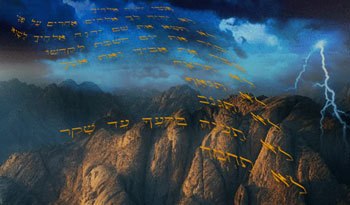
Torah at SinaiGod doesn’t change His mind. When He said the Sabbath was an eternal sign of His covenant with Israel, He wasn’t lying, and this wasn’t some sort of cosmic “bait and switch.” Refactoring our understanding of the Bible to accommodate a Judaic and pro-Jewish perspective on scripture is the only way to view the Bible as a single, unified revelation of God. There is no need to throw out “Biblical sufficiency.” The languages of the Bible still say what they say, and the Bible remains a record of God’s interaction with man and a guide to holy living. The only thing we must change is our tradition about how we interpret the Bible.

I choose not to adhere to a tradition of Biblical interpretation that, by definition and having long been established historically, must rewrite the Old Testament to fit the New Testament as understood by the Church. Christianity has found it necessary to invent man-made ways to retrofit the prophets to map to a Jesus who denies Judaism and an anti-Torah Paul. God’s “eternal covenant” can’t be “eternal” if the Church must interpret Paul as saying it’s temporary. The Church’s fundamental matrix for understanding the Bible is flawed because it denies the unchangability of God and even under the most benign and apparently pro-Israel perspective, must replace or at least significantly “spin” portions of the Messianic prophesies of the Tanakh in order to make sense of a non-Jewish Messiah who is not part of Judaism and does not uphold the primacy of his people Israel.

Nothing else makes sense. Christians can pepper me with this individual verse and that individual verse from New Testament writings, but in the end, the Bible isn’t just a list of verses we can “cherry pick” to fit an outmoded doctrine, it’s a single thing or unit made up of all of its elements, an “Echad.” If all the elements aren’t unified, then the Echad must disintegrate and collapse in upon itself. I don’t believe the Bible does that, so the problem lies elsewhere…with human beings.

It’s time to do this better before the bridegroom comes and finds our lamps are without oil.

Who am I? I’m a Gentile Christian who studies Messianic Judaism. I also go to church, and I’m trying to build bridges between the different members of the body of Messiah.

A Sketch of Christian Fundamentalism

How Christian Fundamentalists are seenChristian fundamentalists, who belong in the center field of Biblical theology, find themselves grouped by the media in the same category as militant political extremists, fascists, snake handlers, and Islamic fundamentalists. It’s about time somebody called foul!

The term “fundamentalism,” as Bible-believing Christians use it, identifies a system of beliefs that are foundational, or fundamental, to the Christian faith. Coined at the turn of the twentieth century, in an era of emerging, aggressive theological error, the term still stands as a watershed between truth and apostasy.

-from the pamphlet
“Fundamentally Sound: Understanding Our Faith”
Regular Baptist Press: Building Lives by the Book

(Note: I just want to point out that when you do a Google image search on “Christian fundamentalism” or “Christian fundamentalists,” the results are never pretty).

A Challies Chronicles Interlude

I’ve been trying not to mention my Pastor and my church to any extent in my blog posts to avoid even the hint that I am being critical of either, but there’s no other way to write this “meditation.” Pastor brought to my attention that I might not quite understand the term “fundamentalism” and have even been using it in a pejorative manner. He also explained some differences relative to how Reformed theology is understood.

In an effort to be fair, and to cement this in my memory, I decided to construct a little summary of “what is Christian fundamentalism.” I won’t go into the history (though I took copious notes of Pastor’s discussion), however, after a series of annual conferences held by leading Christian thinkers from America and Canada starting in 1890 and extending to 1930, the “Fundamentals of the Faith” were established, recorded, and published. The first five were fully agreed upon and the sixth was debated and later added. Here’s the list as we have it today:

  1. The Inspiration and Authority of Scripture: God authored the entire Bible — every word of it and every part of it (2 Tim. 3:16). The Bible is God’s Truth (John 17:17). It is without error!
  2. The Deity of Jesus Christ: He is fully God as well as fully man. He has always existed as God, and He always will be God (John 1:1; 20:31; 1 Tim. 3:16).
  3. Christ’s Virgin Birth and Miracles: Jesus was born of the virgin Mary (Isa. 7:14; Matt. 1:18-25) and was sinless (Hebrews 4:15; 1 Peter 2:22). He performed miracles to authenticate His credentials as Israel’s Messiah (John 20:30, 31).
  4. Christ’s Blood Atonement for Sin: Jesus shed His blood as the payment for our sins. Without the shedding of His blood, there would be no remission of sin (Romans 3:24-26; Col. 1:13, 14; Heb. 9:14-28; Rev. 1:5).
  5. Christ’s Bodily Resurrection: Jesus arose bodily from the grave, triumphing over death and assuring believers of their future resurrection (Luke 24:1-12, 34-38; 1 Cor.15:1-20).
  6. Christ’s Personal Return: Jesus assured His disciples that He will come again (John 14:1-3). Angels announced His return (Acts 1:1), and the apostles taught that He will return (1 Thess. 4:13-17; Titus 2:13; 2 Peter 3:1-10; 1 John 3:2).

This describes the core beliefs of fundamentalist Christianity and as far as I can tell, these six points are generally accepted by most if not all Christians. In fact, if you dispute any one of these points, according to a fundamentalist point of view, you can’t really be called a Christian.

It’s funny how much the topic of apostasy has come up in the Christian, Hebrew Roots, and Messianic Jewish areas of the blogosphere lately.

I don’t doubt that many of you out there will have something to say about this list. I copied it word for word from the aforementioned pamphlet, so as far as it goes, I’m just transmitting information, not engaging in editorial commentary (that comes later).

christian-fundamentals-101It all sounds so simple on the surface, but even accepting those six points, there’s still room for a huge amount of variability beneath the overall Christian “umbrella.” As I mentioned to my Pastor last Wednesday, everyone who claims Yeshua-faith as well as religious Jews who deny Yeshua (Jesus) was/is the Messiah all state that scripture supports their positions. Even when considering the rules of Biblical interpretation, there is always the filter of interpretive tradition each religious stream in Christianity and Judaism utilizes to color understanding and meaning. No one has pure, unbiased access to the Bible.

We are all on a journey attempting to discover truth, attempting to achieve ever higher fidelity to the original, that is, the truth of God, and yet we all fall short. This isn’t to say we should all give up, and it isn’t to say that we can’t come closer to truth as we continue our efforts, but achieving the mind of God is like traveling at the speed of light. To do so would require the expenditure of infinite energy and would result in us laboring under infinite mass.

In other words, no matter how hard we try, and what technologies we use, pushing an object in space faster and faster and faster will get us (marginally) closer and closer to the light speed limit, but we will not only fail to ever achieve it, we will probably fall significantly short of our target.

But that doesn’t mean we will ever stop trying, and in fact, NASA continues to look into developing warp drive.

People of faith continue to strive to break the bonds of our humanity in an effort to touch the Divine. The moral equivalent of developing “warp drive.”

My Pastor suggested that it might be helpful for me to listen to some sermons and to gain some actual experience and perspective on Christian thought and Christian leaders. We discussed John MacArthur, R.C. Sproul, Steven J. Cole, and Chuck Swindoll.

I didn’t tell Pastor this (but since he reads my blog posts, he’s about to find out), but I gave up listening to sermons on Christian radio well over a decade ago. Even as a “young Christian,” I found some of the sermons too elementary, some too confusing, and most too critical of Judaism and Israel to be of much help. Sooner or later, the speaker would say something that would make my blood boil, and my commute home from work would be shot as would my mood when I got home.

I listen to the 1960s “oldies” station now and am much happier on my drives.

I’m a guy sitting on a fence. I go to a Christian church, but I think like a “Messianic” (however you want to define the term). More to the point, I think and enjoy Biblical lessons that focus on understanding scripture from the Judaic thought process, linguistic, social, ethnic, and yes, Rabbinic context of the times when those scriptures were authored, and from the viewpoint of the intended Jewish (in most cases) audience.

Hillel and ShammaiKnowing the original languages isn’t enough, because how we interpret what was actually being said has been stripped of most of its contextual meaning. From a Messianic viewpoint, you can’t read the teachings of Jesus without, in some cases, summoning up Hillel and Shammai, who taught a generation before Christ. They were Jewish teachers, Jesus was a Jewish teacher. In many ways, Jesus had a lot more in common with Hillel and Shammai than he has with MacArthur, Sproul, Cole, and Swindoll. I’m not trying to be mean or insulting. It’s a statement of fact. Jesus wouldn’t call himself a “Christian.” He wouldn’t say that the Law was “nailed to the cross.” He wouldn’t disdain the Shabbat, New Moons, or other Biblical festivals.

To understand Jesus, or Paul, or Peter, or James, it makes more sense to seek out sources closer to them, not only historically and linguistically, but culturally, ethnically, ethically, as well as in terms of what Jewish traditions and interpretative methods were in play in that place at that time.

I’m not sure how men like MacArthur or even the very user-friendly Chuck Swindoll would approach such a context. I don’t want to be unfair, but I do want to be realistic.

This all goes back to Boaz Michael’s book Tent of David and my recent review of who I am and what I mean within the cultural and theological context of Christianity as an institution.

So far, I see one of three outcomes of my “church experience:”

  1. I stay at church and “assimilate,” becoming a “regular Christian” and abandoning any mental, emotional, theological linkage with Messianic Judaism, Hebrew Roots, and any “Judaic” viewpoint on the Bible.
  2. I stay at church but maintain my current perspective, even expanding it though self-study and contact (real or virtual) with others who share my basic viewpoint, generally being a curiosity, a pain in the neck, or ideally, a refreshing conveyer of the Messianic perspective within the church environment.
  3. I give up on Christianity as an institution entirely, leave church, and pursue a life of faith as an independent “free-agent.”

As the end of my first year in church approaches (or has it arrived by now?), I feel like I’m crossing some sort of milestone or threshold. A year in church as resulted in me learning more about the history and institution of Christianity, but it hasn’t diminished the perspective I possessed when I went back to church a year ago. If anything, having to debate my perspective has driven me to do even more reading and studying, strengthening my belief in a Jewish Yeshua and the continuance of Jewish Torah observance for all Jews of faith, including Jews in the body of Messiah.

Every time I enter into such a brain bending set of debates and discussions, I have to get away for a while afterward and be alone with God. God may not be entirely knowable, but He isn’t confusing, either. He is a listener. He doesn’t have much to say most of the time when I pray, but it’s good to be able to tell Him how crazy religion makes me sometimes.

praying-aloneI’m glad He’s there. I’m glad I can remember that regardless of all the religious preachers and pastors and rabbis and sages rolling around human history and the current theological landscape, there is an eternal God who is the point of everything everyone is trying to do. In the end, it doesn’t matter who wins the arguments. In the end, God reigns supreme. In the end, God will stop listening and start talking. Then, if we are wise even to the slightest degree, we will stop talking and listen.

It’s in moments like these that I continue to pursue God, moments when it is dark and quiet, and the only sound is the passage of my voice to the Heavens. God listens. Being with Him is very peaceful and comforting. The chaos of human religion seems miles away.

I’ll return to my review of the Strange Fire conference soon.

In the meantime, tomorrow’s latest review of an episode of First Fruits of Zion’s television series and Wednesday’s follow up on that content continues the discussion of who I am as a believer. I said above that I was sitting on a fence. Wednesday, you will see me hopping off and I will show you on which side of the fence I land.

The Unchanging Changing God

Leah and RachelSo Jacob did so and he completed the week for her; and he gave him Rachel his daughter to him as a wife. And Laban gave Rachel his daughter Bilhah his maidservant — to her as a maidservant. He consorted also with Rachel and loved Rachel even more than Leah; and he worked for him another seven years.

Jacob’s anger flared up at Rachel, and he said, “Am I instead of God Who has withheld from you fruit of the womb?” She said, “Here is my maid Bilhah, consort with her, that she may bear upon my knees and I too may be built up through her.”

When Jacob came from the field in the evening, Leah went out to meet him and said, “It is to me that you must come for I have clearly hired you with my son’s dudaim.” So he lay with her that night.

Genesis 29:28-30, 30:2-3, 16 (Stone Edition Chumash)

So Jacob marries two women, and sisters no less, and “consorts,” not only with his two wives, but with both of their maidservants as well. By today’s standards, even in progressive, secular society, this is beyond scandalous. And yet, in the ancient near east, what Jacob was going and how he was building up a family was considered perfectly acceptable.

But we don’t consider that acceptable today, and certainly not in the Christian church. Did Jacob deviate from God’s plan? Did he commit some horrible sin, some dire mistake as did his grandfather Abraham when Abraham “consorted” with Sarah’s slave Hagar (Genesis 16:1-4)? Ishmael went on to father the Arab nations, who have been a thorn in Israel’s side across history and into the present day. Did Jacob’s actions with his wives and concubines represent the same error?

Apparently not, since without the children produced by all four of these women, there would be no twelve tribes of Israel and their descendants, the Jewish people.

But how is this possible? If God is eternal and His morality is eternal and unchanging, then how can the relationship Jacob had with two wives and two concubines be approved of by God and yet be considered morally wrong and sinful today?

He answered them, Have you not read that from the beginning the Maker “created them male and female,” and it says, “Therefore a man shall leave his father and mother and cling to his wife, and the two will become one flesh”? If so, they are not two any longer, but one flesh. Thus, what God has joined, man must not divide.

Matthew 19:4-6 (DHE Gospels)

One FleshJesus quotes from an even older story in the Bible to define what is marriage (and what is divorce) to the questioning Pharisees, but conspicuous in his answer is the absence of Jacob, his two wives, and his two concubines. Certainly, every Jewish person hearing the words of the Master and even Jesus himself, owed their very existence to Jacob and his offspring who he sired with four women, only two of whom he had formally married. But what about “two becoming one flesh?”

And what about this?

And it was when about three months had passed, that Judah was told, “Your daughter-in-law Tamar has committed harlotry, and moreover, she has conceived by harlotry.”

Judah said, “Take her out and let her be burned.”

As she was taken out, she sent word to her father-in-law, saying, “By the man to whom these belong I am with child.” And she said, “Identify, if you please, whose are this signet, this wrap, and this staff.”

Judah recognized; and he said, “She is right; it is from me, inasmuch as I did not give her to Shelah my son,” and he was not intimate with her anymore.

Genesis 38:24-26 (Stone Edition Chumash)

If not for this rather scandalous act on both the part of Tamar and Judah, she would not have given birth to the twins Perez and Zerah, and Perez is an ancestor of the Messiah.

How ironic that the one son of Jacob who found his wife among the Canaanite inhabitants of the land was none other than Judah, whose name would eventually denote the progeny of Jacob that survives. In the phrase “About that time Judah left his brothers,” the verb “left” suggests not only a physical departure, but also a violation of family mores (see Genesis 38:1-2).

-Ismar Schorsch
Commentary on Torah Portion Vayetze
“Setting Aside Our Abhorrence of Canaanites,” pg 105
Canon Without Closure: Torah Commentaries

All of this suggests, even if we agree God’s morality and ethics are eternal and unchanging, that He is willing to “work with” our current traditions and customs as a means of accomplishing His plan. Otherwise, how can we explain such apparently outrageous behavior by some of the greatest men in the Bible?

Later in the same commentary, Schorsch goes on to say:

The language implies an expansion of the notion of excluded nations. It is not ethnicity that defines the seven original settler nations of Israel, but cultural mores.

-ibid, pg 106

abraham1This makes a great deal of sense, especially in the case of Abraham, who was distinguished from even his close relatives in his homeland, not by ethnicity or genetics, but by a moral and ethical code received from God as the result of “faith counted as righteousness” (Genesis 15:6).

As the family of Abraham progressed forward in time, it began to be distinguished and then defined by families, clans, and tribes descended from the twelve sons of Israel. Who Israel was to each other and to God was set against the national backdrop of the people groups surrounding them. But then, time continues to pass and circumstances radically change.

By the time the Pharisees and Rabbis, Ezra’s spiritual heirs, came to power after the destruction of the Second Temple, Judaism had become a missionizing world religion, constituting as much as one-tenth of the population of the Roman Empire. To maintain the deuteronomic legacy, especially in Palestine, would have severely impeded access to Judaism for prospective converts in a world turned cosmopolitan. Who could be sure that an interested gentile was not a descendant of one of the proscribed nations?

-ibid

I know people in the community of Jesus faith who discount the validity of conversion to Judaism because it is not presupposed in the Torah, as if closure of Torah canon constitutes closure of the will of God. My recent commentaries on Pastor John MacArthur’s Strange Fire Conference have shown me (not that I was unsure of MacArthur’s opinions before this) that he closes Biblical canon with a bang at the end of the Book of Revelation and declares that the Holy Spirit isn’t in the business of working miracles or even talking to people anymore.

And yet, even within the Biblical canon, we see time and time again how God, unchanging and eternal God, seems willing to adapt how He interacts with human beings across the varied mosaic of history in order to accomplish His ultimate goal of reconciling man to Himself and ushering in the Messianic age.

I’ve been struggling more than a little with trying to reconcile the Jewish Torah, Prophets, and Writings, which Christians call collectively, the “Old Testament,” with the later Christian scriptures or the “New Testament.” Even though the books of the Tanakh represent a widely diverse set of writing styles and writers, it yet preserves an overall Jewish “flow” of prophesy aimed at the national redemption of Israel, and the restoration of God’s physical rule on Earth and among all the nations. The Christian interpretation of the later writings shifts the focus away from national Israel and the Jewishness of Yeshua faith, and makes it all a story about God’s plan for personal salvation of all people in a single, homogenized group called “the Church.”

But “the Church” is never mentioned in the Tanakh. If the Bible is supposed to be a unified document, Torah, Prophets, Writings, Gospels, Epistles, Apocrypha, then I would expect that overarching Jewish flow of prophesy to be seamless and unbroken across the “Testaments.”

But it isn’t.

DHE Gospel of MarkHowever, is the fault the document we have that we call the Bible, or is it how different groups interpret it? Certainly Christians see the “Old Testament” in a radically different light than Jews see the Tanakh.

Is my search for Biblical reconciliation and the face of the One, Living God across all history doomed to failure? Is there no way to understand an adaptive God and yet find Him eternal and unchanging in all of the pages of the Bible?

Frankly, one of the only places I’ve been gaining traction so far in my quest is by watching and reviewing the different episodes of First Fruits of Zion’s (FFOZ) television series (available for free viewing online) A Promise of What is to Come. That’s because this program is written and formatted to present familiar concepts in Christianity, such as the Gospel Message, the meaning of the title “Messiah,” repentance, and the parables of Jesus, all from an exclusively Jewish perspective.

The key to understanding the Bible, all of it, is to put yourself in the place of the original writers and especially of the original audience. What were the first century Jewish readers of Matthew’s Gospel supposed to take away from his message? What is “the Good News” from an ancient Jewish point of view? Is the Jesus Christ of the Christian Church really the Jewish Messiah, Son of David we see prophesied by Isaiah, Ezekiel, and Zechariah? Is there some way to make sense of how God seems to change His methods and motives based on changes in ancient (and modern?) cultural mores, and still to recognize that He is One God, a single, unified, creative, entity?

In an ultimate sense, the great Ein Sof God of the Universe is entirely unknowable. How can the small and finite know the limitless infinity?

And yet, God gave us a Bible written in human languages by inspired human beings to other human beings in need of inspiration so that we can know Him. God wants us to know Him and to draw close to Him. We read how Abraham drew close to God. We read how the God of his father became the “Dread” of Isaac. We can see how God turned the fugitive son Jacob into Israel, the father of an empire.

And we can read how one, lone, itinerant teacher changed the course of the world through his teachings, his death, his resurrection, and his ascension to the right hand of Glory.

walkingThe search for God is not a search for an ultimate answer that once we possess it, we may rest in our knowledge and sit assured in our complacency. It is a never-ending process, a trail winding through the mountains, a sea without a shore, a lifelong journey of ever greater discoveries and an ever closer walk with our God.

There is an answer, just as there is a final peace, where each man will sit under his vine and under his fig tree, and no one will make him afraid (Micah 4:4). But that time has yet to come. And until he comes again, we remain a traveler without a home, a bird without a nest, eternally walking, eternally in flight, until home comes to us in the Kingdom of God.

May Messiah come soon and in our day.

Burning on the Strange Pyre

strange-pyreWhen I first read MacArthur, I was enamored. I was young, and my no means spiritually mature; to me, MacArthur appeared to give real direction. His warnings fell on ready ears. Discernment—I was young, and naïve, but I was smart enough to know that I needed discernment. And MacArthur’s work was designed to capitalize on this knowledge. He and other teachers like him have helped to raise a generation of conservative Christians who, practicing what they believe to be “discernment,” have insulated themselves from being influenced by—well, you name it. Anti-megachurch, anti-charismatic, anti-seeker-friendly, anti-topical-sermons, anti-emergent-church, anti-Arminian, anti-dynamic-translations, anti-Rob-Bell, anti-Harry-Potter, anti-anti-anti. A generation of anti-s.

And yes, of course, anti-Messianic. It’s new, it’s weird, it’s different, it’s not what we grew up with, and it doesn’t square with the doctrines on which we have built our on theological superstructure. If Messianic Judaism is right, we’re wrong, and how could we be wrong?

So when I read Messianic Jewish teacher Michael Brown’s appeal to John MacArthur to cease and desist his campaign against the Pentecostal/charismatic movement, my first thought was, “Of course—if MacArthur doesn’t come to his senses, we’re next.”

-Pastor Jacob Fronczak
“Strange Fire & The Gifts of the Spirit”
FFOZ Blogs

Note: It’s Wednesday evening and I just came from my weekly meeting with my Pastor. He gave me his perspective and understanding of the Strange Fire conference which was significantly different than what I’ve been reading in the blogosphere recently. I wrote this blog post a few days ago, and will likely revisit the topic in the near future for the sake of being fair. In the meantime, this is my initial response to the information I previously received and more importantly, my impression of how the different elements in the body of Christ have been treating each other.

I was only marginally aware of the Strange Fire conference before today (as I write this) and only because I previously had some small encounter with the thoughts and writing of John MacArthur, both through my Pastor and in Sunday school. I’ve struggled with MacArthur before and I doubt I’ll ever become his biggest fan.

Then last Sunday, as he was introducing his sermon, my Pastor, from the pulpit, mentioned MacArthur, the “Strange Fire” conference (which got my attention), and how he generally commended it.

My blood ran cold for a second, but then I got lost in a flurry of note-taking as Pastor launched into his sermon, and I didn’t look back. Religious conferences come and go, and I thought MacArthur’s would simply fade into the background noise and finally degrade into static.

But then I read Jacob Fronczak’s commentary on the MacArthur conference. It’s not that I’m writing this as yet another critic of MacArthur or “Strange Fire.” Fronczak, Michael Brown, and many other people far more worthy than I and closer to the issues involved have already done that (I should say at this point that while I’m not particularly attracted to Pentecostalism, I don’t feel I have to lead a “holy crusade” against them, either).

But when Jacob wrote, “Of course—if MacArthur doesn’t come to his senses, we’re next,” it struck a chord.

Oh, some background first.

This is where the phrase “strange fire” comes from:

Now Nadab and Abihu, the sons of Aaron, took their respective firepans, and after putting fire in them, placed incense on it and offered strange fire before the Lord, which He had not commanded them. And fire came out from the presence of the Lord and consumed them, and they died before the Lord.

Leviticus 10:1-2 (NASB)

Christian and Jewish scholars and theologians have been debating for centuries as to exactly why Nadab and Abihu were killed and what the “strange fire” was that they attempted to offer before the Lord. No one really knows for sure, although I don’t doubt there are a few people out there who are certain they do. In the realm of religion, there are always those people out there who think they have all the answers set in concrete on matters so complex or mysterious, that it is reasonably unlikely or even impossible for them to be that sure.

michael-brownNext stop, John MacArthur writes another book. This one is called Strange Fire: The Danger of Offending the Holy Spirit with Counterfeit Worship. According to Amazon, it isn’t available for purchase until November 12th, so I suppose the conference anticipates the book’s publication (I could be cynical and suggest that part of MacArthur’s motivation for the conference was to drum up mass market interest to sell more copies of his book, since controversy sells like proverbial hotcakes, but I digress, since only God knows the heart).

And then we come to Michael Brown’s final attempt to appeal to MacArthur prior to the actual conference.

I received an advanced review copy from the publisher; all quotes here are from the Introduction and should be checked against the final text of the book.

In fact, he claims that leaders of the movement are “Satan’s false teachers, marching to the beat of their own illicit desires, gladly propagate his errors. They are spiritual swindlers, con men, crooks, and charlatans.”

This is divisive and destructive language based on misinformation and exaggeration, as Pastor MacArthur attributes the extreme errors of a tiny minority to countless hundreds of thousands of godly leaders worldwide.

I have worked side by side with some of these fine men and women myself, precious saints who have risked their lives for the name of Jesus, giving themselves sacrificially to touch a hurting and dying world with the gospel, literally shedding their blood rather than compromising their testimonies, yet an internationally recognized pastor calls many of them “Satan’s false teachers . . . spiritual swindlers, con men, crooks, and charlatans.”

May the Lord forgive him for these rash words.

MacArthur didn’t take the expressed concerns of Brown or any of his other critics lying down:

“In response to this conference, there have been some attacks, and we’ve been unable to escape them,” MacArthur said to the more than 3,000 attendees at the conference Friday night. “I just want to address those, because I do think that it’s important to answer the criticisms that have come.”

-Reporter Melissa Barnhart
quoting John MacArthur in the article
“John MacArthur Responds to Critics Who Believe His Strange Fire Conference Is Divisive, Unloving”
ChristianPost.com

I suppose I could make a case for the pot calling the kettle black since one good “attack” deserves another, but again, that would be unfair. To continue:

“This is for the true church, so that they can discern; so that they can be protected from error; and so that they can be a source of truth for others outside the church,” he said, adding that his book, “Strange Fire: The Danger of Offending the Holy Spirit With Counterfeit Worship,” can withstand the most intense scrutiny, when measured against the word of God in the Bible.
Judge NotThis is similar to the rationale behind why we have laws requiring that people in cars must wear seat belts and people riding bicycles must wear helmets…the authority is acting for our own protection.

In his blog post for First Fruits of Zion (FFOZ), Jacob Fronczak commented on this point:

The stated reason is always that it is for the good of the faith. MacArthur’s crusade against Pentecostalism claims to be based on reasoning similar, if not identical, to this: “After years of prayer, fasting, and serious searching of the Scriptures, undertaken due to a genuine concern for the purity of the Christian faith, we have been led by the Holy Spirit to the sobering conclusion that everything you think the Holy Spirit is doing in your life is actually the work of the devil.”

I don’t think we attack each other because we are insecure. John MacArthur is very secure in his beliefs. Nor do I think we attack each other out of genuine hate or malice. I think we attack each other because we enjoy it. We like to fight, and we like to win. We like to make ourselves look good at someone else’s expense. We like to be right, and we like it even better when someone else has to be wrong.

I think this is probably what the Bible calls pride. The unwillingness to admit that we could be wrong and someone else could be right. The unwillingness to give an inch for the sake of another person, even another believer.

“purity of the Christian faith?” Oh my! I can’t even begin to tell you how I’m viewing this statement.

Let me stop here for a moment. Like I said before, I’m not really “going after” MacArthur or his “Strange Fire” book or conference. Unlike Brown, I didn’t receive an advance copy of the book, and I have no idea what actually happened at the conference, so I have no basis upon which to say anything like “John MacArthur is wrong about such and thus.”

But I do have a concern. Under the guise of “revealing truth” and “protecting believers from error,” it becomes acceptable and even desirable to “go after” other religious groups, other denominations within the Christian Church (big “C”), other individuals associated with the denominations brought “under the gun.” It becomes acceptable and even desirable to take the failings of some individuals associated the denomination “under the gun” and to generalize those specific incidents to the entire denomination, painting everyone belonging to that group with an exceptionally broad brush.

rev-john-macarthurIf someone like “little ol’ me” writes a blog post that is critical of an individual, a group, a denomination, or an entire religion, maybe a dozen people at best will pay attention and respond one way or another…and that’s on a good day. When someone like John MacArthur writes a book and holds a conference, lots and lots of people, Christians and just about anyone else interested in what the Church (big “C”) is up to, will pay attention.

It’s a foregone conclusion that MacArthur has no doubts whatsoever that he’s right in an absolute sense. The quote of his words above tells us that he believes his viewpoint is completely backed up in scripture. Never mind that scripture has more than one possible interpretation and even more than one highly likely interpretation, hence the (seemingly) millions of variations on Christianity we see in the world today.

When the Nazis came for the communists, I remained silent; I was not a communist.

When they locked up the social democrats, I remained silent; I was not a social democrat.

When they came for the trade unionists, I did not speak out; I was not a trade unionist.

When they came for the Jews, I remained silent; I wasn’t a Jew.

When they came for me, there was no one left to speak out.

-Martin Niemöller
found at Wikiquote

Before you become too upset, no, I’m not comparing John MacArthur to a Nazi. Relax. I am drawing this parallel because some of the darkest moments in the history of Christianity have been when we’ve “gone after” others who were not like us. The Church may not employ brute violence, torture, maiming, and murder as its tools anymore, but we must now ask ourselves when does “expressing truth” become slander? When does “correcting error” become a lack of love for a fellow disciple of Christ? When do we commit cruelty while hiding beneath the thin veneer of kindness?

In my past experience with the “Hebrew Roots” movement, I met more than a few people who left the Church (big “C”) due to real or perceived injustices of other Christians against them. Some of these people had nothing good to say about Christians, Christianity, and their general church experience. They called the Church “Babylon.” They called the Church “apostate.” They called the Church “heretical.” They said they were telling “the truth.” They said they were trying to “correct error.”

They simply weren’t internationally famous Pastors and authors who could publish books backed up scrupulously by scripture, and the hold large conferences to draw attention to their opinions…fortunately.

Jacob Fronczak and for all I know, Michael Brown have their opinions about why John MacArthur is doing something like this (besides the reasons MacArthur himself gives). I have no idea. I could guess, but that guess would be based on very little information, so I’ll refrain.

Heart-on-FireJohn MacArthur, for all the press he’s currently getting (this will pass in a moment…the media and the public are fickle) is just one man and he has just one opinion. Lots of lots of “famous Christians” have stirred the pot over the years, upset a lot of people, and then faded into the woodwork (I can’t remember the last time James Dobson incited any significant upset in the media).

But the impression all this leaves me with is that some of the different members of the body of Christ have a hunger to eat the other members alive.

Although I attend a church that is part of normative Christianity, my personal beliefs are hardly “normatively Christian.” Anyone who has read more than one or two of my blog posts can figure that out. I know that as an individual, I’m insignificant and fall well below anyone’s radar, especially someone as famous as John MacArthur (thankfully).

But has it occurred to any of these firebrand Christian leaders out there that God is watching? Don’t they imagine that God has His own viewpoint on any of these matters of controversy? Do they think that Jesus Christ will personally approve of them and all their activities when the moment of judgment comes? Do they believe that their interpretation of scripture is so ironclad that their is no room for them to be wrong?

MacArthur was quoted as saying:

“The broader Charismatic movement has opened the door to more theological error than any other doctrinal aberration in this modern day,” MacArthur added, noting that in chapter 12 of his book, he has written an open letter to his continuationist friends.

“…more theological error than any other doctrinal aberration in this modern day.”

Wow. That’s quite a statement. I have an opinion, too. I believe that when the Messiah returns he’s going to be a lot more Jewish than John MacArthur or anyone like him can possibly imagine. I believe the thing we call “the Church” now, that distinguishes itself from any stream of Judaism, will become a lot more like what it was in the days of James, Peter, and Paul. I believe it will be the faith of the Israelites, the Jewish people, and that Gentiles are allowed to join that Jewish stream without becoming Jews. I think a lot of Christians, on the day they come to that realization, will feel pretty humiliated and will need to seek repentance for any “cursing” they may have aimed at Israel, the Jewish people, Judaism, and the idea that “Jesus Christ” will probably want to be called “Yeshua HaMoshiach.”

(The Christianization of Acts 15 is only one small example of how the Church can experience itself as “right” and yet might still be wrong).

broken_spiritAnd I believe that all those people, including the really famous Christians, who were all so sure of themselves, who believed that scripture, as interpreted through all the traditions and presuppositions they held onto as “truth,” totally backed them up, will be shocked out of their socks.

I hope and pray on that day that I’ll at least be prepared to be shocked out of my socks and kneel before my Master in humility and brokenness. I think though, that kneeling and humility and brokenness will be more difficult for some believers to achieve than others. I hope John MacArthur won’t be one of them. I hope all of us, no matter who we are or in what stream of Christianity or other religious expression that points us to Messiah, Son of David we exist, will be ready to receive him on that day.

But we won’t be ready as long as the primary expression of our faith in Jesus Christ is to go on the latest “error” hunt. I even wonder if it might be better to be one of the hunted rather than the hunter? Is it better to ignite someone with your strange fire or to burn on the pyre of someone else’s judgment?

Be bold in what you stand for and careful what you fall for.

-Ruth Boorstin

You may be interested in a blog post written by Boaz Michael called Shaping the Way Spiritual Gifts are Expressed to view the journey of Rabbi Carl Kinbar from a Charismatic Conference to Messianic Judaism, and to see how spiritual gifts have been a meaningful and active force in Rabbi Kinbar’s life.