Tag Archives: Bible

Learning God

davening_morningIn the early period of his leadership the Alter Rebbe taught: “The footsteps of man are directed by G-d.”(Tehillim 37:23) When a Jew comes to a particular place it is for an (inner Divine) intent and purpose – to perform a mitzva, whether a mitzva between man and G-d or a mitzva between man and his fellow-man. A Jew is G-d’s messenger.

Wherever a messenger (shaliach) may be, he represents the power of the meshalei’ach, the one who sent him. The superior quality that souls possess, higher than the angels (who are also “messengers”), is that souls are messengers by virtue of Torah.

“Today’s Day”
Tuesday, Tamuz 10, 5703
Compiled by the Lubavitcher Rebbe; Translated by Yitschak Meir Kagan
Chabad.org

If you know something worthwhile, share it. By reaching others, you will reach yourself.

Whatever you learn – from books, lectures, or life experience – do so with the goal of sharing with others. If it was fascinating, how did it change you? What did it teach you about living? And how can you transfer that insight to others?

-Rabbi Noah Weinberg
“Way #46: Learn In Order To Teach”s
Aish.com

Sharing life experiences? Rabbi Weinberg is talking my language.

The past two “morning meditations” were my commentary on a teaching given by First Fruits of Zion (FFOZ) President and Founder Boaz Michael called Moses in Matthew. One of the essential points I tried to get across is that not all of the information “encoded” in the gospels (or the rest of the Bible for that matter) can be accessed and understood apart from a Jewish context. That context includes not only understanding the original languages and the cultural and historical framework of the time in which the Bible writers were operating, but the philosophical, religious, and midrashic material that would have been in the minds of those writers and their immediate audiences.

While the Bible is truly the inspired word of God, the Bible writers most likely had no idea that what they penned would be translated into hundreds of languages and consumed by nations and cultures all over the planet, two-thousand or more years into the future. In their intent, they were writing to people like them, people they knew or knew about, a specific and contemporary  readership.

Localization, when applied to language, is the process of writing a document in one language with the specific purpose that it be (more or less) easily translated into other languages. That requires the original document be written as “generically” as possible, employing no slang, idiom, or other language forms that are difficult to translate literally into other languages.

But one of the things we know or should know, is that the Bible writers used a lot of word play, symbolism, imagery, idiom, slang, and nicknames that were extremely specific to not only the original languages but to the time and culture in which these writers were living. To make matters worse, the Greek of the New Testament can seem extremely awkward at communicating thoughts and ideas that the Hebrew thinking/speaking writers were attempting to communicate.

My Pastor, who is fluent in Hebrew, agrees that some of the New Testament phrases written in Greek are worded in a very difficult manner, but they become much clearer when “retro-translated” into Hebrew (which is one of the reasons why the Delitzsch Hebrew Gospels are extremely helpful).

man_risingThe quote from “Today’s Day” at the top of this blog post says in part that “A Jew is G-d’s messenger. Wherever a messenger (shaliach) may be, he represents the power of the meshalei’ach, the one who sent him.” That’s quite true but as disciples of the Jewish Messiah, even we Gentiles are messengers of God and we also represent the one who sent us.

Rabbi Weinberg says that the purpose of learning is to teach, not that we must all take on the role of a formal teacher, but any time we communicate something we have learned to another, we are teaching them what we learned. That’s what I’m doing with this blog.

The interesting thing is that, based on everything I’ve written over the past several days (and long before that), as Christians, we can’t really learn the Bible beyond a certain point until we learn to read it “Jewishly.” Therefore, we can’t really teach what we’ve learned about the Bible beyond a particular limit until we’ve learned to teach it “Jewishly.”

This isn’t to say that we Gentile Christians will ever learn to conceptualize the world in the same way as someone who was born into a Jewish home, raised and educated within a fully cultural and religious Jewish context, and as someone who lives a life that is halachically Jewish. I live with a Jewish wife and have three Jewish children and I don’t come anywhere near understanding my world from the Jewish perspective, let alone writing from that perspective.

But hopefully I’ve learned enough to add a bit of an “accent” to my language…to communicate from a different perspective, presenting my understanding of the Bible (limited though it may be) in a way that appears new or at least different from what most Christians teach and comprehend.

According to Rabbi Weinberg, you don’t have to be perfect to teach. That’s a lesson I know all too well:

The best teachers make mistakes; more at the beginning, less later on. It’s like riding a bike or driving a car – the more you do it, the easier it becomes. Nobody ever became a great teacher without flopping a few times.

The first time, you’ll probably be laughed at. But don’t be discouraged. (Be glad they didn’t curse you!) Try again. The second time they’ll argue with you. That’s a good sign already; you’ve got them engaged. The third time they’ll thank you. That makes all the previous efforts worth it.

The same way a budding artist needs to study under the masters, a teacher needs to study the methods of great educators. If you have a favorite teacher (or journalist, actor, etc.) be conscious of their techniques for communicating the message.

But don’t wait until you’re perfect – because that’s a long way off! Just get started and teach as best you can. It will do wonders to help clarify your own viewpoint.

Of course, no one will ever become a perfect teacher and some people are more naturally gifted in that role than others. One of the reasons I write is to clarify what I’m learning within myself. Sometimes presenting that to others helps me learn as well. If the Jewish people were called to be a light to the nations, then Messiah has taught us that we need to be a light, too. We are learning things from our Master that are well worth sharing, but as he said, a light cannot shine if it is hidden under a basket.

GardeningLearning and teaching is a living, organic process. We know we’re alive when we are interacting, not only with other human beings, but with God. We are fulfilling the purpose of our existence. We are exercising the reason for our design.

We don’t have to be perfect and we don’t even always have to be all that good. We do have to do, though. If we are sincere, and motivated, and acting in His Name, we will move forward, we will learn, we will teach, and with the help of God, a few people will actually understand, then learn, and then teach too.

People think that to attain truth you have to pulverize boulders, move mountains and turn the world upside-down. It’s not so. Truth is found in the little things.

On the other hand, to move a mountain takes some dynamite and a few bulldozers. To do one of those little things can take a lifetime of working on yourself.

You do what you can: Learn and meditate and pray and improve yourself in the ways you know how—and He will help that what you do will be with Truth.

-Rabbi Tzvi Freeman
“Small Truths”
Based on letters and talks of the Rebbe, Rabbi M. M. Schneerson
Chabad.org

“I long to accomplish a great and noble task, but it is my chief duty to accomplish small tasks as if they were great and noble.”

-Helen Keller, American writer and political activist

The Master said (Luke 21:15), “…for I will give you words and a wisdom that none of your opponents will be able to withstand or contradict.” While that may not always seem true given the amount of ridicule believers receive from various members of our society, we are not abandoned and alone, either. Learn and keep on learning, but information kept to yourself only helps you. You are only serving God when you share it and Him.

A Few Notes on Inner-Biblical Exegesis and Jewish Hermeneutics

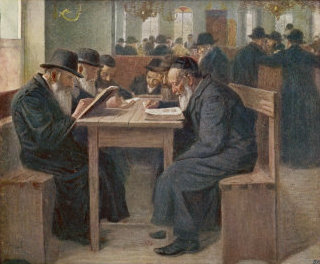
Jewish_men_praying2In this almost painfully beautiful book…Fishbane…explores the question of the kind of canon, privileged status, or Logos, the Torah actually has for the post-modern Western Jew. It…is a moving, personal apologia…

-James A. Sanders,
“Theology Today”

Pastor Randy recommended Michael Fishbane’s book The Garments of Torah to me more than once and I finally decided to buy it. He said he hasn’t read it in many years but recalls Fishbane’s book having a profound effect on him. I’m going to try to give you a taste of the effect it’s having on me.

This isn’t a full book report. I’ve only read one chapter so far. Fishbane’s book is only 168 pages long but it’s hardly what you’d call “light reading.” The first chapter, Inner-Biblical Exegesis: Types and Strategies of Interpretation in Ancient Israel is dense with information and erudite in its writing, so I find I need to read slowly and carefully in order to grasp what is being said by the author.

Hence my writing this blog post as a series of “notes” just to offer some of my impressions. It’s interesting though that I find a sort of association between what Fishbane is presenting so far and what I wrote about in The Jewish Gospel, Part 1 and Part 2.

I want to say before proceeding that there is a likelihood that I’ll misinterpret some of what I’m trying to explain about what Fishbane’s is saying. In that case, I don’t doubt some of my more scholarly readers will step in and point out where and how I could do better. Thank you in advance for your efforts.

One of the great and most characteristic features of the history of religions is the ongoing reinterpretation of sacred utterances which are believed to be foundational for each culture. So deeply has this phenomenon become part of our modern literary inheritance that we may overlook the peculiar type of imagination which it has sponsored and continues to nurture: an imagination which responds to and is deeply dependent upon received traditions: an imagination whose creativity is never entirely a new creation, but one founded upon older and authoritative words and images.

-Fishbane, Chapter 1, pg 3

It’s interesting that Fishbane uses this block of text to begin a chapter on inner biblical exegesis, since it summons images of learned Rabbis crafting new Talmudic interpretations of the Torah in response to the demands of a changing world. But Fishbane is discussing how later portions of the Bible were crafted based on traditional understandings of earlier portions, at least as I read this chapter. The rationale for doing so is also very “Jewish” (I say this last part for the sake of my Christian readers).

…if not tradition’s realization that there is no authoritative teaching which is not also a source of its own renewal, that revealed teachings are a dead letter unless revitalized in the mouth of those who study them.

-ibid

If we don’t reinterpret (some might say “reinvent”) the Bible through the study and perceptions of the scholars and students of the present age, does it become a “dead letter?” Many people, both Christians and Jews, believe so, but clergy and scholars who are literalists tend to believe that reinterpretation throws out the baby with the bath water, and that making scripture more “relevant,” also robs the Bible of its power and holiness.

But even this mythification of a chain of legitimate interpreters did not so much obscure the distinction between Revelation and Interpretation as underscore it. From this perspective, the interpretative traditions of ancient Judaism constitute a separate, non-biblical genre: a post-biblical corpus of texts which stand alongside the Sinaitic revelation as revelation of new meanings through exegesis.

-ibid, pg 4

I know that’s going to disturb and even scare some folks. Fishbane is describing his views on how Pharisaic Judaism (which doesn’t have many fans in the church) attempted to minimize the gap between divine Torah and human interpretation by performing what I have called the rabbinization of Abraham. From an outsider’s point of view, it seems this must require more than a little sleight of hand and violates any sort of sola scriptura approach.

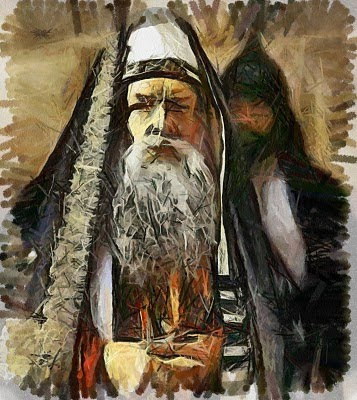
ancient_rabbisFrom this perspective though, the early Rabbis could be considered the “guardians of Torah” and according to Fishbane, the discovery of the Qumran documents may lend credence to the idea that the foundation texts upon which the later portions of the Tanakh (Old Testament) were written have already been interpreted and such “scribal intrusions” actually open a window and allow us to look into both the world of the early Torah authors as well as those who came after them. Examination of newly recovered ancient texts and how they comment on even older texts illustrates a process where the scribes, interpreters, and traditions became integrated components of Divine revelation.

The process of the intercultural transmission of traditions may be considered one of the primary areas in which authoritative teachings or memories were received and revalued for new generations.

-ibid, pg 5

Recall in my commentary on Boaz Michael’s presentation Moses in Matthew how this process was illustrated by the apostle Matthew. Knowledge of traditions about the Creation and Moses being drawn from the water and parting the Reed Sea were a necessary component of correctly interpreting the deeper meaning of Jesus walking on water (see The Jewish Gospel, Part 1). Earlier Biblical text and the traditions surrounding how those scriptures are interpreted seems to be woven into the fabric of the apostle’s Matthew 14:22-33 account.

For if scribalism points to the fact that ordinary textual ambiguity or openness may serve to catalyze commentary and that these supplements, when incorporated into the received text, reflect the cultural dynamics of transmission, then law and theology, where the frequent incomprehensibility or non-comprehensiveness of divinely authorized rules requires human exegesis and expansion, offer an even richer sphere of study.

-ibid, pg 7

I can see two ideas coming from that one sentence. The first is that the uncertainty about particular laws in Torah and how to actualize them may have actually enhanced discussion among sages and scholars resulting in developing a tradition on how to perform the mitzvot based on those commentaries. Tradition first becomes the lens by which Torah ambiguities are examined and finally becomes an element of the revelation itself (though a separate “genre” existing alongside scripture, according to Fishbane). But Fishbane can also be saying that one older section of the Bible such as a prophesy can be refactored and applied anew to a later occurrence, such as Matthew referencing Hosea 11:1 and applying it to Jesus in Matthew 2:15 as possibly based on the ambiguous interpretation of the older scripture.

Not only does tradition resolve Biblical ambiguities but it allows for older prophesies to be reinterpreted in such a way that later portions of the text can connect back to entire ideas and images associated with earlier writings.

The terse formulation prohibiting Sabbath labor found in the Decalogue, Exod. 20:18-21, is taken over virtually verbatim in the Mosaic citation of it in Deut. 5:12-14…But even Moses’ recitation of the ancient rule…does little to explicate the details of prohibited work.

-ibid, pg 10

(I should mention as an aside, that D. Thomas Lancaster’s book The Sabbath Breaker: Jesus of Nazareth and The Gospels’ Sabbath Conflicts which I previously reviewed, also addresses the struggle in comprehending that is considered “forbidden work” within the context of the acts of Jesus in the gospels.)

Fishbane suggests that the ambiguity regarding forbidden work on the Sabbath was later addressed in passages of Jeremiah in an attempt to achieve a resolution (see Jeremiah 17:19-27). Attempting to go into more detail would just result in me either including longer quotes from Fishbane’s chapter or essentially rewriting Fishbane in this blog post. The point is to get you to turn your attention to his book so you can see what you think of his viewpoint for yourself (Well, that’s not the whole point of me writing this. I’m also just trying to get my brain around this topic).

However, among his many examples of Inner-Biblical exegesis is this:

As an example, we may consider 2 Chron. 15:2-7, a speech which one Azzariah ben Oded delivers an oracle to King Asa of Judah.

This prophetic discourse (as also the prophet in whose name it is spoken) is unknown to earlier biblical sources, and appears to reflect the pseudepigraphic handiwork of the Chronicler who has woven together several strands of tradition in order to confront his contemporary readership (in the Persian period) with a matter of “prophetic” concern to him.

-ibid, pp 14-15

studying-talmudThis seems to harken back to books such as Who Wrote the Bible by Richard Elliott Friedman which considerably blur the lines between God-inspired text and the human, social, and political requirements of the authors involved. The tradition for interpretation of the text ultimately becomes part of the revelation itself and we can’t always see where the inspiration of God leaves off and the authorship of the actual human writers (and their various priorities) begins. We only know that how the Jewish people came to understand their Bible scriptures (which is certainly true by the time of Jesus) was inseparable with the interpretative traditions of the text itself.

In fact, those traditions were well used by later Jewish Bible writers such as Matthew (and I mentioned this earlier) in order to communicate important ideas to the audience. To do away with those traditions involving inner-biblical exegesis and return to a strictly literal reading of the text in isolation both from tradition and other sections of the Bible, strips away the vast majority of the meaning from what the Bible is communicating. It becomes virtually impossible to understand what Matthew is really writing about Jesus unless we A) refer to previous sections of the Bible, and B) engage the interpretative traditions associated with those older portions of scripture as applied to the later texts.

Seemingly agreeing with the Moses in Matthew presentation and Boaz Michael’s viewpoint, Fishbane tells us that referencing these older sections of the Bible in later writings re-contextualizes them to apply to (apparently) people and events to which these older scriptures didn’t originally reference (the aforementioned Hosea 11:1 and Matthew 2:15).

And those are my notes on only one chapter made up of fifteen pages in Fishbane’s book. Not the most amazingly cohesive blog post I’ve ever written, but then there’s quite a lot to digest. However, when compared to other opinions and ideas about the Jewish view of the Bible, and particularly the Jewish view of the midrashic linkage between the Tanakh and the apostolic scriptures, we should experience several “Ah-ha” moments in our understanding as the ideas from The Garments of Torah begin to sink in.

I’m looking forward to the rest of Fishbane’s book.

Addendum: I know I’m probably playing fast and loose with Fishbane’s chapter, but these are more my impressions about what I’m reading and the associations sparked by his writing, than a detailed, “nuts and bolts” analysis.


The Bible as a Quantum Cookbook

Talmud StudyWhen I was young, my father, a rabbi, would roll up his sleeves in front of an open Talmud and spend four or five hours putting different postulates and corollaries together as though he were building a road in ancient Rome. It wasn’t easy, but he was determined. He would concentrate unrelentingly on the words and sentences until he fashioned a pshat – a line of reasoning – to make things work. Lazy thinking was as far from him as Queens was from the Pacific.

He was the whole world to me, and I yearned to know what he knew, to be like him. But he and I were too different; we still are. My father is thoroughly God-centered and deeply committed to mastery of religious texts. He is a man of principles, scholarship, organization, planning, and goals. I, on the other hand, am both less scholarly and less organized along rational principles. I cannot be like my father, as much as I may have awkwardly, painfully tried.

-Dr. Simon Yisrael Feuerman
“My Father and the Talmud”
Aish.com

While Rabbi Shkop was spending his final years directing a Talmudic academy in Grodno, Belarus, a tight-knit community of theoretical physicists not so far away was discussing a strikingly similar problem. Instead of a married woman, however, the subject was a cat.

It was the summer of 1935, and Erwin Schrödinger’s thoughts were preoccupied with the fate of a small cat that had somehow been trapped in a metal box with a glass bottle of cyanide. A small hammer hung precariously over the bottle, attached to a kind of Geiger counter, on top of which sat a substance containing a single atom of some radioactive material (my guess would be nitrogen-13). The cat was certainly in danger. As soon as the atom would decay, the Geiger device would drop the hammer so as to smash the bottle, releasing the cyanide and killing the cat.

-Rabbi Tzvi Freeman
“Quantum Talmud: How Deep Can Talmud Go?”
Chabad.org

I recently suggested in Part 1, Part 2 and Part 3 of my discussion on Arminianism and Calvinism, as well as in a blog post about the potential for unknown qualities of the Bible, that the Word of God may have more to it than meets the eye.

I know “Talmud” exceeds the definition of “Torah” or “Bible” for most Christians by quite a bit, but I’ve been having a small discussion with someone named “ProclaimLiberty” on Sunday’s and Monday’s “meditations,” and they seem related to how we perceive the Jewish authority relative to the Bible (and Jewish authority as it exists after the Biblical canon closed) as well as the nature of the Bible and the supernatural itself.

While the quote from Dr. Feuerman’s article illustrates a simple desire to gain a traditional Jewish understanding of Talmud and thus Jewish thought (though like Feuerman, it may always be beyond me), Rabbi Freeman’s article (which is exceptionally lengthy) manages to compare the dynamics of Talmud study with Quantum Physics. I never thought of those two processes being related in any way, but Rabbi Freeman makes a compelling if complicated case.

But what does that have to do with anything, especially a Christian’s understanding of the Bible?

Well, the Pentacostal and Charismatic movements re-introduced the notion that revelation did not necessarily cease 19 centuries ago. Of course, that notion also has been abused terribly to justify everything from charlatanism to insanity. Re-introducing the notion of messianic Judaism also was difficult 4 decades ago, and it is still resisted in some quarters. It could be viewed also as having been already abused in some measure.

Thus I understand very well your sense of the difficulty about re-introducing a notion of the continuity (more than merely a restoration) of Jewish authority. It has been hard enough to convey the idea that Jewish believers are entitled to be something more than or different from merely some ethnic expression of Christianity. But this suggestion derived from Matt.23:3a undermines a fundamental viewpoint underlying the Nicene Council and the creeds it developed. It opens a door to a very scary world in which large segments of Christian doctrine could need to be re-invented. Furthermore, it threatens to unleash another wave of Christian guilt over its historical treatment of Jews. On the other hand, theologians love that sort of challenge; and if Christianity hasn’t learned how to request and accept forgiveness, something truly is fundamentally wrong (though there may be some need to learn a bit more about how repentance and atonement work).

-ProclaimLiberty’s comment on my blog
June 10, 2:45 am

phariseesI invite you to read the entire exchange of comments to get the full flavor of what was discussed, but PL brings to the table the compelling suggestion that Jews didn’t lose the authority provided by God to issue binding halakhic rulings after the Biblical canon was closed sometime in the early centuries of the Common Era.

Christians are almost universally going to reject that idea, but it’s at the heart of Jewish religious observance and Talmudic study within Messianic Judaism (as well as the other streams of Judaism today) and is based, interestingly enough, on a Biblical principle found in Matthew 23:3 (though I’ve yet to hear a Christian interpret that verse in such a fashion).

(PL isn’t the first Jewish commentator to bring up this interpretation of Matthew 23:3. For more details, please read Matthew 23:2-4: Does Jesus Recognize the Authority of the Pharisees and Does He Endorse Their Halakhah? (PDF) by Noel S. Rabbinowitz.)

This may mean that, for the Jewish people in general and for Jewish Messianics in particular, Rabbinic authority to make binding rulings over specific Jewish communities under God’s directives continued in some fashion after the Jewish/Gentile Christian split and continued across time and into the present. Of course, such a suggestion isn’t without problems as PL addresses in the same comment:

Of course, even if the notion of Jewish authority continuity were wholeheartedly adopted, there would still be a lot of analytical work to do examining how it might apply to non-Jews, and in what measure. Along with that analysis is one that would examine how a number of statements in Jewish literature were developed. For example, some statements were polemical responses in defense of Judaism under the pressure of Christian assault. While we don’t throw away such opinions in Judaism, we do at times limit their applicability and effectivity to specific circumstances, even when they were responsible for accepted elements of halakhah.

The “analytical work” involved to “examine how a number of statements in Jewish literature were developed” and the application of some of the more difficult Talmudic statements to Messianic Judaism (let alone non-Jews involved in the Messianic movement) has yet to be done, at least to any significant extent (to the best of my knowledge), but I believe a whole world of study would open up to Christians if we could just see the Bible from the perspective PL seems to represent.

PL was less than impressed by what he calls “esoteric mystical perception” as he commented in our conversation in my other meditation, but then, he’s had some rather unique experiences in that area as well.

However, I still maintain that the Bible is more than the sum of its parts and, as Rabbi Tzvi Freeman has remarked, (and I paraphrase) the Torah is not a book about what God thinks about so much as an illustration about how God thinks.

Reading Rabbi Freeman’s commentary on Talmud study and Quantum Physics, I’m convinced I’d never make a good student of either discipline. I must however, admire a mind that can grasp even the very basics of both.

Today’s “meditation” probably seems a little “over the top,” even for me, but since reading Rabbi Freeman’s article on Talmud and Quantum Physics last week, I’ve been periodically considering the implications if any portion of what he presents can be said to be relevant to non-Jews outside the stream of Jewish thought.

Back when I was an undergraduate for the first time in the early 1970s, I took a few astronomy classes. I might have considered making a career out of it if I could have handled the math. However, among the things I learned in my beginning astronomy class, I learned that we can consider light as both as a wave and a particle. Depending on how we consider light in terms of the math involved and under direct observation, it can behave either as one or the other. Depending on the circumstances of human investigation, we treat light either one way or the other.

In quantum physics, a particle has a potential for a number of locations in space until we observe that particle, then it appears in a single location only, and from that location, we can trace it back to where it must have been.

But why does its location only become fixed when we observe it? What is happening to the particle when we don’t observe it?

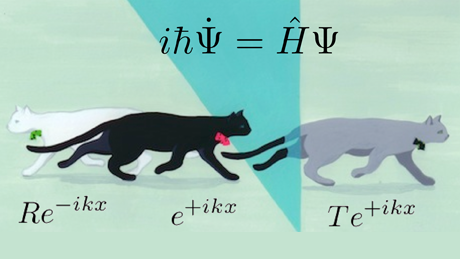
quantum-physics-catAs I asked before, what does any of this have to do with the Bible?

The Bible isn’t a particle (or a wave) of light. It exists in the “macro” world and just like Schrödinger’s hypothetical cat (no, he never put a real cat in danger…it was a thought experiment), we can’t actually apply what we know about subatomic particles to objects like cats and Bibles in our world.

Unless you consider the study of the Bible (like Talmud study) to be somewhat “transcendent” of the world we live in.

I admit that his all requires more mental gymnastics than I am capable of, just like a career in astronomy (I probably would have specialized in cosmology or the study of the origins of the universe, but I wouldn’t have ruled out planetary astronomy), but just like astronomy, I find the more esoteric aspects of the Bible to continue to be compelling in my present-day life.

All this complexity of thought (some of you may see this as unnecessarily complex) comes down to something very simple and something I’ve said before. I think it’s possible for the Word of God to contain far more than we imagine. I think that if we treat the Bible as far more than just a book full of ancient writings, it will “behave” in that manner.

Oh sure, I know this could easily lead to people projecting their (our) desires and imaginations onto the text, reading what we want to read in-between the lines, but what if God Himself put something in-between the lines for us to find? What if it takes someone with the mind and imagination of a Talmud scholar or Quantum physicist to find the place in-between the lines (and that someone would not be me)?

What if that “something” holds the answer to questions like the Calvinism-Arminianism debate or at least provides us with a perspective that throws said-debate clear out of the fifth floor window, defenestrating the very idea that human beings can turn the Bible into a “cookbook” containing Calvin’s and Arminius’s separate “recipes” for salvation?

Food for thought.

The Undiscovered Continent of God

mysterious_land

All scripture is inspired by God and is useful for teaching, for reproof, for correction, and for training in righteousness, so that everyone who belongs to God may be proficient, equipped for every good work.
2 Timothy 3:16-17 (NRSV)

Wisdom that can only be accessed by the angels or by enlightened sages is limited wisdom. Torah is said to be G-d’s wisdom and as such must be boundless. Just as G-d is everywhere and in all things, while at the same time entirely transcendent of all things, so His wisdom must be a wisdom that is equally accessible to a five-year-old child as to a great scholar–as long as there is a mind there to receive. Stories about two brothers fighting, rules about splitting an article of disputed ownership–these are simple matters that everyone can relate to. And yet, in the way Torah deals with them, you can find a well of infinite wisdom.

-Rabbi Tzvi Freeman
“G-d in the Talmud”
Chabad.org

This will probably get me in a lot of trouble, but I’ve been thinking about part of the conversation Pastor Randy and I had last Wednesday night. We had gotten together to discuss chapters 6 and 7 of D. Thomas Lancaster’s book The Holy Epistle to the Galatians, but one discussion inspiring comment in this book often sends Pastor Randy and I down unanticipated trails.

We were talking about the “nature” of the Bible. Pastor Randy is a self-proclaimed literalist and rests the core of his understanding of the Bible on being able to read the text in its original languages, factoring in the context, history, and “personhood” of the writing and the writer. On that level, you should be able to understand 100% of the Bible’s content as long as you have a sufficient background in the ancient languages, cultures, histories, and in some cases, biographies involved in the authoring of the various books and chapters.

But we both acknowledge that it doesn’t seem to work out that way. While some parts of the Bible seem to be understood in the same manner by most people, others elicit wild disagreements, sometimes even by people within the same church, let alone between different Christian churches, between different denominations, and certainly between Christianity and Judaism.

The other part that came up, as noted by Rabbi Freeman above, is that the Bible can be accessed on a variety of conceptual levels, from that of a five-year old child, to an aged, wise, and highly educated scholar. Pastor and I agreed that the Bible contains “depths” such that we can continue to explore forever and we will never comprehend all that there is this side of the Messiah.

I tried to introduce the idea that there might be a “mystic” side to all this built into the Bible itself but that statement came into conflict with Pastor Randy’s view of the Bible as an “object” that God deliberately caused to be written in human languages by human beings. In other words, God wants us to understand the Bible as a revelation…

…doesn’t He?

In my opinion, yes and no.

An atheist can look at the Bible and compare it with other religious, mystical, and philosophical texts. The Bible is sometimes studied in universities as literature rather than as a sacred text. If only viewed at the level of an object containing words on paper, it should be ultimately knowable, and if it wasn’t uniquely inspired by God, it should be ultimately known. After almost two-thousand years of intense study, you’d think we’d have the Bible pretty much “mapped” by now.

mariana_trench_edgepointExcept we don’t. We haven’t reached the “limits” of the Bible. In plumbing its depths, we haven’t reached the bottom of its Mariana Trench. Those people who feel there’s nothing left to learn from the Bible either gave up too soon or they are choosing not to take the Bible seriously and meet it at where the Bible “lives.”

In the beginning when God created the heavens and the earth, the earth was a formless void and darkness covered the face of the deep, while a wind from God swept over the face of the waters. Then God said, “Let there be light”; and there was light. And God saw that the light was good; and God separated the light from the darkness. God called the light Day, and the darkness he called Night. And there was evening and there was morning, the first day.

Genesis 1:1-5

In the beginning was the Word, and the Word was with God, and the Word was God. He was in the beginning with God. All things came into being through him, and without him not one thing came into being. What has come into being in him was life, and the life was the light of all people. The light shines in the darkness, and the darkness did not overcome it.

John 1:1-5

God spoke and the world was, and yet that spoken word is somehow also the living Messiah and if every word in what we call “the Bible” is also God-breathed, then the Bible we hold in our hands, though it is a printed book, is also something much more. So what do we find in the Bible when we actually try to read and understand what God is trying to tell us and how do we find the deeper message?

But the Advocate, the Holy Spirit, whom the Father will send in my name, will teach you everything, and remind you of all that I have said to you.

John 14:26

Now we have received not the spirit of the world, but the Spirit that is from God, so that we may understand the gifts bestowed on us by God. And we speak of these things in words not taught by human wisdom but taught by the Spirit, interpreting spiritual things to those who are spiritual.

Those who are unspiritual do not receive the gifts of God’s Spirit, for they are foolishness to them, and they are unable to understand them because they are spiritually discerned. Those who are spiritual discern all things, and they are themselves subject to no one else’s scrutiny.

“For who has known the mind of the Lord
so as to instruct him?”

But we have the mind of Christ.

1 Corinthians 2:12-16

explorerWe seem to require a unique set of tools beyond the usual hermeneutics, at least if we want to get past a certain level of comprehending the Bible. We actually seems to require some spirit-breathed help, since the Bible is as much a spiritual entity as it is a physical document. Perhaps those depths I’ve been discussing cannot be understood or even discovered without a competent guide, much like Indiana Jones following an ancient map in order to find an even more ancient and elusive treasure.

Or as Rabbi Freeman writes:

Similarly, Torah is not just about “what G-d thinks about” but also about “how to think like G-d.” G-d can choose to think about whatever He wishes to think about. The issue is not the subject but its treatment. That’s why Torah learning, as distinct from typical academic studies, is much more about process than about content. More about “how you got there” and less about “where you got to.”

Certain streams of Judaism have no problem at all understanding the Torah as associated with and even equivalent to God’s own wisdom and thoughts, not just the content of His mind, but the process of God’s thinking. And didn’t Paul say “we have the mind of Christ?”

Almost a month ago, I said that the Bible is water, but from a Chasidic point of view, this is more true than you might think:

When the sages compared the Torah to water, Rabbi Schneur Zalman explains, they had this quality in mind: Just as water descends from the highest place to the lowest without change, so the Torah descends from its place in the highest realms to become invested in mundane, material issues so that every person can grasp it–without any essential change in that wisdom.

It is true that God wants us to know Him from the Bible, but that may be a greater truth than we realize. The Bible is designed to be accessible and knowable to just about anyone, and yet it is not so knowable that it can ever completely be known, even by the greatest sage or scholar in any tradition across the vast span of human history.

The Bible is at once a book that can be read in its simplicity and an amazingly vast and unknown continent that has never been visited by people before. And it is all good, it is all very good.

The law of the Lord is perfect, reviving the soul;
the testimony of the Lord is sure, making wise the simple;
the precepts of the Lord are right, rejoicing the heart;
the commandment of the Lord is pure, enlightening the eyes;
the fear of the Lord is clean, enduring forever;
the rules of the Lord are true, and righteous altogether.
More to be desired are they than gold, even much fine gold;
sweeter also than honey and drippings of the honeycomb.
Moreover, by them is your servant warned; in keeping them there is great reward.

Psalm 19:7-11 (ESV)

But as accessible as the Bible is supposed to be to anyone and everyone, beyond a certain point, it’s best not to “go it alone.” When exploring unknown or uncertain territory, in addition to a map, it never hurts to have one or more experienced guides.

I’m convinced that it is the viewpoints of men like Paul Philip Levertoff and their uniquely Jewish view of the teachings of Messiah that will help open up the unknown continent to us. It is true that said “lost continent” will never be completely known, but it is completely knowable, and that is the challenge is before us (I’m hardly discounting the Spirit of God as our guide, but scholars and theologians are also men of the Spirit who can teach us).

Everlasting-JewI heard Daniel Lancaster recently say that we must examine the New Testament within its native environment: Judaism. In the case of most Christians, I don’t think it would hurt to have a guide who is Jewish and who knows the lay of the land.

It’s books like Levertoff’s Love and the Messianic Age and its accompanying commentary, as well as the soon to be released The Everlasting Jew by Rabbi Isaac Lichtenstein that will be our traveling companions.

Ultimately the Spirit of God and the mind of Messiah will be our guides but we are the explorers. We are the men and women putting on our expedition hats or strapping on an Aqualung to our backs, getting ready to stride into the antediluvian forests or dive into the prehistoric oceans in search of secrets that have only been whispered since the Spirit of the Word moved over those waters who knows how long ago.

Looking at the Bible as a book with words and language and history and context makes it approachable by human beings and thus not so intimidating. Looking at the Bible like mystery novel and mysticism helps us realize how far beyond humanity is the wisdom and words of an infinite God.

This is only the beginning of the adventure.

Conquering Wrong with Right

broken-crossSo Christians, tell me. What is the church really like?

Because I go to a church event for the first time in weeks and within twenty minutes, I hear people make off-the-cuff racist, sexist and homophobic comments and nobody bats an eye.

I lay on the couch, curled up in a ball with the phone to my ear and listen to a dear friend tell me how he feels like an outsider to the people he’s attended church with for years because he has chosen to plant his flag with the disenfranchised and the vulnerable in his community, as messy as that gets. And it got messy.

Another friend I grew up with sends me a middle of the night link to an article about the guy in Arizona who stood on his college campus holding a sign reading “You Deserve Rape.” We’ve been having conversations lately about some of his qualms with Christianity, and he sums it nicely by saying, “I don’t want to have to spend the rest of my life explaining this to people. I have better things to do.” And I sympathize. Because I don’t want to have to spend the rest of my life explaining that to people, either.

And that’s just in the last couple of weeks.

-Emily Joy Allison
“Church Prove Me Wrong”
emilyjoyallison.com

The church is its own worse enemy.

I came across Ms. Allison’s blog (I get the impression she wouldn’t consider us on a first name basis so I’ll maintain some formality) as a link someone put on Facebook. That was well over a week ago, but this was the first chance I had to write about it. She says a lot of good things and a few things I disagree with, but she presents me with a struggle. Actually, she presents me with my own struggle, though I don’t conceptualize it in the same manner that Ms. Allison does. The struggle is with being a Christian and going to church vs. some of the really dippy and even hurtful things some Christians and some Christian churches do in the world.

For instance, she posted a screen capture of John Piper tweeting a message on twitter quoting Job 1:19 “in the wake of the terrible tragedies in Oklahoma,”

“Your sons and daughters were eating and a great wind struck the house, and it fell upon them, and they are dead.”

Even if Piper hadn’t intended this message to be taken the way it sounds, his timing (and probably his tastefulness) was ghastly. The tweet was subsequently deleted, but it’s another example of Christians (and people I refer to as “famous Christians” … more on that in a minute) standing on the platform of faith in Jesus Christ and throwing rocks at the injured and dying people of the world.

I sometimes have a problem with some “famous Christians.” These are usually televangelists or other Pastors or leaders who are in the public eye, people whose names are familiar even with atheists. Christians who typically are the worst examples of Christianity and who give the rest of the world the impression that we’re all like they are.

I recently heard an unsubstantiated story (that is, I can’t find it by Googling it) of scandal-plagued Jimmy Swaggart actually selling individual pages from his family Bible while leading a tour group in Israel. This would have been fairly recently, but I can’t find an online reference to the event. We’ve also heard names such as Benny Hinn and Joel Osteen, and I cringe to think that this is what the world sees when they think they’re looking at men who are disciples of and witnesses for Christ.

praying-aloneMany years ago, I knew some Americans who, when they toured Europe, would tell people they were from Canada (this obviously didn’t work at airports when they had to present their passports) because they were too embarrassed by America’s reputation overseas. There are days when I feel that way about being a Christian. I believe as a Christian, that I should be held accountable for my own behavior, my flaws, my mistakes, my errors, but it’s adding insult to injury if I have to be ashamed for every lousy thing someone else does in the name of Christ.

In terms of social consciousness and popular causes, it looks like Ms. Allison and I are different enough to where she would probably be embarrassed to be counted a Christian along with me, so from her perspective, I’m likely one of those folks she’s appealing to when she says:

YOU are supposed to be the living, breathing, embodiment of the gospel, and sometimes I can’t see anything good about it.

Church, prove me wrong. I’m begging you.

Church, prove me wrong. I’ve tried to be patient—and I will continue to try. I will be eating with you, talking with you, praying with you; from time to time I’ll probably be sitting in a church service with you. I will not abandon you, as long as Jesus has anything to do with it. But I need you to show me that he still does.

I recently read a blog post that quoted Jones, E. Stanley, (1925). The Christ of the Indian Road. Abingdon Press, 72-73. You’ve probably read this before:

“Mr. Gandhi, though you quote the words of Christ often, why is that you appear to so adamantly reject becoming his follower?”

Gandhi replied, “Oh, I don’t reject your Christ. I love your Christ. It’s just that so many of you Christians are so unlike your Christ.”

Ghandi’s rejection of Christianity grew out of an incident that happened when he was a young man. During his years studying law in Britain, he had become attracted to the Christian faith, had studied the Bible and the teachings of Jesus, and was seriously exploring becoming a Christian. One Sunday, in South Africa where he had gone to practice law after getting his degree, he decided to attend a church service.

As he came up the steps of the large church where he intended to go, a white South African elder of the church barred his way at the door. “Where do you think you’re going, kaffir?” the man asked Gandhi in a belligerent tone of voice.

Gandhi replied, “I’d like to attend worship here.”

The church elder snarled at Him, “There’s no room for Kaffirs in this church. Get out of here or I’ll have my assistants throw you down the steps.”

Gandhi is certainly an outstanding example, but how many Christians have thrown people out of the church or driven folks away who otherwise are men and women who act and think and breathe with the heart of Christ?

On the other hand, and there’s always an other hand, I can’t use all of this as an excuse to go “church bashing” or “Christian bashing.” From her writing, I get the impression that Ms. Allison is representative of a specifically narrow corridor of the believing world that exists in fusion with many of the popular values western society espouses today.

If the problem Ms. Allison or anyone else has with “the church” is that “the church” has a specific values system that conflicts with the non-religious social priorities we see continually in the popular news media, then maybe it’s a case of the church following its own priorities rather than believing it must “go along to get along” in American culture.

broken_godAlso, if your issue is that your particular religious group or you, as an individual, have difference of opinion with how other religious people or other religious groups conceptualize and operationalize a life of faith, that may not be a matter of the church needing to prove anything to you. That might just be a difference in how you see a life of faith vs. their perspective.

Some churches aren’t going to support what has come to be known as “marriage equality,” not as a matter of bigotry (note, I think the Westboro Baptist Church is reprehensible and does not represent Christ on any level), but a matter of conscience.

If your problem with “church” is that “church” doesn’t mesh with the values we see paraded in public by CNN, MSNBC, the New York Times, and such so that “church” refuses to blend in like a chameleon into the progressive social background, then that’s not the church failing to follow Christ, it’s the church failing to worship society and culture.

I can’t prove to Ms. Allison that she’s wrong. If the church has failed to live up to her expectations, then I’m sorry. The church isn’t perfect because it’s full of imperfect human beings. Sometimes we do stupid things. Sometimes we do mean things. Sometimes some people in the church need to be told that Jesus would never act the way they’re acting.

Ms. Allison will never find a church that is perfect. No matter where she goes to worship and fellowship, she’ll always find “bad apples.” There are whole churches that are “bad apples.”  I don’t doubt though that there are a number of Christian churches that demonstrate values sufficiently similar to her’s that she’d be comfortable worshiping within their walls. I’m not sure what to make of such churches, but if Ms. Allison wants a place to belong, I’m sure it’s out there.

But we’ll never be perfect. Frankly, if a church is following in the footsteps of the Messiah, they probably shouldn’t look and act exactly like the world around us. Jesus said that we are in the world but not of the world.

I’ve been afraid of church for my own personal reasons, but they’re my personal reasons. My problems with going to church belong to me, not church. And yet, I came to a point in my life where I felt I had no other option but to go to church. If you call yourself a believer and a disciple, you can’t go off half-cocked following your own priorities when you know you need to be in fellowship with other believers and you need to follow the Master.

If you want to think that “the church” is irredeemably bad, you’ll find plenty examples of bad churches and bad Christians. If you don’t want to accept church-bashing lying down, and you believe that Christ still exists within the body of believers, you can do something about it. Instead of pointing a finger at what’s wrong, you can be what’s right in the church.

Gandhi is famous for saying, Be the change you wish to see in the world. If you don’t like what you see happening in the church, then be the sort of Christian you believe Jesus wants to see in the church. Walking away doesn’t make you more noble, it just makes you alone. Jesus didn’t walk away from an imperfect world. He died for it.

Mahatma-GandhiAnd then he lived. Someday he’ll come back to redeem our imperfect world. In the meantime, if we call ourselves disciples, if we call ourselves Christians, then we have a responsibility to do here and now what he is going to do when he comes back. We need to introduce a little kindness, compassion, and self-sacrifice into an otherwise broken and bleeding world. Jesus didn’t complain about what was wrong. He was moved by compassion. He caused the blind to see, caused the deaf to hear, caused the lame to walk. Like Christ, don’t complain about what’s wrong. Just do what’s right.

To the contrary, “if your enemy is hungry, feed him; if he is thirsty, give him something to drink; for by so doing you will heap burning coals on his head.” Do not be overcome by evil, but overcome evil with good.

Romans 12:20-21

If I should ever leave the community of faith, it won’t be because church is broken. It will be because I am.

118 days.

I am Iron Man

iron-man-3-posterFinally, be strong in the Lord and in the strength of his might. Put on the whole armor of God, that you may be able to stand against the schemes of the devil. For we do not wrestle against flesh and blood, but against the rulers, against the authorities, against the cosmic powers over this present darkness, against the spiritual forces of evil in the heavenly places. Therefore take up the whole armor of God, that you may be able to withstand in the evil day, and having done all, to stand firm. Stand therefore, having fastened on the belt of truth, and having put on the breastplate of righteousness, and, as shoes for your feet, having put on the readiness given by the gospel of peace. In all circumstances take up the shield of faith, with which you can extinguish all the flaming darts of the evil one; and take the helmet of salvation, and the sword of the Spirit, which is the word of God, praying at all times in the Spirit, with all prayer and supplication. To that end keep alert with all perseverance, making supplication for all the saints, and also for me, that words may be given to me in opening my mouth boldly to proclaim the mystery of the gospel, for which I am an ambassador in chains, that I may declare it boldly, as I ought to speak.

Ephesians 6:10-20

But on the other hand, Jews put their faith in clothing all the time. Back when the Temple had four walls, the kohanim (priests) wore special clothes. When Jacob wanted to express love for his son, Joseph, he made a special shirt, and all of Joseph’s brothers were so angry they decided to sell him. And when Jacob’s father, Isaac, was getting old and wanted to give Esau a blessing, Jacob’s mother, Rebecca, gave Jacob special clothes to fool his father into blessing him instead, while Esau was off trying to figure out how to hunt wild game with a kosher butcher’s knife. And we specifically wear certain clothes for certain rituals – the tallit (prayer shawl), tefillin, a yarmulke, a white kittel on Passover so we have something on which to spill our wine, and sneakers with our suits on Yom Kippur in case we want to go jogging later. So it’s not like we don’t place any value on clothes.

So how are we to reconcile this?

The case of Jacob seems pretty peculiar, though. Jacob was wearing Esau’s clothes to fool his father, but his father was blind. So who was he trying to fool?

-Mark Papers
“Iron Man 3 and Shavuot”
Aish.com

It has been said that the clothes make the man, but that seems like a pretty shallow way to assess a person’s capacities. On the other hand, people do tend to think, behave, and even feel differently depending on what they’re wearing. If you’re in a tuxedo going to a $500 a plate fund-raiser, you may behave differently than if you are dressed in a ragged t-shirt and swimming trunks going to your neighbor’s pool party.

I would have passed on any sort of commentary on Mr. Papers’ (not his real name) Iron Man 3 review if Pastor Randy hadn’t mentioned Ephesians 6 during his sermon last Sunday. It’s seemed like an odd coincidence, especially since Pastor’s message didn’t breathe one word about Tony Stark’s latest adventure on the big screen.

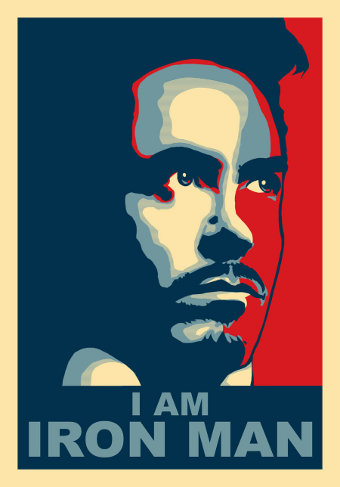
i-am-iron-manPapers drills down into the “clothes make the man” saying during his review, reminding us (spoilers ahead) that Stark (played by Robert Downey Jr) spends as much or more of his time in the film out of his Iron Man armor than in it. There are also sequences in his film where the armor is operated without anyone inside. What do we do with the “clothes” metaphor then?

At the end of the first Iron Man film (2008), instead of protecting his secret by manufacturing a lie as to who Iron Man is to him, Stark abruptly reveals to the world, “I am Iron Man.”

Stark isn’t just Iron Man when he’s in the suit, he’s Iron Man because that’s part of who he is…not as an inventor and not as a person who gets powers from technology, but because it is part of his lived identity. It didn’t start out that way. Stark, at the beginning of the original film, was a brilliant but wholly self-indulgent person who did whatever pleased him and was totally unconcerned about the consequences of his actions…until he realized that those consequences included the deaths of millions on a global scale, thanks to the black market sales of his weapons.

It was Iron Man who molded the soul of Tony Stark, gradually forming him into a hero from the heart outward as opposed to from the armor inward. Four films later, if you include The Avengers (2012), Tony is Iron Man, whether he’s wearing the armor or not.

But what does that have to do with you and me?

In his Ephesians letter, Paul uses the “armor of God” metaphor to say something similar. As human beings we are weak, mortal, frail, self-indulgent, vulnerable to a thousand temptations. We are anything but heroic. Oh, maybe the occasional person has extraordinary courage and strength, but most of us, including me, will never do the stuff we see heroes do, either in the movies or in real life.

Maybe.

That is, we won’t do it just of ourselves. Like Tony Stark before he was critically wounded, made a prisoner of the very people his weapons were designed to kill, before he saw his weapons used against the very soldiers he was supposed to protect, before the man who saved his life sacrificed himself so that Tony in his first, improvised suit, could escape his captors and return home to a renewed life and a new mission, we are weak and subject to our own passions. We are like spoiled children.

When we encounter God, he gives us something that is designed to change us. He gives us the ability to be heroes of a sort. He gives us the opportunity to be more than who we are…to realize the potential to be everything God designed us to be. The Word of God has been euphemistically called a “sword.” We can defend ourselves from all kinds of harm just by reading and studying the Bible. We can learn to protect others with its power.

Like Tony Stark’s fictional armor, we can let God’s armor change us…first from the outside in…and then from the inside out.

In this movie, like the Jews in the desert, Iron Man is taken out of his element and stripped down to just his goatee in the middle of nowhere. But in our case, the desert was our cocoon. God gave us the Torah, kept us away from distractions for a 40-year incubation period, and helped us grow before releasing us back into our homeland. The Torah is our armor. And after wearing that for 40 years, the hope is that we’ve internalized it.

Tony spent time upgrading his suits, but what he didn’t realize was that he needed to upgrade himself. He has to get a few things, um, ironed out. It’s not his metal that matters. It’s his mettle.

We all have within us what it takes to be heroes. We also have an outer shell, but the real question is what we do when it cracks open. Do we just kind of leak out, or are we Iron Man – unflinching in our values, even in the face of danger?

I am Iron Man.

bare-ironThere are different people going to Christian churches today and, for the sake of this blog post, I’m going to say that there are two different types of people. There are those who use the Bible and their faith like armor, like something they wear but also something that can be taken off once they leave church on Sunday…and there are those who wear their armor on the inside, who have integrated the Word, the will, the Spirit of God into their lives. They are Christians regardless of their circumstances. Even stripped down to their bare essentials, even if their churches and their Bibles are taken from them, who they are in God and who God is in them is the same. You can take everything from them but they will always be with God.

The armor doesn’t make the man…the armor and the man become the same.

This should be my absolute last “meditation” until sometime early next week. And no, I haven’t had a chance to see the IM3 movie yet.

132 days.