Tag Archives: Christianity

The Early Christian According to Cohen

In order to maintain their distinctiveness and identity, most Jews of the ancient world sought to separate themselves from their gentile neighbors. In the cities of the East, they formed their own autonomous ethnic communities, each with its own officers, institutions, and regulations. Some cities, notably Alexandria and Rome, had neighborhoods inhabited mostly by Jews. (These were not “ghettos” but “ethnic neighborhoods.”) Following the lead of Ezra, the Jews of the Second Temple period grew more and more intolerant of marriages with foreigners.

Shaye J.D. Cohen
Chapter 2: Jews and Gentiles
Social: Jews and Gentiles, pg 37
from the book
From the Maccabees to the Mishnah, 2nd Ed

I quoted this portion of Cohen’s book in a recent extra meditation and I want to continue discussing the theme of early Jewish and Christian (and Gentile) identity as we can apply it to today’s community of Jewish and Gentile believers. As I also mentioned in my previous missive, there is a group within Hebrew Roots that is invested in believing that for a time, both the Jewish disciples of the Messiah and the non-Jewish disciples brought into the faith, primarily by Paul, were completely of one accord and shared a completely uniform identity as “Messianics,” being “neither Jew nor Greek” (Galatians 3:28), but rather “one new man” (Ephesians 2:15) in Christ, with all distinctions of cultural, ethnic, national, and covenant identity as established by God, completely obliterated.

In traditional (supersessionist) Christianity, this takes on the form of Jews no longer being Jews but rather, “converting” to Christianity. Anyone who has read this blog for any length of time knows that I reject this suggestion and I do not believe it can be sustained from even a casual reading of the Bible. The chronicles of the Jewish disciples recorded in the early chapters of the book of Acts clearly shows them continuing to live lifestyles completely consistent with the other Judaisms of their day. There is nothing to say that Peter, James, or Paul ever surrendered being Jewish and while the Temple stood, ever forsake the festivals or the sacrifices.

However, the aforementioned movement within Hebrew Roots, sometimes referred to as “One Law” takes the same approach from the opposite end of the spectrum. Instead of demanding that Jews stop being Jews, they demand that Gentiles have the right and obligation to be “Jews” in all but name (sometimes referring to themselves as “Israel” or “Spiritual Judaism”). They cite a number of passages in the Bible to support their claim, primarily the “one law for the Jew and the Stranger” in various parts of the Torah (for example, see Leviticus 24:22, Numbers 15:16, and Numbers 15:29) as well as Acts 15:21 to establish the suggestion that God and the Jerusalem Council required the Gentile disciples to more or less “convert” to a form of Judaism without actually converting to Judaism. Further, assuming these suppositions are correct, they state that this practice must be carried forward and established among Gentile Christians today, using the modern synagogue worship model as the template for Gentile practice of what they refer to as “Messianic Judaism.”

In reading Cohen, I’ve become more convinced than ever that the foundation upon which One Law is built is a soggy sandcastle rather than a rock. One Law, by definition, must require the ancient Israelite to share national and tribal identity with the (non-Israelite) “ger” (stranger, alien, sometimes convert) among them and also, that the Second Temple era Jews must surrender their halakhic, ethnic, cultural, national, and covenant identity to the Gentile disciple due to their grafted in (see Romans 11) status. In both cases, the unique people group established by God must become “un-unique.” For this to be true, it must mean that God lied to the Jewish people when He established them as His splendorous treasured people (Exodus 19:5) among all the nations of the earth.

I know there’s a danger is relying on a single source of information (Cohen) for doing any sort of research, so I’ll say right now that my conclusions can’t be considered definitive. On the other hand, I think Cohen’s work does indicate that a number of historical factors related to the ancient Israelites and the Second Temple era Jews have been ignored by One Law proponents and I’d like to briefly bring some of those factors into the forefront.

Let’s take ancient Israel and the status of the “ger” first. According to One Law supporters, the various “one law for the native, etc…” passages indicate that God originally intended for Israelites and non-Israelites (who have attached themselves to the God of Abraham) to operate identically in terms of covenant and identity.

When discussing Conversation to Judaism in Chapter 2 of his book, Cohen states:

In preexilic times, conversion to Judaism did not yet exist because birth is immutable. An Ammonite or an Aramean could no more become an Israelite in preexilic times than an American can become a citizen of Liechtenstein in our own. Mere residency in the land does not confer citizenship, and a social system that defines a citizen solely as a child of a citizen has no legal mechanism by which to assimilate a foreigner.

This seems to support the general supposition of One Law, that Gentiles did not “convert” to Judaism in preexilic times (before the Babylonian exile), and if taken out of context, may be construed as meaning that Gentiles who lived in the land would be under the same law (Torah) and have the same legal status as the native of the land…even though they didn’t have citizenship. But does that make sense?

Biblical law frequently refers to the “resident alien” (ger in Hebrew) who is grouped with the widow, the orphan, and the Levite. All of these are landless and powerless, and all are the potential victims of abuse. (An American analogy to the ger is the Chicano (specifically, undocumented alien) farmworker; a European analogy is the Turkish laborer in Germany.) The Bible nowhere states how a ger might ameliorate his status and become equal to the native born, because there was no legal institution by which a foreigner could be absorbed by a tribal society living on its ancestral land. Resident aliens in the cities of pre-Hellenistic Greece fared no better.
Cohen soundly torpedoes the suggestion that “one law” gerim were equal to the native Israelites in the Land in all aspects of Torah and other covenant status. There was no legal avenue that would allow a non-member of an Israelite tribe to enter into a tribal society that was established by heredity and covenant. There was no way for the ger to become equal to the Israelite in terms of the Mosaic covenant, at least according to Cohen. Any legal requirement for the ger to become circumcised or to not eat from an animal killed by a wild creature was not an indication that the ger was in anyway equal to the native of the land in covenant status, anymore than an undocumented immigrant in the U.S. shares equal status to  U.S citizens.

After the exile of 587 BCE, the Israelite tribal structure was eliminated and the Jews who returned to Judea from Babylon were organized as clans, according to Cohen, not tribes. The ritual organization was specifically “Priest,” “Levite,” and “Israelite.” Further, it became possible to consider the idea that foreigners could somehow be “joined” to Israel and to God. Cohen continues:

But these centuries saw the creation of an institutionalized method for the admixture of gentiles. Ezra was still unfamiliar with the notion of “conversion,” but some of his contemporaries were discussing the idea. One prophet assured the “foreigners who join themselves to the LORD, to minister to him, to love the name of the LORD, and to be his servants” that they would not be excluded from the rebuilt temple but would be gathered to God’s people (Isa. 56:6-8). Several prophets predicted that in the end of days foreigners would join in the worship of the true God in Jerusalem, either as servants of the Israelites or as independent worshipers.”

The mechanism by which all this would occur was not spelled out as far as Cohen is concerned, but Christians believe that it is through our being brought into the New Covenant through faith in the Messiah, Jesus Christ, that we are joined to the God of Israel. Of course, that still doesn’t mean we become identical to the Jewish people in every conceivable detail, particularly if, as we’ve already seen, Gentile residents of ancient, tribal Israel were not included equally in citizenship or covenant, but rather, relegated to the status of alien residents with few, if any rights.

However, as the history of Israel progressed, the concept of conversation to Judaism for the Gentile began to become more formalized. Cohen cites three essential elements of conversion to Judaism: belief in God, circumcision, and joining the house of Israel. Again, this is a definition of a convert to Judaism, not conditions required for the Gentile to join “the Way” as disciples of Christ. Cohen even references the difference:

For Paul, circumcision represents subjugation to the demands of the Torah (Gal. 3-5).

In other words, while Paul did not see circumcision and thus full obedience to the mitzvot as a requirement for the Gentile Christians, he did see it as a necessary step for full conversion to Judaism. The natural conclusion then is that a Gentile becoming a disciple of the Jewish Messiah in the time of Paul was not the same as a Gentile converting to Judaism.

If we take the message of the Book of Galatians as a unit, then we must conclude that Paul is arguing for the sufficiency of faith in Christ for the Gentile. The non-Jew does not have to convert to Judaism in order to be justified before God.

We tend to take the concept of God-fearers as they existed in the late Second Temple era as a sort of stepping stone between Gentile paganism and Christianity, but according to Cohen, these Gentiles were just as likely to be attracted to another form of Judaism (one without the involvement of the Messiah) and perhaps to even convert to one of the many Judaisms of the day.

Even more numerous, however, were those gentiles who accepted certain aspects of Judaism but did not convert to it. In polytheistic fashion, they added the God of Israel to their pantheon and did not deny the pagan gods…In the city of Rome, many gentiles observed the Sabbath, the fasts, and the food laws; in Asia Minor, many gentiles attended synagogue on the Sabbath. Although these gentiles observed any number of Jewish practices and venerated in one form or another the God of the Jews, they did not see themselves as Jews and were not seen by others as Jews.

Cohen does not specifically state that any of these God-fearers were associated with “the Way” nor do we have any indication that the Gentile God-fearers saw themselves as obligated to the Torah or having “rights” of observance. Just as they would have observed any number of other religious practices associated with other “gods,” these God-fearers also observed a number of religious practices associated with the God of Israel. Cohen goes on:

They resemble the polytheists of the preexilic period who feared the Lord but who never changed their identity.

For One Law proponents, the good news is that there is a record of early first century C.E. gentiles observing some of the mitzvot. The bad news is that they were polytheists who did not truly “convert” to any form of Judaism (or necessarily what we now think of as “early Christianity”) nor did they forsake polytheism, which is in direct opposition to fiercely monotheistic Judaism.

Cohen does reference the New Testament (specifically sections of Acts) in further describing these God-fearers.

The book of Acts calls these people “those who fear” (phoboumenoi) or “those who venerate” (sebomenoi) the Lord (Acts 13:16, 26; 16:14; 17:4, 17; 18:7). Modern scholars call them “sympathizers” or “semi-proselytes,” but these terms lack ancient attestation…After all, how can a gentile become a “little bit Jewish?” And why would he want to?

The explanation goes back to Cohen’s description of God-fearers as polytheists who considered the God of Israel as “just another god.” But there may have been other reasons.

Rather than look upon God-fearers as gentiles interested in Judaism, perhaps we should see in the phenomenon the contribution of Judaism to the cultural mix we call Hellenistic. Greco-Roman culture provides various analogies to Jewish ideas and practices.

In other words, gentile interest in Judaism was not for Judaism’s sake per se, but for the sake of multi-culturalism within Greek society, the way that many different religious and cultural practices are integrated into modern Japanese life. My daughter lived in Japan for almost a year with a Japanese family. At one point, she attended the wedding of a Japanese couple who practiced Buddhism but who were married by a Swedish Catholic Priest. When my daughter tried to find out the reason for such an interesting mix, about the best answer she could get was, “In Japan, it’s all good.” Maybe that was also true in some corners of Greek society.

Continuing to read Cohen, I began to wonder if, from the Gentile point of view, converting to Christianity was viewed in the same light as how Gentiles were converting to other forms of Judaism.

Josephus insists that Judaism has no mysteries, no secrets that it keeps hidden from curious observers. This claim may not be entirely true (note, for example, how secretive Jesus is according to the Gospel of Mark), but it is essentially correct. Some Jews even engaged in missionary work. The Pharisees travel about land and the sea in order to make even one proselyte (the Greek word for convert to Judaism; Matt. 23:15). Josephus narrates that in the middle of the first century CE, the royal house of the kingdom of Adiabene became Jewish under the tutelage of itinerant Jewish merchants…

Some scholars have suggested that much of the Jewish literature written in Greek had as its goal the propagation of Judaism among the gentiles, since the literature often emphasizes those elements of Judaism that would make it attractive to outsiders.

Seen from this perspective, Paul and his mission to convert the Gentiles to faith in the Jewish Messiah may have well been just one Jew among many who were attempting to mine the same population of Gentiles and convert them to one of the various forms of Judaism that existed in that era. So it wouldn’t be unusual at all for “Christian” Gentiles to practice various Jewish religious and cultural behaviors in the same manner as other “converts” to Judaism, although as I previously stated, a Gentile converting to Christianity was not converting to Judaism. But at that point in history, the “Judaism” we consider “early Christianity” was considered a Judaism and it had not yet adopted a trajectory that caused it to deviate from Jewish practice and finally to not be considered a Judaism at all.

Apparently that took some time.

Many Christians, generally called “Judaizers” by modern scholarship, were drawn to Jewish practices. For some of these Christians, Judaism was attractive because of Christianity. Through Christianity they learned the Jewish scriptures and became familiar with Jewish observances. Many Christian groups, for example, insisted that Easter must coincide with the Jewish Passover and that it be celebrated with rites similar to those of the Jewish Passover.

It’s interesting that Cohen, although acknowledging a close Christian association with Judaism, continues to differentiate between the Gentile Christians and the Jewish people, presumably even those Jews who followed Jesus as Messiah. Note that early on, the concept of Easter was born and was to be treated in a similar manner to the Passover, but not as if they were the exact same festival or celebration. Nevertheless, according to Cohen, the Jewish-Christian connection endured for a number of centuries, even through the schism began most likely within the lifetime of Paul and John.

In Antioch in the late fourth century, John Chrysostom was shocked that many Christians were doing what pagan God-fearers had been doing in other parts of the empire three centuries previously: they were attending synagogues and observing the Jewish festivals.

It seems as though Christianity and Judaism maintained a “mix” for hundreds of years after the fall of Jerusalem but were never quite “in synch,” making Christianity a unique experience for the Gentile disciples, since they never adopted an actual Jewish identity the way that other proselytes did when they completed an actual conversion to one of the other Judaisms. This seems to indicate a bond between Gentile and Jewish disciples of the Master but not a fused cultural, national, or ethnic identity.

What may have driven a further wedge between Gentile Christianity and the Jewish “Messiah” movement was this:

What did change after 70 CE was that Jews, or at least the rabbis, were no longer as eager to sell their spiritual wares to the gentiles.

There is also some indication that post-Second Temple, Gentile Christianity began to gain some traction independent of the other Judaisms, possibly including the Judaism of “the Way.”

Perhaps (and this is the common explanation) the rabbis saw the growing power of Christianity and decided not to try to compete with it. Outside of rabbinic circles, perhaps some Jews still actively attempted to interest gentiles, especially Christians, in Judaism, but the evidence for this activity is minimal.

The picture Cohen paints of Gentiles in relation to the Judaism most of us call “Christianity” is incomplete, but we can draw some conclusions. First, the historical figure of the “ger” in ancient, preexilic times, is not a model for modern One Law Christians in adopting equality with Messianic (or any other sort of) Jews. The ger’s observance of Torah was for the purpose of having them obey “the law of the land” the way that even an undocumented alien worker would obey some or most of the laws in the U.S., but it didn’t make them citizens of a tribal nation nor did it confer anything even approaching equality between the gerim and the native-born Israelite. There were laws to protect the gerim in the manner of widows or orphans, but they were most definitely “second-class inhabitants” in Israel. The final blow to the “gerim” argument of One Law is that in post-exilic times, the status of the ger ceased to exist because Israel had shifted from a tribal-driven to a clan-driven society.

We see that in the time of Jesus and following, God-fearers were in evidence and they did practice synagogue worship and a number of the other mitzvot but primarily in the manner of polytheists who practiced the religions of multiple Gods. They did not forsake all other gods for the sake of the One God or become equal to the Jewish people in any covenant sense. As far as a Gentile converting to “Christianity” goes, they were not actually converts to Judaism in that they did not enjoy the full covenant benefits of converts to the other Judaisms and full obligation to Torah (which required circumcision as a covenant sign). It is acknowledged that the Gentile disciples of the Way did practice many of the Jewish religious customs including Shabbat and the festivals, even into the fourth century C.E., but the Roman authority never recognized these “Christians” as having legitimate legal rights to these observances the way that the Jews did and Cohen indicates that Gentile observance, particularly of Easter, was similar to but not identical with Passover.

And as the centuries passed, the trajectories of Christianity and Judaism continued to diverge until any “quasi-Jewish” observance by Gentile Christians simply ceased to exist.

Today, Christianity can be said to have its origins in Judaism but it has not been even remotely associated with Judaism for nearly 2,000 years.

I am not saying that there are not Christians today who maintain an attraction to Jewish practices, theology, and philosophy, but there is nothing that we can pull forward across from the time of Paul, and absolutely nothing we can draw forth from the time of Moses, that would suggest that a Gentile Christian today has any right or obligation whatsoever to observance of any aspect of the Jewish Torah mitzvot, except perhaps those that are common with kindness, compassion, and decency toward other human beings (feeding the hungry, and so forth).

While Cohen cannot be considered the final word in the history of Gentiles in the early movement of “the Way,” he certainly gives us a perspective we must pay attention to, and he helps us to realize that whatever the early Christians were in the days of Peter, Paul, and John, we are not the same as they were. They never were Jewish and neither are we.

36 Days: Backing Away from the High Dive

For the most part they were willing to support the state and to partake of the cultural bounty of the Hellenistic world, but they were unwilling to surrender their identity. They wished to “belong” but at the same time to remain distinct.

Shaye J.D. Cohen
Chapter 2: Jews and Gentiles
Social: Jews and Gentiles, pg 37
from the book
From the Maccabees to the Mishnah, 2nd Ed

This statement of Cohen’s describing the early diaspora Jews who were living in Greek society also reminds me of some halachically, ethnically, and cultural Jews who have come to faith in Yeshua (Jesus) as Messiah and who “belong” to the “body of believers,” “but at the same time (wish) to remain distinct” as Jews. Not an easy task, considering how both mainstream Christianity and the Christian Hebrew Roots offshoot movement want to “equalize” the Jews by making them like the rest of the Gentile community (in the former case, by making all Jews give up their Jewish religious and cultural practices, and in the latter case, by requiring all Gentiles take up Jewish religious and cultural practices).

But that’s not the main thing I want to talk about right now.

I had a most interesting dream last night. It went something like this:

I was sitting in a chair in some sort of waiting area at church with a bunch of other people. I think we were waiting to get into the Sanctuary so services could begin. I was looking through a notebook where I was trying to sort out some sort of theological puzzle. I had lots of notes written in pencil from the day before. I thought I had pretty well figured out what the answer was, but a fellow who knew what I was working on said I got it all wrong. I tried to explain my point of view, but I couldn’t find the right words.

As we were talking, another man approached me. I was still sitting down and had to look up at him. He wanted to invite me to a different Sunday school class than the one I had been attending and asked if I had a “Jesus of Nazareth Bible,” whatever that is. I looked in my right hand and was embarrassed to discover that I was holding the Jewish New Testament Commentary by David H. Stern, which I knew would never be accepted in a traditional Christian Bible study (and I thought I had given up Stern’s works many years ago).

The book was filled with a lot of loose pieces of paper that contained many of my notes. I guess it was good enough for him (though he seemed displeased), because the man told me to stand up and follow him. I looked down and discovered I was barefoot. By my feet were a pair of socks and the sandals I use to put something on my feet when I want to step out on my back patio for a few minutes (not exactly appropriate for church).

That’s when I woke up. My daughter has to be at work at 5 a.m. on Sundays, so I have to get up fairly early to drive her there.

That’s also when I knew I wouldn’t go to church today. It’s been a really active holiday week and weekend and I feel like I need just a little bit of space for a while.

But I can’t go back to sleep and I’m too tired to do much else, so I decided to write. I haven’t actually written anything for days since my family has been visiting, so I feel a little like an animal that has spent too much time in a cramped kennel. The gate has been opened and I’m able to run around in the park again. Feels good, but I wish my brain wasn’t full of cotton candy and iron filings.

In order to maintain their distinctiveness and identity, most Jews of the ancient world sought to separate themselves from their gentile neighbors. In the cities of the East, they formed their own autonomous ethnic communities, each with its own officers, institutions, and regulations. Some cities, notably Alexandria and Rome, had neighborhoods inhabited mostly by Jews. (These were not “ghettos” but “ethnic neighborhoods.”) Following the lead of Ezra, the Jews of the Second Temple period grew more and more intolerant of marriages with foreigners.

-Cohen, “Social: Jews and Gentiles”

I’ve written before that I’ve suspected the schism between Christianity and Judaism occurred fairly early, perhaps within a hundred years or less of the beginning of Paul’s “mission to the Gentiles.” But my opinion has been rudely ridiculed by members of the Hebrew Roots movement who are heavily invested in the notion that early Gentile and Jewish “Christians” were completely equal and uniform members of a single religious movement following Jesus of Nazareth, with the Gentiles adopting all of the Jewish cultural and religious practices.

But according to Cohen, particularly the Jews in the diaspora (where Paul was doing much of his work bringing the good news of the Messiah to the Gentiles) were still strongly driven to maintain their ethnic, cultural, and national identity as Jews. Thus, even the Jews who were involved in that early sect of Judaism called “the Way” were unlikely to surrender their unique identity to a non-Jewish population. In fact, the problem of how to integrate the non-Jewish people groups into a Jewish movement must have seemed an almost insurmountable task, both for the leaders of the Way (the Jerusalem Council) and for the Gentiles who were attracted to this form of Judaism. This is probably why the Acts 15 letter limited the requirements of Gentile disciples to just a few of the mitzvot.

The response of the Gentiles receiving the letter confirms that they neither needed or wanted to actually convert to Judaism (although there was an effort among other Jews to convert Gentiles to Judaism) and were overjoyed to become disciples of “the Christ” without having to be Jewish.

So when they were sent off, they went down to Antioch, and having gathered the congregation together, they delivered the letter. And when they had read it, they rejoiced because of its encouragement. And Judas and Silas, who were themselves prophets, encouraged and strengthened the brothers with many words.

Acts 15:30-32 (ESV)

Cohen comments that Judaism wasn’t something that was thought to be easily accessed, and that even the Gentiles respected its exclusiveness:

Even those Greeks and Romans who despised Judaism respected its exclusiveness as an ancestral usage that the Jews themselves were not free to change.

Immediately following the above-quoted sentence, Cohen makes a statement that seems to also confirm those Christians (non-Jewish followers of the Way) who adopted some of the Jewish practices were treated remarkably different by the Roman authorities than their Jewish counterparts.

The Christians, too, were accused of atheism, and since they could not defend their refusal by appeal to ancestral custom, they were persecuted.

I want to write more about what all this means in terms of Jewish and Christian relationships today, especially relative to Messianic Judaism and Hebrew Roots, but my main emphasis for this “meditation” is my own issues in “integration,” specifically into the church.

While my parents were visiting for Thanksgiving, my mother and I talked about this issue (she’s been trying to encourage me in going to church). She mentioned that she had been born and raised in a Lutheran family and for most of her life, she didn’t really think much about what that meant. She worshiped as a Lutheran because that’s what she had always done. She married and raised two sons as a devout Lutheran, but even after we grew up and left home, and even after she and my Dad retired and relocated to Utah, she still didn’t think much about what being a Lutheran meant.

Then, when my Dad and Mom moved to Kanab and they had to look for a church (not too many Lutherans in that part of Southwestern Utah), she got involved in different groups and started to study the Bible and consider what her faith meant, particularly in the area of religious community. The same thing happened as they got older and moved from Kanab to St. George. Mom and Dad had to visit a number of churches and attend just about every service and activity the church had to begin to discover if they “fit in.” In part, through that process, their faith and understanding grew. To become part of something, you have to dive in all the way and only when you’re drowning in it, do you find out if you are part of it and it is part of you.

Unlike the Jewish people of ancient or modern times, I don’t have a distinct cultural, ethnic, and faith identity that defines who I am in terms of God. But church is a culture and an identity and to belong to church, that’s an identity I have to adopt. To adopt it, I have to be part of it in every sense of the word, not just popping in for a few hours on Sunday morning.

Frankly, I hate the idea, primarily because I hate having to change my behavior patterns that much. Like most people, I’m a creature of habit. I go to work at the same time each morning and I come home at the same time each evening. I have my routine and my comfortable activities. Being part of a community, especially if you’re trying to “break in,” means changing all that; it means change.

I hate change.

But what happens if I don’t change?

Spiritual slumps are a natural part of spiritual growth. There is a cycle that people go through when at times they feel closer to God and at times more distant. In the words of the Kabbalists, it is “two steps forward and one step back.” So although you feel you are slipping, know that this is a natural process. The main thing is to look at your overall progress (over months or years) and be able to see how far you’ve come!

This is actually God’s ingenious way of motivating us further. The sages compare this to teaching a baby how to walk. When the parent is holding on, the baby shrieks with delight and is under the illusion that he knows how to walk. Yet suddenly, when the parent lets go, the child panics, wobbles and may even fall.

At such times when we feel spiritually “down,” that is often because God is letting go, giving us the great gift of independence. In some ways, these are the times when we can actually grow the most. For if we can move ourselves just a little bit forward, we truly acquire a level of sanctity that is ours forever.

Here is a practical tool to help pull you out of the doldrums. The Sefer HaChinuch speaks about a great principle in spiritual growth: “The external awakens the internal.” This means that although we may not experience immediate feelings of closeness to God, eventually, by continuing to conduct ourselves in such a manner, this physical behavior will have an impact on our spiritual selves and will help us succeed. (A similar idea is discussed by psychologists who say: “Smile and you will feel happy.”)

That is the power of Torah commandments. Even if we may not feel like giving charity or praying at this particular moment, by having a “mitzvah” obligation to do so, we are in a framework to become inspired. At that point we can infuse that act of charity or prayer with all the meaning and lift it can provide. But if we’d wait until being inspired, we might be waiting a very long time.

“Spiritual Slump”
Ask the Rabbi
Aish.com

stop-timeThis metaphor doesn’t completely apply to me since I’m not Jewish and don’t have the same spiritual relationship to the Torah as a Jew. One of the things I regret about Christianity is that is eliminated the structure of the mitzvot for the “freedom” of grace. More’s the pity.

Part of me wants the next five weeks or so to zip by so that January 1st will roll around and I can completely and finally spiritually “slump,” thus avoiding change altogether. Then I just pull the plug on most of my Internet presence, step out of the blogosphere, and then what happens to me is between me and God, with no accountability to or commentary by other human beings (and no one in the family is going to care if I go to church or not apart from my Mom).

However, as I’ve been reminded, self-improvement seems to be an expectation of God.

The Chazon Ish (20th century Israel) described the level a person is potentially capable of attaining if he has a long term goal for self-improvement: “If a person constantly strives to improve his character traits, it is possible he will eventually reach a level that he no longer gets angry, will not feel hatred or resentment, will not take revenge nor bear a grudge, will not have ambitions of seeking honor, and will not desire mundane pleasures.”

Today, view every person you find difficult as your partner in character development. View every encounter as an opportunity to develop your positive qualities.

-Rabbi Zelig Pliskin
“Our Potential for Self-Improvement”
Daily Lift #645
Aish.com

I keep wondering if Jewish philosophy can ever be applied to a Christian, but a recent blog post quoting Max Lucado reminded me why I prefer Jewish writings over Christian commentaries:

If God had a refrigerator, your picture would be on it.

If He had a wallet, your photo would be in it.

He sends you flowers every spring.

He sends you a sunrise every morning.

Face it, friend – He is crazy about you!

God didn’t promise days without pain, laughter without sorrow, sun without rain; but He did promise strength for the day, comfort for the tears, and light for the way.

I’m sure Lucado is a wonderful human being, but reading his stuff for more than a few seconds gives me the same type of headache I get between my eyes as the last time I swallowed a mouthful of cotton candy.

I’m taking the day off of church. I think I’ll even take a nap now since the sky is finally getting lighter and I woke up at around 3:30 a.m. (It’s coming up on eight as I write this)

I much prefer Jewish teachings and wisdom, but Judaism isn’t my identity. As a disciple of Jesus, I’m considered a Christian, but so far, the thought of jumping into the deep end of the “church swimming pool” doesn’t seem appealing. I’ll sleep on it, read the church bulletin online later on today, and see if there’s some sort of class or activity I can take a dip into later on in the week.

Maybe.

36 Days: Two Pockets in My Sunday Suit

Rabbi Bunim of Pshis’cha said that everyone should have two pockets; one to contain, “I am but dust and ashes,” and the other to contain, “The world was created for my sake.” At certain times, we must reach into one pocket; at other times, into the other. The secret of correct living comes from knowing when to reach into which.

Humility is the finest of all virtues and is the source of all admirable character traits. Yet, if a person considers himself to be utterly insignificant, he may not care about his actions. He may think, “What is so important about what I do? It makes no difference, so long as I do not harm anyone.” Such feelings of insignificance can cause immoral behavior.

When a person does not feel that his actions are significant, he either allows impulses to dominate his behavior or slouches into inactivity. At such a time, he must reach into the pocket of personal grandeur and read: “I am specially created by God. He has a mission for me, that only I can achieve. Since this is a Divine mission, the entire universe was created solely to enable me to accomplish this particular assignment.”

When presidents and premiers delegate missions to their officials, those officials feel a profound sense of responsibility to carry out the mission in the best possible manner. How much more so when we are commissioned by God!

Today I shall…

keep in mind both the humbleness and the grandeur of the human being.

-Rabbi Abraham J. Twerski
“Growing Each Day, Kislev 1″
Aish.com

I cited this exact quote from Rabbi Twerski just a week ago but it seems appropriate to do so again. As you read this “meditation” it is Sunday morning, but given the Thanksgiving holiday and having my parents in town, I’m writing this several days in advance. As it is right now, I feel as if I will attend church again on Sunday and attend the same Sunday school class, having come (however tentatively) to terms with my failing grade in community.

If only I could continually recall the rather useful piece of information provided by Rabbi Bunim of Pshis’cha about having two pockets and reaching into one or the other as need be. I suspect that we all would be better people if we heeded such sage advice. But in attempting to balance out my character traits, I seem to have stumbled upon a greater and more “multi-dimensional” human problem.

When G‑d created the world, He created both good and evil. After these two elements came into being, they came before G‑d and asked for their respective missions. “Spread the light of goodness and kindness in the world,” G‑d instructed the Good Side. “This is achieved by making people aware of their Creator.”

G‑d then instructed the Evil Side to combat the good, thereby giving people the choice and opportunity to overcome adversity. The Evil Side asked, “But will I be able to do my job? Will people really listen to me?” When the Creator responded in the affirmative, the Evil Side asked to be told its name. “You will be called the Serpent,” said the Creator.

Upon hearing this, the Serpent became worried. He was afraid that his name alone would frighten people away and doom his mission. “Have no fear,” reassured G‑d, “you will succeed.”

Indeed, the Serpent was successful in misleading Eve to sin, convincing her to eat from the forbidden fruit in the Garden of Eden and to share her sin with Adam. After Adam had eaten from the same fruit, G‑d banished the pair from Eden, and thus began all of life’s challenges.

However, when Adam and Eve realized their sin, they repented completely and managed to atone for their folly. Seeing the holiness that now permeated their lives, the Serpent came before the Creator again. “Destroy me,” he implored. “I will never be able to succeed now!”

-Rabbi Yossy Gordon
“Sly Arrogance”
Chabad.org

Christians aren’t used to imagining “evil” as a sympathetic character and we certainly don’t imagine evil as a creation of God (and a useful one at that). I suppose that’s one of the reasons we Christians have a difficult time truly grasping how Jews think and conceive of God, the Bible, and everything.

As Rabbi Gordon proceeds to tell a tale attributed to Rabbi DovBer of Lubavitch (the “Mitteler Rebbe,” 1773–1827), we see the “identity” of the evil inclination continue to be metamorphosed by God as circumstances required.

From the failed serpent, evil was transformed into the Angel of Death, which was greatly feared until the advent of Abraham, who spread knowledge of God to the people around him. After that, God had pity on the evil inclination and allowed the Angel of Death to become Satan. You’d think that would be his final identity, but no. In the guise of Satan, the evil inclination was able to do its work until Moses came and began teaching Torah. Satan was so forlorn that he begged the Creator to put him out of his misery.

God had other plans and renamed the adversary “Arrogance.”

Arrogance now began his career. This time, his disguise was so good that he even penetrated houses of Torah learning. The more a true scholar studies, the more he realizes how little he really knows. However, under the influence of Arrogance, people would study and not be humbled by their knowledge. Instead, they assumed airs of superiority and looked down with disdain at the unlearned. Of course, they sugarcoated these feelings by claiming to defend the dignity of their knowledge, not their own person.

Although this wasn’t to be the last guise of the evil inclination, it’s one that manages to adhere to and sway many, many religious people in the world. For some people I encounter, they “defend the dignity of their knowledge,” denying that they are actually arrogant, but some say they are defending the “truth of God” (though they are actually defending their own interpretation of “truth”) and thus apparently make themselves invulnerable to criticism (because to criticize such a person is to actually criticize God).

That’s not my problem, though. I’m not even sure the following is my problem, but in offering advice to a chassid who feared becoming arrogant due to his great Torah knowledge and devotion to prayer, Rabbi DovBer had this to say as the climax of his parable.

This continued until Rabbi Israel Baal Shem Tov arrived in this world. He revealed the true unity of G‑d, before whom all are equal—no matter their level of scholarship.

Again the Evil Side came before the Creator, disguised as Arrogance, asking for a merciful end. Again his name was changed. This time, instead of plain Arrogance, it would be known as “Fear of Arrogance.” Being less bold than plain old Arrogance, Fear of Arrogance could do its work in peace.

“Now, listen here,” concluded the Mitteler Rebbe. “You should know that Fear of Arrogance is Arrogance, who is Satan, who is the Angel of Death, who is the Serpent himself! Quickly, throw him out of your house, because your life is at risk!”

You can either be too arrogant or too humble, but excessive humility can be a disguise for “fear of arrogance.” That’s where I am or where I imagine myself to be, not just in relation to church but in relation to faith and trust in God, sitting on the edge of a razor blade, fearing to jump in one direction or the other. Even though I’m physically going to church, I’m not really being the church (is four weeks sufficient to be the church?).

Early Sunday morning, my parents should be leaving to return home, my daughter should be at work, I’m not sure of my wife’s schedule, but at 9:30 this morning, I should be sitting in church, trying to decide which of two pockets to reach into in order to pull out what I need at the moment.

I’ll let you know how it goes.

Addendum: Keep in mind that any number of experiences will have occurred between when I wrote these words and how I think and feel by the time you read this. My next “meditation” could have a very different tone.

Vayeitzei: Entering the Sacred Space

Jacob left Beer-sheba, and set out for Haran. He came upon a certain place and stopped there for the night, for the sun had set. Taking one of the stones of that place, he put it under his head and lay down in that place. He had a dream; a stairway was set on the ground and its top reached to the sky, and angels of God were going up and down on it. And the Lord was standing beside him and He said, “I am the Lord, the God of your father Abraham and the God of Isaac: the ground on which you are lying I will assign to you and to your offspring. Your descendants shall be as the dust of the earth; you shall spread out to the west and to the east, to the north and to the south. All the families of the earth shall bless themselves by you and your descendants. Remember, I am with you: I will protect you wherever you go and will bring you back to this land. I will not leave you until I have done what I have promised you.” Jacob awoke from his sleep and said, “Surely the Lord is present in this place, and I did not know it!” Shaken, he said, “How awesome is this place! This is none other than the abode of God, and that is the gateway to heaven.” Early in the morning, Jacob took the stone that he had put under his head and set it up as a pillar and poured oil on the top of it. He named that site Bethel; but previously the name of the city had been Luz.

Genesis 28:10-19 (JPS Tanakh)

Jacob leaves his hometown of Beersheba and journeys to Charan. On the way, he encounters “the place” and sleeps there, dreaming of a ladder connecting heaven and earth, with angels climbing and descending on it; G‑d appears and promises that the land upon which he lies will be given to his descendants. In the morning, Jacob raises the stone on which he laid his head as an altar and monument, pledging that it will be made the house of G‑d.

“Vayeitzei in a Nutshell”
Commentary on Torah Portion Vayeitzei
Genesis 28:10-32:3
Chabad.org

According to Rashi’s commentary on Genesis 28:11:

“The place” is Mount Moriah (the “Temple Mount” in Jerusalem, where Abraham had bound Isaac upon the altar and where King Solomon would erect the Holy Temple).

Whether that is literally true that Jacob chose to spend that night on the Temple Mount or not, there’s no way to know, but it is correct according to Jewish tradition. It’s also fitting that my commentary for this week’s Torah portion should be on the site of the Temple, given the sermon I heard at church last week. I’m not so certain that Christians can grasp what the Temple (and its current lack of existence) means to the Jewish people, since the center of our religious lives is the Messiah and not Jerusalem.

Why do we call G-d Hamakom, “The Place”? Said Rabbi Jose ben Chalafta: We do not know whether G-d is the place of His world or whether His world is His place. But when the verse (Exodus 33:21) states, “Behold, there is a place with Me,” it follows that G-d is the place of His world, but His world is not His place.

-Midrash Rabbah

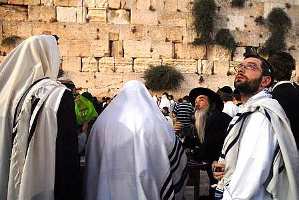
Tisha b'Av at the Kotel 2007While Christianity too has its own rich mystic tradition, Protestantism tends to shy away from any such thing, so how Jews, and particularly the Chassidic tradition tends to view God, Moses, the Torah, and the Temple, seem not just mysterious, but almost completely silly. It’s probably why one fellow in the last Sunday’s Bible study class referred to Orthodox Jews adopting a certain manner of dress and Jewish dedication to praying at the Kotel as “putting God in a box.” Tradition, ritual, and looking outside the literal (English) language of the Bible (ironically) seem to Christians as if Jews are restricting God rather than letting “God be God.”

Rabbi Tzvi Freeman wrote a commentary on Vayeitzei and the Temple called The Temple Mount as Sacred Space. Sacred space? Not a “sacred place?”

Torah generally talks in terms of dual systems: Heaven and Earth; G-d and Man; Creator and created; Nothingness and something. So if we want to get into fascinating territory, we can ask: Where do they meet and what happens there?

The first description of such a place was given by Jacob, the third of the three fathers of the Jewish people. On his way leaving the land of Canaan he slept at a place and dreamt of a ladder with messengers of G-d ascending and descending. When he awoke, he exclaimed, “Y-H-V-H (–we pronounce that ‘Havayeh,’ as the Torah instructs us not to pronounce the four letter name of G-d the way it is written; more about this name later–) is in this place, and I didn’t realize!” Once this realization had hit him, he trembled and said, “This place is awesome!” (The classic Aramaic translation reads, “This is not a normal place.”) And then, “This could only be the house of Elokim, and this is the gateway of heaven!”

According to the sermon I heard last Sunday, “Israel’s history has been characterized by limiting worship to a sacred place, rather than a sacred person.” This is worded as if Israel had made a mistake and venerated the Temple as an act of faithlessness somehow, but that ignores how some religious Jews view the Temple Mount as “sacred space.” Even a plain-text reading of  Genesis 28:10-19 seems to suggest that God wasn’t there with Jacob just because God is everywhere, but because the place where Jacob slept was somehow special, as if the geographic location held some sort of supernatural and mystic significance. Small wonder that Jerusalem has been the object of strife and envy for thousands of years.

There’s a portion of Nehemiah that directs the Israelites to march around the boundaries of Jerusalem, and during his sermon, Pastor Randy said that when he takes his tour group to Israel next spring and they visit Jerusalem, the group will obey this “commandment” and literally walk around the Holy City. But in Nehemiah 12:27-47, it records that Nehemiah divided his choirs of Levites to march around the city to dedicate the wall of Jerusalem.

Maybe I’m thinking of a different part of the Tanakh.

It’s traditional during Sukkot for Jews and Christians to march around Jerusalem’s walls. Jews also march around Jerusalem to commemorate many Jewish tragedies on the 9th day of Av (Tisha B’Av).

While there are some Christians who have the drive and passion to position themselves to better understand Jews and Judaism, for most of us, it’s a bit of a stretch. That’s not because we can’t understand, but because we choose not to, or worse, because we choose to employ a totally maladaptive way of “understanding” Judaism that completely misses the point.

“Messianic Judaism”, or, “Evangelical Jewish Cosplay” is simply another attempt at awkward, text-based reconstructionism, except this awkward, text-based reconstructionism also poorly co-opts living Rabbinic Jewish traditions, creating a Frankenstein LARP that mocks both Jews and Christians.

If we, as Christians, cannot or will not enter “the sacred space” (and perhaps this is a space that only a Jew may enter) or even try to comprehend that it may well exist in our world, we shouldn’t deny the right of the Jews to enter there, nor should we denigrate them for wanting to enter with all of their hearts.

Although the world is generally a binary place, there is a third factor, that which binds and unites all opposites together–even space and non-space. And that, too, is the revelation exemplified by the Third Temple, may it be built very soon, sooner than we can imagine.

Good Shabbos.

39 Days: I’m Alive and Doing Fine

If you feel discouraged about lack of progress in Torah study or spiritual growth, look back a few years and see how much you have grown from when you began. (Pachad Yitzchok, Igros Uksovim, p.218)

This experiential proof will supply you with an indisputable refutation to the premise that you cannot grow. Since you already have progressed, you have a good basis for believing that you can continue to improve.

-Rabbi Zelig Pliskin
“Daily Lift #644, Experiential Proof of Progress”
Aish.com

On the other hand, I just got done quoting Yoda when he said, “You must unlearn what you have learned.” I’m still trying to decide whether or not what I already know is a good or bad thing relative to reconciling with church and traditional Christianity. If I, as Rabbi Pliskin suggests, review my history in order to see my growth in response to my current discouragement and frustration, will that necessarily lead to the correct path for me?

Of course, Rabbi Pliskin also writes:

Rabbi Yeruchem Levovitz used to say that studying mussar (ethical writings) properly does not prevent one from being happy. Just the opposite, the proper study of mussar speaks to the soul. A person begins to identify with his soul and acquires a greater awareness of his Creator. He becomes enlightened, which brings true joy.

Sadness comes from not being satisfied with your present level of behavior, but still not wanting to work on improving. When someone sincerely strives to improve himself, he will feel joy.

“Sadness comes from not being satisfied with your present level of behavior, but still not wanting to work on improving.” So I don’t want to change. That goes without saying. No one wants to change. I suppose only my presumptive arrogance made me believe that church would change for me rather than the other way around. But Rabbi Pliskin is talking about joy and happiness as if they are the goals of a relationship with God. Are they? For that matter, is the goal to have a relationship with God the same or even necessarily compatible with the goal of having a relationship with other Christians?

I go to services, try to sing the Christian hymns (I sing like a frog), put money in the little plate when it is passed around, listen to uplifting Christian music, listen to a scripture reading, listen to a sermon. It’s pretty typical Christian fare but it’s not particularly “me.” But I wonder if being in community is all about being who you are but rather who the community needs you to be?

This thing is too new for me to have any idea what the community needs that would be uniquely within my skill sets to provide. I keep getting the feeling that everyone is waiting for me to do something before the ice breaks and I can get “in,” but I have no idea what that something is. I feel like I’m waiting too, but I don’t know what for.

Although I’m writing this ahead of time, I plan to press the “Publish” button on Thanksgiving morning (my parents will be here for the holiday and so I won’t have much time to write while they’re here). I’ve been thinking if I should somehow include a “thanks” component to this missive. Given that a lot of what I create could be interpreted as complaining, maybe cultivating a bit of gratitude wouldn’t hurt.

Last year we were at a hotel next to the Ramon crater in Israel. I was standing at the edge of the crater at sunset, watching the light bathe the red rocks with an ethereal glow. It looked like the world must have looked like at the beginning of time; just the Creator and the space to create a crater. The horizon melted into the earth as the night began to fall.

Then someone a few steps away from me said loudly into her phone, “There’s nothing to do here! I am bored out of my mind.”

How do we break free from the ‘there’s-nothing-to-see-here’ syndrome?

-Sara Debbie Gutfreund
“Five Ways to Be Grateful”
Aish.com

Modeh AniYou can click the link I just provided to read all of Gutfreund’s article, but I’ll include just one of her five ways to be grateful:

“I have what I need.” This is a blessing we say every morning: Thank You for providing me with everything that I need. But how many of us really mean it? On the days that I think about the words carefully, I am astounded by their truth. God provides me with my every need, with each part of my life designed to enable me to grow and give and fulfill my purpose in this world. I may want a hundred other things. But those are wants, not needs. Don’t make your wants into needs.

This one particularly struck me because my very first meditation for this blog was based on the modeh ani blessing, which I still recite every morning when I first wake up:

“I gratefully thank You, living and existing King
for restoring my soul to me with compassion.
Abundant is your faithfulness.”

Like most blessings, you only get out of it what you put into it, and as I’m still quite groggy when I first wake up, often having been jolted awake by the sound of the alarm, I’m not sure how much gratitude I am really feeling or expressing.

But what about church, anyway?

Am I grateful to be there?

Well, they haven’t thrown me out yet, so I’m grateful for that. Sometimes I’m grateful when I get back to my car after services and Sunday school are over, because I tend to find social events among a group of people I don’t know to require a lot of energy. Often, I need to go off, have lunch, and recharge my emotional batteries afterward.

But maybe I’m looking at this the wrong way. Gutfreund writes another “thanksgiving” related article called 5 Dysfunctions of a Team, and although her focus is on marriage, I think her list of dysfunctions could apply to my approach to church as well. Here’s the list without the accompanying commentary:

  1. Absence of Trust
  2. Fear of Conflict
  3. Lack of Commitment
  4. Avoidance of Accountability
  5. Inattention to Results

Actually, Gutfreund is applying principles from Patrick Lencioni’s book, The Five Dysfunctions of a Team: A Leadership Fable to marriage, so I’m applying a metaphor of a metaphor onto my relationship with church. It should be interesting.

Gutfreund writes:

“You know that you two are complete opposites, right?” my rabbi said to us two weeks before our wedding. My future husband and I looked at each other. We hadn’t really thought about it. But now that he’d pointed it out, I could see there were some minor differences between us. My fiance was laid back. I was intense. He was a logical and concrete thinker. I was the abstract, creative type. I loved the city. He loved the country. But so what?

“And the two of you will make a great team – not despite, but because of your differences. The Torah is made of black letters against a white page. Without the white, you can’t see the black letters. And without the letters, the white has no content. Do you see what I mean?” We nodded, but I’m not sure either one of us completely understood.

“As long as you appreciate each other’s personalities, you’ll be okay. Focus on how each of your unique personalities contributes toward your shared goals. Don’t tolerate. Appreciate.”

However, in any romantic relationship, there is an attraction and a bond that has to be established before the relationship gets to the point of struggling with the differences and then learning to appreciate them. You usually have a young couple who, for whatever reason, find each other initially but superficially (how much can you know about someone just by looking at them) attractive. The attraction is enough to inspire some sort of “first contact.” There’s a conversation. Perhaps a few pleasant sparks fly. There are meetings, dates, encounters, all of which continue to strengthen the bond. Whatever differences that exist between the couple are temporarily beside the point as romantic love and the first stages of what you might call commitment begin to form.

Can I apply that to church? After all, so far I’ve noticed mostly differences and few similarities.

Really, I approached going back to church with the same emotional enthusiasm as a root canal: necessary, but to be avoided if at all possible. I went back to church as a perceived necessity and a duty, not because I was falling in love with church.

Have you ever fulfilled a mitzvot (I guess this question can only apply to Jews by definition) that you performed out of a sense of duty but not love?

Surprisingly, over 10% of the 271 mitzvot that are applicable in our times require consciously choosing our thoughts and feelings. For example, the mitzvah not to harbor hatred in one’s heart toward another person [Lev. 19:18] means that even if you were treated shabbily by your erstwhile friend, you are not supposed to nurse any grievance in your heart. But how is the aggrieved party able to accomplish this feat when his iPod shuffle mind is blaring the “She Hurt Me Blues”? He can drown out that destructive tune with the oldie-but-goodies “She’s Doing the Best She Can With What She Has,” “I Can Rise Above This” and “I Forgave Her, God, So Please Forgive Me.”

-Sara Yoheved Rigler
“The iPod Shuffle: The Zen of Judaism”
Aish.com

Is engaging in religious community a mitzvot; a commandment of God?

Apparently not, at least not in so many words. That is, a quick Google search doesn’t seem to yield a specific scripture that says, “Thou shalt meet with thy brethren weekly,” or something like that. I did find the usual, “Don’t go to church, be the church,” but that’s a platitude or principle, not something that God specifically said to us. Also, and I’ve mentioned this before, I can hardly take a commandment directed specifically at the Jews and somehow magically apply it to Christianity, unless there’s a very clear trail of connections leading from Torah to the commandments of Messiah to the Gentile disciples.

I’m not saying that community is a bad idea, I’m just asking if it’s a mitzvah, a commandment, an act of kindness and charity in the service of God? Does anybody know?

If it is, should I approach a mitzvah with reluctance (and remember, Christians can’t actually fulfill the mitzvot in the manner of the Jews)?

Or thanksgiving?

My general belief system tells me I should believe the latter. That any opportunity to serve God, assuming going to church is serving God, should be done with joy and gratitude. After all, it’s a tremendous honor to serve the Creator of the Universe, the King of all existence. Don’t even the angels sing, “Holy, Holy, Holy, is the Lord God Almighty?”

Beyond all of my internal debates and struggles (which are almost always externalized here), this is what I’m looking for:

When a parent loves a child,

he stoops down to the child, with such love,
he leaves his language to speak the language of the child,
he leaves his place to play the games of the child,
he leaves his entire world and all the maturity he has gained in thirty, forty years or more to become excited, sincerely excited, by those things that excite the child, to react as the child reacts, to live with the child in the child’s world with all his being…

So too, G‑d feels our pain and our joy. He lives intimately with us in our world. Yet He is infinite, beyond all things—even as He is here with us.

-Rabbi Tzvi Freeman
“G-d Involved”
Based on letters and talks of the Rebbe
Rabbi M. M. Schneerson
Chabad.org

Being grateful doesn’t require a perfect life, or a perfect world, or a perfect gift. It doesn’t even require a perfect church or a perfect synagogue. While the writings of the Chabad bring me great comfort and even occasionally joy, I am abundantly aware, at least based on Shmarya Rosenberg’s record of experiences with the Chabad and Orthodox Judaism, that they aren’t a perfect community, either.

Gratitude doesn’t require perfection, it doesn’t even require satisfaction of wants and needs. It just requires an awareness of God and what He has done, including His allowing us to be alive. There’s a blessing that is said by observant Jews at certain special occasions:

O Lord our God, King of the universe
who has kept us in life, sustained us and brought us to this season.

Interestingly enough, a man named Les Emmerson wrote a song over forty years ago called Signs that says something quite similar:

And the sign said everybody welcome, come in, kneel down and pray
But when they passed around the plate at the end of it all,
I didn’t have a penny to pay,
so I got me a pen and a paper and I made up my own little sign
I said thank you Lord for thinking about me, I’m alive and doing fine

41 Days: Still Processing Sunday

“Our fathers had the tent of witness in the wilderness, just as he who spoke to Moses directed him to make it, according to the pattern that he had seen. Our fathers in turn brought it in with Joshua when they dispossessed the nations that God drove out before our fathers. So it was until the days of David, who found favor in the sight of God and asked to find a dwelling place for the God of Jacob. But it was Solomon who built a house for him. Yet the Most High does not dwell in houses made by hands, as the prophet says,

“‘Heaven is my throne,
and the earth is my footstool.
What kind of house will you build for me, says the Lord,
or what is the place of my rest?
Did not my hand make all these things?’”

Acts 7:44-50 (ESV)

Conclusions from Pastor Randy’s sermon on Acts 7:44-53:

  1. Israel’s history is one long story of their stubborn, rebellious tendency to reject God’s gracious dealings with them.
  2. Israel’s history has been characterized by limiting worship to a sacred placed, rather than a sacred person.
  3. We must take great care that we are not guilty of the same things!
  4. We should faithfully imitate Stephen’s bold witness, rather than have undue concern for our own safety or protection.

I don’t know. For the most part, what Pastor Randy said about this portion of Stephen’s defense before the Sanhedrin was supportive of the Tabernacle and the later Temples, including the idea that Ezekiel’s temple is literal and not figurative, and will someday exist in Jerusalem.

On the other hand, I’m bothered by the “either/or” concept of “Israel’s history has been characterized by limiting worship to a sacred placed, rather than a sacred person.” I think it would be valid to say that there were times in Israel’s history when they were faithless and even when offering sacrifices in the Temple, did so only to pay “lip service” to the commandments, while their hearts were far from God. But I don’t think that Israel’s temple service was always without value. Point 2 above seems to imply that rather than the Temple, the Jewish people should always have been focused on the Messiah, but didn’t God command Israel to build the Tabernacle? Didn’t the Shekhinah inhabit first the Tabernacle (Exodus 40:34-38) and later Solomon’s Temple (1 Kings 8:10-12)?

Did Jesus replace the Temple? But then Pastor believes Ezekiel’s Temple will be built, so can he believe that?

The title of the sermon was something like “Putting God in a Box.” I think the idea was that it’s a bad thing to put limits on God in any sense, but I never really got the impression that throughout the history of the Jewish people, anyone actually thought God was confined to the interior of the Mishkan (Tabernacle) or Temple. The Divine Presence, what most Christian Bibles translate as “the Glory of God,” was understood as a manifestation of God’s Presence without being perceived as anything like His totality. This is where understanding a little bit about Jewish mysticism and concepts such as the Ein Sof and Shekhinah would be helpful.

In Sunday school class, I did hear one gentlemen using examples of the specific type of clothing worn by Orthodox Jews and praying at the “wailing wall” (Kotel) as illustrations of Jews “putting God in a box.” It was one of the few times during class that I didn’t speak up, mainly because it would have taken too long to try to explain why those practices aren’t necessarily bad things (for Jews, anyway).

I was also a little disturbed about where I would lead such conversation if I allowed it to go down the predictable path. At the beginning of services, Pastor Randy reminded everyone that he would be leading a tour of Israel this coming spring and that “affordable prices” for airline tickets needed to be purchased by the end of this month. He was extremely supportive of Israel’s efforts in defending itself during the current crisis, and said that we should not let ourselves be put off in planning to visit in the spring because of what is happening right now.

As he went through the slide show of where the tour group would be visiting, the last place is to be Jerusalem, including stopping at the Kotel. How was I supposed to tell this fellow in Sunday school that when I saw the slides of the old city, that I have always desired to offer prayers to God at the Kotel? What would he say? How much more trouble would I stir up than I already had?

I know I don’t fit in to a Jewish community. I’m not Jewish and I’m not going act in such a way that pretends otherwise. But while I say that I’m a Christian because it’s the closest approximation of an accurate description of my faith, I don’t believe a Jewish devotion to the House of Prayer that God Himself requested and required of the Jewish people is a vain and empty effort, even relative to the person and power of the Jewish Messiah King.

And I don’t believe that Jews who choose to observe the mitzvot by a certain way of dress, or who honor their Creator by praying at the Kotel is “putting God in a box.”

Am I just looking for excuses for not going back to church? Maybe. I’ve already concluded that this particular church is about the closest I’ll ever come to finding what I’m looking for within the Christian world. If I blow it here, I’ve blown it completely. I knew I’d never find perfection, but then, what did I expect?

I just don’t know if I can agree with how Stephen’s defense is being interpreted. More from last Sunday’s study notes:

  1. They had accused him of reviling the Holy Place; He accused them of resisting the Holy Spirit. (vs 51)
  2. They had accused him of belittling the Law; He accused them of breaking the Law. (vs. 52a)
  3. They had accused him of making light of Moses, the man of God; He accused them of murdering Jesus, the Messiah of God. (vs. 52a-53)

Granted, Stephen was limiting his accusation to the Sanhedrin (as opposed to leveling it toward all Jews everywhere) in turning the accusations around to apply them to his accusers, but did he not defend the Temple, the Law, and Moses as well as the Messiah?

What am I doing here?

For the most part they were willing to support the state and to partake of the cultural bounty of the Hellenistic world, but they were unwilling to surrender their identity. They wished to “belong” but at the same time to remain distinct. Support for the state was not to be confused with the abnegation of nationalist dreams. Hellenization was not to be confused with assimilation. This tension is also evident in the social relations between Jews and gentiles.

-Shane J.D. Cohen
Chapter 2: Jews and Gentiles
Social: Jews and Gentiles, pg 37
From the Maccabees to the Mishnah, Second Edition

That’s not really describing me, but when I read this paragraph from Cohen’s book, I couldn’t help but think of my attempts at “belonging” in my current church context. However, at the same time do I want to remain distinct? Distinct as what?

I’ve described both Judaism and Christianity as cultures in addition to “faiths” (for lack of a better word). Judaism is notoriously difficult to define since it is a nation, a people, a faith, a culture, and an ethnicity, all rolled into one thing. Worse than that, Judaism encompasses multiple cultural and ethnic elements as well as variations on religious practices, but at its core, Jews will always be part of a single nation; Israel, because God has so ordained it.

By comparison, what is Christianity? It is primarily a religion, but it encompasses many “Christianities” and it has many different cultural and theological expressions. In the middle of all that, what identity do I have among them, and of what they teach, how much can I believe?